2024届新高三开学摸底考试卷(上海专用)
英 语
(考试时间:120分钟 试卷满分:140分)
注意事项:
1.答卷前,考生务必将自己的姓名、考生号等填写在答题卡和试卷指定位置上。
2.回答选择题时,选出每小题答案后,用铅笔把答题卡对应题目的答案标号涂黑。如需改动,用橡
皮擦干净后,再选涂其他答案标号。回答非选择题时,将答案写在答题卡上。写在本试卷上无效。
3.考试结束后,将本试卷和答题卡一并交回。
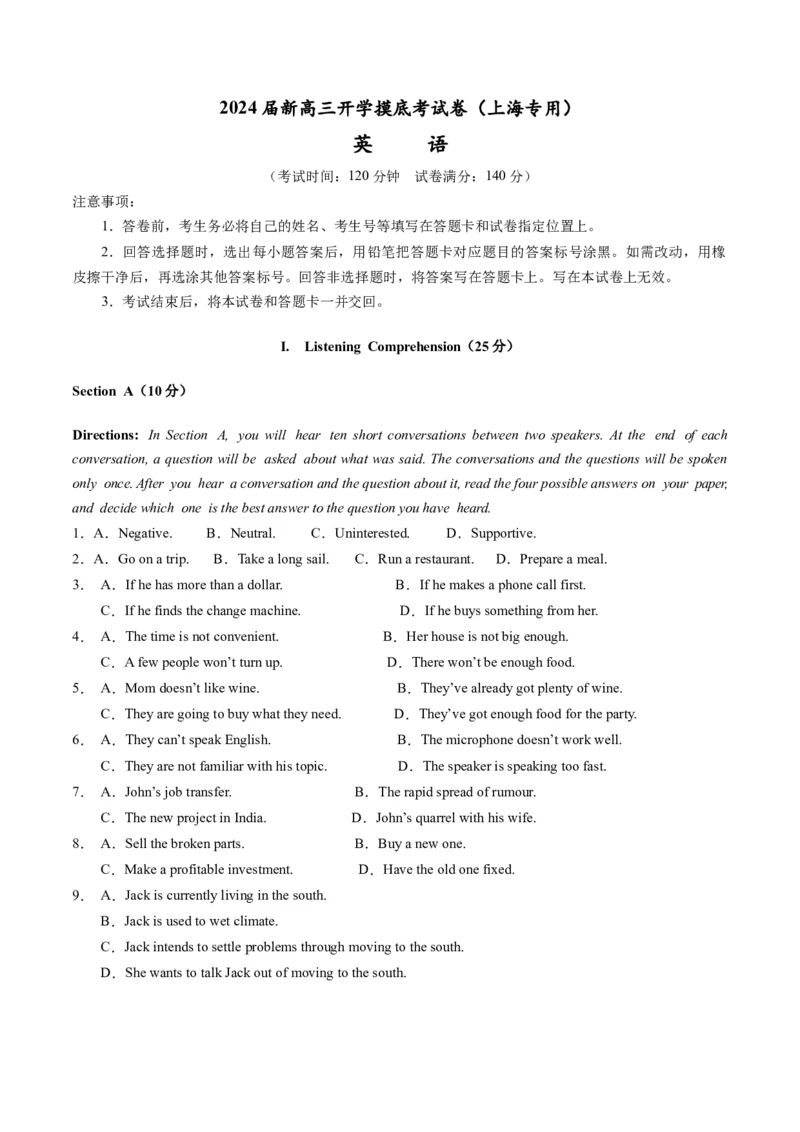
I. Listening Comprehension(25分)
Section A(10分)
Directions: In Section A, you will hear ten short conversations between two speakers. At the end of each
conversation, a question will be asked about what was said. The conversations and the questions will be spoken
only once. After you hear a conversation and the question about it, read the four possible answers on your paper,
and decide which one is the best answer to the question you have heard.
1.A.Negative. B.Neutral. C.Uninterested. D.Supportive.
2.A.Go on a trip. B.Take a long sail. C.Run a restaurant. D.Prepare a meal.
3. A.If he has more than a dollar. B.If he makes a phone call first.
C.If he finds the change machine. D.If he buys something from her.
4. A.The time is not convenient. B.Her house is not big enough.
C.A few people won’t turn up. D.There won’t be enough food.
5. A.Mom doesn’t like wine. B.They’ve already got plenty of wine.
C.They are going to buy what they need. D.They’ve got enough food for the party.
6. A.They can’t speak English. B.The microphone doesn’t work well.
C.They are not familiar with his topic. D.The speaker is speaking too fast.
7. A.John’s job transfer. B.The rapid spread of rumour.
C.The new project in India. D.John’s quarrel with his wife.
8. A.Sell the broken parts. B.Buy a new one.
C.Make a profitable investment. D.Have the old one fixed.
9. A.Jack is currently living in the south.
B.Jack is used to wet climate.
C.Jack intends to settle problems through moving to the south.
D.She wants to talk Jack out of moving to the south.10. A.She doesn’t mind it as the road conditions are good.
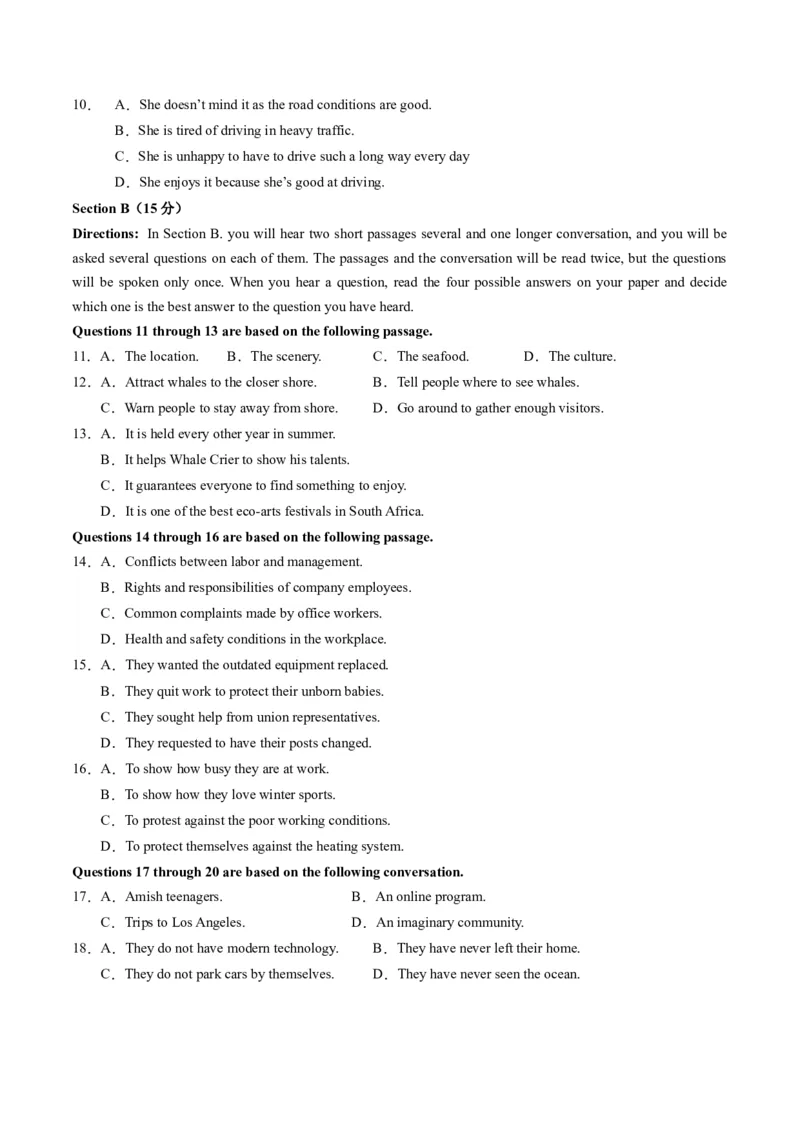
B.She is tired of driving in heavy traffic.
C.She is unhappy to have to drive such a long way every day
D.She enjoys it because she’s good at driving.
Section B(15分)
Directions: In Section B. you will hear two short passages several and one longer conversation, and you will be
asked several questions on each of them. The passages and the conversation will be read twice, but the questions
will be spoken only once. When you hear a question, read the four possible answers on your paper and decide
which one is the best answer to the question you have heard.
Questions 11 through 13 are based on the following passage.
11.A.The location. B.The scenery. C.The seafood. D.The culture.
12.A.Attract whales to the closer shore. B.Tell people where to see whales.
C.Warn people to stay away from shore. D.Go around to gather enough visitors.
13.A.It is held every other year in summer.
B.It helps Whale Crier to show his talents.
C.It guarantees everyone to find something to enjoy.
D.It is one of the best eco-arts festivals in South Africa.
Questions 14 through 16 are based on the following passage.
14.A.Conflicts between labor and management.
B.Rights and responsibilities of company employees.
C.Common complaints made by office workers.
D.Health and safety conditions in the workplace.
15.A.They wanted the outdated equipment replaced.
B.They quit work to protect their unborn babies.
C.They sought help from union representatives.
D.They requested to have their posts changed.
16.A.To show how busy they are at work.
B.To show how they love winter sports.
C.To protest against the poor working conditions.
D.To protect themselves against the heating system.
Questions 17 through 20 are based on the following conversation.
17.A.Amish teenagers. B.An online program.
C.Trips to Los Angeles. D.An imaginary community.
18.A.They do not have modern technology. B.They have never left their home.
C.They do not park cars by themselves. D.They have never seen the ocean.19.A.The modern world likes to teach children to fix machines.
B.The Amish people have no contact with the modern world.
C.The modern world does not welcome the Amish teenagers.
D.The Amish people take horses as a means of transportation.
20.A.Disappointed and sad. B.Upset but excited.
C.Annoyed and unhappy. D.Puzzled but interested.
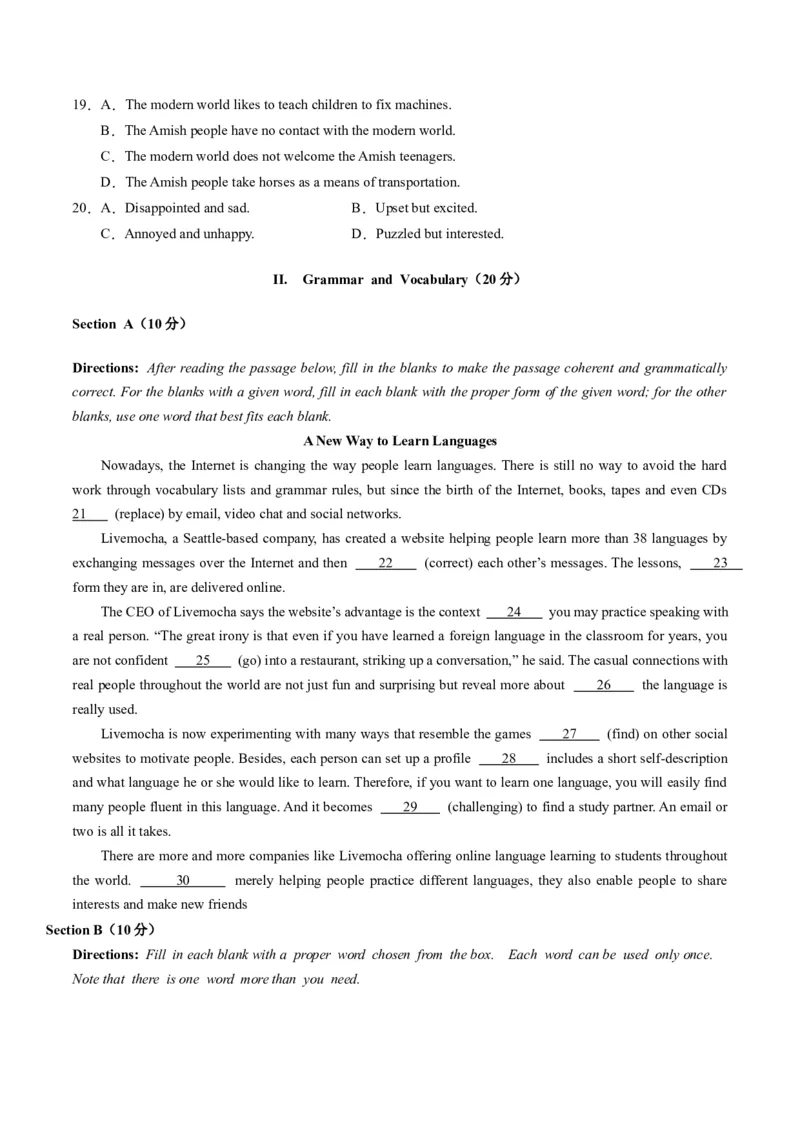
II. Grammar and Vocabulary(20分)
Section A(10分)
Directions: After reading the passage below, fill in the blanks to make the passage coherent and grammatically
correct. For the blanks with a given word, fill in each blank with the proper form of the given word; for the other
blanks, use one word that best fits each blank.
A New Way to Learn Languages
Nowadays, the Internet is changing the way people learn languages. There is still no way to avoid the hard
work through vocabulary lists and grammar rules, but since the birth of the Internet, books, tapes and even CDs
21 (replace) by email, video chat and social networks.
Livemocha, a Seattle-based company, has created a website helping people learn more than 38 languages by
exchanging messages over the Internet and then 22 (correct) each other’s messages. The lessons, 23
form they are in, are delivered online.
The CEO of Livemocha says the website’s advantage is the context 24 you may practice speaking with
a real person. “The great irony is that even if you have learned a foreign language in the classroom for years, you
are not confident 25 (go) into a restaurant, striking up a conversation,” he said. The casual connections with
real people throughout the world are not just fun and surprising but reveal more about 26 the language is
really used.
Livemocha is now experimenting with many ways that resemble the games 27 (find) on other social
websites to motivate people. Besides, each person can set up a profile 28 includes a short self-description
and what language he or she would like to learn. Therefore, if you want to learn one language, you will easily find
many people fluent in this language. And it becomes 29 (challenging) to find a study partner. An email or
two is all it takes.
There are more and more companies like Livemocha offering online language learning to students throughout
the world. 30 merely helping people practice different languages, they also enable people to share
interests and make new friends
Section B(10分)
Directions: Fill in each blank with a proper word chosen from the box. Each word can be used only once.
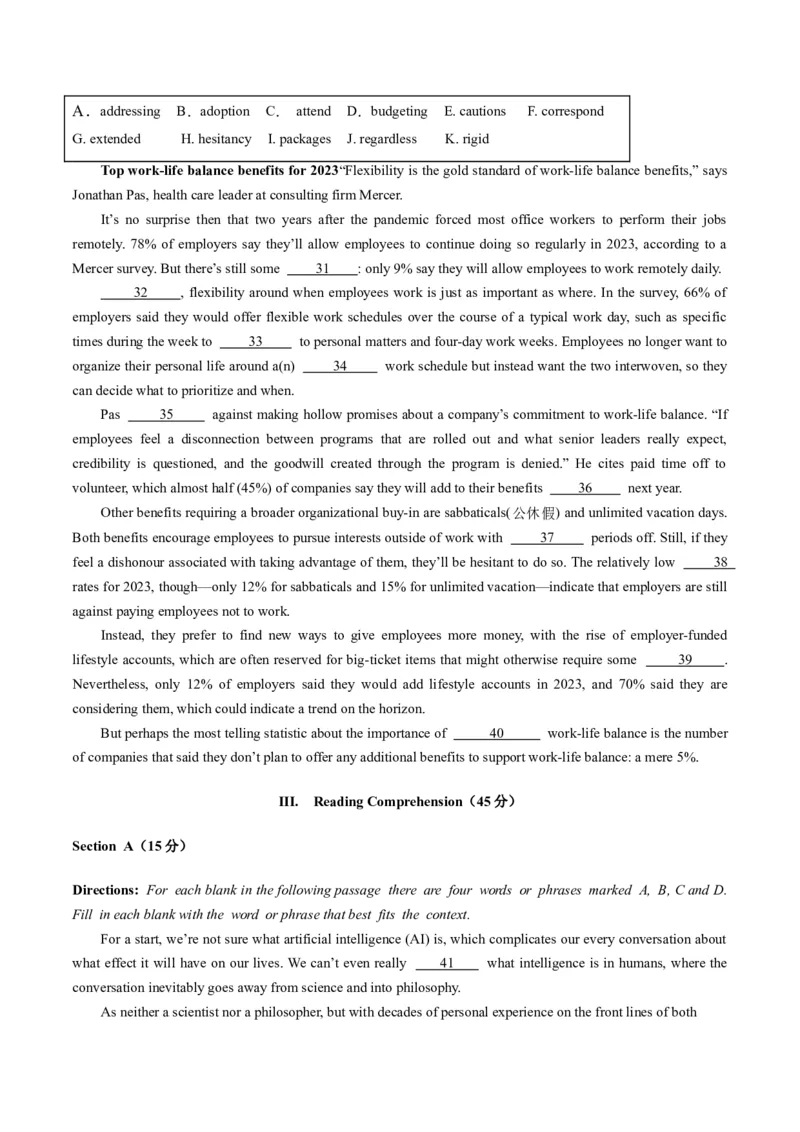
Note that there is one word more than you need.A.addressing B.adoption C. attend D.budgeting E. cautions F. correspond
G. extended H. hesitancy I. packages J. regardless K. rigid
Top work-life balance benefits for 2023“Flexibility is the gold standard of work-life balance benefits,” says
Jonathan Pas, health care leader at consulting firm Mercer.
It’s no surprise then that two years after the pandemic forced most office workers to perform their jobs
remotely. 78% of employers say they’ll allow employees to continue doing so regularly in 2023, according to a
Mercer survey. But there’s still some 31 : only 9% say they will allow employees to work remotely daily.
32 , flexibility around when employees work is just as important as where. In the survey, 66% of
employers said they would offer flexible work schedules over the course of a typical work day, such as specific
times during the week to 33 to personal matters and four-day work weeks. Employees no longer want to
organize their personal life around a(n) 34 work schedule but instead want the two interwoven, so they
can decide what to prioritize and when.
Pas 35 against making hollow promises about a company’s commitment to work-life balance. “If
employees feel a disconnection between programs that are rolled out and what senior leaders really expect,
credibility is questioned, and the goodwill created through the program is denied.” He cites paid time off to
volunteer, which almost half (45%) of companies say they will add to their benefits 36 next year.
Other benefits requiring a broader organizational buy-in are sabbaticals(公休假) and unlimited vacation days.
Both benefits encourage employees to pursue interests outside of work with 37 periods off. Still, if they
feel a dishonour associated with taking advantage of them, they’ll be hesitant to do so. The relatively low 38
rates for 2023, though—only 12% for sabbaticals and 15% for unlimited vacation—indicate that employers are still
against paying employees not to work.
Instead, they prefer to find new ways to give employees more money, with the rise of employer-funded
lifestyle accounts, which are often reserved for big-ticket items that might otherwise require some 39 .
Nevertheless, only 12% of employers said they would add lifestyle accounts in 2023, and 70% said they are
considering them, which could indicate a trend on the horizon.
But perhaps the most telling statistic about the importance of 40 work-life balance is the number
of companies that said they don’t plan to offer any additional benefits to support work-life balance: a mere 5%.
III. Reading Comprehension(45分)
Section A(15分)
Directions: For each blank in the following passage there are four words or phrases marked A, B, C and D.
Fill in each blank with the word or phrase that best fits the context.
For a start, we’re not sure what artificial intelligence (AI) is, which complicates our every conversation about
what effect it will have on our lives. We can’t even really 41 what intelligence is in humans, where the
conversation inevitably goes away from science and into philosophy.
As neither a scientist nor a philosopher, but with decades of personal experience on the front lines of bothhuman and machine cognition (认知), I prefer to focus on the 42 . AI will be the greatest technological
advance since the Internet turned the world into a living stream of data. It will eventually be more 43 than
the Internet, changing every part of our lives in seen and unseen ways. And it’s already 44 .
From medical diagnosis to investment banking, from hiring staff to educating our children, these increasingly
45 systems are changing the world. Whether you find this terrifying or wonderful is important, because public
46 drives education, investment, and regulation, making the outcome a type of self-fulfilling promise. 47
, if people find the rapid advance of intelligent machines terrifying instead of wonderful, it won’t stop it, but it
could make the outcome much worse. Powerful new technology nearly always causes distress before producing
broad benefits. By slowing down our progress out of unreasoning 48 , we lengthen the distress stage by
delaying the next waves of breakthroughs needed to produce the broader benefits.
There are real and immediate 49 about the increase in intelligent machines, especially autonomous
ones. Rising inequality if automation hits lower-income people harder, personal data being used improperly by
companies… None of these issues come anywhere close to an existential threat – the killer robots of Hollywood or
the super-intelligent AI that sees no reason to 50 . It’s as if everyone were curious about how we might all
one day be killed by robots.
As a member of the executive board of the Foundation for Responsible Robotics and as a security ambassador
for Avast Software, I’ve become all too 51 the real threats we may be faced with due to these AI-enhanced
machines. And I’m glad that great minds like Stephen Hawking and Elon Musk are voicing their concerns, and that
top AI authorities like Nick Bostrom are mapping out the 52 possibilities. After all, we live with nuclear
power that could literally destroy the planet, and we certainly want it to be monitored and used 53 .
But like all our inventions, AI is capable of being used for good or evil. 54 matters, and so making
better humans will always be more important than making smarter machines. Above all, we must keep 55 ,
because the only solution for the problems caused by today’s technology is tomorrow’s.
41.A.tell apart B.disapprove of C.glance at D.agree on
42.A.theoretical B.practical C.physical D.mental
43.A.specialized B.transformative C.predictable D.irrelevant
44.A.happening B.misleading C.worsening D.changing
45.A.intense B.annoying C.capable D.simple
46.A.health B.image C.service D.opinion
47.A.In short B.What’s more C.That is D.As a result
48.A.fear B.deed C.manner D.passion
49.A.rumors B.remarks C.mysteries D.concerns
50.A.take humans in B.keep humans around C.give humans up D.put humans away
51.A.familiar with B.ignorant of C.superior to D.unhappy about
52.A.newest B.best C.oldest D.worst
53.A.occasionally B.responsibly C.immediately D.genuinely
54.A.Technology B.Morality C.Intelligence D.Automation55.A.moving forward B.looking upon C.calming down D.running away
Section B(22分)
Directions: Read the following three passages. Each passage is followed by several questions or unfinished
statements. For each of them there are four choices marked A, B, C and D. Choose the one that fits best according
to the information given in the passage you have just read.
A
Eight steps to refocus your anxiety
Thinking of issues that seem unfixable can lead to an anxious paralysis, but there’s hope.
This is some of the advice I give to those in need of help.
Take a break from the news. Doomscrolling can be addictive and increase the tragic nature of events. In one
study, researchers found that those who were immersed in the Boston Marathon bombing news for multiple hours a
day in the week after the event experienced higher stress than individuals who were on the scene. I advise those
who are feeling depressed by the headlines to read the news just once a day, turn off alerts on their phone and, if
possible, check social media less often.
Take care of yourself. You have to be in good fighting shape to cope with the current problems. That means
boosting your resilience (韧性) by taking care of your nervous system (sleep well, eat well, exercise wisely) and
engaging in positive activities.
Focus on the present. Get in the habit of putting yourself in the here and now. Worrying about the future is
not helpful.
Try a breathing exercise. Taking a few deep breaths — for instance, breathing in into the count of five and
breathing out to the count of five — will help calm your sympathetic nervous system (the fight or flight response)
and lower your anxiety. At the very least, breathing gives you something to do when your feel your heart rate
pounding quickly.
Think about your victories. Remind yourself of what’s working well in your own life — whether it’s your
job, friendships, or the array of houseplants you cultivated during the pandemic.
Be your own therapist. Ask yourself, what do I specifically feel hopeless about and why? Being able to put
into words what’s getting you down can help you feel less flooded by emotions and better able to process the
information rationally(理性地).
Take action. Worrying doesn’t help one’s mental health, but taking action does. Look around your
community. Maybe your local playground would benefit from a basketball court, or your church could sponsor a
refugee family. When people engage in local issues, they have a renewed sense of optimism.
Join forces with a friend. Pick a cause. There are hundreds of nonprofits dedicated to addressing some of the
most biggest challenges on the planet. Donate money to an inspiring organization or volunteer.
56.What’s the purpose of writing this passage?
A.To encourage people to help those in need.
B.To help those in need of help relieve anxiety.
C.To urge people to take action to help themselves.D.To cheer readers up and boost a feeling of optimism.
57.What does the underlined part of the sentence mean?
A.“stopping moving and staying where you are” B.“focusing on the present moment”
C.“placing yourself in a favorable environment” D.“forgetting about the losses and gains”
58.Which of the following statements is in line with the author’s advice?
A.Only check social media once a day.
B.Involve oneself in activities that boost one’s nervous system.
C.Think of the past victories.
D.Engage in local issues and make contributions.
B
Ask the new artificial intelligence (AI) tool ChatGPT to write an essay about the cause of the American Civil
War and you can watch it produce a persuasive term paper in a matter of seconds that has even be enable to pass
school exams. That’s one reason why New York City school officials this week started blocking the impressive but
controversial writing tool that can generate paragraphs of human-like text. The free tool has been around for just
five weeks but is already raising tough questions about the future of AI in education, the tech industry and a host of
professions.
ChatGPT was launched on Nov. 30 and is part of a new generation of AI systems that can chat, generate
readable text on demand and even produce novel images and video based on what they’ve learned from a vast
database of digital books, online writings and other media. But unlike previous models of so-called “large language
models”, such as Open AI’s GPT-3, launched in 2020, the ChatGPT tool is available to anyone with an Internet
connection for free and designed to be more user-friendly. It works like a written dialogue between the AI system
and the person asking it questions.
Millions of people have played with it over the past month, using it to write silly poems or songs, trying to
trick it into making mistakes, or for more practical purposes such as helping compose an email.
As with similar systems, ChatGPT can generate convincing prose, but that doesn't mean what it says is factual
or logical. Its launch came with little guidance on how to use it, other than a promise that ChatGPT will admit when
it's wrong.
Many school districts are still struggling to figure out how to set policies on whether and how it can be used.
“While the tool may be able to provide quick and easy answers to questions, it does not build critical-thinking and
problem-solving skills, which are essential for academic and lifelong success,” said a school’s spokesperson Jenna
Lyle from NYC. But there's no stopping a student from accessing ChatGPT from a personal phone or computer
at home.
59.What can we learn about the term paper from paragraph 1?
A.It is a result of the improvement of education.
B.It can be rated as passing by schoolteachers.
C.It has caught the attention of the public.
D.It acts as a model for students to follow.60.What makes Chat GPT different from GPT-3?
A.ChatGPT can create text. B.ChatGPT can edit digital books.
C.ChatGPT is free of charge to all. D.ChatGPT can ask its users questions.
61.What is Jenna's attitude towards students’ use of Chat GPT?
A.Favourable. B.Tolerant. C.Uncaring. D.Disapproving.
62.What is the best title for the text?
A.How Are Schools Handling Chat GPT?
B.You Can Check When ChatGPT’s Telling the Truth
C.What Is ChatGPT and Why Are Schools Blocking It?
D.Students Are Using ChatGPT to Do Their Homework
C
The latest bad but unsurprising news on education is that reading and writing scores on the SAT have once
again declined. The language competence of our high schoolers fell steeply in the 1970s and has never recovered.
This is very worrisome, because the best single measure of the overall quality of our primary and secondary schools
is the average verbal(语言的) score of 17-year-olds. This score correlates with the ability to learn new things
readily, to communicate with others and to secure a job. It also predicts future income.
The most credible analyses have shown that the chief causes are vast curricular changes, especially in the
critical early grades. In the decades before the Great Verbal Decline, a content-rich elementary school experience
evolved into a content-light, skills-based, test-centered approach. Cognitive psychologists agree that early
childhood language learning (ages 2 to 10) is critical to later verbal competence, not just because of the remarkable
linguistic plasticity of young minds, but also because of the so-called Matthew Effect.
The name comes from a passage in the Bible: “For unto every one that hath shall be given, and he shall have
abundance: but from him that hath not shall be taken away even that which he hath.” Those who are language-poor
in early childhood get relatively poorer, and fall further behind, while the verbally rich get richer.
The origin of this cruel truth lies in the nature of word learning. The more words you already know, the faster
you acquire new words. This sounds like an invitation to vocabulary study for babies, but that’s been tried and it’s
not effective. Most of the word meanings we know are acquired indirectly, by intuitively(凭直觉的) guessing new
meanings as we understand the main idea of what we are hearing or reading. The Matthew Effect in language can
be restated this way: “To those who understand the main idea shall be given new word meanings, but to those who
do not there shall follow boredom and frustration.”
Clearly the key is to make sure that from kindergarten on, every student, from the start, understands the main
idea of what is heard or read. If preschoolers and kindergartners are offered substantial and coherent lessons
concerning the human and natural worlds, then the results show up five years or so later in significantly improved
verbal scores. By staying on a subject long enough to make all young children familiar with it (say, two weeks or
so), the main idea becomes understood by all and word learning speeds up. This is especially important for low-
income children, who come to school with smaller vocabularies and rely on school to pass on the knowledge base
children from rich families take for granted.Current reform strategies focus on testing, improving teacher quality, and other changes. Attention to these
structural issues has led to improvements in the best public schools. But it is not enough.
63.The drop in verbal scores on the SAT is worrisome because ________.
A.it will lead to a short supply of talents in the labor market
B.it reveals young people’s negative attitude towards verbal study
C.it shows the schools’ inability to meet the national requirements
D.students’ reading and writing ability affects their future development
64.Which of the following is the reason for the falling verbal competence?
A.Children’s lack of language learning ability.
B.Fewer courses on reading and writing in school.
C.The shift of curricular focus from content to skills.
D.Heavy pressure that numerous tests have resulted in.
65.The implication of Mathew Effect in language is that ________.
A.children should be trained to understand the content
B.teachers should focus on one topic in language teaching
C.children’s family background determines their verbal ability
D.teachers should make everything understandable for students
66.Which of the following is the best title for the text?
A.Mathew Effect in Language Learning B.How to Stop the Drop in Verbal Scores
C.Try to Understand the Main Idea D.Don’t Overestimate Your Verbal Scores
Section C(8分)
Directions: Read the following passages. Fill in each blank with a proper sentence given in the box. Each
sentence can be used only once. Note that there are two more sentences than you need.
How to support a struggling friend
We’ve all been in situations like this, both big and small and everything in between: from missing the bus to
work to struggling with the loss of a loved one. Common wisdom suggests that a problem shared is a problem
halved. We really want to help, yet we don’t quite have the words or the tactics.
Research shows that many people don’t really know what works best to help their friends effectively. 67
A survey of the methods that people used to manage their friends’ emotions identified 378 distinct strategies. Given
this large variety of strategies, it’s no wonder that deciding what to do when you have a friend in tears can be a little
challenging.
The good news is that there are simple strategies you can learn that will help you provide more effective
support to your friends.
Ask questions and really listen
Just as playing down a friend’s problem is unwise, so is trying to empathize too quickly. While this impulse isunderstandable and quite normal, it is also likely to go wrong. 68 So how might you best address
the situation instead? A recent research suggests that it would be better to slow down and start by asking directly
how your friend is feeling, rather than thinking about how you might feel in a similar situation.
A related technique to try is active listening, which is commonly used by therapists, and relatively simple to
implement. 69 For example, your friend might spend some time explaining a series of stressful events
across their week, describing arguments with their spouse, a mounting workload and some worries about debt, and
you might respond by saying that it sounds like they are overwhelmed both at home and at work right now.
Don’t take charge
If your support is too directive and take-charge, it might make your friends feel like they aren’t able to handle
things on their own, like a kid who needs their parent’s help to manage their problems.
Instead, it would have been better to ask them what they want, and how they might be able to change this
situation, and then listen to them talk through their options one by one. In doing this, you provide a sounding board
for them to take control of the situation on their own. 70 This will help them organise their thoughts and
come to some solutions, without feeling like you did it for them.
A.One useful skill is to paraphrase what your friend is saying in your own words.
B.A friend who is going through hardship may benefit from a helpful gesture.
C.Part of the challenge is that there are just so many possible ways to intervene.
D.It’s important not to put too much pressure on your friend to talk.
E.Research has shown that we’re actually really bad at taking other people’s perspectives.
F.Your aim should be to facilitate the other person’s choices, rather than dominating them.
IV. Summary Writing(10分)
Directions: Read the following passage. Summarize the main idea and the main point(s) of the passage in no more
than 60 words. Use your own words as far as possible.
Click to download teacher
“Books will soon disappear in schools,” Thomas Edison announced in 1913: they would, he believed, soon be
replaced by silent films. Each new wave of information technology - radio, television, computers - has led to
similar predictions.
Like teachers, digital educational technology comes in many forms, from wonderful to awful. But, used
properly, it now deserves more prominence (重要性) in schools - especially in poor countries where human
teachers are often ignorant, absent or both.
According to a recent World Bank study of seven sub - Saharan African countries, half of nine - year - olds
cannot read a simple word and three - quarters cannot read a simple sentence. The reason is terrible. The same
study found that only 7% of teachers had the minimum knowledge needed to teach reading and writing effectively.
When classrooms were inspected to see whether a teacher was present, half the time the answer was no. As for the
absence of teachers, if expensive teachers do not turn up to class, government would, surely, fire them? Easier said
than done. Poor governments often lack the money to check on teachers in distant villages.Several recent studies suggested - tech can help. It seems to bring about bigger improvements in poor
countries than in rich ones. Some of the scarce resources being spent on teachers could therefore be better spent on
ed - tech. That does not mean dumping computers on schools in the hope that children will understand how to use
them. Instead, it means providing schools with software that children can use with minimal help from an adult, that
sends teachers prompts about what they are supposed to be teaching and that allows the authorities to check on
whether the teacher is in the classroom.
Technology is no cure - all. Good traditional teachers are not outdated, and are never likely to be. And
authorities need to hold teachers to account. But ed - tech can help greatly - by monitoring pupils and teachers
alike, assisting the best teachers and, most important, making up for the failings of the worst.
________________________________________________________________________________________
____________________________________________________________________________________________
____________________________________________________________________________________________
____________________________________________________________________________________________
____________________________________________________________________________________________
V. Translation(15分)
Directions: Translate the following sentences into English, using the words given in the brackets.
72.(3分)在教练的帮助下,他刻苦训练,保持自律,最终获得成功,这使队友们对他刮目相看。(end
up)
______________________________________________________________________________________________________
______________________________________________________________________________________________________
73.(3分)所幸政府已经实施了“双减”政策来解决教育的内卷问题。(address)
______________________________________________________________________________________________________
______________________________________________________________________________________________________
74.(4分)除了强身健体之外,体育运动还是保持神清气爽的最佳途径。(strengthen)
______________________________________________________________________________________________________
______________________________________________________________________________________________________
75.(5分)世上没有后悔药,你应该学会的是不念过往,不负当下,不畏将来。(use)
______________________________________________________________________________________________________
______________________________________________________________________________________________________
VI. Guided Writing(25分)
Directions: Write an English composition in 120-150 words according to the instructions given below in Chinese.
假设你是明启中学学生李华,你校英语广播站计划在每周五中午开设名为“Talk and Talk”的栏目,目
前正在招募主持人。请给广播站负责人Mr. Li写一封信,应聘这一岗位。信中需包含以下内容:
1) 应聘的理由;
2) 专栏内容的策划。
Dear Mr. Li,________________________________________________________________________________________
____________________________________________________________________________________________
____________________________________________________________________________________________
____________________________________________________________________________________________
____________________________________________________________________________________________
____________________________________________________________________________________________
____________________________________________________________________________________________
Yours sincerely,
Li Hua公众号:高中试卷君