Numerical Test 8
Solutions Booklet
Instructions
This numerical reasoning test comprises 30 questions, and you will have 30 minutes in
which to correctly answer as many as you can. Calculators are permitted for this test, and it is
recommended you have some rough paper to work on.
You will have to work quickly and accurately to perform well in this test. If you don't know the
answer to a question, leave it and come back to it if you have time. Each question will have
five possible answers, one of which is correct. You may click Back and Next during the test to
review or skip questions.
You can submit your test at any time. If the time limit is up before you click submit the test will
automatically be submitted with the answers you have selected. It is recommended to keep
working until the time limit is up.
Try to find a time and place where you will not be interrupted during the test. The test will
begin on the next page.
AssessmentDay
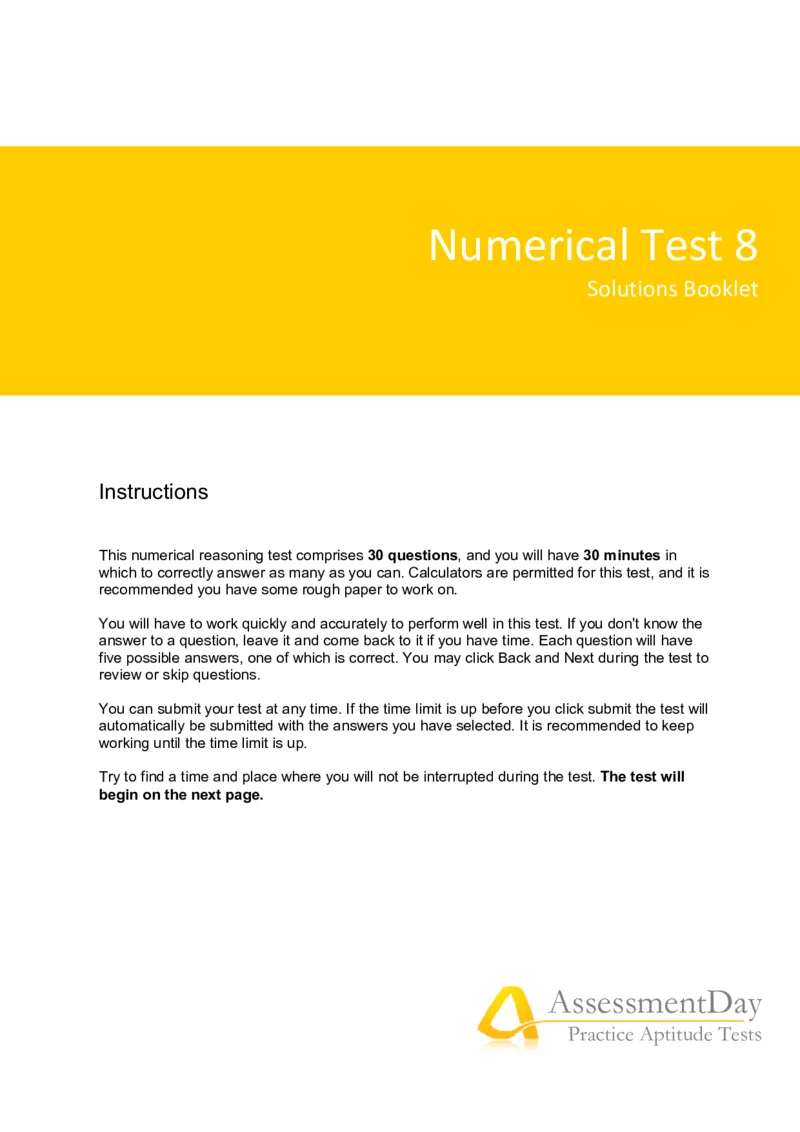
Practice Aptitude TestsQ1 What was a Japanese Yen worth in Euros in Week 3?
(A) €0.01
(B) €0.05
(C) €0.10
(D) €0.15
(E) €1.00
Step 1 – Convert from Yen in to £
1 = 1/134.8 = £0.00742
Step 2 – Convert from £ in to Euro
0.00742 x 1.3 = €0.01
Thus the correct answer is (A), €0.01
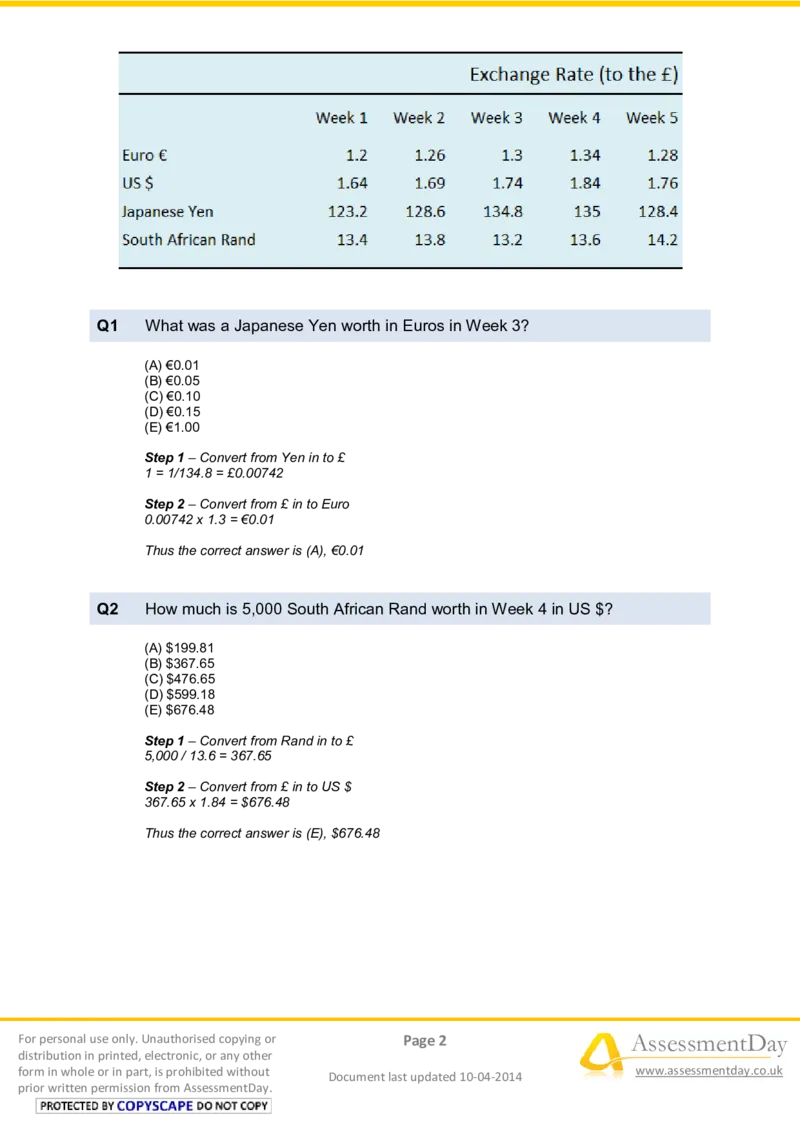
Q2 How much is 5,000 South African Rand worth in Week 4 in US $?
(A) $199.81
(B) $367.65
(C) $476.65
(D) $599.18
(E) $676.48
Step 1 – Convert from Rand in to £
5,000 / 13.6 = 367.65
Step 2 – Convert from £ in to US $
367.65 x 1.84 = $676.48
Thus the correct answer is (E), $676.48
For personal use only. Unauthorised copying or Page 2 AssessmentDay
distribution in printed, electronic, or any other
form in whole or in part, is prohibited without
Document last updated 10-04-2014
www.assessmentday.co.uk
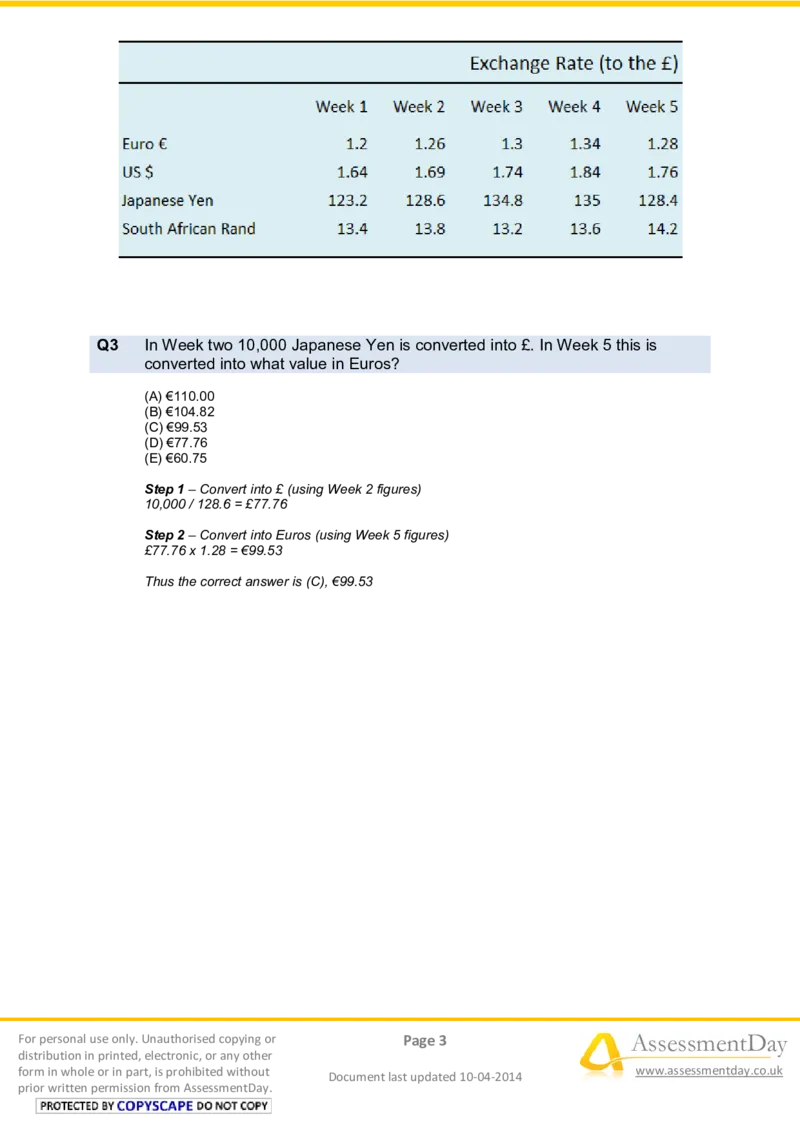
prior written permission from AssessmentDay.Q3 In Week two 10,000 Japanese Yen is converted into £. In Week 5 this is
converted into what value in Euros?
(A) €110.00
(B) €104.82
(C) €99.53
(D) €77.76
(E) €60.75
Step 1 – Convert into £ (using Week 2 figures)
10,000 / 128.6 = £77.76
Step 2 – Convert into Euros (using Week 5 figures)
£77.76 x 1.28 = €99.53
Thus the correct answer is (C), €99.53
For personal use only. Unauthorised copying or Page 3 AssessmentDay
distribution in printed, electronic, or any other
form in whole or in part, is prohibited without
Document last updated 10-04-2014
www.assessmentday.co.uk
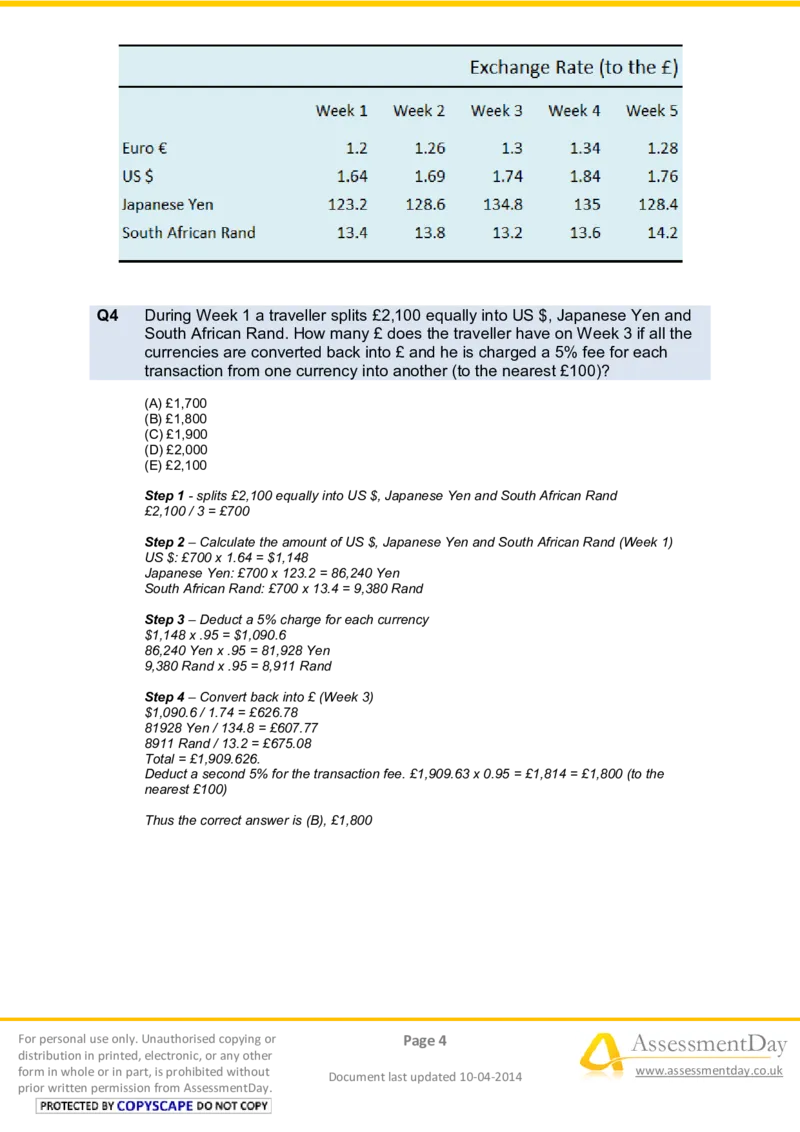
prior written permission from AssessmentDay.Q4 During Week 1 a traveller splits £2,100 equally into US $, Japanese Yen and
South African Rand. How many £ does the traveller have on Week 3 if all the
currencies are converted back into £ and he is charged a 5% fee for each
transaction from one currency into another (to the nearest £100)?
(A) £1,700
(B) £1,800
(C) £1,900
(D) £2,000
(E) £2,100
Step 1 - splits £2,100 equally into US $, Japanese Yen and South African Rand
£2,100 / 3 = £700
Step 2 – Calculate the amount of US $, Japanese Yen and South African Rand (Week 1)
US $: £700 x 1.64 = $1,148
Japanese Yen: £700 x 123.2 = 86,240 Yen
South African Rand: £700 x 13.4 = 9,380 Rand
Step 3 – Deduct a 5% charge for each currency
$1,148 x .95 = $1,090.6
86,240 Yen x .95 = 81,928 Yen
9,380 Rand x .95 = 8,911 Rand
Step 4 – Convert back into £ (Week 3)
$1,090.6 / 1.74 = £626.78
81928 Yen / 134.8 = £607.77
8911 Rand / 13.2 = £675.08
Total = £1,909.626.
Deduct a second 5% for the transaction fee. £1,909.63 x 0.95 = £1,814 = £1,800 (to the
nearest £100)
Thus the correct answer is (B), £1,800
For personal use only. Unauthorised copying or Page 4 AssessmentDay
distribution in printed, electronic, or any other
form in whole or in part, is prohibited without
Document last updated 10-04-2014
www.assessmentday.co.uk
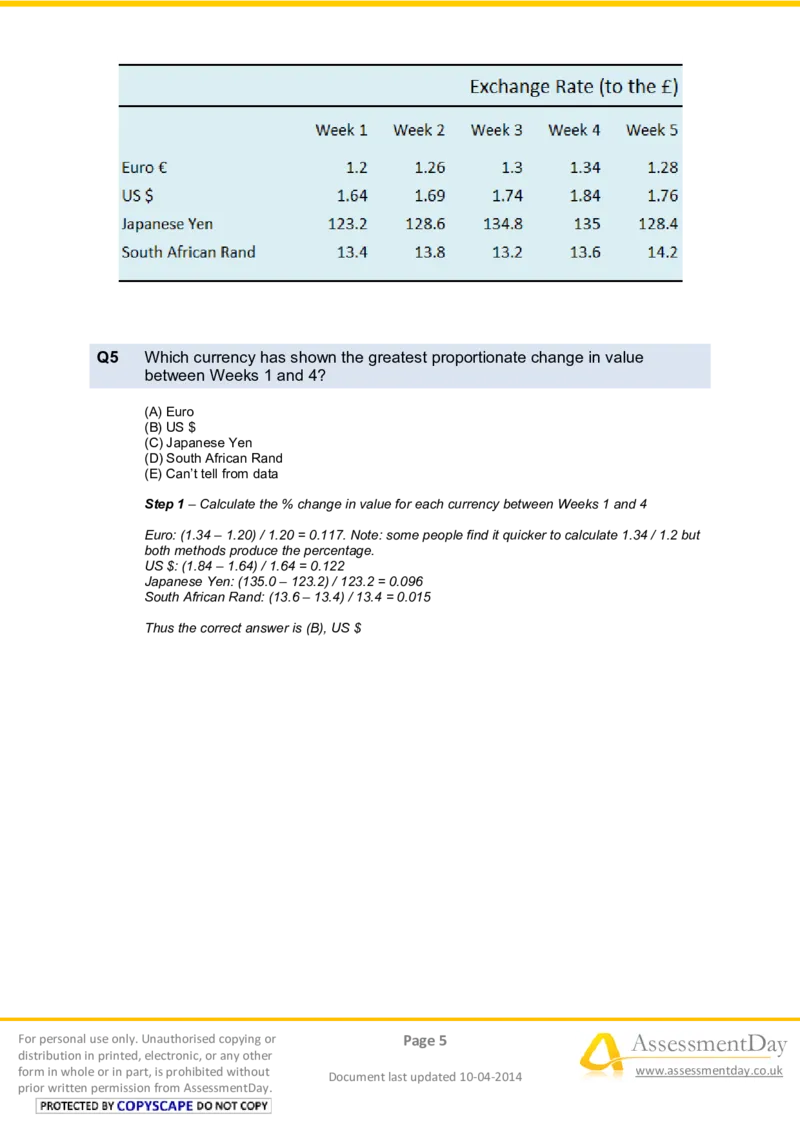
prior written permission from AssessmentDay.Q5 Which currency has shown the greatest proportionate change in value
between Weeks 1 and 4?
(A) Euro
(B) US $
(C) Japanese Yen
(D) South African Rand
(E) Can’t tell from data
Step 1 – Calculate the % change in value for each currency between Weeks 1 and 4
Euro: (1.34 – 1.20) / 1.20 = 0.117. Note: some people find it quicker to calculate 1.34 / 1.2 but
both methods produce the percentage.
US $: (1.84 – 1.64) / 1.64 = 0.122
Japanese Yen: (135.0 – 123.2) / 123.2 = 0.096
South African Rand: (13.6 – 13.4) / 13.4 = 0.015
Thus the correct answer is (B), US $
For personal use only. Unauthorised copying or Page 5 AssessmentDay
distribution in printed, electronic, or any other
form in whole or in part, is prohibited without
Document last updated 10-04-2014
www.assessmentday.co.uk
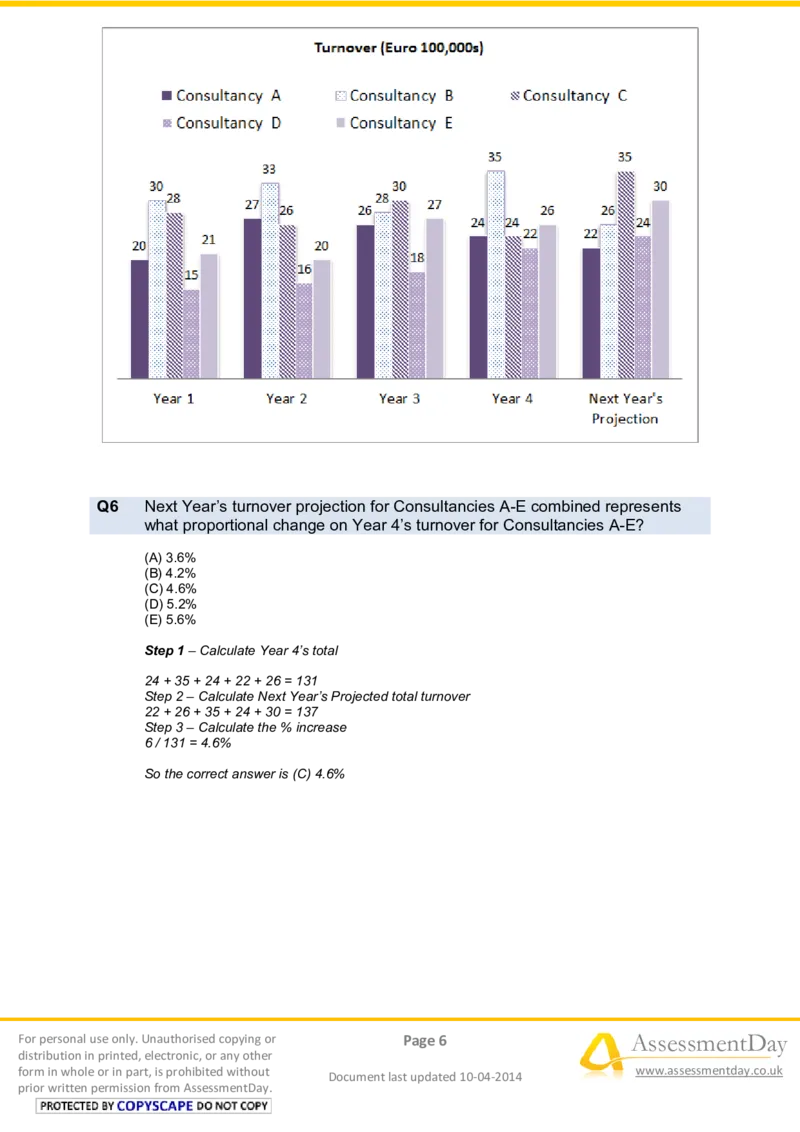
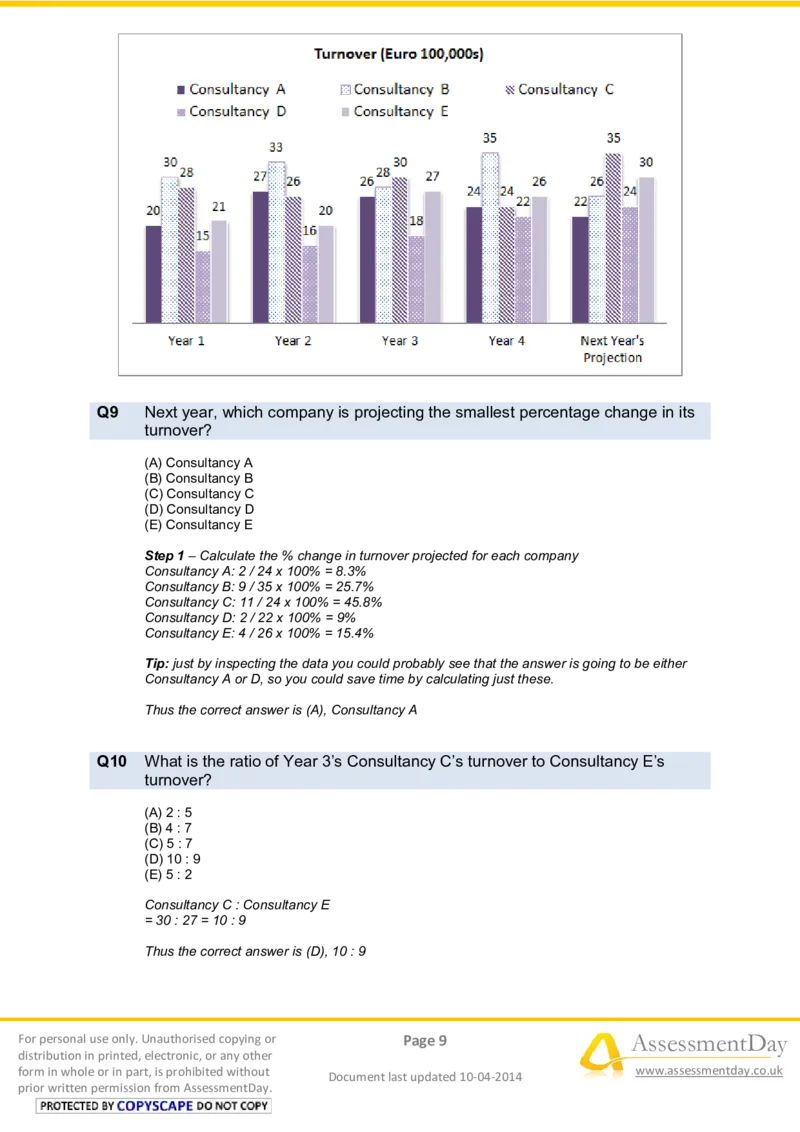
prior written permission from AssessmentDay.Q6 Next Year’s turnover projection for Consultancies A-E combined represents
what proportional change on Year 4’s turnover for Consultancies A-E?
(A) 3.6%
(B) 4.2%
(C) 4.6%
(D) 5.2%
(E) 5.6%
Step 1 – Calculate Year 4’s total
24 + 35 + 24 + 22 + 26 = 131
Step 2 – Calculate Next Year’s Projected total turnover
22 + 26 + 35 + 24 + 30 = 137
Step 3 – Calculate the % increase
6 / 131 = 4.6%
So the correct answer is (C) 4.6%
For personal use only. Unauthorised copying or Page 6 AssessmentDay
distribution in printed, electronic, or any other
form in whole or in part, is prohibited without
Document last updated 10-04-2014
www.assessmentday.co.uk
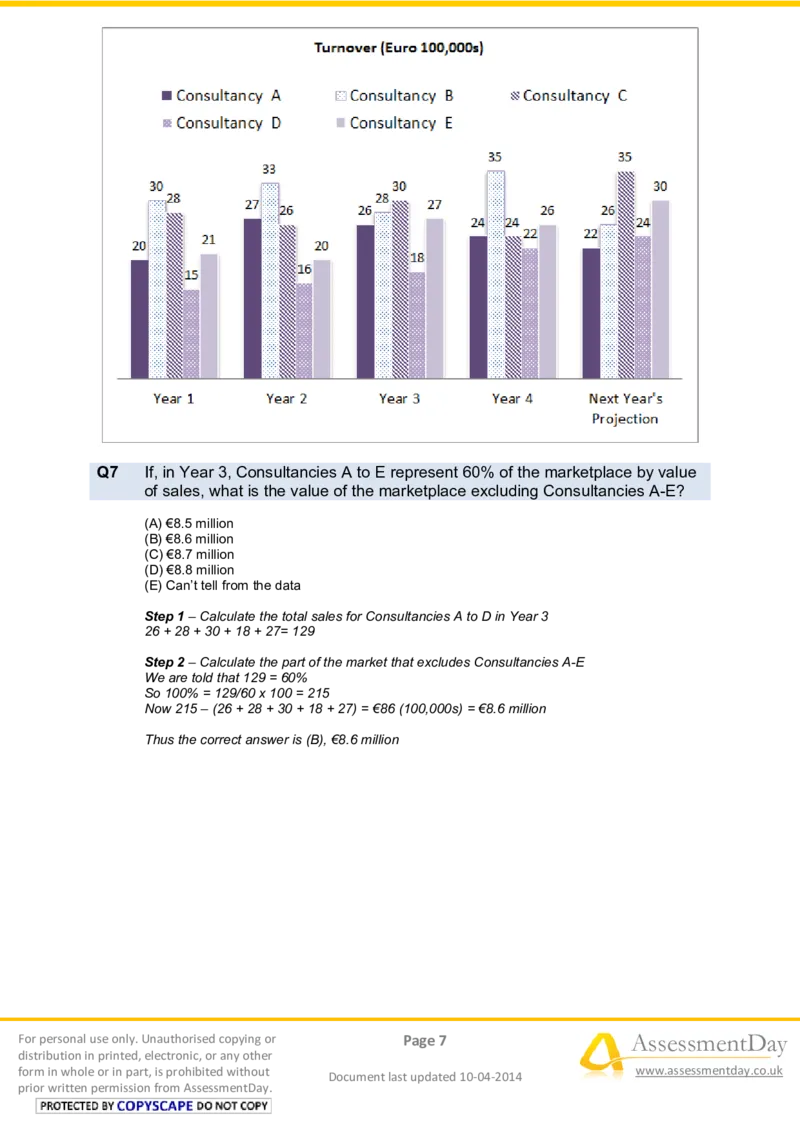
prior written permission from AssessmentDay.Q7 If, in Year 3, Consultancies A to E represent 60% of the marketplace by value
of sales, what is the value of the marketplace excluding Consultancies A-E?
(A) €8.5 million
(B) €8.6 million
(C) €8.7 million
(D) €8.8 million
(E) Can’t tell from the data
Step 1 – Calculate the total sales for Consultancies A to D in Year 3
26 + 28 + 30 + 18 + 27= 129
Step 2 – Calculate the part of the market that excludes Consultancies A-E
We are told that 129 = 60%
So 100% = 129/60 x 100 = 215
Now 215 – (26 + 28 + 30 + 18 + 27) = €86 (100,000s) = €8.6 million
Thus the correct answer is (B), €8.6 million
For personal use only. Unauthorised copying or Page 7 AssessmentDay
distribution in printed, electronic, or any other
form in whole or in part, is prohibited without
Document last updated 10-04-2014
www.assessmentday.co.uk
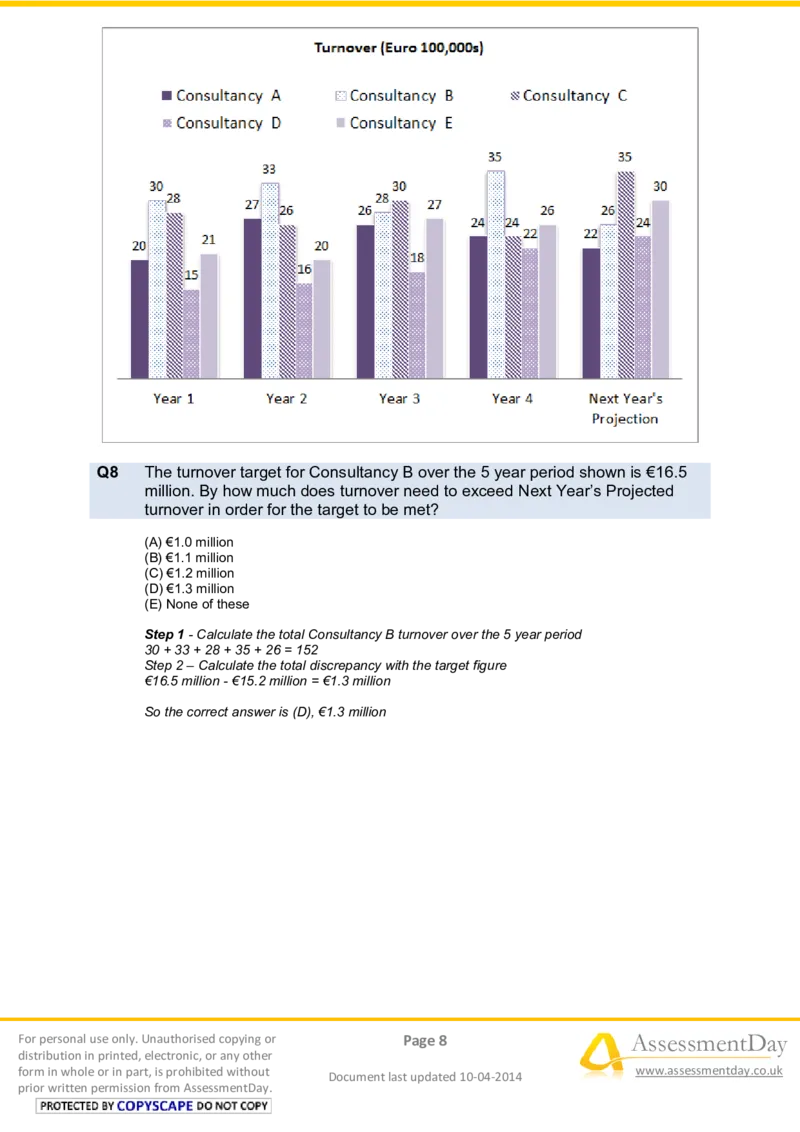
prior written permission from AssessmentDay.Q8 The turnover target for Consultancy B over the 5 year period shown is €16.5
million. By how much does turnover need to exceed Next Year’s Projected
turnover in order for the target to be met?
(A) €1.0 million
(B) €1.1 million
(C) €1.2 million
(D) €1.3 million
(E) None of these
Step 1 - Calculate the total Consultancy B turnover over the 5 year period
30 + 33 + 28 + 35 + 26 = 152
Step 2 – Calculate the total discrepancy with the target figure
€16.5 million - €15.2 million = €1.3 million
So the correct answer is (D), €1.3 million
For personal use only. Unauthorised copying or Page 8 AssessmentDay
distribution in printed, electronic, or any other
form in whole or in part, is prohibited without
Document last updated 10-04-2014
www.assessmentday.co.uk
prior written permission from AssessmentDay.Q9 Next year, which company is projecting the smallest percentage change in its
turnover?
(A) Consultancy A
(B) Consultancy B
(C) Consultancy C
(D) Consultancy D
(E) Consultancy E
Step 1 – Calculate the % change in turnover projected for each company
Consultancy A: 2 / 24 x 100% = 8.3%
Consultancy B: 9 / 35 x 100% = 25.7%
Consultancy C: 11 / 24 x 100% = 45.8%
Consultancy D: 2 / 22 x 100% = 9%
Consultancy E: 4 / 26 x 100% = 15.4%
Tip: just by inspecting the data you could probably see that the answer is going to be either
Consultancy A or D, so you could save time by calculating just these.
Thus the correct answer is (A), Consultancy A
Q10 What is the ratio of Year 3’s Consultancy C’s turnover to Consultancy E’s
turnover?
(A) 2 : 5
(B) 4 : 7
(C) 5 : 7
(D) 10 : 9
(E) 5 : 2
Consultancy C : Consultancy E
= 30 : 27 = 10 : 9
Thus the correct answer is (D), 10 : 9
For personal use only. Unauthorised copying or Page 9 AssessmentDay
distribution in printed, electronic, or any other
form in whole or in part, is prohibited without
Document last updated 10-04-2014
www.assessmentday.co.uk
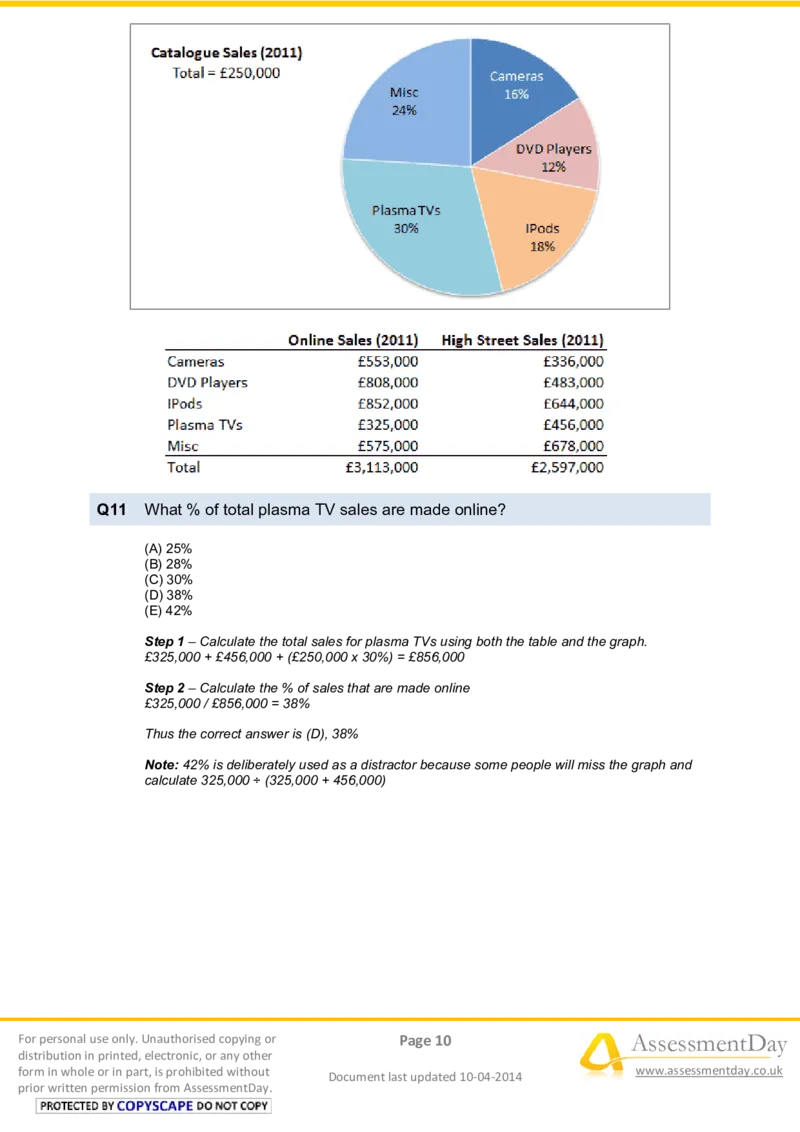
prior written permission from AssessmentDay.Q11 What % of total plasma TV sales are made online?
(A) 25%
(B) 28%
(C) 30%
(D) 38%
(E) 42%
Step 1 – Calculate the total sales for plasma TVs using both the table and the graph.
£325,000 + £456,000 + (£250,000 x 30%) = £856,000
Step 2 – Calculate the % of sales that are made online
£325,000 / £856,000 = 38%
Thus the correct answer is (D), 38%
Note: 42% is deliberately used as a distractor because some people will miss the graph and
calculate 325,000 ÷ (325,000 + 456,000)
For personal use only. Unauthorised copying or Page 10 AssessmentDay
distribution in printed, electronic, or any other
form in whole or in part, is prohibited without
Document last updated 10-04-2014
www.assessmentday.co.uk
prior written permission from AssessmentDay.Q12 What is the difference in value between total sales for IPods compared to
cameras?
(A) £912,000
(B) £812,000
(C) £712,000
(D) £612,000
(E) £512,000
Step 1 – Calculate the total sales for IPods
£852,000 + £644,000 + (18% x £250,000) = £1,541,000
Step 2 – Calculate the total sales for cameras
£336,000 + £553,000 + (16% x £250,000) = £929,000
Step 3 – Calculate the difference
£1,541,000 - £929,000 = £612,000
Thus the correct answer is (D), £612,000
For personal use only. Unauthorised copying or Page 11 AssessmentDay
distribution in printed, electronic, or any other
form in whole or in part, is prohibited without
Document last updated 10-04-2014
www.assessmentday.co.uk
prior written permission from AssessmentDay.Q13 If the High Street and Catalogue sales of DVD Players had been made online,
what % of total Online sales would DVD Players represent?
(A) 28%
(B) 30%
(C) 32%
(D) 34%
(E) 36%
Step 1 – Calculate the value of catalogue sales of DVDs
£250,000 x 12% = £30,000
Step 2 – Sum the High Street and catalogue sales of DVD players
£30,000 + £483,000 = £513,000
Step 3 – Calculate the % of DVD player sales that are online
£808,000 + £513,000 / (£852,000 + £808,000 + £513,000 + £553,000 + £325,000 +
£575,000)
= £1,321,000 / £3,626,000
Thus the correct answer is (E), 36%
For personal use only. Unauthorised copying or Page 12 AssessmentDay
distribution in printed, electronic, or any other
form in whole or in part, is prohibited without
Document last updated 10-04-2014
www.assessmentday.co.uk
prior written permission from AssessmentDay.Q14 In 2012 total Catalogue sales are forecast to increase by 1/4, total Online
sales to increase by a 1/5th, and High Street sales to decrease by 12%. What
will be the 2012 sales for Catalogue, Online and High Street combined (to the
nearest £1,000)?
(A) £5,597,000
(B) £6,285,000
(C) £6,333,000
(D) £6,433,000
(E) £6,613,000
Step 1 – Calculate the total 2011 sales (Online and for the High Street)
Online: £852,000 + £808,000 + £553,000 + £325,000 + £575,000 = £3,113,000
High Street: £644,000 + £483,000 + £336,000 + £456,000 + £678,000 = £2,597,000
Step 2 – Calculate the total 2012 sales (Online and for the High Street)
Online: £3,113,000 x 1.2 = £3,735,600
High Street: £2,597,000 x 88% = £2,285,360
Step 3 – Calculate the total 2012 sales (Catalogue)
£250,000 x 1.25 = £312,500
Step 4 – Sum the total January sales (Online, Catalogue and High Street)
£3,735,600 + £2,285,360 + £312,500 = £6,333,460
= £6,333,000 (to the nearest £1,000)
Thus the correct answer is (C), £6,333,000
For personal use only. Unauthorised copying or Page 13 AssessmentDay
distribution in printed, electronic, or any other
form in whole or in part, is prohibited without
Document last updated 10-04-2014
www.assessmentday.co.uk
prior written permission from AssessmentDay.Q15 The profit made from selling cameras online compared to the High Street is in
the ratio 9:7, and 15% of online camera sales is profit. What is the 2011 profit
for High Street camera sales?
(A) £36,291
(B) £64,517
(C) £66,980
(D) £72,428
(E) £82,950
Step 1 – Calculate the profit for online camera sales
15% x £553,000 = £82,950
Step 2 – Calculate the profit for High Street camera sales
£82,950 x 7 / 9 = £64,517
Thus the correct answer is (B), £64,517
Tip: don’t fall for the trap of answering A) £36,291. The wording of the question is important. If
the question had said something like “the sales were split between High Street and Online in
the ratio 9:7” then you would be correct to multiply £82,950 by 7/(9+7). But the ratio is given
as one number in relation to another, so it is simply a case of multiplying by 7/9.
For personal use only. Unauthorised copying or Page 14 AssessmentDay
distribution in printed, electronic, or any other
form in whole or in part, is prohibited without
Document last updated 10-04-2014
www.assessmentday.co.uk
prior written permission from AssessmentDay.Q16 Which Department has the highest expense budget per member of staff?
(A) HR
(B) Marketing
(C) Sales
(D) IT
(E) Finance
Step 1 – Have a quick look at the data to see if this can be seen by inspection. In this case, it
is unlikely you can ‘see’ the answer before doing some number-crunching. Calculate the
expense budget per member of staff for each department.
6,500 / 3 = £2,167
16,000 / 6 = £2,667
22,500 / 12 = £1,875
4,500 / 5 = £900
20,000 / 7 = £2,857
Thus the correct answer is (E), Finance
For personal use only. Unauthorised copying or Page 15 AssessmentDay
distribution in printed, electronic, or any other
form in whole or in part, is prohibited without
Document last updated 10-04-2014
www.assessmentday.co.uk
prior written permission from AssessmentDay.Q17 If the annual expense budget was evenly allocated for each Quarter, which
Department is under budget by the highest amount in Quarter 4?
(A) HR
(B) Marketing
(C) Sales
(D) Finance
(E) R&D
Step 1 – Calculate the quarterly expense budgets for each Department (excluding IT which is
not shown in the answer options)
HR: 6,500 / 4 = 1,625
Marketing: 16,000 / 4 = 4,000
Sales: 22,500 / 4 = 5,625
Finance: 20,000 / 4 = 5,000
R&D: 6,000 / 4 = 1,500
Step 2 – Compare to the Quarter 4 figures for each Dept.
HR: 1,625 – 1,346 = £279
Marketing is over budget
Sales: 5,625 – 5,245 = £380
Finance: 5,000 – 4,463 = £537
R&D is over budget
Thus the correct answer is (D), Finance
For personal use only. Unauthorised copying or Page 16 AssessmentDay
distribution in printed, electronic, or any other
form in whole or in part, is prohibited without
Document last updated 10-04-2014
www.assessmentday.co.uk
prior written permission from AssessmentDay.Q18 60% of the Sales Department’s budgets for Quarters 1 and 4 was for
attending a Sales Conference. The remainder of the budget was split equally
between accommodation and travel costs. What were the Sales Department’s
travel costs for Quarters 1 and 4 combined?
(A) £2,414
(B) £2,500
(C) £3,500
(D) £4,828
(E) Can’t tell from the data
Step 1 – Although the annual expense budget is provided, we are not told what the quarterly
expense budget is. The table provides data for the annual expense budget and the quarterly
expenses, without any mention of what the quarterly expense budget may be, since it cannot
be assumed that the annual budget is spread equally over each quarter. Therefore we cannot
accurately ascertain 60% of the quarterly budget based on the data provided.
Thus the correct answer is (E), Can’t tell from the data
Q19 The Finance Department has receipts for £14,476 of its annual expenses.
What percentage of the Finance Department’s annual expenses do not have
receipts?
(A) 5%
(B) 10%
(C) 15%
(D) 20%
(E) 25%
Step 1 – Total the Finance Department’s expenses for all 4 quarters
4,257 + 4,830 + 4,545 + 4,463 = 18,095
Step 2 – Calculate the % for which there are receipts
14,476 / 18,095 = 80%
Step 3 - Calculate the % for which there are no receipts
100 – 20 = 20%
For personal use only. Unauthorised copying or Page 17 AssessmentDay
distribution in printed, electronic, or any other
form in whole or in part, is prohibited without
Document last updated 10-04-2014
www.assessmentday.co.uk
prior written permission from AssessmentDay.Thus the correct answer is (D), 20%
Q20 If the percentage changes in expenses that each Department exhibited
between Quarters 3-4 continued into the first quarter of the next year, what
would be that quarter’s total expenses (to the nearest £100)?
(A) £17,100
(B) £19,100
(C) £19,600
(D) £20,600
(E) None of these
Step 1 – Calculate the % change by Department between Quarters 3-4
HR: (1,346 – 1,305) / 1,305 = 3.14%. Note: some people find it quicker to calculate 1,346 ÷
1,305 = 1.0314
Marketing: (4,309 – 3,652) / 4,309 = 17.99%
Sales: (5,245 – 5,091) / 5,245 = 3.02%
IT: (956 – 938) / 956 = 1.92%
Finance: (4,463 – 4,545) / 4,463 = - 1.80%
R&D: (1,821 – 1,755) / 1,821 = 3.76%
Step 2 – Calculate the next quarter’s expenses for each department
HR: 103.14% x 1,346 = 1,1388
Marketing: 4,309 x 117.99% = 5,084
Sales: 5,245 x 103.02% = 5,403.7
IT: 956 x 101.92% = 974
Finance: 4,463 x 98.2% = 4,383
R&D: 1,821 x 103.76% = 1,889
Step 3 - Calculate the next quarter’s total expenses
1,388 + 5,084 + 5,404 + 974 + 4,383 + 1,889 = £19,122
Thus the correct answer is (B), £19,100
For personal use only. Unauthorised copying or Page 18 AssessmentDay
distribution in printed, electronic, or any other
form in whole or in part, is prohibited without
Document last updated 10-04-2014
www.assessmentday.co.uk
prior written permission from AssessmentDay.Q21 What was Year 2’s decrease in the amount invested in North American and
European Equities compared to Year 1?
(A) $10,000
(B) $100,000
(C) $110,000
(D) $111,000
(E) $111,100
Step 1 – Calculate Year 2’s investments in North American and European Equities
North American: $4.5million x 8% = $360,000
European: $4.5million x 12% = $540,000
Step 2 - Calculate Year 2’s decrease compared to Year 1
North American change + European change
= ($400,000 - $360,000) + ($600,000 - $540,000)
= $100,000
Thus the correct answer is (B), $100,000
For personal use only. Unauthorised copying or Page 19 AssessmentDay
distribution in printed, electronic, or any other
form in whole or in part, is prohibited without
Document last updated 10-04-2014
www.assessmentday.co.uk
prior written permission from AssessmentDay.Q22 Which type of investment shows the largest difference between Year 1 and
Year 2 in the proportion it contributed to the total Growth Fund?
(A) Gilts
(B) Fixed interest
(C) North American Equities
(D) UK Equities
(E) Pacific Rim Equities
Step 1 – calculate the proportion of the fund that each investment made up in Year 1
Gilts = 0.2 / 4.8 = 4.17%
Fixed Interest = 0.8 / 4.8 = 16.67%
North American Equities = 0.4 / 4.8 = 8.33%
European Equities = 0.6 / 4.8 = 12.5%
UK Eequities = 1.6 / 4.8 = 33.33%
Pacific Rim Equities = 1.2 / 4.8 = 25%
Step 2 – compare these figures to the % figures shown in Year 2’s pie-chart
Gilts = 4.17% vs. 4%
Fixed Interest = 16.67% vs. 14%
North American Equities = 8.33% vs. 8%
European Equities = 12.5% vs. 12%
UK Equities = 33.33% vs. 40%
Pacific Rim Equities = 25% vs. 22%
Thus the correct answer is (D), UK Equities
For personal use only. Unauthorised copying or Page 20 AssessmentDay
distribution in printed, electronic, or any other
form in whole or in part, is prohibited without
Document last updated 10-04-2014
www.assessmentday.co.uk
prior written permission from AssessmentDay.Q23 If the proportional change in the Growth Fund between Year 1 and Year 2
continued over subsequent years, what would be the projected Growth Fund
value in Year 6?
(A) $3.48 million
(B) $3.51 million
(C) $3.71 million
(D) $5.73 million
(E) $5.95 million
Step 1 – Calculate the proportional change in the Growth Fund between Year 1 and 2
(4.8 – 4.5) / 4.8 = - 6.25%
Step 2 – Apply this % to calculate the growth Fund value each year up to Year 6
Year 3: 93.75% x 4.5 = 4.2188
Year 4: 93.75% x 4.2188 = 3.955
Year 5: 93.75% x 3.955 = 3.708
Year 6: 93.75% x 3.708 = $3.476 million
Thus the correct answer is (A), $3.48 million
For personal use only. Unauthorised copying or Page 21 AssessmentDay
distribution in printed, electronic, or any other
form in whole or in part, is prohibited without
Document last updated 10-04-2014
www.assessmentday.co.uk
prior written permission from AssessmentDay.Q24 If in Year 2 the amount invested in Year 1’s Fixed Interest fund had been sold
and converted into European Equity funds, what is the value of European
Equity funds in Year 2? (Assume no charges are incurred).
(A) $540,000
(B) $700,000
(C) $800,000
(D) $1.24 million
(E) $1.34 million
Step 1 – Calculate the Year 2 amount of European Equity funds
European Equity: 12% x $4.5 million = $540,000
Step 2 - Sum the Year 1 Fixed Interest and Year 2 European Equity investments
$800,000 + $540,000 = $1,340,000
Thus the correct answer is (E), $1.34 million
For personal use only. Unauthorised copying or Page 22 AssessmentDay
distribution in printed, electronic, or any other
form in whole or in part, is prohibited without
Document last updated 10-04-2014
www.assessmentday.co.uk
prior written permission from AssessmentDay.Q25 In Year 3 the percentage of the Growth Fund held in each investment type is
the same as in Year 1. The total value of the Growth Fund increases by 14%
of the Year 2 value. What is the value of Year 3’s holding in UK Equities?
(A) $1,530,000
(B) $1,170,000
(C) $1,710,000
(D) $2,040,000
(E) $2,030,000
Step 1 – Calculate the percentage holding in UK Equities
1.6 / 4.8 = 33.33%
Step 2 – Calculate the increased Growth Fund value
$4.5 million x 114% = $5,130,000
Step 3 – Calculate the value of the holding in UK Equities
$5,130,000 x 33.33% = $1,710,000
Thus the correct answer is (C), $1,710,000
For personal use only. Unauthorised copying or Page 23 AssessmentDay
distribution in printed, electronic, or any other
form in whole or in part, is prohibited without
Document last updated 10-04-2014
www.assessmentday.co.uk
prior written permission from AssessmentDay.Q26 Which month has the lowest asset turnover value? (Use the formula Asset
Turnover = Total Sales / Fixed Assets)
(A) January
(B) February
(C) March
(D) April
(E) May
Calculate Asset Turnover = Total Sales / Fixed Assets for each month
Jan: 136,000 / 38,000 = 3.58
Feb: 135,000 / 34,000 = 3.97
March: 136,500 / 32,000 = 4.27
April: 156,000 / 45,000 = 3.47
May: 145,000 / 40,000 = 3.63
Thus the correct answer is (D), April
For personal use only. Unauthorised copying or Page 24 AssessmentDay
distribution in printed, electronic, or any other
form in whole or in part, is prohibited without
Document last updated 10-04-2014
www.assessmentday.co.uk
prior written permission from AssessmentDay.Q27 Compared to May’s figures, Total sales for June show an increase of 8% and
Operating expenses show a decrease of 7%. What is June’s Income?
(A) £105,450
(B) £95,450
(C) £85,450
(D) £75,450
(E) Can’t tell from the data
Step 1 – The table shows that Income = Total sales – Operating expenses
Step 2 – Calculate June’s values for Total sales and Operating expenses
Total sales = 145,000 x 108% = 156,600
Operating expenses = 55,000 x 93% = 51,150
Step 3 – Apply the formula Income = Total sales – Operating expenses
Income = 156,600 - 51,150 = £105,450
Thus the correct answer is (A), £105,450
For personal use only. Unauthorised copying or Page 25 AssessmentDay
distribution in printed, electronic, or any other
form in whole or in part, is prohibited without
Document last updated 10-04-2014
www.assessmentday.co.uk
prior written permission from AssessmentDay.Q28 Which month has the highest Working capital to Total assets ratio?
(A) January
(B) February
(C) March
(D) April
(E) May
Step 1 – Use the equation provided to calculate the working capital for each month
Working Capital to Total Assets ratio = (Current Assets – Liabilities) / Total Assets
January: (66,500 – 34,400) / 140,500 = 0.23
February: (63,000 – 35,600) / 132,500 = 0.21
March: (65,000 – 33,000) / 133,000 = 0.24
April: (68,000 – 35,000) / 151,000 = 0.22
May: (66,000 – 33,500) / 142,500 = 0.23
Thus the correct answer is (C), March
Q29 If the average value of Total assets between the months of April to June is
£150,000, what is the value of Total assets in June?
(A) £154,500
(B) £155,000
(C) £155,500
(D) £156,000
(E) £156,500
Enter the Total assets figures for April to June into an equation, where z = Total assets in
June.
151,000 + 142,500 + z = 150,000 x 3
z = 450,000 – 151,000 – 142,500 = 156,500
Thus the correct answer is (E), £156,500
For personal use only. Unauthorised copying or Page 26 AssessmentDay
distribution in printed, electronic, or any other
form in whole or in part, is prohibited without
Document last updated 10-04-2014
www.assessmentday.co.uk
prior written permission from AssessmentDay.Q30 If the average monthly sales for the first five months of the year was the same
for the months of June to December, what was the total annual sales?
(A) £1,500,400
(B) £1,600,400
(C) £1,700,400
(D) £1,800,400
(E) £1,900,400
Step 1 – Calculate the total sales for Jan – May
136,000 + 135,000 + 136,500 + 156,000 + 145,000 = 708,500
Step 2 – Since the monthly average is the same, multiply this figure by 12 / 5
708,500 x 12 / 5 = £1,700,400
Thus the correct answer is (C), £1,700,400
-- End of Test --
For personal use only. Unauthorised copying or Page 27 AssessmentDay
distribution in printed, electronic, or any other
form in whole or in part, is prohibited without
Document last updated 10-04-2014
www.assessmentday.co.uk
prior written permission from AssessmentDay.