绝密★考试结束前
2024-2025 学年高二英语上学期期中模拟卷
(考试时间:120分钟 试卷满分:140分)
注意事项:
1.答卷前,考生务必将自己的姓名、准考证号填写在答题卡上。
2.回答选择题时,选出每小题答案后,用2B铅笔把答题卡上对应题目的答案标号涂黑。如需改动,
用橡皮擦干净后,再选涂其他答案标号。回答非选择题时,将答案写在答题卡上。写在本试卷上无效。
3.测试范围:选择性必修一 Units 1~4(2020上教版+上外版)。
4.难度系数:0.65。
5.考试结束后,将本试卷和答题卡一并交回。
I. Listening Comprehension (25分)
Section A
Directions: In Section A, you will hear ten short conversations between two speakers. At the end of each
conversation, a question will be asked about what was said. The conversations and the questions will be spoken
only once. After you hear a conversation and the question about it, read the four possible answers on your paper,
and decide which one is the best answer to the question you have heard.
1.
A.A cook. B.A waitress. C.A saleswoman. D.A shop assistant.
2.
A.7:00. B.7:10. C.9:10. D.9:00.
3.
A.Excited. B.Exhausted. C.Bored. D.Dissatisfied.
4.
A.A hairdresser. B.A waitress. C.A police officer. D.An insurance agent.
5.
A.To a bank. B.To Macao. C.To a travel agency. D.To a gymnasium.
6.
A.At an art gallery. B.In a work shop.
C.At a gas station. D.In a department store.
学科网(北京)股份有限公司7.
A.Playing tennis. B.Writing a term paper.
C.Holding a meeting. D.Gathering materials.
8.
A.David should invest more in stocks. B.It’s unwise to make such an investment.
C.It’s better for him to take out his savings. D.David has the last say in decision-making.
9.
A.She noticed that the students didn’t do their homework.
B.She didn’t teach any class today.
C.She usually assigns homework.
D.She usually talks quietly.
10.
A.She should do more careful work.
B.George does not care about her.
C.She is not concerned about George's remarks.
D.George shouldn't have said much about her.
Section B
Directions: In Section B. you will hear two passages and one longer conversation. After each passage or
conversation, you will be asked several questions. The passages and conversation will be read twice, but the
questions will be spoken only once. When you hear a question, read the four possible answers on your paper and
decide which one is the best answer to the question you have heard.
Questions 11 through 13 are based on the following passage.
11.A.Future researchers. B.College students.
C.Company employees. D.Successful artists.
12.A.To teach the listeners how to work hard.
B.To enable the listeners to get better salaries.
C.To prepare the listeners to get better jobs.
D.To encourage the listeners to seize opportunities.
13.A.Kindness. B.Diligence. C.Willingness. D.Interest.
Questions 14 through 16 are based on the following passage
14.A.The benefits of walking. B.The importance of keeping fit.C.The way of forming a habit. D.The possibility of excising regularly.
15.A.Because it needs much thinking.
B.Because people needn’t concentrate on it.
C.Because it is suitable for everyone.
D.Because people can improve their memory.
16.A.It is the easiest way to lose weight. B.It can be made part of people’s life.
C.It prevents people suffering from cancers. D.It can make people’s hearts stronger.
Questions 17 through 20 are based on the following conversation.
17.A.He has just been back from South America.
B.He has been burnt for a few hours.
C.He has been doing school work all night.
D.He has been surfing the Internet for long.
18.A.To look for information for his project.
B.To meet new friends in the net chatroom.
C.To release pressure from heavy work.
D.To look for something interesting for pleasure.
19.A.Quite a few sites are just old event calendars.
B.It’s a waste of time to surf the Internet.
C.A lot of information can be found.
D.A lot of friends can be made on the Internet.
20.A.It takes long to find things because of many useless sites.
B.It’s hardly the best source of information available.
C.It is hard to start chatting with others in the chatroom.
D.People spend much time talking about other interests.
II. Grammar and Vocabulary (20分)
Section A
Directions: After reading the passage below, fill in the blanks to make the passage coherent and grammatically
correct. For the blanks with a given word, fill in each blank with the proper form of the given word; for the other
blanks, use one word that best fits each blank.
A New Way to Learn Languages
学科网(北京)股份有限公司Nowadays, the Internet is changing the way people learn languages. There is still no way to avoid the hard
work through vocabulary lists and grammar rules, but since the birth of the Internet, books, tapes and even CDs
21 (replace) by email, video chat and social networks.
Livemocha, a Seattle-based company, has created a website helping people learn more than 38 languages by
exchanging messages over the Internet and then 22 (correct) each other’s messages. The lessons, 23
form they are in, are delivered online.
The CEO of Livemocha says the website’s advantage is the context 24 you may practice speaking with
a real person. “The great irony is that even if you have learned a foreign language in the classroom for years, you
are not confident 25 (go) into a restaurant, striking up a conversation,” he said. The casual connections with
real people throughout the world are not just fun and surprising but reveal more about 26 the language is
really used.
Livemocha is now experimenting with many ways that resemble the games 27 (find) on other social
websites to motivate people. Besides, each person can set up a profile 28 includes a short self-description
and what language he or she would like to learn. Therefore, if you want to learn one language, you will easily find
many people fluent in this language. And it becomes 29 (challenging) to find a study partner. An email or
two is all it takes.
There are more and more companies like Livemocha offering online language learning to students throughout
the world. 30 merely helping people practice different languages, they also enable people to share
interests and make new friends
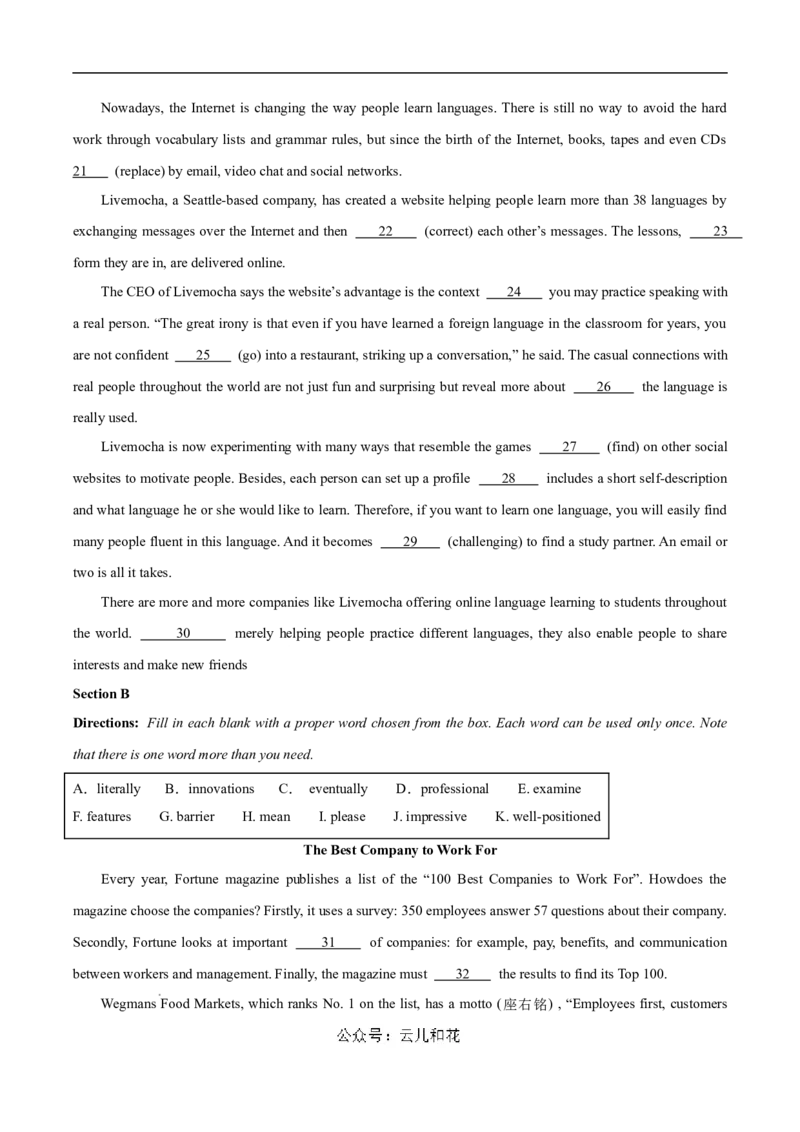
Section B
Directions: Fill in each blank with a proper word chosen from the box. Each word can be used only once. Note
that there is one word more than you need.
A.literally B.innovations C. eventually D.professional E. examine
F. features G. barrier H. mean I. please J. impressive K. well-positioned
The Best Company to Work For
Every year, Fortune magazine publishes a list of the “100 Best Companies to Work For”. Howdoes the
magazine choose the companies? Firstly, it uses a survey: 350 employees answer 57 questions about their company.
Secondly, Fortune looks at important 31 of companies: for example, pay, benefits, and communication
between workers and management. Finally, the magazine must 32 the results to find its Top 100.
Wegmans Food Markets, which ranks No. 1 on the list, has a motto (座右铭) , “Employees first, customerssecond”, and it is also one of the 50 largest private companies in the US, with annual sales of $3. 6 billion,
according to Forbes magazine. Apparently, being good to your employees is no 33 to making money.
How much of Wegmans’ success is due to the company’s policies? “Up to a point, the success is because of
the freedom they give us,” says one employee. “On the other hand, no company gets rich just by not being 34
to its employees. Wegmans has great marketing strategies and it’s 35 within the community. I’ve been here
for 15 years. Looking back, I’d say that the company’s 36 for customers’ benefits, such as the Shoppers’
Club electronic discount programme in the 1990s, have been just as important as the benefits to staff.”
But the employee benefits are 37 . Fundamentally, Wegmans believes in 38 development. As
well as scholarships, the company gives its employees business opportunities. For years, one employee made
delicious cookies for her colleagues. She 39 started selling the cookies in Wegmans. ‘I just asked the
manager,’ she says. ‘While looking back, I think I should have asked earlier. I could have made more money!’
The staff’s freedom to make decisions is another thing you won’t find everywhere. Essentially, Wegmans
wants its workers to do almost anything to 40 the customers. Believe it or not, an employee once cooked
a Thanksgiving turkey in the store for a customer because the woman’s turkey, bought in Wegmans, was too big for
her oven.
III. Reading Comprehension (45分)
Section A
Directions: For each blank in the following passage there are four words or phrases marked A. B.C and D.
Fill in each blank with the word or phrase that best fits the context
It’s late in the evening: time to close the book and turn off the computer. You’re done for the day. What you
may not realize, 41 , is that the learning process actually continues - in your dreams.
It might sound like science fiction, but researchers are increasingly 42 the relationship between the
knowledge and skills our brains absorb during the day and the fragmented, often bizarre imaginings they 43
at night. Scientists have found that dreaming about a task we’ve learned is associated with 44 performance
in that activity (suggesting that there’s some truth to the popular notion that we’re “getting” a foreign language
once we begin dreaming in it). What’s more, researchers are coming to recognize that dreaming is an essential part
of understanding, organizing and 45 what we learn. While we sleep, research indicates, the brain replays
the patterns of activity it experienced during 46 hours, allowing us to enter what one psychologist calls a
neural virtual reality. A vivid example of such 47 can be seen in a video researchers made recently about
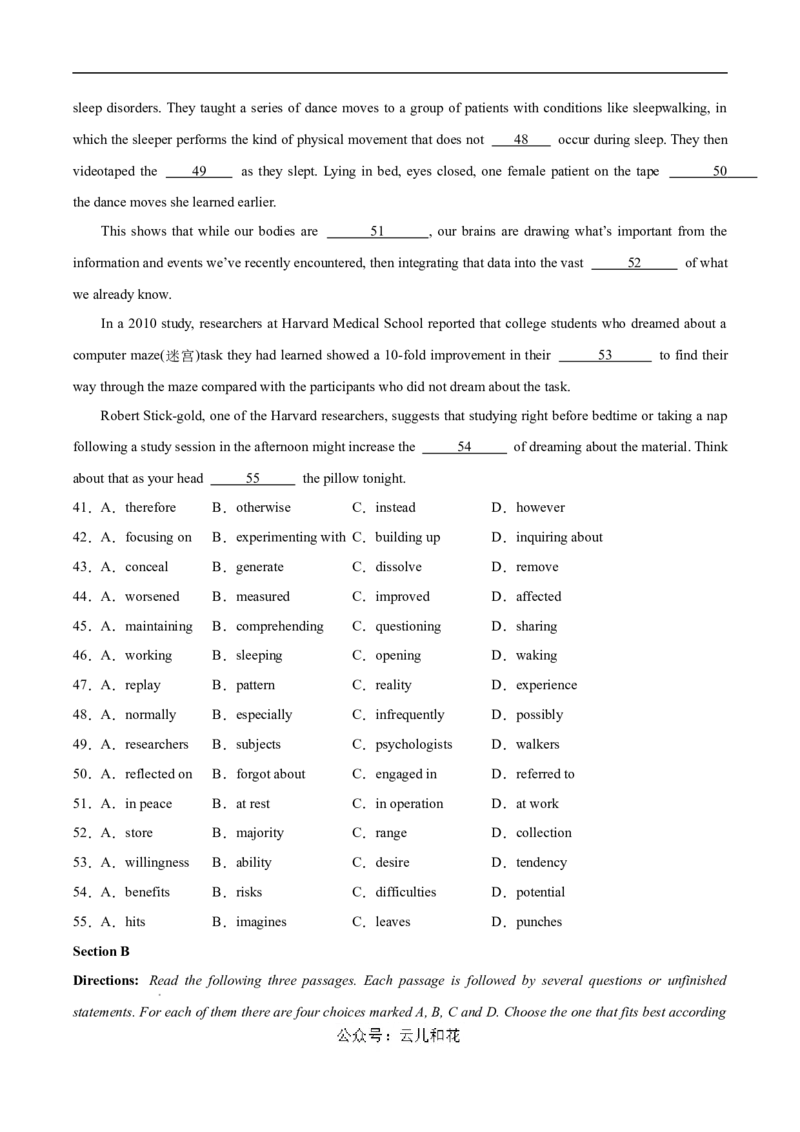
学科网(北京)股份有限公司sleep disorders. They taught a series of dance moves to a group of patients with conditions like sleepwalking, in
which the sleeper performs the kind of physical movement that does not 48 occur during sleep. They then
videotaped the 49 as they slept. Lying in bed, eyes closed, one female patient on the tape 50
the dance moves she learned earlier.
This shows that while our bodies are 51 , our brains are drawing what’s important from the
information and events we’ve recently encountered, then integrating that data into the vast 52 of what
we already know.
In a 2010 study, researchers at Harvard Medical School reported that college students who dreamed about a
computer maze(迷宫)task they had learned showed a 10-fold improvement in their 53 to find their
way through the maze compared with the participants who did not dream about the task.
Robert Stick-gold, one of the Harvard researchers, suggests that studying right before bedtime or taking a nap
following a study session in the afternoon might increase the 54 of dreaming about the material. Think
about that as your head 55 the pillow tonight.
41.A.therefore B.otherwise C.instead D.however
42.A.focusing on B.experimenting with C.building up D.inquiring about
43.A.conceal B.generate C.dissolve D.remove
44.A.worsened B.measured C.improved D.affected
45.A.maintaining B.comprehending C.questioning D.sharing
46.A.working B.sleeping C.opening D.waking
47.A.replay B.pattern C.reality D.experience
48.A.normally B.especially C.infrequently D.possibly
49.A.researchers B.subjects C.psychologists D.walkers
50.A.reflected on B.forgot about C.engaged in D.referred to
51.A.in peace B.at rest C.in operation D.at work
52.A.store B.majority C.range D.collection
53.A.willingness B.ability C.desire D.tendency
54.A.benefits B.risks C.difficulties D.potential
55.A.hits B.imagines C.leaves D.punches
Section B
Directions: Read the following three passages. Each passage is followed by several questions or unfinished
statements. For each of them there are four choices marked A, B, C and D. Choose the one that fits best accordingto the information given in the passage you have just read.
A
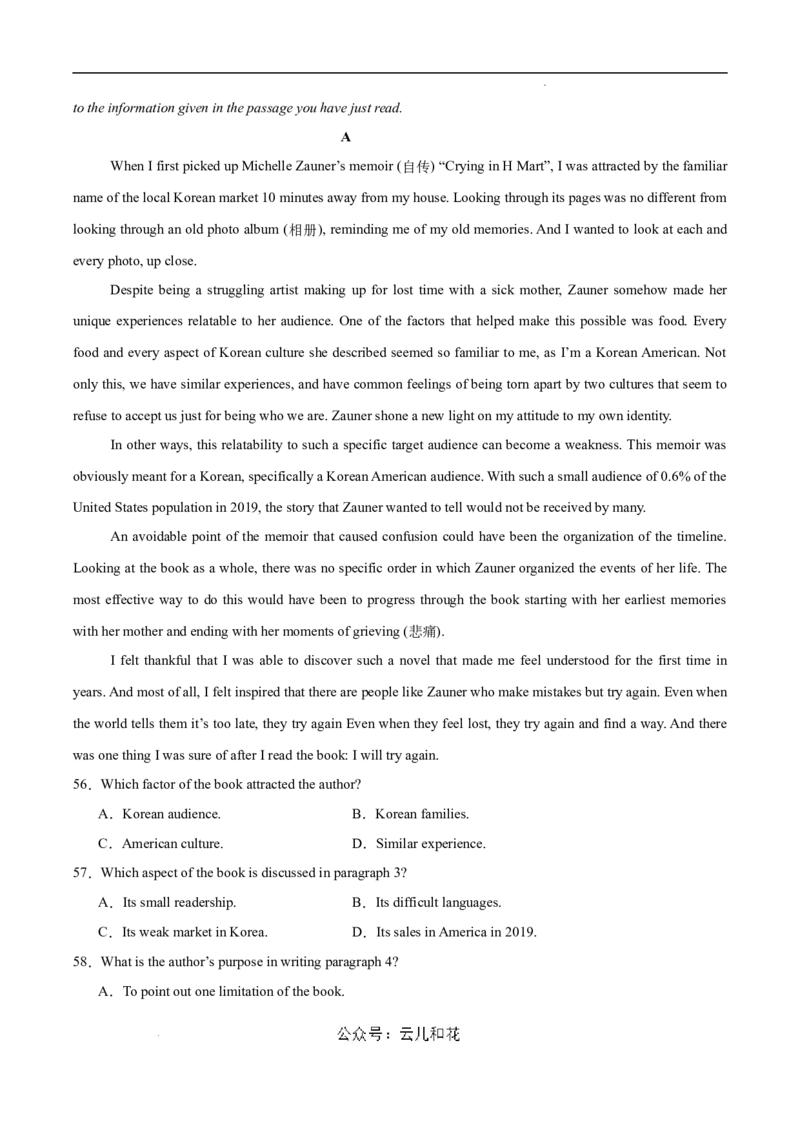
When I first picked up Michelle Zauner’s memoir (自传) “Crying in H Mart”, I was attracted by the familiar
name of the local Korean market 10 minutes away from my house. Looking through its pages was no different from
looking through an old photo album (相册), reminding me of my old memories. And I wanted to look at each and
every photo, up close.
Despite being a struggling artist making up for lost time with a sick mother, Zauner somehow made her
unique experiences relatable to her audience. One of the factors that helped make this possible was food. Every
food and every aspect of Korean culture she described seemed so familiar to me, as I’m a Korean American. Not
only this, we have similar experiences, and have common feelings of being torn apart by two cultures that seem to
refuse to accept us just for being who we are. Zauner shone a new light on my attitude to my own identity.
In other ways, this relatability to such a specific target audience can become a weakness. This memoir was
obviously meant for a Korean, specifically a Korean American audience. With such a small audience of 0.6% of the
United States population in 2019, the story that Zauner wanted to tell would not be received by many.
An avoidable point of the memoir that caused confusion could have been the organization of the timeline.
Looking at the book as a whole, there was no specific order in which Zauner organized the events of her life. The
most effective way to do this would have been to progress through the book starting with her earliest memories
with her mother and ending with her moments of grieving (悲痛).
I felt thankful that I was able to discover such a novel that made me feel understood for the first time in
years. And most of all, I felt inspired that there are people like Zauner who make mistakes but try again. Even when
the world tells them it’s too late, they try again Even when they feel lost, they try again and find a way. And there
was one thing I was sure of after I read the book: I will try again.
56.Which factor of the book attracted the author?
A.Korean audience. B.Korean families.
C.American culture. D.Similar experience.
57.Which aspect of the book is discussed in paragraph 3?
A.Its small readership. B.Its difficult languages.
C.Its weak market in Korea. D.Its sales in America in 2019.
58.What is the author’s purpose in writing paragraph 4?
A.To point out one limitation of the book.
学科网(北京)股份有限公司B.To describe Zauner’s life in order of time.
C.To explain why he falls in love with the book.
D.To introduce an effective way to write a memoir.
59.What did the author learn from reading “Crying in H Mart”?
A.To be thankful. B.To stay positive.
C.To understand others. D.To avoid making mistakes.
B
Many questions can be expected in advance and it’s wise to have some well-constructed answers that you can
tailor more closely on the day. It’s sensible to have a number of key phrases to use. Remember to always try and
make your answers positive.
Q1: Tell me about yourself. (The interviewer is really saying “I want to hear you talk.”)
A1: This is just to get things started, but it is a very common question. Write a script, and practice it so that it
sounds natural. Spend a maximum of four minutes describing your qualifications, career history and your range of
skills. Emphasize those skills that are relevant to the job on offer.
Q2: What have been your achievements to date? (The interviewer is saying “Are you an achiever?”)
A2: Again, this is a common question, so be prepared. Select an achievement that is experience-related and
fairly recent. Identify skills you used in this achievement and say what the results were.
Q3: What do you like about your present job? (The interviewer is really trying to find out whether you will
enjoy the things the new job has to offer.)
A3: This is a straightforward question. All you have to make sure is that your ‘likes’ correspond to the skills
etc. required for the job on offer. Be positive, describe your job as interesting and diverse, but do not overdo it.
After all, you are leaving?
Q4: What are your strengths? (The interviewer simply wants a straightforward answer as to what you are
good at.)
A4: This is the one question that you are definitely going to get, so there is no excuse for being unprepared.
Concentrate on discussing your main strengths. List three or four explanations of how they could benefit the
employer. Strengths to consider include technical proficiency; ability to learn quickly; determination to succeed;
positive attitude; your ability to relate to people and achieve a common goal. You may be asked to give examples of
the above, so be prepared.
Q5: Tell me about the most difficult situation you’ve had to face and how you handled it.(The interview is really trying to find out your definition of “difficult” and whether you can show a logical
approach to problem solving using your initiative.)
A5: This can be a trap! To avoid it, select a difficult work situation that was not caused by you and which can
be quickly explained in a few sentences. Explain how you defined the problem, what the options were, why you
selected the one you did and what the outcome was. Always end on a positive note.
60.The passage is mainly intended to ________.
A.highlight the importance of looking positive in an interview
B.give suggestions on how to answer interview questions
C.provide some sample answers to interview questions
D.illustrate how to look confident in an interview
61.When asked about what you think of your present job, you’d better ________.
A.talk about what you dislike about it
B.comment positively on your colleagues
C.relates it to the job you are applying for
D.describe how interesting it is as far as possible
62.If an interviewer wants to know whether you can solve a problem properly, what will he ask?
A.Tell me about yourself?
B.Tell me about your strengths?
C.What have been your achievements to date?
D.How did you handle the most difficult situation?
C
While more and more scientists are working on nonfiction science books for the general reader, I think we
also need a change.
The typical expert-voiced monologues (独白) that scientists write are a wonderful component of the
engagement effort, but the form is limited. Such books are largely ready people already willing to pick up a science
book, or who are open to the authoritative academic’s voice telling them how to think. There are plenty of people
who can engage with science but who find those kinds of books a sometimes unwelcome reminder of the
classroom.
Following from my belief that science is for everyone, I suggest that publishers need to work with scientists
to expand the kinds of books on offer, assured that there is an audience for them. Progress is possible. Many years
学科网(北京)股份有限公司ago, I realized it is hard to find books on the nonfiction science shelf that let readers see themselves as part of the
conversation about science. So I thought about an entire book of conversations about science taking place between
ordinary people. While “overhearing” those conversations, readers learn some science ideas. It’s a resurrection of
the dialogue form, known to the ancient Greeks, and to Galileo, as a device for exchanging ideas, but with
contemporary settings: cafes, restaurants, trains and so on.
I decided it would be engaging for the reader to actually see who’s having those conversations, and where,
instead of describing them in words. This led me to realize that I was thinking about a powerful form of visual
storytelling: Graphic novels for adults have matured and exploded in popularity in recent years. Spiegelman’s
“Maus: A Survivor’s Tale” and Bechdel’s “Fun Home” are just two well-known examples.
But the storytelling tools of the graphic book have been little used to convey nonfiction science ideas to a
general adult audience. The vast majority of contemporary graphic books with a science focus are presented instead
as “explainer/adventure comics” for younger audiences. This is an important genre, but graphic books about
science should not be limited to that.
And while there are several excellent graphic books for adults that include science, they typically focus
instead on the lives of famous scientists, with discussion of the science itself as a secondary goal. Some excellent
recent examples that balance the two aspects well include Ottaviani arid Myrick’s “Feyrunan” and Doxiadis and
Papadimitriou’s “Logicomix”. The scarcity of science-focused non-biographical (非自传体的) graphic books for
adults is especially true in my field of physics. So I decided that here was an opportunity to broaden the kinds of
nonfiction science book available to engage the public.
63.It can be inferred from Para.2 that the expert-voiced monologues don’t appeal to _________.
A.those who are interested in scientific ideas
B.those who have no talents for scientific research
C.those who would like to know how scientists think
D.those who think science classes in school are uninteresting
64.The word “resurrection” (in paragraph 3) most probably means _________.
A.announcement B.comeback C.explanation D.representation
65.According to the writer, which might be the best form of nonfiction science books for general readers?
A.A collection of scientists’ life stories. B.A book written by a Nobel Prize winner.
C.An adventure novel focusing on science.D.A comic book conveying scientific ideas.
66.What is passage mainly about?A.A well-known writer who writes to promote science among the public.
B.A possible way to get nonfiction science books to appeal to the public.
C.A new approach to have the public get interested in new scientific ideas.
D.An easy access for the public to have a general idea of what science is.
Section C
Directions: Read the passage carefully. Fill in each blank with a proper sentence given in the box. Each sentence
can be used only once. Note that there are two more sentences than you need.
Soil conservation methods help farmers protect their land from the damage caused by farming and the forces
of nature. One method of soil conservation is the use of windbreaks. Windbreaks are barriers formed by trees and
other plants. 67
Windbreaks help prevent the loss of soil. They stop the wind from blowing soil away. They also keep the
wind from damaging or destroying crops. Windbreaks can be highly valuable for protecting grain crops. For
example, studies have been done on windbreaks in parts of West Africa. These studies found that grain harvests
were as much as twenty percent higher in fields protected by windbreaks compared to fields without them.
68 They seem to work best when they allow some wind to pass through the barrier of trees or
plants around a field. If not, then the movement of air close to the ground will lift the soil. Then the soil will be
blown away.
For this reason, a windbreak works best if it contains only sixty to eighty percent of the trees and plants that
would be needed to make a solid line. An easy rule to remember is that windbreaks can protect areas up to ten times
the height of the tallest trees in the windbreak.
There should be at least two lines in each windbreak. 69 The second line, right next to it, can be
shorter trees and other plants with leaves. Locally grown trees and plants are considered the best choices for
windbreaks.
Windbreaks not only protect land and crops from the wind. Surplus trees can be cut down and used or sold
for wood.
Trees reduce the damaging effects of wind and rain. Their roots help protect soil from being washed away.
And trees can provide another valuable service for agriculture. 70
A.Crops in fields can be protected by windbreaks.
B.Farmers plant these barriers around their fields.
C.One line should be large trees.
D.But here is something interesting about windbreaks.
学科网(北京)股份有限公司E.Then the soil will be washed away.
F.They can provide grazing animals with shade from the sun
IV. Summary Writing (10分)
Directions: Read the following passage. Summarize the main idea and the main point(s) of the passage in NO
MORE THAN 60 WORDS. Use your own words as far as possible.
Is fruit getting sweeter?
Is modern fruit bred to be sweeter than in the past? The short answer is yes, though the longer answer is
more complicated. Some of the most powerful evidence that fruit is sweeter than before comes from zoos. In 2018,
it was reported that Melbourne Zoo in Australia had stopped giving fruit to most of its animals because cultivated
fruit was now so sweet.
Among fruit breeders, the word “quality” is now routinely used as a synonym for “high in sugar”. In 2010, a
group of scientists wrote in an article that “in general, the sugar content” of many fruits is now higher than before
“owing to continuous selection and breeding.” Modern apple varieties, the scientists noted, were on average
sweeter than older cultivars.
With the rise in sweeter fruit, our expectations of how fruit should taste have also changed. Whether we are
talking about apples or peaches, Europeans and Americans tend to favor fruit that is both acid and sweet, whereas
in Asia, the most popular fruit is intensely sweet with hardly any acidity. In Asian countries, the “honey” flavors of
low-acid peaches are much appreciated, while European consumers prefer peaches that are slightly acidic. All
around the world, the common thread in what people want from fruit is sweetness.
But the excessive sweetness of modern fruit is not without its problems, especially for people with diabetes,
who have to be careful to moderate their intake of higher-sugar fruits such as pineapple. Health aside, maybe the
real problem with modern fruit is that it has become yet another sweet thing in a world full of sugar. Even
grapefruit, which used to be encouragingly bitter, is sometimes now as sweet as oranges. Fruit that is bred for one-
dimensional sweetness, as opposed to aroma or texture, denies us some of the contrast and variety of life. If you
have never tasted a sour cherry, how can you fully appreciate a sweet one?
71.__________________________________________________________________________________________
____________________________________________________________________________________________
________________________________________________________________________________________________________________________________________________________________________________________
____________________________________________________________________________________________
V. Translation (15分)
Directions: Translate the following sentences into English, using the words given in the brackets.
72.缺乏配合是昨天我们比赛失利的原因吗?(blame)
73.山顶矗立着一座始建于唐朝的古寺庙。(stand)
74.也许了解西方艺术的最好方法是看看西方绘画几个世纪以来的发展。(approach)
75.断网意味着与电子设备保持距离,腾出时间去冥想,在大自然中敞开心扉,这已成为一些当代人的生
存工具。(involve)
VI. Guided Writing (25分)
Direction: Write an English composition in 120-150 words according to the instructions given below in Chinese.
假如你是明启中学的高二学生王磊,学校计划在期中考试之后组织学生秋游,有两个目的地可以选择:上
海博物馆或世纪公园。学校委托学生会就秋游的目的地选择征询全年级学生的意见,请你写一封信,表达
自己的想法,你的信中应包括:
1.你的选择;
2.你的理由。
____________________________________________________________________________________________
____________________________________________________________________________________________
____________________________________________________________________________________________
____________________________________________________________________________________________
____________________________________________________________________________________________
____________________________________________________________________________________________
学科网(北京)股份有限公司____________________________________________________________________________________________
____________________________________________________________________________________________
____________________________________________________________________________________________