2006 年北京高考英语真题及答案
本试卷分第Ⅰ卷(选择题)和第Ⅱ卷(非选择题)两部分,第Ⅰ卷 1至16页。第Ⅱ卷
17至18页。共150分。考试时间120分钟。考试结束后,将本试卷和答题卡一并交回。
注意事项:
1.答题前考生务必分别将答题卡Ⅰ和答题卡Ⅱ上的姓名、准考证号用黑色字迹的签字笔填
写,用2B铅笔将准考证号对应的信息点涂黑。
2.答试卷第Ⅰ卷时,每小题选出答案后,用 2B铅笔把答题卡Ⅰ上对应题目的答案选中涂
满涂黑,黑度以盖住框内字母为准。如需改动,用橡皮擦除干净后再选涂其它答案项。
在试卷上答题无效。
3.答试卷第Ⅱ卷时,必须用黑色字迹的签字笔按题号顺序答在答题卡Ⅱ的红色框答题区域
相应位置内,未在对应的答题区域做答或超出答题区域做答均不得分。在试卷上答题无
效。
第Ⅰ卷(选择题 共115分)
第一部分 听力(共两节,满分30分)
第一节 (共5小题;每小题1.5分,满分7.5分)
听下面5段对话。每段对话后有一道小题,从每题所给的 A、B、C三个选项中选出最
佳选项。听完每段对话后,你将有10秒钟的时间来回答有关小题和阅读下一小题。每段对
话你将听一遍。
例:What is the man going to read?
A.A newspaper.
B.A magazine.
C.A book.
答案是A。
1.What size does the woman want?
A.Size 8.
B.Size 10.
C.Size 12.
2.Where does the conversation take place?
A.In a post office.
B.In a hotel.
C.In a bank.
3.Why is the man going to New York?
A.To live there.
B.To visit a friend.
C.To have a vacation.
第1页 | 共16页4.What are they going to do?
A.Play tennis.
B.Go swimming.
C.Do some cleaning.
5.What is the man doing?
A.Making an announcement.
B.Making an appointment.
C.Making an invitation.
第二节(共15小题;每小题1.5分,共22.5分)
听下面6段对话或独白。每段对话或独白后有几道小题,从每题所给的 A、B、C三个
选项中选出最佳选项。听每段对话或独白前,你将有 5秒钟的时间阅读每小题。听完后,
每小题将给出5秒钟的做答时间。每段对话或独白你将听两遍。
听第6段材料,回答第6至7题。
6.Who is this announcement for?
A.People on a train.
B.People on a plane.
C.People in a restaurant.
7.What time of the day is it?
A.Morning.
B.Noon.
C.Evening.
听第7段材料,回答第8至9题。
8.Where are the speakers?
A.At a Lost and Found.
B.At a bus stop.
C.In a shop.
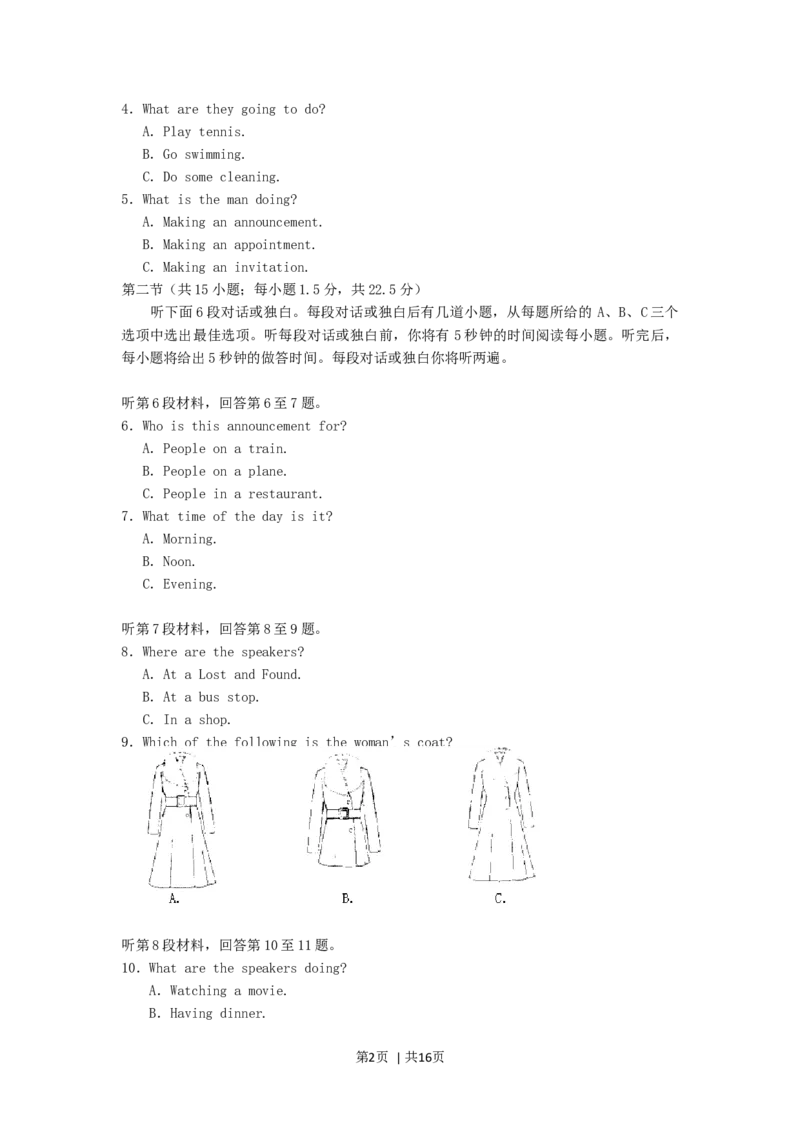
9.Which of the following is the woman’s coat?
听第8段材料,回答第10至11题。
10.What are the speakers doing?
A.Watching a movie.
B.Having dinner.
第2页 | 共16页C.Making soup.
11.What makes the man unhappy?
A.The woman doesn’t cook very well.
B.The woman seldom talks to him at dinner.
C.The woman watches too many commercials.
听第9段材料,回答第12至14题。
12.What does the man dislike about his job?
A.Working in a hotel.
B.Working in summer.
C.Traveling all the time.
13.Why doesn’t he want to take the new job?
A.He doesn’t get a good pay.
B.He dislikes working in a seaside town.
C.He hates playing the same piece again and again.
14.What does the woman think of the job the man was offered?
A.Boring.
B.Well-paid.
C.Tough.
听第10段材料,回答第15至17题。
15.What are they discussing?
A.What to have for lunch.
B.Where to go for lunch.
C.When to have lunch.
16.What can we learn about the man?
A.He usually doesn’t eat fast food.
B.He often eats in a restaurant near his home.
C.He can’t afford an expensive lunch that day.
17.Where are they probably going right after this conversation?
A.A supermarket.
B.A fast-food place.
C.A French restaurant.
听第11段材料,回答第18至20题。
18.Why didn’t the woman go to the man’s birthday party?
A.She forgot all about it.
B.She didn’t like the man.
C.She didn’t know about it.
19.Who is the woman?
A.The man’s friend.
B.The man’s mother.
C.The man’s secretary.
第3页 | 共16页20.What does the woman want to do for the man’s birthday?
A.Buy him a nice present.
B.Have lunch with him.
C.Send him an email.
第二部分:知识运用(共两节,45分)
第一节 单项填空(共15小题;每小题1分,共15分)
从每题所给的A、B、C、D四个选项中,选出可以填入空白处的最佳选项,并在答题卡
上将该项涂黑。
例:It’s so nice to hear from her again _____, we last met more than thirty
years ago.
A.What’s more B.That’s to say
C.In other words D.Believe it or not
答案是D
21.This washing machine is environmentally friendly because it uses _____
water and electricity than _________ models.
A.less; older B.less; elder
C.fewer, older D.fewer; elder
22.-When do we need to pay the balance?
-__________ September 30.
A.In B.By
C.During D.Within
23.She went to the bookstore and bought _________.
A.dozen books B.dozens books
C.dozen of books D.dozens of books
24.-Which driver was to blame?
-Why, ________! It was the child’s fault, clear and simple. He suddenly
came out between two parked cars.
A.both B.each
C.either D.neither
25.-What’s the name?
-Khulaifi. ________ I spell that for you?
A.Shall B.Would C.Can D.Might
26.-I knocked over my coffee cup. It went right over __________ keyboard.
-You shouldn’t put drinks near _________ computer.
A.the; 不填 B.the; a C.a; 不填 D.a; a
27.-_______ leave at the end of this month.
-I don’t think you should do that until _________ another job.
A.I’m going to; you’d found B.I’m going to; you’ve found
C.I’ll; you’ll find D.I’ll; you’d find
28.There have been several new events _______ to the program for the 2008
Beijing Olympic Games.
第4页 | 共16页A.add B.to add
C.adding D.added
29.-Could you do me a favor?
-It depends on ______ it is.
A.which B.whichever C.what D.whatever
30.-Your job _______ open for your return.
-Thanks.
A.will be kept B.will keep C.had kept D.had been kept
31.Women _______ drink more than two cups of coffee a day have a greater
chance of having heart disease than those ________ don’t.
A.who; 不填 B.不填; who
C.who; who D.不填; 不填
32.-Where did you put the car keys?
-Oh, I ______ I put them on the chair because the phone rang as I _______
in.
A.remembered; come B.remembered; was coming
C.remember; come D.remember; was coming
33._______ you’ve tried it, you can’t imagine how pleasant it is.
A.unless B.Because C.Although D.When
34 . He found it increasingly difficult to read, ______ his eyesight was
beginning to fail.
A.and B.for C.but D.or
35.I can’t stand _______ with Jane in the same office. She just refuses
______ talking while she works.
A.working; stopping B.to work; stopping
C.working; to stop D.to work; to stop
第二节 完形填空(共20小题;每小题1.5分,共30分)
阅读下面短文,掌握其大意,从每题所给的A、B、C、D四个选项中,选出最佳选项,
并在答题卡上将该项涂黑。
Learning to Accept
I learned how to accept life as it is from my father. 36 , he did not
teach me acceptance when he was strong and healthy, but rather when he was 3 7
and ill.
My father was 38 a strong man who loved being active, but a terrible
illness
39 all that away. Now he can no longer walk, and he must sit quietly in a
chair all day. Even talking is 40 . One night. I went to visit him with my
sisters. We started
41 about life, and I told them about one of my 42 . I said that we must
very often give things up 4 3 , we grow-our youth, our beauty, our friends-
but it always 44 that after we give something up, we gain something new in
第5页 | 共16页its place. Then suddenly my father 4 5 up. He said, “But, Peter, I gave up
46 ! What did I gain?” I thought and thought, but I could not think of
anything to say, 47 , he answered his own question: “I 48 the love of
my family.” I looked at my sisters and saw tears in their eyes, along with
hope and thankfulness.
I was also 49 by his words. After that, when I began to feel
irritated(恼怒的) at someone, I 5 0 remember his words and become 5 1 . If
he could replace his great pain with a feeling of love for others, then I
should be 5 2 to give up my small irritations. In this 5 3 . I learned the
power of acceptance from my father.
Sometimes I 54 what other things I could have learned from him if I
had listened more carefully when I was a boy. For now, though, I am grateful
for this one
5 5 .
36.A.Afterwards B.Therefore C.However D.Meanwhile
37.A.tired B.weak C.poor D.slow
38.A.already B.still C.only D.once
39.A.took B.threw C.sent D.put
40.A.impossible B.difficult C.stressful D.hopeless
41.A.worrying B.caring C.talking D.asking
42.A.decisions B.experiences C.ambitions D.beliefs
43.A.as B.since C.before D.till
44.A.suggests B.promises C.seems D.requires
45.A.spoke B.turned C.summed D.opened
46.A.something B.anything C.nothing D.everything
47.A.Surprisingly B.Immediately C.Naturally D.Certainly
48.A.had B.accepted C.gained D.enjoyed
49.A.touched B.astonished C.attracted D.warned
50.A.should B.could C.would D.might
51.A.quiet B.calm C.relaxed D.happy
52.A.ready B.likely C.free D.able
53.A.case B.form C.method D.way
54.A.doubt B.wonder C.know D.guess
55.A.award B.gift C.lesson D.word
第三部分:阅读理解(共20小题;每小题2分,共40分)
阅读下列短文,从每题所给的A、B、C、D四个选项中,选出最佳选项,并在答题卡上
将该项涂黑。
A
How to Make a Budget(预算)
Most likely, you aren’t the family breadwinner. But doing a small job or
第6页 | 共16页getting a weekly allowance(零花钱) would put some money in your pocket. For
kids and grown-ups alike, money is easy to spend. If you aren’t careful, it
can be gone in no time.
Being responsible with your money is an important skill to learn-and the
sooner you start the better. Whether you are tracking your spending or saving
for something special, creating a budget can help you deal with your expenses
and plan for the future. All you need are paper and a pencil-and some self-
control.
First, take a look at our sample monthly budget. Then, use a separate
sheet of paper to plan your own. In the first two columns(栏), list your
sources(来源) of income and how much you expect to earn form them. In the third
and fourth columns, list what you expect to spend your money on and the amount.
The left-hand
Sample Monthly Budget
total should be Monthly Income Amount Monthly Expenses Amount
more than or equal Allowance $ 20.00 Snacks $ 26.00
Money earned $ 25.00 Music $ 12.00
to the right-hand
Selling drinks downloads
total. If it is,
Money earned $ 12.50 Movies $ 18.00
you have an babysitting
Money earned $ 30.00 Video rentals $ 10.00
effective budget.
delivering newspapers
Budgets are
Total: $ 87.50 Total: $ 66.00
not complex, but
sticking to them can be tough. When planning your budget, be realistic about
your expenses. If you know that you drop $ 18 at a movie, don’t write $ 12 in
that space simply because you wish you were spending less.
If you are eyeing a big purchase, such as a $ 150 skateboard, spend less
and save more until you have the total amount. No matter how attractive it may
be, avoid spending your savings. One day, you will thank yourself?
56.Who is the passage written for?
A.Children B.Parents.
C.Breadwinners. D.Bank managers.
57.The purpose of making a budget is to help people __________.
A.learn to be realistic
B.increase their savings
C.manage their money well
D.test their power of self-control
58.What should people do when planning a budget?
A.Fill in the expenses as they really are.
B.Avoid spending money on expensive things.
C.Set aside a fixed amount of money as savings.
D.List income and expenses on two pieces of paper.
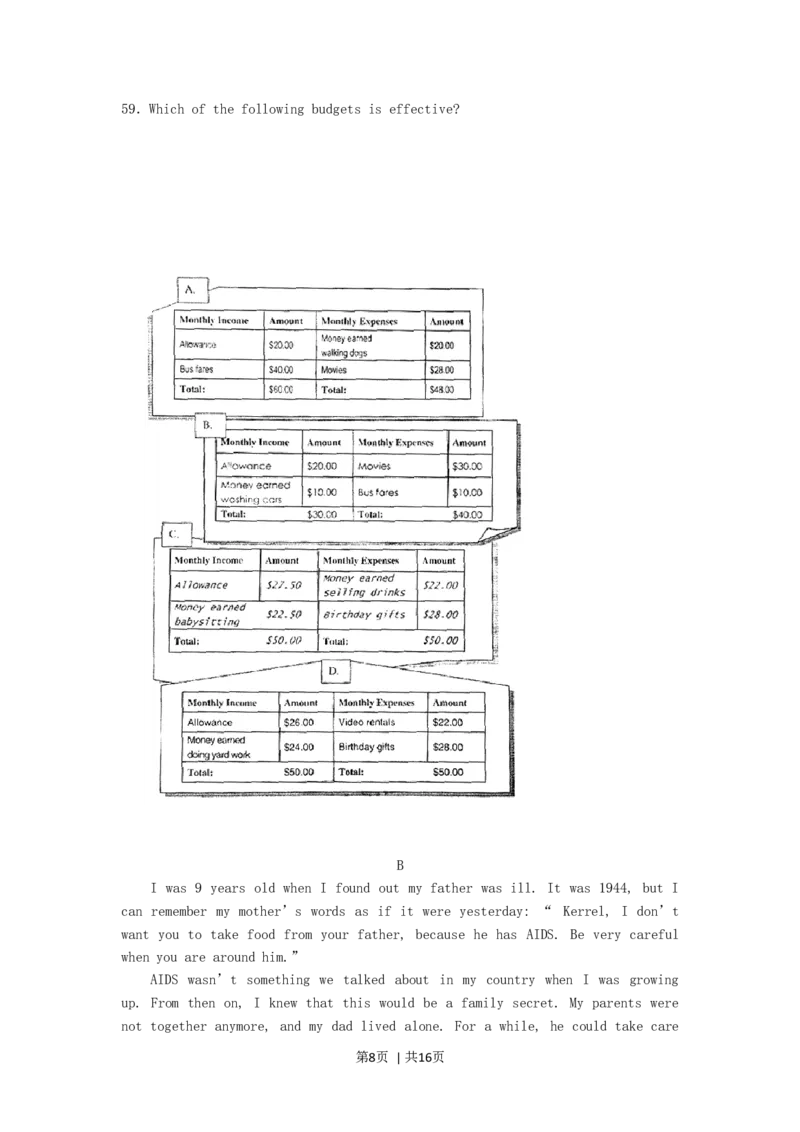
第7页 | 共16页59.Which of the following budgets is effective?
B
I was 9 years old when I found out my father was ill. It was 1944, but I
can remember my mother’s words as if it were yesterday: “ Kerrel, I don’t
want you to take food from your father, because he has AIDS. Be very careful
when you are around him.”
AIDS wasn’t something we talked about in my country when I was growing
up. From then on, I knew that this would be a family secret. My parents were
not together anymore, and my dad lived alone. For a while, he could take care
第8页 | 共16页of himself. But when I was 12, his condition worsened. My father’s other
children lived far away, so it fell to me to look after him.
We couldn’t afford all the necessary medication for him, and because Dad
was unable to work, I had no money for school supplies and often couldn’t
even buy food for dinner. I would sit in class feeling completely lost, the
teache r ’ s word s muffle d a s I trie d t o figur e ou t ho w I wa s goin g t o manage .
I did not share my burden(负担)with anyone. I had seen how people
reacted to AIDS. Kids laughed at classmates who had parents with the disease.
And even adults could be cruel. When my father was moved to the hospital, the
nurses would leave his food on the bedside table even though he was too weak to
feed himself.
I had known that he was going to die, but after so many years of
keeping his condition a secret. I was completely unprepared when he reached
his final days. Sad and hopeless. I called a woman
at the nonprofit National AIDS Support. That day,
she kept me on the phone for hours. I was so lucky
to find someone who cared. She saved my life.
I was 15 when my father died. He took his secret
away with him, having never spoken about AIDS to
anyone, even me. He didn’t want to call attention to AIDS. I do.
60.What does Kerrel tell us about her father?
A.He had stayed in the hospital since he fell ill.
B.He depended on the nurses in his final days.
C.He worked hard to pay for his medication.
D.He told no one about his disease.
61.What can we learn from the underlined sentence?
A.Kerrel couldn’t understand her teacher.
B.Kerrel had special difficulty in hearing.
C.Kerrel was too troubled to focus on the lesson.
D.Kerrel was too tired to hear her teacher’s words.
62.Why did Kerrel keep her father’s disease a secret?
A.She was afraid of being looked down upon.
B.She thought it was shameful to have AIDS.
C.She found no one willing to listen to her.
D.She wanted to obey her mother.
63.Why did Kerrel write the passage?
A.To tell people about the sufferings of her father.
B.To show how little people knew about AIDS.
C.To draw people’s attention to AIDS.
D.To remember her father.
第9页 | 共16页C
Why I Don’t Spare “Spare Change”
“Poor but honest.” “The deserving(值得帮助的)poor. ” These words
always come to my mind when I think of “the poor. ” But I also think of
people who, perhaps through alcohol(酒)or drugs, have ruined not only their
own lives but also the lives of others in order to give way to their own
pleasure. Perhaps alcoholism and drug addiction(上瘾)really are “diseases.
” as many people say, but my own feeling-based, of course, not on any serious
study-is that most alcoholies and drug addicts belong to the “undeserving
poor. ” And that is largely why I don’t give spare change to beggars.
But surely among the street people there are also some who can rightly
be called “ deserving.” Deserving what? My spare change? Or simply the
government’s assistance? It happens that I have been brought up to believe
that it is proper to make contributions to charity(慈善机构), but if I give
some change to a beggar, am I making a contribution to charity and thereby
helping someone, or, am I perhaps simply encouraging someone not to get help?
Or, maybe even worse, am I supporting a cheat?
If one believes in the value of private charity, one can either give to
needy people or to charitable organizations. In giving to a beggar one may
indeed be helping a person who badly needs help, but one cannot be certain that
one is giving to a needy person. In giving to an organization, on the other
hand, one can feel that one’s money is likely to be used wisely. True, facing
a beggar one may feel that this particular unfortunate person needs help at
this moment-a cup of coffee or a sandwich-and the need will not be met
unless I put my hand in my pocket right now. But I have come to think that the
beggars whom I meet can get along without my spare change, and indeed perhaps
they are actually better off for not having money to buy alcohol or drugs.
I know nothing about these beggars, but it’s my impression that they
simply prefer begging to working. I am not generalizing about street people. I
am talking about the people whom I actually meet. That’s why I do not give
“spare change, ” and I don’t think I will in the future.
64.What does the author think of beggars who take drugs?
A.They should be given a cheek-up.
B.They really need money to live.
C.They have no pleasure in life.
D.They are not worth helping.
65.Why doesn’t the author give money to street people?
A.He doesn’t think they need help.
B.He doesn’t have enough money to give.
C.He is not convinced they will use it rightly.
D.He believes they can get help from the government.
第10页 | 共16页66.In the second paragraph, the author presents his idea by _______.
A.asking questions for people to think about
B.giving examples to support his argument
C.raising questions and answering them
D.expressing his opinions directly
67.Which of the following opinions does the author accept?
A.Drug addiction is a disease.
B.Some street people are poor and needy.
C.Most beggars have received enough help.
D.Charitable organizations handle money properly.
D
While parents, particularly mothers, have always been attached to their
infants ( 婴 儿 ) . societal conditions frequently made this attachment
difficult to maintain(保持). First of all, the high infant death rate in the
premodern times meant that such attachments often ended in hopelessness.
Perhaps to prevent the sadness that infant death caused, a number of societal
practices developed which worked against early attachment of mother and child.
One of these premodern attachment discouraging practices was to leave
infants unnamed until they had survived into the second year. Another practice
that discouraged maternal(母亲的)attachment was tightly wrapping(包裹)
infants. Wrapping effectively prevented the close physical interactions like
stroking(抚摸)and kissing that are so much a part of modern mothers’ and
fathers’ affection for their infants.
A third practice which had the same distancing effect was wet-nursing.
Breast-feeding(母乳哺育)was not popular among the well-to-do in the early
modern times; infants were often fed by wet nurses hired for the purpose. In
some places, such as nineteenth-century France, city infants were sent to wet
nurses in the country. Often a wet nurse would feed her own child first,
leaving little milk for the city infant-who, in many cases, died. In Rouen,
the death rate for children sent to a wet nurse was 35 percent
68.Babies were unnamed until they were two so that ______.
A.an old social custom could be kept up
B.maternal attachment could be maintained
C.they could have better chances to survive
D.their parents would not be too sad if they died
69.Why were babies wrapped?
A.To protect them from the cold.
B.To distance their mothers from them.
C.To make them feel more comfortable.
D.To make it easy for their mothers to hold them.
70.Wet nurses were women who _______.
A.babysat city infants
第11页 | 共16页B.fed babies of other families
C.sent their babies to the country
D.failed to look after their babies
71.Which is the best title for the passage?
A.Societal Conditions in Premodern Times
B.Practices of Reducing Matemal Attachment
C.Poor Health Service and High Infant Death Rate
D.Differences between Modern and Premodern Parents
E
A study published in September suggests there is a surprising way to get
people to avoid unhealthy foods; change their memories. Scientist Elizabeth
Loftus of the University of California at I rvine asked volunteers to answer
some questions on their personalities(个性)and food experiences. “One week
later,” Loftus says,“we told those people we’d fed their answers into our
smart computer and it came up with an account of their early childhood
experiences.” Some accounts included one key additional detail (细节): “You
got sick after eating strawberry ice-cream.”The researchers then changed this
detail into a manufactured(人为促生的)memory through leading questions-Who
were you with? How did you feel? By the end of the study up to 41% of those
given a false memory believed strawberry ice-cream once made them sick, and
many said they’d avoid eating it.
When Loftus published her findings, she started getting calls from people
begging her to make them remember hating chocolate or French fries.
Unfortunately, it’s not that easy. False memories appear to work only for
foods you don’t eat on a regular basis. But most important, it is likely that
false memories can be implanted(灌输)only in people who are unaware of the
mental control. And lying to a patient is immoral, even if a doctor believes
it’s for the patient’s benefit.
Loftus says there’s nothing to stop parents from trying it with their
overweight children. “I say, wake up-parents have been lying about Father
Christmas for years, and nobody seems to mind. If they can prevent diseases
caused by fatness and all the other problems that come with that, you might
think that’s a more moral lie. Decide that for yourself.”
72.Why did Loftus ask the volunteers to answer some questions?
A.To improve her computer program.
B.To find out their attitudes towards food.
C.To find out details she can make use of.
D.To predict what food they’ll like in the future.
73.What did Loftus find out from her research?
A.People believe what the computer tells them.
B.People can be led to believe in something false.
C.People tend to forget their childhood experiences.
D.People are not always aware of their personalities.
74.According to the study, people may stop having a certain food if they
第12页 | 共16页_____.
A.learn it is harmful for health
B.lie to themselves that they don’t want it
C.are willing to let doctors control their minds
D.think they once had a bad experience of eating it
75.What is the biggest concern with the method?
A.Whether it is moral.
B.Who it is best for.
C.When it is effective.
D.How it should be used.
第Ⅱ卷(共35分)
第四部分:书面表达(共两节,35分)
第一节 情景作文(20分)
国际文化交流中心将组织一次由各国学生参加“和平·友谊”夏令营活动,要求报名
者提交英文个人简介。假设你是王姗,请根据下列信息写一篇个人简介。
注意:1.词数不少于60。
2.可根据内容要点适当增加细节,以使行文连贯。
(请将情景作文写在答题卡Ⅱ指定区域内)
第二节 开放作文(15分)
请根据下面提示,写一篇短文。词数不少于50。
You and your Australian friend Jim are visiting a city in China where you
see the street sculptures as shown below. You and Jim are discussing what the
第13页 | 共16页artist is trying to say. Now you are telling Jim how you understand this piece
of art and what makes you think so.
提示词: 雕塑 sculpture
笔记本电脑 laptop
2006年北京高考英语真题参考答案
某城市街头雕塑
第一部分:听力理解(共两节,30分)
第一节(共5小题;每小题1.5分,共7.5分)
1.C 2.A 3A 4.C 5.C
第二节(共15小题,每小题1.5分,共22.5分)
6.A 7.B 8.A 9.A 10.B
11.B 12.C 13.C 14.B 15.B
16.C 17.A 18.C 19.A 20.B
第二部分:知识运用(共两节,45分)
第一节 单项填空(共15小题;每小题1分,共15分)
21.A 22.B 23.D 24.D 25.A
26.B 27.B 28.D 29.C 30.A
31.C 32.D 33.A 34.B 35.C
第14页 | 共16页第二节 完形填空(共20小题;每小题1.5分,共30分)
36.C 37.B 38.D 39.A 40.B
41.C 42.D 43.A 44.C 45.A
46.D 47.A 48.C 49.A 50.C
51.B 52.D 53.D 54.B 55.B
第三部分:阅读理解(共20小题;每小题2分,共40分)
56.A 57.C 58.A 59.D 60.D
61.C 62.A 63.C 64.D 65.C
66.A 67.B 68.D 69.B 70.B
71.B 72.C 73.B 74.D 75.A
第四部分:书面表达(共两节,35分)
第一节 情景作文(20分)
一、内容要点:
1.个人基本信息
2.爱好、性格、态度
3.参加夏令营的目的
二、说明:
内容要点可用不同方式表达。
三、One possible version:
I’m Wang Shan, a girl of sixteen, presently attending Beijing Yangguang
Middle School. I like music, especially classical music. I’m also interested
in photography because it allows me to record the beautiful moments in my life.
Through my hobbies, I’ve made many friends. In fact, I like meeting new people
and enjoy talking with them. Believing we all need help from each other, I
appreciate friends’ help, and I’m willing to help anyone in need.
I love life; I love Mother Nature; and I love peace. I hate any form of
violence.
I would like to join the Peace & Friendship Summer Capm since it would be
a great opportunity to make friends with young people from different countries
and learn about their cultures.
第二节 开放作文(15分)
One possible version:
I think the artist wants to show changes in the city. The man stands for
the old generation in China: he is wearing old-fashioned clothes that date back
to the beginning of the twentieth century; he is looking at the laptop in great
curiosity, unable to figure out what it is. The girl, on the other hand, is
第15页 | 共16页totally different; she has long hair and wears a fashionable short skirt. While
the man doesn’t know anything about the laptop, she plays with it skillfully.
The striking differences between the two show rapid changes in people’s life
in China.
第16页 | 共16页