关注公众号:陆陆高分冲刺 ~领取:最新版“小中高考-总复习”、最新试卷下载
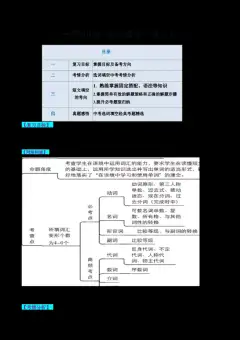
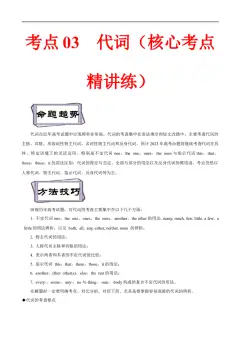
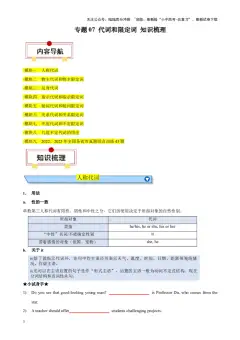
代词考点聚焦和精讲
【考代词考点聚焦】
1、人称代词主格和宾格的用法;
2、形容词物主代词与名词性性物主代词的用法;
3、反身代词的用法;
4、不定代词的用法;
5、指示代词的用法;
6、相互代词的用法;
7、疑问代词的用法;
8、it的用法
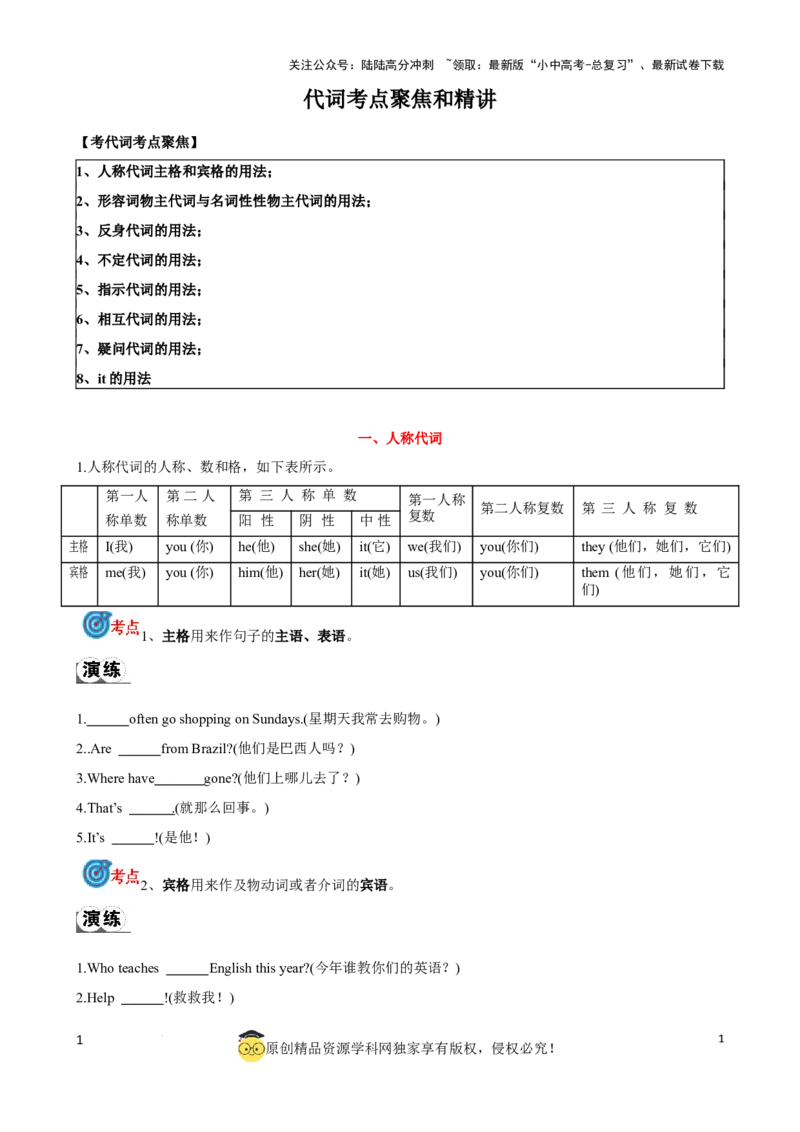
一、人称代词
1.人称代词的人称、数和格,如下表所示。
第一人 第二人 第 三 人 称 单 数 第一人称
第二人称复数 第 三 人 称 复 数
称单数 称单数 阳 性 阴 性 中 性 复数
主格 I(我) you (你) he(他) she(她) it(它) we(我们) you(你们) they (他们,她们,它们)
宾格 me(我) you (你) him(他) her(她) it(她) us(我们) you(你们) them (他们,她们,它
们)
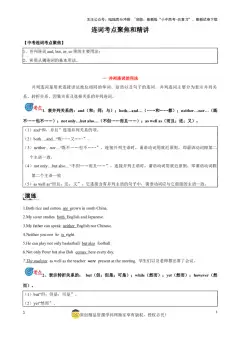
1、主格用来作句子的主语、表语。
1. often go shopping on Sundays.(星期天我常去购物。)
2..Are from Brazil?(他们是巴西人吗?)
3.Where have gone?(他们上哪儿去了?)
4.That’s .(就那么回事。)
5.It’s !(是他!)
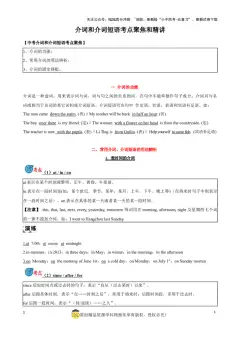
2、宾格用来作及物动词或者介词的宾语。
1.Who teaches English this year?(今年谁教你们的英语?)
2.Help !(救救我!)
1 1
原创精品资源学科网独家享有版权,侵权必究!
学科网(北京)股份有限公司关注公众号:陆陆高分冲刺 ~领取:最新版“小中高考-总复习”、最新试卷下载
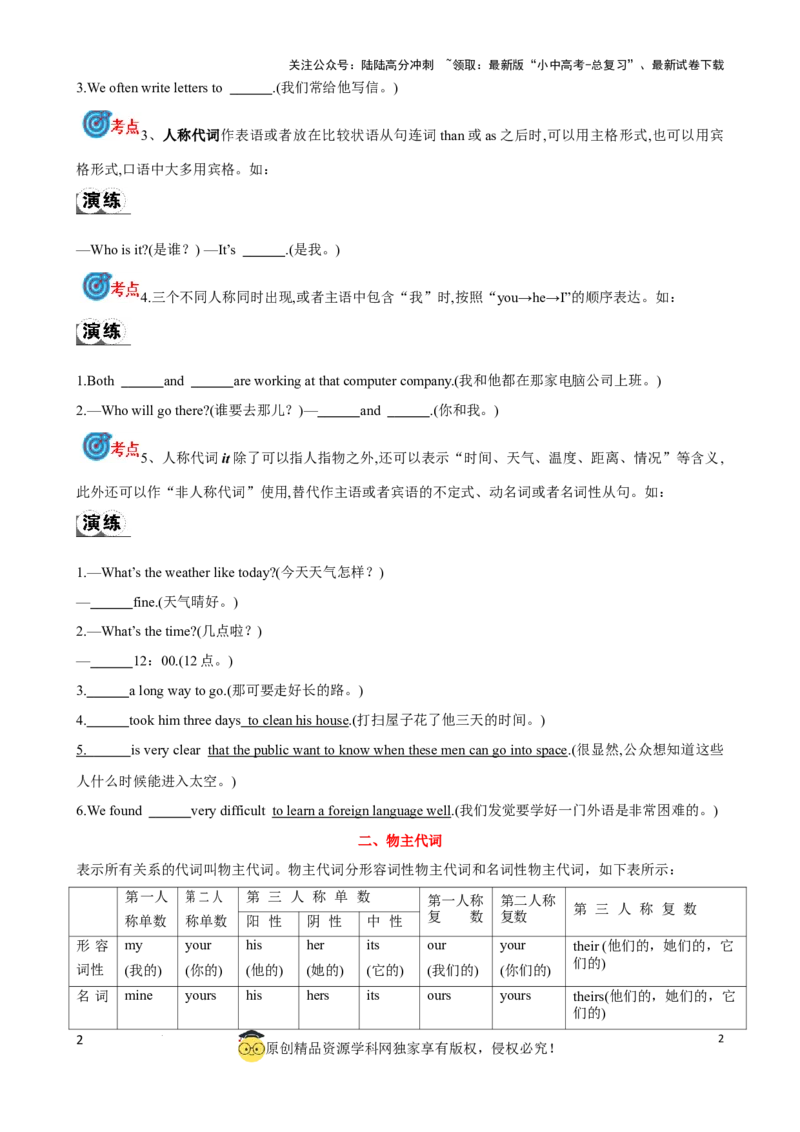
3.We often write letters to .(我们常给他写信。)
3、人称代词作表语或者放在比较状语从句连词than或as之后时,可以用主格形式,也可以用宾
格形式,口语中大多用宾格。如:
—Who is it?(是谁?) —It’s .(是我。)
4.三个不同人称同时出现,或者主语中包含“我”时,按照“you→he→I”的顺序表达。如:
1.Both and are working at that computer company.(我和他都在那家电脑公司上班。)
2.—Who will go there?(谁要去那儿?)— and .(你和我。)
5、人称代词it除了可以指人指物之外,还可以表示“时间、天气、温度、距离、情况”等含义,
此外还可以作“非人称代词”使用,替代作主语或者宾语的不定式、动名词或者名词性从句。如:
1.—What’s the weather like today?(今天天气怎样?)
— fine.(天气晴好。)
2.—What’s the time?(几点啦?)
— 12:00.(12点。)
3. a long way to go.(那可要走好长的路。)
4. took him three days to clean his house.(打扫屋子花了他三天的时间。)
5 . is very clear that the public want to know when these men can go into space.(很显然,公众想知道这些
人什么时候能进入太空。)
6.We found very difficult to learn a foreign language well.(我们发觉要学好一门外语是非常困难的。)
二、物主代词
表示所有关系的代词叫物主代词。物主代词分形容词性物主代词和名词性物主代词,如下表所示:
第一人 第二人 第 三 人 称 单 数 第一人称 第二人称
第 三 人 称 复 数
称单数 称单数 阳 性 阴 性 中 性 复 数 复数
形 容 my your his her its our your their (他们的,她们的,它
们的)
词性 (我的) (你的) (他的) (她的) (它的) (我们的) (你们的)
名 词 mine yours his hers its ours yours theirs(他们的,她们的,它
们的)
2 2
原创精品资源学科网独家享有版权,侵权必究!
学科网(北京)股份有限公司关注公众号:陆陆高分冲刺 ~领取:最新版“小中高考-总复习”、最新试卷下载
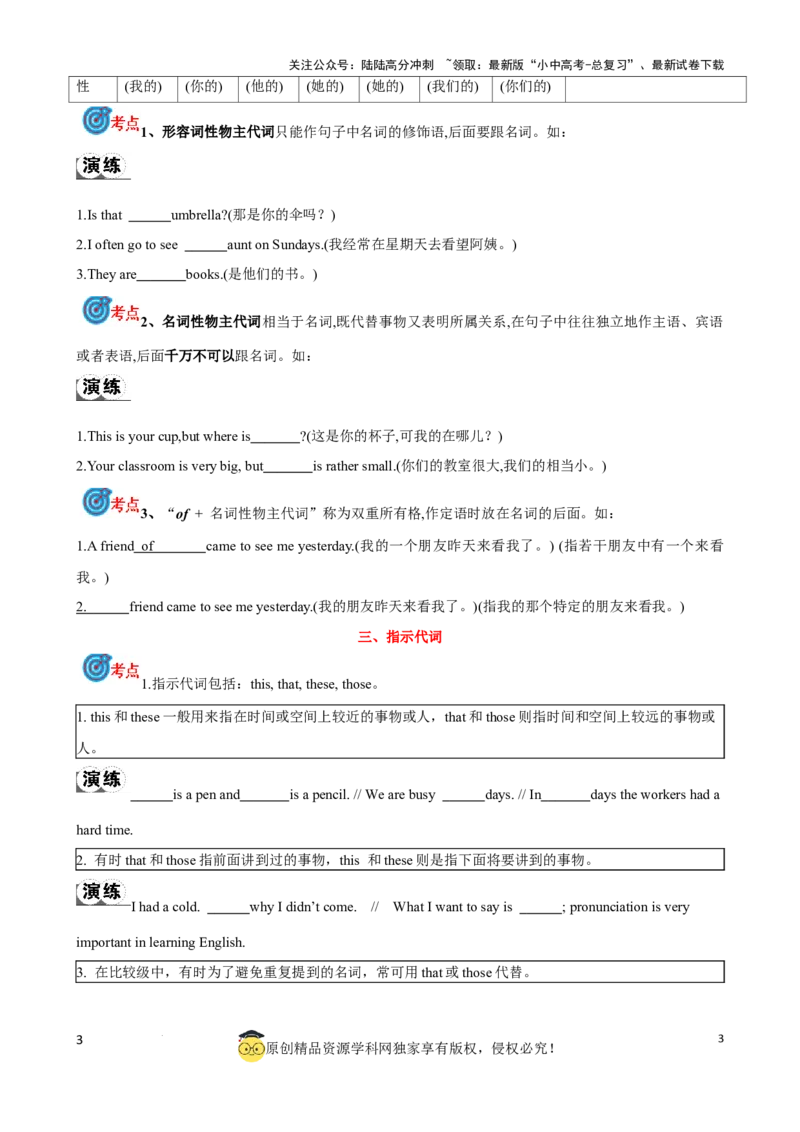
性 (我的) (你的) (他的) (她的) (她的) (我们的) (你们的)
1、形容词性物主代词只能作句子中名词的修饰语,后面要跟名词。如:
1.Is that umbrella?(那是你的伞吗?)
2.I often go to see aunt on Sundays.(我经常在星期天去看望阿姨。)
3.They are books.(是他们的书。)
2、名词性物主代词相当于名词,既代替事物又表明所属关系,在句子中往往独立地作主语、宾语
或者表语,后面千万不可以跟名词。如:
1.This is your cup,but where is ?(这是你的杯子,可我的在哪儿?)
2.Your classroom is very big, but is rather small.(你们的教室很大,我们的相当小。)
3、“of + 名词性物主代词”称为双重所有格,作定语时放在名词的后面。如:
1.A friend of came to see me yesterday.(我的一个朋友昨天来看我了。) (指若干朋友中有一个来看
我。)
2 . friend came to see me yesterday.(我的朋友昨天来看我了。)(指我的那个特定的朋友来看我。)
三、指示代词
1.指示代词包括:this, that, these, those。
1. this和these一般用来指在时间或空间上较近的事物或人,that和those则指时间和空间上较远的事物或
人。
is a pen and is a pencil. // We are busy days. // In days the workers had a
hard time.
2. 有时that和those指前面讲到过的事物,this 和these则是指下面将要讲到的事物。
I had a cold. why I didn’t come. // What I want to say is ; pronunciation is very
important in learning English.
3. 在比较级中,有时为了避免重复提到的名词,常可用that或those代替。
3 3
原创精品资源学科网独家享有版权,侵权必究!
学科网(北京)股份有限公司关注公众号:陆陆高分冲刺 ~领取:最新版“小中高考-总复习”、最新试卷下载
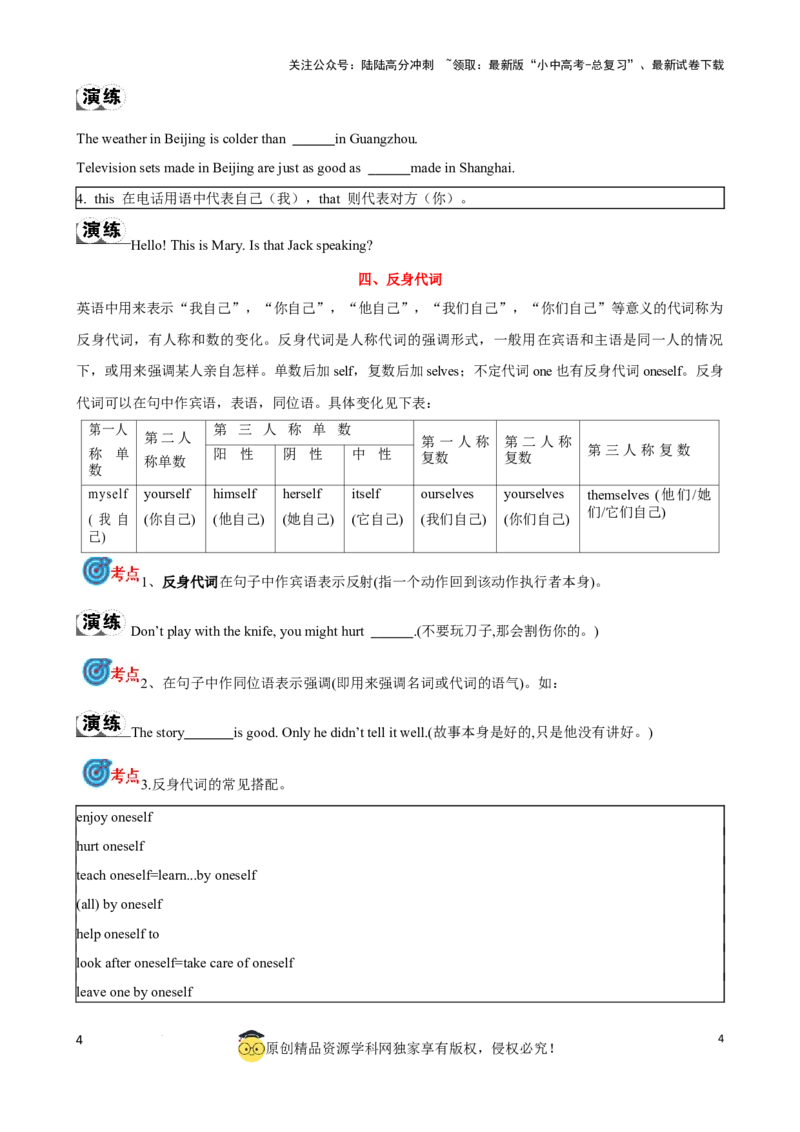
The weather in Beijing is colder than in Guangzhou.
Television sets made in Beijing are just as good as made in Shanghai.
4. this 在电话用语中代表自己(我),that 则代表对方(你)。
Hello! This is Mary. Is that Jack speaking?
四、反身代词
英语中用来表示“我自己”,“你自己”,“他自己”,“我们自己”,“你们自己”等意义的代词称为
反身代词,有人称和数的变化。反身代词是人称代词的强调形式,一般用在宾语和主语是同一人的情况
下,或用来强调某人亲自怎样。单数后加self,复数后加selves;不定代词one也有反身代词oneself。反身
代词可以在句中作宾语,表语,同位语。具体变化见下表:
第一人 第 三 人 称 单 数
第二人 第一人称 第二人称
第三人称复数
称 单 称单数 阳 性 阴 性 中 性 复数 复数
数
myself yourself himself herself itself ourselves yourselves themselves (他们/她
们/它们自己)
( 我 自 (你自己) (他自己) (她自己) (它自己) (我们自己) (你们自己)
己)
1、反身代词在句子中作宾语表示反射(指一个动作回到该动作执行者本身)。
Don’t play with the knife, you might hurt .(不要玩刀子,那会割伤你的。)
2、在句子中作同位语表示强调(即用来强调名词或代词的语气)。如:
The story is good. Only he didn’t tell it well.(故事本身是好的,只是他没有讲好。)
3.反身代词的常见搭配。
enjoy oneself
hurt oneself
teach oneself=learn...by oneself
(all) by oneself
help oneself to
look after oneself=take care of oneself
leave one by oneself
4 4
原创精品资源学科网独家享有版权,侵权必究!
学科网(北京)股份有限公司关注公众号:陆陆高分冲刺 ~领取:最新版“小中高考-总复习”、最新试卷下载
lose oneself in
dress oneself
make oneself at home
wash oneself
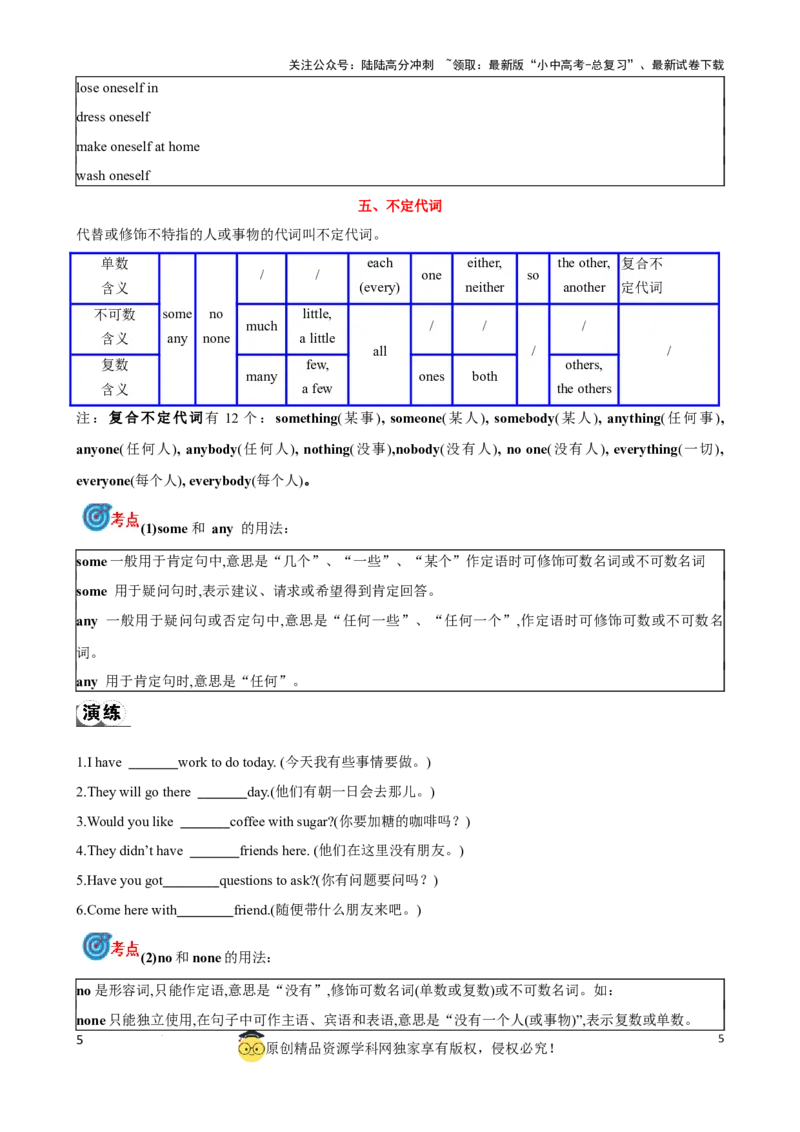
五、不定代词
代替或修饰不特指的人或事物的代词叫不定代词。
单数 each either, the other, 复合不
/ / one so
含义 (every) neither another 定代词
不可数 some no little,
much / / /
含义 any none a little
all / /
复数 few, others,
many ones both
含义 a few the others
注:复合不定代词有 12 个:something(某事), someone(某人), somebody(某人), anything(任何事),
anyone(任何人), anybody(任何人), nothing(没事),nobody(没有人), no one(没有人), everything(一切),
everyone(每个人), everybody(每个人)。
(1)some和 any 的用法:
some一般用于肯定句中,意思是“几个”、“一些”、“某个”作定语时可修饰可数名词或不可数名词
some 用于疑问句时,表示建议、请求或希望得到肯定回答。
any 一般用于疑问句或否定句中,意思是“任何一些”、“任何一个”,作定语时可修饰可数或不可数名
词。
any 用于肯定句时,意思是“任何”。
1.I have work to do today. (今天我有些事情要做。)
2.They will go there day.(他们有朝一日会去那儿。)
3.Would you like coffee with sugar?(你要加糖的咖啡吗?)
4.They didn’t have friends here. (他们在这里没有朋友。)
5.Have you got questions to ask?(你有问题要问吗?)
6.Come here with friend.(随便带什么朋友来吧。)
(2)no和none的用法:
no是形容词,只能作定语,意思是“没有”,修饰可数名词(单数或复数)或不可数名词。如:
none只能独立使用,在句子中可作主语、宾语和表语,意思是“没有一个人(或事物)”,表示复数或单数。
5 5
原创精品资源学科网独家享有版权,侵权必究!
学科网(北京)股份有限公司关注公众号:陆陆高分冲刺 ~领取:最新版“小中高考-总复习”、最新试卷下载
1.There is time left. Please hurry up.(没有时间了,请快点。)
2.They had reading books to lend.(他们没有阅读用书可以出借。)
3 . of them is/are in the classroom.(他们当中没有一个在教室里。)
4.I have many books, but is interesting.(我有很多的书,但没有一本是有趣的。)
(3)all和both的用法:
all指三者或三者以上的人或物,用来代替或修饰可数名词,也可用来代替或修饰不可数名词。
both指两个人或物,用来代替或修饰可数名词。all和both在句子中作主语、宾语、表语、定语等。如:
all和both既可以修饰名词(all/both+(the)+名词),也可以独立使用,采用“all/both + of the +名词(复数)”的形
式,其中的of 可以省略。
1.I know of the four British students in their school.(他们学校里四个英国学生我全认识。)
2.—Would you like this one or that one?
— .(你要这个还是那个?两个都要。)
3 . (of) (the) boys are naughty.(男孩们都调皮。)
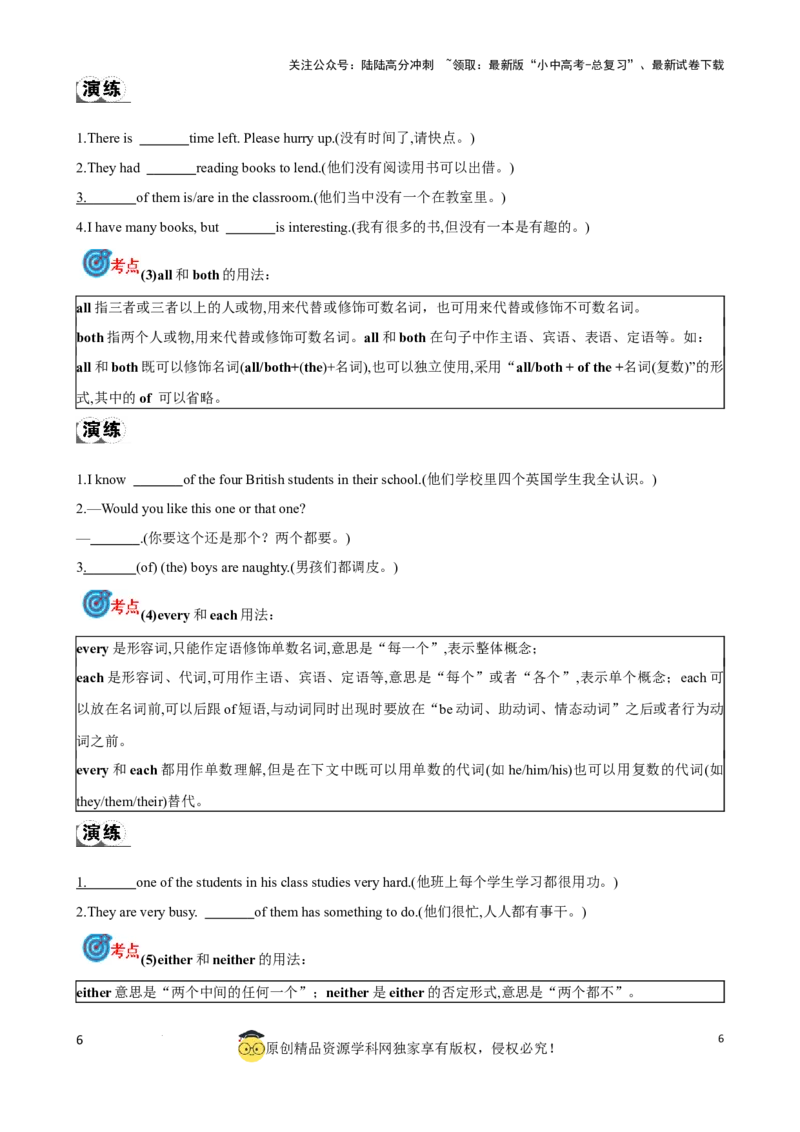
(4)every和each用法:
every是形容词,只能作定语修饰单数名词,意思是“每一个”,表示整体概念;
each是形容词、代词,可用作主语、宾语、定语等,意思是“每个”或者“各个”,表示单个概念;each可
以放在名词前,可以后跟of短语,与动词同时出现时要放在“be动词、助动词、情态动词”之后或者行为动
词之前。
every和each都用作单数理解,但是在下文中既可以用单数的代词(如he/him/his)也可以用复数的代词(如
they/them/their)替代。
1 . one of the students in his class studies very hard.(他班上每个学生学习都很用功。)
2.They are very busy. of them has something to do.(他们很忙,人人都有事干。)
(5)either和neither的用法:
either意思是“两个中间的任何一个”;neither是either的否定形式,意思是“两个都不”。
6 6
原创精品资源学科网独家享有版权,侵权必究!
学科网(北京)股份有限公司关注公众号:陆陆高分冲刺 ~领取:最新版“小中高考-总复习”、最新试卷下载
neither和either在句子中可作主语、宾语和定语等,都用作单数。
1.I don’t care much for what to drink. of the two will do. (我不介意喝些什么,两个之中随便哪个都行)
2.--Will you go there by bus or by car? – . I will go there by train.(——你坐公车去还是坐轿车去?——
一个都不坐,我坐火车去。)
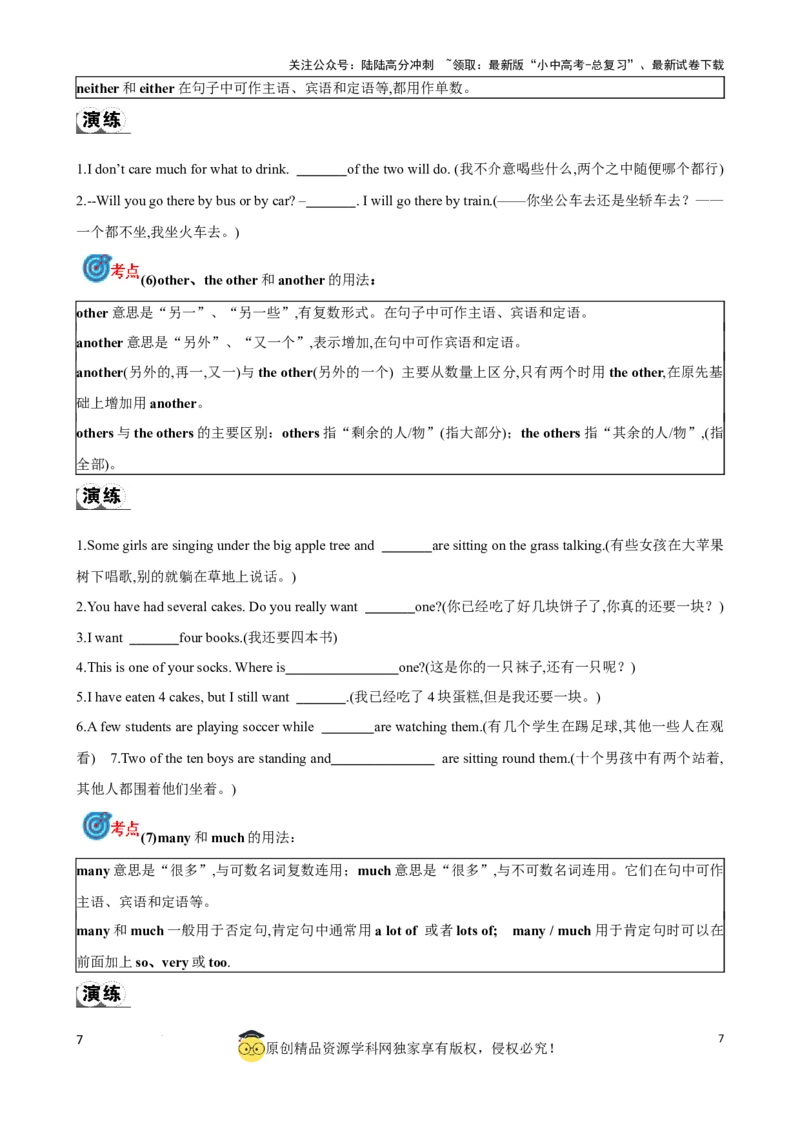
(6)other、the other和another的用法:
other意思是“另一”、“另一些”,有复数形式。在句子中可作主语、宾语和定语。
another意思是“另外”、“又一个”,表示增加,在句中可作宾语和定语。
another(另外的,再一,又一)与the other(另外的一个) 主要从数量上区分,只有两个时用the other,在原先基
础上增加用another。
others与the others的主要区别:others指“剩余的人/物”(指大部分);the others指“其余的人/物”,(指
全部)。
1.Some girls are singing under the big apple tree and are sitting on the grass talking.(有些女孩在大苹果
树下唱歌,别的就躺在草地上说话。)
2.You have had several cakes. Do you really want one?(你已经吃了好几块饼子了,你真的还要一块?)
3.I want four books.(我还要四本书)
4.This is one of your socks. Where is one?(这是你的一只袜子,还有一只呢?)
5.I have eaten 4 cakes, but I still want .(我已经吃了4块蛋糕,但是我还要一块。)
6.A few students are playing soccer while are watching them.(有几个学生在踢足球,其他一些人在观
看) 7.Two of the ten boys are standing and are sitting round them.(十个男孩中有两个站着,
其他人都围着他们坐着。)
(7)many和much的用法:
many意思是“很多”,与可数名词复数连用;much意思是“很多”,与不可数名词连用。它们在句中可作
主语、宾语和定语等。
many和much一般用于否定句,肯定句中通常用a lot of 或者lots of; many / much用于肯定句时可以在
前面加上so、very或too.
7 7
原创精品资源学科网独家享有版权,侵权必究!
学科网(北京)股份有限公司关注公众号:陆陆高分冲刺 ~领取:最新版“小中高考-总复习”、最新试卷下载
1.I don’t have friends here.(在这里我没有很多的朋友。)
2 . died in the bus accident.(许多人在公交车祸中丧失) /
3.We can learn with the help of him.(在他的帮助之下我们能学到很多)
4.They haven’t got work to do.(他们没有多少事情可做)
5.There are too people in the room.(房间里人太多了。)
(8)few、little、a few、a little的用法:
few、little意思是“很少几个”、“几乎没有”,有否定的意思,
a few、a little意思是“有几个”、“有些”,有肯定的意思 ;
few、a few与可数名词连用或代替可数的事物,
little、a little与不可数名词连用或代替不可数的事物。它们在句中可作主语、宾语和定语。
1.He is very poor and he has money.(他很穷,几乎没有什么钱。)
2.Don’t worry. There is still time left.(别着急,还有一点儿时间呢。)
3.In that polar region there live people.(在那个极地地区几乎不住人)
4.You can get sweets from him.(你可以从他那儿弄到一些糖果)
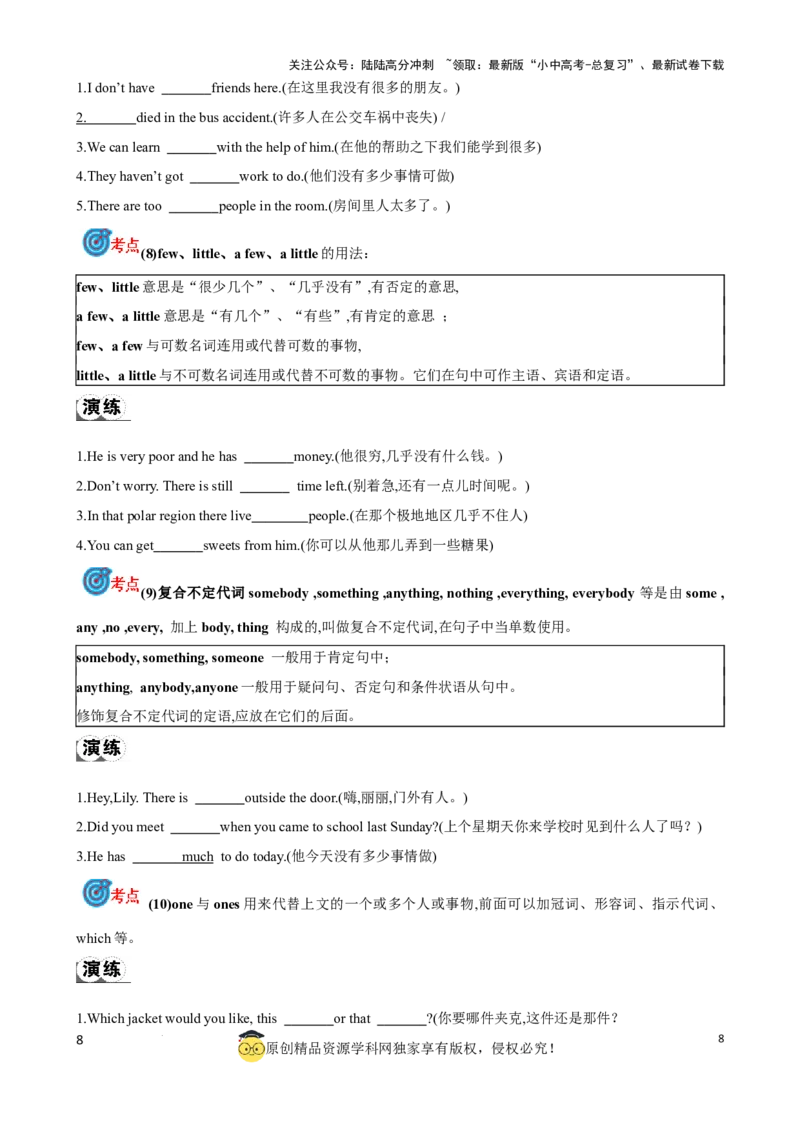
(9)复合不定代词somebody ,something ,anything, nothing ,everything, everybody等是由some ,
any ,no ,every, 加上body, thing 构成的,叫做复合不定代词,在句子中当单数使用。
somebody, something, someone 一般用于肯定句中;
anything, anybody,anyone一般用于疑问句、否定句和条件状语从句中。
修饰复合不定代词的定语,应放在它们的后面。
1.Hey,Lily. There is outside the door.(嗨,丽丽,门外有人。)
2.Did you meet when you came to school last Sunday?(上个星期天你来学校时见到什么人了吗?)
3.He has much to do today.(他今天没有多少事情做)
(10)one与ones用来代替上文的一个或多个人或事物,前面可以加冠词、形容词、指示代词、
which等。
1.Which jacket would you like, this or that ?(你要哪件夹克,这件还是那件?
8 8
原创精品资源学科网独家享有版权,侵权必究!
学科网(北京)股份有限公司关注公众号:陆陆高分冲刺 ~领取:最新版“小中高考-总复习”、最新试卷下载
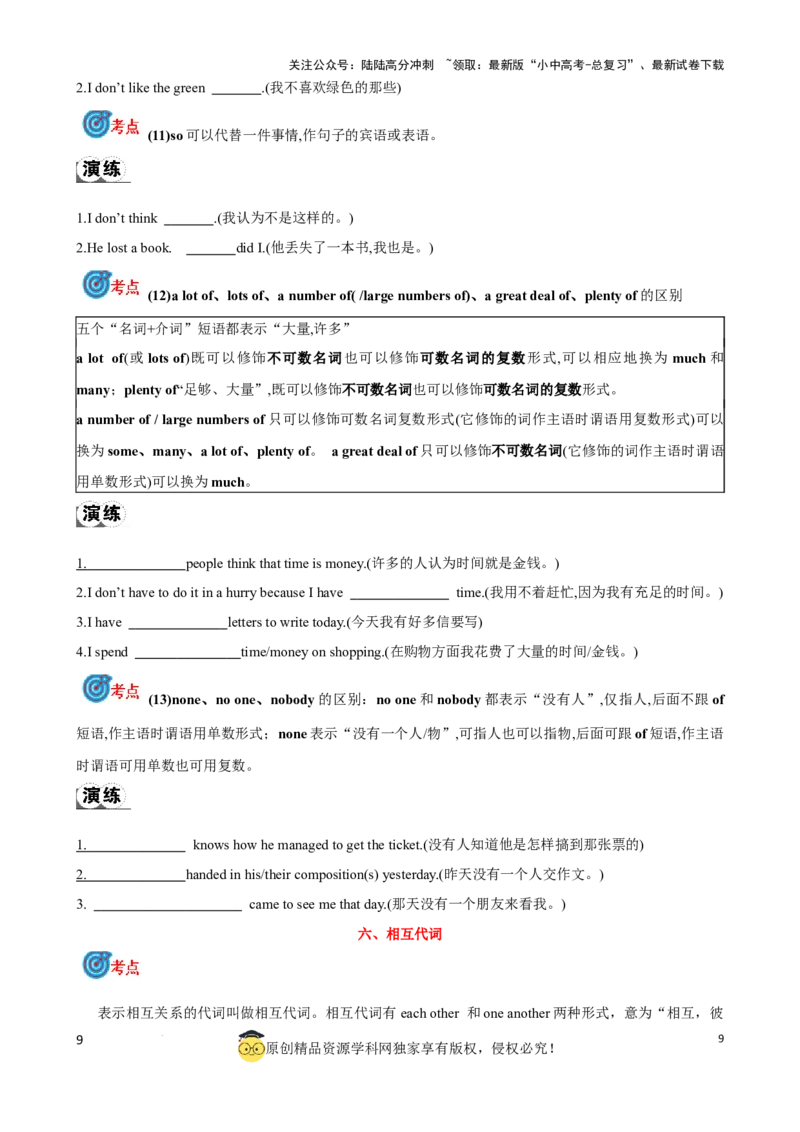
2.I don’t like the green .(我不喜欢绿色的那些)
(11)so可以代替一件事情,作句子的宾语或表语。
1.I don’t think .(我认为不是这样的。)
2.He lost a book. did I.(他丢失了一本书,我也是。)
(12)a lot of、lots of、a number of( /large numbers of)、a great deal of、plenty of的区别
五个“名词+介词”短语都表示“大量,许多”
a lot of(或lots of)既可以修饰不可数名词也可以修饰可数名词的复数形式,可以相应地换为 much和
many;plenty of“足够、大量”,既可以修饰不可数名词也可以修饰可数名词的复数形式。
a number of / large numbers of只可以修饰可数名词复数形式(它修饰的词作主语时谓语用复数形式)可以
换为some、many、a lot of、plenty of。 a great deal of只可以修饰不可数名词(它修饰的词作主语时谓语
用单数形式)可以换为much。
1 . people think that time is money.(许多的人认为时间就是金钱。)
2.I don’t have to do it in a hurry because I have time.(我用不着赶忙,因为我有充足的时间。)
3.I have letters to write today.(今天我有好多信要写)
4.I spend time/money on shopping.(在购物方面我花费了大量的时间/金钱。)
(13)none、no one、nobody的区别:no one和nobody都表示“没有人”,仅指人,后面不跟of
短语,作主语时谓语用单数形式;none表示“没有一个人/物”,可指人也可以指物,后面可跟of短语,作主语
时谓语可用单数也可用复数。
1 . knows how he managed to get the ticket.(没有人知道他是怎样搞到那张票的)
2 . handed in his/their composition(s) yesterday.(昨天没有一个人交作文。)
3. came to see me that day.(那天没有一个朋友来看我。)
六、相互代词
表示相互关系的代词叫做相互代词。相互代词有each other 和one another两种形式,意为“相互,彼
9 9
原创精品资源学科网独家享有版权,侵权必究!
学科网(北京)股份有限公司关注公众号:陆陆高分冲刺 ~领取:最新版“小中高考-总复习”、最新试卷下载
此”。在当代英语中,each other和one another没有什么区别。相互代词可在句中作宾语或定语。作定语
用时,相互代词用所有格形式。
We should learn from each other/one another. (作宾语) // Do you often write to each other/one another? (作宾语)
We often borrow each other’s/one another’s books. (作定语)
The students corrected each other’s / one another’s mistakes in their homework. (作定语)
七、疑问代词
用来构成特殊疑问句的代词叫疑问代词。疑问代词用于特殊疑问句中起名词词组的作用,一般
都放在句首,并在句子中作为某一句子成分。常用的疑问代词有下列几个:指人用who, whom, whose;
指物用what;既可指人又可指物用which。疑问代词的用法和区别如下:
疑问代词 意 义 功 能 例 句
主语 Who will go with you?
who 谁 表语 Who is the girl in red?
宾语(口语中, Who is your manager talking with? (宾语)
不 能 用 于 介 词
后)
whom 谁 宾语 Whom are you looking for? // To whom are you talking?
whose 谁的 主语、表语、 Which subject do you like best? (定语) // What’s your mother.
(表语)
what 什么 宾语、定语
What make you so happy?(主语) // Which woman is your
which 哪个/些
mother?(定语)
My bag is here. Whose bag is there? (定语)
what 一般指不定数目中的 What would you like to eat?
“什么,哪一个/些”选择范
What girls do you like best? 你喜欢什么样的姑娘?
围无限
What/
which指一定数目中的“哪 Which do you like better, apples or bananas?
which 一个”,有一定的选择范围
Which girls do you like best? 你喜欢哪几个姑娘?
在一些固定的场合,what也 What day of the week do you like best?
可指一定数目中的“什
What season do you like best?
么”,如四季、周、颜色等
what what询问人的职业 ---- What’s your mother? ---- She is a doctor.
who who询问人的关系、身份 ---- Who is the boy? ---- He is my brother.
疑问代词与关系代词
1. 疑问代词通常位于句首,引出特殊疑问句。
2. 关系代词用来引导宾语从句,或定语从句。what不能用在定语从句中充当关系代词,但that可用在定
语从句中作关系代词。宾语从句中的关系代词与疑问代词一致。
3. 无论是疑问代词还是关系代词,which和what所指范围不同。what所指的范围是无限的,而which则
指在一定范围内。
10 10
原创精品资源学科网独家享有版权,侵权必究!
学科网(北京)股份有限公司关注公众号:陆陆高分冲刺 ~领取:最新版“小中高考-总复习”、最新试卷下载
Which girls do you like best? 你最喜欢哪几个姑娘?// What girls do you like best? 你最喜欢什么样的姑娘。
4. whom是who的宾格,在口语中作宾语时,也可用 who代替,但在介词后只能用whom。
Who(m) did you meet on the street? 你在街上遇到了?
For whom are you waiting? 等谁?
八、it的用法
在初中英语学习中,我们经常会见到it,但是很多学生对it的用法掌握不牢,出现了很多错误。现将
it 的用法做个简单小结,帮助同学们正确理解和运用。
1. it 可用作人称代词,在句中可以做主语,也可以做宾语等。它可以指人,物或事。
⑴ it 指人时表示:说话者心目中不太清楚的那个人,常在打电话或敲门时用;指说话者心目中的那个
人。如:
⑵ it 指事物时,可指代有生命的东西(包括动物),也可指无生命的东西。注意 it指物时,表示同类同
物。如:
1.--- Who is knocking at the door? ---- me.
2.---- Who is that speaking? ---- me.
3.---- Who is the man? ---- is my father.
4.Who taught you maths last term? Was Mrs. Wang?
5.This is my dog. is very lovely.
6.I lost my pen. I didn’t find .
7.What is that? is a boat.
8.Don’t play football in the street. is very dangerous.
2. it 可以指代时间,天气,距离,气候,季节,长度,重量等。
1.---- What time is it? ---- is 11:20.
2.----What’s the weather like today? ---- is windy.
3.How long is from the school to your home?
11 11
原创精品资源学科网独家享有版权,侵权必究!
学科网(北京)股份有限公司关注公众号:陆陆高分冲刺 ~领取:最新版“小中高考-总复习”、最新试卷下载
3. it可代替动词不定式/动名词,在句中做形式主语。动词不定式/动名词作主语时,主语太
长,显得头重脚轻,为了避免这种现象,用it 代替动词不定式/动名词作主语,真正的主语不定式/动名词
放到句后。如:
1.To learn a foreign language is not easy.可写成 .
2.Getting everything ready in time was very difficult.可写成 .
4. it 可以做形式宾语,在少数动词后可以代替动词不定式/动名词做宾语(后面跟有宾语补足
语)。像 find, think, believe, make, feel等。常用在“主语+v.+it+宾补(adj./n)+不定式/动名词”结构。
如:
1.I find difficult to learn English.
2.He thinks easy to work out this maths problem.
5. 强调句型:It is/was+被强调部分+that/who+其他部分。当强调的部分是人,且为句子的主语
时,用who;如果不强调人一律用that。除谓语部分外,句中的任何成分都可以被强调。
1.I met John in the street yesterday.
2.It was who met John in the street yesterday.(强调主语)
3.It was that I met John.(强调地点状语,不可用where)
4.It was that I met in the street yesterday.(强调宾语)
5;It was that I met John in the street.(强调时间状语,不可用who)
题组1 用适当的代词填空
1.— W volleyball is this?
—It must be Carla's. She loves volleyball.
2.It's not safe to leave a baby in a car by (它自己).
3.People often ask (we) why we're doing this.
4. (they) lifestyle is very simple, but they know more about animals and plants than most people do.
12 12
原创精品资源学科网独家享有版权,侵权必究!
学科网(北京)股份有限公司关注公众号:陆陆高分冲刺 ~领取:最新版“小中高考-总复习”、最新试卷下载
5.Perhaps when you next go for a walk with your family, you can examine the trees you pass to see (它的)
age.
6.Now he works to spread kindness everywhere through projects which help others. He calls (he) action
the Race to Kindness.
7.Now, she enjoys (her) when talking with us every day.
8.He is wise and always helpful, taking care of me and (we)younger sister, Sarah.
9.She thought it was cool that there were many different shapes and sizes of drums, and she wanted to hit
(they), to see what they sounded like.
10.However, every time you exercise, you put (你自己)at the risk of getting hurt, so remember to do it in
a right way.
11.Suddenly, she heard some shouting and turned to see a big, orange object coming towards (she).
12.With the help of his father-in-law, a builder, he moved into a comfortable new home after only four months.
only cost $4,700 to build this house.
13.Nature can often give them (一切) they need to survive.
14.I met a friend of (她的)in the street yesterday.
15.During the party, many activities are organized for kids so that they can enjoy (他们自己).
题组2填空题
1.And the children next to you enjoy (they), singing and laughing.
2.Thanks to (they) hard work, the first irrigation(灌溉)network in the world appeared.
3.Will's friends could hear (he) reporting the emergency.
4.The curator(馆长) was proud to have such a painting in (he) museum and congratulated John on
his discovery.
5.When the old lady got in, Andrea could see that she was in a long dress and had a hat pulled down low over
(she) eyes.
6.My father said if I couldn't make fifty rupees today,he wouldn't allow (I) to eat anything.
7.—Is that your car?
—No, m is parked over the road.
8.Ms. Yang said she based the boy on a student of (她的)years ago.
9.Mike decides to do (anything). He produces chemicals(化学物质).
10.Do you notice pictures or paintings? Maybe most of them are created by your classmates and
(你自己), using your own heads and hands.
11.Schools should do something to help students protect .
13 13
原创精品资源学科网独家享有版权,侵权必究!
学科网(北京)股份有限公司关注公众号:陆陆高分冲刺 ~领取:最新版“小中高考-总复习”、最新试卷下载
12.Sometimes we have to go deep inside to solve our problems.
13.I was doing some shopping in the supermarket when I met a friend of (我的).
14.It's my great pleasure to help others because to help others is to help m .
15.Suppose you saw a big bag left behind by someone on the street. There was (没有人) around
you.
16. (两者都不) of the twin sisters likes the cheesecake because it is too sweet.
题组3选择题
1.(2023·山东东营·统考中考真题)—Lily, put your books into your schoolbag.
—They’re not ________. They are Lucy’s.
A.his B.hers C.mine D.yours
2.(2023·山东东营·统考中考真题)—Has ________ ever been to Mars?
—No, not yet. Maybe in the future.
A.nobody B.anybody C.somebody D.everybody
3.(2023·江苏徐州·中考真题)________ other nurses in the hospital have worked here longer than Helen;
only Lucy and Mary started working here before her.
A.All B.Most C.Some D.Few
4.(2023·辽宁丹东·统考中考真题)Miss Liu teaches English very well. We all like ________ classes.
A.your B.their C.his D.her
5.(2023·辽宁丹东·统考中考真题)— ________ is this basketball?
— Perhaps it’s our English teacher’s. He likes sports.
A.Whose B.Where C.How D.Which
6.(2023·四川雅安·统考中考真题)—Mr. Brown, I find ________ hard to learn English well.
—Come on! Practice makes perfect.
A.that B.it C.this D.its
7.(2023·江苏宿迁·统考中考真题)— Sandy is well organized.
— Exactly. ________ in her room is in good order.
A.Something B.Everything C.Nothing D.None
8.(2023·北京·统考中考真题)My sister enjoys singing and ________ favorite subject is music.
A.his B.her C.your D.their
9.(2023·辽宁抚顺·统考中考真题)—Bob, what’s your dream job, a doctor or a teacher?
—________. I want to be a policeman.
A.Both B.Either C.None D.Neither
14 14
原创精品资源学科网独家享有版权,侵权必究!
学科网(北京)股份有限公司关注公众号:陆陆高分冲刺 ~领取:最新版“小中高考-总复习”、最新试卷下载
10.(2023·吉林长春·统考中考真题)_______ of my parents can swim. They are going to learn it this
summer.
A.Neither B.Either C.All D.None
11.(2023·新疆·中考真题)—Jack, when are we going to buy a birthday gift for our grandma, today or
tomorrow?
— ___________ are OK. I am available.
A.All B.Both C.Neither D.None
12.(2023·辽宁·统考中考真题)I tried to buy the dictionary in two bookstores, but ________ of them had it.
A.both B.all C.neither D.none
13.(2023·辽宁营口·中考真题)Daming is happy today because he helped ________ look for a set of keys on
his way home.
A.nobody B.anybody C.somebody D.everybody
14.(2023·吉林·统考中考真题)—________ is it from our school to the new bookstore, Li Lei?
—Only one kilometer.
A.How far B.How long C.How soon
15.(2023·湖北鄂州·统考中考真题)—Mum, where is my father? I want to give ________ a gift.
—Oh, he is out.
A.me B.your C.him D.her
16.(2023·黑龙江·统考中考真题)We won’t believe it until ________ see it with ________ own eyes.
A.our; us B.we; our C.we; ours
17.(2023·黑龙江齐齐哈尔·统考中考真题)Teachers often say that teenagers should learn to look after
________.
A.ourselves B.yourselves C.themselves
18.(2023·四川乐山·统考中考真题)—Who is the lady in red over there?
—Mrs Smith. She teaches ________ chemistry.
A.we B.us C.our
18.(2023·四川乐山·统考中考真题)—________ do you go swimming, Sam?
—Every Sunday afternoon.
A.How often B.How soon C.How long
19.(2023·湖南株洲·统考中考真题)Although the storm broke many things apart, it brought ________ closer
together.
A.we B.us C.our
15 15
原创精品资源学科网独家享有版权,侵权必究!
学科网(北京)股份有限公司关注公众号:陆陆高分冲刺 ~领取:最新版“小中高考-总复习”、最新试卷下载
20.(2023·广西·统考中考真题)— Frank, is this your bag?
—No, it’s not ________.
A.mine B.yours C.his
21.(2023·广西·统考中考真题)—________ is it from your school to the Nature Museum?
— About 3 kilometres.
A.How far B.How old C.How much
22.(2023·湖南郴州·统考中考真题)—My best friend is more popular than me. I want to be like him.
—It’s not necessary to be the same. You should just be ________.
A.himself B.yourself C.myself
23.(2023·福建·统考中考真题)—Harry, is this your basketball?
—Yes, it’s ________.
A.his B.yours C.mine
24.(2023·北京·统考中考真题)—________ do you tidy your own room?
—Twice a week.
A.How often B.How soon C.How much D.How long
25.(2023·福建·统考中考真题)— ________ is it from our home to the museum, Dad?
— It’s about two kilometers.
A.How far B.How often C.How soon
26.(2023·湖北荆州·统考中考真题)—Hi, Bob! Shall we fly kites this Sunday?
—Good idea! Remember to call _______ then.
A.I B.me C.my D.mine
27.(2023·湖北恩施·中考真题)The girl with a pair of glasses is Nancy. ________ father is my English
teacher.
A.His B.Her C.Your
28.(2023·辽宁抚顺·统考中考真题)— ________ have you been a member of the football team?
—For two years.
A.How much B.How often C.How many D.How long
29.(2023·江苏无锡·统考中考真题)Think about it and ask ________: have you really done everything right?
A.you B.yourself C.me D.myself
30.(2023·四川遂宁·中考真题)— I saw your grandma using Douyin on the phone. Who taught her?
— Nobody. She taught ________.
A.himself B.myself C.herself D.yourself
16 16
原创精品资源学科网独家享有版权,侵权必究!
学科网(北京)股份有限公司关注公众号:陆陆高分冲刺 ~领取:最新版“小中高考-总复习”、最新试卷下载
31.(2023·辽宁·统考中考真题)—Is this ________ hat?
—Yes, I got it from my grandfather as a birthday gift.
A.his B.her C.your D.my
32.(2023·吉林·统考中考真题)Lily will arrive in Changchun tomorrow. Let’s have a party for ________.
A.her B.she C.herself
33.(2023·辽宁·统考中考真题)—________ is it from your home to school?
—About three kilometers.
A.How long B.How much C.How far D.How often
34.(2023·青海·统考中考真题)—________ did you stay in Huangyuan during their Lantern Festival?
—For six days.
A.How long B.How often C.How soon
35.(2023·青海·统考中考真题)To _______ surprise, local villagers are successful in planting strawberries
without soil in Hainan.
A.we B.our C.us
36.(2023·山东菏泽·统考中考真题)—Hurry up! The bus is leaving soon.
—Don’t worry. There is ________ time left.
A.no B.little C.a little
题组4语法选择
A young man was driving down a suburban (郊区的) street, going a bit too fast in 1 new car. There
were many kids playing between the cars parked on the side of the street.
As his car passed, a child suddenly appeared and threw a brick at the car. The man stopped the car and
jumped out. He grabbed the kid and shouted at 2 , “What are you doing?” He continued yelling, “That's a
new car. 3 will be expensive to fix the damage you did with that brick. 4 did you do it?”
“I'm sorry. I didn't know 5 to do! It's my brother,” he said. “He rolled off the curb (马路牙子) and fell
out of his wheelchair (轮椅). I can't lift him up.” The boy asked the man, “Would you please help me get him back
into his wheelchair? He's hurt and he's too heavy for 6 .”
The young man swallowed (吞咽) and said 7 . He lifted the kid's brother back into the wheelchair.
“Thank you, sir,” the child said. The man then watched the little boy push his brother toward 8 home.
The young man did not repair the dent (凹痕) in his car. He kept it to remind 9 not to go through life so
fast that someone has to throw a brick to get his attention. Sometimes, when you don't make the time to listen, life
throws a brick at 1 0 head.
1.A.him B.he C.his D.himself
17 17
原创精品资源学科网独家享有版权,侵权必究!
学科网(北京)股份有限公司关注公众号:陆陆高分冲刺 ~领取:最新版“小中高考-总复习”、最新试卷下载
2.A.he B.his C.him D.himself
3.A.It B.This C.That D.It's
4.A.What B.When C.Why D.How
5.A.what B.who C.which D.whom
6.A.I B.me C.he D.him
7.A.something B.anything C.everything D.nothing
8.A.her B.them C.their D.theirs
9.A.he B.him C.his D.himself
10.A.you B.your C.his D.yours
题组5短文填空
Since last year, because of the outbreak of COVID-19, many people who have had to stay at home have been
eating takeaways(外卖).
M 1 people like takeaways. First, it's convenient(方便的). Thanks to takeaway services, plenty of
restaurants now sell their food through the internet. Moreover, one of the most important reasons why people like
takeaway food is that 2 is also really cheap.
However, there are also s 3 disadvantages(缺点). For example, some restaurants add too much salt,
sugar and oil to 4 (they) food. People who eat it often will put on weight easily. This can even increase the
risk of heart disease(心脏病).
From 5 (I)point of view, we should probably cook for 6 (we)as long as we have time. Cooking
dinner together with other family members can be an enjoyable experience.
1. 2. 3. 4. 5. 6.
18 18
原创精品资源学科网独家享有版权,侵权必究!
学科网(北京)股份有限公司关注公众号:陆陆高分冲刺 ~领取:最新版“小中高考-总复习”、最新试卷下载
19 19
原创精品资源学科网独家享有版权,侵权必究!
学科网(北京)股份有限公司