关注公众号:陆陆高分冲刺 ~领取:最新版“小中高考-总复习”、最新试卷下载
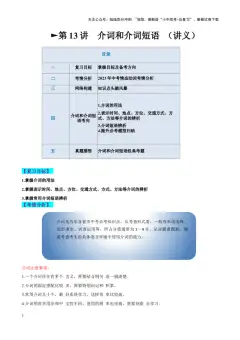
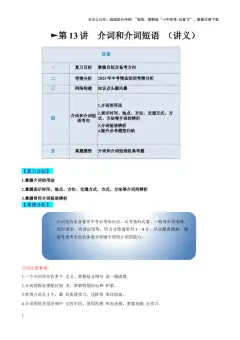
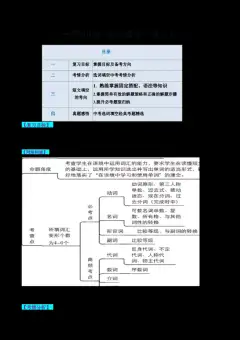
介词和介词短语考点聚焦和精讲
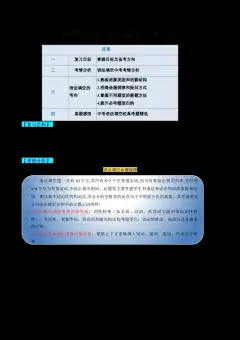
【中考介词和介词短语考点聚焦】
1、介词的功能;
2、常用介词的用法辨析;
3、介词的固定搭配。
一 介词的功能
介词是一种虚词,用来表示词与词,词与句之间的关系的词。在句中不能单独作句子成分。介词可与名
词或相当于名词的其它词构成介词短语。介词短语可在句中 作定语,状语,表语和宾语补足语。如:
The man came down the stairs. (状) // My mother will be back in half an hour. (状)
The boy over there is my friend. (定) // The woman with a flower on her head is from the countryside. (定)
The teacher is now with the pupils. (表) // Li Ting is from Guilin. (表) // Help yourself to some fish. (宾语补足语)
二、常用介词、介词短语的用法辧祈
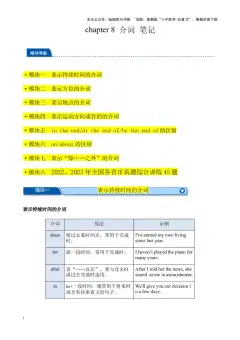
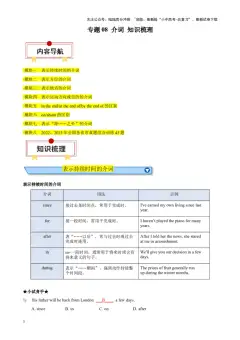
1 . 表时间的介词
( 1 ) at / in / on
at表示在某个时刻或黎明、正午、黄昏、午夜前。
in表示在一段时间里(如:某个世纪,季节,某年,某月,上午,下午,晚上等)(在将来时句子中则表示
在一段时间之后)。on表示在具体的某一天或者某一天的某一段时间。
【注意】 this, that, last, next, every, yesterday, tomorrow等词用在morning, afternoon, night及星期的七个词
前一律不能加介词。如:I went to Hangzhou last Sunday.
1. 7:00; noon; midnight
2. summer; 2013; three days; May; winter;
the morning; the afternoon
3 . Monday; the morning of June 1st; a cold day; Monday;
July 1st; Sunday morning
( 2 ) since / after / fo r
since后加时间点或过去时的句子,表示“自从(过去某时)以来”。
1 1
原创精品资源学科网独家享有版权,侵权必究!
学科网(北京)股份有限公司关注公众号:陆陆高分冲刺 ~领取:最新版“小中高考-总复习”、最新试卷下载
after后跟具体时刻,表示“在……时刻之后”,常用于将来时;后跟时间段,多用于过去时。
for后跟一段时间,表示“(持/延续)……之久”。
1.She has worked here 2000. 自2000年以来,她就在这里工作。
2.He said that he would be here 6:00. 他说他六点钟之后会来这儿。
3.We have lived in China two years. 我们已经在中国住了两年。
( 3 ) before / ag o
ago立足于现在,表示从现在起,若干时间前;ago通常与一般过去时连用,不能与完成时连用。
before立足过去,表示从过去某一时刻起,若干时间以前,before通常与过去完成时连用。
1.I met him three years . (距今)
2.I had met him three years . (距当时)
( 4 ) during / until / before / by
during表示“在……期间”。
until表示“直到……为止”。
before表示“在……之前”。
by表示“到……为止”。
1.I enjoyed myself the summer vacation. 我在暑假期间玩得很高兴。
2.I won’t leave you come back. 我将不离开,直到你回来。
3.Wash hands dinner. 饭前要洗手。
4.I will go there six. 我六点前会去那里。
2. 表示地点、方位的介词
( 1 ) 方位介词 at / in / on
at表示地点:用于指较小的地方或用于门牌号码前。
in表示地点:用于指较大的地方或虽然是很小的地方,如果说话人住在那里,也可用 in。商店、学校、
机关等,若看作一个地点(point)用at,若看作一个场所(place)用in。
on表示地点,一般指与面或线接触(在某一层楼上),意为“在……上;在……旁”。
2 2
原创精品资源学科网独家享有版权,侵权必究!
学科网(北京)股份有限公司关注公众号:陆陆高分冲刺 ~领取:最新版“小中高考-总复习”、最新试卷下载
1.I shall wait for you the station.
2.He lives 115 Zhongshan Road.
3.He lives Shanghai.
4.I met him the post-office.
5.I’m now working the post-office.
6.The picture was hanging the wall.
7.New York is the Hudson River.
( 2 ) “上下”介词 over / above / on / below / unde r
over表示位置高于某物,在某物的正上方,其反义词是under;over还有“覆盖在……上面”之意。如:
above也表示位置高于某物,但不一定在正上方,其反义词是below。
on指两个物体表面接触,一个在另一个的上面。
1.There is a bridge the river.
2.The cat is lying the chair.
3.There’s a piece of cloth the table.
4.We flew the clouds.
5.They put some flowers the teacher’s desk.
( 3 ) in / on / to+ 方位名词
in表示A地在B地范围之内。
to表示A地在B地范围之外,即二者之间有距离间隔。
on表示A地与B地接壤、毗邻。
3 3
原创精品资源学科网独家享有版权,侵权必究!
学科网(北京)股份有限公司关注公众号:陆陆高分冲刺 ~领取:最新版“小中高考-总复习”、最新试卷下载
1.Taiwan is the southeast of China.
2.Beijing is the north of China.
3.Japan lies the east of China.
4.North Korea is the east of China.
( 4 ) “前后”介词 in front of / in the front of / behind / befor e
in front of…意为“在……前面”,指甲物在乙物之前,两者互不包括;其反义词是 behind(在……的后
面)。
in the front of 意为“在……的前部”,即甲物在乙物的内部。反义词是at the back of…(在……范围内的
后部)。
behind表示在某一位置之后。
before意为“在……前面”,表示位置、顺序。
1.There are some flowers the house. 房子前面有些花卉。
2.There is a blackboard our classroom. 我们的教室前边有一块黑板。
3.There’s a pay phone the library and a swimming pool behind it. 图书馆前面有个投币式
电话,后面有个游泳池。
4.Spring comes summer.
( 5 ) “左右”介词 on the left / right o f ;“旁边”介词 beside / by ;“对面”介词 across /
from。
Linda sits me, just my lef t. 琳达坐在我旁边,正好在我左边。
( 6 )“里外”介词 in / inside / into / outside / out o f
in 在……内部。
inside在……里面/到……里面(强调以……为界),反义词outside在……外面。
into到……内,其反义短语为out of。
1.The pen is my pencil case. 钢笔在我的铅笔盒里。
4 4
原创精品资源学科网独家享有版权,侵权必究!
学科网(北京)股份有限公司关注公众号:陆陆高分冲刺 ~领取:最新版“小中高考-总复习”、最新试卷下载
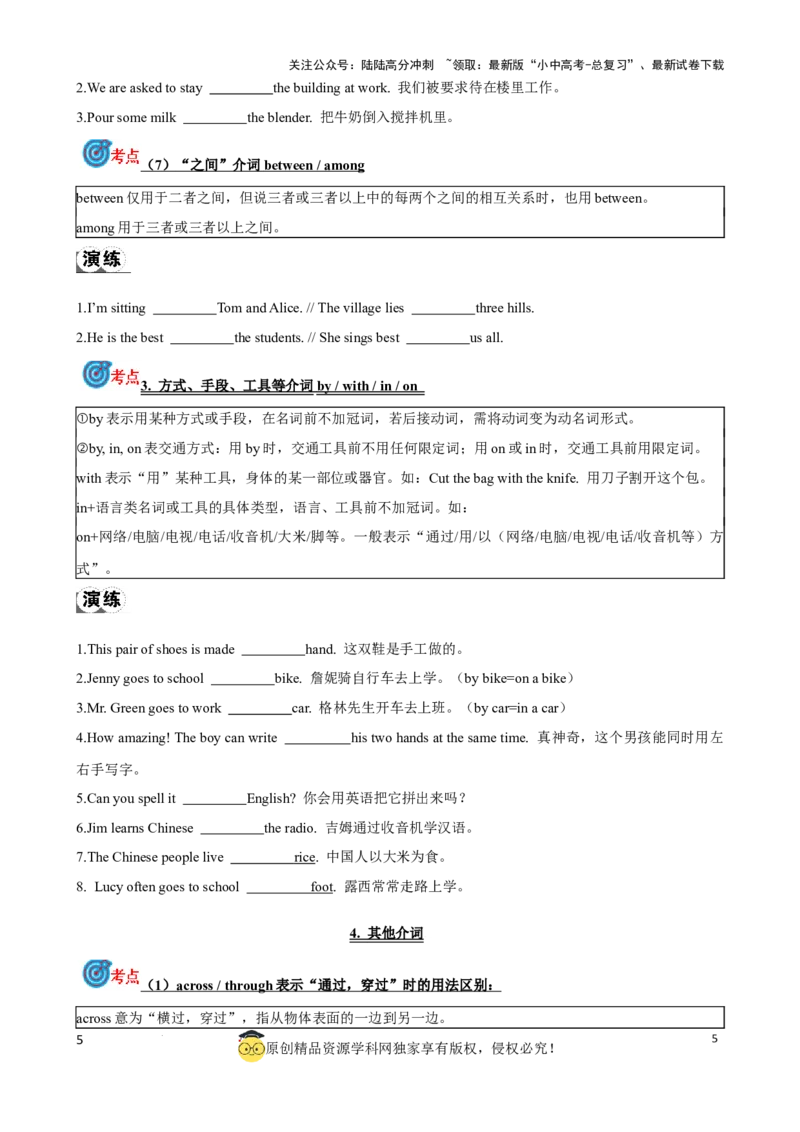
2.We are asked to stay the building at work. 我们被要求待在楼里工作。
3.Pour some milk the blender. 把牛奶倒入搅拌机里。
( 7 ) “之间”介词 between / amon g
between仅用于二者之间,但说三者或三者以上中的每两个之间的相互关系时,也用between。
among用于三者或三者以上之间。
1.I’m sitting Tom and Alice. // The village lies three hills.
2.He is the best the students. // She sings best us all.
3. 方式、手段、工具等介词 by / with / in / on
①by表示用某种方式或手段,在名词前不加冠词,若后接动词,需将动词变为动名词形式。
②by, in, on表交通方式:用by时,交通工具前不用任何限定词;用on或in时,交通工具前用限定词。
with表示“用”某种工具,身体的某一部位或器官。如:Cut the bag with the knife. 用刀子割开这个包。
in+语言类名词或工具的具体类型,语言、工具前不加冠词。如:
on+网络/电脑/电视/电话/收音机/大米/脚等。一般表示“通过/用/以(网络/电脑/电视/电话/收音机等)方
式”。
1.This pair of shoes is made hand. 这双鞋是手工做的。
2.Jenny goes to school bike. 詹妮骑自行车去上学。(by bike=on a bike)
3.Mr. Green goes to work car. 格林先生开车去上班。(by car=in a car)
4.How amazing! The boy can write his two hands at the same time. 真神奇,这个男孩能同时用左
右手写字。
5.Can you spell it English? 你会用英语把它拼出来吗?
6.Jim learns Chinese the radio. 吉姆通过收音机学汉语。
7.The Chinese people live ric e. 中国人以大米为食。
8. Lucy often goes to school foo t. 露西常常走路上学。
4. 其他介词
( 1 ) across / through 表示“通过,穿过”时的用法区别:
across意为“横过,穿过”,指从物体表面的一边到另一边。
5 5
原创精品资源学科网独家享有版权,侵权必究!
学科网(北京)股份有限公司关注公众号:陆陆高分冲刺 ~领取:最新版“小中高考-总复习”、最新试卷下载
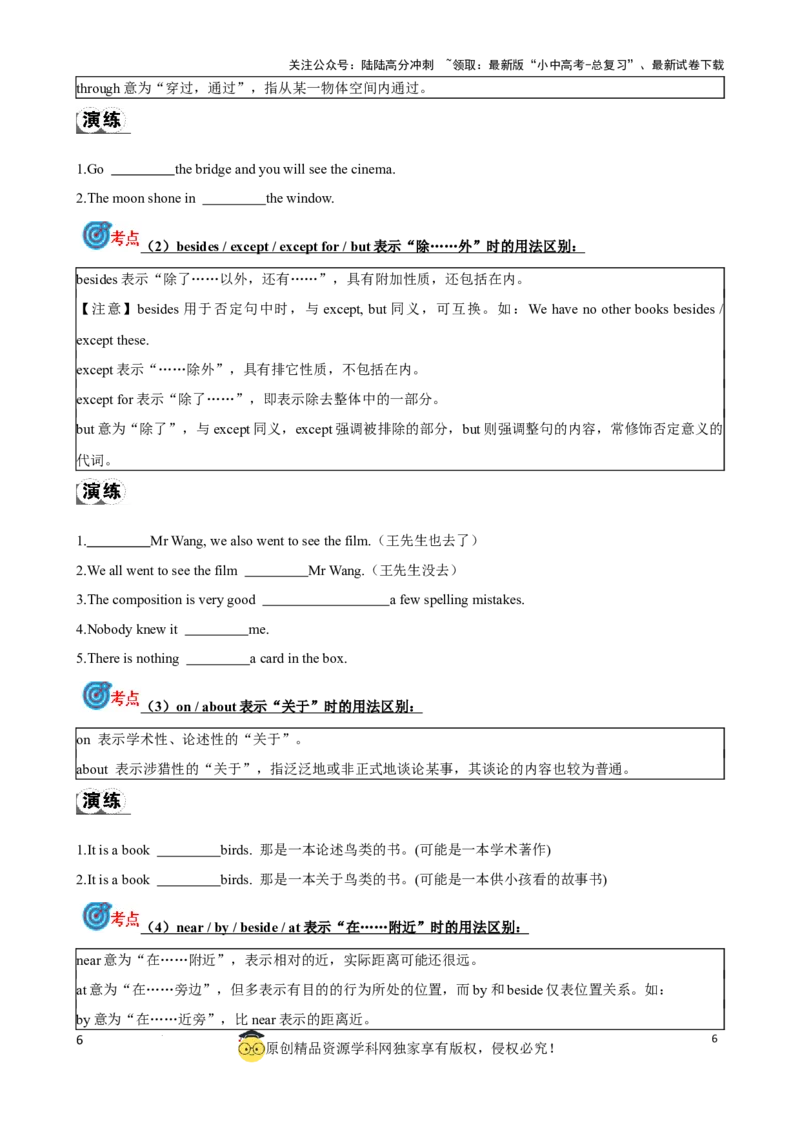
through意为“穿过,通过”,指从某一物体空间内通过。
1.Go the bridge and you will see the cinema.
2.The moon shone in the window.
( 2 ) besides / except / except for / bu t 表示“除 …… 外”时的用法区别:
besides表示“除了……以外,还有……”,具有附加性质,还包括在内。
【注意】besides用于否定句中时,与 except, but 同义,可互换。如:We have no other books besides /
except these.
except表示“……除外”,具有排它性质,不包括在内。
except for表示“除了……”,即表示除去整体中的一部分。
but意为“除了”,与except同义,except强调被排除的部分,but则强调整句的内容,常修饰否定意义的
代词。
1. Mr Wang, we also went to see the film.(王先生也去了)
2.We all went to see the film Mr Wang.(王先生没去)
3.The composition is very good a few spelling mistakes.
4.Nobody knew it me.
5.There is nothing a card in the box.
( 3 ) on / abou t 表示“关于”时的用法区别:
on 表示学术性、论述性的“关于”。
about 表示涉猎性的“关于”,指泛泛地或非正式地谈论某事,其谈论的内容也较为普通。
1.It is a book birds. 那是一本论述鸟类的书。(可能是一本学术著作)
2.It is a book birds. 那是一本关于鸟类的书。(可能是一本供小孩看的故事书)
( 4 ) near / by / beside / a t 表示“在……附近”时的用法区别:
near意为“在……附近”,表示相对的近,实际距离可能还很远。
at意为“在……旁边”,但多表示有目的的行为所处的位置,而by和beside仅表位置关系。如:
by意为“在……近旁”,比near表示的距离近。
6 6
原创精品资源学科网独家享有版权,侵权必究!
学科网(北京)股份有限公司关注公众号:陆陆高分冲刺 ~领取:最新版“小中高考-总复习”、最新试卷下载
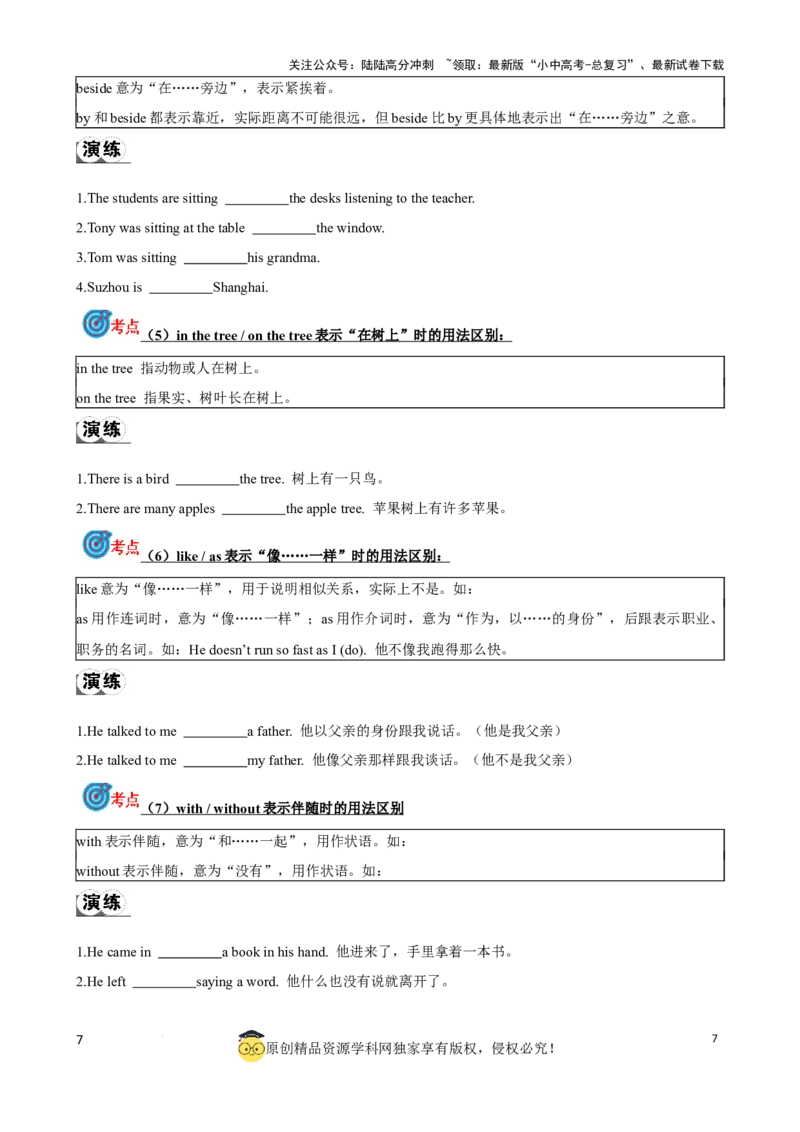
beside意为“在……旁边”,表示紧挨着。
by和beside都表示靠近,实际距离不可能很远,但beside比by更具体地表示出“在……旁边”之意。
1.The students are sitting the desks listening to the teacher.
2.Tony was sitting at the table the window.
3.Tom was sitting his grandma.
4.Suzhou is Shanghai.
( 5 ) in the tree / on the tre e 表示“在树上”时的用法区别:
in the tree 指动物或人在树上。
on the tree 指果实、树叶长在树上。
1.There is a bird the tree. 树上有一只鸟。
2.There are many apples the apple tree. 苹果树上有许多苹果。
( 6 ) like / a s 表示“ 像……一样 ”时的用法区别:
like意为“像……一样”,用于说明相似关系,实际上不是。如:
as用作连词时,意为“像……一样”;as用作介词时,意为“作为,以……的身份”,后跟表示职业、
职务的名词。如:He doesn’t run so fast as I (do). 他不像我跑得那么快。
1.He talked to me a father. 他以父亲的身份跟我说话。(他是我父亲)
2.He talked to me my father. 他像父亲那样跟我谈话。(他不是我父亲)
( 7 ) with / withou t 表示伴随时的用法区别
with表示伴随,意为“和……一起”,用作状语。如:
without表示伴随,意为“没有”,用作状语。如:
1.He came in a book in his hand. 他进来了,手里拿着一本书。
2.He left saying a word. 他什么也没有说就离开了。
7 7
原创精品资源学科网独家享有版权,侵权必究!
学科网(北京)股份有限公司关注公众号:陆陆高分冲刺 ~领取:最新版“小中高考-总复习”、最新试卷下载
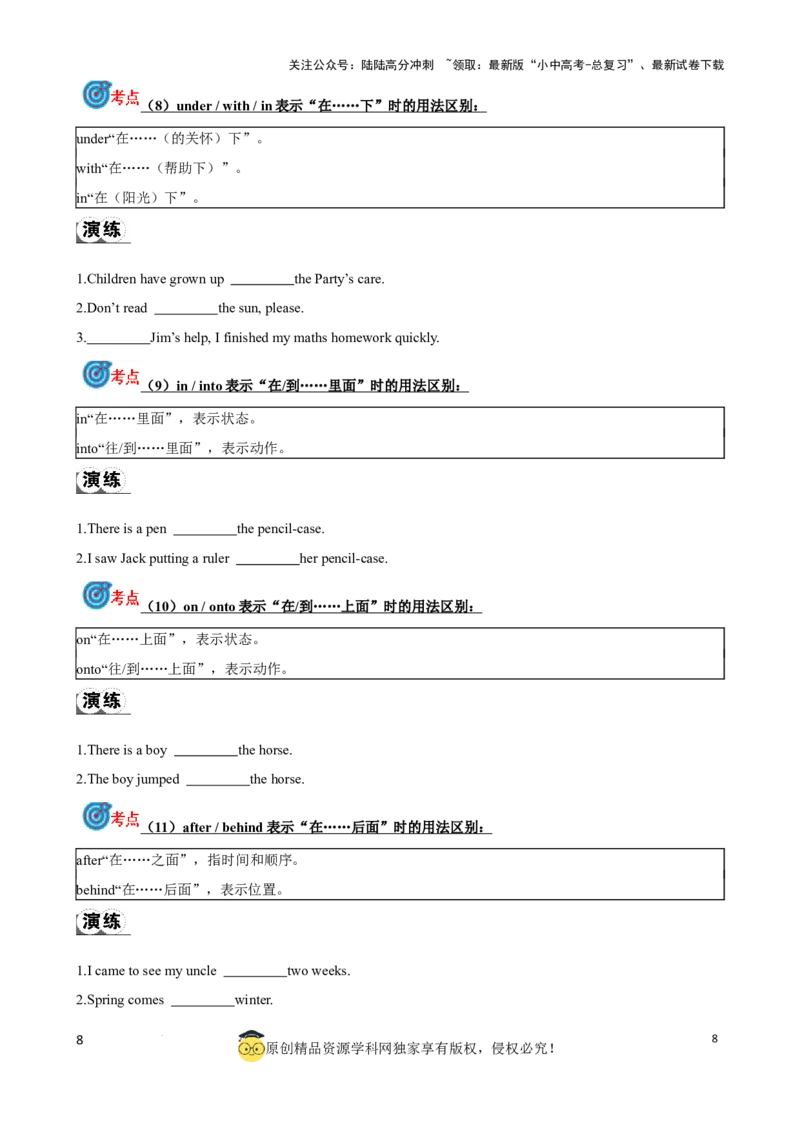
( 8 ) under / with / in 表示“ 在……下 ”时的用法区别:
under“在……(的关怀)下”。
with“在……(帮助下)”。
in“在(阳光)下”。
1.Children have grown up the Party’s care.
2.Don’t read the sun, please.
3. Jim’s help, I finished my maths homework quickly.
( 9 ) in / int o 表示“ 在 / 到……里面 ”时的用法区别:
in“在……里面”,表示状态。
into“往/到……里面”,表示动作。
1.There is a pen the pencil-case.
2.I saw Jack putting a ruler her pencil-case.
( 1 0 ) on / ont o 表示“ 在 / 到……上面 ”时的用法区别:
on“在……上面”,表示状态。
onto“往/到……上面”,表示动作。
1.There is a boy the horse.
2.The boy jumped the horse.
( 1 1 ) after / behind 表示“ 在……后面 ”时的用法区别:
after“在……之面”,指时间和顺序。
behind“在……后面”,表示位置。
1.I came to see my uncle two weeks.
2.Spring comes winter.
8 8
原创精品资源学科网独家享有版权,侵权必究!
学科网(北京)股份有限公司关注公众号:陆陆高分冲刺 ~领取:最新版“小中高考-总复习”、最新试卷下载
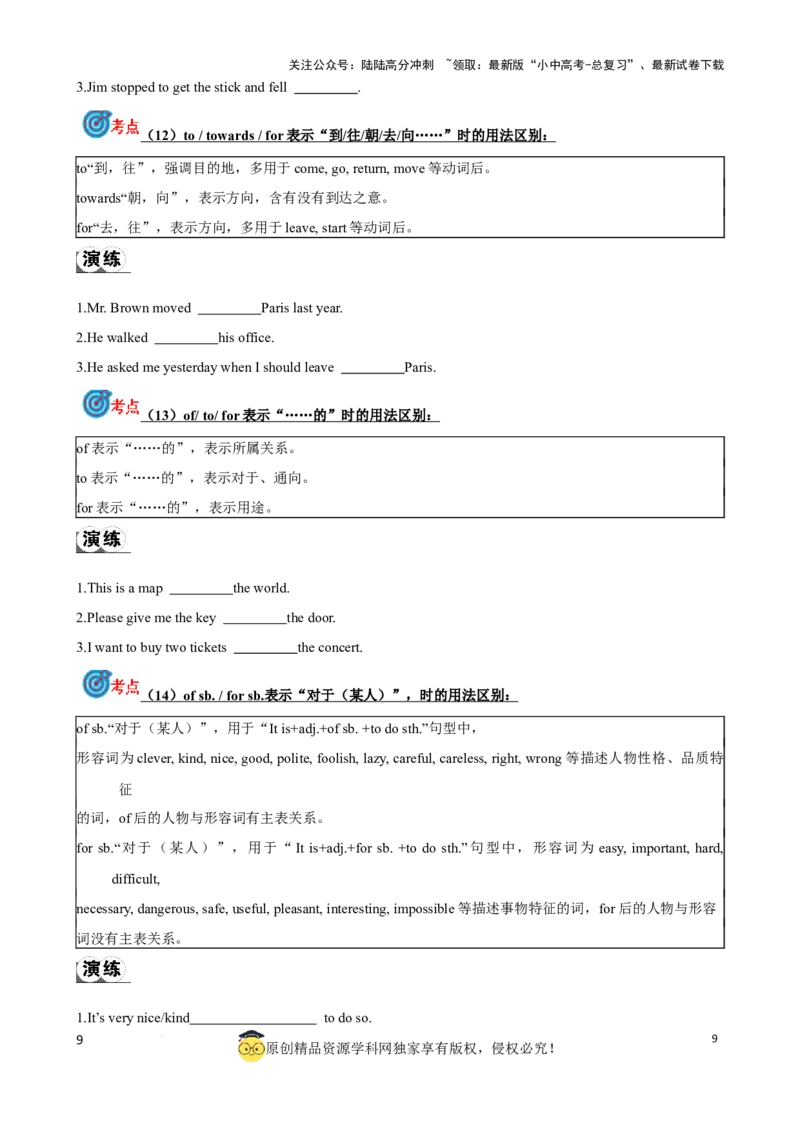
3.Jim stopped to get the stick and fell .
( 1 2 ) to / towards / fo r 表示“ 到 / 往 / 朝 / 去 / 向…… ”时的用法区别:
to“到,往”,强调目的地,多用于come, go, return, move等动词后。
towards“朝,向”,表示方向,含有没有到达之意。
for“去,往”,表示方向,多用于leave, start等动词后。
1.Mr. Brown moved Paris last year.
2.He walked his office.
3.He asked me yesterday when I should leave Paris.
( 1 3 ) of/ to/ fo r 表示“ ……的 ”时的用法区别:
of表示“……的”,表示所属关系。
to表示“……的”,表示对于、通向。
for表示“……的”,表示用途。
1.This is a map the world.
2.Please give me the key the door.
3.I want to buy two tickets the concert.
( 1 4 ) of sb. / for sb . 表示“对于(某人)”,时的用法区别:
of sb.“对于(某人)”,用于“It is+adj.+of sb. +to do sth.”句型中,
形容词为clever, kind, nice, good, polite, foolish, lazy, careful, careless, right, wrong等描述人物性格、品质特
征
的词,of后的人物与形容词有主表关系。
for sb.“对于(某人)”,用于“It is+adj.+for sb. +to do sth.”句型中,形容词为 easy, important, hard,
difficult,
necessary, dangerous, safe, useful, pleasant, interesting, impossible等描述事物特征的词,for后的人物与形容
词没有主表关系。
1.It’s very nice/kind to do so.
9 9
原创精品资源学科网独家享有版权,侵权必究!
学科网(北京)股份有限公司关注公众号:陆陆高分冲刺 ~领取:最新版“小中高考-总复习”、最新试卷下载
2.It’s too hard to finish the work in only one hour.
三、介词的固定搭配
介词往往同其他词类形成了固定搭配关系。熟记并掌握这种固定搭配关系,才会正确使用介词。
1. 动词+介词
agree with同意; hear of 听说; prefer…to… 宁愿选择……,更
arrive in/at 到达; help…with 帮助; 喜欢……;
ask for请求; laugh at嘲笑; regard…as… 把……看作……;
base on以……为根据; learn from向……学习; send for派人去叫,叫人去拿;
begin with 以……开始; leave for出发去某地; shout at大声叫喊,吼叫;
belong to 属于; listen on 听……; smile at向……微笑;
call on号召,访问,邀请; look at (有意识地)看; speak to对……说;
deal (do) with 处置,对待; look after照顾,照看; take away拿走,带走;
decide on 决定; look for寻找; take down拿下,取下;
depend on 依赖,依靠; look like看上去像; take off脱下,起飞;
die of (from)死于; look about/around四下看,到处 talk to与……谈话;
do well in在……方面做得好; 看; thanks to 幸亏,由于;
drop off放下(某物);(让某人) meet with偶尔遇见,遭遇; think about 考虑;
下车; multiply…by… ……乘以……; think of考虑,关心;
fill with充满,装满; pass on 传递; try on试穿(衣服,鞋等);
get to到达; pay for (sth.) 付(……)钱,支 turn...into... 把……变成……;
give up放弃; 付(……费用); turn on (off)打开(关上);
go in for从事,致力于; point to指着; turn up (down) 开大(关小);
hand in上交; put on穿上; wait for等候,等待;
hear from 收到……的来信; write to写信给……;
2. 介词+名词
at all根本,全然; at last最后,终于; at school在学校;
at home在家; at least 至少; at sea在大海上;起初;
at dinner在吃正餐; at night在晚上; at work在工作;
at first首先, at noon在中午; at the age of 在……岁时;
at hospital 在医院; at once立刻,马上; at the back of 在……后面;
10 10
原创精品资源学科网独家享有版权,侵权必究!
学科网(北京)股份有限公司关注公众号:陆陆高分冲刺 ~领取:最新版“小中高考-总复习”、最新试卷下载
at the end of 在……结尾; in life 一生中; on foot步行;
at the foot of 在……脚下; in no time立刻,很快; on one’s way to在某人去……的
at the meeting 在会上; in all总共,总计; 路上;
at the same time 同时,然而; in line成直线; on time准时,按时;
at the table在桌子旁; in order按顺序,整齐,正常; of course当然(可以);
by hand用手,手工,亲手; in order to为了,以便; on display陈列,展览;
by the end of 到……结束时; in public当众,公开地; on duty值日;
by the time... 到……的时候; in space 在空间; one by one —个接一个;
by the way顺便说说(问问); in surprise惊奇地; on the earth在地球上;
by bus乘公共汽车; in time 及时; on show展出;
by train 乘火车; in town在城里; on the left (right)在左(右)边;
by spaceship乘坐宇宙飞船; in trouble处于困境; on the radio通过无线电广播;
day by day日复一日; in silence不作声; on top of... 在……顶上;
in a hurry匆忙,急忙; in this way用这种方法; out of breath上气不接下气;
in a low voice小声地; in the air 在空中; out of sight消失,看不见;
in a minute 一会儿; in the distance 在远处; out of work失业;
in a short while 不久; in the street在街上; to this day直到今天;
in a word总而言之,一句话; in the end最后,终于; to one’s surprise (joy) 使某人吃
in bed 卧床; in the day在白天; 惊(高兴)的是;
in English用英语; in the middle of 在中间; with a smile带着微笑
in fact事实上; in the sun在阳光下;
in front of在……前面; in the tree在树上;
3. 介词与形容词、过去分词和动词等搭配
be angry at sth. 为某事生气 be made of... 由……制成(物理 be satisfied with sth. 对某事感到
be angry with sb. 跟某人生气; 变化); 满意;
be busy with... 忙于……; be made from... 由……制成(化 be strict with sb. 对某人严格要
be born in ... 出生于……; 学变化); 求;
be full of... 充满……; be pleased with sb. 对某人感到 be sure of... 确信……;
be good at… 擅长……; 满意; be surprised at 对……感到惊奇
be interested in 对……感兴趣; be proud of... 以……为自豪(骄 (诧异);
keep out of不让进入; 傲); be tired of… 讨厌……,厌
11 11
原创精品资源学科网独家享有版权,侵权必究!
学科网(北京)股份有限公司关注公众号:陆陆高分冲刺 ~领取:最新版“小中高考-总复习”、最新试卷下载
烦……; go to bed (sleep)去睡觉; look forward to盼望,期待;
be used to... 习惯于……; go to the cinema 去看电影; say hello to 向……问好;
break into (in)闯入; have nothing to do with… take care of照顾,关心,保管;
catch up with跟上,赶上; 与……无关; take (catch) hold of 抓住;
go to school去上学; take part in 参加;
【考点拓展】
1. 介词短语在句子中的位置:
介词短语做状语时,如果表示时间/地点,可以放在句首或句尾,如果表示方向/方式/伴随/涉及/原
因/目的/比较,一般放在句尾;介词短语作表语时放在连系动词之后;介词短语作定语时,只能放在被修
饰的名词之后。
如:He wanted to find a good job in Shanghai the next year. (状语)
The letters are for you. (表语) // Have you seen a cat with a black head and four white legs? (定语)
2. 使用介词时应注意的问题
(1)时间介词的省略。在this/that/these/those/last/next/a/every/each/one/all等词构成的时间短语前,一般不
用at, in, on。
如:Every year travellers from abroad come to visit Pingyao. // He had a bad cold that week.
I want to buy a dictionary tomorrow. // I watched a film last night. // It is fine today.
在某些名词词组前,可以省略(也可不省)如:(on) that day, (in)the year before last。
如:He said that he helped an old man cross the street that day.
(2)介词有时会与它的宾语分离,而且宾语前置。当宾语是疑问词时。
如:Who are you talking about?
宾语在从句中当连接词时。
如:He has a younger brother who he must take good care of.
Do you know who our teacher is talking with over there?
动词不定式作定语且该动词为不及物动词,后面有介词。
如:I finally found a chair to sit on.
题组1 用适当的介词填空
1.There were also differences in what people liked to do outdoors (在……之中) the three countries.
12 12
原创精品资源学科网独家享有版权,侵权必究!
学科网(北京)股份有限公司关注公众号:陆陆高分冲刺 ~领取:最新版“小中高考-总复习”、最新试卷下载
2.They love simple activities the busy, stressful world.
3.In his speech, he talked the importance of kindness.
4.She is happy and you can tell from the expression her face.
5. A the four great classical Chinese novels, my favourite is Journey to the West.
6.There is a low brick wall (在……之间) the garden and the field beyond.
7.They made each group take notes different ways.
8.When I walked the room we shared, I found Claudio sitting at my bedside.
9.“The state's summer camp could open June,”Beth Bye,the leader of the Connecticut Office of Early
Childhood, said a week ago.
10.Giving concerts wasn't easy for Beth in the beginning because usually she only played drums alone in her
bedroom when she came home school.
11.Singapore is also an interesting city. Large numbers of people, ideas, etc. are mixed together (在……
下面)the same sky.
12.Then one day, while going out a walk, Mr Happy met Miss Beautiful.
13.“Grandpa, someone is waiting you to play chess,” I went to him and said.
14.The weather here is wonderful. It's warm and sunny, clear blue skies every day.
15.What we can learn the old man is this:if you've lost a lot over something that doesn't work, let it go and
move on. It's better than continuing to lose.
题组2 介词及介词短语辨析
1.Kate felt excited to see a group of sheep walking her into a village in Qinghai.
A.over B.past C.across D.through
2.China's first Mars rover, Zhurong, touched down on the Red Planet May 15, 2021.
A.on B.in C.at D.to
3.Football fans are often called the “12th man” because of their influence a team.
A.to B.from C.on D.at
4.Anna is taller than me. She sits me in the classroom.
A.between B.from C.behind D.among
5.The instructions tell us everything about how to make the model ship.
A.by hand B.by chance C.in detail D.in person
6.I've ordered some flowers for Grandma and they will arrive two hours.
A.in B.after C.over D.for
题组3 填空题
13 13
原创精品资源学科网独家享有版权,侵权必究!
学科网(北京)股份有限公司关注公众号:陆陆高分冲刺 ~领取:最新版“小中高考-总复习”、最新试卷下载
1.The gate is too small for an elephant to go t .
2.Chinese are fighting (对抗) the novel coronavirus bravely.
3.In a recent survey at one school, we found that (超过) two thirds of the students didn't follow a
good diet.
4.It's a good idea for teenagers to eat food (没有) much fat and oil.
5.Together they designed and did the wall painting (在……期间)one school week.
6.In Chinese culture, bamboo is well-known one of the “four gentlemen” in plants.
7.I am looking forward your coming. I'm sure that you will fall in love with Wuhan.
8.Do you see? This is how plants talk. So don't touch plants fun. It may blame its neighbor.
9.They will clean all parts of the house e the kitchen because someone has already cleaned it.
10.Tickets are cheaper d the off season. And that's the best time to take a trip.
11.Our handwriting is good e for some grammar mistakes.
12.“There wasn't any treasure in the very first place, my son,”the father answered a smile. “But I
think you have found your life's true purpose.”
13.The stone lay in the road three weeks. It was in everyone's way.
14.In the days after the lockdown, more than 30,000 medical workers from (在……各处) the
country were sent to Hubei.
15.Don't walk a the street when the traffic lights are red.
题组4 选择题
1.(2023·青海·统考中考真题)The four pandas in Chongqing Zoo were born on the same day _______ 2019.
A.on B.at C.in
2.(2023·湖北十堰·统考中考真题)—________ my surprise, the restaurant is a actually very nice.
—The service is also great.
A.In B.At C.On D.To
3.(2023·山东东营·统考中考真题)Bees (蜜蜂) can help plants grow. ________ bees, we wouldn’t have
enough food.
A.From B.Like C.Except D.Without
4.(2023·江苏徐州·中考真题)No one helped me. I did it all ________ myself.
A.for B.of C.by D.about
5.(2023·辽宁丹东·统考中考真题)Everything begins to grow ________ spring. It’s full of hope.
A.in B.on C.at D.for
6.(2023·辽宁丹东·统考中考真题)________ the teacher’s help, I have made much progress.
14 14
原创精品资源学科网独家享有版权,侵权必究!
学科网(北京)股份有限公司关注公众号:陆陆高分冲刺 ~领取:最新版“小中高考-总复习”、最新试卷下载
A.Thanks to B.As for C.Such as D.Up to
7.(2023·江苏宿迁·统考中考真题)About 12,000 people took part in the 2023 Suqian Marathon ________
April 2.
A.at B.on C.in D.to
8.(2023·北京·统考中考真题)It’s a good idea to visit Beijing ________ October.
A.at B.on C.in D.to
9.(2023·辽宁抚顺·统考中考真题)The girl takes her dog for a walk ________ the river every evening.
A.in B.along C.over D.under
10.(2023·江苏无锡·统考中考真题)A new bridge was built ________ the Yellow River last year.
A.around B.across C.against D.along
11.(2023·辽宁沈阳·统考中考真题)Three Shenzhou XV heroes successfully came back to the Earth
________ June 4, 2023.
A.at B.on C.in D.until
12.(2023·四川遂宁·中考真题)Look! The traffic light is green. We can go ________ the road now.
A.across B.above C.below D.against
13.(2023·辽宁营口·中考真题)The newly-built teaching building provides the students ________ a
comfortable learning environment.
A.for B.to C.with D.in
14.(2023·黑龙江·统考中考真题)The 20th National Congress of the CPC was convened (召开) __________
October 16th, 2022.
A.on B.in C.by
15.(2023·黑龙江·统考中考真题)It is impolite to speak loudly ________.
A.in danger B.in public C.in person
16.(2023·黑龙江绥化·统考中考真题)— Did Alan and Lily join the art club ________ June 20th, 2023?
—Yes, I joined it, too.
A.on B.in C.at
17.(2023·黑龙江齐齐哈尔·统考中考真题)Bills is ________ all the other runners. It seems that he will be
the winner.
A.next to B.far from C.ahead of
18.(2023·湖南株洲·统考中考真题)China launched (发射) Shenzhou-16 manned space ship successfully
________ May 30, 2023.
A.at B.on C.in
15 15
原创精品资源学科网独家享有版权,侵权必究!
学科网(北京)股份有限公司关注公众号:陆陆高分冲刺 ~领取:最新版“小中高考-总复习”、最新试卷下载
19.(2023·福建·统考中考真题)The toy is ________ my little brother. I bought it yesterday.
A.for B.from C.by
题组5 语法选择
When a man was walking 1 some elephants, he suddenly stopped. He was confused that these huge
animals were being held only 2 a small rope tied 3 their front legs. No chains, no cages. It was
obvious that the elephants could break their bonds at any time, but 4 some reasons, they did not.
He saw a trainer nearby and asked why the animals just stood there and made no attempt to get away.“Well,”
the trainer said, “when they were very young and much smaller, we used the same rope to keep them 5
running away. 6 that age, it was enough to hold them. As they grow up, they get used 7 believing they
cannot break the rope. They believe it can still hold them, so they never try to break free.”
The man was amazed. These animals could break free whenever they wanted, but because they believed they
couldn't, they were stuck right where they were.
How many of us go 8 life like the elephants—holding 9 the belief that we cannot do something
simply because we failed in it once before?
Failure is a part of learning. If we failed once, it doesn't mean we can never succeed. We should never give
up trying when we encounter failures 1 0 life.
1.A.with B.on C.by D.to
2.A.by B.for C.from D.at
3.A.in B.to C.with D.by
4.A.with B.at C.about D.for
5.A.to B.from C.for D.of
6.A.On B.In C.At D.For
7.A.with B.in C.to D.for
8.A.by B.on C.for D.through
9.A.to B.into C.with D.up
10.A.for B.by C.in D.to
题组6.短文填空
Back to my school
I had to stay in China for more than a year because 1 the COVID-19 pandemic. Several weeks ago, I
finally went back 2 my school in the UK.
The school has made many rules to deal 3 the virus. For example, all students must wear masks when
16 16
原创精品资源学科网独家享有版权,侵权必究!
学科网(北京)股份有限公司关注公众号:陆陆高分冲刺 ~领取:最新版“小中高考-总复习”、最新试卷下载
going to school. Boarders (住宿生) need to have their temperature taken every morning.
The rules in dining hall have changed as well. To keep students from different grades apart, we need to stay
in our classroom 4 about 25 minutes first and then line up for about 30 minutes. However, some students
don't follow these social distancing (社交隔离) rules and still chat with each other.
Students can play sports as usual, except for sports 5 soccer, rugby and hockey that have close contact.
We must also take the COVID-19 tests twice a week.
Although there are still some new cases (病例) 6 the UK every day, I'm not that worried because my
school has strict rules to deal with the pandemic.
1. 2. 3. 4. 5. 6.
17 17
原创精品资源学科网独家享有版权,侵权必究!
学科网(北京)股份有限公司关注公众号:陆陆高分冲刺 ~领取:最新版“小中高考-总复习”、最新试卷下载
18 18
原创精品资源学科网独家享有版权,侵权必究!
学科网(北京)股份有限公司