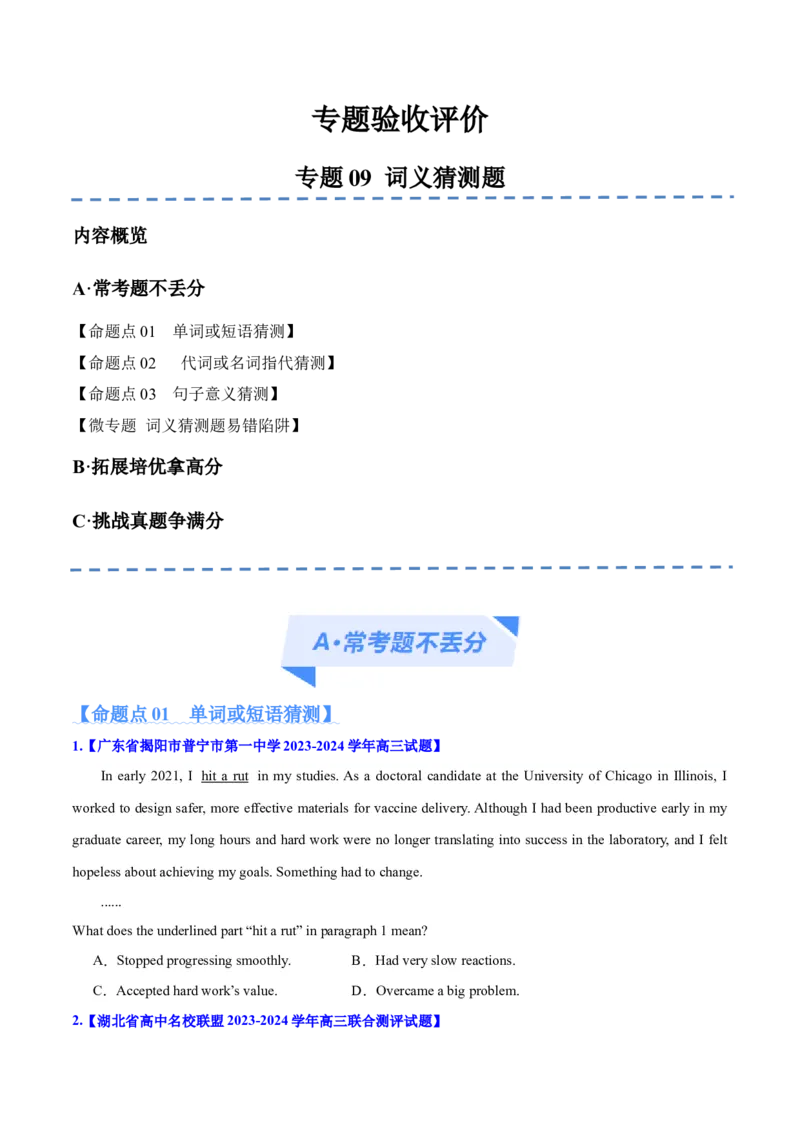
专题验收评价
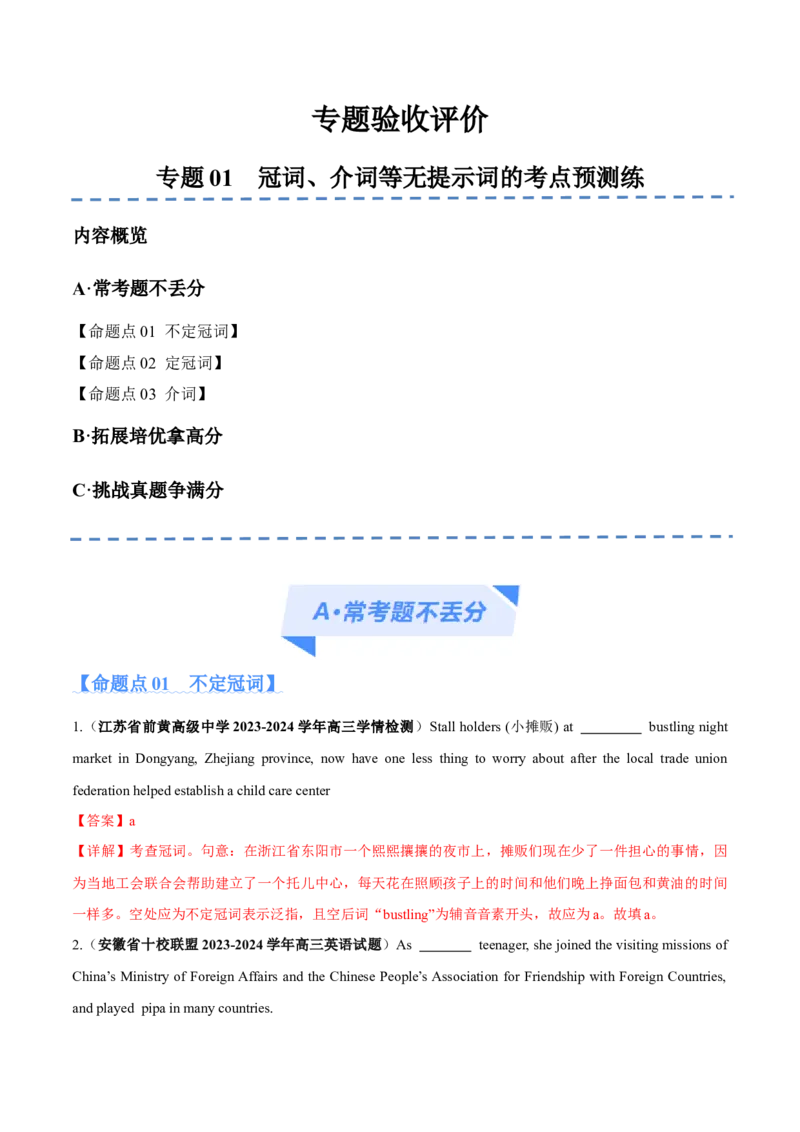
专题 09 词义猜测题
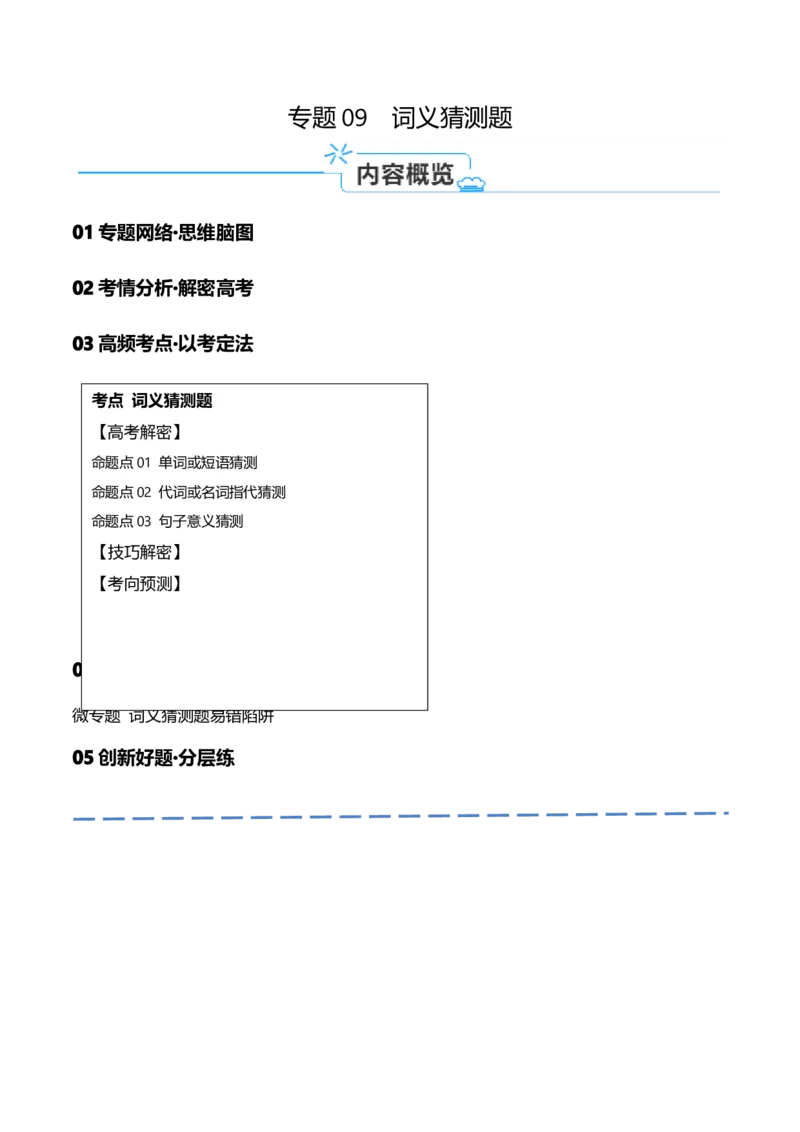
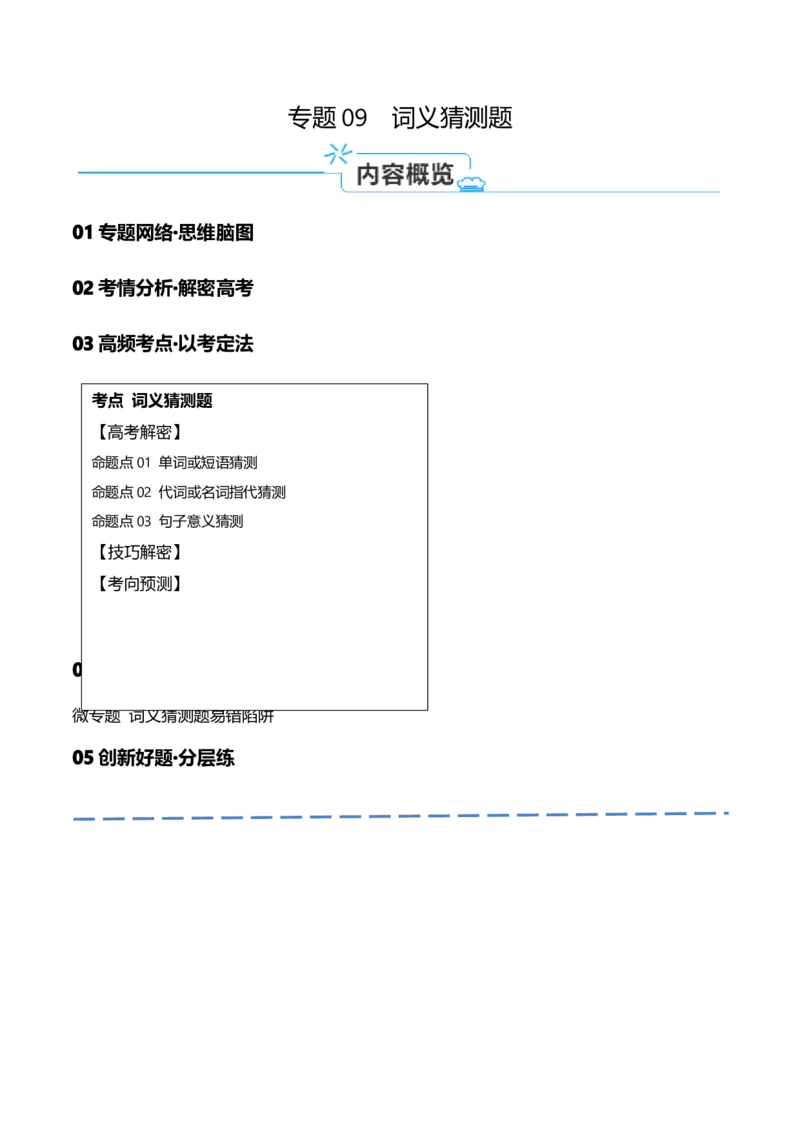
内容概览
A·常考题不丢分
【命题点01 单词或短语猜测】
【命题点02 代词或名词指代猜测】
【命题点03 句子意义猜测】
【微专题 词义猜测题易错陷阱】
B·拓展培优拿高分
C·挑战真题争满分
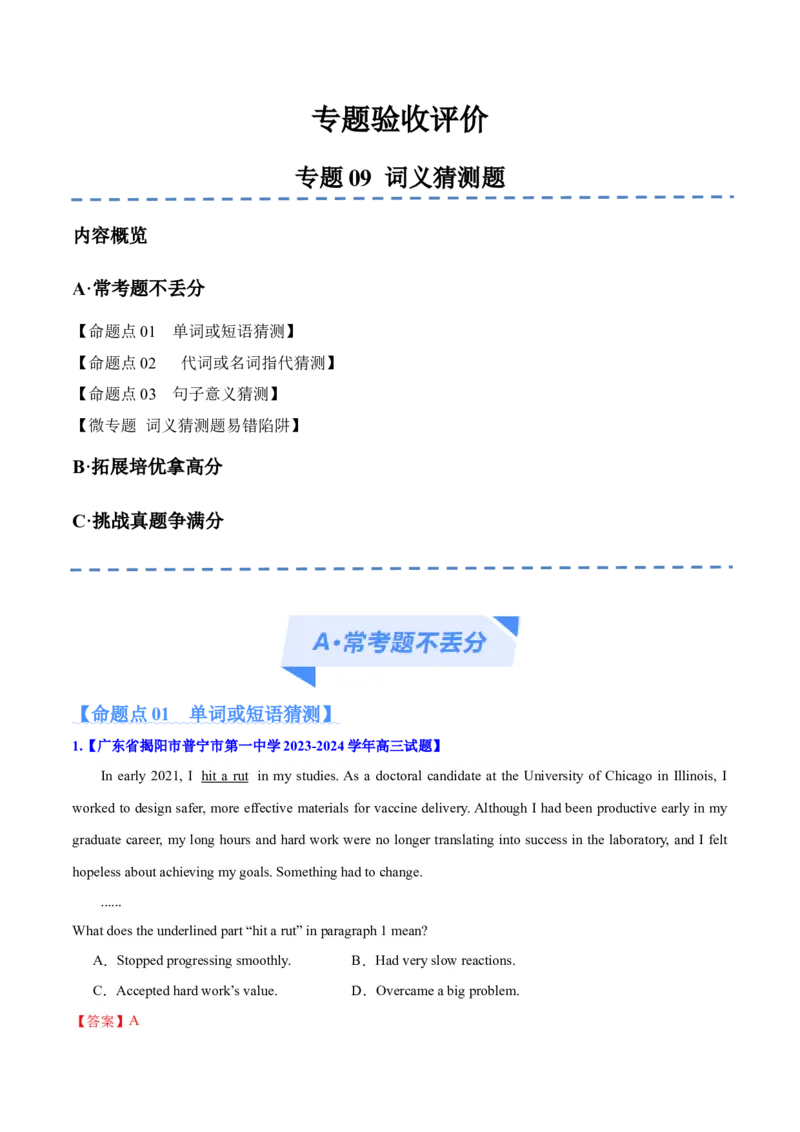
【命题点 01 单词或短语猜测】
1.【广东省揭阳市普宁市第一中学2023-2024学年高三试题】
In early 2021, I hit a rut in my studies. As a doctoral candidate at the University of Chicago in Illinois, I
worked to design safer, more effective materials for vaccine delivery. Although I had been productive early in my
graduate career, my long hours and hard work were no longer translating into success in the laboratory, and I felt
hopeless about achieving my goals. Something had to change.
......
What does the underlined part “hit a rut” in paragraph 1 mean?
A.Stopped progressing smoothly. B.Had very slow reactions.
C.Accepted hard work’s value. D.Overcame a big problem.
2.【湖北省高中名校联盟2023-2024学年高三联合测评试题】Actually, until her pregnancy Quarles had been living at breakneck speed. It went so until last year. “I was
exhausted,” she says. “I’d been working three jobs, doing my charity and going nonstop. I was afraid my mental
health was getting worse.”
......
Which of the following best explains “breakneck” underlined in paragraph 2?
A.Safe and slow. B.Fast and dangerous.
C.Exciting and terrifying. D.Gentle and comfortable.
3.【2023届山西省运城市高三5月第三次模拟调研测试】
Getting a driving license was once a universal passage into adulthood. But now a growing minority of young
people ignore or actively oppose it, into their 20s and beyond. That starts to create more support for anti-car
policies in cities around the world to pass anti-car laws, changing planning rules to favour pedestrians over drivers.
After a century in which the car remade the rich world, the tide begins to swing the other way.
By 1997, 43% of America’s 16-year-olds had driving licenses. But the proportion has been falling for every
age group under 40. Even those who have them are driving less. A similar trend is seen in Europe. One study of five
European capitals found the number of driving trips made by working people was down substantially since a peak
in the 1990s.
No one is entirely sure why young adults are proving resistant to owning a car. The growth of the interest is
one obvious possibility—the more you can shop online, or stream films at home, the less need there is to drive into
town. The rise of taxi apps like Uber has contributed as well. Driving generally is more expensive. Other reasons
seem more cultural. One big motivator is worries about climate change.
The falling popularity of cars among the under-40s chimes with the mood among city planners and urbanists.
In America, New York has banned cars from Central Park and some streets. In the past few years, dozens of
American cities have removed rules that force developers to provide a certain amount of free parking around their
buildings.
As the example in Oxfond shows, political opposition could put the brakes on the growth of anti-car policies.
But in the parts of Europe where anti-car policies have been in place, they appear to have worked. Giulio notes that
almost nowhere in the world that has removed a big road, or pedestrianised a shopping street, has decided to turn
back. “Once people see, they generally don’t want to go back.” If that pattern holds, the 21st century might just see
the car’s high-water mark.
14.What does the underlined part “chimes with” mean in paragraph 4?A.Agrees with. B.Sticks to. C.Cooperates with. D.Emerges from.
4.【2023届贵州省遵义市高三三模】
Joseph Dituri hasn’t seen the sun for days. And he won’t see it again for months. Since March 1, the bio-
medical engineer has been underwater, with the goal of spending 100 days there—for science.
The underwater living, if successful, will also break the current world record for time spent living underwater,
which was set by two Tennessee biologists in 2014 when they stayed beneath the surface for 73 days.
Dituri, who uses the nickname Dr. Deep Sea, is living in Jules’ Undersea Lodge (小屋) in Key Largo, Florida
—the same underwater spot where the previous record was set. The 100-square-foot hotel, which sits 30 feet below
the surface, is his intended home until June 9, where he’ll be carrying out research and giving virtual lectures for
his students at the University of South Florida
As part of this research, Dituri is researching the effects of living in a high-pressure environment for an
extended period. To keep water from entering the lodge, air must constantly be pumped into the space, which
creates a pressure about 1.6 times that of Earth’s surface.
“The human body has never been underwater that long, so I will be monitored closely,” Dituri says in a press
release. “This study will examine every way this journey affects my body.” Before taking the dive, Dituri had
psychosocial, psychological and medical tests. He will continue to have testing during and after his 100 days at the
lodge. He’s also taking doses of Vitamin D and keeping regular psychological appointments.
Beyond research, the project is also a chance to promote ocean protection and encourage young scientists.
“The oceans are in a bit of trouble-the coral reefs are under attack, and the fishing industry is collapsing,” Thane
Milhoan, habitat operations manager for Jules’ Undersea Lodge, says in a video. “We wanted to make use of the
attention that the 100-day mission would demand to inspire the youth, more so than anybody, to get involved and
start taking action.”
11.What does the underlined word “collapsing” in the last paragraph mean?
A.Breaking down. B.Coming out.
C.Operating well. D.Growing fast.
【命题点 02 代词或名词指代猜测】
1.【湖南省常德市第一中学2023-2024学年高三试题】
Regulatory limits for how much PFAS food packaging should contain can vary greatly. For instance, a new
law in California set the limit at less than 100 ppm. “Compared to America, Denmark sets a much lower regulatorylimit of 20 ppm with great success,” said Xenia Trier, an expert at the European Environment Agency. “It does
work to set limits and enforce them. PFAS do migrate from the paper into the food. Even though it was not 100%,
we still saw considerable transmission. In general, transmission from packaging to food is increased as the
temperature of the food rises. It is the same with the time spent in wrapping materials.” Trier told NBS, one of the
major American mass-media companies.
What does the underlined word “it” refer to in paragraph 4?
A.Considerable migration of grease and water.
B.PFAS transmission from packaging to food.
C.Wrapper exposure to high food temperature.
D.Regulatory limits concerning food packaging.
2.【湖南省常德市临澧一中2023-2024学年高三阶段试题】
She programmed an IBM 7030 Stretch computer, providing faster calculations for an accurate Earthmodel. This
detailed mathematical model of the shape of the Earth was a building block for what would become the GPS
orbit.
What does the underlined phrase “a building block” in paragraph 5 mean?
A.A basic part. B.A detailed map.
C.A building material. D.A major obstacle.
3.【2023年湖北武汉校考】Cory’s shearwaters are long-lived, rarely producing young successfully before age
nine. This leaves an opening for learning and practice to develop their migration patterns. Researchers call this the
“exploration-refinement”, and until now it has been hypothetical (假设的) because of difficulties in tracking
migratory animals’ movements.
What does the underlined word “this” in paragraph 3 refer to?
A.The opening for learning and practice.
B.The unique living habit of Cory’s shearwaters.
C.The way Cory’s shearwaters form their migration patterns.
D.The process scientists track Cory’s shearwaters’ movements.
4.【2023届广东省深圳市高级中学高三模拟预测】
During the last few years we have lived through a series of worrying global events, from the COVID
pandemic to devastating wildfires.Instead of feeling informed after watching the news, many people feel anxious,
upset and sick. A new study published in Journal of Health Communication investigated into this problem.
According to the study, stress, anxiety, and poor health follow people who have a constant urge to check thenews. For these individuals, a vicious (恶性的) cycle can develop in which, rather than tuning out, they become
drawn further in, checking for updates around the clock to relieve their emotional stress. But it doesn’t help, and the
more they check the news, the more it begins to interfere (干扰) with other aspects of their lives.
Of the 1,100 people surveyed for the study, 16.5 percent became so absorbed in the news that it dominated
their thoughts, limited the time they spent with family and friends and made it difficult to focus on school or work,
Those are the very things-purposeful engagement and social connection-that help us cope with stress and mental
health challenges.
...
8.What does the underlined phrase “this problem” in Paragraph 1 refer to?
A.That news addiction may bring negative effects.
B.That COVID-19 affects people’s mental health.
C.That people are exposed to too much information.
D.That journalists focus on terrifying stories to impress readers.
5【2023届重庆市巴蜀中学校高考适应性模拟预测5月】
The honeybee waggle dance has been celebrated as a most complex animal communication system. A study
uncovered its new property that bees must partially learn the dance from watching experienced dancers, a discovery
that torpedoes the general perception that the dance is wholly inborn. A dancer bee relays information to follower
bees about the target location by adjusting herself while shaking her stomach, allowing for impressive flexibility in
the angle, duration and her enthusiasm. Her body’s angle corresponds to the sun’s position relative to the nest
entrance.
The distance information is conveyed by the dance duration. And the more energetic and passionate the dance,
the better the food. She’ll waggle in a straight line for seconds before circling back to repeat the dance, creating the
figure eight pattern.
This bee waggle dance system was long assumed to be natural behavior, but researchers made a breakthrough
through an experiment. They created territories of newborn bees completely separated from mature ones. When the
newborn started visiting flowers and producing their first waggle dances, they consistently made more errors in the
way they reported the angle and distance to the food source than bees raised in mixed-aged territories and thus
exposed to the waggle dance since they were born. They also generated looser figure eight patterns, making it
harder for the follower bees to get the message. Even when placed back into a territory with mature bees, they
never seemed to learn how to communicate information correctly.These results suggest every honeybee is born with a waggle dance model that gives them a basic
understanding of how to dance. By watching their elders, they’ll acquire new rules on how to generate the dance
unique to their territory.
This is the first known example of such complex social learning of communication in insects and is a form of
animal culture, strikingly similar to the way human language generates new languages to shape itself around the
local conditions. While the waggle dance is second to human language in terms of the ability to communicate
diverse information through random symbols, the newly-discovered property makes it even more language-like
and just that much more mind-blowing.
A.Illustrates. B.Overturns. C.Fits in with. D.Gives rise to.
15.What does the underlined word “it” in the last paragraph refer to?
A.The waggle dance. B.Human language.
C.The new property. D.Diverse information.
【命题点 03 句子意义猜测】
1.【山东省曲阜师范大学附属中学2023-2024学年质量检测】
Real riches consist of well-developed and hearty capacities (能力) to enjoy life. Most people are already
swamped (淹没) with things. They eat, wear, go and talk too much. They live in too big a house with too many
rooms, yet their house of life is a hut.
......
The underlined sentence in the second paragraph probably implies that______.
A.however materially rich, they never seem to be satisfied
B.however materially rich, they remain spiritually poor
C.though their house is big, they prefer a simple life
D.though their house is big, it seems to be a cage
2.【2022·湖北孝感高三模拟】
As soon as I started pedaling again, my pants got caught in the chain, and I fell flat on my face and hit my
nose. Since that happened t my granddad decided to call it a day and try again the next morning. The next morning
I woke up bright and early, and was very eager to try to ride my bike. My nose felt better, so I wasn’t that afraid of
falling anymore.
......26.What does the underlined part in the passage mean?
A.Remember what happened this day.
B.Make the author feel happy.
C.Stop practicing bicycling.
D.Go on to ride a bike.
3.【2023年湖北武汉校考】
When I was young, a friend and I came up with a “big” plan to make reading easy. The idea was to boil down
great books to a sentence each. “Moby-Dick” by American writer Herman Melville, for instance, was reduced to:
“A whale of a tale about the one that got away.” As it turned out, the joke was on us. How could a single sentence
convey the essence (精髓) of a masterpiece with over five hundred pages?
What does the underlined part “the joke was on us” in Paragraph 1 mean?
A.We were actually joking. B.We were laughed at by others.
C.We were underestimating’ ourselves. D.We were just embarrassing ourselves.
4.【2023届吉林省吉林市普通高中高三下学期第四次调研测】
Ancient Chinese paintings are always in a vivid state for the world to appreciate, interpret and pass on. Each
signature has the echo of history and the breathing of time.
When a scroll (卷轴) is opened, the art of painting is transformed into a living story, and the hidden history
wakes up from the painting. The Night Revels of Han Xizai is described as the earliest human “movie” with the last
emperor of Southern Tang as the “producer”, the painter Gu Hongzhong as the “cameraman“, and Han Xizai as the
“leading actor”. It is said that Han Xizai understood the suspicion of the emperor and the intention of the painter’s
visit, so he staged a banquet (宴会) with songs, dances and drinks to protect himself. Future generations would be
able to feel the undeclared battles and historical suspicions of the ruler and ministers of that era through this
painting.
Then there is The Emperor Taizong Receiving the Tibetan Envoy, which gives you the opportunity to step into
Zhenguan Period and watch the scene of Li Shimin, Emperor Tang Taizong, receiving Lu Dongzan in the palace.
The paintings are used as brushes to record history and have been passed down for thousands of years. They
are ancient paintings, as well as historical documents that can be read at any time. Each one of them is a parallel
universe, allowing us to have a glimpse of those historical ups and downs.
People of later generations want to use advanced technology and innovative ideas to make history and its
stories come alive. Thus, at the 2022 Spring Festival gala, Only This Green, based on the painting A Thousand Li ofRivers and Mountains, became a hit. We realize that pictures can not only be vivid on paper, but also can be alive in
3D.
Ancient paintings have been appreciated for over a thousand years, and the beauty of China is more than
landscapes. You can enjoy China in ancient paintings with a magnifying ( 放大 ) glass . Let’s enjoy the whispering
of ancient paintings and the sweetness of traditional culture in ancient scrolls.
A.A practical tool is a must when appreciating ancient paintings.
B.Ancient paintings are not well preserved due to too long a time.
C.The landscapes in ancient paintings prove to be from China.
D.A lot about Chinese culture can be learnt from ancient paintings.
【微专题 词义猜测题易错陷阱】
1.【福建省龙岩第一中学2023-2024学年高三试题】
After rescuing the lonely animal, Sam and Vera found it extremely emotional to have to release her back
out into the wild to fend for herself—even though they knew it was the right thing to do. But after having such a
strong bond with an animal, it was really difficult to see her go. They had put so much time, effort and energy into
raising her but to see her walking in a herd of blesboks made it all worthwhile.
......
Which word can best explain the underlined word “fend” in the last paragraph?
A.Look. B.Care.
C.Search. D.Hunt.
2.【河北省衡水市第二中学2023-2024学年高三9月检测试题】
In the study, the researchers sought to understand how the brain uses this following information to adjust our
perception of what we initially heard. To do this, they conducted a series of experiments in which the subjects
listened to isolated syllables and similarly sounding words. Their results produced three primary findings: The
brain’s primary auditory cortex (听觉皮层) is sensitive to how ambiguous a speech sound is at just 50 milliseconds
after the sound’s appearance. The brain “replays” previous speech sounds while interpreting the following ones,
suggesting re-evaluation as the rest of the word unfolds. The brain makes commitments to its “best guess” of how
to interpret the signal after about half a second.
......
What does the underlined part “the signal” in the last paragraph refer to?A.The previous speech sound. B.The similarly sounding word.
C.The unclearly sounding word. D.The following speech sound.
3.【河北省保定市重点高中2023-2024学年高三试题】
If you are of the “no regrets” school of life, you may think that all this regret is a recipe for unhappiness. But
that isn’t the case. Letting yourself be overwhelmed by regret is indeed bad for you. But going to the other extreme
may be even worse. To extinguish your regrets doesn’t free you from shame or sorrow but causes you to make the
same mistakes again and again. To truly get over our guilt requires that we put regret in its proper place.
......
What does the underlined word “extinguish” in paragraph 2 mean?
A.Admit. B.Destroy. C.Treasure. D.Encounter.
4.【安徽省合肥市第一中学2023-2024学年高三质检试题】
If the test is already set, the best way to prepare for it is with a battery of activities that most closely look like
the test itself. And so as the Big Standardized Tests have spread, publishers have cranked out varieties of coaching
workbooks that are all collections of short excerpts accompanied by a set of multiple choice questions. Instead of
teaching students how to read a whole book, we teach them how to take a standardized test.
......
Which of the following can replace the phrase “cranked out” in paragraph 4?
A.charged B.canceled C.changed D.Produced
5.【湖北省部分学校2023-2024学年高三起点试题】
Using first-of-their-kind observations from the James Webb Space Telescope. a University of Minnesota Twin
Cities-led team looked more than 13 billion years into the past to discover a unique, minuscule galaxy cluster (星
系团) that generated new stars at an extremely high rate for its size. The galaxy is one of the smallest ever
discovered at this distance —around 500 million years after the Big Bang — and could help astronomers learn
more about galaxies that were present shortly after the universe came into existence.
......
What does the underlined word “minuscule” in paragraph l mean?
A.Extremely small. B.Remarkably dark.
C.Especially remote. D.Quite complicated.(2023上·辽宁沈阳·高三校联考期中)
A new study released in the journal Plant and Cell Physiology suggests that ethanol (乙醇) — or alcohol-can help
plants survive in times of drought, even for as long as two weeks without water.
To come up with their finding, the researchers grew wheat and rice plants, regularly watering them, and then
added ethanol to the soil in one group of plants over three days. They then kept both groups deprived of (中断)
water for two weeks and found that drunk plants grew better than untreated ones. Around 75% of the drunk wheat
and rice plants survived after rewatering, while less than 5% of the untreated plants did.
The study also looked at how ethanol protected a plant. Using arabidopsis, a small plant commonly used in
experiments, the researchers discovered that when ethanol-treated specimens (样品) were deprived of water, tiny
openings on the leaves’ surface closed up to preserve water and heat.
The team studied arabidopsis’ gene expression and found that the ethanol-treated plants started behaving if
they were experiencing drought, even before they were actually deprived of water. This gene expression gave the
plants an advantage in preparing for a drought.
The researchers said, “The finding is not just useful for the world’s gardens, but also for farms growing vital
crops like rice and wheat. Drought-resistant crops could help achieve sustainable food security, which is an issue
affecting many parts of the world right now.” They added that ethanol was a useful and simple way to increase food
production all over the world in times of drought. “The application of ethanol to plants would be a potent
agricultural method to enhance drought resistance in different plants,” said Motoaki Seki, the study’s lead author.
But, he warned that the ethanol needed to be used reasonably as higher concentration of ethanol prevented plants
growing. Seki added, “We will soon begin testing ethanol on plants in real fields.”
40.What did the researchers find in their study?
A.Plants produce ethanol in times of drought.
B.Drunk plants could live longer without water.
C.There is no need to water house plants every day.
D.It requires more water to grow wheat in the field.
41.Why do the researchers do the study?
A.To cut the cost of food production. B.To bring about the change of diet.C.To generate increases in food price. D.To help maintain global food security
42.What does the underlined word “potent” in the last paragraph mean?
A.Effective. B.Basic. C.Fictional. D.Necessary.
43.What does Seki want to stress about ethanol in the text?
A.It would fit all kinds of plants. B.It has been applied to real fields.
C.It should be used in proper amount. D.It enables wheat plants to grow fast.
(2023上·河北·高三泊头市第一中学校联考期中)
Most health experts would agree that eating meat — especially red meat — in large quantities isn’t good for
us, or the planet. Studies point to an increased risk of heart disease and cancer correlating to our meat-heavy diets.
Meanwhile, manufacturers are busy producing increasingly tasty and more meat-like products that match the real
things — making the switch from eating animals seem like a no-brainer. But are these fake meat products any
healthier for us?
Jinan Banna, a dietitian and nutrition professor at the University of Hawaii says that some fake meat products
can be considered “ultra-processed” foods. “That means they go through multiple processes and have a lot of added
ingredients (配料),” she said. “An alternative burger, for example, might have quite a bit of sodium (钠), as well as
additives.” Some of these additives are on the market for a while before the scientific community determines them
to be harmful, Banna added. “Anytime you see a long list of ingredients, including ‘natural flavors’, take it as a
warning sign. In other words, eschew products with lengthy ingredient lists,” said Sofia Popov, a microbiome
scientist in Copenhagen. “Who knows what’s actually in it?”
Perhaps convenience is the best argument for buying an alternative meat product you can simply cook straight
out of the box, but some health experts suggest other plant-based healthful options can be simple, too. For example,
on a busy day, Banna said she was able to throw together a tempeh (a traditional soya product) dish which she put
in a little oil, vinegar and other seasonings. “We definitely obtain nutrients from animal-based food — iron and zinc
and other minerals as well. But it also contains fat and cholesterol, so it’s good to control our intake,” said Banna.
“Vegetarian substitutes can be very tasty so we shouldn’t shy away from them.”
52.What is the common belief on consuming red meat?
A.It is beneficial to our planet. B.It can stimulate the economy.
C.It should be served with vegetables. D.It may make us suffer from heart disease.
53.What does the underlined word “eschew” in paragraph 2 mean?
A.Avoid. B.Provide. C.Inspect. D.Purchase.54.What does Banna advise people to do?
A.Take in more minerals. B.Turn to convenient food instead.
C.Seek for plant-based meals. D.Choose some animal-based substitutes.
55.What can be the best title for the text?
A.Why Is Plant-based Meat Dying? B.Are Fake Meat Products Good For You?
C.Fake Meat: Food’s Future Or A Fashion? D.What Happened To The Plant-based Meat?
(2023上·河南·高三校联考阶段练习)
While some critics claim that history curricula (课程) teach unnecessary content, others argue that these
curricula need to be more comprehensive. Despite ongoing debates about content, one universal truth remains:
strong history curricula are necessary for developing the productive citizens of tomorrow.
The greatest academic value that history curricula provide is not the recall of important dates and names.
Rather, understanding the historical inquiry process is the most important component. This process teaches students
how to become critical thinkers and understand the dynamic nature of the telling of history.
Through strong history curricula, students are shown both a variety of primary and secondary sources and are
taught to critique them. This is where the historical inquiry process begins. Students not only begin to analyze and
ask questions about the content, but they also learn about the author’s credibility and potential bias (偏见). Students
are then able to contextualize the information they learn and can think more critically about historical con text and
those who tell it.
With this framework, students can then understand the causal relationship between human nature, values,
philosophy, actions, and their consequences. It teaches students to recognize recurrent themes and lessons that are
necessary to understand modern society. Most importantly, it teaches students to develop a healthy skepticism (怀
疑论) when presented with information today because our actions are history in the making.
Forty years ago, renowned scholar James Fitzgerald argued that no education is complete without the teaching
of historical inquiry. He believed that the only way to move forward in life is to understand what’s behind us.
Today, this principle still holds true. Students take both the factual knowledge and the historical inquiry skills
they learn in the classroom and apply them to real world circumstances. Throughout their lives, students who are
taught with strong history curricula will take the lessons they learn from our predecessors and become involved,
active, productive citizens who want to create a history that tomorrow’s students will be proud to learn about.
60.What is the biggest academic significance of history learning?
A.Passing down Chinese culture. B.Grasping historical inquiry skills.C.Making people more knowledgeable. D.Enriching people’s everyday life.
61.What does the underlined word “critique” in paragraph 3 probably mean?
A.Protect. B.Combine. C.Comment. D.Remember.
62.Why is James Fitzgerald mentioned in the passage?
A.To stress the importance of history.
B.To point out the essence of education.
C.To indicate famous people learn from history.
D.To show history contributes to people’s achievements.
63.What can be the best title for the passage?
A.It Is the People that Create History
B.History Pushes the Wheel of the Times
C.History Curricula Are Gaining More Attention
D.History Curricula Shape Tomorrow’s Decision Makers
(2023上·四川成都·高三校考期中)
Few parlor games (室内游戏) have left a larger global impact than mahjong, which is at once a mainstay at
immigrant family gatherings.
Mahjong is a four-player game that, like poker, operates on the interplay between chance and skill. Chinese
icons are visible in tiles’(麻将牌) “suits”, which include bamboos and circles, which represent ancient Chinese
currency; arrows or “dragons”, which symbolize the ancient art of archery; and flowers, which represent the four
Confucian plants, including chrysanthemum and orchid.
There are more than 40 versions of the game across the world, according to Annelise Heinz, author of the
bestselling Mahjong: A Chinese Game and the Making of Modern American Culture. She says the material
connection and core tile design keep it recognizable.
The rhythms of mahjong are especially conducive to building community, Heinz says. Whereas the shuffling
of cards in between poker games takes mere seconds, mahjong players must sit through extended pauses to reset
tiles after every round. The interval encourages conversation.
In the early 1920s, American businessman Joseph P. Babcock brought the game to the U.S., where it became
an “enormous national fad” that Heinz says reflected the country’s shifting cultural norms. Dubbed “the game of a
hundred intelligences” and “the gift of heaven”, the first imported mahjong sets quickly sold out at Abercrombie
& Fitch in New York City.
Over the past century in the US, mahjong has changed into a staple that extends far beyond the Chineseimmigrant family. More recently, the record-shattering 2018 romantic comedy Crazy Rich Asians, which features a
crucial mahjong scene, brought the game back into popular culture, fueling interest among Asian American
millennials and Gen Zers. Mahjong’s lasting popularity, Heinz says, speaks to rapid cultural changes that have
unfolded over the past century. “It also offers a kind of hopeful vision of positive identity building and community
building that this game can be a part of into the future,” she says.
69.Which of the following is the synonym for underlined word “mainstay” in Para.1?
A.Backbone B.Guest C.Maintainer D.Decoration
70.What do the Chinese icons of bamboos and circles on the tile’s “suits” represent?
A.Confucian plants and thoughts.
B.Chinese arrows or “dragons”.
C.Ancient forms of art.
D.Ancient Chinese currency.
71.What aspect of playing mahjong is beneficial to community building?
A.Quick shuffling between rounds.
B.Extended pauses to reset tiles.
C.Interplay between chance and skill.
D.Complex game rules and strategy.
72.What does the author think of mahjiong?
A.The rhythms of mahjong is catchy.
B.The imported mahjong sets are costly.
C.It is outdated for the young generations.
D.It is widely influential and promising.
(2023上·广西南宁·高三统考阶段练习)
It’s well-known that humor can benefit us both physically and mentally. The idea that laughter is the best
medicine has been around since ancient times. In his 1905 book, Jokes and Their Relation to the Unconscious,
Sigmund Freud argued that humor is the highest of the psyche’s defense mechanism (机制), capable of turning
anxiety into pleasure.
There are four humor styles. Affiliative humor refers to jokes about things that might be commonly considered
funny, which is usually employed to improve relationships or make others laugh. If you’ve ever shared a funny
picture with a coworker, you’ve used affiliative humor. Self-enhancing humor involves being able to laugh at
yourself, often used as a way for you to deal with stress or difficulties and feel better as a result. Aggressive humoris laughing at the expense of others, which often involves sarcasm (讽刺), teasing, and criticism. Self-defeating
humor is the art of putting yourself down to gain favor from your peers, which is possibly used by someone who’s
targeted by bullies.
Each style of humor actually carries a different influence, when it comes to mental health. Julie Aitken
Schermer, a psychological researcher at The University of Western Ontario, says people using self-enhancing
humor are less likely to show signs of loneliness and poor relationships with others. By contrast, both aggressive
and self-defeating humor styles can hint at trouble. “We find that self-defeating humor is the most concerning style
as it is also linked with loneliness and feelings of not mattering. Those with an aggressive humor style may not
experience loneliness as much, however, since they rely on group dynamics (群体动力) in order to make fun of
their peers,” says Schermer.
Even if you tend to favor more negative humor styles, there’s no reason to lose heart. Schermer says people
can develop a positive, self-enhancing humor style by concentrating on the lighter and more humorous aspects of
life. As author Kurt Vonnegut once wrote, “Laughter and tears are both responses to worries and anxieties. I prefer
to laugh, since there is less cleaning up to do afterward.”
73.Why is Sigmund Freud’s book mentioned in Paragraph 1?
A.To show the importance of mental health. B.To stress the role of humor.
C.To persuade people to stay positive. D.To introduce ancient jokes to us.
74.According to the text, which kind of humor may you use to relieve pressure?
A.Affiliative humor. B.Self-enhancing humor.
C.Aggressive humor. D.Self-defeating humor.
75.What does the underlined phrase “hint at” probably mean in the third paragraph?
A.Signal. B.Explain. C.Prevent. D.Solve.
76.Which of the following will Kurt Vonnegut probably agree with?
A.Humor is difficult to control. B.Crying is a good way of relief.
C.Humor is a double-edged sword. D.Laughter is the best cure for stress.
(2023上·广东广州·高三广州市第三中学校考阶段练习)
After COVID-19, the Bureau of Labor Statistics predicts that while the number of nurses has increased in the
past three years, the U.S. still experiences a shortage of registered nurses, and that there will be over one million
unfilled nursing jobs. So what’s the solution? Robots.
Japan is ahead of the curve when it comes to this trend. Toyohashi University of Technology has developedTerapio, a robotic medical cart that can make hospital rounds, deliver medications and other items, and retrieve
records. This type of robot will likely be one of the first to be implemented in hospital.
Robots capable of social engagement help with loneliness as well as cognitive functioning, but the robot itself
doesn’t have to engage directly — it can serve as a mediator for human communication. Telepresence robots such
as MantaroBot, Vgo, and Giraff can be controlled through a computer, smartphone, or tablet, allowing family
members or doctors to remotely monitor patients or Skype them. If you can’t get to the nursing home to visit
grandma, you can use a telepresence robot to hang out with her.
A robot’s appearance affects its ability to successfully interact with humans, which is why the Human-
Interactive Robot Research decided to develop a robotic nurse that looks like a huge teddy bear. RIBA, also known
as “Robear,” can help patients into and out of wheelchairs and beds with its strong arms.
On the less cute and more scary side there is Actroid F, which has such resilient skin and natural hair color that
some patients may not know the difference. This conversational robot companion has cameras in its eyes, which
allow it to track patients and use appropriate facial expressions and body language in its interactions.
It’s important to note that robotic nurses don’t decide courses of treatment or make diagnoses. Instead, they
perform routine and laborious tasks, freeing nurses up to attend to patients with immediate needs. This is one
industry where it seems the integration of robots will lead to cooperation, not replacement.
77.What does the underlined part in paragraph 2 mean?
A.Take the lead. B.Reach the standard.
C.Set a record. D.Miss a turn.
78.Telepresence robots may serve their right purposes in hospital when ______.
A.they collect medical records for patients
B.they deliver food to clinical doctors
C.they move the mobility-disabled patients
D.they assist doctors with long-distance diagnoses
79.What is the distinctive attraction of Actroid F?
A.Its scary arm strength. B.Its adorable appearance.
C.Its human-like voice. D.Its proper interactive response.
80.What is the suitable title for the passage?
A.Robots — the future replacement of nurses
B.Robots — the earth-shaking reform in hospitals
C.Robots — a good supplement to nursesD.Robots — a new way to treat patients
(2023上·江西宜春·高三江西省宜丰中学校考期中)
Most of us would like to be more creative, but we assume there is little we can do about it. Psychology
professor K. Anders Ericsson claims that with enough practice, any of us can become experts. However, he is quick
to add that this requires a specific kind of practice that Ericsson calls ‘deliberate practice’: that is, pushing beyond
one’s comfort zone and setting goals that are above one’s current level of performance. He says he has yet to find
the limits on being successful and he doesn’t believe them to be real.
Ericsson has looked primarily at artistic and athletic skills, but can these findings apply to creativity? Most
experts agree that even if most people cannot hope to become creative geniuses, they can learn to become more
creative through practice. Psychologists claim that there are actually two levels of creativity, which they refer to
as’Big C’ and ‘small c’. Big C creativity applies to breakthrough ideas, ones that may change the course of a field
or even history. Small c creativity refers to everyday creative problem solving, like creating a new recipe or
improving a process, which psychologists subdivide further into similar and different thinking. Similar thinking
involves examining all the facts and arriving at a single solution. In contrast, different thinking involves coming up
with many possible solutions. What most people think of as creativity generally involves different thinking and can
be taught, practised and learnt.
Even with practice, different thinking alone cannot make one creative, however. Scott Barry Kaufman, a
cognitive psychologist, says that most creative people share one personality quality: openness to new experience.
Since this quality and these processes have been identified, less creative people can try to emulate them. Normally,
we tend to reproduce what we already know because creative ideas move us into unfamiliar territory involving risks
and following the usual behaviors is comfortable.
Moving outside of our comfort zone, engaging indeliberate practice and tolerating contradictory ideas, risk and
failure are all things we can learn to do better. It is unlikely that doing so will transform any of us into creative
geniuses, but it does have the potential to increase our level of creativity.
81.Why does Ericsson think he can’t find the limits?
A.No restrictions exist. B.Practice makes perfect.
C.Each one can succeed. D.The goal is ambitious.
82.Which of the following is an example of ‘small c’?
A.Settling in outer space.
B.Building a plastic doghouse.C.Developing robots to look after the old.
D.Explaining the theory of evolution in class.
83.What does the underlined word “emulate” in paragraph 3 mean?
A.Justify. B.Limit. C.Copy. D.Assess.
84.What message does the author seem to convey in the text?
A.We can learn to be more creative.
B.Life is full of various challenges.
C.It’s better to take deliberate practice.
D.Most can become creative geniuses.
(2023上·辽宁铁岭·高三校联考期中)
Humans have made the world less friendly to birds in many ways. One obvious example of this can be found
in metal spikes (尖刺), or anti-bird spikes in buildings to prevent birds from landing and even nesting. However, a
handful of birds have struck back.
Auke-Florian Hiemstra, a biologist researching animal architecture at the Naturalis Biodiversity Center in
Leiden, Netherlands, studies how wild animals use materials made by humans. He has seen nests that include some
unusual materials—things like plastic flowers and sunglasses. But he was surprised when seeing a picture of a
magpie (喜鹊) nest, the top of which had anti-bird spikes.
Researchers had learned that the smart species, magpies and crows (乌鸦), were stealing anti-bird spikes as a
nest-building material. The two species appeared to use the anti-bird spikes in slightly different ways. For the
crows, the spikes seemed purely structural, a material used to fashion a solid foundation. But for the magpies, there
was an additional layer of intention: They appeared to use the spikes like humans do-rounded covering over their
nests to keep other birds from landing.
One recent study reported that nests with man-made materials have been found all over the world and that the
man-made materials include all kinds of man-made materials, including knitting needles, candy wrappers, spiky
wires, and cigarette ends. Although magpies and crows haven’t been documented doing this, other birds have.
Scientists aren’t sure if birds are using artificial materials because they’re better, or simply because they’re easy to
find. What is noteworthy is that human-made materials in bird nests can cause injuries. For example, anti- bird
netting, often placed over garden plots, is known to be dangerous for birds, which often end up being entangled in
it.
For Hiemstra, while the new discoveries are fascinating, he also highlights a broader issue: the unfortunatepopularity of anti-bird spikes. “It’s kind of sad to keep fighting against nature instead of accepting it as part of the
city,” he said.
85.Why was Hiemstra surprised when seeing the photo of a magpie nest?
A.A magpie decorated its nest with plastic flowers.
B.Magpies and crows are as intelligent as humans.
C.Magpies and crows cooperated to build the nests.
D.The magpie nest was equipped with metal spikes.
86.How do magpies and crows differ from each other in using anti-bird spikes?
A.Crows use them for fashion.
B.Magpies use them for defence.
C.Crows use them to keep off other species.
D.Magpies use them to strengthen the nests.
87.What does the underline word “entangled” in paragraph 4 mean?
A.Discovered. B.Frightened. C.Released. D.Trapped.
88.What does Hiemstra intend to do in the last paragraph?
A.Support birds’ using man-made materials.
B.Accept anti-bird spikes as part of the city.
C.Disapprove of humans’ using anti-bird spikes.
D.Stress the popularity of anti-bird spikes in birds.
(2024上·重庆·高三统考阶段练习)
After astonishing breakthroughs in artificial intelligence (AI), many people worry that they will end up
without job opportunities. A recent paper says that “around 80% of the us workforce could have at least 10% of
their work tasks affected”. Another paper suggests that legal services, accountancy and travel agencies will face
significant and unexpected disruptions (混乱).
Economists, however, tend to enjoy making predictions about automation more than they enjoy testing them.
In the early 2010s many of them loudly predicted that robots would kill jobs by the millions, only to fall silent
when employment rates across the rich world rose to all-time highs. Few of them have a good explanation for why
countries with the highest rates of tech usage, such as Japan, Singapore and South Korea, consistently have the
lowest rates of unemployment.
Here we introduce our first attempt at tracking AI’s impact on jobs. Using American data on employment by
occupation, we single out white-collar workers. These include people working in everything from back-officesupport and financial operations to copy-writers. White-collar roles are thought to be vulnerable to generative AI,
which is becoming ever better at logical reasoning and creativity. However, there is as yet little evidence of an AI
hit to employment. In the spring of 2020 white-collar jobs rose as a share of the total, as many people in service
occupations lost their job at the start of the covid-19 pandemic.
It is, of course, early days. Few firms yet use generative-AI tools massively, so the impact on jobs could only
be delayed. Another possibility, however, is that these new technologies will end up destroying only a small number
of roles. While AI may be efficient at some tasks, it may be less good at others, such as management and working
out what others need.
AI could even have a positive effect on jobs. If workers using it become more efficient, profits at their
company could rise which would then allow bosses to increase hiring.
93.What is the author’s attitude towards the economists’ predictions?
A.Doubtful. B.Positive. C.Puzzled. D.Curious.
94.What does the underlined part “vulnerable to” in Paragraph 3 probably mean?
A.Exposed to. B.Fond of. C.At risk from. D.In need of.
95.What may lead to the limited impact of AI?
A.AI technology is not advanced enough. B.Businesses are resistant to using AI.
C.AI tools are ineffective for most tasks. D.AI tools are still not widely used.
96.Where is this text probably taken from?
A.A research plan. B.A user report
C.A computer textbook. D.A science magazine.
【2023 ▪全国甲卷】
Terri Bolton is a dab hand when it comes to DIY (do-it-yourself). Skilled at putting up shelves and piecing
together furniture, she never pays someone else to do a job she can do herself.
She credits these skills to her late grandfather and builder Derek Lloyd. From the age of six, Terri, now 26,
accompanied Derek to work during her school holidays. A day’s work was rewarded with £ 5 in pocket money. Shesays: “I’m sure I wasn’t much of a help to start with painting the rooms and putting down the flooring throughout
the house. It took weeks and is was backbreaking work, but I know he was proud of my skills.”
Terri, who now rents abhouse with friends in Wandsworth, South West London, says DIY also saves her from
losing any deposit when a tenancy (租期) comes to an end. She adds: “I’ve moved house many times and I always
like to personalise my room and put up pictures. So, it’s been useful to know how to cover up holes and repaint a
room to avoid any charges when I’ve moved out.”
With millions of people likely to take on DIY projects over that coming weeks, new research shows that more
than half of people are planning to make the most of the long, warm summer days to get jobs done. The average
spend per project will be around £ 823. Two thirds of people aim to improve their comfort while at home. Two fifth
wish to increase the value of their house. Though DIY has traditionally been seen as male hobby, the research
shows it is women now leading the charge.
24. Which is closest in meaning to “a dab hand” in paragraph 1?
A. An artist. B. A winner. C. A specialist. D. A pioneer.
25. Why did Terri’s grandfather give her £ 5 a day?
A. For a birthday gift. B. As a treat for her work.
C. To support her DIY projects. D. To encourage her to take up a hobby.
26. How did Terri avoid losing the deposit on the house she rented?
A. By making it look like before. B. By furmishing it herself.
C. By splitting the rent with a roommate. D. By cancelling the rental agreement.
27. What trend in DIY does the research show?
A. It is becoming more costly. B. It is getting more time-consuming.
C. It is turning into a seasonal industry. D. It is gaining popularity among females.
【2023▪浙江1月卷】
Live with roommates? Have friends and family around you? Chances are that if you’re looking to live a more
sustainable lifestyle, not everyone around you will be ready to jump on that bandwagon.
I experienced this when I started switching to a zero waste lifestyle five years ago, as I was living with my
parents, and I continue to experience this with my husband, as he is not completely zero waste like me. I’ve learned
a few things along the way though, which I hope you’ll find encouraging if you’re doing your best to figure out
how you can make the change in a not-always-supportive household.
Zero waste was a radical lifestyle movement a few years back. I remember showing my parents a video of BeaJohnson, sharing how cool I thought it would be to buy groceries with jars, and have so little trash! A few days
later, I came back with my first jars of zero waste groceries, and my dad commented on how silly it was for me to
carry jars everywhere. It came off as a bit discouraging.
Yet as the months of reducing waste continued, I did what I could that was within my own reach. I had my
own bedroom, so I worked on removing things I didn’t need. Since I had my own toiletries (洗漱用品), I was able
to start personalising my routine to be more sustainable. I also offered to cook every so often, so I portioned out a
bit of the cupboard for my own zero waste groceries. Perhaps your household won’t entirely make the switch, but
you may have some control over your own personal spaces to make the changes you desire.
As you make your lifestyle changes, you may find yourself wanting to speak up for yourself if others
comment on what you’re doing, which can turn itself into a whole household debate. If you have individuals who
are not on board, your words probably won’t do much and can often leave you feeling more discouraged.
So here is my advice: Lead by action.
24. What do the underlined words “jump on that bandwagon” mean in the first paragraph?
A. Share an apartment with you. B. Join you in what you’re doing.
C. Transform your way of living. D. Help you to make the decision.
25. What was the attitude of the author’s father toward buying groceries with jars?
A. He disapproved of it. B. He was favorable to it.
C. He was tolerant of it. D. He didn’t care about it.
26. What can we infer about the author?
A. She is quite good at cooking. B. She respects others’ privacy.
C. She enjoys being a housewife. D. She is a determined person.
27. What is the text mainly about?
A. How to get on well with other family members.
B. How to have one’s own personal space at home.
C. How to live a zero waste lifestyle in a household.
D. How to control the budget when buying groceries.
【2023▪浙江1月卷】
A machine can now not only beat you at chess, it can also outperform you in debate. Last week, in a public
debate in San Francisco, a software program called Project Debater beat its human opponents, including Noa
Ovadia, Israel’s former national debating champion.
Brilliant though it is, Project Debater has some weaknesses. It takes sentences from its library of documentsand prebuilt arguments and strings them together. This can lead to the kinds of errors no human would make. Such
wrinkles will no doubt be ironed out, yet they also point to a fundamental problem. As Kristian Hammond,
professor of electrical engineering and computer science at Northwestern University, put it: “There’s never a stage
at which the system knows what it’s talking about.”
What Hammond is referring to is the question of meaning, and meaning is central to what distinguishes the
least intelligent of humans from the most intelligent of machines. A computer works with symbols. Its program
specifies a set of rules to transform one string of symbols into another. But it does not specify what those symbols
mean. Indeed, to a computer, meaning is irrelevant. Humans, in thinking, talking, reading and writing, also work
with symbols. But for humans, meaning is everything. When we communicate, we communicate meaning. What
matters is not just the outside of a string of symbols, but the inside too, not just how they are arranged but what they
mean.
Meaning emerges through a process of social interaction, not of computation, interaction that shapes the
content of the symbols in our heads. The rules that assign meaning lie not just inside our heads, but also outside, in
society, in social memory, social conventions and social relations. It is this that distinguishes humans from
machines. And that’s why, however astonishing Project Debater may seem, the tradition that began with Socrates
and Confucius will not end with artificial intelligence.
28. Why does the author mention Noa Ovadia in the first paragraph?
A. To explain the use of a software program.
B. To show the cleverness of Project Debater.
C. To introduce the designer of Project Debater.
D. To emphasize the fairness of the competition.
29. What does the underlined word “wrinkles” in paragraph 2 refer to?
A. Arguments. B. Doubts. C. Errors. D. Differences.
30. What is Project Debater unable to do according to Hammond?
A. Create rules. B. Comprehend meaning.
C. Talk fluently. D. Identify difficult words.
31. What can we learn from the last paragraph?
A. Social interaction is key to understanding symbols.
B. The human brain has potential yet to be developed.
C. Ancient philosophers set good examples for debaters.
D. Artificial intelligence ensures humans a bright future.【2023 ▪新高考I卷】
The goal of this book is to make the case for digital minimalism, including a detailed exploration of what it
asks and why it works, and then to teach you how to adopt this philosophy if you decide it’s right for you.
To do so, I divided the book into two parts. In part one, I describe the philosophical foundations of digital
minimalism, starting with an examination of the forces that are making so many people’s digital lives increasingly
intolerable, before moving on to a detailed discussion of the digital minimalism philosophy.
Part one concludes by introducing my suggested method for adopting this philosophy: the digital declutter.
This process requires you to step away from optional online activities for thirty days. At the end of the thirty days,
you will then add back a small number of carefully chosen online activities that you believe will provide massive
benefits to the things you value.
In the final chapter of part one, I’ll guide you through carrying out your own digital declutter. In doing so, I’ll
draw on an experiment I ran in 2018 in which over 1,600 people agreed to perform a digital declutter. You’ll hear
these participants’ stories and learn what strategies worked well for them, and what traps they encountered that you
should avoid.
The second part of this book takes a closer look at some ideas that will help you cultivate (培养) a sustainable
digital minimalism lifestyle. In these chapters, I examine issues such as the importance of solitude (独处) and the
necessity of cultivating high-quality leisure to replace the time most now spend on mindless device use. Each
chapter concludes with a collection of practices, which are designed to help you act on the big ideas of the chapter.
You can view these practices as a toolbox meant to aid your efforts to build a minimalist lifestyle that words for
your particular circumstances.
8. What is the book aimed at?
A. Teaching critical thinking skills. B. Advocating a simple digital lifestyle.
C. Solving philosophical problems. D. Promoting the use of a digital device.
9. What does the underlined word “declutter” in paragraph 3 mean?
A. Clear-up. B. Add-on. C. Check-in. D. Take-over.
10. What is presented in the final chapter of part one?
A. Theoretical models. B. Statistical methods.
C. Practical examples. D. Historical analyses.
11. What does the author suggest readers do with the practices offered in part two?
A. Use them as needed. B. Recommend them to friends.C. Evaluate their effects. D. Identify the ideas behind them.
【2023 ▪新高考II卷】
Reading Art: Art for Book Lovers is a celebration of an everyday object — the book, represented here in
almost three hundred artworks from museums around the world. The image of the reader appears throughout
history, in art made long before books as we now know them came into being. In artists’ representations of books
and reading, we see moments of shared humanity that go beyond culture and time.
In this “book of books,” artworks are selected and arranged in a way that emphasizes these connections
between different eras and cultures. We see scenes of children learning to read at home or at school, with the book
as a focus for relations between the generations. Adults are portrayed (描绘) alone in many settings and poses —
absorbed in a volume, deep in thought or lost in a moment of leisure. These scenes may have been painted hundreds
of years ago, but they record moments we can all relate to.
Books themselves may be used symbolically in paintings to demonstrate the intellect (才智), wealth or faith of
the subject. Before the wide use of the printing press, books were treasured objects and could be works of art in
their own right. More recently, as books have become inexpensive or even throwaway, artists have used them as the
raw material for artworks — transforming covers, pages or even complete volumes into paintings and sculptures.
Continued developments in communication technologies were once believed to make the printed page
outdated. From a 21st-century point of view, the printed book is certainly ancient, but it remains as interactive as
any battery-powered e-reader. To serve its function, a book must be activated by a user: the cover opened, the pages
parted, the contents reviewed, perhaps notes written down or words underlined. And in contrast to our increasingly
networked lives where the information we consume is monitored and tracked, a printed book still offers the chance
of a wholly private, “off-line” activity.
8. Where is the text most probably taken from?
A. An introduction to a book. B. An essay on the art of writing.
C. A guidebook to a museum. D. A review of modern paintings.
9. What are the selected artworks about?
A. Wealth and intellect. B. Home and school.
C. Books and reading. D. Work and leisure.
10. What do the underlined words “relate to” in paragraph 2 mean?
A. Understand. B. Paint.C. Seize. D. Transform.
11. What does the author want to say by mentioning the e-reader?
A. The printed book is not totally out of date.
B. Technology has changed the way we read.
C. Our lives in the 21st century are networked.
D. People now rarely have the patience to read.
【2023 ▪全国乙卷】
If you want to tell the history of the whole world, a history that does not privilege one part of humanity, you
cannot do it through texts alone, because only some of the world has ever had texts, while most of the world, for
most of the time, has not. Writing is one of humanity’s later achievements, and until fairly recently even many
literate (有文字的) societies recorded their concerns not only in writing but in things.
Ideally a history would bring together texts and objects, and some chapters of this book are able to do just that,
but in many cases we simply can’t. The clearest example of this between literate and non-literate history is perhaps
the first conflict, at Botany Bay, between Captain Cook’s voyage and the Australian Aboriginals. From the English
side, we have scientific reports and the captain’s record of that terrible day. From the Australian side, we have only
a wooden shield (盾) dropped by a man in flight after his first experience of gunshot. If we want to reconstruct what
was actually going on that day, the shield must be questioned and interpreted as deeply and strictly as the written
reports.
In addition to the problem of miscomprehension from both sides, there are victories accidentally or
deliberately twisted, especially when only the victors know how to write. Those who are on the losing side often
have only their things to tell their stories. The Caribbean Taino, the Australian Aboriginals, the African people of
Benin and the Incas, all of whom appear in this book, can speak to us now of their past achievements most
powerfully through the objects they made: a history told through things gives them back a voice. When we consider
contact (联系) between literate and non-literate societies such as these, all our first-hand accounts are necessarily
twisted, only one half of a dialogue. If we are to find the other half of that conversation, we have to read not just
the texts, but the objects.
32. What is the first paragraph mainly about?
A. How past events should be presented. B. What humanity is concerned about.
C. Whether facts speak louder than words. D. Why written language is reliable.33. What does the author indicate by mentioning Captain Cook in paragraph 2?
A. His report was scientific. B. He represented the local people.
C. He ruled over Botany Bay. D. His record was one-sided.
34. What does the underlined word “conversation” in paragraph 3 refer to?
A. Problem. B. History. C. Voice. D. Society.
35. Which of the following books is the text most likely selected from?
A. How Maps Tell Stories of the World B. A Short History of Australia
C. A History of the World in 100 Objects D. How Art Works Tell Stories
2022年记叙文
【2022年新高考全国Ⅱ卷】
We journalists live in a new age of storytelling, with many new multimedia tools. Many young people don’t
even realize it’s new. For them, it’s just normal.
This hit home for me as I was sitting with my 2-year-old grandson on a sofa over the Spring Festival holiday.
I had brought a children’s book to read. It had simple words and colorful pictures — a perfect match for his age.
Picture this: my grandson sitting on my lap as I hold the book in front so he can see the pictures. As I read, he
reaches out and pokes (戳) the page with his finger.
What’s up with that? He just likes the pictures, I thought. Then I turned the page and continued. He poked the
page even harder. I nearly dropped the book. I was confused: Is there something wrong with this kid?
Then I realized what was happening. He was actually a stranger to books. His father frequently amused the
boy with a tablet computer which was loaded with colorful pictures that come alive when you poke them. He
thought my storybook was like that.
Sorry, kid. This book is not part of your high-tech world. It’s an outdated, lifeless thing. An antique, like your
grandfather. Well, I may be old, but I’m not hopelessly challenged, digitally speaking. I edit video and produce
audio. I use mobile payment. I’ve even built websites.
There’s one notable gap in my new-media experience, however: I’ve spent little time in front of a camera,
since I have a face made for radio. But that didn’t stop China Daily from asking me last week to share a personal
story for a video project about the integration of Beijing, Tianjin and Hebei province.
Anyway, grandpa is now an internet star — two minutes of fame! I promise not to let it go to my head. But I
will make sure my 2-year-old grandson sees it on his tablet.
4. What do the underlined words “hit home for me” mean in paragraph 2?A. Provided shelter for me. B. Became very clear to me.
C. Took the pressure off me. D. Worked quite well on me.
5. Why did the kid poke the storybook?
A. He took it for a tablet computer. B. He disliked the colorful pictures.
C. He was angry with his grandpa. D. He wanted to read it by himself.
6. What does the author think of himself?
A. Socially ambitious. B. Physically attractive.
C. Financially independent. D. Digitally competent.
7. What can we learn about the author as a journalist?
A. He lacks experience in his job. B. He seldom appears on television.
C. He manages a video department. D. He often interviews internet stars.
【2022年浙江卷6月】
Pasta and pizza were on everyone’s lunch menu in my native land of Italy. Everyone who had such a lunch
was fair-skinned and spoke Italian. A few years later, as I stood in the lunch line with my kindergarten class in a
school in Brooklyn, I realized things were no longer that simple. My classmates ranged from those kids with pale
skin and large blue eyes to those with rich brown skin and dark hair. The food choices were almost as diverse as the
students. In front of me was an array of foods I couldn’t even name in my native language. Fearing that I would
pick out something awful, I desperately tried to ask the boy ahead of me for a recommendation. Unfortunately,
between us stood the barrier of language.
Although my kindergarten experience feels like a century ago, the lessons I learned will stick in my mind
forever. For the past three summers, I have worked in a government agency in New York. New immigrants much
like the little girl in the lunch line flooded our office seeking help. I often had to be an interpreter for the Italian-
speaking ones. As I served the role of vital communication link, I was reminded of my desperate struggle to
converse before I learned English. I watched with great sympathy as elderly Italians tried to hold a conversation in
Italian with people who did not speak the language. It suddenly became very clear to me how lucky I was to be
fluent in two languages.
In New York, a multicultural city, students like me are blessed with a chance to work with a diverse
population. In my English to Italian translations, I’ve learned about social programs that I didn’t know existed. This
work expanded my mind in ways that are impossible inside the four walls of a classroom. Walking through the
streets of Brooklyn today, I am no longer confused by this city’s sounds and smells. Instead, enjoy its diversity.1. What did the author realize after entering school in Brooklyn?
A. Time passed quickly. B. English was hard to learn.
C. The food was terrible. D. People were very different.
2. Who does “the little girl” in paragraph 2 refer to?
.
A An Italian teacher. B. A government official.
C. The author herself. D. The author’s classmate.
3. How did the summer job benefit the author?
A. It strengthened her love for school. B. It helped sharpen her sense of direction.
C. It opened her eyes to the real world. D. It made her childhood dream come true.
【2022年浙江卷1月】
For nearly a decade now, Merebeth has been a self-employed pet transport specialist. Her pet transport job was
bom of the financial crisis (危机)in the late 2000s. The downturn hit the real estate (房地产)firm where
she had worked for ten years as an office manager. The firm went broke and left her looking for a new job. One day,
while driving near her home, she saw a dog wandering on the road, clearly lost. She took it home, and her sister in
Denver agreed to take it. This was a loving home for sure, but 1, 600 miles away. It didn't take long for Merebeth to
decide to drive the dog there herself. It was her first road trip to her new job.
Merebeth*s pet delivery service also satisfies her wanderlust. It has taken her to every state in the US except
Montana, Washington and Oregon, she says proudly. If she wants to visit a new place, she will simply find a pet
with transport needs there. She travels in all weathers. She has driven through 55 mph winds in Wyoming, heavy
flooding and storms in Alabama and total whiteout conditions in Kansas.
This wanderlust is inherited from her father, she says. She moved their family from Canada to California when
she was one year old, because he wanted them to explore a new place together. As soon as she graduated from high
school she left home to live on Catalina Island off the Californian coast, away from her parents, where she enjoyed
a life of sailing and off-road biking.
It turns out that pet transporting pays quite well at about $30, 000 per year before tax. She doesn't work in
summer, as it would be unpleasantly hot for the animals in the car, even with air conditioning. As autumn comes,
she gets restless—the same old wanderlust returning. It’s a call she must heed alone, though. Merebeth says,
*'When I am on the road, I'm just in my own world. I've always been independent-spirited and I just feel strongly
that I mush help animals.
1. Why did Merebeth changed her job?A. She wanted to work near her home.
B. She was tired of working in the office.
C. Her sister asked her to move to Denver.
D. Her former employer was out of business.
2. The word "wanderlust" in paragraph 2 means a desire to ?
A. make money. B. try various jobs.
C. be close to nature. D. travel to different places.
3 What can we learn about Merebeth in her new job?
A. She has chances to see rare animals.
B. She works hard throughout the year.
C. She relies on herself the whole time.
D. She earns a basic and tax-free salary.
【2022年浙江卷6月】
Pasta and pizza were on everyone’s lunch menu in my native land of Italy. Everyone who had such a lunch
was fair-skinned and spoke Italian. A few years later, as I stood in the lunch line with my kindergarten class in a
school in Brooklyn, I realized things were no longer that simple. My classmates ranged from those kids with pale
skin and large blue eyes to those with rich brown skin and dark hair. The food choices were almost as diverse as the
students. In front of me was an array of foods I couldn’t even name in my native language. Fearing that I would
pick out something awful, I desperately tried to ask the boy ahead of me for a recommendation. Unfortunately,
between us stood the barrier of language.
Although my kindergarten experience feels like a century ago, the lessons I learned will stick in my mind
forever. For the past three summers, I have worked in a government agency in New York. New immigrants much
like the little girl in the lunch line flooded our office seeking help. I often had to be an interpreter for the Italian-
speaking ones. As I served the role of vital communication link, I was reminded of my desperate struggle to
converse before I learned English. I watched with great sympathy as elderly Italians tried to hold a conversation in
Italian with people who did not speak the language. It suddenly became very clear to me how lucky I was to be
fluent in two languages.
In New York, a multicultural city, students like me are blessed with a chance to work with a diverse
population. In my English to Italian translations, I’ve learned about social programs that I didn’t know existed. This
work expanded my mind in ways that are impossible inside the four walls of a classroom. Walking through thestreets of Brooklyn today, I am no longer confused by this city’s sounds and smells. Instead, enjoy its diversity.
1. What did the author realize after entering school in Brooklyn?
A. Time passed quickly. B. English was hard to learn.
C. The food was terrible. D. People were very different.
2. Who does “the little girl” in paragraph 2 refer to?
.
A An Italian teacher. B. A government official.
C. The author herself. D. The author’s classmate.
3. How did the summer job benefit the author?
A. It strengthened her love for school. B. It helped sharpen her sense of direction.
C. It opened her eyes to the real world. D. It made her childhood dream come true.
2021年记叙文
【2021年新高考全国Ⅱ 卷】I have worked as a keeper at the National Zoo, Paris for 11 years. Spot and
Stripe are the first tiger cubs that have ever been born here. Globally, a third of Sumatran cubs in zoos don't make it
to adulthood, so I decided to give them round-the-clock care at home.
I've got two children—the younger one, Kynan, was extremely happy about the tigers arriving - but all of us
really looked forward to being part of their lives and watching them grow. I wasn't worried about bringing them
into my home with my wife and kids. These were cubs. They weighed about 2.5 kg and were so small that there
was absolutely no risk.
As they grew more mobile, we let them move freely around the house during the day, but when we were
asleep we had to contain them in a large room, otherwise they'd get up to mischief. We'd come down in the
morning to find they'd turned the room upside down, and left it looking like a zoo.
Things quickly got very intense due to the huge amount of energy required to look after them. There were
some tough times and I just felt extremely tired. I was grateful that my family was there to help. We had to have a
bit of a production line going, making up “tiger milk”, washing baby bottles, and cleaning the floors.
When Spot and Stripe were four months old, they were learning how to open doors and jump fences, and we
knew it really was time for them to go. It was hard for us to finally part with them. For the first few days, Kynan
was always a bit disappointed that the cubs weren't there.
I'm not sad about it. I'm hands-on with them every day at the zoo, and I do look back very fondly on the timethat we had them.
4. Why did the author bring the tiger cubs home?
A. To ensure their survival. B. To observe their differences.
C. To teach them life skills. D. To let them play with his kids.
5. What do the underlined words “get up to mischief” mean in paragraph 3?
A. Behave badly. B. Lose their way. C. Sleep soundly. D. Miss their mom.
6. What did the author think of raising the tiger cubs at home?
A. Boring. B. Tiring. C. Costly. D. Risky.
7. Why did the author decide to send Spot and Stripe back to the zoo?
A. They frightened the children. B. They became difficult to contain.
C. They annoyed the neighbours. D. They started fighting each other.
【2021年全国甲卷】When I was 9, we packed up our home in Los Angeles and arrived at Heathrow,
London on a gray January morning. Everyone in the family settled quickly into the city except me. Without my
beloved beaches and endless blue—sky days, I felt at a loss and out of place. Until I made a discovery.
Southbank, at an eastern bend in the Thames, is the center of British skateboarding, where the continuous
crashing of skateboards left your head ringing .I loved it. I soon made friends with the local skaters. We spoke our
own language. And my favorite: Safe. Safe meant cool. It meant hello. It meant don't worry about it. Once, when
trying a certain trick on the beam(横杆), I fell onto the stones, damaging a nerve in my hand, and Toby came
over, helping me up: Safe, man. Safe. A few minutes later, when I landed the trick, my friends beat their boards
loud, shouting: “ Safe! Safe! Safe!” And that's what mattered—landing tricks, being a good skater.
When I was 15, my family moved to Washington. I tried skateboarding there, but the locals were far less
welcoming. Within a couple of years, I'd given it up.
When I returned to London in 2004, I found myself wandering down to Southbank, spending hours there. I've
traveled back several times since, most recently this past spring. The day was cold but clear: tourists and Londoners
stopped to watch the skaters. Weaving(穿梭)among the kids who rushed by on their boards, I found my way to
the beam. Then a rail—thin teenager, in a baggy white T—shirt, skidded(滑)up to the beam. He sat next to me.
He seemed not to notice the man next to him. But soon I caught a few of his glances. “I was a local here 20 years
ago,” I told him. Then, slowly, he began to nod his head. “Safe, man. Safe.”
“Yeah,” I said. “Safe.”
8. What can we learn about the author soon after he moved to London?A. He felt disappointed. B. He gave up his hobby.
C. He liked the weather there. D. He had disagreements with his family.
9. What do the underlined words “Safe! Safe! Safe!” probably mean?
A. Be careful! B. Well done! C. No way! D. Don't worry!
10. Why did the author like to spend time in Southbank when he returned to London?
A. To join the skateboarding. B. To make new friends.
C. To learn more tricks. D. To relive his childhood days
11. What message does the author seem to convey in the text?
A. Children should learn a second language.
.
B Sport is necessary for children's health.
C. Children need a sense of belonging
D. Seeing the world is a must for children.
【2021年浙江卷6月】We live in a town with three beaches. There are two parts less than 10 minutes’ walk
from home where neighborhood children gather to play. However, what my children want to do after school is pick
up a screen — any screen — and stare at it for hours. They are not alone. Today's children spend an average of four
and a half hours a day looking at screens, split between watching television and using the Internet.
In the past few years, an increasing number of people and organisations have begun coming up with plans to
counter this trend. A couple of years ago film-maker David Bond realised that his children, then aged five and three,
were attached to screens to the point where he was able to say “chocolate” into his three-year-old son’s ear without
getting a response. He realised that something needed to change, and, being a London media type, appointed
himself “marketing director from Nature”. He documented his journey as he set about treating nature as a brand to
be marketed to young people. The result was Project Wild Thing, a film which charts the birth of the World
Network, a group of organisations with the common goal of getting children out into nature.
“Just five more minutes outdoors can make a difference,” David Bond says. “There is a lot of really interesting
evidence which seems to be suggesting that if children are inspired up to the age of seven, then being outdoors will
be on habit for life.” His own children have got into the habit of playing outside now: “We just send them out into
the garden and tell them not to come back in for a while.”
Summer is upon us. There is an amazing world out there, and it needs our children as much as they need it. Let
us get them out and let them play.
4. What is the problem with the author’s children?
A. They often annoy their neighbours. B. They are tired of doing their homework.C. They have no friends to play with D. They stay in front of screens for too long.
5. How did David Bond advocate his idea?
A. By making a documentary film. B. By organizing outdoor activities.
C. By advertising in London media. D. By creating a network of friends.
6. Which of the following can replace the underlined word “charts” in paragraph 2?
A. records B. predicts C. delays D. confirms
7. What can be a suitable title for the text?
A. Let Children Have Fun B. Young Children Need More Free Time
C. Market Nature to Children D. David Bond: A Role Model for Children
2020年记叙文
【2020年新高考全国Ⅱ 卷(海南卷)】The end of the school year was in sight and spirits were high. I was
back teaching after an absence of 15 years, dealing with the various kinds of "forbidden fruit" that come out of
book bags. Now was the spring of the water pistol.
I decided to think up a method of dealing with forbidden fruit.
"Please bring that pistol to me," I said. "I'm going to put it in my Grandma's Box."
"What's that?" they asked.
"It's a large wooden chest full of toys for my grandchildren," I replied,
,
"You don't have grandchildren " someone said.
"I don't now." I replied. "But someday I will. When I do, my box will be full of wonderful things for them."
My imaginary Grandma's Box worked like magic that spring, and later. Sometimes. students would ask me to
describe all the things I had in it. Then I would try to remember the different possessions I supposedly had taken
away—since I seldom actually kept them. Usually the offender would appear at the end of the day, and I would
return the belonging.
The-years went by, and my first grandchild Gordon was born. I shared my joy with that year's class. Then
someone said, "Now you can use your Grandma's Box." From then on instead of coming to ask their possessions
back, the students would say, "That's okay. Put it in your Grandma's Box for Gordon."
I loved talking about the imaginary box, not only with my students but also with my own children. They
enjoyed hearing about all the forbidden fruit I had collected. Then one Christmas I received a surprise gift—a large,
beautifully made wooden chest. My son Bruce had made my Grandma's Box a reality.4. What was the author's purpose in having the conversation with the students?
A. To collect the water pistol. B. To talk about her grandchildren.
C. To recommend some toys. D. To explain her teaching method.
5. What do the underlined words "the offender" in paragraph 8 refer to?
A. The student's parent. B. The maker of the Grandma's Box.
.
C. The author's grandchild D. The owner of the forbidden fruit.
6. What did the students do after they learned about the birth of Gordon?
A. They went to play with the baby. B. They asked to see the Grandma's Box.
C. They made a present for Gordon. D. They stopped asking their toys back.
7. What can we infer about the author?
A. She enjoys telling jokes. B. She is a strict and smart teacher.
C. She loves doing woodwork. D. She is a responsible grandmother
【2020年浙江卷1月】I never knew anyone who’d grown up in Jackson without being afraid of Mrs.
Calloway our librarian. She ran Jackson’s Carnegie Library absolutely by herself. SILENCE in big black letters was
on signs hung everywhere. If she thought you were dressed improperly, she sent you straight back home to change
your clothes. I was willing;I would do anything to read.
My mother was not afraid of Mrs. Calloway. She wished me to have my own library card to check out books
for myself, She took me in to introduce me. “Eudora is nine years old and has my permission to read any book she
wants from the shelves, children or adults,” Mother said.
Mrs. Calloway made her own rules about books. You could not take back a book to the library on the same day
you`d taken it out;it made no difference to her that you’d read every word in it and needed another to start. You
could take out two books at a time and two only. So two by two, I read library books as fast as I could go, rushing
them home in the basket of my bicycle. From the minute I reached our house, I started to read. I knew this was
extreme happiness, knew it at the time.
My mother shared this feeling of mine. Now, I think of her as reading so much of the time while doing
something else. I remember her reading a magazine while taking the part of the Wolf in a game of "Little Red
Riding Hood" with my brother's two daughters. She'd just look up at the right time, long enough to answer– in
character –"The better to eat you with, my dear," and go back to her place in the magazine article.
21. Which of the following best described Mrs. Calloway?
A. diet. B. Strict. C. Humorous. D. Considerate.22. What do the underlined words "this feeling" refer to in the last paragraph?
A. Desire to read. B. Love for Mrs. Calloway.
C. Interest in games. D. Fear of the library rules.
23. Where is the text probably from?
A. guidebook. B. an autobiography. C. a news report. D. book review.
2022年阅读理解说明文
【2022年新高考全国Ⅰ 卷】The elderly residents (居民) in care homes in London are being given hens to
look after to stop them feeling lonely.
The project was dreamed up by a local charity (慈善组织) to reduce loneliness and improve elderly people’s
wellbeing, It is also being used to help patients suffering dementia, a serious illness of the mind. Staff in care homes
have reported a reduction in the use of medicine where hens are in use.
Among those taking part in the project is 80-year-old Ruth Xavier. She said: “I used to keep hens when I was
younger and had to prepare their breakfast each morning before I went to school. ”
“I like the project a lot. I am down there in my wheelchair in the morning letting the hens out and down there
again at night to see they’ve gone to bed.”
“It’s good to have a different focus. People have been bringing their children in to see the hens and residents
come and sit outside to watch them. I’m enjoying the creative activities, and it feels great to have done something
useful.”
There are now 700 elderly people looking after hens in 20 care homes in the North East, and the charity has
been given financial support to roll it out countrywide.
Wendy Wilson, extra care manager at 60 Penfold Street, one of the first to embark on the project, said:
“Residents really welcome the idea of the project and the creative sessions. We are looking forward to the benefits
and fun the project can bring to people here.”
Lynn Lewis, director of Notting Hill Pathways, said: “We are happy to be taking part in the project. It will
really help connect our residents through a shared interest and creative activities.”
8. What is the purpose of the project?
A. To ensure harmony in care homes. B. To provide part-time jobs for the aged.
C. To raise money for medical research. D. To promote the elderly people’s welfare.
9. How has the project affected Ruth Xavier?A. She has learned new life skills. B. She has gained a sense of achievement.
C. She has recovered her memory. D. She has developed a strong personality.
10. What do the underlined words “embark on” mean in paragraph 7?
A. Improve. B. Oppose. C. Begin. D. Evaluate.
11. What can we learn about the project from the last two paragraphs?
A. It is well received. B. It needs to be more creative.
C. It is highly profitable. D. It takes ages to see the results.
【2022年新高考全国Ⅱ卷】Over the last seven years, most states have banned texting by drivers, and public
service campaigns have tried a wide range of methods to persuade people to put down their phones when they are
behind the wheel.
Yet the problem, by just about any measure, appears to be getting worse. Americans are still texting while
driving, as well as using social networks and taking photos. Road accidents, which had fallen for years, are now
rising sharply.
That is partly because people are driving more, but Mark Rosekind, the chief of the National Highway Traffic
Safety Administration, said distracted(分心)driving was "only increasing, unfortunately. "
"Big change requires big ideas. " he said in a speech last month, referring broadly to the need to improve road
safety. So to try to change a distinctly modern behavior, lawmakers and public health experts are reaching back to
an old approach: They want to treat distracted driving like drunk driving.
An idea from lawmakers in New York is to give police officers a new device called the Textalyzer. It would
work like this: An officer arriving at the scene of a crash could ask for the phones of the drivers and use the
Textalyzer to check in the operating system for recent activity. The technology could determine whether a driver
had just texted, emailed or done anything else that is not allowed under New York's hands-free driving laws.
"We need something on the books that can change people's behavior,” said Félix W. Ortiz, who pushed for
the state's 2001 ban on hand-held devices by drivers. If the Textalyzer bill becomes law, he said, "people are going
to be more afraid to put their hands on the cell phone. "
8. Which of the following best describes the ban on drivers' texting in the US?
A. Ineffective. B. Unnecessary.
C. Inconsistent. D. Unfair.
9. What can the Textalyzer help a police officer find out?
A. Where a driver came from. B. Whether a driver used their phone.
C. How fast a driver was going. D. When a driver arrived at the scene.10. What does the underlined word "something" in the last paragraph refer to?
A. Advice. B. Data. C. Tests. D. Laws.
11. What is a suitable title for the text?
A. To Drive or Not to Drive? Think Before You Start
B. Texting and Driving? Watch Out for the Textalyzer
C. New York Banning Hand-Held Devices by Drivers.
D. The Next Generation Cell Phone: The Textalyzer-
【2022年全国乙卷】Can a small group of drones(无人机)guarantee the safety and reliability of railways
and, at the same time, help railway operators save billions of euros each year? That is the very likely future of
applying today’s “eyes in the sky” technology to making sure that the millions of kilometres of rail tracks and
infrastructure(基础设施)worldwide are safe for trains on a 24/7 basis.
Drones are already being used to examine high-tension electrical lines. They could do precisely the same thing
to inspect railway lines and other vital aspects of rail infrastructure such as the correct position of railway tracks
and switching points. The more regularly they can be inspected, the more railway safety, reliability and on-time
performance will be improved. Costs would be cut and operations would be more efficient(高效)across the board.
That includes huge savings in maintenance costs and better protection of railway personnel safety. It is
calculated that European railways alone spend approximately 20 billion euros a year on maintenance, including
sending maintenance staff, often at night, to inspect and repair the rail infrastructure. That can be dangerous work
that could be avoided with drones assisting the crews’ efforts.
By using the latest technologies, drones could also start providing higher-value services for railways, detecting
faults in the rail or switches, before they can cause any safety problems. To perform these tasks, drones for rail
don’t need to be flying overhead. Engineers are now working on a new concept: the rail drones of the future. They
will be moving on the track ahead of the train, and programmed to run autonomously. Very small drones with
advanced sensors and AI and travelling ahead of the train could guide it like a co-pilot. With their ability to see
ahead, they could signal any problem, so that fast-moving trains would be able to react in time.
8. What makes the application of drones to rail lines possible?
A. The use of drones in checking on power lines. B. Drones’ ability to work at high altitudes.
C. The reduction of cost in designing drones. D. Drones’ reliable performance in remote areas.
9. What does “maintenance” underlined in paragraph 3 refer to?
A. Personnel safety. B. Assistance from drones.C. Inspection and repair. D. Construction of infrastructure.
10. What function is expected of the rail drones?
.
A To provide early warning. B. To make trains run automatically.
C. To earn profits for the crews. D. To accelerate transportation.
11. Which is the most suitable title for the text?
A. What Faults Can Be Detected with Drones
B. How Production of Drones Can Be Expanded
C. What Difficulty Drone Development Will Face
.
D How Drones Will Change the Future of Railways
【2022年全国甲卷】As Ginni Bazlinton reached Antarctica, she found herself greeted by a group of little
Gentoo penguins(企鹅) longing to say hello. These gentle, lovely gatekeepers welcomed her and kick-started what
was to be a trip Ginni would never forget.
Ever since her childhood, Ginni, now 71, has had a deep love for travel. Throughout her career(职业) as a
professional dancer, she toured in the UK, but always longed to explore further When she retired from dancing and
her sons eventually flew the nest, she decided it was time to take the plunge.
After taking a degree at Chichester University in Related Arts, Ginni began to travel the world, eventually
getting work teaching English in Japan and Chile. And it was in Chile she discovered she could get last-minute
cheap deals on ships going to Antarctica from the islands off Tierra del Fuego, the southernmost tip of the South
American mainland. “I just decided wanted to go,” she says. “I had no idea about what I’d find there and I wasn’t
nervous, I just wanted to do it. And I wanted to do it alone as I always prefer it that way.”
In March 2008, Ginni boarded a ship with 48 passengers she’d never met before, to begin the journey towards
Antarctica. “From seeing the wildlife to witnessing sunrises, the whole experience was amazing. Antarctica left an
impression on me that no other place has,” Ginni says. “I remember the first time I saw a humpback whale; it just
rose out of the water like some prehistoric creature and I thought it was smiling at us. You could still hear the
operatic sounds it was making underwater.”
The realization that this is a precious land, to be respected by humans, was one of the biggest things that hit
home to Ginni.
8. Which of the following best explains “take the plunge” underlined in paragraph 2?
A. Try challenging things. B. Take a degree.
C. Bring back lost memories. D. Stick to a promise.9. What made Ginni decide on the trip to Antarctica?
A. Lovely penguins. B. Beautiful scenery.
C. A discount fare. D. A friend’s invitation.
10. What does Ginni think about Antarctica after the journey?
A. It could be a home for her. B. It should be easily accessible.
C. It should be well preserved. D. It needs to be fully introduced.
.
11 What is the text mainly about?
A. A childhood dream. B. An unforgettable experience.
C. Sailing around the world. D. Meeting animals in Antarctica.
【2022年北京卷】“What would the world be if there were no hunger?” It’s a question that Professor Crystal
would ask her students. They found it hard to answer, she wrote later, because imagining something that isn’t part
of real life—and learning how to make it real—is a rare skill. It is taught to artists and engineers, but much less
often to scientists. Crystal set out to change that, and helped to create a global movement. The result—an approach
known as systems thinking—is now seen as essential in meeting global challenges.
Systems thinking is crucial to achieving targets such as zero hunger and better nutrition because it requires
considering the way in which food is produced, processed, delivered and consumed, and looking at how those
things intersect (交叉 ) with human health, the environment, economics and society. According to systems
thinking, changing the food system—or any other network—requires three things to happen. First, researchers need
to identify all the players in that system; second, they must work out how they relate to each other; and third, they
need to understand and quantify the impact of those relationships on each other and on those outside the system.
Take nutrition. In the latest UN report on global food security, the number of undernourished (营养不良
)people in the world has been rising, despite great advances in nutrition science. Tracking of 150 biochemicals in
food has been important in revealing the relationships between calories, sugar, fat and the occurrence of common
diseases. But using machine learning and artificial intelligence, some scientists propose that human diets consist of
at least 26,000 biochemicals—and that the vast majority are not known.This shows that we have some way to travel
before achieving the first objective of systems t hinking - which,in this example, is to identify more constituent
parts of the nutrition system.
A systems approach to creating change is also built on the assumption that everyone in the system has equal
power. But as some researchers find, the food system is not an equal one. A good way to redress (修正 ) such
power imbalance is for more universities to do what Crystal did and teach students how to think using a systemsapproach.
More researchers, policymakers and representatives from the food industry must learn to look beyond their
direct lines of responsibility and adopt a systems approach. Crystal knew that visions alone don’t produce results,
but concluded that “we’ll never produce results that we can’t envision”.
28. The author uses the question underlined in Paragraph 1 to ________.
A. illustrate an argument B. highlight an opinion
C. introduce the topic D. predict the ending
29. What can be inferred about the field of nutrition?
A. The first objective of systems thinking hasn’t been achieved.
B. The relationships among players have been clarified.
C. Machine learning can solve the nutrition problem.
D. The impact of nutrition cannot be quantified.
30. As for systems thinking, which would the author agree with?
A. It may be used to justify power imbalance.
B. It can be applied to tackle challenges.
C. It helps to prove why hunger exists.
D. It goes beyond human imagination.
【2022 年浙江卷 6 月】Many people believe that working to the maximum is the secret to success, but
research has found that moderation(适度) also gets results on the job.
In a study led by Ellen Langer of Harvard University, researchers asked people to translate sentences into a
new a made-up language. Subjects who practiced the language moderately beforehand made fewer errors than those
who practiced extensively or not at all. High levels of knowledge can make people too attached to traditional ways
of viewing problems across fields the arts, sciences, and politics. High conscientiousness is related to lower job
performance, especially in simple jobs where it doesn’t pay to be a perfectionist.
How long we stay on the clock and how we spend that time are under careful examination in many
workplaces. The young banker who eats lunch at his desk is probably seen as a go-getter, while his colleagues who
chat over a relaxed conference-room meal get dirty looks from the corner office. “People from cultures that value
relationships more than ours does are shocked by the thought of eating alone in front of a computer”, says Art
Markman, a professor of psychology at the University of Texas, Austin. Social interaction has been shown to lift
mood(情绪) and get people thinking in new directions and in ways that could help improve any post-lunch effort.
Markman also promotes off-task time. “Part of being a good thinker is experiencing things that are seeminglyunrelated to what you are working on at the moment but give you fresh ideas about your work,” he says. “Also,
there is a lot of research showing that a positive mood leads to higher levels of productivity and creativity. So, when
people do things to increase their life satisfaction, they also make themselves more effective at work.”
7. What does Ellen Langer’s study show?
A. It is worthwhile to be a perfectionist B. Translation makes people knowledgeable.
C. Simpler jobs require greater caution. D. Moderate effort produces the best result.
8. The underlined word “go-getter” in paragraph 3 refers to someone Who_______.
A. is good at handling pressure B. works hard to become successful
C. a has a natural talent for his job. D. gets on well with his co-workers
9. What can be inferred from the last paragraph?
A. A good thinker is able to inspire other people.
B. Experience unrelated to your job is useless.
C. A cheerful mood helps make a creative mind.
D. Focusing on what you do raises productivity.
10. What does the text seem to advocate?
A. Middle-of-the-road work habits. B. Balance between work and family.
C. Long-standing cultural traditions. D. Harmony in the work environment.
【2022 年浙江卷 6 月】Many people believe that working to the maximum is the secret to success, but
research has found that moderation(适度) also gets results on the job.
In a study led by Ellen Langer of Harvard University, researchers asked people to translate sentences into a
new a made-up language. Subjects who practiced the language moderately beforehand made fewer errors than those
who practiced extensively or not at all. High levels of knowledge can make people too attached to traditional ways
of viewing problems across fields the arts, sciences, and politics. High conscientiousness is related to lower job
performance, especially in simple jobs where it doesn’t pay to be a perfectionist.
How long we stay on the clock and how we spend that time are under careful examination in many
workplaces. The young banker who eats lunch at his desk is probably seen as a go-getter, while his colleagues who
chat over a relaxed conference-room meal get dirty looks from the corner office. “People from cultures that value
relationships more than ours does are shocked by the thought of eating alone in front of a computer”, says Art
Markman, a professor of psychology at the University of Texas, Austin. Social interaction has been shown to lift
mood(情绪) and get people thinking in new directions and in ways that could help improve any post-lunch effort.
Markman also promotes off-task time. “Part of being a good thinker is experiencing things that are seeminglyunrelated to what you are working on at the moment but give you fresh ideas about your work,” he says. “Also,
there is a lot of research showing that a positive mood leads to higher levels of productivity and creativity. So, when
people do things to increase their life satisfaction, they also make themselves more effective at work.”
7. What does Ellen Langer’s study show?
A. It is worthwhile to be a perfectionist B. Translation makes people knowledgeable.
C. Simpler jobs require greater caution. D. Moderate effort produces the best result.
8. The underlined word “go-getter” in paragraph 3 refers to someone Who_______.
A. is good at handling pressure B. works hard to become successful
C. a has a natural talent for his job. D. gets on well with his co-workers
9. What can be inferred from the last paragraph?
A. A good thinker is able to inspire other people.
B. Experience unrelated to your job is useless.
C. A cheerful mood helps make a creative mind.
D. Focusing on what you do raises productivity.
10. What does the text seem to advocate?
A. Middle-of-the-road work habits. B. Balance between work and family.
C. Long-standing cultural traditions. D. Harmony in the work environment.
2021年阅读理解说明文
【2021年新高考全国Ⅰ 卷】When the explorers first set foot upon the continent of North America, the
skies and lands were alive with an astonishing variety of wildlife. Native Americans had taken care of these
precious natural resources wisely. Unfortunately, it took the explorers and the settlers who followed only a few
decades to decimate a large part of these resources. Millions of waterfowl ( 水 禽 ) were killed at the hands of
market hunters and a handful of overly ambitious sportsmen. Millions of acres of wetlands were dried to feed and
house the ever-increasing populations, greatly reducing waterfowl habitat.
In 1934, with the passage of the Migratory Bird Hunting Stamp Act (Act), an increasingly concerned nation
took firm action to stop the destruction of migratory ( 迁徙的) waterfowl and the wetlands so vital to their
survival. Under this Act, all waterfowl hunters 16 years of age and over must annually purchase and carry a Federal
Duck Stamp. The very first Federal Duck Stamp was designed by J.N. “Ding” Darling, a political cartoonist from
Des Moines, lowa, who at that time was appointed by President Franklin Roosevelt as Director of the Bureau of
Biological Survey. Hunters willingly pay the stamp price to ensure the survival of our natural resources.About 98 cents of every duck stamp dollar goes directly into the Migratory Bird Conservation Fund to
purchase wetlands and wildlife habitat for inclusion into the National Wildlife Refuge System — a fact that ensures
,
this land will be protected and available for all generations to come. Since 1934 better than half a billion dollars
has gone into that Fund to purchase more than 5 million acres of habitat. Little wonder the Federal Duck Stamp
Program has been called one of the most successful conservation programs ever initiated.
28. What was a cause of the waterfowl population decline in North America?
A. Loss of wetlands. B. Popularity of water sports.
C. Pollution of rivers. D. Arrival of other wild animals.
29. What does the underlined word “decimate” mean in the first paragraph?
A. Acquire. B. Export.
C. Destroy. D. Distribute.
30. What is a direct result of the Act passed in 1934?
A. The stamp price has gone down. B. The migratory birds have flown away.
C. The hunters have stopped hunting. D. The government has collected money.
31. Which of the following is a suitable title for the text?
A. The Federal Duck Stamp Story B. The National Wildlife Refuge System
C. The Benefits of Saving Waterfowl D. The History of Migratory Bird Hunting
【2021年北京卷】Hundreds of scientists, writers and academics sounded a warning to humanity in an open
letter published last December: Policymakers and the rest of us must engage openly with the risk of global collapse.
Researchers in many areas have projected the widespread collapse as “a credible scenario(情景) this century”.
A survey of scientists found that extreme weather events, food insecurity, and freshwater shortages might
create global collapse. Of course, if you are a non-human species, collapse is well underway.
The call for public engagement with the unthinkable is especially germane in this moment of still-
uncontrolled pandemic and economic crises in the world's most technologically advanced nations. Not very long
ago, it was also unthinkable that a virus would shut down nations and that safety nets would be proven so
disastrously lacking in flexibility.
The international scholars’ warning letter doesn't say exactly what collapse will look like or when it might
happen. Collapseology, the study of collapse, is more concerned with identifying trends and with them the dangers
of everyday civilization. Among the signatories(签署者) of the warning was Bob Johnson, the originator of the
“ecological footprint” concept, which measures the total amount of environmental input needed to maintain a givenlifestyle. With the current footprint of humanity, “it seems that global collapse is certain to happen in some form,
possibly within a decade, certainly within this century,” Johnson said in an email.
“Only if we discuss the consequences of our biophysical limits,” the December warning letter says, “can we
have the hope to reduce their speed, severity and harm”. And yet messengers of the coming disturbance are likely to
be ignored. We all want to hope things will turn out fine. As a poet wrote,
Man is a victim of dope(麻醉品)
In the incurable form of hope.
The hundreds of scholars who signed the letter are intent(执着) on quieting hope that ignores preparedness.
“Let's look directly into the issue of collapse,” they say, “and deal with the terrible possibilities of what we see there
to make the best of a troubling future.”
28. What does the underlined word “germane” in Paragraph 3 probably mean?
A. Scientific. B. Credible.
C. Original. D. Relevant.
29. As for the public awareness of global collapse, the author is________.
A. worried B. puzzled
C. surprised D. scared
30. What can we learn from this passage?
A. The signatories may change the biophysical limits.
B. The author agrees with the message of the poem.
C. The issue of collapse is being prioritized.
D. The global collapse is well underway.
【2021年浙江卷1月】 Researchers say they have translated the meaning of gestures that wild chimpanzees
(黑猩猩) use to communicate. They say wild chimps communicate 19 specific messages to one another with a
"vocabulary" of 66 gestures. The scientists discovered this by following and filming groups of chimps in Uganda,
and examining more than 5,000 incidents of these meaningful exchanges.
Dr Catherine Hobaiter, who led the research, said that this was the only form of intentional communication to
be recorded in the animal kingdom. Only humans and chimps, she said, had a system of communication where they
deliberately sent a message to another group member.
"That's what's so amazing about chimp gestures," she said. "They're the only thing that looks like human
language in that respect. ”Although previous research has shown that apes and monkeys can understand complex information from
another animal's call, the animals do not appear to use their voices intentionally to communicate messages. This
was a significant difference between calls and gestures, Dr Hobaiter said.
Chimps will check to see if they have the attention of the animal with which they wish to communicate. In one
case, a mother presents her foot to her crying baby, signaling:" Climb on me. " The youngster immediately jumps
on to its mothers back and they travel off together. "The big message from this study is that there is another species
(物种) out there. that is meaningful in its communication, so that's not unique to humans," said Dr Hobaiter.
Dr Susanne Shultz, an evolutionary biologist from the University of Manchester, said the study was
praiseworthy in seeking to enrich our knowledge of the evolution of human language. But, she added, the results
were "a little disappointing".
"The vagueness of the gesture meanings suggests either that the chimps have little to communicate, or we are
still missing a lot of the information contained in their gestures and actions," she said. "Moreover, the meanings
seem to not go beyond what other animal convey with non-verbal communication. So, it seems the gulf remains. "
7.What do chimps and humans have in common according to Dr Hobaiter?
A.Memorizing specific words. B.Understanding complex information.
C.Using voices to communicate. D.Communicating messages on purpose.
8.What did Dr Shultz think of the study?
A.It was well designed but poorly conducted.
B.It was a good try but the findings were limited.
C.It was inspiring but the evidence was unreliable.
D.It was a failure but the methods deserved praise.
9.What does the underlined word "gulf" in the last paragraph mean?
A.Difference. B.Conflict. C.Balance. D.Connection.
10.Which of the following is the best title for the text?
A.Chimpanzee behaviour study achieved a breakthrough
B.Chimpanzees developed specific communication skills
C.Chimpanzees: the smartest species in the animal kingdom
D.Chimpanzee language: communication gestures translated
2020年阅读理解说明文【2020年新课标Ⅰ】 Returning to a book you’ve read many times can feel like drinks with an old friend. There’s
a welcome familiarity - but also sometimes a slight suspicion that time has changed you both, and thus the
relationship. But books don’t change, people do. And that’s what makes the act of rereading so rich and
transformative.
The beauty of rereading lies in the idea that our bond with the work is based on our present mental register. It’s
true, the older I get, the more I feel time has wings. But with reading, it’s all about the present. It’s about the now
and what one contributes to the now, because reading is a give and take between author and reader. Each has to pull
their own weight.
There are three books I reread annually .The first, which I take to reading every spring is Emest
Hemningway’s A Moveable Feast. Published in 1964, it’s his classic memoir of 1920s Paris. The language is
almost intoxicating (令人陶醉的),an aging writer looking back on an ambitious yet simpler time. Another is
Annie Dillard’s Holy the Firm, her poetic 1975 ramble (随笔) about everything and nothing. The third book is
Julio Cortazar’s Save Twilight: Selected Poems, because poetry. And because Cortazar.
While I tend to buy a lot of books, these three were given to me as gifs, which might add to the meaning I
attach to them. But I imagine that, while money is indeed wonderful and necessary, rereading an author’s work is
the highest currency a reader can pay them. The best books are the ones that open further as time passes. But
remember, it’s you that has to grow and read and reread in order to better understand your friends.
24. Why does the author like rereading?
A. It evaluates the writer-reader relationship.
B. It’s a window to a whole new world.
C. It’s a substitute for drinking with a friend.
D. It extends the understanding of oneself.
25. What do we know about the book A Moveable Feast?
A. It’s a brief account of a trip.
B. It’s about Hemingway’s life as a young man.
C. It’s a record of a historic event.
D. It’s about Hemingway’s friends in Paris.
26. What does the underlined word "currency" in paragraph 4 refer to?
A. DebtB. Reward.
C. Allowance.
D. Face value.
27. What can we infer about the author from the text?
A. He loves poetry.
B. He’s an editor.
C. He’s very ambitious.
D. He teaches reading.
【2020年新课标Ⅱ】When you were trying to figure out what to buy for the environmentalist on your
holiday list, fur probably didn’t cross your mind. But some ecologists and fashion (时装)enthusiasts are trying to
bring back the market for fur made from nutria(海狸鼠).
Unusual fashion shows in New Orleans and Brooklyn have(showcased)nutria fur made into clothes in different
styles. “It sounds crazy to talk about guilt-free fur-unless you understand that the nutria are destroying vast
wetlands every year”, says Cree McCree, project director of Righteous Fur.
Scientists in Louisiana were so concerned that they decided to pay hunters $5 a tail. Some of the fur ends up in
the fashion shows like the one in Brooklyn last month.
Nutria were brought there from Argentina by fur farmers and let go into the wild. “The ecosystem down there
can’t handle this non-native species(物种).It’s destroying the environment. It’s them or us.” says Michael Massimi,
an expert in this field.
The fur trade kept nutria check for decades,but when the market for nutria collapsed in the late 1980s,the
cat-sized animals multiplied like crazy.
Biologist Edmond Mouton runs the nutria control program for Louisiana. He says it’s not easy to convince
people that nutria fur is green, but he has no doubt about it. Hunters bring in more than 300,000 nutria tails a year,
so part of Mouton’s job these days is trying to promote fur.
Then there’s Righteous Fur and its unusual fashion. Model Paige Morgan says,”To give people a guilt-free
option that they can wear without someone throwing paint on them-1 think that’s going to be a massive thing, at
least here in New York.” Designer Jennifer Anderson admits it took her a while to come around to the opinion that
using nutria fur for her creations is morally acceptable. She trying to come up with a lable to attach to nutria
fashions to show it is eco-friendly.
28. What is the purpose of the fashion shows in New Orleans and Brooklyn?A. To promote guilt-free fur.
B. To expand the fashion market.
C. To introduce a new brand.
D. To celebrate a winter holiday.
29. Why are scientists concerned about nutria?
A. Nutria damage the ecosystem seriously.
B. Nutria are an endangered species.
C. Nutria hurt local cat-sized animals.
D. Nutria are illegally hunted.
30. What does the underlined word “collapsed” in paragraph 5 probably mean?
A. Boomed. B. Became mature. C. Remained stable. D. Crashed.
31. What can we infer abouf wearing fur in New York according to Morgan?
A. It’s formal. B. It’s risky. C. It’s harmful. D. It’s traditional.
【2020年新高考全国Ⅰ 卷(山东卷)】According to a recent study in the Journal of Consumer Research,
both the size and consumption habits of our eating companions can influence our food intake. And contrary to
existing research that says you should avoid eating with heavier people who order large portions(份), it's the
beanpoles with big appetites you really need to avoid.
To test the effect of social influence on eating habits, the researchers conducted two experiments. In the first,
95 undergraduate women were individually invited into a lab to ostensibly(表面上)participate in a study about
movie viewership. Before the film began, each woman was asked to help herself to a snack. An actor hired by the
researchers grabbed her food first. In her natural state, the actor weighed 105 pounds. But in half the cases she wore
a specially designed fat suit which increased her weight to 180 pounds.
Both the fat and thin versions of the actor took a large amount of food. The participants followed suit, taking
more food than they normally would have. However, they took significantly more when the actor was thin.
For the second test, in one case the thin actor took two pieces of candy from the snack bowls. In the other case,
she took 30 pieces. The results were similar to the first test: the participants followed suit but took significantly
more candy when the thin actor took 30 pieces.
The tests show that the social environment is extremely influential when we're making decisions. If this fellow
participant is going to eat more, so will I. Call it the “I’ll have what she's having” effect. However, we'll adjust the
influence. If an overweight person is having a large portion, I'll hold back a bit because I see the results of his
eating habits. But if a thin person eats a lot, I'll follow suit. If he can eat much and keep slim, why can't I?12. What is the recent study mainly about?
A. Food safety. B. Movie viewership.
C. Consumer demand. D. Eating behavior.
13. What does the underlined word “beanpoles” in paragraph 1 refer to?
A. Big eaters. B. Overweight persons.
C. Picky eaters. D. Tall thin persons.
14. Why did the researchers hire the actor?
A. To see how she would affect the participants.
B. To test if the participants could recognize her.
C. To find out what she would do in the two tests.
D. To study why she could keep her weight down.
15. On what basis do we “adjust the influence” according to the last paragraph?
A. How hungry we are. B. How slim we want to be.
C. How we perceive others. D. How we feel about the food.
【2020年江苏卷】 For those who can stomach it, working out before breakfast may be more beneficial for
health than eating first, according to a study of meal timing and physical activity.
Athletes and scientists have long known that meal timing affects performance. However, far less has been
known about how meal timing and exercise might affect general health.
To find out, British scientists conducted a study. They first found 10 overweight and inactive but otherwise
healthy young men, whose lifestyles are, for better and worse, representative of those of most of us. They tested the
men’s fitness and resting metabolic (新陈代谢的) rates and took samples (样品) of their blood and fat tissue.
Then, on two separate morning visits to the scientists’ lab, each man walked for an hour at an average speed
that, in theory should allow his body to rely mainly on fat for fuel. Before one of these workouts, the men skipped
breakfast, meaning that they exercised on a completely empty stomach after a long overnight fast (禁食). On the
other occasion, they ate a rich morning meal about two hours before they started walking.
Just before and an hour after each workout, the scientists took additional samples of the men’s blood and fat
tissue.
Then they compared the samples. There were considerable differences. Most obviously, the men displayed
lower blood sugar levels at the start of their workouts when they had skipped breakfast than when they had eaten.
As a result, they burned more fat during walks on an empty stomach than when they had eaten first. On the other
hand, they burned slightly more calories (卡路里), on average, during the workout after breakfast than after fasting.But it was the effects deep within the fat cells that may have been the most significant, the researchers found.
Multiple genes behaved differently, depending on whether someone had eaten or not before walking. Many of these
genes produce proteins (蛋白质) that can improve blood sugar regulation and insulin (胰岛素) levels throughout
the body and so are associated with improved metabolic health. These genes were much more active when the men
had fasted before exercise than when they had breakfasted.
The implication of these results is that to gain the greatest health benefits from exercise, it may be wise to skip
eating first.
61. The underlined expression “stomach it” in Paragraph 1 most probably means “______”.
A. digest the meal easily B. manage without breakfast
C. decide wisely what to eat D. eat whatever is offered
62. Why were the 10 people chosen for the experiment?
A. Their lifestyles were typical of ordinary people.
B. Their lack of exercise led to overweight.
C. They could walk at an average speed.
D. They had slow metabolic rates.
63. What happened to those who ate breakfast before exercise?
A. They successfully lost weight. B. They consumed a bit more calories.
C. They burned more fat on average. D. They displayed higher insulin levels.
64. What could be learned from the research?
A. A workout after breakfast improves gene performances.
B. Too much workout often slows metabolic rates.
C. Lifestyle is not as important as morning exercise.
D. Physical exercise before breakfast is better for health.
2022年阅读理解议论文
【2022 年北京卷】Quantum ( 量子 ) computers have been on my mind a lot lately. A friend has been
sending me articles on how quantum computers might help solve some of the biggest challenges we face as
humans. I’ve also had exchanges with two quantum-computing experts. One is computer scientist Chris Johnson
who I see as someone who helps keep the field honest. The other is physicist Philip Taylor.
For decades, quantum computing has been little more than a laboratory curiosity. Now, big tech companies
have invested in quantum computing, as have many smaller ones. According to Business Weekly, quantummachines could help us “cure cancer, and even take steps to turn climate change in the opposite direction.” This is
the sort of hype ( 炒作 ) that annoys Johnson. He worries that researchers are making promises they can’t keep.
“What’s new,” Johnson wrote, “is that millions of dollars are now potentially available to quantum computing
researchers.”
As quantum computing attracts more attention and funding, researchers may mislead investors, journalists, the
public and, worst of all, themselves about their work’s potential. If researchers can’t keep their promises,
excitement might give way to doubt, disappointment and anger, Johnson warns. Lots of other technologies have
gone through stages of excitement. But something about quantum computing makes it especially prone to hype,
Johnson suggests, perhaps because “‘quantum’ stands for something cool you shouldn’t be able to understand.” And
that brings me back to Taylor, who suggested that I read his book Q for Quantum.
After I read the book, Taylor patiently answered my questions about it. He also answered my questions about
PyQuantum, the firm he co-founded in 2016. Taylor shares Johnson’s concerns about hype, but he says those
concerns do not apply to PyQuantum.
The company, he says, is closer than any other firm “by a very large margin ( 幅度 )” to building a “useful”
quantum computer, one that “solves an impactful problem that we would not have been able to solve otherwise.”
He adds, “People will naturally discount my opinions, but I have spent a lot of time quantitatively comparing what
we are doing with others.”
Could PyQuantum really be leading all the competition “by a wide margin”, as Taylor claims? I don’t know.
I’m certainly not going to advise my friend or anyone else to invest in quantum computers. But I trust Taylor, just
as I trust Johnson.
31. Regarding Johnson’s concerns, the author feels ________.
A. sympathetic B. unconcerned C. doubtful D. excited
32. What leads to Taylor’s optimism about quantum computing?
A. His dominance in physics. B. The competition in the field.
C. His confidence in PyQuantum. D. The investment of tech companies.
33. What does the underlined word “prone” in Paragraph 3 most probably mean?
A. Open. B. Cool. C. Useful. D. Resistant.
34. Which would be the best title for the passage?
A. Is Johnson More Competent Than Taylor?
B. Is Quantum Computing Redefining Technology?C. Will Quantum Computers Ever Come into Being?
D. Will Quantum Computing Ever Live Up to Its Hype?
2021年阅读理解议论文
【2021年全国乙卷】When almost everyone has a mobile phone, why are more than half of Australian
homes still paying for a landline(座机)?
These days you’d be hard pressed to find anyone in Australia over the age of 15 who doesn’t own a mobile
phone. In fact plenty of younger kids have one in their pocket. Practically everyone can make and receive calls
anywhere, anytime.
Still, 55 percent of Australians have a landline phone at home and only just over a quarter (29%) rely only
on their smartphones according to a survey (调查). Of those Australians who still have a landline, a third
concede that it’s not really necessary and they’re keeping it as a security blanket — 19 percent say they never use it
while a further 13 percent keep it in case of emergencies. I think my home falls into that category.
More than half of Australian homes are still choosing to stick with their home phone. Age is naturally a factor
(因素)— only 58 percent of Generation Ys still use landlines now and then, compared to 84 percent of Baby
Boomers who’ve perhaps had the same home number for 50 years. Age isn’t the only factor; I’d say it’s also to do
with the makeup of your household.
Generation Xers with young families, like my wife and I, can still find it convenient to have a home phone
rather than providing a mobile phone for every family member. That said, to be honest the only people who ever
ring our home phone are our Baby Boomers parents, to the point where we play a game and guess who is calling
before we pick up the phone(using Caller ID would take the fun out of it).
How attached are you to your landline? How long until they go the way of gas street lamps and morning milk
deliveries?
24. What does paragraph 2 mainly tell us about mobile phones?
A. Their target users. B. Their wide popularity.
C. Their major functions. D. Their complex design.
25. What does the underlined word “concede” in paragraph 3 mean?
A. Admit. B. Argue.
C. Remember. D. Remark.
26. What can we say about Baby Boomers?
A. They like smartphone games. B. They enjoy guessing callers’ identity.C. They keep using landline phones. D. They are attached to their family.
27. What can be inferred about the landline from the last paragraph?
A. It remains a family necessity.
B. It will fall out of use some day.
C. It may increase daily expenses.
D. It is as important as the gas light.
【2021年天津卷第一次】About five weeks ago, I noticed the skin of our pet lizard was growing dusty. It
worried me. I reported the strange surface on the skin of the lizard to my husband and children the next morning.
Seconds later, our lizard emerged from its tank with its old skin flowing behind it.
I didn't think about it much until a morning last week when I knocked my favorite teapot off the table. It burst
into hundreds of pieces. As I swept up the mess, I wondered why we had been breaking so many things over the
months.
The destruction started three months ago. It was my husband's birthday. He had just lost his job. The
uncertainty was starting to wear on us, so I wanted to do something special.
“Let's make a cake for Dad!” I cried.
My kids screamed with joy. We baked, iced and sprinkled for most of the day. Candles on the cake! Balloons
on the walls! Flowers on the table!
Two hours before my husband came back home from another job interview, my daughter climbed up to grab a
glass vase from a high shelf. It fell and crashed beside the cake. Tiny pieces of glass were everywhere. She sobbed
loudly as I threw the cake away. My husband had banana pudding for his birthday.
Three days ago, the light in our living room suddenly went out. After several frustrating hours of unsuccessful
attempts to fix it, my husband suggested watching the Michael Jordan documentary series The Last Dance.
The poignancy of Jordan retiring from his beloved basketball to play baseball and what had pushed him to
make such a tough decision took me by surprise. As I watched him take off his basketball uniform and replace it
with a baseball uniform, I saw him leaving behind the layer that no longer served him, just as our lizard had.
Neither of them chose the moment that had transformed them. But they had to live with who they were after
everything was different. Just like us. I realized that we have to learn to leave the past behind.
Humans do not shed skin as easily as other animals. The beginning of change is upsetting. The process is
tiring. Damage changes us before we are ready. I see our lizard, raw and nearly new.
Jordan said that no matter how it ends, it starts with hope. With our tender, hopeful skin, that is where webegin.
40.What can we learn about the pet lizard from Paragraph 1?
A.Its tank grew dirty. B.Its old skin came off.
C.It got a skin disease. D.It went missing.
41.Why did the author's husband have banana pudding for his birthday?
A.The birthday cake was ruined. B.The author made good puddings.
C.Pudding was his favorite dessert. D.They couldn't afford a birthday cake.
42.Why does the author mention The Last Dance in the passage?
A.To prove a theory. B.To define a concept.
C.To develop the theme. D.To provide the background.
43.The underlined part "leaving behind the layer" in Paragraph 8 can be understood as .
A.letting go of the past B.looking for a new job
C.getting rid of a bad habit D.giving up an opportunity
44.What does the author most likely want to tell us?
A.Love of family helps us survive great hardships. B.It's not the end of the world if we break things.
C.We should move on no matter what happens.D.Past experiences should be treasured.
2020年阅读理解议论文
【2020年新课标Ⅱ】I have a special place in my heart for libraries. I have for as long as I can remember. I
was always an enthusiastic reader, sometimes reading up to three books a day as a child. Stories were like air to me
and while other kids played ball or went to parties, I lived out adventures through the books I checked out from the
library.
My first job was working at the Ukiah Library when I was 16 years old .It was a dream job and I did
everything from shelving books to reading to the children for story time.
As I grew older and became a mother, the library took on a new place and an added meaning in my life. I had
several children and books were our main source(来源) of entertainment. It was a big deal for us to load up and go
to the local library, where my kids could pick out books to read or books they wanted me to read to them.
I always read ,using different voices ,as though I were acting out the stories with my voice and they loved it !It
was a special time to bond with my children and it filled them with the wonderment of books .
Now, I see my children taking their children to the library and I love that the excitement of going to the library
lives on form generation to generation.As a novelist, I’ve found a new relationship with libraries. I encourage readers to go to their local library when
they can’t afford to purchase a book. I see libraries as a safe haven(避风港) for readers and writers, a bridge that
helps put together a reader with a book. Libraries, in their own way, help fight book piracy(盗版行为) and 1 think
all writers should support libraries in a significant way when they can. Encourage readers to use the library. Share
library announcements on your social media. Frequent them and talk about them when you can.
32. Which word best describes the author’s relationship with books as a child?
A. Cooperative. B. Uneasy. C. Inseparable. D. Casual.
33. What does the underlined phrase “an added meaning” in paragraph 3 refer to?
A. Pleasure from working in the library.
B. Joy of reading passed on in the family.
C. Wonderment from acting out the stories.
D. A closer bond developed with the readers.
34. What does the author call on other writers to do?
A. Sponsor book fairs. B. Write for social media.
C. Support libraries. D. Purchase her novels.
35. Which can be a suitable title for the text?
A. Reading: A Source of Knowledge
B. My Idea about writing
C. Library: A Haven for the Young
D. My Love of the Library
【2020年北京卷】Certain forms of AI are indeed becoming ubiquitous. For example, algorithms (算法)
carry out huge volumes of trading on our financial markets, self-driving cars are appearing on city streets, and our
smartphones are translating from one language into another. These systems are sometimes faster and more
perceptive than we humans are. But so far that is only true for the specific tasks for which the systems have been
designed. That is something that some AI developers are now eager to change.
Some of today’s AI pioneers want to move on from today’s world of “weak” or “narrow” AI, to create “strong”
or “full” AI, or what is often called artificial general intelligence (AGI). In some respects, today’s powerful
computing machines already make our brains look weak. A GI could, its advocates say, work for us around the
clock, and drawing on all available data, could suggest solutions to many problems. DM, a company focused on the
development of AGI, has an ambition to “solve intelligence”. “If we’re successful,” their mission statement reads,
“we believe this will be one of the most important and widely beneficial scientific advances ever made.”Since the early days of AI, imagination has outpaced what is possible or even probable. In 1965, an
imaginative mathematician called Irving Good predicted the eventual creation of an “ultra-intelligent machine…
that can far surpass all the intellectual (智力的) activities of any man, however clever.” Good went on to suggest
that “the first ultra-intelligent machine” could be “the last invention that man need ever make.”
Fears about the appearance of bad, powerful, man-made intelligent machines have been reinforced (强化) by
many works of fiction — Mary Shelley’s Frankenstein and the Terminator film series, for example. But if AI does
eventually prove to be our downfall, it is unlikely to be at the hands of human-shaped forms like these, with
recognisably human motivations such as aggression (敌对行为). Instead, I agree with Oxford University
philosopher Nick Bostrom, who believes that the heaviest risks from A GI do not come from a decision to turn
against mankind but rather from a dogged pursuit of set objectives at the expense of everything else.
The promise and danger of true A GI are great. But all of today’s excited discussion about these possibilities
presupposes the fact that we will be able to build these systems. And, having spoken to many of the world’s
foremost AI researchers, I believe there is good reason to doubt that we will see A GI any time soon, if ever.
42. What does the underlined word “ubiquitous” in Paragraph I probably mean?
A. Enormous in quantity. B. Changeable daily.
C. Stable in quality. D. Present everywhere.
43. What could AGI do for us, according to its supporters?
A. Help to tackle problems. B. Make brains more active.
C. Benefit ambitious people. D. Set up powerful databases.
,
44. As for Irving Good’s opinion on ultra-intelligent machines the author is ____________.
A. supportive B. disapproving
C. fearful D. uncertain
45. What can be inferred about AGI from the passage?
A. It may be only a dream.
B. It will come into being soon.
C. It will be controlled by humans.
D. It may be more dangerous than ever.
2020年阅读理解新闻报道
【2020年新课标Ⅲ】When “Rise of the Planet of the Apes” was first shown to the public last month, a groupof excited animal activists gathered on Hollywood Boulevard. But they weren’t there to throw red paint on fur-coat-
wearing film stars. Instead, one activist, dressed in a full-body monkey suit, had arrived with a sign praising the
filmmakers: “Thanks for not using real apes (猿)!”
The creative team behind “Apes” used motion-capture (动作捕捉) technology to create digitalized animals,
spending tens of millions of dollars on technology that records an actor’s performance and later processes it with
computer graphics to create a final image (图像). In this case, one of a realistic-looking ape.
Yet “Apes” is more exception than the rule. In fact, Hollywood has been hot on live animals lately. One
nonprofit organization, which monitors the treatment of animals in filmed entertainment, is keeping tabs on more
than 2,000 productions this year. Already, a number of films, including “Water for Elephants,” “The Hangover Part
Ⅱ” and “Zookeeper,” have drawn the anger of activists who say the creatures acting in them haven’t been treated
properly.
In some cases, it’s not so much the treatment of the animals on set in the studio that has activists worried; it’s
the off-set training and living conditions that are raising concerns. And there are questions about the films made
outside the States, which sometimes are not monitored as closely as productions filmed in the States.
24. Why did the animal activists gather on Hollywood Boulevard?
A. To see famous film stars.
B. To oppose wearing fur coats.
C. To raise money for animal protection.
D. To express thanks to some filmmakers.
25. What does paragraph 2 mainly talk about?
A. The cost of making “Apes.”
B. The creation of digitalized apes.
C. The publicity about “Apes.”
D. The performance of real apes.
26. What does the underlined phrase “keeping tabs on” in paragraph 3 probably mean?
A. Listing completely.
B. Directing professionally.
C. Promoting successfully.
D. Watching carefully.
27. What can we infer from the last paragraph about animal actors?
A. They may be badly treated.B. They should take further training.
C. They could be traded illegally
D. They would lose popularity.
【2020年新高考全国Ⅰ 卷(山东卷)】In the mid-1990s, Tom Bissell taught English as a volunteer in
Uzbekistan. He left after seven months, physically broken and having lost his mind. A few years later, still attracted
to the country, he returned to Uzbekistan to write an article about the disappearance of the Aral Sea.
His visit, however, ended up involving a lot more than that. Hence this book, Chasing the Sea: Lost Among
the Ghosts of Empire in Central Asia, which talks about a road trip from Tashkent to Karakalpakstan, where
millions of lives have been destroyed by the slow drying up of the sea. It is the story of an American travelling to a
strange land, and of the people he meets on his way: Rustam, his translator, a lovely 24-year-old who picked up his
colorful English in California, Oleg and Natasha, his hosts in Tashkent, and a string of foreign aid workers.
This is a quick look at life in Uzbekistan, made of friendliness and warmth, but also its darker side of society.
In Samarkand, Mr Bissell admires the architectural wonders, while on his way to Bukhara he gets a taste of police
methods when suspected of drug dealing. In Ferghana, he attends a mountain funeral(葬礼)followed by a strange
drinking party. And in Karakalpakstan, he is saddened by the dust storms, diseases and fishing boats stuck miles
from the sea.
Mr Bissell skillfully organizes historical insights and cultural references, making his tale a well-rounded
picture of Uzbekistan, seen from Western eyes. His judgment and references are decidedly American, as well as his
delicate stomach. As the author explains, this is neither a travel nor a history book, or even a piece of reportage.
Whatever it is, the result is a fine and vivid description of the purest of Central Asian traditions.
8. What made Mr Bissell return to Uzbekistan?
A. His friends' invitation. B. His interest in the country.
C. His love for teaching. D. His desire to regain health.
9. What does the underlined word “that” in paragraph 2 refer to?
A. Developing a serious mental disease.
B. Taking a guided tour in Central Asia.
C. Working as a volunteer in Uzbekistan.
D. Writing an article about the Aral Sea.
10. Which of the following best describes Mr Bissell's road trip in Uzbekistan?
A. Romantic. B. Eventful. C. Pleasant. D. Dangerous.
11. What is the purpose of this text?A. To introduce a book. B. To explain a cultural phenomenon.
C. To remember a writer. D. To recommend a travel destination.