Unit3Diverse Cultures
目标导航
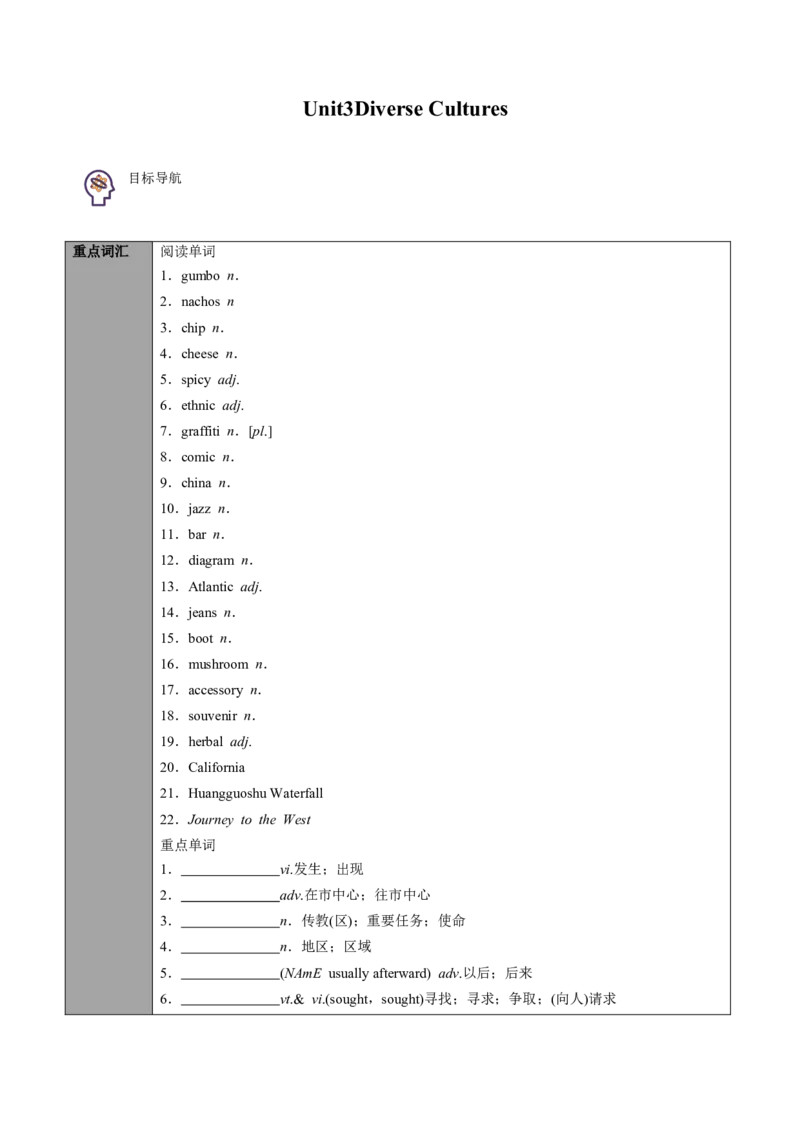
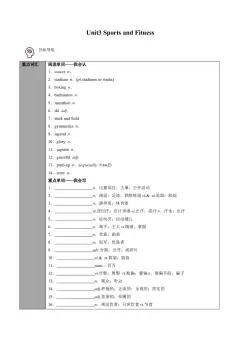
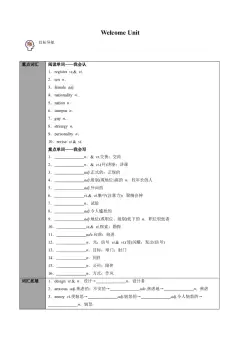
重点词汇 阅读单词
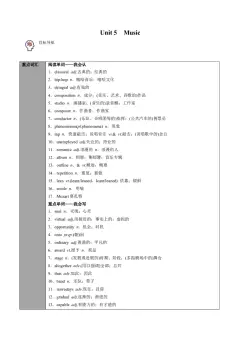
1.gumbo n.
2.nachos n
3.chip n.
4.cheese n.
5.spicy adj.
6.ethnic adj.
7.graffiti n.[pl.]
8.comic n.
9.china n.
10.jazz n.
11.bar n.
12.diagram n.
13.Atlantic adj.
14.jeans n.
15.boot n.
16.mushroom n.
17.accessory n.
18.souvenir n.
19.herbal adj.
20.California
21.Huangguoshu Waterfall
22.Journey to the West
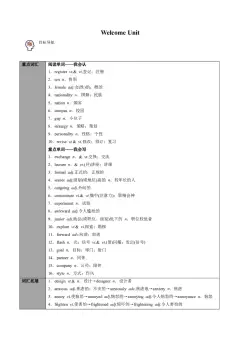
重点单词
1. vi.发生;出现
2. adv.在市中心;往市中心
3. n.传教(区);重要任务;使命
4. n.地区;区域
5. (NAmE usually afterward) adv.以后;后来
6. vt.& vi.(sought,sought)寻找;寻求;争取;(向人)请求7. n.日志;日记;报纸;刊物
8. vt.& n.夺取(生命);宣称;断言
9. vi.& vt.逃走;逃脱;避开 n.逃跑;逃脱;解脱
10. vt.包;裹;折叠 vt.& vi.(可)折小;(可)叠平
11. adv.特别;格外adj.顶好的;超级的
12. n.气候
13. adj.温和的;和善的;轻微的
14. n.材料;布料;素材 adj.物质的;实际的
15. n.衣服;服装
16. vt.适合;满足……需要;相配;合身 n.西服;套装
17. n.项目;一件商品(或物品);一条(新闻)
18. vt.包含;含有;容纳
19. adj.极好的;整洁的;整齐的
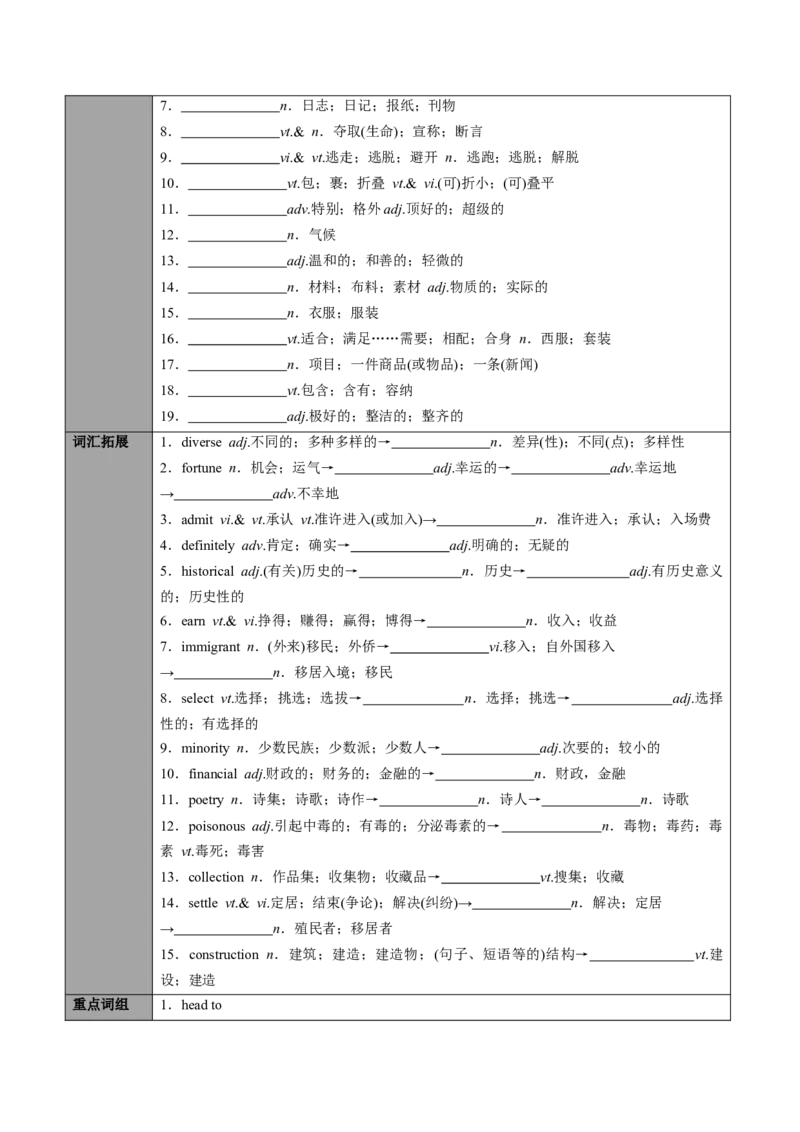
词汇拓展 1.diverse adj.不同的;多种多样的→ n.差异(性);不同(点);多样性
2.fortune n.机会;运气→ adj.幸运的→ adv.幸运地
→ adv.不幸地
3.admit vi.& vt.承认 vt.准许进入(或加入)→ n.准许进入;承认;入场费
4.definitely adv.肯定;确实→ adj.明确的;无疑的
5.historical adj.(有关)历史的→ n.历史→ adj.有历史意义
的;历史性的
6.earn vt.& vi.挣得;赚得;赢得;博得→ n.收入;收益
7.immigrant n.(外来)移民;外侨→ vi.移入;自外国移入
→ n.移居入境;移民
8.select vt.选择;挑选;选拔→ n.选择;挑选→ adj.选择
性的;有选择的
9.minority n.少数民族;少数派;少数人→ adj.次要的;较小的
10.financial adj.财政的;财务的;金融的→ n.财政,金融
11.poetry n.诗集;诗歌;诗作→ n.诗人→ n.诗歌
12.poisonous adj.引起中毒的;有毒的;分泌毒素的→ n.毒物;毒药;毒
素 vt.毒死;毒害
13.collection n.作品集;收集物;收藏品→ vt.搜集;收藏
14.settle vt.& vi.定居;结束(争论);解决(纠纷)→ n.解决;定居
→ n.殖民者;移居者
15.construction n.建筑;建造;建造物;(句子、短语等的)结构→ vt.建
设;建造
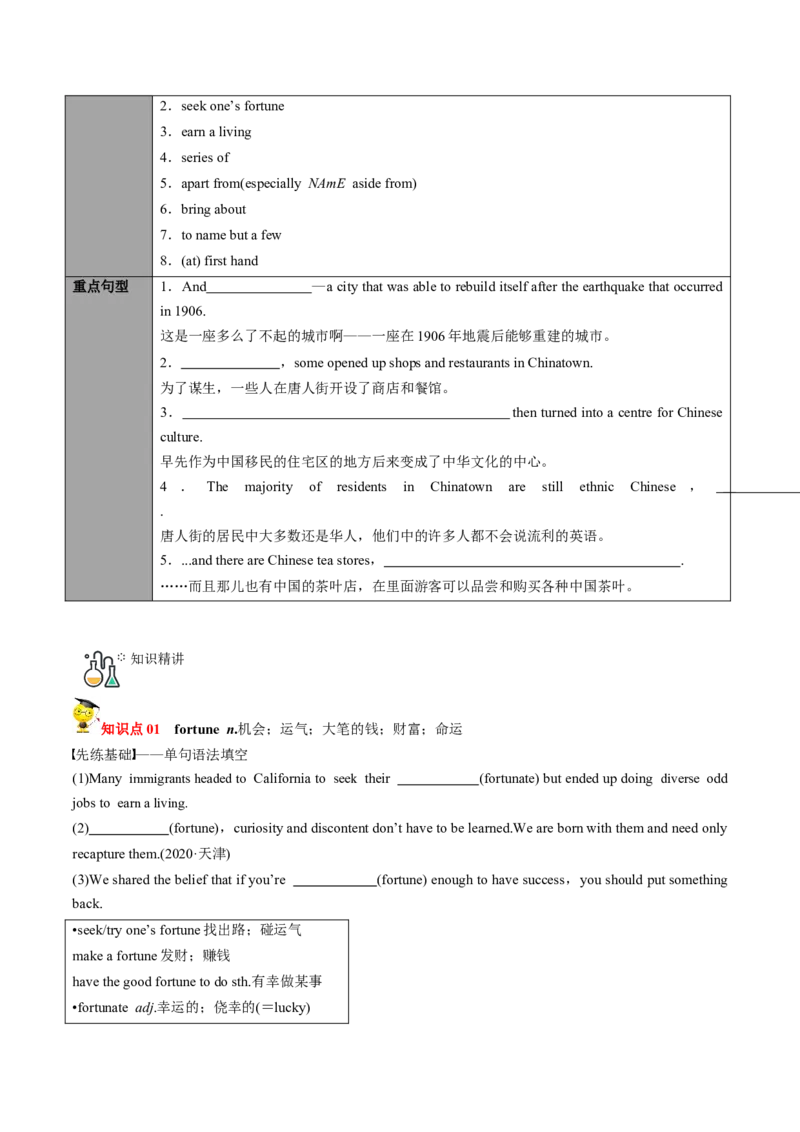
重点词组 1.head to2.seek one’s fortune
3.earn a living
4.series of
5.apart from(especially NAmE aside from)
6.bring about
7.to name but a few
8.(at) first hand
重点句型 1.And —a city that was able to rebuild itself after the earthquake that occurred
in 1906.
这是一座多么了不起的城市啊——一座在1906年地震后能够重建的城市。
2. ,some opened up shops and restaurants in Chinatown.
为了谋生,一些人在唐人街开设了商店和餐馆。
3. then turned into a centre for Chinese
culture.
早先作为中国移民的住宅区的地方后来变成了中华文化的中心。
4 . The majority of residents in Chinatown are still ethnic Chinese ,
.
唐人街的居民中大多数还是华人,他们中的许多人都不会说流利的英语。
5....and there are Chinese tea stores, .
……而且那儿也有中国的茶叶店,在里面游客可以品尝和购买各种中国茶叶。
知识精讲
知识点01 fortune n.机会;运气;大笔的钱;财富;命运
先练基础——单句语法填空
(1)Many immigrants headed to California to seek their (fortunate) but ended up doing diverse odd
jobs to earn a living.
(2) (fortune),curiosity and discontent don’t have to be learned.We are born with them and need only
recapture them.(2020·天津)
(3)We shared the belief that if you’re (fortune) enough to have success,you should put something
back.
•seek/try one’s fortune找出路;碰运气
make a fortune发财;赚钱
have the good fortune to do sth.有幸做某事
•fortunate adj.幸运的;侥幸的(=lucky)be fortunate to do sth./in doing sth.有幸做某事
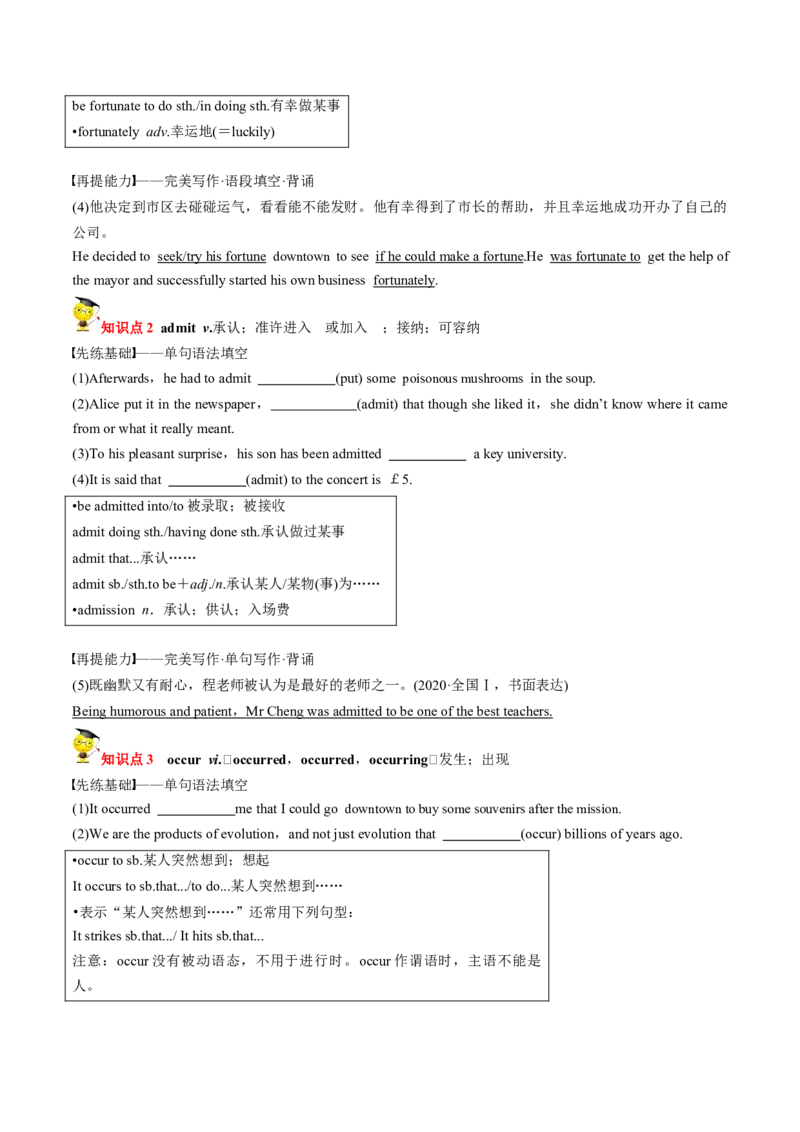
•fortunately adv.幸运地(=luckily)
再提能力——完美写作·语段填空·背诵
(4)他决定到市区去碰碰运气,看看能不能发财。他有幸得到了市长的帮助,并且幸运地成功开办了自己的
公司。
He decided to seek/try his fortune downtown to see if he could make a fortune.He was fortunate to get the help of
the mayor and successfully started his own business fortunately.
知识点2 admit v.承认;准许进入或加入;接纳;可容纳
先练基础——单句语法填空
(1)Afterwards,he had to admit (put) some poisonous mushrooms in the soup.
(2)Alice put it in the newspaper, (admit) that though she liked it,she didn’t know where it came
from or what it really meant.
(3)To his pleasant surprise,his son has been admitted a key university.
(4)It is said that (admit) to the concert is £5.
•be admitted into/to被录取;被接收
admit doing sth./having done sth.承认做过某事
admit that...承认……
admit sb./sth.to be+adj./n.承认某人/某物(事)为……
•admission n.承认;供认;入场费
再提能力——完美写作·单句写作·背诵
(5)既幽默又有耐心,程老师被认为是最好的老师之一。(2020·全国Ⅰ,书面表达)
Being humorous and patient , Mr Cheng was admitted to be one of the best teachers.
知识点3 occur vi.occurred,occurred,occurring发生;出现
先练基础——单句语法填空
(1)It occurred me that I could go downtown to buy some souvenirs after the mission.
(2)We are the products of evolution,and not just evolution that (occur) billions of years ago.
•occur to sb.某人突然想到;想起
It occurs to sb.that.../to do...某人突然想到……
•表示“某人突然想到……”还常用下列句型:
It strikes sb.that.../ It hits sb.that...
注意:occur没有被动语态,不用于进行时。occur作谓语时,主语不能是
人。再提能力——完美写作·一句多译·背诵
(3)妈妈突然想起她把帐篷落在我们前一天晚上住的旅馆里了。
① she had left the tent in the hotel where we stayed the night before.(occur)
② she had left the tent in the hotel where we stayed the night before.(strike)
③ she had left the tent in the hotel where we stayed the night before.(hit)
知识点4 escape v.逃脱;逃走;泄漏;避开;被忘掉
n.逃跑;逃脱;解脱
先练基础——单句语法填空
(1)Only a minority of students want to escape (take) the responsibility for their own behavior.
(2)A prisoner attempted to escape the prison,but in vain.
•escape from从……逃脱,从……逃跑
escape (doing) sth.避开(做)某事
escape being done逃避(被)做某事
•have a narrow escape死里逃生
再提能力——完美写作·单句写作·背诵
(3)最后,我们九死一生,幸运地逃过了被那头饥饿的北极熊伤害。(2020·浙江,读后续写)
At last , we had a narrow escape , fortunately escaping being hurt by the hungry polar bear .
知识点5 settle vi.定居;安家;停留
vt.使定居;(使)平静下来;安排;解决
先练基础——单句语法填空
(1)At last,he settled in a district where there were diverse ethnic groups.
(2)At the Jorvik Viking Centre in York,the city’s Viking (settle) is recreated,and people
experience the sights,sounds and smells of the old town.
(3)Having settled a beautiful village,he settles down to his writing.
•settle down (使)安定;安居;平静下来
settle in/into安顿下来;习惯于;适应
settle down to (doing) sth.开始认真(做)某事
•settlement n.定居点;协议;解决
•settler n.移居者;殖民者
再提能力——完美写作·单句写作·背诵
(4)每天有许多的问题要解决,我感到压力很大。(应用文之求助信)
With so many problems to settle every day , I feel greatly stressed .知识点 6 bring about引起;导致
bring up抚养;培养;教育;提出;呕吐
bring in引进;获利;赚钱
bring out出版;使显现
bring down使倒下;减少;降低
bring back把……带回来;使回忆起;使恢
复
根据句意用bring短语的正确形式填空
(1)I don’t clearly remember who the question but clearly remember it a heated
discussion.
(2)The reason why the goods are sold at such a low price is that the manufacturers are willing to the
price in return for big volume purchases.
(3)The picture often to me many happy memories of my high school days.
知识点7 what引导名词性从句
What started as a residential area for Chinese immigrants then turned into a centre for Chinese culture.早
先作为中国移民的住宅区的地方后来变成了中华文化的中心。
先练基础——单句语法填空
(1)Ten minutes later,we arrived at we called Gum Tree.
(2) attracted me most to the job was the chance to travel.
(3)The village is not it was decades ago.
what引导名词性从句时,在从句中充当句子成分主要作主语、表语和宾语。可以译成
多种意思:……的东西或事情;……的人或样子;……的数量或数目;……的时间;……的
地方等。
再提能力——完美写作·单句写作/完成句子·背诵
(4)让我印象最为深刻的是她的独特的教学方式。(2020·全国Ⅰ,书面表达)
What impressed me most was her unique teaching method.
(5)一个新体育馆在曾经的荒地上建了起来。
A new stadium was built on what used to be a wasteland.
(6)你应该关注的是整个句子而不是每一个单词的意思。(应用文之建议信)
What you should focus on is the meaning of the whole sentence rather than every single word.
语法精讲
省略为了避免重复,将句子中的一个或几个成分省去,这种语法现象叫省略。省略是避免重复、突出新
信息并使上下文紧密连接的一种语法手段。英语中的省略有下列几种情况。
一、简单句的省略
1.祈使句的省略。在祈使句中,通常省略主语you。
Open the window.
请(你)打开窗户。
2.在一些口语中可以省略某些句子成分。
(Is there)Anything else?
(还有)其他东西吗?
3.疑问句的答语省略。为避免重复而省略疑问句的答语,这也是常见的一种句式省略。
—Are you a student?
——你是一名学生吗?
—Yes,I am(a student).
——是的,我是(一名学生)。
4.感叹句的省略。目的是突出感叹的部分。
What a beautiful girl(she is)!
(她是)多么漂亮的女孩呀!
二、比较结构的省略
在“the+比较级,the+比较级”结构中和由than和as引导的比较句式中,常会有一些成分在上下
文清楚的情况下被省略。
The sooner(you do it),the better(it will be).
(你做得)越快(结果就会)越好。
He is cleverer than any other boy (is).
他比其他男孩聪明。
三、并列句中的省略
在由and或but连接的并列句中,常省略一些重复的词或词组。
My father is a lawyer and my mother (is) a teacher.
我爸爸是律师,我妈妈是教师。
She came into the room and (she) turned on the computer.
她进了房间,打开了电脑。
The news made me angry,but (the news made) John happy.
这条消息使我生气,但却让约翰高兴。
四、主从复合句中的省略
1.宾语从句中,连词that常省略,但当有多个并列宾语从句时,只能省略第一个that。
I know(that)she is a teacher and that she is an excellent writer.
我知道她是一名教师,也是一位优秀的作家。
2.表示条件、时间、地点、方式或让步等的状语从句的谓语含有 be动词,且从句的主语又和主句中的主语一致,或者主语是it时,常把从句中的主语连同be动词一起省略。
If so(=If it is so),you must go back and get it.
如果是这样的话,你必须回去把它拿来。
Look out for cars when crossing the street (=when you are crossing the street).
穿过街道时要当心车辆。
3.定语从句中的省略。若引导定语从句的关系代词在从句中作宾语,该关系代词一般可省略。
The car(which/that)his father gave him as a birthday present was stolen.
他父亲送给他的作为生日礼物的那辆汽车被盗了。
五、不定式的省略
1.并列的不定式可以省略后面的不定式符号to。但若两个不定式之间表示对比关系时,不省略to。
The book is intended to be read and not (to) be torn.
这本书是供人阅读的而不是供人撕毁的。
The purpose of new technologies is to make life easier, not to make it more difficult.
新技术的目的是要让生活更轻松自在,而不是让生活更困难。
2.某些使役动词如make,let,have等,和感官动词如see, watch,notice,observe等,后面作宾补
的不定式须省略to,但若这些动词用于被动语态,则to不省略。
My mother wouldn't let me go to see the film.
我妈妈不会让我去看电影的。
He was noticed to leave the office.
有人注意到他离开了办公室。
3.不定式to后面的内容也可承前省略,此时所省略的成分相当于 do so,但一定要有上下文语境。
但倘若承前省略的不定式含有作助动词用的have,be的任何形式,to后要保留原形have或be。
—Would you like to study English with me?
——你愿意和我一起学英语吗?
—Yes. I'd like to (study English with you).
——是的,我愿意(和你一起学英语)。
She has succeeded in the final examination , but in fact, she ought to have(succeeded in the final
examination).
她在期末考试中取得了成功,而实际上,她本就该获得成功。
4.介词but,except(除了)前有实义动词do的具体形式时,后面的不定式不带to。
All he could do was nothing but wait and see.
他所能做的只有等着看看(情况)。
六、虚拟语气中的省略
1.虚拟条件句常省略if,而将were,had,should提前,构成部分倒装。
Had you come here yesterday,you would have met her.
=If you had come here yesterday,you would have met her.
如果你昨天来这儿的话,你就会见到她了。2.动词 advise,suggest(建议),propose,demand,insist(坚持要求),require,command,
recommend,order等后的宾语从句及It is...that...主语从句中常省略表虚拟语气的should。
We insisted that they (should) go with us.
我们坚持要求他们和我们一起走。
It is necessary that we (should) learn more words by heart.
我们有必要多记一些单词。
It is suggested that we (should) go to see the film.
有人建议我们去看这部电影。
七、介词的省略
1.在英语中一些与动词、名词、形容词搭配的介词常被省略,而只保留后面的动名词:spend
time/money (in) doing sth.; have difficulty/trouble (in) doing sth.;prevent/stop sb.(from)doing sth.。
She spends half an hour (in) doing some reading every day.
她每天花半小时读书。
I have some trouble (in) learning English.
我学英语有困难。
What prevented him (from) going?
什么事阻止了他去?
2.表示时间的介词at,on和in用在next,last,this, each,these,yesterday,every,tomorrow等词
之前,一般可省略。
We have a final exam (in) every term.
每学期我们都举行一次期末考试。
八、使用so,not等的省略
英语中,可以使用so,not或其他手段来省略上文或问句中的一部分或整个句子。
—Can I put my bike here?
——我可以把自行车放在这儿吗?
—You'd better not.
——你最好不要。
—Do you think our team will win?
——你认为我们队会赢吗?
—I think so.
——我认为会。
用适当的词或所给词的适当形式填空
1.—Is it going to rain tomorrow?
—I'm afraid .
2.Don't plant potatoes till I tell you .
3.—I hear that Bai Shan can't afford his schooling this fall.
—If ,_let's do something for him.
4.—Have you fed the dog?—No, but I'm just going .
5.—I'm afraid the date for the interview doesn't suit me.
—If ,_we can make it another day.
6.—My spoken English is poor, what shall I do?
— (join) an English language club to practice, and you'll be good at it.
7.—Would you like to join us in going to Hong Kong's Disneyland this Sunday?
—I'd love ,_but I have to prepare for my examination on Monday.
8.—Are you a doctor?
—No, but I want .
写作园地
——写作要求——
假定你是李华,你的美国朋友 Sarah 打算暑期来北京旅游,来信询问改建后前门大街的情况。请你
写封回信,简单介绍以下内容:
1.简况:长800余米、600多年历史、300余家商铺;
2.位置:天安门广场南面;
3.交通:公共汽车17、69、59路等,地铁2号线;
4.特色:步行街、铛铛车、茶馆、剧院等。
参考词汇:步行街 pedestrian street
铛铛车 trolley car 地铁 subway
注意:1.词数80左右;
2.可以适当增加细节,以使行文连贯;
3.开头与结尾已为你写好,不计入总词数。
Dear Sarah,
Thank you for your letter asking about the rebuilt Qianmen Street. Here is something about it.
_______________________________________________________________________________________
____________________________________________________________________________________________
____________________________________________________________________________________________
_____________________________________________________________________________________
Yours,
Li Hua
——思路分析——
一、写作要点
1.显性要点:感谢来信询问改建后前门大街的情况,现予以回复——前门大街的简况(长度、历
史、商铺)——前门大街位置(天安门广场南面)——前门大街交通(公共汽车和地铁)——前门大街特色(步行
街、铛铛车、茶馆、剧院等)。
2.隐性要点:交通便利(就在天安门广场南面,有公共汽车和地铁)——品味特色(坐铛铛车去茶馆、剧院体验中国人的生活)——希望对方能够喜欢(点名介绍用意)。
二、要点串并
把梳理出的要点进行串并,将零碎的事实巧妙整合。
◆前门大街简况串并思路如下:具有600多年历史的前门大街长800余米,沿街林立300余家店铺。
◆前门大街位置与交通串并思路如下:前门大街位于天安门广场南面,乘坐公共汽车 17、69、59路
等,地铁2号线均可到达。
◆前门大街特色串并思路如下:前门大街虽是步行街,但可乘坐铛铛车去茶馆和剧院。
三、组句成篇
1.当要点之间存在主次关系,但又不能将次要点省略时,便可尝试使用从句以突出主句。
范例:As the street is just to the south of Tian'anmen Square, it's very convenient to get there by bus.
2.当要点之间存在并列关系时,可以使用并列连词,使句与句之间结构更紧凑。
范例:Qianmen Street is a pedestrian street, but there are trolley cars to take you not only to the shops, but
also to theaters and teahouses...
——佳作展示——
Dear Sarah,
Thank you for your letter asking about the rebuilt Qianmen Street. Here is something about it.
Qianmen Street is a famous street of over 600 years old. Along this over 800meter street, there are more than
300 shops. As the street is just to the south of Tian'anmen Square, it's very convenient to get there by bus. You may
take Buses No. 17,69 or 59. Subway Line 2 has a stop there too. Qianmen Street is a pedestrian street, but there are
trolley cars to take you not only to the shops, but also to theaters and teahouses where you can experience a truly
Chinese way of life. I'm sure you'll like it.
Yours,
Li Hua
——技巧点拨——
景点介绍类文章的写作
景点介绍主要是对景点周围的环境、场面及自然现象的描述。通过对景点的描写来表达作者的看法
或态度,以及环境对人物的影响等。 写作时要注意:
1.把景点和周围的环境及景点的历史意义等结合起来。
2.描写景观时按照从整体概述到细节刻画的方法,灵活使用定点描写(同一角度描写多个景观)和定
景描写(景观不变,更换观察角度)的手法。在描写过程中要注意处理好空间位置的转换。
3.以描写为主要写作手法,对景物进行介绍,并适当抒发个人情感。
分层提分
题组A 基础过关练
Ⅰ.单词拼写(根据汉语提示或首字母提示写单词)(每小题2分,共16分)
1.The has taken on a fresh look since the new roads were built.2.As is known to us all,there are 55 groups in China,each with its traditional customs and
culture.
3.The company that their product can make you slim without dieting.
4.The driver narrowly being killed in the traffic accident.
5.It is impossible for this country to recover in a short time from this (金融的) crisis.
6.Tom came in for a cup of tea and he went out soon (之后).
7.Yesterday they went (往市中心) and rode the cable cars.
8.The book (包含) 50 stories,including 15 short stories.
Ⅱ.词形变化填空(用括号内所给词的适当形式填空)(每小题2分,共14分)
9.There are cultures in our country,but it’s the that makes our motherland
wonderful.(diverse)
10.He went to America to seek his and imagined he would be very ,but
,he couldn’t even make ends meet.(fortune)
11.He that he into a financial school,but he hadn’t received the letter of
.(admit)
12.He is very about books,so he often some books for his kids to read.Look! Here
is a of his books.(select)
13.The has written many and I have bought a of him.(poet)
14.He loves stamps and he often shows off his in front of others.(collect)
15.With the problem ,they finally got a new .(settle)
Ⅲ.经典句型仿写(每小题2分,共10分)
16.你买的纪念品真漂亮!
!
17.为了谋生,他必须每天早起。
,he must get up very early every day.
18.让这个地区出名的是其多种多样的文化。
is its diverse cultures.
19.这位女士挑选了很多衣服,都很适合她。
The lady selected many clothes, .
20.最后,他们定居在了一个气候温和的地方。
At last,they settled down in a place .
题组B 能力提升练
Ⅰ.课文语法填空——复习本单元Reading and Thinking部分
After 1. (camp) in the Redwood Forest,I spent a whole day in San Francisco,
2. there are many beautiful old buildings sitting on top of big hills.I walked around in the Mission
District,which used to be a poor area of town,3. is now a centre for art,music and food.In the
afternoon,I paid a visit 4.to a local museum that showed the 5. (history) changes in California.Ilearned that America got California from Mexico in 1848.In 6.the same year,gold 7. (discover) near
San Francisco,which 8. (start) a gold rush.Over 300,000 immigrants from all over the world came
here 9. (seek) their fortune.They also brought their 10. (culture) with them.In the
evening,I went to Chinatown and had a great meal in a Cantonese restaurant.Tomorrow evening,I will go to a
jazz bar in the Richmond District.I can’t wait to go there.
请先从表格中选用本单元所学词汇完成下列短文,然后翻译短文并背诵该短文。(文中加波浪线的句子
为本单元的语法项目:省略)
I had always been attracted to ethnic cultures.So I went to Dali,Yunnan province,a district of diverse
minorities.A 1. super experience .In fact,at first,I thought there would be a large percentage of
2. made of primitive materials due to financial difficulty.However,it turned out that the
downtown area 3. bars in which jazz was played and shops where special clothing,accessories
and souvenirs were for sale.Many people are immigrants from other places.Some come to 4. their
fortune or (to) earn a living while others 5. down to escape from the cold north of
China.Afterwards,we
6. a neighborhood where the Bai ethnic group live.I participated in series of activities,including
knowing poisonous mushrooms,learning about herbal medicine,and 7. items unique to the
Bai.Apart from this,I tasted really spicy local food. I experienced the culture first hand and (I) wrote
journals neatly every day .
题组C 培优拔尖练
阅读下列短文,从每题所给的A、B、C、D四个选项中选出最佳选项。
A
Researchers are often interested in how culture changes over time. All cultures go through periods of change
and some cultures change faster than others. For example, in the past 10 years, Chinese culture has changed rapidly
as western products have become popular. Other countries, such as France, have created rules to prevent their
culture from changing too quickly.
Even though cultures change at different paces, the causes of cultural change are quite similar around the
world. One of these is technology and medicine. In the United States the invention and development of birth control
pills and other measures helped parents to limit the size of their families. As a result, families grew smaller and
parents could give more attention to fewer children. On the other hand, new technology has also created emotional
distance among families.
Cultures also change when they come into contact with other cultures. Immigration, for example, often results
in cultural change for both immigrants and the host culture. Immigrants often bring with them different ideas, food,music, language, and manners when they move to a new culture. In Canada, for example, the government has a
policy of multiculturalism where immigrants are encouraged to share their background cultures with Canadians
while adopting and accepting Canadian culture.
Cultural change can occur due to larger events. For example, economic depression, war, and disaster can
endanger societies, which must adapt to these challenges and events. Because of these changes in society, ideas and
ways of life also affect the entire culture. For example, during World War Ⅱ, many American men were sent far
off to fight. Consequently, women were suddenly needed to work in the factories. As a result of this change, it is no
longer culturally acceptable to believe that they should not have the right to work.
1.In the first paragraph, which country has experienced rapid cultural change in the last decade?
A.Canada. B.China.
C.France. D.America.
2.What will probably be talked about following the last paragraph?
A.Another reason for cultural change.
B.A discussion of immigration policy in France.
C.Another cultural change caused by World War Ⅱ.
D.Some examples of highly successful working women.
3.What would be a good title for this passage?
A.Immigration Policy and Culture
B.Immigration and Culture
C.New Technology and Family Culture
D.Theories of Cultural Change
B
A culture's values can be mirrored by its humor. Humor has been evaluated by many great minds such as
Thomas Hobbes, who disliked humor, “Laughter is nothing else but sudden glory arising from some sudden
thought of feeling far better than others.” He thought humor to be a negative quality of human narrowmindedness.
However, Mordechai Gordon, Ph. D of Education, insists, “Humor allows us to view the world from an angle
that is amusing rather than serious.” I agree with Gordon. Learning to look at the world through humor is important.
In the United States, every four years an election occurs. Without humor as a way to express their feelings,
how else would Americans keep from clawing their eyes out and going the way of lemming?Television shows
like “The Daily Show” have become important parts of American culture. They are mothering the masses by
metaphorically (隐喻地) taking politics into our mouths. They make politics fun.
Of course, politics is only one type of humor. Social humor helps people through the twists and turns of the
human condition. American pop culture promotes (促进) an unhealthy selfimage. On the topic of selfimage, Hari
Kondabolu stands out. He has a joke about the popular musical group “The Pussycat Dolls”, describing their hit
song “Don't Cha” as a negative representation of women. He points out an obvious offence in American culture.
A study from Loyola University of Maryland has shown that humor is one determining factor for selecting a
mating partner. Amongst other things, mates look for an outstanding funny bone in a potential partner.Of course, humor is not always used for good purposes. Humor can be linked to vulgarity (庸俗) and racism,
but, like everything else, it has potential to unite human beings by allowing us to laugh at ourselves, our failures
and our connection with one another.
Though life may seem tough and depressing at times, all I have to do is look in the mirror at my increased
wrinkles (皱纹) to know that there is a comedy out there that even Chaplin wasn't aware of.
With that in mind, remember to laugh with humanity and sometimes at humanity.
4.Hobbes believed that humor .
A.was only a way to laugh at others to make oneself feel better
B.resulted in narrow mindedness of human beings
C.had the power to mirror personal glory and national values
D.was for people to view the world from another angle
5.What is the author's attitude towards political humor?
A.Worried. B.Disappointed.
C.Curious. D.Appreciative.
6.The fourth paragraph is developed mainly .
A.by example B.by process
C.by comparison D.by classification
7.What can we learn from the last two paragraphs?
A.Chaplin wasn't aware of being laughed at.
B.The author feels helpless and sad about getting older.
C.Never be the one who laughs at other people.
D.The author is determined to face life with a sense of humor.
C
San Francisco's Chinatown is the biggest and oldest in the country. It's the third most visited tourist destination
in the city. It's also the city's most densely populated neighborhood. So why are businesses in Chinatown
struggling?
In this week's paper, I outline some of the reasons for why Chinatown's crowded streets and busy shops might
be declining. Underneath the surface, Chinatown is falling. And the city, local organizations and businesses are
trying to figure out what they can do to turn things around.
While numbers of people visit Chinatown, they don't stay long and they don't spend a lot of money. And
beyond annual festivals, like Chinese New Years, this month's Moon Festival and last month's Sunday Streets—
which drew about 15,000 to 20,000 people—the neighborhood has a hard time attracting locals.
Can you remember the last time you went to Chinatown? If you can't, you're not alone. Locals told me that
Chinatown doesn't have much to offer them—that the stores are all the same. There are some good eating joints,
people said, but they don't know how to find them. Some people even told me that they sometimes go to extreme
measures to avoid the neighborhood altogether. But when asked if they would like to see Chinatown gone, the
answer was always a strong no.Locals are hopeful that things will get better and traffic will increase when the Central Subway is complete.
But that's not for another five years, at least. And if new shops or restaurants don't make their way into Chinatown,
the same problem of attracting locals will exist.
Not that Chinatown's going to die. The dragon still has some fire in its belly. And many people are rooting for
positive change. The question is, how does Chinatown change without losing the very importance of what makes it
unique?
8.Which can we know about Chinatown according to the passage?
A.Businesses in Chinatown are going well.
B.Local people like going shopping there.
C.A great number of people visit it every year.
D.No period has seen a more prosperous Chinatown.
9.According to the locals we can know that .
A.Chinatown doesn't love to offer them assistance
B.shops in Chinatown lack their own characteristics
C.it is hard to buy quality goods at proper prices
D.they feel annoyed to see so many familiar faces
10.It can be inferred from the passage .
A.the Central Subway is under construction
B.Chinatown has to make way for subway
C.many restaurants have been closed down
D.the locals hope Chinatown will be extinct
11.What is the author's attitude towards Chinatown?
A.Negative. B.Sympathy.
C.Hopeful. D.Indifferent.
第二节(共5小题;每小题2.5分,满分12.5分)
阅读下面短文,从短文后的选项中选出可以填入空白处的最佳选项。选项中有两项为多余选项。
The freezing cold winter really prevents me from going to Beibei District, Chongqing. You really can't
imagine how cold a southern China city can be until you experience a winter there. 1 However, while beneath
three quilts (被子), I found it still first wet and then cold. Without the wetness, there will be no coldness, for which
spicy (辛辣的) food has been popular since very long time ago.
2 The hotness and wetness is really beyond imagination. While you are out, with shade everywhere but
useless to prevent the high temperature, what you have to put up with is wetness added to hotness. 3 Among
the famous spicy foods, hotpot is the most preferred by both natives and newcomers from other provinces as well as
foreign countries, as can be seen from the fact that Chongqing is an international city.
4 As the home of beauties and bridges, it is also a charming city of mountains and rivers, of which I
prefer Jialing River most with its green water running smoothly.
People there are very kind especially the old people enjoying a comfortable life either in the shade of treesswinging their fans or playing chess on a square. Living in Chongqing is not a bad choice. 5
A.The steaming hot summer prevents me from going there, too.
B.The winter in Chongqing is pretty cold, which is beyond my imagination.
C.All in all, what I had experienced there really left me a deep impression.
D.I still remember when I was in Southwest University, I had to keep warm with three quilts.
E.Beauties in Chongqing are quite charming as well as knowledgeable.
F.Although it has disadvantages, Chongqing has many advantages over other cities.
G.Ancestors in Chongqing were so intelligent that they knew spicy foods could make the weather easy and
enjoyable to tolerate.
第二节(共10小题;每小题1.5分,满分15分)
阅读下面短文,在空白处填入1个适当的单词或括号内单词的正确形式。
The Chinese Culture Center in Paris, 1 (locate) in downtown areas opposite the celebrated historic sites
of Grand Palais and Petit Palais across the Seine River, 2 (sit) next to a large number of grand handsome and
elegant classical architectures that have witnessed the evolution of Paris at 3 (vary) historical stages. It
conforms to (符合) the status of China, a great power with 4 lasting civilization of several thousand years in
the East, 5 (set) the Chinese Cultural Center in this exact place.
The amazing progress in 6 (smooth) selecting the site for the Chinese Culture Center and putting it into
7 (operate) in downtown Paris in such a short period was due to high priority of the Chinese government and
constructive cooperation of the French party. Wu Jianmin, Chinese ambassador to France, said 8 excitement,
“We have our own cultural center in Paris at last, 9 we have eventually realized the long cherished wish of my
predecessor in the Chinese embassy.” Hou Xianghua, the first director of the Chinese Cultural Center in Paris, said
the center will stick to its “nongovernmental” nature and greet people from all 10 (walk) of life, in addition to
serving the mainstream society.