八年级(上) Q.pdf 1 2014/6/4 10:21:14
C
M
Y
CM
MY
CY
CMY
K义务教育教科书
ENGLISH
英 语
八年级 上册
主 编 王 蔷
副 主 编 曹 瑞珍 陈则航
本册主编 陈则航 王 琦
·北京·基础教育教材网址:http://www.100875.com.cn
出版发行:北京师范大学出版社 www.bnup.com.cn
北京新街口外大街19号
邮政编码:100875
印 刷:唐山市润丰印务有限公司
经 销:全国新华书店
开 本:184mm× 260mm
印 张:8.25
字 数:250千字
版 次:2013 年6月第1版
印 次:2013 年6月第1次印刷
定 价:
ISBN 978-7-303-16506-3
责任编辑:王 琦 孙山泉 装帧设计:王 蕊
责任校对:李 菡 责任印制:吕少波 吴祖义
版权所有 侵权必究
反盗版、侵权举报电话:010-58800697
北京读者服务部电话:010-58808104
外埠邮购电话:010-58808083
本书如有印装质量问题,请与印制管理部联系调换。
印制管理部电话:010-58800825前 言
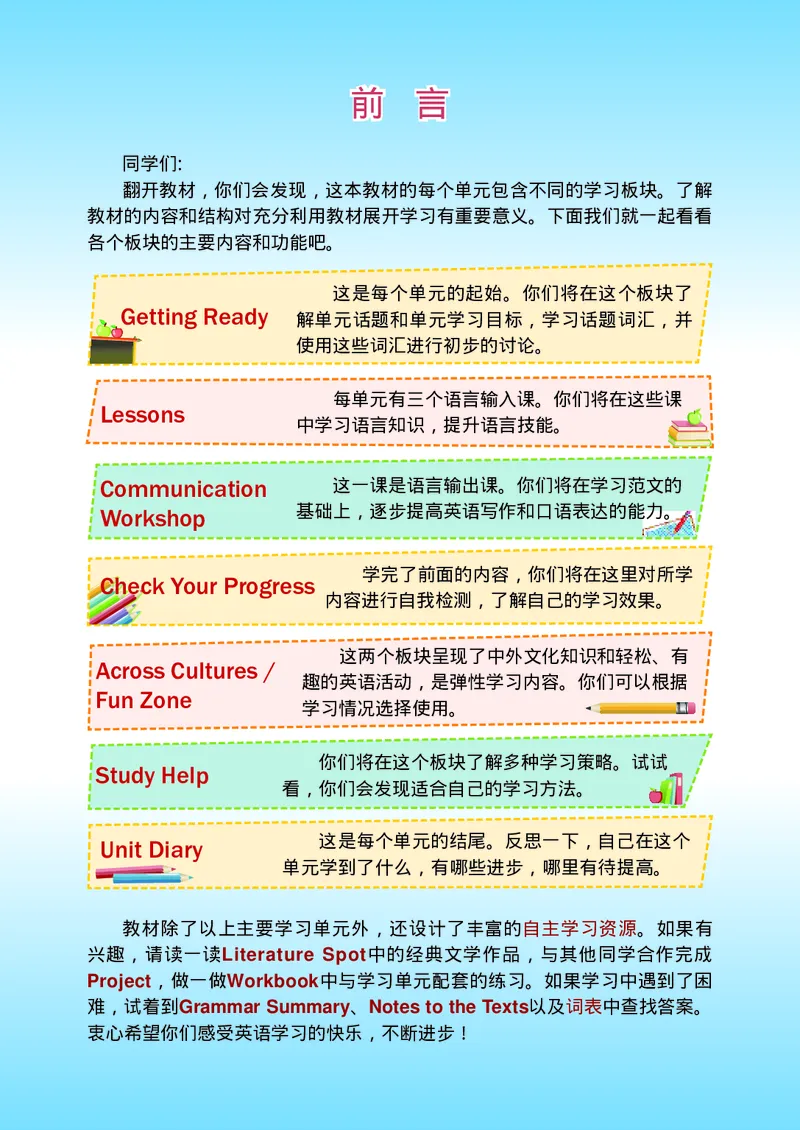
同学们:
翻开教材,你们会发现,这本教材的每个单元包含不同的学习板块。了解
教材的内容和结构对充分利用教材展开学习有重要意义。下面我们就一起看看
各个板块的主要内容和功能吧。
这是每个单元的起始。你们将在这个板块了
Getting Ready 解单元话题和单元学习目标,学习话题词汇,并
使用这些词汇进行初步的讨论。
每单元有三个语言输入课。你们将在这些课
Lessons
中学习语言知识,提升语言技能。
Communication 这一课是语言输出课。你们将在学习范文的
基础上,逐步提高英语写作和口语表达的能力。
Workshop
学完了前面的内容,你们将在这里对所学
Check Your Progress
内容进行自我检测,了解自己的学习效果。
这两个板块呈现了中外文化知识和轻松、有
Across Cultures /
趣的英语活动,是弹性学习内容。你们可以根据
Fun Zone
学习情况选择使用。
你们将在这个板块了解多种学习策略。试试
Study Help
看,你们会发现适合自己的学习方法。
这是每个单元的结尾。反思一下,自己在这个
Unit Diary
单元学到了什么,有哪些进步,哪里有待提高。
教材除了以上主要学习单元外,还设计了丰富的自主学习资源。如果有
兴趣,请读一读Literature Spot中的经典文学作品,与其他同学合作完成
Project,做一做Workbook中与学习单元配套的练习。如果学习中遇到了困
难,试着到Grammar Summary、Notes to the Texts以及词表中查找答案。
衷心希望你们感受英语学习的快乐,不断进步!Scope and Sequence
Unit / Pages Skills
Reading: Reviews for Last Week’s TV; The Big Game
1 Listening: An Interview on TV
Television
Speaking: Talking about a TV programme; using
5~16 exclamations
Writing: My Favourite TV Programme
Reading: Class Project Rules; A Special Team
2
Listening: Teamwork
Teams
Speaking: Talking about school rules and special teams
17~28
Writing: My Teams
3 Reading: Olympic Winners; Together to the Poles
Faster, Higher,
Listening: Time to Exercise
Stronger
Speaking: Making comparisons
29~40 Writing: School Sports Day
Reading: Health Advice; Healthy Bones
4
Listening: Going to the Doctor
Healthy Living
Speaking: Seeing a doctor; giving health advice
41~52
Writing: My Health Habits
Reading: Helping Each Other; Young Girl Warns
5 Others about Tsunami
Helping
Listening: Helping Your Community
53~64 Speaking: Asking for and offering help
Writing: A Special Day
Reading: Amazing Animals!; True Stories?
6
Listening: Dreams
The Unexplained
Speaking: Talking about unusual experiences
65~76
Writing: A Strange Dream
Appendices pp. 77~150
2Functions Vocabulary Grammar Pronunciation
一般过去时
• Exclamations • TV programmes • • /e/, /ɪ/
• Language • /iː/, /eɪ/
learning • /ɪ/, /iː/
• Preferences • Materials and • Can, must, • /æ/, /eɪ/
objects have to • /e/, /æ/
• Teamwork • /e/, /eɪ/
activities
比较级 陈述句语调
• Comparison • Sports • •
最高级 一般疑问句
• Comparatives • •
and superlatives 语调
特殊疑问句
•
语调
状语从句
• Seeing the doctor • Healthy habits • • /f/, /θ/
• Health problems • /s/, /θ/
• /d/, /ð/
过去进行时
• Requests and • Helping • • /ʊ/, /ɒ/
replies • /ʊ/, /uː/
• /ɔːl/, /uːl/
• Showing surprise • Senses •
过去进行时
•
/r/音连读
• Adjectives •
连读
34
loohcS
ot
kcaB
Holiday Survey
1 Work in pairs. Ask and answer these questions about your recent
holidays.
1 Where were you on holiday this summer?
I was …
a) in the country. b) at home.
c) abroad. d) Others. Please specify.
2 Who were you with?
I was with …
a) my family. b) my friends.
c) my friend’s family. d) Others. Please specify.
3 What did you do during the holiday?
I …
a) studied a lot. b) visited some interesting places.
c) went swimming every day. d) Others. Please specify.
Short Quiz
2 Work in pairs. Answer these questions. You have five minutes!
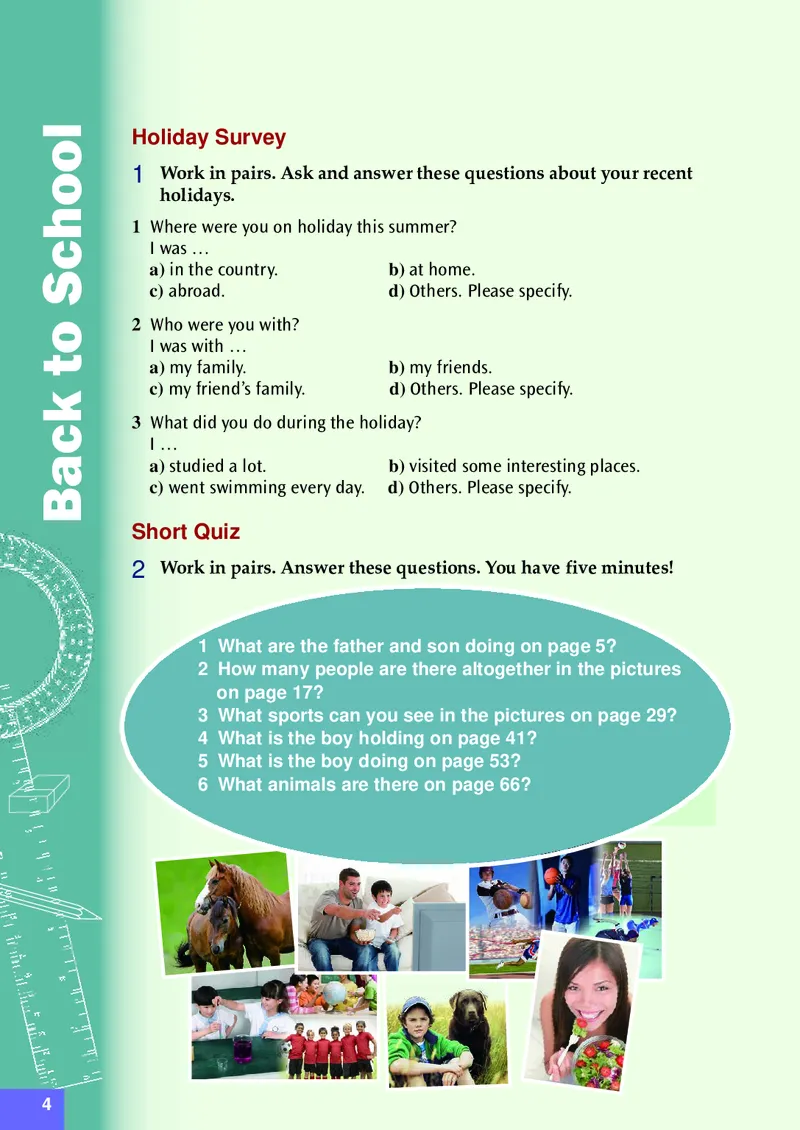
1 What are the father and son doing on page 5?
2 How many people are there altogether in the pictures
on page 17?
3 What sports can you see in the pictures on page 29?
4 What is the boy holding on page 41?
5 What is the boy doing on page 53?
6 What animals are there on page 66?
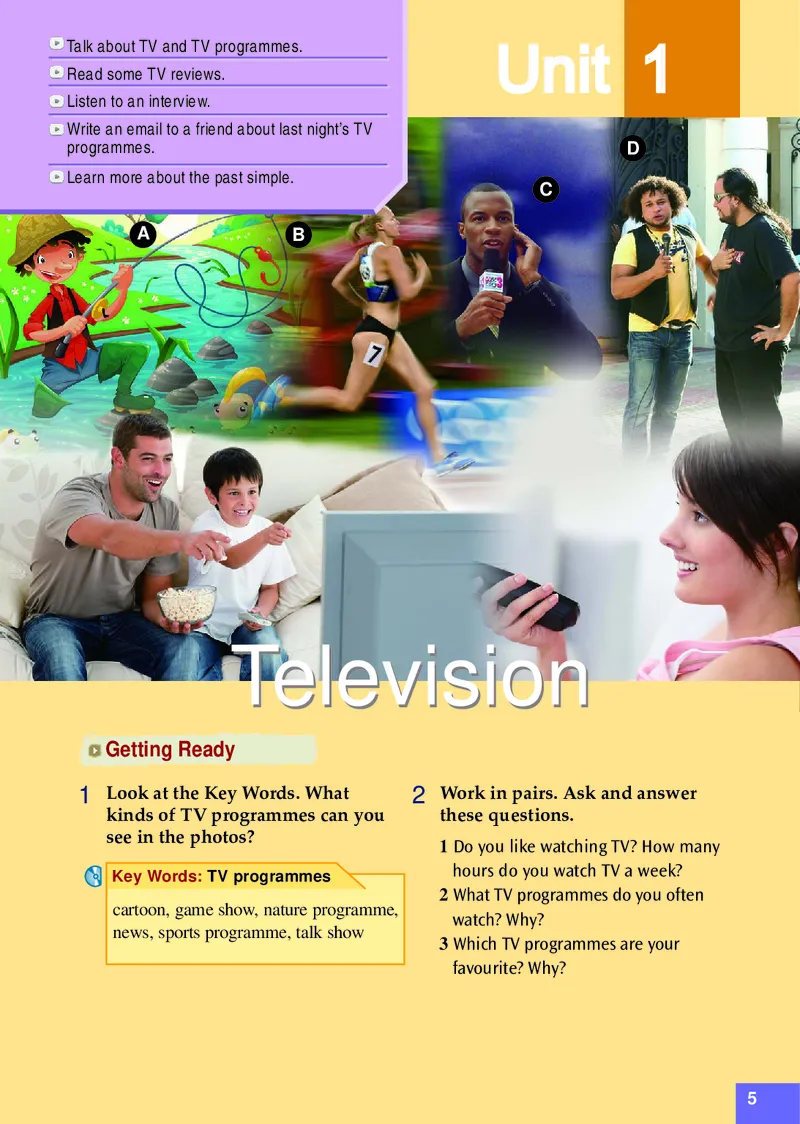
4Talk about TV and TV programmes. Unit 1
Read some TV reviews.
Listen to an interview.
Write an email to a friend about last night’s TV
programmes. D
Learn more about the past simple.
C
A B
TTeelleevviissiioonn
Getting Ready
1 Look at the Key Words. What 2 Work in pairs. Ask and answer
kinds of TV programmes can you these questions.
see in the photos?
1 Do you like watching TV? How many
hours do you watch TV a week?
Key Words: TV programmes
2 What TV programmes do you often
cartoon, game show, nature programme,
watch? Why?
news, sports programme, talk show
3 Which TV programmes are your
favourite? Why?
551
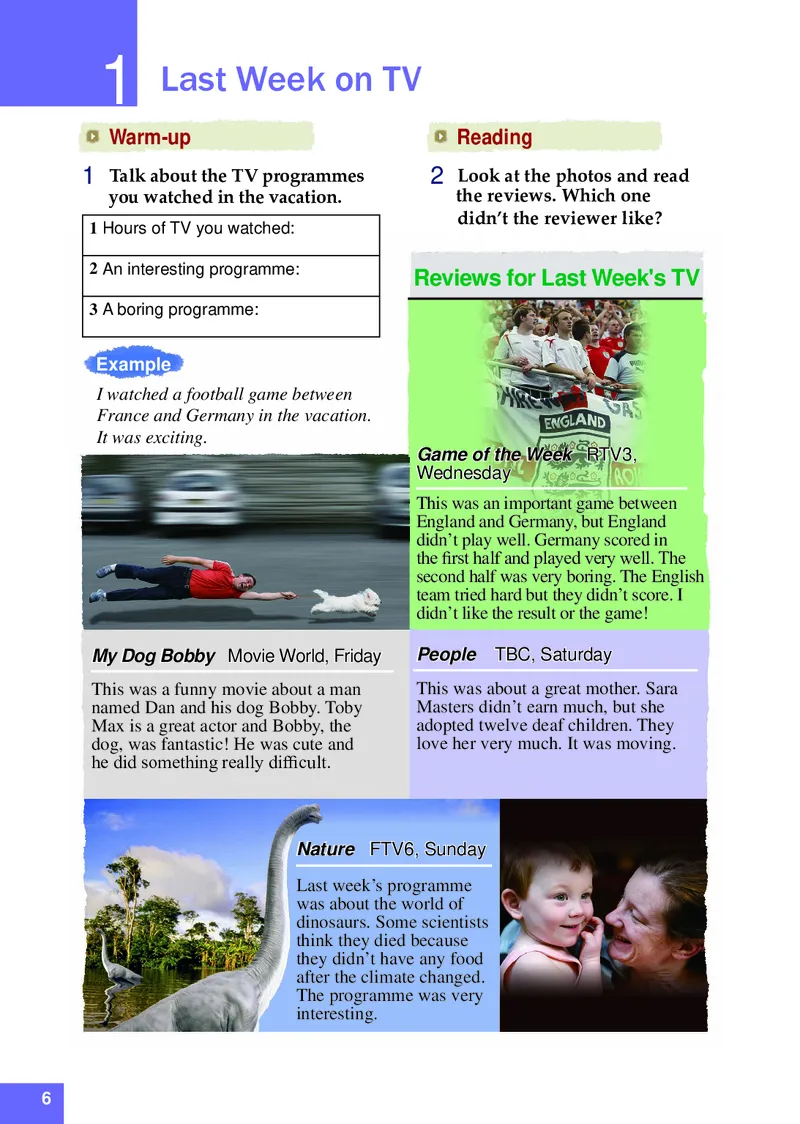
Last Week on TV
Warm-up Reading
1 Talk about the TV programmes 2 Look at the photos and read
you watched in the vacation. the reviews. Which one
didn’t the reviewer like?
1 Hours of TV you watched:
2 An interesting programme:
Reviews for Last Week's TV
3 A boring programme:
Example
I watched a football game between
France and Germany in the vacation.
It was exciting.
Game of the Week RTV3,
Wednesday
This was an important game between
England and Germany, but England
didn’t play well. Germany scored in
the irst half and played very well. The
second half was very boring. The English
team tried hard but they didn’t score. I
didn’t like the result or the game!
My Dog Bobby Movie World, Friday People TBC, Saturday
This was a funny movie about a man This was about a great mother. Sara
named Dan and his dog Bobby. Toby Masters didn’t earn much, but she
Max is a great actor and Bobby, the adopted twelve deaf children. They
dog, was fantastic! He was cute and love her very much. It was moving.
he did something really dificult.
Nature FTV6, Sunday
Last week’s programme
was about the world of
dinosaurs. Some scientists
think they died because
they didn’t have any food
after the climate changed.
The programme was very
interesting.
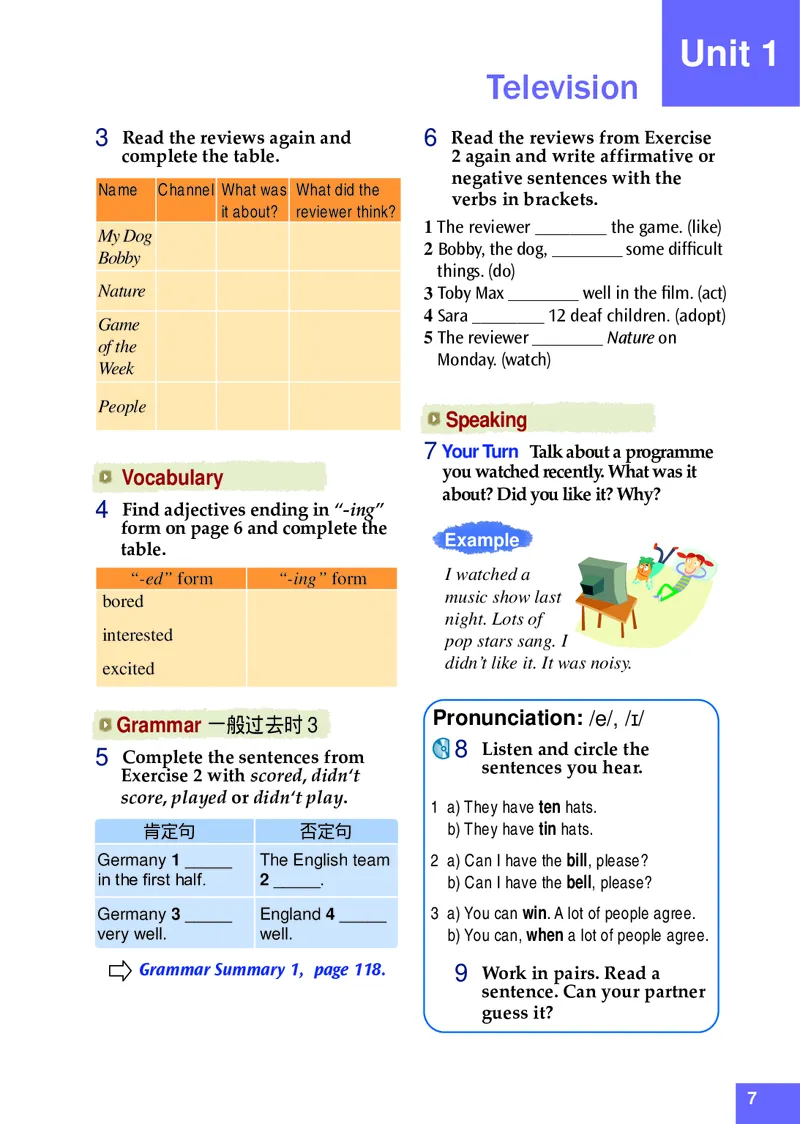
6Unit 1
Television
3 Read the reviews again and 6 Read the reviews from Exercise
complete the table. 2 again and write affirmative or
negative sentences with the
Name Channel What was What did the
verbs in brackets.
it about? reviewer think?
1 The reviewer ________ the game. (like)
My Dog
2 Bobby, the dog, ________ some dificult
Bobby
things. (do)
Nature 3 Toby Max ________ well in the ilm. (act)
4 Sara ________ 12 deaf children. (adopt)
Game
5 The reviewer ________ Nature on
of the
Monday. (watch)
Week
People
Speaking
7 Your Turn Talk about a programme
Vocabulary you watched recently. What was it
about? Did you like it? Why?
4 Find adjectives ending in “-ing”
form on page 6 and complete the
Example
table.
“-ed” form “-ing” form I watched a
music show last
bored
night. Lots of
interested
pop stars sang. I
didn’t like it. It was noisy.
excited
Grammar 一般过去时 3 Pronunciation: /e/, /ɪ/
8 Listen and circle the
5 Complete the sentences from
sentences you hear.
Exercise 2 with scored, didn‘t
score, played or didn‘t play.
1 a) They have ten hats.
肯定句 否定句 b) They have tin hats.
Germany 1 _____ The English team 2 a) Can I have the bill, please?
in the irst half. 2 _____. b) Can I have the bell, please?
Germany 3 _____ England 4 _____ 3 a) You can win. A lot of people agree.
very well. well. b) You can, when a lot of people agree.
Grammar Summary 1, page 118. 9 Work in pairs. Read a
sentence. Can your partner
guess it?
72
An Interview on TV
Warm-up 1 She speaks English very well. Her
___________ is quite good.
1 Look at the Key Words. Choose 2 He is learning to write Chinese
the correct words to complete the
___________.
sentences on the right.
3 Sometimes ___________ rules are hard
to remember.
Key Words: Language learning
4 I just read an interesting ___________
characters, conversation, grammar,
in an old book.
listening, passage, pronunciation,
5 We had a long ___________ about the
reading, speaking, vocabulary,
interview on the Internet.
writing
Listening
China Today
2 Listen to the first part of the
Learning Chinese
interview and answer the
questions.
Tina and James live in Beijing. They
are learning Chinese. We asked them 1 When did Tina come to Beijing?
about their experience. 2 Did Tina like her teacher?
3 What did Tina do in her Chinese class?
3 Listen to the second part of the
interview and complete the
notes about James.
James—Learning Chinese
Reason
In the US:
Learning
experience In China:
4 Listen to the whole interview and write Tina, James or Tina & James in
each blank.
1 _________ didn’t speak any Chinese before 2008.
2 _________ learned some Chinese from games and TV.
3 _________ began learning Chinese at university.
4 _________ think(s) Chinese writing is dificult.
8Unit 1
Television
Grammar 一般过去时 4 Speaking
5 Look at the table and circle the 8 Your Turn Work in pairs. Talk
correct words. about your own English learning
一般疑问句 答句 experience.
Did you enjoy / Yes, I did.
- When did you begin learning English?
enjoyed it? No, I did not (didn’t).
- What did you do in your English
When did you come / I came to Beijing
class?
came to Beijing? in 2008.
- What did you do after class?
Grammar Summary 1, page 118.
- What helped you learn English?
6 Pair Work Make yes/no questions
Example
about James. Ask and answer in
pairs. A: In English class, I usually listen
to the teacher carefully.
Example
B: Me too. Taking notes is also
A: Did he see a Chinese book in very important.
his cousin’s room?
B: Yes, he did.
1 see a Chinese book in his cousin’s
room?
2 learn Chinese in high school? Pronunciation: /i:/, /eɪ/
3 go to university?
9 Listen and follow the
4 enjoy his Chinese class?
lines. Write the correct
numbers in the circles.
7 Write wh-questions about the
underlined words. Listen!
1 Tina came to Beijing in 2008. eat eight
______________________________? C say C
me may me may
2 She sometimes played games in
Chinese class. Jean Jane Jean Jane Jean
______________________________? 1
3 James went to university in the US.
______________________________?
10 Choose a circle. Guide
your partner to it by
4 James didn’t use Chinese for many years.
reading the words aloud.
______________________________?
93
The Big Game
Warm-up Reading
1 What sports do you like to 2 Read the dialogues. Match each
dialogue with the correct picture.
watch? Describe one of your
favourite sports shows to the 3 Read the dialogues again and
class. write the correct names in each
blank.
1 ________________ hurt his foot.
2 ________________ scores a goal.
3 ________________ fouls when he
tries to make a basket.
4 ________________ hits the ball to
the back of the court.
a 1
A: Look at the speed of Hill as he runs down the ield
with the ball. Can you believe that? He’s extremely it
this season. Do you agree?
B: Certainly! And think about this. His foot was hurt last
year and he was out for two months. It’s just fantastic!
A: And he passes the ball to McCall and … IT’S A GOAL!
B: Wow! What a great kick! It was perfect.
b
2
C: … Wilson is going to make a basket and …
IT’S IN! That’s another two points for… just
wait … It’s a foul? Are you kidding me?
D: Right you are, Dan. That was a bad call. It
was clearly a basket but now the Lions will
not get those two points. As you can hear,
their fans also think it was a terrible call.
C: What a shame! They should complain
about that one …
c 3
E: And there they go! Chambers hits the ballto the back
of the court. Lister is running …
F: Look at that speed! She is really in top form today.
E: And it’s back to Chambers. She’s also in top form.
F: How exciting! This is going to be a great match.
1100Unit 1
Television
Vocabulary
4 Match the words from the text 6 Your Turn Make sentences
with the correct sport. Some may with the words and add the
match more than one. exclamations from Exercise 5.
tennis Example
football
basketball A: She kicked the ball and made
a goal.
B: How exciting!
1 she / kick the ball / make a goal
kick basket goal 2 I / forget / homework
hit foul match 3 my dad / lose / car keys
court ield 4 she / fall / hurt her arm
5 our team / win the game
Function 感叹
Speaking
5 Read the Key Expressions. Then
circle the improper exclamations 7 Pair Work Tell your partner five
below. events that have happened recently,
and respond to your partner’s
Key Expressions: Exclamations
events using exclamations.
Wow! What a great kick!
Are you kidding me? Example
What a shame!
A: My dad lost his car keys.
Can you believe that?
B: Oh, that’s too bad!
How exciting!
1 A: My dad is a teacher.
Pronunciation: /ɪ/, /iː/
B: Can you believe that? 8 Listen and underline the
2 A: Mark broke his leg. words with an /ɪ/ sound.
B: What a shame!
Tim and Tina are
3 A: You won irst prize!
brother and sister.
B: How exciting!
Tim and Tina played
4 A: Tomorrow it’ll be very cold and rainy.
tennis. Tim is weaker
B: What a great day!
and Tina is bigger, so
5 A: We did very well on our tests.
Tina won easily.
B: What a shame!
6 Wow! Our team is playing really well. 9 Listen again and circle the
words with an /iː/ sound.
Grammar Summary 2, page 118. Then read aloud to your
partner.
1111CCoommmmuunniiccaattiioonn WWoorrkksshhoopp
Reading
1 Read Jack’s blog and answer the questions below.
My Favourite TV Programme
Like many students, I enjoy watching TV. I like cartoons, magic
shows, talk shows and many other kinds of TV programmes. Out of
all these, I like nature shows best and Animal World is my favourite.
I love animals. We have tortoises, birds and ish at home and I help
my dad feed them after school every day. They’re really interesting
and I love learning about animals. That’s why I love Animal World.
It shows animals from every part of the world. It shows lions
running after a deer or birds flying freely in the sky or whales
swimming in the blue ocean. The photographers and cameramen
get very close to the animals to show how they live in the wild. And
the host explains the animals’ habits clearly. I love the beautiful
scenery, the clear explanations and all the interesting information
in the programme.
I irst watched Animal World when I was ive and became a fan of
it. I hope the programme will continue for a long time.
1 What kinds of TV programmes does
Jack like?
2 What animals does Jack have at
home?
3 What does Jack like about
A n i m a l W o r l d ?
1122Unit 1
Television
Text Builder
2 Read Jack’s blog again and complete 4 Write a blog to tell your
the list. classmates about your
favourite TV programme.
Jack’s favourite TV programme is
Animal World.
His reasons:
_________________________
1 _____________________
_________________________
2 _____________________ _________________________
3 _____________________ _________________________
_________________________
4 _____________________
Ending:
_______________________
Speaking
5 Introduce your favourite
TV programme to the class.
Writing
3 Think of your favourite TV
Example
programme. Write a few
reasons why you like it. My favourite TV programme
is “The Book Club”. I started
watching it three years ago. I
like it because ...
My favourite TV programme
is _____________.
My reasons:
1 _____________________
2 _____________________
3 _____________________
4 _____________________
1133Unit 1
Check Your Progress
A Match the words with the C Choose the correct exclamations.
pictures.
13 Lara gave up the plan. (How
1 hit ___ 2 court ___ interesting! / What a shame!)
3 ield ___ 4 kick ___ 14 Mr Luo can ly a plane. (Can you
5 goal ___ believe that? / How boring!)
a b 15 (Oh, no! / Wow!) I lost my keys.
16 We won irst prize! (What a shame! /
How exciting!)
17 Mrs Ma is your mother? (Are you
kidding me? / What a great day!)
c d e 18 It’ll be cloudy and windy on Sunday.
(How exciting! / What a shame!)
D Complete the dialogue using
did or didn’t and the words
given.
_____ (you / enjoy) the game?
B Write the correct word in each
blank. Did you enjoy the game?
listening reading letters words
boring pronunciation exciting
Hi, Phil. 19 ________ (What / you /
do / last night)?
6 The nature show was __________. We
fell asleep. Hi, Eric. I watched the tennis match on
TV. 20 ________ (you / see / it)?
7 He watched an ________ football
No, 21 ________ (I / not). Who won?
match last night.
Li Na won. It was a really great match.
8 If your ________ isn’t good, others
What happened?
can’t understand you when you
Well, Li 22 ________ (not / win)
speak.
many points in the first few games, but
9 If your ________ skills aren’t good, then she started to play really well.
you can’t understand others when Sounds exciting.
they speak. Yes, it was. I 23 ________ (not /
10 There are 26 ________ in the English know) the final result until the last
alphabet. minute.
11 I like ________ English stories.
12 I try to memorise new ________
by writing them in my vocabulary
notebook.
Vocabulary ___ / 12 Grammar ___ / 11
14Fun Zone 1 Show Time
1 Can you break the code? 2 How important is TV to you? Complete
the questionnaire. If you have a different
Example answer, write it in the blank.
3 15 21 18 20 1 What do you do when you get up on
= C O U R T weekends?
a read a book
b turn on the TV
1 2 1 19 11 5 20 c have breakfast and watch TV
d ___________
2 6 15 21 12
2 What do you do on Friday evening when
3 13 1 20 3 8 your favourite programme is on?
a stay at home and watch it
4 11 9 3 11
b go out and meet my friends
c go out but record the programme
5 6 9 5 12 4
d ___________
3 What would you like for your next birthday?
a a bicycle
b a pair of new shoes
c a DVD collection of my favourite TV
programme
d ___________
3 What sports do they like watching on television?
You can touch the ball with
your hands but you mustn’t There are eleven players in a team.
touch it with your feet. You Ten players mustn’t touch the ball
can’t hold the ball while with their hands but one player in
moving. You can pass it to the team can. Your team must get
other players. Your team Jim the ball into the other team’s goal.
must get the ball into the
other team’s basket.
There are six players in a team. The
players mustn’t hold the ball when
they play. The ball must go over a net.
Players in one team can touch the ball
three times. Then they must return the
ball to the other team.
Bob
Sara
1155Unit 1
Study Help
Looking for Information in a Book
These sections are in your textbook. Which is the most useful to you?
Key Words Key Expressions Word Builder
Grammar Pronunciation
Match the problems (1–7) with the solutions (a–g).
I want to … Look at …
1 ind out what is in a unit. a “Key Words” and “Word
2 revise a grammar area. Builder”
3 revise vocabulary. b “Study Help”
4 do extra grammar practice. c “Key Expressions”
5 ind useful expressions for d “Get Ready”
speaking. e “Pronunciation”
6 ind tips for studying. f “Workbook”
7 learn about sounds. g “Grammar”
1 __d__ 2 ____ 3 ____ 4 ____ 5 ____ 6 ____ 7 ____
Unit Diary
How well can you do these?
• I can understand reviews of TV
programmes.
• I can ask and answer questions about
Language past events.
• I can understand dialogues about
and Skills
different ball games.
• I can write a blog about TV programmes
I like.
• I know where to ind different
Study Skills
information in my Students’ Book.
16Talk about teams. Unit 2
Read about class project rules and about a
special team.
Listen to students talking about a class project.
Write about teams you are in.
Learn about modal verbs.
TTeeaammss
Getting Ready
1 Is teamwork important for these 2 What teams are you in? What do
activities? you do in the teams? Tell the class.
a) acting in a play b) going ishing
c) playing chess d) playing football Example
e) doing a class project
I’m in a play. It’s about life in a
f) doing a science experiment
small village. There are 11 actors
g) playing a musical instrument in a concert
and I play a grandma.
Example
Teamwork is very important for playing
football, but it’s not so important for
playing chess.
11774
Class Projects
Warm-up
1 Read the words in the box.
Write them in the table.
bottle, camera, chopsticks, glue,
metal, model, musical instrument,
paper, plastic, wood
Reading
Materials glue
2 Read the rules for the class projects.
Objects model Which class do you think each project
is for? Why? Explain your opinion to
the class.
Class Project Rules
a A Famous Building c A Short Film
Build a model of a famous Make a ilm about your group.
Classes
building. You can use wood, You can bring a video camera
paper and glue but you or a mobile phone from
mustn’t use other things. home. The ilm has to be in
1 You have to paint the English. You can interview
model. Next class, you must people in your group but
2 describe your building but their answers mustn’t be
it doesn’t have to be long. long. You must play the ilm
in class and introduce your
b Musical Instruments group in three minutes.
3
You must make two musical
d A Chopstick Plane
4 instruments with plastic
bottles. You can’t use You must make a plane with
materials from toys or real two chopsticks. You can use
5 instruments. In class, you paper and glue but you can’t
have to play some music use metal. You must test
with the instruments for the plane in front of your
6
three minutes. teacher and your classmates
in the playground. It has to
ly for ten seconds.
3 What do you think? Are these projects:
● interesting? ● dificult? ● easy? ● possible?
18Unit 2
Teams
Grammar can, must, have to 5 Complete the traffic rules with
must / mustn’t.
4 Read the sentences and complete
the school rules with can/can’t or 1 You _______ stop at a red light.
have to/don’t have to. 2 You _______ cross the road on a red
light.
can / can’t, must / mustn’t,
3 You _______ drive fast near a school.
have to / don’t have to
4 Drivers _______ use mobile phones.
You can use wood, paper and glue but you 5 Babies _______ sit in a baby seat.
mustn’t use other things.
You must make two musical instruments Speaking
with plastic bottles.
6 Your Turn What are your school
You can’t use materials from toys or real rules? Talk to your partner. Use
instruments. the phrases in the box to help
You must describe your building but it you.
doesn’t have to be long.
eat food in class, use mobile phones
You have to play some music with the
in class, get to class on time, listen to
instruments for three minutes.
music in class, talk in exams, sleep
in class, bring dictionaries to school
Grammar Summary 3, page 118.
1 You _________ play basketball in the
Example
classroom. You _________ play in
the playground. We mustn’t eat food in class.
2 You _________ borrow books from the
Pronunciation: /æ/, /eɪ/
library, but you _________ return them
7 Listen and circle the
on time.
sentences you hear.
3 You _________ use dictionaries in
1 a) There are some snacks in the
English class, but you _________ use
cupboard.
them for tests.
b) There are some snakes in the
4 You _________ come to school before cupboard.
8, and you _________ leave school after
2 a) There are two cats in this room.
5:00.
Which one do you mean?
5 You _________ use mobile phones after b) There are two Kates in this
class, but you _________ use them room. Which one do you mean?
during class. 3 a) The pan is on the right.
b) The pain is on the right.
6 You _________ take photos of the
animals, but you _________ feed them. 8 Listen again and repeat.
195
Teamwork
Warm-up
1 Which of these do you think are
important for effective teamwork?
1 listen to each other
2 work together all the time
3 speak to each other politely
4 be in a team with your friends
3 Listen to the second part and
5 have clear roles for everyone
answer the questions.
6 question each other
7 inish before the other teams 1 Which building does Luo Li suggest?
8 have a good leader 2 Which buildings does Adam want to do?
3 Which buildings are they going to study?
Example
I think it’s important to listen to 4 Listen to the whole discussion.
each other in group discussions. How did the group do as a team?
Fill in the observation sheet.
Listening
5-Excellent 4-Very good 3-Good
2 Listen to the first part of a
2-Not very good 1-Poor
discussion about a class project.
Complete the table with the 1 They listened carefully to each other.
words from the box. 5 4 3 2 1
Example _______________________
making models, doing research,
doing research alone 2 They spoke to each other politely.
5 4 3 2 1
likes / doesn’t doesn’t Example _______________________
loves mind like / hates
3 Each student had a different role.
Adam
5 4 3 2 1
Luo Li Example _______________________
Rachel 4 Everyone in the team participated.
5 4 3 2 1
Example _______________________
5 They asked each other questions and
this helped them understand their
task.
5 4 3 2 1
Example _______________________
the Bird’s Nest the Pyramids the Temple of
Heaven
20Unit 2
Teams
Vocabulary 8 Your Turn Look at the Key
Expressions and write true
5 Complete the sentences with
sentences about you.
the words below.
Example
alone, argue, hate, share, carefully
I like making PPTs a lot, but I don’t
1 I love apples, but I _____ carrots. like giving speeches very much.
2 I only have one book. We have to
_____. ● working in groups ● writing
3 There are lots of children. Drive _____. ● working in pairs ● drawing
4 Lily doesn’t like to play with other ● working alone ● making things
children. She often plays _____. ● making PPTs ● giving speeches
5 We don’t need to _____ about the
results.
Speaking
Function 喜好 9 Pair Work Work in pairs. Ask
and answer questions about
6 Read the Key Expressions. the activities in Exercise 8.
Key Expressions: Preferences Example
I love drawing.
A: Do you like working alone?
I like making models.
B: No, I can’t stand it. And you?
I don’t mind taking notes.
A: I love it!
I don’t like doing research.
I hate building models.
Pronunciation: /e/, /æ/
I can’t stand arguing.
10 Listen and follow the lines.
Watch out! Write the correct numbers
in the circles.
I really like / love / don’t like this model.
I like this model a lot. Listen!
I don’t like that building very much.
Ken can
men man men
7 Make sentences with the words
bed bad bed bad
provided.
1 this subject / don’t like / we / very much said sad said sad said
2 working alone / I / don’t mind
1
3 hates / she / making tables
4 like / they / our project / a lot
5 can’t stand / he / crazy ideas 11 Choose a circle. Guide your
6 my friends / doing research / love / on partner to it by reading the
words aloud.
the Internet
216
A Special Team
Warm-up
1 Look at the picture. What do
you think happened? What are
the people doing?
Reading
2 Read the text quickly. Complete 3 Read the text again and
the sentences with correct numbers. answer the questions.
1 The earthquake lasted for ______ 1 Why didn’t the group go down the
minutes.
mountain right after the earthquake?
2 The Lins found _____ people at the
2 What problems did the group have?
resort.
3 How did the team solve the problems?
3 Mr Lin divided the 25 people into
4 What did the group leaders do at night?
_____ groups.
4 It took the team _____ hours to get
out safely. 4 Listen and read aloud.
http://www.thetimesnews2.com
It was a terrible day for Mr and Mrs look for food and blankets. They found
Lin. The old couple was on holiday at some, but not enough for everyone. The
a mountain resort. They were taking young people gave theirs to the older ones.
a walk in the early afternoon, when
After that, Mr Lin divided the people into
suddenly the ground started to shake. In
ive groups. Each group had a leader. He
just two minutes, everything changed
also collected all the mobile phones and
completely! They were in the middle of
made sure each group had one. They used
a very strong earthquake!
them as lashlights. Every 30 minutes, the
The Lins tried to ind some other people group leaders lashed their mobile phones,
and the light in the dark rainy night made
irst. One by one, they found 23 other
everyone feel safe.
people. Many were tourists, young and
old. Soon it was dark and it started to Early the next morning, the groups
rain heavily. Some cried and some lost started to go down the mountain. It was a
hope. dificult journey, but the group members
encouraged and supported each other.
At that moment, Mr Lin decided to
take the lead. He called for everyone’s After twelve hours’ walking, they inally
attention and said, “The roads are got out safely. By then, it was 30 hours
too dangerous. We can’t go down the after the earthquake. Everyone was tired
mountain until tomorrow. We must stay but they felt lucky because they were part
here tonight.” Then Mr Lin and a few of a special team. This special team gave
young men went back to the ruins to them hope for life.
2222Unit 2
Teams
Vocabulary Speaking
5 Complete the sentences with 7 Your Turn What special teams
the correct form of the words.
can you think of? Tell your
partner. Include these details.
dark, earthquake, enough, journey,
leader, shake, support 1 Who are in the team?
2 What does the team do?
1 A good team ________ helps everyone
3 Why do you think the team is special?
to work together.
4 What can you learn from this team?
2 There are not ________ blankets for
everyone.
Example
3 The sun went down and soon it was
Astronauts work as a special team.
________.
Each one of them has different
4 The room started ________. Dishes fell
skills, but they must help each
and broke. It was an ________.
other.
5 They walked for six hours. It was a very
long ________ and everyone was tired.
6 It was very dificult but the team
members _________ each other.
6 Complete the sentences with
the correct words from the box.
as at for in into on
Pronunciation: /e/, /eɪ/
1 The couple was ____ holiday at a 8 Listen and fill in the table.
mountain resort.
2 ____ just two minutes, everything /e/ /eɪ/
changed.
Ed Amy
3 ____ that moment, Mr Lin decided to
take the lead.
4 There wasn’t enough food ____
everyone.
5 Mr Lin divided the 25 people ____ Ed and Amy are from Australia. Every
ive groups. vacation, they go to a dangerous
6 They used mobile phones ____ place. Today, they’re in a rainforest.
lashlights. It’s raining, so they are getting wet all
over.
9 Listen again and repeat.
2233CCoommmmuunniiccaattiioonn WWoorrkksshhoopp
Reading
1 Read Luke’s writing about teams.
Which team is NOT in the photos?
My Teams
I like teams. I have fun working with my friends and
meeting new people. I’m on several teams and I join
these teams for different reasons.
I love playing football. I started playing on a football
team four years ago. Everybody has to be clear about
his role and cooperates with all the other players. It’s
exciting when we win a game. Can you see the old
photo of me?
I’m in the school Maths Club. I don’t like maths but
I like going to the Maths Club. We do lots of puzzles
and team games. We discuss ways to solve problems
together. Well, sometimes we “argue” but it’s fun.
I also play the drums in a band. All my friends are in
the band. We have fun together.
2 Read Luke’s writing again and underline
the words and expressions that show Luke’s
interests. How many different expressions can
you find?
3 Match the feelings and the reasons.
1 Luke loves playing a because he can have fun
football and meet new people.
2 Luke likes teams b because he wants to be
with his friends.
3 Luke likes going to c because it’s exciting when
the Maths Club they win a game.
4 Luke likes playing d because puzzles and
the drums team games are fun.
2244Unit 2
Teams
Speaking
4 Role-play Luke and his friend. Ask
Luke some questions.
• Do you like playing football?
• What does a football player have to do?
• What are your favourite subjects?
• Can you play the drums? Do you like it?
• What clubs are you in? Why?
What other questions can you ask?
Writing 6 Write about your teams.
5
What teams are you in? Why
My Teams
did you join the teams? What
do you like and not like? Fill
in the list and the table.
My teams:
1 __________________
2 __________________
3 __________________
I love / like / Why?
don’t like
2255Unit 2
Check Your Progress
A Choose the correct words to C Write the correct prepositions
complete Matt’s email.
in the blanks.
16 These people were _____ many
experiments chess Club join us
different countries.
favourite sings football
17 You can play tennis _____ the
sports centre.
18 She went to the cinema _____ her
Hi Dan, friends.
19 There is no water _____ the moon.
I started at my new school this week. 20 He is _____ the football team.
Science and English are my 1 _______
subjects. In science lessons we do a lot of D Choose the correct expressions.
2 _______. Our English teacher is funny.
He sometimes does tricks and 3 _______ 21 She doesn’t like / likes this
songs in class! building a lot.
22 I like teamwork. I love / can’t
At lunchtime I usually play 4 _______. I’m
stand working alone.
not very good yet — it takes a long time
23 He loves drawing, but he hates /
to learn.
doesn’t mind making tables.
I started playing the violin in the Music
5 _______ after school on Mondays. It’s
E Use the words to write rules
great fun.
according to the pictures.
I’m on a sports team too. I play 6 _______
play chess here use your camera
after school on Fridays. Anyone can play. I
eat or drink play football here
hope you can 7 _______ one day.
wear a hat be younger than twelve
Got to go now. Time for violin practice!
pay any money
Matt can’t
You can’t eat or drink.
B Put the words into the correct 24 must
_________________
categories.
25 can
paper writing drawing sky _________________
model metal building sun 26 mustn’t
_________________
Materials Objects Nature Activities
27 can’t
wood bottle moon making
_________________
plastic camera planet models
28 don’t have to
8 ______ 10 ______ 12 ____ doing Free Entry
_________________
9 ______ 11 ______ 13 ____ research
29 have to UNDER 12’s
14 ____
_________________ ONLY !
15 ____
Vocabulary ___ / 15 Grammar ___ / 14
26Across Cultures 1
AA GGrreeaatt TTeeaamm
1 Answer the questions. 3 Answer these questions.
1 What are your favourite groups? 1 How many members did The
2 Who are your favourite singers? Beatles have after they returned to
Liverpool?
2 Read the text. Why are The 2 Who was The Beatles’ producer?
Beatles important for modern 3 Which three kinds of music did
popular music? they mix on their records?
4 How many records have they sold?
~ The Beatles ~
In 1957, a Liverpoo(l 利物浦)schoolboy, listen to music. For example, they mixed
John Lennon, started a “rock and roll”( 摇 different kinds of music together on their
滚) group. The other members were Paul records -- rock, pop and even classical.
McCartney, George Harrison, Stuart Sutcliffe They were the first band to make music
and Pete Best. In August 1960, they went video important, and people even wanted
to Hamburg in Germany and worked hard to look like them, with Beatles suits and
every night in the clubs. When the group Beatles haircuts. Modern musicians still
returned to Liverpool, Stuart and Pete left, copy their songs and their way of playing
and Ringo Starr joined. They were “The music.
Beatles”.
The Beatles are the best-selling band in
In 1962, The Beatles made a record with the history of popular music. No one
the producer( 制作人)George Martin. knows exactly how many records they
The Beatles were very talented, so their sold, but the number is between 600
first records were great hits in the UK. In million and one billion, and they are still
1964, they visited the United States. The selling records now, more than 50 years
Americans loved them and they became after they first got together.
famous fast.
The Beatles had different personalities
and abilities but they worked perfectly as
a team. John and Paul wrote songs quickly
and easily. They were also the lead singers.
Ringo played the drums. George and John
played the guitar and Paul was the bass
guitarist. Together they came up with lots
of new ideas and changed the way we
2277Unit 2
Study Help
Working in Groups
Here are some tips for effective teamwork:
· Have clear roles for everyone.
· Speak to each other politely.
· Listen to your group members’ ideas and suggestions.
You can use these expressions in group discussions:
Making suggestions
Asking what others think
· Let’s …
· What do you think?
· What / How about …?
· How about you?
· Maybe we can …
Saying you agree / disagree
Expressing likes / dislikes
· I like …, too. / I don’t like …, either.
· Good idea.
· I agree with you.
· That’s a good point.
· (I’m afraid) I don’t think so.
· I’m afraid I don’t like …
· I think it’s better to … instead.
· I don’t think it’s a good idea.
Unit Diary
How well can you do these?
• I can talk about rules.
• I can express preferences in group
Language
discussions.
and Skills
• I can understand the article about a
special team.
• I can write about my teams.
Culture • I know more about The Beatles.
Study Skills • I know how to work effectively in groups.
28Talk about sports. Unit 3
Listen to a dialogue about sport events.
Read about Olympic events and about an
expedition.
Write a report about a competition.
B C
Learn about comparatives and superlatives.
A
E
D
FFaasstteerr,, HHiigghheerr,, SSttrroonnggeerr
Getting Ready
1 Look at the Key Words. Which 2 Work in pairs and answer these
sports CAN’T you see in the questions.
photos?
1 Which sports are popular in your school?
Key Words: Sports 2 What sports do you play?
baseball, basketball, football, 3 Who are your favourite sports stars?
high jump, long jump, running,
skating, swimming, table tennis,
tennis, volleyball
22997
Time to Exercise
Warm-up
1 Match the activities (1–5) with 2 Work in pairs. Answer these
the correct photos (a–e). questions.
1 do push-ups 2 do sit-ups 1 Which sport is easy for you? Why?
3 run a race 4 climb a rope 2 Which sport is hard for you? Why?
5 do the high jump
a
Listening
3 Listen to the dialogue and circle the words that
match each person.
Mike David
b
slow tall slow tall
active funny active funny
c
fast it fast it
4 Listen again. Then rate the activities in the photos
(a-e) from 1 to 5 according to Mike. (1 = very easy;
d
5 = very hard)
5 Listen and write T for true and F for false.
1 David wants to break the record this year. ___
2 Mike is very good at running. ___ e
3 David thinks sit-ups are easier than push-ups. ___
4 Mike thinks climbing a rope is easy. ___
5 Mike likes to joke around. ___
6 Listen and answer these questions.
1 Did David run fast in the race last week? 2 What does David think of sit-ups?
3 Why does Mike think climbing the 4 What does Mike mean by the last
rope is easy for David? sentence? Is he good at high jump?
30Unit 3
Faster, Higher, Stronger
Grammar 比较级 9 Look at the table and write some
sentences comparing the two
7 Look at the examples and
sports centres.
complete the table with
comparatives. What patterns do
Eastern
you see? Sports Sport Fun
Centre
形容词、副词 比较级
size 800m2 550m2
fast 1 faster
average
high 2 ___________ 35 22
member age
large 3 larger
members 320 210
late 4 ___________
year built 1994 2006
big 5 bigger
how clean
it 6 ___________
easy 7 easier
Example
heavy 8 __________
The Eastern Sports Centre is older
Grammar Summary 4, page 119. than Sport Fun.
8 Complete the writing with Speaking
comparatives.
10 Pair Work Talk to a partner.
Ask and answer questions
The kids were good
about the sports centres.
during PE class. Tim is much
1________ (strong) than last Pronunciation: Statements
year. So is Tina. The running
Statement: I often go skating.
team did well. They all ran
When we make statements, our voices
2________ (fast) than last
go down at the end of the sentences.
week. Some students are
3________ (weak) than last 11 Listen and repeat.
year. They can’t climb the
1 My grandpa is 67.
rope now. A few students are
2 Table tennis is popular in our school.
4________ (heavy), too. I gave
3 She ran in three races.
them some homework – 4 He can jump high.
sit-ups! 5 The running team did well.
6 You’re tall and you have strong legs.
318
Olympic Winners
Warm-up
1 Which of these is NOT an Olympic
event?
Key Words: Sports Reading
baseball, diving, gymnastics,
horse-riding, long jump, 2 Read the webpage and match the
swimming, weightlifting headings with the texts. Then
listen and check.
The heaviest and strongest The highest and the longest jumps
The oldest and the youngest The tallest and the shortest
Home Olympic Games Sports Countries Athletes
BEIJING 2008
1 __________________________ 2 __________________________
The oldest athlete was 67-year-old Hiroshi The tallest athlete was Yao Ming.
Hoketsu. He is a horse-rider from Japan. The basketball player from China is
He competed in the 1964 Olympics. The 2.29m tall. The shortest athletes were
youngest athlete, however, was only Deng Linlin and Wang Xin. The
twelve years old. Her name is Antoinette gymnast and the diver were about
Guedia and she is a swimmer. She began 1.36m tall during the 2008 Olympics.
swimming at the age of eight and became
a national champion in two years.
3 __________________________ 4 __________________________
Russia’s Andrey Silnov won the gold Matthias Steiner from Germany won
medal in the men’s high jump competition. the gold medal for weightlifting. He
He jumped 2.36 metres! Maurren Higa was in the heaviest group – weightlifters
Maggi from Brazil won the women’s long heavier than 105kg – so he was certainly
jump with a jump of 7.04 metres. the strongest and heaviest man.
3 Read the webpage again and complete the sentences.
1 Hiroshi Hoketsu _________ in 1964. 4 Andrey Silnov won a ________ medal.
2 The youngest athlete was a __________. 5 A woman _______ Brazil won the long
3 The _________ athletes were only jump.
1.36m tall. 6 The strongest man was from _________.
32Unit 3
Faster, Higher, Stronger
6 Read about the swimmers and
write sentences with superlatives
about them.
City Swimming Competition Winners
Mike Green Jack White Eric Brown
• 10 years old • 12 years old • 11 years old
• 34kg • 32kg • 38kg
• Time: 1:20 • Time: 1:23 • Time: 1:25
4 Complete the Word Builder. Example
Mike is the youngest swimmer.
Word Builder
sports athletes Speaking
basketball basketball player 7 Pair Work Talk about your
horse-riding classmates using the words in
the box.
swimming
weightlifting fast, funny, old, strong, tall, young
diving
Example
Grammar 最高级 A: Who’s the fastest runner in
our class?
5 Look at the examples and complete B: I think John is the fastest runner.
the table with superlatives. What
Pronunciation:
patterns do you see?
Yes/noquestions
形容词、副词 最高级
Question: Do you like tennis?
high 1 highest
When we ask yes/no questions,
long 2 ___________
our voices usually go up at the
old 3 ___________ end of the sentences.
large 4 largest 8 Listen and repeat.
late 5 ___________ 1 Do you play football?
2 Are you the youngest?
big 6 biggest
3 Can you swim?
hot 7 ___________ 4 Is Tim’s brother the
fastest?
easy 8 easiest
5 Do you have a ball?
heavy 9 ___________
9 Read the questions to a
Grammar Summary 4, page 119. partner. Make your voice
go up at the end.
339
Never Give Up!
Warm-up
Together to
1 Look at the photo and the title.
the Poles
Then answer the questions.
1 Where are they?
Janek Mela is the youngest explorer
2 What’s the weather like?
to go to the North and South Poles.
3 What are they doing?
1 The twenty-seventh of July, 2002,
was the worst day in Janek Mela’s
life. The Polish boy had an accident
and lost half his left leg and half
his right arm. Janek spent a long
time in hospital and was very sad.
2 Then his most important journey
began. Marek Kaminski, a famous
Reading Polish explorer, visited Janek and
asked him to go to the North and
2 Look at the headings (a-f). Read South Poles with him. Janek gave
the text and match them with the best answer of his life.
the paragraphs (1-6). Write the
3 Janek prepared for the trips for
numbers in the boxes.
a few months. First, he learned
a The Second Expedition to use his artificial leg. Then he
b A Day of Hope trained hard for the expeditions.
c The First Expedition 4 Their first expedition was to the
d Getting Ready North Pole. Janek and the team had
to be careful. There were animals,
e A Dark Day
dangerous ice and bad weather. It
f Setting a Record
was really difficult, but things got
3 Read the text again and answer better. They got to the pole on
April 24th, 2004. Janek was 15.
these questions.
5 In December, the team started the
1 How did Janek lose part of his arm
expedition to the South Pole. The
and leg?
weather was worse this time. This
2 Where did he meet Marek Kaminski? made the expedition even more
difficult. They finally arrived at
3 What did Janek do before the
the South Pole on December 31st,
expedition?
2004.
4 Why was the irst expedition dificult?
6 Janek is the youngest explorer to
5 When did they get to the North Pole?
go to the North and South Poles
6 What was Janek’s best answer of his because he was brave and said
“Yes!”
life? Why?
3344Unit 3
Faster, Higher, Stronger
Grammar 比较级、最高级 6 Your Turn Read and answer
4 Look at the examples and
the following questions.
complete the table with the correct 1 What are your favourite books?
comparatives and superlatives. Which one do you like best?
不规则的形容词、副词 2 Which do you think is more dificult,
English or maths?
形容词、副词 比较级 最高级
3 Which is more interesting to you,
interesting more the most
sports or computer games?
interesting interesting
dificult 1 _________ 2 _________
quickly 3 _________ 4 _________ Speaking
bad worse the worst
7 Pair Work Work in pairs. Ask
good 5 _________ 6 _________
and answer the questions from
well 7 _________ 8 _________
Exercise 6.
Grammar Summary 4, page 119.
Example
5 Read about three Sports Club
A: What are your favourite books?
activities and complete the writing
Which one do you like best?
with the correct form of the
B: I like “Harry Potter” best.
adjectives in brackets.
The story is great.
Black Mountain Trip
Pronunciation:
- 100 students joined
- cost: $100 Wh-questions
- no training
Green Forest Camp
Question: What sports do you play?
- 70 students joined
- cost: $300 When we ask wh- questions, our
- training for three days voices usually go down at the end of
the sentences.
Blue Lake Expedition
- 40 students joined 8 Listen and repeat.
- cost: $200
- training for six days 1 Who’s your favourite player?
- must be over 16 2 Where can we play?
The mountain trip was 1 ________________ 3 When do you play tennis?
(popular) than the forest camp and the lake 4 Why are you so good at
expedition. Both the camp and the expedition swimming?
were 2 ________________ (expensive) than 5 How can we get to the park?
the mountain trip. The lake expedition was
9 Read the questions to a
3 _________________ (dificult) of the three.
partner. Make your voice go
It was also 4 __________________.
down at the end.
(dangerous)
3355CCoommmmuunniiccaattiioonn WWoorrkksshhoopp
Reading
1 Read the report and complete the table below.
School Sports Day
Our School Sports Day last week was a success!
Class Three had the best team again this year. They
were the strongest in the push-up and pull-up events.
They also had the fastest runners, for both boys and
girls in the 100 metres.
Class Two, our class, did better than last year and was
second. We jumped the highest in the high jump event,
and we had the fastest runner in the 400 metres.
Jiang Wenbo gets ready
Class One did worse than last year and was third.
for the 400m race. He
However, they had the best jumper in the long jump.
was 2nd.
They did worse in the high jump, the 100-metre race
and the 400-metre race than the other two classes.
The students below broke school records.
Event One Two Three
Girls
push-ups 3rd
Fastest runner: Zhao Yanfang (Class 3)
pull-ups 2nd
Highest jumper: Wu Qixin (Class 2)
long jump 3rd
high jump 1st
Boys
400m 3rd
Longest jumper: Li Ming (Class 1)
100m 1st
Fastest runner: Gao Jiaming (Class 3)
Speaking
2 Work in pairs. Ask and answer questions about the school sports games.
A: Which class was the slowest in the 400 metres?
Example
B: Class 1 was the slowest.
3366Unit 3
Faster, Higher, Stronger
Writing
3 Think of a recent sports competition at
your school. Fill the information in the
table.
Event Class 1 Class 2 Class 3
4 Write sentences comparing the classes’
performances in the sports competition.
5 Write a report about the sports
competition at your school. Use
the example in Exercise 1 to help
you.
3377Unit 3
Check Your Progress
A Complete the timetable C Put the words in the correct
according to the pictures. categories.
hard running football player
Sports Event Timetable
swimming horse-rider fast
10:00–11:15
Sports Sports people Adjectives
1 _________ _ h _i_g_h_ j_u_m__p_
cycling athlete high
11:30–12:45 football tennis player long
13 _______ 15 _______ 17 _______
2 _________ 3 _________
14 _______ 16 _______ 18 _______
14:00–15:15
Vocabulary ___ / 18
4 _________ 5 _________
15:30–16:45 D Look at the information
about the athletes. Complete
6 _________
the sentences.
Mary Wang
B Complete Derek’s letter
Jones Jijing
according to the pictures.
Height 1.72m 1.75m
Hi, Dave!
Weight 52kg 58kg
Today we had a itness test High jump 1.9m 1.8m
at school. We had to do lots of 100m run 11.2s 11.4s
different exercises. Mary is shorter (short) than Jijing.
19 Jijing is ________ (tall) than Mary.
First, we did 7 __________ and
20 Jijing is ________ (heavy) than Mary.
8 __________. That was really
21 Mary can jump __________ (high)
hard! Then, I had to 9 _________.
than Jijing.
I couldn’t get to the top — I gave 22 Mary can run __________ (fast) than
up half way through. After that, we Jijing.
did 10 __________. I did 34, and E Complete the teacher’s report.
that was quite good. I jumped 1.35m
This is a report on the itness test for
in the 11 __________. Finally,
Class 8A.
we had to 12 __________. I’m so
The worst (bad) student got 35 points,
tired!
and the 23 _____ (good) got 93. The
Derek 24 ______ (easy) test was running —
everyone did very well. The 25 ______
7 8 9
(dificult) was the pull-ups. No one could
do more than six.
The 26 ______ (tall) boy in the class is
10 11 12 Andrew Jones. He is 1.65m. The
27 ______ (heavy) boy is Eric Smith. He
weighs 75 kg.
Grammar ___ / 9
38Across Cultures 2
OOllyymmppiicc CCiittiieess
ATHENS
1 Answer the questions. Athens is the capital of
Greece. It was the host
1 Name three foreign Olympic cities. What do you
city of the irst modern
know about them?
Olympic Games in 1896.
2 Which Olympic cities would you like to visit? Why?
The games took place in
the Panathenaic Stadium.
2 Read the texts.
1 When was the irst modern Olympic Games?
2 When did the 2008 Olympic Games open?
3 Which city held the Olympic Games most recently?
3 Read the texts again. Which city would
you like to visit? Why?
Athens is well-known for its
old statues and buildings.
BEIJING
The Parthenon on the
Beijing is the capital of China. It
Acropolis is probably the
hosted the 2008 Olympic Games.
most famous.
Beijing is an old city with a long
history of more than 3,000 years. It
is also a modern city with more than
20 million people.
The Beijing Olympic Games opened
on August 8th, 2008. The opening
ceremony was in the National
Stadium. It is also called “the Bird’s
Nest”.
LONDON
London is the capital of Great Britain. It has hosted the Olympic
Games three times (in 1908, 1948 and 2012), more than any
other city.
London is also home to the Wimbledon Tennis Championships.
Unlike the Olympic Games, Wimbledon is held every year. It is
the oldest tennis competition in the world. The irst one was in
1877.
3399Unit 3
Study Help
Phonetic Symbols
Dictionaries use phonetic symbols to show the pronunciation of words.
Try to remember the phonetic symbols.
Use a dictionary to help you write new words in phonetic symbols.
What are these words? Use a dictionary to help you.
1 /ˈbeɪsbɔːl/
2 /ˈæθliːt/
3 /əˈlɪmpɪk/
4 /təˈɡeðə/
5 /saʊθ/
Choose three words from this unit. Write the words in phonetic
symbols. Then get into pairs. Ask your partner to figure out what the
words are.
Unit Diary
How well can you do these?
• I can make comparisons.
• I can understand a text about an
expedition.
Language
• I can understand texts about
and Skills Olympic events.
• I can write a report about school
sports games.
Culture • I know some famous Olympic cities.
• I can use a dictionary to learn the
Study Skills
pronunciation of words.
40Talk about healthy habits. Unit 4
Read about common health myths and about
healthy bones.
Listen to a dialogue with a doctor.
Write about your good health habits.
B
Learn about adverbial clauses and conjunctions.
A
C D
E
HHeeaalltthhyy LLiivviinngg
Getting Ready
1 Look at the Key Words. What healthy 2 Do you have healthy habits?
habits can you see in the photos? Answer the questions.
Key Words: Healthy habits 1 How many hours do you sleep
brush your teeth, eat healthy food, at night?
exercise, play sports, sleep well, 2 How often do you exercise?
take a shower, walk to school, 3 Do you eat fruit and vegetables
wash your face / hands every day?
Example
In Photo D, the boy is brushing his teeth.
We need to brush our teeth every day.
441110
Going to the Doctor
Warm-up
1 What do you think people
should do for these health
problems?
Key Words: Health problems
cough, fever, headache, runny nose,
sore throat, stomachache, toothache
drink lots of water, get plenty of
rest, go to the doctor / dentist,
take some medicine
Listening
Example 2 Listen to the dialogue. Complete
the patient’s form.
For a sore throat, you should drink
lots of water.
Patient’s Name:___________________
Date: _O_c_t_. _1_2_th_ Time: _2_:3_0_ _p_m_
Symptoms
headache stomachache
cough sore throat
runny nose fever
Treatment
Medicine: Yes (for ________) No
Take your medicine _______ a day, _______
meals. _________________ for the next few
days.
Get plenty of ________ and drink a lot of
________.
3 Listen again and complete the following sentences.
1 Xiaoli is at the doctor’s ofice with her ________.
2 Xiaoli hasn’t got a ________.
3 She has a sore ________ and a runny ________.
4 Xiaoli needs a ________ for school.
42Unit 4
Healthy Living
Vocabulary Speaking
4 Look at the Sentence Builder. 6 Pair Work Role-play a doctor
Then choose the correct and a patient with your partner.
expressions for the sentences
below. Example
Sentence Builder
A: Hello there. So, what’s the matter?
Drink lots of water. B: I have a headache and a runny
= Drink a lot of water. nose.
= Drink plenty of water.
A: Do you have a fever?
B: I don’t think so.
1 She earns a lot of / many money. A: Let’s see. No. You don’t have a
2 There are plenty of / much snacks for fever. Open your mouth and say
“Ah”.
everyone.
B: Aaaaaah.
3 They drink many / lots of water every
A: You have a cold. You should get
day.
plenty of rest. You should drink a
4 You will have plenty of / much fruit and
lot of water, too.
vegetables.
Here’s some
5 There are much / lots of mistakes in his
medicine for you.
speech.
Take it once
a day in the morning.
Watch out!
B: Thanks, doctor.
We spent a lot of / lots of / plenty of
money on it.
A lot of / Lots of / Plenty of people like Pronunciation: / f /, /θ/
the book.
7 Listen and repeat.
My headache is a lot better.
The ifty-ifth ish fell four feet at
Function 就医 three thirty-four, and the forty-
ifth ish fell three feet at four thirty
5 Read the Key Expressions. three.
Key Expressions: Seeing the doctor
8 Practise with a
What’s the matter?
partner. Try and say
I have a cough / a bad headache.
the sentence as fast
You have a cold.
as you can.
Drink plenty of water.
You should get plenty of rest and
take this medicine twice a day.
4311
Health Advice
A B
Warm-up
1 Match the sentences with the
photos.
C D
1 You don’t want to get the lu.
2 You want to be stronger and healthier.
3 You don’t want to feel sleepy during the day.
4 You want to stay it.
Reading
2 Read and match the questions with the correct health advice. Then
listen and check.
1 2
I listen to loud music a lot. Can
My dad smokes. He doesn’t think it’s
this make me deaf? My mum
harmful. This isn’t true, is it? Marie
thinks so. Tim
3 4
Should we wash our hands
Can I get the flu from my food? For
with soap 20 times a day? My
example, can I eat chicken? Will I get bird
flu? Jill friend does this. Sara
a No, you can’t because we don’t get the b You’re right. It isn’t true. Smoking
flu from any food. We get the flu from is very harmful to your dad. It’s
other people. When people sneeze, also harmful to you when he
we can get the flu from the air. At the smokes around you. Maybe your
moment, it’s very hard for people to dad says this because he can’t
get bird flu. Usually, only birds get it. stop.
c It’s good to wash your hands because d Maybe. How loud is the music?
it helps you stay healthy. When you Do you use earphones? It can
keep your hands clean, it’s harder to hurt your ears when you listen to
get the flu. However, you don’t need very loud music on earphones.
to wash your hands 20 times a day. You should make sure the
That’s too much. volume is not too high.
44Unit 4
Healthy Living
3 Read the text again and answer 6 Your Turn Complete the
these questions. following sentences with your
ideas.
1 Whose friend washes their hands a lot?
2 Whose parent smokes and thinks it’s 1 When you get the lu, you should …
OK? 2 You should go to bed early because …
3 Who is afraid of eating chicken? 3 It’s good to eat lots of vegetables
4 How do we usually get the lu? because …
5 Is it bad for you when someone 4 Loud music isn’t good because …
smokes near you?
Speaking
Vocabulary 7 Pair Work Talk to your
4 Look at the example and partner about health advice.
complete the Word Builder.
Example
Word Builder
A: When you get the lu, you
noun / verb adjective should drink plenty of water
harm harmful and get lots of rest.
care B: Yes, and you should go to the
help doctor.
use
wonder Pronunciation: /s/,/θ/
8 Listen and circle the
sentences you hear.
Grammar 状语从句 1
1 a) There are thick socks in the bag.
5 Match the pairs of sentences. b) There are six socks in the bag.
Then join them using when or
2 a) It has the biggest mouth I’ve seen.
because.
b) It has the biggest mouse I’ve seen.
1 People sneeze. a It helps you stay
3 a) The force is very strong.
healthy.
b) The fourth is very strong.
2 You keep your b We don’t get the
4 a) The pass is very hard to ind.
hands clean. lu from any food.
b) T he path is very hard to ind.
3 No, you can’t. c It’s harder to get 9 Work with a partner.
the lu. Read a sentence. Can
your partner
4 It’s good to wash d We can get the
guess which
your hands. lu from the air.
sentence it is?
Grammar Summary 5, page 120.
4512
Healthy Bones
Warm-up EE
very time we walk,
1 Read the following sit down or hold a book,
sentences. Which one is we are using our bones.
false? Bones are important
1 The smallest bone in our because they support our
bodies and help us move
body is in our head.
freely. Although they
2 A twenty-year-old man has
are very light, bones are
more bones than a baby.
strong enough to support
3 Our bones stop growing when
our weight.
we are 21-25.
Bones are hard on the outside, but they are soft
on the inside. The soft part of the bone makes
our blood. Blood carries nutrients through our
Reading bodies. It also helps move waste materials away
so our bodies can stay healthy.
2 Look at the pictures and
skim the text. Choose
Calcium makes our
the best title. bones solid, so we
A) HEALTHY BONES AND need to get enough of
SICK BONES it each day. We can get
B) GETTING TO KNOW calcium easily from
YOUR BONES
milk, some vegetables
and other foods.
C) New Research on Our
Blood Vitamin D is also important because it helps calcium
work well in our bodies. Although we get vitamin D
from food like ish and eggs, we can also get it from
the sun! Try to get a bit of sun every day so you can
3 Read the text again have healthier bones!
and answer the
following questions. Exercise improves our
bone health too, so make
1 Are bones weak?
it a habit. Running,
2 Are bones hard on the
jumping and dancing are
inside?
all good exercise, but
3 What do bones make?
even daily activities like
4 Why is blood important?
walking and climbing
5 What can we do to keep
stairs can help keep
our bones healthy?
our bones healthy and
strong!
4466Unit 4
Healthy Living
Vocabulary 6 Your Turn Write your own
4 Complete the Word Builder
health advice. Include the words
because, so, although and but.
with the opposites.
Think about these things:
Word Builder
• food • sleep
Adjective Opposite
• drink • school
hard soft
• exercise • bones
inside
sick Example
weak Don’t eat before you go to bed so
you can sleep better.
Although I’m very busy at school, I
Grammar 状语从句 2
try to exercise three times a week.
5 Look at the Sentence Builder.
Then join the pairs of sentences Speaking
with although, because, but or so.
7 Group Work Take turns
Sentence Builder reading your advice to the
group. Who has the most helpful
Bones are important because they help
advice in your group?
us move freely. / Bones help us move
freely, so they are important. Example
Although we get vitamin D from food I think your advice is the best. Don’t
like ish and eggs, we can also get it eat before you go to bed so you can
from the sun! / We get vitamin D from sleep better.
food like ish and eggs but we can also
Pronunciation: /d/, /ð/
get it from the sun!
8 Listen and follow the lines.
Bones are hard on the outside, but
Write the correct numbers
they’re soft on the inside. / Although
in the circles.
bones are hard on the outside, they are
Listen!
soft on the inside.
Den then
Grammar Summary 5, page 120.
Dan than Dan
1 I exercise once a week. I’m still not very
day they day they
it.
2 We always eat a good breakfast. We dare there dare there dare
aren’t hungry before lunchtime.
1
3 She usually goes to bed early. She
doesn’t like to be sleepy at school. 9 Choose a circle. Guide
your partner to the circle by
4 He never eats junk food. His brother
reading the words aloud.
always does.
4477CCoommmmuunniiccaattiioonn WWoorrkksshhoopp
Reading
1 Read the diary. Match the sentence parts.
We did a survey at school today. my teeth twice a day. I’m fast so I
It was about health habits. I have don’t waste water.
some good habits, although I have
Although I’m thin, I don’t exercise
a few bad habits, too.
very much and I’m not very strong.
I usually eat healthy food because When you exercise, it makes your
my mum and dad are good cooks. bones stronger. I play ping-pong
When they cook, I often help once a month, but I’m not very
them. However, I sometimes eat good at it. I walk to school every
junk food when I’m with my day, but I should do more.
friends. They love candy and
I have a lot of good habits, but I
chocolate.
need to eat less junk food and
I’m also very clean and tidy. I exercise more.
often wash my hands and I also
Wu Wenjing
take a shower every day. I brush
1 Wu Wenjing is quite a so she eats healthy
healthy food at home.
2 Her mother and father b she sometimes eats
are good at cooking junk food.
3 When she’s with her c although she has some
friends bad habits.
4 She doesn’t waste water d because she doesn’t
exercise much.
5 She’s not very strong e because she takes fast
showers.
4488Unit 4
Healthy Living
2 Complete the survey below.
Health Habits Survey
Name: _________ Date: _________
Do you have healthy habits? Choose and write the letters in the blanks.
1 I ____ eat junk food.
a always b often c sometimes d seldom
2 I brush my teeth ____ a day.
a once b twice c three times
3 I wash my hands ____ a day.
a once b twice c more than three times
4 I take a shower ____.
a once a day b three times a week c once a week
5 I exercise ____.
a every day b three times a week c once a week d once a month
Speaking
My Health Habits
3 Look at your answers to the
health habits survey and
talk about your health habits. ____________________________
Example ____________________________
I sometimes eat junk food, like ____________________________
hamburgers and potato chips. But I
exercise a lot. I play sports … ____________________________
____________________________
Writing
4 Write a report about your ____________________________
health habits. Use the
____________________________
example in Exercise 1 as a
model.
____________________________
____________________________
4499Unit 4
Check Your Progress
A Complete the advice according D Choose the correct words.
to the pictures.
17 You shouldn’t listen to loud music
1 2 3
because / when it can hurt your
ears.
18 I should exercise more because /
4 5 6
when I am not very strong.
19 You are using your bones because /
when you walk, sit down or hold
Healthy Living
a book.
1 Remember to ______________ twice
20 You should eat food like ish and
a day.
eggs because / when they can
2 Always ______________ before eating.
give you Vitamin D.
3 ______________ every day.
21 Michael is not very healthy because /
4 ______________ in the morning.
when he eats a lot of junk food.
5 ______________ for at least three
hours a week.
E Complete Andy’s letter with
6 ______________ for about eight hours
because, so, although or but.
each night.
B Match the health problems Hi, Phil!
with the body parts.
Sorry, I can’t come to your birthday
stomachache sore throat
party 22 __________ I’m sick! I have
headache toothache
the flu. I took some medicine,
7 23 __________ it isn’t working very
well. 24 __________ I don’t feel that
bad, Mum says I should stay at home.
I don’t want to make anyone else ill,
8
25 __________ I’ll listen to her.
9
10 I got you a present, 26 __________ I
won’t be able to give it to you until I’m
Vocabulary ___ / 10
better.
C Complete the advice with the
verbs.
I really want to know what the party
Get Go (×2) Drink Take Stay is like, 27 __________ please take lots
of photos!
11 ____ to the 12 ____ lots of
doctor. water.
Andy
13 ____ plenty of 14 ____ some
rest. medicine.
15 ____ at home. 16 ____ to bed.
Grammar ___ / 17
50Fun Zone 2 Stay Healthy
1 Find these words. Look. 2 Read the information. One
statement is false — which one?
cough cold headache
1 A sneeze is faster
fever doctor lu
than a car.
2 The record for the
Q R U N N Y N O S E longest time with no
W E R D L O C T Y H sleep is ifteen days.
U T I O P A S D F E
G E H J K L Z X C A
3 A man from France called
V L B C O U G H F D
Monsieur Mangetout ate a
F B N M Q W E R U A whole plane. He didn’t even
E A M N B V C X L C get a stomachache!
V T Z L K J H G F H
4 A thirsty camel can drink 100 litres
E S R O T C O D D E
of water in one day. That’s the same
R A Q W E R T Y U I
as about 300 glasses!
5 Giraffes have the longest necks of
Can you ind more words?
all animals. However, they only have
seven bones in their necks, the same
as humans.
3 Read the words of the song. What problems does the singer talk about?
a) Don’t worry. Be happy.
Don’t worry. Be happy.
b) Ain’t got no place to lay your head.
Somebody came and took your bed.
Don’t worry. Be happy.
The landlord say your rent(房租) is late.
He may have to litigate(打官司) .
c) Here’s a little song I wrote.
You might want to sing it note for note.
Don’t worry. Be happy.
In every life we have some trouble.
But when you worry, you make it double.
4 Listen to the song and order the verses (a----c).
5511Unit 4
Study Help
English through Songs
A good way of learning English is to listen to English songs.
You can ind lyrics in pop magazines, on
CD covers and on the Internet.
If you really like a song, read the lyrics and
listen to the song several times. Work with
a friend and ind the meaning.
Remember, the grammar of songs is not always
correct!
Choose one of your favourite English
songs and follow the advice above.
1 Is the song easy or dificult to understand?
2 What new words or expressions did you learn?
Unit Diary
How well can you do these?
• I can understand texts about health
advice and our bones.
Language • I can give advice and suggestions.
and Skills • I know how to express myself when
seeing a doctor.
• I can write a report about health habits.
• I know listening to English songs is a
Study Skills
good way to learn English.
52Talk about how to be helpful. Unit 5
Read stories about helping.
Listen to a dialogue about helping in the
community.
Write an article about a special day.
Learn about the past continuous.
C
A
B
HHeellppiinngg
Getting Ready
1 Look at the Key Words. Which of 2 Work in pairs. Ask and answer
these do you often do? the questions below.
Key Words: Helping At home, do you …
help your mum and dad / old people / turn off the lights when you leave your
younger students, protect the room?
environment, recycle bottles / plastic / save water?
paper, save electricity / water, turn off clean your room?
the lights / the TV help with the cooking?
In your community, do you ...
Example
help old people?
I often turn off the lights when I
recycle bottles / paper / plastic?
leave my room.
553313
Helping Your Community
Warm-up
Volunteer Work This Month
1 Read the posters on the notice
board. Discuss the questions in
Help needed
class. Library helpers
at the Food b
1 Do you ever do similar volunteer work? a wanted. Please
Bank. Call
2 Do you do other kinds of volunteer work? complete the
Miss Walker at
3 Do you enjoy doing volunteer work? form at the library
90239951.
information desk.
Listening c
Read stories to children
2 Listen to a conversation. Which at Sun Vale Hospital,
volunteer work did the students Sunday, 2:00.
choose? Tick the box. Talk to Mr Denny.
3 Listen again. Who has the Beach clean-up on Saturday!
following things? Match the
Talk to Mandy.
people with the pictures. d
4 Think about the volunteer work
you discussed in Exercise 1. What
things do you need to do the work?
• • Discuss in pairs.
Amy
Example
A: Sometimes we go to the Children’s
• • Centre.We bring books and CDs.
B: We can also bring some toys.
Bai Min
• •
Jim
•
54Unit 5
Helping
Vocabulary Speaking
5 Complete the sentences with the 7 Pair Work Work in pairs. Make
correct form of the words in the and reply to requests about the
box. things below.
• Can I borrow / use: your pencil / pen /
seem, shame, can, litter, notice
dictionary / eraser / ruler?
1 We shouldn’t ________ in the park. • Can you help me with: this exercise /
my homework / this box?
2 There are only two ________ of soup
• Can I have: some water / some bags /
on the shelf.
some chocolate?
3 It ________ that it’s easier than I thought.
4 The ________ on the wall said “Quiet”. Example
5 I have an exam tomorrow, so I can’t
A: Can I borrow your pen, please?
play basketball with you. It’s really a
B: Sure. Here you are.
________.
A: Can I use your ruler, too?
B: Sorry, I’m using it now. I only have
Watch out!
one.
It’s quite heavy. Everyone is quiet in
the library. Pronunciation: /ʊ/, /ɒ/
8 Listen and circle all the
words with an /ʊ/ sound.
9 Listen again and underline
all the words with an /ɒ/
sound.
Mr Cox has a wooden box.
Function 请求 What’s in the box, Mr Cox?
Cookbooks, chocolate and orange
6 Read the Key Expressions. socks!
Can I borrow your socks, Mr Cox?
Key Expressions: Requests
They look good.
and replies
Can you give me one, please?
Can we use it?
Sure. Here you are.
Just a second.
Sorry, I don’t have it, either.
10 Listen and repeat.
5514
Helping Each Other
Warm-up
1 Which of the following are
helpful? Which aren’t? Write H for
helpful and N for not helpful.
1 Fight with students if they are not polite.
2 Laugh at your classmates’ mistakes.
3 Help your friends with their homework.
4 Avoid cleaning your classroom.
5 Be friendly to new students.
3 Read the story again and
Reading
complete the sentences.
2 Read Amy’s story and order the 1 The irst day at Amy’s new school was
following events. cold and ________.
2 Amy felt better on her way to school
■ Amy sat down beside a girl.
because of a small ________.
■ Amy was walking slowly to her new
3 Amy was so ________ that she didn’t
school. dare to look at the other students.
■ Carrie shared her book with Amy. 4 Carrie ________ her English textbook
■ A girl fell off her bike. with Amy.
5 On that day, Amy and Carrie ________
■ Carrie and Amy became good friends.
each other.
It was a cold and snowy morning after the winter vacation. Actually, it was my first
day at my new school. I was walking slowly and worrying about lots of things. It
was early and there weren’t many people on the road. A girl on a bike passed me
quickly. She was riding on ice when suddenly she fell off her bike a few steps in
front of me. She was trying hard to get up but fell again. Without thinking, I went
over and helped her stand up. She said,“ Thank you,” with a smile and then rode
away. The words“ Thank you” warmed me and this small event made me feel less
nervous about my new school.
Finally, I got to school. The teacher led me to the classroom and asked me to sit
down beside a girl. I was so nervous. I knew some of the students were looking at
me but I didn’t dare to look at them. Soon the first class started. It was English.
They used a different textbook from my old school and I didn’t have a copy. As I
was wondering what to do, a book appeared in front of me. “Let’s share,” the
girl next to me said. “And hi, I’m Carrie.” I looked up. It was the girl I helped
that morning. What a surprise!
From then on, we became good friends. She was my first and best friend
at my new school. Helping her also helped me find a friend.
56Unit 5
Helping
Vocabulary 7 Complete the sentences with
the correct tenses.
4 Complete the sentences with
the words below. 1 Jim _____ (talk) with me on the phone
at 6 yesterday.
nervous, tried, inally, events, wonder 2 My grandma ______ (not hear) your
phone call. She ________ (work) in
1 We ________ found a nice present for
the garden.
our father.
3 Sorry, I ______ (not see) you, because I
2 I ________ why Kate is so happy.
______ (read) a book.
3 Chris often gets ________ before he
4 I ______ (not get) up until 7 yesterday.
makes a speech in public.
I ______ (lie) in bed when you called
4 The sports meet is one of the most
me.
important ________ in our school
every year. Speaking
5 Tom ________ very hard to learn
8 Game Write three true and three
maths, but he was still not good at it.
false sentences about helping
other people in the last week.
Grammar 过去进行时 1
Then work in pairs and guess.
5 Complete the table with was,
wasn’t, were or weren’t. Example
肯定句
A: I was helping my cousin with
I/He/She/(It) 1 ____ trying to get up. his homework at 1 pm last
We/You/They 2 ____ looking at the new Sunday.
student. B: False!
A: You’re right. It’s false. I was
否定句
washing dishes then.
I/He/She/(It) 3 _____ watching it.
We/You/They 4 _____ reading the story.
Pronunciation: /ʊ/, /uː/
Grammar Summary 6, page 120.
9 Listen and fill in the table.
6 Read the sentence. Which activity /ʊ/ /uː/
book zoo
happened first, a or b?
I was having lunch at 12 yesterday when
When I was cooking, a shooting star
I heard a dog outside.
fell in our pool.
Activities: a) I was having lunch at 12
I took a photo.
yesterday.
It looked really cool.
b) I heard a dog outside.
I put it up on my bedroom wall.
10 Read to your partner.
5715
A Young Hero
Warm-up
1 Look at the title. What do you think
the girl in the picture did? Reading
• saved some friends during a bad storm 2 Read the text and fill in the
• saved her parents during an earthquake timeline.
• saved people during a tsunami
• saved her brother in a swimming accident
Young Girl Warns Others about Tsunami
Tilly Smith is from England. Two weeks
before the 2004 Christmas holiday, Tilly’s
teacher talked about tsunamis in her
geography class. This helped her save
many lives on December 26th, 2004. What were people doing before
the tsunami came?
The tsunami reached Maikhao Beach
in Thailand in the morning. What was Although some people were
Tilly doing at that time? walking on the beach or in the
water, many were still sleeping
On that morning, ten-year-old Tilly and her
or taking a shower in the hotel
family were walking on Maikhao Beach
near the beach. Because of Tilly’s
and enjoying the sun. Then suddenly, the
warning, the hotel workers quickly
water went out very far. It was bubbling,
helped guests get to a safer place.
too.
The tsunami killed about eight
Was Tilly paying attention to this?
thousand people in Thailand.
Yes, she was, and she told her mother at
However, no one died at Maikhao
once. A tsunami was coming. Her mum
Beach. People think Tilly saved
didn’t understand. Tilly was very sad. She
about 100 people that day.
shouted to her dad. He warned others and
everyone left the beach.
December 26th, 2004 (morning)
The water suddenly went out very Tilly’s ______ warned People at the ______
far. Tilly ______ her ______. She others. _________ left went to a safer place.
didn’t understand. the beach.
3 Read the text again and answer these questions.
1 Where were Tilly and her family having their Christmas holiday?
2 How did Tilly know that it was a tsunami?
3 How many people did she save?
5588Unit 5
Helping
Vocabulary because, because of 7 Your Turn Complete the
4 Read the Sentence Builder and following sentences with your
complete the sentences with because own responses.
or because of. 1 Last Saturday, I was … when you
phoned.
Sentence Builder
2 This morning at six o’clock I was …
Tilly was worried because the water
3 I wasn’t … yesterday afternoon.
bubbled.
4 Yesterday, I was …
They were safe because of the warning.
5 Last night I was …
1 The hotel was empty _________ everyone
Example
ran away.
Last Saturday I was doing my
2 We have to stay at home _________ the
homework when you phoned.
rain.
3 _________ the tsunami, many people
died. Speaking
4 _________ Tilly warned them, they
8 Pair Work Ask and answer
were safe.
questions about your sentences
Grammar 过去进行时 2 from Exercise 7 with a partner.
5 Complete the table with was, were, Example
wasn’t or weren’t.
A: What were you doing last
一般疑问句 答句
Saturday when I phoned?
Was she walking on Yes, she 1 _____. B: I was doing my homework.
the beach? No, she 2 _____.
Were they still Yes, they 3 _____. Pronunciation: /ɔːl/, /uːl/
sleeping? No, they 4 _____. 9 Listen and circle the
特殊疑问句 sentences you hear.
What 5 ______ I / he / she / it doing? 1 a) A tall salesman came to call.
b) A tool salesman came to call.
What 6 ______ we / you / they doing?
2 a) The fall broke his back.
Grammar Summary 6, page 120.
b) The fool broke his back!
6 Look at the cues and write
3 a) There are two Pauls. Which
questions.
one do you mean?
1 riding / horse / she / a / was
b) There are two pools. Which
2 they / doing / at / what / lunchtime /were
one do you mean?
3 this / playing / were / they / morning /
basketball 10 Work with a partner. Read
a sentence. Can your partner
4 school / you / after / doing / what / were
guess which sentence it is?
5 painting / you / what / were
59CCoommmmuunniiccaattiioonn WWoorrkksshhoopp
Reading
1 Read Emma’s diary and put the events in time order.
It was a very special day because Dylan Terry
came to the West End Children’s Home! Dylan
Terry is my favourite singer. I like him because The kids danced.
he sings well, he’s cute and he helps a lot in the
community. Dylan Terry shook their
hands.
We were all standing near the door and waiting
for him. Everyone was very excited. Finally, he
Dylan Terry arrived.
arrived and shook hands with us. He was so nice!
Mrs Walters showed Dylan around and we They had lunch.
followed him everywhere. Then he sang some
songs for us. Some of us even started dancing She got a teddy bear.
when he was singing. We were having a great
time! 1 The kids waited near
the door.
Dylan joined us for lunch. To our surprise, he
brought us a big cake. Everyone had some and it
Dylan told them stories
was delicious. While we were eating, Dylan told
about his life.
us some interesting stories about himself. I never
thought I could talk to my favourite pop star. It
was just like a dream.
Before Dylan left, he gave us another big surprise
– new toys for everyone! I got a big teddy bear
and I really love my gift. I’ll never forget this
wonderful day.
Speaking
2 In pairs, ask and answer questions about
Emma’s day.
A: What were they doing when
Example
Dylan Terry arrived?
B: They were …
6600Unit 5
Helping
Writing 5 Look at your list of the day’s
events. Which events are the
3 Think about a special day that you
most interesting? Which
remember. Use the list of titles to
are the funniest? Circle these
help you.
events.
Think about these questions:
What happened on that day? 6 Write a few paragraphs about
Where were you? your day. Write the most
Who were you with?
interesting events.
What did you do?
Why was it special?
Titles
A Special Birthday
The Day I Got a Wonderful Gift
A Day with Grandma and Grandpa
A Special Day with My Classmates
The Day I Did Volunteer Work in
the Community
The Day I Learned an Important
Lesson
4 Write some notes about what
happened that day. List the
events in time order.
Speaking
7 Tell the class about your special
Example
day.
- took my bag, brought hat and
sunglasses
- got on the bus at school
- drove to the zoo
- saw lions, pandas and many other
animals for the irst time
- took a picture in front of a huge
panda statue
- …
6611Unit 5
Check Your Progress
A Write the correct words in the D Complete the sentences with
blanks to complete the leaflet. was, wasn’t, were or weren’t.
17 He ______ smiling.
save help protect recycle turn off
Help Make This City Better!
18 ______ they drinking
1 __________ water.
coffee?
2 Walk or use buses. Don’t drive a car.
__________ the environment.
3 __________ the TV when you leave
19 ______ she reading a
a room.
book?
4 __________ plastic bottles and
paper.
5 __________ old people by giving
20 They ______ playing
up our seats on the bus or subway.
basketball.
B Match the words with the
pictures.
a stone b 21 ______ he helping his
mother?
6 glass
c 7 plastic d
8 metal 22 ______ you recycling
bottles?
e 9 wood f
10 paper
Vocabulary ___ / 10
E Complete the sentences with the
C Write the correct words in the
past simple or past continuous,
blanks to complete the dialogue.
using the verbs in brackets.
no problem borrow sorry
help me here can I I 23 __________ (think) about my
sister when my phone 24 __________
Maria: Can you 11 __________ with my
(ring). It was her!
homework, please?
Anna: 12 __________, I’m very busy.
When Dad 25 __________ (come)
Maria: That’s OK. But can I
home, our cats 26 __________ (stand)
13__________ your dictionary?
by the door.
Anna: 14 __________.
Maria: 15 __________ use your pen, too?
He 27 __________ (watch) the news
Anna: 16 __________ you are. But
when his dog 28 __________ (bring)
remember to bring your things to
him the newspaper.
school next time, OK?
Grammar ___ / 18
62Across Cultures 3
1 Work in pairs. Do you think
these statements are true (T)
or false (F)?
1 UNICEF helps children and
young people.
a UNICEF is the United Nations International
2 Ten million young children
Children’s Emergency Fund.
die every year.
b It raises money and helps millions of young
3 There are about 300,000 people around the world.
child soldiers in the world.
c There are four main UNICEF projects at the
4 More girls than boys go to moment:
school in the world.
Under Fives. Every year, ten million young
children die. We can stop this. We can give
5 More than two million
children a better start in life – healthy food, a
children die from diseases
good home and a good school.
every year.
Child Workers. Many children do not go to
school – they work in factories. They often
2 Read the leaflet and check
work twelve or fourteen hours a day. And about
your guesses from
300,000 children in the world are soldiers –
Exercise 1.
some are only eight years old! This is wrong
3 Match the parts of the and we want to stop it.
leaflet (a-e) with these Girls’ Education. More boys than girls in the
world go to school. Some girls do not learn
questions (1-5).
to read or write and later in life they don’t get
1 What does UNICEF do? good jobs. Education is good for both boys and
2 What are UNICEF’s main projects? girls. We want more girls in schools.
Medicine. Every year more than two million
3 What can your money buy?
children die from diseases because they do
4 What is UNICEF?
not have enough medicine. Medicine is not
5 What can you do?
expensive. We give medicine to 40% of the
world’s children, mainly in Africa and Asia.
d Buy UNICEF products – cards, T-shirts, teddy
bears. Is there a UNICEF group in your area?
Join your local group! Raise some money with
your friends and give it to UNICEF.
e $17 protects a child from children’s diseases.
$40 buys clothes for ten small children.
$150 buys clean water for 250 people.
$500 brings vitamins for 16,000 children.
6633Unit 5
Study Help
Your Vocabulary Bag
Vocabulary cards help you remember the meaning and spelling of new
words. Get your cards and make a “vocabulary bag”.
How do you make a “vocabulary bag”?
1 Write the new words at the top of the card. Then draw a picture or add a
photo of the word. You can also cut out photos from magazines.
2 Write the translation on the other side.
3 Put the cards into a bag.
4 Carry the bag with you. Review the words whenever you are free.
beach
tsunami
Make a vocabulary bag for the Key Words from this unit.
Unit Diary
How well can you do these?
• I can make and respond to requests.
• I can talk about past events.
Language
• I can understand a text about a young
and Skills hero.
• I can write about events on a special day.
• I know what UNICEF does to help
Culture
children around the world.
• I can use a “vocabulary bag” to revise
Study Skills
new words.
64Listen to people talking about dreams. Unit 6
Read about amazing animals.
Read stories about strange creatures.
Write about strange creatures, animals or a dream.
Learn more about the past continuous.
B
A
C
TThhee UUnneexxppllaaiinneedd
Getting Ready
1 Look at the photos and match 2 Work in pairs. Ask and answer
them with the unexplained things the questions below.
below. Do you think they’re real?
1 Do you think some people or animals
1 Bigfoot have unusual skills?
2 the Loch Ness Monster
2 Do you know any other stories about
3 UFOs
strange creatures? Do you believe
them?
Example
3 Do you always remember your dreams?
I think Photo A is about the Loch Ness
Why do you think we dream?
Monster. I don’t believe it’s real.
665516
Natural Abilities
Warm-up Reading
1 Look at the Key Words. Then 2 Read the two interviews. Write the
make sentences about these correct question in each blank.
things.
1 What did you do?
Key Words: Senses 2 What was happening on the farm?
hear, see, smell, taste, touch (feel) 3 What happened then?
4 What were you doing when it happened?
• cheese • air • water • sun
3 Now answer the interview
Example
questions using your own
You can see, smell, taste and feel words.
cheese but you can’t hear it!
AMAZING
ANIMALS!
Last summer, Tom and his family
1 were returning from a trip when
their dog
disappeared.
___________________________
We were relaxing at a coffee shop
near the road because my mum
and dad weren’t feeling very well. I
was taking Paddy for a walk when
he saw a rabbit. He ran after it and Pam was at her aunt and uncle’s
disappeared. 2 home in the countryside when some
___________________________ animals started to act strangely.
We searched for him for hours. _______________________________
Finally, we gave up and went My aunt and uncle were working in
h
w
o
e
m
ek
e
s
,
l
1
a
5
te
0
r ,
k
w
ilo
e
m
w
e
e
t
r
r
e
e s
h a
a
v
w
in
a
g
y .
l u
F
n
iv
c
e
h
t
n
h
o
e
i s
y
y
a
.
r
T
d
h
w
e
h
n
e
t
n
h e
th
ir
e i
t
r
w
d
o
o g
h o
b
r
e
s
c
e
a
s
m
b
e
e c
re
a
a
m
ll
e
y
when we heard a dog outside. noisy. They were running around, too.
We looked out of the window and They tried to break the fence and run
there was Paddy. He was back! away. We didn’t understand why.
_______________________________
The animals kept acting strangely.
About an hour later, the ground started
shaking. It was an earthquake. The dog
and the horses knew before we did!
66Unit 6
The Unexplained
Vocabulary 6 Your Turn Guess and write
sentences about what your
4 Complete the sentences with the
partner was doing at these times.
correct prepositions or adverbs
in the box. • yesterday afternoon
• one hour before he / she had dinner
after away for (×2) from up
last night
1 We searched _____ our cat for hours. • at 8 pm last night
2 They just returned _____ a trip to • at 7 am this morning
Yunnan. • before English class started
3 I usually take my dog _____ a walk
after dinner. Example
4 She ran _____ her balloon but she
Yesterday afternoon, he / she was
didn’t catch it.
studying at school.
5 We tried to climb to the top of the
mountain but we gave _____. Speaking
6 They ran _____ from the angry,
7 Pair Work Work in pairs. Check
barking dog.
your guesses in Exercise 6.
Grammar 过去进行时 3
Example
5 Complete the table with the
A: What were you doing yesterday
past simple or past continuous
afternoon?
form of the verbs in brackets.
B: I was studying at school.
肯定句
I 1__________ (sleep) when a noise Pronunciation: Linking /r/
2 _________ (wake) me up. Sometimes, we add an extra /r/ sound
between two words. It helps join the
否定句
words together.
They were not listening to music
when I 3 ________ (open) the door. 8 Listen to the sentences.
Which have an extra /r/
一般疑问句 答句
sound? Put a or in the
Were they doing their Yes, they box. Can you make a rule?
homework when I went 4 ________ (be).
1 Were they working?
shopping?
Was he waiting when you No, he 2 Were Ann and James working?
arrived at the shop? 5 ________ (be). 3 Her English is very good.
特殊疑问句 4 Her Spanish is very good.
5 My father is a teacher.
What were you 6 ___________ (do) when it
7 ___________ (happen)? 6 My father was a teacher.
Grammar Summary 6, page 120. 9 Listen again and repeat.
6717
True Stories?
Warm-up
1 Look at the Key Words. Which two
words mean "very big"?
Key Words: Adjectives
dangerous, dark, dirty, hairy, huge,
large, long, scary, strange, tall
Reading
2 Read the stories. What unusual
things are mentioned?
1 In China in 1977, Pang Gensheng was working in the
forest when he saw something unusual. He got scared.
There was a strange man. He was tall and hairy. Pang
said he was about two metres tall with long arms, dark
eyes and big teeth. The two stood there. After a while,
Pang threw a stone at him. The big man was hurt. He
was making noises as he slowly walked away.
2 Dr Robert Kenneth Wilson was on holiday in Scotland
near Loch Ness. He saw a strange creature in the water,
so he took out his camera. He took about five photos
before the creature disappeared. Most of the photos
were not good. It was hard to see anything. However,
one photo was a bit better. It appeared in a newspaper in
1934. Before that, some people knew about the monster.
After that, it became famous. It was called the “Loch
Ness Monster”.
3
In 1966, two British sailors – John Ridgway and Chay
Blyth – were rowing across the Atlantic Ocean in a
small boat. During the trip, they saw many large fish.
One evening, it was getting dark. John Ridgway saw a
creature in the sea. It was a huge snake. It came toward
the boat, dived under it and came up on the other side
after some time.
3 Read the stories again. Who found the
unusual things? How were they found?
4 Do you think these unusual things are
real? Go to page 121 to find more information.
68Unit 6
The Unexplained
Vocabulary 8 Your Turn Complete the
sentences with real or
5 Look at the Sentence Builder.
imaginary things.
Find one more example in the
stories. 1 After our maths class, I …
2 Before the holiday, my mum …
Sentence Builder
3 Before the weekend, I …
I/We/You/They get hungry.
4 During the lesson, my teacher …
He/She gets tired. 5 After lunch, my classmate and I …
It gets dark.
Speaking
6 Work in pairs. Ask and answer
these questions. 9 Pair Work Listen to your partner’s
sentences from Exercise 8. Are their
1 When do you get nervous?
sentences real or imaginary?
2 When do you get scared?
3 When do you get angry?
Example
4 What time does it get dark in your town?
A: After our maths class, I saw a
5 When does it get cold in your town?
small brown and black creature.
6 When does it get hot in your town?
B: That’s imaginary.
A: No. It’s real. I saw a brown and
Example
black cat near the school.
I get nervous when I have an exam.
7 Look at the Sentence Builder. Pronunciation: Sound changes
Then complete the sentences The sounds at the end of words can be
with after, before or during. different when they are in a sentence.
They can be changed by the irst sound
Sentence Builder
of the next word.
After a while, Pang threw a stone
at him. Example
Before that, some people knew
I’m in bed. He ran past the shop.
about the monster.
Have you seen the ilm “Rain Man”?
During the trip, they saw many
“n” sounds like “m” before b, p and m.
large ish.
10 Listen and repeat after the
1 ________ Pang Gensheng saw the
tape.
strange man, he was scared.
1 She’s a good girl.
2 ________ trips to Loch Ness, people
2 These shops are closed.
sometimes say they see a creature in
3 I have to go now.
the water.
4 Did you win the game?
3 ________ John Ridgway saw a creature
5 Why don’t you know?
in the sea, it was getting dark.
6918
Dreams
Warm-up
1 Look at the pictures.
What’s the girl dreaming about?
2 Do you have dreams like this
sometimes?
Listening
3 Listen to the dialogue. What kind
of conversation is it?
a) Two friends are talking.
b) A teacher is talking to a student.
c) An interviewer is talking to a scientist.
4 Listen again and circle the true 5 Listen and circle the common
sentences. dreams according to the dialogue.
1 a) Scientists don’t know why we lying
dream. dancing falling
b) Scientists know why we dream.
riding a bicycle swimming
legs won’t move forgetting a test
2 a) People dream several times every
night. going to school / work in pyjamas
b) Some people never dream.
growing very big / tall
3 a) We always remember our dreams.
b) We don’t remember every dream.
6 Look at your answers from
Exercise 5. Have you ever had
4 a) Animals never dream.
dreams like these? Are they
b) Animals dream, too.
common in your class? Talk to
your partner.
5 a) People have some similar dreams.
b) No two people ever dream
similar dreams.
6 a) We often dream about lying.
b) We often dream about animals.
7700Unit 6
The Unexplained
Vocabulary Speaking
7 Read the sentences and circle the 9 Your Turn Read the sentences.
correct words. How would you respond to
show interest? Role-play in pairs.
1 When I was asleep / sleepy, I dreamt
about lying. 1 I dreamt about dinosaurs. They
were running after me!
2 In fact, our brains / heads are active
even during sleep. 2 I dreamt that I was lying over the
city!
3 One same / common dream people have
is about forgetting a test. 3 Women remember dreams more
easily than men.
4 I didn’t realise / understand that.
4 Everyone dreams. Even blind people
Animals dream, too!
dream.
5 The story is hard to believe, but it is
true / right.
6 He is not at home at once / right now. Pronunciation: Dropped
sounds
When we speak quickly in English,
Function 表示惊奇
we don’t say sounds at the end of
8 Complete the Key Expressions some words.
with these words.
Example
funny interesting realise see
My father is short but my
mother is tall.
Key Expressions: Showing surprise
We don’t say the “t” at the end
1 A: Even animals have dreams.
of “but”.
B: Wow, that’s ________.
2 A: We all dream several times every 10 Listen. Underline the
missing sounds. Which
night, but we don’t always
two letters do we
remember our dreams.
sometimes leave out?
B: I ______. That’s ___________.
3 A: For humans, there are some 1 Next person, please.
common dreams. 2 My old mother walked slowly.
B: I didn’t _________ that! 3 My father and my brother like stars.
4 The blue one cost more.
5 I don’t know.
11 Listen and repeat.
7711CCoommmmuunniiccaattiioonn WWoorrkksshhoopp
Reading
1 Read and match the titles to each piece of writing. Write the letters in the
boxes.
a) A Strange Dream b) Interesting Animals
1
I saw an interesting story on the news.
It was about a dog and an elephant. The
elephant Tara made friends with the dog
Bella. They were always together. Then
Bella the dog got hurt and was resting
inside. When Tara the elephant couldn’t
see Bella, she became very sad and
waited for Bella outside. When someone
carried Bella out, Tara was so happy.
2
2 Read the writing again and answer Last night, I had a strange
the questions below.
dream. I was in primary school.
1 How do people know that the dog and the I was talking to my friend Janet.
elephant were friends? I knew it was my friend Janet
2 Do you think the story about the elephant
but she looked different. Then,
and the dog is true?
suddenly, someone was running
3 Why do you think the girl dreamt about
behind us. We were getting very
falling?
4 Do you have dreams about falling scared and we ran up the school
sometimes? stairs very fast. Then we went to
the top of the school building.
We were walking near the side
of the building when suddenly I
fell! After that, I woke up. I was
on the floor near my bed.
Melanie
7722Unit 6
The Unexplained
3 Circle the words after and when in the passages from Exercise 1.
Then complete the sentences below.
1 Tara was happy ________ she saw Bella again.
2 Melanie was talking to her friend ________ someone started to run after them.
3 Melanie woke up ________ she fell in her dream. She was on the loor.
Writing
4 Think of a strange dream of yours.
What happened in the dream? Write
a few sentences.
I lew in the air in I couldn’t move.
my dream.
I forgot about my I was wearing my
test. pyjamas at school.
5 Write about your dream. Use your
notes from Exercise 4 and the example
in Exercise 1 to help you.
First _________________________
_____________________________
_____________________________
Then _________________________
_____________________________
_____________________________
After that, ____________________
_____________________________
_____________________________
Finally, _______________________
_____________________________
_____________________________
7733Unit 6
Check Your Progress
A Write sentences with the words D Complete the sentences with
according to the pictures and the the verbs in past simple or
past continuous.
example given.
They 13 ________ (search) for the
see hear smell touch taste
strange animal when they
1 2 14 ________ (hear) a sound.
_I _h_e_a_r _w_i_t_h _________ _________ He 15 ________ (return) home from
_m_y_ _e_a_rs_.__ _________ _________ work when it 16 ________ (start) to
rain.
3 4
I 17 ________ (shop) when my phone
_________ _________
18 ________ (ring).
_________ _________
B Write the correct words in the When William 19 ________ (come) in,
blanks. Mary 20 ________ (talk) to Jijing.
dark dirty huge long tall
Jenny 21 ________ (not sleep) when
5 Elephants are ________ animals. we 22 ________ (arrive) home.
6 These dogs have ________ tails.
7 Don’t touch that cat. It is ________. E Complete the sentences with
8 Giraffes are ________. They can eat leaves before, during or after.
from the trees.
23 She spent two hours getting ready
9 We see stars when the sky gets ________.
________ she went to the party.
Vocabulary ___ / 9
24 We will try to inish the job
C Choose the correct expressions ________ the daytime, while it is
to complete the dialogue. still sunny.
a That’s interesting. b I see. 25 He saw through the window that
c I didn’t realise that! it was raining, so he took an
umbrella ________ he went out.
Kate: I saw a programme about hair last
night. It says blond people have more 26 Remember to clean your teeth
hair than people with dark hair. ________ you go to bed.
Sam: Wow! 10 ____
27 He was asleep just two minutes
Kate: And the hair on our head grows
________ he went to bed.
about 15 cm a year.
28 They visited six different countries
Sam: Really? 11 ____ How long is the
________ their holiday.
longest hair in the world?
Kate: The world record is over 6 metres!
Sam: 12 ____ That’s very, very long! Grammar ___ / 19
74Fun Zone 3 Amazing
1 S u rvival Game 2 Amazing
but True
Here are two stories. The parts of each story are
in the correct order – but the stories are mixed
up! Can you separate them?
Which sentence is not true?
Story 1
1 Penguins can swim at 27
kilometres per hour.
Story 2
a In April 1994, Mauro
2 Cinderella, a dog from
Prosperi, a policeman, began
Florida, can jump 3.5
a 233km marathon across
metres.
the Sahara desert.
b He was in the seventh place
3 Koko, a gorilla in
when a sandstorm started.
California, can
He put his shirt round his
understand 2,000 words.
head.
c In 1823, Hugh Glass went on a hunting expedition
near the Missouri River in the USA. 4 Two monkeys at
Columbia University
d When the storm stopped, he was lost. The
can do simple maths.
temperature was over forty degrees and he only
had half a bottle of water.
e One day, a big bear attacked him and he lost a
lot of blood. After three days, the other hunters
thought he was dead, so they went away and left
him.
f But he was not dead. He woke
up, but couldn’t walk. 5 Ostriches can run at 72
kilometres per hour.
g He caught desert bats and drank
their blood.
h He crawled over 200km through
dangerous Indian country. He
ate wild fruit to survive.
i After more than two months, he arrived at Fort
Kiowa and started work again – as a hunter!
j After nine days, a desert family found him. They
took him by camel to a village. He was eighteen
kilos lighter and almost 300km off course!
75Unit 6
Study Help
Learning Styles
How do you memorise words? What kind of learner are you?
Visual: You look at new words. You cover the page
family
and try to “see” the words in your mind. Sometimes
you draw pictures next to the words
in your vocabulary book.
Oral: You repeat words to
yourself (silently or aloud) again and
headache = again. You memorise new words by
head + ache saying and hearing them.
Analytical: You break words
into different parts and think how
they it together (e.g. dis + appear).
Look at the Key Words boxes in the whole book. Try to memorise five
new words. Ask your partner to test you.
Unit Diary
How well can you do these?
• I can understand texts about amazing
Language animals and strange creatures.
• I can talk about past events.
and Skills
• I know how to express interest during
dialogues.
• I can write about a strange dream.
Study Skills • I know my learning style.
76Appendices
Literature Spot: Twenty Thousand Leagues 78~79
under the Sea
Project 1: A Report on a Sports Event 80
Project 2: An Unexplained Event 81
Workbook 82~117
Grammar Summary 118~121
Notes to the Texts 122~128
Tapescripts 129~132
Vocabulary in Each Unit 133~140
Word List 141~147
Irregular Verbs 148~149
后 记 150
77Literature Spot
Twenty Thousand Leagues
1
The Monster
Look at the picture. Read the first part of the
story. Order the paragraphs (a–d).
a I fell into the sea. Conseil jumped in and helped me but we
got lost in the dark. Then, I heard a familiar voice. It was
Ned! He was on top of the monster! It was made of metal! Ned
knocked on the metal. Suddenly, a door opened and eight men
came out.
b In 1866, a lot of ships around the world saw a strange
creature like a whale. It was very fast and it sometimes
destroyed ships. I was in America then and people asked me,
Professor Aronnax, for help. I am a scientist and know a lot about
the sea. I decided to go and find the monster.
c After months at sea, there was no sign of the monster. Then, one night,
in the middle of the Pacific Ocean, we saw it! It had a big, black body
and was about eighty metres long. There was a strange light around it.
Our captain tried to shoot at it and then the monster attacked us.
d We left New York on the “Abraham Lincoln”. I went with my servant,
Conseil. On the ship, there was a Canadian whale hunter called Ned.
He did not believe the stories about the “whale”. “How can a whale
destroy a metal ship?” Ned asked.
2 The Nautilus
Read the second part of the story. Which of these things
did Jules Verne predict in the story (in 1866)?
· robots · electric engines · electric light · diving suits · submarines · nuclear power
The men took us inside the enormous submarine. The commander was a tall,
handsome man. “My name is Nemo, Captain Nemo. You can stay here, on the
Nautilus,” he told us. “But you can never leave and tell the world about
it!”
The captain showed me his submarine. There was a dining room and a big
library. The engines used minerals from the sea to make electricity.
Captain
Nemo told me, “I love the sea. Here, I am free. I can escape from people.
I hate people!” Was Captain Nemo mad?
Life on the submarine was interesting and we had a lot of adventures.
We sometimes put on diving suits and walked on the sea bottom. We saw
colourful fish and beautiful coral.
One day, the Nautilus got stuck on a rock near a small island. Ned and I
78under the Sea
by Jules Verne
visited the island in a small boat. It was great to be on
land again! Ned was happy
and wanted to stay on the island. Suddenly, we saw some
natives! We were scared. We ran to the boat and quickly
returned to the submarine but the natives followed us
in canoes.
When the natives were on top of the submarine, Nemo
turned a switch to electrify it. The natives screamed
and jumped into the sea. That afternoon, the Nautilus
escaped from the reef and we sailed away.
3
The Monster
Read the last part of the story. What two
geographical mistakes are there in the story?
After that, we travelled around the world and saw some amazing things.
We crossed the Indian Ocean and near Ceylon (Sri Lanka). From there, we
went to the Red Sea and travelled through an underground tunnel into the
Mediterranean.
Near the Spanish coast, Nemo took us to the ruins of an underwater city:
Atlantis! Then, we went a long way south and saw icebergs. We went under
the ice and came to an island in a small sea. This was the South Pole!
From there we went up the coast of South America. One day, a giant squid
attacked the submarine. The monster picked up Ned and another sailor but
Captain Nemo killed the squid with his axe and saved the two men.
We went north to the USA and there was a bad storm near New York.
After months in the submarine, Ned was desperate to leave. We
asked the captain, but Nemo got angry and said, “NO!”Later,
when we were crossing the Atlantic, a warship started to
shoot at us and the captain sank it. Now he was completely
mad!
Finally, near the coast of Norway, Ned, Conseil and
I escaped in the submarine’s boat. When we were in
the boat, we heard the terrible sound of a whirlpool.
Luckily, we survived it and some fishermen picked us
up. We never saw Captain Nemo and the Nautilus again.
Maybe, the whirlpool destroyed them. Or maybe Captain
Nemo is still exploring the oceans …
79A Report on a Sports Event
Project 1
You will prepare and present a sports programme.
Step 1 Work in groups. Discuss the kind of sports events you are going
to report.
Example
A: I love football. Shall we talk about a football match in our
programme?
B: I don’t like football very much but I like basketball a lot.
Can we talk about a basketball match instead?
C: I don’t mind talking about basketball.
A: Neither do I. Let’s talk about a basketball match then.
Step 2 Collect information about two or more sports
events and make notes.
Example basketball game between Italy and Germany
scores — 75 points (Italy) to 60 points (Germany)
best player — …
Step 3 Work with your group. Collect videos or photos about two or
more sports events and write the script for the programme.
The script can include:
Example
When / Where was the match?
Welcome to Sports World. Who played in the match?
Last Wednesday, there was a What was the score?
basketball match between Who was the best player?
Italy and Germany. Italy got What did you think about the game?
75 points and won the
Remember to use the past tense!
match. The best player was
Jeremy from Italy. He made
Self-assessment
a lot of baskets and scored
1 Did your group members like sports?
30 points. In the … □Yes
□No (How did you solve the problem?) ___
Step 4
2 Was it easy for your group to reach an
agreement?
Present your report to the
□Yes □No Why? _________________
class in the form of a sports
programme. Show the class 3 Are you satisied with your report?
your videos or photos while □Yes □No Why? _________________
you present.
4 What did you learn from doing this project?
__________________________________
80An Unexplained Event
Project 2
You will write about an unexplained event.
Step 1 Work in groups. Choose one of the following topics and make notes.
Example
Seven Wonders of the World Animal wonders Interesting facts
about nature
Step 2 Collect photos or draw pictures to illustrate the unexplained event
and write a short description about it.
Example
The description can include:
When did the event take place?
Where did it take place?
On the morning of 13th Who was the event about?
January 2012, some small What happened?
yellow ish fell from the What did you feel about it?
sky in the Philippines. No
one knew where the ish
came from. Remember to use the past tense!
Step 3
Make a display using the
Self-assessment
photos or pictures and the 1 What did you do in this project?
description. You can also ____________________________________
use a PPT or make a video
2 Do you like the project?
to present the information. ____________________________________
3 What do you ind the most interesting about
Step 4
this project?
Present the unexplained ____________________________________
event to the class. The class 4 Are you satisied with your group’s
vote for the most interesting presentation?
event. □ Yes □No Why? _________________
81Workbook
Unit 1 Television Lesson 1
Reading / Writing
A Look at the pictures and write the correct words:
boring, cartoon, interesting, music show, nature show, news report
TV programmes Adjectives
5 a _________
1 _________ 3
l esson
_________ _________
2 _________ 6 an ________
4
_________ book
_________
B Complete the sentences in the C Complete the dialogue.
affirmative () or negative ().
Use the correct form of the boring well sing
verbs. win watched exciting
music scored didn’t
1 (
) I ____________________ my
result talk show
favourite TV show last night.
(watch)
Bob: Hey, Jane. I 1 ____ a great football
game on Saturday. It was really
2 (
) My brother __________________
2 ____.
the prize. (win)
Jane: I 3 ____ watch that. What happened
3 (
) The best singer _______________ in the game?
well on last week’s show. (do) Bob: England played very well but they
didn’t 4 ____. The other team 5 ____
4 (
) My team ____________________
two points. I didn’t like this 6 ____.
the winning point. (score) Jane: Well, I watched a 7 ____ on Saturday.
The TV host talked to Tracy Wu.
5 (
) My cousin __________________
Bob: Oh. She’s a singer. Was it interesting?
in the play last month. (act)
Jane: No, it was 8 ____. She didn’t 9 ____.
She just talked for an hour.
6 (
) They ______________________
Bob: Well, maybe that’s OK. I saw Tracy
basketball last weekend. (play)
singing on a 10 ____ show last week.
7 ( ) She ___________________ She didn’t sing very 11 ____.
yesterday’s TV show. (like)
82Lesson 1 Unit 1 Television
Listening C Listen to Rick’s review of TV
shows. Choose the correct words.
A How do the people feel? Listen
and write 1-5 in the boxes. Rick’s Review: Yesterday’s Shows
The show was about a
a b famous actor / singer.
Last night, the show
was interesting /
boring.
c d Rick usually likes /
doesn’t like nature
shows. The elephants
helped / didn’t help
each other.
e
The ilm was funny /
boring. It was about
a talking / singing
bird.
B Are the sentences true or false?
Germany / England
Listen and choose T or F.
won the game. He
1 The boy didn’t like yesterday’s T F liked / didn’t like
nature show.
the result.
2 The girl watched the news last T F
night.
3 Dan’s brother didn’t play very T F
Translation
well yesterday.
Translate the sentences into
4 The student didn’t do her T F
English.
homework last night.
5 The boy’s cousin sang at the T F 1 昨晚的足球比赛非常令人激动。
school show last year. 2 她不喜欢昨天的游戏节目。
6 Lucy won the dancing T F 3 比赛很沉闷,但我们这一队胜出了。
competition last month. 4 上周的访谈节目很感人。
5 这部电影很有趣。
83Unit 1 Television Lesson 2
Reading / Writing
A Complete the sentences. Find the words and .
1 I practise listening by
c z e y u e o r k v c a
watching English movies.
h x m w o x j e h l q b
2 It’s hard to learn thousands of
a i f t s p e a k i n g
Chinese c .
r a v l i e b d s s e r
3 We study g to
a b d c e r a i u t l a
understand the rules of the
language. c q b a s i c n b e y m
4 It’s fun to practise s t p x b r e k g p n j m
with your classmates. e l z q m n o u w i a a
5 This story was written in r m i l k c i c l n t r
s English. My little s i m p l e b t d g e h
brother can also read it.
j t i e y s z q u i t a
6 I want to read faster. How can I
improve my r skills?
7 Mr Brown had many happy C Complete the form. Use the
correct form of these words.
e when he taught
in Shanghai.
character, enjoy, pronunciation,
take, think, when, where, write
B Circle the correct words.
1 A: Did / Do you watch the ilm on TV
Survey on learning Chinese
last night?
B: Yes, I did. It was so interesting. 1 ______________ did you start
Chinese classes?
2 A: What did you do / did yesterday?
I started learning Chinese in 2010.
B: I played basketball.
2 ______________ did you take your
3 A: Does / Did Sarah speak French classes?
when she was young?
I ______________ my classes at my
B: Yes, she did.
high school.
4 A: When did / do you study for 3 Did you ______________ it was hard
yesterday’s test? to learn Chinese?
B: I study / studied last Friday. Yes. It was so hard to speak and use
the correct ______________.
5 A: When did you watch / watched
the ilm?
4 What did you ______________ about
B: Last Friday. studying Chinese?
A: Did you enjoyed / enjoy it? I like to learn the ______________.
B: Yes. The ilm was fantastic. It was exciting to read and
______________ in Chinese.
84Lesson 2 Unit 1 Television
Listening C Listen to Jake and the teacher.
Circle the correct answers.
A The students are talking about
1 Jake is from ____.
learning Chinese. Listen and
write a–e. a France
b England
1 It’s dificult to ____.
c China
2 It’s interesting to ____.
3 It’s exciting to ____. 2 Jake arrived in Beijing ____.
4 It’s boring to ____. a last month
5 It’s fun to ____. b a few months ago
c in September
a understand the grammar 3 In China, Jake wants to ____.
b sing in class a teach English
b learn French
c learn about Chinese New Year
c study Chinese
d talk to others in Chinese
4 At university, Jake learned ____.
e learn Chinese characters
a to read and write
B Listen and circle the best b lots of Chinese characters
responses. c to say a few words
1 a I went there last night.
5 At university, Jake really liked to ____.
b Yes, I did.
a talk to others in Chinese
c No, I can’t.
b study grammar
c learn Chinese writing
2 a I went to the library.
b It was at two o’clock.
c I watched TV.
Translation
3 a Yes. We always go there.
Translate the sentences into
b We saw her on Sunday.
English.
c I enjoyed the visit.
1 你是什么时候开始学习英语的?
4 a It was fun to play games. 2 你喜欢昨晚的音乐节目吗?
b I didn’t like to do tests. 3 汉字书写需要大量的练习。
c It was so boring. 4 以前她认为写汉字很难。
5 汉字看起来很有意思。
85Unit 1 Television Lesson 3
Reading / Writing C Complete the newspaper
articles.
A Look at the pictures and fill in
the blanks. Use these words:
speed foul basket
kick match exciting
basket, court, ield, goal, hit, match
form pass complained
1 2
Lions Beat Tigers Finally
It’s a basketball It’s a _________. The game yesterday was 1 ____. The
_______. new star David Allen was in his top
3 4 2 ____. He is a shooter but he also
loves to 3 _____ the ball to his
teammates. So they can make a
4 ____, too. Ryan Green also played
It’s a football It’s an exciting
an important part. He ran at top
_______. _______!
5 _____ and could often easily score
5 6
three points! Lions won the game 102
points to 87.
He’s going to make She’s going to
a _________. ______ the ball. Leopards’ Ken Brook Sent Off
B Complete the sentences. Circle The result of the 6 ____ between
the correct responses. Leopards and Apollos was a great
surprise. At the beginning, Ken Brook
1 Thomas scored a goal. _____
a What a great kick! of Leopards had a good 7 ____ and
b What a shame! scored a goal. But later he was sent
2 We won the game! _____ off(罚下场)for a 8 ____ on the
a How boring! captain of Apollos. Their coach 9 ____
b How exciting! about it but the referee didn’t change
3 I failed my test. _____
his mind. In the end, Leopards lost the
a Wow!
game. It was their irst time to lose in
b What a shame!
this season.
4 Sam: _____ My parents are going to
take me to Europe this summer!
Amy: Wow!
a Can you believe that?
b Are you kidding me?
86Lesson 3 Unit 1 Television
Listening C Judy interviews Gary in her
radio show. Listen and circle
A Listen and circle the correct
the correct answers.
answers.
1 When was the football game?
1 What game is it?
a this morning
a a football match
b last night
b a tennis match c last week
2 Which team does Leo like more?
2 The players in Gary’s team ____.
a Sunshine
a are very young
b Storm
b worked well with each other
3 What did Jerry do? c are in top form
a passed the ball
3 ____ hurt his leg during the game.
b made a basket
a Gary
4 Julie _____.
b Philip
a runs fast c Leo
b writes fast
4 What else does Gary like doing?
B Listen and number the a cooking
responses (1–5). b playing tennis
c playing basketball
5 When will the next game be?
Certainly!
a this afternoon
b tomorrow
c next Monday
How exciting!
What a shame!
Translation
Translate the sentences into
What a great day!
English.
1 你在开玩笑吧!
Are you kidding me? 2 她输了那场比赛。真遗憾!
3 他本赛季状态极佳。
4 他上个赛季背部受伤,三个月未参
加比赛。
5 这场比赛太精彩了。
87Unit 2 Teams Lesson 4
Reading / Writing C Look at the materials in Exercise
A and information on the poster.
A Look at the pictures and write
Then choose the correct words
the correct words.
in Jim’s email.
Rocket Making Contest
What: Make a rocket, big or small,
1 p____________ 2 g____________
work in groups of two or
three
Where: Art Room, 3rd Floor
When: Monday—Thursday,
4:00—5:30 pm
3 p____________ 4 c____________
Give a picture of the rocket to
Mr Li on Monday the 12th.
Build the rocket and give it to
Mr Li on Monday the 26th.
5 w____________ 6 m____________
Hi, Jane,
Are you ready for the model rocket
B Write the correct words. Use
contest? I read the rules. We 1 must /
can, must or mustn’t for each
can draw a picture of the rocket for Mr Li.
rule.
Do you have any ideas? We 2 can’t / can
Rules for the Art Room
use lots of materials but we 3 have to /
1 You a ___________ eat in the art room. mustn’t use metal.
No food, please! You b ___________
Betty and Bill want to build a rocket, too.
drink but you c ___________ use a
We 4 mustn’t / can work with Betty but
bottle, not a glass.
we 5 have to / can’t work with Betty and
2 You a ___________ talk quietly to Bill. No more than 6 three / four people
your friends but you b ___________ can work together. Do you want to ask
shout. Also, you c ___________ turn Betty?
off your mobile phone.
We 7 must / can’t work on Fridays in
3 You a ___________ only use the
the Art Room. How about Tuesdays and
materials in the boxes in the front of
Thursdays? We have to build the rocket
the class. You b ___________ ind
and give it to Mr Li on the 8 12th / 26th.
paint and pencil crayons in those
You 9 can’t / have to talk to Betty soon!
boxes, too. You c ___________ touch
the materials on the teacher’s desk. Jim
He needs those materials!
88Lesson 4 Unit 2 Teams
Listening C The students are going to the
zoo. Listen and circle the correct
A Listen and match the rules answers.
with the places.
1 Students have to meet ____.
1 a
a inside the school
b in their classroom
c at 7 o’clock
2 2 Students ____ bring lunch from home.
b
a can
b must
c have to
3 3 Students must ____ at the zoo.
c
a write about animals
b buy a notebook
c draw pictures
4 4 They must remember to bring ____.
d
a coloured pencils
b umbrellas
c cameras
5
e
5 Students ____ bring a snack on the
bus.
a can
b must
c mustn’t
B Listen and choose the correct
words.
Translation
1 The man must / mustn’t take a
photo. Translate the sentences into
English.
2 The students can’t / must ly their
1 做一个飞机模型。
model planes.
2 你可以用塑料,但不可以用木材。
3 The students have to / don’t have
3 学生不可以在课堂上用手机。
to use wood to make the musical
4 他必须在演出中弹奏一种乐器。
instrument.
5 我们必须写一份关于电影的报告,
4 Ben must / mustn’t sing quietly.
但不需要很长。
5 The students don’t have to / mustn’t
write their reports in English.
89Unit 2 Teams Lesson 5
Reading / Writing C Lisa and her cousins are
planning a show for Grandma’s
A Look at the pictures and
birthday party. What do they
complete the sentences. Use
like to do?
these words:
Lisa Mark Pam
alone, argue, excellent, poor, share
1 Jim and Paul 2 Sarah and Amy
always _______ nearly ______
the food. every day.
Complete Lisa’s diary notes. Use
the correct form of the words.
a lot hate like mind
3 This dish was 4 My test result really sing stand together
_________. was _________.
Dear Diary,
5 Old Mrs Brown
has no children. It’s Grandma’s birthday next week.
She lives ________. My cousins and I are going to have a
show for her.
B Choose the correct words. I 1 _________ dancing
A: Do you want to 1 sing / singing 2 __________ and Pam loves dancing,
with me in the show? too. We can dance
B: No, thanks. I don’t like 2 sing / 3 __________. Maybe Mark could
singing. sing. Oh, no. Mark can’t
A: Then you can 3 play / playing the 4 __________ singing. He
violin with me. 5 __________ singing but he
B: OK. I love 4 play / playing the 6 ___________ loves playing the
violin. guitar. Pam likes 7 __________
A: Shall we ask Mary to join us? She can but she doesn’t like singing alone.
5 sing / singing along. I can join her. I don’t 8 _________
B: No, I don’t think so. Mary doesn’t singing.
like singing 6 lot / very much, but
I think Grandma is going to love
we could ask Mike. He doesn’t mind
the show!
7 sing / singing.
90Lesson 5 Unit 2 Teams
Listening C Bill is visiting Suzy this weekend.
Suzy and her mum are making
A Ben and Rachel are talking about
plans. Listen and tick () or
after - school activities. Listen and
cross ().
circle the correct icons.
Does Ben like the activities?
No Doesn’t Yes
mind
1 Bill loves all sports. ( )
2 Bill can’t stand shopping but Suzy
loves it. ( )
3 Bill doesn’t like watching ilms very
much. ( )
4 Both Bill and Suzy like pizza a lot. ( )
5 Suzy and Mum are going to meet
Grandpa on Saturday. ( )
B Listen and circle the best 6 Suzy, Mum and Bill are going to the
responses. restaurant at seven o’clock. ( )
1 a Sure! I like doing research.
b Sure! I like working alone.
c I like making models but I
Translation
don’t like doing research.
Translate the sentences into
2 a She doesn’t like dancing.
English.
b Yes. She loves it.
c She loves playing chess. 1 我朋友喜欢唱歌,但他不喜欢跳舞。
2 我不介意看电影。
3 a Sure! No problem.
b Yes. I love giving speeches.
3 他不粗鲁,说话很有礼貌。
c No, thanks. 4 他们正在进行小组讨论。
5 他喜欢和朋友们分享他的快乐。
4 a I can ask him.
b He hates it.
6 她不能忍受与别人争辩。
c I don’t like it very much.
91Unit 2 Teams Lesson 6
Reading / Writing C Complete the ad and Grandpa’s
letter with the words in the box.
A Complete the diary entry. Use
these words: from journey for
special divide solve
broke, completely, couple, dark, terrible in collect
Dear Diary,
To all high school students:
It was a 1 ___________ day today. In
Do you like science? Do you want to
the morning, I went hiking with my
travel to interesting places? Do you
friends. At 3 pm, the weather suddenly
want to do something 1 ____ this
changed. It started to rain heavily
summer?
and we were 2 ____________ wet. On
the way downhill, I tripped over(绊倒) Meet scientists and engineers at
a research station in Antarctica!
and 3 ____________ my mobile phone.
You will 2 ____ information about
Later we even lost our way! Luckily, we
penguins and other interesting lives
met a helpful 4 ____________.
there.
They showed us the right path. We
could all go home safely before You will travel with students 3 ____
it was 5 ____________. many countries. The leader will
4 ____ you into different groups.
There will be a challenging task
B Complete the sentences. Use 5 ____ every group.
these prepositions:
Send us a letter. Why do you want to
go to Antarctica?
as, at, for, from, in, into, on, to
1 It was very dark here. David used his
Dear Lily,
mobile phone _____ a lashlight.
2 John is lazy. He usually gets up _____
I saw this ad and I thought of you.
the afternoon.
3 Amy is waiting for her friend _____ a I think everyone can learn a lot from
bus stop. this 6 ____. You don’t just learn about
4 The visitors come _____ many animals there. You can also learn how to
countries to see the birds. 7 ____ problems, too.
5 My brother was _____ holiday last
Why don’t you come over and stay with
week.
us on Saturday? We can talk about the
6 There are not enough maps _____
trip and then have a barbecue
every student. So the teacher divides
8 ____ the evening.
the class _____ six groups and she
gives the maps _____ the group Love,
leaders. Grandpa
92Lesson 6 Unit 2 Teams
Listening C Rick interviews Sandra in his
radio show. Listen and circle the
A Listen and write T or F.
correct answers.
1 The members in the girl’s team 1 Sandra came back from _____.
do not help each other. ( ) a New York
2 There was an earthquake in the b China
afternoon. ( ) c Japan
3 Natalie is collecting blankets for
2 The earthquake lasted for _____.
people in the earthquake. ( )
a one minute
4 Sue’s father is on holiday. ( )
b two minutes
5 Mum will buy some oranges. ( )
c three minutes
B Listen and circle the correct
3 Sandra’s son was _____ .
answers.
a afraid
1 Billy studied for ____. b excited
a one hour c nervous
b three hours
4 People from the hotel used their
c four hours
mobile phones _____.
2 The scientists are from ____. a to take photos of the earthquake
a Japan b as lashlights
b China c to call their families
c Australia
5 They stayed in the playground for
3 Matt talked with Ann ____. _____ hours.
a in the morning a two
b in the afternoon b three
c in the evening c six
4 There are not enough ____ for
Translation
children at the hospital.
a pencils Translate the sentences into
English.
b pencil cases
c rulers 1 昨晚的地震持续了一分钟。
5 Sally is waiting for Sam at ____.
2 这里有足够的毛毯给每一个人。
a the museum 3 朋友应该互相支持。
b the bus stop 4 他们最终解决了问题。
c the train station 5 昨天她将全班分为三组。
93Unit 3 Faster, Higher, Stronger Lesson 7
Reading / Writing
A Look at the poster of the Sports Club. Fill in the blanks.
Come and join the Sports Club!
There are lots of sports for you to play: You can also do these
exercises yourselves:
2 h________
1 b________
j________ 5 p_______-
u_s
6 p_______-
4 s_________
3 s_________ u_s
B Write the correct form of the C Complete the newsletter. Use
words. the correct form of these words.
1 (fast) You can run ________ than
easy fast hard high old
most students. You’re really short slow strong tall
________.
2 (easy) Playing baseball is ________. Meet Tom and Julie –
Bob thinks playing baseball is New Stars at the Sports Club
________ than playing
Tom and Julie are good at sports! Tom is
basketball.
14 years old and Julie is 13. Tom is
3 (big) A tennis ball isn’t ________,
1 _________ than Julie but he’s short.
but it’s ________ than a Julie is 2 _________ than Tom. She has
table tennis ball. long legs. Julie is great at basketball. She
4 (high) The short girl can jump can jump 3 _________ than Tom. It’s
________ but the tall girl can 4 _________ for her to do the long jump,
jump ________. too. Tom’s legs are 5 _________ than
5 (strong) That boy is ________. He’s Julie’s legs, but he’s good at running.
Julie is 6 _________ than Tom in a race.
________ than most of the
Tom always wins! He’s
players on the football team.
7 _________ than Julie
6 (hard) I think push-ups are ________
in football games, too. He
than sit-ups or pull-ups.
always has the ball.
Tom also has 8 _________
arms. It’s not 9 _________
for Tom to climb a rope.
94Lesson 7 Unit 3 Faster, Higher, Stronger
Listening C Listen to the dialogues. Tick ()
the correct boxes.
A Listen and circle the correct
May Jim
pictures.
1 Who is older?
1
2 Who can run
faster?
a b
3 Who is stronger?
2
4 Who is taller?
5 Who can jump
a b
higher?
3
You’re Don’t 6 Who has larger
great! give up! hands and feet?
a b
4
a b
B Listen and circle the correct
responses.
1 a I think baseball is easy.
b No, it isn’t. It’s hard!
c I’m not good at tennis.
2 a Sure. I can do sit-ups.
b That’s a good idea.
Translation
c I think push-ups are harder.
Translate the sentences into
3 a He can run fast. English.
b He has strong arms.
1 他比他姐姐跳得高。
c He likes team sports.
2 我觉得仰卧起坐比俯卧撑更容易。
4 a I jumped higher than almost every 3 你很擅长跑步。
other student.
4 他上周打破了跳高纪录。
b It was bigger than last year.
5 哪种运动对于你来说比较难?
c It was exciting.
95Unit 3 Faster, Higher, Stronger Lesson 8
Reading / Writing C Read the chart from Fun
Olympics. Complete Emma’s
A Look at the pictures and
letter to her aunt.
complete the puzzle.
Emma Ted Sarah
1 2 3
How old? 12 13 14
How tall? 158cm 154cm 163cm
High jump 140cm 150cm 165cm
4 5 6 Long jump 3.6m 4.3m 4.1m
100-meter
13.5s 15s 14.3s
race time
1
2 g shortest run competition
tallest older fastest
athlete jumped farthest
happiest youngest
3
4
Dear Aunt Jean,
5 We had Fun Olympics at our club
last weekend. It was interesting to
6 - be in a 1 ____ with my brother and
sister. I’m only 12 years old, so I’m
B Choose the correct words. the 2 ____ but I think I’m a good
1 He is a great diving / diver. He started 3 ____.
diving / diver at the age of nine. At 13 years of age, Ted is 4 ____
2 Most of the basketball playing / than me but he’s only 154 cm. He’s
players are 15 but Sandy is only 12. the 5 ____ in our family. However,
She’s the younger / youngest on the he jumped the 6 ____ in the long
team. jump competition. He jumped 4.3
3 Sam is good at horse-riding / metres.
horse-rider. He was the faster / Sarah is the oldest and the 7 ____
fastest in the competition. of the three of us and she also
4 Lucy won the gold medal for gymnast/ 8 ____ the highest in the high jump.
gymnastics. She’s the short /
I always 9 ____ everywhere I go
shortest of all the athletes but she’s
and at Fun Olympics. I ran the
very strong / strongest. 10 ____. After the race, I was the
5 He competed in weightlifting / 11 ____ person at the competition.
weightlifter. He’s a big man. He’s
Love,
the heavier / heaviest of them all.
Emma
96Lesson 8 Unit 3 Faster, Higher, Stronger
Listening C Jen is talking to Stan about
Sports Day. Listen and circle
A Listen and number the sports.
the correct answers.
a
b 1 Stan isn’t running in the competition
because he’s ____.
a not the fastest
c
b doing the high jump
d c lazy
2 Last year, Stan ____.
a won the high jump
b won the race
c didn’t jump the highest
f
3 An American athlete won nine Olympic
e gold medals for ____.
a long jump
b running
c long jump and running
4 That athlete started doing the long
B Listen and choose the correct
jump ____.
words.
a at the age of 13
b after high school
1 The athlete is the oldest /
youngest in her event. c in 1996
She jumped the longest / 5 Stan thinks the loudest cheers will
shortest. come from ____.
a his teacher
2 As a child, the athlete was
b Jen
the biggest / smallest of all.
c his mum
Now he is the strongest /
oldest in his event.
Translation
Translate the sentences into
3 The athlete was from Japan /
English.
Russia. He thinks his sport is
the easiest / hardest. 1 我哥哥是最强壮的举重运动员。
2 这名运动员获得了男子跳远金牌。
4 The athlete was a gymnast / 3 这个女孩在比赛中跳得最高。
diver. She is short / tall. 4 她是来自日本的游泳运动员。
5 那名游泳运动员游得最快。
6 她在2012年夺得冠军。
97Unit 3 Faster, Higher, Stronger Lesson 9
Reading / Writing
A Complete the description of the pictures. Use these words:
exciting, brave, dificult, expensive, important, busy
1 $$$ 2 3
This car is _______. The cafe is _________. This sport is _________.
4 5 6
My homework is _______. The ireighters are The talk is ___________.
Can you help me? _________. Please listen carefully.
B Complete the statements with C Complete the letter.
the correct form of the
more easier most
adjectives.
best prepared dificult
April May June worse highest journey
Weather
Dear Ken,
1 (good) The weather is _g_o_o_d_ in April. I just had the 1 ____ expedition of my
life. I climbed Mount Kilimanjaro, the 2
It’s ___________ in May than in April
____ mountain in Africa. I 3 ____ for
and it’s _____________ in June.
the trip for a few weeks.
Zone 1 Zone 2 Zone 3
My plane ticket there was 4 ____
Cinema
$ $$ $$$ expensive than a ticket to England, but
I’m happy I went on this 5 ____. Mount
2 (expensive) Movie tickets for Zone 2 Kilimanjaro is more 6 ____ to climb
than the mountains near our city but it’s
are _____________ than Zone 1.
7 ____ to climb than many others.
Tickets for Zone 3 are ____________
_____________ of all. Remember to choose a good time to
visit. There’s a lot of snow and rain from
March to June so that’s the
Joe’s 8 ____ dangerous time to climb. I went
Cafe there in January and I was lucky. On
most days, the weather at home was
3 (bad) The hot dogs at Joe’s Cafe are 9 ____ than the weather on Mount
________ but the pizza is ________. Kilimanjaro!
Don’t try the hamburgers. They’re Rachel
_____________ food on the menu!
98Lesson 9 Unit 3 Faster, Higher, Stronger
Listening C Dad is talking to Anna about a
trip. Listen to the descriptions
A Listen and choose the correct
and tick ().
words.
Forest Lake Hill
1 It’s more dificult to play football / This place …
Park Park Park
volleyball.
is the most
2 The worst weather was on Sunday / expensive.
Tuesday.
is the shortest
3 Diving / Sailing is more popular. trip by car.
has the most
4 Sandy’s favourite food is pizza / interesting
ice cream. activities.
has the best
5 The tennis / basketball player is the
food.
most famous.
has the best
6 The grapes / apples were the
beach.
most expensive.
is the most
popular.
B Listen and circle the correct
responses. Which place do Anna and her dad
like the best? Tick ().
1 a I like volleyball the best.
b Basketball is the most dificult. ( ) Forest Park
c I can play basketball very well.
( ) Lake Park
( ) Hill Park
2 a Yes. It was the best.
b Yes. It was the worst day of the
week.
Translation
c I like rainy days.
Translate the sentences into
3 a Maths is my favourite subject.
English.
b Yes. They’re dificult.
c I think maths is more dificult.
1 他为那次考试准备了两个月。
2 他小时候出过一次车祸,失去了
4 a The runner is the most popular
右腿。
athlete.
3 她是队中最好的游泳运动员。
b The runner is more popular
than the diver. 4 星期二的天气比星期一的更糟糕。
c The runner is the best athlete. 5 跑步和游泳相比,哪个更有趣?
99Unit 4 Healthy Living Lesson 10
Reading / Writing C Look at the information about
the flu in Exercise A. Read the
A Write the correct words. Label
second half of the poster.
the poster.
Possible treatment for lu:
drink water rest
Check the symptoms for this new lu! take medicine stay at home
See your doctor!
Complete the newspaper article.
Use the correct form of these words.
cough careful doctor have lot
1 c_____________ 2 f_____________ plenty some temperature times
Watch out for the lu this year!
Do you have a sore throat? Do you
1 __________ a headache? Do you
3 r______ n______ 4 s______ t______ have a 2 __________? Take your
3 __________. Do you have a small
These aren’t symptoms of the lu.
fever?
If you answer “Yes” to three of these
questions, you should go to a
4 __________! It’s lu season so you
should be 5 ___________!
5 h_____________ 6 s_____________ What will the doctor probably tell
you?
See your doctor for more information.
You should take 6 __________
medicine. (Many people are taking it
three 7 _________ a day.) You should
B Choose the correct words. drink a 8 ___________ of water as
well. You should stay at home and get
1 You should get a lot / plenty of rest.
9 __________ of rest!
2 You have a few / high fever.
3 She sleeps a lot / a lot of. Take good care of yourself!
4 Take this two / twice a day.
5 I have a toothache. I should go to the
doctor / dentist.
100Lesson 10 Unit 4 Healthy Living
Listening C Listen to Sam’s talk with the
doctor. Complete the report.
A Listen and match the patients
with their treatment.
Patient’s Report
a
1
Name: Sam Lee
Age: ________ years old
Symptoms (Mark or ):
2 b
headache ( ) stomachache ( )
cough ( ) runny nose ( )
sore throat( ) fever ( )
3
c
Treatment (Write numbers.)
Medicine: _____ times a day
for _____ days
Stay at home for _____ days
4 d
Other advice (Tick ):
( ) Rest a lot.
( ) Eat lots of fruit and
vegetables.
( ) Drink plenty of water.
B Listen and circle the correct
( ) Exercise.
responses.
1 a It’s a beautiful day. See the doctor again on
b Thanks for your help. _______________.
c I don’t feel well.
2 a I don’t think so.
b Yes. Her stomach hurts. Translation
c She’s drinking lots of water.
Translate the sentences into
3 a That’s good. English.
b You should take a rest. 1 我在流鼻涕。
c No, I don’t.
2 你应该在家里待几天。
4 a OK. Thanks for your help. 3 你怎么了?
b I don’t think so. 4 多喝水,并每天锻炼身体。
c What’s the matter? 5 这个药每天吃两次。
101Unit 4 Healthy Living Lesson 11
Reading / Writing C Read the advice column.
Choose the correct words.
A Complete the puzzle.
Dear Dr Advice,
5
I have some important tests at
1 b
school and I don’t want to 1 get /
6 got the lu. What should I do?
h 7 Jerry
2 v
Dear Jerry,
3
Here’s an easy way. You can try to
4 2 protect / protection yourself. Be
3 care / careful and remember to
Across wash your hands.
1 Remember to ___ your teeth twice a 4 Because / When you keep
day. your hands clean, it can 5 help /
2 Eat lots of fruit and ___. helpful keep you from getting sick.
3 I feel very ___. I want to take a nap. Dr Advice
4 ___ your hands.
Down
Dear Dr Advice,
5 Don’t ___.
6 Because / When I am at school,
6 The doctor is giving Tom
I usually feel 7 sleep / sleepy in
some ____ advice.
the morning. What’s the matter
7 Peter is taking a ____.
with me?
Linda
B Complete the sentences. Use
when or because.
Dear Linda,
1 __________ you eat lots of fruit and
8 Maybe / May you’re tired
vegetables, you’ll feel better.
because you need to get more
2 I stayed at home yesterday __________
sleep. 9 Because / When young
I had the lu.
people go to bed earlier, they
3 Turn down the volume __________
usually feel better. You should also
you listen to music.
make sure to eat a 10 health /
4 He’s washing his hands __________
healthy breakfast every morning.
he’s going to have lunch.
I hope my advice helps!
5 __________ you get the lu, you should
Dr Advice
go to the doctor.
102Lesson 11 Unit 4 Healthy Living
Listening C The health nurse is talking to
students at school. Listen and
A Listen and write the names under
tick () or cross ().
their pictures.
1 ( ) The nurse is talking to the
Amy, Ben, John, Mike, Peter, Sally
students because many students
1 2 in the school are sick.
2 ( ) Most students eat some fruit
when they have breakfast.
3 4
3 ( ) Students shouldn’t have so
many snacks.
4 ( ) Students can take medicine to
protect themselves from getting
5 6
the lu.
5 ( ) Students should go to bed earlier.
6 ( ) Students should exercise at least
B Listen and circle the correct three times a week.
answers.
1 Sam listens to music when he wants to 7 ( ) Not many students in the school
____. smoke.
a relax b do his homework
2 Bobby should wash his hands because
he ____.
Translation
a is going to eat
b has inished eating Translate the sentences into
English.
3 Mum wants Molly to go to the dentist
because ____. 1 生病时,你应该好好休息。
a she should see the dentist a few
2 饭前洗手是个好习惯。
times every year
3 你要确保吃大量的水果和蔬菜。
b she has a toothache
4 我会从食物中感染流感吗?
4 Ken should put his hand over his
5 吸烟对吸烟者以及周围的人都有害。
mouth when he ____.
a is eating b sneezes
103Unit 4 Healthy Living Lesson 12
Reading / Writing C Complete the dialogue between
the teacher and students.
A Complete the words.
improve calcium support
1 2 activities important soft
stairs outside habit
although because
o __ __ __ __ __ e i __ __ __ __ __
3 4 Mr Li: This past week, we talked about
our bones. Why are they 1 ____
to us?
Luke: They 2 ____ our body. They
s __ __ __ h __ __ __ __ __ __
also help us move. We need
5 6
them to do 3 ____, like walking.
Mr Li: Yes! What can you tell me
about bones?
May: Well, 4 ____ they’re light,
w __ __ __ s __ __ __ __ __
they’re very strong.
Mr Li: You’re right. The 5 ____ of a
7 8
bone is hard, but how about the
inside?
Cam: It’s 6 ____. It’s really important
s __ __ __ h __ __ __
7 ____ it makes our blood.
B Complete the sentences. Use Mr Li: Yes. And what do we need to
although, because, but or so.
keep our bones strong?
1 We get vitamin D from the sun, Ann: We need 8 ____. We can get
________ it’s important to go outside.
that from milk.
2 I go running every day __________ it
Mr Li: What else helps to 9 ____ our
keeps me healthy.
bone health?
3 __________ we don’t usually think
Lily: Exercise! We can simply walk
about it, we need to keep our bones
or climb 10 ____. I always have
strong.
a walk after dinner. It becomes
4 Our bones are light __________ they
can support our weight. my 11 ___.
5 I drink milk every morning __________ Mr Li: Good for you, Lily. Now, let’s
milk has calcium. My brother doesn’t go and exercise!
like milk __________ he likes cheese,
__________ he eats that.
104Lesson 12 Unit 4 Healthy Living
Listening C Amy talks to Dr Brown in his
radio show. Listen and circle
A Listen and number the pictures.
the correct answers.
1 Amy is talking to Dr Brown because
b
she ____.
a
a is studying for a test
b wants some advice
c is bored
2 Amy usually ____.
a goes to bed late
b needs more sleep
c goes to bed early
d
c
3 Amy needs to ____.
a wake up earlier
b make her breakfast
c ask her mum for help
4 After lunch, it’s good for Amy to ____.
a sleep in the library
b talk to a friend
c walk in the sun
f
e
5 Amy’s snack is not the best because
____.
a she eats unhealthy food
b she eats too much
c she has only fruit and milk
B Listen and tick () or cross (). Translation
Translate the sentences into
1 ( ) The girl doesn’t like to play
English.
tennis.
2 ( ) The boy likes healthy food 1 骨骼虽然很轻,但它足以支撑我们
more than junk food. 的体重。
3 ( ) The student is happy to walk to
2 他每天都跑步,因为他喜欢做运动。
school every day.
3 骨头外面坚硬,里面却是软的。
4 ( ) It’s good for the girl’s grandma
to sit in the sun. 4 她起得早,因此她可以准备好再去
5 ( ) Jeff can ride his bike by himself. 上学。
6 ( ) The boy’s aunt cooks ish 5 拥有健康的骨骼很重要。
because it’s healthy.
105Unit 5 Helping Lesson 13
Reading / Writing C Read and complete the poster and
the report about a beach clean-up
A Complete the flyer. Use these
with the words.
words:
can cans clean-up
clean-ups, community, contact,
glass gloves huge
environment, library, metal, plastic
paper pieces plastic
quite seems shame
Help in the 1 ______________!
Hi, everyone!
We’re looking for volunteers to: I read this article in the
newspaper yesterday. I think
we should organise a beach
1 ___, too. So 2 ___ you help
me to organise it?
Geoff
Be helpers in the Take part in beach
2 ______________. 3 ______________.
Beach is full of rubbish
Protect the The organisers of a local beach
4 _____________ by clean-up last weekend have
recycling paper, reported inding 3 ___ amounts of
5 ____________ cans rubbish there.
and 6 ____________
bottles. “It’s such a 4 ___!” said William
Please 7 ______________ Miss Smith Hurst of Clean Our Beaches, one
for more details. organiser of the clean-up. “It 5 ___
that people just don’t care about
our beaches.”
B Choose the correct words.
In addition to old 6 ___ cups and
1 I don’t have a pen. Can I borrow / 7 ___ bags, volunteers found metal
give yours? 8 ___ and 9 ___ of broken 10 ___
2 This bag is quiet /quite heavy. on the beach.
3 A: Must / Can you give me a pencil,
please? “We had to be 11 ___ careful when
B: Sure. Here it is / you are. we picked them up,” said Hurst.
4 John is always quite / quiet when he’s “Luckily we were all wearing
feeling nervous. 12 ___!”
5 Can you help me with / about this
project?
106Lesson 13 Unit 5 Helping
Listening C Listen to Tom’s conversation
with his Geography teacher.
A Listen and match the people
Complete the report.
with the activities on the right.
1 Beach Report
Name: Tom Law
Class: ________
Amy
Beach visited:
2
________________________
Types of rubbish found:
Brian
(Mark or ):
3
broken glass ( ) metal cans ( )
paper cups ( ) pieces of wood ( )
Jane plastic bags ( ) used rope ( )
Others: __________________________
4
Overall condition of the beach
(Tick the correct box.):
Steven
very good □ quite good □
very bad □ quite bad □
B Listen and circle the correct
Advice:
responses.
_______________________________
1 a Yes, please.
b Sure. Here you are.
c It’s made from plastic.
Translation
2 a Just a second.
b What’s the time? Translate the sentences into
c Where do you work? English.
3 a Can we? 1 他有很多工作要做。
b Sorry, I was wrong. 2 我们把所有垃圾都放入这个垃圾
c Sorry, I’m using it now. 袋吧。
3 这比我想象的要难。
4 a Yes, if you like.
b Not at all. 4 他每个星期都在儿童中心帮忙。
c Can you? 5 我们应该在墙上贴张告示。
107Unit 5 Helping Lesson 14
Reading / Writing C Complete the advice column.
Choose the correct words.
A Complete the sentences with the
correct words.
avoided copy friendly
Dear Dr Advice,
Pick up quietly surprise
I’ve just moved to a new school.
1 A: Have you read the latest Youth When I arrived, I 1 was / were
Magazine? feeling lonely because I
B: No, I don’t have a ________. Can I 2 didn’t have / wasn’t having any
borrow yours? friends. Now I feel even worse
2 Richard is ________. He likes making 3 because / when I ind the work
new friends and always smiles. really dificult — all the
3 ________ the can, Ryan. You mustn’t 4 stories / textbooks are different
litter! from the ones at my old school.
4 We didn’t expect to win in yesterday’s Please 5 give / share your advice
game, but we did! What a great with me!
________! Mabel
5 We can’t hear the steps. She moves
so _________.
6 I _________ talking to James yesterday.
He looked quite angry.
Dear Mabel,
B Complete the sentences in the
Please don’t worry. It’s 6 perfect /
affirmative () or negative ().
perfectly normal to have some
Use the correct form of the verbs.
dificulties 7 so / when you move
1 ( ) The students ________________ to a new school.
when the teacher came into the I remember when I 8 started /
classroom. (talk) starting at a new school, I had the
2 ( ) James ______________________ same problems as you. So I tried to
attention when he fell off his bike. be more 9 friend / friendly. As a
(pay) result, people started to 10 do /
3 ( ) Sorry, I _____________________ treat me 11 less / more kindly.
a shower so I couldn’t answer the They also helped me with my home-
phone. (have) work and my marks 12 got / were
4 ( ) Rachel _____________________ getting better, too.
well because she didn’t have any So my advice to you is to be positive!
breakfast that morning. (feel) I hope my advice helps.
5 ( ) The teacher was walking into Dr Advice
the classroom when her mobile
phone _____________________
to ring. (start)
108Lesson 14 Unit 5 Helping
Listening C Vicky interviews Ben for the
school magazine. Listen and
A Listen and write T or F.
circle the best answers.
1 Ben comes from ___.
1 Gary is polite. ( )
a China
2 Diana is shy. ( ) b Japan
c Canada
3 Simon is friendly. ( )
2 The weather in Ben’s hometown is
4 Laura treats people badly. ( )
___ during the winter.
5 Martin has a lot of courage. ( ) a rainy
b snowy
c warm
B Listen and circle the correct 3 Last year, Ben’s mum got hurt when
answers. ___.
a she was walking to the
1 Alan was ___ during the noon break.
supermarket
a ighting in the playground
b she was talking on her phone
b sitting in the ofice
c she was riding her bike
c waiting for a teacher
2 Catherine ___ while she was riding
4 Ben is ___ at the moment.
a studying
her bike yesterday.
b working
a hurt her arm
c on vacation
b broke some ice
c fell on her back 5 Ben thinks the students at Vicky’s
school are ___.
3 John did ___ in last week’s English
a friendly
test.
b clever
a badly
c hard-working
b well
c better
Translation
4 Serena picked up the rubbish ___.
a quietly Translate the sentences into
b quickly English.
c carefully 1 他不假思索地回答了我的问题。
5 Paul was ___ when Mrs Chen came 2 开始下雨时,他正在打篮球。
into the classroom. 3 他昨天从自行车上摔下来了。
a cleaning the classroom 4 当我正思考着该怎样做的时候,他
b talking with David 给我打了个电话。
c ighting 5 我没有胆量和她说话。
109Unit 5 Helping Lesson 15
Reading / Writing C Choose the correct words in the
dialogue.
A Complete the news report. Use
these words: Bob: Hi, Amy! How was your
holiday in Japan?
guests, hero, reach, saved, warned
Amy: It was good for most of the
days. But there was 1 an
27 December 2005 earthquake / a storm on the
Tilly Closes Ceremony last day of our trip. The ground
shook 2 sudden / suddenly.
Child 1 ___________ Tilly Smith
We were very afraid.
gave the closing speech at a
Bob: What 3 was / were you doing
ceremony to remember the tsunami
at that time?
in Thailand yesterday.
Amy: Jane and I 4 shopped / were
Tilly 2 ___________ 100 lives last
shopping and talking
year when she 3 ___________ the
5 about / on our trip. Then
hotel 4 ___________ at Maikhao
a man shouted 6 to / in us.
Beach that a tsunami was coming.
We didn’t know what he was
As a result, these people were able
saying, but we saw everyone
to 5 ___________ safe places before
run out of the building. Then
the tsunami came.
7 immediate / immediately
we ran after them. The workers
B Fill in the blanks with the correct at the shopping centre helped
form of the verbs. Use the past us to get 8 off / to a safe place.
continuous tense. Luckily, no one was hurt. What
1 (sleep) Q: _____ you _________ in about you, Bob? How was
the Geography lesson? your holiday?
A: No, I ________. Bob: I went to Gold Beach with my
family. Every day we walked
2 (pay) Q: _____ Barry _________ 9 on / off the beach and swam
attention in class? 10 on / in the water.
A: No, he ________. Amy: Sounds like a good holiday.
Bob: Yes, but I had a small accident.
3 (say) Q: What _____ the teacher I hurt myself when I 11 was
_________? running / ran on the beach.
(tell) A: She ______________ us There were some stones a few
about tsunamis. steps ahead but I wasn’t paying
12 attention / warning. I fell
4 (do) Q: What _____ you _________ and hurt my arm.
in Thailand last month? Amy: I’m sorry to hear that.
(take) A: I _____________ a vacation.
110Lesson 15 Unit 5 Helping
Listening C Julian is talking to Cathy on the
phone. Are the sentences true or
A Listen to the dialogues. Were
false? Listen and write T or F.
the people doing the following
activities? Tick () or cross ().
1 2
3
1 Cathy was at her friend’s ( )
house when the storm came.
2 Cathy saw an accident on her ( )
way home.
4 5
3 The taxi driver was taken to ( )
hospital.
4 Cathy forgot to close her ( )
bedroom window.
B Listen and circle the correct
responses.
5 Julian’s mum is angry with ( )
1 a Yes, she is. him.
b Yes, she was.
c Yes, she did. 6 Cathy agrees with Julian’s ( )
mum.
2 a No, they weren’t.
b Yes, they are.
Translation
c They were talking.
Translate the sentences into
3 a Yes, I am.
English.
b No, I wasn’t.
c No, I didn’t. 1 她正在网上看关于地震的信息。
2 暴风雨期间你在做什么?
4 a Yes, I was.
3 游客马上离开了海滩。
b No, I wasn’t.
c I was walking home from
4 她那时正在海滩散步吗?
school. 5 大约有八千人在这次海啸中丧生。
111Unit 6 The Unexplained Lesson 16
Reading / Writing C Complete Kate’s story about her
dog.
A Look and write the correct words
involving the five senses. when communicate up
searched amazing for
after shouting was
1 2 3
stayed standing were
My Dog Taffy by Kate
I think my dog Taffy is really
4 1 ____! He understands me. I can
2 ____ with him.
1 h the birds
Taffy doesn’t usually sit quietly.
2 s the lower He always wants to go 3 ____ a
3 t the dog walk. However, yesterday when I
4 t the ice was feeling sick, he 4 ____ beside
5 cream me for hours.
5 s the
Taffy always wants everybody to
butterly
be happy. Last week, I was mad
at my brother. I was 5 ____ at
him 6 ____ we saw our dog. Taffy
was 7 ____ between us and he
B Fill in the blanks with the correct looked very sad. My brother and I
form of the verbs. laughed. Then Taffy 8 ____ happy
1 When Ted ___________ (call) on his again.
mobile phone, his cousin ___________
Taffy also likes to help me. One
(clean) her bedroom.
day, my friends and I 9 ____
2 Jane ___________ (sleep) when her playing football. When my friend
favourite TV show ___________ (start). Jack made me fall over, Taffy
started to run 10 ____ Jack! It
3 A: ___________ you ___________
was so funny! At another time, I
(eat) when he ___________ (come)
couldn’t ind my watch. Taffy
into the kitchen?
11 ____ for it for hours. He didn’t
B: Yes, I ___________ (eat). give 12 ____. He found my watch
4 A: What ___________ he ___________ inally!
(do) when the player ___________
I really love my
(score) the goal?
dog!
B: He ___________ (talk) to his friends.
112Lesson 16 Unit 6 The Unexplained
Listening C Jacky talks to Bill and Emma
about yesterday’s heavy rain.
A Listen and match the pictures.
Listen and put the events in the
correct order. Write 1–5.
1 a
1 ( ) Someone opened the door to
the school building.
( ) He was watching a football
2 b game.
( ) They stopped the game.
( ) He was waiting inside the
school building.
c ( ) He looked up and
3
saw black clouds.
Bill
4 d
2 ( ) They went inside a shop.
( ) They were walking with their
bikes.
( ) They started to ride to her
B Listen and circle the correct house.
answers. ( ) They were enjoying their ice
1 At 9 o’clock last night, Lucy was ___. cream.
a studying for her test ( ) She was riding a
b watching TV bike with her
c talking to her friend friend.
2 After school, Bob ____.
Emma
a cleaned his room
b helped his mum Translation
c talked to his grandma
Translate the sentences into
3 For two hours, Mike was ____. English.
a reading a book
1 孩子们喜欢互相追逐。
b playing with his brother
c visiting with his father
2 我到家的时候,他正在院子里干活。
3 电影开始的时候,他在做什么?
4 At 11 o’clock, Grace was ____.
a sleeping 4 他们从上海旅游归来。
b enjoying some music 5 昨天下午三点,我们正在家里休息。
c having a party
113Unit 6 The Unexplained Lesson 17
Reading / Writing C Complete Andy’s report to
Unexplained magazine about
A Fill in the blanks. Use these
his trip to Scotland.
words:
camera After strange
dangerous, dark, dirty, hairy, huge, strange trip sight During
huge lake Before
1 Wash them. Your hands are ___________.
got creature boat
2 Stay away from it. That animal is
___________.
3 Turn on the light. It’s ___________ in 1 ____ my trip to Loch Ness in
here.
Scotland, I read lots of stories
4 Look at his big shoes. That man has
about the 2 ____ and unusual
___________ feet.
creature. I bought a camera
5 Is it a cat or a rabbit? I don’t know! That
because I wanted to take a good
animal looks ___________.
6 You can’t see its eyes! The picture of it.
dog is so ___________.
I was in Scotland for a week.
3 ____ my trip, I was always near
the 4 ____. On my last day there,
I was by myself in a
B Complete the sentences. Use 5 ____ on the water. I saw an
before, during or after. unusual 6 ____. There was
something 7 ____ with a long
1 I need to wake up early and do my
homework ___________ I go to school. neck. It seemed to look at me!
I took a picture but I 8 ____ so
2 ___________ music class, we sang lots
excited that I dropped my 9 ____
of songs.
in the water.
3 ___________ we inish eating the
10 ____ I got to the beach, I told
hamburgers, we can have some ice
cream. people about the large 11 ____.
Nobody believed me.
4 ___________ the game, we cheered
every time our team scored. Next year, I’m going to take
another 12 ____ to Scotland.
5 I have to go to bed ___________ the
Before I go, I’m buying two
ilm. It’s late.
cameras!
6 ___________ we go to the show, we
need to buy our tickets.
Welcome to
Loch Ness!
114Lesson 17 Unit 6 The Unexplained
Listening C Sandy calls the radio station to
talk about a strange sound. Listen
A Listen and match the feelings and circle the best answers.
with the situations. Write a–e.
1 What happened? The girls heard
something ____.
a funny
b quiet
c strange
2 What were the girls doing before
they heard the sound?
a They were telling scary stories.
b They were reading scary stories.
c They were sleeping.
a b c
3 How did the girls feel at that time?
a excited
b scared
c angry
d 4 What did the girls do after they heard
e
the sound?
a They stayed in the tent.
b They ran to the house.
c They followed the sound.
5 How did the girl feel at the end of
B Listen and circle the best words. the call?
a angry
1 He was running in the park before /
b nervous
after he saw the creature.
c happy
2 The girl got scared / angry after she
picked up the dog.
Translation
3 The boy was bored / happy during
the holidays. Translate the sentences into
English.
4 The girl feels cold / hot.
1 我们在旅途中拍了很多照片。
5 The girl read a story about a sea 2 他们在森林里看到了不寻常的东西。
monster during / after class. 3 他们正在巴黎度假。
6 The girl’s sister got bored / excited 4 暑假期间,他读了六本书。
when she watched the ilm. 5 他看到那奇怪的生物后感到很惊慌。
115Unit 6 The Unexplained Lesson 18
Reading / Writing C Complete the dialogue.
A Write the correct words to interesting relaxing see
complete the sentences. sleepy probably dream
active asleep laughing
1 I usually have good d________ at night.
might realise kept
2 I try to r_____________ my dreams, so I
can tell my friends. Pam: You look 1 ____, Max. Did you
3 I can’t e__________ my dreams to have a bad dream last night?
anybody. They’re sometimes strange! Max: No … but my brother Joe did!
He’s noisy when he sleeps!
4 How can you p__________ that animals
Pam: Oh, really?
can dream?
Max: Yes. Joe often talks in his sleep.
5 Your dream isn’t very special. It’s a very
He dreams every night. His
c__________ dream.
brain is so 2 ____ even when
6 I didn’t r_______________ that animals
he’s sleeping. Last night in his
dream, too.
3 ____, an angry turtle was
running after him.
Pam: A turtle? That’s funny!
B Complete the responses. Choose
Max: Well, Joe wasn’t 4 ____. He was
the best words.
shouting! I woke him up but
1 A: Lions sleep for about 20 hours every
then he fell 5 ____ and started to
day.
dream about a huge rabbit. Soon
B: I didn’t understand / realise that!
he was shouting again!
Pam: That’s 6 ____.
2 What is the major difference between
Max: Maybe, but the shouting 7 ____
humans / people and animals?
me awake!
Pam: Max, does your brother always
3 A: In my dream, I forgot to study for my
dream about animals?
test.
Max: Yes, he usually does. He 8 ____
B: Oh … Let me explain / understand
dream about dinosaurs some
your dream to you. It’s quite common.
day.
Pam: I 9 ____. Does he watch nature
4 A: You can learn a lot about people
shows before he goes to bed?
when they tell you their dreams.
Max: Yes, usually.
B: I see / hear.
Pam: Well, maybe he should turn off
the TV and read a 10 ____ book
5 A: I write down my dreams in a book.
before he goes to sleep. He’ll
B: That’s interesting / right.
11 ____ have better dreams.
Max: Good idea. I didn’t 12 ____
those TV shows could be the
problem.
116Lesson 18 Unit 6 The Unexplained
Listening C Emma is talking to Ken. Listen
and tick () or cross ().
A Listen and circle the correct
words.
1 The boy is always tired / happy in the
morning.
2 The girl had a good / bad dream last
night.
3 They’ll probably watch a ilm / a game
tonight.
1 ( ) Ken always remembers his
4 The girl’s dream is strange / common.
dreams.
5 The guest knows a lot about dreams / 2 ( ) Ken’s dream is a good one.
dogs. 3 ( ) Ken is always on time for his
tests.
6 In his dream, the boy goes to school in
4 ( ) Emma can’t remember her
his shorts / pyjamas.
dreams.
5 ( ) Emma’s cat was sleeping on
B Listen and circle the correct her bed.
responses. 6 ( ) Emma woke up and gave the
cat some food.
1 a Oh. I’m sorry.
b Can you explain that?
7 ( ) Emma hopes her cat will talk
to her again in her dreams.
c Really? I didn’t realise that.
8 ( ) Ken explains that Emma
2 a I see.
should feed her cat before she
b No, I don’t.
goes to bed.
c That’s interesting.
3 a Wow!
Translation
b That’s OK.
Translate the sentences into
c Of course.
English.
4 a I can’t remember my dream.
b Wow, that’s interesting. 1 我常常记不住我的梦。
c I don’t know. 2 你能解释你的梦吗?
3 他没有意识到这件事。
5 a Can you explain that?
b Probably not. 4 哇!这真有趣!
c Wow, that’s funny! 5 这真的很难弄明白。
117Grammar Summary
1 The Past Simple 一般过去时 Form 形式
1 How +adj./adv. 例如:
Uses 用法
How funny (it is)!
一般过去时表示:
How well (he writes)!
·过去完成的动作。例如:
2 What(+a / an) +名词
They bought a new house.
单数可数名词之前用 what a / an,复数名
The team won the champion last night.
词和不可数名词之前用 what。例如:
·过去反复或持续发生的状态和过去的
What a place (it is)!
习惯。例如:
What beautiful pictures (they are)!
Boxing was quite popular at that time.
What 和 what a / an所修饰的名词之前可
They always went swimming in the
以有形容词。例如:
afternoon.
What a big apple!
Form 形式
What ine weather (it is)!
·规则动词的过去式是动词+-ed(以y结
What good questions (you asked)!
尾的改为ied),不规则动词用其过去式
3 陈述句、疑问句、祈使句以及一些感叹
(见Irregular Verbs, 第148页)。例如: 词语 oh dear,ouch,good heavens 等也可
It snowed all day yesterday. 表示感叹。例如:
They ran out of the classroom. Oh! That’s a shame!
·在疑问句和否定句中用 did 和 did not Did you ever hear of such a thing!
(didn’t) + 动词原形。例如: Listen to him!
Did you watch the football game last Congratulations!
night? Good!
She didn’t pass the maths examination. 注:现代英语常省略以上例句中括号
·一般过去时否定句中的wasn’t, weren’t, 内的部分。
didn’t在比较正式的语体中写为was not,
were not, did not. 3 Modal Verbs 情态动词
情态动词是表达说话人对动作或状态的
2 Exclamations 感叹句 情态观点的动词。情态动词一般出现在
Uses 用法 动词原形前面与之一起构成谓语动词。
感叹句用来表达喜怒哀乐等强烈的感情, 1 can, cannot (can’t)
通常用降调,句末加感叹号。例如: ·can 表示“ 能够”“ 会”“ 可以”。例如:
Great! Can I come in?
How hot (it is)! You can watch TV as long as you like.
What a good student (he is)! ·can’t 表示“ 不能够”“ 不会”“ 不可以”。
How beautifully (she sings)! 例如:
118You can’t stay out late. 2 最高级用于二者以上的比较,表示
You can’t smoke here. “ 最……”。例如:
2 must, must not (mustn’t) Peter is the oldest boy of them all.
·must 表示“ 必须”“ 一定要”,表示说 Jeremy did the best in the test.
话人的主观意图和个人感情。例如: Form 形式
I must leave at 9:00. 比较级和最高级的构成
I must get up early tomorrow. I have a ·单音节词和一些双音节词以加-er 和-est
lot of things to do. 的方法构成。
·mustn’t 表示“ 一定不要”,语气强硬。 变化方式 举例
例如: small
直接加-er
一般情况 smaller
It’s a secret. You mustn’t tell anyone. 或-est
smallest
We mustn’t waste our time.
large
以e结尾的
3 have to, do not (don’t) have to 加-r或-st larger
词
·have to 表示“ 不得不”“ 必须”,但相比 largest
must, have to 含有“ 客观条件使得必须 以“ 辅音字 busy
变y为i,再
母 + y” 结 busier
如此做” 的意思。例如: 加-er或-est
尾的词 busiest
You have to do it.(因为是规章制度或
以重读闭音 双写该辅音 big
情况的要求)
节结尾,且 字母,再加 bigger
George can’t come out with us this 末尾只有一 -er或-est biggest
个辅音字母
evening. He has to work.
·don’t have to 表示“ 没有必要”。例如: ·其他双音节和多音节词在词前加 more
You can tell me if you want but you 和 most 构成比较级和最高级。
don’t have to. 原级 比较级 最高级
more most
I’m not working tomorrow, so I don’t important
important important
have to get up early.
most
slowly more slowly
slowly
4 Comparatives and
·有些词的比较级和最高级变化是不规
Superlatives 比较级和最高级
则的。
形容词和副词有比较级和最高级的形式。 原级 比较级 最高级
Uses 用法 good / well better best
bad worse worst
1 比较级用于二者的比较,表示“ 比……
farther / farthest /
更……”。形容词、副词的比较级常与 far
further furthest
than 连用。例如: old older / elder oldest / eldest
Mary is older than Jenny. much /many more most
He can run faster than me. little less least
1195 Adverbial Clauses 状语从句 Although it rained a lot, we enjoyed
our holiday.
状语从句在句中用作状语,由从属连词引
The house isn’t very nice. I like the
导。状语从句的位置可以在句首,也可以
garden though.
在句末。
Even though I was really tired, I
1 时间状语从句
couldn’t sleep.
时间状语从句由下列从属连词引导:when
(当……时),as(当,一边……一边),
6 The Past Continuous
while(在……期间),after(在……之后),
过去进行时
before(在……之前),as soon as(一……
就),since(自从),till / until(直到), Uses 用法
过去进行时表示:
whenever(任何时候)等。例如:
·过去一段时间内持续的动作。例如:
When my uncle came yesterday, I was
I was reading a novel last night.
playing football.
They were listening to the teacher
As the girls walked along the lake,
carefully.
they sang happily.
·描述故事发生的背景或状态。例如:
Let’s wait until the rain stops.
We were talking quietly at the bar
2 原因状语从句
when a fight broke out.
原因状语从句由下列从属连词引导:
He was working on the farm when
because(因为),since(既然),as(由
the storm began.
于)等。例如:
Form 形式
He went to bed because he felt ill.
过去进行时的构成形式是 was / were + 动
Since I’m here today, I saw
词 -ing。
everything.
·肯定句:
As it was raining hard, they stayed
I was walking.
home.
We / You / They were walking.
3 结果状语从句
He / She / It was walking.
so 可以引导结果状语从句。例如:
·否定句:
I didn’t plan the work well, so I didn’t
I was not (wasn’t) walking.
finish it in time.
We / You / They were not (weren’t)
4 让步状语从句 walking.
让步状语从句由下列从属连词引导:though
He / She / It was not (wasn’t)
(虽然),although(虽然),as(尽管),
walking.
even if(即使),even though(即使),no ·一般疑问句:
matter...(不管)等。例如: Were you / they walking?
120Was he / she / it walking?
·简略答语:
Yes, I / he / she / it was.
Yes, we / they were.
No, I / he / she / it was not (wasn’t).
No, we / they were not (weren’t).
·特殊疑问句:
Where were you / they going?
Where was he / she / it going?
More information about the unusual
things on page 68.
① Is it true? No one knows.
② Is it true? No.
“ Dr Wilson” was not the photographer’s
real name and it was a trick photo.
③ Is it true? Probably not.
Mr Ridgway said dolphins looked like
huge sea snakes on dark nights. He was
probably very tired as well.
121Notes to the Texts
Unit 1 Television Lesson 3
1. He’s extremely fit this season. 这个
Lesson 1
赛季他身体非常健壮。
1. This was an important game between
本句中,season 指赛季。season 有“ (特
England and Germary, but England
定的)时期” 的含义。例如:
didn’ t play well. 这是英格兰队和德国
the rainy season 雨季
队之间的一场重要比赛,但英格兰队踢
It is the season for fishing. 现在是钓鱼的
得不好。
季节。
between … and … 在(两者)之间,在
2. Are you kidding me? 你在和我开玩
……中间。例如:
笑吧?
The ship sails between Wuhan and
kid 用作动词,意为“ 耍弄,开玩笑”,
Chongqing. 这条船航行于武汉与重庆
多用于口语。例如:
之间。
You’re kidding! 你在开玩笑吧!
We have breakfast between seven and
No kidding!别开玩笑!
eight. 我们在七点至八点之间吃早饭。
2. He was cute and he did something
Communication Workshop
really difficult. 他很可爱,做了些很
1. Like many students, I enjoy watching
难的事情。
TV. 像许多学生一样,我喜欢看电视。
用形容词修饰 something 时,形容词要
enjoy doing 喜欢……,享受……。例
后置。例如:
如:
I have something important to tell you.
I enjoy playing the piano. 我喜欢弹钢琴。
我有重要的事要告诉你。
Peter doesn’t enjoy the concert. 彼得不喜
She’s looking for something delicious.
欢那场音乐会。
她正在找好吃的东西。
2. I like cartoons, magic shows, talk
shows and many other kinds of TV
Lesson 2
programmes. 我喜欢卡通片、魔术表
1. They looked so interesting! 它们看起
演、访谈节目以及许多其他种类的电视
来这么有趣。
节目。
look + 形容词,表示“ 看起来……”。
kind 种,类。通常与 of 连用。例如:
例如:
What kind of fruit do you like? 你喜欢吃
She looks tired. 她看起来很疲劳。
哪种水果?
Mum looks young for her age. 妈妈看起
There are many different kinds of animals
来比实际年龄年轻。
in the zoo. 动物园里有很多各种各样的动
2. Chinese writing takes a lot of
物。
practice! 中文写作需要大量的练习。
3. That’s why I love Animal World. 这
在这里,take 意为“ 需要”。例如:
就是我喜欢《动物世界》的原因。
It takes a brave man to do that. 要勇敢的
That’s why +从句,意为“ 这就是……
人才能做那件事。
122的原因”。例如: Lesson 6
There was a traffic jam this morning.That’s 1. The Lins tried to find some other people
why I was late for school. 今天早上交通 first. 林氏夫妇先试着找其他人。
拥堵,这就是我迟到的原因。 The Lins 指“ Mr and Mrs Lin”,即“ 林
4. The photographers and cameramen 氏夫妇” 。
get very close to the animals to show the+姓氏复数,指全家人。例如:
how they live in the wild. 摄影师和 The Wangs live upstairs. 王家住在楼上。
摄像师靠近动物,展示它们是如何在野 2. One by one, they found 23 other
外生存的。 people. 陆续地,他们找到了另外23个
(1)get close to 接近。例如: 人。
All of us hope to get close to nature. 我们 one by one 一个接一个,陆续地。例如:
都希望接近大自然。 She talked to them one by one. 她逐一和
(2)in the wild 在自然环境下,在野 他们谈话。
外。例如: 3. Mr Lin decided to take the lead. 林
We decided to tent in the wild for a few 先生决定带头。
days. 我们决定去野营几天。 (1)decide to do 决定做……。例如:
He decided to buy a new bicycle. 他决定
Unit 2 Teams 买一辆新自行车。
Mary decided not to go to the beach. 玛丽
Lesson 5
决定不去海滩了。
1. Can anyone help me with that? 有人
(2)take the lead 带头,树立榜样
能帮我做(研究)吗?
We have to take the lead. 我们需要带个头。
help sb with 意为“ 帮助某人……”。
4. Mr Lin divided the people into five
例如:
groups. 林先生把这些人分为五组。
Can you help me with the housework? 你
divide… into … 把……分成……。例
能帮我做家务吗?
如:
2. I’d love to make a model of the
Mum divided the cake into four. 妈妈把
Pyramids or the Temple of Heaven.
蛋糕分成了四份。
我想做一个金字塔或天坛的模型。
5. Every 30 minutes, the group leaders
(1)would love to 愿意,想要。缩写
flashed their mobile phones, and the
形式为 ’d love to。例如:
light in the dark rainy night made
I’d love to visit the museum with you. 我
everyone feel safe. 每隔三十分钟,组
想和你去参观博物馆。
长用手机闪光发出信号。这些光亮让
(2)Pyramids 金字塔
大家在漆黑的雨夜中感到安全。
金字塔是古埃及文明的代表作,它建造
(1)在这里,every 意为“ 每(隔,逢)
于沙漠之中,结构精巧,外形宏伟,是
……”。例如:
埃及的象征。
Mum goes to the supermarket every three
123or four days. 妈妈每隔三、四天去一次 Dad gave up smoking two years ago. 爸爸
超市。 两年前戒了烟。
Buses come every five minutes. 公共汽
车每隔五分钟来一班。 Lesson 8
(2)feel safe 感到安全 1. Olympic Games 奥林匹克运动会
feel+形容词 感觉到……;觉得……。 现代奥林匹克运动会于1896年首次在希
例如: 腊的雅典举行。奥运会每四年举行一
I feel thirsty. 我觉得口渴。 次,分为夏季奥运会和冬季奥运会。
I feel sorry for her. 我为她感到难过。 2. She began swimming at the age of
eight. 她八岁开始游泳。
Communication Workshop at the age of 在……岁时。例如:
Everybody has to be clear about his He could play the violin at the age of five.
role and cooperates with all the other 他五岁时就能拉小提琴。
players. 每个人都要清楚自己的角色,并 She became a nurse at the age of 23. 她23
且要与其他所有的队员合作。 岁时成了一名护士。
(1)be clear about ... 清楚……,确
定……。例如: Lesson 9
I’m not clear about what to do. 我不确定要 1. The Polish boy had an accident and
做什么。 lost half his left leg and half his right
She seems quite clear about her plans. 她似 arm. 这个波兰男孩在一次事故中失去
乎对自己的计划很有信心。 了半条左腿和半条右臂。
(2)cooperate with 与……合作,协力。 (1)have an accident 发生事故。例如:
例如: He had an accident on his way home. 他
Can you cooperate with us? 你能和我们合 在回家的途中发生了事故。
作吗? (2)half 用作形容词,意为“ 一半的,
半数的”。half 可以与 a / an 连用,也可
Unit 3 Faster, Higher, Stronger 以构成“ half + the + 名词” 或“ half +
one’s + 名词” 的搭配。例如:
Faster, Higher, Stronger 更快、更高、
half an hour 半小时
更强。这是奥林匹克格言(Olympic
Half the students are girls. 半数的学生为
Motto),是奥林匹克运动宗旨之一。
女孩子。
She’s half his age. 她年龄是他的一半。
Lesson 7
2. Janek gave the best answer of his life.
I always give up half way through.我
詹尼克做出了他一生中最好的回答。
总是半路放弃。
give an answer 回答,答复。answer 用
give up 放弃(尝试,想法);戒除(习惯
作名词,通常与 to 连用。例如:
等)。例如:
Can you tell me the answer to this question?
Don’t give up hope. 不要放弃希望。
124你能告诉我这个问题的答案吗? 2. At the moment, it’s very hard for
3. Janek prepared for the trips for a few people to get bird flu. 目前,人们不易
months. 詹尼克用了几个月的时间为旅 患上禽流感。
行做准备。 (1)at the moment 目前,现在。相当
prepare for 准备……,为……做准备。 于 now。
例如: (2)bird flu 禽流感
The students are preparing for the class 3. It’s good to wash your hands because
meeting. 学生们正在为班会做准备。 it helps you stay healthy. 洗手有益,
4. They finally arrived at the South 有助于保持健康。
Pole on December 31st, 2004. 他们最 stay+形容词,表示“ 维持……(的状
终在2004年12月31日到达了南极。 态),保持,继续”。例如:
arrive at / in 到达。例如: The weather stayed fine for three days. 一
They arrived in Beijing last night. 他们昨 连三天都是好天气。
天晚上到达了北京。 4. However, you don’t need to wash
your hands 20 times a day. 但是,你
Unit 4 Healthy Living 不需要一天洗20次手。
本句中,need用作及物动词,表示“ 需
Lesson 10
要,需求”。例如:
1. What’s the matter? 你怎么了?
I need some water. 我需要些水。
这是看病时医生询问病情的用语,也
You don’t need to worry. 你不必担心。
可以用于询问他人情况。
need 还可用作情态动词,主要用于否
2. Let’s take your temperature. 量量体
定句和疑问句。例如:
温吧。
You needn’t worry. 你不必担心。
take one’s temperature 给某人量体温。
Need I go before breakfast? 我需要在早
例如:
饭前走吗?
The nurse took his temperature. 护士量了
他的体温。
Lesson 12
1. Bones are strong enough to support
Lesson 11
our weight. 骨骼很结实,能够支撑我
1. Can this make me deaf? 这会使我耳
们的体重。
聋吗?
形容词+ enough +(for sb)+ to do, 表示
make+名词+形容词,表示“ 使……成
“ (某人)足够……做……”。例如:
……(的状态);使……显得……”。
He is old enough to decide by himself. 他
例如:
已经足够大,可以自己做决定了。
This gift made me very happy. 这个礼物
This umbrella is small enough to put in
令我很开心。
your pocket. 这把伞小得可以放进你的
The suit makes him much more handsome.
口袋里。
这套衣服使他看起来帅气了许多。
1252. Exercise improves our bone health 本句中,put up 意为“ 挂起,张贴”。put
too, so make it a habit. 运动也可以改 up 还可以表示“ 举起”。例如:
善我们的骨骼健康,所以养成运动的 Put up your hand if you have a question.
习惯吧。 如果有问题,请举手。
exercise用作名词。exercise 也可以用作
动词。例如: Lesson 14
Although I’m very busy at school, I try to 1. I was walking slowly and worrying
exercise three times a week. 尽管我上学 about lots of things. 我走得很慢,担
挺忙的,我还是设法一周锻炼三次。 心很多事情。
worry about 担心……。例如:
Communication Workshop He has nothing to worry about. 他没什么
once a day 一天一次 可担心的。
three times a week 一周三次 I’m worrying about making mistakes. 我
以上均为表示频率的短语。 担心会出错。
once 表示“ 一次”,twice 表示“ 两次”, 2. I looked up. It was the girl I helped
三次以上用“ 数字 + times” 表示。例 that morning. 我抬头一看。原来她是
如: 我早上帮过的那个女孩儿。
I exercise three times a week. 我每周锻炼 本句中,look up 意为“ 向上看,抬头
三次。 看”。look up 还可以表示“ (在词典
I brush my teeth twice a day. 我每天刷两次 中)查看”。例如:
牙。 I looked up the word in the dictionary. 我
在字典里查这个词。
Unit 5 Helping 3. From then on, we became good
friends. 从此,我们成了好朋友。
Lesson 13
from then on 从那时起,从此。例如:
1. Help needed at the Food Bank. 食品
From then on, he refused to talk about it.
银行需要帮助。
从那以后他就拒绝再谈这件事了。
Food Bank 食品银行,欧美一些国家专
from now on 意为“ 从现在起,从今以
门收集、存放已过保质期但未过保存期
后”。例如:
的安全食品的地方。这些食品会分发给
From now on, I will exercise every day.
各类贫困人群,既减轻社会底层人群的
现在开始,我要每天锻炼。
生活压力,又避免不必要的浪费。
2. We’ve only got four hours so let’s
Lesson 15
get started. 我们只有四个小时。咱们
1. 2004年印度洋海啸
开始吧。
2004年12月26日在印度尼西亚苏门答
get started 开始,相当于 start。
腊岛附近海域发生九级地震,并引发
3. Should we put up a notice there? 我
强烈海啸。此次海啸波及印度尼西
们是不是应该在那张贴一个告示?
126亚、斯里兰卡、印度、泰国、马尔代 Lesson 16
夫、马来西亚等多个国家,造成至少 1. Last summer, Tom and his family
二十几万人丧生。 were returning from a trip when their
2. Tilly Smith 泰丽 · 史密斯 dog disappeared. 去年夏天,汤姆和他
在2004年的海啸中,英国小女孩─ ─ 10 的家人旅行回来的途中他们的狗失踪了。
岁的泰丽 · 史密斯准确地做出海啸即将 return from 从……返回。例如:
到来的预警,使正在泰国普吉岛的百余 He returned from Shanghai. 他从上海回
游客脱险。 来了。
3. Was Tilly paying attention to this? 泰 2. He ran after it and disappeared. 他追
丽注意到这个现象了吗? 着它(兔子)跑,然后就失踪了。
pay attention to 对……注意;对……留 run after 追赶,追逐
意。例如: run around 四处跑
He didn’t pay attention to me. 他没注意 run away 逃出,逃跑
到我。 3. We searched for him for hours. 我们找
You must pay more attention to your task. 了他好几个小时。
你必须更加专注于你的任务。 search for 搜寻,找寻。例如:
The police are searching for the man. 警察
Communication Workshop 们正在搜寻这个人。
To our surprise, he brought us a big cake.
让我们惊喜的是,他给我们带来了一个大 Lesson 17
蛋糕。 1. Pang said he was about two metres
to one’s +名词,表示“ 使某人感到……的 tall with long arms. 庞(先生)说他大
是……”。例如: 约两米高,胳膊长长的。
to one’s joy … 使某人高兴的是…… two metres tall 两米高。
to one’s delight … 使某人感到欣喜的 tall, old, deep, high, long, thick, wide与“ 数
是…… 词+名词”连用时,放在后面。例如:
My sister is eight years old. 我妹妹八岁。
Unit 6 The Unexplained This river is 10 metres deep and 20 metres
wide. 这条河水深10米,宽20米。
Getting Ready
2. It came toward the boat, dived under
1. Bigfoot 大脚怪
it and came up on the other side after
大脚怪是在美国和加拿大发现,但未证
some time. 它(巨蛇)朝着船游过来,
实的一种似猿的巨型怪兽。
潜入船底。过了些时候,又从船的另一
2. the Loch Ness Monster 尼斯湖水怪
边钻出来。
尼斯湖水怪是地球上最神秘也最吸引
(1)toward 用作介词,表示“ 朝……
人的谜之一。
方向”。例如:
He walked toward the door. 他朝着门走
127过去。 some day(将来的)某一天,有朝一日。
注意:toward只表示朝着目的地移动, 例如:
而to则含有到达的意思。例如: Some day I will be a pilot. 有朝一日,我会
We drove toward Tianjin. 我们朝着天津 成为一名飞行员。
的方向开。
We drove to Tianjin. 我们开车去了天津。 Communication Workshop
(2)some time 一段时间。 The elephant Tara made friends with
注意:sometimes, sometime 以及 some the dog Bella. 大象泰拉和小狗贝拉做了
time 的区别。sometimes 有时;sometime 朋友。
某个时候;some time 一段时间。例 make friends with... 跟……要好,与……做
如: 朋友。例如:
I sometimes go to school by bus. 我有时 We made friends with them during the trip.我
乘公共汽车上学。 们在旅途中和他们成为了朋友。
I saw him sometime last year. 我是去年
的某个时候见到他的。
She lived in Paris for some time. 她在巴
黎住过一段时间。
Lesson 18
Scientists might understand it all some
day but right now, we aren’t sure. 有朝
一日,科学家也许会搞清楚,但是现在还
不太确定。
128Tapescripts
Unit 1 the US. Then I went to
work and didn’t use it for
Lesson 2 Exercise 2 & 3 many years.
Interviewer: Did you enjoy your Chinese
Narrator: Tina and James live in
class at university?
Beijing. They are learning
James: Oh, yes. I liked it a lot.
Chinese. We asked them
It helped me understand
about their experience.
Chinese pinyin, grammar,
Interviewer: Tina, when did you come
pronunciation and simple
to Beijing?
conversations. Now I’m
Tina: I came to Beijing in 2008.
learning to read long
I studied in a language
passages and learn about
school.
Chinese characters.
Interviewer: Did you know any Chinese
Interviewer: Do you think Chinese is
before you came to China?
hard?
Tina: No, I didn’t know a word
James: Well, Chinese writing is
of Chinese.
hard to learn. The characters
Interviewer: So, what did you do in
are really dificult.
your Chinese class?
Interviewer: Do you think so too, Tina?
Tina: Oh, we did lots of
Tina: Oh, yes, Chinese writing
listening, speaking and
takes a lot of practice!
writing exercises but
sometimes we played
games too. And we Unit 2
watched interesting TV
Lesson 5 Exercise 2 & 3
programmes. My teacher
was pretty good.
Luo Li: So our project is about famous
Interviewer: So James, why did YOU
buildings. How are we going to
want to learn Chinese?
share the work? Adam?
James: Well, I was about ten
Adam: I like making models. I can make
years old and I saw a
a model of a famous building
Chinese book at my
but I don’t like doing research.
cousin’s house. It was the
I think it’s boring. Can anyone
irst time I saw Chinese
help me with that?
characters. They looked
Rachel: I don’t mind doing research,
so interesting!
Adam, but I hate doing it alone.
Interviewer: Did you start learning
Do you want to do it together,
Chinese soon after that?
Luo Li?
James: No, I began learning
Luo Li: Sure, Rachel. I like doing research
Chinese at university in
and I hate making models so
129that sounds good. But which to run this week?
famous buildings are we going David: Oh, yeah. Last week, I was
to study? How about the Bird’s faster than any other student!
Nest? I want to break the record
Adam: The Bird’s Nest! Are you crazy? this year. How about you?
That’s too much work! Think Mike: I’m not very good at running.
about all the sticks. I felt a bit sick after the irst
Luo Li: I thought you liked making race, remember?
models, Adam. David: How about sit-ups? I think
Adam: I do but that’s going to take too they’re easier than push-ups.
long. Mike: Well, maybe you’re right,
Rachel: OK, let’s not argue. What but sit-ups and push-ups
buildings would you like to are still hard for me. I think
make a model of, Adam? running is easier.
Adam: I’d love to make a model of David: OK, what about climbing a
the Pyramids or the Temple of rope? That’s easy.
Heaven. Mike: It’s even harder than sit-
Luo Li: How many buildings should ups and push-ups! It’s easy
we study? for you because you have
Rachel and Adam at the same time: stronger arms and larger
Rachel: Six. hands. I always give up half
Adam: Four. way through.
Luo Li: Wait. We only need to make David: OK, what about the high
one model. Do we need to jump? You’re tall and you
study so many buildings? have strong legs. You’re
Rachel: Why don’t we ind information very good at jumping!
on the Pyramids and the Mike: That’s a good idea. It’s easier
Temple of Heaven? than any of these sports. I
Luo Li: That’s a good idea. Then we can jump higher than that
can choose our favourite. table. Look.
David: Really?
Mike: Yeah. Tables can’t jump.
Unit 3
Lesson 7 Exercise 3
Unit 4
Narrator: It’s time for after-class sports Lesson 10 Exercise 2
activities. Mike and David
are discussing what they are Doctor: Hello. Lin Xiaoli?
going to do this week. Mum: Yes, and I’m Xiaoli’s mum.
Mike: Hey, David! Are you going Doctor: Please sit down. So Xiaoli,
130What’s the matter? work to do. It’s really a shame.
Xiaoli: I’m not feeling very well. OK, we’ve only got four hours
I’ve got a headache and a so let’s get started.
stomachache. Amy: Jim, you brought all the
Doctor: Have you got a cough too? rubbish bags, didn’t you? Can
Xiaoli: No, I haven’t got a cough but I you give me one, please?
have a sore throat and a bit of a Jim: Sure. Here you are.
runny nose. Bai Min: Here are some glass bottles.
Doctor: Does she have a fever? There’s some metal here and
Mum: She had a small fever this some old cans too. Do we
morning. have some gloves?
Doctor: OK, let’s take your Amy: Oh, yes. They’re in my bag.
temperature. Yes, you’ve still Here’s a pair for you, Bai
got a bit of a fever. Open your Min. And you have a rope
mouth and say “Ah”. with you, right? Can I use it?
Xiaoli: Aaaaaah. These huge pieces of wood
Doctor: Take a deep breath … OK. You are quite heavy.
have the lu but it’s not very Bai Min: Yes, I have the rope. Just a
serious. I’ll give you some second.
medicine for your fever. Take Amy: OK, we’re inally inished!
this twice a day before meals. I think we really need to let
You should stay at home for people know they shouldn’t
the next few days. You should litter on the beach.
get plenty of rest and drink lots Bai Min: Should we put up a notice
of water too. there?
Xiaoli: OK, but I need a note for school. Jim: That’s a good idea. Do you
Doctor: Yes, that’s no problem. And have a pen? Can I borrow it?
remember to eat lots of fruit Bai Min: Sorry, I don’t have one either.
and vegetables. And exercise Amy: I have one in my bag. Now
every day. That’ll make your we need a big piece of paper.
body strong and keep you away
from lu.
Unit 6
Xiaoli: Sure! Thanks, doctor.
Lesson 18 Exercise 3
Unit 5
Host: Today, our guest is Doctor
Lesson 13 Exercise 2 Marian Hall. She studies sleep
and dreams. So, doctor, why do
Jim: Oh no. It seems that it’s dirtier we dream?
than I thought. There’s a lot of Doctor: Well, scientists might
131understand it all some day, but humans, there are some
right now, we aren’t sure. We common dreams. For example,
have some ideas, but it’s really people often dream about
dificult to prove how and why lying or falling. Sometimes we
we dream. try to run but our legs won’t
Host: I see. That’s interesting. You move. Sometimes we dream
don’t have an easy job then. about forgetting a test.
Does everybody dream? Host: I didn’t realise that! I thought
Doctor: Yes. Even animals dream. Our I was the only one. Sometimes
brains are active when we’re in my dreams, I go to work in
asleep. We all dream several my pyjamas.
times every night but we don’t Doctor: Oh, that’s a common one, too.
always remember our dreams. But you work at a radio station.
Host: Wow, that’s funny! I would You can come to work in your
love to know my dog’s dreams. pyjamas. People won’t know.
Doctor: He probably dreams about Host: That’s true. Maybe I’ll do that
running and playing. For tomorrow.
132Vocabulary in Each Unit
Unit 1 谈话
grammar /ˈgræmə/ n. 语法 8
Getting Ready
passage /ˈpæsɪdʒ/ n. 章节,段落 8
programme /ˈprəʊgræm/ n. 节目; 5 pronunciation /prəˌnʌnsiˈeɪʃn/ n. 8
程序;活动安排 发音;读音
cartoon /kɑːˈtuːn/ n. 动画片;漫画 5 *vocabulary /vəˈkæbjələri/ n. 8
nature /ˈneɪtʃə/ n.自然;自然界 5 词汇,词汇量
quite /kwaɪt/ adv. 相当 8
Lesson 1 rule /ruːl/ n. 规则 8
vacation /vəˈkeɪʃn/ n. 假期 6 experience /ɪkˈspɪərɪəns/ n. 经验; 8
实践 v. 经历;体验
reviewer /rɪˈvjuːə/ n. 评论者;检查者 6
score /skɔː/ v. 得分 n. 得分,比分; 6 carefully /ˈkeəfəli/ adv. 仔细地 9
take notes 记笔记 9
分数
result /rɪˈzʌlt/ n. 结果 6
Lesson 3
movie /ˈmuːvi/ n. 电影 6
actor /ˈæktə/ n. 演员 6
fantastic /fænˈtæstɪk/ adj. 极好的, 6 ield /iːld/ n. 运动场;田地 10
了不起的 *extremely /ɪkˈstriːmli/ adv. 极其; 10
非常
*earn /ɜːn/ v. 挣钱 6
*adopt /əˈdɒpt/ v. 收养,领养 6 it /fɪt/ adj. 健壮的,健康的 10
v. 适合;合身
deaf /def/ adj. 聋的 6
moving /ˈmuːvɪŋ/ adj. 令人感动的 6 agree /əˈgriː/ v. 同意;赞成 10
*dinosaur /ˈdaɪnəsɔː/ n. 恐龙 6 certainly /ˈsɜːtnli/ adv. 当然;确定 10
die /daɪ/ v. 死;死亡 6 pass /pɑːs/ v. 传球;传递 10
*climate /ˈklaɪmət/ n. 气候 6 *goal /gəʊl/ n. 射门,进球得分;目标 10
score a goal 进球,得分 10
*channel /ˈtʃænl/ n. 电视频道 7
bored /bɔːd/ adj. 厌倦的;烦闷的 7 kick /kɪk/ n., v. 踢 10
basket /ˈbɑːskɪt/ n. 投篮得分;篮子 10
make a basket 投篮得分 10
Lesson 2
*foul /faʊl/ n., v. 犯规 10
interview /ˈɪntəvjuː/ n. 访谈;采访; 8 kid /kɪd/ v. 开玩笑 n. 小孩 10
面试 v. 面试;采访 call /kɔːl/ n.(裁判员的)判决;电话 10
*character /ˈkærəktə/ n. 文字;特点;8 v. 打电话;把……叫做
性格;角色 terrible /ˈterəbl/ adj. 非常讨厌的; 10
conversation /ˌkɒnvəˈseɪʃn/ n. 交流, 8 可怕的
说明:未做标记的词汇为课标词汇、根据构词法可以推导的词汇和短语。加*的词汇为
扩展词汇,只要求认读。
133shame /ʃeɪm/ n. 令人遗憾的事; 10 continue /kənˈtɪnjuː/ v. 持续;继续 12
羞耻,羞愧
What a shame! 真遗憾! 10
should /ʃʊd/ v. 应该,应当 10 Unit 2
*complain /kəmˈpleɪn/ v. 抱怨;埋怨 10
hit /hɪt/ v. 击(球) n. 打,击 10 Getting Ready
*court /kɔːt/ n. 球场;法庭 10
form /fɔːm/ n. 表现状态;形式;表格 10 play /pleɪ/ n. 戏剧 v. 玩 17
v. 组成;产生;组织 *experiment /ɪkˈsperɪmənt/ n. 17
in top form 状态很好 10 实验;试验
win /wɪn/ v. 获胜,赢 11 musical /ˈmjuːzɪkl/ adj. 音乐的 17
break /breɪk/ v. 弄破,(使)破;中断 1 1 instrument /ˈɪnstrəmənt/ n. 乐器 17
n. 间歇 teamwork /ˈtiːmwɜːk/ n. 协同工作, 17
prize /praɪz/ n. 奖;奖金 11 配合
lose /luːz/ v. 遗失,丢失 11
fall /fɔːl/ v. 跌倒;落下 11 Lesson 4
n. 落下;秋天 bottle /ˈbɒtl/ n. 瓶子 18
camera /ˈkæmərə/ n. 照相机 18
Communication Workshop chopsticks /ˈtʃɒpstɪks/ n. 筷子 18
glue /gluː/ n. 胶水 18
magic /ˈmædʒɪk/ n. 魔法;魔术 12
*metal /ˈmetl/ n. 金属 18
adj. 神奇的;有魔力的
paper /ˈpeɪpə/ n. 纸;纸张 18
*tortoise /ˈtɔːtəs/ n. 乌龟 12
*plastic /ˈplæstɪk/ n. 塑料 18
run after 追逐 12
wood /wʊd/ n. 木头 18
*deer /dɪə/ n. 鹿 12
*material /məˈtɪərɪəl/ n. 材料 18
sky /skaɪ/ n. 天空 12
object /ˈɒbdʒɪkt/ n. 物品,东西;目标 18
*whale /weɪl/ n. 鲸 12
build /bɪld/ v. 建筑;建造 18
*ocean /ˈəʊʃn/ n. 大海,海洋 12
describe /dɪˈskraɪb/ v. 描述 18
photographer /fəˈtɒgrəfə/ n. 拍照者, 12
摄影师 video /ˈvɪdiəʊ/ n. 录像 v. 录像 18
cameraman /ˈkæmrəmæn/ n. 摄影师 12 second /ˈsekənd/ n. 秒;第二 18
*host /həʊst/ n. 主持人;主人;主办地12 possible /ˈpɒsəbl/ adj. 可能 18
v. 主持 return /rɪˈtɜːn/ v. 还回;回来 n. 返回 19
on time 准时 19
explain /ɪkˈspleɪn/ v. 解释;说明 12
habit /ˈhæbɪt/ n. 习惯 12 seat /siːt/ n. 座位,坐处 19
*scenery /ˈsiːnəri/ n. 风景,景色 12 exam /ɪgˈzæm/ n. 考试 19
explanation /ˌekspləˈneɪʃn/ n. 12
说明;解释
134Lesson 5 take a walk 散步 22
together /təˈgeðə/ adv. 在一起,到一起20 shake /ʃeɪk/ v. 摇动,抖动 22
completely /kəmˈpliːtli/ adv. 彻底地, 22
politely /pəˈlaɪtli/ adv. 有礼貌地 20
完全地
role /rəʊl/ n. 角色;职能 20 earthquake /ˈɜːθkweɪk/ n. 地震 22
question /ˈkwestʃən/ v. 提问;质疑 20 one by one 逐个地,一个接一个地 22
n. 问题 dark /dɑːk/ adj. 黑暗的 22
discussion /dɪˈskʌʃn/ n. 讨论,商讨 20 heavily /ˈhevɪli/ adv. 超出一般规模地;22
research /rɪˈsɜːtʃ/ n. 研究,调查 20 重重地
v. 进行研究;调查 *moment /ˈməʊmənt/ n. 片刻;瞬间 22
alone /əˈləʊn/ adv. 独自;仅仅 20 at that moment 正在那时 22
adj. 独自的,孤单的 decide /dɪˈsaɪd/ v. 决定 22
share /ʃeə/ v. 分享;共有;有相同之处20 call for one’s attention 让……注意 22
anyone /ˈenɪwʌn/ pron. 任何人 20 until /ənˈtɪl/ prep., conj. 直到 22
mind /maɪnd/ v. 介意 20 *ruin /ˈruːɪn/ n. 废墟 22
hate /heɪt/ v. 讨厌,厌恶;憎恨 20 look for 寻找 22
sound /saʊnd/ v. 听起来好像;听起来 20 *blanket /ˈblæŋkɪt/ n. 毯子,毛毯 22
n. 声音
enough /ɪˈnʌf/ adj. 足够的 22
crazy /ˈkreɪzi/ adj. 疯狂的;荒唐的; 20
divide /dɪˈvaɪd/ v.(使)分开,分散 22
狂热的
stick /stɪk/ n. 棍;条 v. 粘贴 20 collect /kəˈlekt/ v. 收集 22
*argue /ˈɑːgjuː/ v. 争论,争辩 20 *lashlight /ˈlæʃlaɪt/ n. 手电筒 22
choose /tʃuːz/ v. 选择 20 *lash /læʃ/ v.(使)闪耀,闪光 22
suggest /səˈdʒest/ v. 建议,提议 20 journey /ˈdʒɜːni/ n. 旅行,行程 22
excellent /ˈeksələnt/ adj. 优秀的, 20 encourage /ɪnˈkʌrɪdʒ/ v. 鼓励 22
杰出的,极好的 support /səˈpɔːt/ v.,n. 支持 22
poor /pɔː/ adj. 差的;贫穷的 20 safely /ˈseɪli/ adv. 安全地;平安地 22
*participate /pɑːˈtɪsɪpeɪt/ v. 参加,参与 20 lucky /ˈlʌki/ adj. 幸运的 22
task /tɑːsk/ n. 任务,工作;活动 20 hope /həʊp/ n.,v. 希望 22
stand /stænd/ v. 容忍;忍受;站立 21
solve /sɒlv/ v. 解决,处理 22
speech /spiːtʃ/ n. 演讲;发言 21
problem /ˈprɒbləm/ n. 问题; 困难 22
give speeches 发表演讲 21
into /ˈɪntə/ prep. 到……里面;朝,向 2 3
*astronaut /ˈæstrənɔːt/ n. 宇航员, 23
航天员
Lesson 6
special /ˈspeʃl/ adj. 特殊的,特别的 22 Communication Workshop
last /lɑːst/ v. 持续,延续 22
several /ˈsevrəl/ det. 几个;一些 24
couple /ˈkʌpl/ n. 夫妻 22
on holiday 在度假 22 everybody /ˈevribɒdi/ pron. 每人;人人 24
*resort /rɪˈzɔːt/ n. 旅游胜地 22 *cooperate /kəʊˈɒpəreɪt/ v. 合作,协作 24
135*puzzle /ˈpʌzl/ n. 谜,智力游戏;疑问 24 horse-rider 骑马者 32
discuss /dɪˈskʌs/ v. 讨论,商量 24 compete /kəmˈpiːt/ v. 竞争,对抗 32
*band /bænd/ n. 乐队 24 at the age of … 在……岁的时候 32
national /ˈnæʃnəl/ adj. 国家的;民族的 32
*champion /ˈtʃæmpɪən/ n. 冠军,第一名32
Unit 3 *gymnast /ˈdʒɪmnæst/ n. 体操运动员 32
*diver /ˈdaɪvə/ n. 跳水运动员 32
Getting Ready *medal /ˈmedl/ n. 奖牌,奖章 32
high jump 跳高 29
competition /ˌkɒmpəˈtɪʃn/ n. 竞争; 32
比赛
long jump 跳远 29
popular /ˈpɒpjələ/ adj. 受欢迎的 29 metre /ˈmiːtə/ n. 米 32
gold /gəʊld/ n. 金 adj. 金色的 32
weightlifter n. 举重运动员 32
Lesson 7
runner /ˈrʌnə/ n. 赛跑的人 33
push-up 俯卧撑 30
sit-up 仰卧起坐 30
Lesson 9
race /reɪs/ n. 赛跑 30
rope /rəʊp/ n. 绳 30 *expedition /ˌekspəˈdɪʃn/ n. 探险 34
after-class 课下的 30 *pole /pəʊl/ n. 极;地极;柱子 34
record /ˈrekɔːd/ n. 纪录;记录;唱片 30 *explorer /ɪkˈsplɔːrə/ n. 探险者 34
break the record 打破纪录 30 north /nɔːθ/ n. 北 adj. 北部的 34
bit /bɪt/ n. 少量;少许 30 worst /wɜːst/ adj. 最差的,最坏的 34
a bit 稍微;有点儿 30 *accident /ˈæksɪdənt/ n. 意外;事故 34
sick /sɪk/ adj. 想呕吐的;生病的 30 prepare /prɪˈpeə/ v. 准备 34
active /ˈæktɪv/ adj. 活跃的;积极的 30 *artiicial /ˌɑːtɪˈfɪʃl/ adj. 人工的,假的 34
joke /dʒəʊk/ v. 开玩笑 n. 玩笑 30 careful /ˈkeəl/ adj. 仔细的;认真的 34
joke around 开玩笑,胡闹 30 ice /aɪs/ n. 冰 34
weak /wiːk/ adj. 弱的,虚弱的 31 better /ˈbetə/ adj. 较好的;更好的 34
size /saɪz/ n. 大小,尺寸 31 worse /wɜːs/ adj. 更差的,更坏的 34
*average /ˈævərɪdʒ/ adj. 平均的 31 arrive /əˈraɪv/ v. 到达,抵达 34
arrive at 到达 34
brave /breɪv/ adj. 勇敢的 34
Lesson 8
Olympic /əˈlɪmpɪk/ adj. 奥林匹克运动会的32
Communication Workshop
*diving /ˈdaɪvɪŋ/ n. 跳水,跳水运动 32
*gymnastics /dʒɪmˈnæstɪks/ n. 体操 32 success /səkˈses/ n. 成功,胜利 36
horse-riding 骑马 32 pull-up 引体向上 36
weightlifting /ˈweɪtlɪftɪŋ/ n. 举重 32 *event /ɪˈvent/ n. 比赛项目;事情 36
*athlete /ˈæθliːt/ n. 运动员 32 jumper /ˈdʒʌmpə/ n. 跳跃者 36
136Unit 4 *sneeze /sniːz/ v. 打喷嚏 n. 喷嚏 44
*soap /səʊp/ n. 肥皂 44
Lesson 10
time /taɪm/ n. 次,回;时间 44
health /helθ/ n. 健康;身体状况 42 air /eə/ n. 空气;空中 44
cough /kɒf/ n.,v. 咳嗽 42 earphone /ˈɪəfəʊn/ n. 耳机 44
fever /ˈiːvə/ n. 发烧,发热 42 *volume /ˈvɒljuːm/ n. 音量;体积 44
headache /ˈhedeɪk/ n. 头痛 42 *harm /hɑːm/ n.,v. 伤害,损害 45
*runny /ˈrʌni/ adj. 流鼻涕的 42 care /keə/ n. 照顾,小心 45
*sore /sɔː/ adj. 疼痛的,酸痛的 42 v. 关注,在意
*throat /θrəʊt/ n. 咽喉,喉咙 42 wonder /ˈwʌndə/ v. 想知道;感到惊讶 45
stomachache /ˈstʌməkeɪk/ n. 胃痛 42 n. 惊讶;奇迹
toothache /ˈtuːθeɪk/ n. 牙痛 42
plenty /ˈplenti/ pron. 大量;充足 42 Lesson 12
plenty of 许多;大量 42 *bone /bəʊn/ n. 骨头 46
*dentist /ˈdentɪst/ n. 牙医 42 blood /blʌd/ n. 血 46
matter /ˈmætə/ n. 问题;事情 42 hold /həʊld/ v. 拿着 46
temperature /ˈtempərətʃə/ n. 体温; 42 although /ɔːlˈðəʊ/ conj. 尽管,虽然 46
温度,气温
outside /ˌaʊtˈsaɪd/ n. 外面,外部 46
deep /diːp/ adj. 深(呼吸)的;深的 42 adj. 外面的 adv. 在(或向)外面
*breath /breθ/ n. 一次呼吸的空气 42 prep. 在……外面
*lu /luː/ n. 流行感冒 42 inside /ˌɪnˈsaɪd/ n. 里面,内部 46
serious /ˈsɪərɪəs/ adj. 严重的;严肃的 42 adj. 里面的 adv. 在(或向)里面
twice /twaɪs/ adv. 两次,两遍 42 prep. 在……里面
note /nəʊt/ n. (病假)证明;笔记 42 *nutrient /ˈnjuːtrɪənt/ n. 营养;营养物 46
patient /ˈpeɪʃnt/ n. 病人 42 waste /weɪst/ n. 废物;浪费 v. 浪费 46
date /deɪt/ n. 日期 42 *calcium /ˈkælsɪəm/ n. 钙 46
*symptom /ˈsɪmptəm/ n. 症状 42 *solid /ˈsɒlɪd/ adj. 坚硬的 46
treatment /ˈtriːtmənt/ n. 治疗 42 *vitamin /ˈvɪtəmɪn/ n. 维生素,维他命 46
cold /kəʊld/ n. 感冒;冷 adj. 寒冷的 43 *stair /steə/ n. 楼梯 46
once /wʌns/ adv. 一次 43 lunchtime /ˈlʌntʃtaɪm/ n. 午餐时间 47
Lesson 11 Communication Workshop
advice /ədˈvaɪs/ n. 建议,劝告 44 *ping-pong 乒乓球 48
sleepy /ˈsliːpi/ adj. 困倦的,瞌睡的 44 less /les/ adj. 较少的,更少的 48
harmful /ˈhɑːml/ adj. 有害的 44 letter /ˈletə/ n. 字母;信函 49
for example 例如 44 *blank /blæŋk/ n. 空白处 adj. 空白的 49
bird lu 禽流感 44 potato chip 薯片 49
137Unit 5 n. 打斗
laugh at 嘲笑 56
Getting Ready
polite /pəˈlaɪt/ adj. 有礼貌的 56
protect /prəˈtekt/ v. 保护 53 avoid /əˈvɔɪd/ v. 避免,防止 56
environment /ɪnˈvaɪrənmənt/ n. 环境 53 *actually /ˈæktʃʊəli/ adv. 事实上; 56
*recycle /ˌriːˈsaɪkl/ v. 回收利用, 53 实际上
再利用 step /step/ n. 一步;迈步 v. 迈步;行走 56
save /seɪv/ v. 节约;拯救 53 without /wɪˈðaʊt/ prep. 不(做某事);56
*electricity /ɪˌlekˈtrɪsəti/ n. 电 53 不用;缺乏
off /ɒf/ adv. 未连接;离开 53 lead /liːd/ v. 带路;通往 56
prep. 落下;距;从……去掉 *dare /deə/ v. 敢于,胆敢 56
turn off 关掉,关闭 53 textbook /ˈtekstbʊk/ n. 教科书 56
community /kəˈmjuːnəti/ n. 社区;团体53 copy /ˈkɒpi/ n. 一本,一册;复印件 56
v. 复制;复印
Lesson 13 appear /əˈpɪə/ v. 出现 56
surprise /səˈpraɪz/ n. 意想不到的事 56
similar /ˈsɪmələ/ adj. 相像的,类似的 54
v. 使惊奇,使感到意外
ever /ˈevə/ adv. 在任何时候;曾经 54
from then on 从那以后 56
*volunteer /ˌvɒlənˈtɪə/ n. 志愿者 54
present /ˈpreznt/ n. 礼物 57
v. 志愿做
public /ˈpʌblɪk/ n. 民众 adj. 公共的; 57
helper /ˈhelpə/ n. 帮手;助手 54 公众的;公开的
complete /kəmˈpliːt/ v. 填写,完成 54 in public 公开地 57
adj. 完全的
garden /ˈgɑːdn/ n. 花园 57
clean-up 清扫,清理 54
lie /laɪ/ v. 平躺,平放;说谎 57
seem /siːm/ v. 看起来;好像 54
can /kæn/ n. 金属罐 54
Lesson 15
piece /piːs/ n. 块;片;段;碎片 54
inished /ˈfɪnɪʃt/ adj. 完成(了) 54 hero /ˈhɪərəʊ/ n. 英雄 58
litter /ˈlɪtə/ v. 乱扔 54 *tsunami /tsuːˈnɑːmi/ n. 海啸 58
put up 张贴 54
Christmas /ˈkrɪsməs/ n. 圣诞节 58
notice /ˈnəʊtɪs/ n. 通告,通知;注意 54 *bubble /ˈbʌbl/ v. 冒泡 n. 气泡 58
v. 意识到;注意
at once 立刻 58
*request /rɪˈkwest/ n.,v. 请求,要求 55 shout /ʃaʊt/ v. 呼叫,呼喊 58
reply /rɪˈplaɪ/ n.,v. 回答,答复 55 warn /wɔːn/ v. 提醒注意,警告 58
hotel /həʊˈtel/ n. 旅馆 58
because of 因为,由于 58
Lesson 14
guest /gest/ n. 客人,宾客 58
ight /faɪt/ v. 打架;与……斗争 56 kill /kɪl/ v. 杀死 58
138thousand /ˈθaʊznd/ num. 千 58 taste /teɪst/ v. 尝 n. 味道;滋味 66
empty /ˈempti/ adj. 空的 59 touch /tʌtʃ/ v. 摸 66
*amazing /əˈmeɪzɪŋ/ adj. 令人惊奇的 66
Communication Workshop relax /rɪˈlæks/ v. 放松,休息 66
disappear /ˌdɪsəˈpɪə/ v. 消失,不见 66
shake hands 握手 60 search /sɜːtʃ/ v. 搜索,搜寻 66
show … around 带……参观 60 yard /jɑːd/ n. 院子;码 66
to one’s surprise 使某人惊奇的是 60 *fence /fens/ n. 篱笆,围栏 66
delicious /dɪˈlɪʃəs/ adj. 美味的,可口的 60 strangely /ˈstreɪndʒli/ adv. 异常地, 66
dream /driːm/ n. 梦;梦想 v. 做梦;梦想 60 奇怪地
bear /beə/ n. 熊 v. 忍受;生(孩子) 60 noise /nɔɪz/ n. 声响;吵闹声 67
teddy bear 玩具熊 60 wake /weɪk/ v. 醒来;唤醒 67
gift /gɪft/ n. 礼物;天赋 60
sunglasses /ˈsʌnglaːsɪz/ n. 太阳镜, 61 Lesson 17
墨镜
hairy /ˈheəri/ adj. 多毛的 68
get on 上车 61
*scary /ˈskeəri/ adj. 恐怖的,吓人的 68
*statue /ˈstætʃuː/ n. 雕塑,雕像 61
*scared /skeəd/ adj. 害怕的,恐惧的 68
*title /ˈtaɪtl/ n. 题目,标题;头衔 61
throw /θrəʊ/ v. 扔,投 68
newspaper /ˈnjuːzpeɪpə/ n. 报纸 68
*sailor /ˈseɪlə/ n. 水手,海员 68
Unit 6
row /rəʊ/ v. 划船 n. 一排,一行 68
boat /bəʊt/ n. 小船,划艇 68
Getting Ready
toward /təˈwɔːd/ prep. 朝,向,接近 68
unexplained /ˌʌnɪkˈspleɪnd/ adj. 65 *dive /daɪv/ v. 跳水,潜水 68
原因不详的;未说明的
side /saɪd/ n. 边缘;一边,一侧 68
*monster /ˈmɒnstə/ n. 怪物 65 imaginary /ɪˈmædʒɪnəri/ adj. 69
*UFO /ˌjuːefˈəʊ/ n. 不明飞行物 65 想象中的,虚构的
unusual /ˌʌnˈjuːʒʊəl/ adj. 特别的, 65
不寻常的
Lesson 18
strange /streɪndʒ/ adj. 奇怪的;奇特的 65
might /maɪt/ v. 可能;可以 70
*creature /ˈkriːtʃə/ n. 生物;动物 65
right now 现在;立刻,马上 70
*prove /pruːv/ v. 证明,证实 70
Lesson 16
brain /breɪn/ n. 脑 70
natural /ˈnætʃrəl/ adj. 天生的;自然的 66 asleep /əˈsliːp/ adj. 睡着的 70
sense /sens/ n. 感官;感觉;意识 66 probably /ˈprɒbəbli/ adv. 很可能 70
v. 感觉到 human /ˈhjuːmən/ n. 人 70
smell /smel/ v. 闻到 n. 气味 66 common /ˈkɒmən/ adj. 普通的,常见的70
139realise /ˈriːəlaɪz/ v. 意识到,领会 70 the Temple of Heaven 天坛 20
radio /ˈreɪdiəʊ/ n. 无线电广播 70 Japan /dʒəˈpæn/ n. 日本 32
*pyjama /pəˈdʒɑːmə/ n. 睡衣裤 70 Russia /ˈrʌʃə/ n. 俄罗斯 32
in fact 事实上,实际上 71 Brazil /brəˈzɪl/ n. 巴西 32
the North Pole 北极 34
Communication Workshop the South Pole 南极 34
wake up 叫醒;醒来 72 Maikhao Beach 麦拷海滩 58
Thailand /ˈtaɪlænd/ n. 泰国 58
Places and Names Bigfoot 大脚怪 65
France /frɑːns/ n. 法国 6 Loch Ness Monster 尼斯湖水怪 65
Germany /ˈdʒɜːməni/ n. 德国 6 Scotland /ˈskɒtlənd/ n. 苏格兰 68
the Pyramids 金字塔 20 the Atlantic Ocean 大西洋 68
140Word List
A B
a bit 稍微;有点儿 30 *band /bænd/ n. 乐队 24
*accident /ˈæksɪdənt/ n. 意外;事故 34 basket /ˈbɑːskɪt/ n. 投篮得分;篮子 10
active /ˈæktɪv/ adj. 活跃的;积极的 30 bear /beə/ n. 熊 v. 忍受;生(孩子) 60
actor /ˈæktə/ n. 演员 6 because of 因为,由于 58
*actually /ˈæktʃʊəli/ adv. 事实上; 56 better /ˈbetə/ adj. 较好的;更好的 34
实际上 bird lu 禽流感 44
*adopt /əˈdɒpt/ v. 收养,领养 6 bit /bɪt/ n. 少量;少许 30
advice /ədˈvaɪs/ n. 建议,劝告 44 *blank /blæŋk/ n. 空白处 adj. 空白的 49
after-class 课下的 30 *blanket /ˈblæŋkɪt/ n. 毯子,毛毯 22
agree /əˈgriː/ v. 同意,赞成 10 blood /blʌd/ n. 血 46
air /eə/ n. 空气;空中 44 boat /bəʊt/ n. 小船,划艇 68
alone /əˈləʊn/ adv. 独自;仅仅 20 *bone /bəʊn/ n. 骨头 46
bored /bɔːd/ adj. 厌倦的;烦闷的 7
adj. 独自的;孤单的
bottle /ˈbɒtl/ n. 瓶子 18
although /ɔːlˈðəʊ/ conj. 尽管,虽然 46
brain /breɪn/ n. 脑 70
*amazing /əˈmeɪzɪŋ/ adj. 令人惊奇的 66
brave /breɪv/ adj. 勇敢的 34
anyone /ˈenɪwʌn/ pron. 任何人 20
break /breɪk/ v. 弄破,(使)破;中断 11
appear /əˈpɪə/ v. 出现 56 n. 间歇
*argue /ˈɑːgjuː/ v. 争论,争辩 20 break the record 打破纪录 30
arrive /əˈraɪv/ v. 到达,抵达 34 *breath /breθ/ n. 一次呼吸的空气 42
arrive at 到达 34
*bubble /ˈbʌbl/ v. 冒泡 n. 气泡 58
*artiicial /ˌɑːtɪˈfɪʃl/ adj. 人工的,假的 34 build /bɪld/ v. 建筑;建造 18
asleep /əˈsliːp/ adj. 睡着的 70
*astronaut /ˈæstrənɔːt/ n. 宇航员, 23 C
航天员
at once 立刻 58 *calcium /ˈkælsɪəm/ n. 钙 46
at the age of ... 在……岁的时候 32
call /kɔːl/ n.( 裁判员的)判决;电话 10
v. 打电话;把……叫做
at that moment 正在那时 22
call for one’s attention 让……注意 22
*athlete /ˈæθliːt/ n. 运动员 32
camera /ˈkæmərə/ n. 照相机 18
*average /ˈævərɪdʒ/ adj. 平均的 31
cameraman /ˈkæmrəmæn/ n. 摄影师 12
avoid /əˈvɔɪd/ v. 避免,防止 56
can /kæn/ n. 金属罐 54
care /keə/ n. 照顾,小心 45
v. 关注,在意
说明:未做标记的词汇为课标词汇、根据构词法可以推导的词汇和短语。加*的词汇为
扩展词汇,只要求认读。
141careful /ˈkeəl/ adj. 仔细的;认真的 34 D
carefully /ˈkeəfəli/ adv. 仔细地 9
*dare /deə/ v. 敢于,胆敢 56
cartoon /kɑːˈtuːn/ n. 动画片;漫画 5
dark /dɑːk/ adj. 黑暗的 22
certainly /ˈsɜːtnli/ adv. 当然;确定 10
date /deɪt/ n. 日期 42
*champion /ˈtʃæmpɪən/ n. 冠军,第一名32
deaf /def/ adj. 聋的 6
*channel /ˈtʃænl/ n. 电视频道 7 decide /dɪˈsaɪd/ v. 决定 22
*character /ˈkærəktə/ n. 文字;特点; 8 deep /diːp/ adj. 深(呼吸)的;深的 42
性格;角色
*deer /dɪə/ n. 鹿 12
choose /tʃuːz/ v. 选择 20 delicious /dɪˈlɪʃəs/ adj. 美味的,可口的 60
chopsticks /ˈtʃɒpstɪks/ n. 筷子 18 *dentist /ˈdentɪst/ n. 牙医 42
Christmas /ˈkrɪsməs/ n. 圣诞节 58 describe /dɪˈskraɪb/ v. 描述 18
clean-up 清扫,清理 54
die /daɪ/ v. 死;死亡 6
*climate /ˈklaɪmət/ n. 气候 6 *dinosaur /ˈdaɪnəsɔː/ n. 恐龙 6
cold /kəʊld/ n. 感冒;冷 adj. 寒冷的 43 disappear /ˌdɪsəˈpɪə/ v. 消失,不见 66
collect /kəˈlekt/ v. 收集 22 discuss /dɪˈskʌs/ v. 讨论,商量 24
common /ˈkɒmən/ adj. 普通的,常见的 70 discussion /dɪˈskʌʃn/ n. 讨论,商讨 20
community /kəˈmjuːnəti/ n. 社区;团体 53 *dive /daɪv/ v. 跳水,潜水 68
compete /kəmˈpiːt/ v. 竞争,对抗 32 *diver /ˈdaɪvə/ n. 跳水运动员 3 2
competition /ˌkɒmpəˈtɪʃn/ n. 竞争; 32 divide /dɪˈvaɪd/ v.( 使)分开,分散 22
比赛 *diving /ˈdaɪvɪŋ/ n. 跳水,跳水运动 32
*complain /kəmˈpleɪn/ v. 抱怨,埋怨 10 dream /driːm/ n. 梦;梦想 v. 做梦;梦想 60
complete /kəmˈpliːt/ v. 填写,完成 54
adj. 完全的 E
completely /kəmˈpliːtli/ adv. 彻底地 22
*earn /ɜːn/ v. 挣钱 6
完全地
earphone /ˈɪəfəʊn/ n. 耳机 44
continue /kənˈtɪnjuː/ v. 持续,继续 12
earthquake /ˈɜːθkweɪk/ n. 地震 22
conversation /ˌkɒnvəˈseɪʃn/ n. 交流,谈话 8
*electricity /ɪˌlekˈtrɪsəti/ n. 电 53
*cooperate /kəʊˈɒpəreɪt/ v. 合作,协作 24
empty /ˈempti/ adj. 空的 59
copy /ˈkɒpi/ n. 一本,一册;复印件 56
encourage /ɪnˈkʌrɪdʒ/ v. 鼓励 22
v. 复制;复印
enough /ɪˈnʌf/ adj. 足够的 22
cough /kɒf/ n., v. 咳嗽 42 environment /ɪnˈvaɪrənmənt/ n. 环境 53
couple /ˈkʌpl/ n. 夫妻 22 *event /ɪˈvent/ n. 比赛项目;事情 36
*court /kɔːt/ n. 球场;法庭 10 ever /ˈevə/ adv. 在任何时候,曾经 54
crazy /ˈkreɪzi/ adj. 疯狂的;荒唐的; 20 everybody /ˈevribɒdi/ pron. 每人;人人24
狂热的
exam /ɪgˈzæm/ n. 考试 19
*creature /ˈkriːtʃə/ n. 生物;动物 65 excellent /ˈeksələnt/ adj. 优秀的, 20
杰出的,极好的
142*expedition /ˌekspəˈdɪʃn/ n. 探险 34 give speeches 发表演讲 21
experience /ɪkˈspɪərɪəns/ n. 经验; 8 glue /gluː/ n. 胶水 18
实践 v. 经历;体验 *goal /gəʊl/ n. 射门,进球得分;目标 10
*experiment /ɪkˈsperɪmənt/ n. 实验, 17 gold /gəʊld/ n. 金 adj. 金色的 32
试验 grammar /ˈgræmə/ n. 语法 8
explain /ɪkˈspleɪn/ v. 解释;说明 12 guest /gest/ n. 客人,宾客 58
explanation /ˌekspləˈneɪʃn/ n. 说明; 12 *gymnast /ˈdʒɪmnæst/ n. 体操运动员 32
解释 *gymnastics /dʒɪmˈnæstɪks/ n. 体操 32
*explorer /ɪkˈsplɔːrə/ n. 探险者 34
*extremely /ɪkˈstriːmli/ adv. 极其;非常 10 H
F habit /ˈhæbɪt/ n. 习惯 12
hairy /ˈheəri/ adj. 多毛的 68
fall /fɔːl/ v. 跌倒;落下 n. 落下;秋天 11 *harm /hɑːm/ n., v. 伤害,损害 45
fantastic /fænˈtæstɪk/ adj. 极好的, 6 harmful /ˈhɑːml/ adj. 有害的 44
了不起的
hate /heɪt/ v. 讨厌,厌恶;憎恨 20
*fence /fens/ n. 篱笆,围栏 66 headache /ˈhedeɪk/ n. 头痛 42
fever /ˈiːvə/ n. 发烧,发热 42 health /helθ/ n. 健康;身体状况 42
ield /iːld/ n. 运动场;田地 10 heavily /ˈhevɪli/ adv. 超出一般规模地;22
ight /faɪt/ v. 打架;与……斗争 56 重重地
n. 打斗 helper /ˈhelpə/ n. 帮手;助手 54
inished /ˈfɪnɪʃt/ adj. 完成(了) 54 hero /ˈhɪərəʊ/ n. 英雄 58
it /fɪt/ adj. 健壮的,健康的 10 high jump 跳高 29
v. 适合;合身
hit /hɪt/ v. 击(球)n. 打,击 10
*lash /læʃ/ v.( 使)闪耀,闪光 22 hold /həʊld/ v. 拿着 46
*lashlight /ˈlæʃlaɪt/ n. 手电筒 22 hope /həʊp/ n., v. 希望 22
*lu /luː/ n. 流行感冒 42 horse-rider 骑马者 32
for example 例如 44
horse-riding 骑马 32
form /fɔːm/ n. 表现状态;形式;表格 10 *host /həʊst/ n. 主持人;主人;主办地 12
v. 组成;产生;组织
v. 主持
*foul /faʊl/ n., v. 犯规 10 hotel /həʊˈtel/ n. 旅馆 58
from then on 从那以后 56
human /ˈhjuːmən/ n. 人 70
G I
garden /ˈgɑːdn/ n. 花园 57 ice /aɪs/ n. 冰 34
get on 上车 61 imaginary /ɪˈmædʒɪnəri/ adj.想象中 69
gift /gɪft/ n. 礼物;天赋 60 的,虚构的
143in fact 事实上,实际上 71 M
in public 公开地 57
in top form 状态很好 10 magic /ˈmædʒɪk/ n. 魔法;魔术 12
inside /ˌɪnˈsaɪd/ n. 里面,内部 46 adj. 神奇的;有魔力的
adj. 里面的 adv. 在(或向)里面 make a basket 投篮得分 10
prep. 在……里面 *material /məˈtɪərɪəl/ n. 材料 18
instrument /ˈɪnstrəmənt/ n. 乐器 17 matter /ˈmætə/ n. 问题;事情 42
interview /ˈɪntəvjuː/ n. 访谈;采访; 8 *medal /ˈmedl/ n. 奖牌,奖章 32
面试 v. 面试;采访 *metal /ˈmetl/ n. 金属 18
into /ˈɪntə/ prep. 到……里面;朝,向 2 3 metre /ˈmiːtə/ n. 米 32
might /maɪt/ v. 可能;可以 70
J mind /maɪnd/ v. 介意 20
*moment /ˈməʊmənt/ n. 片刻;瞬间 22
joke /dʒəʊk/ v. 开玩笑 n. 玩笑 30
*monster /ˈmɒnstə/ n. 怪物 65
joke around 开玩笑,胡闹 30
movie /ˈmuːvi/ n. 电影 6
journey /ˈdʒɜːni/ n. 旅行,行程 22
jumper /ˈdʒʌmpə/ n. 跳跃者 36
moving /ˈmuːvɪŋ/ adj. 令人感动的 6
musical /ˈmjuːzɪkl/ adj. 音乐的 17
K
N
kick /kɪk/ n., v. 踢 10
national /ˈnæʃnəl/ adj. 国家的;民族的 32
kid /kɪd/ v. 开玩笑 n. 小孩 10
natural /ˈnætʃrəl/ adj. 天生的;自然的 66
kill /kɪl/ v. 杀死 58
nature /ˈneɪtʃə/ n. 自然;自然界 5
newspaper /ˈnjuːzpeɪpə/ n. 报纸 68
L
noise /nɔɪz/ n. 声响;吵闹声 67
last /lɑːst/ v. 持续,延续 22 north /nɔːθ/ n. 北 adj. 北部的 34
laugh at 嘲笑 56 note /nəʊt/ n. (病假)证明;笔记 42
lead /liːd/ v. 带路;通往 56 notice /ˈnəʊtɪs/ n. 通告,通知;注意 54
less /les/ adj. 较少的,更少的 48 v. 意识到;注意
letter /ˈletə/ n. 字母;信函 49 *nutrient /ˈnjuːtrɪənt/ n. 营养;营养物 46
lie /laɪ/ v. 平躺,平放;说谎 57
litter /ˈlɪtə/ v. 乱扔 54 O
long jump 跳远 29
look for 寻找 22 object /ˈɒbdʒɪkt/ n. 物品,东西;目标 18
lose /luːz/ v. 遗失,丢失 11 *ocean /ˈəʊʃn/ n. 大海,海洋 12
lucky /ˈlʌki/ adj. 幸运的 22
off /ɒf/ adv. 未连接;离开 53
prep. 落下;距;从……去掉
lunchtime /ˈlʌntʃtaɪm/ n. 午餐时间 47
Olympic /əˈlɪmpɪk/ adj. 奥林匹克运动会的32
144on holiday 在度假 22 pronunciation /prəˌnʌnsɪˈeɪʃn/ n. 8
on time 准时 19 发音;读音
once /wʌns/ adv. 一次 43 protect /prəˈtekt/ v. 保护 53
one by one 逐个地,一个接一个地 22 *prove /pruːv/ v. 证明,证实 70
outside /ˌaʊtˈsaɪd/ n. 外面,外部 46 public /ˈpʌblɪk/ n. 民众 adj. 公共的; 57
adj. 外面的 adv. 在(或向)外面 公众的;公开的
prep. 在……外面 pull-up 引体向上 36
push-up 俯卧撑 30
P put up 张贴 54
*puzzle /ˈpʌzl/ n. 谜,智力游戏;疑问 24
paper /ˈpeɪpə/ n. 纸;纸张 18
*pyjama /pəˈdʒɑːmə/ n. 睡衣裤 70
*participate /pɑːˈtɪsɪpeɪt/ v. 参加,参与 20
pass /pɑːs/ v. 传球;传递 10
Q
passage /ˈpæsɪdʒ/ n. 章节,段落 8
patient /ˈpeɪʃnt/ n. 病人 42 question /ˈkwestʃən/ v. 提问;质疑 20
photographer /fəˈtɒgrəfə/ n. 拍照者, 12 n. 问题
摄影师 quite /kwaɪt/ adv. 相当 8
piece /piːs/ n. 块;片;段;碎片 54
*ping-pong 乒乓球 48 R
*plastic /ˈplæstɪk/ n. 塑料 18 race /reɪs/ n. 赛跑 30
play /pleɪ/ n. 戏剧 v. 玩 17 radio /ˈreɪdiəʊ/ n. 无线电广播 70
plenty /ˈplenti/ pron. 大量;充足 42 realise /ˈriːəlaɪz/ v. 意识到,领会 70
plenty of 许多;大量 42
record /ˈrekɔːd/ n. 纪录;记录;唱片 30
*pole /pəʊl/ n. 极;地极;柱子 34 *recycle /ˌriːˈsaɪkl/ v. 回收利用,再利用53
polite /pəˈlaɪt/ adj. 有礼貌的 56 relax /rɪˈlæks/ v. 放松,休息 66
politely /pəˈlaɪtli/ adv. 有礼貌地 20 reply /rɪˈplaɪ/ n., v. 回答,答复 55
poor /pɔː/ adj. 差的;贫穷的 20 *request /rɪˈkwest/ n., v. 请求,要求 55
popular /ˈpɒpjələ/ adj. 受欢迎的 29 research /rɪˈsɜːtʃ/ n. 研究,调查 20
possible /ˈpɒsəbl/ adj. 可能 18 v. 进行研究;调查
potato chip 薯片 49 *resort /rɪˈzɔːt/ n. 旅游胜地 22
prepare /prɪˈpeə/ v. 准备 34 result /rɪˈzʌlt/ n. 结果 6
present /ˈpreznt/ n. 礼物 57 return /rɪˈtɜːn/ v. 还回;回来 n. 返回 19
prize /praɪz/ n. 奖;奖金 11 reviewer /rɪˈvjuːə/ n. 评论者;检查者 6
probably /ˈprɒbəbli/ adv. 很可能 70 right now 现在;立刻,马上 70
problem /ˈprɒbləm/ n. 问题;困难 22 role /rəʊl/ n. 角色;职能 20
programme /ˈprəʊgræm/ n. 节目;程 5 rope /rəʊp/ n. 绳 30
序;活动安排 row /rəʊ/ v. 划船 n. 一排,一行 68
145*ruin /ˈruːɪn/ n. 废墟 22 sky /skaɪ/ n. 天空 12
rule /ruːl/ n. 规则 8 sleepy /ˈsliːpi/ adj. 困倦的,瞌睡的 44
run after 追逐 12 smell /smel/ v. 闻到 n. 气味 66
runner /ˈrʌnə/ n. 赛跑的人 33 *sneeze /sniːz/ v. 打喷嚏 n. 喷嚏 44
*runny /ˈrʌni/ adj. 流鼻涕的 42 *soap /səʊp/ n. 肥皂 44
*solid /ˈsɒlɪd/ adj. 坚硬的 46
S solve /sɒlv/ v. 解决,处理 22
*sore /sɔː/ adj. 疼痛的,酸痛的 42
safely /ˈseɪli/ adv. 安全地;平安地 22
sound /saʊnd/ v. 听起来好像;听起来 20
*sailor /ˈseɪlə/ n. 水手,海员 68
n. 声音
save /seɪv/ v. 节约;拯救 53
special /ˈspeʃl/ adj. 特殊的,特别的 22
*scared /skeəd/ adj. 害怕的,恐惧的 68
speech /spiːtʃ/ n. 演讲;发言 21
*scary /ˈskeəri/ adj. 恐怖的,吓人的 68
*stair /steə/ n. 楼梯 46
*scenery /ˈsiːnəri/ n. 风景,景色 12
stand /stænd/ v. 容忍;忍受;站立 20
score /skɔː/ v. 得分 6
*statue /ˈstætʃuː/ n. 雕塑,雕像 61
n. 得分,比分;分数
step /step/ n. 一步;迈步 v. 迈步;行走56
score a goal 进球,得分 10
stick /stɪk/ n. 棍;条 v. 粘贴 20
search /sɜːtʃ/ v. 搜索,搜寻 66
stomachache /ˈstʌməkeɪk/ n. 胃痛 42
seat /siːt/ n. 座位,坐处 19
strange /streɪndʒ/ adj. 奇怪的;奇特的 65
second /ˈsekənd/ n. 秒;第二 18
strangely /ˈstreɪndʒli/ adv. 异常地, 66
seem /siːm/ v. 看起来;好像 54 奇怪地
sense /sens/ n. 感官;感觉;意识 66 success /səkˈses/ n. 成功,胜利 36
v. 感觉到
suggest /səˈdʒest/ v. 建议,提议 20
serious /ˈsɪərɪəs/ adj. 严重的;严肃的 42 sunglasses /ˈsʌnglaːsɪz/ n. 太阳镜, 61
several /ˈsevrəl/ det. 几个;一些 24 墨镜
shake /ʃeɪk/ v. 摇动,抖动 22 support /səˈpɔːt/ v., n. 支持 22
shake hands 握手 60
surprise /səˈpraɪz/ n. 意想不到的事 56
shame /ʃeɪm/ n. 令人遗憾的事;羞耻,10
v. 使惊奇,使感到意外
羞愧
*symptom /ˈsɪmptəm/ n. 症状 42
share /ʃeə/ v. 分享;共有;有相同之处 20
should /ʃʊd/ v. 应该,应当 10 T
shout /ʃaʊt/ v. 呼叫,呼喊 58
show … around 带……参观 60 take a walk 散步 22
sick /sɪk/ adj. 想呕吐的;生病的 30 take notes 记笔记 9
side /saɪd/ n. 边缘;一边,一侧 68 task /tɑːsk/ n. 任务,工作;活动 20
similar /ˈsɪmələ/ adj. 相像的,类似的 54 taste /teɪst/ v. 尝 n. 味道;滋味 66
sit-up 仰卧起坐 30 teamwork /ˈtiːmwɜːk/ n. 协同工作, 17
配合
size /saɪz/ n. 大小,尺寸 31
146teddy bear 玩具熊 60 *vitamin /ˈvɪtəmɪn/ n. 维生素,维他命 46
temperature /ˈtempərətʃə/ n. 体温; 42 *vocabulary /vəˈkæbjələri/ n. 词汇, 8
温度,气温 词汇量
terrible /ˈterəbl/ adj. 非常讨厌的;可怕的10 *volume /ˈvɒljuːm/ n. 音量;体积 44
textbook /ˈtekstbʊk/ n. 教科书 56 *volunteer /ˌvɒlənˈtɪə/ n. 志愿者 54
thousand /ˈθaʊznd/ num. 千 58 v. 志愿做
*throat /θrəʊt/ n. 咽喉,喉咙 42
throw /θrəʊ/ v. 扔,投 68 W
time /taɪm/ n. 次,回;时间 44
wake /weɪk/ v. 醒来;唤醒 67
*title /ˈtaɪtl/ n. 题目,标题;头衔 61
wake up 叫醒;醒来 72
to one’s surprise 使某人惊奇的是 60
warn /wɔːn/ v. 提醒注意,警告 58
together /təˈgeðə/ adv. 在一起,到一起 20
waste /weɪst/ n. 废物;浪费 v. 浪费 46
toothache /ˈtuːθeɪk/ n. 牙痛 42
weak /wiːk/ adj. 弱的,虚弱的 31
*tortoise /ˈtɔːtəs/ n. 乌龟 12
weightlifter n. 举重运动员 32
touch /tʌtʃ/ v. 摸 66
weightlifting /ˈweɪtlɪftɪŋ/ n. 举重 32
toward /təˈwɔːd/ prep. 朝,向,接近 68
*whale /weɪl/ n. 鲸 12
treatment /ˈtriːtmənt/ n. 治疗 42
What a shame! 真遗憾! 10
*tsunami /tsuːˈnɑːmi/ n. 海啸 58
win /wɪn/ v. 获胜,赢 11
turn off 关掉,关闭 53
without /wɪˈðaʊt/ prep. 不(做某事);56
twice /twaɪs/ adv. 两次,两遍 42
不用;缺乏
wonder /ˈwʌndə/ v. 想知道;感到惊讶 45
U
n. 惊讶;奇迹
*UFO /ˌjuːefˈəʊ/ n. 不明飞行物 65 wood /wʊd/ n. 木头 18
unexplained /ˌʌnɪkˈspleɪnd/ adj. 65 worse /wɜːs/ adj. 更差的,更坏的 34
原因不详的;未说明的 worst /wɜːst/ adj. 最差的,最坏的 34
until /ənˈtɪl/ prep., conj. 直到 22
unusual /ˌʌnˈjuːʒʊəl/ adj. 特别的, 65
不寻常的 Y
yard /jɑːd/ n. 院子;码 66
V
vacation /vəˈkeɪʃn/ n. 假期 6
video /ˈvɪdiəʊ/ n. 录像 v. 录像 18
147Irregular Verbs
Base form Simple past Base form Simple past
be was, were grow grew
bear bore hang (悬挂) hung
become became have / has had
begin began hear heard
break broke hide hid
bring brought hit hit
build built hold held
burn burnt / hurt hurt
burned
keep kept
buy bought
know knew
can could
lay laid
catch caught
lead led
choose chose
learn learnt/
come came
learned
cost cost
leave left
cut cut
lend lent
deal dealt
let let
do did
lie (躺) lay
draw drew
light lit /
dream dreamt / lighted
dreamed
lose lost
drink drank
make made
drive drove
may might
eat ate
mean meant
fall fell
meet met
feed fed
mistake mistook
feel felt
must must
ight fought
pay paid
ind found
put put
ly lew
read /riːd/ read /red/
forget forgot
ride rode
get got
ring rang
give gave
run ran
go went
148Base form Simple past
say said
see saw
spread spread
sell sold
stand stood
send sent
steal stole
set set
stick stuck
shake shook
swim swam
shall should
take took
shine shone
teach taught
show showed
tell told
think thought
Base form Simple past
throw threw
understand understood
say said
wake woke
see saw
wear wore
sell sold
will would
send sent
win won
set set
write wrote
shake shook
shall should
shine shone
show showed
sing sang
sit sat
sleep slept
smell smelt /
smelled
speak spoke
spell spelt /
spelled
spend spent
149后 记
《北师大版义务教育教科书》由众多国家基础教育课程标准研制组负责人和核心
成员、学科专家、教育专家、心理学专家和特级教师参加编写,研究基础深厚、教育
理念先进、编写质量上乘、服务水平专业。教材力求反映国家基础教育课程标准精
神,重视多种信息资源手段的利用,体现最新的学科进展,强调知识、技能在实际生
活中的应用,贴近学生生活,关注学生的学习过程,促进每一个学生的全面发展,满
足学生多样化的学习需求。
《北师大版义务教育教科书·英语》(7~9年级)结合初中学生学习英语的特
点,以培养学生的综合语言运用能力为目标,以教会学生“ 用英语做事情” 为基本思
路,以话题、结构、功能和学会学习为编排主线,科学合理地安排教材容量和难度,
精心编选有利于促进学生语言、思维、情感、策略和文化意识整体发展的语言素材,
循序渐进地引导学生发展语言能力、思维能力和自主学习能力,帮助学生形成积极向
上的情感态度价值观和初步的跨文化交流的意识。
本教材的教学活动设计力求从学生生活经验、学习兴趣和认知特点出发,倡导在
语境中理解和体验语言的意义,通过参与、体验、探究、实践等多种活动形式,帮助
学生巩固和内化语言,逐步形成语言学习的自信心和运用所学语言交流信息与经历、
表达观点和情感的能力。
为了确保本教材与小学和高中英语课程的有效衔接,教材遵循语言学习的规律,
精选学习内容,力求从知识体系、能力发展、情感态度、文化意识和学习策略等各方
面起到承接小学、开启高中的作用,保证英语学习的整体性、渐进性和持续性。
本套教材主编王蔷,副主编曹瑞珍、陈则航;编写组成员有马欣、王琦、蒋京
丽、刘雯、王源、孙山泉等。还有很多实验区教研员和一线教师为教材的编写和修改
提供了宝贵的意见,在此一并表示衷心的感谢!
由于时间仓促,教材中的错误在所难免,恳请使用者批评指正。欢迎来电来函
与我们联系:北京师范大学出版社基础教育分社(100875),(010)58802782,
58802831,czyy@bnupg.com。
北京师范大学出版社
150八年级(上) Q.pdf 1 2014/6/4 10:21:14
C
M
Y
CM
MY
CY
CMY
K