义务教育教科书
ENGLISH
英 语
八年级 下册
北京教育科学研究院 编
·北京·基础教育教材网址:http://www.100875.com.cn
出版发行:北京师范大学出版社 www.bnup.com.cn
北京新街口外大街19号
邮政编码:100875
印 刷:唐山市润丰印务有限公司
经 销:全国新华书店
开 本:184mm×260mm
印 张:8.25
字 数:250千字
版 次:2013 年6月第1版
印 次:2013 年6月第1次印刷
定 价:
ISBN 978-7-303-16506-3
责任编辑:王 琦 孙山泉 装帧设计:王 蕊
责任校对:李 菡 责任印制:吕少波 吴祖义
责任印制:吕少波 吴祖义
版权所有 侵权必究
反盗版、侵权举报电话:010-58800697
北京读者服务部电话:010-58808104
外埠邮购电话:010-58808083
本书如有印装质量问题,请与印制管理部联系调换。
印制管理部电话:010-58800825前 言
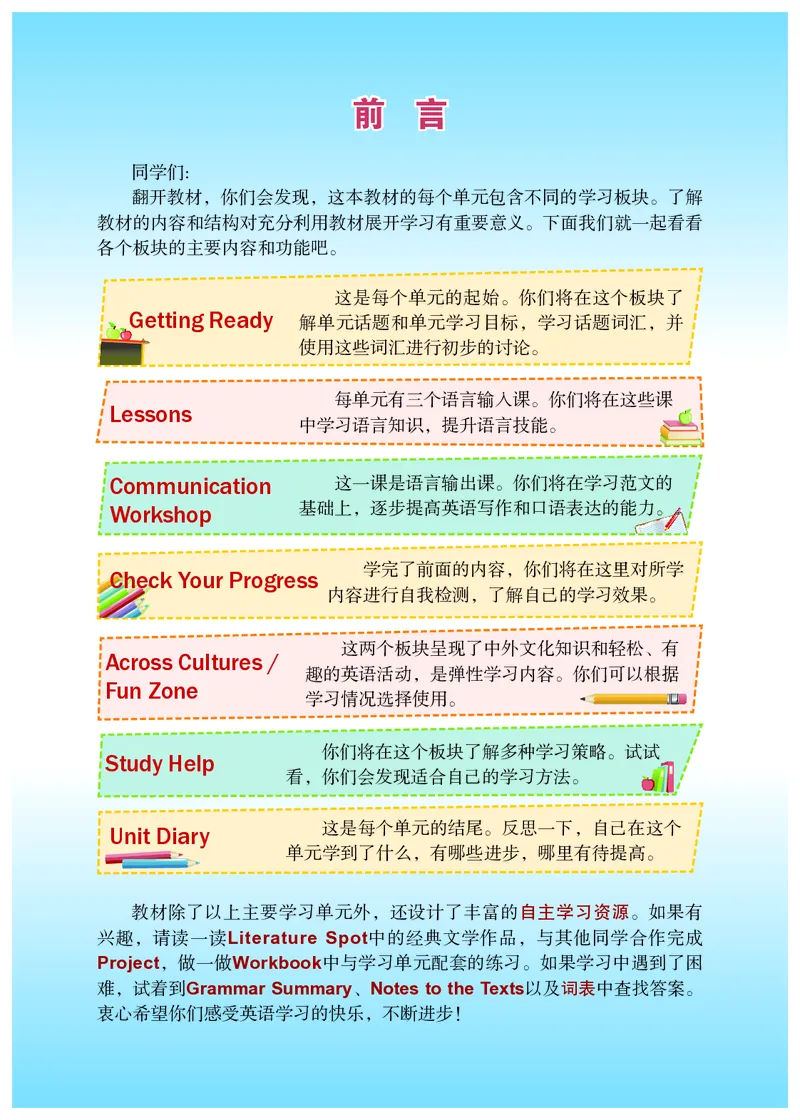
同学们:
翻开教材,你们会发现,这本教材的每个单元包含不同的学习板块。了解
教材的内容和结构对充分利用教材展开学习有重要意义。下面我们就一起看看
各个板块的主要内容和功能吧。
这是每个单元的起始。你们将在这个板块了
Getting Ready
解单元话题和单元学习目标,学习话题词汇,并
使用这些词汇进行初步的讨论。
每单元有三个语言输入课。你们将在这些课
Lessons
中学习语言知识,提升语言技能。
Communication 这一课是语言输出课。你们将在学习范文的
基础上,逐步提高英语写作和口语表达的能力。
Workshop
学完了前面的内容,你们将在这里对所学
Check Your Progress
内容进行自我检测,了解自己的学习效果。
这两个板块呈现了中外文化知识和轻松、有
Across Cultures /
趣的英语活动,是弹性学习内容。你们可以根据
Fun Zone
学习情况选择使用。
你们将在这个板块了解多种学习策略。试试
Study Help
看,你们会发现适合自己的学习方法。
这是每个单元的结尾。反思一下,自己在这个
Unit Diary
单元学到了什么,有哪些进步,哪里有待提高。
教材除了以上主要学习单元外,还设计了丰富的自主学习资源。如果有
兴趣,请读一读Literature Spot中的经典文学作品,与其他同学合作完成
Project,做一做Workbook中与学习单元配套的练习。如果学习中遇到了困
难,试着到Grammar Summary、Notes to the Texts以及词表中查找答案。
衷心希望你们感受英语学习的快乐,不断进步!Scope and Sequence
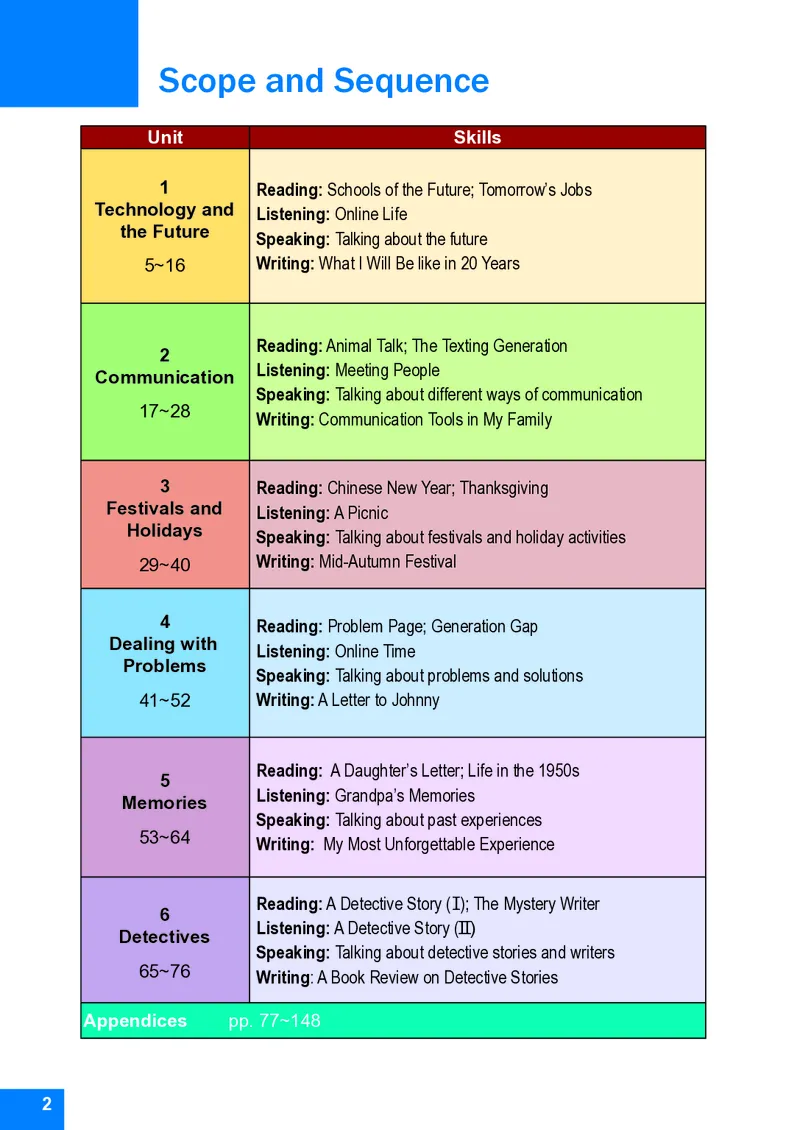
Unit Skills
1 Reading: Schools of the Future; Tomorrow’s Jobs
Technology and Listening: Online Life
the Future
Speaking: Talking about the future
5~16 Writing: What I Will Be like in 20 Years
Reading: Animal Talk; The Texting Generation
2
Listening: Meeting People
Communication
Speaking: Talking about different ways of communication
17~28
Writing: Communication Tools in My Family
3 Reading: Chinese New Year; Thanksgiving
Festivals and Listening: A Picnic
Holidays
Speaking: Talking about festivals and holiday activities
29~40 Writing: Mid-Autumn Festival
4 Reading: Problem Page; Generation Gap
Dealing with
Listening: Online Time
Problems
Speaking: Talking about problems and solutions
41~52 Writing: A Letter to Johnny
Reading: A Daughter’s Letter; Life in the 1950s
5
Listening: Grandpa’s Memories
Memories
Speaking: Talking about past experiences
53~64
Writing: My Most Unforgettable Experience
Reading: A Detective Story (Ⅰ); The Mystery Writer
6
Listening: A Detective Story (Ⅱ)
Detectives
Speaking: Talking about detective stories and writers
65~76
Writing: A Book Review on Detective Stories
Appendices pp. 77~148
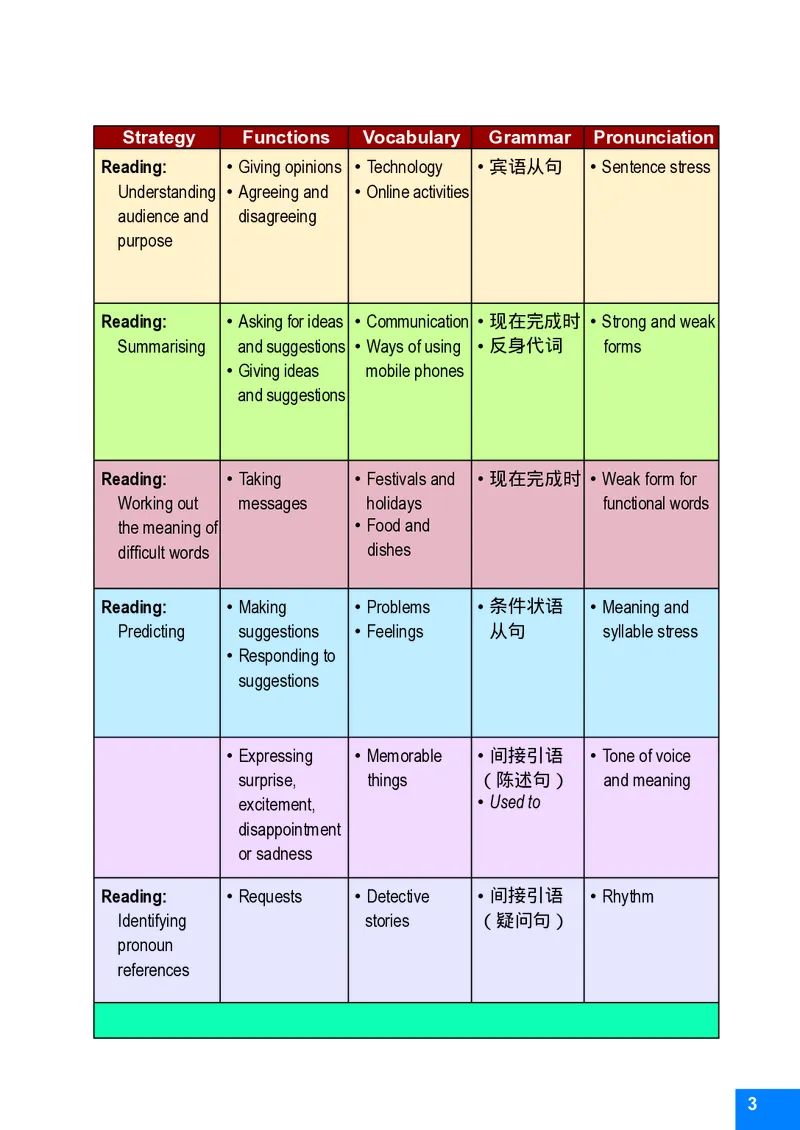
2Strategy Functions Vocabulary Grammar Pronunciation
Reading: • Giving opinions • Technology • 宾语从句 • Sentence stress
Understanding • Agreeing and • Online activities
audience and disagreeing
purpose
Reading: • Asking for ideas • Communication • 现在完成时 • Strong and weak
Summarising and suggestions • Ways of using • 反身代词 forms
• Giving ideas mobile phones
and suggestions
Reading: • Taking • Festivals and • 现在完成时 • Weak form for
Working out messages holidays functional words
the meaning of • Food and
difficult words dishes
Reading: • Making • Problems • 条件状语 • Meaning and
Predicting suggestions • Feelings 从句 syllable stress
• Responding to
suggestions
• Expressing • Memorable • 间接引语 • Tone of voice
surprise, things (陈述句) and meaning
excitement, • Used to
disappointment
or sadness
Reading: • Requests • Detective • 间接引语 • Rhythm
Identifying stories (疑问句)
pronoun
references
34
loohcS
ot
kcaB
What kind of learner are you?
1 Read the questionnaire and circle your answers.
1 How do you like to learn in class?
a) Working by myself. b) Working in pairs. c) Working in groups.
2 What helps you remember words and phrases?
a) When I see them. b) When I hear them. c) When I see pictures of them.
3 I understand something better after I …
a) try it out. b) think about it. c) write it down.
4 When I’m learning something new, I like to …
a) talk about it. b) think about it. c) write it down.
5 In a group discussion, I like to …
a) talk a lot. b) sit back and listen. c) do my own work.
6 Do you feel nervous when you speak English in class?
a) No, I’m always relaxed.
b) Sometimes, when I speak in front of the whole class.
c) Yes, I always feel nervous.
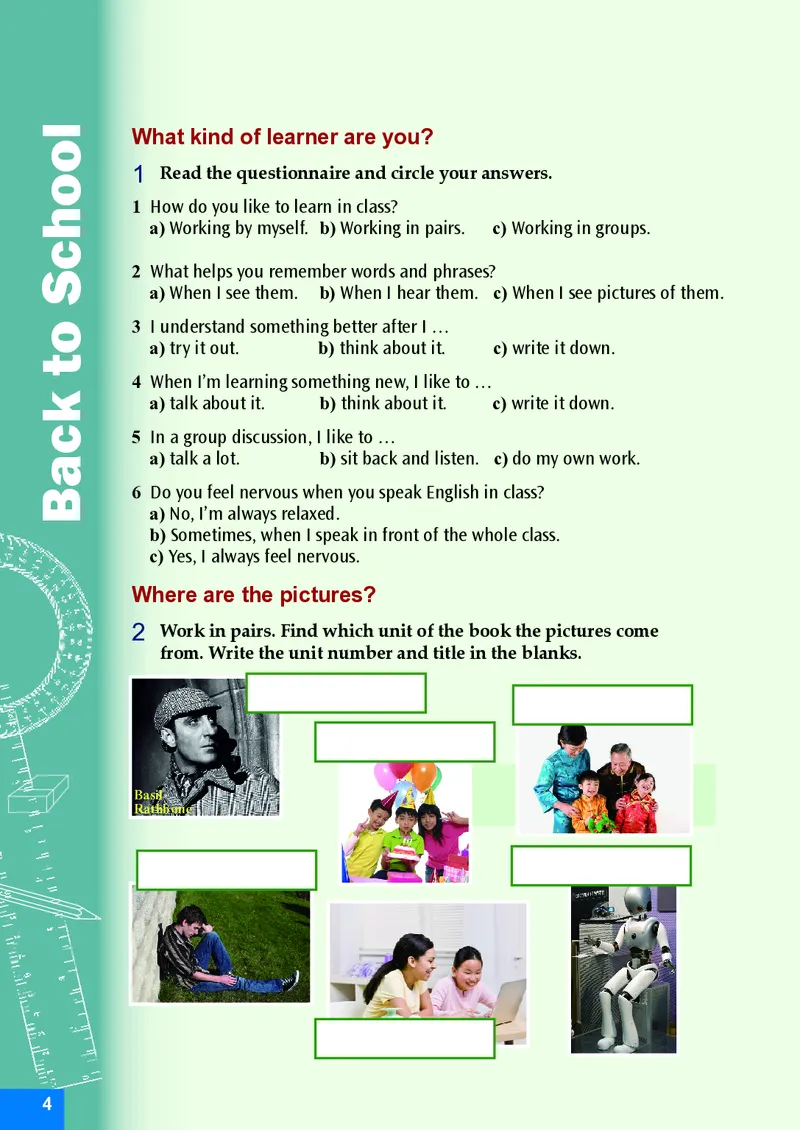
Where are the pictures?
2 Work in pairs. Find which unit of the book the pictures come
from. Write the unit number and title in the blanks.
Basil
Rathbone
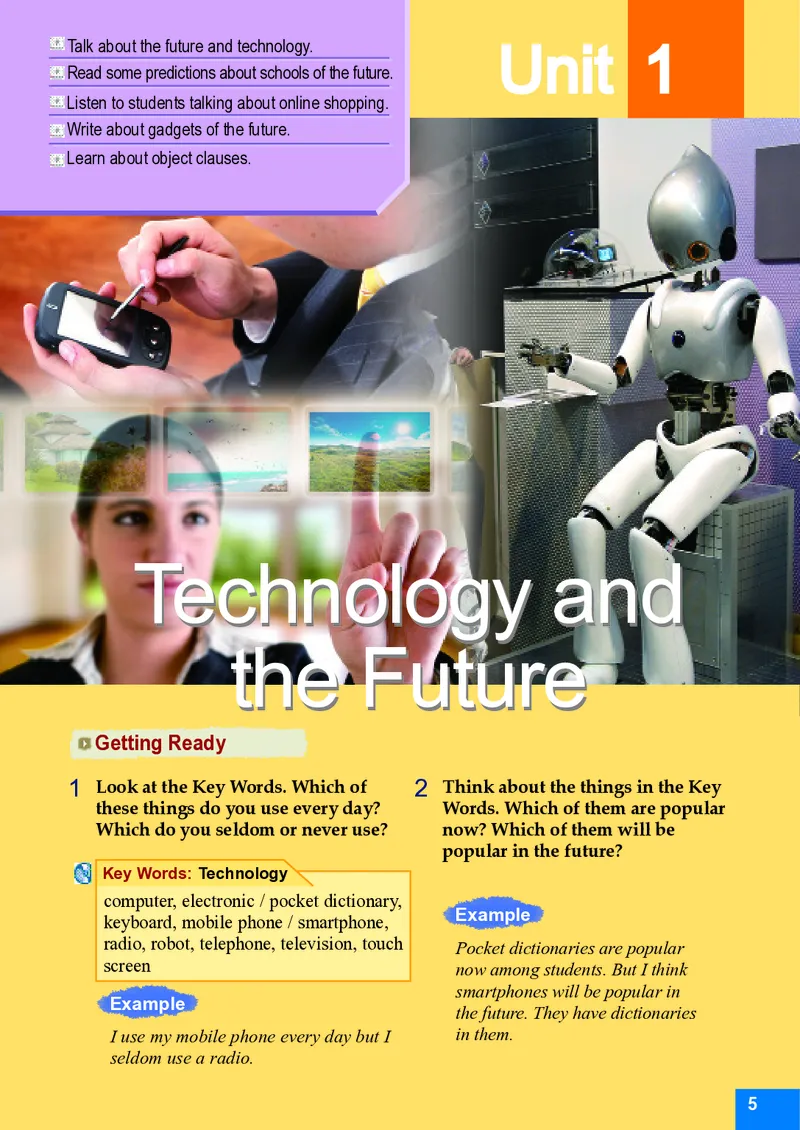
4Talk about the future and technology.
Unit 1
Read some predictions about schools of the future.
Listen to students talking about online shopping.
Write about gadgets of the future.
Learn about object clauses.
TTeecchhnnoollooggyy aanndd
tthhee FFuuttuurree
Getting Ready
1 Look at the Key Words. Which of 2 Think about the things in the Key
these things do you use every day? Words. Which of them are popular
Which do you seldom or never use? now? Which of them will be
popular in the future?
Key Words: Technology
computer, electronic / pocket dictionary,
Example
keyboard, mobile phone / smartphone,
radio, robot, telephone, television, touch Pocket dictionaries are popular
screen now among students. But I think
smartphones will be popular in
Example
the future. They have dictionaries
I use my mobile phone every day but I in them.
seldom use a radio.
551
Schools of the Future
Warm-up
1 Look at the photos. What do you
think will be useful at school? Why?
robot teachers
Example
I think smart ID will be useful at school.
Students can use them to borrow books
and check their scores online.
Reading
Name: Fred Hall
2 Read the text. Match the headings
with the correct paragraphs. smart ID
a New Ideas for Classes b Online Learning
online learning
c E-books for School d Robot Teachers
Tomorrow
Schools keep changing. Every year, new 3
inventions and products appear. Some
Many people believe schools will use less
of them are very helpful for students
paper and fewer books. In the future,
and teachers. Which of them will schools
students may only need to bring an
use? No one is sure, but here are some
e-book to school. In fact, some schools
possible developments.
are already doing this. The e-book will
1
store all their school materials and
There will be robots in the schools of students can write notes and answers
the future. Some people think that these on the screen. They can also search for
robots will help students with their information from the Internet. Most
homework. The robots will have special people think students would be happy to
software from the school. They will know have lighter schoolbags.
what the students are studying and they
4
will be able to help them solve problems
Teachers will give homework online in
easily.
the future. This can help parents follow
2 their child’s progress closely. They can
Many teachers do not believe there will check their child’s work and their marks
be traditional classes or classrooms. Each through the Internet. The system will
student in a class might study different also allow students to see teaching
materials at the same time. Classrooms videos and notes online. Some people
might be in open areas and use large LCD wonder if students will even need to go
screens. to schools any more.
Do you believe they will come true?
6Unit 1
Technology and the Future
3 Which of these things does the Grammar 宾语从句
writer mention? Read the text
6 Read the following sentences
again and tick.
and complete the sentences
1 In the future, schools will use fewer from the text.
books and less paper.
Many teachers do not believe (that) there
2 Teachers will have different will be traditional classes or classrooms.
classrooms.
They will know what the students are
3 Students will need to use smart ID studying.
cards to get into schools.
Some people wonder if students will
4 Parents can check their child’s even need to go to schools any more.
progress online.
a Some people think _______________.
5 Students will use smartphones in b Many people believe _____________.
class to take notes. c Most people think ________________.
6 Students will not need to go to d Do you believe __________________?
schools any more.
Grammar Summary 1, page 118.
4 Your Opinion Do you think
7 Match the sentence parts below
these inventions and products and write new ones.
will be helpful?
1 The students agreed …
2 No one knows …
Vocabulary
3 Tim thinks …
5 Complete the sentences with 4 Tina is not sure …
the correct words.
a Where are the books?
robots e-books online b Will she do well in the next exam?
traditional software progress c Their test was difficult.
d His school will be different in the
1 ________ classrooms do not have any future.
computers or screens.
2 Nowadays more and more factories Speaking
make use of ________.
8 Pair Work Discuss with your
3 My computer is broken so I cannot
partner about future schools.
hand in my homework ________.
4 The robots will have special ________
Example
from the school.
5 In future schools, students will use A: Will future schools have
________. classrooms?
6 He made great ________ in chemistry B: I think they will because ...
this year.
72
Online Life
Warm-up
1 Look at the words and the
websites. Which of these things
do you or your parents do online?
Key Words: Online activities
book air tickets, check the weather,
find a job, chat with friends, do
medical checks, listen to music,
look at maps, read emails, read the
news, do shopping, watch films,
pay bills …
Example
My parents often book air tickets
online.
2 Match the people with their
possible opinions about
online life.
DDrr ZZhheenngg MMiissss NNeewwmmaann
a computer
Listening
science professor the president
at university of a website
3 Listen to their talk. Check your
He thinks: She believes: predictions in Exercise 2 and
complete the table below.
a Most people will still buy food at the
Miss
market. Dr Zheng
Newman
b People are much more comfortable
online these days.
Opinion
c People will do even more things online About
in the future. now
Examples
d Not everybody will have a computer
and not everyone can connect to the
Internet. About Opinion
e People will all be online every day. the
f People will not do everything online. future Examples
8Unit 1
Technology and the Future
Vocabulary Speaking
4 Complete the sentences with 6 Your Turn Do you agree with
these words. Dr Zheng or Miss Newman?
Tell your reasons.
website Internet social media
e-ticket shopping
Example
I agree that everyone will be online
in the future. But people will still
do some things in person. For
example, I think they will always
buy vegetables at the market.
1 Not many elderly people do their 7 Group Work Work in groups of
four. Discuss your opinions about
____________ online.
the future.
2 ____________ has become so
popular! We seldom talk to our friends
Example
face to face!
A: I think people will do almost
3 You do not have to go there. You can
everything online in the future.
buy an ____________.
B: I agree. You can buy things,
4 I have finally bought a new computer. pay your bills and even take
Now I can connect to the _________. exams on the Internet.
C: I don’t think so. You can’t do
5 You can find a lot of useful information
an X-ray online.
on this ___________.
D: …
Function 表达意见—同意和不同意
Pronunciation: Sentence
5 Read the Key Expressions.
stress
Key Expressions: Giving opinions 8 Listen and circle the stressed
words.
I think / don’t think people will do
A: Is there anything that you would
everything online.
never buy online?
I believe / don’t believe people will
B: I would never buy eggs online.
still buy food at the market. How would they send them to
me? They would all break!
Key Expressions: Agreeing and
9 Which words would you stress
disagreeing
in these sentences? Read them to
You’re right. I agree that people
the class.
today aren’t afraid to use the Internet.
My grandparents don’t understand the
I don’t agree … / I don’t think so. Internet. I’d like to help them.
93
Tomorrow’s Jobs
Warm-up
1 Look at the following expressions.
Which do you think people will
Jobs in the past
do more in the future? Which Some time ago, people did not
will people do less? have many choices about their
jobs. They usually worked near their
work for one company / work for
hometown and they often stayed
many different companies
in one job for their whole life. They
work in the office / work from home
worked with fixed hours in fixed
work for money / work for fun
places and did not have much need
to develop new skills.
Example
I think in the future more people
Present jobs
will work for fun and fewer people
Now people have much more
will work for money.
choices. They can choose to work in
other towns or cities and some may
Reading
even work in other countries. Also,
2 Read the Reading Help. it is common for people to change
Then read the text and choose jobs and by doing so, they can
the best answers. have different working experience.
On the other hand, with increasing
Reading Help: Understanding
competition in the job market, most
audience and purpose
people want to, and often need to,
Look at the pictures and read develop new job skills.
the text quickly to get the
main idea.
Jobs in the future
Who is the text for? Who is the
In the future, more people will be
writer speaking to?
able to sell their skills and services
Think about the purpose of the to many different companies
article. What information does it
instead of working for one company
g ive? What point or points does for many years. More people will
it make? work from home. They will also
need to work with people they
1 Who is the writer talking to in the text?
never meet in person. And there
a college teachers
will be many other changes we
b junior high school students cannot imagine now. All of these
c company managers changes mean that there will be
more competition from people all
2 What is the purpose of the text?
over the world for tomorrow’s jobs.
a to tell teachers what to teach in the future
Are you ready for the future?
b to compare jobs in the past, at
present and in the future
c to help students get prepared for
future jobs
10Unit 1
Technology and the Future
5 Your Opinion What skills are
you good at and what skills are
you still weak at for future jobs?
What skills will future jobs
need?
Vocabulary
What will the future job market
require of students at school today? 6 Find the expressions in the text
What skills will students need for and match the words.
success in the future?
communication hours
Some skills will always be important.
job situations
They include good communication
fixed market
skills, decision-making skills and
difficult skills
problem-solving skills. You need to
express your ideas clearly and at the
7 Complete the following
same time be a good listener. You
expressions with prepositions.
also need to plan well and make
good decisions quickly. And, as there
1 a key ___ success
will always be problems to solve, the
2 stay ___ one job
ability to deal with difficult situations
3 ___ the same time
is a key to success.
4 ___ the future
Since the world changes so fast, it’s
important to keep learning about
new ideas and technology. There Speaking
will be a lot of changes coming
8 Your Turn What kind of job would
our way before we even know they
you like to do in the future? Why?
are coming. Hope they make you
excited rather than scared.
Example
3 Read the paragraphs on page 10
I’d like to be a tour guide in the
and complete the table about
future because I love travelling
how jobs change.
and meeting people.
Jobs in Present Jobs in
Situations
the past jobs the future
9 Pair Work Talk in pairs. Do you
Choices of jobs
think the job you want to do will
Changes of jobs
be the same or different in the
Changes of
working places future?
Needs for new
skills Example
I’d like to be a teacher. I think it
4 Read the paragraphs on this page.
will be different in the future. I’ll
What skills will be important for
use more technology in my job.
future jobs? Why? How should
we face the changes?
11CCoommmmuunniiccaattiioonn WWoorrkksshhoopp
Reading
1 Read Jim’s writing and put the correct themes in the table below.
family conclusion work spare time introduction
What I Will Be like in 20 Years
Twenty years later, I will be thirty-four years old. I think I will be a
successful and happy person.
I will be a businessman then and will set up my own website. I
will enjoy my job very much because I love surfing the net. I won’t
often go to the office. Instead, I will work from home according
to my own timetable. I won’t need to wake up early and I can work
until late at night.
I will leave home and live in my own flat. But I will live near my
parents and I will often visit them. Every year, we will have a family trip
together.
In my spare time, I will read books and travel around.
I like sports, so I will also play football with my
friends and go swimming at the swimming pool
near my home.
I will enjoy my life a lot because I can spend most
of my time according to my own will. Life will
be so exciting and comfortable.
Paragraph Theme Questions
1
2
3
4
5
1122Unit 1
Technology and the Future
2 Put these questions in the correct place in the table on page 12.
1 What will you do in your spare time?
2 What will you do in your job?
3 How old will you be?
4 Will you enjoy your life? Why / Why not?
5 Where will you live?
Writing
3 Think of your life after twenty years and fill in the table below.
Remember to use the future tense.
Example
Q: Will you enjoy your family life? Why?
A: I will enjoy my family life because I love living with my parents.
Theme Questions Answers
4 Write about your future life
Speaking
using the answers in your
5 Tell the class about your life
table.
twenty years from now.
What I Will Be like in 20 Years
_______________________
_______________________
_______________________
_______________________
_______________________
Twenty years later I’ll …
1133Unit 1
Check Your Progress
A Complete Eric’s email using the C Match the sentence parts.
pictures.
10 Many teachers hope ____.
11 Students all say ____.
12 My brother doesn’t know ____.
Hi! Wang Jun,
13 Parents will be able to use the
I’m on holiday in Tokyo. The technology is
Internet to check ____.
amazing — like being in the future! Today
14 I am not sure ____.
we went to a restaurant. The waiter was a
1 __________! We typed our order on a
2 __________ and it brought us the food. a that lighter schoolbags would
I took some photos with my 3 __________. be a good thing
I’ll show you when I’m back. Some things b if he would like a robot teacher
are really cheap here — I bought an
c they won’t have to use
4 __________ for my sister. She loves music.
traditional blackboards in the
OK, I have to go now. We’re coming home
future
tomorrow, but no one can find the
d whether it is good to use
5 __________!
smartphones in class
Eric e what their children are studying
1 2 3
D Circle the correct words.
15 People will never buy fruit and
vegetables online, so I think /
4 5
don’t think people will ever
do all their shopping on the
B Write the correct words in the blanks. Internet.
16 I believe / don’t believe there’s
speak a foreign language talk online
anything you can buy in a real
communicate in writing check the weather
shop that you can’t buy online
now.
6 He will go to Europe this summer holiday.
Can he __________? 17 You’re right. I agree / don’t
7 A storm is coming. Please __________ agree that all our work will be
before you go out. done by robots one day.
8 My cousin lives in Australia but we can see 18 He said that we would have
each other when we __________. e-books instead of paper books
9 Grandpa doesn’t like technology. He wants soon, but I don’t think so /
us to __________.
think so.
Vocabulary ___ / 9 Grammar ___ / 9
14Across Cultures 1
MMeessssaaggeess aabboouutt tthhee FFuuttuurree
1 Do you think we can predict the future? Why / Why not?
2 Read the text and find out answers.
1 What year did John Titor come from?
2 Why did the government ask Titor to time-travel?
3 What was his prediction of the year 2004?
4 Why would the earth be damaged in 2015?
3 Read the text again. Do you believe in John Titor? Why / Why not?
A Time-traveller from the Future?
In 2000 and 2001, a person called John Titor posted some
strange messages on the Internet. Titor said he came
from the future — he was an American soldier from the
year 2036. He was on a government mission(任务) to go
back to 1975 to find an old computer for fixing computer
programmes in his time. Before returning to the future, he
travelled to the year 2000 to visit his family.
Titor talked about some future events in his posts.
He said there would be a civil war(内战) in the
United States after the presidential election in 2004.
The war would lead to many global conflicts(冲突).
As a result, there would be no more Olympic Games
in the future.
Titor also warned that there would be a nuclear
attack in 2015. The attack would destroy the
environment seriously and most of the strong
countries in the world would disappear.
As of today, none of Titor’s predictions has come
true. But some people still believe in Titor and retell
his story on different websites. There is even a book
and a play about Titor.
1155Unit 1
Study Help
Using Online Resources
When you find that a website contains useful information on a topic:
bookmark the website so that you can return to it and use the
information later.
copy useful parts of the website onto your computer or print them out.
Then you can read them more slowly and take notes.
always put a list of the websites where you got the information from at
the end of your work.
Not all the information on the Internet is true. Government, university
and public organisation sites are more reliable.
Choose a topic from below. Use the above tips to get information about the
topic on the Internet and prepare simple notes.
the development of robots
independent learning
popular jobs in China
online shopping in China
Unit Diary
How well can you do these?
• I can understand the texts about
schools and jobs of the future.
Language • I can give opinions about the future.
and Skills • I can understand the purpose of an
article and its audience.
• I can write about my life twenty years
from now.
• I have my own opinions about
Culture
predictions of the future.
Study Skills • I know how to use online resources.
16Talk about different methods for communication.
Unit 2
Listen to a dialogue about making small talks.
Read about how animals communicate.
Write about communication tools in your family.
B
Learn about the present perfect and reflective
pronouns.
A
C D
CCoommmmuunniiccaattiioonn
Getting Ready
1 Look at the Key Words and use 2 Think about your methods for
them to describe the photos. communication. Answer these
questions.
Key Words: Communication
1 How do you usually communicate with
blog, body language, email, face-to-
your friends?
face conversation, mobile phone,
letter, postcard, sign language, 2 When do you talk to your friends and
text message, telephone when do you write to them?
3 What things do you still send by post?
Example
In Photo A, the two people are using a computer.
Maybe they are writing a blog or sending an email.
11774
Animal Talk
Warm-up Reading
1 Think of animals you know. 2 Read the text. What are the three main
How do they communicate? methods of animal communication?
1 by smell 2 by sound
3 Read the text again. What methods
3 by body language
do these animals use to communicate?
Example • ants • elephants • dogs • frogs
• cats • whales • mice • insects
I think ants communicate by body
language.
My dog is in the garden. He is wagging his tail, his mouth is open and he
is looking at me. What is he trying to tell me? Jane Roberts reports.
People have always been interested Whales and elephants also use sound
in animal communication and to communicate. These sounds can
scientists have done a lot of research travel very far through water or the
on this subject. ground. However, it is not possible
for humans to hear some of the
Most animals communicate by
sounds. They are either too low or
smell. Dogs are famous for this.
too high for us.
When a dog walks outside, it learns
about other dogs by smelling things. Animals have always used body
Dogs have helped the police for a language to communicate as well.
long time, too. They can find missing When a cat puts its ears back, it is
people by using their fantastic sense a bit mad. When it sits with its tail
of smell. Mice have an excellent around itself, it is happy. When a
sense of smell, too. And scientists dog puts its tail under its body, it
have trained them to find landmines. is scared. When it wags its tail and
Scientists have discovered that even opens its mouth, it is happy. So I
ants use smell. They use smell to tell think my dog is happy right now.
other ants where the food is.
Everyone has heard birds singing.
Research has shown that many other
animals use sound to communicate.
Frogs and insects communicate with
sounds. Usually the “gentlemen”
make sounds to invite the “ladies”.
18Unit 2
Communication
4 Your Opinion How is human 7 Complete the text with the
communication different from verbs in brackets in present
animal communication? simple or present perfect.
I 1________ (have) two dogs. Ginger
Vocabulary 2________ (be) in our family for seven
years and Choc 3________ (be) just two
5 Find these words from the text.
years old. They aren’t really friends.
Tick their correct meanings in the
Ginger 4________ (bite) Choc a few times
text.
and she often 5________ (bark) at her.
Word Meanings
At the moment, we’re training them. I
mad (adj.) 1. angry 2. crazy
6________ (find) a good dog trainer and
sound 1. (n.) something that you can
I 7________ (take) the dogs to her three
hear 2. (v.) to seem to you when
times a week. She’s really great!
you hear or read about them
8 Use the words to make sentences.
subject (n.)1. a thing that is discussed
or studied 2. an area of 1 love animals / always / she
knowledge that is learned in a 2 never / he / have a pet
school 3 Molly / be / for 10 years / my pet
4 have a pet tortoise / I / since I was ten
years old
Grammar 现在完成时 1
6 Read the following sentences Speaking
and find more similar ones
9 Your Turn Do you have any pets?
from the text. Then find rules to
Have you ever watched an animal?
complete the table.
How do they communicate? Talk to
1. Scientists have discovered that even your partner.
ants communicate this way.
2. Everyone has heard birds singing.
Example
现在完成时
A: I don’t have any pets, but I’ve
主语+ 助动词+ 过去分词 seen animals on TV. Some monkeys
I / You / learned make loud noises to communicate
______
We / They said with other monkeys.
seen B: How?
______
He / She / It been A: When they see a lion, they make
loud noises. Then all the monkeys
Grammar Summary 2, page 118.
hide.
For and since are usually used in present perfect sentences.
Watch out! Jim has worked for ten years.
Tim and Tina have lived here since 2004.
195
Meeting People
Warm-up
1 A group of foreign students are
going to visit your school. How
Action Plan:
will you welcome them?
1. Clean our classrooms.
Example 2. Decorate our school
A: I think we can invite them to join with flowers.
our classes and activities.
3. Show them around
B: I think we should learn about their
our school.
culture first and introduce Chinese
culture to them.
The class is discussing what they
C: How about asking about their trip
should do for the visit of students
or the weather?
from England tomorrow.
D: I think they will feel happy if we
show them around our school.
Listening
3 Listen again. What things does
2 Listen to the class discussion. the teacher tell the students not
What ideas do the students have? to do? Circle the correct answers.
Put ticks in the boxes.
a Don’t speak too much.
• wait at the school gate for b Make sure you don’t make any English
mistakes.
them
• shake hands c You don’t have to shake hands with
• smile and say “Hello” the students.
• say your name
d Don’t worry about making mistakes.
• ask the teacher about his /
e You shouldn’t talk about the weather.
her age
• ask about their trip f Don’t laugh at their Chinese mistakes.
• talk about China
g You shouldn’t ask their teacher about
• talk about sports
his / her age.
• help them find their
classroom
20Unit 2
Communication
Grammar 反身代词 7 Rearrange the words to make
sentences.
4 Complete the table with the
1 website? / showing / them / school /
correct pronouns.
How / our / about
人称代词 人称代词 _______________________________
反身代词
(主格) (宾格) 2 have / you / Do / more / ideas? / any
me myself _______________________________
us ourselves 3 think / I / should / we / party. / a / have
_______________________________
you (one) you
4 could / We / help / clean / them / up.
you (more
yourselves _______________________________
than one)
he himself
Speaking
she her
8 Group Work The foreign
it it
students are leaving your school.
they them
In groups, think of ideas and
Grammar Summary 3, page 119. suggestions for their goodbye
party.
5 Complete the sentences with the
correct pronouns. Example
1 Tom painted the room all by _____. A: What can we do for the
(he) goodbye party?
2 After dinner _____ went for a walk. B: I think we should have some
(they) local snacks.
3 Sophie sometimes talks to _____. (she) A: Good idea. What else?
4 The team has got _____ into 9 Your Turn Make a plan for
difficulties. (it) the party and share it with the
class.
Function 建议 1
Pronunciation: Strong and
6 Read the Key Expressions.
weak forms
Key Expressions: Asking for 10 Listen and circle the
ideas and suggestions sentences that use the
What can / could / should we do? strong form of the
Do you have any more ideas? underlined words.
What else? Any other ideas? 1 a ) Yes, we can have a party.
b) Yes, we can.
Key Expressions: Giving
2 a ) We saw some people.
ideas and suggestions
b) Some of us want to go.
We can / could / should …
3 a ) The answer is on the board.
I think we should …
b) Who’s on the team?
How about …?
11 Listen and repeat.
216
The Texting Generation
Warm-up
1 What do people do with mobile
phones?
• take photos • send text messages
• check the time • search the Internet
• play games • store phone numbers
Example These days, it seems everybody is texting
although young people are texting the
People use mobile phones to send text
most. In 2010, American teenage girls
messages.
sent and received about 80 text messages
a day. Boys sent and received about 30.
Reading
Adults sent five to fifteen messages a day.
2 Read the Reading Help. Then
Since the first text message in 1992,
read the text and choose the best
texting has become very popular. Texting
summary of the first paragraph.
did not become common until about
1998. Later, text messages increased
Reading Help: Summarising
rapidly. From 2006 to 2007 in the US,
When you summarise, choose the the number of monthly texts grew 335%.
In early 2006, people sent about 65
most important points in the text.
messages per month. At the end of 2007,
You might need to use your own
they sent about 218. Now, some people
words. The topic sentence can
send more than 1500 text messages a
always help you summarise.
month.
Summary of paragraph 1: Why is texting so popular? The main
a Texting is more popular than other reason is that it is not expensive. It has
communication tools. other values, too. Texting is quieter and
more private than a phone call. It is also
b Girls send the most texts.
more convenient as people can reply
c Teenagers text more than adults and when they have time. They also invented
“text language” such as “thx” for “thanks”
girls text more than boys.
and “cul8tr” for “see you later”. This
d Texting is a popular activity among makes texting even quicker and easier.
both adults and teenagers.
3 Summarise paragraph 2, 3 and 4.
4 Read the text again and answer
the following questions.
1 When did texting become common?
2 Why does texting become popular?
3 What problems does texting cause?
2222Unit 2
Communication
However, texting has led to some 1 Mike played basketball. The game
problems. Some people text while they started at 3 pm and finished at
are driving or riding a bike. This is very 4:30 pm. (from, to)
dangerous. It is also against the law in ___________________________
many places. In one city in the US, you
cannot text while walking. Police can 2 It rained all day. It stopped just
make you pay $85. People often text now. (not ... until)
during conversations as well. It is not ___________________________
polite. Many people do not like this.
3 They work on the project. They
Love it or hate it, texting is certainly here
started on Monday. (since)
to stay.
___________________________
4 I got home. Then I realised I lost
my mobile phone. (not ... until)
5 Your Opinion How has texting
___________________________
changed our life (language,
communication, etc.)? 5 We live in Beijing. We moved here
ten years ago. (since)
Vocabulary ____________________________
6 Fill in the table with words and
expressions from the text.
Speaking
Meaning Word
to send a message on a 8 Your Turn Should students
mobile phone have mobile phones? Why?
to grow very quickly
not for public use Example
not allowed by the set of
A: I don’t have a mobile phone
rules of a country
and I don’t think students
should have mobile phones
7 Look at the Sentence Builder.
because we may spend too
Then connect the sentences using
much time on the games
the words in brackets.
in them.
Sentence Builder B: I don’t agree. I think
students should have mobile
Since the first text message in 1992,
texting has become very popular. phones so our parents can
always know where we are.
Texting did not become common until
about 1998.
From 2006 to 2007 in the US, the
number of monthly texts grew 335%.
2233CCoommmmuunniiccaattiioonn WWoorrkksshhoopp
Reading
1 Read Betty’s writing and fill in the table below.
Communication Tools in My Family
Thirty years ago, my grandparents wrote letters to their
friends and family. Grandpa worked in the city and
Grandma lived in the country, so they wrote to each
other. It took one week to deliver the letter. When
Grandma asked a question in her letter, it took her two
weeks to get the answer! If there was anything urgent,
they needed to send telegrams.
The telephone became a popular communication tool in the early 1990s. But my
dad’s family did not have a telephone until 1998. Although it was much faster than
writing letters, it was still inconvenient. Once Dad arrived home late because he
helped a granny on his way. My grandparents were so worried about him because
he could not call them and tell them what happened. This never
happened again after my dad bought his first mobile phone in
2002.
My favourite communication tool is the mobile phone. I have
used it since my thirteenth birthday. My parents and friends can
find me wherever I am. It is very convenient, but at the same
time it is easy to get bothered especially when I want to stay
alone. Sometimes I have headaches after talking on the mobile
phone for a long time.
How they
Who When Good / Bad things about it
communicate
My grandparents _________ Writing _______ ● took one week to deliver a letter
● _______ than writing letters
My dad 1998 Using ________
● not ________________
● ________________: parents and
Since my friends can find me wherever I am
Me Using ________
__________ ● have ________________ after
talking for a long time
2244Unit 2
Communication
Speaking
2 Role-play Betty and her friend. Choose some questions from below.
• What communication tool did your grandparents / parents use?
• What is your favourite communication tool?
• How long have you used it?
• What do / don’t you like about it?
What other questions can you ask?
Writing
3 Think about the communication tools in your family. Write notes for
each paragraph using the table below.
When? (e.g. Good / Bad things about it
… ago, since / (e.g. fast / slow, convenient /
Paragraph Who? What?
until …, from … inconvenient, cheap /
to …) expensive)
1
2
3
4 Write about the communication tools in your family. Remember
to use linking words to link your ideas.
Example
Communication Tools in My Family
_In_ _m_y_ f_am__il_y_ t_od_a_y_, _w_e_ u_s_e_ b_o_th_ _te_l_ep_h_o_n_e_s _a_n_d_ m_o_b_i_le_ p_h_o_n_e_s_ t_o _c_o_m_m_u_n_i_ca_t_e.
_B_u_t _te_n_ y_e_a_rs_ _ag_o_,_ ._..__________________________________________
_________________________________________________________
_________________________________________________________
2255Unit 2
Check Your Progress
A Write the correct words in the C Match the words with the
blanks. categories.
known shown found email letter blog text message
been interested in heard body language mobile phone
1 I have __________ learning about Internet Phone Post Face to face
animals since I was very young.
computer call postcard smile
2 Everyone has __________ the sound of 11 _____ 13 _____ 15 _____16 _____
birds singing in the morning. 12 _____ 14 _____
3 Scientists have already __________
Vocabulary ___ / 16
about animal communication.
4 Monkeys have __________ that they D Write the correct words in the
can use their faces to express their blanks.
feelings.
since from until ago
5 The baby elephant has __________ its
17 The first text message was sent
mother. It followed her calls.
many years ______.
B Complete the note according to
18 My mother didn’t have a mobile
the pictures.
phone ______ last year. Now she
has three!
Today our teacher told us that
some students from England were 19 He’s sent me five messages ______
coming to visit! To welcome them, we last met.
we should 6 __________ and
20 ______ July 2010 to May 2011, this
7 ____________, but we don’t
girl sent over 2000 texts a month.
need to 8 ____________. If they
try to speak Chinese, we shouldn’t
E Put the words in order to make
9 __________ at their mistakes.
sentences. Use the present
Then we are going to help them
perfect tense.
find their 10 __________.
21 write / letters / They / for ten years.
_____________________________
6 7 8 22 never / She / send / text message /
before.
_____________________________
23 computers. / always / I / be
9 10
interested in
_____________________________
24 study / We / since 1987. / animal
communication
_____________________________
Grammar ___ / 8
26Fun Zone 1 Let’s Talk!
1 What do these text messages mean? Match them with their “translations”.
1 3 5
:-) bday
ru ok? tmb wan2 play
cus
b4 2moro tennis 2nite
or 2moro?
2 thx cu 4 6
not sure
im :-(
next week
ttyl gtg
dad is >-(
:-) wknd
a I am unhappy! My dad is angry.
b Happy Birthday! See you soon.
c Do you want to play tennis tonight or tomorrow?
d Thanks. See you next week. Have a good weekend.
e I’m not sure. Talk to you later. Got to go.
f Are you okay? Text me back before tomorrow.
2 How do these animals communicate?
3 Look at these lines from the
Match them with the things they do.
song You Said Something.
What do you think the song
● ● Show they are is about?
angry by putting
How did we get here?
out their tongues.
● ● On a rooftop in Brooklyn
Rub noses as a
sign of love.
When you said something
That was really important
● ● Press their necks
together when Describing the colours
they like each And the smells of our
other. homelands
● ● Hit the ground Riding in your car
with their back
legs when there is
4 Listen to the song and put the
danger.
lines above in order.
2277Unit 2
Study Help
Communicating
Use gestures and facial expressions when you communicate.
It’s great! It tastes awful!
Work in pairs. Take turns to mime these words and guess the words.
knife tired asleep bored
camera sad violin snake
Use expressions to give you time to think.
Well, …
Example
You know, …
I’m not sure, but …
Work in pairs. Take turns to ask a question. Reply using hesitation
expressions.
A: What’s the capital of Gansu Province?
Example
B: I’m not sure, but I think it’s Lanzhou.
Unit Diary
How well can you do these?
• I can understand the texts about animal
communication and texting.
• I can ask for and give ideas and
Language suggestions.
• I can relate past events to the present.
and Skills
• I can summarise texts.
• I can write about the communication
tools in my family.
• I know how to use gestures, facial
Study Skills expressions and hesitation expressions
in communication.
28Talk about festivals and holidays.
Unit 3
Read about Chinese New Year and American
Thanksgiving.
Listen to people making a phone call and taking
messages.
B
Write about celebrating a festival.
Learn more about the present perfect.
A
C
D
FFeessttiivvaallss aanndd HHoolliiddaayyss
Getting Ready
1 Put the following festivals and 2 Which festival or holiday do
holidays in order of time in a year. you like best? Tell the class.
Key Words: Festivals and holidays Example
American Thanksgiving, Chong Yang A: I like Dragon Boat Festival the best.
Festival, Christmas, Dragon Boat The boat races are so exciting.
Festival, May Day, Mid-Autumn B: I like it, too. But Spring Festival is
Festival, New Year’s Day, Qing Ming the best because there are a lot of
Festival, Spring Festival (Chinese fireworks and I get to see all my
cousins.
New Year), Women’s Day
22997
Chinese New Year
Warm-up
1 What do you and your family
do on Chinese New Year’s Eve?
Example
We have a big family dinner on
Chinese New Year’s Eve.
Reading
2 Read the instant messages.
Who are talking? What are 1
they talking about?
Hi, Grace! You were not online all day.
Where have you been?
Hi, Dad. We’ve been busy. In the morning,
Grace is a student from we put up Chinese New Year decorations. Li
England. She’s having Lin’s grandpa wrote lots of “福” (meaning
the Chinese New Year “good luck”) on red paper. I helped to put
holiday with her friend them on doors and windows.
Li Lin’s family in Beijing.
Have you learned to write the character?
Oh yes. It’s interesting!
2
3 Then in the afternoon, I helped Li Lin’s
family prepare the Chinese New Year
Have you tasted the jiaozi you made?
dinner. It’s like the Christmas dinner we
Oh yeah, they were not bad, though they
have for family reunion.
didn’t look as good as the others. In fact,
What have you prepared?
we’ve just finished dinner. It lasted for
We’ve prepared fish, tofu, fried meat
three hours!
balls, etc. Every dish has its meaning,
Three hours! What have you eaten?
like peace, good luck, good health …
Lots and lots! And it’s not just about
And I’ve learned to make jiaozi!
eating. The family wished each other,
and me, good luck, and they watched TV.
Everyone was so happy! 3 List what Grace did in time order.
4
In the morning ________________
The best thing about the Chinese New Year ________________
is fireworks. Just before midnight, everyone In the afternoon ________________
went outside and millions of fireworks went
In the evening ________________
off together. The sky suddenly became bright
________________
and everybody cheered. It was very exciting.
________________
Have you taken any photos?
At night ________________
Oh, yes, I have. Lots of them …
30Unit 3
Festivals and Holidays
4 Your Opinion How did Grace feel 7 Complete the following
about Chinese New Year’s Eve? Find sentences using the tense
evidence from her instant messages. indicated.
1 I _____________ (never / write)
Chinese. (present perfect)
Grammar 现在完成时 2
2 They _____________ (not see)
5 Read the following sentences and us at the market. (past tense)
find more similar ones from the text.
3 We _____________ (never /
Then work out rules to complete the
see) our friends here. (present
table with has, have, hasn’t or haven’t.
tense)
What have you prepared? 4 What ______ you _______
Have you taken any photos? (do) on New Year’s Eve? (present
perfect)
Oh, yes, I have.
5 Who ______ they _______ (talk)
疑问句 to at the beach? (past tense)
______ I / we / you / they 6 The boys are so dirty! Where
written
______ he / she / it Chinese? ______ they _______ (be)?
(present perfect)
Yes, I ______. / No, I _______.
Yes, she _______. / No, he _______.
Speaking
Where ______ I / we / you / they been?
Who / What ______ he / she / it seen? 8 Your Turn Have you ever
done the things below?
Grammar Summary 2, page 118. Ask your partner.
Watch out! • cook New Year’s Eve’s dinner
• make jiaozi
They have already finished that project.
• set off fireworks
Jim has never been to the Great Wall.
• buy flowers at a market
Have you ever seen anything like it?
• send text messages to friends
Example
6 Complete the questions according to
their answers. A: Have you ever made
jiaozi?
1 --____ you ever ____ Chinese? (write)
B: Yes, I have.
--No, I haven’t.
A: Have you ever set off
2 --____ you ____ jiaozi? (like)
fireworks?
-- Yes, we do.
B: No, I haven’t.
3 --What __________________?
--I’ve made jiaozi.
4 --What __________________?
--I went to the market.
318
A Picnic
Warm-up
1 Here are some things you could
bring to a picnic. Which are food
and which are dishes? Write them
in the table below.
Key Words: Food and dishes
bean, biscuit, bowl, corn, cup,
fork, hot dog, hamburger, knife,
plate, sausage, spoon, strawberry,
watermelon
food bean Uncle Dan will leave at
dishes bowl 1_________ tomorrow
2_________ and he’ll see
us tomorrow afternoon at the
Listening
3_________
2 Listen to the dialogue and
Don’t buy more 4_________ and
complete Julie’s message.
don’t buy any 5_________.
Julie is taking some messages from her
Uncle Dan about the family picnic. Bring 6_________ and plates.
3 Listen again. Which of the following does
Uncle Dan NOT say? Circle them.
a Can I speak to your mum or dad?
b Dean’s coming too, right?
c Have your mum and dad bought any vegetables yet?
d We’ve got a big watermelon.
e Please tell them not to buy any sausages.
f We’ll bring the knives and plates.
32Unit 3
Festivals and Holidays
Vocabulary Speaking
4 Write the correct words in 7 Pair Work Choose one of the
the table. Can you work out the following situations and role-
spelling rules? play with a partner.
• You called Linda. She was not at home.
单 数 复 数
Her mother (Mrs Hill) took a message.
a fork
Tomorrow is the deadline for the
a spoon
school painting competition. You would
a knife like to remind Linda to bring her work
a strawberry to school tomorrow.
• Yang Ning left his book at your home.
a sausage
You called him. He was not at home. Mr
Yang took a message. You would bring
Function 电话留言 them to school tomorrow.
5 Read the Key Expressions.
Example
Key Expressions: Taking A: Hello.
messages
B: Hi, Mrs Hill. Can I speak to
Can I speak to your mum or dad?
L inda please?
Sorry. They’re not here. Can I take
A: Sorry, she’s not here. Can I
a message?
t ake a message?
Can you remind them to / not to …?
B: Sure.
6 Pair Work Role-play talking Pronunciation: Weak form for
to your friend’s parents about
functional words
the school picnic. Convey the
following messages. 8 Listen and write S for strong
and W for weak.
• Don’t wear school uniform.
1 a) for s b) for W
• Bring plenty of water and snacks.
2 a) would ___ b) would ___
• Don’t forget to bring sunglasses.
3 a) should ___ b) should ___
• Meet at the school gate at 9 am.
4 a) to ___ b) to ___
Example 9 Listen and circle the weak
forms.
A: Can you remind Sally not to
A: What are you looking for?
wear school uniform for the
B: I’m looking for the theatre.
picnic tomorrow?
A: Walk to the end of the street. You’ll
B: OK. I’ll tell her.
see it.
339
Thanksgiving
Warm-up
1 Do you know Thanksgiving?
Read the text below. Find out
when and how people in the US
celebrate the festival.
It was the turkey that made it the worst
Thanksgiving ever … well it nearly did.
Holiday: Thanksgiving
All the family, my grandparents, my
Time: the fourth Thursday in
parents, my aunt and uncle, my cousin,
November (US)
my sister and I, expected the turkey. But
Traditional food: turkeys, ham,
turkey is not the easiest thing to cook.
pumpkin pie, potatoes It takes a lot of time to prepare and a lot
Special activities: a big family of work to cook … and there are a lot of
dinner, family reunion, chances for things to go wrong.
giving thanks to friends My mum and dad bought a nice, big
and families turkey a few days before Thanksgiving.
My mum was proud of herself as she
got it for a good price. The night before
Reading Thanksgiving, Mum got the turkey out
of the fridge. Early next morning, my
2 Read the text. What happened
sister and I helped her put some butter
to the family and how did they
and salt on the turkey, and then Mum
solve the problem?
put it in the oven. It looked like it would
3 Read the text again. Complete the
timeline of the whole story. What 4 Read the Reading Help.
happened at different times? Then read the text and find out
the meaning of the following
A few days before
words.
Thanksgiving
Reading Help: Working out the
The night before meaning of difficult words
Thanksgiving
• Underline words or groups of words
you don’t know.
Early on Thanksgiving
• Read the sentences before and after
morning
and try to guess the meaning of the
underlined words from the context.
Then soon
• Check whether your guess is correct or
not using a dictionary.
Finally
be proud of (para. 2) heat up (para. 3)
That evening suggestion (para. 5) awful (para. 5)
34Unit 3
Festivals and Holidays
be delicious. My sister and I were excited. 5 Your Opinion What is the most
important thing for Thanksgiving
But soon, we noticed something was
according to the writer?
wrong. The oven was not heating up. Dad
checked it closely. Then he said in a low
voice, “It’s broken!”
Vocabulary
Mum’s heart nearly stopped. All her
6 Put the expressions in the
efforts turned out to be a “failure”. We
following sentences in proper
did not know what to do. What were
forms.
we going to feed everyone without the
turkey? Mum looked worried. agree with, heat up, be proud of, get
… for a good price, put … on …,
Finally, Dad had an idea, and we all
have a great time, turn out to be
agreed with his suggestion: to order
pizza instead. After all, Thanksgiving 1 They have done a great job. They
is about giving thanks and spending should _____________ themselves.
time with your family. If we did not have 2 The oven takes a while to
turkey, it was different but there was _____________.
nothing awful about it. 3 She was _____________ some flowers
_____________ her hair.
That evening, we had some really nice
4 The man _____________ a sports car
pizza, large and delicious. We had a great
_____________.
time, talking, eating and playing games.
5 The problem _____________
Thanksgiving without turkey can be as
harder than we thought.
fun!
6 I _____________ her opinion
about the travelling plan.
7 We really _____________ in your
party last night.
Speaking
7 Your Turn Do you have any
interesting / sad / exciting
holiday experience? Tell the
class your experience.
Example
Last Spring Festival was really
exciting. My whole family went
to Harbin and spent the whole
Spring Festival there. It was
extremely cold and there was
snow and ice everywhere. It was
great fun.
35CCoommmmuunniiccaattiioonn WWoorrkksshhoopp
Reading
1 Read the emails and circle the correct answers on page 37.
From: mandyt@teenmail.com Sent: June 07 3:45
To: jason313@teenmail.com
Subject: your stay in China
Hi Jason,
Aunt Linda told me you were visiting China and were staying with a host
family. How long have you stayed there? Have you had any interesting
experiences? Have you done anything special for the first time?
Today’s Dragon Boat Festival. Have you done any special activities? What
did you eat? Look forward to your email.
Mandy
From: jason313@teenmail.com Sent: June 08 8:12
To: mandyt@teenmail.com
Subject: RE: your stay in China
Hey Mandy,
Thanks for your email. I’ve stayed here for one week. I
enjoy my stay very much. The host family is very good
to me. They have a son of my age. He led me to the
night market. I tried many kinds of traditional Chinese
food there. Some of them looked strange but tasted
really good! I’ve also tried to order food myself.
You’re right. It was Dragon Boat Festival yesterday. I’ve
tried some Zongzi but I haven’t made one myself. I’ve
eaten both sweet Zongzi and salty Zongzi. I like the
salty ones better. I’ve also watched dragon boat races.
The drums were loud and the boats were very colourful.
I enjoyed it very much.
I’ve bought you some Zongzi. You can have a taste of
them when I come back next week. I hope you’ll like
them.
Jason
3366Unit 3
Festivals and Holidays
1 Jason arrived in China on the seventeenth / first of June.
2 Jason thought some strange Chinese food tasted bad / good.
3 Jason has / has never spoken Chinese.
4 Jason has / has never made Zongzi.
5 Jason prefers sweet / salty Zongzi.
6 Jason has heard / beaten the drums on the dragon boats.
7 Jason thought the dragon boat races were enjoyable / too loud.
8 Jason has given / got some Zongzi to Mandy.
Writing
2 Imagine you are an American student
staying with your host family in China.
It is Mid-Autumn Festival. What have
you done?
4 Your friend has sent you an email
like Mandy’s email on page 36.
buy lanterns
Write an email reply to your
solve riddles on lanterns
friend. Talk about your stay and
look at lanterns in the park
Mid-Autumn Festival.
look at the moon in the park
eat mooncakes
http://www.flymail.net
______________________
______________________ ________________________________
________________________________
________________________________
________________________________
________________________________
Speaking
5 Exchange emails from Exercise
3 Write sentences about your list.
4 with another student. Read
Remember to use linking words.
the email. Then role-play and
ask and answer questions.
Example
- I’ve looked at the lanterns and solved Example
the riddles on them in the park.
A: How long have you stayed in
- I’ve eaten mooncakes but I haven’t
China?
eaten any starfruit.
B: I’ve stayed here for …
3377Unit 3
Check Your Progress
A Match the words with the pictures. C Put the sentences in order to
make a conversation.
1 fork ___ 2 biscuit ___
3 corn ___ 4 plate ___ a Sorry. He’s not in his room. Can I take
5 spoon ___ 6 strawberry ___ a message?
7 sausage ___ 8 knife ___ b Good morning, Ritz Hotel. How can I
help you?
a c Can you ask him to call me back?
b d Can I speak to Mr Jones in Room 8024,
c please?
e OK. What’s your number?
f Wait a moment. I’ll see if he’s there.
d
e 13 ___ 14 ___ 15 ___ 16 ___ 17 ___
18 ___
D Circle the correct words.
f
19 This is my first time in Beijing. I
g h
didn’t visit / I’ve never visited
Beijing before.
20 Yesterday I bought / I have bought
some flowers at a fair.
21 I’ve already been / I already went
B Write the correct words in the
to the Fragrant Hills Park.
blanks according to the pictures. 22 Have you ever been / Did you ever
go on the Great Wall?
E Put the words in order to make
sentences.
23 today? / have / Where / been / you
9 _________ 10 _________ _____________________________
24 has / He / made / never / before. /
jiaozi
_____________________________
25 firecrackers? / they / Have / ever / set
off
11 _________ 12 _________
_____________________________
Dragon Boat Festival Thanksgiving 26 written / hasn’t / She / ever / Chinese.
Spring Festival Mid-Autumn Festival _____________________________
Vocabulary ___ / 12 Grammar ___ / 14
38Across Cultures 2
NNeeww YYeeaarr CCeelleebbrraattiioonnss
1 How do your family celebrate the New Year?
2 Read the texts and find out the answers to the questions.
1 What do people put in their windows at Diwali?
2 Why do Japanese people laugh after the midnight’s bell?
3 What do people do during the countdown at Times Square?
4 What New Year traditions are the same in these places?
3 Read the texts again. Which celebration do you think is the most
exciting? Why?
People all around the world celebrate the start of a new year. They do
it in different ways and at different times because their calendars (历法)
are not the same.
New Year (on January 1st) in Spain is more commonly known as
“Nochevieja”. Celebrations usually begin with a family dinner on New
Year’s Eve. It is a tradition to eat twelve grapes on the twelve strokes
(钟声) of clock when it approaches New Year. It is thought that
every grape brings good luck for every month of the coming year.
Hindus (印度教教徒) celebrate Diwali (排灯节) , the New
Year Festival of Lights, after the end of the monsoon (雨季) in
October or November. People light small lamps and put them
in their windows. They visit their friends and family and have a
special meal. On the night of Diwali there are fireworks.
The Japanese New Year is on the first day of January. People buy decorations and put them
on their doors and windows for good luck. Families make rice cakes and give presents to
each other. At midnight, Buddhist monks (僧人) ring bells 108 times. Then people laugh —
this brings them luck in the new year.
In America, there is often a “ball drop” celebration during the
countdown (倒计时) to the New Year. The most famous one is at
Times Square in New York. From 11:59 pm on December 31st,
the huge crystal ball at the top of the tower moves down slowly.
Everyone counts down the final ten seconds. When the ball
reaches the bottom at midnight, there are beautiful fireworks in
the city centre.
3399Unit 3
Study Help
Idiomatic Expressions
A good dictionary can help you work out the meaning of idiomatic expressions.
First, identify the idiomatic expression, e.g.
We will have a white Christmas this winter.
Then look up the key word in your dictionary, e.g. white.
a white Christmas: a Christmas when there is snow
Finally, look for an equivalent idiom or expression in your own language, e.g.
a white Christmas: 白色圣诞节
Match these idiomatic expressions with their meanings. Use a dictionary
to help you.
Getting into that high school is a something that looks bad
mixed blessing — it is a good school at first but turns out to be
but there is a lot of homework. good
Don’t complain all the time! Please a situation that has both
count your blessings. good and bad sides
Missing the bus this morning was
remember how lucky
a blessing in disguise. There was a
we are
serious car accident on the road.
Unit Diary
How well can you do these?
• I can understand the texts about
Chinese New Year and Thanksgiving.
• I can relate past events to the present.
Language • I can take and leave telephone messages.
• I can work out the meaning of difficult
and Skills
words.
• I can write an email about celebrating
Mid-Autumn Festival in China.
• I know how people around the world
Culture
celebrate the New Year.
• I can use a dictionary to work out the
Study Skills
meaning of idiomatic expressions.
40Talk about everyday problems.
Unit 4
Read an advice column and write advice.
Listen to dialogues about using the Internet.
Learn about when, if and unless (conditionals).
Learn how to make and reply to suggestions. B
Learn how to use let and make.
A
C D
DDeeaalliinngg wwiitthh PPrroobblleemmss
Getting Ready
1 Look at the Key Words. What problems 2 Look at the Key Words. Ask
can you see from the photos? and answer the questions.
1 Which problems are most
Key Words: Problems
common for junior high
problems with classmates or friends,
students?
problems with parents and grandparents,
health problems, learning difficulties, 2 Have you ever advised your
poor grades, worrying about exams friends on any of these problems?
Example
The girl in Photo B seems unhappy. I guess she
has some problems with her friends.
4411A
10
Problem Page
Warm-up
1 Look at the Key Words. Write P (positive) B C
or N (negative) beside the words. Use
them to describe the people in the photos.
Key Words: Feelings
angry ( ), bored ( ), excited ( ), glad ( ),
lonely ( ), nervous ( ), relaxed ( ), sad ( ),
satisfied ( ), scared ( ), upset ( ), worried ( )
Example
3 Summarise the problems and
The girl in Photo A looks lonely. I think
take notes of the suggestions.
she feels sad now.
Example
Reading
1 hard to control bad moods—take
2 Read the problems (1-4) and
ten deep breaths when you feel …
match them with the replies (a-d).
a Most people are shy from time to time so you’re not alone.
Problem
If you meet new people, ask them about their interests and
their everyday life. It’s a great way to break the ice and turn
Solvers
strangers into friends. Start making friendly conversations
today. You won’t develop your social skills unless you try.
Got a problem? We
offer help! b Trust yourself. If you study hard every
day, you’ll achieve your goals. When
1 I find it hard to control my bad
you’re taking your exam, pay attention to
moods. I have them a lot. I try but
your answers and don’t think about your
I can’t seem to cheer myself up. Do
grades. If you worry too much, it won’t
you have any advice?
help you produce good results.
2 I always get nervous before tests. I
c It’s common to be in low spirits sometimes
study hard but when the test starts
but it’s unhealthy to often have bad moods.
I forget everything. I feel so stupid.
If you feel yourself getting angry, take ten
What can I do?
deep breaths. It’ll help you cool down. If
3 How can I stop being so shy? I want to you’re feeling upset, try talking about your
make friends, be popular and talk to problems with somebody you trust.
people easily but I’m not sure how.
d You won’t improve your situation unless
4 I’m so upset! I have so much school you relax. Speak to your parents and your
work to do all the time and I don’t teacher and explain the problem. Then
know how to manage it all. What make a plan. You’ll succeed if you do one
should I do? thing at a time and stick to your plan.
42Unit 4
Dealing with Problems
4 Your Opinion Which suggestions do 7 Complete the sentences
you find useful? with the correct form of
the verbs in brackets.
Vocabulary 1 If you _________ (not understand),
_________ (ask) your teacher.
5 Complete the sentences with the
2 She _________ (not be) satisfied
correct words from the box below.
unless her son _________ (do) as
control, manage, trust, succeed, achieve she says.
3 If you _________ (see) a red light,
1 They tried very hard to ________ their
_________ (not cross) the road.
goals, but they failed.
4 You _________ (not feel)
2 Many people find it hard to ________ their
relaxed unless you _________
bad moods.
(learn) to let go.
3 We will ________ the task even though it
is very difficult.
4 You have to work hard if you want to Speaking
________ in the future.
8 Role-play Role-play a
5 I ________ Ella because she is honest and conversation with your friend.
she is my best friend. Use the expressions below and
ideas from the box or your own
Grammar 条件状语从句 ideas.
6 Complete the sentences from the
text with the correct verb forms. Then I had a quarrel with my best
complete the table with the name of
friend and I’m feeling really
the correct verb tense.
down. What should I do?
Advice
1 If you ____ new people, ask them about their
interests.
learn to forgive and forget, talk
2 If you ____ yourself getting angry, take ten
to him / her, say sorry, tell him /
deep breaths.
her your feeling, write him / her a
从句 主句 sorry note
if + ____________ 祈使句
• If you’ve said something impolite, …
Consequence • Your friend won’t understand
3 You won’t develop your social skills unless unless …
you _____. • If you want to make up with your
4 You won’t improve your situation unless you friend, …
______. • You won’t feel better unless …
主句 从句
Example
_________ unless + ___________
If you’ve said something impolite,
Grammar Summary 4, page 119. say sorry to your friend.
4311
Online Time
Warm-up
1 Do a small survey in your class and find out your classmates’ online habits.
Example
A: I spend more than two hours a day online.
B: That’s a long time! What do you usually do?
A: I usually …
Student’s Name: ___________________
1 How much time do you spend online? (Circle one.)
a Less than one hour a day.
b Between one and two hours a day.
c More than two hours a day.
2 I should spend ____ time online. (Circle one.)
a more b the same amount of c less
3 What do you usually do online? (Circle one or more.)
a Search for information / read news articles.
b Play online games.
c Talk to friends on social media.
d Send and receive emails.
e Watch videos / listen to music.
Listening
2 Mike’s mother is talking to
Professor Smith, an expert on
3 Listen again. What suggestions
Internet addiction. Listen to the
did Professor Smith give to
dialogue and decide which are
Mike’s mum? Complete the
true for Mike.
sentences below.
1 I like football. I play on the school
1 Encourage him to ________________
team.
_______________________________.
2 I usually talk to my friends online.
3 My parents want me to play sports
2 Join a ________________ so you
but they don’t even play sports
can all _________________________.
themselves!
4 I think the Internet is more useful
3 You should ______________________.
than the library.
44Unit 4
Dealing with Problems
Vocabulary 6 Your Turn Write some advice for
the people below.
4 Complete the Word Builder
to make expressions from the • Janet’s cousin has moved far away.
dialogue. She misses her but phone calls are
expensive.
music, friends, sports, videos, • Li Jia has to do a history project but
a club, information, emails she cannot find the right information
in the library.
Word Builder • Mr Ball is 62. He just got a new
verb noun computer for Christmas, but he is not
join sure how to use it.
talk to
send Speaking
watch
7 Pair Work Role-play the people
listen to
from Exercise 6 and have a
play
conversation.
search for
Example
Function 建议 2 A: I’m really busy now. I have too much
homework.
5 Read the Key Expressions.
B: Why don’t you take a short break?
Key Expressions: Making A: That’s a good idea, but …
suggestions
Why don’t you encourage him to
Pronunciation: Meaning and
develop some other hobbies?
syllable stress
How about joining a family sports
8 Listen and underline the stressed
club?
syllables. What do you notice?
Maybe you should set a time limit. Noun Verb Noun Verb
object object research research
survey survey record record
Key Expressions: Responding
address address present present
to suggestions
We tried, but he’s just not 9 Listen and practise saying the
interested. sentences. Are the underlined
words nouns or verbs?
That’s a good idea but I think he’ll
1 The magician made six objects disappear.
still spend a lot of time online.
2 I object to that!
Yeah, you’re right. I should try
3 His student record is really good.
that.
4 We’ll record the school concert with our
video camera.
4512
Generation Gap
Warm-up Example
I love my parents but sometimes I argue
1 Do you argue with your parents
with them about playing computer
about any of these things? If so,
games.
what do you argue about?
Reading
Key Words: Problems
homework, your clothes, playing
2 Read the Reading Help and predict
computer games, watching TV, the topic of the following passages.
your hair, calling / texting your
friends, inviting friends to your Reading Help: Predicting
home, getting home late, doing Look at the title, pictures and any other
housework clues. Try to guess what might be in a
passage before you read it.
What do you argue about at home? We asked three
students and their parents.
Andy: My mum and I argue about Susan: I’m proud of Andy. He’s a sweet
homework a lot. If I finish school work and smart child. And he often gets praise
early, she would add more exercises. And from his teachers. But he’s a bit lazy so I
she won’t let me use the computer on my have to be strict with him. I set a password
own. She won’t let me enter the password on the computer so he can’t use it freely
myself. I’m not a little boy anymore. or spend too much time on it.
Jessica: I love my mum but we argue a Karen: Jessica makes friends easily. She’s
lot. She says I’m always late and she says very popular among her classmates. But
my phone bill is too high! I know she cares she has too many friends, and she spends
about me but I think she sometimes acts hours on the phone! I’m not sure if these
like she’s my boss. This causes problems are the “right” friends for her. I let her go
between us. out on weekends but she often comes
back late. She has not grown up yet.
Edward: My dad’s pretty cool. I can have George: I let Edward bring friends home
friends come over to our house any time. whenever he wants. He can be messy
We never argue except that he makes me sometimes. He never makes his bed and
clean my room. He often says my room is he hates tidying his room. He thinks he
in a mess and things are dirty, but I don’t can find things more easily if they’re lying
think so. I like the way it is. around.
4466Unit 4
Dealing with Problems
3 Read the article again and 7 Complete the sentences from the
find out what problems the text with let or make.
students and their parents
1 She won’t _______ me use the computer
have.
on my own.
4 Which person from the article 2 I _______ Edward bring friends home.
could say these things?
3 I _______ her go out at weekends but
she often comes back late.
Karen 1 If you don’t get off the
4 We never argue but he _______ me clean
phone, you’ll have to pay
my room.
the bill yourself!
_____ 2 It’s not fair! I want to play
my game! Speaking
_____ 3 I know you’re smart, but
8 Role-play With your partner, role-
you still need to do your play one student and his / her parent
homework. from the text. They are trying to
_____ 4 I make phone calls because communicate with each other.
I have lots of friends. I like to
talk to them after school. Example
_____ 5 I won’t let you bring your
Jessica: Mum, you always say that my
friends home until you make
phone bill is too high. That is
your bed.
because I have many good friends
_____ 6 What’s the matter? I cleaned
and we like to talk on the phone.
it last month.
Karen: Well, I’m really worried that you
5 Your Opinion Why do Andy,
don’t know how to choose friends.
Jessica and Edward complain
about their parents? What
9 Your Turn What do / don’t your
suggestions do you have?
parents make you do? What do / don’t
they let you do? Write sentences.
Vocabulary Then talk to your partner.
6 Circle the correct words.
Example
1 I want to play loud music. My
parents say “No.” My mum lets me choose my own clothes.
= My parents don’t let / make me She doesn’t let me come home late. How
play loud music.
about you?
2 He doesn’t want to do housework.
His parents say he must do
housework.
= His parents let / make him do
housework.
47CCoommmmuunniiccaattiioonn WWoorrkksshhoopp
Reading
1 Read the magazine page and tick the problems Linda has.
Aunt Ada’s Advice
Dear Aunt Ada,
I am a new student. Some girls in my class are not friendly to me although I tried
to be nice to them. I want to play with them but I am too shy to talk to them. They
never play with me. No one helps me because I have no friends in class. Can you
help me?
Linda
Dear Linda,
I am sorry to hear about your problems and hope I can help.
Maybe the girls don’t understand you so they are not friendly to you. You don’t
need to feel bad about yourself. How about joining a club with these girls and
communicate with them? They will like you when they get to know you more.
If you are too shy to talk to them, how could they know you? I think you may start
with saying hi to the classmates around you and make some short conversations
with them. It may be difficult at first but the more you try, the better you will be.
I hope my advice helps. Please write to me again if you need any more help.
Aunt Ada
She can’t finish her homework on time.
She doesn’t get along well with her classmates.
She argues with her parents about a lot of things.
Text Builder
2 Read the magazine page again and label the
parts of the letter from Aunt Ada.
A first piece of advice B positive closing C showing sympathy
D greeting E signature F second piece of advice
4488Unit 4
Dealing with Problems
Writing
Dear Aunt Ada,
I always argue with my parents. They make me study and
study. They scold me when I talk on the phone or use the
computer. They don’t let me go out with my friends. What
can I do?
Johnny
3 Imagine you are Aunt Ada. Think of some advice for Johnny. You
can use your own ideas or choose some of the ideas listed.
make a plan for your
tell your parents
____________________ spare time and discuss
how you feel
it with your parents
____________________
____________________
____________________ invite your parents
invite your friends to
to go out with you
____________________ go to your house
and your friends
____________________
4 Write the advice in your 5 Write a letter to Johnny.
list. Try to use different Use your sentences from
ways to make suggestions. Exercise 4 and the example on
page 48 to help you.
Example
- If they scold you, tell them how you
Speaking
feel.
- Why don’t you invite your parents to
6 Role-play Johnny and Aunt Ada.
go out with you and your friends?
- Maybe you should spend less time on
Example
the phone.
- How about using the computer after
A: I always argue with my parents.
you study?
B: Why don’t you …?
4499Unit 4
Check Your Progress
A Write the correct phrases in the C Match the sentence parts.
blanks.
12 You can’t bring your friends home
problems with her classmates ____.
poor grades learning difficulties 13 You won’t get good grades ____.
generation gap health problems 14 You can’t use the computer ____.
15 I can’t hear you ____.
1 Sometimes I really can’t understand my 16 You won’t be happy ____.
grandfather — the __________ is too
big. a unless you’re searching for
2 Zhang Min cried after school. I think information
she has __________. b if you play music so loudly
3 Peter got some very ___________ in c unless you clean your room
his last school report. He hasn’t been d unless you talk about your problems
studying hard. e if you don’t work harder
4 One of the students had __________,
so he had to stay at home. D Put the words in order to make
5 Our teacher is good at helping students sentences.
with ___________.
17 join / you / a reading club? / why
don’t
B Write the correct words in the
_____________________________
blanks according to the pictures.
18 he / maybe / talk to / his parents. /
angry nervous scared should
excited bored relaxed _____________________________
19 a time limit / for her? / how about /
Hi Eric,
setting
I flew to Beijing yesterday. It’s the first _____________________________
time I’ve flown so I was 6 ________. My 20 develop / should / maybe / some
dad had flown before so he was very hobbies. / they
_____________________________
7 ________.
During the flight, we hit some bad E Circle the correct words.
weather. I felt very 8 ________. It was
21 Our teacher never lets / makes me
so bad that my dad dropped his dinner
do extra homework, so I have a lot
on the floor. He was really 9 ________ of free time.
because they wouldn’t give him another 22 My mum always lets / makes me
one. Then the weather got better and I do the housework on Saturday, so
just felt 10 ________. When I got off the I’m not free.
23 Please let / make us play computer
plane in Beijing, I was really 11 ________
games for a while. We’re bored.
though. See you when I am back!
24 Annie’s dad doesn’t let / doesn’t
Dan
make her get home late.
Vocabulary ___ / 11 Grammar ___ / 13
50Fun Zone 2 Ups and Downs
1 Find these words. Look . 3 Listen to the song Just a Ride
and fill in the blanks.
1 Life, it’s ever so
____________________.
angry bored upset lonely
nervous sad scared worried 2 No need to run, no need to
__________.
3 Sometimes you’re up, sometimes
Q Z Y R G N A G E T
you’re __________.
G P O L O N E L Y G
C E Y G S E K Q W T 4 Don’t be scared, don’t hide your
J D N Y C R J U O S __________.
V E C K A V L P R X
5 Truth, we don’t wanna __________.
H R L X R O S S R A
E O X I E U A E I V 6 So we make our __________ ten
times a day
A B G G D S D T E A
S U K D A O F B D D 7 Coz this ride’s never gonna
R F C O O L K H V S __________.
Can you find more words?
4 Listen to the song again. What
do you think the song means?
2 Are you shy or outgoing? Find
Which of these statements do
out!
you think describes the song
Do these statements describe you? best?
Circle your choice on the scale of 1–4.
a You shouldn’t take life too
1 = no, not at all 2 = sometimes seriously.
3 = often 4 = yes, definitely
b It’s natural for things to go wrong
1 When I’m out with my 1 2 3 4 sometimes.
friends, I talk less than the
c You should enjoy life and not make
others.
too many plans.
2 I listen to other people 1 2 3 4
before I give my opinions.
3 When I go to a party, 1 2 3 4
I only talk to people I know.
4 I’m a thoughtful, careful 1 2 3 4
and loyal person.
5 When I’m busy and the 1 2 3 4
phone rings, I ignore it.
Find answers on page 130.
5511Unit 4
Study Help
Noticing the Stress
Words with more than one syllable have a stressed syllable. For example:
house · work /'haʊswɜːk/
In the dictionary, the stress is shown by “ ' ”. You say the stressed syllable
a bit louder than other syllable(s). We can also mark the main stress like this:
housework.
Find the main stress in the following words. Underline the stressed
syllables.
pass · word lone · ly a · mong
hob · by sup · pose stran · ger
Stresses can also be found in sentences. For example:
What can I do for you?
Usually, content words (or key words) in sentences are stressed. We do not
usually put stresses on articles, pronouns or auxiliary verbs.
The following sentences come from this unit. Underline the stressed words.
I always get nervous before tests. (page 42)
I should try that. (page 45)
I love my mum but we argue a lot. (page 46)
Unit Diary
How well can you do these?
• I can understand the texts about
dealing with problems.
• I can give advice using i f .
Language • I can make and respond to suggestions.
• I know how to make predictions before
and Skills
reading a text.
• I can write a letter to give advice on
dealing with problems.
• I know how to read words with stressed
Study Skills syllables and stressed words in
sentences.
52Talk about memorable events.
Unit 5
Read about life in the 1950s.
Listen to a dialogue about one man’s memories.
Write about a happy memory.
Learn about reported speech. B
A
C D
MMeemmoorriieess
Getting Ready
Example
1 Look at the Key Words. What can
In Photo A, the children are having a
you see in the photos?
birthday party. They look happy.
Key Words: Memorable things
birthday party, happy / bad day at school,
important news, magic moment, party
2 Work in pairs. Talk about the
at school, special present, Sports Day,
events you remember most
vacation
clearly last year.
553313
A Daughter’s Letter
Warm-up
1 Has anyone had a great influence on you?
Who is it? What has he or she done?
Liu Fei is writing a
Example letter to her mother.
My dad has a great influence on me. I 3 Read the letter again. Answer
was a shy girl. My dad encouraged me the questions below.
and helped me communicate with other 1 What made Liu Fei think about her
people. mother today?
2 Is Liu Fei living close to her mother
Reading
now? How do you know?
2 Read the letter. Why does Liu Fei 3 What did Liu Fei’s mother do with
write this letter? her and what did she say to her?
Dear Mum,
Today is my birthday and it is the first birthday I spend far away from home. I miss
you very much.
A few days ago, we learned a poem and discussed the famous line “You don’t know
what you’ve got until it’s gone.” Miss Li told us that her primary school teacher made
a huge difference in her life. She also told us how her teacher encouraged her. But she
mentioned with pity that she didn’t have a chance to tell her. This made me think a lot,
especially when I’m thousands of kilometres away from home. I write you this letter
because I want you to know how much I love you.
A friend once said that a person’s happiness was mostly because of his happy
childhood. I agree with her. I still remember the times when you held my hand and played
counting steps with me; you told me stories about the brave elephant and encouraged me
to be a confident girl. I also remember that in our small room, you read books at your
desk and I played with my toys on the bed nearby; in cool autumns, we took many walks
along the street, chatting and laughing together. My childhood was filled with these warm
memories. Now, I see what an influence you’ve had on my life.
Time flies and so much has happened. There have been good times and bad times,
successes and failures, pleasure and pain. But you were always by my side. When I won
the swimming prize, you smiled and said you were proud of me. When I failed my maths
exam, you encouraged me and said that everything would be fine. Your words encouraged
me to deal with all the difficulties. Now when I have difficulties, I always think of your
words and they help me so much.
You have always said that we should judge people’s success by how they live their lives
every day. I think I’m living a successful life and it’s all because of you. Thank you, Mum.
Love,
Feifei
54Unit 5
Memories
4 Read the letter. Who said these 8 Change the following
sentences? sentences into reported
speech.
1 Everything will be fine. Don’t worry about it.
2 As a teacher, she made a huge difference in 1 Bill, “I can win this game!” (say)
my life. __________________________
3 Thank you. You have a great influence on me. 2 Sara, “I’m writing a poem.” (tell
me)
5 Your Opinion What influence did the __________________________
mother have on her daughter? Do you
3 Li Mei, “Swimming is harder than
agree with the underlined sentence?
running.” (tell me)
What is a successful life?
__________________________
4 Zhang Ting, “My grandmother is
Grammar 间接引语(陈述句)
from Russia.” (mention)
6 Complete the table with the correct __________________________
sentences from the text.
5 John, “My friend is playing
直接引语 间接引语 football.” (say)
__________________________
“I don’t have a Miss Li mentioned
chance to tell her.” that ____________
________________. Speaking
“My primary school
Miss Li told us that 9 Role-play Work in pairs. Tell
teacher makes a
________________ each other what you want to
huge difference in
________________. do tomorrow. Then tell the
my life.”
class what your partner plans
“Everything will be You encouraged to do.
fine.” me and said that
________________ Example
________________.
Wang Fei told me she would play
Grammar Summary 5, page 120. basketball tomorrow.
7 Match the original words with the 10 Your Turn How do your
reported words.
parents / grandparents
influence you? Have they
1 “I walk to school.”
said anything that you keep
2 “I’ll walk to school.”
in mind?
3 “I’m walking to school.”
Example
a) She mentioned that she would walk to
school. My father told me to be an honest
b) She said that she was walking to school. man. I always remember that.
c) She told me that she walked to school.
5514
Grandpa’s Memories
Warm-up
1 What memories do your
grandparents / parents often talk
4 Listen to the dialogue again.
about? Do you like to listen to
Write T for True or F for False.
their memories?
1 The other person in the photo is her
great-grandpa. ____
Example
2 Her great-grandpa remembered the
My grandpa often talked about his
day the war started. ____
childhood. He told me what he played
3 There were only a few street lights on
and how clever he was. He was
at night during the war. ____
proud of himself. I like to listen to his
4 Her great-grandpa was hurt during
memories.
the war. ____
5 Linda’s grandpa moved from Britain
2 Look at the picture and guess what
to the US. ____
the grandpa and granddaughter
6 Her great-grandpa met his wife in
are talking about.
Britain. ____
Vocabulary
5 Complete the sentences with
the correct words.
bomb scary expect Luckily move
1 I didn’t ________ him to be a
successful singer.
2 His dad was in the army, so Henry
________ a lot when he was a kid.
3 Many people died when the enemy
________ the city.
4 That film is really ________.
5 ________, we arrived home before it
started to rain.
Listening
3 Listen to the dialogue and check
your guess.
56Unit 5
Memories
Function 感叹与失望 Speaking
6 Read the Key Expressions. 8 Pair Work Tell your partner about
the following situations.
Key Expressions: Expressing
• You lost something and found it later.
surprise or excitement
• You won a prize or competition.
Wow, you look so young!
• You had an exciting trip or holiday.
Is it? / He did?
• You were sad or unhappy.
That’s good!
That was lucky!
Example
Key Expressions: Expressing A: I lost my pet Stone a year ago. I was
disappointment or sadness really sad.
Oh no! That would be scary. B: Oh, that’s too bad.
That’s so sad. A: My neighbour found him and
brought him back home a week later.
B: That was lucky.
7 Choose the best expression to
complete the conversations.
Pronunciation: Tone of voice
1 A: I won a prize at the school
Sports Day, mum! and meaning
B: Oh no! / That’s great!
9 Listen and underline the correct
meaning.
2 A: I lost my wallet but someone
found it on the bus and brought 1 “That’s great!”
it to the school. I (think / don’t think) it’s great.
B: That was lucky. / That’s great. 2 “That’s great!”
I (think / don’t think) it’s great.
3 A: We lost the football match 5-0.
B: Oh good! / That’s too bad. 3 “That’s too bad.”
I (think / don’t think) that’s bad.
4 A: I came first in all my exams this
year. 4 “That’s too bad.”
B: That was lucky. / Wow! I (think / don’t think) that’s bad.
5 A: I fell over and broke my leg. 10 Now listen and repeat.
B: Oh no! / Oh good!
5715
Life in the 1950s
Warm-up
1 Look at the Key Words. Which machines
do you think were available in the UK and
US in the 1950s?
Key Words: Machines in the home
air conditioner, cooker, dishwasher, fridge, radio,
record player, telephone, television, washing
machine
Example
I guess in the 1950s, people in the US used radios, but they didn’t have air
conditioners.
Reading
2 Read the text and complete the form about how Sheila and Tom lived
and spent their spare time.
LLiiffee iinn tthhee
5500ss
In the UK
My name is Sheila Galloway. In the 50s, my dad worked in a factory but my mum
stayed at home to look after me and my sister. We lived in a small house with a
tiny garden. My sister and I shared a room. We didn’t have central heating and
our bedroom was very cold and wet in winter. We wore socks in bed to keep
warm! We didn’t have a fridge, a washing machine or a telephone in those days. I
remember we used to listen to the radio in the evenings but then, in 1959, we got
a TV! The programmes were in black and white and finished at eleven o’clock at
night. My sister and I used to go to the cinema at weekends. The films and music
in those days were mainly from the US. We had a record player and we played our
favourite records on it.
In the US
My name is Tom Harmer. In the 50s, we lived in a house with a big garden. On a
dry summer day, my dad built a tree house and my friends came round to play in
it. I remember that very well. I used to sit in the tree house with my friends. We
drank cold lemon tea and ate mum’s cookies. When I was sixteen, I had driving
lessons. My dad gave me a second-hand car to go to school on weekdays. On
weekends, I used to drive around with my friends and we went to movie theaters
or fast-food restaurants. I was a baseball fan. I used to watch baseball games at
my friend’s home. We didn’t have a color TV until 1962.
5588Unit 5
Memories
Sheila’s Tom’s Grammar used to
family family
6 Read the sentences. Then complete
Houses a ____ house a house with
the table.
with_______, __________
肯定句
my sister and I
____ a room I used to drive around with my friends.
Things _____, _____, a tree house, I 1 ______ (see) my cousin at weekends.
they had a record player__________
否定句
Things ____, ____, __________
It didn’t use to rain a lot here.
they did a fridge, a
He 2 ______ (watch) TV in the morning.
not have telephone
Activities went to ____, ____, ____, 疑问句
they used listened to __________, Did you use to get up at 5 o’clock?
to do ____, went to ____, Yes, I did. / No, I didn’t.
__________ went to ____ Where did you use to wait for him?
3 Answer these questions about Grammar Summary 6, page 121.
the texts.
Watch out!
1 Why did Sheila’s mum stay at
Used to and be / get used to are two
home?
different phrases.
2 Why did Sheila’s family wear socks
e.g. I used to write letters in the 1990s.
in bed?
I’m already used to the cold weather
3 Why did Tom’s friends come to his
here.
house?
4 What kind of lessons did Tom have
when he was 16?
Speaking
4 Your Opinion What are the
differences between Sheila’s 7 Pair Work Work in pairs. Discuss
these questions about your life five
life in the UK and Tom’s life in
years ago.
the US in the 1950s?
Vocabulary • What did you use to do at weekends?
• What TV programmes did you like?
5 Complete the Word Builder
• What was your favourite sport?
with the American words in
the text.
Example
British English American English
A: I used to have piano lessons and played
1 biscuit ______________ sports at weekends. How about you?
2 film ______________ B: I …
3 mum ______________
4 colour ______________
5599CCoommmmuunniiccaattiioonn WWoorrkksshhoopp
Reading
1 Read Danny’s writing and answer the questions.
My Most Unforgettable Experience
I had the most unforgettable experience when I was twelve years old. One morning
I was riding my bike to school when a car bumped into me. My head bled a lot and
my right leg was broken. I was frightened and in great pain. The driver took me to
the hospital.
My mother came to the hospital immediately after she learned about my accident.
She held my hand and told me that she would always stay by my side so I didn’t
feel afraid any more. The doctor told me that I needed to stay in hospital for a
month. My mother came to the hospital every day to take care of me. She cooked
me delicious food and brought me books and toys.
When I felt bored, she told me stories. When I felt
upset, she chatted with me and cheered me up.
I learned how my mother loves me and cares about
me. She is the best mother in the world. I told her
that I would try my best to be a good son and make
her happy.
1 When did Danny have his most unforgettable experience?
2 What was Danny doing when he had the accident?
3 How did Danny’s mother take care of him?
4 What did Danny learn after the accident?
Text Builder
2 Look at the questions in the mind map on page 61. Match the
question number with the correct paragraph of Danny’s writing.
Paragraph 1: __ , __ , __
Paragraph 2:
Paragraph 3: __
6600Unit 5
Memories
Writing
3 Think of your most unforgettable experience. Answer the questions in
the mind map below.
When did it
happen? (e.g. … ago,
when I was …)
Where did it
What happened in
happen? (e.g. at
the end? / What did
My most school, in the street)
you learn?
unforgettable
experience
What did your What happened?
How did you feel? (e.g.
______ do / say?
scared, proud, worried,
How did you feel?
excited, upset)
4 Write about your most unforgettable
experience. Use your notes from Speaking
Exercise 3 and the example on page
60 to help you. Remember to use 5 Tell the class about your most
reported speech for what people said. unforgettable experience.
Example
My grandpa told me that he loved me
most.
My Most Unforgettable Experience
________________________________
________________________________
The most unforgettable experience
________________________________
in my life happened when I was …
________________________________
6611Unit 5
Check Your Progress
A Write the correct words in the D Write in, at or on in the blanks.
blanks according to the pictures.
14 ___ June 15 ___ four o’clock
special presents vacation 16 ___ Monday 17 ___ 2012
birthday party Sports Day 18 ___ the morning 19 ___ autumn
E Put the sentences in order to
make a conversation.
a Yes, I was thin, but I was good at
basketball. We won the national
1 _________ 2 _________ championship that year.
b That’s too bad.
c Here’s a photo of me with my school
basketball team when I was 16.
d Wow! You look so thin in that picture.
e That’s great! So did you play in the
final?
f No, I didn’t. I fell over and broke my
3 _________ 4 _________ leg the day before the match.
B Write the correct words in the
20 ___ 21 ___ 22 ___ 23 ___
blanks.
24 ___ 25 ___
said mentioned told F Change the following
sentences into direct speech.
5 She __________ at the interview that
Lily said that she shared a room with her
she would go to Shanghai.
sister.
6 They __________ him to practise Lily, “I share a room with my
more if he wanted to join the team.
sister.”
7 He __________ that he was going to 26 Ken and Ann told us that their house
practise more. was cold.
_____________________________
C Match the words with the
27 May mentioned that she didn’t like it.
categories.
_____________________________
cooker fridge record player 28 Tom said that his dad had bought him
dishwasher television washing machine a car.
_____________________________
cleaning heating / entertainment
29 Bill told me that he was playing in the
cooling
tree house.
vacuum air conditioner radio
_____________________________
cleaner 10 ________ 12 ________
30 Jeff mentioned that he would go to
8 ______ 11 ________ 13 ________
the shops.
9 ______
_____________________________
Vocabulary ___ / 13 Grammar ___ / 17
62Across Cultures 3
CCoommiinngg ooff AAggee
1 When was your most memorable birthday? Why was it special?
2 Read the texts.
1 What does Coming of Age mean to Li chi?
2 On what dates are the citizenship ceremonies in Australia?
3 When do students in Russia celebrate Coming of Age?
4 Read the texts again. Which celebration would you like to go to? Why?
How will you celebrate becoming an adult? Many countries have
events to celebrate Coming of Age. Check out how these people
celebrated their special birthdays.
Li Chi (Rich), 18, China
Last Saturday, my school had a big event to celebrate
Coming of Age for all Senior three students. All the boys
were dressed in suits and ties, and the girls wore dresses.
In the ceremony, we walked across the “Adult Gate” one by
one. The headmaster welcomed us on the other side and
shook hands with each of us. My parents were invited, too.
Becoming adults does not only mean a change of age, but
more responsibilities(责任)as well.
Gary, 18, Australia
It was 17th September, the Citizenship Day, yesterday. I
turned eighteen last month so I could join the citizenship
ceremony. I was lucky because the other ceremony is on
Australia Day — 26th January — and it will be burning
hot then! I liked the traditional dances in the town hall.
Mum took the whole family and my friends to my favourite restaurant after the
ceremony. She said it was a treat to welcome me to the world of adults.
Nina, 18, Russia
In Russia, we celebrate our Coming of Age on our
graduation day. I will never forget that day. The girls
were dressed in black skirts and white aprons(围裙).
The boys all wore their smartest clothes. We received
our diplomas from our headmaster and then we gave
our teachers presents to say “thank you”. After the ceremony, we had a big
party. We sang, danced and participated in a big performance to celebrate our
Coming of Age. The party lasted till early morning the next day, when all of us
became “adults”. It was very exciting!
6633Unit 5
Study Help
Planning for Writing
Before writing, you can use different methods to plan what you are
going to write.
Use a mind map to note down and organise your ideas, e.g.
Why do I write a What are my sweet
letter to Mum? memories with Mum?
A Letter to Mum
What did Mum teach me?
You can also discuss the ideas with your partner, e.g.
A: I’m going to write a letter to my mum. I’m going to write about our
sweet memories. What do you think?
B: I think that’s a good idea but maybe you can write about what your mum
taught you as well.
Show your paragraph notes to your partner and ask for his / her ideas and
suggestions.
Unit Diary
How well can you do these?
• I can understand the letter from a daughter.
• I can use reported speech andu s e d t o .
• I know how to express surprise,
Language
excitement, disappointment and
and Skills sadness.
• I can write about my most unforgettable
experience.
• I know how people in different countries
Culture
celebrate their special birthdays.
• I can use different ways to brainstorm
Study Skills
ideas.
64Talk about detectives and detective stories.
Unit 6
Read and listen to a detective story.
Read about a famous author.
Write a book report about a detective story. C D
Learn about reported questions.
B
A
G H
E
F
DDeetteeccttiivveess
Getting Ready
1 Do you know any of the detective stories? 2 Which of these qualities do
Do you know any people in the photos? you think a detective needs?
What other jobs require these
1 Miss Marple / Hercule Poirot
qualities?
2 Sherlock Holmes
3 Johnny English • a good memory
4 Jackie Chan • ability to observe things carefully
• ability to think clearly
Example • good health
• humorous nature
Rowan Atkinson is a famous British actor.
• medical knowledge
His famous role is Mr Bean. He is also the
• a university degree
actor for Johnny English.
665516
A Detective Story (I)
Warm-up Reading
1 Which of the following elements are 2 Skim the first part of the
the most important for detective stories? story. List all the characters.
a wise detective a clear solution
interesting events unclear clues
3 Read the story carefully and
an interesting mystery dark settings complete the following table.
A Mystery
Just after dark, the door opened. Detective Winters walked into the hall. Doctor
Hawthorne welcomed him. In the living room were three cups of warm lemon tea and a
guest.
“I came as soon as I could. What’s going on?” asked Detective Winters as he quickly
took off his scarf, hat and coat.
“First, we must keep everything we know very secret. The police have asked us to help
them find the truth.”
“I’m sure we can do that,” said Winters. Then they heard a noise from the parlour. “Is
someone in the parlour?”
“Lord Lister’s son Daniel is here. Or at least …”
“Lord Lister?! I haven’t seen him in 20 years. Let me speak to his son. Then we can
get to work.”
“Actually sir, Lord Lister is dead. He passed away recently and his son … well his son
is the work,” said Dr. Hawthorne.
“Can you explain this to me, Dr. Hawthorne?”
“You see, there are doubts. Daniel Lister disappeared thirteen years ago. He went on a
trip to France and never returned. Nobody knew where he was or whether he was
alive. Then suddenly, a week after his father’s death, he reappeared to claim his
very valuable inheritance. The police have tried their best but it’s impossible for
them to know exactly what’s going on. They thought you could help.”
“Oh my. This is all very sad. I knew Lord Lister well when we were young,
but I’ve only met Daniel once. Let’s see what we can find out,” said Winters.
Main characters
Setting Time: Place:
•Lord Lister ______.
•Daniel Lister disappeared ______.
•Daniel ______ and never returned.
Clues
• ______ after his father’s death, Daniel _______.
•Detective Winters knew ______ well, but he _________once.
66Unit 6
Detectives
4 Discuss with your partner and 7 Match the direct questions (1-4)
check your answers. with the reported questions
(a-d).
5 Your Opinion What’s the mystery 1 “What do you do?”
of the story? 2 “Are you doing your homework?”
3 “What will you do?”
4 “Can you do that?”
Grammar 间接引语(疑问句)
6 Read the questions and the report. a) She asked what I would do.
Then complete the table. b) She asked what I did.
c) She asked if I could do that.
d) She asked if I was doing my
homework.
What’s going on?
8 Read the questions and
Detective Winters asked what was going complete the sentences.
on.
1 Are you studying at York College?
They wanted to know ___________.
2 Why do you like this project?
Is someone in the parlour?
She asked me _________________.
He asked if someone was in the parlour. 3 What is he doing?
She asked me _________________.
4 Where is the library?
They wanted to know ___________.
Can you explain this to me, 5 When can you finish your project?
Dr Hawthorne? They asked me ________________.
He asked if Doctor Hawthorne could
Speaking
explain the situation to him.
9 Your Turn Think about some
questions your family or friends
asked you yesterday and tell the
问句 间接引语
class about them.
Will you come He asked me __
tomorrow? _____________.
Example
What do you do after Simon asked me
My dad asked me if I was tired.
school? _____________.
Grammar Summary 5, page 120.
10 Tell the first part of the story as
a third person.
6717
A Detective Story (II)
Warm-up
1 Discuss with your partner. What
clues do you remember from the last
lesson?
2 What questions do you think
Detective Winters would ask Daniel
Lister?
Example
Detective Winters will ask where Daniel
Lister has been for the last 13 years.
Listening
3 Listen to the second part of the story
and list the questions Detective
Winters asks.
What ____________________________?
Can you tell me _____________________?
Do you remember ___________________?
_________________________ at the
Rosewood Hotel?
4 Listen to the second part of the story
again and answer the questions.
1 What are Daniel Lister’s answers to the
questions Detective Winters asked?
2 What other evidence can you find
from Daniel Lister’s answers?
5 Listen to the third part of the
story and answer the questions.
1 What’s Detective Winters’ conclusion?
2 What are his evidences?
68Unit 6
Detectives
6 Look at the Sentence Builder. Speaking
Then change the following
8 Role-play Role-play with your
direct questions to indirect
partner. Take turns to be a student
questions using the phrases in
and a teacher. Ask for permission to
brackets.
do these things.
Sentence Builder
• work in groups • go to the library
Direct questions Indirect questions
• do research online • close the window
1 Can I ask you a Do you mind if
Example
few questions? I ask you a few
questions? A: Is it OK to work in groups?
2 Why did you Can you tell me B: Sorry. Not for this exercise. Please
come back? why you came find your partner.
back?
3 Can I visit you Is it OK if I 9 Pair Work Work with your partner.
again tomorrow? visit you again Take turns asking each other to do
tomorrow? these things.
• explain today’s maths homework
1 Which room is open? (Do you
• lend you his / her dictionary
know …?)
• show you where the bus stop is
2 Have they finished? (Could you ask
• tell you the time
them …?)
3 Who’ll bring a basket? (Do you
Example
know …?)
4 Has Jenny got the Music Club notes? A: Could you explain today’s maths
(Could you ask Jenny …?) homework to me please?
B: Sure. / No problem.
Function 请求
Pronunciation: Rhythm
7 Look at the Key Expressions.
10 Listen to the sentences. Circle
the name of the speaker who
Key Expressions: Requests
sounds more natural.
Do you mind if I ask you a few
1 Could we talk to you please?
questions?
Tim Dan
No. Please go ahead.
2 Do you mind if I open the window?
Can you tell me why you came
back now? Sara Emma
Sure. 3 Do you think we could meet at 8:30?
Is it OK if I visit you again Harry Megan
tomorrow?
11 Listen and underline the stressed
OK, that’s fine.
syllables in each sentence. Then
listen and repeat.
6918
The Mystery Writer
Warm-up
1 Do you remember this writer from page 65?
Which famous detective characters did she create?
Reading
2 Read the Reading Help. Then read the text
and get the main idea of each paragraph.
Reading Help: Identifying pronoun references
• Read the article to get the main idea of each
paragraph.
• Next, read the article and circle the pronouns.
• Check the sentences before and after the
pronouns. Find out what each one refers to.
She has sold more than two billion who lives and works in Britain. He is
books and her books are translated the main character in 33 of her books
into 103 languages. Her play, The and 51 of her short stories. He usually
Mousetrap, has run longer than any uses his thinking skills to find the truth.
other play. It started in the West End He believes that guilty people always
of London in 1952. After more than show themselves. Sometimes they do
24,000 shows, actors and actresses this by telling the truth. Sometimes they
still perform it there today. She is do this by lying.
most famous for her very popular
Miss Marple appears in twelve books
detective stories which made her
and twenty short stories. She seems
wealthy. Her name is Agatha Christie.
to be a sweet, shy, old lady, but she
Although she was never a pupil in a actually has no fear. She uses her
classroom, by age five, she learned to intelligence, her knowledge of human
read by herself. She played the piano nature and memories of local history to
and loved music. Her father taught discover the truth. She often beats the
her maths with story problems. police by solving crimes before they do.
With this kind of education, it is no
Agatha Christie had a long and very
wonder she became such a fantastic
active career before she died in 1976.
mystery writer. Readers must pay
Her first book came out in 1920. She
close attention while reading her
wrote her last one in 1973, at the age
stories and she very cleverly made
of 82. She produced more than 75
each one difficult to solve. Her most
detective books, 22 books of stories,
famous characters are Hercule Poirot
and 22 plays. Even now, her books are
and Miss Marple.
still printed, her sales are strong and
Hercule Poirot is a foreign detective people still know her name.
7700Unit 6
Detectives
3 Who / What do the underlined Vocabulary
pronouns refer to?
6 Complete these sentences with the
1 She has sold more than two billion
proper pronouns.
books and her books are translated
1 I don’t know where the books are. ____
into 103 languages. ____________
aren’t in the classroom.
2 It started in the West End of London
2 The play was very long. ____ didn’t end
in 1952. ____________
until 10:40 pm.
3 Readers must pay close attention
3 Mr Wang and his daughter go to Wushan
while reading her stories and she
School together every morning. ____ is a
very cleverly made each one a
teacher and ____ is a student there.
difficult to solve. ____________
4 James left his wallet in the gym. Now he
4 He is the main character in 33 of
can’t find ____.
her books and 51 of her short stories.
5 I really like the detective characters in
____________
this book. ____ are so clever.
5 Sometimes they do this by telling
6 Stop! ____ mustn’t smoke here.
the truth. ____________
4 Read the text again and write
T (True) or F (False) for the Speaking
sentences. Then correct the
7 Pair Work What kind of stories or
false ones. books do you read? Who’s your
( ) 1. The play The Mousetrap has favourite author? Talk to your
partner.
a history of over 60 years.
( ) 2. Agatha Christie learned
reading, writing and maths Example
by herself.
A: I like reading science fiction.
( ) 3. Hercule Poirot and Miss
B: Why do you like reading this kind of
Marple are two main
books?
characters in Agatha’s stories.
A: Because I enjoy stories about people in
( ) 4. Hercule Poirot usually uses
imaginary worlds of the future.
his memory of local history to
B: Who’s your favourite science fiction
find the truth.
writer?
( ) 5. Agatha Christie wrote her last
A: Isaac Asimov. I can lend you one of his
book when she was 79 years
old. books.
B: Great, thanks!
5 Your Opinion Compare Hercule
Poirot and Miss Marple. How are
they similar? How are they
different?
7711CCoommmmuunniiccaattiioonn WWoorrkksshhoopp
Reading
1 Read Danny’s writing and complete the chart below.
Tape-measure Murder
Tape-measure Murder is a short story by Agatha Christie. In the story, Miss
Politt the dressmaker finds that Mrs Spenlow is dead in her house in a small
village called St Mary Mead. Everybody, including the police, thinks that Mr
Spenlow is the murderer because he is so calm and quiet after discovering his
wife’s death. But after the police talks to Miss Marple, she finds out who the
real murderer is.
The best part of the story is when Miss Marple explains how she solves the
mystery by noticing a tiny pin on a policeman’s uniform. Her explanation
is very clear and clever. Miss Marple is my favourite character in the story. I
think she is very special because she is just an old lady but she is even smarter
than the policemen. I never thought that an old lady can become the heroine
of a detective story!
Can you guess who the murderer is? Read the book to find
out! You will enjoy the book very much because the
ending is so surprising. You won’t put down the book
until you come to the end!
Title: __________________
Setting: In ____________ Main characters: ________________
Problem: __________ is murdered
Most important events:
- everybody thinks that _______________ murdered his wife
- the police talks to ________________
Solution: ________ solves the case by using a ________
7722Unit 6
Detectives
Text Builder
2 Read the book report again. What is each paragraph about? Put the
questions in the correct place in the table.
a What questions can you ask your friends to make them interested in the book?
b What is the book’s title?
c What is your favourite part? Why?
d Who is the writer?
e Why do you think your friends will enjoy the book?
f Who are the main characters?
g What is the book about?
h Who is your favourite character? Why?
Paragraph 1 – Beginning
Paragraph 2 – Middle
Paragraph 3 – Ending
Writing
3 Read a detective story. Make notes and then write about it.
Beginning
Middle
Ending
Speaking
4 Tell the class about the detective story you read.
7733Unit 6
Check Your Progress
A Complete the text with words C Who / What do the underlined
in the blanks. pronouns refer to? Write the
answers in the blanks.
a good memory courage
good health and strength sense of humour The dog stole the sausages, then it
ability to think clearly ran away.
it = the dog
Dear Sir / Madam,
12 That morning, the students
I am writing to apply for a job at Star Detective
remembered they had to hand in
Agency. I think I have all the qualities a good
detective needs. I was a soldier for ten years, their homework.
which shows that I have 1 __________. I they = __________
go to the gym three times a week, so I have 13 Mike’s shoes smelt so bad that his
2 __________. I was also a police officer for
mum put them outside the house.
15 years, and I never forget criminal’s faces
them = __________
or names, even after many years. I have 3
__________. During my time in the army 14 June’s glass fell off the table onto
and the police, I have been in many difficult the floor. It didn’t break, though.
situations, but I never get confused. I always it = __________
have the 4 __________. Finally, my friends 15 Dave wants a new phone, but he
say that I always make them laugh so my 5
can’t afford one this month.
__________ is good. I think that is important
one = __________
when doing such a difficult job.
16 The dog was really sick. We had to
I look forward to receiving your reply.
carry it to the car and take it to the
Yours Sincerely, vet’s.
Phillip Ho it = __________
17 She wanted to earn more money, so
Vocabulary ___ / 5 Kate asked Mike for a part-time job
at his shop.
B Put the sentences in order to
she = __________
make a conversation.
a OK. Can we meet downstairs?
D Complete the sentences to
b Do you mind if we make it in the report the questions.
afternoon? I have a meeting on
Where have you been?
Tuesday morning.
He asked me where I had been.
c Could we meet on Tuesday morning?
18 Can you help me with my homework?
d No, I don’t mind. Is 2:30 OK? She wondered _________________.
19 Where are you from?
e Yes, we can do that. Do you think you
They asked me ________________.
could bring your computer?
20 Will you go to Andy’s party?
f Yes, I can bring it if you want.
He wanted to know ____________.
6 ___ 7 ___ 8 ___ 9 ___ 10 ___ 21 Have you ever been to Australia?
11 ___ He wondered _________________.
Grammar ___ / 16
74Fun Zone 3 Puzzles
1 Read the news story and the
people’s answers. Who was the
killer? How do you know?
This morning the police found
Steve (61): “I stayed the the body of a man of about 50
night in the campsite in on the top of a mountain. They
the village.This morning are now interviewing people in
I went up the mountain. I the area at the time.
didn’t see the man there
because it was very foggy.”
Rose (43): “I’m from the
2 What does this secret note
village. This morning it
say? Look at the example
was sunny and I went out
and break the code!
with my dog. I saw two
men in the distance. They
? ?
walked up the mountain.”
IF YOU CAN
Ben (16): “It was foggy
9-6 25-15-21 3-1-14
yesterday and I got lost.
I stayed the night on the 2-18-5-1-11 20-8-9-19
mountain in my tent. I
3-15-4-5 25-15-21
was cold and scared. This
morning I woke up because it was hot
8-1-22-5 20-8-5
in my tent. I heard two men. They
had a fight.” 17-21-1-12-9-20-9-5-19
1 4-5-20-5-3-20-9-22-5
Kelly (19): “I love taking
14-5-5-4-19
photos and today it was a
lovely day. I went up the
mountain this morning.
?
I saw a woman with her
dog and a boy in his tent. Then a
man walked past me. He looked very
nervous. He was about sixty.”
7755Unit 6
Study Help
Noticing Language
After reading a text and answering questions about it, go through the text
again and look for examples of useful language.
Find examples of the structures you have learnt (e.g. Nobody knew where
he was or whether he was alive.)
Find words that go together:
- phrasal verbs (e.g. find out)
- verb and noun (e.g. heard a noise)
- adjective and noun (e.g. valuable inheritance)
In dialogues, find words and phrases for:
- gaining time (e.g. You see …)
- expressing how you feel (e.g. Oh my …)
In dialogues and reading texts, find more useful expressions (e.g. What’s
going on?)
Look at the reading text in Lesson 18. Look for
structures you have learnt, words that go together
and useful expressions.
Unit Diary
How well can you do these?
• I can understand a detective story and
a text about Agatha Christie.
Language • I can write reported questions.
• I can make requests using indirect
and Skills
questions.
• I can identify pronoun references in
texts.
• I can write a book report about a
detective story.
Study Skills • I can find useful language in new texts.
76Appendices
Literature Spot: Escape from Quark 78~79
Project 1: A Festival Poster 80
Project 2: A Magazine: Life in the 1980s 81
Workbook 82~117
Grammar Summary 118~121
Notes to the Texts 122~130
Vocabulary in Each Unit 131~138
Word List 139~146
Irregular Verbs 147~148
77Escape from Quark
Literature Spot
1
Look at the picture on the right and read
the story. Find five mistakes in the story.
t was 7:45 in the morning. Commander Church was in
bed, Engineer Datum was in the kitchen and Lieutenant
Riker and Dr Novak were at the controls.
There was a big explosion in the spaceship’s computer!
There was a fire and the astronauts were scared. But the
Iplanet Quark was near. The planet was strange but
it was okay because there was oxygen. The plants were
strange – there were big blue cactuses with red flowers.
There were some big black snakes on the plants. The sky
was yellow and there were black clouds. It was very cold
on the planet. Then there was a signal on Dr Novak’s radio.
There was life on Quark!
2
Read the story. Draw the
astronauts’ route on the map.
The astronauts wanted to find life astronauts decided to stay the night there.
on the planet. They started their The next morning, they saw an oasis with fruit
journey, went west and crossed a trees. Then they arrived at a big river. Dr Novak
desert with giant cactuses. They saw two boats and the astronauts sailed south.
saw some red and yellow zebras. They saw some dolphins but they were not
The zebras were friendly and the friendly. Three killer dolphins attacked the boat
but Lieutenant Riker killed them. The
weather was very bad and there was
a big tornado but the astronauts were
okay. Then they arrived at a beautiful
bridge. They travelled for two days.
They were very tired and scared. But
then they saw a spectacular, modern
palace. It was the palace of the Grand
Emperor of Quark. This emperor was
famous – he was a space pirate and
he wasn’t very friendly to visitors!
78Escape from Quark
3
Read the rest of the story.
Order the parts of the story (a–f).
Example: 1e
a “You ask ME for help?!” the emperor said. “Take them to the killer
lizards! They are very hungry.”
“Emperor, please help us,” said Dr Novak.
“Okay. You’ve got one chance. Answer three questions about Quark. One
wrong answer and you are lunch for the lizards! Question one. What is
this?” He pointed to his helmet.
b “Correct. Final question. What are those?” The emperor pointed at the
walls.
“They are TV screens,” said Datum. “The emperor can watch his planet
on them.”
“Okay,” said the emperor. “That is right. You are lucky! Help these
strange astronauts. Goodbye.”
c The astronauts did not know the answer. Then Engineer Datum spoke.
“It is the famous gold helmet of Quark. It was the first emperor’s when
he discovered Quark.”
“Correct. Second question. What is this? ”
The emperor pointed to his pet lizard.
d That afternoon, the aliens helped
them repair the spaceship. Then the
astronauts left the planet Quark.
“How do you know about the planet
Quark?” Dr Novak asked Datum.
“I did a project about Quark at
my robot school!” said Datum.
e Ten aliens arrived and took the
astronauts to the great hall of the
palace. The emperor was there.
“Why are you here?” he asked.
“There was an explosion on our
spaceship,” said Commander
Church. “Can you help us?”
f “That is a young Quark lizard,”
replied Datum. “They eat meat and
can fly at 97 kilometres per hour.
They are very dangerous.”
79A Festival Poster
Project 1
You will make a poster about interesting festivals in a country.
Step 1 Work in groups. Choose a country from below.
Example
A: Shall we talk about festivals celebrated in Thailand? I
think they have some interesting festivals.
Step 2 Collect pictures and information about festivals
celebrated in the country. You can go to the library or
use the Internet to search for information. Then make
notes.
Example
Songkran in Thailand
New Year, also called “Water Festival”
13th to 15th April (public holidays no work or school!)
throw water on other people — wash away bad things, have a clean start
Step 3 Work with your group. Make a poster about two or three
important festivals celebrated in the country.
Example
The writing can include:
When is the festival?
What special food do people eat?
What do people do to celebrate?
Songkran
Self-assessment
Songkran is the New Year in
1 Did you speak to your group members
Thailand. It is celebrated on politely?
13th to 15th April every year. □Yes □No Why? _________________
At Songkran, people throw
water on each other. They 2 Was it easy to work together with your
group members?
believe this will wash away bad
things and they will have a clean □Yes □No Why? _________________
start in the new year.
3 Are you happy with your poster?
□Yes □No Why? _________________
Step 4 Put up your poster.
Present your poster to 4 What did you learn from doing this project?
__________________________________
the class.
80A Magazine: Life in the 1980s
Project 2
You will make a magazine about life in the 1980s.
Step 1 Work in groups. Agree on a topic to write about.
Life in the 1980s
spare time activities jobs food
transportation sport films
communication school clothes
Step 2 Collect information about your topic.
Example
Spare time activities You can also ask your
electronic games — not common play chess or parents or grandparents
other games to tell you about their
TVs at home — some families read newspapers lives in the 1980s.
computers— very rare couldn’t surf the Internet
Step 3 Work with your group. Write about the topic.
Example
The writing can include:
What was special about life in
the 1980s?
In the 1980s, electronic games What did the people in the
were not common. Children 1980s like to do?
often played chess or other Who was the event about?
outdoor games with their How was life different from
friends. now?
Remember to use the past tense!
Step 4 Collect photos for Self-assessment
your writing. In 1 Did your group members cooperate well?
groups, design a □Yes □No Why? _________________
magazine page to
2 Where did you get the information and
present your writing. photos?
____________________________________
Step 5 Gather all groups’
3 How would you rate your group’s magazine?
pages to make a
□excellent □good □so-so
magazine about life
in the 1980s. Put a 4 What did you learn from other groups’
magazines?
contents page at the
____________________________________
front.
81Workbook
Unit 1 Technology and the Future Lesson 1
Reading / Writing C Complete the article in TV Times
with the words in the box.
A Look at the pictures. Write the
correct words.
inventions Traditional need
online television able
future progress allow
electronic
1 r___________ 2 c___________ TONIGHT’S TV
Watch Meet Mr Robot on your 1 _______
tonight. This show introduces some new
technology that could change our schools
in the 2 _______.
3 _______ classrooms don’t have any
3 c___________ 4 t_____ s_____
computers or screens. On Meet Mr
Robot, we’ll look at some amazing
4 _______ that we’ll see soon.
As well as carrying lots of books in
their schoolbags, we know that many of
5 k___________ 6 s_____ _____ today’s students carry small 5 _______
dictionaries. Many schools also have
computers that allow students to go
B Choose the correct words. 6 _______ if they need to find
information on the Internet.
1 The students know what / if they
will need to study for the test.
One of the scientists on the show believes
2 My teacher believes what / that the
that students will arrive at school with
school will get more computers next
a new type of e-book in the future. That
year.
will be all they 7 _______ to read texts,
3 Parents wonder if / that they’ll be
take notes, write reports and do tests.
able to contact teachers online.
4 The computer teacher knows that / And how about Mr Robot? The show will
what we’ll do with the new software also 8 _______ us to see what robots will
programme. be 9 _______ to do and how they will
5 Some people think that / what robots help students 10 _______ in their studies.
will be used more in the future.
Meet Mr Robot will make you wonder
6 I don’t know if / what I would like to
what our schools will look like in the
do all my schoolwork on a computer
future!
at home.
82Lesson 1 Unit 1 Technology and the Future
Listening C Dan is talking to his mum about
the summer camp. Listen and
A What are the children describing? read the statements. Write T
Listen and number (1-5). Then
(True) or F (False).
write the name of the items.
1 Mum believes that Dan is playing
computer games.
____
2 Dan doesn’t know what they’ll teach
at the science camp.
____
3 Mum wonders if the robot will move.
____
4 Dan knows that he’ll study science at
that university in the future.
____
5 Dan thinks that lots of people will
apply for the camp.
____
B Listen and circle the correct
6 Mum wonders if Dan will be able to
answer.
go to the football camp, too.
1 The boy ____ a robot will clean his
____
r oom in the future.
a knows that b wonders if
Translation
2 Jessie ____ her mother will be able to
u se the software. Translate the sentences into
a doesn’t think b knows English.
3 Dad ____ he’ll be able to use the 1 有些学校已经在使用这些新产品。
phone. 2 老师们认为将来我们会减少用纸。
a believes b doesn’t believe
3 没有人知道未来可能出现的变化。
4 Jane ____ her parents will get her an 4 我不相信教室会设在露天场地。
MP3 player.
5 有的科学家认为, 将来机器人可以
a doesn’t believe b knows
帮学生解决问题。
5 The teachers ____ books the students
will need to buy.
a know what b wonder what
83Unit 1 Technology and the Future Lesson 2
Reading / Writing C A reporter from School News
talked to Jan and Bob about the
A Choose the words to complete
use of the Internet. Complete the
the sentences.
interview.
comfortable, connect, emails,
online agree but
elderly, Internet, shopping,
example emails Internet
Social media, website
think job disagree
1 ____________ has become so social media
popular! We don’t talk to our friends
SN = School News
face to face any more!
SN: Some people 1 _______ that
2 You can find a lot of useful
people use the Internet too much.
information on this ____________.
What do you think, Jan?
3 Oh! I forgot to check my ____________.
4 Not many ____________ people do Jan: I 2 _______! Some teenagers are
their ____________ online. always playing games online. They
need to turn off their computers!
5 My parents are ____________ online.
They do many things on the Internet. SN: Bob, do you agree with Jan?
6 I finally bought a new computer.
Bob: No, I 3 _______. I believe that
Now I can ____________ to the
most people use the Internet in
____________.
good ways. For 4 _______, I use
it to help me research projects for
B Choose the correct words. class.
Jan: Well, I know that it’s easy to share
1 A: I think most people will shop for
photos and stories on 5 _______
clothes online.
for hours every day. I don’t think
B: I agree / don’t agree. I want to
that’s good.
touch the clothes before I buy them.
Bob: That’s true. However, I like to
2 A: It’s great to read the news on the
write 6 _______ to my grandpa.
computer.
He lives in another city. And there
B: I agree / don’t agree. It’s much are many other things we can do
better than picking up a newspaper 7 _______. My brother went on the
every day. Internet and found a 8 _______!
Now he’s working!
3 A: I think / don’t think most people
want to watch films on the computer. SN: So, Jan, should we stop people
B: I don’t agree. A lot of people love to from using the 9 _______?
watch films at the cinema. Jan: No, I don’t think so. There are
4 A: I believe most people send emails. good reasons to use the Internet,
B: I think so, too. / I don’t think so. Even 10 _______ I just wish that some
my grandparents have email accounts. people wouldn’t use it all the time!
84Lesson 2 Unit 1 Technology and the Future
Listening C Kate is doing a project on the use
of the Internet. She interviews
A What are the people doing online?
her grandma. Listen and tick ().
Listen and number (1–6).
THE USE OF THE INTERNET
a b
Name:
Agree Disagree
My Grandma
1 It’s easy to find
things on the
Internet.
c d
2 I like to … online.
● shop
● read the news
● write emails
● watch films
● buy air tickets
e f
3 In the future,
everyone will be
online.
4 I will do more
things online in
B Listen and complete the responses. the future.
Choose the correct answers.
1 I agree. I enjoy / don’t enjoy sharing
Translation
stories with my friends online.
Translate the sentences into
2 I don’t think so. I like / don’t like to
English.
buy them at a shop.
1 我相信很多人在网上购物。
3 I think so, too. It’s easy / difficult to
2 我不认为每个人都想使用互联网。
look for jobs online.
3 她在大学教计算机科学。
4 I disagree. I always / never watch 4 大多数人生病时会去看医生。
films on my computer.
5 我同意网上购物越来越受欢迎。
5 That’s right. Most people think it’s 6 他是这家公司的总裁。
easier / more difficult to look on a
computer screen.
85Unit 1 Technology and the Future Lesson 3
Reading / Writing C Complete the texts with the
correct form of the verbs.
A Look at the pictures and write
the words.
A long time ago, most people
1 ______________ (work) at the
same job all their lives. They often
2 ______________ (live) in small
towns or on farms.
1 talk f______ to 2 talk on the Today, people often 3 ____________
f______ p______ (change) their jobs many times. They
always 4 ______________ (need) to
learn new things. Now, many people
Bonjour! 您好!
5 ______________ (live) in big
cities.
3 speak a f_______ 4 speak a l______ In the future, it is possible that more
language l_____________ people 6 ______________ (stay) at
home and 7 ______________ (work)
with computers. But we really do not
know!
When you were younger, what job
5 talk o_______ 6 c____________
8 ______________ (do) you want to
in writing
have? What job 9 ______________
(seem) the most interesting to you
B Choose the correct preposition
now?
to complete the sentences.
about, from, in, on, to, with If people could find the right job,
some 10 ______________ (like) to
1 Do you like to talk ______ the phone? live in different places. Where do you
2 You’ll need to learn ______ the 11 ______________ (think) you
newest technology. would like to live when you are
3 Many people can work ______ home. older?
4 You’ll probably find that you have
problems ______ solve at your job.
Make a plan today: “I 12 _________
5 More people are now living ______
(go) to study hard at school so I can
cities.
get ready for the future job market.”
6 Do you like to work by yourself or
______ other people?
86Lesson 3 Unit 1 Technology and the Future
Listening C Listen to the interview with the
manager of a toy company. Circle
A What do these people do for their
the correct answer.
jobs? Listen and number (1–5).
1 Miss Wu ___.
a a likes to work by herself
b gets along well with people
b
c isn’t good at making decisions
2 The job is hard work because she ___.
a never has fun
c
b always needs to learn about new
technology
c invents toys
e
3 At university, Miss Wu ___.
d a studied many different subjects
b always knew what she wanted
c had many problems
4 Miss Wu thinks people always need to
___.
a talk to lots of teachers
b change their work
c learn new things
5 Miss Wu would like to ___.
B Listen to the questions about
May’s father. Number the a have more free time
responses (1–6). b learn more about drawing
c stop working
___ He likes to learn new skills.
___ He studied hard and helped his
Translation
parents.
Translate the sentences into
English.
___ He’ll learn a foreign language.
1 很多人想发展新的工作技能。
2 过去,人们对自己的工作没有太
___ He lived on a farm.
多的选择。
___ He would like to get more 3 这项工作要求良好的沟通能力和处
international experience. 理困难情况的能力。
4 另一方面,随着市场竞争的加剧,
___ He works from home. 我们需要迅速做出决定。
87Unit 2 Communication Lesson 4
Reading / Writing C Complete the story about Ella.
Use the present simple tense or
A Match the words with the
present perfect tense.
meanings. Write the correct letters.
be (×2), communicate, hear, learn, lift,
A train B show C invite
see, think, understand, visit, work
(v.) 1. to ask sb to come to a place or
do sth 2. to make sth likely to happen Meet Ella the Elephant
1. (n.) a kind of transport that runs on Ella 1 has been at
a railway 2. (v.) to teach City Zoo for 32 years.
She’s 40 years old now.
1. (n.) a performance or a programme
As Ella’s trainer, Jake Smith
2. (v.) to provide information to make
2 __________ with Ella for the past ten
it clear that something is true
years. Jake says that he 3 __________
B Complete the sentences with Ella very well.
the words in the box.
Ella 4 __________ usually a happy
blog postcards
elephant. Jake watches Ella’s body
body language sign language
language to see how she’s feeling. It
emails mobile phones
doesn’t happen often, but Jake
letters text messages
5 __________ Ella get angry. She
face to face
holds her head up high and spreads out
1 He’s looking away from us. You can her ears. He has seen her get excited,
see by his ______ that he’s bored. too. When this happens, Ella
6 __________ up her ears and flaps
2 It’s great to have a ______ conversation
them around.
with somebody. You can see how a
person is feeling when you talk. Ella 7 __________ by making different
3 She can’t speak so she uses ______ to sounds. Sometimes, Ella and the three
communicate with others. other elephants at the zoo make sounds
4 On holidays, it’s fun to send ______ that are so quiet that Jake can’t hear
so people can see where you are. them. But when they’re excited, Jake
5 My brother has a ______ so he can 8 __________ them make very loud
sounds.
write about his favourite sports team.
6 Long ago, people used to write long
Many people 9 __________ Ella at the
______. Now, they send ______ from zoo and she has made a lot of friends.
their computers. Jake 10 __________ that he’s lucky to
7 A lot of teenagers communicate with be her trainer and friend for all these
friends by sending short ______ on years! He 11 __________ a lot from
their ______. her.
88Lesson 4 Unit 2 Communication
Listening C Listen and circle the correct
answer.
A What have scientists discovered
1 Linda has had Frisco for ___ years.
about how animals communicate?
a eight b ten c eighteen
Listen and match. Write a–e.
2 Linda has tried to ___ with Frisco at
weekends.
a b
a walk near home
b relax at home
c take a walk on the beach
d
e
3 Frisco ___.
c
a doesn’t understand body language
b can understand Linda
c is always quiet
___ show their teeth when they’re angry.
___ shake their heads from side to side 4 Linda has learned that ___.
when they’re excited. a it’s easy to train a dog
___ rub their heads and necks together b it’s important to take lessons
when they meet. c you can learn everything from a book
___ use songs to send messages to others.
___ make different calls so they can find 5 Frisco loves to play with ___ dogs.
each other. a small b noisy c big
B Listen and circle proper
Translation
responses.
Translate the sentences into
1 a Yes, I’ve found one.
English.
b No, I didn’t find it.
1 蚂蚁用气味告诉同伴食物的位置。
2 a No, I didn’t.
2 每个人都曾听过狗叫声。
b Yes, I have.
3 科学家们已经发现,有些昆虫利用
3 a She has had her dog for six years.
声音来交流。
b Her dog is eight years old.
4 当我的猫用尾巴绕着它自己坐时,
4 a They use body language.
它很开心。
b They’ve used sounds.
5 有些狗能用它们出色的嗅觉寻找失
5 a Yes, they discovered that. 踪的人。
b They’ve discovered that insects
communicate with sound.
89Unit 2 Communication Lesson 5
Reading / Writing C Complete the dialogue with the
words in the box.
A Do the puzzle.
them, name, talk, should, idea, don’t,
Across
age, myself, they, else, perhaps
1 She has a friendly ____.
2 He’s going to ____ himself to his new
Dad: It’s your first day at the summer
teacher.
camp, Mark. What 1______ you
3 I don’t ____ hands with my friends.
do when you meet your camp
4 I asked the boy his ____. He’s 13 years
leader?
old.
Mark: I don’t know, Dad. Well,
Down 2______ I’ll introduce 3______.
5 We always ____ at his funny stories.
Dad: Yes! He’ll want to know your
6 Hi! My ____ is Luke.
4______. What 5______ could
7 I like to ____ to my friends about
you do?
sports.
Mark: I could shake hands with him.
5
1 s 1 Dad: Sure. That’s a good 6______,
6 Mark. It’s important to be polite.
2 n
Mark: I 7______ have to shake hands
7
with the other kids, do I?
3 h
4 a Dad: No. Just smile at 8______and
say hello. They’re all the same
9______ as you but 10______
come from different schools.
B Complete the table with the You’ll have lots to 11______
correct words. about. Hey, who’s smiling at
you, Mark?
Subject Object Reflexive
Mark: That’s Sandra. She’s from my
pronoun pronoun pronoun
school.
he him himself
Dad: That’s great! You already know
she her
somebody at camp.
it it
they them
us ourselves
me myself
you (one)
you (more yourselves
than one)
90Lesson 5 Unit 2 Communication
Listening C A teacher is talking to her
students. Listen and read the
A Listen and choose the correct
statements. Write T (True) or F
word(s) to complete the responses.
(False).
1 myself / herself / himself
2 she / her / him
3 them / we / us
4 you / me / yourself
1 The students should call the scientist
Jim.
5 myself / itself / himself
____
6 they are / themselves / we are
2 The students should introduce
themselves before asking a question.
B Listen and circle the correct
____
responses.
3 The students could ask the scientist
about his work.
____
4 The students could ask the scientist
about his age.
____
1 a That’s a good idea.
5 The students can show the scientist
b They could say hello.
their science tests.
c No, they shouldn’t.
____
2 a We could tell stories.
6 It’s a good idea to take a picture for
b That’s great!
the school newspaper.
c I don’t know that song.
____
3 a You can shake hands with them.
Translation
b Sure. That’s a good idea.
c I could ask about their trip. Translate the sentences into
English.
4 a Yes, we can.
1 或许这有些过于正式了。
b We don’t have to do that.
c No, I don’t. 2 黑板上的答案是正确的。
3 他们应该做自我介绍。
5 a OK. I can do that.
4 你有其他想法吗?
b I think we should introduce
ourselves. 5 有没有人参加了昨晚的聚会?
c Make sure that you don’t. 6 我认为我们应该问一下成年人。
91Unit 2 Communication Lesson 6
Reading / Writing C Complete the advice column
with the words in the box.
A Fill in the table with the
correct words. to until conversation
since polite problem
law, main, rapidly, text from during such as
reply texting popular
Meaning Words
to send a message on a
Dear Dr Help,
mobile phone
I got my teenage daughter a mobile
very quickly
phone so we could call each other.
most important
However, 1 ______ she got that
the set of rules that phone, she’s always 2 ______. She
people must follow even texts her friends 3 ______
dinner. I don’t like that! I’m sure
she also texts 4 ______ late at night
B Choose the correct words to
when she should be sleeping.
complete the sentences.
What can I do?
ago, during, from, later,
Tired Mother
now, since, to, until
Dear Tired Mother,
1 She always reads a book __________
lunch. She doesn’t talk to anyone A lot of parents share your 5 ______.
when she’s eating. Texting is really 6 ______ among
teenagers 7 ______ your daughter. It’s
2 We visited my cousins three years
so convenient.
__________.
Let your daughter know that she
3 I’ve been working on this project
shouldn’t use her phone when she’s
__________ Tuesday. I’m almost
eating meals or having a 8 ______
finished!
with others. It’s not 9 ______! She can
10 ______ to her friends’ messages
4 He took swimming lessons __________
later.
2008 __________ 2011. He learned a
lot. She also shouldn’t be texting late at
night. You might have to take away
5 I watched TV __________ my mother
her phone 11 ______ 10 pm
came home. Then we had dinner
12 ______ 7 am each day. She needs
together.
her sleep!
6 They need to do their homework
Good luck!
__________ so they can play a game
Dr Help
__________.
92Lesson 6 Unit 2 Communication
Listening C Judy interviews Gary in her
radio show. Listen and tick ()
A Listen and write the correct
the best answers.
numbers.
Mobile Phone Survey
1 2 12 25 42 100
Name Sara _________
1 1 year that Joe has had this phone Age ___ years old
Has own
2 years since Joe sent his first text Yes No
mobile phone
message
Got first mobile
___ years old
phone
3 text messages Joe sends and
receives each day Use of mobile to call to text
phone both
4 calls Joe makes to his mum and
Number of send and receive
dad each month
calls per day ___ calls
5 phone numbers stored on Joe’s Number of send and receive
phone texts per day ___ texts
6 hours Joe turns off his mobile Main reason
talk to ____________
for calls
phone every night
Main reason
B Listen to the dialogues and read talk to ____________
for texts
the statements. Write T (True) or
Time using from ___ am
F (False). mobile phones to ___ pm
1 The girl is going to wait until later to
to play games
call her dad. Other uses to search on the Internet
____ to take photos
2 The boy started to study French six
years ago. Translation
____
Translate the sentences into
3 The boy thinks calling friends is more English.
convenient than texting them.
1 发短信比打电话更便宜。
____
2 在许多国家,一边开车一边发短信
4 The most important reason the lady
是违法的。
shouldn’t text and drive is because
3 我从2010年开始用这部手机。
it’s dangerous.
4 我的手机可以拍照。
____
5 发短信时不出声音,所以它比打电
5 Not many old people are using
话更私密。
mobile phones now.
____ 6 越来越多的人用“短信语言”。
93Unit 3 Festivals and Holidays Lesson 7
Reading / Writing C Complete Jessie’s email with the
words in the box.
A Complete the sentences using
never meaning ever sky
the words from this lesson.
been bright excited
1 I like to eat _d_ _u_ m_ _ _ p_ _ l_ _ i_ _n_ _g_ _s_.
luck go off Christmas
1 8
2 Let’s stop fighting and have _p_ __ __ __ wished jiaozi prepared
__ in the world. 14 3
From: jchang@write.com
3 She doesn’t understand the m__ __ __ __
To: changes@write.com
5
__ __ __ of the word.
Date: 24th December 20××
12
4 The sun is _b_ __ __ __ __ __ in the _s_
Hi everybody,
4 6 9
__ __.
1 ______ will be here tomorrow and
5 Get ready! We need to _p_ __ __ __ __ __
I’m very 2 ______. I’m staying with my
13 2 15
__ for the party. friend Judy’s family for the holidays and
we’ve 3 ______ busy!
6 For the new year, I _w_ __ __ __ __ __ for
better health. 7 We’ve 4 ______ a lot of food for dinner
tomorrow. Judy’s mum asked me to
7 You’ll need a lot of _l_ __ __ __ to win.
make 5 ______ so I did that today! I’ve
10 11
6 ______ made them by myself before. I
Match the numbers. Write the letters
hope they’re good!
from above to form a sentence.
This evening, we looked at the Christmas
The _d_ __ __ o __ __ __ __ o __ __
lights in the neighbourhood. The lights
1 2 3 4 5 6 7 8 9
were really 7 ______! Judy told me that
__o o __ __ __ __ __ t. many of the decorations have special
10 11 12 13 14 15 8 ______ to people. It was fun to meet
B Complete the dialogues using Judy’s neighbours. Everybody 9 ______
the present perfect tense. us happy holidays.
1 A: ____ you ____ (take) photos of the After Christmas, we’ll get ready for 31st
decorations? December. Have you 10 ______ seen the
B: No, I _________ (do) that. New Year’s Eve celebrations from New
2 A: ____ she ever ____ (see) the York on TV? We’ll be there! We’ll look
up at the 11 ______ and watch hundreds
fireworks at midnight?
of fireworks 12 ______.
B: No, she ____ ever ____ (see) them.
3 A: Where ____ they ____ (be)? I’ll write again tomorrow after dinner. I
hope everyone likes jiaozi. Wish me
B: They ________ (be) at their
13 ______!
grandparents’ house.
4 A: What ____ you ____ (eat)? Love,
Jessie
B: We ________ (eat) a lot of fish.
94Lesson 7 Unit 3 Festivals and Holidays
Listening C Mum and Tom are preparing for
Chinese New Year. Listen and
A What festivals are they talking
read the statements. Write T
about? Listen and number the
(True) or F (False).
festivals (1–6).
1 Grandma has gone shopping for
a ____ Christmas
flowers.
____
b ____ Dragon Boat Festival
2 Dad has gone to meet Grandma at the
c ____ Mid-Autumn Festival
market.
____
d ____ Spring Festival
3 Mum has prepared all the food for
e ____ American Thanksgiving
tomorrow’s dinner.
____
f ____ Women’s Day
4 Tom should help Mum clean the living
B Listen and circle the best
room now.
response.
____
1 a No, I haven’t.
b Yes, I am.
5 Tom hasn’t bought all his new clothes
c Yes, I do.
for tomorrow.
____
2 a Yes, he can.
b No, he hasn’t. 6 Mum is going to call Uncle Bob about
c No, he’s buying vegetables. tomorrow’s fireworks.
____
3 a Yes, they’re going to make it.
b No, they’ve never made it.
Translation
c No, they aren’t.
Translate the sentences into
English.
4 a We went to the beach.
b I’ve gone to the beach. 1 他从来没吃过饺子。
c No, I didn’t. I stayed at home.
2 这个房间非常明亮。
3 每道菜都有含义。
5 a Yes, they have.
4 我从来没有拍过烟花的照片。
b The girls have seen it.
5 我祝她好运。
c No, thanks.
95Unit 3 Festivals and Holidays Lesson 8
Reading / Writing C Look at the pictures and complete
the dialogue. Write a-e in the boxes
A Complete the table with the
and fill in the blanks with the names
correct words.
of food.
Grandma has …
Singular noun Plural noun
1 a fork
2 a spoon
3 a knife Mum has …
4 a strawberry
5 a sausage
6 a plate
a I’ll give her the message.
7 a biscuit b OK. I’ll remind her.
c Anything else?
B Choose the correct words. d Can I speak to your mum?
e Can I take a message?
A: Hello. Can I 1 tell / speak to Mark,
please? Grandma:Hi Jane! □
B: Sorry, he 2 was / is not here Jim: Sorry, Grandma! She’s not here.□
Grandma:Yes, it’s about the picnic. Can you
now.
tell her that I’ll bring a tin of ____?
A: Oh. What 3 does / is he doing?
Your grandpa loves meat.
B: He 4 is hiking / hiked in the
Jim: OK. How about some fruit? Dad
park. Can I 5 take / taking a
bought a lot of ____ at the market.
message?
Grandma:Great! I have a big ____. I’ll
A: Sure. Please 6 reminded / remind bring that, too. And we need some
him to meet me at the cinema. vegetables. Could you remind your
The film 7 start / will start at mum to bring some ____?
seven o’clock tonight. Jim: □
Grandma:Oh, and I’ll bring some ____ and
B: OK. I 8 telling / will tell him.
____ for us to use. Ask your mum
A: Can you also 9 remind / reminded
to bring five ____ for us.
him to call me when he 10 gets /
Jim: OK. □
got home tonight?
Grandma:Yes. There’s more. Can your mum
B: OK. I 11 will write / writing call me later? I’ll be back this
everything down. I 12 remembered/ evening.
will remember to give him your Jim: Sure. □Bye, Grandma.
message. Grandma:Bye!
96Lesson 8 Unit 3 Festivals and Holidays
Listening C Listen to the telephone
conversations and take notes.
A Which food items or objects do
the people mention? Listen and Note 1
number the photos (1–9).
a b c
Message to: ___________
From: ___________
About: ___________
Don’t forget to bring:
d e f ___________
Where: ___________
When: ___________
g h i
Note 2
Message to: ___________
From: ___________
B Listen and circle the best
About: ___________
response.
Don’t forget to bring:
1 a Sure. Please tell her to call me.
b Yes, she can. ___________
Where: ___________
2 a Yes. They’ll be there. When: ___________
b OK. I’ve written that down.
3 a Sorry. He’s not here.
b Nice to meet you. Translation
Translate the sentences into
4 a She’ll be home later. English.
b Nice to meet you.
1 你可以告诉他给我打电话吗?
5 a Thank you. 2 对不起,她不在。
b No problem. 3 他到家后,我会告诉他。
4 你在做记录吗?
5 我们会带一些水。
97Unit 3 Festivals and Holidays Lesson 9
Reading / Writing C Complete the descriptions
with the words in the box.
A Write the correct words. Complete
the sentences. suggestion chance proud
turkey agreed nearly
1 People usually eat t________ at
fireworks expect fridge
Thanksgiving dinner.
2 Mum is h________ up some spaghetti
Dragon Boat Festival
for dinner.
I always 1 ______ to have a good time
3 Tina’s h________ jumps when she sees
at these races. This year, my dad made
her favourite singer on TV.
a 2 ______: I should try to join a team!
4 I’m angry because I can do n________
I 3 ______ to do
about the rubbish near my home.
this! I can’t wait for
5 Hurray! Uncle Sam a________ to go
the races next year!
on a picnic with us.
By Ray, Shanghai
6 Peter, please look in the f________
and see whether there is any cheese.
Thanksgiving
B Choose proper prepositions to I like going to my grandparents’ house.
complete the sentences. My grandma is always 4 ______ of
herself on this day because she cooks
at, for, of, on, to, with 5 ______ better than anyone. Also,
there is always a lot of delicious food
It seems that many people do not have in her 6 ______.
a lot 1 ____ time to visit their family By Harry, Boston
during the year, so it is important 2 ____
meet for special holidays. It is sometimes
difficult to travel 3 ____ these times.
Spring Festival
People have to expect big crowds 4 ____
I love to get together with my family
the buses and trains.
to see the 7 ______. I love the colour
and noise! Then at home, I play games
People eat delicious food 5 ____ these with my grandpa. He wins 8 ______
holiday meals! The cooks in the family all the time, but there’s
are proud 6 ____ the food they prepare. always a 9 ______ that I
After the meal, there is usually a chance will win a game!
7 ____ everybody 8 ____ play games By Amy, Beijing
and have fun 9 ____ each other.
98Lesson 9 Unit 3 Festivals and Holidays
Listening C Emma and her cousin Bill are
talking about Thanksgiving.
A What have these families done
Listen and circle the correct
for the holidays? Listen and
answer.
number the photos (1–6).
1 Bill is excited about ____.
a seeing Emma
a b
b cooking turkey by himself
c eating the food
2 Bill expects they will arrive in the
____.
a morning
b afternoon
c evening
c d 3 Last year, Bill was ____ to see Emma’s
new dog.
a happy
b angry
c shocked
4 Emma likes the suggestion of ____
after dinner.
a playing games
e f b watching a film
c washing dishes
5 Bill ____ that Grandpa will play the
violin for them.
a expects
b wishes
c is excited
B Listen and tick () or cross ().
1 Everyone expects Mum to make
Translation
jiaozi.
Translate the sentences into
2 We agreed with my cousin’s English.
suggestion.
1 这份意大利面很难吃。
3 He is speaking in a low voice.
2 我为我的表姐感到骄傲。
4 The oven is heating up.
3 春节时,人们希望吃到饺子。
5 Your team nearly won the race.
4 事实证明,她的建议是有用的。
6 The fireworks show was awful. 5 爸爸有一个好提议。
99Unit 4 Dealing with Problems Lesson 10
Reading / Writing C Some students wrote to Dr Lee.
Complete the letters.
A Complete the sentences with the
correct words. lonely achieve everyday
unhealthy nervous succeed
bored, excited, glad, myself trust somebody
lonely, nervous, worried manage bored unless
1 Look! Tom is shaking. He’s always
Dear Dr Lee,
________ before performing on stage.
I’m worried about my grades. I won’t
2 I’ve finished reading my new book
sleep at night 1 ________ I feel
and there’s nothing interesting on TV.
prepared for all my classes the next
I’m ________!
day. I’m always tired.
3 I’m so ________ you can come to my
Tired Student
party.
Dear Tired Student,
4 They’re ________ because they can’t
It’s good to study hard but it’s
find their dog.
2 ________ to get so little sleep. Make
5 Everybody was very ________ when
a study plan so you can 3 ________
the Chinese team won the volleyball
your time and 4 ________ your goals,
match!
too. If you have any problems, talk to
6 Nobody talks to me at the new school.
your parents or somebody you
I feel so ________.
5 ________. They can give you advice
B Complete the sentences with and help you 6 ________!
the correct form of the verbs in
Dr Lee
brackets.
Dear Dr Lee,
1 If you ______ (feel) bored,
I’m going to a new school and I feel
____________ (not watch) TV. Read a
7 ________ because I don’t have
book!
friends. I often sit by 8 ________. I’m
2 You _____________ (not succeed)
9 ________ because I have nothing to
unless you _______ (work) with others.
do but study! If I try to talk to a new
3 If strangers ________ (talk) to you,
person, I feel 10 ________.
_____ (go) away immediately.
Lonely Girl
4 You ________ (not have) any friends
Dear Lonely Girl,
unless you ________ (control) your
It’s difficult to be a new student but
bad moods.
5 If you ______ (not be) happy with your don’t feel shy. If you’re sitting next to
grades, _______ (make) a study plan. 11 ________ in class, talk about your
6 They _____________ (not improve) homework and 12 ________ things,
their English unless they ________ like sports or movies. You might make
(speak) more. a new friend. You won’t know unless
7 If you _____________ (not know) the you start talking.
way, ________ (ask) a policeman. Dr Lee
100Lesson 10 Unit 4 Dealing with Problems
Listening C Lucy is talking to Aunt May about
her new school. Listen and circle
A Listen and number the problems
the correct answer.
(1 – 5).
1 Lucy is worried about ___.
This student has problems …
a her new school
b her music class
a ___ looking after his health.
c her grade in maths
2 Aunt May tells Lucy to ___.
b ___ talking with parents.
a get help from her friend
b ask her teacher for help
c ___ getting good grades.
c come to her house
d ___ making friends with classmates. 3 If Lucy wants to make new friends,
she needs to ___.
e ___ writing exams. a talk to her favourite singer
b talk to her classmates
c go to music class
B Listen and complete the
sentences. Write a–e. 4 If Lucy gets upset with her sister, she
should ___.
a try to feel relaxed a turn off the computer
b get some suggestions from your b study
teacher
c take a deep breath
c answer his questions about it
d manage your time better 5 Aunt May advises Lucy to ___.
e tell him you are sorry a stay home for the holidays
b relax on her holidays
1 If you forgot to meet your friend, c stay busy during the holidays
___.
Translation
2 If you’re worried about your class,
___. Translate the sentences into
English.
3 You won’t get everything done
1 除非你努力, 否则不会成功。
unless you ___.
2 如果有任何困难, 跟你的父母谈谈。
4 It’s difficult to write a test unless you 3 除非你放松下来,否则情况不会
___. 好转。
4 大家都信任我爸爸。
5 Your dad might like the show if you
5 考试前, 深呼吸并放松。
___.
6 请尝试控制自己的情绪。
101Unit 4 Dealing with Problems Lesson 11
Reading / Writing C Aunt is talking with Mum
about Eva. Complete the
A Fill in the table with the correct
dialogue with the correct words.
words.
articles interested idea
spend search notice
encourage suppose search hobbies suppose
decide encourage spare
1 The first thing I ________ about the join somewhere line
room was the painting on the wall.
2 My parents always ________ me in Aunt: Eva spends a lot of time online.
my studies. What’s she doing on her computer?
3 They ________ the last weekend in
Mum: Well, sometimes she has to 1 _____
Shanghai.
for information for school projects.
4 I ________ I will have a very busy
Aunt: I 2 _____ that’s important.
summer holiday.
5 Firefighters ________ the buildings Mum: Yes, it is. But she also talks to her
for people. friends online and reads a lot of
3 _____ about her favourite movies.
B Complete the questions and
Aunt: I think you need to draw a 4 _____
suggestions. Write a–f.
somewhere. You can’t let her use
the computer as long as she likes.
a should play baseball on Sunday
Mum: Yes, I need to think about that.
b go hiking with your friend
c has a good suggestion Aunt: Why don’t you 5 _____ her to get
away from that computer? Eva
d spend online
needs some other 6 _____. Maybe
e joining the English Club
she should 7 _____a club at school.
f like to do after school
Mum: We tried to get her to play
1 Why don’t you ___? basketball but she’s not 8 _____.
2 How about ___? Aunt: Well, how about swimming? I think
there’s a good pool 9 _____ near
3 Maybe you ___.
your house.
4 What do you ___? Mum: Yes. Swimming is a good 10 _____.
Eva needs more exercise and I do,
5 How much time do you ___?
too! Let’s talk about it at dinner.
6 Who ___?
Aunt: Sure! Maybe we can 11 _____
on an activity that we can enjoy
together in our 12 _____ time.
102Lesson 11 Unit 4 Dealing with Problems
Listening C Dora is visiting her cousin Peter.
Listen to their conversation.
A Listen and number the activities
Write T (True) or F (False).
(1 – 6).
1 Peter spends a lot of time studying
a b music in class.
____
2 Dora’s parents limit the time she can
spend online.
____
c d
3 Peter is often busy writing emails.
____
4 Dora encourages Peter to develop
some other hobbies.
____
e f
5 Peter is more interested in ice cream
than badminton.
____
6 Peter decides he doesn’t want to go
B Listen and circle the best with Dora.
response. ____
1 a Sure. That’s a good idea.
Translation
b Yes. You’re right.
Translate the sentences into
2 a I like to play football. English.
b OK. I’ll try that.
1 为什么不上网查找那资料?
3 a I don’t think she’s interested. 2 或许我们应该发封电子邮件给爸爸。
b I’m excited because I’m having a
3 为什么不设一个时限?
party.
4 他花太多时间发短信。
4 a It takes a long time. 5 你应该将他的注意力吸引到运动
b Yes. We’ll do that.
上来。
5 a How about watching a movie? 6 遇到困难的时候,爸爸经常鼓励我。
b Do you think so?
103Unit 4 Dealing with Problems Lesson 12
Reading / Writing C Complete the dialogue with the
words in the box.
A Complete the sentences using
words from this lesson. messy argue problems
angry praises spends
1 Wash the _d_ __ __ __ __ clothes please.
causes lazy whenever
8 9
2 We feel good _w_ __ __ __ __ __ __ __ mess lets make
we help others. 3 12 10
3 _E_ __ __ __ __ the password for your TEEN TALK
5 7
Teens and their parents talk about their
c omputer.
1 _______ in “Teen Talk”. Today we
4 Don’t _a_ __ __ too much salt in your
hear from Anna and her parents.
4
f ood.
5 She acts like my _b_ __ __ __ and always “2 _______ I do my
1 1 1 2 homework, I like to play
orders me to do things.
songs. This 3 _______
6 I study every day _e_ __ __ __ __ __ problems between me and
S unday. On Sundays I relax. 6 my dad. He gets 4 _______ when he
hears the music. He thinks I don’t study
Match the numbers. Write the letters
hard enough. But I’m not 5 _______. I
from above to form a sentence.
love music and it helps me feel relaxed.
Y__ u __ __ oul__ b__ __ __ ou __ My mum 6 _______ me listen to music
1 2 3 4 5 6 7 8
but sometimes she’s not happy because
of __ ou__ __ __ lf. my room is 7 _______.”
9 1 0 11 12
“I think Anna should listen
B Read the parents’ statements.
to music after she studies.
Circle the correct words in teens’
Besides she plays her music
responses.
too loudly. I 8 _______
1 “Invite Ted to the party if you want.”
her turn off the music when I want to
I can let / make Ted come to the party.
watch my favourite shows on TV. We
2 “You can go out with your friends but
sometimes 9 _______ about this.”
don’t come home late.”
My dad makes / lets me come home
“Anna is really good at
early.
singing. She gets a lot of
3 “You must take the bus with your
10 _______ from her music
cousin. Don’t travel by yourself.”
teacher. However, I’m
My mum won’t let / won’t make me
worried that she 11 _______ too much
come home alone.
time thinking about music. Her room is a
4 “You don’t have to take art lessons if
12 _______ but she never tidies it.”
you don’t enjoy them.”
My mum won’t let / won’t make me
Write to “Teen Talk” with your
take art lessons.
suggestions. What should this family do?
104Lesson 12 Unit 4 Dealing with Problems
Listening C Jim and his mum are on holidays
in London. Listen and circle the
A Listen and match the adjectives
correct answer.
with the people.
1 Mum thinks Jim is a little ___.
friendly, lazy, messy, smart, strict, sweet a messy
b bored
c lazy
2 Mum is going to let Jim ___.
a go out by himself
1 Carol is _______. 2 Tim is _______. b take them to the museum
c stay at the hotel
3 Mum won’t let Jim ___ again.
a go to a concert
b take out his phone at a concert
3 Dave is _______. 4 Nancy is _______.
c text his friend
4 Mum wants Jim to ___.
a find a restaurant for them
b play computer games
c read online information about
5 May’s dad is _____. 6 Ken’s mum is London
_____.
5 Mum thinks Dad might feel ___ unless
B Listen and read the statements. she calls.
Write T (True) or F (False). a relaxed
1 Bob’s mum makes him go to bed at ten. b angry
____ c worried
2 Jane’s parents don’t make her study
Translation
every night.
Translate the sentences into
____
English.
3 Paul’s dad lets him use his computer
for online games. 1 我有时会跟朋友们争论。
____
2 他爸爸对他很严厉。
4 Sharon’s mum won’t let her see her 3 我爷爷很关心我。
friends at the weekend.
4 我爸爸不准我深夜独自外出。
____
5 她在同学中很受欢迎。
5 Ben’s mum makes him clean his room
once a week. 6 妈妈总认为我还没长大。
____
105Unit 5 Memories Lesson 13
Reading / Writing C Complete the interview with
the words in the box.
A Do the puzzle.
pleasure difference told
Across influence successful difficult
1 My aunt has a big ____ on me. courage inspired chose
2 It’s a ____ that she can’t visit. presents pity
3 This ____ is about love and it has
eight lines.
SN = School News
4 It’s a ____ to learn English, not a pain.
SN: Who 1 ___ you to play this sport?
Down Jim: My dad did. He always 2 ___ me
5 My teacher ____ me to write this song. that it was important to study hard
6 He never ____ that he was married, so I but also have fun. I 3 ___ baseball
didn’t know. because it is great fun.
7 We ____ Alan to be our group leader
SN: Can you have fun when your team
yesterday.
is having a 4 ___ game?
6
5 m 7 Jim: Sure! I think I’m 5 ___ at baseball
1 i because I enjoy the game in good
n and bad times. It’s always a 6 ___
s to play baseball.
2 p
SN: Last year, you couldn’t play for a
i
month because you hurt your arm.
r
3 e 4 p Jim: Yes. It was a 7 ___ that I couldn’t
play. My friends visited me and
d
brought me 8 ___ to cheer me up.
B Rewrite the sentences in SN: You returned to play the last game
reported speech. of the year, right?
1 Jim: “I talk to my cousin every day.” Jim: Yes. At first I didn’t have the 9 ___
Jim said _________________________. to play. I was so scared. But my
2 Jane told me, “I’m going to my friend’s dad told me that I should try my
house in my vacation.” best. His words made a 10 ___to
Jane told _________________________. me. They helped me relax.
3 “I’ll ask my aunt about her cat,” said Judy.
SN: It sounds like your dad has had a
Judy ____________________________.
big 11 ___ on your life.
4 Alan said, “Lucy is my cousin’s first pet.”
Alan ____________________________.
106Lesson 13 Unit 5 Memories
Listening C Sally is talking to her neighbour.
Listen to their conversation and
A Listen and number the photos
circle the correct answer.
(1 – 6).
1 Sally told Mr Wu that she ___.
a was hungry
a b
b liked to cook
c was in the kitchen
2 Who inspired Sally to cook?
a her neighbour
b her mother
c d c her uncle
3 Mr Wu thinks it is a pity that ___.
a Sally works in the restaurant
b the restaurant is so far away
c he can’t go to the city
e f
4 Sally said that it was ___ to have a
successful restaurant.
a difficult
b easy
c fun
5 For New Year, Sally mentioned that
she would ___.
B What did they say? Listen and a eat at the restaurant
choose the correct words. b cook with her uncle
1 My mum told me that I forgot / would c buy some jiaozi
remember the words.
Translation
2 Bobby told me that he would eat /
Translate the sentences into
was eating his dinner.
English.
3 Miss Lin mentioned that she had given /
1 我的姑姑对我有很大影响。
would give everybody a grade on their
2 他说你今晚会复习功课。
projects.
3 阅读对我来说是一种乐趣。
4 Karen said that she would go / went to
4 他告诉我一切都会好起来的。
the lake on Friday.
5 谁曾鼓励你当教师?
5 Dad told me that he was walking /
6 遇到困难的时候,妈妈总是陪在我
walked to the shop.
身边。
107Unit 5 Memories Lesson 14
Reading / Writing C Sam is talking with his mum.
Complete the dialogue with the
A Write the correct words and
words and expressions in the box.
complete the sentences.
shame memories lucky
1 She bought some s________ in the
look Why T hat’s too bad
supermarket.
Oh no Wow Is it see
2 I was l________ that I wasn’t hurt in
the accident. Mum: Look at this photo, Sam. This is
Dad and this is you!
3 My friends had a v____________ near
Sam: 1 ______? I look so small.
the beach.
Mum: You were four years old. We
4 Can you r___________ your first day were taking you to the zoo. I
at school? have wonderful 2 ______ of
that special day. You were so
5 We have good m__________ of our
excited.
school camp.
Sam: 3 ______?
Mum: You wanted to see an elephant.
B Read and match the statements Dad’s friend worked at the zoo.
with the correct responses. Write He told us that we could meet
a–e. one.
Sam: His friend worked there? That
a That was lucky!
was 4 ______!
b Is it?
Mum: Yes. Look! Here’s a picture of
c That’s so sad.
Dad and you by the elephant.
d That’s great!
Sam: What a 5 ______! I’m sleeping.
e What a shame.
Mum: You were tired. You fell asleep
1 A: My dog ran away. I can’t find him. before you saw the elephant.
B: ___ Sam: 6 ______.
Mum: We still had fun. After the zoo,
2 A: I did really well on the exam!
we had ice cream. Look!
B: ___
Sam: 7 ______! I have ice cream all
3 A: I fell off my bike and hurt my arm. over my face.
Now I can’t play basketball. Mum: But you 8 ______ so happy!
B: ___ After that, Dad bought you a
toy elephant in a store.
4 A: I went fishing for the first time. I
Sam: 9 ______! That’s the elephant I
caught a big fish!
have in my room now.
B: ___
Mum: Yes. You didn’t 10 ______ the
5 A: It’s my birthday today!
elephant at the zoo but you had
B: ___
your own elephant at home.
108Lesson 14 Unit 5 Memories
Listening C Grandpa is talking to Sherry
about some old photos. Listen
A Listen and number the photos
and read the statements. Write T
(1 – 6). Was it a good or bad
(True) or F (False).
memory? Circle or .
1 Grandpa is in the picture with his
a b
brother and mother.
____
2 Sherry has a lot of memories of her
great--grandfather.
/ /
____
c d 3 Grandpa was always with his brother.
____
4 The dog was sad because he missed
Grandpa’s brother.
/ /
____
e f
5 Life on the farm was difficult.
____
6 Grandpa’s mum liked life on the
farm.
/ /
____
7 It was a shame that Grandpa never
returned to the farm.
B Listen and circle the best
____
response.
1 a That was lucky. Translation
b Oh no!
Translate the sentences into
English.
2 a That’s great.
b That was lucky. 1 爷爷记得战争时的艰难时期。
3 a That’s too bad. 2 奶奶告诉过我她在英国的生活。
b Is it? 3 哇!你会有一个月的假期!
4 很幸运, 我找回了手机。
4 a Wow!
5 那对我来说是个好消息。
b That was lucky!
5 a Is it?
b Oh no!
109Unit 5 Memories Lesson 15
Reading / Writing C Complete the article using
the words in the table.
A Complete the sentences using
had didn’t have
the words from this lesson.
television dishwasher
1 This room isn’t big. It’s _t_ __ __ __ .
radio air conditioner
10 7
2 Would you like to come _r_ __ __ __ __ fridge mobile phone
14 6 record player computer
my house for dinner?
central heating MP3 player
3 She bought bright yellow _l_ __ __ __
__ __at the fruit market. 2
9 MIDDLE SCHOOL NEWS
4 The _m_ __ __ __ __ __ __ is broken. Growing up in the 1970s
4 3 15
We need to fix it. By Mr Harris, English Teacher
5 We went to movie _t_ __ __ __ __ __ __ Today we have a lot of machines in our
__ to watch movies. 8 11 homes. Life was different when I was
12
growing up in the United States.
6 I go swimming when it is hot and _d_ __
__ . 5 When I was a teenager, I loved music.
13 I didn’t have a little 1 ________ like
7 It’s raining so it’s _w_ __ __ outside .
many teens today. My family and I used
1
to listen to music on a 2 ________. I
Match the numbers. Write the letters
listened to music and the news on a tiny
from above to form a sentence.
3 ________ in my bedroom.
__ __ __ __ __ f__ __ wh__ __
My family watched our 4 ________ for
1 2 3 4 5 6 7 8 9
__ w__ __ __ __u __ g. one or two hours in the evening. My
10 11 12 13 14 15 friends sometimes came round to watch
a movie. My mum let us make snacks
but then we had to clean up! We didn’t
B Complete the sentences with in, have a 5 ________ so it took a long time.
at, on or with.
It was hot in the summer. We didn’t have
1 They have a house ______ a small an 6 ________ so we used to get a lot of
garden. cold drinks from the 7 ________. Our
2 He worked ______ a factory. house was fine in the winter because we
3 She has to stay ______ home and do had 8 ________.
her homework.
I didn’t have a 9 ________ to call my
4 He went to the beach ______ a sunny
friends or a 10 ________ to send emails
day.
but I used to visit my friends a lot. We
5 My parents let me watch TV ______
talked to each other and played sports.
weekends.
6 Life was difficult ______ the 1950s. I have great memories of those days.
110Lesson 15 Unit 5 Memories
Listening C Listen and choose the correct
words.
A Listen and number the photos (1 – 6).
a b
c d
1 Ella didn’t enjoy the dinner / cleaning
up.
2 Aunt Tina used to wash / dry the
e f
dishes when she was a girl.
3 They needed to turn on the
dishwasher / fan.
4 They don’t call Mum because she
doesn’t have / shouldn’t use her
B Listen and complete the phone now.
sentences with the correct words. 5 Aunt Tina has a tiny / huge garden.
has, doesn’t have, had, didn’t have,
6 Ella often does homework on Tuesday /
used to, didn’t use to Saturday evenings.
7 Aunt Tina didn’t have a television /
1 Mum _______________ central
games when she was young.
heating in her home when she was
growing up.
2 When he was a boy, Dad ___________
Translation
go to bed at eight o’clock.
Translate the sentences into
3 Dad ________________ his mobile
English.
phone with him now.
1 我以前经常听收音机。
4 Uncle Ted ______________ a radio
2 他们在六十年代买了一台彩色电视机。
when he was young.
5 Grandma ______________ a big 3 我爸爸小的时候,家里没有电话。
colour TV. It’s new. 4 他们住在一座很小的房子里。
6 Eric _________________ play 5 这台机器很有用。
computer games all the time.
111Unit 6 Detectives Lesson 16
Reading / Writing C Read Jake’s story about his
visit to Marty’s house. Complete
A Write the correct words and
the sentences with the words in
complete the sentences.
the box.
1 It’s winter. Put a h______ on your head
hall angry recently
and a s__________ around your neck!
nobody what would
2 He fell when he was climbing the
asked told if
mountain. He’s lucky to be a__________.
whether
3 My dad says it’s going to be sunny today
but I have my d____________. Look at
My Visit with Marty by Jake
the clouds!
My friend Marty asked me to visit him at
4 That painting is expensive. It’s really
his house 1 ______. His parents weren’t
v________________.
there but he told me that his grandmother
5 His grandmother p________ a________.
was sleeping in her room.
He’s very sad.
Marty 2 ______ if I was hungry. I told him
B Rearrange the words into that I was, so Marty went to the kitchen to
reported questions. make us a snack.
I was waiting for Marty in the living room
1 was / My / homework / I / my / teacher /
when I heard a woman’s loud voice from
if / asked / doing
a room down the 3 ______. She asked me
My ____________________________
what my name was. I told her my name
_______________________________.
and then she asked me 4 ______ I was
2 was / know / the / wanted / scared / if / doing. I told her that I was visiting Marty.
She / to / boy
I didn’t know 5 ______ I should visit her
She ____________________________
in her room or not. But then she asked me
_______________________________.
for a biscuit. She asked a few times. She
3 would / asked / what / do / My / me / sounded a bit 6 ______.
friend / I I went to find Marty in the kitchen. I told
My ____________________________ him that his grandma was asking for
_______________________________. biscuits. Marty asked me 7 ______ I had
seen his grandma. When I 8 ______ him
4 if / to / store / Her / went / asked / the /
that I just heard her voice, Marty started to
dad / she
laugh.
Her ____________________________
Marty asked me to follow him to that
_______________________________.
room. He opened the door but 9 ______
5 I / cousin / his / when / visit / house / was there. Then I saw a big bird. The bird
asked / My / could looked at me and said, “I want a biscuit.”
My ____________________________
Marty smiled and asked me if I 10 ______
_______________________________.
like to meet Becky, his talking bird.
112Lesson 16 Unit 6 Detectives
Listening C Dan is talking to Pam about his
missing cat. Listen and choose
A Which words describe each
the correct words.
person? Listen and number (1–6).
a has good health.
b has humorous nature.
c has medical knowledge.
d is able to observe things carefully. 1 Dan told Pam that he had a good /
bad time on his holiday.
e has a good memory.
2 Princess ran away two weeks / three
days ago.
f has a university degree.
3 Dan is worried that his cat died / Ted
took his cat.
B Listen to the original question.
4 Pam’s dog died a long time ago /
Then tick the reported question.
recently.
1 ___ a He asked what she did.
___ b He asked what she was doing.
5 Princess is black and white / black.
6 Dan is excited because Princess likes
2 ___ a He asked where they would go.
to climb trees / is alive.
___ b He asked what they would do.
7 Pam asked Dan how / when he
3 ___ a She asked if he could shop with would get Princess to climb down.
his dad.
___ b She asked if he was shopping Translation
with his dad.
Translate the sentences into
English.
4 ___ a She asked if they could help her
clean up. 1 他问我是否还有疑问。
___ b She asked if they were helping
2 没有人知道他去了哪里。
her clean up.
3 我们想知道他们是否累了。
4 他死后,没人认领他的巨额遗产。
5 ___ a He asked when I was going to
the park. 5 我们会尽快查出真相。
___ b He asked when I went to the 6 她去年去云南旅行了。
park.
113Unit 6 Detectives Lesson 17
Reading / Writing C Jim is having a picnic in the
park with Don and Tina.
A Complete the sentences using
Complete the dialogue with
the words from this lesson.
the words in the box.
1 He is _w_ __ __ __ . He can’t pick it up.
7 9 problem know wonder
2 The _d_ __ __ __ __ __ __ __ __ is okay tell sorry
5 13 1 14 mind thirsty ahead
trying to find the answers.
fine could great
3 Do you mind if I ask you some
_q_ __ __ __ __ __ __ __ __ ? Don: Jim, is it 1 ______ if I have
3 19 16 2 15 another sandwich?
4 She has a beautiful _s_ __ __ __ dress. Jim: Sure. Oh … Do you 2 ______ if I
17 10 4
ask you a question, Don?
5 Water, please. I’m _t_ __ __ __ __ __
Don: No. Go 3 ______.
__ . 18 6 12 8
Jim: How many sandwiches have you
11
eaten?
Match the numbers. Write the letters
Don: Just one. Why?
from above to form a question.
Jim: I made two sandwiches for each
__ __ __ __ __ __ __ __ __ __f of us, but there aren’t any left! I
1 2 3 4 5 6 7 8 9 10 ate two and you ate one. Hmm …
__ou a__ __ f__ __ __ __ __ __d ? Where’s Tina? I 4 ______ how
11 12 13 14 15 16 17 18 19 many she ate.
Don: She’s over there. I’ll call her.
Tina, 5 ______ you come over
B Complete the dialogues with the
here?
correct words.
Tina:Sure! No 6 ______!
ahead, can, mind, okay, Jim: Tina, can you tell me how many
problem, sorry, sure, t h ink sandwiches you’ve eaten?
Tina:Two sandwiches. Is that OK?
1 A: Do you __________ if I speak? Jim: Yes. That’s 7 ______. But it’s
B: No. Go __________. strange. I made six sandwiches.
Tina:Oh. Could I 8 ______ you
2 A: Do you __________ you could clean something?
your room? Jim: Yes, of course!
Tina:Well, when I went over there, I
B: __________. I can do that.
met a friendly dog. It was hungry,
so I gave it a sandwich. I didn’t
3 A: Is it __________ to look in our
9 ______ it was Don’s sandwich.
books?
I’m 10 ______! Don, is it okay if
B: __________. Not for this exam.
I buy you a hamburger? That man
is selling them.
4 A: __________ you talk to my teacher? Don: That would be 11 ______! Can
B: Sure. No __________. you get me some juice, too? I’m
12 ______!
114Lesson 17 Unit 6 Detectives
Listening C Chris is talking to his cousin Ella.
Listen and circle the correct
A Listen and number the answer.
responses (1–5).
1 Chris feels nervous because he ___.
a is talking to Ella
a Sure. Here it is.
b has a test next week
c isn’t feeling well
b No. Go ahead.
2 Chris tells Ella that he ___.
c Sorry. I’m busy tomorrow. a thinks maths is boring
b is doing OK in maths
d Yes. I’m Nancy. c finds maths difficult this year
e Yes. That’s fine. 3 Chris asks Ella if they can meet ___.
a on Sunday
b at one o’clock
B Listen to the indirect question.
c at three o’clock
Then circle the direct question.
1 a Are you coming to the party? 4 Chris agrees to help Ella ___.
b Who will come to the party? a write English stories
b with her science project
2 a Is she calling her dad? c speak Chinese
b Can she call her dad?
5 Chris would like Ella to ___.
a bring a DVD
3 a Can you read that book?
b go to the cinema with his parents
b Why are you reading that
c make dinner
book?
Translation
4 a Can we go to the basketball
Translate the sentences into
game?
English.
b Do you like to play basketball?
1 我在报纸上读到了这则消息。
5 a Where will they go? 2 你可以告诉我要去哪儿吗?
b Where did they go?
3 你是否介意我去看望你呢?
4 我记得你以前很瘦。
6 a Can I have some more juice?
b Do you like juice? 5 希望你在这里过得愉快。
115Unit 6 Detectives Lesson 18
Reading / Writing C Show Time magazine talks to
Leo James about his newest
A Do the puzzle.
play. Complete the interview.
Across
wealthy fear truth
1 There were many interesting c____ in
actress beats writer
the story.
sales translated produce
2 She was a good p____ in his class.
crime holiday character
3 The police solved the m____.
ST = Show Time
Down
4 She’ll t____ the play from English into ST: Hello, Leo. We’re excited to talk to
Chinese. you about your new play.
5 We b____ the other team in the game. Leo: Yes! It opens at the theatre next
6 The w____ wrote a book about week.
England. ST: How are 1 ______ for the show?
7 The company p____ many films. Leo: Great! A lot of people are buying
tickets for it. This should be one
6
of the best plays we 2 ______
4 5
7 this year. A great 3 ______ is
performing in it. She’s wonderful.
1 ST: Can you tell us about the story?
Leo: Sure! The main character is a
4 ______ American woman named
2
Marsha. When the play begins,
she’s on a 5 ______ in England.
3
She’s staying in a beautiful old
hotel when strange things start to
B Complete the sentences with the
happen. She finds herself trying to
best pronouns.
solve the 6 ______. She’s smart
he, it, she, they, we, you and shows no 7 ______.
ST: How about the other 8 ______?
1 Mary is a pupil in Mr Wu’s class. ______
Leo: We learn about them by listening to
is also on the girl’s volleyball team.
Marsha. She asks a lot of questions
2 The students are performing in the school and discovers the 9 ______.
play. A lot of people have bought tickets ST: It sounds interesting.
for ______. Leo: Yes. A great mystery 10 ______
3 My friends and I had a party last night. from France wrote this play. It was
11 ______ from French into English.
______ had a good time.
ST: Well, I’d like to see this play!
4 I can’t decide which of the plays to see.
Leo: Yes. I always say that seeing a play
______ all look really good.
in a theatre 12 ______ watching a
5 Shh! ______ can’t talk during the show.
film at home. I would encourage
6 My dad is friendly to everyone. ______ everybody to buy their tickets
always says hello. today!
116Lesson 18 Unit 6 Detectives
Listening C Ben is talking to Sarah about her
favourite writer, Sir Arthur Conan
A Listen and number the pictures Doyle. Listen and choose the
(1–5).
correct answers.
a b 1 Ben was doing his homework /
playing basketball when he saw
Sarah.
2 Sarah is reading the writer’s poems,
plays and novels / detective stories.
3 The writer wrote about 20 / 60
c
stories with the detective Sherlock
Holmes as the main character.
f 4 Conan Doyle was a writer and also a
doctor / police officer.
d e
5 The stories about Sherlock Holmes
are printed in English only / in
many languages.
6 Ben told Sarah that he could watch
a film / read a book about Sherlock
Holmes.
B Listen and complete the descriptions. Translation
Choose the correct words.
Translate the sentences into
1 She / He is a happy person. English.
1 她将故事译成英文了。
2 Give it / you to me, please. 2 那个女孩告诉我们,她正在写一
部剧。
3 She is / They are fun to watch.
3 他经常在警察破案之前就把案子
4 They / You need to sit down. 破了。
4 他因诗歌而闻名。
5 She / It is wealthy.
5 他于1998年去世,享年94岁。
6 他这么成功,并不奇怪。
117Grammar Summary
1 Object Clauses 宾语从句 Her last book has been a great success.
(结果:她现在是一个知名人物。)
宾语从句是在句子中起宾语作用的从句。
I have lost my keys. (结果:我现在开不
宾语从句需要由连接词引出。常用的连接
了门。)
词有:that,whether,if,what,which,
2 过去反复发生的动作。例如:
who,where,when,how,why 等。宾语
Have you ever eaten sweet potatoes?
从句用陈述语序。例如:
3 发生在过去,持续到现在的动作。常
She said (that) she didn’t want to know.
和 since,for,all my life 等时间状语连
He has got what he wanted.
用。例如:
I wonder whether / if it is large enough.
She has been an English teacher for
1 由 that 引导的宾语从句
five years.
在宾语从句中,that只起引导作用,没有
Form 形式
具体的意义,且常可省略。例如:
现在完成时的构成形式是 have / has +
They believe (that) many people will
过去分词。
come to the party.
·肯定句:
I don’t think (that) he is honest.
I / We / You / They have (=’ve) gone
2 由 if , whether 引导的宾语从句
out.
if , whether 引导宾语从句时,意为“是
He / She / It has (=’s) gone out.
否”。例如:
·否定句:
I don’t know whether / if she will come.
I / We / You / They have not
I wonder whether / if the postman has
(=haven’t) gone out.
any letter for me.
He / She / It has not (hasn’t) gone out.
3 由连接代词、连接副词引导的宾语从句
·一般疑问句:
what,which,who,whose,where,
Have you / they gone out?
when,how,why 等疑问词都可以引导宾
Yes, I / we / they have.
语从句。例如:
No, I / we / they haven’t.
We don’t know when she will come.
Has he / she / it gone out?
Can you tell me why this is
Yes, he / she / it has.
impossible?
No, he / she / it hasn’t.
I can’t remember what his name is.
·特殊疑问句:
He asked me where I was going.
When have you / they gone out?
When has he / she / it gone out?
2 The Present Perfect
现在完成时及其常用副词和时间状语
现在完成时
·现在完成时常与already,just,ever,
Uses 用法 never,yet等副词连用,副词置于have / has
现在完成时表示: 之后,或置于句尾。例如:
1 发生在过去但对现在有影响的动作。例 I have never been to Peter’s house.
如: He has just bought a new car.
118·already 常用于肯定句,yet 常用于疑问 4 Adverbial Clauses of
句和否定句,ever 常用于疑问句。例如: Condition 条件状语从句
I have already finished my homework.
条件状语从句表示说话人对事情的实现提
Have you repaired your bike yet?
出的前提或条件。引导条件状语从句的连
Have you ever thought about
词有 if,unless 等。例如:
becoming an astronaut?
You will succeed if you do one thing
·现在完成时还可以与 for+一段时间或
at a time and stick to your plan.
since+某时间点连用。例如:
Come tomorrow if you have time.
I have studied here for three years.
If the salary isn’t too low, he will
I have studied here since 2010.
accept the job.
1 如果从句用 if 条件句,主句用祈使句,
3 Reflexive Pronouns
则表示说话人在向某人提出建议、命令或
反身代词
请求。该句型是:
Uses 用法 从句 主句
·反身代词作宾语。例如: If + Present Simple 祈使句
We got out of the river and dried 例如:
ourselves. If it rains today, stay at home.
I didn’t enjoy myself at all that day. If you want to lose weight, eat less
She was talking to herself. bread.
·反身代词作表语。例如: 2 如果从句用 unless 或者条件句, 主句
He can’t be well; he doesn’t seem 用陈述句,表示说话人要告知某人在一
himself today. 定条件下会产生的结果。该句型是:
The poor boy was myself. 主句 从句
·反身代词作同位语。例如: 陈述句 unless+ 动词肯定式
He himself is a doctor. 或if … don’t / doesn’t
The house itself is beautiful, but the …
decorations are rather old. 例如:
Form 形式 You will be late unless you start at
人称代词 形容词性 once / if you don’t start at once.
反身代词
(主格) 物主代词
You can’t drive a car unless you pass
I my myself
the driving test / if you don’t pass the
we our ourselves
driving test.
you (单数) your yourself
We’ll be locked out unless we come
you (复数) your yourselves
he his himself back by midnight / if we don’t come
she her herself back by midnight.
it its itself
they their themselves
1195 Reported Speech 间接引语 They said, “We will be late for the
plane if we don’t start at once.”
在引用别人的原话时,被引用的句子称
They said that they would be late for
为直接引语(Direct Speech)。例如:
the plane if they didn’t start at once.
“Pass me the dictionary, Mike,” she
The policeman said, “You can prevent
said.
the accident.”
He suggested, “Let’s take a taxi back
The policeman said that I could
home.”
prevent the accident.
当用自己的话转述别人的话时,被转述
·改变间接陈述句中的时间和地点。变
的部分称为间接引语(Reported Speech)。
化如下:
例如:
直接引语 间接引语
She told me that she was getting
now then
married next week.
today that day
He said that he would stay in London
at the moment at that moment
for a week. yesterday the day before
1 Reported Statements 间接陈述句 last week / month the week / month /
如果转述的是陈述句,需要: / year year before
·用连词 that 引导, that 可以省略。例如: the next day / the
tomorrow
following day
He said, “I have lost my umbrella.”
the day after
He said (that) he had lost his umbrella.
in two days’ time
tomorrow
·改变引语谓语动词的时态,使其与主
next week / year the following week /
句谓语动词时态保持一致。动词变化
etc. year etc.
如下:
here there
直接引语 间接引语
this that
一般现在时 一般过去时
·根据句意,改变人称。例如:
现在进行时 过去进行时
He said, “I like my new house.”
现在完成时 过去完成时
He said that he liked his new house.
一般过去时 过去完成时
He said, “We’ll discuss this
一般将来时 过去将来时
情态动词 情态动词过去时 tomorrow.”
例如: He said they would discuss it / the
He said, “The road is still blocked.” matter the next day.
He said (that) the road was still 2 Reported Questions 间接疑问句
blocked. 间接疑问句是由一般疑问句和特殊疑问
Paul said, “I’m trying to get a taxi.” 句转换而来的间接引语。
Paul said (that) he was trying to get ·特殊疑问句转换为间接引语,要用ask,
a taxi. wonder,want to know + wh- 疑问词作
120为引导词,即 when / where / who / what / 6 Used to
how / why 等,语序不变,即从句用陈述
Uses 用法
语序。例如:
used to do sth 用来表示过去的习惯和状
He said, “Where does she live?”
态,指某人过去习惯于做某事,现在已
He asked where she lived.
经不做了。例如:
The nurse asked, “How do you feel?”
He used to play table tennis, but now
The nurse asked how I felt.
he’s getting interested in tennis.
“Why is my mother driving so fast?” I
My father used to smoke a lot.
wondered.
Form 形式
I wondered why my mother was
肯定句:used to 用于所有人称。
driving so fast.
否定句:didn’t use to do sth / used not to
·一般疑问句、选择疑问句等转换为间
do sth 例如:
接引语,要用连接词 if 或 whether 作
He didn’t use to play computer games.
为引导词,从句用陈述语序。例如:
Buses used not to stop here.
She said, “Do you want me to help
疑问句:Did sb use to do…? 例如:
you?”
Did you use to swim a lot?
She asked if / whether I wanted her
Did this building use to be a hotel?
to help me.
Where did you use to live before you
“Are you waiting for the bus?” he
came here?
asked.
He asked if / whether I was waiting
for the bus.
121Notes to the Texts
Unit 1 Technology and the Future 2. The ability to deal with difficult
situations is a key to success. 应对困
Lesson 1
境的能力是成功的关键。
1. Classrooms might be in open areas
(1)deal with 对待(人、事物);处
and use large LCD screens. 教室可
理。如:
能在露天并使用大幅的液晶显示屏。
Miss Lin knows how to deal with students.
in open areas 在开阔的地方,在开放的
林老师知道如何与学生相处。
地区。此处,open 用作形容词。
He won’t be able to deal with the situation.
2. The system will also allow students
他没有能力应付局面。
to see teaching videos and notes
(2)本句中,key 意为“(解决问题
online. 系统还允许学生在线观看教学
的)关键,要诀”。如:
录像和笔记。
the key to the problem 解决问题的关键
allow sb to do sth 允许某人做某事。如:
key 还可以表示“(习题等的)答案;钥
My parents won’t allow me to go out alone
匙”。如:
at night. 我父母不允许我晚上独自外出。
the key to the exercise 习题的答案
the car keys 汽车钥匙
Lesson 2
1. Not everyone can connect to the
Internet. 不是所有人都能联网。
Unit 2 Communication
connect to 与……连接。此处 to 用作介
词,后面接名词。如: Lesson 4
If you have a laptop, just connect to the hotel 1. People have always been interested
Internet service. 如果你有笔记本电脑的 in animal communication and
话,连接宾馆的互联网服务就可以了。 scientists have done a lot of research
2. I agree that people today aren’t on this subject. 人们一直对动物如何
afraid to use the Internet. 我同意现 交流感兴趣,科学家们已就这一课题
在的人们不怕使用网络。 做了许多研究。
be afraid to do 害怕做……。如: be interested in 对……感兴趣。如:
Don’t be afraid to tell your friend the truth. She is interested in collecting stamps. 她
不要害怕告诉你的朋友真相。 对集邮感兴趣。
2. Everyone has heard birds singing.
Lesson 3 大家都听过鸟儿唱歌。
1. You also need to plan well and make hear, see, watch, listen to 都可以接人称
good decisions quickly. 你还需要做好 代词宾格+动词ing 的结构。如:
计划,并快速做出好的决定。 I saw her working in the garden. 我看见
make a decision 做决定。如: 她在花园里干活。
I’m afraid you made a wrong decision. 恐 He watched them eating. 他看着他们吃饭。
怕你做出了错误的决定。 We listened to the band playing in the
122park. 我们曾在公园听乐队演奏。 人受打搅,尤其是我想独处的时候。
3. They are either too low or too high 此处 at the same time 意为“然而,可
for us. (这些声音)对我们来说不是 是”。如:
太高就是太低。 He can be very rude, but at the same time
either … or … 或是……或是……,不 you can’t help liking him. 他有时很粗
是……就是……。如: 鲁。可是,你还是禁不住喜欢他。
Either your mother or your father will at the same time 还可以表示“同时”。如:
come with you. 你母亲或是你父亲会陪 They began laughing at the same time. 他
你来。 们同时笑了起来。
I don’t speak either French or German. 我
既不会说法语也不会说德语。 Unit 3 Festivals and Holidays
Getting Ready
Lesson 6
1. American Thanksgiving 美国感恩节
1. The Texting Generation 短信时代
在美国,每年11月的第四个星期四是
texting 为不可数名词,意为“发送手机
感恩节。美国人在这个节日通常会和
短信”;text 发短信;text message 短信。
家人团聚、聚餐。感恩节的大餐通常
2. Texting did not become common
有火鸡、火腿、南瓜饼、苹果饼和其
until about 1998. 直到大约1998年,
他蔬菜。
发短信才变得普遍起来。 2. Christmas 圣诞节
not … until … 直到……才……。如: 圣诞节在每年12月25日。大多数西方
He didn’t return home until he finished 国家的圣诞庆祝活动从12月24日晚上
the work. 他直到工作完成才回家。 (圣诞前夜)开始,直到1月1日或6日
3. Now, some people send more than 结束。
1500 text messages a month. 现在,
有人一个月发送1500多条短信。 Lesson 7
more than 多过……,不止……,…… 1. It lasted for three hours! 它(这顿
以上。与 over 的意思相同。如: 饭)持续了三个小时!
There were more than 100 people at the 此处,last 用作动词,意为“持续”。如:
meeting. 有100多人参加了会议。 The rainy season lasted until August. 雨
Over 100 people were at the meeting. 有 季一直持续到8月。
100多人参加了会议。 2. Lots and lots! 太多太多了!
lots and lots 许许多多。如:
Communication Workshop There are lots and lots of people in the
It is very convenient, but at the park on Sundays. 星期天,公园里的人
same time it is easy to get bothered 很多。
especially when I want to stay alone. 3. The family wished each other, and
它(手机)是很方便,但是也很容易让 me, good luck. 他们一家人互相祝福,
123也祝福我好运。 为“没关系”。如:
wish sb +名词,表示“愿(某人幸运 -I’m sorry to keep you waiting for a long
等),祝……”。如: time. 很抱歉让你等了这么长时间。
I wish you a happy birthday. 我祝你生日 -No problem. 没关系。
快乐。 No problem.还可以表示同意,意为
4. Just before midnight, everyone went “没问题”。如:
outside and millions of fireworks -Could you post the letter for me? 你能
went off together. 午夜前,人们走到 帮我寄信吗?
户外,无数的烟花同时爆响。 -No problem. 没问题。
(1)millions of 数百万的……,
大量……。如: Lesson 9
There were millions of people in the 1. It was the turkey that made it the worst
square. 广场上有好多好多人。 Thanksgiving ever. 就是那只火鸡使那
类似的用法还有: 次感恩节成为至今最糟糕的一次。
hundreds of 数以百计的,成百上千的 ever与最高级、比较级连用,意为“至
thousands of 成千上万的 今”。如:
(2)此处,go off 意为“爆发,产生 That is the best book that he has ever
很大的声音”。如: written. 那是迄今为止他写过的最好的
He didn’t wake up though the alarm 小说。
clock went off. 尽管闹钟响了,他还是 I think she is the best sportswoman ever.
没醒来。 我认为她是迄今为止最棒的女运动员。
2. …and there are a lot of chances for
Lesson 8 things to go wrong. ……有很多时候
1. And can you remind them to bring 事情会出差错。
the spoons and plates? 还有,你能提 go wrong 失败,弄不好,不顺利。如:
醒他们带勺和盘子吗? Everything went wrong in those days. 当
remind sb to do sth 提醒某人做某事。否 时,事事不顺。
定形式为 remind sb not to do sth 。如:
3. My mum was proud of herself as she
I reminded him to buy a birthday gift for his
got it for a good price. 妈妈很得意,因
mum. 我提醒他给他妈妈买生日礼物。
为她以便宜的价格买的(火鸡)。
Remind me to post this letter. 提醒我寄
(1)be proud of 因……而骄傲。如:
这封信。
Mr Smith is proud of his daughter. 史密斯
2. - OK. Thanks a lot. 好的。非常感谢。
先生为他的女儿感到自豪。
- No problem. 不用谢。
(2)for a good price 以很好的价钱。如:
此处,No problem.意为“不用谢,不
He sold the house for a good price. 他的房
客气”。用来回应别人致谢。
子卖了个好价钱。
No problem. 还可以用来回应道歉。意
4. Then he said in a low voice“, It’s
124broken!”然后他低声说:“它坏了”。 留期间”。如:
in a low voice 小声地,低声地。如: How was your stay in New York?你在
Though they talked in a low voice, we 纽约期间过得怎样?
could hear clearly. 尽管他们谈话的声音 4. You can have a taste of them when I
很低,我们还是听得清清楚楚。 come back next week. 我下周回去后
5. All her efforts turned out to be a 你可以尝一尝。
“failure”. 她所有的努力以失败告终。 a taste (食物、饮料等的)少量,一
turn out to be 结果是……。如: 口。如:
The rumor turned out to be true. 那谣言 I had a taste of the soup to see if it needed
后来被证明是真的。 more salt. 我尝了一口汤,看看是不是
6. Finally, Dad had an idea, and we all 还要加点盐。
agreed with his suggestion. 最后,爸
爸有了主意,我们都赞同他的建议。
agree with 与(人、想法)意见一致。如: Unit 4 Dealing with Problems
I agree with you. 我同意你的看法。
Lesson 10
They couldn’t agree with each other. 他们
1. I find it hard to control my bad moods.
意见不一致。
我感觉很难控制自己的坏情绪。
find it +形容词+ to do 发觉做……
Communication Workshop
是……。如:
1. Aunt Linda told me you were visiting
I find it difficult to get along with him. 我感
China and were staying with a host
觉和他相处挺难的。
family. 琳达阿姨告诉我你正在中国参
2. I try but I can’t seem to cheer myself
观游览,住在寄宿家庭里。
up. 我努力了,但是似乎无法让自己提
(1)stay with 逗留(客居)在……的
起精神。
家。如:
cheer up 恢复活力,使提起精神。如:
I will stay with my aunt. 我将住在姑姑家。
Cheer up! 打起精神!
(2)host family 寄宿家庭
3. Most people are shy from time to time
2. Look forward to your email. 期待收
so you’re not alone. 大多数人偶尔也会
到你的邮件。
害羞,所以你不是一个特例。
look forward to 期待……,盼望……。如:
from time to time 不时,偶尔。意思同
I am looking forward to the summer
sometimes。如:
vacation. 我盼着暑假的到来。
Steve writes to me from time to time. 史蒂
I’m looking forward to seeing you soon.
夫偶尔会写信给我。
我盼望早日与你见面。
4. It’s a great way to break the ice and
3. I enjoy my stay very much. 我在这
turn strangers into friends. 这是消
儿玩得非常开心。
除紧张气氛,使陌生人成为朋友很好
此处,stay 用作名词,意为“停留,逗
125的方式。 力。如:
(1)a way to do sth 做……的方式。如: Action films can attract children’s
There are a lot of ways to make friends. 有 attention. 动作片对小孩子很有吸引力。
很多交朋友的方法。 3. We have to draw a line somewhere.
(2)break the ice 打破僵局,消除紧张 我们得加以限制。
的气氛。如: draw a line 意为“加以限制,划一界限”。
The host told a joke to his guest to break
the ice. 为了打破僵局,主人给客人讲了 Lesson 12
个笑话。 1. I’m proud of Andy. 我为安迪感到自
(3)turn … into … 使……变成……, 豪。
使……成为……。如: be proud of 以……为荣,对……感到骄
I’m thinking of turning the flower garden 傲。如:
into a vegetable field. 我正在考虑把花园 She is proud of being a member of the
改成菜地。 music club. 她以身为音乐俱乐部的会员
感到骄傲。
5. It’ll help you cool down. 它(深呼吸十
次)能帮你冷静下来。 2. But he’s a bit lazy so I have to be
cool down 冷静下来。 strict with him. 但是他有些懒,所以
我不得不对他严格要求。
6. You’ll succeed if you do one thing at
be strict with sb 对某人要求严格。如:
a time and stick to your plan. 如果你
First of all, you should be strict with
一次只做一件事并且坚持你的计划,
yourself. 首先,你应该严格要求自己。
你就能取得成功。
at a time 一次;同时。如:
Communication Workshop
I can’t do two things at a time. 我不能一
1. I want to play with them but I am too
次做两件事。
shy to talk to them. 我想和他们玩,但
是我很害羞,不敢和他们说话。
Lesson 11
too … to … 太……而不能……。如:
1. He spends all his spare time sitting
This problem is too difficult for me to work
in front of the computer. 所有的业余
out. 这问题太难了,我解答不出来。
时间里,他都坐在电脑前面。
I’m too tired to go on working. 我太累
spend +时间+(in) doing 花时间做……,
了,干不下去了。
度过。这个结构中的in可以省略。如:
2. It may be difficult at first but the more
He spent half an hour (in) washing dishes.
他用了半个小时刷盘子。 you try, the better you will be. 开始也
许很难,但是你尝试的次数越多,你就
2. You should attract his attention to
会做得越好。
some other interests. 你应该把他的注
意力吸引到其他兴趣爱好上。 “the +比较级,the +比较级”意为
attract one’s attention 吸引某人的注意 “越……,越……”。如:
126The higher you go, the colder you feel. 你 having a good teacher makes a big
越向上走,就越觉得冷。 difference. 学外语的时候,有个好老师
The richer he became, the more he wanted. 会有很大的影响。
他越富有,贪图的就越多。 4. My childhood was filled with these
3. Why don’t you invite your parents to warm memories. 我的儿童时代充满了
go out with you and your friends? 你 温暖的回忆。
为什么不邀请父母以及朋友们一起外出 be filled with 充满……,装满……。如:
呢? The shelf was filled with books. 架子上塞
invite sb to do sth 邀请某人做……。如: 满了书。
I invited her to have coffee with me. 我邀 The bathtub was filled with water. 浴缸里
请她和我一起喝咖啡。 装满了水。
5. But you were always by my side. 但
是您总是在我身边。
by one’s side 在某人的身边,在某人的
Unit 5 Memories
旁边。如:
Lesson 13 His daughter walked by his side. 他女儿
1. Today is my birthday and it is the 走在他的身边。
first birthday I spend far away from Please sit by my side. 请坐在我的旁边。
home. 今天是我的生日。这是我第一 6. When I have difficulties, I always
think of your words and they help me
次在离家很远的地方过生日。
so much. 每当我遇到困难,我就会想
I still remember the times when you
起您的话,它们对我很有帮助。
held my hand and played counting
此处,think of 意为“想起……”。如:
steps with me. 我还记得,那时候你拉
I can’t think of his address. 我想不起他
着我的手和我一起玩数台阶的游戏。
的地址。
这两句都是定语从句,只要求理解,
think of 还有“考虑……,认为……”
不要求掌握。九年级会正式学习定语
的意思。如:
从句。
What do you think of the film? 你觉得那
2. You don’t know what you’ve got
部电影怎么样?
until it’s gone. 失去了才知道珍惜。
7. You have always said that we should
此处,gone 用作形容词,意为“过去
judge people’s success by how they
的;遗失了的”。如:
live their lives every day. 您常说我们
Summer is gone. 夏天过去了。
应该通过人们怎样过每一天来判断他们
3. Her primary school teacher made a
是否成功。
huge difference in her life. 她的小学 (1)judge +名词+by,意为“根据……
老师在她生活中起了重要的作用。 下判断”。如:
make a difference 有影响,起重要作用。如:
We shouldn’t judge a person by his
When you learn a foreign language, appearance. 我们不该以貌取人。
127(2)live one’s life 生活。如: in great pain 意为“处于极大地痛苦中”。
He lives his life in the country. 他在乡下 pain 用作名词,意为“痛;痛苦”。如:
生活。 The boy cried with pain. 那个男孩痛得大哭。
此外,live a +形容词+ life,意为“过…… Do you feel any pain? 你觉得痛吗?
生活”。如:
I live a busy life. 我过着忙碌的生活。
Unit 6 Detectives
Lesson 15
1. Life in the 1950s 20世纪50年代的生活 Getting Ready
in the 50s 在50年代 1. Rowan Atkinson 罗温 • 艾金森
表示“……十”的数词的复数形式可 (1955—),英国著名喜剧演员,代表
用来表示人的岁数或年代。如: 作品有系列喜剧《憨豆先生》和电影
He is in his thirties. 他有三十多岁。 《憨豆特工》。
This took place in the 1930s. 这事发生在 2. Agatha Christie 阿加莎 • 克里斯蒂
20世纪30年代。 (1890—1976),英国著名女侦探小说
2. In the 50s, my dad worked in a 家。
factory but my mum stayed at home 3. Basil Rathbone 巴兹尔 • 拉思伯恩
to look after me and my sister. 五十 (1892—1967),英国电影演员,著名福
年代,我爸爸在工厂工作,但是我妈 尔摩斯饰演者。
妈在家照看我和妹妹。 4. Jackie Chan 成龙(1954—),中国著名
look after 照顾,照看。相当于take care 功夫影星,曾扮演多个警察角色。
of。如:
5. Miss Marple 马尔普小姐,阿加莎 • 克
Who will look after your sister? 谁来照 里斯蒂笔下两大侦探之一。
看你妹妹?
6. Hercule Poirot 赫尔克里 • 波洛,阿加
My mother came to the hospital every day 莎 ·克里斯蒂笔下两大侦探之一。
to take care of me. 我妈妈每天到医院来
7. Sherlock Holmes 夏洛克 • 福尔摩斯,
照顾我。
英国侦探小说家柯南 • 道尔塑造的才华
3. When I was sixteen, I had driving
横溢的大侦探。
lessons. 我十六岁的时候上驾驶课。
8. Jonny English 强尼 • 英格力,电影《憨
have ... lessons 意为“上……课”。如:
豆特工》中Rowan Atkinson扮演的搞笑
I used to have piano lessons and played
侦探。
sports at weekends. 过去在周末我常去
上钢琴课和做运动。
Lesson 16
1. “I came as soon as I could. What’s
Communication Workshop
going on?”asked Detective Winters as
I was frightened and in great pain. 我
he quickly took off his scarf, hat and
非常害怕,还非常痛。
coat. “我尽快赶来了,发生了什么
128事?”温斯特侦探一边问一边迅速地摘 (2)此处,go ahead 意为“请,开始”。
掉围巾、帽子,脱去外套。 是对对方请求的应答。又如:
(1)as soon as one can = as soon as -Do you mind if I make a phone call? 你
possible 尽快,尽早。如: 介意我打个电话吗?
Finish your homework as soon as you -Go ahead. 请吧。
can. 尽快完成你的作业。 2. -I saw it when I shook his hand. 我
此外,as soon as用作连词,意为“一 和他握手的时候看见的。
……就……”。如: -Is that it? 是吗?
I’ll return the book to you as soon as I 此处,Is that it? 并不是真正的问句,而
finish reading it. 我一看完就把书还给你。 是略表惊讶中带点附和对方的意思。
(2)此处,go on 意为“发生,进行”。
如: Lesson 18
There’s a party going on next door. 隔壁 1. She has sold more than two billion
正在开派对。 books and her books are translated
(3)take off 脱掉,脱去。如: into 103 languages. 她的书销量超过20
Don’t take off your raincoat. You’ll get 亿册,并被译成103种语言。
wet. 别把雨衣脱了,你会被淋湿的。 此处,be translated into 意为“被译成”。
2. He went on a trip to France and 如:
never returned. 他去法国旅行,再也 The novel was translated from English
没有回来过。 into Chinese. 那本小说由英文翻译成了
go on a trip 去旅行。类似的用法还有: 中文。
go on a picnic 去野餐 2. Her play, The Mousetrap , has run
go on an expedition 去探险 longer than any other play. 她的戏剧
3. Oh my. This is all very sad. 哎呀,这 《捕鼠器》比其他任何的舞台剧的上
太让人难过了。 演时间都长。
此处,my 用作感叹词,用来表示惊讶。 此处,run意为“上演”。
意为“哎呀!哇!”。 3. Although she was never a pupil in a
classroom, by age five, she learned
Lesson 17 to read by herself. 尽管没上过小学,
1. Do you mind if I ask you a few 她在五岁的时候就自己学会阅读了。
questions? 你介意我问你几个问题吗? (1)teach oneself to 自学。如:
No. Please go ahead. 不。请问吧。 He taught himself to swim. 他自学游泳。
(1)Do you mind if …? 你介意……吗? (2)此处,by意为“在……之前”。如:
这是表示请求允许的用法。如: I have to go back home by nine o’clock. 我
Do you mind if I turn down the 必须在九点之前回家。
television? 你介意我把电视声音调小点 4. With this kind of education, it is no
儿吗? wonder she became such a fantastic
129mystery writer. 受到这样的教育, to the end 到最后。如:
难怪她能成为如此了不起的推理小说 This novel sustains the readers’ interest to
作家。 the end. 这部小说使读者自始至终都兴趣
no wonder 难怪,怪不得。如: 盎然。
No wonder you can’t find anybody here.
They’re all away at a meeting. 难怪找不 Keys to Exercise 2 on page 51:
到人,都开会去了。 Most answers are 1:
5. Sometimes they do this by telling You are a very open and outgoing
the truth. Sometimes they do this by person! You love being with people and
lying. 有时他们(露出马脚)是因为说 meeting new people. Sometimes you
出了真相,有时是因为他们撒谎。 “speak before you think”!
(1)此处,by意为“借,靠,因”,用在 Most answers are 2:
动名词前,表示方法、手段、原因。如: You are a very sociable and friendly
You can make the cake by mixing eggs person. You enjoy the company of
and flour. 把鸡蛋和面粉混合,你就可 friends.
以做出那种蛋糕。 Most answers are 3:
He had a cold by playing football in the You are a quiet person and possibly
rain. 他因在雨中踢球感冒了。 a bit shy. You enjoy being with your
(2)此处,lie意为“撒谎”。如: friends but don’t consider yourself a
Don’t lie to me. 别骗我。 “leader”.
lie还可以用作名词,意为“谎言”。如: Most answers are 4:
tell a lie 撒谎 You are a very quiet and thoughtful
person and possibly shy but you are not
Communication Workshop afraid to say what you think!
You won’t put down the book until you
come to the end! 你会一口气把书读完!
130Vocabulary in Each Unit
Unit 1 card /kɑːd/ n. 卡片 7
make use of 使用;利用 7
Getting Ready
future /ˈfjuːtʃə/ n. 未来,将来 5 Lesson 2
technology /tekˈnɒlədʒi/ n. 科技 5 book /bʊk/ v. 预订 n. 书 8
electronic /ɪˌlekˈtrɒnɪk/ adj. 电子的 5 ticket /ˈtɪkɪt/ n. 票,券 8
pocket /ˈpɒkɪt/ n. 口袋,衣袋 5 *chat /tʃæt/ v. 聊天,交谈 8
keyboard /ˈkiːbɔːd/ n. 键盘 5 medical /ˈmedɪkl/ adj. 医疗的 8
smartphone 智能手机 5 *professor /prəˈfesə/ n. 教授 8
robot /ˈrəʊbɒt/ n. 机器人 5 president /ˈprezɪdənt/ n. 总经理,总 8
telephone /ˈtelɪfəʊn/ n. 电话,电话机 5 裁;总统,国家主席
screen /skriːn/ n. 屏幕;银幕 5 connect /kəˈnekt/ v. 连接 8
*touch screen 触摸屏 5
e-ticket 电子票 8
among /əˈmʌŋ/ prep. 在……中 5 elderly /ˈeldəli/ adj. 年纪较大的, 8
上了年纪的
Lesson 1
social /ˈsəʊʃl/ adj. 社交的;社会的 8
ID 身份证明 6 *media /ˈmiːdɪə/ n. 传媒 8
e-book 电子书 6 social media 社群媒体 8
invention /ɪnˈvenʃn/ n. 发明,创意 6 ill /ɪl/ adj. 有病,不舒服 8
product /ˈprɒdʌkt/ n. 产品;产物 6 X-ray /ˈeks reɪ/ n. X射线检查;X光 8
development /dɪˈveləpmənt/ n. 发展 6 in person 亲自;亲身 8
*software /ˈsɒftweə/ n. 软件 6 *opinion /əˈpɪnjən/ n. 意见,想法 8
traditional /trəˈdɪʃənl/ adj. 传统的, 6 almost /ˈɔːlməʊst/ adv. 几乎;差不多 9
习俗的
LCD 液晶显示器 6 Lesson 3
already /ɔːlˈredi/ adv. 已经,早已 6 *company /ˈkʌmpəni/ n. 公司 10
store /stɔː/ v. 存储;保存 n. 百货商店 6 choice /tʃɔɪs/ n. 选择 10
progress /ˈprəʊgres/ n. 进步,进展 6 whole /həʊl/ adj. 全部的,所有的; 10
closely /ˈkləʊsli/ adv. 准确地;接近地 6 整体的 n. 整体
*system /ˈsɪstəm/ n. 系统;体系 6 fixed /fɪkst/ adj. 固定的,不变的 10
allow /əˈlaʊ/ v. 允许 6 develop /dɪˈveləp/ v. 发展;加强 10
teach /tiːtʃ/ v. 教 6 present /ˈprezənt/ adj. 现在的,当前 10
video /ˈvɪdɪəʊ/ n. 录像;录像带 6 的;出席的
come true 实现;成为现实 6 on the other hand 另一方面 10
说明:未做标记的词汇为课标词汇、根据构词法可以推导的词汇和短语。加*的词汇为
扩展词汇,只要求认读。
131*increasing /ɪnˈkriːsɪŋ/ adj. 渐增的, 10 Communication Workshop
越来越 多的
*conclusion /kənˈkluːʒn/ n. 结尾; 12
competition /ˌkɒmpəˈtɪʃn/ n. 竞争; 10
结论
比赛
spare /speə/ adj. 空闲的;闲置的 12
sell /sel/ v. 出售,卖 10 introduction /ˌɪntrəˈdʌkʃn/ n. 引言; 12
service /ˈsɜːvɪs/ n. 服务 10
介绍
instead /ɪnˈsted/ adv. 反而;代替 10 successful /səkˈsesfl/ adj. 获得成功 12
instead of 代替,作为……的替换 10
的 ,有成就的
work from home 在家工作 10
businessman /ˈbɪznəsmæn/ n. 商界人 12
imagine /ɪˈmædʒɪn/ v. 想象,设想 10
士;企业家
college /ˈkɒlɪdʒ/ n. 学院;大学 11 set /set/ v. 放置 n. 一组,一套 12
manager /ˈmænɪdʒə/ n. 经理 10 set up 建立 ;创 立 12
purpose /ˈpɜːpəs/ n. 目的;意图 10 *surf /sɜːf/ v. (在互联网上)浏览; 12
compare /kəmˈpeə/ v. 比较;对比 10
冲浪
require /rɪˈkwaɪə/ v. 需要 11 *net /net/ n. 网络;网 12
include /ɪnˈkluːd/ v. 包括 11 according to 根据,依据 12
decision-making adj. 做决策的 11
pool /puːl/ n. 游泳池;池塘 12
n. 做决策
will /wɪl/ n. 愿意;心愿 v. 将,要 12
problem-solving adj. 解决问题的 11
n. 解决问题
express /ɪkˈspres/ v. 表达 11
Unit 2
at the same time 同时;然而 11
listener /ˈlɪsnə/ n. 倾听者 11 Getting Ready
plan /plæn/ v. 计划,打算 11
*blog /blɒg/ n. 博客,网络日志 17
n. 计划;方案
face-to-face 面对面的 17
decision /dɪˈsɪʒn/ n. 决定 11
letter /ˈletə/ n. 信件;字母 17
deal /diːl/ v. 经营 n. 协议 11
sign /saɪn/ n. 手势;迹象 17
deal with 处理;解决 11
sign language 手势语 17
situation /ˌsɪtjuˈeɪʃn/ n. 情况;形势; 11
text message 短信 17
位置
*rather /ˈrɑːðə/ adv. 相反,而是; 11
Lesson 4
相当;稍微
ant /ænt/ n. 蚂蚁 18
rather than 而不是 11
*wag /wæg/ v. (狗)摇(尾巴) 18
guide /gaɪd/ n. 导游,向导 11
tail /teɪl/ n. 尾巴 18
interested /ˈɪntrəstɪd/ adj. 感兴趣的 18
missing /ˈmɪsɪŋ/ adj. 失踪的;丢失的 18
132*landmine /ˈlændmaɪn/ n. 地雷 18 himself /hɪmˈself/ pron. 他自己 21
discover /dɪˈskʌvə/ v. 发现 18 herself /hɜːˈself/ pron. 她自己 21
*frog /frɒg/ n. 蛙,青蛙 18 itself /ɪtˈself/ pron. 它自己 21
*insect /ˈɪnsekt/ n. 昆虫 18 local /ˈləʊkl/ adj. 本地的;当地的; 21
gentleman /ˈdʒentlmən/ n. 先生;绅士 18 地方的
invite /ɪnˈvaɪt/ v. 邀请 18
lady /ˈleɪdi/ n. 女士 18 Lesson 6
human /ˈhjuːmən/ n. 人 18
*generation /ˌdʒenəˈreɪʃn/ n. 一代; 22
as well 也 18
一 代人
mad /mæd/ adj. 很生气的;疯的 18 *teenager /ˈtiːneɪdʒə/ n. (13至19岁之 22
area /ˈeərɪə/ n. 地区;领域 19 间的)青少年
knowledge /ˈnɒlɪdʒ/ n. 知识,学问 19 American /əˈmerɪkən/ adj. 美国的 22
since /sɪns/ prep. 自……以来 19 *teenage /ˈtiːneɪdʒ/ adj. (指13至19岁) 22
十几岁的,青少年的
conj. 自……以来;因为,由于
increase /ɪnˈkriːs/ v. 增长,增多 22
*bark /bɑːk/ v. 狗吠 n. (狗等的)吠声 19
rapidly /ˈræpɪdli/ adv. 迅速地,快速地 22
trainer /ˈtreɪnə/ n. 驯兽师,教练员; 19
monthly /ˈmʌnθli/ adj. 每月的 22
运动鞋
*per /pə/ prep. 每 22
hide /haɪd/ v. 躲藏;隐藏 19
end /end/ n. 结尾;终结;末尾 22
v. 终止;结束
Lesson 5
at the end of 在……结尾;在……末端22
culture /ˈkʌltʃə/ n. 文化 20
value /ˈvæljuː/ n. 用途;价值 22
*decorate /ˈdekəreɪt/ v. 装饰 20
private /ˈpraɪvət/ adj. 私人的;秘密的 22
themselves /ðəmˈselvz/ pron. 20
*convenient /kənˈviːnɪənt/ adj. 便利的,22
他(她、它)们自己
方便的
*formal /ˈfɔːməl/ adj. 正式的 20
reply /rɪˈplaɪ/ v. , n. 回复;回答 22
perhaps /pəˈhæps/ adv. 可能,大概 20
invent /ɪnˈvent/ v. 发明,创造 22
anybody /ˈenibɒdi/ pron. 任何人 20
such /sʌtʃ/ det. , pron. 这样的, 22
shy /ʃaɪ/ adj. 羞怯的,腼腆的 20
那样的,类似的
correct /kəˈrekt/ adj. 正确的;恰当的 20
such as 例如 22
*adult /ˈædʌlt/ n. 成年人 20
lead to 导致 23
though /ðəʊ/ adv. 可是,然而 20
against /əˈgenst/ prep. 违反,反对 23
conj. 尽管;即使
law /lɔː/ n. 法律 23
treat /triːt/ v. 对待;处理 20
just now 刚才,刚刚 23
myself /maɪˈself/ pron. 我自己 21
ourselves /aʊəˈselvz/ pron. 我们自己 21
Communication Workshop
yourself /jɔːˈself/ pron. 你自己 21
yourselves /jɔːˈselvz/ pron. 你们自己 21 *deliver /dɪˈlɪvə/ v. 递送,传送 24
133*urgent /ˈɜːdʒənt/ adj. 紧急的 24 bright /braɪt/ adj. 明亮的;聪明的 30
*telegram /ˈtelɪgræm/ n. 电报 24 cheer /tʃɪə/ v. 欢呼,喝彩 30
*inconvenient /ˌɪnkənˈvɪːnɪənt/ adj. 24 ever /ˈevə/ adv. 在任何时候;从来 31
不方便的;引起麻烦的
*granny /ˈgræni/ n. 奶奶 24 Lesson 8
wherever /weərˈevə/ conj. 在任何地方 24 picnic /ˈpɪknɪk/ n. 野餐 32
adv. 究竟在哪里
bean /biːn/ n. 豆 32
*bother /ˈbɒðə/ v. 打扰;使(某人)烦恼 24 biscuit /ˈbɪskɪt/ n. 饼干 32
(担忧、不安)
corn /kɔːn/ n. 玉米;谷物 32
especially /ɪˈspeʃəli/ adv. 尤其,特别 24 fork /fɔːk/ n. 餐叉 32
knife /naɪf/ n. 刀 32
*plate /pleɪt/ n. 盘子,碟子 32
Unit 3
*sausage /ˈsɒsɪdʒ/ n. 香肠,腊肠 32
spoon /spuːn/ n. 勺,匙 32
Getting Ready
strawberry /ˈstrɔːbəri/ n. 草莓 32
*firework /ˈfaɪəwɜːk/ n. 烟花,烟火 29 *remind /rɪˈmaɪnd/ v. 提醒,使想起 32
*Thanksgiving /ˌθæŋksˈgɪvɪŋ/ n. 29 *uniform /ˈjuːnɪfɔːm/ n. 制服,校服 33
感恩节 sunglasses /ˈsʌnglɑːsɪz/ n. 太阳镜, 33
*dragon /ˈdrægən/ n. 龙 29 墨镜
boat /bəut/ n. 小船 29 gate /geɪt/ n. 大门 33
Dragon Boat Festival 端午节 29 *deadline /ˈdedlaɪn/ n. 最后期限, 33
Mid-Autumn Festival 中秋节 2截9止日 期
Lesson 7 Lesson 9
*eve /iːv/ n. 前夜 30 *turkey /ˈtɜːki/ n. 火鸡;火鸡肉 34
*decoration /ˌdekəˈreɪʃn/ n. 装饰品 30 *pumpkin /ˈpʌmpkɪn/ n. 南瓜 34
luck /lʌk/ n. 运气 30 pie /paɪ/ n. 馅饼;派 34
*reunion /ˌriːˈjuːniən/ n. 团聚,重逢 30 nearly /ˈnɪəli/ adv. 几乎,差不多 34
*tofu /ˈtəʊfuː/ n. 豆腐 30 expect /ɪkˈspekt/ v. 预料,预期 34
*fry /fraɪ/ v. 油炸 31 *oven /ˈʌvn/ n. 烤箱,烤炉 34
peace /piːs/ n. 和平 30 heat /hiːt/ v. 加热,变热 n. 热 35
fact /fækt/ n. 事实;现实 30 voice /vɔɪs/ n. 说话声,嗓音 35
in fact 事实上,实际上 30 heart /hɑːt/ n. 心脏;内心;中心 35
wish /wɪʃ/ v. 祝愿;希望 n. 愿望 30 *effort /ˈefət/ n. 努力 35
*midnight /ˈmɪdnaɪt/ n. 午夜,子夜 30 failure /ˈfeɪljə/ n. 失败 35
*million /ˈmɪljən/ num. 一百万 30 *pizza /ˈpiːtsə/ n. 比萨饼 35
millions of 大量 30 nothing /ˈnʌθɪŋ/ pron. 没有什么, 35
134没有一件东西 worried /ˈwʌrɪd/ adj. 担忧的 42
awful /ˈɔːfl/ adj. 很坏的,极讨厌的 35 offer /ˈɒfə/ v. 提供;提出 42
control /kənˈtrəʊl/ v. 克制;控制 42
Communication Workshop *mood /muːd/ n. 情绪,心情 42
*forward /ˈfɔːwəd/ adv. 向前 36 stupid /ˈstjuːpɪd/ adj. 愚蠢的,笨的 42
look forward to 期望,盼望 36 manage /ˈmænɪdʒ/ v. 完成(困难的事);42
sweet /swiːt/ adj. 甜的,含糖的; 36 应付(困难局面等)
惹人喜爱的,可爱的 n. 糖果 from time to time 不时;偶尔 42
salty /ˈsɔːlti/ adj. 咸的,含盐的 36 everyday /ˈevrideɪ/ adj. 每天的,日常的42
colourful /ˈkʌləfl/ adj. 颜色鲜艳的, 36 break the ice 打破僵局 42
五彩缤纷的 stranger /ˈstreɪndʒə/ n. 陌生人 42
*prefer /prɪˈfɜː/ v. 更喜欢 37 unless /ənˈles/ conj. 除非 42
beat /biːt/ v. 敲打,击打;击败; 37 trust /trʌst/ v. 相信 42
心脏跳动 n. (心脏的)跳动;击鼓声 achieve /əˈtʃiːv/ v. 达到,完成 42
enjoyable /ɪnˈdʒɔɪəbl/ adj. 令人愉快的 37 produce /prəˈdjuːs/ v. 使产生;生产 42
lantern /ˈlæntən/ n. 灯笼 37 spirit /ˈspɪrɪt/ n. 情绪;精神 42
*riddle /ˈrɪdl/ n. 谜,谜语 37 unhealthy /ʌnˈhelθi/ adj. 不健康的 42
mooncake n. 月饼 37 succeed /səkˈsiːd/ v. 成功,达到目标 42
*starfruit /ˈstɑːfruːt/ n. 杨桃 37 stick to 坚持,维持 42
fail /feɪl/ v. 失败;考试不及格 43
even though 即使;纵然;虽然 43
Unit 4 honest /ˈɒnɪst/ adj. 诚实的 43
*quarrel /ˈkwɒrəl/ n. 争吵,口角 43
Getting Ready
*forgive /fəˈɡɪv/ v. 原谅;宽恕 43
difficulty /ˈdɪfɪkəlti/ n. 困难,难题 41 impolite /ˌɪmpəˈlaɪt/ adj. 不礼貌的 43
poor /pʊə/ adj. 差的;贫穷的;可怜的41
unhappy /ʌnˈhæpi/ adj. 不快乐的 41 Lesson 11
advise /ədˈvaɪz/ v. 建议,劝告 41 circle /ˈsɜːkl/ v. 圈出;画圈 n. 圆圈 44
*amount /əˈmaʊnt/ n. 数量 44
Lesson 10 article /ˈɑːtɪkl/ n. (报纸上的)文章,报道 44
glad /glæd/ adj. 高兴,愉快 42 *attract /əˈtrækt/ v. 吸引 44
lonely /ˈləʊnli/ adj. 孤单的,寂寞的 42 suppose /səˈpəʊz/ v. (根据所知)认为, 44
relaxed /rɪˈlækst/ adj. 放松的 42 推断;设想
satisfied /ˈsætɪsfaɪd/ adj. 满意的, 42 *limit /ˈlɪmɪt/ n. 限量;限制 v. 限制 44
满足的 somewhere /ˈsʌmweə/ adv. 在某处 44
*upset /ˌʌpˈset/ adj. 难过的,沮丧的 42
135Lesson 12 Unit 5
*gap /gæp/ n. 间隔;裂口 46
Getting Ready
*generation gap 代沟 46
housework /ˈhaʊswɜːk/ n. 家务劳动 46 *memorable /ˈmemərəbl/ adj. 难忘的 53
add /æd/ v. 增加 46
on my own 独自,单独 46 Lesson 13
enter /ˈentə/ v. 输入;进入 46 influence /ˈɪnflʊəns/ n. 影响,作用 54
*password /ˈpɑːswɜːd/ n. 密码,口令 46 poem /ˈpəʊɪm/ n. 诗 54
smart /smɑːt/ adj. 聪明的;智能的 46 mention /ˈmenʃn/ v. 提到,说到 54
praise /preɪz/ n. 赞扬,称赞 46 pity /ˈpɪti/ n. 遗憾;同情,怜悯 54
lazy /ˈleɪzi/ adj. 懒惰的 46 thousands of 成千上万的 54
strict /strɪkt/ adj. 严格的,严厉的 46 happiness /ˈhæpɪnɪs/ n. 幸福 54
care /keə/ v. 关心;在意 46 mostly /ˈməʊstli/ adv. 主要地;一般地 54
n. 照料,照顾 *childhood /ˈtʃaɪldhʊd/ n. 童年,幼年 54
care about 关心 46 count /kaʊnt/ v. 计数;数数 54
boss /bɒs/ n. 老板;领导 46 *confident /ˈkɒnfɪdənt/ adj. 自信的 54
grow up 长大 46 fill /fɪl/ v. (使)充满,填满 54
pretty /ˈprɪti/ adv. 相当,十分 46 pleasure /ˈpleʒə/ n. 高兴,快乐 54
adj. 漂亮的 pain /peɪn/ n. 痛苦,苦恼;疼痛 54
except /ɪkˈsept/ prep. 除……之外 46 *judge /dʒʌdʒ/ v. 评价,判断 54
mess /mes/ n. 杂乱,不整洁 46
whenever /wenˈevə/ conj. 无论何时 46 Lesson 14
lie /laɪ/ v. 平放,平躺;撒谎 n. 慌言 46
good-looking adj. 漂亮的,好看的 56
fair /feə/ adj. 公平的 47
great-grandpa n. 曾祖父,曾外祖父 56
prime minister 首相;总理 56
Communication Workshop
war /wɔː/ n. 战争 56
get along with … 和……相处 48 *curtain /ˈkɜːtn/ n. 窗帘 56
*positive /ˈpɒzətɪv/ adj. 积极乐观的 48 German /ˈdʒɜːmən/ adj. 德国的 56
*sympathy /ˈsɪmpəθi/ n. 同情 48 *bomb /bɒm/ v. 轰炸 n. 炸弹 56
*greeting /ˈgriːtɪŋ/ n. 问侯;打招呼 48 luckily /ˈlʌkɪli/ adv. 幸运地 56
*signature /ˈsɪgnətʃə/ n. 签名,签字 48 marry /ˈmæri/ v.(和某人)结婚 56
*scold /skəʊld/ v. 批评,训斥 49 great-grandma n. 曾祖母,曾外祖母 56
army /ˈɑːmi/ n. 军队 56
enemy /ˈenəmi/ n. 敌人 56
136Lesson 15 *observe /əbˈzɜːv/ v. 观察 65
machine /məˈʃiːn/ n. 机器 58 humorous /ˈhjuːmərəs/ adj. 滑稽有 65
趣的,有幽默感的
air conditioner 空调 58
cooker /ˈkʊkə/ n. 炊具,厨灶 58 degree /dɪˈgriː/ n. (大学)学位;度数; 65
程度
dishwasher /ˈdɪʃwɒʃə/ n. 洗碗机 58
radio /ˈreɪdɪəʊ/ n. 收音机;无线电广播 58
Lesson 16
record player 唱机 58
tiny /ˈtaɪni/ adj. 极小的,微小的 58 detective story 侦探小说 66
central /ˈsentrəl/ adj. 中央的;主要的 58 wise /waɪz/ adj. 充满智慧的 66
central heating 中央供暖 58 *solution /səˈluːʃn/ n. 解决方法 66
wet /wet/ adj. 潮的,湿的 58 unclear /ˌʌnˈklɪə/ adj. 不清楚的 66
used to 过去常常 58 *clue /kluː/ n. 线索 66
mainly /ˈmeɪnli/ adv. 大部分;主要地 58 *mystery /ˈmɪstri/ n. 神秘的事物,谜 66
round /raʊnd/ adv. 周围 adj. 圆形的 58 *setting /ˈsetɪŋ/ n. (戏剧、小说等的) 66
come round 短暂拜访 58 情节背景;环境
lemon /ˈlemən/ n. 柠檬 58 hall /hɔːl/ n. 门厅,走廊 66
second-hand adj. 二手的,旧的 58 hat /hæt/ n. 帽子 66
weekday /ˈwiːkdeɪ/ n. 工作日 58 truth /truːθ/ n. 真相 66
theatre /ˈθɪətə/ n. 剧院;电影院;戏剧 58 *parlour /ˈpɑːlə/ n. 客厅 66
*lord /lɔːd/ n. 大人;阁下;领主 66
Communication Workshop
least /liːst/ adv. 最少 66
unforgettable /ˌʌnfəˈgetəbl/ adj. 难以 60 adj. 最小的;最少的
忘怀的 at least 至少 66
*bump /bʌmp/ v. 碰,撞 60 dead /ded/ adj. 死的 66
*bleed /bliː d/ v. 流 血 60 pass away 过世;逝世 66
*frightened /ˈfraɪtnd/ adj. 受惊的; 60 recently /ˈriːsntli/ adv. 最近 66
害怕的 doubt /daʊt/ n. 疑惑,疑问 v. 怀疑 66
*immediately /ɪˈmiːdɪətli/ adv. 立即, 60 nobody /ˈnəʊbədi/ pron. 没人 66
马上 whether /ˈweðə/ conj. 是否 66
take care of 照顾 60 alive /əˈlaɪv/ adj. 活着的,在世的 66
*death /deθ/ n. 死,死亡 66
reappear /ˌriːəˈpɪə/ v. 再次出现 66
Unit 6 *claim /kleɪm/ v. 索取,认领;宣称 66
valuable /ˈvæljʊəbl/ adj. 贵重的; 66
Getting Ready
宝贵的
*detective /dɪˈtektɪv/ n. 侦探,警探 65 *inheritance /ɪnˈherɪtəns/ n. 遗产 66
British /ˈbrɪtɪʃ/ adj. 英国的;英国人的 65 impossible /ɪmˈpɒsəbl/ adj. 不可能的 66
137exactly /ɪgˈzæktli/ adv. 确切地;准确地66 *guilty /ˈgɪlti/ adj. 犯罪的;感到内疚的70
*intelligence /ɪnˈtelɪdʒəns/ n. 智力, 70
Lesson 17 才智
*ahead /əˈhed/ adv. 向前面;提早 68 *crime /kraɪm/ n. 犯罪活动;罪行 70
thirsty /ˈθɜːsti/ adj. 渴的 68 *career /kəˈrɪə/ n. 生涯,职业 70
sadly /ˈsædli/ adv. 不幸地 68 print /prɪnt/ v. 印刷;打印 70
little /ˈlɪtl/ det. , pron. 不多的 68 sales /seɪlz/ n. 销售量 70
a little 少量,一些 68 *fiction /ˈfɪkʃn/ n. 小说;虚构的事 71
mark /mɑːk/ n. 记号;成绩 v. 做记号 68
Communication Workshop
*sleeve /sliːv/ n. 袖子 68
silk /sɪlk/ n. 丝绸;蚕丝 68
*evidence /ˈevɪdəns/ n. 证据,证明 68 dressmaker /ˈdresmeɪkə/ n. (女装) 裁缝 72
*murderer /ˈmɜːdərə/ n. 杀人凶手 72
Lesson 18 *calm /kɑːm/ adj 镇静的;沉着的 72
*pin /pɪn/ n. 胸针 72
*billion /ˈbɪljən/ num. 十亿 70
policeman /pəˈliːsmən/ n.( 男)警察 72
translate /trænsˈleɪt/ v. 翻译 70
*heroine /ˈherəʊɪn/ n. 女主人公; 72
the West End of London 伦敦西区 70
女英雄
actress /ˈæktrəs/ n. 女演员 70
ending /ˈendɪŋ/ n. 结尾;结局 72
*perform /pəˈfɔːm/ v. 表演 70
surprising /səˈpraɪzɪŋ/ adj.令人吃惊的72
wealthy /ˈwelθi/ adj. 富有的,富裕的 70
*murder /ˈmɜːdə/ n., v. 谋杀 72
pupil /ˈpjuːpl/ n. 学生,(尤指)小学生 70
*case /keɪs/ n. 案件 72
education /ˌedʒuːˈkeɪʃn/ n. 教育 70
cleverly /ˈklevəli/ adv. 聪明地 70
138Word List
A beat /biːt/ v. 敲打,击打;击败; 37
心脏跳动 n. (心脏的)跳动;击鼓声
a little 少量,一些 68
*billion /ˈbɪljən/ num. 十亿 70
according to 根据,依据 12
biscuit /ˈbɪskɪt/ n. 饼干 32
achieve /əˈtʃiːv/ v. 达到,完成 42
*bleed /bliːd/ v. 流血 60
actress/ˈæktrəs/ n. 女演员 70
*blog /blɒg/ n. 博客,网络日志 17
add /æd/ v. 增加 46
boat /bəut/ n. 小船 29
*adult /ˈædʌlt/ n. 成年人 20
*bomb /bɒm/ v. 轰炸 n. 炸弹 56
advise /ədˈvaɪz/ v. 建议,劝告 41
book /bʊk/ v. 预订 n. 书 8
against /əˈgenst/ prep. 违反,反对 23
boss /bɒs/ n. 老板;领导 46
*ahead /əˈhed/ adv. 向前面;提早 68
*bother /ˈbɒðə/ v. 打扰;使(某人)烦恼 24
air conditioner 空调 58
(担忧、不安)
alive /əˈlaɪv/ adj. 活着的,在世的 66
break the ice 打破僵局 42
allow /əˈla ʊ/ v. 允 许 6
bright /braɪt/ adj. 明亮的;聪明的 30
almost /ˈɔːlməʊst/ adv. 几乎;差不多 9
British /ˈbrɪtɪʃ/ adj. 英国的;英国人的 65
already /ɔːlˈredi/ adv. 已经,早已 6
*bump /bʌmp/ v. 碰,撞 60
American /əˈmerɪkən/ adj. 美国的 22 businessman /ˈbɪznəsmæn/ n. 商界人 12
among /əˈmʌŋ/ prep. 在……中 5 士;企业家
*amount /əˈmaʊnt/ n. 数量 44
ant /ænt/ n. 蚂蚁 18 C
anybody /ˈenibɒdi/ pron. 任何人 20
*calm /kɑːm/ adj 镇静的;沉着的 72
area /ˈeərɪə/ n. 地区;领域 19
card /kɑːd/ n. 卡片 7
army /ˈɑːmi/ n. 军队 56
care /keə/ v. 关心;在意 n. 照料,照顾 46
article /ˈɑːtɪkl/ n. (报纸上的)文章,报道4
care about 关心 46
as well 也 18
*career /kəˈrɪə/ n. 生涯,职业 70
at least 至少 66
*case /keɪs/ n. 案件 72
at the end of 在……结尾;在……末端 22
central /ˈsentrəl/ adj. 中央的;主要的 58
at the same time 同时;然而 11
central heating 中央供暖 58
*attract /əˈtrækt/ v. 吸引 44
*chat /tʃæt/ v. 聊天,交谈 8
awful /ˈɔːfl/ adj. 很坏的,极讨厌的 35
cheer /tʃɪə/ v. 欢呼,喝彩 30
*childhood /ˈtʃaɪldhʊd/ n. 童年,幼年 54
B
choice /tʃɔɪs/ n. 选择 10
*bark /bɑːk/ v. 狗吠 n.( 狗等的)吠声19 circle /ˈsɜːkl/ v. 圈出;画圈 n. 圆圈 44
bean /biːn/ n. 豆 32 *claim /kleɪm/ v. 索取,认领;宣称 66
说明:未做标记的词汇为课标词汇、根据构词法可以推导的词汇和短语。加*的词汇为
扩展词汇,只要求认读。
139cleverly /ˈklevəli/ adv. 聪明地 70 degree /dɪˈgriː/ n. (大学)学位;度数; 65
closely /ˈkləʊsli/ adv. 准确地;接近地 6 程度
*clue /kluː/ n. 线索 66 *deliver /dɪˈlɪvə/ v. 递送,传送 24
college /ˈkɒlɪdʒ/ n. 学院;大学 11 *detective /dɪˈtektɪv/ n. 侦探,警探 65
colourful /ˈkʌləfl/ adj. 颜色鲜艳的, 36 detective story 侦探小说 66
五彩缤纷的 develop /dɪˈveləp/ v. 发展;加强 10
come round 短暂拜访 58 development /dɪˈveləpmənt/ n. 发展 6
come true 实现;成为现实 6 difficulty /ˈdɪfɪkəlti/ n. 困难,难题 41
*company /ˈkʌmpəni/ n. 公司 10 discover /dɪˈskʌvə/ v. 发现 18
compare /kəmˈpeə/ v. 比较;对比 10 dishwasher /ˈdɪʃwɒʃə/ n. 洗碗机 58
competition /ˌkɒmpəˈtɪʃn/ n. 竞争;比赛 10 doubt /daʊt/ n. 疑惑,疑问;v. 怀疑 66
*conclusion /kənˈkluːʒn/ n. 结尾;结论12 *dragon /ˈdrægən/ n. 龙 29
*confident /ˈkɒnfɪdənt/ adj. 自信的 54 Dragon Boat Festival 端午节 29
connect /kəˈnekt/ v. 连接 8 dressmaker /ˈdresmeɪkə/ n. (女装) 裁缝 72
control /kənˈtrəʊl/ v. 克制;控制 42
*convenient /kənˈviːnɪənt/ adj. 22 E
便利的,方便的
e-book 电子书 6
cooker /ˈkʊkə/ n. 炊具,厨灶 58
education /ˌedʒuːˈkeɪʃn/ n. 教育 70
corn /kɔːn/ n. 玉米;谷物 32
effort /ˈefət/ n. 努力 35
correct /kəˈrekt/ adj. 正确的;恰当的 20
elderly /ˈeldəli/ adj. 年纪较大的, 8
count /kaʊnt/ 计数;数数 54
上了年纪的
*crime /kraɪm/ n. 犯罪活动;罪行 70
electronic /ɪˌlekˈtrɒnɪk/ adj. 电子的 5
culture /ˈkʌltʃə/ n. 文化 20
end /end/ n. 结尾;终结;末尾 22
*curtain /ˈkɜːtn/ n. 窗帘 56
v. 终止;结束
ending /ˈendɪŋ/ n. 结尾;结局 72
D
enemy /ˈenəmi/ n. 敌人 56
dead /ded/ adj. 死的 66 enjoyable /ɪnˈdʒɔɪəbl/ adj. 令人愉快的 37
*deadline /ˈdedlaɪn/ n. 最后期限, 33 enter /ˈentə/ v. 输入;进入 46
截止日期 especially /ɪˈspeʃəli/ adv. 尤其,特别 24
deal /diːl/ v. 经营 n. 协议 11 e-ticket 电子票 8
deal with 处理;解决 11 *eve /iːv/ n. (尤指宗教节假日的)前夜 30
*death /deθ/ n. 死,死亡 66 even though 即使;纵然;虽然 43
decision /dɪˈsɪʒn/ n. 决定 11 ever /ˈevə/ adv. 在任何时候;从来 31
decision-making adj. 做决策的 11 everyday /ˈevrideɪ/ adj. 每天的,日常的 42
n. 做决策 *evidence /ˈevɪdəns/ n. 证据,证明 68
*decorate /ˈdekəreɪt/ v. 装饰 20 exactly /ɪgˈzæktli/ adv. 确切地;准确地66
*decoration /ˌdekəˈreɪʃn/ n. 装饰品 30 except /ɪkˈsept/ prep. 除……之外 46
140expect /ɪkˈspekt/ v. 预料,预期 34 great-grandma n. 曾祖母,曾外祖母 56
express /ɪkˈspres/ v. 表达 11 great-grandpa n. 曾祖父,曾外祖父 56
*greeting /ˈgriːtɪŋ/ n. 问侯;打招呼 48
F grow up 长大 46
guide /gaɪd/ n. 导游,向导 11
face-to-face 面对面的 17
*guilty /ˈgɪlti/ adj. 犯罪的;感到内疚的 70
fact /fækt/ n. 事实;现实 30
fail /feɪl/ v. 失败;考试不及格 43
H
failure /ˈfeɪljə/ n. 失败 35
fair /feə/ adj. 公平的 47 hall /hɔːl/ n. 门厅,走廊 66
*fiction /ˈfɪkʃn/ n. 小说;虚构的事 71 happiness /ˈhæpɪnɪs/ n. 幸福 54
fill /fɪl/ v. (使)充满,填满 54 hat /hæt/ n. 帽子 66
*firework /ˈfaɪəwɜːk/ n. 烟花,烟火 29 heart /hɑːt/ n. 心脏;内心;中心 35
fixed /fɪkst/ adj. 固定的,不变的 10 heat /hiːt/ v. 加热,变热 n. 热 35
*forgive /fəˈɡɪv/ v. 原谅;宽恕 43 *heroine /ˈherəʊɪn/ n. 女主人公; 72
女英雄
fork /fɔːk/ n. 餐叉 32
herself /hɜːˈself/ pron. 她自己 21
*formal /ˈfɔːməl/ adj. 正式的 20
hide /haɪd/ v. 躲藏;隐藏 19
*forward /ˈfɔːwəd/ adv. 向前 36
himself /hɪmˈself/ pron. 他自己 21
*frightened /ˈfraɪtnd/ adj. 受惊的; 60
honest /ˈɒnɪst/ adj. 诚实的 43
害怕的
housework /ˈhaʊswɜːk/ n. 家务劳动 46
*frog /frɒg/ n. 蛙,青蛙 18
human /ˈhjuːmən/ n. 人 18
from time to time 不时;偶尔 42
humorous /ˈhjuːmərəs/ adj. 滑稽有趣 65
*fry /fraɪ/ v. 油炸 31
的,有幽默感的
future /ˈfjuːtʃə/ n. 未来,将来 5
I
G
ID 身份证 明 6
*gap /gæp/ n. 间隔;裂口 46
ill /ɪl/ adj. 有病,不舒服 8
gate /geɪt/ n. 大门 33
imagine /ɪˈmædʒɪn/ v. 想象,设想 10
*generation /ˌdʒenəˈreɪʃn/ n. 一代; 22
*immediately /ɪˈmiːdɪətli/ adv. 立即, 60
一代人
马上
*generation gap 代沟 46
impolite /ˌɪmpəˈlaɪt/ adj. 不礼貌的 43
gentleman /ˈdʒentlmən/ n. 先生;绅士 18
impossible /ɪmˈpɒsəbl/ adj. 不可能的 66
German /ˈdʒɜːmən/ adj. 德国的 56
in fact 事实上,实际上 30
get along with … 和……相处 48
in person 亲自;亲身 8
glad /glæd/ adj. 高兴,愉快 42 include /ɪnˈkluːd/ v. 包括 11
good-looking adj. 漂亮的,好看的 56
*inconvenient/ˌɪnkənˈviːniənt/ adj. 24
*granny /ˈgræni/ n. 奶奶 24 不方便的,引起麻烦的
141increase /ɪnˈkriːs/ v. 增长,增多 22 adj. 最小的;最少的
*increasing /ɪnˈkriːsɪŋ/ adj. 渐增的, 10 lemon /ˈlemən/ n. 柠檬 58
越来越 多的 letter /ˈletə/ n. 信件;字母 17
influence /ˈɪnflʊəns/ n. 影响,作用 54 lie /laɪ/ v. 平放,平躺;撒谎 n. 谎言 46
*inheritance /ɪnˈherɪtəns/ n. 遗产 66 *limit /ˈlɪmɪt/ n. 限量;限制 v. 限制 44
*insect /ˈɪnsekt/ n. 昆虫 18 listener /ˈlɪsnə/ n. 倾听者 11
instead /ɪnˈsted/ adv. 反而;代替 10 little /ˈlɪtl/ det. , pron. 不多的 68
instead of 代替,作为……的替换 10 local /ˈləʊkl/ adj. 本地的;当地的, 21
*intelligence /ɪnˈtelɪdʒəns/ n. 智力, 70 地方的
才智 lonely /ˈləʊnli/ adj. 孤单的,寂寞的 42
interested /ˈɪntrəstɪd/ adj. 感兴趣的 18 look forward to 期望,盼望 36
introduction /ˌɪntrəˈdʌkʃn/ n. 引言; 12 *lord /lɔːd/ n. 大人;阁下;领主 66
介绍 luck /lʌk/ n. 运气 30
invent /ɪnˈvent/ v. 发明,创造 22 luckily /ˈlʌkɪli/ adv. 幸运地 56
invention /ɪnˈvenʃn/ n. 发明,创意 6
M
invite /ɪnˈvaɪt/ v. 邀请 18
itself /ɪtˈself/ pron. 它自己 21 machine /məˈʃiːn/ n. 机器 58
mad /mæd/ adj. 很生气的;疯的 18
J
mainly /ˈmeɪnli/ adv. 大部分;主要地 58
make use of 使用;利用 7
*judge /dʒʌdʒ/ v. 评价,判断 54
just now 刚才,刚刚 23 manage /ˈmænɪdʒ/ v. 完成(困难的 42
事);应付(困难局面等)
K manager /ˈmænɪdʒə/ n. 经理 10
mark /mɑːk/ n. 记号;成绩 v. 做记号 68
keyboard /ˈkiːbɔːd/ n. 键盘 5
marry /ˈmæri/ n.( 和某人)结婚 56
knife /naɪf/ n. 刀 32
meaning /ˈmiːnɪŋ/ n. 意义 30
knowledge /ˈnɒlɪdʒ/ n. 知识,学问 19
*media /ˈmiːdɪə/ n. 传媒 8
medical /ˈmedɪkl/ adj. 医疗的 8
L
*memorable /ˈmemərəbl/ adj. 难忘的 53
lady /ˈleɪdi/ n. 女士 18 mention /ˈmenʃn/ v. 提到,说到 54
*landmine /ˈlændmaɪn/ n. 地雷 18 mess /mes/ n. 杂乱,不整洁 46
lantern /ˈlæntən/ n. 灯笼 37 Mid-Autumn Festival 中秋节 29
law /lɔː/ n. 法律 23 *midnight /ˈmɪdnaɪt/ n. 午夜,子夜 30
lazy /ˈleɪzi/ adj. 懒惰的 46 *million /ˈmɪljən/ num. 一百万 30
LCD 液晶显示器 23 millions of 大量 30
lead to 导致 23 missing /ˈmɪsɪŋ/ adj.失踪的;丢失的 18
least /liːst/ adv. 最少 66 monthly /ˈmʌnθli/ adj. 每月的 22
142*mood /muːd/ n. 情绪,心情 42 pity /ˈpɪti/ n. 遗憾;同情,怜悯 54
mooncake n. 月饼 37 *pizza /ˈpiːtsə/ n. 比萨饼 35
mostly /ˈməʊstli/ adv. 主要地;一般地 54 plan /plæn/ v. 计划,打算 11
*murder /ˈmɜːdə/ n., v. 谋杀 72 n. 计划;方案
*murderer /ˈmɜːdərə/ n. 杀人凶手 72 *plate /pleɪt/ n. 盘子,碟子 32
myself /maɪˈself/ pron. 我自己 21 pleasure /ˈpleʒə/ n. 高兴,快乐 54
*mystery /ˈmɪstri/ n. 神秘的事物,谜 66 pocket /ˈpɒkɪt/ n. 口袋,衣袋 5
poem /ˈpəʊɪm/ n. 诗 54
N policeman /pəˈliːsmən/ n.( 男)警察 72
pool /puːl/ n. 游泳池;池塘 12
nearly /ˈnɪəli/ adv. 几乎,差不多 34
poor /pʊə/ adj. 差的;贫穷的;可怜的41
*net /net/ n. 网络;网 12
*positive /ˈpɒzətɪv/ adj. 积极乐观的 48
nobody /ˈnəʊbədi/ pron. 没人 66
praise /preɪz/ n. 赞扬,称赞 46
nothing /ˈnʌθɪŋ/ pron. 没有什么, 35
*prefer /prɪˈfɜː/ v. 更喜欢 37
没有一件东西
present /ˈprezənt/ adj. 现在的,当前 10
的;出席的
O
president /ˈprezɪdənt/ n. 总经理, 8
*observe /əbˈzɜːv/ v. 观察 65 总裁;总统,国家主席
offer /ˈɒfə/ v. 提供;提出 42 pretty /ˈprɪti/ adv. 相当,十分 46
on my own 独自,单独 46 adj. 漂亮的
on the other hand 另一方面 10 prime minister 首相;总理 56
*opinion /əˈpɪnjən/ n. 意见,想法 8 print /prɪnt/ v. 印刷;打印 70
ourselves /aʊəˈselvz/ pron. 我们自己 21 private /ˈpraɪvət/ adj. 私人的;秘密的 22
*oven /ˈʌvn/ n. 烤箱,烤炉 35 problem-solving adj. 解决问题的 11
n. 解决问题
P produce /prəˈdjuːs/ v. 使产生;生产 42
product /ˈprɒdʌkt/ n. 产品;产物 6
pain /peɪn/ n. 痛苦,苦恼;疼痛 54
*professor /prəˈfesə/ n. 教授 8
*parlour /ˈpɑːlə/ n. 客厅 66
progress /ˈprəʊgres/ n. 进步,进展 6
pass away 过世,逝世 66
*pumpkin /ˈpʌmpkɪn/ n. 南瓜 34
*password /ˈpɑːswɜːd/ n. 密码,口令 46
pupil /ˈpjuːpl/ n. 学生,(尤指)小学生 70
peace /piːs/ n. 和平 30
purpose /ˈpɜːpəs/ n. 目的;意图 10
*per /pə/ prep. 每 22
*perform /pəˈfɔːm/ v. 表演 70
Q
perhaps /pəˈhæps/ adv. 可能,大概 20
picnic /ˈpɪknɪk/ n. 野餐 32 *quarrel /ˈkwɒrəl/ n. 争吵,口角 43
pie /paɪ/ n. 馅饼;派 34
*pin /pɪn/ n. 胸针 72
143R sign /saɪn/ n. 手势;迹象 17
sign language 手势语 17
radio /ˈreɪdɪəʊ/ n. 收音机;无线电广播 58
*signature /ˈsɪgnətʃə/ n. 签名,签字 48
rapidly /ˈræpɪdli/ adv. 迅速地,快速地 22
silk /sɪlk/ n. 丝绸;蚕丝 68
rather /ˈrɑːðə/ adv. 相反,而是; 11
since /sɪns/ prep. 自……以来 19
相当;稍微
conj. 自……以来;因为,由于
rather than 而不是 11
situation /ˌsɪtjuˈeɪʃn/ n. 情况;形势; 11
reappear /ˌriːəˈpɪə/ v. 再次出现 66
位置
recently /ˈriːsntli/ adv. 最近 66
*sleeve /sliːv/ n. 袖子 68
record player 唱机 58
smart /smɑːt/ adj. 聪明的;智能的 46
relaxed /rɪˈlækst/ adj. 放松的 42
smartphone 智能手机 5
*remind /rɪˈmaɪnd/ v. 提醒,使想起 32
social /ˈsəʊʃl/ adj. 社交的;社会的 8
reply /rɪˈplaɪ/ v. , n. 回复;回答 22
social media 社群媒体 8
require /rɪˈkwaɪə/ v. 需要 11
*software /ˈsɒftweə/ n. 软件 6
*reunion /ˌriːˈjuːniən/ n. 团聚,重逢 30
*solution /səˈluːʃn/ n. 解决方法 66
*riddle /ˈrɪdl/ n. 谜,谜语 37
somewhere /ˈsʌmweə/ adv. 在某处 44
robot /ˈrəʊbɒt/ n. 机器人 5
spare /speə/ adj. 空闲的;闲置的 12
round /raʊnd/ adv. 周围 adj. 圆形的 58
spirit /ˈspɪrɪt/ n. 情绪;精神 42
spoon /spuːn/ n. 勺,匙 32
S
starfruit /ˈstɑːfruːt/ n. 杨桃 37
sadly /ˈsædli/ adv. 不幸地 68 stick to 坚持,维持 42
sales /seɪlz/ n. 销售量 70 store /stɔː/ v. 存储;保存 n. 百货商店 6
salty /ˈsɔːlti/ adj. 咸的,含盐的 36 stranger /ˈstreɪndʒə/ n. 陌生人 42
satisfied /ˈsætɪsfaɪd/ adj. 满意的, 42 strawberry /ˈstrɔːbəri/ n. 草莓 32
满 足的 strict /strɪkt/ adj. 严格的,严厉的 46
*sausage /ˈsɒsɪdʒ/ n. 香肠,腊肠 32 stupid /ˈstjuːpɪd/ adj. 愚蠢的,笨的 42
*scold /skəʊld/ v. 批评,训斥 49 succeed /səkˈsiːd/ v. 成功,达到目标 42
screen /skriːn/ n. 屏幕;银幕 5 successful /səkˈsesfl/ adj. 获得成功 12
second-hand adj. 二手的,旧的 58 的,有成就的
sell /sel/ v. 出售,卖 10 such /sʌtʃ/ det. , pron. 这样的,那样的,22
service /ˈsɜːvɪs/ n. 服务 10 类似的
set /set/ v. 放置 n. 一组,一套 12 such as 例如 22
*setting /ˈsetɪŋ/ n. (戏剧、小说等的) 66 sunglasses /ˈsʌnglɑːsɪz/ n. 太阳镜, 33
情节背景;环境 墨镜
set up 建立 ;创 立 12 suppose /səˈpəʊz/ v. (根据所知)认为, 44
shy /ʃaɪ/ adj. 羞怯的,腼腆的 20 推断;设想
144*surf /sɜːf/ v. (在互联网上)浏览; 12 习俗的
冲浪 trainer /ˈtreɪnə/ n. 驯兽师,教练员; 19
surprising /səˈpraɪzɪŋ/ adj. 令人吃惊的 72 运动鞋
sweet /swiːt/ adj. 惹人喜爱的,可爱 36 translate /trænsˈleɪt/ v. 翻译 70
的;甜的,含糖的 n. 糖果 treat /triːt/ v. 对待;处理 20
*sympathy /ˈsɪmpəθi/ n. 同情 48 trust /trʌst/ v. 相信 42
*system/ˈsɪstəm/ n. 系统;体系 6 truth /truːθ/ n. 真相 66
*turkey /ˈtɜːki/ n. 火鸡;火鸡肉 34
T
U
tail /teɪl/ n. 尾巴 18
take care of 照顾 60 unclear /ˌʌnˈklɪə/ adj. 不清楚的 66
teach /tiːtʃ/ v. 教 6 unforgettable /ˌʌnfəˈgetəbl/ adj. 难以 60
technology /tekˈnɒlədʒi/ n. 科技 5 忘怀的
*teenage /ˈtiːneɪdʒ/ adj. (指13至19岁) 22 unhappy /ʌnˈhæpi/ adj. 不快乐的 41
十几岁的,青少年的 unhealthy /ʌnˈhelθi/ adj. 不健康的 42
*teenager /ˈtiːneɪdʒə/ n. (13至19岁之 22 *uniform /ˈjuːnɪfɔːm/ n. 制服,校服 33
青间少的年) unless /ənˈles/ conj. 除非 42
*telegram /ˈtelɪgræm/ n. 电报 24 *upset /ˌʌpˈset/ adj. 难过的,沮丧的 42
telephone /ˈtelɪfəʊn/ n. 电话,电话机 5 *urgent /ˈɜːdʒənt/ adj. 紧急的 24
text /tekst/ v. 发短信 n. 短信;文本 22 used to 过去常常 58
text message 短信 17
*Thanksgiving /ˌθæŋksˈgɪvɪŋ/ n. 29 V
感恩节
valuable /ˈvæljʊəbl/ adj. 贵重的; 66
the West End of London 伦敦西区 70
宝贵的
theatre /ˈθɪətə/ n. 剧院;电影院;戏剧 58
value /ˈvæljuː/ n. 用途;价值 22
themselves /ðəmˈselvz/ pron. 20
video /ˈvɪdɪəʊ/ n. 录像;录像带 6
他(她、它)们自己
voice /vɔɪs/ n. 说话声,嗓音 35
thirsty /ˈθɜːsti/ adj. 渴的 68
though /ðəʊ/ adv. 可是,然而 20
W
conj. 尽管;即使
thousands of 成千上万的 54 *wag /wæg/ v. (狗)摇(尾巴) 18
ticket /ˈtɪkɪt/ n. 票,券 8 war /wɔː/ n. 战争 56
tiny /ˈtaɪni/ adj. 极小的,微小的 58 wealthy /ˈwelθi/ adj. 富有的,富裕的 70
*tofu /ˈtəʊf uː/ n. 豆 腐 30 weekday /ˈwiːkdeɪ/ n. 工作日 58
*touch screen 触摸屏 5 wet /wet/ adj. 潮的,湿的 58
traditional /trəˈdɪʃənl/ adj. 传统的, 6 whenever /wenˈevə/ conj. 无论何时 46
145wherever /weərˈevə/ conj. 在任何地方 24 X
whether /ˈweðə/ conj. 是否 66
X-ray /ˈeks reɪ/ n. X射线检查;X光 8
whole /həʊl/ adj. 全部的,所有的; 10
整体的 n. 整体
Y
will /wɪl/ n. 愿意;心愿 v. 将,要 12
wise /waɪz/ adj. 充满智慧的 66 yourself / jɔːˈself/ pron. 你自己 21
wish /wɪʃ/ v. 祝愿 30 yourselves /jɔːˈselvz/ pron. 你们自己 21
work from home 在家工作 10
worried /ˈwʌrid/ adj. 担忧的 42
146Irregular Verbs
Base form Simple past Past Base form Simple past Past
participle participle
be was, were been forget forgot forgotten
bear bore born get got got
become became become give gave given
begin began begun go went gone
blow blew blown grow grew grown
break broke broken hang (悬挂) hung hung
bring brought brought have (has) had had
build built built hear heard heard
burn burnt / burnt / hide hid hidden
burned burned
hit hit hit
buy bought bought
hold held held
can could ---
hurt hurt hurt
catch caught caught
keep kept kept
choose chose chosen
know knew known
come came come
lay laid laid
cost cost cost
lead led led
cut cut cut
learn learnt / learnt /
deal dealt dealt learned learned
do did done leave left left
draw drew drawn lend lent lent
dream dreamt / dreamt / let let let
dreamed dreamed
lie (躺) lay lain
drink drank drunk
light lit / lit /
drive drove driven lighted lighted
eat ate eaten lose lost lost
fall fell fallen make made made
feed fed fed may might ---
feel felt felt mean meant meant
fight fought fought meet met met
find found found mistake mistook mistaken
fly flew flown must must ---
147Base form Simple past Past Base form Simple past Past
participle participle
pay paid paid speak spoke spoken
put put put spell spelt / spelt /
spelled spelled
read /riːd/ read /red/ read /red/
ride rode ridden spend spent spent
ring rang rung spread spread spread
run ran run stand stood stood
say said said steal stole stolen
see saw seen stick stuck stuck
sell sold sold swim swam swum
send sent sent take took taken
set set set teach taught taught
shake shook shaken tell told told
shall should --- think thought thought
shine shone shone throw threw thrown
show showed shown / understand understood understood
showed
wake woke woken
sing sang sung
wear wore worn
sit sat sat
will would ---
sleep slept slept
win won won
smell smelt / smelt /
write wrote written
smelled smelled
148