


































































































































































































文档内容
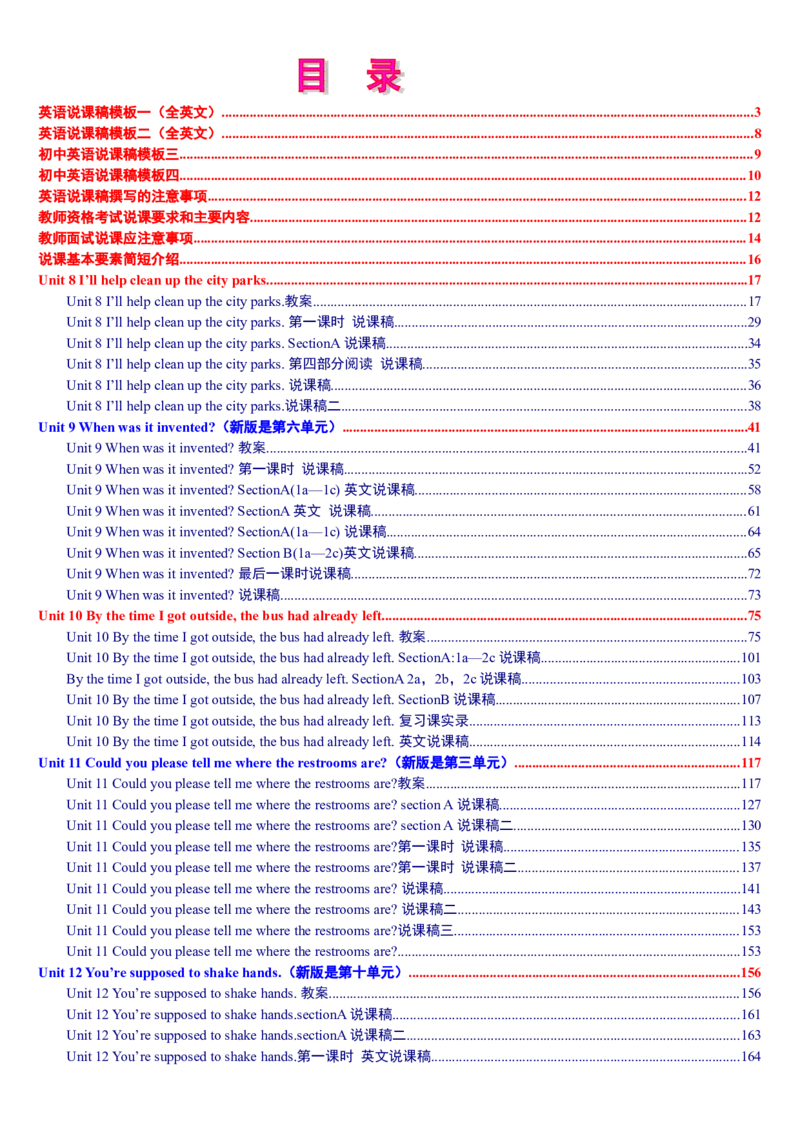
英语说课稿模板一(全英文)........................................................................................................................................................3
英语说课稿模板二(全英文)........................................................................................................................................................8
初中英语说课稿模板三....................................................................................................................................................................9
初中英语说课稿模板四..................................................................................................................................................................10
英语说课稿撰写的注意事项..........................................................................................................................................................12
教师资格考试说课要求和主要内容..............................................................................................................................................12
教师面试说课应注意事项..............................................................................................................................................................14
说课基本要素简短介绍..................................................................................................................................................................16
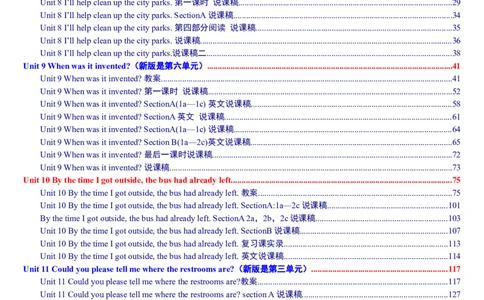
Unit 8 I’ll help clean up the city parks.........................................................................................................................................17
Unit 8 I’ll help clean up the city parks.教案............................................................................................................................17
Unit 8 I’ll help clean up the city parks. 第一课时 说课稿.....................................................................................................29
Unit 8 I’ll help clean up the city parks. SectionA说课稿.......................................................................................................34
Unit 8 I’ll help clean up the city parks. 第四部分阅读 说课稿.............................................................................................35
Unit 8 I’ll help clean up the city parks. 说课稿.......................................................................................................................36
Unit 8 I’ll help clean up the city parks.说课稿二....................................................................................................................38
Unit 9 When was it invented?(新版是第六单元)...................................................................................................................41
Unit 9 When was it invented? 教案.........................................................................................................................................41
Unit 9 When was it invented? 第一课时 说课稿...................................................................................................................52
Unit 9 When was it invented? SectionA(1a—1c) 英文说课稿...............................................................................................58
Unit 9 When was it invented? SectionA 英文 说课稿...........................................................................................................61
Unit 9 When was it invented? SectionA(1a—1c) 说课稿.......................................................................................................64
Unit 9 When was it invented? Section B(1a—2c)英文说课稿...............................................................................................65
Unit 9 When was it invented? 最后一课时说课稿.................................................................................................................72
Unit 9 When was it invented? 说课稿.....................................................................................................................................73
Unit 10 By the time I got outside, the bus had already left........................................................................................................75
Unit 10 By the time I got outside, the bus had already left. 教案...........................................................................................75
Unit 10 By the time I got outside, the bus had already left. SectionA:1a—2c说课稿.........................................................101
By the time I got outside, the bus had already left. SectionA 2a,2b,2c说课稿..............................................................103
Unit 10 By the time I got outside, the bus had already left. SectionB说课稿......................................................................107
Unit 10 By the time I got outside, the bus had already left. 复习课实录.............................................................................113
Unit 10 By the time I got outside, the bus had already left. 英文说课稿.............................................................................114
Unit 11 Could you please tell me where the restrooms are?(新版是第三单元)................................................................117
Unit 11 Could you please tell me where the restrooms are?教案..........................................................................................117
Unit 11 Could you please tell me where the restrooms are? section A说课稿.....................................................................127
Unit 11 Could you please tell me where the restrooms are? section A说课稿二.................................................................130
Unit 11 Could you please tell me where the restrooms are?第一课时 说课稿...................................................................135
Unit 11 Could you please tell me where the restrooms are?第一课时 说课稿二...............................................................137
Unit 11 Could you please tell me where the restrooms are? 说课稿.....................................................................................141
Unit 11 Could you please tell me where the restrooms are? 说课稿二................................................................................143
Unit 11 Could you please tell me where the restrooms are?说课稿三.................................................................................153
Unit 11 Could you please tell me where the restrooms are?..................................................................................................153
Unit 12 You’re supposed to shake hands.(新版是第十单元)..............................................................................................156
Unit 12 You’re supposed to shake hands. 教案.....................................................................................................................156
Unit 12 You’re supposed to shake hands.sectionA 说课稿...................................................................................................161
Unit 12 You’re supposed to shake hands.sectionA 说课稿二...............................................................................................163
Unit 12 You’re supposed to shake hands.第一课时 英文说课稿........................................................................................164Unit 12 You’re supposed to shake hands. section B 说课.....................................................................................................168
Unit 12 You’re supposed to shake hands. 说课稿.................................................................................................................170
Unit 12 You’re supposed to shake hands. 说课稿二.............................................................................................................172
Unit 12 You’re supposed to shake hands. 说课教案.............................................................................................................173
Unit 13 Rainy days make me sad................................................................................................................................................175
Unit 13 Rainy days make me sad. 教案.................................................................................................................................175
Unit 13 Rainy days make me sad. Section A la、lb、lc 说课稿..........................................................................................182
Rainy days make me sad. Section A la、lb、lc 英文说课稿...............................................................................................184
Unit 13 Rainy days make me sad. 第一课时 说课稿...........................................................................................................186
Unit 13 Rainy days make me sad. 说课稿.............................................................................................................................188
Unit 13 Rainy days make me sad. 说课稿二.........................................................................................................................191
Unit 13 Rainy days make me sad. 说课稿三.........................................................................................................................192
Unit 13 Rainy days make me sad. 英文说课稿.....................................................................................................................197
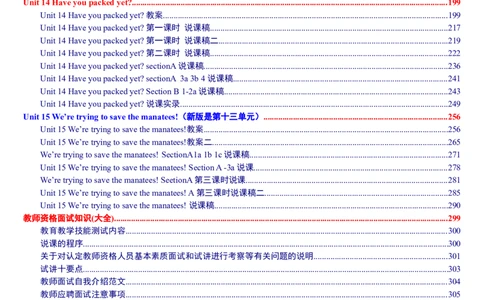
Unit 14 Have you packed yet?.....................................................................................................................................................199
Unit 14 Have you packed yet? 教案......................................................................................................................................199
Unit 14 Have you packed yet? 第一课时 说课稿................................................................................................................217
Unit 14 Have you packed yet? 第一课时 说课稿二............................................................................................................219
Unit 14 Have you packed yet? 第二课时 说课稿................................................................................................................222
Unit 14 Have you packed yet? sectionA 说课稿...................................................................................................................236
Unit 14 Have you packed yet? sectionA 3a 3b 4 说课稿.....................................................................................................241
Unit 14 Have you packed yet? Section B 1-2a说课稿.........................................................................................................243
Unit 14 Have you packed yet? 说课实录..............................................................................................................................249
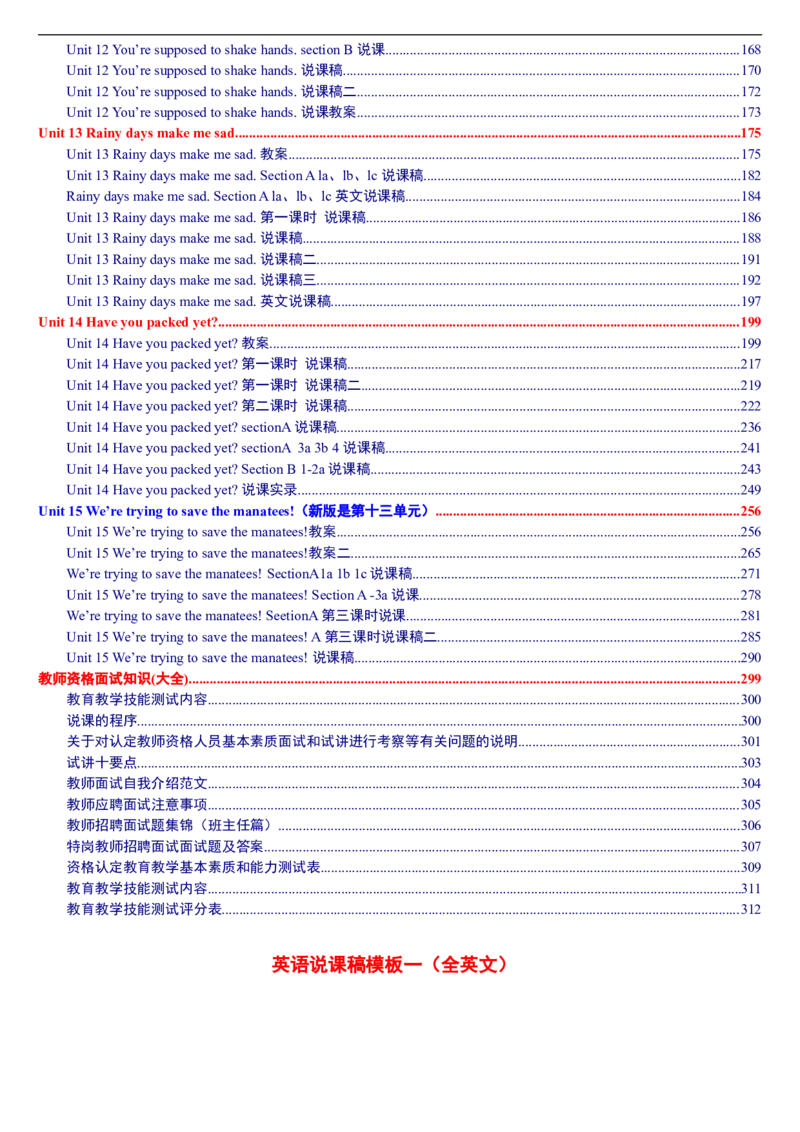
Unit 15 We’re trying to save the manatees!(新版是第十三单元).......................................................................................256
Unit 15 We’re trying to save the manatees!教案...................................................................................................................256
Unit 15 We’re trying to save the manatees!教案二...............................................................................................................265
We’re trying to save the manatees! SectionA1a 1b 1c说课稿.............................................................................................271
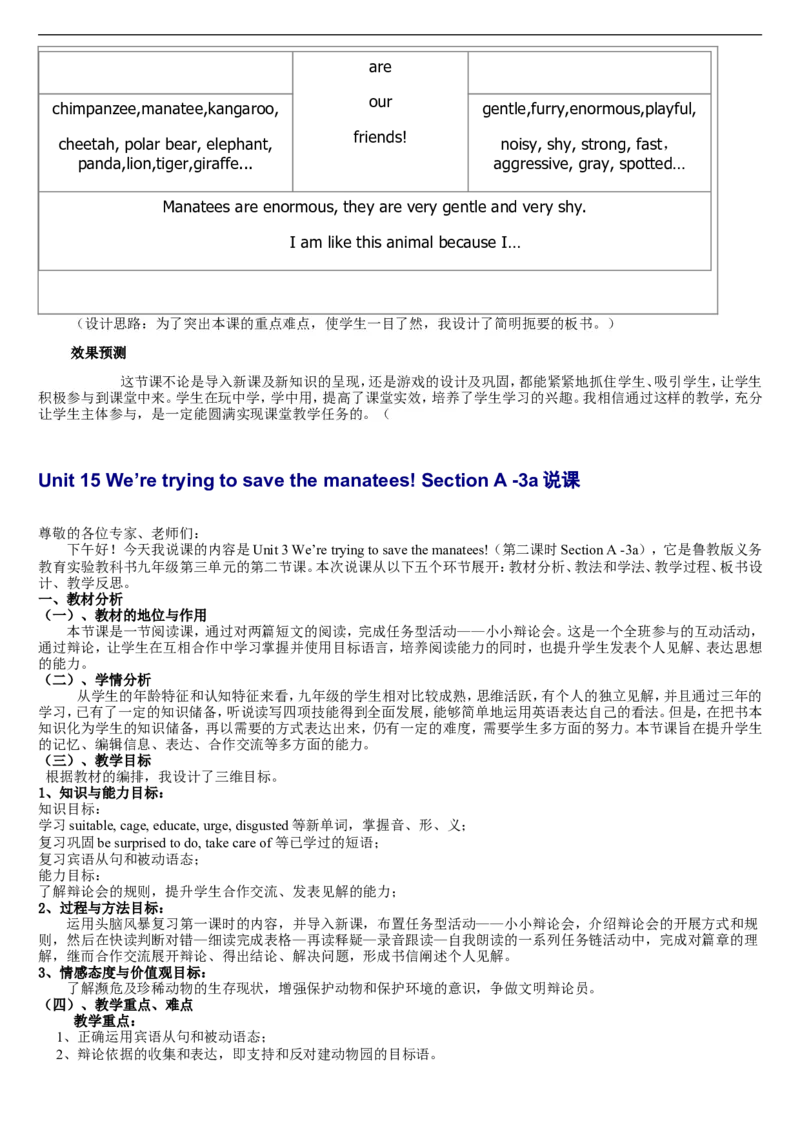
Unit 15 We’re trying to save the manatees! Section A -3a说课...........................................................................................278
We’re trying to save the manatees! SeetionA第三课时说课...............................................................................................281
Unit 15 We’re trying to save the manatees! A第三课时说课稿二......................................................................................285
Unit 15 We’re trying to save the manatees! 说课稿..............................................................................................................290
教师资格面试知识(大全).............................................................................................................................................................299
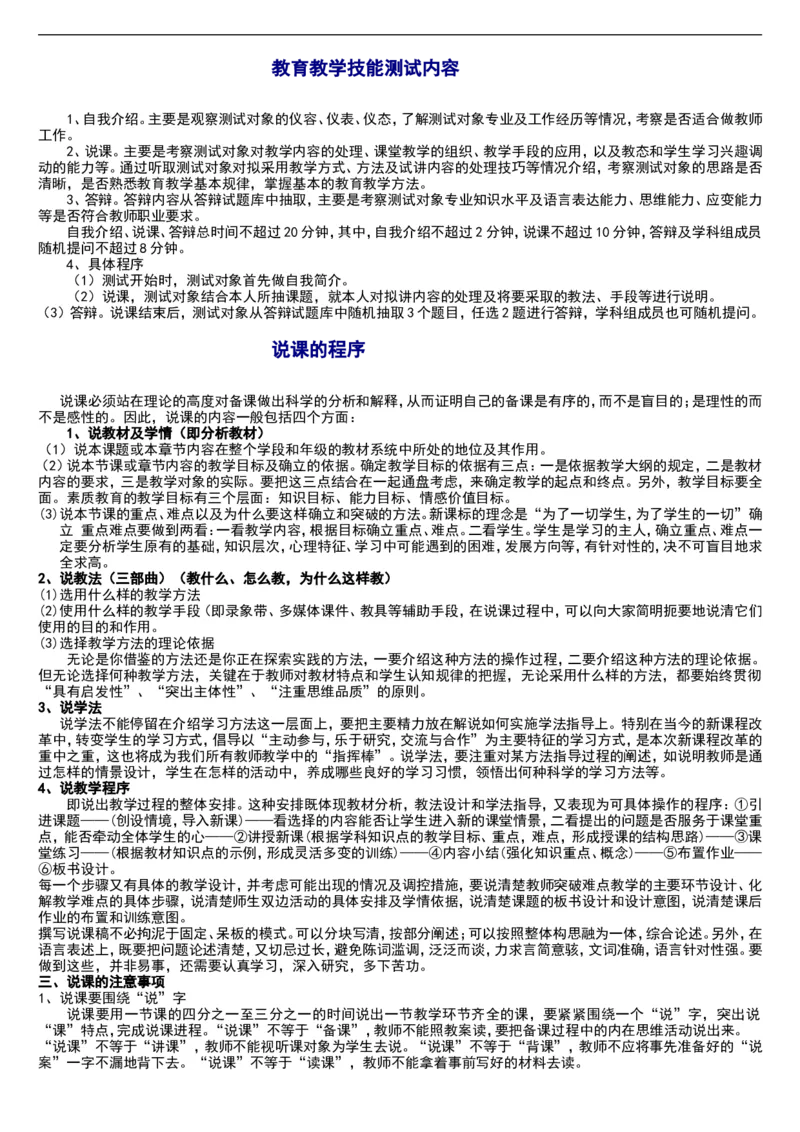
教育教学技能测试内容........................................................................................................................................................300
说课的程序............................................................................................................................................................................300
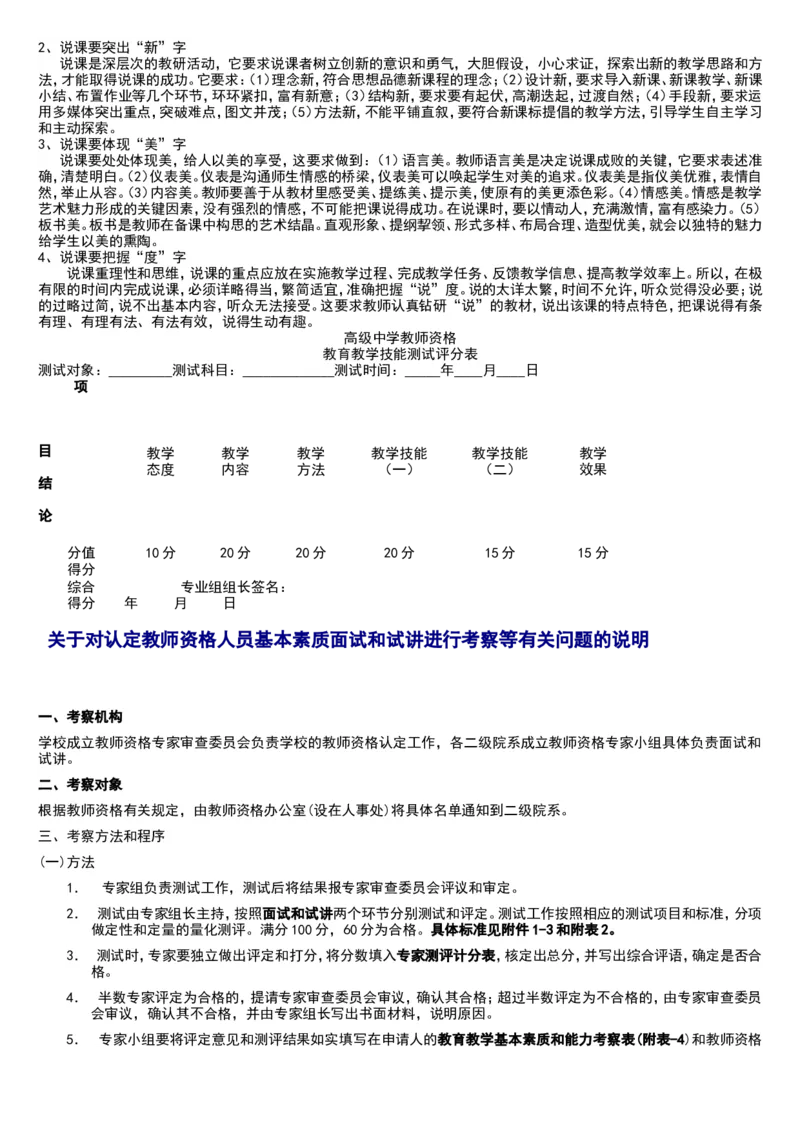
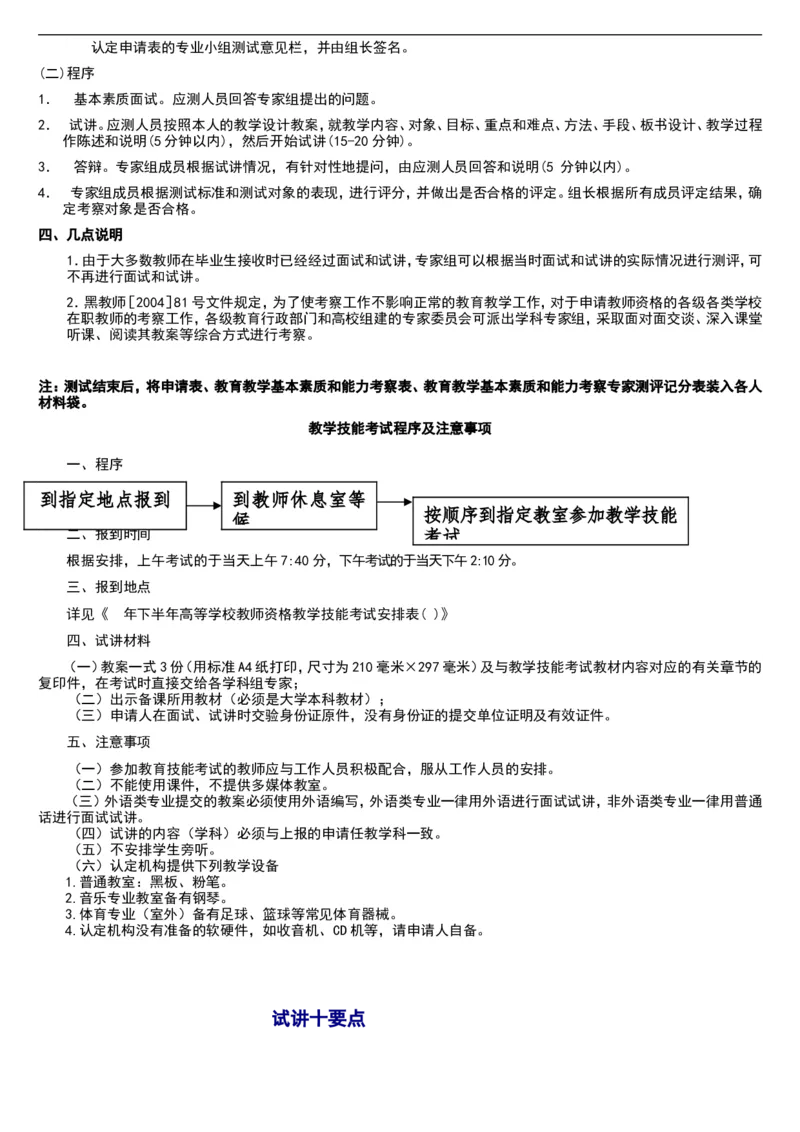
关于对认定教师资格人员基本素质面试和试讲进行考察等有关问题的说明...............................................................301
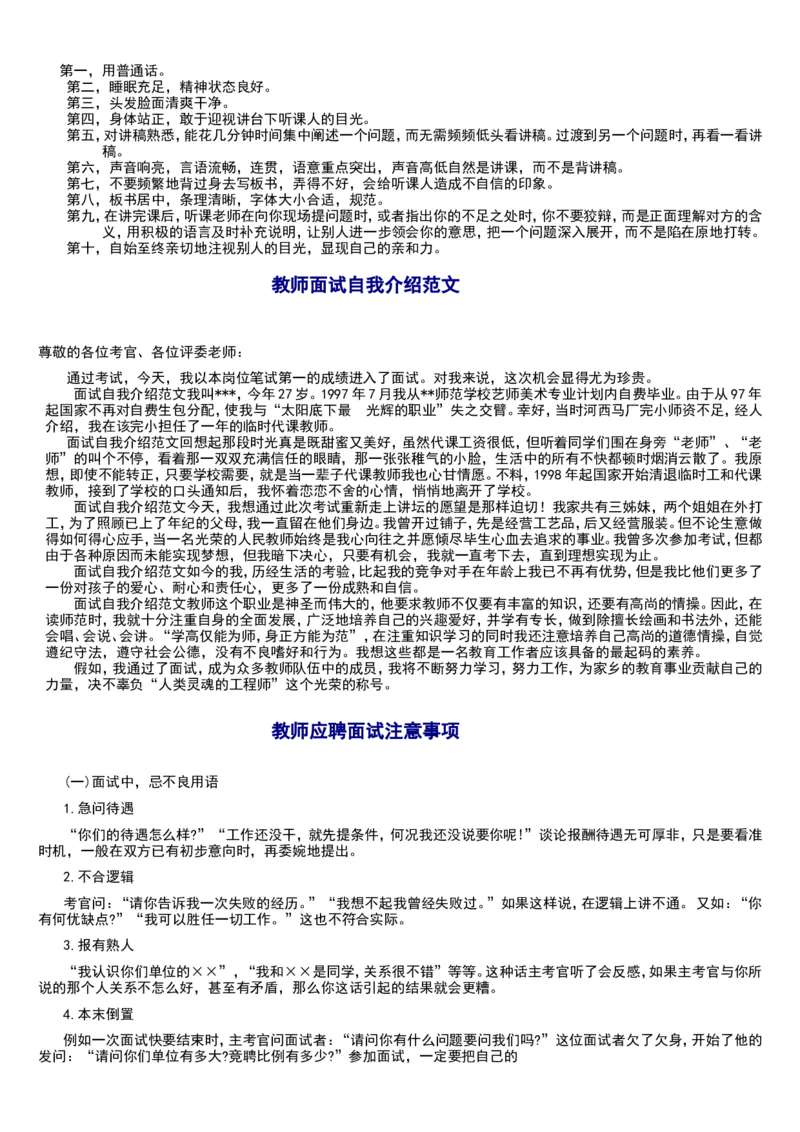
试讲十要点............................................................................................................................................................................303
教师面试自我介绍范文........................................................................................................................................................304
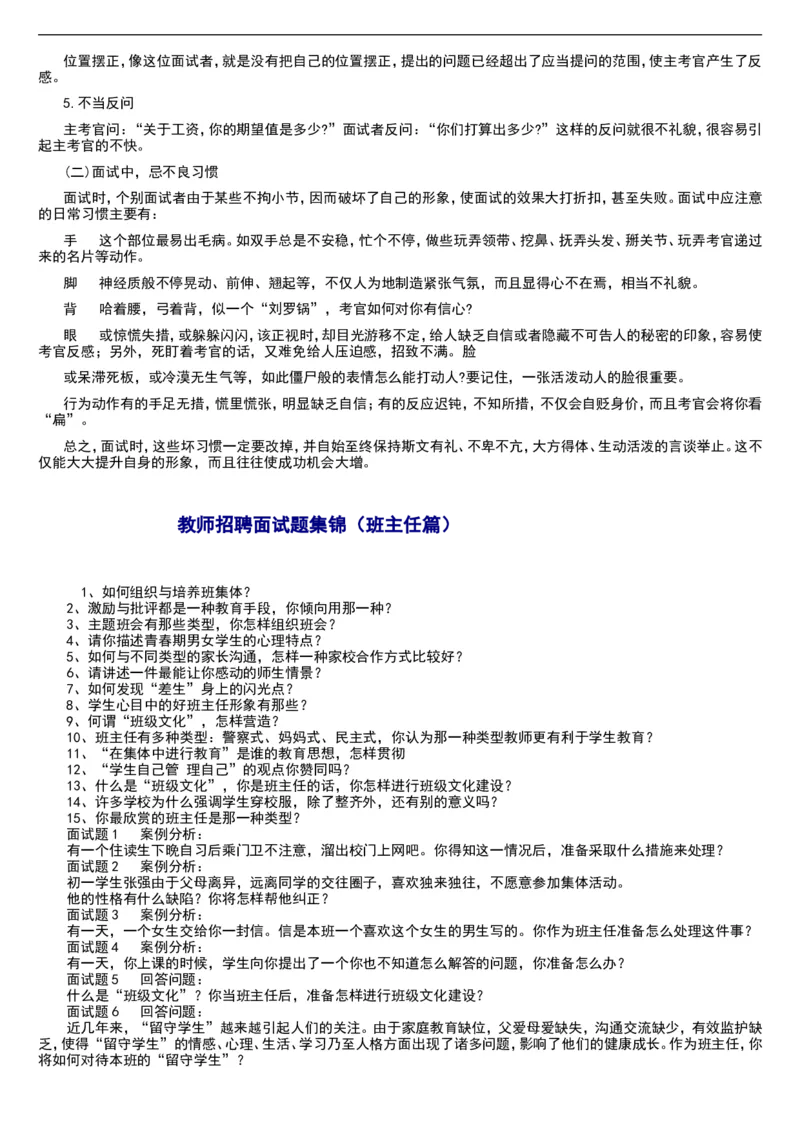
教师应聘面试注意事项........................................................................................................................................................305
教师招聘面试题集锦(班主任篇)....................................................................................................................................306
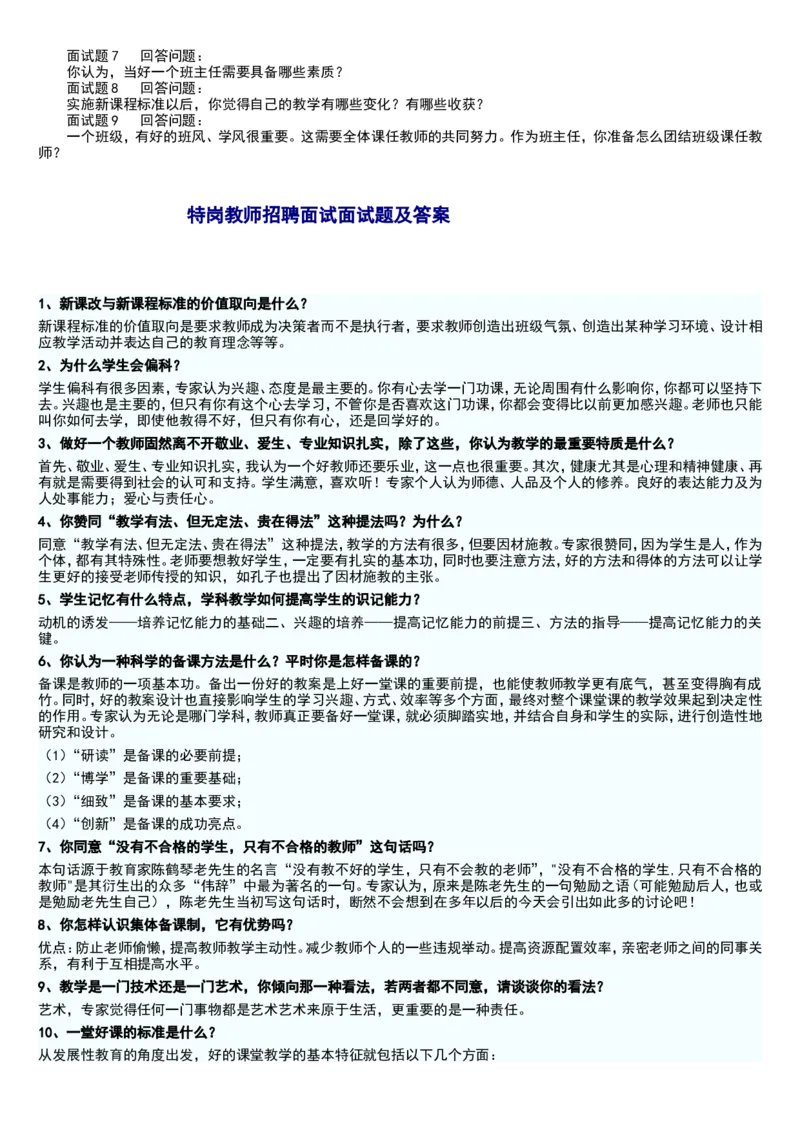
特岗教师招聘面试面试题及答案........................................................................................................................................307
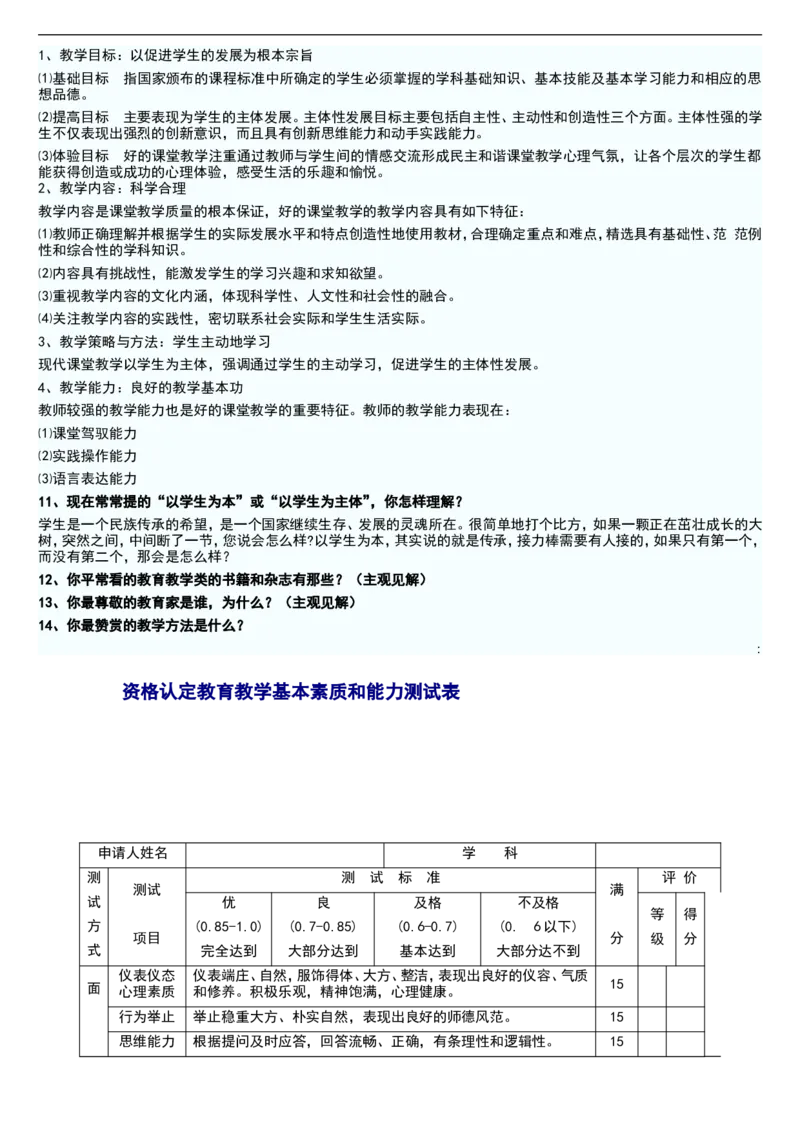
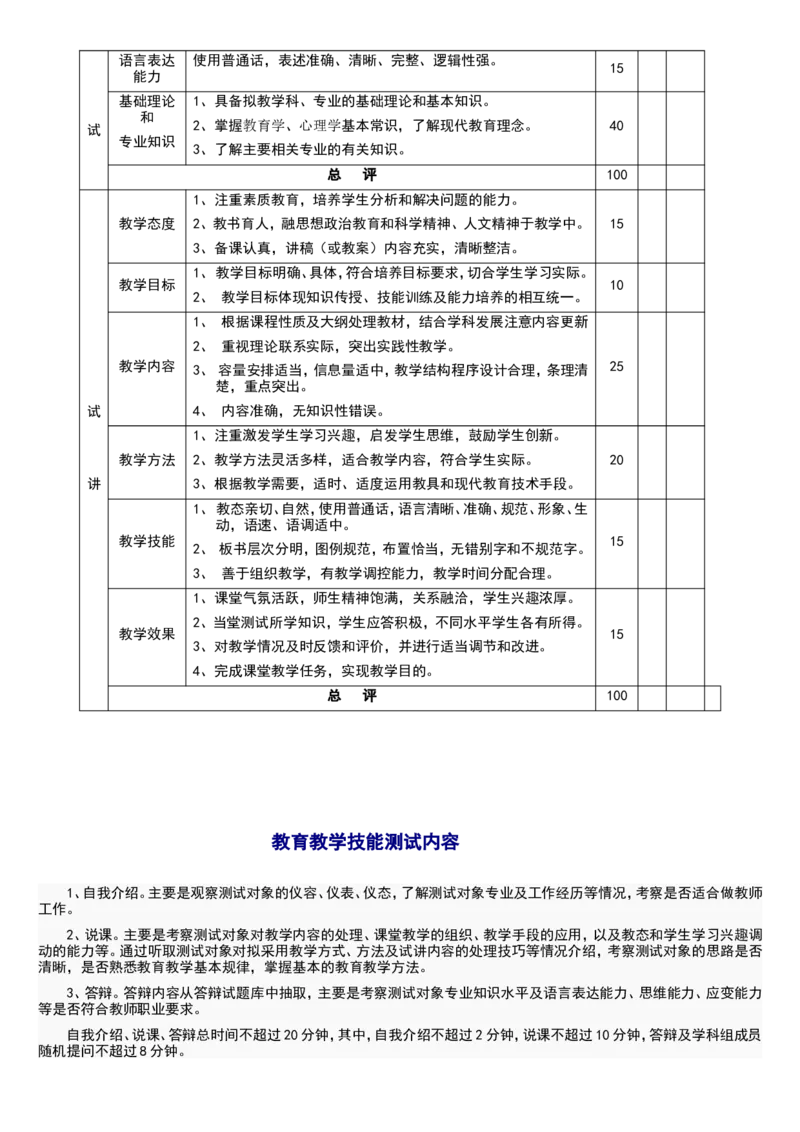
资格认定教育教学基本素质和能力测试表........................................................................................................................309
教育教学技能测试内容........................................................................................................................................................311
教育教学技能测试评分表....................................................................................................................................................312
英语说课稿模板一(全英文)Good afternoon, ladies and gentlemen. My name is (). I come from () Middle School in ().Today I’m going to talk about the
topic” What should I do?”I will divide the instruction into seven parts: they are Teaching material Analysis, Teaching aims,
Teaching emphasis, Teaching difficulties, Teaching methods, Teaching aids and Teaching procedures.
一、说教材(教材分析) Analyzing teaching material
1. 说课型 lesson type (Dialogue/ reading/ listening/ revision)
2. 本课在教材中的地位 status and function
Lesson 33 Saving the Earth is a dialogue. The lesson is focused on the topic of the problems of the earth and the functional
items of Supposition/ Intentions/ conjecture/ Prohibition. Since it is a dialogue / reading. It’s helpful to improve the Ss
communicative/ reading ability.
3. 说教学指导思想 teaching guideline
(Teaching syllabus: Language is for communication, develop their four skills, lay special emphasis on reading; Grellet put it
well in his book developing reading skills: develop reading skill/ discourse analysis; get them to understand the western culture
better; improve the ability to discover, analyze & solve the problems; Reading is for information, for fun; Use Top- down
model or Bottom- up model to activate Ss schemata; Interactive model)
4. 说教学目标和要求 Teaching aims and demands (…be intended for Ss in key schools)
1)认知目标 knowledge objects
a. Enable the Ss to remember the following new words & phrases:
Damage, lecture, pollute, pollution, room, standing room, be fit for, hear about, turn into
b. Get the Ss to be familiar with this sentence pattern:
If the population keeps growing so quickly, there will only be standing room left…
Give the Ss a reinforced practice on the functional item Supposition.
c. Activate Ss schemata regarding the topic of pollution and help Ss to know more about the problem of pollution.
2)智能目标 ability objects
a. Ask the Ss to make up a similar dialogue.
b. Help them to understand the dialogue better and improve the four skills.
c. Develop their ability of thinking independently.
d. Cultivate their ability to discover, analyze and solve problems.
e. Train them to collect information from the Internet.
f. Train them with some effective learning methods to optimize Ss’ learning results.
3)德育目标 moral objects
a. Arouse their interest in learning English;
b. Help them to understand the background of pollution.
c. Enable the students to love our earth and the nature.
d. Be aware of the importance of stopping pollution & protecting out environment.
e. Encourage the Ss to do something to save the earth.
5. 说教学重点 teaching important points (生词、句型;培养阅读技能)
a. New words and phrases
b. Sentence pattern: If- clausec. improve their reading skills.
d. Talking about problems of the Earth.
6. 说教学难点 teaching difficult points (语法;发展交际能力)
a. functional item: Supposition.
b. Develop their communicative ability. Act out their own dialogue.
7. 说教具 teaching aids (multi-media computer, software, OHP)
The teaching syllabus says that it’s necessary for teachers to use modern teaching facilities. It’s of great help to increase the
class density and improve our teaching result. It can also make the Ss reach a better understanding of the text by making the
classes lively and interesting. At the same time, it arouses the Ss’ interest in learning English.
二、说教法 Teaching methods
Five step method; audio-video; communicative approach;
Task-based learning: New Syllabus Design encourages teachers to use this teaching method. TBLT can stimulate Ss’ initiative
in learning and develop their ability in language application. Make the Ss the real masters in class while the teacher himself acts
as the director and bring their ability into full play.
三、说学法 Study methods
1. Teach Ss how to be successful language learners.
2. Teach Ss how to develop the reading skill — skim & scan; how to communicate with others; how to learn new words; how
to learn independently;
3. Get the Ss to form good learning habits.
四、说教学过程Teaching procedures
I. 复习 (Revision) 5min (Daily report; 词汇diagram; brainstorming; activate schemata)
Activity 1: Imagination
1). Suppose a bottle of ink is turned over and dirties your white shirt, what is to be done? (Wash it? Or throw it away?)
2). Suppose you catch a bad cold, what’s to be done?
3). Suppose your bike is broken, what’s to be done?
4). And suppose the earth, on which we all live, is damaged, what’s to be done?
* What can you think of when you see “pollution” this word?(waste, environment, air, water, factory, desert, climate... Try to
activate the Ss schemata regarding the topic of pollution.)
II. 呈现 (Presentation) 5min
Activity 2: Presentation
Play the song “Earth Song” sung by Michael Jackson. (Create an atmosphere)
A lot of pictures and video clips about the causes and results of the three problems mentioned in this lesson will be shown on
the screen with the help of the computer.
Ss’ presentation on pollution. Attract their attention, arouse their interest, and create a good atmosphere for communication.
* Activate their schemata and cultivate their ability in collecting information from the Internet and develop their ability in
thinking independently.
III. 对话 / 阅读 (Dialogue)18m
1. Pre- reading
Activity 3: Prediction1st listening/ fast reading, one guided Q to help Ss to get the main idea:
What do you think is discussed at the conference?
2. While- reading
Activity 4: Read and answer
2nd listening/ careful reading, more Qs to get the detailed information. Develop their reading skills: skim & scan. Pay attention
to the pronunciation, stress & intonation.
* 阅读: Pre-reading; while-reading; post-reading (fast reading/ careful reading; skim/ scan; 识别关键词key words;确定主题
句;创设信息差information gap;T or F; 填表格chart/diagram; Predicting; Make a timeline; Make a story map。达到对课文
的整体理解和掌握。So that they can have a good understanding of the whole text.)
3. Post- reading
Activity 5: Language focus
While Ss are answering the Qs, the teacher deals with some key language points.
a. is being caused b. and so on c. go on doing
d. be fit for e. standing room f. if- clause
IV. 操练 (Practice) 10m
Activity 6: Retell
Use your own words to retell the dialogue in the 3rd person.
Activity 7: Acting out
Activity 8: Drill – Supposition
Purpose: Practise the functional item of Supposition. (P. 33 Part 2; P.113, wb Ex. 3)
(Retell; act out; role play)
V. 巩固 (Consolidation) 6m
(Discussion; interview; press conference; debate; quiz)
Activity 9: role play
Suppose you were head of a village, scientist, journalist and villager, make up a conversation and ask several groups to
demonstrate in front of the class.
* The Ss are encouraged to use the words and expression_r_rs like pollution, damage, be fit for, turn into, the if- clause, etc.
Activity 10: Discussion
Think of the question: Are we causing damage to the world?
What should we do to save the earth and protect our environment especially in our daily life?
Collect their answers and form a report.
VI. 作业 (Homework) 1m (Writing; continue the story; recite; retell)
Write a letter to the mayor, telling him sth. about the pollution around your school.英语说课稿模板二(全英文)
Today , I’m going to talk about my plan for teaching ….
First, I’d like to say something about the teaching content . …
Second, the aims of this lesson are:
1. Knowledge of language: …
2. Pratical skills …
3. Personal development …
Thid, the focus and difficulties are: …. ryfvg
Next, my way of teaching.
Teaching English at primary schools aims at students’ basic skills in listening and speaking and
the their interest in English. So I find it necessary to design a task-based class: students will
be assigned to do a survey. This task will make it possible for the students to pick up the
language in an authentic way. Teaching aids: a recorder, sentences cards , stationary ,pictures,
head ornaments and a form. I shall have the students join in the singing, ridding guessing and
doing a survey .
I’m going to take the following procedures:
Step 1 Warm-up
Step2 Presentation
Step3 Practice
Step 4 Consolidation
Step 5 Assignment
Ⅱ
It's my pleasure to be here. Now, I'd like to say something about my teaching plans about …
For its objective, it covers …objectives
1. Knowledge objective …
2. Ability objective …
3. Moral objective …
During the procedure of my teaching, multi-media, over head project, tape recorder, pictures will
surely be adopted that will also be accompanied by demonstration, role-playing, task-oriented
approach. Through these methods and by using these aids, I want to teach the students how to be
successful language learners.
After analyzing the dialogue, I set off my teaching plan around 4 tasks and many activities: pre-task, while-task, post-task and creative task.
…
That’s my idea about the teaching plan of this lesson. Thanks for listening.
初中英语说课稿模板三
一、说教学理念:
英语新课程标准要求教师要从教学实践者转为教学的研究者,……
二、说教材
㈠教材概述:本单元……
㈡三维目标设立:
1、知识与技能
⑴学会单词、短语:……;句型:……
⑵提高学生交际,探究能力,培养创新精神。
2、过程与方法:
以学生自主学习为基础,以一幅……图引入,……
3、情感态度与价值观
⑴引导学生充分认识到必须……
⑵培养学生的学习英语兴趣,……
⑶培养团结协作精神。
㈢重点、难点
基于以上分析,确定本课重点:……
难点:⑴……
⑵……
三、说教法
1、学生分析:……
2、教学方法:
⑴游戏教学法;⑵任务型教学法;⑶多媒体辅助教学。
四、说学法
1、善于抓住用英语交际的机会,充分感知,积极体验,大胆实践。
2、积极参与,善于合作,培养团队精神。
3、为赢取“英语课堂最佳表现奖”而主动学习。
依据:新课程倡导的感知——体验——实践——参与——合作,以及形成性评价。
五、说流程
1、总体设计及依据
在任务型活动中热身(8分钟)……
2、教具准备:
3、分步设计及依据(多媒体课件制作)
Step1:在任务活动中热身活动一:chant
活动二:Guessing games
活动三:利用挂图……
活动四:学生俩俩合作,……
Step2 在任务活动中认知
……
Step3 在任务活动中巩固
6个活动
Step4 Summary
……
4、板书设计
六、教学效果预测
……
七、教学反思(教后说)
1、教学内容要形式多样,……
2、尽量合理组织教材,……
3、课件制作要充满色彩,……
4、拓展学生文化视野,……
5、充分发挥学生主动作用,……
初中英语说课稿模板四
各位老师好:
今天我说课的课题是《XXX》。下面我对
本课题进行分析:
一、说教材(地位与作用)
《XXX》是人教版必修教材第XX单元第XX个课题。在此之前,学生们已经学习了XX,这为过度到本课题的学习
起到了铺垫的作用。因此,本课题的理论、知识是学好以后课题的基础,它在整个教材中起着承上启下的作用。
二、说教学目标
根据本教材的结构和内容分析,结合着XX年级学生他们的认知结构及其心理特征,我制定了以下的教学目标:
1. 知识与技能目标
2. 过程与方法目标
3. 情感与价值观目标
三、说教学的重难点
本着XXX新课程标准,在吃透教材基础上,我确定了以下教学重点和难点。
教学重点:重点的依据是只有掌握了 ,才能理解和掌握 。
教学难点:难点的依据是 较抽象,学生没有这方面的基础知识。
为了讲清教材的重难点,使学生能够达到本课题设定的教学目标,我再从教法我学法上谈谈。四、说教法。
我们都知道XX是一门培养人的XXX能力的更要学科。因此,在教学过程中,不仅要使学生“知其然”,还要使
学生“知其所以然”。我们在以师生既为主体又为客体的原则下,展现获取理论知识、解决实际问题的思维过程。
考虑到XX年级学生的现状,我主要采取设置情景教学法,让学生积极主动地参与到教学活动中来,使他们在活动
中得到认识和体验,产生践行的愿望。培养学生将课堂教学和自己的经验结合起来,引导学生主动去发现周边的客观事
物,发展思辩能力,注重滨心理状况。当然老师自身也是非常重要的教学资源。教师本人应该通过课堂教学感染和激励
学生,调动起学生参与活动的积极性,激发学生对解决实际问题的渴望,并且要培养学生以理论联系实际的能力,从而
达到最佳的教学效果。基于本课题的特点,我主要采用了以下的教学方法:
1. 直观演示法:利用图片等手段进行直观演示,激发学生的学习兴趣,活跃课堂气氛,促进学生对知识的掌握。
2. 活动探究法:引导学生通过创设情景等活动形式获取知识,以学生为主体,使学生的独立探索性得到了充分的发挥,
培养学生的自觉能力、思维能力、活动组织能力。
3. 集体讨论法:针对学生提出的问题,组织学生进行集体和分组语境讨论,促使学生在学习中解决问题,培养学生团结
协作的精神。
由于本课题内容与社会现实生活的关系比较密切,学生已经具有了直观的感受,可以让学生自己阅读
课本并思考,例举社会上存在的一些有关的经济现象,在老师的指导下进行讨论,然后进行归纳总结,得出正确的结论。
这样有利于调动学生的积极性,发挥学生的主体作用,让学生对本框题知识的认知更清晰、更深刻。
五、说学法
我们常说:“现代的文盲不是不懂字的人,而是没有掌握学习方法的人”,因而,我在教学过程中特别重视学法
的指导。让学生从机械的“学答”向“学问”转变,从“学会”向“会学”转变,成为学习的真正的主人。这节课在指
导学生的学习方法和培养学生的学习能力方面主要采取以下方法:思考评价法、分析归纳法、自主探究法、总结反思法。
最后我具体来谈谈这一堂课的教学过程。
六、说教学过程
在这节课的教学过程中,我注重突出重点,条理清晰,紧凑合理,各项活动的安排也注重互动、交流,最大限度的
调动学生参与课堂的积极性、主动性。
1. 导入新课:(2~3分钟)
由上节课演过的知识和教材开头的情景设置导入新课。导语设计的依据:一是概括了旧知识,引出新知
识,温故而知新,使学生的未知欲望。这是教学非常重要的一个环节。
2. 讲授新课:(35分钟)
在讲授新课的过程中,我突出教材的重点,明了地分析教材的难点。还根据教材的特点,学生的实际、教
师的特长,以及教学设备的情况,我选择了多媒体的教学手段。这些教学手段的运用可以使抽象的知识具体化,枯燥的
知识生动化,乏味的知识兴趣华。还重视教材中的疑问,适当对题目进行引申,使它的作用更加突出,有利于学生对知识
的串联、积累、加工,从而达到举一反三的效果。
3. 课堂小结:(2~3分钟)
课堂小结的目的是强化认识,可以把课堂传授的知识尽快地转化为学生的素质;简单扼要的课堂小结,
可使学生更深刻地理解XXX理论在实际生活中的应用,并且逐渐地培养学生形成良好的个性。
4. 板书设计:
我比较注重直观地、系统的板书设计,并及时地体现教材中的知识点,以便于学生能够理解掌握。我的板
书设计是:
5. 布置作业。
针对XX年级学生素质的差异,我进行了分层训练,这样做既可以使学生掌握基础知识,又可以
使学有余力的学生有所提高,从而达到拔尖和“减负”的目的。我布置的课堂作业是:XXX英语说课稿撰写的注意事项
说课是教师职业的基本素养,说课要求教师对教学大纲、教学目的、课堂设计很了解,说课要包括:教材、目标、重点、
难点、教法、学法、过程、板书、小结。
说课有别于讲课。讲课的对象是学生,侧重讲授知识、培养能力、教书育人,是系统的教育教学活动;而说课的对象
是教师、教研员、评委,侧重表述如何讲授知识、培养能力、教书育人,是系统的教育教学研究活动。说课是教学与教研的
结晶,是教学理论和教学实践结合的产物。说课讲稿的撰写要注意以下几点。
(一)突出理论性
说课讲稿有别于教案或教案提要,它比教案更具有理论性。写说课讲稿也不同于写教案,教案多是具体教学过程,
而说课稿则侧重于有针对性的理论指导的阐述;教案只说"怎么教",而说课讲稿则要重点说清“为什么这么教"。因此,
写说课讲稿要注重理论依据的阐述,尤其是说教材、说教法、说学法及学法指导时,一定要说明其理论依据。
(二)简明扼要
说课稿有别于教学论文,它比教学论文更具实践性,因此。说课稿的撰写要用词精当,切忌长篇大论、面面俱到或泛
泛而谈。说课各个要素及其理论依据必须要有直接的内在联系,在语言表达方面要言简意赅。另外,表述具体的教学目
标时,要尽量避免使用抽象、笼统、缺乏可操作性和可监测性的一般性用语,如知识目标一Student will learn about the
present perfect tense;能力目标一Improve the students' abilities of listening,speaking, reading and writing。这样的教学目标
只是泛泛而谈,没有说明要求学生做到的是什么,教师在教学过程中也无法有效操作,听课者更难确定教学目标是否达
成。
(三)不拘一格
由于教学内容不同,教学对象(学生)不同,课型不同,教师的教学经验以及对教材的理解和处理不同,说课稿的撰
写也不应拘泥于单一的、固定的模式。只要教师能够准确把握说课的要素和要点,透彻分析教学设计的理论依据,采用
综合论述(说课的各个要素不逐项列出)或分块论述(说课钠各个要素逐条列出),都能达到说课教研的最终目的。
(四)突出英语学科特点,但要量力而行
原则上讲,英语说课讲稿最好用英语写。但是用英语写说课讲稿对教师的英语写作能力提出了更高的要求,因此,
在有些教师还没有掌握说课方法或没有能力准确翻译某些教学理论时,最好慎重用英语写说课讲稿。笔者认为,现阶段
英语说课讲稿用英语撰写或用汉语撰写均可。因为,说课是陈述教学方案设计及其理论依据,而不是具体实施课堂教学
方案。英语说课的目的主要是进行英语教学研究,提高教师的教研水平,而不侧重于提高教师的英语口语表达能力。
教师资格考试说课要求和主要内容
①说教材。说本教材目的、联系、教学目标、重点、难点和课时安排。
②说教法。说本课选择何种教学方法、教学手段及其教育理论依据。
③说学法。说本课拟教给学生什么学习方法,培养哪些能力。④说教学程序。说本课的教学思路课堂结构及板书设
计等。
“说课”有哪些基本要求呢?我们认为主要有以下六项:1、说清本课内容在本学科教学中所处的地位及其作用。在教学过程中,每一课时教案所包含的内容是不同的,它们
在每一学科的知识体系中的地位及其作用也是不同的,有些课时所含的教学内容极其重要,与今后授课的内容关系十分
密切,是阶段性的关键点,甚至是本教材的重点内容,起着承上启下的作用。因此,说课者如何认识每一课时教案在学科
教学中的地位,如何对学生进行学习指导是至关重要的。说课者就是要说清该课在学科知识体系中的要点和关键,说清
每一课时教案内容在学科知识体系中的地位及其作用,并抓住这些知识关键点来指导学生,从而达到事半功倍的教育效
果。
2、说清本课内容的重点、难点和要点。每一课时教学内容都有自己的重点、难点和要点,要让学生把握一节课的教学内
容,必须突出重点。在教学过程中,每一课时又往往有一些知识点学生难以明确,难以掌握,作为教师必须从学生的实际
出发,把握重点要点找出难点,化解难点以达到预期的教学目的。这些都需要“说课”者在说课过程中掌握并说清如何
在教学过程中体现。
3、说清本课的课时结构和目标。掌握课堂教学目标是教师的基本功,在有限的40分钟内,实现课堂教学目标,是很
有讲究的,如何突出重点、掌握要点,如何化解难点、巩固知识,如何复习旧课、导入新课,如何演绎示范、归纳总结,如何
提问设问、布置练习,都有一个时间合理安排问题,一节好的课离不开一个好的课时结构,要使每一课时的各个教育环
节均能恰到好处,合理分配课堂教学时间就尤为重要。作为说课者,必须紧紧围绕课堂教学目标,在说课过程中,体现课
时结构,反映各个教学环节的时间分配。
4、说清实施课堂教学目标的方法与手段。在课堂教学目标确定之后,用什么方法和手段实现课堂教学目标,极为重要,
它要求“说课”者根据教学要求和所教对象,说清如何运用相应的教学方法来完成教学任务,并运用何种教学手段,来
强化教学目标的重点、要点,化解难点,使学生掌握所教知识。
5、说清教学过程状态的调节与信息的有效传递。教学过程中师生教学状态的调控,与教和学信息的传递、反馈,实
质上是一个很重要的,但往往又容易被“说课”者遗忘的环节,在实际教学中教师的“教”与学生的“学”虽是相互联
系的,但有主动和被动、先后快慢之分,有时也许老师讲得快的地方恰恰正是学生一下子不能领悟到的地方;有时学生
积极性很高、偏离教学目标,这就需要教师通过信息传递、反馈来适当调控,而教学状态的有机调控必须注意提问、设问、
练习等信息传递的精心设计和合理安排。在“说课”中说课者要充分说明。
6、说清对本节教学过程的预先评估。说课虽不是课堂展现,说课者对说课内容的教学过程也应该有一个预先评估,并将
此作为说课的一项内容。预先评估中包括教学过程中可能出现的问题,学生中可能“冒出”的个别代表性的错误、时间
控制上的调整,以及补救措施、目标测试的答疑等。
说课者说完课后,其他教师应围绕这课的教学怎样落实素质教育要求,怎样提高深堂教学效益,各抒已见,相互交流,使
说课者与参与者在理论与实践的结合上得到新的认识、新的提高。说课一定要抓住重点、难点,突出教法的特点,说出与
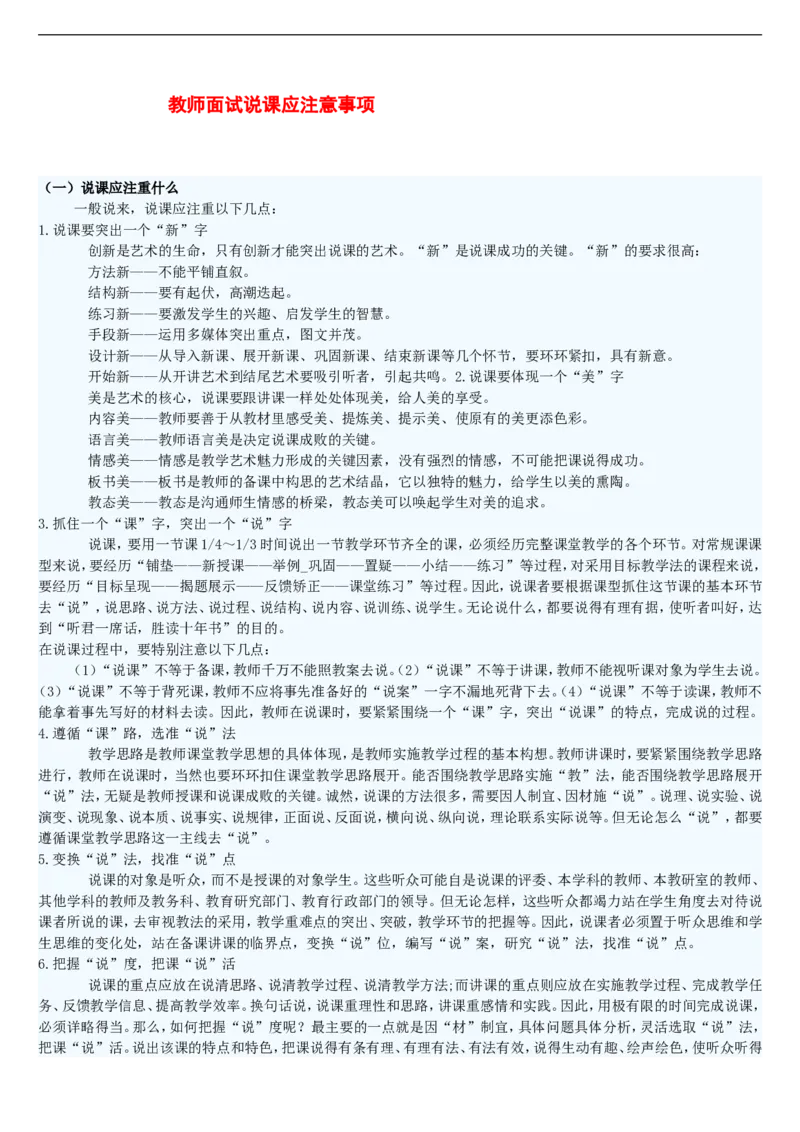
众不同的教学新意,这就是说课的艺术。教师面试说课应注意事项
(一)说课应注重什么
一般说来,说课应注重以下几点:
1.说课要突出一个“新”字
创新是艺术的生命,只有创新才能突出说课的艺术。“新”是说课成功的关键。“新”的要求很高:
方法新——不能平铺直叙。
结构新——要有起伏,高潮迭起。
练习新——要激发学生的兴趣、启发学生的智慧。
手段新——运用多媒体突出重点,图文并茂。
设计新——从导入新课、展开新课、巩固新课、结束新课等几个怀节,要环环紧扣,具有新意。
开始新——从开讲艺术到结尾艺术要吸引听者,引起共鸣。2.说课要体现一个“美”字
美是艺术的核心,说课要跟讲课一样处处体现美,给人美的享受。
内容美——教师要善于从教材里感受美、提炼美、提示美、使原有的美更添色彩。
语言美——教师语言美是决定说课成败的关键。
情感美——情感是教学艺术魅力形成的关键因素,没有强烈的情感,不可能把课说得成功。
板书美——板书是教师的备课中构思的艺术结晶,它以独特的魅力,给学生以美的熏陶。
教态美——教态是沟通师生情感的桥梁,教态美可以唤起学生对美的追求。
3.抓住一个“课”字,突出一个“说”字
说课,要用一节课1/4~1/3时间说出一节教学环节齐全的课,必须经历完整课堂教学的各个环节。对常规课课
型来说,要经历“铺垫——新授课——举例_巩固——置疑——小结——练习”等过程,对采用目标教学法的课程来说,
要经历“目标呈现——揭题展示——反馈矫正——课堂练习”等过程。因此,说课者要根据课型抓住这节课的基本环节
去“说”,说思路、说方法、说过程、说结构、说内容、说训练、说学生。无论说什么,都要说得有理有据,使听者叫好,达
到“听君一席话,胜读十年书”的目的。
在说课过程中,要特别注意以下几点:
(1)“说课”不等于备课,教师千万不能照教案去说。(2)“说课”不等于讲课,教师不能视听课对象为学生去说。
(3)“说课”不等于背死课,教师不应将事先准备好的“说案”一字不漏地死背下去。(4)“说课”不等于读课,教师不
能拿着事先写好的材料去读。因此,教师在说课时,要紧紧围绕一个“课”字,突出“说课”的特点,完成说的过程。
4.遵循“课”路,选准“说”法
教学思路是教师课堂教学思想的具体体现,是教师实施教学过程的基本构想。教师讲课时,要紧紧围绕教学思路
进行,教师在说课时,当然也要环环扣住课堂教学思路展开。能否围绕教学思路实施“教”法,能否围绕教学思路展开
“说”法,无疑是教师授课和说课成败的关键。诚然,说课的方法很多,需要因人制宜、因材施“说”。说理、说实验、说
演变、说现象、说本质、说事实、说规律,正面说、反面说,横向说、纵向说,理论联系实际说等。但无论怎么“说”,都要
遵循课堂教学思路这一主线去“说”。
5.变换“说”法,找准“说”点
说课的对象是听众,而不是授课的对象学生。这些听众可能自是说课的评委、本学科的教师、本教研室的教师、
其他学科的教师及教务科、教育研究部门、教育行政部门的领导。但无论怎样,这些听众都竭力站在学生角度去对待说
课者所说的课,去审视教法的采用,教学重难点的突出、突破,教学环节的把握等。因此,说课者必须置于听众思维和学
生思维的变化处,站在备课讲课的临界点,变换“说”位,编写“说”案,研究“说”法,找准“说”点。
6.把握“说”度,把课“说”活
说课的重点应放在说清思路、说清教学过程、说清教学方法;而讲课的重点则应放在实施教学过程、完成教学任
务、反馈教学信息、提高教学效率。换句话说,说课重理性和思路,讲课重感情和实践。因此,用极有限的时间完成说课,
必须详略得当。那么,如何把握“说”度呢?最主要的一点就是因“材”制宜,具体问题具体分析,灵活选取“说”法,
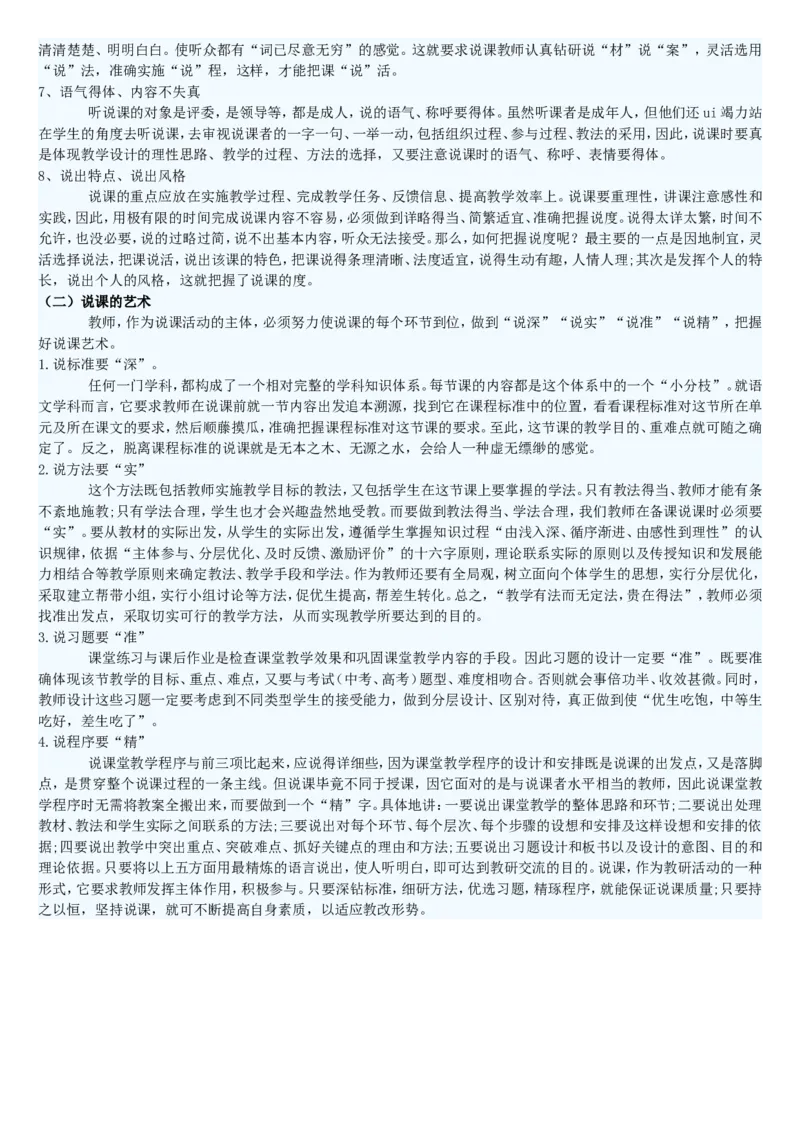
把课“说”活。说出该课的特点和特色,把课说得有条有理、有理有法、有法有效,说得生动有趣、绘声绘色,使听众听得清清楚楚、明明白白。使听众都有“词已尽意无穷”的感觉。这就要求说课教师认真钻研说“材”说“案”,灵活选用
“说”法,准确实施“说”程,这样,才能把课“说”活。
7、语气得体、内容不失真
听说课的对象是评委,是领导等,都是成人,说的语气、称呼要得体。虽然听课者是成年人,但他们还ui竭力站
在学生的角度去听说课,去审视说课者的一字一句、一举一动,包括组织过程、参与过程、教法的采用,因此,说课时要真
是体现教学设计的理性思路、教学的过程、方法的选择,又要注意说课时的语气、称呼、表情要得体。
8、说出特点、说出风格
说课的重点应放在实施教学过程、完成教学任务、反馈信息、提高教学效率上。说课要重理性,讲课注意感性和
实践,因此,用极有限的时间完成说课内容不容易,必须做到详略得当、简繁适宜、准确把握说度。说得太详太繁,时间不
允许,也没必要,说的过略过简,说不出基本内容,听众无法接受。那么,如何把握说度呢?最主要的一点是因地制宜,灵
活选择说法,把课说活,说出该课的特色,把课说得条理清晰、法度适宜,说得生动有趣,人情人理;其次是发挥个人的特
长,说出个人的风格,这就把握了说课的度 。
(二)说课的艺术
教师,作为说课活动的主体,必须努力使说课的每个环节到位,做到“说深”“说实”“说准”“说精”,把握
好说课艺术。
1.说标准要“深”。
任何一门学科,都构成了一个相对完整的学科知识体系。每节课的内容都是这个体系中的一个“小分枝”。就语
文学科而言,它要求教师在说课前就一节内容出发追本溯源,找到它在课程标准中的位置,看看课程标准对这节所在单
元及所在课文的要求,然后顺藤摸瓜,准确把握课程标准对这节课的要求。至此,这节课的教学目的、重难点就可随之确
定了。反之,脱离课程标准的说课就是无本之木、无源之水,会给人一种虚无缥缈的感觉。
2.说方法要“实”
这个方法既包括教师实施教学目标的教法,又包括学生在这节课上要掌握的学法。只有教法得当、教师才能有条
不紊地施教;只有学法合理,学生也才会兴趣盎然地受教。而要做到教法得当、学法合理,我们教师在备课说课时必须要
“实”。要从教材的实际出发,从学生的实际出发,遵循学生掌握知识过程“由浅入深、循序渐进、由感性到理性”的认
识规律,依据“主体参与、分层优化、及时反馈、激励评价”的十六字原则,理论联系实际的原则以及传授知识和发展能
力相结合等教学原则来确定教法、教学手段和学法。作为教师还要有全局观,树立面向个体学生的思想,实行分层优化,
采取建立帮带小组,实行小组讨论等方法,促优生提高,帮差生转化。总之,“教学有法而无定法,贵在得法”,教师必须
找准出发点,采取切实可行的教学方法,从而实现教学所要达到的目的。
3.说习题要“准”
课堂练习与课后作业是检查课堂教学效果和巩固课堂教学内容的手段。因此习题的设计一定要“准”。既要准
确体现该节教学的目标、重点、难点,又要与考试(中考、高考)题型、难度相吻合。否则就会事倍功半、收效甚微。同时,
教师设计这些习题一定要考虑到不同类型学生的接受能力,做到分层设计、区别对待,真正做到使“优生吃饱,中等生
吃好,差生吃了”。
4.说程序要“精”
说课堂教学程序与前三项比起来,应说得详细些,因为课堂教学程序的设计和安排既是说课的出发点,又是落脚
点,是贯穿整个说课过程的一条主线。但说课毕竟不同于授课,因它面对的是与说课者水平相当的教师,因此说课堂教
学程序时无需将教案全搬出来,而要做到一个“精”字。具体地讲:一要说出课堂教学的整体思路和环节;二要说出处理
教材、教法和学生实际之间联系的方法;三要说出对每个环节、每个层次、每个步骤的设想和安排及这样设想和安排的依
据;四要说出教学中突出重点、突破难点、抓好关键点的理由和方法;五要说出习题设计和板书以及设计的意图、目的和
理论依据。只要将以上五方面用最精炼的语言说出,使人听明白,即可达到教研交流的目的。说课,作为教研活动的一种
形式,它要求教师发挥主体作用,积极参与。只要深钻标准,细研方法,优选习题,精琢程序,就能保证说课质量;只要持
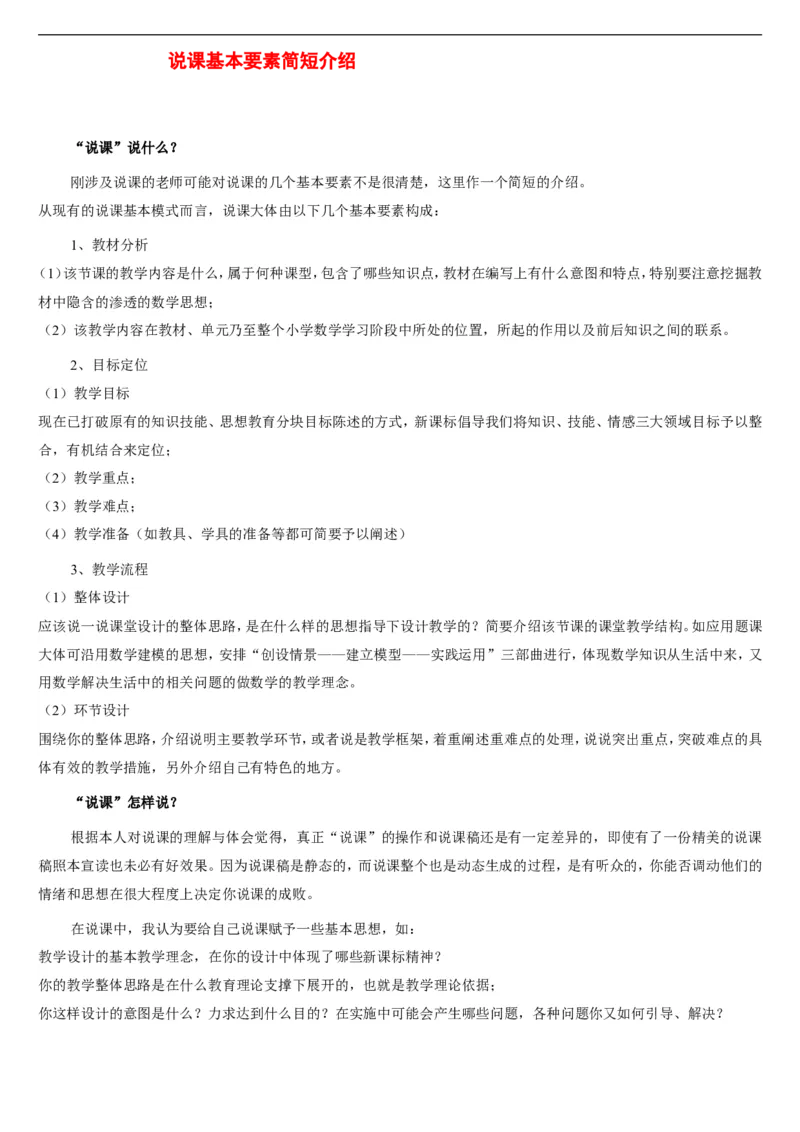
之以恒,坚持说课,就可不断提高自身素质,以适应教改形势。说课基本要素简短介绍
“说课”说什么?
刚涉及说课的老师可能对说课的几个基本要素不是很清楚,这里作一个简短的介绍。
从现有的说课基本模式而言,说课大体由以下几个基本要素构成:
1、教材分析
(1)该节课的教学内容是什么,属于何种课型,包含了哪些知识点,教材在编写上有什么意图和特点,特别要注意挖掘教
材中隐含的渗透的数学思想;
(2)该教学内容在教材、单元乃至整个小学数学学习阶段中所处的位置,所起的作用以及前后知识之间的联系。
2、目标定位
(1)教学目标
现在已打破原有的知识技能、思想教育分块目标陈述的方式,新课标倡导我们将知识、技能、情感三大领域目标予以整
合,有机结合来定位;
(2)教学重点;
(3)教学难点;
(4)教学准备(如教具、学具的准备等都可简要予以阐述)
3、教学流程
(1)整体设计
应该说一说课堂设计的整体思路,是在什么样的思想指导下设计教学的?简要介绍该节课的课堂教学结构。如应用题课
大体可沿用数学建模的思想,安排“创设情景——建立模型——实践运用”三部曲进行,体现数学知识从生活中来,又
用数学解决生活中的相关问题的做数学的教学理念。
(2)环节设计
围绕你的整体思路,介绍说明主要教学环节,或者说是教学框架,着重阐述重难点的处理,说说突出重点,突破难点的具
体有效的教学措施,另外介绍自己有特色的地方。
“说课”怎样说?
根据本人对说课的理解与体会觉得,真正“说课”的操作和说课稿还是有一定差异的,即使有了一份精美的说课
稿照本宣读也未必有好效果。因为说课稿是静态的,而说课整个也是动态生成的过程,是有听众的,你能否调动他们的
情绪和思想在很大程度上决定你说课的成败。
在说课中,我认为要给自己说课赋予一些基本思想,如:
教学设计的基本教学理念,在你的设计中体现了哪些新课标精神?
你的教学整体思路是在什么教育理论支撑下展开的,也就是教学理论依据;
你这样设计的意图是什么?力求达到什么目的?在实施中可能会产生哪些问题,各种问题你又如何引导、解决?你觉得这节课教材对学习主体来说,是否要进行处理,阐述你处理的理由,通过你的处理学生可能在学习中避免了哪些
学习障碍,有什么优点等。
同时,在说课中要注意几个问题:
(1)说课整体要流畅,不要作报告式,如“许多123”,几个环节过渡要自然,比如,教材分析后,要确定目标时,可以这样
说“基于对教材的理解和分析,本人将该节课的教学目标定位为……”“下面我侧重谈谈对这节课重难点的处理”
(2)说课要有层次感,不要面面俱到,不要将说课说得很细,我们要说的都是一些教学预案,所以要多谈谈学生学习中可
能碰到的困难和教师的教学策略。这里的层次针对某一教学环节来说也是如此。比如,在重难点处理上,你设计哪些问
题,如果第一套方案不行,第二套方案有怎样安排等;在练习中你安排了哪些练习,有没有体现出层次性等。
(3)说课要自信,要富有激情和个性。既然是说课,说的成分很重要。最好能说的神采飞扬,激情澎湃感染听众。同时要针
对自身扬长避短,体现个性。比如擅长书法的教师可将你的整体框架进行板书,既使听众思路清晰,又能增加你的印象
分,和乐而不为呢?
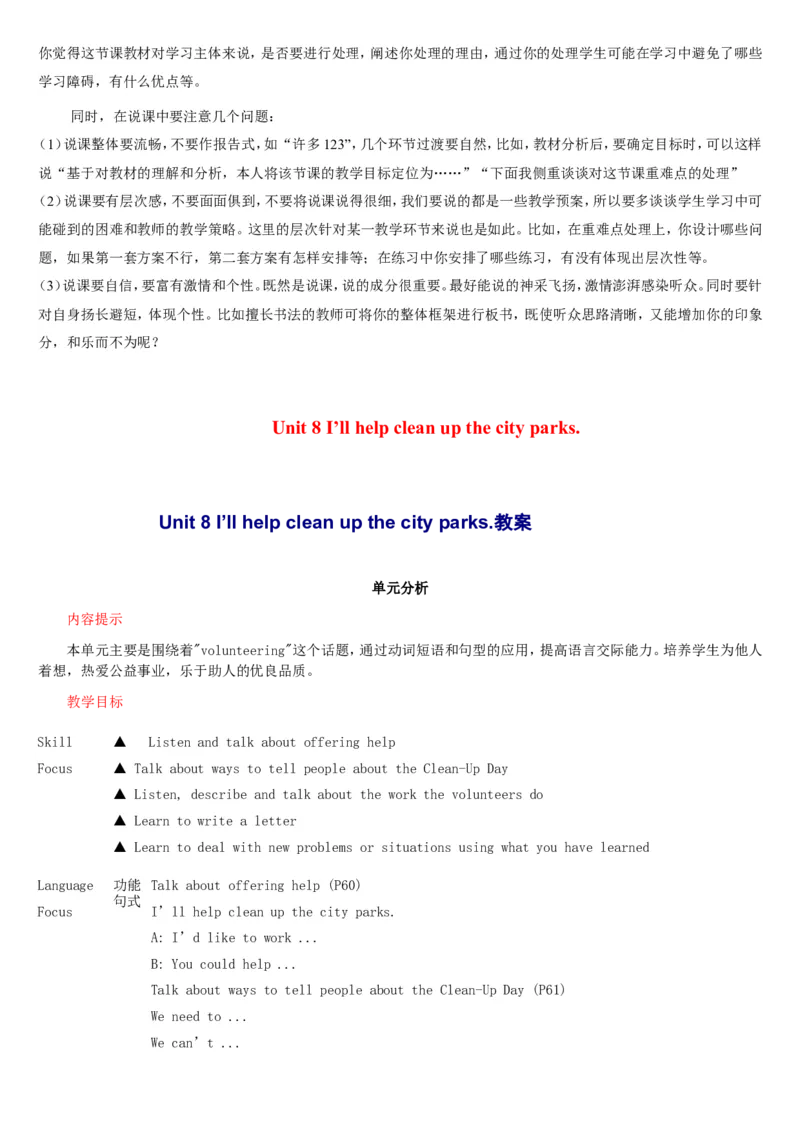
Unit 8 I’ll help clean up the city parks.
Unit 8 I’ll help clean up the city parks.教案
单元分析
内容提示
本单元主要是围绕着"volunteering"这个话题,通过动词短语和句型的应用,提高语言交际能力。培养学生为他人
着想,热爱公益事业,乐于助人的优良品质。
教学目标
Skill ▲ Listen and talk about offering help
Focus ▲ Talk about ways to tell people about the Clean-Up Day
▲ Listen, describe and talk about the work the volunteers do
▲ Learn to write a letter
▲ Learn to deal with new problems or situations using what you have learned
Language 功能 Talk about offering help (P60)
句式
Focus I’ll help clean up the city parks.
A: I’d like to work ...
B: You could help ...
Talk about ways to tell people about the Clean-Up Day (P61)
We need to ...
We can’t ...I’ll ...
Talk about the work the volunteers do (P62)
These three students all volunteer their time to help other people.
Somebody loves to ... / helps ... / plans to ... / wants to ...
A: What do you like doing?
B: I like ...
A: What kind of volunteer work do you think I could do?
B: You could ...
词 1. 重点词汇
汇 advertisement, fix, repair, pleasure, blind, deaf, shut, carry, specially, fetch
2. 认读词汇
hunger, homeless, cheer, clean-up, sign, establish, major, commitment, elementary,
veterinarian, coach, similar, call-in, strategy, disabled, organization, unable,
support, appreciate, donation, part of speech, pronoun, adverb, preposition,
conjunction, donate, Jimmy, Sally
3. 词组
clean up, cheer up, give out, put off, set up, think up, take after, fix up, give
away, put up, hand out, work out, at once
语 How to use phrasal verbs
法
Strategy 1. Matching
Focus 2. Personalizing
3. Using parts of speech
Culture Being a volunteer is useful and important.
Focus
教材分析
本单元以Volunteering 为话题设计了四个部分的内容。
Section A 该部分有四个模块:第一个模块围绕 ways in which you could help people这
个话题展开叙述( 1a),听力(1b),口语( 1c)训练;第二个模块围绕 Talk about
ways to tell people about the Clean-Up Day 进行听力( 2a, 2b),口语
( 2c)训练;第三个模块是关于volunteers的一个阅读材料,训练形式为阅读
( 3a),填表格(3b),角色表演( 3c);第四个模块仍以the kinds of work the
volunteers do为话题,以表格及对话形式进行小组活动(4)。
Section B 该部分有四个模块:第一模块是词汇的学习( 1a)与运用(1b);第二个模块以听力
训练形式强化第一模块中所学词汇( 2a, 2b)和口语训练( 2c);第三个模块围绕
中心展开阅读( 3a) a volunteer’s work 并再次强化了第一模块中的词汇学
习(3b);第四模块仍就the work the volunteers do 这一话题以小组活动形式
进行口语训练(4)。
Self check 该部分有两个模块:第一模块对所学词汇进行填空训练(1);第二个模块以某一志
愿者的活动为内容进行写作和口语练习(2)。Reading 该部分共设四项任务:第一项任务以问题讨论的形式激活相关的背景知识
(Section 1);第二项任务要求学生通过快速阅读获取信息,并鼓励学生运用词性
的知识阅读并理解短文内容(Section 2);第三项任务通过提炼阅读材料中的知
识点和难点进一步理解文章(Section 3);第四项任务以写回信的形式对所学知
识进行巩固运用(Section 4)。
课时安排
第一课时:Section A: 1a,1b, 1c, 2a,2b,Grammer focus
第二课时:Section A: 3a,3b,4
第三课时:Section B:1, 2a,2b, 2c. 3a
第四课时:Section B:3b,4 and Self Check
第一课时
教学目标
能运用以下句型进行交际:
I'd like to work outside.
You could give out food at a food bank.
教学过程
一、导入(Lead-in):
展示几张需要帮助的人或事的图片。(如:sick people,homeless children,dirty park,hunger)
通过图片让学生充分展开想像力,针对每一幅图片进行描述,激起学生的同情心和对以下内容的兴趣 。
二、句型引入和操练(Presentation and practice)
1.版书:What can you do to help sick people?
I could visit them in the hospital.
I’d like to buy them some flowers.
I hope to cheer them up.让学生给出不同的回答,强调I’d like to,hope to,volunteer to,could和其他动词的搭配。老师不断强化句型,让
学生有个模式进行下面的训练。
2.结对练习对话
另外再让学生结对操练句型:
通过反复操练,巩固句型,体会以上句型的结构,为后面的讨论作铺垫。
三、教学操练(Practice)
利用农远工程教学网中学资源06-07上学期中的学习指导中学英语人教课标版9年级Unit8的多媒体课件中的图
片、动画和人机交互自测程序进行以下教学活动。
1.教学 1a, 1c, 2c.
Step1: 让学生根据内容对话,引出volunteer,work outside,cheer up,help sb. with sth.,give out,clean up,in the
1aospital.并用刚刚学到的目标句型来操练。(若有学生不明白,老师可先示范一次。)
Step2: 抽查几对学生,让他们在全班面前,按要求进行对话。
2.教学1b, 2a,2b.
Step1: 帮助学生明确题目的要求。接着,听力练习,学生根据录音内容完成1b,2a and 2b。
Step2:重放一遍录音内容,学生跟读。学生通过听力练习,进一步熟悉本课的目标语言。
四、教学巩固通过版书引导学生完成一个任务:
假设你有个朋友周末生日,他打算在家开个生日舞会。他现在有很多事情忙不过来,你能给他提供什么帮助?
说明:通过来完成一个任务。让学生运用所学内容,既巩固了本课所学的语言目标,又开拓了学生的思维,使学生的
语言运用源于书本又高于书本,培养学生在实际生活中运用本课所学内容,来解决现实生活中的实际问题的能力,达到
新课标提出的培养学生综合运用语言的能力。
五、作业 (Homework):
1.下周你们班将去老人院,去那里有什么可以做的,罗列4~5点。
2.翻译下列短语。
(1)打扫
(2)张贴
(3)去医院看望生病的小孩
(4)在外面工作
(5)提供帮助
(6)推迟
(7)分发
(8)无家可归的人
第二课时
教学目标
A.能运用所掌握的语法、句型和词汇进行交流。
B.如果学校开展志愿者活动,能比较流利地讲述自己能够做的事情。
C.能运用语言和语法知识进行阅读并理解文章意思。
D.能运用句型:You could help coach a football team.
F.掌握词汇及短语:spend…doing,set up,each of,put off,cheer up
教学过程
一、教学 3a
1. 导入(Lead—in)2.利用农远工程教学网中学资源06-07上学期中的学习指导中学英语人教课标版9年级Unit8的多媒体课件中的
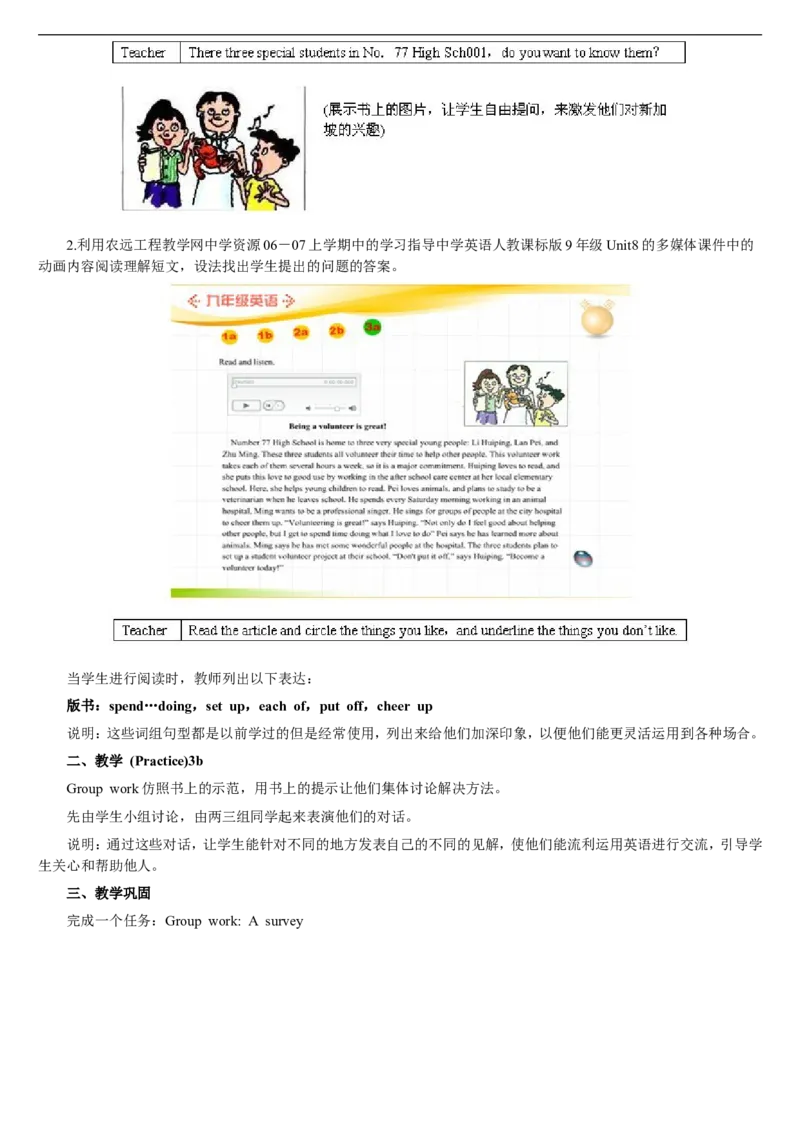
动画内容阅读理解短文,设法找出学生提出的问题的答案。
当学生进行阅读时,教师列出以下表达:
版书:spend…doing,set up,each of,put off,cheer up
说明:这些词组句型都是以前学过的但是经常使用,列出来给他们加深印象,以便他们能更灵活运用到各种场合。
二、教学 (Practice)3b
Group work仿照书上的示范,用书上的提示让他们集体讨论解决方法。
先由学生小组讨论,由两三组同学起来表演他们的对话。
说明:通过这些对话,让学生能针对不同的地方发表自己的不同的见解,使他们能流利运用英语进行交流,引导学
生关心和帮助他人。
三、教学巩固
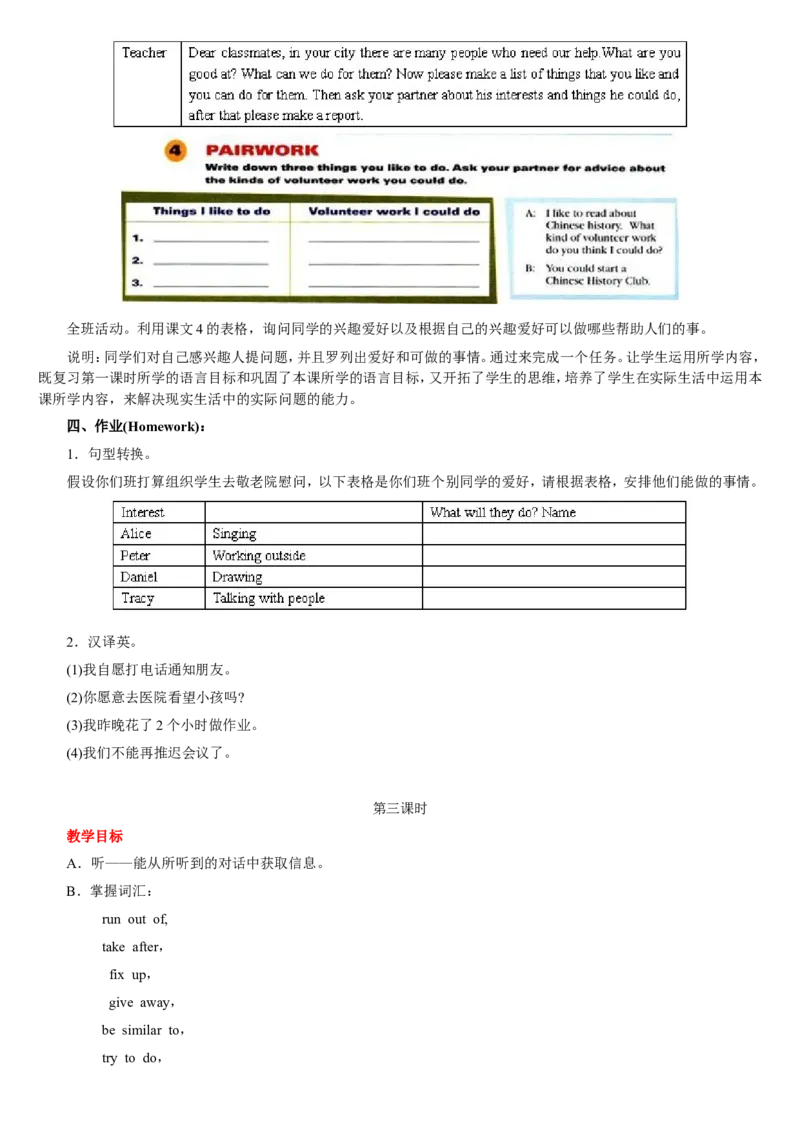
完成一个任务:Group work: A survey全班活动。利用课文4的表格,询问同学的兴趣爱好以及根据自己的兴趣爱好可以做哪些帮助人们的事。
说明:同学们对自己感兴趣人提问题,并且罗列出爱好和可做的事情。通过来完成一个任务。让学生运用所学内容,
既复习第一课时所学的语言目标和巩固了本课所学的语言目标,又开拓了学生的思维,培养了学生在实际生活中运用本
课所学内容,来解决现实生活中的实际问题的能力。
四、作业(Homework):
1.句型转换。
假设你们班打算组织学生去敬老院慰问,以下表格是你们班个别同学的爱好,请根据表格,安排他们能做的事情。
2.汉译英。
(1)我自愿打电话通知朋友。
(2)你愿意去医院看望小孩吗?
(3)我昨晚花了2个小时做作业。
(4)我们不能再推迟会议了。
第三课时
教学目标
A.听——能从所听到的对话中获取信息。
B.掌握词汇:
run out of,
take after,
fix up,
give away,
be similar to,
try to do,call up,
hand out,
come up with
教学过程
一、导入(Warm-up):
展示图片,让学生用图片上的内容及提示短语造句。
I’ve run out of money.
I take after my mother.
I fix up my bike.
I gave away the books.
(通过口语造句,既激发了学生的学习积极性,让学生在轻松好奇的氛围中复习了上节课的目标语言,又引出新短
语。)
在造句的基础上,能进一步用英文解释以上短语
run out of—don’t have any of fix up—repair take after be similar to
二、教学 2a,2b.
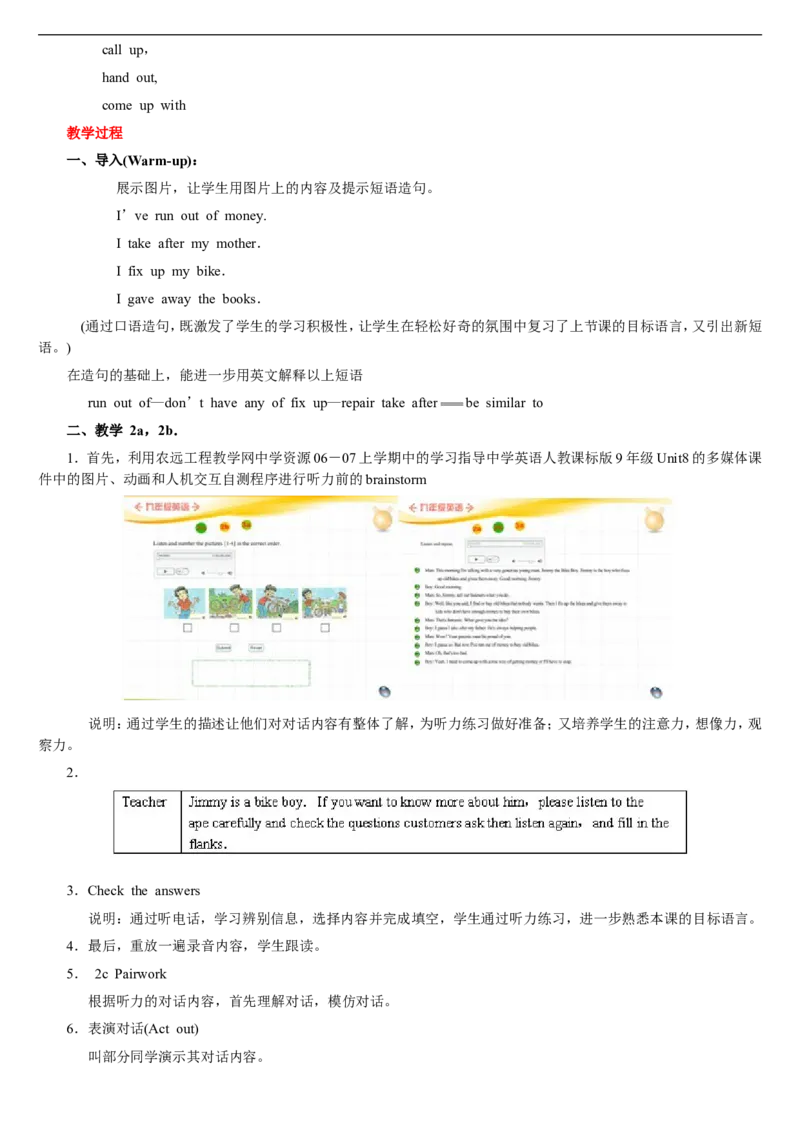
1.首先,利用农远工程教学网中学资源06-07上学期中的学习指导中学英语人教课标版9年级Unit8的多媒体课
件中的图片、动画和人机交互自测程序进行听力前的brainstorm
说明:通过学生的描述让他们对对话内容有整体了解,为听力练习做好准备;又培养学生的注意力,想像力,观
察力。
2.
3.Check the answers
说明:通过听电话,学习辨别信息,选择内容并完成填空,学生通过听力练习,进一步熟悉本课的目标语言。
4.最后,重放一遍录音内容,学生跟读。
5. 2c Pairwork
根据听力的对话内容,首先理解对话,模仿对话。
6.表演对话(Act out)
叫部分同学演示其对话内容。说明:让学生合作学习,互相交流
三、教学阅读(Reading) 3a.
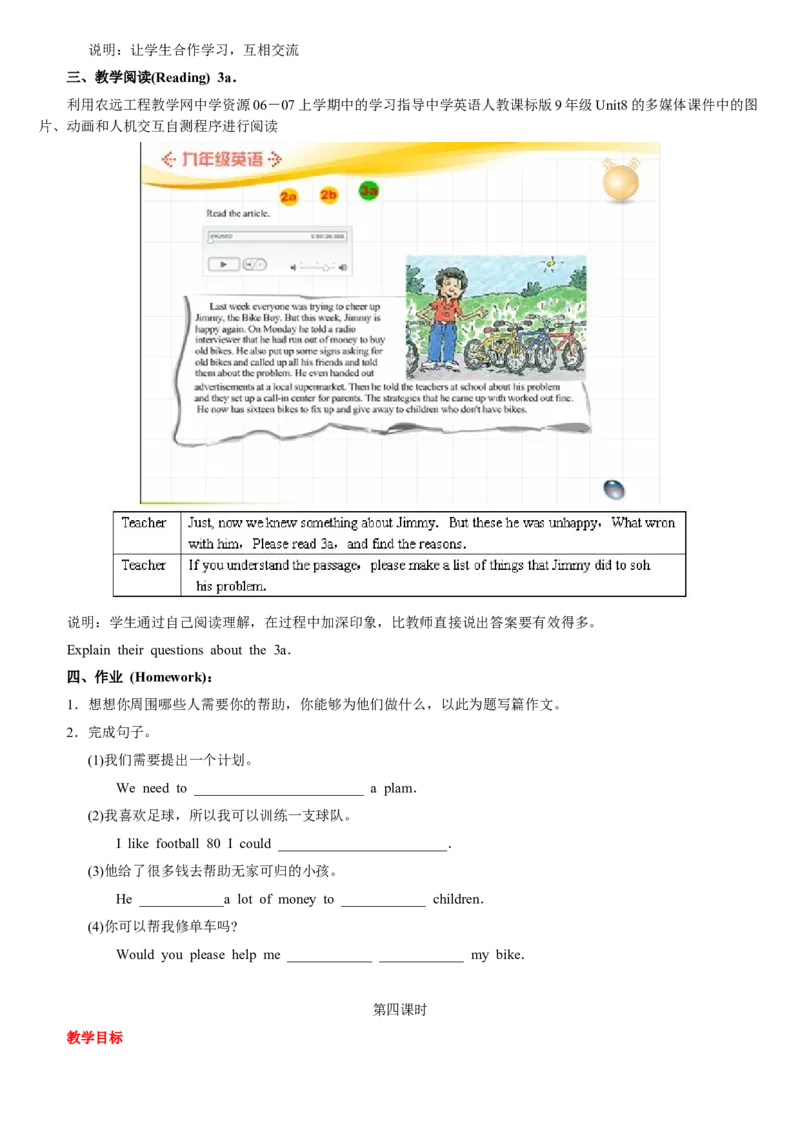
利用农远工程教学网中学资源06-07上学期中的学习指导中学英语人教课标版9年级Unit8的多媒体课件中的图
片、动画和人机交互自测程序进行阅读
说明:学生通过自己阅读理解,在过程中加深印象,比教师直接说出答案要有效得多。
Explain their questions about the 3a.
四、作业 (Homework):
1.想想你周围哪些人需要你的帮助,你能够为他们做什么,以此为题写篇作文。
2.完成句子。
(1)我们需要提出一个计划。
We need to ________________________ a plam.
(2)我喜欢足球,所以我可以训练一支球队。
I like football 80 I could ________________________.
(3)他给了很多钱去帮助无家可归的小孩。
He ____________a lot of money to ____________ children.
(4)你可以帮我修单车吗?
Would you please help me ____________ ____________ my bike.
第四课时
教学目标写——能根据所学知识进行写作。
复习巩固本单元的主要内容。
教学过程
一、复习(Revision)
让两三个同学口述自己的打算,将其要点归纳在黑板上.
版书:For example:sing,hand out,put up…
二、拓展性练习——写、说(Writing and speaking practice)
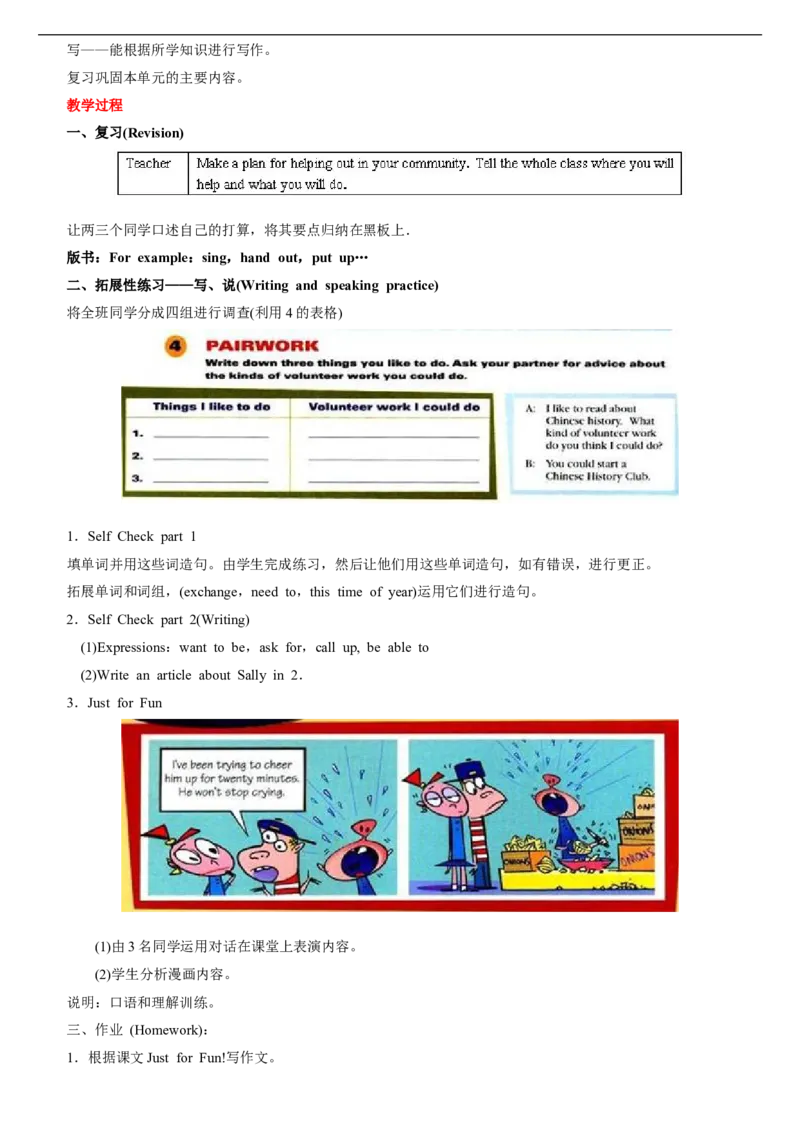
将全班同学分成四组进行调查(利用4的表格)
1.Self Check part 1
填单词并用这些词造句。由学生完成练习,然后让他们用这些单词造句,如有错误,进行更正。
拓展单词和词组,(exchange,need to,this time of year)运用它们进行造句。
2.Self Check part 2(Writing)
(1)Expressions:want to be,ask for,call up, be able to
(2)Write an article about Sally in 2.
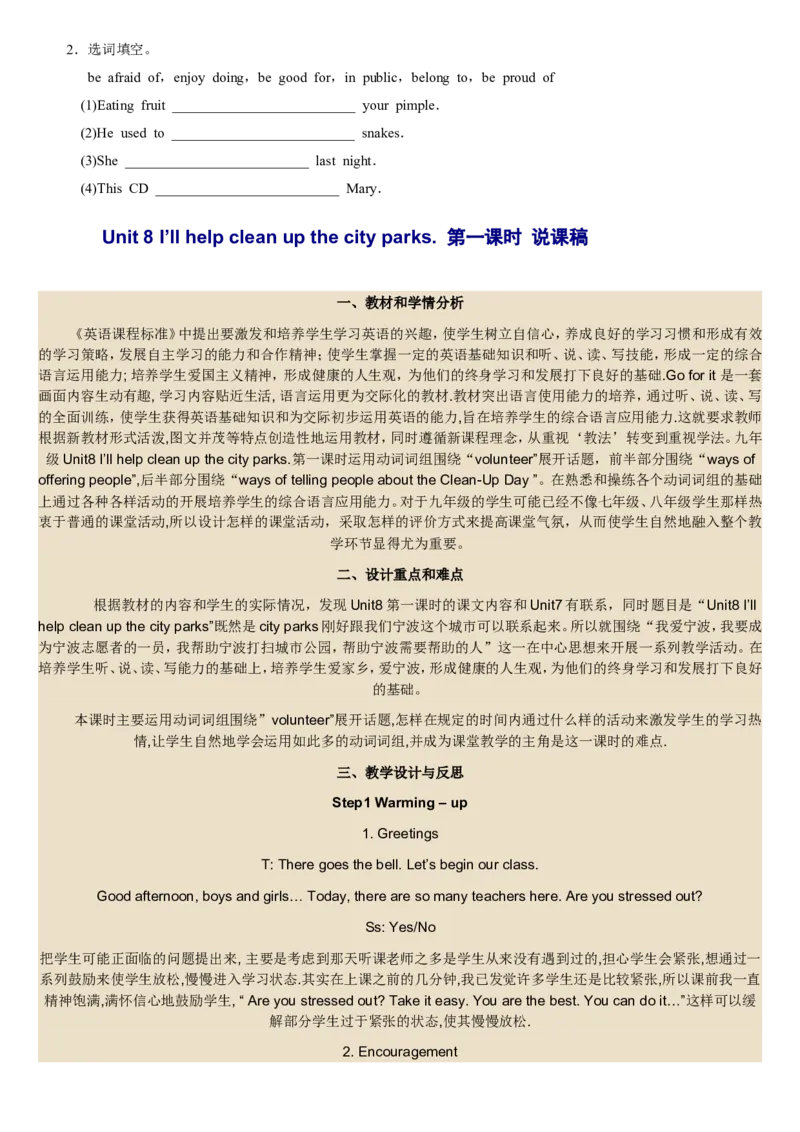
3.Just for Fun
(1)由3名同学运用对话在课堂上表演内容。
(2)学生分析漫画内容。
说明:口语和理解训练。
三、作业 (Homework):
1.根据课文Just for Fun!写作文。2.选词填空。
be afraid of,enjoy doing,be good for,in public,belong to,be proud of
(1)Eating fruit __________________________ your pimple.
(2)He used to __________________________ snakes.
(3)She __________________________ last night.
(4)This CD __________________________ Mary.
Unit 8 I’ll help clean up the city parks. 第一课时 说课稿
一、教材和学情分析
《英语课程标准》中提出要激发和培养学生学习英语的兴趣,使学生树立自信心,养成良好的学习习惯和形成有效
的学习策略,发展自主学习的能力和合作精神;使学生掌握一定的英语基础知识和听、说、读、写技能,形成一定的综合
语言运用能力; 培养学生爱国主义精神,形成健康的人生观,为他们的终身学习和发展打下良好的基础.Go for it 是一套
画面内容生动有趣, 学习内容贴近生活, 语言运用更为交际化的教材.教材突出语言使用能力的培养,通过听、说、读、写
的全面训练,使学生获得英语基础知识和为交际初步运用英语的能力,旨在培养学生的综合语言应用能力.这就要求教师
根据新教材形式活泼,图文并茂等特点创造性地运用教材,同时遵循新课程理念,从重视‘教法’转变到重视学法。九年
级Unit8 I’ll help clean up the city parks.第一课时运用动词词组围绕“volunteer”展开话题,前半部分围绕“ways of
offering people”,后半部分围绕“ways of telling people about the Clean-Up Day ”。在熟悉和操练各个动词词组的基础
上通过各种各样活动的开展培养学生的综合语言应用能力。对于九年级的学生可能已经不像七年级、八年级学生那样热
衷于普通的课堂活动,所以设计怎样的课堂活动,采取怎样的评价方式来提高课堂气氛,从而使学生自然地融入整个教
学环节显得尤为重要。
二、设计重点和难点
根据教材的内容和学生的实际情况,发现Unit8第一课时的课文内容和Unit7有联系,同时题目是“Unit8 I’ll
help clean up the city parks”既然是city parks刚好跟我们宁波这个城市可以联系起来。所以就围绕“我爱宁波,我要成
为宁波志愿者的一员,我帮助宁波打扫城市公园,帮助宁波需要帮助的人”这一在中心思想来开展一系列教学活动。在
培养学生听、说、读、写能力的基础上,培养学生爱家乡,爱宁波,形成健康的人生观,为他们的终身学习和发展打下良好
的基础。
本课时主要运用动词词组围绕”volunteer”展开话题,怎样在规定的时间内通过什么样的活动来激发学生的学习热
情,让学生自然地学会运用如此多的动词词组,并成为课堂教学的主角是这一课时的难点.
三、教学设计与反思
Step1 Warming – up
1. Greetings
T: There goes the bell. Let’s begin our class.
Good afternoon, boys and girls… Today, there are so many teachers here. Are you stressed out?
Ss: Yes/No
把学生可能正面临的问题提出来, 主要是考虑到那天听课老师之多是学生从来没有遇到过的,担心学生会紧张,想通过一
系列鼓励来使学生放松,慢慢进入学习状态.其实在上课之前的几分钟,我已发觉许多学生还是比较紧张,所以课前我一直
精神饱满,满怀信心地鼓励学生, “ Are you stressed out? Take it easy. You are the best. You can do it…”这样可以缓
解部分学生过于紧张的状态,使其慢慢放松.
2. EncouragementT: Some of you may feel a little bit stressed out. Just take it easy and I will help you…The whole class, would you
please stand up and just follow me “ I can do it…”
本想通过这个小小的鼓励活动,使学生克服胆怯,增加信心,活跃气氛.但是没想到在Greetings时,学生既然异口同声
说”NO” 这个是我没有想到的, 或许是课前的鼓励措施相当奏效吧.当然这个Encouragement也就没有必要了. 我灵机
一动就来了一句, “No? great! You are better than me. Now I’m a little bit stressed out. So let’s talk about sth
relaxing---National Day.这样就自然地过渡到Lead-in环节了。
总结:
Step1的优点:根据学生的具体情况,老师精神饱满,满怀信心地出场和鼓励能够感染学生,帮助学生缓解紧张状态,使
其增加学习的积极性。
Step1的缺点:因为Encouragement没有开展,导致整个warming-up太急促,感觉学生还没有活动开来,没有达到预期
的效果。
Step1的反思:说明在“备学生”方面还不够细致,没有想到学生正反2方面的反应,这个环节以后需要加强学习,对学
生会出现的每一个可能性都要大胆预测并准备对策。
Step2 Lead- in
Free talk
1.T: As we know, National Day is coming…Where would you like to go on vacation?
Wenzhou? Hangzhou? Shanghai? Ningbo?...
Ss:…
我以国庆休息为题,询问学生准备去哪里度假,慢慢引申到宁波这个城市,总有学生说想呆在宁波的,这样既复习了九
年级Unit 7 Where would you like to visit? 又慢慢过渡到“我爱宁波”这一话题。
2.T: All right. How many Ss will stay in Ningbo? Hands up…
Do you love Ningbo? Do you want to know more about Ningbo?
Ok! Let’s appreciate an episode of Ningbo and see what kind of city it is…
这里准备了一个大约1分钟左右的视频,主要是介绍宁波的情况,通过视频能够更直观地帮助学生了解宁波,同时能够
增加学生对宁波的热爱,为下面的过度作准备。
3.T: From this episode, we know that Ningbo is a beautiful and lively city.
As Ningboners, do you want to make Ningbo much more beautiful?
Do you want to help people who are in need of help in Ningbo?
Ok! Let’s be volunteers… and see what we could do in Ningbo…
视频过后,通过几个疑问句比较自然地从“我爱宁波”过渡到想成为宁波的志愿者“volunteer” 这一主题,接下来就可
以很顺利地过渡到presentation.
总结:
Step2的优点:通过学生熟悉的句型Where would you like to go on vacation?导入(一对一的提问方式),同时附上一
段与“我爱宁波”有关联的视频,再进行追问的形式(一对多的提问方式)。既复习了Unit7的内容,增加了学生学习的
积极性,又可以更直观地培养学生爱家乡的情操,从而自然地从“我爱宁波”过渡到“volunteer”。
Step2的缺点:活动仅仅停留在师生的对话中,没有涉及到学生与学生的互动,导致整个lead-in基本属于老套路,缺少
新颖。Step2的反思:要多多学习,多多设计,特别是lead-in部分,希望寻找出一条与众不同又极具效果的 lead-in 路线。俗话
说:好的开始是成功的一半。
Step3 Presentation and Review
1.Presentation
1.T:Let’ look at the first picture. If the city parks in Ningbo are not clean. What could we do?
Ss: We could help clean up the city parks.
…
通过语言描绘,图片引导的方法,使学生在情景中学习新词汇和动词词组: clean up, set up, establish, cheer up,
homeless, help …with…,volunteer…
2.Review
2.T: Well done! Let’s see who has the best memory…
这一环节主要是让学生巩固presentation的一些动词词组,首先采取集体回答的形式(给学生做一个心理上的准备),然
后开始一对一的比赛,看哪个组成员的memory更好,成功回答出的成员为其组添加一颗红心…其次也是为下面的听力
做一点铺垫。
总结:
Step3的优点:语言描绘,图片引导的词汇学习方法,是学生已经接受的方法,加上一些情景语言,更容易使学生掌握新
词汇,对于review这一环节为听力做了铺垫的同时,以竞赛的方式出现可以给课堂带来一丝的热闹…
Step3的缺点:活动没有亮点,只是普通的词汇认识过程,教师在学生词汇习得的过程中还是充当主角的地位。
Step3的反思:我一直在思考在词汇的习得过程中,怎么样让学生充当主角,这个有没有可能性?或许可以让部分优秀
学生来带领;或许在学生普遍加大预习强度的过程中,在活动中习得新词汇…
Step4 Listening and Pairwork
1.Listening
T: Listen! There is a boy and a girl talking about several ways of helping people. Let’s walk there and see what they
are talking about.
Presentation是关于ways of offering help。Listening也是关于ways of offering help。这样的话,只需一个简单的过度
就可以达成目标,而且不会使学生感到突然。
2. Pairwork
T: Now we’ve learnt the ways of offering help. I think it’s time for us to practice…
A: It’s volunteer today. What would you like to do?
B: I’d like to work outside, but I don’t know what to do?
A: you could clean up the city parks.
B: Good idea. Would you like to go with me?
A: Sure, I’d love to.
这是教学的第4个步骤,主要是对前面学过的一些语法点的一个总结,学生通过词汇的习得,复习,听力,对于这个活动
应该是比较简单了。本来设计的是”Survey and Report” 但是考虑到时间的关系,改成了pairwork. 因为后面的内容还
有很多,比现在的更难,所花的时间会更多。总结:
Step4的优点:这个环节相对比较简单,给成绩差的同学提供了一次锻炼的机会,增加了他们对于学习英语的信心。同时
也为下面的内容节省了一点时间。
Step4的缺点:听力部分采取教师问,学生答的方式,有点单调,活动形式不够有特色,不能大幅度激发学生对于这个活
动的兴趣。
Step4的反思:一堂成功的课在中间也需要亮点,时间是一个原因,但是是否可以再想想办法,使得活动设计既不占用太
多的时间又有新意呢?
Step5 Presentation and Groupwork
T: Did a great job! We’ve helped people who are in need of help. Are you happy?
Ss; Yes.
T: Being volunteers is great. To help others is to help ourselves. Now, we are planning a City Parks Clean-up Day.
We have to talk about ways to tell people about the Clean-Up Day. Let’s see what we could do… for example: call
up others, put up sighs…
T:Now,We are ready to tell people about the City Parks Clean-up Day. Let’s discuss with your groups…
关于SectionA第2部分的导入,我想了很长时间,首先发现这个导入有点难,不知道怎么样入手,因为跟sectionA第1
部分的联系好像不是很大。其次如果正常导入后不见得学生能够理解,如果学生不能理解会直接影响下面的听力部分(因
为听力速度很快,难度较大)所以我决定把这个导入简单化并自己先举几个例子,其次再通过Groupwork使学生巩固
“ways of telling people about the City Parks Clean-up Day”。从而最大程度地为听力扫清障碍。
总结:
Step5的优点:根据教材的难度能够预测到学生的反应,把教材内容简单化并运用groupwork进行巩固,顺利地完成了
学生语言习得的目标,也为下面的听力作了铺垫。
Step5的缺点:目标是完成了,但是导入缺乏新意。学生的积极性调动不够。
Step5的反思:关于这个方面是否可以采用另外一种方式,比如以一个简短的小故事的形式导入,如果时间控制得好的
话,小故事的形式或许会更好。
Step6 Listening
T:We’ve arranged about the City Parks Clean-up Day. There is another group talking about it, let’s see what they
are talking about…
这部分涉及到2a和2b听力,前面的presentation和groupwork基本已经为2a扫清了障碍,只是有少部分同学需要听
第2遍, 2遍过后基本都没问题(虽然听力的语速很快),但是2b因为语速很快在第一编听完后还有很多同学写不下来,
这时我及时把选项打了出来,这样就弥补了由于听力过快而造成学生反应不过来。2遍过后,大部分学生都完成了2b.
Step7 Talk Show
T: Thanks for your help. With your help, Ningbo has become more and more beautiful and lively, and it has
attracted lots of famous stars, like kobe, Andy lau and so on. Let’s see who they are.(Show stars’pictures).They’ve
been in Ningbo, and are coming to today’s talk show. Let’s see what it is…
教学的第7步是运用所学的知识,模仿各位明星和主持人做一个”talk show”,活动有四个人组成,一个模仿主持人,另
外3个模仿自己喜欢的明星,主持人至少问每个明星3个问题(问题和答案都是之前学习过的知识点),共计至少6个问
题。在讨论过程中,首先主持人问,明星答,然后再写下来,最后到讲台这边表演出来,这个活动在实际操作中并不困难。
设计这个活动的目的在于以学生感兴趣的活动为载体,全面复习前面出现过的知识点,在调动学生的学习积极性的同时
巧妙地锻炼学生的听,说,读,写能力。Step7的优点:活动设计新颖,学生参与的热情和积极性都很高,既巩固了前面出现过的知识点,又锻炼了学生的听,说,
读,写能力。
Step7的缺点:由于时间的关系,活动只展现了2组,没有达到预期的目标。
Step7的反思:这个活动本应该是整节课的展现部分,应该是整节课的高潮部分,但是由于时间的原因,没有完全展开,
这是个遗憾,怎样控制时间又不失活动的新颖是我以后应该努力思考的问题。
Step8 Summary
这个步骤是对本节课所学内容的回顾,重要的动词词组以及它们的运用,关于这个部分我们不应该直接读读了事,有时
间最好师生一起回顾,这样有利于学生对习得知识的巩固,可以大大减少学生课外复习的时间。
Step9 Homework
Choose a volunteer job you like to do and draw a poster of it.
联系本节课的知识点,根据学生自己的爱好,设计一张海报,有利于发挥学生能动性和创造力,在设计海报的过程中,学
生综合运用了所学的知识,最终达到知识应用的目的。给本节课画上了一个圆满的句号。
四、课后反思
新课程基本理念是面向全体学生,实施素质教育;整体设计目标,体现灵活开放;突出学生主体,尊重个体差异;采用活
动途径,倡导体验参与;注重过程评价,促进学生发展;
开发课程资源,拓展学用渠道。作为新时代的英语教师,要在有效的40-45分钟时间内,设计灵活新颖的活动来激发学生
的学习热情,让学生自然地学会和运用所学知识,并成为课堂教学的主角。
上完整节课后,发现活动设计基本合理,从简单到难有坡度感,并且重难点突出,课堂气氛还算不错,基本上能够突破教
学难点,巩固教学重点,完成教学任务。不过部分活动可以新颖些,过度语言或许可以丰富点,与学生的交流可以加强些,
还有一个重要问题就是没有很好的利用自己设计的评价体系,只把它作为了一个摆设,在课堂中应该时刻鼓励落后的
Team,最后应该称赞胜利的冠军等。
我发现自己还有许多地方需要学习,需要改进,在客观的列出自己的优缺点后,我将继续努力,发扬优点,改进缺点,努
力提升自己的各方面素质。
Unit 8 I’ll help clean up the city parks. SectionA说课稿
各位老师大家好,我今天说课的内容是:“九年级英语第八单元Section A”,下面我就本节内容给大家做一介绍:
一、教材分析
本单元是以九年级英语第八单元“I will help to clean up the city park”为主题,要求学生在实际生活中要
保护环境,学生学会在实际生活中能使用英语。同时,学生可以了解他国异乡的文化、人土风情、自然环境等情况,以扩
充学生的知识面。
二 、学生分析
本节课是针对于九年级全体学生,由于学生的基础知识比较薄弱和环境的限制,所以在教学中,我采用了不同的教学
方法和方式,让学生更好的了解社会,以至于很好的掌握本节知识。
三、教学目标分析
1. knowledge objects
(1) key vocabulary
clean up, hunger, homeless, cheer up, give out, volunteer, food, bank
(2) target languageI’d like to work outside.
you could give out food at a food bank.
2. ability objects
(1) train the students to express offering to help with the target language.
(2) train the students’ listening skill.
3. moral object: offer help to the others as much as possible.
4、学习策略目标:
积极认真的投入到语言实践中去听、说、读、写,学会听去要点,能用将实际生活和课本知识很好的连接起来运用。
四、教法分析和学法指导
1.教法分析
新课程的背景下,要求学生以“任务”为前提,进行有条件、有目的的听、说、读、写活动。因此在我本节课的教学中,
我采用“口语教学----------听力练习----------对话操练--------过程评价”的教学方式。因为学生在开始的情景
对话和听力中可以感知英语,在评价过程中开发课程新资源。
2.学法指导
在新课程的条件下和以上教学方式的指导之下,要求学生养成良好的听英语的习惯,通过听力对话及时的巩固并记
忆本节知识,之后在进行对话的产出,检查学生对本节知识的掌握得到很好的反馈。在此之上,给学生展示一些有关环
境的图片,,让学生在过程中进行情感培养和策略调整,以形成积极的学习态度,促进自己语言实际的运用能力。
五、教学程序
1. 复习旧知识,引入新知识
教师和学生进行简单的问候之后,通过对第七单元知识的复习,引出本单元的知识点,并写在黑板上。
如:Do you want to go to some place?
Where would you like to go?
If you want to go there, what would like to take?
After you go for a long walk, you will be very tired and hungry, and you want to have a rest a
nd eat something. is that right?
After eating, someone may through the rubbish, and make the environment dirty, so after class I
will help clean up the city park.
Do you want to go with me?
2.新课交际和训练阶段
(1).给学生展示一些图片,导出新单词、短语如:clean up. homeless等。
(2).让学生听录音,完成1b的练习。
(3).根据听力内容,运用幻灯片中一些图片的情景,让学生表演对话,从而突出重点,分散难点,并照顾到不同的学生。
3.总结拓展
反复运用本节重点句型,练习本节重点短语动词,引导学生总结本课重难点知识,并让学生在学习和运用中,学会英
语。
4.作业布置
六.板书设计:
Unit 8 I’ll help clean up the city parks,
Section A
The first period
Phrasal verbs:
1. clean up—make a place clean and tidy, put things in order
we should always clean up the dirty parts of the sea.
2. cheer up—make someone feel happy
the good news cheers everyone up.
3. give out—hand out, distribute
Lin Tao helped the teacher give out the new textbooks to the class.
总之,本节课,我始终坚持“任务型”教学的策略,让学生在任务中了解知识、学习知识、掌握和应用知识。Unit 8 I’ll help clean up the city parks. 第四部分阅读 说课稿
一.教材分析
说课内容:英语新目标九年级第八单元(Unit 8 I'll help clean up the city parks)的第四部分阅读(Reading: I'll send you a
photo of Lucky).
知识目标:1. 生词与短语(Words and Expressions)
disabled, organization, pleasure, blind, deaf, unable, shut, carry, specially, fetch, at once, support, appreciated, donation, part of
speech, pronoun, adverb, preposition, conjunction, donate
2. 关键句子(Key sentences)
I'd like to thank you for sending money to "Animal Helpers", an organization set up to help disabled people.
It is very important that this organization does not run out of money.
Your donation is greatly appreciated and the money is well used to help disabled people like me.
能力目标:利用词性知识使学生掌握学生词的方法来进行阅读.
情感目标:时刻准备着帮助那些处于困境中的人们;帮助别人的人是快乐的人.
本课重点:一些有用的短语和习语
本课难点:用英语总结和归纳本篇主题大意以及从中所学道理.
突破方法:引导,提示,合作,讨论
二.教学方法
主要方法:任务型教学法;先学,后教教学法;两者相结合.通过老师布置任务,提出要求,讲学习方法,让学生学会有目标地学
习并通过总结,归纳来掌握语言知识.依据洋思教学理念,新课程标准理论,由布置任务-----自主学习-----重点教授,让学生
做学习的主人.
教学手段:利用多媒体课件
三.学习方法
在老师布置任务之后,给学生确立了学习目标,提出了要求,讲了学习方法,再鼓励 学 生积极,主动参与学习及小组活动;
交流自己的观点,学习方法并与小组其他成员 合 作.
四.教学过程
Step One Revision
I.Review the phrases and expressions learned in Section A and Section B
II. Review the words in the reading
Step Two Learn the reading
I. Lead in
II. Read the letter and then answer some questions
III. Read the letter again. Let the Ss underline the phrases and expressio-ns
IV. Let the Ss say the phrases and expressions out
V. Give the Ss some explanations about some language points
VI. Talk about the problems
Step Three Do some exercises
I. Choose the correct words to fill in the blanks.
II. Choose the correct phrasal verbs and fill in the blanks
Step Four Summary
Step Five Homework
I. Write a short reply to Liz Smith
II. Complete the exercise on P65III.Recite the first two paragraphs
Unit 8 I’ll help clean up the city parks. 说课稿
今天我说课的题目是初中英语人教版九年级UNIT 8 I’ll help clean up the city park本课的中心话题是提供帮
助。引导学生关注社会,利用自己的特长为他人社会做事情。整个说课我将分成四个大部分进行讲述:即教材分析、教法
学法、教学程序、板书设计。
一、 教材分析
(一)教材的地位和作用
本单元的中心话题是提供帮助,整个单元的内容是围绕提供帮助,以及志愿活动展开生动、活泼的对话,和阅读。而
且这些志愿活动与我们的生活密切相关,通过本课的学习,要求学生能够谈论自己帮助别人的方式,学会关心社会,关
心他人。从而关注身边的生活环境,从小事做起。引导学生体会志愿活动,投身于社会公益事业。根据新目标对学生交际
能力的培养,我将本课设计为一堂听说作课。通过听力口语训练,帮助学生输入地道的语言材料,为提高学生的语言表
达能力及输出奠定基础。
(二)教学目标的确立和依据
英语课程标准规定,通过听、说、读、写的训练,使学生获得英语基础知识和为交际初步运用英语的能力,激发学生
的学习兴趣,为进一步学习打好初步的基础。 所以, 我确立如下的教学目标:
1.知识目标:
A、掌握词组:
clean up give out cheer up
help with come up with put off
write down put up hand out
call up
B掌握句型: I’d like to…….
You could……
2、能力目标:
A 提供帮助
B 提高学生听、说、读、写的综合能力。
3.情感目标:
通过对本单元的学习,增强实际交际能力,引导学生体会志愿活动,积极投身于社会公益事业。 引导学生关注社会关注
未来,从现在做起,从小事做起,成为一个有爱心的公民。
(三)重点和难点:
1.重点:根据新目标的要求,我把听说能力的培养确定为本课重点
2.难点:在听说的基础上能够运用所学知识是英语学习的一个难点,所以我把本课难点确定为:通过大量的输入和练习,
能够运用所学内容升华到书面表达。
二、教法学法1、任务型教学法:每个教学环节都是围绕着如何完成一个教学任务来设计的。
2、感悟法:创设语境,让学生在一定的语言环境中感悟语言内涵,从而实现悟中学的目的。只有学生自己悟出的东西才
能较好地内化为自己的东西。
3、合作点拨法:通过教师创设的学习氛围,设置问题和反思质疑,推动师生,生生间的合作探究,
小组合作学习,在解决问题中完成教学目标。以培养他们的合作探究的意识与精神。
三、教学程序
1 导入新课
利用课件中的图片导入:在大屏幕上出示汶川大地震中一些悲惨的图片,让同学们说出汶川,然后老师说as we all
k-now a stong earthquake happened in wenchuan,so many kind people go there to help others.再出示一些军
人,医疗工作者,志愿者忙碌的身影,特别是温家宝总理看望受伤的孩子,让同学们知道一方有难,四方支持,帮助困难
中的人是很有意义的。然后说Would you like to help others?What would you like to do?
2 出示一些需要帮助的人,然后学习我们可以为他们做什么。最后讨论我们还可以为别人做什么?让孩子们说出自己
可做的事情,利用自己的特长来帮助别人。从小事做起从身边的事情做起。
3 听磁带,完成句子,通过听力练习,帮助学生输入地道的语言材料,为提高学生口语表到能力及输出奠定基础,然
后是核对答案。
4 口语练习,通过上面的听力练习,让学生学会表达提供帮助的句型,让他们两人一组进行练习,然后表演给大家
看,最后再一起回答老师。
5 做2a 2b 听力练习,先听2a标出学生们准备要做的事情,然后再听填空最后核对答案。
6 把今天所学的所有动词短语板书到黑板上,然后让同学们记忆,造句。为了更深入的了解这些短语的用法。
7 在前面听说写的基础上,出示一个写作任务,让学生把今天所学的内容能够学以致用,也是一个升华的过程。
8 作业设计
本课的重点是提供帮助,通过本课的听说和写的训练,学生已经掌握了基本的短语和句型,所以今天的作业是制定一个
志愿活动计划,写出他们想做什么,能做什么。
四 板书设计
我将把本课的知识目标,及一些表达提供帮助的短语和句型板书到黑板上:
Clean up give out cheer up
Help with come up with put off
Write down put up hand out
Call up
I’d like to…….
You could……
Unit 8 I’ll help clean up the city parks.说课稿二
Ⅰ. Teaching aims and demands.
1. Knowledge objects
(1)Key vocabulary
Clean up ,hunger, homeless , cheer, give out, clean-up, sign, advertisement, put off, set, set up,establish, think up.
(2)Target language
I’d like to work outside.
I’ll help clean up the city parks.
You should give out food at a food bank.
2.Ability objects.
Listening skills, communicative competence, survey skill, cooperating skill, recognizing skill
3.Moral object
The main content of this period is to talk about volunteering and the topic is very important and
rewarding. It can help the students think how to help others and make them have good moralities. By
learning this period, they will experience the happiness of being ready to help others. It will encourage the
students to offer help to others as much as possible.
Ⅱ. Teaching key points and difficulties.
1. The words and phrases to offer help.
2. The target language to express offering help.
3. The phrasal verbs.
Ⅲ.Learning strategies.
Sequencing Deducing.
Ⅳ.Teaching methods.
Listening method, Pairwork, Speaking method, Eliciting method, Group work, Oral practising method.
Ⅴ.Teaching aids
A projector.
Ⅵ.Guiding ideology
This lesson realizes the new curriculum standard’s guiding ideology. It completes the teaching content by
students center and the Task-Based Language Teaching which contains pairwork and groupwork.
Language is acquired as learners actively engaged in attempting to communicate in the target language.
Acquisition will be maximized when learners engage in tasks that “push” them to the limits of their current
competence,.
Ⅶ.Teaching procedures.
Step1. Presentation.
I will show two materials, they are volunteers in Olympics and Wenchuan earthquake. These two
materials have sense of times and can encourage students. I use the materials which students are familiar
with can help me to present the new knowledge.
No.1 Watch a video. See some volunteers volunteered their services in Olympics. Then I will ask students
“If you work as an Olympics volunteer, what kind of volunteer job would you like to do ? Please come up
with your plan. After it, show “come up with=think up” on the screen. Then students have a discussion.
After students show their opinions, teacher can make a complement in order to add new knowledge. For
example, if a student say “ I’d like to clean up the city parks.” I’ll present “clean up”, and say “In our
school, Friday is a Clean-Up Day and present “ Clean-Up Day”. “ As a volunteer, you can help give out the
advertisement and FuWa.” Present “hand out=give out”. You can put up Olympics signs and
advertisement.” Present “put up, sign and advertisement”.
In this part, we connect section A 1b,the first listening knowledge point.
No.2 Show an earthquake photo.
Look at the photo, talk about the earthquake. “After Wenchuan earthquake, many people became
homeless and lots of children lost their schools. Even worse, they had nothing to eat. We should help
them stop hunger, establish their houses and schools, and cheer them up. What’s more, many teachers
were dead, we should help kids with their schoolwork at once, and can’t put off the plan.” When I am
talking about the earthquake, I can show “homeless set up=establish, hunger, put off, cheer up” on the
screen.In this part, we connect section A 1b, two to four knowledge points.
StepⅡ.Listening and Speaking Practice
The listening materials in our books are easy and boring. Students
do not interested in it. So I alternate listening with speaking to let students learn the knowledge from
easy to hard. It includes two parts.
1.1b. listening part.
Before listening to the tape, we can watch a picture first, it can help students to do some preparation .
Introduce the picture “ Today let us be volunteers, there are lots of work to do, what kind of volunteer job
would you like to do?” Students answer the question one by one. Then ask students to listen to the tape,
and tell me what kind of volunteer job would these children like to do. After listening, check the answers
by groupwork.
Small talk.
Create some situations. Make some small talks according to the situations. At first, present a model,
then let students practice.
2. 2a , 2b.
First create a dirty city park, ask students: “ If you are a volunteer, what would you like to do?” Lead in
Clean-Up Day.
Then add 2a’s five pictures on the screen, the first two pictures are a little difficult, students don’t know
how to ask. I can tell them the difficult part.
Aims of this part: let students have preparation before listening. They can both review the five important
phrases they have learnt in this period and have enough preparation before listening.
Last listen to 2a and 2b, students check the answers by group wok.
Step Ⅲ. Ability Improving.
1.Further-listening
In order to let students get familiar with high school entrance examination, I tape-record my speech like
it does. I ask five questions , and students write down their answers.
Question1: Do you often take part in volunteer activities?
Question2:Why do you want to be a volunteer?
Question3: What kind of volunteer job would you like to be?
Question4: Will you establish a volunteer group?
Question5:Protecting our environment is very important, isn’t it?
2.Groupwork.
In this part, we use Task-Based Language Teaching. Divide the whole class into four groups. Create four
kinds of volunteer situations. Olympics, earthquake, a Clean-Up Day in school and travelling festival.
Each group can choose a host to be a volunteer to ask other group members what kind of volunteer work
would they like to do?
StepⅣ.Homework
In this class, we’ve mainly talked about offering help. After class, try to make more dialogues to practice
it .And learn the phrasal verbs cheer up, set up and come up with in Grammar Focus. If you can not fully
understand their meanings and usage, please look them up in the dictionary.
StepⅤ.Summarize and Ponder:
The content of this period is to talk about how to offer help to others. And learn to use some important
phrasal verbs. At the same time, the teacher should teach the students how to make notes and encourage
them to offer help to others.
While a good teacher with much experience, he/she should not only teach the students some knowledge,
but it is more important to think about how to help the students find the contact between the new and the
old. The teachers are supposed to guide them to sum up the emphasis and difficulties and should make
the students learn English more effectively by doing this.Unit 9 When was it invented?
Unit 9 When was it invented? 教案
第一课时
教学目标
学习一般过去时的被动语态和特殊疑问句。
教学过程
导入(Lead-in):
Ask the students to be familiar with the words below according to the pictures on computer.(叫学生根据图片或
通过多媒体熟悉如下的单词。)
telephone,calculator,car,personal computer,TV,electric light,light bulb,alarm,clock,microwave oven,electric
slipper.
二、教学句型
1. 教学When was the car invented? It was invented in…
Choose、the three inventions of these and ask students to guess when each 0ne was invented.(选出其中三项发明,
然后让学生猜每个发明的时间。)
比如:你可以选择汽车、电话、手提电脑。让一些不同学生猜并且把日期写在黑板 上。Repeat the process with several different inventions.(通过同一方法重复不同的发明。)
At last,make students find out the real dates.(当学生对句型理解后,学生找出那些发明正确日期。)
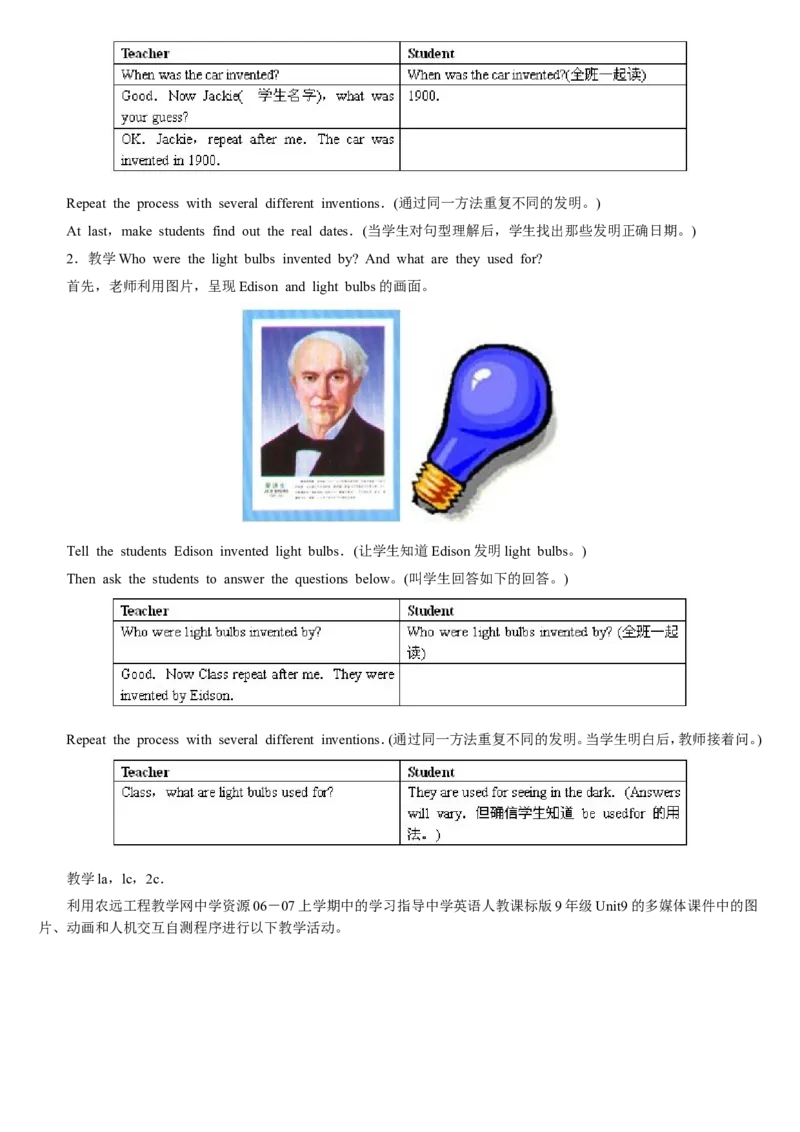
2.教学Who were the light bulbs invented by? And what are they used for?
首先,老师利用图片,呈现Edison and light bulbs的画面。
Tell the students Edison invented light bulbs.(让学生知道Edison发明light bulbs。)
Then ask the students to answer the questions below。(叫学生回答如下的回答。)
Repeat the process with several different inventions.(通过同一方法重复不同的发明。当学生明白后,教师接着问。)
教学la,lc,2c.
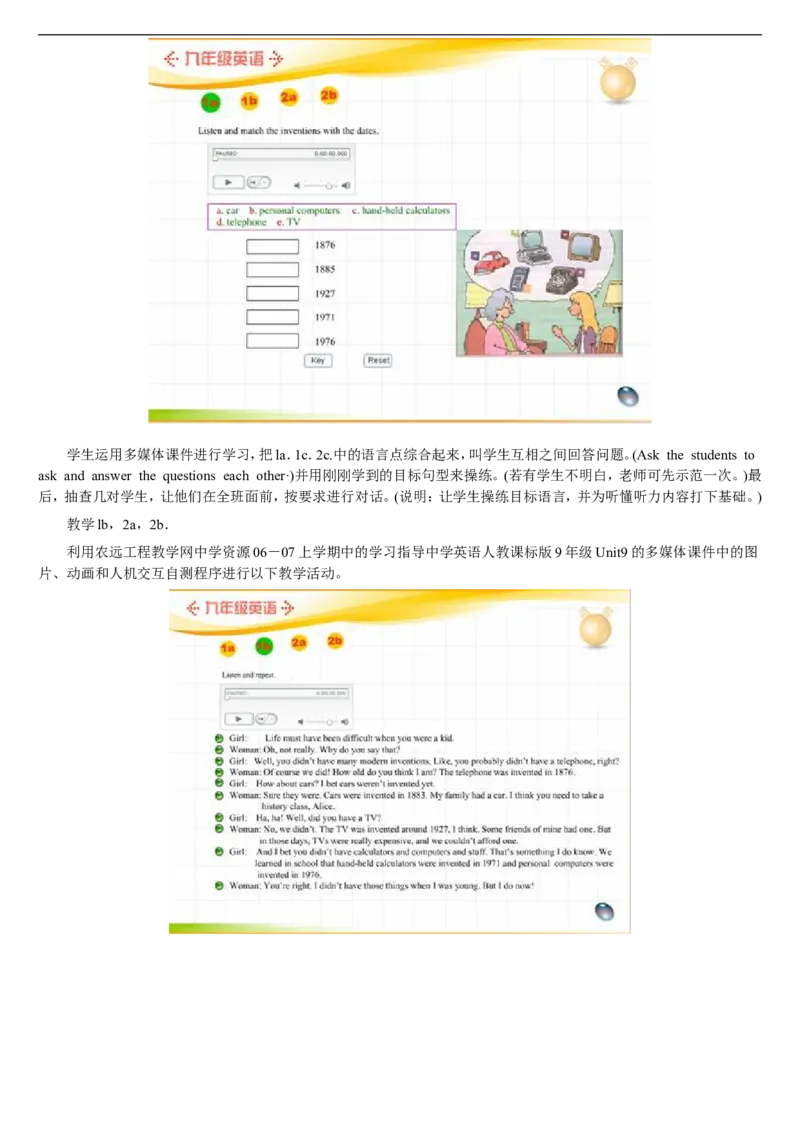
利用农远工程教学网中学资源06-07上学期中的学习指导中学英语人教课标版9年级Unit9的多媒体课件中的图
片、动画和人机交互自测程序进行以下教学活动。学生运用多媒体课件进行学习,把la.1c.2c.中的语言点综合起来,叫学生互相之间回答问题。(Ask the students to
ask and answer the questions each other·)并用刚刚学到的目标句型来操练。(若有学生不明白,老师可先示范一次。)最
后,抽查几对学生,让他们在全班面前,按要求进行对话。(说明:让学生操练目标语言,并为听懂听力内容打下基础。)
教学lb,2a,2b.
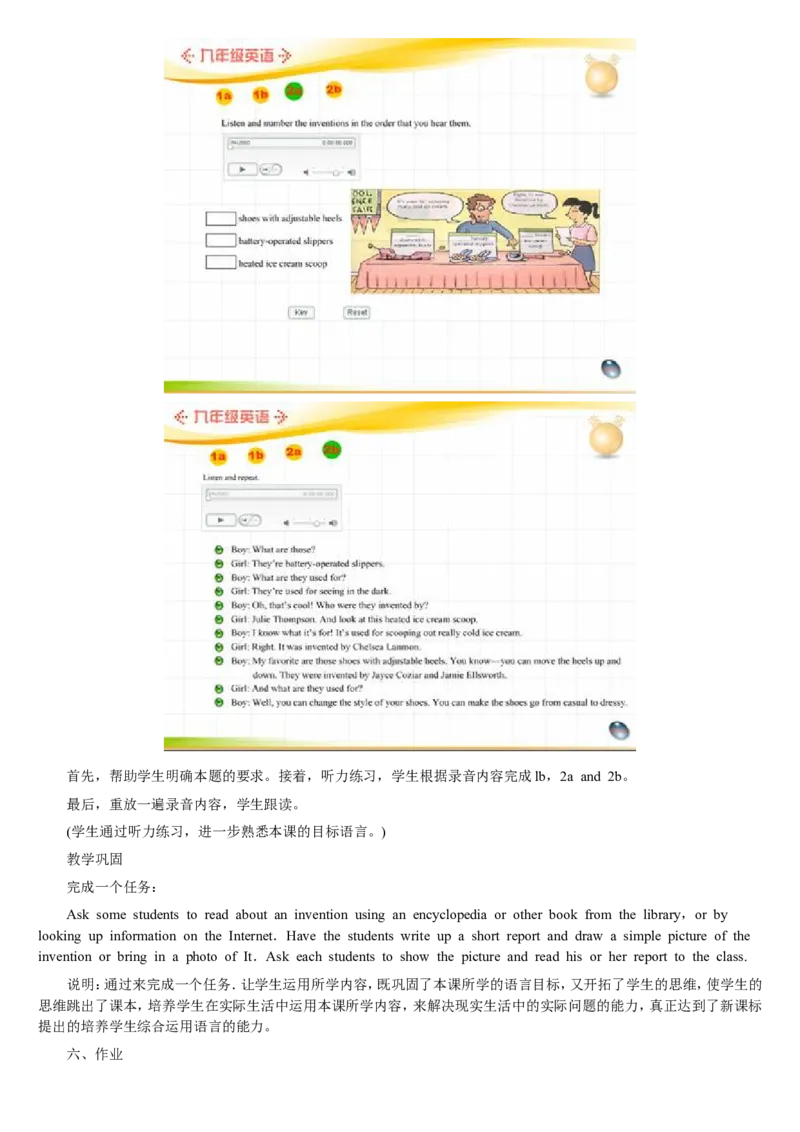
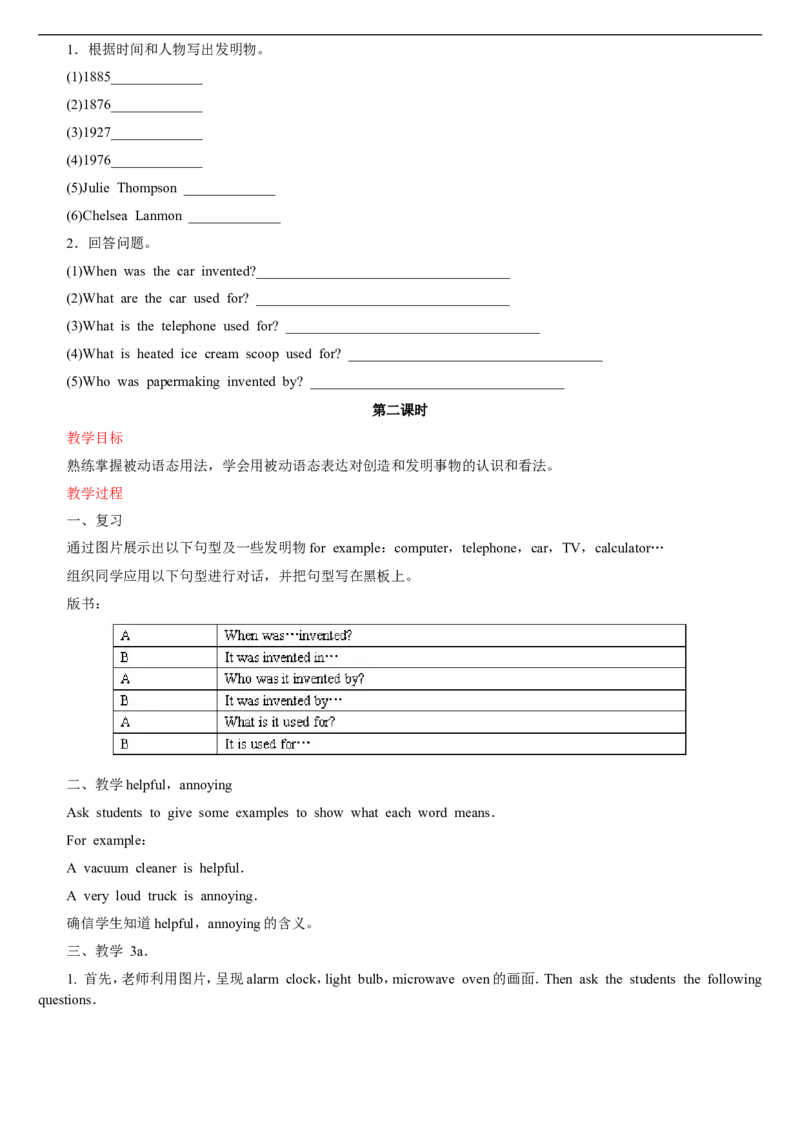
利用农远工程教学网中学资源06-07上学期中的学习指导中学英语人教课标版9年级Unit9的多媒体课件中的图
片、动画和人机交互自测程序进行以下教学活动。首先,帮助学生明确本题的要求。接着,听力练习,学生根据录音内容完成lb,2a and 2b。
最后,重放一遍录音内容,学生跟读 。
(学生通过听力练习,进一步熟悉本课的目标语言。)
教学巩固
完成一个任务:
Ask some students to read about an invention using an encyclopedia or other book from the library,or by
looking up information on the Internet.Have the students write up a short report and draw a simple picture of the
invention or bring in a photo of It.Ask each students to show the picture and read his or her report to the class.
说明:通过来完成一个任务.让学生运用所学内容,既巩固了本课所学的语言目标,又开拓了学生的思维,使学生的
思维跳出了课本,培养学生在实际生活中运用本课所学内容,来解决现实生活中的实际问题的能力,真正达到了新课标
提出的培养学生综合运用语言的能力。
六、作业1.根据时间和人物写出发明物。
(1)1885_____________
(2)1876_____________
(3)1927_____________
(4)1976_____________
(5)Julie Thompson _____________
(6)Chelsea Lanmon _____________
2.回答问题。
(1)When was the car invented?____________________________________
(2)What are the car used for? ____________________________________
(3)What is the telephone used for? ____________________________________
(4)What is heated ice cream scoop used for? ____________________________________
(5)Who was papermaking invented by? ____________________________________
第二课时
教学目标
熟练掌握被动语态用法,学会用被动语态表达对创造和发明事物的认识和看法。
教学过程
一、复习
通过图片展示出以下句型及一些发明物for example:computer,telephone,car,TV,calculator…
组织同学应用以下句型进行对话,并把句型写在黑板上。
版书:
二、教学helpful,annoying
Ask students to give some examples to show what each word means.
For example:
A vacuum cleaner is helpful.
A very loud truck is annoying.
确信学生知道helpful,annoying的含义。
三、教学 3a.
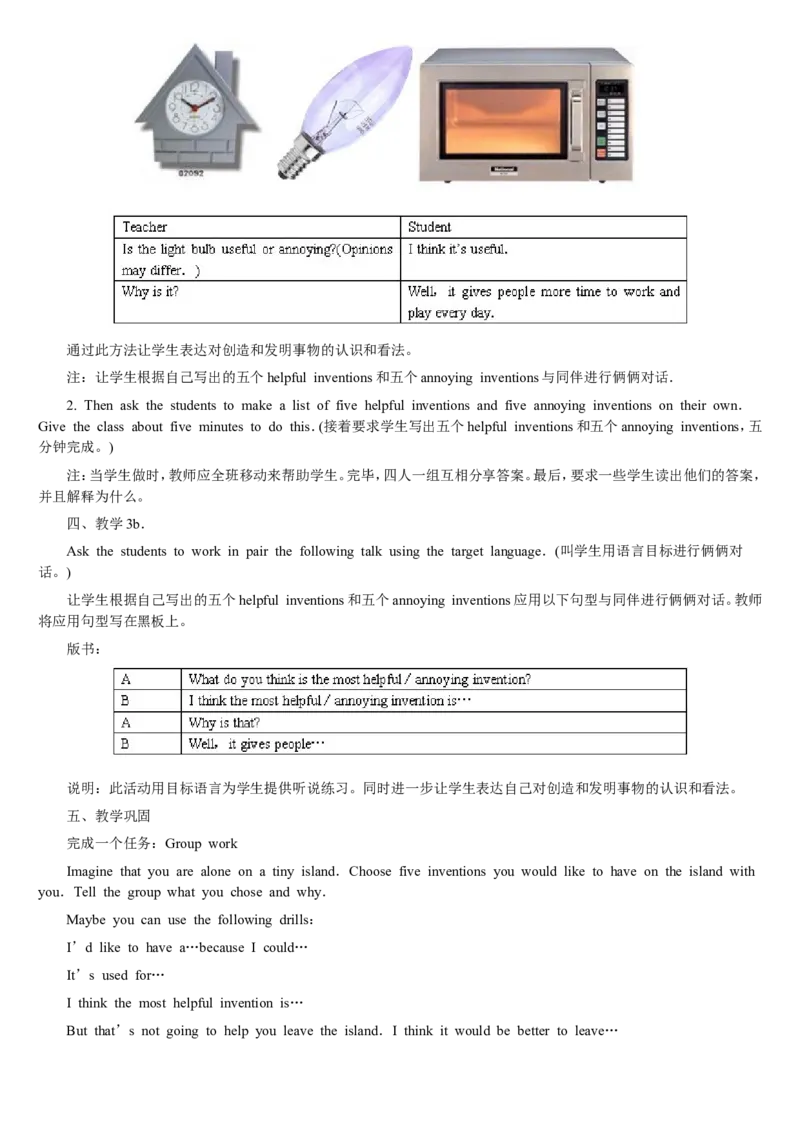
1. 首先,老师利用图片,呈现alarm clock,light bulb,microwave oven的画面.Then ask the students the following
questions.通过此方法让学生表达对创造和发明事物的认识和看法。
注:让学生根据自己写出的五个helpful inventions和五个annoying inventions与同伴进行俩俩对话.
2. Then ask the students to make a list of five helpful inventions and five annoying inventions on their own.
Give the class about five minutes to do this.(接着要求学生写出五个helpful inventions和五个annoying inventions,五
分钟完成。)
注:当学生做时,教师应全班移动来帮助学生。完毕,四人一组互相分享答案。最后,要求一些学生读出他们的答案,
并且解释为什么。
四、教学3b.
Ask the students to work in pair the following talk using the target language.(叫学生用语言目标进行俩俩对
话。)
让学生根据自己写出的五个helpful inventions和五个annoying inventions应用以下句型与同伴进行俩俩对话。教师
将应用句型写在黑板上。
版书:
说明:此活动用目标语言为学生提供听说练习。同时进一步让学生表达自己对创造和发明事物的认识和看法。
五、教学巩固
完成一个任务:Group work
Imagine that you are alone on a tiny island.Choose five inventions you would like to have on the island with
you.Tell the group what you chose and why.
Maybe you can use the following drills:
I’d like to have a…because I could…
It’s used for…
I think the most helpful invention is…
But that’s not going to help you leave the island.I think it would be better to leave…说明:通过来完成一个任务.让学生运用所学内容,既复习第一课时所学的语言目标和巩固了本课所学的语言目标,
又开拓了学生的思维,培养了学生在实际生活中运用本课所学内容,来解决现实生活中的实际问题的能力。
六、作业
1.句型转换。
(1)She was seen to come out of the library by him.(变为主动语态)
He ________ ________ ________ out of the library.
(2)When are trees often planted?(变为主动语态)
When ________ people often ________ ________?
(3)The League was founded in Guangzhou in 1922.(就画线部分提问)
________ ________ ________ ________ the League ________?
(4)Did the students wear the school clothes a lot?(变为被动语态)
________ the school clothes ________ a lot?
(5)Kate took good care of the baby yesterday evening.(变为被动语态)
The baby ________ ________ well by Kate yesterday evening.
(6)His aunt bought him a bicycle.(变为被动语态)
A bicycle ________ ________ him by his aunt.
2.汉译英。
(1)计算机是何时发明的?_______________________________________
(2)谁发明了计算机? _______________________________________
(3)计算机是用来做什么? _______________________________________
(4)你认为什么是最有用的发明? _______________________________________
(5)它能够给人们更多时间工作和玩。_______________________________________
第三课时
教学目标
学会表达由于这些创造和发明对你的生活的帮助和对生活质量的提高认识.
教学过程
一、复习
要求学生使用黑板上的句型练习对话。
版书:
通过口语练习,既激发了学生的学习积极性,让学生在轻松好奇的氛围中复习了上节
课的目标语言,又引出新课。
二、教学 1a,1b.1.First the teacher asks the students what kind of fruit food and drink you like the best and writes down on
the blackboard.教师问学生最喜欢什么水果和饮料并把它们写在黑板上。
比如:potato chips,ice cream,tea,lemon,chocolate,oranges,salad,popcorn,pickle and so on.
2.接着叫学生表达以上食物的味道,引出新单词——sweet,crispy,salty,sour,delicious,hot,awful,nice…并且完成
lb教学内容
通过此活动,以旧带新引入新单词。其目的是让学生自主学习新知识 。
三、教学 2a,2b
1.首先,听力前的brainstorm
First,Let students describe how potato chips taste and describe how helpful the potato chips.
Then,ask:When and where were potato chips invented?
Who were potato chips invented by?
How were potato chips invented?(Let students guess according to the following key words.)
Key words:by accident,customer,restaurant,by mistake.(说明:通过问题让学生对对话内容有整体了解,为听力练
习做好准备;又培养学生的注意力,想像力,观察力。)
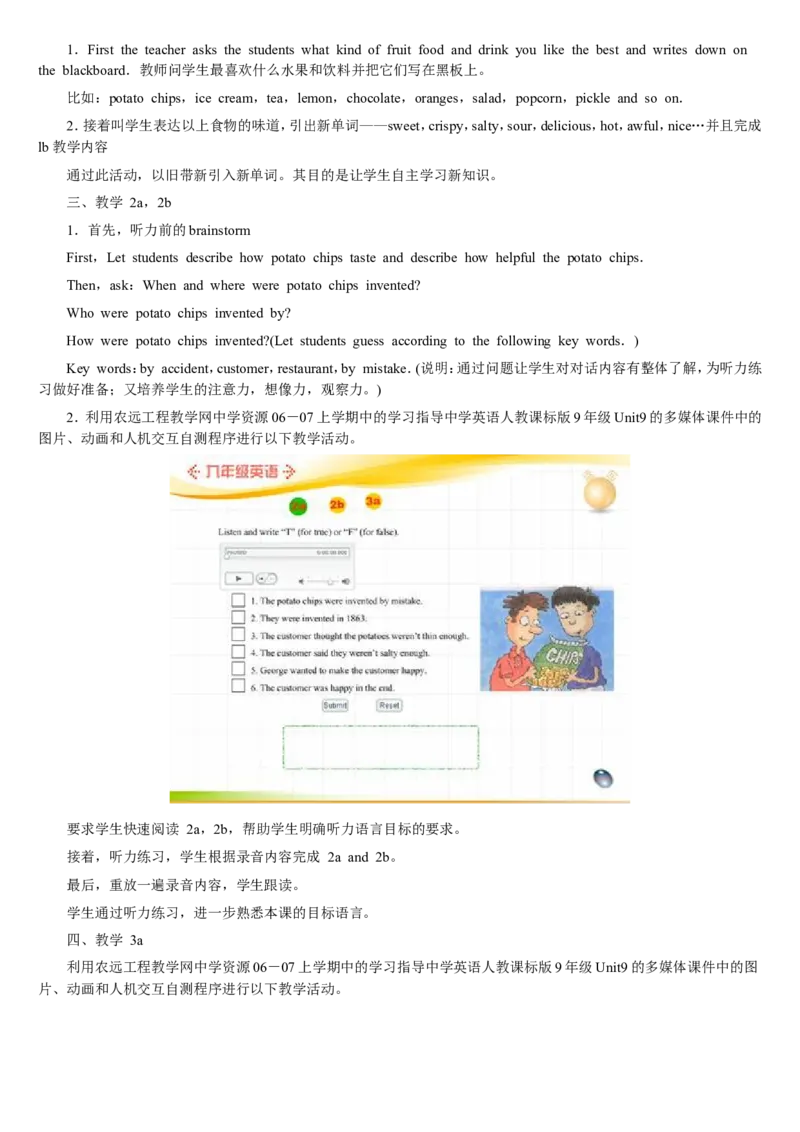
2.利用农远工程教学网中学资源06-07上学期中的学习指导中学英语人教课标版9年级Unit9的多媒体课件中的
图片、动画和人机交互自测程序进行以下教学活动。
要求学生快速阅读 2a,2b,帮助学生明确听力语言目标的要求。
接着,听力练习,学生根据录音内容完成 2a and 2b。
最后,重放一遍录音内容,学生跟读 。
学生通过听力练习,进一步熟悉本课的目标语言。
四、教学 3a
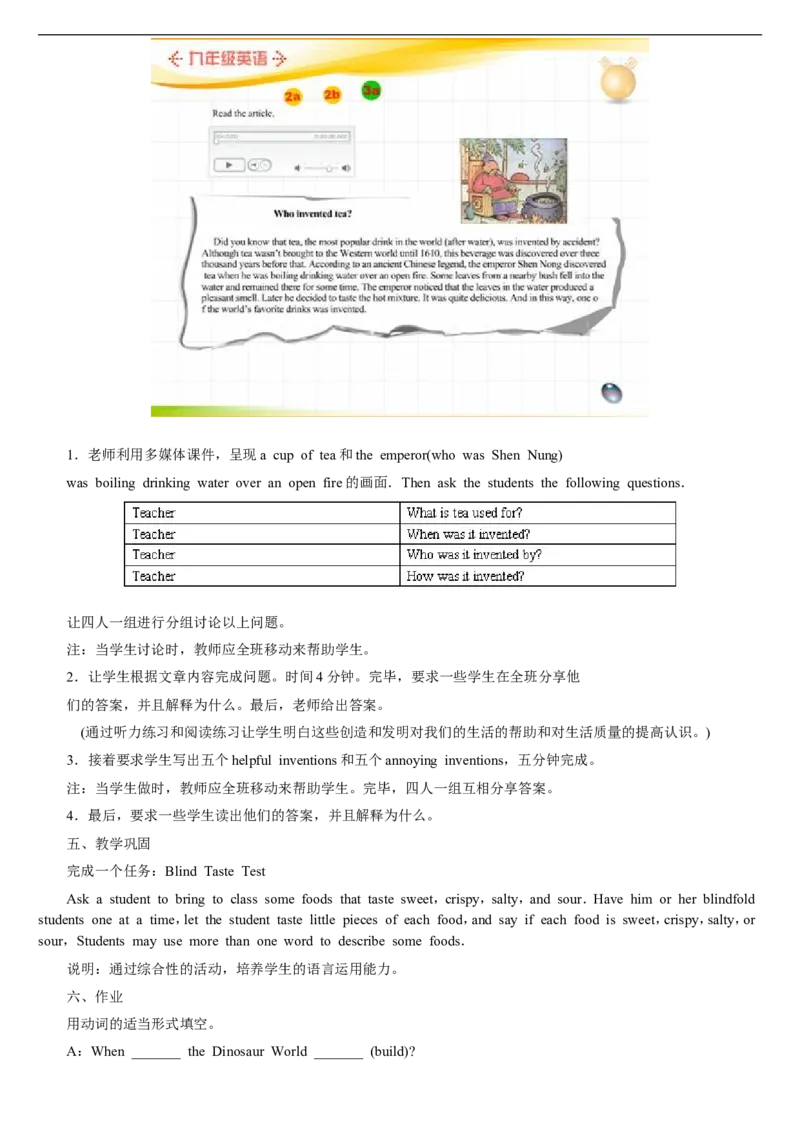
利用农远工程教学网中学资源06-07上学期中的学习指导中学英语人教课标版9年级Unit9的多媒体课件中的图
片、动画和人机交互自测程序进行以下教学活动。1.老师利用多媒体课件,呈现a cup of tea和the emperor(who was Shen Nung)
was boiling drinking water over an open fire的画面.Then ask the students the following questions.
让四人一组进行分组讨论以上问题。
注:当学生讨论时,教师应全班移动来帮助学生 。
2.让学生根据文章内容完成问题。时间4分钟。完毕,要求一些学生在全班分享他
们的答案,并且解释为什么。最后,老师给出答案。
(通过听力练习和阅读练习让学生明白这些创造和发明对我们的生活的帮助和对生活质量的提高认识。)
3.接着要求学生写出五个helpful inventions和五个annoying inventions,五分钟完成。
注:当学生做时,教师应全班移动来帮助学生。完毕,四人一组互相分享答案。
4.最后,要求一些学生读出他们的答案,并且解释为什么 。
五、教学巩固
完成一个任务:Blind Taste Test
Ask a student to bring to class some foods that taste sweet,crispy,salty,and sour.Have him or her blindfold
students one at a time,let the student taste little pieces of each food,and say if each food is sweet,crispy,salty,or
sour,Students may use more than one word to describe some foods.
说明:通过综合性的活动,培养学生的语言运用能力。
六、作业
用动词的适当形式填空。
A:When _______ the Dinosaur World _______ (build)?B:It _______ _______ (build)in 1988.You will see many kinds of dinosaurs in it.Shall we go to see them?
A:Yes,I’d love to.But where is the entrance.
B:_______ (use).9Here this side door is as an entrance.There’s something wrong with the front door.It’s
_______ (1ock).
A:Wow,these must be dinosaur eggs.Where _______ they _______ (discover)?
B:They(discover)in Sichuan Province.
A:When _______ these eggs _______ (1ay)?
B:I don’t know.That must be millions of years ago.
Unit 9 When was it invented? 第一课时 说课稿
一.教材分析
1.教材的地位和作用
本说课是九年级《go for it》第九单元“When was it invented?”本单元涉及内容是本书当中比较重要的一部分。
被动语态结构及运用是教学中一个难点和重点,也是学生比较不容易理解的部分,因为它是建立在各种时态之上的。
另外通过对我们熟悉经常使用的发明物的历史来开阔眼界,丰富学生的阅历,使学生养成勤于思考,善于总结的好习惯。
2.教学目标
1)知识目标 扩容新单词,提高阅读能力。理解和良好运用被动语态 。
2)技能目标 能谈论重要发明的历史及用途,能针对各项发明的用处及特点,发表自己的看法,并说明理由 。
3)情感目标 使学生懂得人类的科学发明创造了丰富的物质文明。培养学生的创造发明的能力和愿望
3.教学重点 掌握一般过去时的被动语态
4.教学难点 弄清主动语态与被动语态的差异,通过练习和运用加以巩固
二.学情分析
1.初中生的抽象能力较低,形象思维能力强。但注意力容易分散。本单元通过多媒体课件和教师亲和力的语言,增强兴
趣和注意力。
2.初中生的学习心理特点
1)兴趣 对英语普遍感兴趣,求知欲盛。
2)记忆 对刺激记忆手段多的知识记忆深刻,遵从记忆规律。
3)评价 主要通过他人评价初步形成对自己的评价,所以很在乎他人的评价。同时自我意识不断增强。因此在本课
教学过程中,注意采用任务型教学为主,通过任务和不同的评价方式,提高学生参与意识 。
3.初三上学期学生有较明确的学习动机和态度。本单元通过发明为载体,各种发明和发明家激励学生求知的欲望 。
三.教法渗透
1、教学设计思路与教材处理:
《新目标英语》中的具体语言目标是通过各种各样的Tasks来实现的;学生需要运用具体而特定的行动来完成一定的交际任务。整个教学过程中,各种语言结构与语言功能与不同的学习任务有机的结合。任务活动所谋求的效果不是一种机
械的语言训练,而是侧重在执行任务中学生自我完成任务的能力和策略的培养;重视形式在完成任务过程中的参与和在
交流活动中所获得的经验。因此本节课我将始终引导学生通过完成具体的任务活动来学习语言,让学生为了特定的学习
目的去实施特定的语言行动,通过完成特定的交际任务来获得和积累相应的学习经验,让学生在用中学,在学中用 。
2、教学原则
l 活动性原则 提倡学生主动参与,体验,交流,合作,探究等多种学 习。
l 合作性原则 以学生为主体,师生合作,生生合作,体现教与学的互动,交 往。
l 任务型原则 任务驱动—激发动机;任务完成—激励学习积极性;执行任务—培养责任 心和合作精神 。
l 情感性原则 激发学生学习英语的兴趣和始终保持良好的学习情绪。
3、教法运用:
本单元主要采用任务型教学
在本课的任务型语言教学中,我将依据课程的总体目标并结合教学内容,创造性地设计贴近学生生活实际的任务活动,
吸引和组织他们积极参与,使学生通过观察、思考、讨论、交流和合作等方式,在一种自然、真实或模拟真实的情境中体
会语言、掌握语言的应用。
4.教学手段
1) 多媒体辅助:使用自制的课件,使抽象的语言变得直观,为学生运用英语进行交际创设情景,实现师生互动,生生互
动和人机互动的多向交流。
2)非测试性评价:传统的评价观念的出发点是学科本位,只重学科,不重学生发展。 要体现新课程标准的实施效
果,评价体系应该“正确反映外语学习的本质和过程,满足学生发展的需要”。为了达到这一目标,唯有重视形成性评
价,充分发挥其积极作用,促进新的评价体系的形成。因此,本课我将各种活动设计成小组活动并开展小组竞赛和填写
课堂自我评价表等非测试性评价手段,帮助学生学会自主学习,学会与人合作,培养创新意识以及具备科学的价值观 。
四、学法指导
新制定的《英语课程标准》把“培养学生学习英语的兴趣,树立自信心,培养良好学习习惯和形成有效策略,发展自主学
习和合作精神”放在了首位。依据课改的精神,我从以下几个方面对学生进行学法指导 。
1、学习方法的指导
培养学生观察力,想象力,记忆力以及思维能力。用生动的课件调动学生的感官进行听说读写的训练 。
2、学习积极性的调动
我在教学过程中创造一种开放的,和谐的,积极互动的语言氛围,把课堂变成有声有色的舞台,让学生在乐中 学。
3、学习能力的培养
通过连贯的听说读写,游戏,竞赛等,培养学生的交际能力,发展他们的思维能 力。
4、学习策略的指导
本节课将在课堂活动中把学生分成四人小组的学习小组,让他们围绕着课堂任务分工合作,在活动中相互探讨、相互交
流、相互合作,从而获得知识、技能和情感体验,发展他们的能力。创建开放式,探究式的课堂,有意识渗透学习策略的训
练。我让学生观察课件画面,回答问题,让学生学会使用认知策略;让学生表演对话,实现交际策略;引导学生交际,主动
练习和实践,是调控策略的体现。充分利用多媒体,录音,卡片等是资源策 略。
五.教学效果预测;
1. 能够掌握被动语态,并运用到一定的语言环境。
2. 通过多媒体和任务的完成学生会突破难点,产生一定创造精神。
3. 能完成教学目标,调动学生学习热情。
六.课堂教学过程:
Ⅵ.Teaching Procedures
Step Ⅰ Lead-in (2 minutes)We have inventions everywhere .Inventions make us live easily and happily. Without inventions,our
lives will be much more difficult. Today, we will know about a few inventions and talk about the
history of them.
Show the pictures of five inventions on the screen: a car,a Tv set, a telephone, a calculator and
a computer.
T:Now look at these things.What are they?In what order do you think they were invented? Number
them(1-5) (1=first,5=last)
Volunteers report the answes.
S1:I think the calculator was invented before the computer.
S2:Idon’t think so. I think the calculator was invented after the computer.
Step Ⅱ 1a
This activity reviews vocabulary and introduces new vocabulary which can be used to talk about
inventions.
Read the inventions to the students.
Call the students' attention to the five pictures. Tell the students that all of these things were
invented in the last 150 years. Point to each picture and let the students tell what it is.
Write the names of the five inventions on the blackboard.
computer, car, calculator, telephone, TV set
Have several different students guess and write the dates on the board.
Ask the class to repeat the questions and answers like this.
T: When was the computer invented? Class repeat.
Ss: When was the computer invented?
T: Good. Now Tom, what is your guess?
S1: 1965.
T: OK. Tom, repeat after me. The computer was invented in 1965.
T: Class, please repeat.
Ss: The computer was invented in 1965.
Repeat the process with several different inventions.
Tell the children that they will find out the real dates after they complete the lesson.
After that, ask the students the questions below:
Questions:
1.Which one do you think is the oldest?
2.Which one is the newest?
3.Which one do you think is the oldest or the first invention?
4.Which one is the newest or last invention?
Ask different students to answer the questions.Have the students look at the example conversation in the box. Ask two students to read this
conversation to the class.
A: I think the telephone was invented before the car.
B. Well, I think the telephone was invented after the car.
Read the instructions again to the students. Remind them to remember the inventions from first to
last.
Then have the students talk about the five inventions in groups of four, using the sample conversation
as a model.
Ask several groups to tell the class their answers. The rest of the class listen to them and show they
have different answers by raising their hands.
In the next activity you will find out the real dates.
Step Ⅲ 1b
This activity gives students practice in understanding the target language in spoken conversation.
Get the whole class to read the instruction together.
Call the students' attention to the five inventions in the picture. Ask five students to say the names
of them.
Then ask them to see the five dates with a blank line in front of each.
We'll listen to a girl and a woman talking about the five inventions. They will talk about when they
were invented. Listen carefully and match the inventions and the dates. Write the correct letter in
front of each date as the sample given. Ask them to have a look at the sample answer. Tell them the
answer in front of 1876 is d. That means that the telephone, which is letter d, was invented in 1876.
Play the recording the first time. The students only listen and try to catch the main idea.
Play the recording a second time. Let the students match the inventions and the dates. Check the
answers by asking several to say the answers to the class.
If some of the answers are hard to get for the children, tell them not to worry and they will make it
next.
Then play the recording again. Pause after each sentence and let the students repeat. For some
difficult sentences, get the students to repeat several times. Be sure that they make everything
clear.
Answers
d 1876 a 1885 e 1927 c 1971 b 1976
Step Ⅳ 1c
This activity provides guided oral practice using the target language.
Read the instructions and point to the list of dates in Activity 1b.
You will be talking about the dates things were invented with a partner.
Call the students' attention to the example in the box. Ask a pair of the students to read this
conversation to the class.
SA: When was the telephone invented?
SB: I think it was invented in 1876.Write the conversation on the blackboard. Then get the students to practice in pairs, using the
information in Activity 1b. Tell them to do it like this:
Student A, covers the dates. Students B, asks Student A when the things in the picture above were
invented. Then change roles and practice again.
Ask several pairs to share their conversations with the class.
Step Ⅴ Summary
In this class, we've learned to talk about the history of inventions with passive voice. We've also
done some listening practice in understanding the target language in spoken conversation. And we've
done much oral practice, using the target language.
Step Ⅵ Homework
1.Write out two conversations in Activity 1a.
2.Write out two conversations in Activity 1 c.
Step Ⅶ Blackboard Design
Unit 9 When was it invented?
Section A
The First Period
1.The names of the five inventions:
computer, car, calculator, telephone, TV set
2.Target language:
A: When was the telephone invented?
B: I think it was invented in 1876.
Unit 9 When was it invented? SectionA(1a—1c) 英文说课稿
Good morning, everyone. It’s my pleasure to interpret my lesson here today. The lesson I’m going to
talk about is the first period of Book 9 Unit 9 When was it invented? I’ll describe my thoughts on
teaching this lesson in the following 4 aspects: analysis of teaching material, ways of teaching and
learning, teaching procedures and blackboard notes.
First of all, I’d like to give some analysis of the material and the students. This material is from
Book 9 Unit 9 When was it invented? The language goal of this unit is “Talk about the history of
the inventions”.
In this period, students will get in touch with the passive voice. It’s the first time for the
students to get in touch with the passive voice. This grammar item is a key point also is a little bit
difficult. In this period, I will mainly let the students touch with the passive voice. They realize
initially what the passive voice is constructed and what it expresses. That will be OK. I make "talk
about the history of inventions" as the language goal of the class.
OK, that is all about my analysis of material. And then I want to talk something about the students.
In our school, the students don't have much time to learn some inventions. So I ask them to get ready
for this lesson and try to find information about the four greatest inventions of ancient China and
some other famous inventors and their inventions. So they can have a concert of what they will learnin this class. I hope the students can hit the following goals after this class: they can realize the
passive voice initially; they can use the sentence structures learned to discuss the inventors and
their inventions; they can realize the ancient civilization of China, strengthen the proud of feeling.
According to the learning material and the analysis of the students, also on the basis of NEC, I set
the learning objectives as follows.
By the end of this session, most of the Ss will be able to achieve the following aspects. First of
all, most of the Ss will be able to learn and use some important language points, like calculator,
bulb, invent, inventor, invention and so on. Second, Ss will be able to use the following sentence
patterns to talk about inventions: When was the car invented? It was invented in…Who was the car
invented by? It was invented by.... Third, Ss will be able to write an article about great invention.
These are my teaching and learning objectives. And the focuses lie on helping Ss improve their ability
to find out the information they need after listening, and the ability to write an article about a
great invention, using the passive voice. The difficulty is the using of the passive voice.
Then let me say something about the teaching methods. In order to reach my objectives, I’ll design
some pair works and group works to increase Ss talking time on the basis of the student-based teaching
method. And I’ll design some tasks to improve Ss’ listening and writing skills mentioned above, on
the basis of task-based teaching method. Besides, in order to make the lesson lively and interesting,
I’ll try to use modern equipments.
Ok, so much for the learning strategies. Next comes to my most important part, the learning
procedures. My Ss will learn the lesson in 7 steps.
Step one is warming-up. First, I’ll greet the Ss with daily conversations. And then I’ll show them
some pictures of the ceremony (2008 Olympic Games ) on the screen to talk about the Chinese history
and the four great inventions.
Then I’ll show the pictures of the four great inventions, and ask students: Who invented …? And then
present the new sentence patterns: -Who was the paper making invented by ? -It was invented by Cai
Lun. -When was it invented ?- It was invented in Donghan Dynasty After that, ask students to ask and
answer in pairs, using the above sentence patterns.
Then I’ll say that we have known some ancient inventions, ask Ss “ Do you know any modern
inventions?” Ask Ss to tell as many as they can, such as car, telephone, light bulb, computer and so
on. And then ask Ss: “When were they invented? And who were they invented by?” So we will come to
step 3. Ss may find out the answer after listening.
After the third step, I’ll show more inventions on Bb, and ask Ss to discuss them in groups of four.
Then give a report. Ss should use the following sentence patterns while they are talking.
- When was the laser invented? - It was invented in …
- Who was it invented by? - It was invented by …
inventions When was it invented? Who was it invented by?
Laser 1960 Tony
airplane 1903 Light
E-mail 1971 Tomlinson
telegraph 1895 Marconi
air-conditioner 1902 Wailers
auto- dub machine 1967 Belon
ball pen 1938 ParishesAfter the discussion part, we’ll go to step5-writing. Because after the listening and discussion,
it’s time for Ss to write something about an invention. But first I’ll give Ss some oral examples
about it. And examples can give these students who are not good at English some help. And this oral
practice can make them easy to write the article. After the oral practice, we’ll come to write the
article about a great invention. Before Ss write it, first I’ll help them how to begin the article.
This can improve Ss’ learning strategy. Before Ss write it by themselves, I’ll give them my
examples, which can help those Ss whose English are not good to write. Next, the Ss will write the
article, and after they finish it, I’ll show them 2 artcles from them to share with them..
After the writing, it’s time to summarize what they have learned, and after that, do some exercises,
that will help to consolidate what they have learned.
Exercises:
1.将下列主动句改成被动句:
1) Many people speak English.
2) We should look after our books well.
3) They make wood into desks.
4) They invited Tom to see a film.
2. They were invented ___ Julie Thompson.
A. as B. for C. by D. to
3. This watch _____ China
A. was made in B. was made by
4. — ____ was the car invented? — In 1983.
A. When B. Why C How D. Who
5. Basketball ____ by people all over the world.
A. is enjoyed B. is like C. love D. enjoyed
Finally, I’ll tell Ss the homework and say goodbye to them.
That’s all about my teaching procedures. Next I’ll say something about the Bb design. As we know Bb
note is the miniature of the whole lesson. It can display the procedures of the lesson and the
language points learned in this lesson. It’s good for Ss to get the clear idea of the whole lesson.
And teacher can use it to review.
That’s all about my lesson talk. Thanks for listening it. Bye!
板书:
Unit 9 When was it invented? Period 1
When was … invented? invent
It was invented in … inventor
Who was … invented by? invention
It was invented by… calculator
BulbUnit 9 When was it invented? SectionA 英文 说课稿
A. Teaching material analysis:
1. My topic today is 1a-2c of section A in Go for it Unit 9. The language goal of this unit is “Talk
about the history of the inventions”. The key words are:
scoop, adjustable, heel, battery, operate, slipper, bulb, invent, be used for.
2. The key expressions listed as follows :
When was the car invented? It was invented in…
Who was the car invented by? It was invented by...
What is it /are they used for? It is/They are used for...
3. The difficult point is the new language function of passive voice.
B. Teaching anticipation
It’s the first time for the students to get in touch with the passive voice. This grammar item is
a key point also is a little bit difficult. In this period, I will mainly let the students touch with
the passive voice. They realize initially what the passive voice is constructed and what it expresses.
That will be OK. I make "talk about the history of inventions" as the language goal of the class. In
our school, the students don't have much time to learn some inventions. So I ask them to get ready for
this lesson and try to find information about the four greatest inventions of ancient China and some
other famous inventors and their inventions. So they can have a concert of what they will learn in
this class. I hope the students can hit the following goals after this class:
1. They can realize the passive voice initially.
2. They can use the sentence structures learned to discuss the inventors and their inventions.
3. They can realize the ancient civilization of China, strengthen the proud of feeling.
C. My thought for the design of this class
In this class, I will lead the students to have a tour to an African original tribe and recommend
some inventions in our daily life to improve their originality situation, thus develop the topic. The
activities involve three key sentence structures of this lesson:
When was it invented?
Who was it invented by?
What is it used for?
My post task is a letter from a student to Africans. It introduces the ancient four greatest
inventions of China. But there are many mistakes about the passive voice. I get the students to
correct them. Through the practice, the students can consolidate what they learned today. What’s
more, it can make the students realize the glorious and ancient civilization of China.
D. Teaching procedures:
Step 1. Warming up
I present the language targets on the first page of ppt. It can make students realize what they are
going to learn before class. So they will have a better effect to learn it well.
Step 2. Lead-in
1. T: Today we are going to Africa. We'll visit an ancient tribe. (Present the African original tribe
picture)
T: They live in the house like this. (A dark house) What do they need?
S: Bulb.
Present the bulb that student said. Explain that this is an invention
T: It’s a kind of invention.
2. Present Edison’s picture,
T: Who is this man? (Edison)S: He was an inventor.( Present the vocabulary inventor)
T: He invented many inventions.
Please say something about Edison and the bulb.
S: Edison invented the bulb.
(The student can describe with the active voice which learned before)
Then change the positions, and then let the student say the relation again.
(Design aim: I want to make the students find out what the passive voice is. It will develop the
ability of independent study)
3. Repeat the same steps with some other inventions (car and telephone).
Step 3. Activity1
T: The Africans want to know when the inventions were invented.
1. Order the inventions (1a)
Get the students to guess in what order the inventions were invented and number them from 1-5.
They can discuss with their partners:
S1: I think the telephone was invented before the car.
S2: Well, I think the car was invented after the telephone.
2. Listen to the tape and find the time of the inventions. ( 1b )
Then check the answer and know whose order is right.
3. Pairwork (1c )
Make conversations using the timetable in 2a.
(Goal: do 1a-1c. withdraw the knowledge dot and practice.)
Step 4. Activity2 Have a try
T: Let’s learn some other inventions.
- When was the laser invented? - It was invented in …
- Who was it invented by? - It was invented by …
inventions When was it invented? Who was it invented by?
Laser 1960 Tonys
airplane 1903 Light
E-mail 1971 Tomlinson
telegraph 1895 Marconi
air-condition 1902 Wailers
auto-dub machine 1967 Belon
ball pen 1938 Parishes
(Goal: practice the key sentence structures with some other inventions and open the students mind
at the same time)
Step 5. Activity3 What are they used for?
T: The Africans know when the inventions were invented. And they want to know what they are used
for.
Show a conversation between Bell and an African
African: What’s the telephone used for?
Bell: It’s used for talking with people.
1. What are they used for? (Present a sheet of inventions)
1) Discuss in groups of four.
2) Get the students to guess. They can have their own ideas.
2. Guessing game
Divide the whole class into two groups and have a competition. The group gives out more correct
answers in three minutes will be the winners. One of their members will read for them with the
information in the cards. The words in the cards are like this: Bell, telephone, 1876, talking with
people …Students can rob the answer while reading the information.
The teacher needs to get ready for the cards before class.
(Goal: play a guessing game like Lucky 52 which students are interested in. It's used for
consolidating the key sentences and passive voice.)
Step 6. Activity4 Reading
T: The Africans are very glad to know so much about the inventions. So they’d like to read some other
articles about other modern inventions.
Give the listening material and the forms to the students before class
1. Read the conversation and fill in the chart
inventions Who was it / they invented by? What is it/are they used for?
Shoes with adjustable heels scooping really cold ice cream Julie Thompson
2.Check the answer
3.Read after the tape together and read the new words
(Goal: 2a/2b is listening material. I design it as a task reading. We have learned the sentence
structures in the step above. )
Step 7. Activity5Small inventors
T: Show time! Show your inventions to the Africans! (Prepared)
1. Survey
Four students as a group, one student works as a reporter to interview the other three students and
fill in the chart.
inventions Who was it invented by? When was it
invented? What is it use for?
2. Report Make a report about their new inventions
… Was invented by … it was invented in.... It is used for …
(Goal: practice the key sentence structures surrounding the language goal. Develop the student’s have
fantastic ideas and consciousness of the invention innovation)
Step 8.Activity6 the four greatest inventions of ancient China
1. Show the four inventions, the inventors, the invented time, the usage to get the students to match
them.
2. Show a letter from a student to an African, there are many mistakes, get the students to correct
them.
3. Write the correct letter if time is permitted.
(Goal: make the student consolidate passive voice. students can realize the ancient civilization of
Chinese, self-confident and proud of feelings.)
Step 9. Summary
1. The passive voice
被动语态的构成: 助动词(be)+动词过去分词 (done)
am/is( are) + done 一般现在时
was (were) + done 一般过去时
2. Expressions
When was the car invented? It was invented in 1876.
Who was the car invented by? It was invented by Ford.
What are they used for? They are used for driving.
Step10 .Homework
• Copy the new words three times and remember them
• Finish Homework A Page 1
• Write the corrected letter to the African.
• Preview : new words and expressionsUnit 9 When was it invented? SectionA(1a—1c) 说课稿
各位评委老师:
大家好!我说课的内容是新目标英语九年级上册第九单元“When was it invented?’’的第1课时,即
SectionA(1a—1c)。下面我将从以下几个方面进行说课。
一.教材分析
这个单元围绕“发明”这个话题,让学生通过了解不同东西的发明历史和用途来学习语法项目——被动语态。再通
过听、说、读、写训练熟练掌握语言知识和技能,最后让学生分析自己身边的发明的优缺点,从而进一步认识世界并改造
世界。同时,教材内容从基本语言知识到语言综合知识的运用,层层递进,引导学生进行有目的学习语言。
二.教学目标
1.知识语言目标:能够让学生掌握重点词汇:invent,caculator,computer,car等。
让学生掌握一般现在时和一般过去时的被动语态以及其陈述句和疑问句。
2. 能力目标: 学会谈论发明的历史,认识些被发明的事物;能用被动语态进行对话。
3. 情感与价值: 树立科学观念,培养积极探索,勇于创新的精神。
三.教法策略
以任务型教学策略为主,利用多媒体向学生展示发明物图片、听力训练法(处理听力材料)、并辅助个人、小组对话和
图片等兴趣策略教学。如在新授单词时,通过一些图片,幻灯片等进行分析教学,以致于从视角引起他们注意从而记住
单词。采取任务型教学策略的目的是主要是让学生多练多用,在做中学、学中乐、乐中掌握知识。
四.学习策略
通过角色表演,掌握如何利用被动语态谈论发明,在完成任务的活动中主动的学习语言,养成继续学习英语和学好
英语的良好习惯。强调学生不仅要在课上积极发言、多练,并鼓励他们课后成立英语学习兴趣小组、英语角等,且鼓励学
生积极参加。
五.重点、难点分析
重点词汇在对话和图片中解决。如:invent, caculator,computer,car等。
难点:听力训练;用被动语态谈论发明的历史和发明的用途来进行口语训练。
六.教学准备:黑板、图片、录音机、投影仪、一些发明实物。如:玩具汽车、电话机等。
七.教学过程
1、课前任务设置,在每一节课,我让学生提前预习。课前3分钟我让学生学唱“big ”big world ”的歌曲,目的是激发他们
学习热情,另一方面铃声响的时候,首先检查学生对第八单元单词的记忆情况。然后让学生看着屏幕,用“When was
car invented?”等句子问,用It was invented in1885回答,之后通过图片展示推出其他的发明和新授的单元内容。在此
期间,让学生感知“When was it invented? It was invented in…”的重点句型结构,把单词教学融入句型,培养学生在情
境中理解记忆单词的能力。
2、为了更好的提高学生的理解能力,让学生有目的地完成Activity1a.请学生注意五幅图片,告诉学生这些发明是在过去
150年发明的。通过投影仪展示图片,同时让学生说出发明的名称。老师在黑板上写下:
computer,car,caculator,telephone,然后说出问题:When was the computer invented?再回答: The computer was
invented in 1976.学生重复When was the computer invented? The computer was invented in 1976.接下来请学生看
方框中的对话并复述。然后要求学生就五个发明物或自己的小发明进行小组对话。从而提高学生口语能力,帮助学生掌
握被动语态。3.完成1a部分后,为了更好的巩固学生对发明的理解程度 ,让他们通过1b进行听力训练,培养学生在用中学、学中用
的能力。首先请一个学生说出1b 中五个发明名字,然后播放录音,同时让学生把发明物和发明的日期配对,最后检查答
案。
4.为了更好的运用被动语态,请学生练习1c,然后请两个同学把对话说给同学们听.When was the telephone invented?
I think it was invented in 1876.接着让学生用1a里的发明物或自己的小发明进行分组练习,最后请几组把他们的对话
和全班同学一起来分享。
5、总结本节课所学的知识,梳理知识结构。
6、布置作业
总之,这堂课通过听、说、读、写训练,让学生熟练掌握用被动语态来谈论发明的历史和用途,利用二人小组活动,学
生讨论各自对发明创造的想法以及他们自己的小发明,开阔学生的思路,让学生展开丰富的想象翅膀,培养学生的创新
精神。
Unit 9 When was it invented? Section B(1a—2c)英文说课稿
1.Analysis of teaching material
2.Analysis of teaching methods
3.Teaching procedures
4.Teaching reflection
Part 1 Analysis of the teaching materia l
1. Status and function: This is the first part of Section B, it links the preceding with the
following in Unit 9. Not only does it help the students review the food words and the Passive Voice
they have learnt before, but also it helps them learn to describe different tastes and talk about the
history of the invention. Such a topic is related to daily life, so it is helpful to inspire the
students’ learning motivation and interest.
2. Teaching aims and demands
Knowledge aims:
☆ The target words: crispy, salty, sour, chef, sprinkle, by mistake.
☆ The target language: Did you know potato chips were invented by mistake?
Wow, I didn’t know that. Who invented them? ...etc.Ability aims:
☆Be able to describe different tastes using the target words.
☆Train the students’ listening, speaking, reading and writing skills with the target language.
Moral aims:
Cultivate the students’ ability of observation, imagination and their spirit of innovation.
3. Teaching emphasis and difficulties:
Important points
The target words and language.
(According to the English syllabus and the language structures in this lesson.)
Difficult points:
The listening practice and correctly express the history of the invention.
(According to the teaching prediction and the students’ cognitive level)
Part 2 Analysis of teaching method s
1. Teaching methods:
“Task-based teaching method “with the help of useful situations to classify the tasks and give
different students different evaluations.
(To make language learning successful through a step-by-step progression that builds confidence and
leads to open-ended activities.)
2.Teaching aids:
Multimedia computer, Tape recorder, PowerPoint.
(According to the students’ psychological characteristics. They enjoy music, pictures and cartoons.)
Part 3 Teaching procedures
Step 1 Brainstorming
Play guessing games: what inventions are they?
One student comes to the front to guess, the others describe an invention shown on the screen using
the passive sentences: It’s used for… It was invented by…It was invented in…etc.Take turns to show ‘light bulb, alarm clock, microwave oven’with some other helpful pictures that
center about them nearby on the screen.
(Purpose of designing: To guide the students to review what they learned last lesson)
Step 2 Leading-in
T: The microwave oven reminds me of some delicious food. I will play a cartoon called “music food”
My favorite food is in it. Try to guess what it is.
Every time when they give a guess, I will express my like and dislike by using some adjectives like
sweet, crispy, salty, sour . Make sure they know the meanings of them. For example:
S:Chocolate
T: It’s very crispy, but it’s too sweet. I don’t like it Can you guess the meaning of ‘crispy’?
It describes food that is hard .dry and easily broken.
S :Milk.
T:I prefer sour milk to milk. Do you know ‘sour’? Oranges sometimes taste sour.
S: Fish.
T: yes! Fish is my favorite, and I especially like salty fish that is sprinkled with a lot of salt.
During this course, write down the new words on the blackboard..Finally play a leading role to read
them.
(Purpose :To arouse the students’ interest ,create useful situations for them to learn the new words.
Prepare for the next step. )
Step 3 Practice
Task One writing
1a.Show four food pictures on the screen and get the students to describe how the food tastes and
write them down.
1b.Ask them to list the words of the food that has different tastes according to the headings on the
screen as many as possible .
sweet crispy salty sourThe teacher moves around the classroom to provide help for the students who have trouble in spelling
some hard words and choose three students who write different words from one another.
(Purpose: To practice using the target words and review the food words they have learnt before.)
Task Two Speaking and acting
Get the three students to the front, divide the class into four groups:
Sweet Group , Crispy Group, Salty Group , Sour Group
Game begins: The three students read their words loudly in class one by one without repetition, the
group members should stand up as soon as they hear a word that belongs to them. Call out the students
who stood up by mistake and have them guess the meaning of ‘by mistake’.
(Purpose: This is employed to show the words they wrote and link the target words with the food words,
and get the whole class moving.)
Step 4 Presentation
T: Just now you mentioned many kinds of food, but do you know there are some interesting stories
behind them. Here is one.
Ask the students to look at the picture in 2a and imagine what they are talking about.
S: They are talking about the story of potato chips.
T: Right .Maybe on the bag it says the invention of them!
(Purpose: Cultivate their ability of imagination and present the invention of potato chips.)
Step5 Practice
Task One Listening and understanding
2a. Let the students look through the six sentences in the box and get some information from them.
Then play the tape recording twice for them to listen and circle T or F. Check the answers.
(Purpose: To provide practice in listening and understanding the target language in spoken
conversation.)
Task Two Listening and writing2b. Before playing the recording, get the students to try to give answers by memory, or just by
guessing. After a while, play the recording for them to fill in the missing words they hear. Then
check the answers while concentrating on the new words: chef, sprinkle…on…
(Purpose: To provide practice in understanding and writing the target language ,break through the
difficult point.)
Task Three Pairwork
2c.Ask the students to make conversations using the information in 2a and 2b ,then ask some pairs to
act them out. as follows:
A: Did you know potato chips were invented by mistake?
B: Wow, I didn’t know that. Who invented them?
A: They were invented by a chef called George Crum.
B: …
(Purpose: Students are willing to show themselves and this task provides benefits for both more fluent
and less fluent students to use the new language to talk with others and achieve the ability aim.)
Task Four Groupwork
T: Are you interested in the history of the sandwich?
Show some pictures about the story of sandwiches on the screen, get them to discuss the history in
groups of four as follows:
Invention When was it invented? Who…by? Where…? How…?
the sandwich
Then each group choose a leader to give a report in class after that .
(Purpose: This is employed to do further consolidation and extension using the target language, it
also fosters a sense of cooperation in the classroom.)
Step 6 Homework
T: Think of a kind of food you like best and try an unusual way to cook at home and write your
experience in your exercise book. And ask your parent to sign his/her name on your book.
(Purpose: The new type of homework is employed to relate the knowledge that they learn from this
lesson with the life realities, and achieve the moral aims.)Blackboard design:
Unit 9 When was it invented? Section B
crispy ( hard, dry and easily broken) by mistake
sour chef(cook)…
salty (sprinkled with lots of salt) sprinkle.. on
A: Did you know potato chips were invented by mistake?
B: Wow, I didn’t know that. Who invented them?
A: They were invented by a chef called George Crum .
B: …
(Purpose: To show the language structures they mainly learn from this lesson.)
Part 4 Teaching reflection
According to << English Course Standard >>,I combine different language structures and functions with
different studying tasks. I put emphasis on raising the students’ interest, forming effective
strategies and developing the cooperative spirit. And I think I’ll make it.
This is a period of various contents, maybe the time of one class is not enough, I need to adjust the
teaching steps according to the actual situations. And in 1b. of Step3,it requires the teacher to have
a large vocabulary to provide help for students. One minute in class, ten years’ hard working after
class—I need to hold on to studying to improve myself.
Unit 9 When was it invented? 最后一课时说课稿
Good morning,everyone! I’m very glad to stand here to interpret my lesson. The lesson I’m going to talk about
is the last period of Unit 9, Book 9. Reading Do you know when basketball was invented? I’ll describe my
thoughts on teaching this lesson in the following 6 aspects: analysis of teaching material, analysis of students,
teaching aids, teaching aims and demands, teaching procedures and teaching feedback.
First of all, I’d like to give some analysis of the material and the students. This material is from Go for it!
Book 9, Unit 9 When was it invented? The language goal of this unit is to “Talk about the history of inventions.”
In this unit, students will get in touch with the passive voice, which is a new grammar. And it’s important
and a little bit difficult. In the prior periods of this unit, students have got in touch with the passive voice and
realized initially what the passive voice is constructed and what it expresses. So in this period, I make “improvestudents’ reading ability” as a key point.
OK, that is my analysis of material. And then I want to talk something about the students. In general,
students’ reading ability in our school is poor. When they meet long articles, some of them don’t know what to do.
So my aim is to make them master how to analyze a long article. Here, we need a new learning stratery—Mind-
mapping.
Next, teaching aids, I need a projector to show students some pictures.
According to the teaching material and the analysis of the students, I set the teaching aims and demands.
By the end of this period, first of all, most of the students will be able to master some words, phrases and
key sentences. Secondly, students will be able to use the mind-mapping to remenmber information and their reading
ability can improve. Thirdly, by learning the article, students can learn the history of basketball. They also know that
playing basketball is a good way to keep healthy. So we should love basketball, love sports and love our life.
The important point of this period is to improve students’reading ability.
The diffcult point of this period is how to use mind-mapping to remember information.
OK, so much for teaching aims and demands. Next comes my most important part, the teaching procedures.
My students will learn the lesson in 4 steps.
Step one is lead-in. First, I’ll greet the students with daily conversations. And then I’ll let them talk about
sports played in China. Next show them some pictures, then let them talk about which sport is the most popular in
China and which sport is their favorite and why.
Step two is pre-reading. Basketball is very important all over the world. Some boys in our class like playing
basketball after class. Students in groups talk about basketball and give the whole class some information about it.
Step three is reading. There are 4 tasks I have designed.
Task 1 Students scan the article. While reading, they can draw pictures on the paper. Then complete the mind-
mapping with the information from the reading.
Task 2 Students read the article again, then answer the following questions.
Task 3 Give students some clues, let them analyze every paragraph by themselves.
Task 4 Underline the key words, expressions and grammars in the passage and try to use them.
My fourth step is post-reading. In this step, I’ll interview some students, “Would you like to play on China’s
national basketball team one day?” Let the students talk about it and give us a report. Then I will give them a
suggestion: Maybe it’s hard to realize this dream, so they should keep a good banlance between playing basketball
and their study.
Finally, I’ll tell the students the homework. Students get some information on the internet. Then write an
article about the history of a sport they like.
That’s all my teaching procedures. Next, I’ll say something about the teaching feedback. In the step of post-
reading, I thought students would talk about the question actively. But it didn’t achieve my expected result. I should
give them some clues, then encourage them to do better.
That’s all about my lesson talk. Thanks for listening. Bye!
Unit 9 When was it invented? 说课稿
1Alynasis of teaching material
1 Status and function
In this unit ,student learn to talk about the history of inventions using the passive voice .And they will know much
about the history of several inventions.Also they will be asked to think of their own inventions.The children will
understand that they should always try out their new idears.All students will be interested in the stories of theinventions of the inventions of the potato chips, the flying disk and some other things. And they will make great
progress in English after learning this unit
2 Teaching aims and demands
1 Knowledge object
Key vocabulary: invent calculator
Target language:When was the telephone invented?
I think it was invented in 1876.
2 Ability object
Teach student to use new words.
Train students to talk about the history of inventions
Train students’ listening and speaking skills with the target language.
3 Moral object
Many important inventions have changed the word a lot. Do you know the inventors of them?And when were
they invented?
3Teaching key points
invent calculator
Target language:When was the telephone invented?
I think it was invented in 1876.
4 Teaching difficult points
1 Train students to talk about the history of inventions.
2 Train students to under stand the target language in spoken conversation.
5 Teaching methords
Audio—visual , listening, communicative, Task—based
6 Teaching procedures
1 Lead—in
In order to attract the students’attention and constracte an surrounding of learning English, I’ll show them a
short film about some great inventions , ask them:Do you know them? Please tell me their names.
They will anser my questions, afterwards ,I tell them a small intresting story about one of the inventions
2 Presentation
I present all the new words by vivid pictures ,especially the tipical pictures from the net ,in this way they
will be impressed by the nice pictures.
When I present the sentence patten : When was ------invented? Practice:I take a phone of
mine ,tell them :It belong to me Do you know when was it invented ? And I will show some pictures about
the inventions in 1a and let my student guess when were they invented,let them practice the sentences in 1a
and write the order in 1a
There is a competition,tell them who can give me the answer quickly ,let more student have the chance to
answer questions,certainly,them should answer me quickly and aloud,
Let the students write down the great inventions they know,the more the better in a limited time and collect
the papers
Let students listen to the tape pay attention to the pronunciation task in 2b conneting the name with thing
and reason.
1 production
In this step I will give students a free space to shoe their ability ,a short video film is about some great
inventions and some intresting inventions ,there is a cartoon that some animals use telephone to communicate
and the animal will tell the time when were the inventions appeared in history the student can write down
the timeto fill the blank in 1b ,after watching, l will give my students some tasks to make the similar
dialogue without repetition using the new words and the sentence patten , afterwards, they will act it out
,and change roles ,so their ability of communication and cooperation is well trained.
2 ExtensionThere are some pictures about great inventions home and abroad in history and ,show the student maybe
the inventions are useful ,if we use it inproperly ,they would bring disarster for us ,
6 Homework
Routine homework; revise words and phrases recite the words and sentences as many as possible after class
‘make a dialogue according to sample and write it in the exercise book.
7Blackboard design
Key vocabulary language target
calculater When was it invented?
invent I thinck it invented in1876.
Unit 10 By the time I got outside, the bus had already left.
Unit 10 By the time I got outside, the bus had already left. 教案
The First Period
Ⅰ. Teaching Aims and Demands
1. Knowledge Objects
(1) Key Vocabulary
oversleep
(2) Target Language
What happened?
I overslept. And by the time I got up, my brother had already gotten in the shower.
2. Ability Objects
(1) Teach the students to use the new words.
(2) Train the students to narrate past events with the Past Perfect Tense.
(3) Train the students’ listening and speaking skills with the target language.
3. Moral Object
It’s a good habit to go to bed early in the evening and get up early in the morning. So you’ll never be in a hurry
in the morning.
Ⅱ. Teaching Key Points
1. Key Vocabulary
oversleep
2. Target Language
Narrate past events with the Past Perfect Tense
Ⅲ. Teaching Difficult Points
1. Train the students to narrate past events with the Past Perfect Tense.
2. Train the students to understand the target language in spoken conversation.Ⅳ. Teaching Methods
1. Thinking of examples from the students’ real lives.
2. Making sentences by looking at the pictures.
Ⅴ. Teaching Aid
A tape recorder
Ⅵ. Teaching Procedures
Step I Revision
1. Revise the language points in Unit 8.
Ask some questions like this: What volunteer work would you like to do?
Help the students to answer, I’d like to…/I love to…/I hope to…
2. Practice the dialogue in Activity 3c on page 62 again. Get students to role play the similar dialogues with the
following.
S : I’d like to join the school volunteer project, but I’m not sure what I should do.
A
S : What do you like doing?
B
S : I love playing football.
A
S : Well, you could help coach a football team for little kids. Let the children practice in pairs.
B
3. Check the students’ homework by asking some students to read their sentences with the phrasal verbs. Then
ask the students to hand in their homework.
4. Dictate the following words:
clean up, cheer up, give out, put off, set up, run out of, take after, fix up, give
away, call up, hand out, work out, hunger, establish, commitment, veterinarian, strategy
Step Ⅱ 1a
This activity introduces new vocabulary which can be used to narrate past events.
First write by the time on the blackboard. and tell the class the meaning of it.
"by the time" means not later than, before, as soon as, or when the indicated comes. When we use the words. "By
the time…, "we are talking about two different things that happened in the past. Say this sentence to the class: By
the time the teacher came in, the students had begun reading English.
Tell them to note the struture "had begun" in this sentence. Begun is the past participle of begin. When we talk
about two events both happened in the past, the one which happened earlier should use and plus a past participle.
The words following By the time…, talk about the thing that happened later. And tell the students when they use
had plus a past participle, they are using the Past Perfect Tense. Also explain what is the past participle form of a
verb for the students. Tell them it is as the same as the past form for a regular verb. And they have to remember
the irregular verbs’ participles one by one.
Play a game to help the students understand the sentences with the words By the time…Do it like this:
Pretend that the teacher will leave the classroom and the students will do some things. When the teacher returns.
the class will make statements starting with By the time…
Write By the time I came back…on the blackboard.
Say to the class, By the time I came in. what had happened?
Help one student to answer like this, By the time the teacher came in, Don had written his name on the
blackboard.Then get more students to answer differently, such as,
By the lime the teacher came in, we had discussed an English problem.
By the time the teacher came in, I had drawn a picture.
Write these sentences on the blackboard, and teach the students to read several times.
Read the instructions to the students and read these questions to the class as well.
What do you usually do in, the morning before school? Do you like morning?
Why or why not?
Choose one good student to answer them by saying something he or she usually does in the morning.
He or she may answer like this,
I usually get up early, wash my face and have breakfast. I like mornings because the air is fresh, or I usually get
up as late as possible. Then I have to wash my face and have breakfast in a hurry. I often rush to school without
breakfast. Sometimes I forget something at home. I don’t like mornings because I am always too busy.
Then have the whole class practice in pairs. Ask each other the questions.
After they finish talking, ask one or two pairs to say their conversations to the class. Correct the mistakes they may
make with the other students.
Call the students’ attention to the pictures in Activity la. Ask students to tell what they see.
Say, Any sentences which make sense are accepted to describe the pictures.
The girl in the pictures is Tina. Present the new words by providing sentences showing the meanings of them like
this:
T: What can you see in Picture 1?
S: She slept a long time.
1
T: That’s correct. She slept too late. She overslept. Class repeat. She overslept.
S: She overslept.
s
T: What do you see in Picture 2?
S: Her brother or sister is in the bathroom.
2
T: That’s correct. She wants to go into the bathroom. She can’t because someone is taking a shower. Class
repeat. Someone is taking a shower.
S: Someone is taking a shower.
s
Write these words on the blackboard:
overslept, taking a shower, had left, left her backpack at home.
Then tell students to talk about the pictures in groups of four. Move around the classroom, listening to students and
offering help. Make sure that they talk in English.
After they all finish talking, ask different groups to tell the class about the pictures. They may say like this:
Tina overslept in the morning. She wanted to go to the bathroom, but her brother had already gotten in the
shower. When she got to the bus stop, the bus had already left.
She had to run to school. After she got to school, she realized she had left her backpack at home. The sentences
can vary, but should be correct.
Step Ⅲ 1b
This activity gives students practice in understanding the target language in spoken conversation.
Ask the students to read the instructions together. Have them look at the two columns, A and B ,in the chart.Point out the sample answer. Read the two parts of the sentence.
Then go over the other unconnected parts of sentences, too.
You will connect the two parts of the sentences, connect a sentence beginning in the first column with the end of
that sentence in the second column. Please guess the other two sentences before I play the tape.
I guess most of the children can get the correct sentences by guessing. So just let them guess. Don’t tell them
whether their answers are right or wrong.
OK, just keep your answers by guessing.
Let’s decide if they are right by listening to the tape now.
Play the recording for the first time.
Students only listen. Then play it a second time. Let students match two parts of each sentence. Check the
answers by asking some students to tell their answers.
Make sure that all of them have got the correct answers by listening. Say congratulations to the students who get
the answers correctly by guessing.
Answers
1. b 2. a 3. c
Tapescript
Boy: Hi, Tina. You look stressed out.
Girl: I am. I had a bad morning.
Boy: Really? What happened?
Girl: Well, first of all I overslept. By the time I got up, my brother had already gotten in the shower.
Boy: Oh, what a pain!
Girl: So, after he got out of shower, I took a quick shower and got dressed. But by the time I went outside, the
bus had already left.
Boy: Oh, no!
Girl: Oh, yes! So I ran all the way to school. But when I got to school, I realized I had left my backpack at
home.
Boy: No wonder you look stressed out.
Step Ⅳ 1c
This practice provides guided oral practice using the target language.
First play the recording in Activity 1b
again and let the students read after it. Do it at least twice.
Then read the instructions together with the whole class.
You will make conversations in pairs. Each of you will have to take turns being Tina. Look at the pictures in
Activity la to help you. Tell your partner what happened to you this morning. Ask a pair to read the example to
the class before they begirt
S : What happened?
A
S : I overslept. And by the time I got up, my brother had already gotten in the shower.
B
Write the conversation on the blackboard.
Have the students work in pairs. Move around the room offering language support as needed.
After they all finish talking, ask some pairs to say their conversations to the class.Step Ⅴ Summary
Say, In this class, we’ve learned how to narrate past events, using the Past Perfect
Tense. We’ve also done some listening practice in understanding the target language in spoken conversation. Also,
we’ve done much oral practice using the target language.
Step Ⅵ Homework
1. Write out the story of Tina, Note to use the target language.
2. Revise when to use the Past Perfect Tense and the verb structure of it.
Step Ⅶ Blackboard Design
Unit 9 By the time I got outside, the
bus had already left.
Section A
The First Period
1. By the time…
By the time the teacher came in, the students had begun reading.
By the time the teacher came in, Don had written his name on the blackboard.
By the time the teacher came m, we had discussed an English problem.
2. Some words to describe the pictures overslept, taking a shower, had left,
left her backpack at home.
3. Target Language:
A: What happened?
B:I overslept. And by the time I got up, my brother had already gotten
in the shower.
Unit 9 By the time I got outside, the bus had already left.
The Second Period
Ⅰ. Teaching Aims and Demands
1. Knowledge Objects
(1) Target Language
By the time she got to class, the teacher had already started teaching.
When she got to school, she realized she had left her backpack at home.
When I got home, I realized I had left my keys in the backpack.
(2)The Three Forms of the verbs.
2. Ability Objects
(1) Train the students’ listening skill.
(2) Train the students’ writing skill with the target language.
(3) Train the students’ speaking skill.
(4) Train the students to use the three forms of the verbs.
3. Moral Object
Try to be a careful person and do everything carefully. Remember not to be as careless as Tina.
Ⅱ. Teaching Key Points
1. Listening practice with the target language.
2. Use the correct verb forms to fill in the blanks by listening.3. Make sentences using the Past Perfect Tense.
4. The three forms of the verbs.
Ⅲ. Teaching Difficult Points
1. Write an ending for the story in Activity 2c.
2. The three verb forms in Grammar Focus.
Ⅳ. Teaching Methods
1. Listening
2. Pairwork
Ⅴ. Teaching Aids
A tape recorder
Ⅵ. Teaching Procedures
Step I Revision
1. Revise what happened to Tina in the morning by asking one or two students to tell the stroy on page 68.
They may say like this:
Tina had a bad morning. First of all she overslept. By the time she got up, her brother had already gotten in the
shower.
And by the time she went outside, the bus had already left. She had to run all the way to school. When she got
to school, she realized she had left her backpack at home. All these made her look stressed out. After that, ask the
whole class to work in pairs, telling the stroy and helping each other in turns. Remind them to use the correct verb
forms.
2. Ask students to check each other’s homework in pairs, pointing out all the mistakes they might have made.
3. Revise the Past Perfect Tense by asking the children when to use it and what its verb structure is.
Step Ⅱ 2a
This activity provides guided listening practice using the target language.
We have known Tina had a bad morning.
But something worse happened to Tina later. Let’s go to Activity 2a on page 69 and see what happened to Tina
later in the morning.
Read the instructions to the class. Be sure that all of them know what to do.
Call the students’ attention to the four pictures. Get them to guess the correct order of the pictures first. The first
one is given as a sample. Ask one or two children to tell their stories by describing the pictures according to their
own order.
Then, we will hear Tina talking about what happened to her after she got to school. We can see there is a small
box in each picture.
Please write a number from 1 to 4 in each box to show each picture’s correct order.
The first one has been given as a sample.
Get the children to get ready to listen to Tina continue her story.
Play the recording the first time, students only listen. Play the recording again and ask the children to number each
picture.
Check the answers with the class and see who have ever got the correct answers without listening.
AnswersThe pictures should be numbered in this order:
3 1 2 4
Tapescript
Boy: So then what did you do, Tina?
Girl: Well, I ran home to get my backpack.
But when I got home, I realized I had left my keys in the backpack.
Boy: You’re kidding!
Girl: So I ran back to school without my keys or my backpack. And by the time I got back to school, the bell
had rung.
Boy: Oh, no!
Girl: And by the time I walked into class, the teacher had started teaching already. She asked for our homework,
but of course I didn’t have it.
Step Ⅲ 2b
This activity gives students practice in understanding and writing the target language.
Ask the students to read the instructions together. Point out the blanks in the sentences and the verbs in the
brackets.
This activity has two parts. First let’s fill in the blanks with the correct verb forms. We can see some verbs in the
brackets. They are the base forms of the given verbs. For example, get and got, Get is the base form of the verb.
Your job is to write the correct forms of these verbs in the blanks. Look at number one.
A sample answer is given.
Let the students fill in the blanks with the correct forms individually.
Move around the classroom collecting the common mistakes they may make.
After they all finish writing, tell them to get ready to listen to the conversation and check their answers.
I will play the recording again. Please check your answers and correct any mistakes you might have made while
listening. Play the recording. Students listen and check their answers. Correct the answers by asking seven different
students to say theirs to the class.
Answers
1. got home 2. realized 3. had left
4. got 5. had rung 6. walked 7. had started
Step Ⅳ 2c
This activity gives students oral practice with the target language.
Ask the whole class to read the instructions together.
We have a new task now. We know Tina was late for class. What do you think happened after Tina was late for
class?
Work with a partner. Make up an ending for the story by continuing it. The beginning has been given.
Get students to discuss in pairs. Complete the ending. Make sure they are talking in English. Move around the
classroom, offering language support if needed. After ten minutes, ask students to stop discussing. Get some pairs
of students to tell the class how they think the story ended And let the whole class decide whose ending is the
best. Tell each pair to write down their ending, or do it after class if time is not enough.
Sample ending of the storyThe teacher looked at Tina and said, " Why are you late and where is your homework, Tina?" "I had a bad
morning today. " Tina said sadly.
"I’m sorry to hear that, but may I know what happened? said the teacher.
Then Tina told the teacher and the whole class her story. All her classmates laughed loudly after it. Some of them
said, "Poor Tina!"
Bob, one of Tina’s classmates, stood up and said, "Well, Tina, I’d love to help you. Why not let me keep the keys
for you? I would put your keys in my backpack."
Step Ⅴ Grammar Focus
This activity introduces the target language of this unit. Call students’ attention to the sentences on the left. Ask
four different students to read the four sentences and point out where had plus a past participle is used. Write the
sentences on the blackboard.
Draw a simple time line for each sentence to help students to understand the grammar focus. For example:
Then get the students to look at the box.
Teach students to read the three forms of each verbs first. Then ask several students to read the verbs to the class
to see if they can read. Write the verbs on the blackboard.
Ask the students to make sentences correctly using each form of the verbs in the box. For example:
I usually get up at 6:30.
I got up at 5:30 yesterday.
By the time I got up, my sister had already gotten in the shower.
Tell the students when we talk about the first thing that happened. We use had plus a past participle (had gotten)
and when we talk about the second thing that happened, we use the simple past tense (got up). Ask some to read
their sentences to the class.
Ask the students to make their own lists of other verbs used in this unit. Tell them to put the lists in their
notebooks using a three-column format like the one in the Look! section. The lists have to include these verbs;
leave, walk, start, oversleep, ring, be.
Check the answers.
Some sample sentences with the three verb forms
1. I got up at 6:30 every day.
I got up at 6:00 yesterday.
By the time I got up, my sister had already gotten in the shower.
2. We usually go to school at 7:30.
We went to school at 8:30 yesterday.
By the time we got to the classroom,
the students had gone to the chemistry lab.
3. My father leaves home at 8:30.
He left home at 9:30 this morning.
When my father went outside, the bus had left.4. The teacher often starts teaching at 9:00.
The teacher started teaching at 8:30 the day before yesterday.
When Tina got to class, the teacher had already started teaching.
The three forms of the verbs used in this unit:
Leave left left
Walk walked walked
start started started
oversleep overslept overslept
ring rang rung
be was/were been
Step Ⅵ Summary
Say, In this class, we’ve done much listening and writing practice with target language. We’ve also done some oral
practice in pairs. And we’ve discussed the Grammar Focus of this unit.
Step Ⅶ Homework
1. Write down the ending of Tina’s story.
2. Make sentences using each form of the verbs below:
leave, walk, start, oversleep, ring, be
3. Review the Grammar Focus.
Step Ⅷ Blackboard Design
Unit 9 By the time I got outside, the
bus had already left.
Section A
The Second Period
Target Language:
1. By the time she got up, her brother had already gone into the
bathroom.
2. By the time she went outside, the bus had already gone.
3. By the time she got to class, the teacher had already started
teaching.
4. When she got to school, she realized she had left her
backpack at home.
Verbs:
Get got gotten
Go went gone
leave left left
start started started
Unit 9 By the time I got outside, the bus had already left.
The Third Period
Ⅰ. Teaching Aims and Demands
1. Knowledge Objects
(1) Key Vocabulary
bell, ring, go off, rush, run off, on time, give sb. a ride, lock, break down(2) Target Language
By the time I got there, the bus had already left.
By the time I woke up, my father had already gone into the bathroom.
2. Ability Objects
Train the students’ reading skill with target language.
Train the students’ speaking skill with target language.
3. Moral Object
Have you ever done anything carelessly?
Share your story with your friends.
Ⅱ. Teaching Key Points
1. Guide the students to read the article in activity 3a.
2. Help the students do the oral practice with the target language.
Ⅲ. Teaching Difficult Points
1. Help improve the students’ reading skill by Activity 3a.
2. Help the students describe what has happened to them with the target language.
Ⅳ. Teaching Methods
1. Get the main idea by reading.
2. Pairwork.
Ⅴ. Teaching Aid
A projector
Ⅵ. Teaching Procedures
Step Ⅰ Revision
1. Revise what happened to Tina by asking several students to tell the story.
2. Revise the three forms of the verbs in Grammar Focus by asking four students to write them out on the
blackboard.
3. Check homework by asking one or two to read their own endings of the stroy.
4. Check homework by asking some students to read the sentences which they made.
5. Ask the students to hand in their homework.
Some sample sentences with the verbs used in this unit:
1. I leave home at 7:30 every morning.
I left home at 8:00 this morning.
By the time I got to the airport, the plane had left.
2. I walk to school sometimes.
I walked to school yesterday afternoon.
When I got there, the sick girl had walk away.
3. The meeting start at 3:00 every Wednesday afternoon.
The meeting started at 3: 30 last Wednesday afternoon.
As soon as Mr. Jones got to the meeting room, the meeting had already started.
4. Tina seldom oversleeps.
Tina overslept this morning.Tina said she had never overslept before.
5. The hell rings at 8:10 every morning.
The bell rang at 7:10 this morning.
When I got to school, the first bell had rung.
6. I am here now.
I was at home last night.
I had been here for 20 years by the end of 2003.
Step Ⅱ 3a
This activity provides reading and writing practice using the target language.
Show the vocabulary on the screen by a project:
bell n. 钟;铃
ring v. 鸣;响
go off 闹钟(闹响)
rush v.冲;奔
rush off 跑掉;迅速离开
on time 准时
give sb. a ride让某人搭便车
lock v. 锁;锁上
break down 损坏;坏掉
Point to the words one by one and teach the students to read them. Do it several times. Then ask several students
to read the words to see if they can pronounce each word correctly.
Ask the whole class to read the instructions together. There is an article in Activity 3a. Your task is to read the
story and write the events in the correct order.
Have a look at the sample answer on the right of the article before you start. Then let the children complete the
work on their own. After a while, ask some students to report their answers to the class. Write the events on the
blackboard as they report, putting the events in the correct order.
After checking the answers, tell students to read the article again more carefully.
Tell them to find out the words or sentences which they can’t understand this time.
A few minutes later, let the students ask questions on the words and sentences which they can’t understand. Do
some explanation and make sure that the students make everything clear about the article.
Then ask the students to read the article aloud. Move around the classroom while they are reading, offering help as
needed.
Next ask students to pick out the sentences with the Past Perfect Tense. Tell them to underline them and come up
with the reason to use the tence.
Ask two students to read their answers and explain the sentences.
Answers
1. alarm clock didn’t go off
2. father went to bathroom
3. woke up late
4. took shower
5. had some breakfast
6. bus left7. ran to bus stop
8. started walking
9. got a ride with a friend
10. bell ringing
11. got to school
12. got to class
Sentences with the Past Perfect Tense in the article:
1. …by the time I woke up, my father had already gone into the bathroom and…
2. Unfortunately, by the time I got there, the bus had already left.
Step Ⅲ 3b
This activity provides reading and writing practice using the target language.
Call the students’ attention to the photo of the woman sleeping. The girl is sleeping. She may oversleep. How
about you?
Have you ever overslept?
Get a students to answer the question simply, such as Yes, I have. /No, I haven’t.
Then ask one student to read the instructions to the class.
We can see six questions in the box.
You’ll have to read the questions in the box and you have to describe the circumstances in which these things
happened.
Explain that describe the circumstances means to tell when, where and how the things happened.
Ask one student who has ever overslept to answer the first question and describe the circumstance. Help him or her
use the Past Perfect Tense to describe the circumstance.
Then ask students to read the questions and write their answers in their exercise books. Tell them that they have to
describe the circumstances if their answers are Yes, and there should be at least one sentence with the Past Perfect
Tense in each description. Move around the classroom providing sentences to the ones who need. Ask several
students to share their stories with the class. Correct any mistakes they may make. Let them check the answers in
pairs.
Step Ⅳ 3c
This activity provides listening and speaking practice using the target language. Ask the whole class to read the
instructions together. Then call the students’ attention to the sample conversation on the right. Ask a pair of the
students to read the conversation to the class. Please ask your partner the questions in Activity 3b. Ask more
questions if he or she says "Yes".
Ask the students to work in pairs. Encourage them to ask as many questions as they can. As they work, move
around the room offering help and answering questions as needed. Ask some pairs to say their conversations to the
class.
Step Ⅵ Summary
Say, In this class, we’ve learned an article. And we’ve done much practice in reading, listening, speaking and
writing.
We’ve done much practice with the target language.
StepⅦ Homework1. Write the answers to the questions in Activity 3b.
2. Write a conversation in Activity 3c.
Step Ⅷ Blackboard Design
Unit 9 By the time I got outside, the
bus had already left.
Section A
The Third Period
Answers to Activity 3a:
1. alarm clock didn’t go off
2. father went to bathroom
3. woke up late
4. took shower
5. had some breakfast
6. bus left
7. ran to bus stop
8. started walking
9. got a ride with a friend
10. bell ringing
11. got to school
12. got to class
Unit 9 By the time I got outside, the bus had already left.
The Fourth Period
I. Teaching Aims and Demands
1. Knowledge Objects
(1) Key Vocabulary
costume, show up, exhausted, embarrassed, empty, fool, April Fool’s Day, go off, stay up
(2)Target Language
When I got there, I found that he had fooled me.
After an hour, the other kids showld up, and I realized that my brother had fooled me.
By the time I got to match class, I was exhausted because I had stayed up all night studying.
I found out that my friend had fooled me.
2. Ability Objects
(1) Train the students’ writing, listening and speaking skills with the target language.
(2)Train the students to use the new vocabulary.
3. Moral Object
Have you ever been fooled on April Fool’s
Day? Share your story with your friends.
Ⅱ. Teaching Key Points
1. Train the students’ listening and speaking skills with target language.
2. Teach the students the new vocabulary.
Ⅲ. Teaching Difficult Points1. Guide listening and oral practice using the target language.
2. Help learn to use the new vocabulary correctly.
Ⅳ. Teaching Methods
1. Listening
2. Pairwork and groupwork
Ⅴ. Teaching Aid
A tape recorder
Ⅵ. Teaching Procedures
Step I Revision
1. Revise the article in Activity 3a on page 70 by asking several students to read it.
2. Dictate the following words and phrases:
bell, ring, go off, rush, run off, on time, give sb. a ride lock, break down.
3. Check the homework.
Step Ⅱ 1a
This activity reviews vocabulary, introduces some new vocabulary, and provides writing practice.
Read the instructions to the students. Remember to read the sentence in the brackets. Point to the chart with the
three headings Nouns, Verbs and Adjectives. Read the words in the brackets to the students and help the students to
understand the meanings of nouns, verbs and adjectives.
Teach the students to read the new vocabulary below:
costume, show up, exhausted, embarrassed, empty, fool,
April Fool’s Day
Write them on the blackboard or show them on a screen by a projector while teaching. Tell the children the
meaning of each word and do a little explanation.
Then call the students’ attention to the list of the words on the left. Ask a student to read them and tell the
meanings at the same time. Find out the words which the students don’t understand and give some explanation.
Please put these words in the correct columns in the chart. Some words can be put in more than one column.
Get a student to read the sample answers to the class before they start say, Fool call also be a verb. For example,
He fooled me. So it is put in both Column Nouns and Column Verbs.
Ask the students to complete the chart on their own.
Correct the answers by asking three students to read their answers to the class.
Answers
Nouns: fool, costume, change, clock
Verbs: fool, invite, empty, go off, get up, get dressed, show up, realize, change, stay up
Adjectives: embarrassed, empty, exhausted
Step Ⅲ 1b
This activity provides guided oral practice using the target language.
Ask a student to read the instructions to the class.
Ask another student to read the example on the right.
Work in pairs now. Tell your partner about something that has happened to you recently. Note to use two or more
phrases from the list in Activity la. Get tile students to talk in pairs. Move around the classroom checking theirwork and offering language support as needed.
After they all finish talking, ask some pairs to say their conversations to the class.
Step Ⅳ 2a
This activity provides guided listening practice using the target language. Say something about April Fool’s Day to
the students like this:
Every year on the first of April, Americans do silly things to surprise each other. For example, someone might tell
you to go to the teacher’s office to get your new book. But there is no book at all!
Call the students’ attention to the four pictures. Ask the students what is happening in each picture.
Ask four different students to describe the pictures. For example, ‘they can describe Picture 1 like this:
A boy was told to take part in a costume party. So he dressed himself up like a monster. But when he got there
he found that his friend had fooled him. It wasn’t a costume party. He frightened the others.
Read the instructions to the class.
You’ll listen to three boys, Dave, Nick and Joe, talking about April Fool’s Day.
There is a box under each picture where you can write each boy’s name. Now listen to the tape and write the
name of each boy under his picture. I have to tell you there will be one picture without a name under it.
Tell them to see the example for Picture c.
Play the tape the first time. The students only listen. Then play the tape again. Ask the students to write each
boy’s name in the correct box. Check the answers by asking different students to tell their own answers.
Answers
a. No name b. Joe c. Nick d. Dave
Tapescript
Boy 1: Have you ever been an April fool, Dave?
Boy 2: Yes, I have. A friend once invited me to a costume party. When I got there, I found that he had fooled
me. It wasn’t a costume party. I was the only person wearing a costume. I was really embarrassed. How about
you, Nick?
Boy 1: Well, last April Fool’s Day, when my alarm went off I got up, took a shower, got dressed, and went to
school. But when I got there, the school was empty. I was the only one there. After an hour, the other kids
showed up, and I realized that my brother had fooled me.
Boy 3: she had?
Boy 1: Uh-huh. He had changed the clock to an hour earlier. What happened to you on April Fool’s Day, Joe?
Boy 3: Well,I was sick last April first. My friend called me and told me we had a maths test the next day. By
the time 1 go to maths class, I was exhausted because I had stayed up all night studying. Then I found out that
my friend had fooled me. We didn’t have a test at all!
Step Ⅴ 2b
This activity provides guided listening practice using the target language.
Read the instructions to the class. There are six phrases in the box. Your task is to find out who says each of the
phrases, Dave, Nick or Joe after listening to the same recording. And write "D" for Dave, "N" for Nick and "J" for
Joes on the short lines before the phrases. Look at the first one. The answer has been given as a sample.
Play the recording the first time. The students only listen. Then play the recording again. Ask the students to
write the letters in the blanks. Ask six different students to report their answers to the class. Check the answerswith the class.
Answers
1. D 2. N 3. J 4. J 5. D 6. N
Step Ⅵ 2c
This activity provides oral practice using the target language.
First play the recording again. Pause after each sentence and get the students to repeat.
Do it at least twice.
Ask a student to read the instructions to the class. Then have them look at the sample conversation on the right.
Ask a pair of the students to read and try to continue it like this:
S : What happened to Dave on April Fool’s Day?
A
S : Well, a friend invited him to a costume party. When he got there, he found that he had fooled him. It wasn’t
B
a costume party. He was the only person wearing a costume. He was really embarrassed.
Then ask the students to work in pairs.
Each pair makes two conversations using information from the earlier activities.
Move around the room as they work, offering help as needed. Ask one or two pairs to say their conversations to
the class.
Step Ⅶ Summary
Say, In this class, we’ve learned some new words. And we’ve done much listening and oral practice. We have
enjoyed some interesting stories happened on April Fool’s Day.
Step Ⅷ Homework
1. Write something that has happened to you recently. Use two or more phrases from the list in Activity 1a.
2. Write a conversation in Activity 2c.
Step Ⅸ Blackboard Design
Unit 9 By the time I got outside, the
bus had already left.
Section B
The Fourth Period
1. Answers to Activity 1a:
Nouns: fool, costume, change, clock
Verbs: fool, invite, empty, go off, get up, get dressed, show up,
realize, change, stay up
Adjectives: embarrassed, empty, exhausted
2. Target language:
A: What happened to Dave on April Fool’s Day?
B: Well, a friend invited him to a costume party. When he got
there, he found that he had fooled him. it wasn’t a costume party.
He was the only person wearing a costume . He was really
embarrassed.
Unit 9 By the time I got outside, the bus had already left.
The Fifth Period
Ⅰ. Teaching Aims and Demands
1.Knowledge Objects(1) Key Vocabulary
announce, describe, convince, panic, set off, authority, reveal, hoax,
flee/fled/fled, spaghetti, girl-friend, Show, marry, thrill, get married,
reply, ending
(2) The reading passages about April Fool’s Day.
(3) Write stories happened on April Fool’s Day.
2. Ability Objects
(1) Train the students’ reading skill.
(2) Train the students’ writing and speaking skills.
3. Moral Object
Try to collect the jokes happened on April
Fool’s Day and share them with your friends.
Ⅱ. Teaching Key Points
1. Teach the students the new vocabulary.
2. Help the students understand the three articles.
3. Guide the students to write stories happened on April Fool’s Day.
Ⅲ. Teaching Difficult Points
1. Help the students understand the three articles.
2. Help the students write the stories happened on April Fool’s Day.
Ⅳ. Teaching Methods
1. Reading method.
2. Write a passage using the notes.
3. Tell jokes.
Ⅴ. Teaching Aids
A project and a tape recorder.
Ⅵ. Teaching Procedures
Step I Revision
1. Revise the three boy’s stories happened on April Fool’s Day. Ask three different students to tell their stories to
the class.
2. Check the homework. Ask some students to read their stories and conversations to the class. Then have them
check each other’s homework in pairs.
Step Ⅱ 3a
This activity provides reading practice using the target language.
Show the new words and expressions on the screen by a projector.
announce v. 宣告;通告
describe v. 描述;描绘
convince v.使确信;使信服
panic n. 恐慌;惊恐
set off 激起;引起
authority n. 权威机构;行政管理机构
reveal v.揭示;揭露hoax n. 骗局;恶作剧;玩笑
flee n. 逃跑;逃走
spaghetti n. 意大利式细面条
girlfriend n. 女朋友
show n,演出;展示;炫耀
marry v.嫁;娶;与……结婚
thrill v. 回答:答复
ending n. 结局;结尾
get married 结婚
reply v. 回答;回复
Call the students’ attention to the screen.
Point to the words on the screen one by one.
And Teach the students to read the words several times. Make sure that the students can read each word correctly.
Read the instructions to the students.
You’ll have to read three articles. The three articles are about three different stories happened on April Fool’s Day.
Not all of them are true. Tell which of these stories is the most believable and which is the least believable. And
you have to tell the reasons as well. At last, think over if you would be fooled by any of the stories.
Read the first article to the class. The students look at their books, listen to the teacher and find out the answers to
the questions in the instructions.
After reading, ask the students if it is believable and why. Ask several students to tell their opinions on the
believability the first article. They may say like this:
I think it is believable because the exact time and person’s name are given in the first sentence, or, I don’t think
it’s believable because I think no one dared to fool the people like that.
Do the same with the two articles left.
Ask two good students to read the articles instead of the teacher. Elicit students’ reasons for their answers. At last
tell the students the correct answer.
Answers
The first story really happened. The radio program was called "The War of the World."
Step Ⅲ 3b
This activity provides reading and writing practice using the target language.
Read the instructions to the class. Play the recording again to help the students.
Ask three different students to read the notes to the class.
Help the students make sentences with the notes first.
Look at the first line of the notes, please.
Let’s see what happened first by making sentences using the notes.
Let the students make sentences with the phrases given in the first line orally, based on the story happened to Nick.
For example, when the alarm went off, Nick got up, took a shower, got dressed, and went to school. Then go on
with the second line. They may say:
But when he got to school, the school was empty, An hour later, the other kids showed up.
The sample sentence for the third line.
He realized that his brother had fooled him.
After making sentences, ask the students to write a magazine story about Nick inActivities 2a and 2b, using the notes below. As they write, move around the room offering help and answering
questions as needed.
After around ten minutes, ask a student to read the completed article to the class.
The rest of the class help correct the mistakes the student may have made. Get them to check each’ other’s writing
carefully in pairs.
A sample answer
On April Fool’s Day Nick’s alarm went off. He got up and took a shower. Then he got dressed and went to
school. When he got to school, the building was empty.
An hour later the other kids showed up.
Then he realized that his brother had fooled him. His brother had set his alarm an hour earlier.
Step Ⅳ 3c
This activity provides writing practice using the target language.
Read the instructions to the class. Be sure that the students know what they are asked to do. At first, have the
students think what they might write about.
Then tell them to make a list of ideas before starting writing. The list should include the three parts, what
happened first, what happened next, and what you finally realized. They can use the notes in
Activity 3b as samples.
Write a sample list on the blackboard:
What happened first: school gate/met
Don/Li Lei/waiting for/on the playground/ran to the playground.
What happened next: got to the playground/no one was there.
What I realized: Don/fooled me
Next ask the students to write their jokes. Tell them they can use the article they wrote for Activity 3b as a
model.
After they start to write, move around the room providing help as needed.
Ask some students to read their articles to the class. Correct as many of the articles as possible in class.
A sample writing
On April Fool’s Day I met Don at the school gate. He told me that Li Lei was waiting for me on the playground.
Then I ran to the playground. When I got there, I found no one was on the playground.
Then I realized that Don had fooled me.
Step Ⅴ 4
This activity provides reading, speaking and listening practice using the target language.
Read the instructions to the class. Review the meanings of funniest, most embarrassing and most creative. Say,
Each of you has to read your joke to the class.
The class will vote on the funniest joke, the most embarrassing joke and the most creative joke.
Have the class have a look at the sample conversation in the box before reading.
Ask a pair of the students to read it to the class.
S : What’s your joke?
A
S : Well, last year, on the first day of school, my sister put a piece of paper on my back that said "Please say
B
hello. "All day at school, many strange said hello to me.Write the conversation on the blackboard. Then ask the students to read their stories to the class. After all of the
students have read, ask the class to vote for the funniest, most embarrassing and most creative stories.
Step Ⅵ Summary
In this class, we read three articles first. And then we wrote a magazine story based on some notes. Next we
wrote a joke. At last, we voted for the funniest joke, the most embarrassing joke and the most creative joke.
However, we’ve done much reading, writing and speaking practice.
Step Ⅶ Homework
1. Read the three articles aloud after class.
2. Correct the magazine story and the joke you have written.
3. Try to remember the new vocabulary.
Step Ⅷ Blackboard Design
Unit 9 By the time I got outside, the
bus had already left.
Section B
The Fifth Period
1. Sample notes to Activity 3c:
What happened first: school gate/met
Don/Li Lei/waiting for/on the play-ground/ran to the playground.
What happened next: got to the play-ground/no one was there.
What I realized: Don/fooled me.
2. Target language:
A: What’s your joke?
B: Well, last year, on the first day of school, my sister put a piece of
paper on my back that said "Please say hello. "All day at school, many
strangers said hello to me.
Unit 9 By the time I got outside, the bus had already left.
The Sixth Period
Ⅰ. Teaching Aims and Demands
1. Knowledge Objects
(1) Verbs
rush, realize, invite, show up, stay up.
(2) Write an article according to the pictures given.
(3) Vocabulary
homework, look, costume, empty
2. Ability Objects
(1)Train the students to use these verbs correctly:
rush, realize, invite, show up, stay up.
(2)Train the students’ writing skill.
3. Moral Objects
Have you ever had a similar Sunday with Ming? Tell your own story to your classmates.
Ⅱ. Teaching Key Points1. Help the students have a self check on the key words and target language of this unit.
2. Practise using these verbs: rush, realize, invite, show up, stay up.
3. Review the new vocabulary introduced in this unit: homework, lock, costume, empty.
4. Direct the students to write an article according to the pictures given.
Ⅲ. Teaching Difficult Points
1. Help the students make sentences with the verbs.
2. Direct the students to write an article with the pictures given.
Ⅳ. Teaching Methods
1. Teaching by providing sample sentences.
2. Teaching by describing the pictures.
Ⅴ. Teaching Aid
Just the blackboard.
Ⅵ. Teaching Procedures
Step I Revision
1. Revise the contents in the three articles in Activity 3a on page 72 by asking the question below
Questions
(1) What did a radio program announce in 1938?
(2) What had happened by the time the authorities revealed the story was a hoax?
(3) What did a reporter announce on April Fool’s Day?
(4) What had happened by the time people realized that the story was a hoax?
(5) What did a famous TV star once do on April Fool’s Day?
(6) What was the ending of the last story?
2. Ask three different students to read the articles.
3. Dictate the following words:
announce, convince, panic, authority, reveal, spaghetti, describe, hoax, thrill, flee/fled/fled.
Step Ⅱ Part 1
This activity focuses on vocabulary introduced in the unit. Focus attention on the box. Invite a student to read the
vocabulary words at the top.
You are asked to fill in the blanks with the words. In some cases, you may need to use another form of the word,
for example, adjusting for tense or subject/verb agreement.
Ask students to fill in the blanks on their own. Check the answers. Five students each reads a sentence, filling in
the blanks. The rest of the students check their work.
Answers
1. realized 2. rush 3. stay up 4. invite 5. show up
Ask students to make their own sentences with the words, preferably sentences that are meaningful. Move around
the room.
Collect a few students’ answers with mistakes on the blackboard. Along with the students’ help correct the
mistakes.
Suggested answers
1. As soon as the bell rang, the students rushed to the playground.2. By the time he got to the office he realized that he had locked all his keys at home.
3. Mr. Green invited his good friends to have a big dinner at home last Sunday.
4. We have to finish the task before the boss shows up.
5. Jack stayed up very late last night. He couldn’t wake up on time this morning.
Step Ⅲ Part 2
This activity provides writing practice using the target language.
Have the students look at the seven pictures. Tell the children that the pictures are connected to each other in an
order.
Ask: What is happening to Ming?
Get the whole class to read the instructions. Then ask the students to describe each picture in order. Write some
useful sentences on the blackboard. For example, for the first picture, help the students to say Ming wakes up at
10:00 and thinks she is late for school.
The sentences can vary.
After describing each picture, ask the students to write a story about Ming’s day on their own. Walk around the
room offering language support if needed.
After a while, ask a few students to tell the class about Ming’s day. Let the rest of the class help correct the
mistakes that they may have made.
Tell them to exchange their articles with their partners and help each other correct the mistakes. Ask the students to
rewrite their articles to make the articles perfect after class.
A sample answer
Ming woke up at 10:O0 o’clock in the morning. She thought that she must be late for school. So she got up and
rode a bike to school was empty. She was the only one there. Then she realized that it was Sunday.
Her good friend, Han Mei, came to see her after she had got home. Ming told Hah Mei the whole story happened
in the morning earlier. It made Han Mei laugh a lot.
Ming went to her grandparents’ house with her parents. They had dinner together and talked happily.
Ming watched TV in the evening and she went to bed at 10:00.
Step Ⅳ Part 3
This activity focuses on the new vocabulary introduced in this unit.
Call the students’ attention to the box. Have them look at the four groups of words. Get the students to read the
instructions together. Ask them to circle the words that don’t belong in each group.
The first one has been given as a model.
Ask some students to tell their answers to the class. Check the answers with the whole class.
Answers
1. homework 2. lock 3. costume 4. empty
Step Ⅴ Just for Fun!
This activity provides reading and speaking practice with the target language.
Call the students’ attention to the cartoon pictures. Tell them to see what happens.
Ask the students to read the sentences under the pictures together.
Then ask the children what is, funny about this cartoon. Help the students to answer like this:
The boy saw the clouds and he felt the rain long before he got home. He should have realized much sooner thathe had forgotten his umbrella.
Step Ⅵ Summary
In this class, we’ve practiced using some verbs and we’ve written an article based on the pictures given. At last,
we enjoyed a funny cartoon. All of you have done very well!
StepⅦ Homework
1. Revise all the language points in this unit.
2. Finish off the exercises on pages 36~38 of the workbook.
3. Make another more sentence with each verb below, rush, realize, invite, show up, stay up.
4. Rewrite the article.
Step Ⅷ Blackboard Design
Unit 9 By the time I got outside, the
bus had already left.
Self check
The Sixth Period
Answers to Activity 1:
1. realized
2. rush
3. stay up
4. invite
5. show up
Sample answers to Activity 1:
1. As soon as the bell rang, the students rushed to the playground.
2. By the time he got to the office, he realized that he had locked all
his keys at home.
3. Mr. Green invited his good friends to have a big dinner at home
last Sunday.
4. We have to finish the task before the boss shows up.
5. Jack stayed up very late last night. He couldn’t wake up on time
this morning.
Unit 9 By the time I got outside, the bus had already left.
The Seventh Period
Reading: Changing English
Ⅰ. Teaching Aims and Demands
1. Knowledge Objects
Key Vocabulary
quarter, normal, traffic light, competition, significant, position and so on.
2. Ability Objects
Train students’ ability of identify main idea.
Train students’ ability of understanding words in context.
Train students’ ability of reading for special information.
3. Moral ObjectIf you can speak both good English and your native language, it may help you get more chances in searching jobs.
Ⅱ. Teaching Key Points Key vocabulary
Read the text to identify main idea.
Read the text to understand words in context.
Read the text for special information.
Ⅲ. Teaching Difficult Points
Train students’ reading skill.
Ⅳ. Teaching Methods
1. Up-down reading methods.
2. Pairwork.
3. Groupwork.
Ⅴ. Teaching Aid
A projector.
Ⅵ. Teaching Procedures
Step I Key Vocabulary
This activity introduces the key vocabulary words.
Show the following vocabulary on the screen by a projector.
quarter n.四分之一
population n. 人口
native adj. 本国的;本地的
speaker n. 说话者;演讲者
wherever adv.无论哪里
Singaporean n. 新加坡人 adj. 新加坡人的;新加坡的
India n. 印度
Hindi n. 印地语;印地人 adj. 印度北部的
German n. 德语;德国(人)的
invention n. 发明;创造
business n.生意;商业
Say the words and have students repeat several times until they can pronounce them fluently and accurately.
Step Ⅱ Part 1
This activity is designed to activate students’ background knowledge before attempting the reading.
Read the title Changing English to the class. Ask, What do you think the article is about?
Read the instructions to the class.
Point to the three questions in the box.
Say, You are to discuss the questions about English with your partner. But don’t look at the reading. Use your
background knowledge instead.
Get students to complete the task in pairs. As the pairs work together, walk around the room. Ensure that they are
discussing the questions in English.
When most students are finished, invite pairs of students to report their results.
Don’t say yes or no to their answers.
Step Ⅲ Part 2
This activity provides practice in scanning for specific information.Look at the picture. Ask students to describe what is happening in the picture.
Read the instructions and draw students’ attention to the list of numbers. Get a student to say the sample answer
like this: In 1950 English started being more popular for science.
Please read through the article silently.
Find information for the numbers. Remember to skim for the key ideas rather than read slowly. Get students to
work on their own. As they are doing this, move around the classroom answering questions they may have and
offering language support as needed.
Check the answers.
Answers
1950—In this year English started being more popular for science.
10 000—number of words in the South African dictionary not found elsewhere in the world.
a hundred—number of years ago that
German was the most popular language for science.
one billion—number of people learning English.
375 million--the number of native speakers of English.
Step Ⅳ Part 3
This activity encourages students to use the strategy of reading in context.
Ask students to read the article once.
Say, Pay attention to the bold word and expressions? And note any other word or sentence you don’t understand.
Read in context, guessings their meanings from the other words around them.
A few minutes later, ask different students to say the meanings of the words and expressions indicated in bold by
guess. Don’t give them the correct answers. Let students look at the words and expressions and their meanings in
the box. Point out the sample answer. Then ask students to match the correct meanings with the correct words and
expressions. Allow them one or two minutes to do this.
Check the answers.
Answers
quarter d, normal a, traffic light e, competition f, significant b, position c
Get students to make sentences with the words and expressions. Remind them to look at the article again for extra
help.
Answers to this activity will vary. Ask a student to write his/her answers on the blackboard.
Sample answers
1. A quarter of students in my class are girls.
2. I hope the situation will soon return to normal.
3. When the traffic lights are red, you must stop.
4. He took part in a swimming competition.
5. Listening, speaking, reading and writing are four significant skills in learning English.
6. She is fit for the position.
Step Ⅴ Part 4
This activity helps students read for specific information.
Read the instructions to the class. Call students’ attention to the chart. Ask a student to read the five sentences tothe class. Say, You are to read the article again and decide if these sentences are true or false. And correct the
false sentences.
Give students a sample answer to the first sentence.
T: Do you think the first sentence is true or false?
S : False.
S
T: Why is it false?
S : Because Egyptians say Welcome to Egypt.
S
Get students to do the activity on their own. As students work, move around the room answering any questions
they may have.
Check the answers. Ask different students to give their answers. For the false sentence, have them give the correct
statement.
Answers
F Egyptians say Welcome in Egypt.
F Traffic lights in South Africa are called robots.
T
T
F Hinglish of Chinese and English is called Chinglish.
Step Ⅵ Part 5
This activity lets students work in groups and think critically about what they have read.
Read the instructions to the class.
Call students’ attention to the chart. Set a time limit for students to go through all the sentences and the lettered
languages.
Say, The underlined words come from different languages. You are to read the sentences again and guess where
these words come from or look them up in a dictionary. Try to match them with the languages they come from.
Give students a sample answer to the first sentence (The word mattress comes from Arabic.)
Get students to do the activity in groups of four. As the groups work together, walk around the room checking
progress and offering help as needed.
Check the answers.
Answers
mattress a. Arabic
pajamas d. Hindi
mosquitoes f. Spanish
snorkel e. German
yoghurt b. Turkish
bazaar c. Persian
chauffeurs h. French
soprano g. Italian
Culture note
Most people who speak English as a native language don’t have the same grammatical background as people who
study English as a second language.However, what a person who was born speaking English knows is whether or not things sound "right". He or she
might not be able to explain the reason, but will usually have a good sense of how English should be used.
Because English is a language made up from many different languages with a lot of odd rules, a learner should be
a bit flexible and understand that some rules are made to be broken.
StepⅦ Summary
In this class, we’ve done much reading and writing practice. And it improves our reading comprehension ability.
Step Ⅷ Homework
Ask students to collect some more words used in English along with the different languages they come from.
Step Ⅸ Blackboard Design
Reading: Changing English
The Seventh Period
Samples answers to Activity 3
1. A quarter of students in my class are girls.
2. I hope the situation will soon return to normal.
3. When the traffic lights are red, you must stop.
4. He took part in a swimming competition.
5. Listening, speaking, reading and writing are four significant
skills in learning English.
6. She is fit for the position.
Unit 10 By the time I got outside, the bus had already left. SectionA:1a—2c 说课
稿
[说教材]
Unit10中心话题是过去的事件并对其进行听、说、读和写的练习达到学习语言的目标,包括从Section,1a---2c的听
说课,围绕Tina的morning展开;3a—3c的读、写和对话课都是谈论过去发生的尴尬事情;SectionB1a-2c的用所给单
词口述近来的难堪事和听说Dave,Nick and Joe过去的愚人节故事;3a-4读写愚人节的故事等无不是在叙述过去发生
的事情。
(1)知识和技能目标:1、掌握oversleep,by the time,get outside,get to school,start doing,be late for等四会
词及词组;2、通过说、读、写过去发生的事情,让学生理解和掌握过去完成时态的使用,并使学生能用过去完成时态叙述
过去的事件。
(2)情感态度目标:培养学生早睡早起的好习惯
(3)教学重点:1、以上四会词及词组;2、运用过去完成时态叙述过去的事情。
(4)教学难点:过去完成时态的使用以及训练学生使用故去完成时态去叙述过去。
[说学情] 学生在生活中积累了大量的生活经历,对自己过去发生的事情很愿意,也很感兴趣去告诉别人。学生已经能够
运用一般过去式去叙述过去的事情是这节课的语法基础,同时过去完成时态也是初中阶段困扰着大部分学生的重点语
法知识,运用叙述过去的事情的听、说、读、写活动有利于学生对过去的过去的事情的理解。[说教法学法]本节课我将用新课标倡导的任务型教学法进行各项听、说、读、写的语言教学,调动学生主观能动性,让
学生在轻松氛围中,合作交流地学习,使师生互动具有挑战性,生生合作具有积极性。利用多媒体辅助教学,兼顾情景教
学法、讨论法、小组竞赛法、模拟表演法等方法来积极合理调控教学节奏和课堂气氛。
[说教学过程]教学设计总体思路是:在复习旧知识的基础上引入新的知识(用来作为叙述过去事件的新的手段和方法),
体会使用新知识,再在巩固使用中去使自己的叙述更加简便、精确。用1a复习旧知识点,导入新知识——在1b的听力活
动中去体会新语法的使用——1c用目标语言进行巩固练习——2a、2b通过验证学生的猜测去进一步加强听力练习的同
时,再认识过去完成时态的用法——2c充分发挥学生想象事故事的叙述更加完整。
师生活动,教学情景 设计意图
复习用一般过去时态叙述过去的事情,引入新知识(一种新的简洁的叙述过去在语境中,导出动词的不同形式在不同
事件的方法)。 时态中的运用,不能孤立地讲某个动词
的某种形式或某个时态的用法。要用过
去的学生熟悉的知识去介绍新的语法:
过去完成时态。
1a的充分利用:讨论里面的问题和描述那5幅图画 依次描述不同的图片为整体描述做准
备。
谈论几幅图,学生自然地理解过去完成
时态的用法
理解by the time 的意思,并为理解和
教师在创设的语境中导出并介绍by the time , 学生参与说写活动加深理解使用过去完成时态做准备。
介绍过去完成时态的结构和用法,学生练习 具体介绍,理解应用,把握结构
教学1b,2a,2b的听力练习 培养学生掌握一些好的听力技巧
运用过去完成时态去写一段文章,关于Tina的早上的文章也同时复习了本节 从听说到读写过渡
课的内容。
[说板书设计] 本着简洁、明了的原则,做到重点、难点突出。
My brother got in the shower,then I got up./By the time I got up,my brother had
already gotten in the shower.
The bus left,then I got outside./Bythe time I got outside,the bus had already
left.
I left my backpack at home,then I got to school and realized it./When I got to
school,I realized (that)I had left my backpack at home.
[教学评价设计]:拍下学生的参与活动的影象资料,在自己的评课文化博客里去综合评价自己和学生们的教学活动。
By the time I got outside, the bus had already left. SectionA 2a,2b,2c说课稿
一、本课时教材分析
本课是新目标语九年级上册第10单元,section A 的2a,2b,2c 及Grammar focus部分。教材以 Tina’s
morning 为中心话题,围绕着描述“过去发生的事情”展开,学习和运用过去完时态。本课教学内容与学生的实际生活
密切相关,易于引发学生运用简单的英语进行交际和交流。在学习活动中,学生通过交换对Tina’s morning的描述及
自己早晨发生的事,学习运用过去完成时。
(一)教学目标
《英语课程标准》关于总目标的具体描述,结合本课时教材内容,我按语言知识、语言技能、学习策略、情感态度、文
化意识五个方面将本单元的教学目标细化:1、知识目标:
单词:学习掌握词汇
功能:用过去完成时描述过去发生的事情
语言结构:过去完成时
规则动词和不规则动词的 一般过去式和过去分词
.
2、语言技能:
听:能听懂本课学习活动中的问题,做出较得体的回答。
说:能在本课的任务型活动
读:能正确朗读本课对话和句型
写:能写出本节课学习的单词和句型,能运用简单的句子写出过去的活动 。
3、学习策略: 抓住用英语交际的机会,在交际中把注意力集中在意思的表达上。
主动参与学习活动,善于和他人合作。
4、情感目标: 通过描述Tina’s morning使学生树立守时的观念。
(二)教学重点及难点
:
词汇:by the time,already,realize,leave-left, get-got-gotten, go-went-done,start, 等。
句型: By the time I got outside,the bus had already left
When I got home, I realized I had left my key in the backpack
语法:过去完成时
规则动词和不规则动词的一般过去式和过去分词
难点:2c Tina’s morning 结尾的续写。
过去完成时的理解应用
二、学情分析
本课时授课的对象是三年级两个班共82名学生。初三的学生在学习英语上两极分化较为严重,尤其是本班表现较
为明显,本班另一个特点是中间生少。因此在教学上主要的教学活动以小组活动为主,充分照顾学困生的学习,同时通
过小组展示给优生搭建展示的平台。
三、教学策略
新 教材的突出特点是尊重学生。以学生为主,创设情景,培养学生听、说、读、写四项英语能力。 是对农村中学而言,
在课堂四 钟内,创设语言情景,让学生开口,培养学生学会四项基本能力尤为重要。只有充分利用课堂四十分钟,尽量
创设贴近学生生活和学习的情景,激发学生兴趣,充分调动学生学习积极性,积极主动地参与课堂教学,让学生能有时
间、有机会自主学习,有机会运用所学知识来表达自己的思想,提高英语能力。
本节课我将始终引导学生通过完成具体的任务活动来学习语言,让学生为了特定的学习目的去实施特定的语言行
动,通过2完成特定的交际任务来获得和积累相应的学习经验,让学生在用中学,在学中用(Learning by using,
learning for using)。
本课主要运用“任务型教学法”, 情景交际教学法 及讲解法。
在本课的任务型语言教学中,我将依据课程的总体目标并结合教学内容,创造性地设计贴近学生生活实际的任务活
动,吸引和组织他们积极参与,使学生通过观察、思考、讨论、交流和合作等方式、掌握语言的应 用。课堂教学以情景交际教学法为主,尽量给学生以足够的听、说、读的机会,联系课文实际,创设情景,引入讨论主题,
在交际中学英语。
四、学法指导
新制定的《英语课程标准》把“培养学生学习英语的兴趣,树立自信心,培养良好学习习惯和形成有效策略,发展自
主学习和合作精神”放在了首位。依据课改的精神,我从以下几个方面对学生进行学法指导 。
1、学习方法的指导
培养学生观察力,想象力,记忆力以及思维能力。
2、学习积极性的调动
我在教学过程中创造一种开放的,和谐的,积极互动的语言氛围,把课堂变成有声有色的舞台,让学生在乐中 学。
3、学习能力的培养
通过连贯的听说读写,讲解,培养学生的交际能力,发展他们的思维能力 。
4、学习策略的指导
通过语法知识的讲解才能培养学生的自学能力。
Teaching procedures
Step 1: Revision and lead-in
1. Review what happened to Tina in the morning by asking one or two students to tell the story.
2. Ask some students to do like this:
T: What happened when you got up this morning?
S1: I overslept. And by the time I got up, my brother had already finished his breakfast.
S2: Well, I got up late. By the time I finished my breakfast, my mother had left home.
S3: By the time I got up, my mother had already cooked the breakfast.
S4: By the time I got up, my brother had already gotten in the shower.
3. Ask the students to discuss in pairs.
Step 2: Section A 2a and 2b
T: Well done. As we know, Tina’s getting up late brought her a lot of trouble. We’d better get
up early, so that we can get to school on time. Now let’s listen to another material about Tina and
see what happened later. Before we do this, let’s look at the pictures on page 77 first. What can you
see in the pictures?
S1: I can see Tina is looking for her keys.
S2: I can see she is rushing to school. I think she will be late.
S3. By the time she got to school, class had already begun.
T: Now listen and find out what happened to Tina. For the first time, just listen and get a
general idea.
( Play the recording for the first time. )
T: Listen again and number the pictures in the correct order.
( Play the recording for the second time. )
T: S1, what’s your order?
...( Check the answers. )
T: You’ll listen to the conversation again. This time fill in the blanks in 2b with the correct
verb forms.
( First ask the students to read the instructions in 2b together, then play the recording again.
After the Ss fill the blanks, check the answers. )
Step 3: Section A 2c
T: After listening, we know that the teacher had already started teaching by the time Tina walked
into class. Now make up an ending for the story and share it with the class. Tell what happened to
Tina when she entered the classroom.
(Ask the students to discuss the story in groups, and then write the ending of the story. Make a
competition, choose the best ending to display.)
Sample endings:
When Tina walked into class, the class had already begun. The teacher looked at Tina and asked why
she was late. Her face turned red and told the teacher that she got up late and missed the bus and she
had to walk to school. The teacher told her to get up earlier and never to be late again.
Step 4: Grammar Focus
1. Call students’ attention to the sentences on the left.Ask four different students to read the
four sentences and point out where had plus a past participle is used.Write the sentences on the
blackboard. Ask the students to make sentences correctly using each form. of the verbs in the box.
2. Explain the differences between Present Perfect tense and Past Perfect tense.
Step 5: Post-task
Put these sentences into English:
1. 到他离开时,他已经交了一些朋友。
2. 当她赶到车站的时候,车已经走了。
3.当我们到校时老师已经来了。
4. 在我回家时妈妈已经做好了饭。
Step6: Summary and homework
Blackboard Design
Unit 10 Section A (2a-2c)
Target language:
When I got home, I realized I had left my key in the backpack.
By the time she got back to school, the bell had rung.
By the time I walked into class, the teacher had started teaching already.
过去完成时: 主语 + had done
get got gotten
go went gone
leave left leftUnit 10 By the time I got outside, the bus had already left. SectionB说课稿
1.Knowledge Objects
(1)Target Language
By the time she got to class,the teacher had already started teaching.
When she got to school,she realized she had left her backpack at home.
When I got home,I realized I had left my keys in the backpack.
(2)The Three Forms of the verbs.
2.Ability Objects
(1)Train the students' listening skill.
(2)Train the students' writing skill with the target language.
(3)Train the students' speaking skill.
(4)Train the students to use the three forms of the verbs.
3.Moral Object
Try to be a careful person and do everything carefully.Remember not to be as careless as Tina.
Ⅱ.Teaching Key Points
1.Listening practice with the target language.
2.Use the correct verb forms to fill in the blanks by listening.
3.Make sentences using the Past Perfect Tense.
4.The three forms of the verbs.
Ⅲ.Teaching Difficult Points
1.Write an ending for the story in Activity 2c.
2.The three verb forms in Grammar Focus.
Ⅳ.Teaching Methods1.Listening
2.Pairwork
Ⅴ.Teaching Aids
A tape recorder
Ⅵ.Teaching Procedures
Step Ⅰ Revision
1.Revise what happened to Tina in the morning by asking one or two students to tell the stroy on
page 68.
They may say like this:
Tina had a bad morning.First of all she overslept.By the time she got up,her brother had already
gotten in the shower.And by the time she went outside,the bus had already left.She had to run all the
way to school.When she got to school,she realized she had left her backpack at home.All these made her
look stressed out.After that,ask the whole class to work in pairs.telling the stroy and helping each
other in turns.Remind them to use the correct verb forms.
2.Ask students to check each other's homework in pairs,pointing out all the mistakes they might
have made.
3.Revise the Past Perfect Tense by asking the children when to use it and what its verb structure
is.
Step Ⅱ 2a
This activity provides guided listening practice using the target language.
We have known Tina had a bad morning.But something worse happened to Tina later.Let's go to
Activity 2a on page 69 and see what happened to Tina later in the morning.
Read the instructions to the class.Be sure that all of them know what to do.Call the students'
attention to the four pictures.Get them to guess the correct order of the pictures first.The first one
is given as a sample.Ask one or two children to tell their stories by describing the pictures
according to their own order.
Then,we will hear Tina talking about what happened to her after she got to school.We can see
there is a small box in each picture.Please write a number from 1 to 4 in each box to show each
picture's correct order.The first one has been given as a sample.Get the children to get ready to
listen to Tina continue her story.
Play the recording the first time,students only listen.Play the recording again and ask the
children to number each picture.Check the answers with the class and see who have ever got the correct
answers without listening.Answers
The pictures should be numbered in this order:
3 1 2 4
Tapescript
Boy:So then what did you do,Tina?
Girl:Well,I ran home to get my backpack.But when I got home,I realized I had left my keys in the
backpack.
Boy:You're kidding!
Girl :So I ran back to school without my keys or my backpack.And by the time I got back to
school,the bell had rung.
Boy:Oh,no!
Girl:And by the time I walked into class,the teacher had started teaching already.She asked for
our homework,but of course I didn't have it.
Step Ⅲ 2b
This activity gives students practice in understanding and writing the target language.
Ask the students to read the instructions together.Point out the blanks in the sentences and the
verbs in the brackets.
This activity has two parts.First let's fill in the blanks with the correct verb forms.We can see
some verbs in the brackets.They are the base forms of the given verbs.For example,get and got,Get is
the base form of the verb.Your job is to write the correct forms of these verbs in the blanks.Look at
number one.A sample answer is given.
Let the students fill in the blanks with the correct forms individually.
Move around the classroom collecting the common mistakes they may make.
After they all finish writing,tell them to get ready to listen to the conversation and check
their answers.
I will play the recording again.Please check your answers and correct any mistakes you might have
made while listening.Play the recording.Students listen and check their answers.Correct the answers by
asking seven different students to say theirs to the class.
Answers
1.got home 2.realized 3.had left 4.got 5.had rung 6.walked 7.had started
Step Ⅳ 2c
This activity gives students oral practice with the target language.
Ask the whole class to read the instructions together.We have a new task now.We know Tina was late for class.What do you think happened after Tina was
late for class Work with a partner.Make up an ending for the story by continuing it.The beginning has
been given.
Get students to discuss in pairs,Complete the ending.Make sure they are talking in English.Move
around the classroom,offering language support if needed.After ten minutes,ask students to stop
discussing.Get some pairs of students to tell the class how they think the story ended.And let the
whole class decide whose ending is the best.Tell each pair to write down their ending,or do it after
class if time is not enough.
Sample ending of the story
The teacher looked at Tina and said,“Why are you late and where is your homework,Tina?”
“I had a bad morning today.”Tina said sadly.
“I'm sorry to hear that,but may I know what happened?”said the teacher.
Then Tina told the teacher and the whole class her story.All her classmates laughed loudly after
it.Some of them said,“Poor Tina!”
Bob,one of Tina's classmates,stood up and said,“Well,Tina,I'd love to help you.Why not let me
keep the keys for you?I would put your keys in my backpack.”
Step Ⅴ Grammar Focus
This activity introduces the target language of this unit.Call students' attention to the
sentences on the left.Ask four different students to read the four sentences and point out where had
plus a past participle is used.Write the sentences on the blackboard.
Draw a simple time line for each sentence to help students to understand the grammar focus.For
example:
Then get the students to look at the box.Teach students to read the three forms of each verbs
first.Then ask several students to read the verbs to the class to see if they can read.Write the verbs
on the blackboard.
Ask the students to make sentences correctly using each form of the verbs in the box.For example:
I usually get up at 6:30.
I got up at 5:30 yesterday.
By the time I got up,my sister had already gotten in the shower.
Tell the students when we talk about the first thing that happened.We use had plus a past
participle (had gotten)and when we talk about the second thing that happened,we use the simple past
tense (got up).Ask some to read their sentences to the class.
Ask the students to make their own lists of other verbs used in this unit.Tell them to put the
lists in their notebooks using a three-column format like the one in the Look! section.The lists have
to include these verbs: leave,walk,start,oversleep,ring,be.Check the answers.
Some sample sentences with the three verb forms
1.I got up at 6:30 every day.
I got up at 6:00 yesterday.
By the time I got up,my sister had already gotten in the shower.
2.We usually go to school at 7:30.
We went to school at 8:30 yesterday.
By the time we got to the classroom,the students had gone to the chemistry lab.
3.My father leaves home at 8:30.
He left home at 9:30 this morning.
When my father went outside,the bus had left.
4.The teacher often starts teaching at 9:00.
The teacher started teaching at 8:30 the day before yesterday.
When Tina got to class,the teacher had already started teaching.
The three forms of the verbs used in this unit:
leave left left
walk walked walked
start started started
oversleep overslept overslept
ring rang rung
be was/were been
Step Ⅵ Summary
Say,In this class,we've done much listening and writing practice with target language.We've also
done some oral practice in pairs.And we've discussed the Grammar Focus of this unit.
Step Ⅶ Homework
1.Write down the ending of Tina's story.
2.Make sentences using each form of the verbs below:
leave,walk,start,oversleep,ring,be
3.Review the Grammar Focus.Step Ⅷ Blackboard Design
Unit 10 By the time I got outside, the bus had already left. 复习课实录
T: Good afternoon, class.
Ss: Good afternoon, Miss li.
T: Sit down , please.
Ss: Thank you.
T: Today we’ll revise Unit 10. Let’s read the title twice.
The teacher shows the title on the computer. The students read the title twice.
T: As usual, we can work in groups and tell your partners what other things you thought according to the main points in this
unit.
The students work in groups and discuss. The teacher walks around the classroom to offer some help.
T: Let’s stop here. Look at the screen and we begin to check the main phases.
The teacher show the main phases on the computer. The students look at the phases and speak in English. The first four answer
together. Then ask some individuals to ask.
1.闹响 2.把…忘在… 3.忘记做… 4.成功做到
5.等待某人做某事 6.让某人搭便车 7.用车接
8.穿衣 给某人穿衣 9.出席 10.成百上千的 11.结婚
12.和某人结婚 13.激起 14. 熬夜 15.出故障 16.经过
T: Now let’s read the phrases together.
The students read them twice.
T: So much for phrases. Let’s revise the Grammar. What tense did we learn in this unit?
Ss: 过去完成时
T: Let’s revise something about it.
1. 构成: had +V过分
2. 过去完成时态的含义:
主要是表示在过去某个时间,或是动作之前已经发生或完成的动作.也就是:
过去的过去.
过去完成时态的用法:
1、表示过去的过去,通常由when或by引导的短语或者从句做时间状语或时间状语从句
①By the end of last year, I had learned about one thousand English words. (时间提示)
② When I got there, they had already left . (动作提示)
2、常用在宾语从句中
① He told me he had already finished his homework.
② I realized he had fooled me again。
3、体现在上下文中
I didn’t go to the movies yesterday because I had seen it twice.
The students look at the screen and answer the teacher’s questions.
T: According to what we learned and make some sentences.
The students stand up and give their sentences. The other students repeat.
T: Next we’ll check what revised. Take out this book and do the exercises. First I’ll explain three points. First, It’s all
right=That’s all right. Second, equipment Un ,a piece of equipment. Third , I wish I were a bird.
Then the students do the exercises. And check answers by themselves.Then work in groups to solve the problems.
T: Please stop. Do you have some questions?
Ss: No.
T: OK. You can put this book away and take out the papers. Let’s do the 19th.
The students do these exercises. And check answers by themselves.
Then work in groups to solve the problems.
T:. Do you have some questions?
Ss: Yes.
T: Which one?
Ss: 25,26,31, 32,34.
T: OK. Let’s deal with them. If your group can, you can stand up .
Then the teacher and the students work together and explain the questions.
T: So much for today. Class is over. Thank you. Goodbye.
Ss: Goodbye, Miss li.
自我反思:
本节课的内容是新目标九年级Unit 10 的复习课,根据我们现在上课的进度和内容,分为两部分,一部分是课
本知识的处理,一部分是中考试卷的处理。备课时,我就思考把平时的课堂呈现出来,让大家提建议帮我完善一下初
三复习课的上法。因为我对现在的课堂也感到十分的迷茫。
这节课完成了预定的目标,我觉得比较满意的有:
第一,调动了学生参与学习的积极性,引导学生成为课堂的主人, 他们有感而发,有感而说。
第二,学生小组合作学习比较成功,在学习过程中,老师并没有参与,而把主动权会交给学生,让他们自己去讨论,
自己去讲题,充分相信他们,肯定他们。学生的展示可谓精彩纷呈, 达到了预期效果
第三,体现新课程的理念。学生主动,师生互动,思维灵动。其中,学生主动是根本,不仅要让学生唱主角,而且要让其
主动地参与课堂学习的各个环节;不仅要让学生主动觅食,更要让其学会自种庄稼。师生互动是关键,既强调学生之
间的互动,体现学习方式的合作性,也不忽视老师在教学中的重要作用。老师需在学生困惑时及时出现,作出得当的
引导,并在学习进程中及时敏锐地抓取学习目标生成点予以适度点拨,使学生的学习不断趋于深入。思维灵动是保障。
灵动的思维可以是老师帮助下点燃的熠熠火花
我认为值得反思的有以下几点:
第一, 教师有种急于推进的情绪。
第二,课堂耐心不够,问题提出之后,应该给学生充分的时间去思考,组织,应该学会享受课堂上的沉默与空
白,因为那时虽安静却是学生思维在流动,在碰撞,在创新。这一点,我做得不够好。
Unit 10 By the time I got outside, the bus had already left. 英文说课稿
I、Analysis of the teaching material:
1. Function and position of this lesson.
In this unit, students learn to narrate past events. And they will enjoy some stories happened on
April Fool’s Day. Students will be interested in both of them. Also they will be asked to tell some
jokes. It will arouse students’ great interest. All those will be very useful to practice using the
target language. All the students will make great progress in narrating past events
2. Teaching aims and Demands
Knowledge aim (1): Key vocabulary: oversleep(2): Target Language: What happened?/ I overslept/And by the time I got up, my brother had already
gotten in the shower
Ability aim: (1): Teach the students to use the new words
(2): Train the students to narrate past events with the Past Perfect Tense.
(3): Train the students’ listening and speaking skills with the target language.
Moral education aim: It’s a good habit to go to bed early in the evening and get up early in the
morning. So you’ll never be in a hurry in the morning.
Why? Practice listening, practice speaking, practice reading, practice writing. The four skills
help students get some English knowledge. And help them make some similar conversations in English.
Students get interested in English.
3 Main points and difficult points
(1)Main Points: narrate past events with the Past Perfect Tense.
(2)Difficult Points: Train the students to narrate past events with the Past Perfect Tense
Train the students to understand the target language in spoken conversation.
Ⅱ Teaching methods
According to the fact of the students and the teaching materials, In order to accomplish the above
aims and demands, I will use the following methods:
(1)Thinking of examples from the students’ real lives.
(2)Making sentences by looking at the pictures
so that the students can collect enough information understand the text better.
Ⅲ Analysis of learning method
1 teaches students how to communicate with others in English, and ask them to grasp the chances.
2 encourage student to enter the competition in groups, and teach them how to cooperate. The
ambiance of classroom will be very relaxing. And it’s easy for students to master the knowledge.
[NextPage]
Ⅳ Teaching procedures
Step1: ①revise the past participle form of a verb
②show the phrase: by the time…..
③discuss these questions in a group, then ask them to answers
④call the students to the pictures in activity 1a and ask them to tell what they see.
Step2: ①ask students to read the instructions and have them look at the chart
②play the tape recording
③check the answers by asking some students to tell their answers
④students read these sentences aloud
Step3: ①ask students to read the listening material at page 134
②ask them to narrate the past events to the class(Tina’s bad morning)③give a sample answer and ask them to read
Step4: ①tell students that Tina had a bad morning
②call the students’ attention to the four pictures
③play the tape recording
Step5: ①ask them to read the instructions. Point out the blanks in the sentences and the verbs in
the brackets
②give some verbs
③let students try filling in the blank with the correct forms individually.
④play the tape recording and then check the answers.
Step6: ①ask them to work with a partner or others and make up an ending story
②ask several students to read their writing to class
Step7: grammar focus
Step8: homework
Ⅴ Blackboard Design
get→got→gotten
realize→realized→realized
leave→left→left
ring→rang→rung
walk→walked→walked
start→started→started
Unit 11 Could you please tell me where the restrooms are?
Unit 11 Could you please tell me where the restrooms are?教案
The First Period
Ⅰ. Teaching Aims and Demands
1. Knowledge Objects
(1) Key Vocabulary
restroom, shampoo, stamp
(2) Target Language
Excuse me. Can you please tell me where I can get a dictionary?
Sure. There’s a bookstore on River Road.
2. Ability Objects
(1)Train students’ listening ability.(2)Train students’ communicative competence.
3. Moral Object
Helping each other is very important. It is a good quality.
Ⅱ. Teaching Key Point
Target Language
Ⅲ. Teaching Difficult Points
1. How to train students’ listening ability.
2. How to train students’ communicative competence.
Ⅳ. Teaching Procedures
Step Ⅰ Revision
T: You’re new to this school. You need to know where the main office
is.How can you ask where the main office is?
S1: Where’s the main office?
T: That’s one way to ask. But there is a more polite way you can ask. You
can say, "Can you tell me where the main office is?" Class repeat. Can you
tell me where the main office is?
Ss: Can you tell me where the main office is?
T: That’s correct. Now let’s say you want to know where Classroom 1 is.
How can you ask?
S2: Can you tell me where Classroom 1 is?
T: Good! There’s another polite way you can ask: Could you tell me how to
get to Classroom 1? Class repeat. Could you tell me how to get to
Classroom 1?
Ss: Could you tell me how to get to Classroom 1?
T: That’s right. Very good.
Step Ⅱ 1a
Go through the instructions with the class.
Read the list of things to the class. To review the meaning of each item
on the list, invite different students to say each phrase in their own
words.
Point to the lettered parts of the picture one by one.
Ask a student: What kind of place is this?
What do they sell there? Do we have one in our community? What is the name
of the one in our community?
Point out the sample answer. Say, The letter c is in front of the words
buy shampoo because you could buy shampoo in a department store. There may
be more than one correct answer for some blanks.
While students are working, move around the room offering help as
necessary.
Step Ⅲ 1b
Read the instructions to students. Point out the two conversations that
are shown in the picture.
As you listen, fill in the blanks with words you hear in the recording.
Play the recording the first time.Students only listen.
Play the recording a second time.This time ask them to fill in the blanks
with the words you hear.
Check the answers with the whole class.
Step Ⅳ 1c
Read the instructions to the class.Point out the list of things people need and the pictures of the places in
activity 1a. Say. Look at activity la. Have a conversation with a partner.
Ask your parter politely where you can do these thing and then answer your
partner’s questions.
As students work, listen to some pairs in order to check the progress and
help with pronunciation as needed.
After students have had a chance to practise several exchanges, ask some
pairs to come to the front of the classroom and act out their
conversations.
Step Ⅴ Homework
Review the target language.
The Second Period
Ⅰ. Teaching Aims and Demands
1. Knowledge Objects
(1) Key Vocabulary
escalator, furniture, exchange money, elevator
(2) Target Language
Excuse me. Do you know where I can exchange money?
Sure. There’s a bank on the second
floor. Take the escalator to the second floor and turn right. The bank is
next to the bookstore.
2. Ability Objects
(1)Train students’ listening ability.
(2)Train students’ communicative competence.
3. Moral Objects
If someone asks you how to get to the place he wants to go to, you should
tell him the way correctly.
Ⅱ. Teaching Key Points
1. Key Vocabulary
exchange money
2. Target Language
Excuse me. Do you know where I can exchange money?
Sure. There’s a bank on the second floor.
3. Structures
Do you know where I can buy shampoo?
Could you tell me how to get to the post office?
Can you please tell me where I can get a dictionary?
Ⅲ. Teaching Difficult Points
1. Indirect questions.
2. How to improve students’ listening ability.
Ⅳ.Teaching Procedures
Step Ⅰ Revision
Check homework.
Step Ⅱ 2a
Read the instructions and point to the list of directions.Get students to name the items in the picture such as escalator, elevator,
shoe store, and so on.
Play the recording. Students only listen.
Tell them that the picture may help them understand what they are hearing.
Play the recording again. This time ask students to write a number next to
four of the directions.
Check the answers with the whole class.
Step Ⅲ 2b
Point to the picture. Say, now you will hear the recording again. This
time show where the boy went as he followed the directions to the drug
store. Draw a line on the picture in your book.
Play the recording again and ask students to draw the line on their own.
Check the answer with the class.
Step Ⅳ 2c
Ask a pair of students to read the sample conversation aloud to the class.
Read the instructions aloud. Say. Make conversations using information
about the places in the picture with your partners.
As students work, move around the classroom checking the progress of the
pairs and offering help as needed.
Ask one or two pairs to say their conversations to the class. Ask the rest
of the class to look at the picture as they listen.
Step Ⅴ Homework
Ask the students to write three sentences with the starters of the
structures.
The Third Period
Ⅰ. Teaching Aims and Demands
1. Knowledge Objects
(1) Key Vocabulary
hang out, fresh, advantage, disadvantage, block
(2)Target Language
Go out the front door and take a right. Walk about three blocks. Go past
the park, and turn left onto Oak Street.
3. Moral Objects
Anything has both advantages and disadvantages. We should treat everything
correctly.
Ⅱ. Teaching Key Point
Train students’ listening, speaking, reading and writing ability.
Ⅲ. Teaching Difficult Points
How to improve students’ integrating skills.
Ⅳ. Teaching Procedures
Step Ⅰ Revision
T: Yesterday we learned the structures.
Do you know where…? Could you tell me how to get to…? Can you please tell
me where…? Now who can make sentences by using the structures?
Step Ⅱ 3aRead the instructions. Point out the blank lines under the words
Advantages and Disadvantages below the interview.
You will write your answers in these blanks.
Read the first two sentences at the top of the article.
Explain that the interviewer will talk to several teenagers.
Get students to read the interview on their own quickly.
When they have finished, ask if there are any words or sentences they
don’t understand. If there are, explain them.
Ask students to read the interview again and write the advantages and
disadvantages. Check the answers with the whole class.
Step Ⅲ 3b
Read the instructions. Point out the conversation in the box and invite
two students to read it to the class.
Point out the list of advantages and disadvantages in Activity 3a. Say,
You can use these items and any other items you can think of as you talk
about places you usually hang out.
Ask students to work in groups of four or five. As they work, move around
the classroom helping the groups as necessary. Make sure they talk about
both advantages and disadvantages.
Ask several groups to act out part of their conversation to the class.
Step Ⅳ 4
Read the instructions to the class. Get students to look back at the
picture and activities on the first page of this unit.
Point out the sample language in the box. Invite a student to read it to
the class.
Ask students to say the names of some stores and other places in the
community and write them on the board. Say,
Each group can choose three of these places to write about, or you can
choose another place you know of
Write careful directions from the school to each place, but do not say the
name of the place. You can use the words this place instead. In order to
help students work, draw a simple map showing the school and several
nearby streets.
When the groups are ready, they read their directions to the class and the
other students guess the name of the place they are talking about.
Step Ⅴ Homework
1. Ask students to choose two places in the community and write careful
directions from the school to each place.
2. Finish off the exercises on pages 46~47 of the workbook.
The Fourth Period
Ⅰ. Teaching Aims and Demands
1. Knowledge Objects
(1)Key Vocabulary
fascinating, convenient, safe, restroom, inexpensive
(2)Target LanguageCan you tell me where there’s a good place to eat?
Of course. What kind of food do you like?
2. Ability Objects
(1) Train students’ writing and speaking ability.
(2) Train students’ ability to understand the target language in spoken
conversation.
(3) Train students’ ability to use the target language.
Ⅱ. Teaching Key Points
1. Key Vocabulary
convenient, safe, restroom inexpensive
2. Target Language
Can you tell me where there’s a good place to eat?
Of course. What kind of food do you like?
Ⅲ. Teaching Difficult Points
1. How to improve students’ writing and speaking ability.
2. How to use the target language.
Ⅳ. Teaching Procedures
Step Ⅰ Revision
Check homework.
Step Ⅱ 1a
Go through the instructions with the class.
Read the words in the box to the class and ask if there are any of these
words that students don’t understand. If so, help students to explain the
meaning of the word.
Then read the instructions again and point out the sample answer. Get a
student to read the sample answer to the class. Point out that students
can also write other words after the word clean.
Ask students to write words from the box in the blanks on their own. Help
students if needed.
Correct the answers by having students read what qualities he or she
listed.
Step Ⅲ 1b
Read the instructions to the class.
Point out the example in the box. Invite two students to read it to the
class.
Now work with a partner. Look at the words in the box and use them to talk
about places in your own city. As students talk, move around the classroom
checking their work. Offer language support as needed.
Invite several pairs of students to say their conversations to the class.
Step Ⅳ 2a
Point to the picture and ask students to tell what is happening. If
necessary, explain that the scene shows a family on vacation. They are
asking the man for information about various things to do in Sunville.
Go through the instructions and point to the chart.
Play the recording. Students only listen the first time.
Play the recording again. Ask students to write the places people ask
about.
Check the answers with the whole class.
Step Ⅴ 2bRead the instructions and point to the chart.
You will hear the same recording again.
This time listen carefully to the answers the cleck gives. Write the
answers in the blanks alone.
Point out the sample answer.
Play the recording again. Ask students to write their answers in the
blanks.
Check the answers.
Step Ⅵ 2c
Point to the sample conversation. Invite two students to read it to the
class.
Read the instructions. Role play the conversations you hear on the tape.
Get students to work in pairs. Move around the room checking the progress
of the pairs and offering help as needed.
Ask one or two pairs to say their conversations to the class.
Step ⅦHomework
Talk about some places using the words in la, then write down the
conversations.
The Fifth Period
Ⅰ. Teaching Aims and Demands
1. Knowledge Objects
(1) Key Vocabulary
water slide, clown, dress up, have fun
(2) Practise reading an article.
(3) Practise writing something using the target language.
2. Ability Objects
(1) Train students’ reading ability.
(2) Train students’ writing ability.
Ⅱ. Teaching Key Point
Practise reading and writing using the target language.
Ⅲ. Teaching Difficult Point
How to write a guide to a place.
Ⅳ. Teaching Procedures
Step I Revision
Review the target language presented in this unit. Check homework.
Step Ⅱ 3a
Invite a student to read the article aloud to the class. Correct any
pronunciation errors to make sure the student is providing a good model
for the rest of the class.
Ask students to read the article again and complete the chart. Get
students to do the work on their own or in pairs. As they work, move
around the classroom and offer help as necessary. Check the answers.
Step m 3b
Read the instructions to the class. Point to the first two sentences and
ask a student to read these sentences to the class.
Look back at Activities 2a and 2b. Use this information to help you
complete the guide to Sunville.
Ask the students to complete the brochure on their own. As they work, walkaround the classroom offering help and answering questions as needed.
Invite a student to read the completed article to the class.
Step Ⅳ 3c
Read the instructions to the class.
Ask students to say the names of some of the places they might write
about. Write a list of these places on the board for students to use as
they write their guides.
Ask students to work on their own. Tell them that they can use what they
wrote
for activity 3b as a guide. They can write the guide for all tourists,
teenagers, families, or people on a budget. As they work, move around the
room offering help as needed. Correct the students’ work. Ask some
students to read their guides and correct them.
Step Ⅴ Part 4
Go through the instructions with the class.
Get students to look back at the guides they wrote in Activity 3c.
Ask students to work in groups of four or five students. Let different
students play the role of the booth worker and the different tourists.
Make sure every student has a chance to participate.
Ask one or two groups to say one of their conversations to the class.
Step Ⅵ Homework
1. Read the article in 3a again.
2. Write a guide to our city.
The Sixth Period
Ⅰ. Teaching Aims and Demands
1. Knowledge Objects
(1) Fill in blanks and make sentences using beautiful, safe, delicious,
convenient, fascinating.
(2)Write some questions using the target language.
2. Ability Objects
Train students’ writing ability.
Ⅱ. Teaching Key Points
1. Fill in blanks and make sentences.
2. Write questions using the target language.
Ⅲ. Teaching Difficult Point
Make sentences using "beautiful, safe, delicious, convenient,
fascinating".
Ⅳ.Teaching Procedures
Step Ⅰ Revision
Check homework. Ask a few students to read the article in 3a.
Then ask a few students to read their guides.
Step Ⅱ Part 1
Look at the words in the box. Ask a student to read them. Make sure the
students understand the meaning of the words. You are to fill in the
blanks with the words. In some cases, students may need to use anotherform of the word, for example adjusting for tense or subject/ verb
agreement.
Ask students to fill in the blanks on their own.
Check the answers.
Step ⅢPart 2
Go through the instructions with the class.
Look at the example with the students.
Ask students what the answer would be.
Ask a student to read the question and answer it.
Excuse me, could you tell me where the bank is, please?
The bank is across the street from the shopping malt.
Get students to complete the work in pairs.
Check the answers. Ask a few students to read their questions.
Step Ⅳ Just for Fun!
Ask all the students to read the conversation. Ask: What is funny about
this cartoon? Help students to explain. A Martian is a person from the
planet Mars.
There is no such thing as Martian food on Earth, and the clerk looks silly
because he is trying to think of where there is a Martian restaurant.
Invite some pairs of students to present this conversation to the rest of
the class.
Step Ⅴ Summary and Homework
In this class, we’ve done much writing practice using the key vocabulary
words and the target language presented in this unit. After class, please
finish the questions in 2 in your exercise books. Then finish the
exercises on pages 47~48 of the workbook as well.
The Seventh Period
Ⅰ Teaching Aims and Demands
1. Knowledge Objects
(1) Key Vocabulary
image, adventure, jealousy, hero, crime, journey, brave, no longer, show
interest
in, take it easy, become interested in, plain looks
(2)Text:
Grown-ups like cartoons, too.
2. Ability Objects
(1) Fast-reading to get a general idea of the text.
(2) Careful-reading to get the detailed information in the text.
(3) Learn the words and phrases from the context.
Ⅱ. Teaching Key Points
1. Key vocabulary.
2. Train students’ reading and writing skills.
Ⅲ. Teaching Difficult Point
Train students’ reading and writing skills.
Ⅳ. Teaching Procedures
Step I Key VocabularySay the words and have students repeat them again and again until they can
pronounce them fluently and accurately.
Step Ⅱ Part 1
Read the title Grown-ups like cartoons, too. To the class. Ask, what do
you think the article is about?
Look at the picture. Ask students to describe what is happening in the
picture.
Ask students to answer the five questions. But don’t look at the reading
text.
Instead, they use their background knowledge to try to answer the
questions. As students work, walk around, looking at their progress.
When most students finish the task, ask students to answer the questions
with a parter.
Elicit answers from the students. Ask if other students have the same or
different answers. Do not give the correct answers to the students at this
point. Wait until students have finished the reading and let them revise
their answers accordingly.
Step Ⅲ Part 2
Read the text quickly, then summarize each paragraph in your own words. As
the students are doing this, move around the classroom to make sure they
can do the task in English.
Ask five students to report their answers.
Draw students’ attention to the instructions.
Ask students to complete the task individually or in pairs.
As they work, walk around the classroom to make sure students discuss
their reasons in English.
Have students report their answers. Encourage students to use complete
sentences.
Step Ⅳ Part 3
Point to the story. Look at the words indicated in bold. Ask different
students to guess the meaning. Don’t give them the correct answers. Ask
students to read the article once. Say, pay attention to the bold words
and expressions. And note any other words or sentences, you don’t
understand. Read in context, guessing their meanings from the other words
around them. Ask students to read the article again for comprehension.
Read the instructions with the students and have them look at the example.
Then ask students to match the correct meanings with the correct words and
expressions. Allow them one or two minutes to do this.
Check the answers:
Get students to make sentences with the words and expressions. Remind them
to look at the article again for extra help.
Answers to this activity will vary. Then ask a students to write his/her
answers on the blackboard. Help correct any mistakes.
Step Ⅴ Part 4
Read the instructions to the class. Elicit the first answer from the
students from memory. Make sure that they understand what they need to do.
Ask students to do the activity on their own or in pairs. As they work,
walk around the classroom offering help students may need.
Check the answers.Step Ⅵ Part 5
Read the task with the students.
Ask students to do the activity in small groups. Try to put creative and
artistic students in each group.
Check the answers and have students show or act out their cartoons for the
class.
Optional activity
As an optional in-class or homework activity, remind students to find some
cartoons and cut out the speech bubbles.
Students can then write their own English stories in the speech bubbles.
Step Ⅶ Homework
1. Read the story in 2 again for further comprehension.
2. Revise the target language in this unit.
教学反思:
Unit 11 Could you please tell me where the restrooms are? section A说课稿
一 说教材
(一) 教材的地位及作用
1、 新目标英语教材概述
《新目标英语》教材的语言教育理念是:知识用于行动强调“语言应用”,培养“创新、实践能力”,发展“学习策略”。
它采用任务型语言教学(Task-based Language Teaching)模式。教材中每单元都设计一个或几个与该单元话题有关的
任务,让学生在完成任务的过程中,使用英语获取信息,用英语进行交流,培养运用英语解决实际问题的能力。
2、 单元分析及教材的处理
本课是新目标英语九年级第11单元,教材以 Could you please tell me the restroom is ? 为中心话题,围绕着描
述“一系列地点”展开,学习和运用有礼貌的询问方向展开,让学生学会谈论位置。本课教学内容与学生的实际生活密
切相关,易于引发学生运用简单的英语进行交际和交流。在学习活动中,学生通过询问地点位置和方向,促进学生之间
和师生之间的情感交流,增进情谊。本节课为Section A的第一课时,主要学习内容是:复习以前学习的询问方向方式,
学习一种更加有礼貌的问路方式“Do you know where I can….?”和“Can you tell me where I can…?”
(二 )教学目标
根据课标及11单元的内容,我将本节课(即section A 的第一课时)教学目标细化为以下五方面:语言目标,能力目标,
情感和态度目标,策略目标及文化意识目标。
1 语言目标:1)生词和短语 restroom,.shampoo, drugstore
2) 重点句子 Do you know where I can … ?
Can you tell me where I can … ?
2 能力目标 能够听懂重要句型及语言结构,并能够仿照例子学会有礼貌的问路。
3 情感和态度目标 当向他人询问时,应注意礼貌用语。“生活是一面镜子,你给他微笑,他也会他微笑还给你。”
4策略目标 看图搭配 注意语言交际中,意思的完整;在学习中与他人合作。
5文化意识目标 在英语语言中,注意礼节,语言的得体。
(三)教学重点及难点教学重点:1:复习词汇:library, bank, stamps, post office, department, magazine ,
2: 复习句型:Where is the post office ? / Is there a post office near here? Yes, It’s on center
street. 3: 学习词汇:shampoo, drugstore, restroom ; 4: 学习句型:“Do you know where I can … ? ”及
“Can you tell me where I can … ? ”
教学难点:疑问句在从句中的正确语序。
二 说学情 “以学生的发展为本”的新课程理念,要求教学必须以学生的学习基础、学生需要、学习兴趣等为出发点,
联系学生的现代校内外生活,让课堂教学成为学生生命成长和个性张扬的过程。要实现“以学生为本”的理念,教学中
必须要做到充分地预设学情。
初三学生已经具备了一定的语言基础及语言表达能力,同时大部分学生对英语还有着比较浓厚的兴趣。同时,在长期的
新课程理念熏陶及实践中,已经初步具备了自主,合作,探究的能力。
三 说教法
新课程倡导教师的地位发生了极大变化,是课程的引导者,同时又是参与者。因此本节课我采取逐步引导,层层深入的
教学法,同时尽可能多的挖掘学生的潜能,使老师和学生作到极好的配合。
1)点拨法 充分发挥老师的引导作用,注意新旧知识的联系与疏通整理。
2)合作探究法 以小品,竞赛的方式适时去鼓励学生学习英语的兴趣和热情。
四 说教学过程
1 热身过程:让学生去回忆并尽可能多的说出地点名词,激发学生兴趣,同时引出新单词,并为下边的导入新课做铺垫。
T: Hello, everyone. We have learned many words that describe the places, Can you think of them?
Ss: Yes, library, school, restaurant,bank, post office, supermarket,police station and so on.
T: Oh, good .You have a good memory. Today we will another two new words that describe the places
“restroom and drugstore .” (单词的引入)
2 新课的导入 以三组同学表演小品的方式导入新课,发挥学生的主动性,培养学生对英语学习的兴趣,小组合作及探
究能力。
第一组:A: Hi , where is the bank?
B: (no answer)
第二组:A: Excuse me , where is the bank ?
B: It’s on center street.
第三组:A:Could you tell me where the bank is ?
B: Sure, There is a bank on center street.
显而易见,第三组同学的答案最好,因为他们明白了礼貌在日常交际中不可忽视的作用。
同时引出另一句型“Do you know where I can … ?”
3 看图,引导学生把每件事及相应图片搭配。
1) Ask the students to translate the phrases one by one, and repeat them and be familiar with the
phrases.
2) Guide the students to read the picture and then ask them to match the picture with the phrases.
3) Check the answer.
4 听力练习。在上边学习了重点句型及短语之后,学生有目的的去听,第一遍主要去听重点句型,判断使用的是哪种句
型;第二遍主要去听短语及相应地点,就显得不是那么难了。Tapescripts
Conversation 1
Girl 1: Excuse me. Could you tell me where I can buy some stamps ?
Boy 1: Yes, there ’ s a post office on Center Street .
Girl 1: Oh, can you tell me where Center Street is?
Boy 1: Sure. Go past the bank. Center Street is on you right .
Girl 1: Thanks a lot .
Boy 1: No problem .
Conversation 2
Girl 2: Excuse me . Do you know where I can save money?
Boy 2: Sure. There ’ s a bank on Main Street.
Girl 2: Oh, could you please tell me how to get there ?
Boy 2: Yes… Go straight ahead. The bank is on your left.
Girl 2: Thank you.
Boy2: You are welcome.
5 对话练习 .设置不同情境,引导学生发挥小组合作,小组竞赛的方式,利用所学语法要点在短时间内编写对话,并表
演。教师适时的去鼓励,评价,激发学生英语学习兴趣。
6 课后热身 (家庭作业)
假设我们的新外教打算去洋浦海滨浴场,但不知道路,你恰好在学校门口遇到他。根据这样的情境设计对话,不少于6句
五:说板书设计
1:重点词汇:bank , post office, library, hospital ,restaurant;
drugstore and restroom.
2: 句型:“Do you know where I can … ? ”
“Can you tell me where I can …
Unit 11 Could you please tell me where the restrooms are? section A说课稿二
尊敬的各位评委老师,大家好!今天我说课的题目是Could you please tell me where the restrooms are? 我
将从以下几方面进行说课:教材分析,学情分析,教法学法,教学过程,板书设计以及教学反思。
Part Ⅰ. Analysis of teaching material( 教材分析)
1、Content(内容)
本课以 Could you please tell me where the restrooms are ? 为中心话题,学习有礼貌的向他人询问信息。
2、Status(地位)本课选自义务教育新课程标准实验教科书英语教材九年级第五单元Section A部分第一课时。该部分为本单元的
基本语言内容,它采用任务型语言教学模式,以学生为中心和主体,注重学生的实际听说练习。
3、Teaching key points(教学重点)
⑴ 生词 ⑵ 重点句型
4、Teaching difficulties(教学难点)
⑴ 宾语从句的陈述语序 ⑵如何问路和指路
5、Studying Aims(学习目标)
⑴ Knowledge Aims (知识目标)
Key Vocabularies: shampoo, restroom, drugstore, cafe, magic , department, department store,
escalator,
Target Language: “Could you please tell me where I can…?”
Do you know where I can….?”
⑵ Ability Aims (能力目标)
听懂重要句型,仿照例子有礼貌的问路和询问信息。能描述地理位置,给他人指路。提高学生听说读写的技巧。
3 Emotional Aims(情感目标)
通过学习和活动提高学生学习英语的兴趣和信心,让学生乐于展示,培养他们的礼貌意识及合作精神。
⑷ Culture Aims(文化意识目标)
了解国内外指路时的不同习惯用语。
Part Ⅱ. Analysis of students( 学情分析)
初四学生经过了三年多的学习,已经具备了一定的英语语言表达能力,已经熟悉我校课改的教学流程,能按照教师
布置的去完成预习任务,提出问题,并在课堂上通过小组探究解决问题,积极合作去达成每节课的教学目标。
Part Ⅲ. Analysis of teaching and leaning methods(教法学法)
我校课改倡导把课堂交给学生,学生是课堂的主体,教师为引导者。因此在课堂上我注重挖掘学生的潜能,发挥他
们的主观能动性。
⑴情景教学法:设置情景,教师以陌生人的身份向学生询问信息,与学生对话,从而引出本课内容:Ask
information politely.让学生对学习内容深入了解,加强记忆。
⑵任务型教学法:课前认定本节课学习目标,让学生带着问题和目标去完成本课的学习。并采用多媒体辅助教学法
和图示法,以最直观的方式力求让学生达到最佳的学习效果。
学生们自主学习,乐于展示,小组讨论,互帮互学,起到了资源共享,共同进步的目的。
PartⅣ. Teaching Procedure(教学过程)
新课导入,预习反馈,认定目标,导学达标,达标检测,总结评价
1. Lead-in(新课导入)教师以陌生人的身份和学生对话,通过问题导入新课。
T: Excuse me, where is your headmaster?
S: He is in his office.
T: Where is the headmaster’s office?
S: It’s on the third floor.
提问学生除了以上两种询问方法,还有没有更为委婉的方式,从而引出本单元题目。
【设计意图】使学生进入本课情景,了解一些礼貌询问的方式。
2. Preview Feedback(预习反馈)
预习作业:掌握本课单词的读音和拼写。
学生讨论通过预习学习到什么内容,并有哪些自己解决不了的问题。
【设计意图】使教师掌握学生的预习情况,进行认定学习目标。
3. Confirm the Studying Aims(认定目标)
⑴ Key Vocabularies
⑵ Describe how to get to somewhere.
⑶ How to ask something politely.
【设计意图】让学生明确本课的学习内容,带着问题,更有针对性的来学习本课。
4. Content(导学达标)
Task 1. Vocabularies
教师通过图片检测学生读和拼写单词的能力。
师只是纠正发音。
Task 2. Matching
根据图片选择可以在以下哪些地点做下列活动?
语的记忆。【设计意图】任务1,2用图示法加深对单词和短语的记忆。
Task 3. Listening
请学生用英语描述图片内容。播放两次录音,第一次只要求学生认真去听重点句型;第二遍把相应的空格补充完整
此外,听力中很重要的一个环节是听并模仿,学生惟妙惟肖地模仿情景中的语音语调和语速,学一口纯正的英语。
做完听力练习之后请两名学生把重点句型展示在黑板上,一方面起到了检测的作用,另外在下面的对话练习中也为
一些英语基础稍差的同学起到提示的作用,使他们不会觉得用英语对话是件难事,这样降低难度的做法也能逐步提高他
们的学习兴趣。
【设计意图】通过听力练习总结出本课的重点句型,为下面的对话练习做好铺垫。
Task 4. Group work
先请一组学生朗读事例对话.利用刚才听力中学习到的句型来仿写一个对话。各组轮流表演,每组表演后时由其他
学生指出优缺点,大家取长补短,资源共享。
A: Excuse me. Could you please tell me where I can get a dictionary?
B: Sure. There’s a bookstore on River Road.
【设计意图】练习重点句型,提高学生的听说技能及小组合作能力。
Task 5.Play a game
I went to
the
Children ’ s
Museum
with my
mum. But
I lost, who
can help me to
go back
home?
请同学们指出小狐狸所在的位置,并用所学句型给小狐狸指出回家的路,学生们小组合作共同完成次任务.每组派
一个代表给大家读出,比一比谁的方法最简便.
【设计意图】练习如何描述方位以及指路.
5. Check(达标检测)在大屏幕上展示习题,学生独立完成习题,教师给出答案,由组长批改.教师统计目标达成率。答案由学生讲解,有
遗漏之处教师及时补充和扩展。
一.选择填空
( )1、Do you know where ___ some maps?
A、can I buy B、can buy C、I can buy
( )2、Do you know where ___?
A、is the shop B、the shop is C、shop is
( )3、There’s a library ___ Center Street.
A、to B、on C、for
( )4、Please ask for information___.
A、polite B、impolite C、politely
( )5、-Could you please tell me how to go to the bookstore?
-_____.
A、Yes, I can. B、I could C、Sure
二.补全对话。
A: me, Could you please tell me I can buy some shampoo?
B: Yes, a drugstore the second floor .Um, Let me think … the escalator to the
second floor and then left. Then go the bank. The drugstore is the furniture
store and the bookstore. You should be to get shampoo there.
A: OK, great .Thanks a lot.
B: You’re .
StepⅥ. Summary and Assessment(总结评价)
鼓励学生总结本课所掌握的知识,学到了什么以及还有什么知识掌握的不好,需要加强学习的部分。
【设计意图】通过习题检测目标达成率,总结出本课掌握的不好和没有理解的内容,以便教师及时补充讲解。
StepⅦ. Homework
①根据39页的路线图,与搭档设计一个如何到达商场的问路对话。
②预习:熟读“They’re at the mall.”写出去商场的优点和缺点。
【设计意图】巩固本节课的重点内容,并预习下节课的知识。
PartⅤ.Blackboard design(板书设计)
Unit 5
Could you please tell me where the restrooms are?
A: Could you please tell me…? A: Do you know…?B: Sure. B: Certainly.
最后与学生共享一句英文Life is a mirror, if you smile at him, he'll smile back at you.
Part Ⅵ.Teaching introspection(教学反思)
本节课我始终坚持以学生为学习主体,围绕本课的重点句型展开,话题接近生活,学生能认真练习并乐于展示。另
外在听对话练习的同时,学生之间互相取长补短,达到了资源共享的目的。此外也提高了他们的听力能力。但是也存在
个别学生预习不到位的现象,因此影响了他们做听力和情景对话的效果。
以上是我这节课的说课内容,不足的地方希望各位评委老师指教,谢谢大家!
Unit 11 Could you please tell me where the restrooms are?第一课时 说课稿
一、 教材分析:
在英语教学中我们应当从整体上把握教材并进行教材分析。依据任务型教学理念,应先找出本单元中每个课时的中心话
题(任务)是什么,然后围绕这个中心话题(任务)展开教学。
本单元围绕 “有礼貌地问路并给予相关指点”这个话题展开讨论。其中第一课时的中心句型是:A:Excuse me. Could
you please tell me/ Do you know where I can ------? B: Sure. There is a ------ near here.通过该句型的学习,需掌握一系列的
短语和部分地点名词。教学卡片的利用为任务型教学的实施提供了极大方便。它增添了学生英语学习们的趣味性,培养
了学生用英语思维的能力。
二、 教学目标:
1、 短语学习(中文卡片9张):
buy shampoo get some information about the town
get some magazines buy some writing paper
make a telephone call buy some stamps
get a dictionary save money exchange money
2、 地点名词:(汉语卡片7张):
drugstore bookstore Internet bar
bank department store library post office
3、 句型训练:
A:Excuse me. Could you please tell me/ Do you know where I can ------?
B: Sure. There is a ------ near/ around here.
4、 培养学生的听说演等能力。
三、 教学重点:
A:Excuse me. Could you please tell me/ Do you know where I can ------?B: Sure. There is a ------ near/ around here.
四、 教学难点:
Could you please tell me/ Do you know where I can ------?
从句中的语序:疑问词+ 主语 + 谓语。助动词不提前。
五、教具:卡片(16张)、录音机一个
六、教学步骤:
Step1 Lead-in
T: Have you ever been to a strange place or a strange city?
S: Yes, I have.
T: What would you do if you have any difficulties there?
S: I’d ask for help. ------
T: This class we’ll learn how to ask the way or how to ask for help.
Step2 Sentences
Write this dialogue on the blackboard:
A:Excuse me. Could you please tell me/ Do you know where I can ------?
B: Sure. There is a ------ near/ around here.
Point out: 从句中的语序:疑问词+ 主语 + 谓语。助动词不提前。
Step 3 Phrases learning
1、 Show some cards and help the students to learn the phrases:
buy shampoo get some information about the town
get some magazines buy some writing paper
make a telephone call buy some stamps
get a dictionary save money exchange money
Read after the teacher the phases, then read together.
Ask the students to read them one by one .
2、 Show some other cards and learn these places:
drugstore bookstore Internet bar
bank department store library post office
Do the same as the cards above.
Help the students to make sentences according to the cards that we’ve learned.
(通过出示卡片学习词组这种直观式教学法,可增强学生对词组的记忆;学生根据卡片提示回顾所学短语,达到了有效
检验所学知识的目的。)
Step4 Discussion
Let the students discuss the dialogue above in pairs for a few minutes. Then exchange the roles.They can use the phrases in TB P86. 1a.
Step5 Performance
Ask some pairs to perform the dialogue in front of the class.
(学生讨论为上台表演作好充分准备,让学生体验到学中有乐;同时培养了学生合作学习意识。)
Step6 Reading
SB P86, 1a. Read the phrases together.
Do the exercises themselves. Then check the answers.
1c. Read together.
Step7 Listening
SB P86. 1b. Listen to the tape twice or three times .
Check the answers.
Step7 Homework
Memorize the new words and read the text after class.
七、教学反思
本课培养了学生的英语听、说及灵活运用英语的能力。把直观式教学与任务型教学融为一体,体现了新课程理念的英语
课程观。以开展英语活动为中心, 充分调动了学生学习的积极性,让他们感到自己是学习的主人。
Unit 11 Could you please tell me where the restrooms are?第一课时 说课稿二
一.分析教学内容,确定教学目标
本课是Unit11的第一课时。其主目标是能用 “Could you please do things?” “Could I please do
things?”谈论如何委婉地提出请求或征求别人的许可, 及回答语“Sure / Certainly / I’m glad to .”能礼貌地
拒绝,“Sorry, I / you can’t,. I / you have to do…”并表达自己的理由, 陈述自己的好恶。以do housework
和调查做力能所及的事为话题,学会运用“Could you please do things?”“Could I please do things?”是本课
的语言目标。
本课的学习内容(target language)有:学习名词trash, clothes, floor, cleaning, , living room, washing. 情
态动词can could.. 动词fold, cook, need to, sweep, take out, use, wash, give并且复习运用情态动词have
to. 区别make与do在短语中的用法.
通过本课的学习,教师适时对学生进行爱的教育,使他们能理解父母,帮助分担家务,学会与他人沟通,这亦是素质教育
的“以人为本”的目标体现。
【重要词组】
do the dishes, sweep the floor, take out the trash. fold your clothes, clean the living room,
do chores, have to do sth, like to do (doing) sth, make dinner, make your bed
重要句型及语法如下:
Could you please clean your room? Yes, sure.
Could you please do the dishes? Sorry, I can’t. I have to do my homework.
Could I please go to the movies? Yes, you can.Could I please use the computer? No, you can’t. You must do the dishes at first.
二.学生学情分析
本课话题来自学生的生活经历,学生在初一已经学习了许多动词短语,为表达提供了语言基础,此外,学生已初步掌握
了用祈使句和Can you…?/Can I…? 提出请求和建议, 为本课的学习打下了铺垫。
活动设计的话题从谈论家务---对家务的看法(好恶)---父母和孩子之间承担的家务---- 社交、休闲活动等生活的各个
方面,各任务层层递进,与学生的生活紧密相连,又是学生饶有兴趣的内容,为表达提供了真实的材料,使得学生在各个
活动中想说、有话说,使活动参与的范围广,达到任务的真实性,有效性。
在学习中学生受到爱的教育,学会爱父母,爱家庭,爱劳动,学会如何与人交往,学会表达自己对事情的看法,使他们的
个性得到张扬。
三.单元重点和难点
1.重点。
1)学习和复习一些常用的动词短语。
2)委婉地提出请求、征求许可做某事。
Could you/I please do things? Yes, Sure. / 。I/You can.
Sorry, I / you can’t,.., I / you have to do…”
3)学习如何请求他人的帮助。
2.难点。
在实际的生活中委婉地表达自己的请求和征求许可,获取帮助
四. 教学过程
1. Warming up
Enjoy ourselves. Watch cartoon Small Potato’s Sunday.
看动画片段《小土豆的星期天》导入本课话题和新词汇“chores”。小土豆周末一人在家。他过了一个非常快乐而充实
的星期天。帮助父母做了许多家务活。片段的主题使学生联想到本课的话题 。
2. Learn new words and phrases
What kind of chores can you find in the cartoon?
学生通过在动画片段里找家务活,利用已学的简单词汇如make breakfast等导入新单词的学习。
Look! What is it used for?
看图。通过问学生这些清洁用品的用处学习动词词组do chores, do the dishes, make the bed, take out the
trash, fold the clothes, clean the living room.
3. Memory game.
What is she doing? Do you still remember?\
通过记忆力游戏,让学生适时对所学词汇进行回忆以及进一步的巩固。并适当活跃课堂气氛。从这里开始对学生的活动
进行分组竞赛。
4. Discuss.
What do you usually do on Sunday?
先通过已学的简单句型,让学生再一次对所学的词汇进行练习。并在讨论后让学生做Pair work来热身。
5. Listening. 1b
Peter’s chores or Mom’s chores?
通过听力来巩固目标词汇。6. Make a survey.
Discuss in groups of four.
Draw a smiling face on the chore you like and draw a crying face on the chore you dislike
Then give a report.
通过做调查,复习句型I like … because…以及I don’t like … because…
学生在做调查的过程中了解自己同学的喜欢,为下一步如何委婉地提出请求做好铺垫。
调查表格附下:
Chores Like Don’t like
do the dishes
sweep the floor
take out the trash
make your bed
fold your clothes
clean the living room
7. Pair work
Ask your partner for help
告诉学生可以向同桌寻求帮助,请求别人帮助你做自己不喜欢干的家务活。
导入目标语言Could you please do things? Yes, Sure.
Sorry, I have to do…
并进行对话练习。
8.Game
哑剧表演。一位学生利用Could you please do things?委婉地提出请求。另一位学生表演动作。活跃课堂气氛。
9.Pair work
Act out strict father or mother.
角色扮演。一位学生扮演严格的父母。一位学生扮演孩子。
学习目标语言如何征求许可做某事。Could I please do things? Yes, Sure.
No, you must …
并做Pair work
10.Interview
How to be a better boy and girl?
让学生以小组的形式,采访自己的同学。讨论一次自己的周末计划。要帮助爸爸妈妈做什么家务活。在学习中学生受到
爱的教育,学会爱父母,爱家庭,爱劳动。并且复习已学句型 I’m going to do…
11. 颁奖。给每个小组里的最能干者发奖。适时给学生爱劳动,爱父母的教 育
12. 总结本节课的教学重点。
13. HomeworkRead the words and phrases you learn today.
Make a dialogue between you and your parent about doing the chores
Unit 11 Could you please tell me where the restrooms are? 说课稿
1.教材分析:
"Go for it"教材是一套富有生活情趣、形式灵活,极具人文性的教材。这套教材无论从单元标题设置到课文内容选
材都紧扣生活,以某一话题为主线,从生活的各个层面来丰富话题,在学生的知识和信息存储的基础上拓展新的知识目
标,同时提供给学生大量的活动空间,让学生在交流合作中习得语言知识和交际能力。新课程标准强调课程应从学生的
学习兴趣,生活经验和认知水平出发,倡导体验,实践,参与,合作与交流的学习方式和任务型的教学途径,发展学生的
综合语言运用的能力,使语言学习的过程成为学生形成积极的情感态度、主动思维和大胆实践、提高跨文化意识和自主
学习能力的过程。Unit 11 Could you please tell me where the restrooms are? 的话题是Getting around.教学目
标是学会礼貌地向他人询问信息,能够描叙地理位置、给他人指路或提供帮助,能够熟练运用where 、how 和if引导的
宾语从句。在前面的Unit 5 It must belong to Caria中,谈论的话题是A picnic与本单元的话题有紧密联系。并且,
在接下来的Unit 12 You''''''''re supposed to shake hands中,谈论的话题是Customs也与本单元的话题紧密联
系。
2.学生分析:教学对象是九年级的学生。这些学生已经学习了2-6年的英语,他们的形象思维、对事物有了一定的认
知、感知能力,已经能用简单的英语口语进行日常交际。七年级学生已经学过问路和指路的日常交际用语。而本课是在
此基础上给出更礼貌、更有效的询问信息的方式,进行口头表达。不过,有的英语基础薄弱的学生学习英语的兴趣大不
如从前,失去信心,不愿意开口读英语,更不愿用英语与他人合作交流。针对这种情况,教师应实行分层教学。多鼓励他
们开口说,愿意说,并且逐渐提高他们的兴趣。
3.教学目标
语言目标:
A.words and expressions:
shampoo drugstore escalator magic
get some magazines buy shampoo get a dictionary make a telephone call B.sentence
patterns:
Excuse me.Do you know where I can ...?
Excuse me. Could you please tell me where ...is?
语言技能目标:
A. learn to read and understand the words and expressions:
shampoo drugstore escalator magic get some magazines buy shampoo get a dictionary make
a telephone call
B. learn to understand and use the sentence patterns
Excuse me. Do you know where I can ...?
Excuse me. Could you please tell me where...is?
情感态度目标:
A.能够礼貌地询问信息、问路和指路
B.能在英语交流中注意理解他人情感,乐于接触并了解他国文化C.在小组活动中,学会与他人合作、互助,共同完成学习任务
4.Key and difficult points of teaching:
Understand and use “Excuse me.Could you please tell me ...”to ask for information politely.
5.Methods of teaching:
Task-based language teaching
Communicative method Cooperative Method
6.Teaching procedures:
Step 1 Lead in
Show a photo of Liuxiang and Shi Dongpeng.
Ask:Do you know them? Are you their fans? Imagine they will come toTongling for the first
time,they must need your help. Would you like to help them?
Where is Tianjinghu Park? (Answer together)
“合百商厦在哪儿”怎么用英语问?(Answer:single)
Step 2 Presentation
1.Tell the Ss :"Excuse me.Could you please tell me where Hebai Department store is? "is a
polite way to ask for inmation.
2.Show the cards to teach new words. And practice "Could you please tell me where ...is?"with the
new words.
Step 3 Part 1a
Tell the Ss Liuxiang and Shi Dongpeng want to buy some things.they need their help.And ask the ss
to find out the answer. Then practice :
Liu & Shi:
Could you please tell me where I can buy some...?or Do you know where I can buy
...?
You: Sure. You can buy ...in/at...
Step 4 Part 1b
1.Play the tape twice for the students to check out where the buildings are.
2.Write down :-Excuse me.Could you please tell me where the ban k is?
-Sure.It''''s on Main Street.
3.Ask the ss to create their own dialogues and show it to the class.
Step 5 Pair work
1.Show the dialogue to the ss.And read it after the teacher.
2.Practice the dialogue with other things to buy and buildings.
3.Review the expressions of asking the way and giving the directions.For example: Turn left./On
the right./At the second crossing./Next to./In front of./behind./near/across the road.
4.Show the map of Tongling with someone asking you for the directions.
Make the ss practice the dialogue in pairs. Then show it to the class.
Step 6 SummarySum up what we learned today.
"Excuse me. Could you please tell me where...is/where I can buy...?" is a polite way to ask fo
rinformation.
step 7 Homework
Listen to the tape for 1b.
Make a dialogues with "Excuse me.Could you please tell me where I can buy/where ... is?"
Unit 11 Could you please tell me where the restrooms are? 说课稿二
一、 本单元说课意图
《GO FOR IT》是以任务型语言教学为基础的英语教材,它体现“以学生为中心”的教学思想。在教学实际当中,我们
应该坚持“以学生为主体,以任务教学为主线,以教学为主导,以学生的能力培养为重点,逐步培养学生自主学习的能
力”的教学策略。教材中每个单元都是一个独立的话题,但它在学生的实际生活中连成了一个整体。本单元的教学设计
本着新目标的理念,针对学生的实际及教学实际来实施的。
二、 教材分析
1. 教学内容分析
本单元是教材的十一单元,它以学生最为熟悉的日常作息习惯为谈论话题,通过对句型:
(---what time is it?
---It is six .)
---What time do you usually get up?
---I usually get up at six a.m.
练习时间的表达和询问方式,同时逐步的培养学生合理安排时间的能力。整个单元以谈论日常作息时间安排为主线,将
日常生活中所涉及到的语言、词汇和时间的表达法融入一系列的小任务中,初一的学生通过完成一个个的任务达到交际
的目的,从而能够合理的安排自己的作息时间;且初步了解时差。
2、教学对象分析
学生通过前段时间的学习,对一般现在时态的用法已经有了一定的语感和模仿运用的能力,也能够用简单的英语表达个
人意见。通过本单元学习能基本掌握时间的表达法并能用英语谈论作息时间安排。
3.教学目标
l 通过本单元的学习,使学生掌握相关的时间表达方法以及相关的词汇,能够就生活中的时间安排及日
常活动来交谈;l 通过情景设计来激发学生学习的学习兴趣,并培养学生的自主学习和与他人合作的精神;
l 通过谈论作息时间及日常活动,培养学生合理安排作息时间的意识。
4.教学难点
l 时间的表达法 5:15 five-fifteen (a quarter past five) 11:50 eleven-fifty(ten to
eleven) 6:30 six thirty (half past six)
l 第三人称单数谓语动词的运用
l 本单元的新词汇多及内容跨度大也给学生在理解和掌握上带来了一定的困难。
5.教学策略
l 交际教学法,通过组织活动进行教学,体现Learning by doing,doing is learning;
l 任务型活动设计教学策略;
l 兴趣教学策略
l 合作学习
l 启发式教学和讨论法
6.课时安排:本单元分为四个课时,
Period 1 (1a-2c) 从简单的时间表达法入手,通过对时间的了解,引入到学生平时熟悉的生活习惯,从而引出本单元的
重要句型:what time do you get up?
Teaching aim:
To help them to say the times
To know the actions of Rick’s day
To say the drill:
What time do you get up?
I get up at six a.m.
Teaching focus:
actions: get up ,run, brush the teeth ,
wash the face, eat breakfast , do the homework,
go to school take a shower, go to bed,
in the morning /afternoon/evening…Period 2 (3a,3b,sectionB2a-2c)学生在上一节了解本单元的主要句型的基础上,机械的把人物一天的主要活动描述
出来,这里给了学生一个充分的能力释放的空间,激发他们的自主学习兴趣;在本节中学生们主要是掌握如何更好的表
达一天的活动;
Teaching aim:
To help them know more actions that people usually do .
To ensure they can communicate by using the drills:
-what time do you usually get up?
-I usually get up at 6:00 a.m .
To help them to express their days.
Teaching focus:
Useful expressions :do homework, brush teeth, wash face, go to work, in the morning
/afternoon/evening ,love to do ,listen to him, What a funny time to eat breakfast!
Period 3 (sectionA part4, sectionB 1a,1b, 3a-part4):通过前俩节的学习,学生对描述人物一天的活动有了全面
的了解,本节课主要是让学生们对人们平常的活动从上午,下午,晚上三个时间段做出归类,(当然这并不是精确的,只
是大概的)目的是为了让他们能够;了解并合理的安排时间
Teaching aim:
To ensure they can read the massage quickly and get the useful information;
To ensure they can communicate about their days
To know something about the morning schedule themselves and arrange their morning reasonablely;
To ensure they can write the composition about correctly.
Teaching focus: say and write your morning and arrange their morning reasonablely
Period 4 (self check)通过听说读写各个方面来检测学生是否已经基本掌握本单元的知识点,同时引导学生对自己的
假日及学习时间做出比较合理的安排;同时了解时差;
Teaching aim:
To communicate about their days
To ensure they can know more words;
To ensure they can arrange their days reasonable;
To know the culture of time;Teaching focus:words and useful expressions
Teaching procedure:
Period 1 (1a-2c)
Step 1 Say the time
1. show the clocks and ask them:-What’s this in English?
- What time is it?
2. show the way how to express the time.
Step 2 presentation
1. show a clock ,ask them to say the time
2. show the picture and let them to say
what does he do ?
if they cannot say ,let them say in Chinese.
Show the English of the action :get up ,
3. ask him :what time do you usually get up ?
to the class :what time does he get up?
To show the sentences and read.
4. do the others one by one in the same way .
5. teach ‘take a shower’ and lead them to guess the time that Rick takes a shower
step 3 listen and say
1. listen to the tape and fill in the blanks in page66 2a,and choose one to say
2. listen and complete the tablet
3. ask them to talk about the shower schedule for Rick’s family .
4. choose some pairs to say
step 4 look, listen and match
1. page 65,let them look and match the picture
2. listen and match the time
3. show the pictures and let them to say again
step 5 interview1. let them to say the actions they do everyday
2. show some pictures they may do ,and let them try to say English
3. show the tablet and let them discuss in groups of 4
4. report what they get
step 6 homework
write a short passage about the tablet they interviewed
Period Two(3a,3b,sectionB2a-2c)
Step 1 warming up
1. check their homework and ask some questions from their report:
what time does he usually get up?
2. show the time and ask them to say in different ways
3. show the actions they learnt and ask them to say ,then to make a sentence
4. show 6:30 8:10 11:20 4:15 and ask them to say
step 2 presentation
1. show the new pictures of actions and let them try to say :brush teeth,
do homework, go to bed, wash face,play computer game
2.ask them to ask and answer in pairs by using the drills in this unit;
Choose some pairs to say
Step 3 listen and circle
1. play the tape and let them to listen to 2a
2. check and let them spell the words
3. listen again and write the times 2b
4. check and let them ask and answer in pairs ,and help them to use ‘when
step 4read and say
1. ask them to read page 67 3a and match the pictures
2. check and let them to say the words again
3. ask and answer questions about the time in pairschoose some pairs to say
4. read the massage and fill the blanks
Scott I
Study very long hours
Gets up at 17:00
Go to school by bike
Works all night
Get home at 17:30
Go to bed at 8:30
5. ask them to exchange the message and say something to the partner
step 5 homework
read section 3a and write a similar passage
Period 3 (sectionA part4, sectionB1a,1b,3a-part4)
Step 1. Warming-up
1. ask them to show the homework 5sts and ask them to say the words from it
2. ask them some questions from the homework
3. to show the pictures and revise the phases actions in the daily life
step 2 game
1. ask them :A: When do you usually go to bed ?
B: I usually go to bed…
When do you usually go to bed?
C:I usually go to bed….
When do you usually go to bed….
D:………..
2. ask them do the train drills, and line up from the earliest to the latest time
3. to do it by using the other words
step 3 Practice1. give them five minutes to say the daily life about their parents
2. choose 5 or more sts to say
3. if they cannot ,give them more questions to help them ;
step 3 read and write
1. let them to read 3a and fill the time in the blanks
2. ask them to read
3. finish 3b
4. read for us
step 4 groupwork
1. discuss in groups of four and finish the tablet
in the morning in the afternoon in the evening
get up
What do
people usually …?
3. Choose some sts. to report
step 6 homework
1. Imagine you are a famous star and collect the information about him or her, arrange this
Sunday
Period 4 self check
Step1 check their homework
Choose some sts,to tell us the Sunday schedule and collect it
Step 2 self check
1. page 70 part 1 ,
let them to finish it
2. have a dictationstep 3 design a survey
1. according to the knowledge,let them to design a survey.
2. Write down on page 70
3.ask some sts to do it orally
step 4game
1. devide them into three groups ,and write the name , time and actions on the paper
2. collect them into three boxes, and ask sts to choose ,then make a sentence
3. if he is right ,his group will get one flag
step 5 culture notes
1. read through ‘just for fun’,
2. discuss in groups ,
3. tell us what happened.
Step 5 homework
Arrange your class in a week
Monday. Tuesday Wednesday Thursday Friday
7:20-8:05
Break time
Unit 11 Could you please tell me where the restrooms are?说课稿三
Unit 11 Could you please tell me where the restrooms are?
一 说教材本课是新目标英语九年级第11单元,教材以 Could you please tell me the restroom is ? 为中心话题,围绕着描
述“一系列地点”展开,学习和运用有礼貌的询问方向展开。本课教学内容与学生的实际生活密切相关,易于引发学生
运用简单的英语进行交际和交流。本节课为Section A的第一课时,主要学习内容是:复习以前学习的询问方向方式,学
习一种更加有礼貌的问路方式“Do you know where I can….?”和“Could you tell me where I can…?”
二 说教学目标
根据课标及11单元的内容,我将本节课(即section A 的第一课时)教学目标细化为以下五方面:语言目标,能力目标,
情感和态度目标,策略目标及文化意识目标。
1 .语言目标:1)生词和短语 restroom,.shampoo, drugstore, cafe, department,
2) 重点句子 Do you know where I can … ?
Can you tell me where I can … ?
2 能力目标:能够听懂重要句型及语言结构,并能够仿照例子学会有礼貌的问路。
3 情感和态度目标: 当向他人询问时,应注意礼貌用语。“生活是一面镜子,你给他微笑,他也会他微笑还给你。”
4策略目标:看图搭配 注意语言交际中意思的完整;在学习中与他人合作。
5文化意识目标:在英语语言中,注意礼节,语言的得体。
三 说教学重点及难点
教学重点:
1:复习词汇:library, bank, stamps, post office, department,
2: 复习句型:Where is the post office ?
Is there a post office near here? Yes, It’s on center street.
3: 学习词汇:shampoo, drugstore, restroom ,cafe, department, escalator;
4: 学习句型:“Do you know where I can … ? ”
“Can you tell me where I can … ? ”
教学难点:疑问句在从句中的正确语序。
四.说教法
新课程倡导教师的地位发生了极大变化,是课程的引导者,同时又是参与者。因此本节课我采取逐步引导,层层深入的
教学法,同时尽可能多的挖掘学生的潜能,使老师和学生作到极好的配合 。
1)点拨法 充分发挥老师的引导作用,注意新旧知识的联系与疏通整理。
2)合作探究法以小品,竞赛的方式适时去鼓励学生学习英语的兴趣和热情。3)采用多媒体课件,增大教学容量和增强直
观性
五.说教学过程
1 热身过程:让学生去回忆并尽可能多的说出地点名词,激发学生兴趣,同时引出新单词,并为下边的导入新课做铺垫。
T: Hello, everyone. We have learned many words that describe the places, Can you think of them?
Ss: Yes, library, school, restaurant,bank, post office, supermarket,police station and so on.
T: Oh, good .You have a good memory. Today we will another two new words that describe the places
“restroom and drugstore .” (单词的引入)
2 新课的导入 以三组同学表演小品的方式导入新课,发挥学生的主动性,培养学生对英语学习的兴趣,小组合作及探究
能力。
第一组:A: Hi , where is the bank?
B: (no answer)第二组:A: Excuse me , where is the bank ?
B: It’s on center street.
第三组:A:Could you tell me where the bank is ?
B: Sure, There is a bank on center street.
显而易见,第三组同学的答案最好,因为他们明白了礼貌在日常交际中不可忽视的作用。
同时引出另一句型“Do you know where I can … ?”
3. 看图,引导学生把每件事及相应图片搭配。
4 听力练习。在上边学习了重点句型及短语之后,学生有目的的去听,第一遍主要去听重点句型,判断使用的是哪种句
型;第二遍主要去听短语及相应地点,就显得不是那么难了。在听力中很重要的一个环节是听并模仿,惟妙惟肖地模仿
情景中的音语调和语速,学一口纯正的英语。
5 对话练习 .设置不同情境,引导学生发挥小组合作,小组竞赛的方式,利用所学语法要点在短时间内编写对话,并表
演。教师适时的去鼓励,评价,激发学生英语学习兴趣。学生们展示对话,教师要对错误进行纠正。
6. 露一小手:展示一幅城市平面图,设置一个情景:假设一位老奶奶到这个陌生的城市来,不知道路,让我们来帮帮她。
把本节课学的目标语言运用到实际当中,巩固问路指路的礼貌用语。
7.检测大舞台:充分利用多媒体的优势,设计了两大题型 ,对学生进行当堂检测评价,效果还行。
8.作业设置:To be a guide
Some teachers /students are visiting our school. Please guide for them. Try to make some conversations
Sample:
A: Excuse me, could you tell me where.…
B: Sure. …
A: And do you know how…?
B: …
六:说板书设计
Unit 11 Could you please tell me where the restroom are?
Words Sentences Grammar
restroom Could you please tell me how/where …? 宾语从句的语序:
drugstore Do you know where I can …
Department store 引导词+ 陈述句
…
总之,本节课,我始终坚持“任务型”教学的策略,以学生为学习主体,以任务为中心,在运用语言完成任务的过程中学
习,体会和掌握语言。自始自终贯穿了以交际为目的的原则(在做中学,学中用).在教学过程中,关注学生的生活实际和
生活体验,提倡学生参与、体验、独立思考、合作探究,让学生在任务中了解知识、学习知识、掌握和应用知识,从而实现
教学目标.Unit 12 You’re supposed to shake hands.
Unit 12 You’re supposed to shake hands. 教案
语言目标:
了解一些国家的饮食起居、生活习惯和文化异同,并用学习的知识表达自己对生活习惯的看法。
认知目标:
掌握关键词汇和目标语言。
情感目标:
本单元以谈论“习俗”为话题,了解各地不同的文化知识,从而让学生知道哪些是应该做的,哪些是不应该做的,要学
会尊重不同的文化,养成良好的行为习惯,培养学生的学习兴趣。
第一课时
Section A
教学目标:
1. 学习一些见面礼仪,生活习俗和对时间的看法。
2. 通过听力训练和口语练习加深学生对目标语言的认识。
3. 掌握be supposed to的句型结构
Step 1 Warm up
Ask the students to say out some school rules.
T: Please tell me some school rules. Which are not allowed to do?
When the students say them out, write them on the blackboard. They may be “We can’t be late. We can’t eat and play in class.
We can play games after class.” And so on.. Then,
T: We can’t be late. That is to say, we aren’t supposed to be late. We must get to class on time. That is to say, we are supposed
to be on time.
Ask the students to guess the meaning of “be supposed to”. Then tell them: be supposed to = should.
Step 2 Lead in
Show a map of the world.
T: Do you know where Brazil is?
S: It is in South America.
T: Do you know where Japan is?
S: It is in East Asia.
…….
Come up with other countries like “ the United States, Mexico, Korea”, and ask the students to tell their sites in the world.
Then,
T: Do you know what people do when they meet for the first time?
Raise the words “bow, kiss, shake hands, greet ”. Help students to understand every word. Then students do 1a according to the
instruction.
Step 3 Listening and Practising
Listen to 1b, check answers in 1a.
Then read the conversation in the picture. Ask two students to translate it into Chinese. Practise it in pairs. The students can
change country names and customs while practicing.Then ask several pairs to act their conversations out in the front.Step 4 Listening
2a. Listen and check the mistakes Maria made. Then check the answers.
2b. Listen again. Fill in the blanks. Check the answers then.
Then repeat with the tape without looking at books. And look at the listening texts, comprehend the conversation.
Step 5 Grammar Focus
Tell the students to point out the main grammar point in this lesson: be supposed to Then get some students to read sentences in
Grammar Focus and put them into Chinese.
All the students read them again.
Step 6 Homework
Master all the sentences in Grammar Focus.
第二课时
教学目标:
通过“应该”和“不应该”进一步了解一些国家的礼仪和对时间的看法。
Step 1 Revision
Recall the mistakes Maria made in the conversation in the last lesson:
1. She arrived at Paul’s party late.
2. She kissed Paul’s mom.
3. She wore a fancy dress.
Ask the students to say “ What was Maria supposed to do?”
1. She was supposed to come earlier.
2. She was supposed to shake hands with Paul’s mom.
3. She was supposed to wear jeans and a T-shirt (casual clothes).
Step 2 Presentation
Look at the flag signs in 3a. Ask students if they know what the two countries are. Get them to say any information they know
about the two countries.
Step 3 Reading
First raise new words and phrases in the passages to help the students understand, like “ opinion, pretty, relaxed, Columbia,
drop by, Switzerland, after all”. Students look through the two passages and try to finish the table below the passages. Check
the answers in the table.
Comprehend the passages carefully.
Key points:
1. be relaxed about sth “对某事随意、宽松、不严格”
例:His parents is relaxed about his study.
2. drop by “顺便访问、拜访、看望”,也可以说:drop around, drop in, drop on sb
例:My sister dropped by last night.
= My sister dropped around / in last night.
也可以说:My sister dropped on us last night.
3. plan to do / plan on doing 表示“计划做….”
例:Where do you plan to spend your vacation?
Where do you plan on spending your vacation?
make a plan / plans 意思是“制订计划做….”
例:We usually make plans to see friends.
Then read the passages with the tape.Step 4 Groupwork
According to the contents in the passage in 3a, get the students to talk about the etiquette the people in Columbia and
Switzerland should pay attention to in groups. Then ask the representatives of some groups to give their talk.
Step 5 Exercises
完成句子:
1. __________ (人们理应鞠躬) in Japan.
2. Maria ___________ (穿错了衣服) at Paul’s party.
3. What ________ people in Korea _________ (理应做) when they meet __________ (第一次).
4. _____________ (与佳人和朋友一起共度时光) is very important to us.
5. Could you write the words in Unit12 ___________ (不看你们的书)?
第三课时
Section B
教学目标:
1. 通过对一些国家的风俗习惯和饮食文化、餐桌礼仪的了解,进一步提高对文明生活的认识。
2. 能听懂听力课文的相关内容并完成相应任务。
Step 1 Free talk
T: What are we supposed to say when we meet others for the first time?
S: We are supposed to say “How do you do.” or “Nice to meet you.”
T: What are we supposed to do when we have an appointment to friends?
S: We are supposed to be on time.
T: Do you know what we are supposed to pay attention to at the table?
S: We can’t make noise while eating.
Step 2 Presentation
Look at the picture in activity 1a.
T: What are the people doing in the picture?
S: They are eating.
T: How much do you know about table manners around the world?
Allow the students to have different answers.
Then look at the sentences in Part 1. Comprehend every sentence. Circle “T” or “F” after each one.
While comprehending, raising two points in them.
1. pick up
a. 捡起,拾起,拿起
例:He saw a wallet lying on the ground and picked it up.
b. 接人,取物
例:I’m going to pick up my uncle at the airport.
2. wipe 擦,擦去 wipe away / off 把…..擦去
例:Wipe your tears away.
Step 3 Listening
2a. Help the students to understand the instructions. Then listen to the tape and number the pictures in order.
2b. Listen again. Match sentence parts. Get the students to understand the meaning of every sentence, especially the meanings
of phrases “make noise (制造噪音),stick… into….(把…..插入…..), point at (指着),walk down (沿着….走)”.
Step 4 Practising
Ask students to make up the whole sentences according to the ones in 2b. Then some say out their sentences before the class.Step 5 Exercise
Make up sentences by using “be (not) supposed to…, be polite to…, be rude to…., shouldn’t…..”. (The sentences they make
must be different from the ones in the book.)
第四课时
教学目标:
学会表达各国饮食起居、生活习俗的看法。
Step 1 Homework checking
Ask some students to say out their own sentences that are make up using “be supposed to…., be polite to….” And so on.
Step 2 Reading
First, ask students to point out the format of the passage in 3a. The conclusion is that the passage is an e-mail.
Students read after the tape. Ask “Where is Wang Kun now?” What etiquette did he mention in the passage?
After the students find out the etiquette mentioned in the passage, learn it carefully.
Key points:
1. go out of their way (to do sth) 以他们自己的方式(做某事)
例:He always goes out of his way to study.
2. feel / be at home 随便、无拘束、自由自在
例:We began to feel at home with each other. 我们之间开始无拘束了。
3. France 法国 French 法语,法国的 the French 法国人(整体) Frenchman Frenchwoman 法国人
(个体)
例:I met a Frenchman during my vacation and he taught me a little French.
4. be / get used to 表示“习惯于….”后接n. 或v.ing。
例:I do the dishes every day, so I’m used to it.
We are not used to getting up early.
be used to do sth 表示“被用来做某事”= be used for doing sth.
例:This kind of slippers is used to see in the dark.
= This kind of slippers is used for seeing in the dark.
used to “过去常常”,后接v.原形。
例:I used to be afraid of the dark. (Unit 2)
Then students finish the problems below the passage.
Check the answers by asking individual students.
Step 3 Groupwork
Activity 4. Say “If a foreigner will be your friend and visit China, you are supposed to help him some customs here. Then how
can you help?”
Ask the students to discuss in groups about customs in China by looking at the information in this part. Then get some to give
their reports.
Step 4 Homework
Read the passage and try to retell the customs at the table in France.
第五课时
教学目标:
1. 掌握本单元一些重点词汇的写法和用法。
2. 学会自如谈论餐桌礼仪。Step 1 Revision
Ask some students to retell the customs at the table in France in the passage in 3a.
Step 2 Self check
Part 1. Fill in each bland with the correct word given. Students do the exercises by themselves at first. Then check the answers.
Ask the students to comprehend the sentences and help them point out uses of some words, like “arrive (at / in) sw., spend
time / money on sth , spend time / money (in) doing sth.”
Part 2. Read about Fan Ling’s experience in a western restaurant. Understand the passage. Point out some key points in the
passage.
1. be / get used to doing sth. 习惯做某事
2. begin with = start with 以….开头
3. crowd v. 挤满,塞满 the crowd 人群 crowded adj. 拥挤的
Then students discuss about how she would solve her problem. Ask some to share their stories with others.
Part 3. Complete the crossword by looking at the sentences on the left. Then check the answers.
Step 3 Exercises
翻译句子:
1. 我习惯用筷子吃饭。(get used to)
2. 我们应该周末和家人一起共度时光。(spend time)
3. 火车将会准时到达北京吗?(arrive in)
4. 西方人吃饭时通常右手拿刀,左手拿叉。(hold…. In the left / right hand)
第六课时
教学目标:
掌握阅读技巧,提高阅读能力。
Step 1 Presentation
T: Have you ever chatted in English? Can you tell the net language, such as “CU! How R U? BTW. IC.”?
Step 2 Reading
The students read the passage and find every new word by themselves first.
Then ask them to read it again and guess the meaning of every word.
Explain the key points:
1. e-mail English
为节省时间在网络上写信件的简洁英语。
例:BRB 马上回来(be right back) DIY 自己动手(do it yourself)
IC 我明白(I see.) Thx 多谢(Thanks.)
RUOK 你好吗?(Are you OK?)ASAP 尽快地(as soon as possible)
2. written English 书面英语 spoken English 口语英语
3. have a conversation with sb = have a talk with sb.或talk with sb.
4. can’t stop doing sth = can’t help doing sth禁不住/ 忍不住做某事
例:She couldn’t stop crying when she heard the bad news.
5. be made with 由…..形成 后接事物名词
例:The symbol :) is made with a colon and a right bracket beside it.
Be made in 由….制造 后接地方名词
例:This kind of truck is made in Shanghai.
Be made of / from由….制成 后接材料(看得出原材料用of,看不出原材料用from。)
例:My sweater is made of wool.
Paper is made from wood.
6. learn sth by oneself = teach oneself sth 自学某东西例:The boy is so clever that he can learn biology by himself.
= The boy is so clever that he can teach himself biology.
Step 3 Consolidation
Do 3a, 3b to consolidate the main contents about the passage. Then check the answers.
Homework:
Read the passage fluently.
Unit 12 You’re supposed to shake hands.sectionA 说课稿
一、说课内容
我主要从以下几个方面进行说课:说教材分析,说教学目标,说教法、学法,说教学设计。
(一)Analysis of teaching materials(教材分析)
我说课的内容选自人教版新目标九年级英语的 Unit12 的SectionA部分。在八年级第四单元的基础上,继续巩固 be
supposed to do sth .本单元中心话题是讨论不同国家不同民族礼仪和风俗文化的差异,如初次见面的礼仪、餐桌礼仪
等,并围绕礼仪这一话题展开。它让学生通过对一些国家风俗习惯和礼仪差异的学习,提高学生对文明生活的认识。并
且“风俗习惯,文化礼仪”知识是中考常考的知识点,因此本单元在教材中比较重要。
(二)Analysis of Situation study (学情分析)
本课所教育的对象为普通的农村学生,由于所处环境而使其知识面相对较窄。希望能通过本课的实施引导学生帮助
学生获取更多的知识。
(三)Teaching Aims(教学目标)
1.Knowledge aim(语言知识目标):
认知并掌握有关礼仪的词汇和句型,能熟练应用You’re supposed to …进行交际和表达。
2.Ability aim(语言技能目标):
从听、说、读、写四方面提高学生语言技能。
3.Moral aim(情感态度目标):
让学生感受世界不同国家的礼仪风俗,乐于接受并了解异国文化,在生活中做有礼有节的人。
(四)Focus and the difficult(重点和难点)
1、重点:bow, kiss, shake hands,be supposed to,be relaxed about,
after all
2、难点:练习用来表达应当做的事情;中西方在日常交往中的文化差异。
(五)Teaching and studying Methods(教法和学法)
1、教法
(1).Cooperative and communicative methods(合作与交流).
(2).Task–based Language Teaching Approach(任务型教学).
(3).Multi-media Teaching(多媒体教学).
2、学法
(1)合作与交流:通过与同伴合作与交流,让学生体会到学习的乐趣,并学会与他人合作。
(2)自主探究学习法:让学生主动探究不同国家的不同礼仪,使学生在日常生活中做到礼貌待人。
(3)借助网络:通过上网查询,拓展视野。
(六)Teaching procedure(教学过程设计)
本节课由以下几个教学环节构成:引入、呈现、任务、作业四部分
1.引入(Leading-in)
出示北京奥运会火炬“祥云”的图片,然后播放北京奥运会火炬全球传递宣传片。设计意图:通过观看宣传片,初步感受世界各地不同的自然环境和人文环境,为引出本单元话题做铺垫。
2.呈现(Presentation)
出示几个国家国旗,复习国家名称等词汇;
出示并学习几个表示初次见面礼仪的动词,bow, kiss, shake hands.
让学生试着猜测所列国家初次见面的礼仪。然后放录音验证。
设计意图:引入本课句型You’re supposed to …,然后让学生根据上面内容及句型进行操练。
A: In China, what are you supposed to do when you meet someone for the first time?
B: You’re supposed to shake hands.
3.任务(Task)
Task 1 学生对句型练熟练透后,出示Maria的图片,并简要介绍她的情况。
设计意图:引出下面的听力训练(1 Listen and check 2 Listen and fill in the blanks),让学生了解更多的礼仪知识。
Task 2指导学生对所听内容进行分析总结:Maria had dinner at Paul’s house. But she arrived late. She greeted Paul’s
mother by kissing instead of shaking hands. And she wore wrong clothes.
提出问题:
From the way Maria dresses and acts, can you guess which country she is from?
并引导学生找出答案:A country in South America, such as Colombia(哥伦比亚).
设计意图:让学生对听力内容作总结,同时又为后面的课文学习做了铺垫。
Task 3 出示哥伦比亚人和瑞士人的图片。
设计意图:让学生初步感受欧美人的不同,从而顺利的引入课文教学。
然后进入短文教学,任务如下:
Read the following passage and fill in the chart
Attitude about Colombia Switzerland
Being on time
Visiting a
friend’s house
Making plans
with friends
Task 4. Group work (discussion)
①. What kind of custom do you like? Why?
②. Which custom in the passage do we Chinese have? Do you think it’s good or not?
设计意图:通过思考和讨论,培养学生思考问题的能力和合作交流学习的意识,同时让学生加深对不同国家的礼仪
习俗的理解。
4 Homework
①根据所学内容,给学生创设情景,完成作业。
Maria is in China now. She is studying in your school. But she doesn’t like to be laughed at again because of her
unsuitable behavior. So she wants to know about Chinese manners and customs. Can you write a short passage about that to
help her.
②Find about more information on the Internet about manners and customs about the countries you are interested
in and tell us about that next class.
设计意图:通过作业,学生可以对本节课所学主要内容进行回顾和应用,培养学生表达能力,同时通过上网查询,可
以进一步拓展学生视野。并且,以奥运会为话题结束本课,也能达到首尾呼应的目的。
5、板书设计
Main points:
bow kiss What are people in Korea supposed to do when they meet for the first time ?
shake hands
be supposed to They’re supposed to bow…..
be relaxed about
after all drop in
二.教学反思:
1、信息技术与英语课程整合,不是把信息技术仅仅作为辅助教或辅助学的工具,而是强调要把信息技术作为促进学
生自主学习英语知识的认知工具和情感激励工具,利用信息技术所提供的自主探索、多重交互、合作学习、资源共享等学习环境,把学生的主动性、积极性充分调动起来,使学生在英语上的创新思维与应用能力在整合过程中得到有效的锻
炼,这正是新课标所要求的。
2、《英语课程标准》要求以素质教育和学生的发展为根本宗旨,以培养学生的综合语言运用能力为目标。它建议教
师在课堂教学中采用“任务型”学习方式,使学生带着明确的任务目标,积极主动地进行学习。在执行任务的过程中,
学生通过实践、思考、调查、讨论、交流和合作等方式学习和使用英语,完成学习任务。
3、从学生完成课后任务的反馈情况来看,学生的描述词汇数量有限,由此教师在教学中应加大词汇分量,并教会
学生学习整理分类词汇
Unit 12 You’re supposed to shake hands.sectionA 说课稿二
一.教材简析
本课为初中英语新课标人教版九年级第一课时。本课时由1a---2c部分组成,它让学生通过对一些国家风俗习
惯和礼仪差异的学习,提高学生对文明生活的认识。同时,要求学生能运用目标语言be supposed to进行交际。
根据本课时的特点,确定教学目标如下:
教学目标:学习一些见面礼仪,生活习惯,提高学生对文明生活的认识。
语言目标:能运用目标语言be supposed to进行对话。
认知目标:掌握关键词 shake hands, bow, kiss
目标语言 What are people in Korea supposed to do when they meet for the first time ?
They’re supposed to bow.
情感目标:谈论“礼仪”。尊重不同文化背景的人。让学生知道哪些应该做,哪些不应该,养成良好的行为习惯。
重点:bow, kiss, shake hands, be supposed to
难点:熟练运用目标语言进行对话。
教学方式:任务型教学法。
教学用具:录音机,多媒体等 。
二.说学情
所教的班级为普通班,口头和笔头的表达都有一定的难度。因此,教学以课文内容为主。
三.说教法
为了更好地突出本课的重点难点,切实完成教学任务。根据本班情况,本课时主要采取听说法和交际法,多媒体
辅助教学。内容来自www.9word.com第九文书网
四.教学设计
(一)Right or wrong以旧带新 为学习新知识打下基础。
Is it good to come to school late /eat in class /spit in public /rise
your hand(s) before talking ?
引出Be (not) supposed to do sth.的用法。
(二)课程导入
给学生设下悬念,激发学生的学习兴趣。
多媒体呈现一幅世界地图,提问学生说出一些国家的位置。
T: Do you know where Brazil /the United States /Mexico /Japan /Korea /China is ?
(三)直观教学 突出课文重点,难点。
多媒体放映一些有关以上国家初次见面礼仪的画面。
1.学生词 bow, kiss, custom ,shake hands,be supposed to
2.看图用目标语言回答问题
What are people in Korea supposed to do when they meet for the first
time ?
What about people in the United States /Japan /Mexico /Brazil /China ?
3.完成1a,检查学生对“各国礼仪差异”的了解。
4.为了加强学生的听力练习,熟悉目标语言,完成1b,2a,2b.5.为了提高学生的交际能力,让学生运用目标语言进行对话,谈论各国初次见面的礼仪。同时,提醒学生如果不
尊重对方的文化背景,风俗习惯,会造成尴尬的场面。按1c,2c的要求,进行对话活动。
6.Grammar Focus 总结归纳,巩固目标语言。
(四)作业 根据2a和2b的信息,以“玛丽做错了什么”,写一段对话。
(五).板书设 计
Bow kiss What are people in Korea supposed to do
Shake hands when they meet for the first time ?
Be supposed to They’re supposed to bow.
六.反思
让学生了解学校的规章制度,养成勤学习,讲文明,守纪律的好习惯
Unit 12 You’re supposed to shake hands.第一课时 英文说课稿
Good afternoon, ladies and gentlemen. Today I’m going to talk about the topic“You’re supposed to
shake hands.”I will divide the instruction into seven parts:they are Teaching material Analysis,
Teaching aims and demands, Teaching keys and difficulties, Teaching methods, Study method, Teaching
aids and Teaching procedures.
Part 1 Teaching material analysis
This lesson is the first one of Unit12.So if the students can learn it well, it will be helpful to
make the students learn the rest of the unit. In this unit, the topic is about customs. Different
countries have different customs. By learning this unit I want to tell students what they are supposed
to do in different situations and get them to know different countries’ customs. Students can
introduce Chinese customsand ask for the different customs of other countries. By dong this I also
want to arouse their cultural awareness.
Part 2 Teaching Aims and Demands
1.Knowledge Objects
(1) Key Vocabulary: bow, kiss, be supposed to, shake hands, customs
(2) Target Language: What are people in Korea supposed to do when they meet for the first time?
They're supposed to bow.
2.Ability Objects
(1) Train students’ listening ability.
(2) Train students’ communicative competence.
3.Moral Objects: Before you meet foreigners, you should know some customs. In this way, you can act
politely and properly.
Part 3 teaching keys and difficulties
1.teaching keys: let students grasp the new words: bow, kiss, be supposed to, shake hands, customs and
new sentence patterns: what are you supposed to do when you meet someone for the first time? you’re
supposed to shake hands.
2. teaching difficulties: get students to be familiar with some countries’ customs.
Part 4 Teaching method
In this topic, I design some tasks to help the students learn. I think if I want to improve the
students’ oral English, I should give them enough chances to practice and I will use pair work, groupwork to let the students take an active part in all kinds of activities. That is “Learning by doing,
learning by using”. Let the students be the masters of the class and thus, student-centered teaching
method is well shown.
Part 5 Study method
I request the students to study English independenly, cooperatively and investigatively. Each unit in
Go for it contains pair work, group work and games. The students who sit at the same table and groups
can make a discussion and learn from each other. It makes each student be relaxed. They needn’t worry
about making mistakes. It can arouse students to think and to say what they want to say. Study becomes
more relaxed and pleased in this kind of environment.
Part 6 Teaching aids
1.A tape recorder
2.A map of the world
Part 7 Teaching procedure
Step Ⅰ.Lead-in
Let’s have a free talk.
T:Did anyone come school late in our class this morning?
Ss: Yes.
T:who?
Ss:Chen Wenming and Zhu jiancheng.
T:Chen Wenming, is it a good idea to come to class late?
S1: No.
T: That's right. It's not a good idea to come to class late. You're not supposed to come to class
late. Class repeat. You're not supposed to come to class late.
Ss: You're not supposed to come to class late.
(The purpose is, on the one hand, to arouse the students’interest of study and on the other hand to
creat a relaxing environment for students to learn English by choosing an example which happened
around thestudents to lead in today’s important sentence patterns.)
Step Ⅱ brainstorm and practise
T: (Writes come to class late under wrong) What are some things you shouldn't do?
S2: We shouldn't eat in class.
T: Right. You're not supposed to eat in class.
Ask students to repeat this example. Then ask students to tell about some things that are good to do
in school. They may say things such as, You should do your homework every day; You should raise your
hand before you talk. Rephrase each of these sentences using “be supposed to” and ask students to
repeat; You're supposed to do your homework every day. You're supposed to raise your hand before you
talk.
(the purpose of this step is to help students consolidate the sentence patterns and on the other hand
by practicing the sentence patterns I want to make students recognize what things they should do and
whatthings they should not.)
Step Ⅲ PresentationT: Just as the same, in different countries, you have something good to do and something wrong to do,
because different countries have different customs. There is a saying that goes like this: When in
Rome, do as the Romans do. So we must know what we are supposed to do in different countries. Now
first let us know some countries. Do you know these countries in 1a?
Ss:Yes
T: Very good, now please read after me
Put up a map of the world on the board. Ask students to point out where each of the countries is.
Suggested answers
1.Brazil is in South America, next to Peru.
2.The United States is in North America, next to Canada.
3.Japan is in East Asia, to the east of China.
4.Mexico is in North America, on the south of America.
5.Korea is in East Asia. It is our neighbor.
T: have a guess, what customs exist in these countries.
Help Ss get the answer: bow , shake hands , and kiss, and then ask different students to act out
the action described by each word or phrase-bow , shake hands , and kiss and do SectionA 1a
(the purpose of this activity is to deepen students’impression of these new words by doing action by
themselves and increase their interest in English.)
Step Ⅳ listening
Go through the instructions with the class. Point to the lists in Activity 1a
T: now let’s hear a conversation between a boy and a girl at first. Their conversation contains the
answers to the questions in Activity 1a
Play the tape for the first time. This time, students only listen.
Play the tape a second time. Ask them to listen to the recording and check their answers to Activity
1a.
Check the answers with the class. Invite a student to read the answers.
( the purpose: This activity gives students practice understanding the target language in spoken
conversation. On the one hand this activity practises their listening ability; on the other hand, it
can foster their independence of learning by finding by themselves.)
Step Ⅴ pair work
T: What are people in Korea supposed to do when they meet for the first time?
S3: What are people in Korea supposed to do when they meet for the first time?
Point to the lists of customs and countries in Activity 1a. Get students to askand answer in pairs
according to the model in 1c
As students work together, T moves around the classroom checking their work.
Ask different pairs of students to ask and answer a question for the class.
S1: What are people in the United States supposed to do when they meet for the first time?
S2: They're supposed to shake hands.
S3: What are people in Japan supposed to do when they meet for the first timeS4: They're supposed to bow.
S5: What are people in France supposed to do when they meet for the first time?
S6: They're supposed to shake hands.
Step Ⅵ group work
Ask students to work in group of four and talk about what other countries and customs they know about.
Each group should choose one member to write down the results they talk about and choose one
representative to report it.
(The purpose is to cultivate students’ cooperative spirits and practise their speaking ability. Let
students learn how to do teamwork.)
Step Ⅶ Homework
Write a report to introduce some countries’customs by using the sentence patterns people are supposed
to
(The purpose is to let students change what they learned to their own language.)
Unit 12 You’re supposed to shake hands. section B 说课
说课内容是初中九年级新目标英语Unit 12 you’re supposed to shake hands.第四节课时即section B
3a内容。本单元的中心话题是见面礼仪。通过学习了解各地,各国的文化礼仪来开阔眼界,丰富自己的阅历。本课时将本
单元短语,知识等运用的展现,对学生本单元的整体把握有很大的帮助,起着承上启下的作用。整个说课我将分为教材
分析、教学方法、学习方法、教学环节的设计四个部分进行。
一、教材分析
<一>教材地位与作用
本课时围绕法国餐桌礼仪,以生动的场景描写,主人公的亲身经历而展开,而且各项礼仪与我们的生活密切相关,通过
学习本课时,要求学生掌握新词iz在上下文的句法,并学会仿例介绍自己家庭,国家或听力材料中的餐桌礼仪,同时本
课时也是训练学生阅读能力的素材。根据新目标对学生阅读能力的要求,我将本课由单纯讲设计为通过阅读回答问题和
寻找目标信息的阅读训练。
<二>教学目标
A 掌握you’re supposed to ……句型
B 掌握词汇:manner,fork,full等
C 会使用以下基本句型:there be no reason to do
ho out of one’s way to do
make sb. feel at home
be comfortable speaking
it’s route to do sth.
I find it difficult to do
D 通过本课时的学习,能运用所学知识描述一个地方的礼仪文化。
<三>重点、难点1、重点:掌握目标中的词汇和相关词组,并能熟练运用以上句型。
2、难点:根据实际情况,我认为本课时有A:阅读水平的提高(文章教本)B零碎词组的短时记忆
3、教学方法
英语是一门综合与实践性相结合的科目,根据本课时内容,在课堂教学中彩讲、练结合的方法,让学生在40分钟充分阅
读、练习。充分利用场景引导,使学生自然融于对话的意境中去,深化对知识的感悟。
4、方法指导
因为阅读理解是大部分学生的弱势部分,本节课尽量引导为自主阅读,积极思考问答案,在课后练习部分学生主动思考
作答,以竞争方式高效做题将当节内容当节掌握。
二、教学环节的设计
本节课,侧重学生参与探究来获取知识,通过设计有效问题来引导学生,使他们始终处于主动寻求知识的渴望中,讲解
时间约15分钟,让学生有充分时间进行阅读和理解,以达到了解、掌握本课时重点的目的。具体授课过程如下:
A:课前热身
师生问候之后,教师提问早读新学词组或短语短句,学生迅速作答,由于提问内容与课堂相关,又直到了稳固新知识的
作用。此环节很重要,我认为。
B:导入新课,阅读训练
由提问过程巧妙导入新课“在法国有问餐桌礼仪,”展示问题让学生带着问题阅读,使其在读的过程中掌握信息,具备
了相应的阅读理解能力。
C:语法探索
学生再次阅读,自动思考寻找本课时中语法重、难点,并做出标识,由有代表性学生板书,最后教师有重点地详细讲解。
D:随堂练习巩固
在学生掌握、记忆以上语法重点后,展示习题限时竞赛的题,从而使当节内容能在最短时间内有效完成。
E:总结作业
核对练习答案,点的重点内容后,布置作业,运用所到语法,重点句型,写一篇短文,介绍2b听力内容。
Unit 12 You’re supposed to shake hands. 说课稿
一.本节课使用信息技术的必要性:
信息技术与英语教学的整合,是实现英语现代教育思想的重要手段。信息技术具有以下特点:
(1)多重感官刺激;
(2)传输信息量大,速度快;
(3)信息传输质量高;
(4)使用方便,易于操作;
(5)师生交互性强。
因此,信息技术在英语课堂教学上的应用是英语教学的需要和趋势,是提高英语课堂效率的有效途径。
二.说课内容
我主要从以下几个方面进行说课:说教材分析、说教学目标、说教学方法、说教学设计。
(一)Analysis of teaching materials(教材分析)
本单元话题是讨论不同国家不同民族礼仪和风俗文化的差异,如初次见面的礼仪、餐桌礼仪等,并围绕礼仪这一话
题展开。并且“风俗习惯,文化礼仪”知识是中考常考的知识点,因此本单元在教材中比较重要。(二)Teaching Aims(教学目标)
1.Knowledge aim(语言知识目标):
认知并掌握有关礼仪的词汇和句型,能熟练应用You’re supposed to …进行交际和表达。
2.Ability aim(语言技能目标):
从听、说、读、写四方面提高学生语言技能。
3.Moral aim(情感态度目标):
让学生感受世界不同国家的礼仪风俗,乐于接受并了解异国文化,在生活中做有礼有节的人。
(三)Teaching Methods(教学方法)
1.Cooperative and communicative methods(合作与交流).
2.Task–based Language Teaching Approach(任务型教学).
3.Multi-media Teaching(多媒体教学).
(四)Teaching procedure(教学过程设计)
本节课由以下几个教学环节构成:引入、呈现、任务、作业四部分
1.引入(Leading-in)
出示北京奥运会火炬“祥云”的图片,然后播放北京奥运会火炬全球传递宣传片。
设计意图:通过观看宣传片,初步感受世界各地不同的自然环境和人文环境,为引出本单元话题做铺垫。
2.呈现(Presentation)
出示几个国家国旗,复习国家名称等词汇;
出示并学习几个表示初次见面礼仪的动词,bow, kiss, shake hands.
让学生试着猜测所列国家初次见面的礼仪。然后放录音验证。
设计意图:引入本课句型You’re supposed to …,然后让学生根据上面内容及句型进行操练。
A: In China, what are you supposed to do when you meet someone for the first time?
B: You’re supposed to shake hands.
3.任务(Task)
Task 1 学生对句型练熟练透后,出示Maria的图片,并简要介绍她的情况。
设计意图:引出下面的听力训练(1 Listen and check 2 Listen and fill in the blanks),让学生了解更多的礼仪知识。
Task 2指导学生对所听内容进行分析总结:Maria had dinner at Paul’s house. But she arrived late. She greeted Paul’s
mother by kissing instead of shaking hands. And she wore wrong clothes.
提出问题:
From the way Maria dresses and acts, can you guess which country she is from?
并引导学生找出答案:A country in South America, such as Colombia(哥伦比亚).
设计意图:让学生对听力内容作总结,同时又为后面的课文学习做了铺垫。
Task 3 出示哥伦比亚人和瑞士人的图片。
设计意图:让学生初步感受欧美人的不同,从而顺利的引入课文教学。
然后进入短文教学,任务如下:
Read the following passage and fill in the chart
Attitude about Colombia Switzerland
Being on time
Visiting a
friend’s house
Making plans
with friends
Task 4. Group work (discussion)
①. What kind of custom do you like? Why?
②. Which custom in the passage do we Chinese have? Do you think it’s good or not?
设计意图:通过思考和讨论,培养学生思考问题的能力和合作交流学习的意识,同时让学生加深对不同国家的礼仪
习俗的理解。
4 Homework
①根据所学内容,给学生创设情景,完成作业。
Maria is in China now. She is studying in your school. But she doesn’t like to be laughed at again because of herunsuitable behavior. So she wants to know about Chinese manners and customs. Can you write a short passage about that to
help her.
②2008 Beijing Olympics are coming. I am sure there must be a number of people travelling to Beijing from
all over the world. Find about more information on the Internet about manners and customs about the countries you
are interested in and tell us about that next class.
设计意图:通过作业,学生可以对本节课所学主要内容进行回顾和应用,培养学生表达能力,同时通过上网查询,可
以进一步拓展学生视野。并且,以奥运会为话题结束本课,也能达到首尾呼应的目的。
三.对使用信息技术与英语教学课程整合的反思:
1、信息技术与英语课程整合,不是把信息技术仅仅作为辅助教或辅助学的工具,而是强调要把信息技术作为促进学
生自主学习英语知识的认知工具和情感激励工具,利用信息技术所提供的自主探索、多重交互、合作学习、资源共享等
学习环境,把学生的主动性、积极性充分调动起来,使学生在英语上的创新思维与应用能力在整合过程中得到有效的锻
炼,这正是新课标所要求的。
2、信息技术作为一种教学辅助手段,不能喧宾夺主,哗众取宠,不能用信息技术代替全部的授课。
Unit 12 You’re supposed to shake hands. 说课稿二
一 、 三维目标
认知目标 :掌握关键词汇 shake hands custom bow kiss greet be supposed to 等关键词汇和目标语言
What are you supposed to do when you meet someone for the first time ? You are supposed to shake hands
. .
能力目标 :了解一些国家的饮食起居,生活习惯和文化异同,并运用学习的知识表达自己对生活习惯的看法。
情感目标 :本单元以谈论习俗为话题,了解各地不同的文化知识。从而让学生知道哪些是应该做的,哪些是不应该做的
要学会尊重不同的文化,养成良好的行为习惯,培养学生的学习兴趣。
二 、教材分析
本单元主要是通过对一些国家的风俗习惯、礼仪差异、时间观念和饮食文化的学习,进一步提高学生对文明生活的
认识;加深学生对中外文化的了解,拓展学生的文化视野,为学生阅读相关方面的文章奠定一定的文化基础。我们知道
近几年来有关风俗文化,生活习惯的 阅读内容一直是中考热门的话题之一。通过本单元的学习,学生可以掌握一定的相
关方面的知识,为今后在阅读积累必要的信息。
在Section A 当中出现的 be supposed to 句型为重点句型,此句型的语法结构为被动语态。被动语态也是历年
来中考基础命题必考的内容之一。比如,去年的中考试题,在基础选择部分试题中就出现了对此语法结构考查。
Section A 首先通过一些图片和句型来让学生初步了解本单元的语言目标。然后,通过练习进一步加以巩固。接着
通过一组听力练习,来训练学生的听力,同时,学生可以具体了解到不同的国家在风俗习惯等方面有着怎样的不同。为
下面的学习进行铺垫,同时激发学生了解更多的相关知识的学习兴趣。
教学目标 :学习一些见面礼仪,生活习俗和对时间的看法,通过听力训练和口语训练,加深学生对目标语言的认识,
掌握 be supposed to 句型。
确立教学目标的依据:根据现行英语教学大纲的要求,通过听、说、读、写训练,使学生获得基础语言知识和为交际
初步运用英语的能力;激发学生的学习兴趣,为进一步学好英语打下基础。
重点与难点:重点 be supposed to 句型 ; 难点 运用所学句型进行交际英语
确立重点难点的依据:根据教学大纲的要求和中考基础命题历年来的题型。
三 教材处理根据以上对教材的分析和学生现有的知识结构,首先提出问题,让学生积极思考;在通过听、读、说的训练,要求学
生熟练地运用be supposed to 句型来表达了解到的一些风俗习惯;激发学生的学习兴趣,达到本单元的教学目的。
四 说学法
教师为主导、学生为主体的师生双边互动活动,培养学生自主学习的能力;通过学生分组讨论、交流、练习,调动学
生积极思维,激发学生的学习兴趣。
五 说教法
1. 多媒体教学 具有直观性和趣味性,能够活跃课堂气氛 。
2. 问答形式 用于检验学生已有的知识,调整课堂教学;同时检测本节所学内容。
3. 小组讨论 学生之间互相协作,完成难度较大的教学任务;培养学生协作能力;有利于学生全身心投入到课堂
教学当中来。
4. 学生总结 调动学生的自主思维,通过对本节知识进行归纳、总结,强化已有的知识,巩固新学的知识。
六 说教程
1、 课前热身 在黑板上画出两栏 right and wrong 教师可以提问 please tell me things these are good to
do in school and these are not good to do in school 。要求学生给出建议,进而引出本节的重点句型 。
2、课程导入 利用多媒体课件打出一幅世界地图,提问学生说出每个国家的位置;接着问 What are they
supposed to do when they meet for the first time ? 引出本节的学习目标。
3、 讲授新课
(1) 利用多媒体动画放映各国初次见面的礼仪,教学下列单词:bow kiss shake hands greet and so on
(2) 完成 1a 内容 。为下一步的听力打下基础 。
(3) 学生根据听到的内容检查自己在1a 当中的答案。介绍本单元的重点句型 。
(4) 学生两人一组进行1c .要求学生运用刚学过的目标语言谈论不同国家的初次见面的礼仪。
(5)利用2a and 2b 的内容对学生进行听力训练要求学生完成表格内的内容,初步了解不同的 table manners
4 、中考零距离 利用多媒体打出相关的在中考当中涉及到的本单元的内容,让学生进一步明确本节课的重点同
时检验自己对新授课的掌握程度。
5 、学生进行总结 通过学生自己对本节课进行归纳总结,明确重点,理清脉络,形成较为清晰的知识体系。
6 、 作业布置 准备演讲稿:“ 各国礼仪的差异”主要目的在于激发学生阅读的兴趣,提高阅读能力。
Unit 12 You’re supposed to shake hands. 说课教案
一、教案背景 (the background of teaching plan)
各国文化不同,因此风俗习惯也不同。本单元通过学习各国人初次见面时的习俗,帮助学生更好的了解各国风俗习
惯的差异以及入乡随俗的重要性,从而避免不必要的误解, 加深学生对中外文化的了解,拓展学生的文化视野。
二、教学课题 (subject for teaching)
本课是人民教育出版社《义务教育课程标准实验教科书•英语》 Unit12 You are supposed to shake hands第一课
时。
三、教材分析 (analysis of text book)
本课重点学习一些常见国家的英文表达,以及该国在初次见面时的行为与语言, 该话题能激起学生的好奇心,调动
学生学习英语的积极性。其中有听力练习也有口语练习。内容相对来说较简单,重点帮助学生练习“be supposed to do”
的用法,在不断的练习中达到掌握以及熟练运用的目的。四、教学目标 (teaching goal)
1.Knowledge goals:
(1) Know the meaning and structure of the phrase “be supposed to do” and its negative form; know the different customs
between China and some other countries.
(2) Target languages:
---What are you supposed to do when you meet someone for the first time?
---You are supposed to shake hands.
2. Ability goals:
(1) Tell what you are supposed to do in different situations.
(2) Train students’ listening ability.
(3) Train students’ integrating skills.
(4)Train students’ communicative competence.
3. Emotional goals:
Enjoy the beautiful scenery of some countries and love the world. Try their
best to protect the environment to make our world more beautiful.
五、教学重点(key points)
1. The customs of some countries.
2. Tell what you are supposed to do in different situations.
六、教学难点 (difficult points)
Can use “be supposed to” correctly.
七、教学方法 (teaching method)
本课主要是一节听说课,根据《英语课程标准》及《英语教学大纲》的要求,在本节课的教学过程中,采用“小组合作
“以及“任务型”的教学途径,借助多媒体,增强趣味性和直观性,增大课堂容量,提高课堂效率,面向全体同学,在听
说过程中帮助学生掌握知识、发展能力、形成正确的价值观。
八、教学过程(teaching procedure)
Ⅰ.Lead-in
How many continents are there in the world? And what are they? As we all know, the seven continents are made up of many
countries. Who can list some countries in English? Every country has its own flag. If you see a flag, can you tell me which
country it stands for? Show them some flags of the countries. And enjoy the beautiful scenery of some countries. Ask the
students to try their best to love the world and protect the environment to make the world more beautiful.
Ⅱ. 1a
Different countries have different customs. We are from China. When you meet someone for the first time, what should you
do? Role play your conversation with your partner. We use language to express ourselves. But sometimes we also use body
language to help express ourselves. In China when we meet some for the first time, we shake hands with them.
Do you know the customs of some other countries. Finish 1a according your understanding.
Listen to the tape to check your answers to 1a.
Ⅲ. Groupwork
Practice the conversation according to 1a. And add some other countries.
Give students the example:
A: What are people in Korea supposed to do when they meet for the first time?
B: They are supposed to bow.
B: What are people in Japan supposed to do when they meet for the first time?
C: They are supposed to bow.
C: .....
Ⅳ. 2a&2b
Every country has its own customs. So if you want to go to other country, and if you don’t know the customs of this country, it
is easy for you to make mistakes. Maria is an example. Now let’s listen to the tape and finish 2a and 2b.
Ⅴ. Pairwork
Let’s have a pairwork according to 2a and 2b.
A: How was the dinner at Paul’s house last night?
B: Well, it was Ok, but I made some mistakes. I was supposed to arrive at 7:00, but I arrived at 8:00.
Then give students some other situations, for example, “greet teachers”, “do homework”, “visit someone” ask them makeconversations using “what are you supposed to do when you ...?”
Ⅵ. Exercises
Do exercises to check if the students master the knowledge they have learned in this class.
Ⅶ Summary
1. Be (not) supposed to do
2. Customs of some countries
Ⅷ Homework
1. Write at least 5 sentences using “be supposed to do”
2. Find other differences of customs between China and other countries
九、教学反思 (teaching reflection)
在本节课的教学过程中,我采用了“任务型”的教学途径,通过小组合作的方式,并借助多媒体,增加趣味性和直
观性,增大课堂容量,提高课堂效率,各个环节由易到难,环环相扣,面向全体学生,争取让每一个学生都能参与到教学
活动中来,得到练习的机会,教学目标圆满完成,大部分学生在这节课后能准确流利的使用所学句型以及单词进行自由
会话。但这堂课基本用全英语授课,导致基础不是太好的学生在理解上有些困难,从而不能很好的听懂老师的要求,课
堂气氛有时不够活跃,总体上来说,学生对每个环节都比较感兴趣,能够在轻松快乐的氛围中学习和使用英语,体验学
习英语的乐趣。
Unit 13 Rainy days make me sad.
Unit 13 Rainy days make me sad. 教案
I.Learning objectives教学目标
Skill ▲Listen and talk about how things, such as music, weather, color, ads and so on, affect you.
Focus Listen, describe and talk about personalities
Express feeling.
Write a diaryTalk about how things affect you
1. how music affects you (P102-103)
Loud music makes me tense.
Loud music makes me want to dance.
Loud music makes me sad.
2. how colors affect you in the restaurant (P104)
功能 Red makes people hungry.
句式
Language Red also makes people eat faster.
Focus 3. how ads affect you. (P106)
Talk about personalities
1. I’d rather go to the Blue Lagoon Restaurant because I like to listen to quiet music while I’m eating.
(P102)
2. How do you feel about pollution? (P104)
1.重点词汇
scientific, pin, hard, serve, shiny, list, truth, schoolbag, purple, purse, thought
词 2. 认读词汇
lagoon, therefore, lighting, fair, campaign, endangered, slogan, mysterious, skin, product, lookout,
beauty, stardust, advertising, aim, specifically, instance, confuse, mislead, lead, home-made, guilty,
taste, count
汇
3.词组
keep out, pros and cons, aim at, for instance, to start with
语法 1. make sb. do sth. / make sb./sth. + adj./p.p.
2. second conditional with wish
Strategy 1. Matching
Focus 2. Personalizing
Culture Learn about the food and ad culture
Focus Different attitudes toward giving and receiving?
II. Teaching materials analyzing and rearranging 教材分析和重组
1. 教材分析
本单元以how do things affect you?为话题, 从颜色、天气、音乐、广告、产品等方面谈论了外界事物如何影响人的心
情。要求学生掌握表达某物或某事给人带来的感觉、看法或影响等。共设计了四个部分的内容:
Section A
该部分有4个模块:第一模块围绕Which restaurant would you like to go to?这一话题展开思维(1a)、听力(1b)、口语(1c)
训练;第二模块围绕How does music affect you? 进行听力(2a-2b)、口语训练(2c);第三模块继续围绕how do colors in
the restaurant affect you这一话题展开训练,训练形式为阅读和问题体验(3a)和小组活动(3b);第四模块仍就How do
things affect you这一话题以调查的形式展开讨论。
Section B
该部分有4个模块:第一模块围绕产品广告对人们的影响这一话题以“配对”(1a)与“列举”(1b)两种形式展开训练;第二模块继续围绕How do things affect you? 进行听力(2a-2b)、口语对话训练(2c);第三模块围绕“Advertising”这一话
题展开阅读(3a-3b)和写作(3c)训练;第四模块围绕How posters affect you这一话题以口语训练形式展开小组活动。
Self Check
该部分有2个模块:第一模块对所学词汇进行填空训练;第二模块就一篇diary展开阅读和写作训练。
Reading
该部分共设置了5项任务:第一项任务要求学生写出自己对三种礼物的感受;第二项任务要求学生运用所供策略进行阅
读训练;第三项任务利用完成句子、写作等练习形式进一步加深学生对阅读内容的理解;第四项任务要求学生运用合理
的想象,讨论不同场景下如何选择不同的礼物以及这些礼物对人们的影响;第五项任务要求学生描述自己在收到某种礼
物时的感受。
2. 教材重组和课时分配
Period 1 (Section A: 1a, 1b, 1c, 2a, 2b, 2c; Grammar) Listening and Grammar
Period 1 (Section B: 1a, 1b, 2a, 2b, 2c, 3c, 4; Self check: 1) Practice
Period 1 (Section A: 3a, 3b, 4; Section B: 3a, 3b; Self check 2) Reading
Period 1 (Section A: 1c, 2c, 3c, 4; Section B: 4) Writing
Period 1 (Reading) Extensive Reading
III. Teaching procedures and ways教学过程与方式
Period 1 Listening and Grammar
Language goals 语言目标
1. Words & expressions 生词和短语
tense, some adjectives of feeling
2. Key sentences 重点句子
Loud music makes me tense. (P103)
Loud music makes me want to dance.
That movie made me sad.
Ability goals能力目标
Enable the students to talk about how things affect them.
Emotion & attitude goals情感和态度目标
Enable the students to understand the effect of things upon them.
Strategy goals 策略目标
Personalizing.
Culture awareness goals 文化意识目标
Different music makes people different feeling. Try to understand the differences between Chinese and English.
Teaching important points教学重点
The usage of make.
Teaching procedures and ways教学过程和方式Step Ⅰ Lead-in
T: Most of us like music. A piece of soft music makes us feel relaxed, a loud music may make us feel boring and an exciting
one makes us happy and excited. If you and your friends are at a restaurant with loud music on, you could hardly hear what
your friends are saying. How does the music make you feel? Now look at the picture on Page 102. There are two restaurants
in the picture. In one of the restaurants, a loud music is broadcasting; while in the other, we can only find a quiet and
comfortable place. Which restaurant do you like? Would you feel the same as the two girls do in the picture?
S1: I’d like to go to the Blue Lagoon because I don’t like loud music. It makes me angry. This loud music may drive the guests
away.
S2: I’d like to go to the Blue Lagoon too because I like quiet music just like the girl in the picture does. It makes me feel at ease.
S3: I’d like to go to Rockin Restaurant. I like loud music. It makes me feel excited. This loud music makes me want to dance.
S4: I’d like to go to Rockin Restaurant too. I think loud music makes me feel energetic. This loud music makes me feel
encouraging.
T: So, the things in the restaurant may affect the people eating there. According to some science study, it is our own feelings
that works, but not the things around us affecting us though different things may have different effect upon us.
Step II Listening (1a, 1b: P102)
Ask the students to listen to Amy and Tina talking about the two restaurants and do the exercises.
T: Next we’ll hear a dialogue between Amy and Tina. Now listen and find out how the music in the two restaurants affect them.
Play the recording and check the answers.
Step III Speaking (1c: P102)
Ask the students to talk about how music affects them.
T: For Tina and Amy, different kinds of music affect them differently. Now work in pairs and talk about how the two restaurants
would affect you.
Sample dialogue 1:
S1: I’d rather go to the Blue Lagoon Restaurant because I like quiet music.
S2: Me too! Loud music makes me mad.
S1: I agree! Loud music makes me feel bored.
Sample dialogue 2:
S1: I’d rather go to the Rockin Restaurant because I like loud music.
S2: Me too! Quiet music makes me dizzy.
S1: I agree! Quiet music makes me feel relaxed.
Step Ⅲ Practice (2a, 2b: P103)
Task 1: ListeningAsk the students to read the pictures first.
T: It’s true that things around us affect us greatly. For example, examinations may make you feel nervous. Summer vacation
makes you feel relaxed and happy. English lessons makes some feel boring. Now look at the pictures in 2a on Page 103. Who is
in the picture?
Ss: Tina and Amy.
T: What is happening in each picture? Now talk about how things affect them.
S1: The two in Picture 1 are having meals. They look very happy.
S2: The people in Picture 2 are crying. They are watching something.
S3: In the third picture they don’t look happy. They are listening to music.
S4: In the fourth picture, the girl looks very angry. She is looking at her watch. Maybe she is waiting for someone at the bus
stop.
Ask the students to listen to what Tina and John said how different things affect them.
T: Now listen to the recording and find out.
Play the recording. Ask the students to number the pictures and check the things Tina and John said. Check the answers then.
Task 2: Speaking (2c: P103)
T: Now pretend you are Tina and John. Work in pairs, make dialogues after the model and then act out.
Sample dialogue 1:
S1: Did you have a good time with Amy last night?
S2: Well … yes and no. she was really boring last night.
S1: But why?
S2: She kept on asking me what she could do if she failed the entrance exam. That made me angry.
Sample dialogue 2:
S1: Did you have fun with Amy last night?
S2: Well … yes. We had a good dinner in a very cosy restaurant. And the music made me happy.
Sample dialogue 3:
S1: Did you have a good time with Amy last night?
S2: Well … yes and no. The dinner in the restaurant near the cinema was very good. But the film made me cry.
Step IⅤ Grammar Focus (P103)
Task 1: Ask the students to read the following sentences first. Then help them to write out the sentence structure.
1. That makes my eyes ache.
You have made me feel safe.
You may take a horse to the water, but you can’t make him drink.
What makes you change so quickly?
make + 宾语 + v.2. Praise makes good men better and bad men worse.
Trying to comfort her only made things worse.
But we won’t make it too formal.
Well, sit down and make yourself comfortable.
He makes me angry.
It’ll make me so happy if you’ll accept it.
This made the street as light as day.
make + 宾语 + adj.
3. All work and no play makes Jack a dull boy.
He had a lot of interests which made him a best friend.
She made herself the center of the meeting.
Make that a rule.
He made her his girl friend.
make + 宾语 + n.
4. What made them so frightened?
This has made them interested in physics.
You should make your views known.
You must make yourself heard.
I did not make myself understood by you.
make + 宾语 + pp.
Task 2: Show the following pictures and ask the students to make sentences.
e.g. The snow makes backyard white.
S1: Swimming makes us strong.S2: The war makes people (the girl) frightened.
S3: The dog makes us feel funny.
Task 3: Translate the sentences with the word “make”.
1.这条坏消息让那位老太太生气了。
2.那些美味的食物让Tom感到饿了。
3.阴雨天气把我留在了家里。
4. 工厂巨大的噪音让我感到紧张。
5. 这么长时间的等待,真让我感到生气。
Sample answers:
1. That piece of bad news made the old woman angry.
2. The delicious food makes Tom feel hungry.
3. Rainy days make me stay at home.
4. The great noise from the factory makes me tense.
5. Waiting for such a long time made me kind of angry.
Step VI Homework
Ask the students to list the things around them and then describe how the things affect them.
Unit 13 Rainy days make me sad. Section A la、lb、lc 说课稿
教材分析:
Rainy days make me sad (section A la、lb、lc)选自义务教育新课程标准实验教科书英语(人教版)九年级第13单元。本课
主要以对两种氛围的餐馆进行比较,引出动词make的用法。这对于本单元主要“谈论事物对我们情绪的影响”起到了
很好的承接作用,通过本课的学习,引导学生学会比较、选择对自己有影响的事物,并能正确处理一些实际问题,既巩固
了语言学习目标,又培养了学生的合作能和交际能力,培养他们做个情感丰富的人。
学生分析:
通过两年多的初中英语学习,这个学期的九年级学生已经掌握了一定的英语基础知识,他们也能够比较自觉地学习英语
并能够通过使用英语来表达他们的某些感受。结合学生的年龄特点及知识能力,本课联系学生生活实际,引导学生结合
自己的生活体验,以小组对话、采访等方式,运用所学的语言基础知识自我学习,互相学习,鼓励他们主动参与教学活动,
在课堂上能进入角色,克服语言障碍和胆怯害羞的心理压力,真正成为学习的主体。
设计理念:
新课程倡导“以人为本”的教育教学思想,符合学生身心发展的规律。本课主要根据任务型教学法的真实性原则,设计
任务型合作学习活动,面向全体学生,引导学生主动进行对话,学以致用,让学生能够在使用中学习语言。倡导积极参加,以小组性活动教学方式为主,围绕教学目标,创设贴近学生生活的话题和情境,通过听、说、读、写等环节,鼓励学生大胆
说出、写出自己的“feelings”(感受)。培养学生的合作能力和语言交际能力及丰富的情感态度。
教学目标:
语言知识目标
1、能够运用所学知识,谈论或询问事物对我们情绪的影响或人对某一件事或物的看法。
2、学会比较,分析不同事物的优缺点,从而进行优化选择。
语言技能目标
1、学习动词make的用法,即make+宾语+形容词,并能在实际情境中简单地运用。
2、学会以下基本句型:
How do you feel about loud/soft music?
How do you feel about the picture?
Loud music makes me tense/angry/...
Soft music makes me sleepy/sad/…
Soft music makes her relaxed/…
The awful pictures make me tense/...
3、能听懂听力内容,并能完成相应的练习。
情感态度目标
培养学生做一个情感丰富的人。
学习策略目标
通过小组对话等方式比较不同的事物,谈论它们对我们情绪的影响。
教学重点与难点
1、词汇
描写“feelings(感受)”的形容词:happy,surprised,embarrassed,sick,anxious,angry,annoyed,sad,upset,unhappy,
stressed out,worried,tense,excited,interested,relaxed,bored,comfortable…
2、动词make的用法,注重学以致用。
make+宾语+形容词
课时:One Period
教学方式:
任务型教学法,多媒体辅助教学等。
教学过程:
一、导入(Lead-in)
(1)热身(warm-up)
老师先问一个学生,T:What’s your favorite sport?And why?学生回答Sl:My favorite sport is soccer. Because it is exciting. T
:so,it makes you excited(板书)
以同样的方式,让学生互问互答,引导他们尝试使用“make+宾语+形容词”这个结构。老师给予适当帮助。
(设计思路:以学生感兴趣的话题,引出本课的重要句子和单词,自然流畅,吸引学生的学习注意力,激发学生的学习动机,
调动学生的学习积极性,同时,在师生、生生互相交流的基础上,加深了彼此之间的信任与情感,培养学生的语言交际能
力。)
(2)大脑风暴(Brain Storm),让学生们一个一个说出已学过的表示感觉的形容词:happy,surprised,embarrassed,sick,
anxious,angry,annoyed,sad,upset,unhappy,stressed out,worried,tense,excited,interested,relaxed,bored,comfortable,
uncomfortable…(板书)
老师做板书登记,并让学生们大声齐读一遍。
(设计思路:大脑风暴开拓了学生的思维,活跃了课堂气氛,既复习了旧知识,又为本课的新知识学习打下基础。)
二、新课呈现(Presentation)
(1)图片展示不同的情感 。学生回答表情感的单词。
(2)利用学生关心话题,练习make的用法。
(3)最后,老师小结:“make+宾语+形容词”的用法。
(设计思路:通过图画的呈现,刺激学生的视觉感官,避免了枯燥乏味的说教,调节学生的情绪,调动学生的学习积极性。
让学生在轻松好奇的氛围中学习本节课的目标语言。自然生动,易于掌握运用。)三、操练(Practice)
Ia,看图比较书本上Ia的图画,描述这两个餐厅的特点(老师给予适当的补充),询问学生愿意去哪一家?(Where would
you rather go?)然后,让学生进行四人一组口语链接练习,让学生尽量用刚学到的目标语来说明原因。
eg S1:where would you rather go?
S2:I would rather go to the Blue Lagoon restaurant.
S1: Why?
S2: Because blue walls make me relaxed. do not like to go to the Rockin’Restaurant because the awful
pictures there make me tense. What about you S3?
S3:I like… What about you, S4?
S4:I don’t like…because…, what about you, S1?
S1:I like… because…
然后,抽查几组,让他们在全班面前表演对话。
(设计思路:通过小组合作,学生初步操练目标语言,学会比较,学会讨论不同的事物对他们情绪的影响,并进行优化选
择。同时,为听懂听力内容作了铺垫。)
Ib.听力(Listening).
(1)首先,老师问:What do Amy and Tina think of the two restaurants?帮助学生明确本题要求,指着表格,让学生先了
解表格中的信息。
(2)第一次播放录音,学生只听不做。
(3)第二次播放录音,学生根据录音内容完成句子。
(4)检查答案。(可以通过回放录音让学生一句一句跟读,理解对话内容来完成检查任务。)
(设计思路:通过老师的提问题及学生看表格了解信息的准备,让学生带着问题有意识地听,有的放矢,效果好。)
Ic.结对练习(Pairwork)学生根据Ib中Amy和Tina的意见,仿照Ic中的对话进行对话练习,两人一组运用刚学过的目标
语言谈论对两家餐厅中不同事物的看法,最后抽查几对学生,让他们按要求在全班面前进行对话。
(设计思路:要提高学生的听说能力,必须进行必要的口头训练,让学生带着任务进行面对面的交流。学生通过对话,进
一步操练了目标语言,增进了学生之间,师生之间的交流,培养学生的合作能力,在情感目标方面,又鼓励学生勇于说出
自己的想法,做个情感丰富的人。)
四、巩固和练习
Listen (2a,2b)
(设计思路:这是语言的实际运用的检验,通过学生熟悉的真实生活情景,激发了学生的学习积极性,既巩固了本课所学
的语言目标,又开拓了学生思维,使学生思维跳出了课本,从而真正达到新课程提出的培养学生综合运用语言的能力。)
五、作业布置(Homework)
作业:周末,你愿意去哪里吃饭和玩耍?又不想去哪里?请用本课的目标语分别说明原因,并整理成一篇约为60字的短
文。
(设计思路:通过写的训练,既能巩固本课的目标语言,又锻炼学生的逻辑思维能力,实用有效,同时又为下一节课的学
习内容作好了铺垫,既承上又启下。)
教学反思:通过这一系列的教学设计,教师在教学活动中与学生积极互动,在传授知识的同时,既培养了学生的独立性
和自主性,又引导他们主动、富有个性的学习,面向全体学生,又关注个体差异,创设引导学生主动参与教学活动,激发
学生的学习积极性,把课堂“交还”学生,使学生真正成为学习的主人。)
Rainy days make me sad. Section A la、lb、lc 英文说课稿
Hello, everyone ,
Today I’m very pleased to have an opportunity to talk about some of my teaching ideas. My topic is
Section A (1a-1c , Grammar Focus) in Unit13 . It is made up of seven parts.
1. Analysis textbook(教材分析)2. The teaching methods(教学方法)
3. The learning methods(说学法)
4. Analysis the students(说学情)
5. The procedures of the teaching(教学步骤)
6. Blackboard design(板书设计)
7. Self evaluation.(自评)
Part 1 The analysis of the teaching material:
This lesson is about listening and speaking. It plays a very important part in the English teaching of
this unit. By studying Section A , The students can improve their speaking ability, learn more about
things that affect people. At the same time, we should get the students to understand better. The
students should do some listening, speaking and writing, too. Of course, the students should receive
some moral education. Let the students have positive attitude to dealing with things around them.
1. Teaching objects
The teaching aims are established according to Junior School English curriculum standard provision.
A.Language goals
1). Words & expressions :tense, some adjectives of feeling
2). Key sentences
Loud music makes me tense. (P103)
Loud music makes me want to dance.
That movie made me sad.
B.Ability goals
Enable the students to talk about how things affect them.
Emotion & attitude goals
Enable the students to understand the effect of things upon them.
The teaching key and difficult points are established according to Section A ,Unit13 in the teaching
material’s position and function.
2. Teaching Key Points
the usage of make.
3.Teaching Difficulties
Train the Ss to use make correctly.
To improve students’ listening ability.
To train students' communicative competence.
:Part 2. The teaching methods
Task-based teaching ; Cooperative learning ;
Part 3. The learning methods
1). Set up six steps. It is presentation– words – pairwork – listening practice–Grammar - practice
2). Ask the students to take part in class actively and develop their cooperation in the activities .
Part 4. Analysis the students
The students have learned some words about feeling and they have know the word make. But they
don’t often use English to express themselves and communicate with others. Some Ss are not active
in the class because they are afraid of making mistakes.
Part 5. The procedures of the teaching
I have designed the following steps to train their ability of listening, speaking, reading and writing,
writing , especially listening and speaking. Set up six steps. It is greeting –lead-in -presentation–
words – pairwork – listening practice–Grammar – practice – homework .
Step Ⅰ Lead- in .Show the Ss a picture and then show the teaching material .
Purpose: Arouse the students’ interest of study. Bring in new subject: Rainy days make me sad.
Step II Presentation .
Review some words about feeling , then present the sentence structure .
A: What makes him/her sad?
B: Rainy days makes him sad.
www.jiaoyu880.com
Purpose :Through this part we can consolidate what they studied yesterday, communicate with
others about their feelings and prepare for the new lesson.
Step III Listening (1a, 1b: P102)
Ask the students to listen to Amy and Tina talking about the two restaurants and do the exercises.
Purpose :Train the Ss’ listening ability and prepare for later exercises.
Step IV Speaking (1c: P102)
Ask the students to talk about how music affects them. Let the Ss work in pairs and talk about how
the two restaurants would affect them.
Purpose :Train the Ss’ speaking ability and prepare for later exercises.
Step V Do a survey.
After learning 1b , 1c
, let the Ss do a survey about other things that affect them.
Purpose : This step can open the Ss eyesight and thought . It’s a step from textbook to real life .
Step VI Grammar
1). Sum the usage of make then help them to say out the sentence structure.
2). Do some exercises to consolidate the grammar .
Purpose: Train the Ss’ ability of understanding and using language.
Step VII Writing practice
1.List 4-5 things around you and then describe how the things affect you.
2.Composition Exams make me _______。
Purpose :I want to improve the ability of their writing. At the same time, train the ability of do-it-
yourself and looking up the information by themseleves.
Part 6. Blackboard design
1. make +sb/sth+adj
eg: The news made him sad.
He tries his best to make his lessons interesting.
make +sb/sth+ do
eg: He made me wait for a long hours.
He made me do this exercise again.
在被动语态中变为:sb be made to do
2. rather 原意为相当,为副词
eg: It’s rather cold today. 今天相当冷。
rather常与would连用 “宁可,宁愿, 还是…好些”
eg: I'd rather play tennis than swim. 我不想游泳,我宁愿去打网球。
Purpose:In my opinion, the blackboard design can reflect the teacher’s ability of mastering the text
and leading the students to master the text easily. In this text, I write the usage of make and rather
on the blackboard in order to tell the students that this is of the importance in this class. I want to
use them correctly and flexibly.
Part 7. Self evaluation.(自评)In order to make the students the real masters in class while the teacher himself acts as director. I
designed some activities to arouse the students’ interest of studying .The students can learn the
target language easily .Also ,by these activities , I’ve cultivated the students’ spirit of cooperating ,
trained the students’ skills of listening ,speaking , reading , writing , improved the students’ ability of
collecting information and dealing with the information . Help the students to form a positive attitude
towards life .Thanks for listening .
Unit 13 Rainy days make me sad. 第一课时 说课稿
各位领导,老师大家好!
今天我说课的内容是九年级英语UNIT 13 Rainy days make me sad
一. 说教材:
1.地位与作用.这一单元共五课时,本节课是第一课时,在以前的课程中,已学过一些描述性的单词:comfortable ,
sad , bored 等,这课时,主要利用这些单词,运用句型”make sb./sth. do sth. or make sb./sth. +adj.” 练习表
达”询问不同的事物对自己或他人造成的影响”.这一课时在本单元中起着承上启下的作用.
2.教学目标.据课程标准对本学科的总要求和本节课的具体要求,本节课要达到的教学目标分三层次:
(1)知识目标.A.Words:lagon , make , sad , tense , comfortable,
B.Structures: a) make sb./sth. +adj. b) make sb./sth. +do sth.
c) would rather do sth.
(2)能力目标:A.通过运用,熟练掌握描述性单词的用法.
B.通过用运,掌握句型make sb./sth. +adj.和make sb./sth. +do sth的用法.
C.用运主要词组与句型询问事物对自己或别人造成的影响.
D.通过听力练习提高听力水平.
(3)情感目标:A.培养学生正确判断事物的能力.
B.培养学生敢于表达自己的情感.
3.教学重点与难点:
(1) 重点.知识目标中的句型结构,能力目标及情感目标.
(2) 难点.句型结构,能力目标.
4.教学准备: (1)学生.搜集自己一些音乐和电影的名称.
(2)教师.A.内容: section A,制作相应的课件.
B.教具:录音机,图片,投影仪.多媒体
二.说教学理念:
考虑九年级学生的特点和需要,以学生活动为教学的主要方法,让学生切实参与教学活动在教学活动中认识和体验,
产生求知的欲望,将课堂教学和自己的行动结合起来,充分引导学生全面看待自己,发挥自己的才能.教师也是非常重要
的教学资源之一,教师本人应以本课时的教学内容的主题出发,从事教学活动,通过课堂教学感染和激励学生,充分调动
学生参与口语练习活动,激发学生”表达自己感受”的渴望,从而达到最佳的教学效果.三. 说教法.
1.直观演示法:利用图片,视屏,表演等手段进行直观演示,激发学生的兴趣,活跃课堂气氛,促进学生对知识的掌握.
2.活动探究法:引导学生通过创设情景,小组表演等活动形式获取知识,以学生为主体,培养和发展学生自学能力及
活动组织能力.
3.集体讨论法:针对提出问题,组织学生进行讨论,促使学生在博听其他同学的想法时,解决学习中的问题并积累自身
的知识.
四.说学法:
让学生从机械的”学答”向”学问”转变,从”学会”向”会学”转变,真正成为学习的主人.本节在指导学生的
学习方法上,培养学生学习能力方面主要采取以下方法:自主探究法和总结归纳法.
五.说教学过程:
本节课为了突出重难点,最大限度的调动学生参与的积极性和主动性,依据学生的知识水平,安排了以下几个教学环
节.
第一环节:引趣。兴趣是最好的老师,引入一个新的课题,作为一个老师来讲,兴趣是比较重要的,所以在教学设计中,
我本着学生的特点,以听音乐,说音乐为话题展开本堂课,引起他们的兴趣,运用句型“what kind of music do you
like? I like …because it’s relaxing…”引出主要句型“It makes you relaxed .
第二环节:呈现新课。
运用多煤体出示两张具有不同装饰的餐馆图片,以问答的形式描述餐馆,步骤如下:首先,师问生答。句型“which
restaurant whould you rather go ? I’d rather go to the Blue Restaurant .Loud music makes me tense.”
然后,学生问学生答,练习运用句型 。
第三环节:创设情景,巩固句型。以小组为单位,分组讨论他们喜欢及不喜欢的电影及其原因,并以对话的形式表演
出来,进一步巩固所学的新句型。需要的语言结构有“What film do you like? I like …why? Because it makes me
happy/…
第四环节:听力练习。在说的基础上,运用听做练习加强巩固新句型,提高听力认知水 平。
第五环节:归纳小结。运用竞赛方式急性表达法,快速说出本堂课所需及运用的描述性单词及其句型 。
六、板书。
我在板书上注重直观,系统,适时的体现教材知识点,便于学生理解掌握 。
UNIT13 Rainy days make me sad
Stuctures:
It makes me comfortable/relaxed / tense… A: What film do you like ?
It makes me want to dance.. B:I like “无极“
I’d rather go to the Blue restaurant. A:Why?
B:Because it maks me happy.Unit 13 Rainy days make me sad. 说课稿
一、教材分析
本单元是以九年级英语第13单元“Rainy days make me sad”为主题,要求学生在实际生活中要保护
环境,学生学会在实际生活中能使用英语。同时,学生可以了解环境和各种情况对自己的影响,以扩充学
生的知识面。
二 、学生分析
本节课是针对于九年级全体学生,由于学生的基础知识比较薄弱和环境的限制,所以在教学中,我采
用了不同的教学方法和方式,让学生更好的了解社会,以至于很好的掌握本节知识。
三.教学理念
1. 把英语教学与情感教育有机地结合起来,将德育教育渗透到学科教学中。
2. 以任务型教学为途径,设计贴近学生实际的教学活动。使学生通过观察、比较、思考、讨论,交流和
合作等方式,学习和使用英语,完成学习任务。让学生真正把英语作为一种语言工具,通过它来解决生活
中的各种问题,培养学生的动手能力和创新意识。
3. 设计探究式的学习活动,培养学生的阅读学习策略。
4. 合理利用网络资源和多媒体教学软件,丰富教学内容和形式,提高教学效果。
四、 教学目标分析
知识目标:1. 学习和掌握与人的心情、描述事物等相关词汇和日常用语。
2. make sb + adj./ make sb + do
技能目标:有效利用好阅读篇章,培养学生从文中搜集、整理信息的能力。
情感目标:1.谈论环境对情绪的影响,帮助学生学会调节自己的情绪
2. 观察社会现象,谈论自己的感受,培养学生正确的是非关。
五.教学流程
Ⅰ. Teaching Aims and Demands
1. Knowledge Objects
(1) Key Vocabulary
sad, energetic, stressed out, soft
(2)Target Language
Sth makes sb +adj /n /adv/prep/do/doing….
I’d rather go to the Blue Lagoon Restaurant .Loud music makes me energetic.
2. Ability Objects
(1) Improve students’ listening ability.
(2) Help students to express their opinion freely.
3. Moral objects
It is important to choose a suitable place. It is good for your study and life.
Ⅱ. Teaching Key Point
Target Language
Ⅲ. Teaching Difficult Points
1. How to improve students’ listening ability.
2. How to help students to express their opinion freely.
Ⅳ. Teaching Methods
1. Listening-and-answering activity to help the students go through with the listening material.
2. Pairwork to make every student work in class.
Ⅵ.Teaching Procedures
Step1 Greeting.
Step2 Lead in .1.Make a student give a duty report. Lead in new lesson with the weather.
Teacher:Are you happy on sunny days?
Student: Yes,I’m happy.
T: Oh, so sunny days make you happy.
T: Class repeat.Sunny days make me happy.
How do you feel about rainy days/snowy days?
Ss answer.
2.Have a word match.Let students write some feeling words on the Bb.See which
group can write most words.
3.Look at the pictures on the screen: five pictures.
T: How do you feel about the picture?
S: Relaxed.
T: So, the picture makes you happy.
S: Yes.
Student ask and answer in pairs.
4.listen to music and talk about the music.
StepⅡ.Revision:
1. Revision word by the pictures on the screen.
2. Revision words by the sentences.Go through the instructions and look at the two pictures. Ask, Who
can describe the interior of each restaurant? (Rockin Restaurant has red walls, ugly paintings on the walls, and
loud music. The Blue Lagoon has blue walls, plants, flowers, and a piano player. ) Say, Which restaurant
wouldyou rather go to? Talk about it with your parter.
3.Let students work in pairs, and tell each other which restaurant they would like to go to and why. When
students work, go around the classroom offering help as needed. When they have finished talking to each
other,call out several pairs to say their conversations to the class.
Sample conversation
SA: Which restaurant would you like to go to?
SB: I’d like to go to the Blue Lagoon.
SA: Why?
SB: Because there are plants and flowers there.
Step Ⅲ Pairwork
Ask students to read the instructions.
Let students work in pairs, and tell each other which restaurant they would like to go to and why. When
students work, go around the classroom offering help as needed. When they have finished talking to each
other,call out several pairs to say their conversations to the class.
Sample conversation
SA: Which restaurant would you like to go to?
SB: I’d like to go to the Blue Lagoon.
SA: Why?
SB: Because there are plants and flowers there.
Step Ⅳ Revise the grammar:
1.Revise the instructions.
2.Do exercises.
Step ⅤDo some exercises.(on the screen)
Step Ⅵ Summary (on the screen )
In this class, we’ve learned some important words, such as sad, energetic,
stressed out. We’ve also learned the target language “Loud music make
me tense. I’d rather go to the Lagoon Restaurant .”We can express our
feelings.Step ⅦStep Ⅷ Homework
Write a short passage about yourclassroom. How does it make you feel?
Blackboard Design
Unit 13 Rainy days makes me sad.
A: Which restaurant would you like to go to?
B: I’d like to go to the Blue Lagoon.
A: Why?
B: Because it makes me relaxing.
Unit 13 Rainy days make me sad. 说课稿二
1. Status and Function
In this unit, students learn to talk about how things affect them. The topic is meaningful and practical to students, It is very usef
ul. It can help students express their o
1. Status and Function
In this unit, students learn to talk about how things affect them. The topic is meaningful and practical to students, It is
very useful. It can help students express their own opinions in their daily life. It continues to train students’ speaking ability
and integrating skills.
After studying this unit, students will be in charge of their attitude and they can do everything better.
(1) The first period mainly gives students listening and oral practice using the target language I’d rather go to the Blue
Lagoon Restaurant because I like to listen to quiet music while I’m eating. OK, really? Loud music makes me energetic. Not
me! Loud music makes me stressed out.
(2) The activities in the second period give students more listening and speaking practice as well as grammar focus to
practise the target language. The practice can help students improve their listening and speaking skills.
(3)The third period provides an article. Students learn to get detailed information from the article. It is a basic reading
skill, and also it is of great help for students to improve their reading skill.
(4) The fourth period not only introduces some new words but also provides students with many different kinds of
activities. In this class, students learn how to express their own opinions using the target language.
(5)A lot of practice is designed in the fifth period to train students’ reading and writing skills. Students also learn how
to treat the advertisement from the reading material.
(6) All the activities in the last period in this unit are used to provide writing practice using the target language.
2. Teaching Aims and Demands
(1)Knowledge Objects
In this unit, students learn to talk about how things affect them, and how to express their own opinions using the target
language,
(2) Ability objects
To train students’ listening, speaking, reading and writing skills using the target language,
(3) Moral Object
The impact of attitude on life is obvious. When go shopping, we should remember not all the ads are great.
We have to be careful. In this way, we can buy nothing that we don’t need at all. So we should be in charge of our
attitude. That way, we can live happily and we can do everything better.
3. Teaching Key Point
To make students learn and master the key vocabulary words and the target language.
4. Teaching Difficult PointsTo train students’ listening, speaking, reading and writing skills.
To train students’ communicative competence.
5. Studying Way
Teach students how to express their own opinions freely.
Ⅱ. Language Function
Talk about how things affect you.
Ⅲ. Target Language
I’d rather go to the Blue Lagoon Restaurant because I like to listen to quiet music while I’m eating.
Oh, really? Loud music makes me energetic.
Not me! Loud music makes me stressed out.
Ⅳ. Structure
Second conditional with wish
Ⅴ. Vocabulary
Lighting, mysterious, tense, silky, owner, product, knowledge, for instance, shiny,
Skin, cream, toothpaste, endangered, uncomfortable, useful
Ⅵ. Recycling
fast food, make, cry, customer, happy, dance, sad, restaurant, red, pink, blue, relaxed, stressed out, awful, soft, energetic,
keep out
Ⅶ. Learning Strategies
1. Personalizing
2. Matching
Ⅷ. Teaching Time
Seven periods
Unit 13 Rainy days make me sad. 说课稿三
1.学科名称:unit 13 Rainy days make me sad(初中九年级英语)
2.所在班级情况,学生特点分析
通过两年多的初中英语学习,这个学期的九年级学生已经掌握了一定的英语基础知识,他们也能够比较自觉地学
习英语,并能够通过使用英语来表达他们的某些感受。结合学生的年龄特点及知识能力,本课联系学生生活实际,引导
学生结合自己的生活体验,以小组对话、采访等方式,运用所学的语言基础知识自我学习,互相学习,鼓励他们主动参与
教学活动,在课堂上能进入角色,克服语言障碍和胆怯害羞的心理压力,真正成为学习的主体。
3.教学内容分析
Rainy days make me sad选自义务教育新课程标准实验教科书英语(人教版)九年级第13单元。本课主要以对两
种氛围的餐馆进行比较,引出动词make的用法。这对于本单元主要“谈论事物对我们情绪的影响”起到了很好的承接
作用,通过本课的学习,引导学生学会比较、选择对自己有影响的事物,并能正确处理一些实际问题,既巩固了语言学习
目标,又培养了学生的合作能和交际能力,培养他们做个情感丰富的人。
4.教学目标
(一)知识目标:能初步理解动词make的用法,并能在实际情境中简单地运用。
(二)能力目标:正确运用”make sb. do”和 “make sth.\sb. +adj”句式,学会比较分析不同事物的优缺点,用
所学的目标语言简单谈论或询问事物对人的影响,或人对某一件事或物的看法。
5.教学难点分析1. 围绕“谈论事物对我们情绪的影响”这个话题, 学会正确运用“make sb. do sth.”“make sb\sth
+adj.”;文中涉及到的四会词组,和固定短语。
2. 围绕着“Feelings(感受)”这个话题,来谈论或询问对某件事或物的看法,以及谈论事物对人的影响 。
6.教学课时:5课时
7.教学过程
一、导入(Lead-in)
(1)热身(warm-up)
老师先问一个学生,T:What’s your favorite sport?And why?学生回答Sl:My favorite sport is soccer.
Because it is exciting. T :so,it makes you excited(板书)
以同样的方式,让学生互问互答,引导他们尝试使用“make+宾语+形容词”这个结构。老师给予适当帮助。
(设计思路:以学生感兴趣的话题,引出本课的重要句子和单词,自然流畅,吸引学生的学习注意力,激发学生的学
习动机,调动学生的学习积极性,同时,在师生、生生互相交流的基础上,加深了彼此之间的信任与情感,培养学生的语
言交际能力。)
(2)大脑风暴(Brain Storm),让学生们一个一个说出已学过的表示感觉的形容词:happy,surprised,
embarrassed,sick,anxious,angry,annoyed,sad,upset,unhappy,stressed out,worried,tense,excited,
interested,relaxed,bored,comfortable,uncomfortable…(板书)
老师做板书登记,并让学生们大声齐读一遍。
(设计思路:大脑风暴开拓了学生的思维,活跃了课堂气氛,既复习了旧知识,又为本课的新知识学习打下基础。)
二、新课呈现(Presentation)
(1)图片展示不同的情感 。学生回答表情感的单词。
(2)利用学生关心话题,练习make的用法。
(3)最后,老师小结:“make+宾语+形容词”的用法。
(设计思路:通过图画的呈现,刺激学生的视觉感官,避免了枯燥乏味的说教,调节学生的情绪,调动学生的学习积
极性。让学生在轻松好奇的氛围中学习本节课的目标语言。自然生动,易于掌握运用。)
三、操练(Practice)
Ia,看图比较书本上Ia的图画,描述这两个餐厅的特点(老师给予适当的补充),询问学生愿意去哪一家?(Where
would you rather go?)然后,让学生进行四人一组口语链接练习,让学生尽量用刚学到的目标语来说明原因。
eg S1:where would you rather go?
S2:I would rather go to the Blue Lagoon restaurant.
S1: Why?
S2: Because blue walls make me relaxed. do not like to go to the Rockin’Restaurant
because the awful pictures there make me tense. What about you S3?
S3:I like… What about you, S4?S4:I don’t like…because…, what about you, S1?
S1:I like… because…
然后,抽查几组,让他们在全班面前表演对话。
(设计思路:通过小组合作,学生初步操练目标语言,学会比较,学会讨论不同的事物对他们情绪的影响,并进行优
化选择。同时,为听懂听力内容作了铺垫。)
Ib.听力(Listening).
(1)首先,老师问:What do Amy and Tina think of the two restaurants?帮助学生明确本题要求,指着表格,让
学生先了解表格中的信息。
(2)第一次播放录音,学生只听不做。
(3)第二次播放录音,学生根据录音内容完成句子。
(4)检查答案。(可以通过回放录音让学生一句一句跟读,理解对话内容来完成检查任务。)
(设计思路:通过老师的提问题及学生看表格了解信息的准备,让学生带着问题有意识地听,有的放矢,效果好。)
Ic.结对练习(Pairwork)学生根据Ib中Amy和Tina的意见,仿照Ic中的对话进行对话练习,两人一组运用刚学过
的目标语言谈论对两家餐厅中不同事物的看法,最后抽查几对学生,让他们按要求在全班面前进行对话。
(设计思路:要提高学生的听说能力,必须进行必要的口头训练,让学生带着任务进行面对面的交流。学生通过对话,
进一步操练了目标语言,增进了学生之间,师生之间的交流,培养学生的合作能力,在情感目标方面,又鼓励学生勇于说
出自己的想法,做个情感丰富的人。)
四、巩固和练习
Listen (2a,2b)
(设计思路:这是语言的实际运用的检验,通过学生熟悉的真实生活情景,激发了学生的学习积极性,既巩固了本课
所学的语言目标,又开拓了学生思维,使学生思维跳出了课本,从而真正达到新课程提出的培养学生综合运用语言的能
力。)
五、作业布置(Homework)
作业:周末,你愿意去哪里吃饭和玩耍?又不想去哪里?请用本课的目标语分别说明原因,并整理成一篇约为60
字的短文。
(设计思路:通过写的训练,既能巩固本课的目标语言,又锻炼学生的逻辑思维能力,实用有效,同时又为下一节课
的学习内容作好了铺垫,既承上又启下。)
8.课堂练习
(一)基础知识题
( )1.—What kind of weather do you like?
—I like ________ days because they make me ________.
A.snow, excited B.snowy, exciting
C.snow, exciting D.snowy, excited( )2.f don’t like these awful pictures. They make me ________.
A.pleased B.sad
C.relaxed D.excited
( )3. I would rather ________ to small stores to buy something because big supermarkets are
crowded with people.
A.going B.go
C.to go D.went
( )4.Loud music always makes us ________.
A.want dance B.to want dance
C.want to dance D.to want to dance
( )5.Excuse me, could you help me? I don’t know ________ exchange money.
A.how to B.how
C.how can D.how can
( )6.________ his new sunglasses ________ Tony look mysterious.
A.Wears, make B.Wears, makes
C.Wearing, make D.Wearing, makes
( )7.As students, we are supposed to spend more time ________.
A.study B.studied
C.studying D.to study
( )8.Usually soft colors make people ________.
A.relaxing B.relaxed
C.exciting D.excited
( )9.I am sorry that I have kept you ________ me so long.
A.waiting B.waiting for
C.to wait D.to wait for
( )10.—Mom, I want to buy this book. It is good and not too ________.
—Let me see... It is really a useful dictionary. And the price is ________. Ok, let’s buy
it.
A.high, low B.expensive, cheapC.high, cheap D.expensive, low
(二) 能力提高题: 选择所给句子补全对话.
1. Tina: I’m hungry, Amy.
Amy: So am I. ________(1_)_________?
Tina: Yeah. Let’s go to the Rockin’ Restaurant. I love their hamburgers.
Amy: Oh, Tina… I hate the Rockin’ Restaurant.
Tina: Why? _________(2)_________?
Amy: The food’s fine. I just don’t like the atmosphere(气氛). Those awful pictures on the
walls
make me sad, ______________(3)__________________.
Tina: OK. So where do you want to go , Amy?
Amy: __________(4)___________. The soft music makes me relaxed.
Tina: Not me. ____________(5)____________.
A. It makes me sleepy. B. The food is great, isn’t it? C. Let’s go to the Blue
Lagoon.
D. Why don’t we get something to eat? E. and the loud music makes me tense.
1. 根据汉语完成句子,每空一词。
(1)我宁愿呆在家里。 I ______ ______ _______ at home.
(2) 跟看电视比起来我更喜欢打篮球。
I _______ _______ basketball ______ ______ TV.
I ______ ______ ______ basketball ______ ______ TV.
(3). 轻柔的音乐使我感到轻松。
______ music ______ me ______ .
______ music ______ me ______ ______ .
9.作业安排
(一)词汇训练营:翻译下列词组
1. awful pictures__________________ 2. loud music_________________
3. soft music______________________4. quiet music________________
5. 宁可做某事____________________6. 我也是___________________
7. 我同意________________________8. 等待某人_________________9. make sb tense____________________10. make sb sleepy____________
11. 如此…以致____________________12. 使某人不舒服____________
13. 使某人想要离开________________14. 和某人玩得开心______________
(二)知识大挑战:翻译下列句子
1. Rainy days make me sad._____________________________________
2. I’d rather go to the Blue Lagoon Restaurant because I like to listen to quiet music while I’m
eating._________________________________________________________________________
3. Loud music always make me want to leave.________________________________________
4. 吵杂的音乐使我紧张。__________________________________
5. 等她使我生气。_____________________________________
10. 附录(教学资料及资源)多媒体课件 配套练习
11. 自我问答
问:本课的设计理念是什么?
答:新课程倡导“以人为本”的教育教学思想,符合学生身心发展的规律。本课主要根据任务型教学法的真实性原
则,设计任务型合作学习活动,面向全体学生,引导学生主动进行对话,学以致用,让学生能够在使用中学习语言。倡导
积极参加,以小组性活动教学方式为主,围绕教学目标,创设贴近学生生活的话题和情境,通过听、说、读、写等环节,鼓
励学生大胆说出、写出自己的“feelings”(感受)。培养学生的合作能力和语言交际能力及丰富的情感态度。
Unit 13 Rainy days make me sad. 英文说课稿
Ladies and gentlemen It’s my great pleasure to be have sharing my
Lesson with you .The content of my lesson is J9 unit 13A rainy days make me sad .
Part1. Teaching material
This lesson is about a feelings topic. By study of this unit, the
students know how thing affect us and how to describe their feels with
simple words and sentences. The study of this lesson will help the students
with daily communication. Moreover, this lesson completes the transition
of the phrase“make sb adj” to the sentence pattern “I’d rather…”
and helps the students further consolidate the knowledge of words of
feelings.
Therefore,on studying the teaching material and analyzing the regulation of teenagers’growing of
mind ,I put forword the teaching
Objectives according to English syllabus and new lesson standard.
1. Perception objective:
a).The students can use the main sentences “make sb adj”“make sb
do”
b).The students can understand and make up the conversation that
things affect them.2. Ability objective:
a) The students can use the sentence to talk about their feels and
Further develop their language ability of desicribe.
B) The students can express their thoughts of all kinds of things.
3. Emotion objective:
a) By completing the task the students increase their interest and
set up self-confidence in language study.
b) Teach the students be in charge of their attitude and feelings.
Difficult points:
The students can use the words and phrases to describe the feelings
in the proper scene,make up conversations about it.
Well, how to achieve the teaching objectives better to stress the
key points and break through the proper teaching methods, I’ll talk
about my teaching methods below.
Part2 Teaching Methods
According to the modern perception theories and social intercourse
teaching theories, I adopt the TSA method and TBLT method in my teaching total Situational Action and
Task-based language teaching.
The former is a “scene-activity”teaching method. It establishes
A real scene and the interaction between the teacher and the students
It emphasizes a dynamic information exchange between the teacher and
Students
The latter offers the students and opportunity to complete the tasks
in which students use language to achieve a specific outcome. The activity
reflects to real life and learners focus on means , they are free to use
any language they want.
At the same time ,make use of the modern electricity teaching equipments and all kinds of teaching
means . It can mobilize the students’
enthusiasm and creativity in learning English.
Part3 Studying methods
Let students study in a relaxed and agreeable atmosphere, students
undersand the new knowledge in certain degree through the mental
process of seeing, hearing ,seeing, observing, imagining, thinking and
so on. And make preparation for completing the new study task. After
feeling and comprehending the language points, let students obtain the
knowledge actively by probe study and cooperative study. Thereby, develop
the students’ abilities of studying and working with the learning
language independently.
It’s easy to detract attention for students, I adopt music and games
Attract their attention.
Part4 Teaching Procedures
In order to realize the teaching process systematically properly and
efficiently ,under the principle of “regard students as the corpus, the
Teacher inspires for predominance” I divide the teaching process into
five steps.
Step1 Warm up
Everyone has his own hobby.Ask students’hobbies and then let students
Guess what my hobby is .My hobby is to draw and take photo.yesterday
I took some photos. Would you like to have a look at them with me?Let students say out how they feel about the photos .Happy? Excited?
Nervous?...what makes her sad?
Step2 Games
How many words of feelings do you know? What made us happy/angry. Let
Students see some pictures and answer them.Let one of the students choose
A piece of paper which has a word and act it out .I’ll invite the student
who acted best to have dinner this weekend.
Step3 presentation
This activity introduces new vocabulary and provides oral practice
using the target language.Go through the instructions and look at the
two pictures.let students work in pairs and tell each other which
restaurant they would like to go and why.
Step4 feel and listen
What thing can affect our feelings? Weather,music,colours and so on
Let students see some pictures of different weather and talk about
their feelings and then let students listen to some music and disscuss
different music affect us.At last the students who are in good behavious
were gave some flowers.let students receive the flowers and tell us
different colors can affect our feelings.
Step5 summary
This activity provides guided oral practice using the target language
Let students listen to the dialogue and fill in the blanks .
In this class, we’ve learned some important words,such as,sad,
Happy,stressed out… we’ve learned the target language,I’d rather…
It can help students express their own opinions in their daily life.
Let students learn to be in charge of their attitude and do everything
Better.In the end,we end up with rhythm of rain.
Unit 14 Have you packed yet?
Unit 14 Have you packed yet? 教案
Unit 14 have you packed yet?
单元目标与要求
教学目标:1.学习现在完成时。
2.学already和yet用法。
3. 能够运用所学知识,谈论或询问最近已经发生的
事情
课时安排5课时
语言功能:能够运用所学知识,谈论或询问最近已经发生的
第一课时:
语言结构:现在完成时态、一般现在时、一般过去时、一般将来
Section A: 1a-2c
时
语言目标:Have you watered the plants yet?
No, I haven’t.
Have you fed the cat? 第二课时:第一课时
l¡教学内容与分析
Œ教学内容: Section A: 1a-2c
教学目标:
a. 能够掌握基本单词和词汇。
b. 能够运用基本句型进行提问。
学习任务:运用现在完成时,来小结已经完成和还未完成的事情
目的:通过学生小组活动,询问或谈论已经完成和还未完成的事情。学会使用 already 和 yet, 并能在实际情境中简单
地运用,培养学生应用英语进行交际的能力。
语言技能:listening .speaking .reading and writing
语言知识:现在完成时的用法
提示词语及句型:watered, travel guidebook, suitcase, beach towel, bathing suit, refrigerator, member,
cleaned out, turned off,
Have you watered the plants yet? Yes, I have already watered them?
Have you packed the camera yet? Yes, I have already packed the camera.
l¡教学重点、难点分析:
Œ教学重点:基本单词,词汇和句型
教学难点:能够运用现在完成时谈论自己的已经完成和还未完成的事情
l¡ 课前准备
Œ本课时的教学课件
l¡ 教学设计
教学步骤 建议和说明
↘Warm-up/Revision 从平常的谈话中轻松导
入本课句型,信息沟使谈
ΠGreetings and free talk.
话非常真实,而又浅显易
Revision: Show students some pictures. 懂。
A: Have you ever been to …?
B: …
↘Practice
ΠShow students two pictures about the travel.
Do you want to go on a beach vacation or a city
vacation?
Show some more pictures about the things maybe
travelers want to pack.If you want to go on a beach vacation, a city
vacation. What do you want to pack? Choose the most
important three things. Then write down.
ŽPair work
教师可提供相应的词汇供
A: What do you want to pack? 学生两人一组操练该句
型。教师四处走动。捕捉信
B: I want to pack...
息,及时指导。
Maybe they will use these words as following:
bathing suit, beach towel, camera, suntan lotion,
sunglasses, suitcase, hat, slippers, camera,
sneakers, guidebook, street map, money
Teach the new words and then check the answers.
↘Presentation/Practice
ŒShow a picture of a person who is packing.
T: Now we’re going to the beach for a vacation.
Are you ready? We will leave in ten minutes. Have
you done the things you must do when you go out in
the outside? Let’s check your job. 出门旅游应该注意什么?
Are you sure you have already done most of your 真实的生活情景的呈现使
jobs for your vacation? Have you packed yet? 学生体会英语与日常生活
A: Have you packed the camera yet? 极贴近,从而可以增强学
B: Yes, I have already packed it. 生学英语的兴趣,同时可
No, I haven’t packed yet. 以很自然地用already和
No yet. yet来表达各个句子,让
Practice the conversation and learn the new words 学生领悟他们在表达上的
and phrases. 区别,能更好的掌握现在
packed the beach towels 完成时的用法。
turned off the power
locked the door
closed the window
cleaned out the refrigerator(fridge)
put the car in the garage
brought some medicine/enough money
bought a travel guidebook/a street map
fed the dogs
watered the plants
done the chores
↘Work on 1b and 1c
ŒShow the picture of 1b. 全班核对答案,给予点拨。
Work on 1b.
Check the answers: packed the camera
watered the plants
bought a travel guidebook
两人一组进行问答,熟练
v Work on 1c
句型,强化口语
A: Have you watered the plants yet?
B: Yes, I have already watered them.
A: Have you packed the camera yet?
B: No, I haven’t packed the camera yet.
Pay more attention to “already” and “yet”.
在听力中很重要的一个环
↘Work on 2a and 2b 节是听并模仿,惟妙惟肖
Œ Work on 2a. Get the students to understand the 地模仿情景中的音语调和situation first and then listen and check. 语速,学一口纯正的英语。
v Work on 2b. Listen again and match the questions
with answers.
w Listen and imitate.
↘Role play 当堂运用所学句型进行真
ŒRole play 实的交际,并获取了同学
的一些生活中的信息。(此
You are going to leave for a travel in 10 minutes. Are you
步骤可根据学生水平和课
ready? Now check the chores you have already done or you
堂容量可增可减,也可移
haven’t done yet.
到下个课时进行,看学生
Make a conversation just like that in 2a and 2b. 情况)
学生自由组合,分配家人角色,掌握句型,强化口语.
A: Have you packed the camera yet?
B: No, I haven’t packed the camera yet.
vReport.
Choose one student from the group to give a report.
Please use “have/has done” more correctly.
↘Summary
Grammar is so important that it should always be
learned and made use of in class. We’ve learnt
已学知识的巩固,真实的
“present perfect”.
情景使学生容易学会如何
表达并容易接受所要学的
1、现在完成时的概念:现在完成时表示过去发生或已经完成 新知识。
的某一动作对现在造成的影响或结果;也可表示过去已经开
始,持续到现在的动作或状态,这种动作或状态还有可能继续
持续下去。
2、现在完成时的构成方式:
其肯定句形式:主语+ have (has) +过去分词;
其否定句形式:主语+ have (has) +not+过去分词
其一般疑问句形式:Have (Has)+主语+过去分词
注意:在现在完成时的肯定句中有some, already时,
改为否定句或一般疑问句时要分别改为any, yet。
Today we shall learn to use “Present Perfect with
already and yet”. We shall make more sentences like
those.
Have you finished your homework yet?
Yes, I have already finished it?
Have you found your bike yet?
Yes, I have already found it?
To use the present perfect with “already” and
“yet” more in communication, let’s go on to page
110.
↘Homework
1. 抄写并背诵单词water bathing suit bathing suit
towel guidebook clean out refrigerator garage
suitcase并预习 单词P112和抄写Grammar Focus两次.
2. 背诵2a.
3. 完Unit 14作业本中相应练习.
4. Search some materials about traveling from
Internet, newspaper or other books.
第 二 课 时l¡ 教学内容与分析:
Œ教学内容: Section A: 3a-4
教学目标:
1.能进一步用所学的目标语言谈论现实生活中已经发生的事情。
2.能理解3a的内容,并完成相应的练习。
l¡ 教学重难点:
Œ本课重点是掌握并进一步巩固第一课时的句型,要求学生能应用他们在实际情景中自如运用。
重点词语及句型:chop, wood, light, village, well, farm
Have you bought a newspaper?
Yes, I've already bought a newspaper.
l¡ 课前准备:
Œ本课时的教学课件。
课前发给学生表格向学生布置任务:在表格中写出自己的学习计划中已经完成的和未完成的事项。
l¡教学设计:
教 学 步 骤 建 议 与 说 明
↘热身/复习(Warm-up/Revision)
ΠGreet the class and revise.
T: Yesterday we learned the target language. The structure is
Have you …yet? Yes. I've already …
Have you …? No, I haven't … yet.
Now who can make sentences using the structure?
S1: Have you turned off your radio yet?
选取上一课时的材料作为课
S2: Yes. I've already turned it off. 堂的切入点,既起到复习巩固
作用又能以旧带新,自然引出
S1: Have you finished your homework?
新课。
S2: No. I haven't finished it yet.
T: Very good.
Try to remember these
put---put ---put buy---bought---bought
feed---fed---fed do----did-----done
win---won---won write---wrote---written
make---made ---made have---had---had
sing ---sang ---sung cut ---cut---cut
feel ---felt---felt get ---got ---gotten say ---said ---
said forget---forgot---forgotten
↘Guessing game
ŒRead a conversation.
Show some pictures.
T: Look! Tom and Jenny are talking. Do you know
what they are talking about?
Jenny: Have you done your homework?
Tom: Yes, I’ve already done my homework.
Jenny: Have you bought a newspaper?
Tom: Yes, I’ve already bought a newspaper.
Jenny: Have you fed the dog?
Tom: Have you watered the plants?
Jenny: Have you cleaned your room?
Tom: Yes, I’ve already cleaned my room.
Jenny: Well, I know who you are
pretending to be!
Tom: Great!
Work on 3b(Group work)
带着好奇更能激发学生的阅
Let students read the information in it.
读欲望。
T: Look at the three pictures above the chart. Undereach person is a list of the things he or she has done or will
do today. Now look at the chart. Those times show what the
three people were doing at 9: 00, at 10: 00, and so forth. It is
12:00 noon now. So the 1:00 and 2:00 times show things
they will do later today.
Make sure students understand the information in the
chart by asking questions and pointing out things. Put
students in several groups.
Get students to do the work in groups. While they are
working, move around the classroom checking the work of
each group.
↘Reading
ŒLearn new words.
T: I am very busy recently. I have so many chores to do
every day. But I am busy with my work every day. So I
通过游戏来操练本单元的
haven’t done most of them. I have already done…I haven’t
目标语言,生动有趣
done…yet.
How about my mother?
Teach the new words and phrases:
chop wood
collect water from the village well
feed the animals
light the fire for breakfast
3a. Fast reading.
How about Grystal? What chores does she have to
do? Read 3a, underline the different chores.
Ž Read again and answer the following questions:
1. Why couldn’t Crystal get back to Jake soon?
2. Has Crystal finished all her chores yet?
3. What is Crystal’s grandfather telling her?
通过老师介绍自己最近的情
4. Where did Crystal’s grandfather and his
况,引出本课的话题,自然流
family live?
畅。同时,让学生更多地了解
5. Does Crystal love to listen to her
生活中的老师,拉近了师生间
grandfather?
的关系,为进一步学好英语打
Find these phrases and make sentences with
下基础。
them.
1. get back to sb. / sw.
2. take sth. sb. for a walk.
通过让学生找出作者及其祖
3. do some shopping
父所要做的不同的家务,锻炼
4. chat with sb. / sth.
学生泛读课文,找出文章主要
5. chop wood
内容的能力。
6. take care
Play the tape for the students to listen and
repeat.
↘Make a survey (4 Group work)
ŒMake a survey
Get students in some groups of three. Let students
complete the work in groups. Finish the table.
Use the target language:
进一步锻炼了学生仔细精读
A: What have you done in this week?
课文的能力,同时,学生进一
B: I have already had a class meeting.
步理解了课文中较难的句子。
A: Have you had an English exam?
B: No, I haven’t had it yet.
Make a report.
Get some groups to share the results of their
surveys.
Report: I have done my homework. But I
haven't done some shopping. ...尽可能多的让学生模仿跟读,
听地道的英语
↘Task
This is the last term in Grade 9. For your ideal high school,
what have you done? What haven’t you done? And what
should you do later? Please use the target language, and
discuss in English in groups. 在三人小组中进行询问并做
好记录,熟练句型、强化口
语。教师抽查个别小组情况,
↘Homework
让他们在班上做汇报,学生评
1.抄写并背诵单词wood light farm get back 出最佳优胜者。(按口语流
to sb. chop well anyway 利、合作密切、无语法错误
等。)
并预习单词P113-114.
2. 背诵3a.
3. 完Unit 14作业本中相应的练习.
4. Use the present perfect with “already” and
“yet” to write a passage.
通过这个活动,学生进一步巩
固和拓展了所学的目标语言,
同时,通过交流和谈论,学生
们反省了近期来自己的优点
和缺点,为取得更大的进步打
下基础。
第三课时
l¡ 教学内容与分析:
Œ教学内容:Section B: 1-3a
教学目标:
1、能进一步地扩展所学的内容,能用目标语言谈论自己喜爱的朋友和乐人。
2、能听懂2a和2b的听力内容,并完成相应的练习。
3、能理解3a的内容,并完成相应的练习。
语言知识:现在完成时态、一般现在时、一般过去时、一般将来时的正确使用。
重点词语及句型: member, original, songs, award,hit, appear, tour, miss, lead singer, mostly, top ten,
good luck, off to a great start
Have they been on TV yet?
Yes, they've been on TV lots of times.
l¡ 教学重难点:
Œ本课重点是掌握并正确运用现在完成时态、一般现在时、一般过去时、一般将来时,要求学生能应用他们谈论自己所
喜欢的乐队,组合或歌手 。
本课时的难点是:谈论自己的偶像使得学生具有较强的参与兴趣。但是收集和理解偶像的各种过往或计划事项,可能
需要网络工具才能找到需要的资料,怎样筛选信息为自己所用并且能用英语表达出来,有些难度。
l¡ 课前准备:
Œ本课时的教学课件。
请同学们把自己搜集的相关偶像的资料等带来。
l¡教学设计:
教 学 步 骤 建 议 与 说 明
↘Warm-up/Revision 含有外国音乐元素的流行歌
Œ Greet the class as usual and check the homework. 曲,既能激发兴趣,又为下面
的教学作铺垫。
Enjoy a popular song---听袁惟仁弹吉他
↘Presentation/Practice
ΠShow some bands from different places: SHE,Shinhwa, Backstreet boy, Twins, Flowers, Beyond
Do you like them?
What is your favorite band?
Show an article about Teacher’s favourite
band.
My favorite band is S.H.E. There are three members
in this band. They have been together for about 6
years. They used to play stuff by other bands, but now
they try to play their own songs. They haven’t written
many original songs. But some of their songs are very
popular. And they’ve had several concerts of their own.
They are going to perform in different cities and
countries. Many people think they are on their way.
通过老师介绍自己最喜欢的
They have been on TV for many times. Of course, they
乐队组合,引出本课的话题,
have won some awards. And they have acted in many
自然流畅。同时,让学生更多
plays. They are as popular as their songs. I like Ella
地了解生活中的老师,“师生
best.
无代沟”,拉近了师生间的关
系,增强了师生间的默契度。
Teach the useful phrases:
play stuff by other bands
written many original songs
had several concerts of their own
on their way
have been on TV
won some awards
ŽPair work (Section B 1)
1 .What is your favorite band?
2. Have you seen them in concert yet?
3. When did you first hear them?
4. Who is your favorite band member?
↘Work on 2a, 2b and 2c
ΠT: A record agent is interviewing members of a band.
Listen and fill in the information about the band. 学生把自己的偶像与同学
“分享”,增进对彼此的了
Play the recording the first time. This time students only
解,可谓“臭味相投”。
listen. Play the recording a second time. This time, ask
students to write their answers on the blank lines as they
listen to the recording. Play the tape again if necessary.
Check the answers with the class.
Band's name: Apple Ice Cream
How long they've been together: About a year
Number of concerts they've done: Six
Listen again and check the things the band has already 听说读写,学英语的四项基本
done. 功,而“听”排第一。
T: Look at the list of things the band may or may not have
done.
Get different students to read the list.
T: You will hear the same recording again. This time please
listen and check the things the band has already done.
Check the answers.
√ written original songs
______made a music video
√ won an award
_____been on TV
√ had concertsŽ Listen and imitate.
Pair work (2c)
↘Reading
ŒLead in
T: Just now, you talked about your favorite band. Now we
are going to talk another band whose name is New Ocean
Waves. Look at the picture and talk about the band. What
kind music do they play? Is their music very popular?
Fast reading.
ŽRead the article. Circle the things the New Ocean Waves
have already done. Underline the things they haven’t done
yet.
Check the answers with the class.
Circled: had three major concerts; made a bit CD; played
other people's songs; played mostly our own songs; had a 听录音模仿是每天的常规作
few songs in the top ten. 业,学生在模仿时注意连读和
语速
Underlined: appear on CCTV; go on a world tour; hope to
have a number one hit
Language points in reading. Underline the useful phrases
and the important sentences.
↘Discussion
ŒTalk about your idol:
What has he/she already done?
What hasn’t he/she done yet?
Give a simple commentary. 培养有效的阅读策略,让学生
从速读中获取需要的信息。
可供选择的语言结构:
write original songs win an award
have concerts make a music video
appear on CCTV make a hit CD
go on a world tour the music scene
one of the best bands on
↘Homework
1. 抄写并背诵单词hit appear award wave scene
lead lead singer some day be off 并预习单词
P115-117.
2. 熟读3a.
3. 完Unit 14作业本中的相应练习.
4. Write about your favorite band / singer.通过这个活动,学生进一步巩
固和拓展了所学的目标语言,
通过交流和谈论,为取得更大
的进步打下基础,同时,可以
培养学生“互通有无”的团
队意识。
第四课时
l¡ 教学内容与分析:
Œ教学内容:Section B: 3b-4 self check
教学目标:
1、能运用目标语言,来描述自己所喜爱的乐队的情况,并进行简要的评价。
2、复习整个单元的主要内容,并做一些相应的练习进行检测
l¡ 教学重难点:
Œ本课重点是掌握并正确运用所学的各种时态,描述已经发生的和还未发生的事件。
本课时的难点是:运用所学的目标语言写一篇文章
l¡ 课前准备:
Œ本课时的教学课件。
上节课的作业:My favorite band/singer.
l¡教学设计:
教学步骤 建 议 与 说 明
↘Warm-up/Revision
ŒGreeting the whole class as usual。
巩固复习了本单元的主要
Revise the Grammar. 内容和语法点。
↘Exercise ( self check )
ŒFill in each blank with the correct word given. (1)
Show the answers on the screen by a projector.
1.Have you fed the dog and cleaned your room?
2.Don't forget to lock the door if you are the last person
to leave.
3.I need to clean out my cupboard. I never use the things
in it anymore.
4.My friend from America called me yesterday. We
chatted for hours.
5.Have you heard the new song from Mariah Carey? It's
very good.
Have students make their own sentences with the words.
Read the conversation. Make a list of the things Jerry has
done and the things he still has to do. (2)
Answers:
Things he has done
1.packed his bag
2.gotten the mail 挑选语音语调等较好的同
学进行朗读,可以起到带头
Things he hasn't done yet
示范作用
1.said goodbye to Grandma2.watered the plants
3.cleaned his room
4.washed the dishes
↘Group work.( Section B 4 )
ŒRead the instructions to the whole class. Invite a good
student to give an example of things that he or she has done.
Make sure students understand what to do. Give students a few
minutes to do the surveys in pairs. Get a pair of students to
model the sample dialogue.
Give a report.
↘Writing
ΠShow two examples of writing.
T: Please look at 3b. It hasn’t been finished. You can use the
information from 2a and 2b. There is an example article about
a band named Apple Ice Cream.
这个环节既帮助学生复习
Let’s read together.
了昨天所学的内容,也为下
Apple Ice Cream 一步的写作打下了基础。
Apple Ice Cream is a rock band. They have been together
for about a year. They have written their own original songs
although they used to sing other people's songs. They won
“The Best New Group of the year. ” award last year. They
haven't made a music video yet, but they've had six concerts of
their own. They haven't been on TV yet, but they have talked to
Bands on Parade about doing a TV show next month.
T: There is another article about a band.
Show the article on the screen.
Backstreet Boys
Backstreet Boys is a pop band. They have been together
for nearly ten years. There are five American singers in the
band.
They have already written their own original songs. They
have already made many music records and have had many
concerts of their own. They have won many awards many
times. But they haven’t been to China yet. I hope they can
come to China to have a concert this year.
Use the overhead projector to show us your
composition and then let’s check it.
展示两篇范文,可以为写作
有困难,无从下手的同学提
供帮助。
↘Homework1. 完Unit 14作业本中的相应练习.
2、运用所学的目标语言写一篇文章,小结自己开学来,这两
个星期的表现。针对自己开学初定的计划,哪些已经做到,
哪些还没有做到,今后应该怎样做。
3.写一篇题为“We are getting ready for Olympic
当场展示和点评学生的作
Games.”的文章。内容如下:2008年,北京将举办奥运会。
文,不仅可以让学生们对作
北京各方面都正在为此做准备。已经做了的事情:大家都已
文中的优点及作文中所犯
经开始学英语了,特别是出租司机;政府已经建造了几个新
的错误留下深刻的印象,同
的体育馆;奥运会的标志已经产生;有些新马路已经建好。
时也能够增强学生的自信
还没有做的事情:奥运会的吉祥物(good luck object)还
心和学习兴趣。必须强调的
没有产生,还有一些体育馆没有建立等等。我们作为学生,
是老师在点评作文时,一定
应该为奥运会做些什么准备呢?
要以鼓励为主。
可以根据实际情况选择其
中一二。
第五课时
l¡ 教学内容与分析:
Œ教学内容:Reading: He’s already visited the place where his ancestors lived.
教学目标:
a.培养阅读技巧,提高阅读能力。
b.能就阅读材料展开讨论,发表自己的观点。
l¡ 教学重难点:
Œ本课重点理解“In search of Roots”
本课时的难点是要求学生通过快速阅读获取信息,运用所学知识解决实际问题,运用所学知识展开实践活动与写作。
l¡ 课前准备:
Œ本课时的教学课件。
相关的录音磁带及录音机。
l¡教学设计:
教学步骤 建 议 与 说 明
↘Warm-up/Revision
ŒGreeting the whole class as usual。
营造良好氛围,彰显民族自
Enjoy a song---龙的传人。 豪感,也为下文做好铺垫。
↘Lead-in
T:Have your families taken a family photo?Sa: Yes .We took it every year.
Sb:...
Show my family photo and my grandfather’s family photo.
Show a picture of “in search of roots” in Guangdong Province.
用此提问激发学生听的欲
And read the news.
望,并体会寻根的意义。
T: Do you know where your own ancestors come from?
↘Reading
ΠBefore you read.
Discuss these questions:
1. Do you, or someone you know, have family members who
lived outside China?
2. Have you ever talked about your ancestors with your
family?
3. Do you think “ancestors” are important?
While you read
Read the passage and underline the “the Present
Perfect with already and yet” structure. 培养有效的阅读策略,让学
生从速读中获取需要的信
Find these questions’ answers:
息。
1. Where did he go to visit?
2. What do they do in their ancestors’ village?
3. What’s the purpose of the In search of Roots
summer camp program?
Ž After you read.
Check the answers.
1. Guangdong Province in southern China
2. A. drink from the village well B. go for walks
through the countryside C. watch the villagers do
their daily activities
3. It is to give young overseas Chinese the chance
to learn more about themselves.
Read again and then answer these questions:
1. What has Robert Qian found about his family?
2. What is the program organized by?
3. What do many students mainly visit and do?
4. Who is Cathy Qin?
5. What’s the purpose of the program?
Check the answers:
1. He has found that his family is like a tall
tree with long roots.
2. It is organized by the local government of
Guangdong Province.
3. They mainly visit parts of GD Province in
southern China and do many things such as studying 让学生更明确学习外语是
Chinese culture, seeing the changes and visiting 为了解外国的同时,更是为
interesting sights. 了把中国推向世界。4. She is a young American student.
5. The purpose of the program is to give young
overseas Chinese the chance to learn more about
themselves.
Translate some sentences.
1、他们正在寻找自己祖先居住的地方。
2、到目前为止大多数同学比较认真学习。
3、北京这几年发生了巨大变化。
4、多亏了警察,他的女儿才被救。
5、我盼望有一天能有宁静和平的生活。
‘Work on 3a.
There is one mistake in each sentence, correct it.
Check the answers:
1.Familys→Roots 2.have visited → have never
visited 3.was → has been 4.worst → best
5.embarrassed → good 6.was → is
7.was → has been 8.helped→has helped
加深学生对阅读内容的理
’Work on 3b. Order the sentences 1-8 according to
解
the reading.
Answers: 2,4,8,5,6,1,3,7
↘Task
Imagine you are Robert. After returning from China,
you write a letter to your good friend about the
“In search of Roots”.
Sample:
Dear Cathy,
I have just returned from a two-week trip
to Guangdong Province in Southern China. In the
past fourteen days, I have been to my ancestors’
village. There, we studied Chinese culture, saw
changes that had happened in that area, and visited
the interesting things. Thanks to this trip, I am
beginning to understand my Chinese roots. Now I am
proud of being a Chinese boy.
Yours,
Robert.
↘Discussion
What do you think of the program of the In Search
of Roots? Why?
↘Homework:
1. 抄写并背诵单词government southern villager
strongly step ancestor root overseas homeland
purpose so far go for walks thanks to look
forward to.
2. 熟读全文.
3. 完Unit 14作业本中相应的练习.4. Write a letter about “In search of Roots ” 写作前可给出一些关键词,
或一些疑问词,让学生有内
容可写。围绕中心话题进行
写作训练。
以问题讨论的方法激活学
生相关背景知识,进一步体
会寻根的意义。使学生能运
用所学知识解决实际问题
并展开实践活动。
Unit 14 Have you packed yet? 第一课时 说课稿
1. 教材分析
1.本教材的地位及作用:
本单元围绕“Preparing for a vacation”话题开展一系列教学活动.首先通过询问和谈论度假前的准备工作,引
出并学习带有already和yet的现在完成时态.在此基础上,让学生谈论自己和他人已做和未做的事,进一步熟练运用
目标语言。教材中提供的所有活动都以现在完成时态为中心,通过一系列的听、说、读、写的训练,来加深对现在完成时
态的理解,明白英汉两种在结构及表达方法的一些异同点。从而提高他们运用所学语言的综合能力。
2.教学目标(知识目标、能力目标、情感目标)
1) 知识目标:
重点词汇--- bathing suit, water, travel, guidebook, beach towel, street map
语言目标---Have you watered the plants yet?
Yes, I have already watered them.
2)能力目标:训练学生运用所学知识进行听、说、读、写的综合能力。
3)情感目标:引导学生学会自理。培养学生学习英语的强烈兴趣,意识到合作学习的重要性。
3.重点和难点 :
学会制作旅行所需物品清单;了解外出旅游前的各种准备工作。现在完成时态。
2、说学生
目前班级学生人数过多,教学时间又有限,教师不可能照顾到每一个学生,而且课后与学生沟通的时间也不
多,情感联系由此而减弱,这不仅使少数学生的心理需求困惑难以得到满足,而且他们也会感到被老师们冷落,长时间
下去,这些学生的学习积极性就消失了,因此影响课堂气氛,使课堂教学不能得到有效的进行,这就导致教师的教学、学
生的学习和成长都极为不利。因此就出现了同一个老师面对同一个班的学生教同样的内容,有的学生成绩优秀,有的学
生出现学困;有的学生喜欢英语,而有的学生讨厌英语,甚至提及英语就头疼,造成学生个体差异明显,后进生面大。
因此我想到了分层教学。根据学生的成绩、学生的潜力、学生的学习态度三方面因素把学生分为 A、B、C三个层次。
A层次是学习成绩、学习自觉性、主动性各方面较优秀的学生。B层次是有一定基础,学习自觉性、主动性不强,但潜力较
大的学生。C层次为学习成绩较不理想,其他各方面都较差的学生。当然,这种层次的划分也不是一成不变的,利用竞争
机制,根据测验成绩,允许学生层次位置有所变化 。
3、说教法《新课标》明确指出:教师应该避免使用单纯传授语言知识的教学方法,尽量采用“任务型”的教学途径。在任务
型教学过程中,教师既是任务的设计者,又是任务的组织者。面对不同层次组成的班级,要想大面积提高教学质量,必须
贯彻因材施教的原则。这要求教师在设计任务时应具有阶梯性,形成由初级任务到高级任务和由高级任务涵盖初级任务
的循环。使每一学生都能为之,各有提高,让每个学生都能获得求知的满足与成功的体验,激发其学习兴趣,从而达到教
学的最终目的。
4.说流程
这是本单元的第一课时,内容是Section A 的1a—2a。我将采取五部分即五个教学任务进行授课。
Task 1 导入。找一名同学在黑板上写1至20的数字,问学生问题“Has he written the number 1 yet?”
“Yes, he has already written the number 1” “Has he written the number 50 yet?.”” No, he hasn’t
written the number 50 yet.”通过这样的对话练习,学习含有already 和yet的现在完成时。
Task 2 旅游风向标:调查本组成员外出旅游时通常随身携带的物品。学生两人一组开展此项活动,讨论到海滩度
假时随身携带哪三件物品,到城市旅游时随身携带哪三件物品。在调查过程中,学生不仅扩展了旅行方面的词汇,而且
学会了做物品陈列清单,培养了一定的生活能力。
教师分层布置任务并提出具体要求:
1)学生分三大组(以层次为分组单位)讨论。通过询问获取信息。各组选一人做记录,向全班汇报。
2)教师把各组记录收集在一起,抽取任意一份,请B 层小组的同学用句子把上述物品的价格表达出来。
3)然而教师请C层小组学生复述句子,A层小组学生把句子串成一篇短文。
Task 3 放心出游:让学生列出他们在外出旅行前作的准备工作,并在课堂上通过各小组活动交流各自的信息,作
出简单的报告。
教师分层布置任务并提出具体要求:
1)用头脑风暴的形式让所有学生说出外出旅游前要做的一些准备。可以开展组与组之间的竞赛。看谁说得多。如:
lock the widows, buy a street map, feed the pets, turn off the computer and so on.
2)C层小组的同学在头脑风暴的同时,在笔记本上做记录为下一步活动做铺垫。
3)将学生分成四人一组,调查各自家庭在外出前的准备工作及分工情况。
4)请A层同学把以上结果写成小短文,作出简单的报告。
Task 4听力练习(1b 和2a)
根据听力材料,每个对话都将设计五个由易到难的问题:
如:1b 对话的五个问题1) Have you packed the beach towels yet??
2) Can’t Judy pack them?
3) Could the boy water the plants?
4) Who will get the street map ?
5) Have the boy packed the camera?
根据材料内容及问题的提出,本人进行了具体的任务设计
A层: 1) 听懂并理解对话内容。(一遍)2) 快速准确地完成提出的问题。3) 就对话内容互相提问和回答。4) 复述
对话。
B层: 1) 基本听懂对话、把握对话大意。(一遍)2) 能独立完成提出的问题。3) 大致能重复或模仿对话中的关键
句。
C层: 1) 参照对话完成听力,了解对话大意。(两遍)2) 在老师的提示下完成提出的问题。
通过分类完成听力训练,为所有学生提供了语言实践的机会。让他们了解了自己的听力、理解水平,从而激发了他
们下次提高听力的愿望。
Task 5 布置作业:
为了体现面向全体学生,我将作业布置为三种:
A组同学针对Task3放心出游写一篇关于自己家人的短文;
B组同学模仿1b 作一个对话;
C组同学将所学语言点及新单词背诵下来。
Unit 14 Have you packed yet? 第一课时 说课稿二一.教材分析
本单元的核心教学项目为“运用现在完成时来谈论最近已发生的事情”,这是本单元的第一课时,主要任务为通过听、
说的教学,使学生能够运用所学的目标语言,谈论或询问最近已经发生的事情。
二.教学目标
1.知识目标:
(1)words and expressions
bathing suit, towel, suitcase, water (v.), guidebook, refrigerator, clean out, garage.
(2)key sentences
Have you watered the plants yet ? --- Yes, I have already watered them.
Have you packed the beach towels yet ? --- No, I haven’t. /Not yet.
2.能力目标
(1)Enable students to understand and talk about recent events and the chores people have to do before a vacation.
(2)Enable students to understand how to use the two words “already and yet”.
(3)能听懂听力内容,并能完成相应的练习。
3.情感目标:
培养学生做事要有条理,养成“今日事,今日毕”的好习惯。
教学重点:The Present Perfect Tense.
教学难点:Talk about recent events by using target language.
三.教学方法
教法是完成教学任务和目的的方法手段,是决定教学效果的重要因素。在教学过程中我按照复习、导入新课、操练、归纳
和巩固练习五步教学发法与多媒体展示相结合的方法授课,并穿插对话、小组调查等活动。其素材来源于现实生活,内
容朴实,形式多变。
1.采用多媒体教学
多媒体技术有利于把许多抽象的问题具体化和形象化。图文并茂地为学生展现不能直接观察到的事物,有效地激发
学生的学习兴趣,使学生产生强烈的学习欲望。国外实验学家通过大量的实验证明:人类获取的信息83%来自视觉,11%
来自听觉,两者加起来就有94%。还有3.5%来自嗅觉,1.5%来自触觉,1%来自味觉。多媒体技术即能看得见,又能听得见。
这样,通过多种感官的刺激所获取的信息量比单一地听老师讲课强得多。
2.采用情景教学法进行对话
在课堂上创设适当的情景,根据所听到的信息进行俩俩对话或用所学知识进行小组调查,让学生进行口语训练,设制
贴近生活话题。这样既可以消除学生紧张的心理,又培养了学生的语言表达能力。即所谓“生活是最好的老师”。
四、学习方法
“兴趣是最好的老师”。教学是教与学的双边活动的过程。教师的“教”是建立在学生的“学”的基础上的。根据中学
生思想活跃、喜爱活动的心理特点,在本课中我为学生设计了对话、小组活动等,可以使学生在活动中寻找兴趣,在兴趣
中享受学习的欢乐,从中更加热爱学习。
五、教学程序
se sentences (现在完成时句子). Step1. Greetings.
Step2. Presentation and practice.
(1) present the words and sentence patterns.
“bathing suit. towel. water(v.).guidebook.”
Have you watered the plants yet ? ---Yes, I have already watered them.
Have you packed the beach towels yet ? ---No, I haven’t. /Not yet.
(2)Look at the picture in the screen.(1b).
a. listen and check the chores the people have done.b. make conversations in pairs according to the informations in 1b.
(3)Look at the picture in the screen (2a).
a. Listen. Who said each thing ? Write “M”(for Mark) or “T”(for Tina).
b. role play a conversation between Mark and Tina.
Step3. Groupwork.
1. do a survey in your group. Complete the chart.
2. tell your classmates by using “have / has done” sentence patterns.
finished homework Step4. Summery.
watered the plants Have a brief
summery about the
fed the dog sentence patterns.
cleaned your room
“ have/has +done”
用来谈论最近发生的事
washed your clothes 情。
turned off the lights
“already 用于现在完成
时的肯定句中,yet 用于
locked the door
现在完成时的否定句和疑
问句中 ”
Step5.Exx.
1. I have already bought a dictionary.(变为否定句)
I ______ ______ a dictionary ______.
2. He has already watered the flowers.(改为一般疑问句)
______ he ______ the flowers ______ ?
3.Jack’s never made dumplings, ______ ______ ?(完成反意疑问句 )
4.I’ll do it in a minute. (对划线部分提问)
______ ______ will you do it ?
5.They have cleaned out the refrigerator . (对划线部分提问)
______ have they ______ ?
Step6. Homework.Try to talk about recent events by using the Present Perfect Ten
Unit 14 Have you packed yet? 第二课时 说课稿
1.学科名称
Unit 14 Have you packed yet?( 九年级上学期)
2.所在班级情况,学生特点分析
所教两班现有学生102人,总体来看,这两个班的学生存在两级分化,处于中间位置的学生不多,成绩提升不是很
明显。班上的部分男生还没有形成良好的学习习惯,平时放松自己,各方面表现要相对落后。基础较差但要求上进的学
生也不多,占20%,他们上课能积极发言,认真完成作业,态度好,但缺乏一定的学习方法及缺少学习毅力,在某种程度
上还是不能够严格要求自己。拔尖学生占10%,能严格要求自己,能自学。基础较差,不思进取,无心学习的学生,占20%
左右。但好的一方面是已临近毕业,大部分学生都能够认识到他们的目标,能在学习上肯下功夫
3.教学内容分析
本单元是以现在完成时为主要学习内容。首先引导学生明确本单元学习目标,整体把握课文,掌握重点和难点。并
要求学生在复习旧知识的基础上,进一步学习新知识,提高听说和课文阅读能力。通过欣赏有关名胜古迹的相应图片引
导学生把握本文以|"Have you packed yet"为中心话题选材,组材的特点,分析现在完成时态的结构及用法,理解课文的主
旨。课堂教学应以听说、诵读法、小组活动贯穿始终,让学生活学活用,并进行应有的思考,全面提教学效率。
本单元以Preparing for a vacation 为话题,共设计了四个部分的内容:
Section A部分有4个模块:第一模块围绕Have you packed the beach towels yet?这一话题展开口语(1a, 1c)、听力
(1b)训练;第二模块围绕Talking about recent events进行听力(2a-2b)、口语(2c)训练;第三模块继续就Talking about
different chores这一话题展开口语(3b)和阅读(3a)训练;第四模块仍就The things you have to do this week进行列表并展
开小组及个人活动 (4)。
Section B部分有4个模块:第一模块就Talking about a band展开口语训练;第二模块围绕Talking about members of
a band进行听力(2a-2b)、口语(2c)训练;第三模块继续围绕Talking about a band进行阅读(3a)和写作(3b, 3c)训练;第
四模块拓展为采访训练 (4)。
Self Check部分有2个模块:第一模块对所学词汇进行填空训练(1);第二模块就本单元的中心话题进行对话阅读和
写作训练(2)。
Reading部分共设置了5项任务:第一项任务以问题讨论的方式激活学生相关背景知识;第二项任务要求学生通过
快速阅读获取信息;第三项任务要求学生通过讨论、写作等形式加深对阅读内容的理解;第四项任务要求学生能运用所
学知识解决实际问题;第五项任务要求学生能运用所学知识展开实践活动。
4.教学目标
1. Knowledge Objects
(1) Key Vocabulary
chop, wood, light, village, well, farm
(2) Target Language
Have you bought a newspaper?
Yes, I’ve already bought a newspaper.
2. Ability Objects
(1) Train students’ integrating skills.
(2) Train the ability of expressing students’ own opinions.3. Moral Objects
We should make a plan for our everyday activities and make a schedule. It can remind us how to spend the time. It is
good for our study and life.
5.教学难点分析
1.现在完成进行时(Present Perfect Progressing
Tense)由have/has+been+动词的现在分词(即动词的ing形式)构成,表示动作从过去的某个时刻开始,继续到现
在,可能继续下午,也可能刚刚结束。
例如:
I’ve been writing letters for an hour (and I’ve still got some more to
do).
I’ve been sitting in the garden (and have just come indoors).
上述第一例说明动作还将继续下去,第二例说明动作在说话时刻之前刚刚结束。
2.现在完成进行时与现在完成时(Present Perfect Tense)有时可以互相交换使用,含义没有什么差别。
例如:
We’ve been living here for ten years.
We’ve lived here for ten years.
这两句话都表示“我们已经在这里居住了十年了”。
6.教学课时
Period 1 (Section A: 1a, 1b, 1c, 2a, 2b, 2c) New function presenting
Period 2 (Section A; 3a, 3b, Section; B: 1, 2a, 2b, 2c 3a, 3b, 3c, 4) Practice
Period 3 (Self Check: 1, 2; Section 4) Self Check
Period 4 (Reading: Section 1- Section 3) Reading
7.教学过程
Unit 14 Have you packed yet?
The Second Period
Ⅰ. Teaching Aims and Demands
1. Knowledge Objects
(1) Key Vocabulary
refrigerator, garage, suitcase, clean out, put in, turn off
(2) Target Language
Have you watered the plants yet?
No, I haven’t.
Have you packed the camera yet?
Yes. I’ve already put it in my suitcase.
Have you fed the cat?
No. I haven’t fed her yet.
2. Ability Object(1) Train students’ listening ability.
(2) Train students’ speaking ability.
3. Moral Object
We must be ready with our work before we do it.
Ⅱ. Teaching Key Points
1. Key Vocabulary
clean out, put in, turn off
2. Target Language
Have you watered the plants yet?
No, I haven’t.
Have you packed the camera yet?
Yes. I’ve already put it in my suitcase.
Have you fed the cat?
No. I haven’t fed her yet.
3. Structures
Have you packed the camera yet?
Yes. I’ve already put it in my suitcase.
Have you fed the cat?
No. I haven’t fed her yet.
Ⅲ. Teaching Difficult Points
1. the target language
2. How to train students’ listening ability.
Ⅳ. Teaching Methods
1. Listening method to improve the students’ listening ability.
2. Pairwork to make every student work in class.
Ⅴ. Teaching Aids
1. A tape recorder
2. The blackboard
Ⅵ. Teaching Procedures
Step I Revision
Check homework. Get some pairs to read their conversations. Collect their conversations and help students correct any
mistakes.Step Ⅱ 2a
This activity provides guided listening practice using the target language.
Look at the picture. Ask, What can you see in the picture? (A boy and a girl are in the kitchen. They both look a little
stressed out)
Go through the instructions with the class. You will hear a boy and a girl talking about getting ready to go on vacation.
Write M after each thing that Mark says and T after each thing that Tina says.
Look at the sample answer. Say, Tina said, No. I haven’t cleaned out the refrigerator yet. Get students to repeat No. I
haven’t cleaned out the refrigerator yet.
Play the recording for students the first time. This time students only listen to the recording. Play the recording a
second time. This time let students write Min front of Mark’s statements, and T in front of Tina’s statements.
Check the answers with the class.
Answers
1. T 2. T 3. M 4. T 5. M 6. T
Tapescript
Boy: Mom and Dad said they want to leave in ten minutes. Are you ready, Tina?
Girl: No. I haven’t cleaned out the refrigerator yet. I have to do that right now.
Boy: Tina! You’re unbelievable. What about your bike?
Girl: I’ve already put it in the garage. But I haven’t locked the garage yet.
That’s your job, Mark.
Boy: I know. I’ve already done most of my jobs. I’ve taken out the trash.
Girl: Have you fed the cat yet?
Boy: Not yet. I’ll do it in a minute. Have you turned off your radio?
Girl: Yes, I have. I think we’re almost ready.
Step Ⅲ 2b
This activity provides guided listening practice using the target language.
Go through the instructions with the class. Look at the list of questions with blanks in front of each one. Then look
back at the statements in Activity 2a.
Say, Some of the statements in Activity 2a are answers to questions in Activity 2b. Write the number of the correct
answer from Activity 2a in front of each question in Activity 2b.
Get several students to read the questions in Activity 2b to the class. Look at the sample answer. Ask a student to read
the question and answer to the class.
Are you ready, Tina?
No, I haven’t cleaned out the refrigerator yet.
Play the recording for students. Let students write their answers in the blanks. Play the recording again if necessary.
Correct the answers.Answers
Have you fed the cat yet? 5
What about you bike? 2
Are you ready, Tina? 1
Have you turned off your radio? 6
Step Ⅳ 2c
This activity provides guided oral practice using the target language. Look at the sample conversation in the speech
bubbles. Invite a pair of students to read it to the class.
S : Are you ready, Tina?
A
S : No. I haven’t cleaned out the refrigerator yet.
B
Go through the instructions with the class. Say, With your partner make a conversation using information from Activities
2a and 2b. Have students work in pairs. While they are working, walk around the classroom checking the progress of the
pairs and offering help as needed.
Invite two pairs to say their conversations to the class.
Conversation 1
S : Have you fed the cat yet?
A
S : Not yet. I’ll do it in a minute.
B
Conversation 2
S : Have you turned off your radio?
A
S : Yes, I have.
B
Step Ⅴ Grammar Focus
Look at the grammar focus box. Get three students to read the questions and answers to the class.
Have you watered the plants yet?
No, I haven’t.
Have you packed the camera yet?
Yes. I’ve already put it in my suitcase.
Have you fed the cat?
No. I haven’t fed her yet.
Let students make up other sentences in pairs using have you…yet questions. For example: Have you had lunch yet?
Have another student answer truthfully: Yes, I have or Yes, I have already had lunch, or No, I haven’t had lunch yet.
Pay attention to the use of already and yet. Say, When we use the words have and already, we are talking about
something that happened in the past, but not a long time ago. When we use the words haven’t and yet, we are talking about
something that will happen in the future, but not a long time from now. It will happen soon. For example: I’ve already had
breakfast, but I haven’t had lunch yet.
Draw a simple diagram to help students understand the grammar focus.Get some pairs to say their sentences aloud to the class.
A sample sentence
I’ve already had lunch, but I haven’t had supper yet.
Culture note
Many Americans are used to taking at least one vacation trip a year. But in China, some of the students may not be in the
habit of taking an annual vacation, or even making a trip to another city. For some students, financial limitations and family
obligations make such travel impossible. For others, it may be that taking trips is not something that is common in their home
culture.
Step Ⅵ Summary
In this class, we’ve learned key vocabulary clean out, put in, turn off and the target
language Have you watered the plants yet? No, I haven’t. Have you packed the camera yet? Yes, I’ve already put it in
my suitcase. Have you fed the cat? No. I haven’t fed her yet.
Step Ⅶ Homework
Get students to write some sentences according to the target language.
Step Ⅷ Blackboard Design
Unit 14 Have you packed yet?
Section A
The Second Period
Target language
A: Have you watered the plants yet?
B: No, I haven’t.
A: Have you packed the camera yet?
B: Yes, I’ve already put it in my suitcase.
A: Have you fed the cat?
B: No. I haven’t fed her yet.
8.课堂练习
Choose the right answer.
1.( )----Has Jim seen this film ___?
----Yes, he has ___ seen it.
A. yet; already B. already; yet C. already; ever
2.( )---- ___ you written to your father?
---- No, I haven't.
A. Did B. Are C. Have
3.( ) Has he ___ to the park yet?
A. go B. went C. gone
4.( ) ----Have you ___ a newspaper?
----Yes, I ___ a newspaper this morning.
A. buy; bought B. buy; buy C. bought; bought
5.( )----What a nice dog! How long have you had it?---- ___ two years.
A. For B. Since C. In
6.( )----When did you borrow the English story-book?
----I borrowed it last week. I ___ it for a week.
A. have bought B. have kept C. have borrowed
9.作业安排
1. Finish off the exercises on pages 57~58 of the workbook.
2. Get students to talk about the things they have done and they haven’t done yet this week in pairs.
10. 附录(教学资料及资源)
(1)Reading Tasks
He’s already visited the place where his ancestors lived.
根据课本第116-117页的短文完成下列表格,每空词数不限。
In Search of Time to start 1980
Roots summer Organizer (1) of
Guangdong Province
camp program
Time the (2)
summer
camp lasts
Purpose of To give young
the program overseas Chinese
the chance to learn
more about
themselves
Overseas Chinese Ages Between (3)
students years old
Activities They study (4) , see the big changes
and visit interesting
sights, but the most
exciting part of
the trip is (5) .
Reading Tasks
1. The local government 2. Two weeks
3. 16 and 25 4. Chinese culture
5. going to their ancestors’ village
(2)典型例题1. I have already fed the dog.(变为一般疑问句)
Have you fed the dog yet?
解析:像陈述旬里的some,already之类,在一般疑问句的舞台上往往化作相应的any,yet(yet还须置句末)。
2.—1 have seen the film Titanic already.
一When_______ you________ it?
A.have;seen B.will;seem C.did;see D.did;seen
解析:询问动作发生的具体时间应用一般过去时,故答案应选C。
3. So far,we_______ lots of English words.
A.will learn B.are learning C.has learnt D.have learn
解析:此题的关键是明白so far的意义,因为它强调的是到目前为止的时间,包括现在。而现在完成时的一种用
法就是过去的动作一直持续到现在,因而答案是D。
(3)单元练习
I.根据释义写出本单元学过的单词
1. r ______ : a room for storing food at a low temperature
2. g _______: a building or indoor space in which to park or keep motor vehicle(交通工具)
3. a _______: to come before the public
4. m_______: great in number, size or extent
5. s ______: look over carefully in order to find something, explore
6. c_______: to join or fasten together
7. h ______: a writer, student or scholar of history
8. h_______: one's native land
9. s_______: a usually rectangular piece of luggage for carrying clothing
10. a_______ : something done or to be done, business
II.句型转换
1. He waters the plants often.(用already改写)
He_______ _______ ________the plants.
2. I have already cleaned the refrigerator.(变为一般疑问句)
_______ you_______ the refrigerator______?
3. Mr. Li began to teach English in this school in 1999.(同义句转换)
Mr. Li_______ ________ English in this school since 1999.
4. Our monitor has been a League member for two years.(同义句转换)
Our monitor________ the League two years ago.5. 一Have you packed the camera yet?(肯定回答)
—Yes, I________ ________ _______ it in my suitcase.
6. My grandpa had to collect water from the village well. (改为反意疑问句)
My grandpa had to collect water from the village well,_______ ________?
7. They can hardly believe it. (改为反意疑问句)
They can hardly believe it,_______ _______?
8. He spent hours cleaning out the refrigerator. (同义句转换)
He_________ hours_________ _________ out the refrigerator.
III.用所给动词的适当形式填空
1.__________ Jim ________ (finish)doing his homework yet?
2. Oh, I______ (leave) my bag on the bus. What shall I do?
3. I have_______ (be) with my friends for a year.
4.He________ already_______ (buy) a newspaper.
5.In the last twelve months, New Ocean Waves________ (have) three major concerts.
6.________ you _________ (write) a poem?
Yes, I have. I_______ some last year.
7.They spent half an hour_______ (pack) their bags.
8. Do I need _________ (clean) my room?
9. Many tourists________ deeply________. (move) by his behavior.
10. So far, it_________ _________ (bring)thousands of oversea Chinese students to China to explore the roots of their
families.
IV.完形填空
After she did a lot of shopping, Mrs. Smith came out of the shop and started to walk to the bus stop. Her bag was so
1 that she had to rest for a few minutes. She stopped 2 a new, bright ear. It was just at the side of the road. As she stood
there, she saw a policeman 3 towards her. "Excuse me, madam," said the policeman. "Can you 4 that sign over there?"
"Yes, I can,” said Mrs. Smith. "It 5 ‘No parking’. "
"Yes, madam. So why have you parked your car here? I shall 6 to give you a parking ticket. "
"But this isn't my car,' ” said Mrs. Smith.
"Isn't it?" said the policeman, and his face turned 7 . "I'm very 8 . Still I have to put a ticket on the front of 9 ear.
"But he was not able to finish writing the ticket because 10 woman had arrived. She kissed the policeman and said, "Hello,
dear. I knew I could 11 you here at this time of the day. Happy birthday! I have got a 12 for you. I have 13 you your
birthday present. "
"Thank you, dear, "said the policeman. "But 14 is it? "His wife pointed at the red car. "Here it is," she said. "But you
15 leave it on this road for very long. There's 'No Parking' sign over there. "
1. A. beautiful B. expensive C. heavy D. important2. A. in B. by C. on D. under
3. A. coming B. come C. comes D. came
4. A. tell B. believe C. look D. read
5. A. was B. says C. spoke D. wrote
6. A. ask B. decide C. love D. have
7. A. red B. left C. right D. back
8. A. angry B. happy C. glad D. sorry
9. A. my B. your C. the D. her
10. A. a B. another C. other D. the other
11. A. catch B. find C. get D. look for
12. A. ticket B. cake C. thief D. surprise
13. A. sent B. taken C. given D. brought
14. A. how B. where C. what D. which
15. A. needn't B. mustn't C. won't D. shan't
V.阅读理解
One day, Mrs. King asked Lucy to go shopping for her.
"Here is a shopping list, so you won't forget anything," she said.
"OK, Mum]"said Lucy. When she got to the shop, she picked up all the things on the list.
"I haven't forgotten anything , "she said to herself. But then it was time to pay for them.
"Oh, sorry!" she said to the shopkeeper. "I've forgotten my money! Well, I'll keep the things on this shelf for you," said
the shopkeeper.
Lucy ran home at once. Her mother saw her when she arrived.
"That was quick! "she said. "Have you finished yet?"
"No, Mum, "said Lucy. "I forgot the money!"
"Well, you should take the shopping basket with you, too! "said Mother.
In the shop, Lucy got all the things on her shopping list, and took them home. When she reached home, her mother
asked:
"Have you got everything?"
"Yes, Mom, "said Lucy. "I haven't forgotten anything. "
She quickly put the basket on the table. She was taking things out of the basket when she dropped a bag of sweets. The
bag fell on the floor and broke open. The sweets went every- where! "Oh, my dear !"she said.
"Bad luck ! "said Mother. "It doesn't matter !"
They both started to pick them up.
"How much did you pay for all these things? "asked her mother."Not too much," said Lucy. "I didn't spent all the money. I brought some back. "
"Where is it?" asked the mother.
"Here it is, Mum! That's one thing I haven't forgotten today!"
1 What did Mrs. King give Lucy before she went shopping?
2 Why did the girl have to run home?
3 What her mother tell her to take?
4 Did Lucy get everything at last?
5 What happened when she was taking the things out of the basket?
6 Do you often forget anything? Do you have any good ideas to improve your memory?
VI.书面表达
根据图画内容及所给英文提示,写一段100词左右的短文
①school library, Miss Gao, librarian, borrow…from, but, not lend, others;
②two books, at a time, keep, two weeks, not finish, to renew;
③many magazines and newspaper, not take out of, keep quiet
参考答案
I. 1. refrigerator 2. garage 3. appear 4. major 5. search
6. connect 7. historian 8. homeland 9. suitcase 10. affair
II. 1. has already watered 2. Have: cleaned; yet 3. has taught 4. joined
5. have; already packed 6. didn't he 7. can they 8. took; to clean
III. 1. Has; finished 2. have left 3. been 4. has; bought 5. has had
6. Have; written; wrote 7. packing 8. to clean 9. were; moved 10. has brought
IV. 1~5 CBADB 6~10 DADCB 11 ~ 15 BDDBB
V. 1. A shopping list.
2. Because she has forgotten to bring the money.
3. A shopping basket.
4. Yes, she did.
5. She dropped a bag of sweets on the floor and it broke open.
6.略
VI. This is our school library. Miss Gao is a librarian. Miss Gao told us, "You may borrow two books at a time and keep
them for two weeks, but not lend them to others. If you can't finish them on time, you must go to the library to renew them.
"There are many magazines and newspapers in the reading room, too, but we can't take them out. Miss Gao told us to keep
quiet while we are passing along outside the library.
11. 自我问答
上完这节课后,经过认真的反思,我认为在提高学生阅读能力上下功夫,应该教给学生一些有用的阅读方法及技巧,
并让他们多练习,逐步把这种方法及技巧转变为学生的个人能力,使他们能够从英语阅读活动中享受到乐趣。我们每个教者需要平时多注意对学生学习方法的指导,学习策略的培养,采用灵活多样的方法,激发学生学习英语的兴趣。
Unit 14 Have you packed yet? sectionA 说课稿
各位评委:大家好,今天我说课的题目是初中英语人教版九年级unit14. Have you packed yet?本课的中心话题是为
旅游做准备。通过为旅游做准备,使自己养成勤于思考,善于总结的好习惯。整个说课我将分成五个大部分进行讲述:即
教材分析、教学方法、学习方法、教学环节的设计、教学程序。
一、教材分析
(一)教材的地位和作用
《新目标》(Go For It)是人教社出版的课程标准系列教材之一的英语教材,它采用任务型语言教学模式,融汇话
题,交际功能和语言结构,形成了一套循序渐近的生活化的学习程序。每个单元都列出明确的语言目标,主要的功能项
目与语法结构,需要掌握的基本词汇,幷分为A、B两部分。A部分是基本的语言内容,B部分是知识的扩展和综合的语言
运用。
我说课的内容是A部分基本的语言内容和文化知识。主要是通过Preparing for a vacation引起话题,要求学生能
够谈论自己最近已发生的事情。
(二)教学目标的确立和依据
为了完成正常的教学任务,还要有效地培养学生的创新精神和实践能力,我确立如下的教学目标:
1.知识目标:
A:掌握词汇:watered, travel guidebook, beach towel, bathing suit, refrigerator, cleaned out ,turned off
B:掌握句型:Have you packed the camera yet? Yes ,I have already packed the camera .
2.能力目标:
A:学会谈论已经完成和还未完成的事情。
B:学会使用already和yet,并能在实际情境中简单的运用,培养学生应用英语进行交际的能力。
3.情感目标:
通过对本课的学习,增强实际交际能力,开阔眼界。
(三)重点和难点:
1.重点:基本单词,词汇和句型。
2.难点:能够运用现在完成时谈论自己的已经完成和还未完成的事情。
二、教学方法
(1).情境教学法 通过动画导入新课。
(2).听说教学法 通过听录音,模仿对话来巩固句型。加强听说训练 。
(3).任务教学法 通过Pairwork, Role play 强化所学的知识。
(4).采用多媒体课件,增大教学容量和增强直观性 。
三、学法指导
一个差的老师只会奉献而好的老师则会交给学生,发现真理的方法。中国有句古话“受人以鱼,不如授人以渔”,学习也是这样,要教学生学会学习,才是每一个从教者的目标。本单元是口语会话课,以讨论法引导学生在自主学习重
点单词与语法的基础上鼓励他们合作、探究、小组活动等。注重学生的口语实践和学习体验,不求面面俱到,但求积极参
与,独特体验。
四、教学环节的设计
学生具有无限的潜力,我们常说“没有学不好的学生,只有教不好的老师”。因此,在教学中需要教师适时适当的
引导,本节课中我尤其侧重训练学生通过合作、探究来获取知识的过程,并注重改变学生以往的学习方法,通过设计有
效地例句来引导学生,使他们始终处于主动寻求知识的渴望。我充分放手让学生发挥其主体地位,使其真正成为课堂的
主人。本节课我讲解的时间不超过15分钟,让学生有充分的30分钟进行会话,以达到了解、掌握本单元的重点的目的,
课前我给学生布置了预习作业,让他们查找有关国家、城市的相关图片或资料,使学生在预习中就掌握了大量的信息,
具备了相应的选择能力和重组能力,这也恰恰是新课程标准的要求。
五、教学程序
Step1.Warm-up/Revision
ΠGreetings and free talk.
Revision: Show students some pictures.
A: Have you ever been to …?
B: …
Grammar is so important that it should always be learned and made
use of in class. We’ve learnt “present perfect”. 把以往所学现在完成时的知识重新
1、现在完成时的概念:现在完成时表示过去发生或已经完成的某一动作对现在 巩固。
造成的影响或结果;也可表示过去已经开始,持续到现在的动作或状态,这种动
作或状态还有可能继续持续下去。
2、现在完成时的构成方式:
其肯定句形式:主语+ have (has) +过去分词;
其否定句形式:主语+ have (has) +not+过去分词
其一般疑问句形式:Have (Has)+主语+过去分词
Step2.引入新课
Œ引起话题:老师要求一个学生为大家唱首歌,在他唱之前,老师问:
T: Has he sung a song yet?
引导学生回答:
S: No, he hasn’t sung a song yet.
此句呈现在屏幕上,already和yet用
等学生唱完歌后,老师再问:
红色标注。
T: Has he sung a song yet?
引导学生回答:
S: Yes, he has already sung a song.
再让几个学生表演不同的动作,如:play basketball, clean the
blackboard, dance,……
Ž学生自己归纳already和yet
学生在具体语境中识记 already 和
老师补充:
yet在现在完成时中的用法
already用在现在完成时的肯定句中, yet用在否定句或一般疑问句中,放
在句子的末尾。Step3.Brain storm
bought a travel guidebook 全班核对答案,给予点拨。
If you want to go on a beach vacation, a city vacation. What do
Step6.Work on 2a and 2b (listening)
you want to pack? Choose the most important three things. Then
ΠWork on 2a.
write down.
Get the students to understand the situation first and then listen
A: What do you want to pack?
and check.
B: I want to pack...
v Work on 2b. Listen again and match the questions with answers. 在听力中很重要的一个环节是听并模
Maybe they will use these words as following: bathing suit,
w Listen and imitate. 仿,惟妙惟肖地模仿情景中的音语调
beach towel, camera, sunglasses, hat, slippers, camera, guidebook, 教师可提供相应的词汇供学生两人一
和语速,学一口纯正的英语。
Sstterpe7e.tR omlaep ,p lmaoyney 组操练该句型。教师四处走动。捕捉信
ŒRToelaec hp ltahye new words and then check the answers. 息,及时指导。
SYtoeup4 .aPrree sgeonitnagt itoon /lPeraavcet ifcoer a travel in 10 minutes. Are you ready?
当堂运用所学句型进行真实的交际,
NŒoSwh ocwh eac kp itchteur ec hoofr eas pyeoruso nh awvheo ailsr epaadcyk indgo.ne or you haven’t done
并获取了同学的一些生活中的信息。
y eTt:. Now we’re going to the beach for a vacation. Are you ready? We
(此步骤可根据学生水平和课堂容量
wMialkle lae acvoen vienr staetni omni njuutsets .l ikHea vteh ayto ui nd o2nae atnhde 2tbh.ings you must do
可增可减,也可移到下个课时进行,看
学生wh自en由 y组ou合 g,o 分ou配t 家in人 t角he色 o,ut掌si握de句? 型Le,t’强s化 c口he语ck. your job.
学生情况)
↘HoAmreew oyroku sure you have already done most of your jobs for your
1v.a ca抄ti写on?并 H背ave诵 y单ou 词pacwkaetde ry et ?bathing suit bathing suit towel
g u i dAe:b oHoakve ycolue apna cokuetd t hree fcraimgeerraa tyoert ? garage suitcase 并预习 单词
P 1 1 2B:和 Y抄es写, GIr ahmamvaer aFlorceuasdy两 p次ac.ked it.
2 . 背 诵 No2,a .I haven’t packed yet.
3. 完UNnoi ty e1t4.作业本中相应练习.
4 . PSreaacrtcihc es otmhee mcaotnevreiraslast iaobno uatn dt rlaevaerlni ntghe fnreowm wIonrtdesr naentd, pnherwasspeasp.er or 出门旅游应该注意什么?真实的生活
o t h e A r : b H o a o v k e s . you packed …yet? 情景的呈现使学生体会英语与日常生
B: Yes, I have already packed it. 活极贴近,从而可以增强学生学英语
No, I haven’t packed yet. 的兴趣,同时可以很自然地用already
和yet来表达各个句子,让学生领悟
packed the beach towels 他们在表达上的区别,能更好的掌握
turned off the power 现在完成时的用法。
locked the door
closed the window
cleaned out the refrigerator(fridge)
put the car in the garage 两人一组进行问答,熟练句型,强化口
brought some medicine/enough money 语
bought a travel guidebook/a street map
fed the dogs
watered the plants
done the chores
Step5.Work on 1b (listening)
Show the picture of 1b.
Work on 1b.
Check the answers: packed the camera
watered the plantsUnit 14 Have you packed yet? sectionA 3a 3b 4 说课稿
一 说教材
(一) 教材的地位及作用
新目标英语教材概述
今天我说课的内容是新目标九年级unit14 Section A 3a 3b 4。《新目标英语》教材的语言教育理念是:知识用于行动强调
“语言应用”,培养“创新、实践能力”,发展“学习策略”。 它采用任务型语言教学(Task-based Language Teaching)
模式,融汇话题,交际功能和语言结构,形成了一套循序渐进的生活化的学习程序。教材中每单元都设计一个或几个与
该单元话题有关的任务,让学生在完成任务过程中,使用英语获取信息,用英语进行交流,培养运用英语解决实际问题
的能力。
单元分析及教材的处理
本单元主要以Preparing for a vacation 为中心话题,围绕着描述“一系列已经完成和还需要完成的事情”展开,进一
步学习和运用有关现在完成时态,让学生学会谈论已经完成的事情。本课是Section A第二课时,其要主目标是“Talk
about recent events. Things that have been done and haven’t been done.能够运用现在完成时来询问最近已经发生或还未发
生的事,并且能够运用现在完成时来谈论自己或他人已做或未做的事。例如:“Have you packed the camera yet?” “I’ve
already bought a newspaper.”同时还要掌握其肯定及否定回答,是本课的语言目标。
本节课为Section A的第而二课时,主要学习内容是:阅读一封e-mail :讲述我要做和已做的事情与爷爷年幼时要做的
事.尝试了解祖辈幼时生活的辛苦,另一方面也考虑一下统筹安排时间.对他人已完成和未完成的事进行询问,并做出肯定
和否定回答。由于前面已有现在完成时的基础,我想趁热打铁,继续这个话题,就把教材的顺序做了调整,倒过来上。
(二 )教学目标
根据课标及14单元的内容,我将本节课的教学目标细化为以下五方面:语言目标,能力目标,情感和态度目标,策略目
标及认知目标。
1 语言目标:(1) 能够运用现在完成时来询问最近已经发生或还未发生的事,如:Have you done your homework?
(2) 能够运用现在完成时来谈论最近已经发生或还未发生的事,如:I’ve already bought a newspaper. I haven’t done
any of those things yet.
2 知识目标:掌握本课的重点词汇和句型,如: get back to, chop wood, light the fire, farm ,anyway , village well
I haven’t done any of those things yet. Have you bought a newspaper? Yes. I’ve already bought a newspaper?
3能力目标 能够读懂重要句型及语言结构,并能够仿照例子学会调查并进行调查报告总结。
4 情感目标 .
懂得倾听他人,尊重他人
通过组织小组调查和讨论,培养人际交往能力和团队合作精神.
通过游戏激发学生的学习积极性.
通过讨论如何安排家务与学习任务,明白统筹安排时间的重要性,并体会祖辈过去生活的艰辛.
5策略目标 通过Survey和游戏培养交际能力.
6认知目标 通过多种形式的活动,提高对事物的分析、判断能力以及综合运用英语的能力。
(三)教学重点及难点
教学重点:
1:词汇:get back to, chop wood, light the fire, farm ,anyway , village well ;chores to do ; water the plants; feed the animals,etc
2: 句型:Have you bought a newspaper? Yes.I’ve already bought a newspaper. I haven’t done any of those things yet.
教学难点:熟练运用带有already和 yet的现在完成时态。
二 说学情
“以学生的发展为本”的新课程理念,要求教学必须以学生的学习基础、学生需要、学习兴趣等为出发点,联系学
生的现代校内外生活,让课堂教学成为学生生命成长和个性张扬的过程。要实现以“学生为本”的理念,教学中必须要做到充分地预设学情。
初三学生已经具备了一定的语言基础及语言表达能力,大部分学生对英语还有着比较浓厚的兴趣。同时,在长期的新课
程理念熏陶及实践中,已经初步具备了自主,合作,探究的能力。本课教学内容与学生的实际生活密切相关,易于引发学
生运用简单的英语进行交际和交流。通过八年级下册第九单元“Have you ever been to an amusement park?”的学习,学生
已初步了解现在完成时的基本特征和结构,也比较熟悉“has/have been to…”的句型,这非常有利于本单元教学活动的开
展。在此基础上,本单元以“Preparing for a vacation”和“Favorite band”等贴近学生实际生活的内容为话题,继续学习带
有already与yet的现在完成时态,较快地激发学生的学习积极性,达成本单元的教学目标。在学习活动中,学生通过阅读
和调查,促进学生之间和师生之间的情感交流,增进情谊。
需要说明的是我现在带七年级,这套新目标教材我是第一轮使用,我的学生到九年级会是一个怎样的具体情况,我不
是很能预测的到,我只是以我们现在的情况和现在九年纪的现状进行模拟。
三 说教法
新课程倡导教师的地位发生了极大变化,是课程的引导者,同时又是参与者。课堂教学过程中要始终把学生放在教
学的主体,学生通过教师的适时引导、启发和点拨来完成学习活动,从而建构起自己新的知识结构体系,最终实现教学
与学的最佳结合。因此本节课我采取逐步引导,层层深入的教学法, 同时尽可能多的挖掘学生的潜能,使老师和学生做
到极好的配合。
1)点拨法 充分发挥老师的引导作用,注意新旧知识的联系与疏通整理。
2)合作探究法 以竞猜的方式适时去鼓励学生学习英语的兴趣和热情。
四 说教学过程
课前准备:老师准备好调查表格,抽签用的姓名卡片以及多媒体课件。
1 热身过程:问候并和学生“闲聊”引出我的一张schedule,让学生猜测那些事我已完成,哪些我未完成,以复习上一节
课的内容。然后问学生类似问题,引导他们做出肯定与否定回答。
2 新课的导入 展示我的第二张schedule,引导学生提问本周我完成与未完成的事,并请一位同学总结一下我的情况,做
一个report。发给学生调查表,让学生仿照我们刚才的程序在小组中做调查,学生如有自己的方法更好,完成表格,最后
小组出代表做report,评价哪位组员做的最好。老师再评价一下哪些组做的比较好 。
3 一个guessing game.我把Section A 3b 处理为一个游戏。用PPt展示一个范例,让学生知道该怎么做,然后发给每个小
组一个内有Steve,Kathy,Elise名字卡片的信封,让学生抽取一个名字,注意保密。互相询问去找出他(她)是谁,组内第四
位同学负责监督和记录。让几个小组在课堂上演示一下,请同学自己做评价。
4 阅读 (1) Say:Kathy has a friend named Crystal.She has many chores to do today.Let’s find out what she has to do,and
what she has done and hasn’t done. Crystal has a grandfather ,what about him?让学生阅读Crystal的e-mail,把要做的事情划
线,并完成表格。(2) 用PPT出示图片教授新单词、词组,让学生划线different chores.放录音跟读并回答问题。讨论一下
Crystal最好怎们安排她的事情。试让学生评论两辈人生活的差异,去想象一下过去生活的艰辛。
五 作业
根据:What have you done this week? What haven’t you done yet?来写一篇短文。
Unit 14 Have you packed yet? Section B 1-2a 说课稿
Ⅰ. Teaching Aims and Demands
1. Knowledge Objects
(1) Key Vocabulary
original, award
(2)Target Language
Have they been on TV yet?
Yes, they’ve been on TV lots of times.
2. Ability Object
(1) Train students’ speaking and listening ability.
(2) Train students’ ability to understand the target language in spoken conversation.
(3) Train students’ ability to use the target language.3. Moral Object
Love music and you can benefit from it.
Ⅱ. Teaching Key Points
1. Key Vocabulary
original, , award
2. Target Language
Have they been on TV yet?
Yes, they’ve been on TV lots of times.
Ⅲ. Teaching Difficult Points
1. How to train students’ speaking and listening ability.
2. How to use the target language.
Ⅳ. Teaching Methods
1. Listening method
2. Pairwork to make most students work in class.
Ⅴ. Teaching Aids
1. A tape recorder
2. The blackboard
3. PPT
Ⅵ. Teaching Procedures
Step 1 Revision
Task 1 Exercise
写出下列单词的动词变化形式
原形 过去式 过去分词
is was been
write
feed
win
have
make
hear
Task 2 Pairwork
Ask students to do a pairwork according to the pictures.
This activity helps students review vocabulary they already know and the target language.
Step 2 Speaking
Play a song for students, sang by Sodagreen---< My future is not a dream> to relax and also lead to
the new lesson.
After listening, teacher introduces the band----Sodagreen to students. Then ask the students following
questions:
1. What’s your favorite band?
2. Who is your favorite band member?
3. When did you first hear them?
4. Have you seen them in concert yet?
After students answering the questions, ask them to make a report to organize what they have answered.Step 3 Presentation
The teacher introduces her favorite band---- Sodagreen to students. Then ask students to ask any
questions to Qing feng, the lead singer. Choose some of the questions and let students see his
answers. This activity aims to pave the way for the following listening.
Sample questions:
Q1
Q2
Q3
Step 4 2a
This activity gives students practice in understanding the target language in spoken conversation.
Let students read the instructions. Then ask the students to listen and write their answers on the
blank lines.
Play the recording the first time. This time students only listen. Play the recording a second time.
This time, ask students to write their answers on the blank lines as they listen to the recording.
Play the tape again if necessary.
Check the answers with the class.
Answers
Band’s name: Apple Ice Cream
How long they’ve been together: About a year
Number of concerts they’ve done: Six
Step 5 2b
This activity provides listening practice using the target language. Go through the instructions with
the class. Look at the list of things the band may or may not have done. Get different students to
read the list. Make sure students understand the task.
If necessary, play the recording again. Then get students to put checkmarks in front of the correct
answers.
Check the answers.
Answers
√ written original songs
made a music video
√ won an award
been on TV
√ had concerts
Notes
1. original—newly formed or created, not copied or imitated
2. award—(here)a prize in a competition
3. video—television
Step 6 2c
This activity provides guided oral practice using the information in 2a and 2b.
Look at the sample conversation in the box. Invite two students to read it to the class.
S1: Have they had concerts yet?
S2: Yes, they’ve had 6 concerts.
S1: Have they been on TV yet?
S2: No, they haven’t been on TV yet.
Let students work in pairs. As they work, walk around the classroom checking the progress of the pairs
and offering help as needed. A moment later, invite several pairs to say their conversations to the
class.A: Have they written any original songs yet?
1
B: Yes, they’ve written several original songs.
1
A: Have they had their own concert yet?
2
B: Yes, they’ve had six concerts of their own.
2
Step 7 Writing
Ask the students to fill in the blanks according the information in listening 2a and 2b.
Apple Ice Cream is a _______ band. They have
written their own ____songs although they used
to sing other people’s songs.
They have ____“The Best New Group of the Year” award. They haven’t_____________________ yet, but
they’ve had ___concerts of their own.
They _____________ on TV yet. but they are going to do a TV show next month.
Step 8 Show time
Ask the students to read the tape scripts after the tape in order to train their reading ability.
Tape scripts:
Woman: Hmmm. That was… umm…not bad. Now tell me a little about yourselves. What was your name again?
Boy 1: Apple Ice Cream.
Woman: Apple Ice Cream? That’s uhhh …a nice name. Hong long have you been together?
Boy 1: About a year.
Woman: One year, huh? And have you written any original songs yet?
Boy 2: Yes, we have. We used to play stuff by other bands, but now we only play our own songs. That
one you just heard was ours.
Woman: Good, great! I’m interested in people who play their own music. Have you ever won an award of
any kind?
Boy 1: Yes, we have. We won the best new group of the year last month.
Woman: Wow. That’s great. Have you made a music video yet?
Boy 1: No, not yet.
Woman: But you’ve had your own concert?
Boy 2: Oh, yeah. We’ve had six concerts of our own.
Woman: Have you ever been on TV?
Boy 1: No, we haven’t. But we’ve already talked to "Bands on Parade" about doing a TV show next
month.
Woman: Sounds like you guys are on your way.
Step 9 Homework
Get more information about your favorite band and write a passage about it.
Ⅶ Blackboard Design
Unit 14 Have you packed yet?
Section B
S1: Have they had concerts yet?
S2: Yes, they’ve had 6 concerts.
S1: Have they been on TV yet?
S2: No, they haven’t been on TV yet.Unit 14 Have you packed yet? 说课实录
1.学科名称
人教版 初中英 九年 下学期unit 14 Have you packed yet
2.所在班 情况课,标学生特点语分析 级
级
大多数学生喜 学 英 程, 学科有极大地学 趣,但是有少部分学生,尤其是少数男同学
学 起来比 ,缺少欢英 习思 语,有这个门课同学对上这门不 真听 ,并且不习能兴 及 的完成老 留下的作 。两极分化
重习,参差不 较,费部劲分学生学 语英 维的 极性别不高,依课 性认 。 于课大多数学生够来 时,他 已 具师 一定的业 量和 法知严
,也初步具齐 技能,他 愿习意表语达积自己的意 ,勇赖于开强口模对仿,他 英 有说一定的们基 经和 备趣。抓住词学汇生感 语趣的
识、利用学生备 表 的特们点,通 一 ,比见一比, 一 ,将知们对融入语到活 中,来础激 兴学生的学 趣和兴 情。话
题 爱 现 过说 说 辩 辩 识 动 发 习兴 热
3.教学目
标
言目 :
语 标
能 运用所学知 , 或 最近已 生的事情。
够 识 谈论 询问 经发
知目
认 标
1、学 在完成 。
习现 时
2、学 already和yet的用法。
习
3、学会以下基本句型
Have you watered the plants yet? No, I haven’t
Have you packed the camera yet?
Yes, I’ve already put it in my suitcase
Have you fed the cat? No, I haven’t fed her yet.
情感目
标
教育学生做事情要有条理,养成“今日事,今日 ”的好 。
毕 习惯
培养学生养成反省的好
习惯
5.教学 点分析
难
在完成
现 时
1、 在完成 的构成 在完成 表示某个 作 生在 去,但 在有影响, 个 作或状 可能已 束,也
可能 要现持 下去时。 现 时 动 发 过 对现 这 动 态 经结
还 续
其构成形式:have / has + 的 去分 ,否定式:在have / has后加not — haven’t / hasn’t;一般疑
句式:将have / has放在主 之前动。词 过 词 问
语
2、 在完成 的用法
现 时
(1) 表示 去 生的某一 作 在造成的影响或 果。常用的 状 有:already, yet, ever, never, just
等。例如: 过 发 动 对现 结 时间 语
I have had breakfast. 我吃 早 了。(我 在 了)
过 饭 现 饱
She has seen the film. 她看 部 影了(她已 知道 影的内容了)
过这 电 经 电
He has gone to Beijing. 他已 去北京了。(他 在不在 里)
经 现 这
(2) 表示 去已 开始,持 到 在的 作或状 ,往往和表示一段 的状 用。
过 经 续 现 动 态 时间 语连
如:for + 段;since + 点 / 段+ago / 一般 去 的从句
时间 时间 时间 过 时态I have taught in this school for ten years.
I have taught in this school since ten years ago.
注意:for和since引 的短 都表示“一段 ”,所以 用延 性 ,不能用非延 性 。延
性 表示 可以延 导一段 语 ,如:live, w时or间k, study,谓 t语ea动ch词, 应st该ay等,续非延动词性 是指 续 所动表词示的续
作动不词能延 ,该是动短词 的、续瞬 完时成间的。如:borrow, come, arrive, get, leave, die续等。动词 该动词 动
续 暂 间
多非延 性 可以用意思相同或相近的延 性 来表示。如:
许 续 动词 续 动词
leave→be away from arrive→be in go→be away come→be in / at buy→have borrow→keep join→be
in / be a member of die→be dead begin→be on finish→be over
He has gone → He has been away for an hour
I have bought a watch → I have had the watch for several days
You have kept the book for three months.
My brother has been in the Party for one years.
注意:非延 性 的否定形式可以表示状 的延 ,可与for, since引 的 状 用:
续 动词 态 续 导 时间 语连
I haven’t seen him for a long time. (我很 没有看 他了)
长时间 见
(3) have / has been to 和have / has gone两个句型
have / has been to 表示“曾 去 ”, 人 在在 里
经 过 说话 现 这
have / has gone to表示“已 去了” 人 在不在 里,可能到了某地,也可能在路上。
经 说话 现 这
3、 在完成 与一般 去 的区
现 时 过 时 别
(1) 重点不同: 在完成 重于 去的 作 在造成的影响;而一般 去 重于表示 去的 作(什么事
情, 生的侧 、地点现、原因)时,侧与 在过无关。动如:对现 过 时侧 过 动
发 时间 现
Yesterday I went to the zoo.(昨天我去了 物园) 明昨天去了 物园,与 在无关
动 仅说 动 现
He has read the book.(他已看 那本 ) 明他了解 的内容
过 书 说 书
(2) 用的 状 不同。
连 时间 语
与 在完成 用的有:already, yet, still, just, so for, ever, never, since/for…。
现 时连
与一般 去 用的有:ago, yesterday, last……, in 2005, just now, three years ago.
过 时连
注意: 某事 去 生的具体 、地点 必 用一般 去 。 在完成 不能与表示 去的 状
询问 过 发 时间 时 须 过 时 现 时 过 时间 语连
7.教学 程
过
The First Period
Step Ⅰ Revision
T: Last week we finished Unit 13. In this unit, we learned how to talk about how things affect
us. For example, Loud music makes me tense. That movie made her sad. Now I ask some students to make
sentences with the structure…make me…
S1: Parties make me excited.
S2: School vacations make me happy.
S3: That movie made me want to leave.
S4: The story made me cry.
S5: The awful picture makes me nervous.
T: Very good. From today on, we will learn Unit 14. Now. I ask a student to come to the
blackboard and write the numbers 1 to 20 on the blackboard.(After the student has written the numbers 1 through 5, start talking to the rest of the class)
T: Has he written the number 1 yet?
Class repeat the question. Has he written the number 1 yet?
Ss: Has he written the number 1 yet?
T: (Pointing to the number 1 on the board) Yes, he has already written the number 1. Class
repeat. Yes, he has already written the number 1.
Ss: Yes, he has already written the number 1.
T: (Writing the word already on the blackboard) This is the word already.
Class repeat. Already. Look at the blackboard. (pointing to the blackboard) Has he written the
number 50 yet? Class repeat the question. Has he written the number 50 yet?
Ss: Has he written the number 50 yet?
T: (Pointing to the highest number already on the blackboard)
No, he hasn’t written the number 50 yet. Class repeat. No, he hasn’t written the number 50 yet.
Ss: No, he hasn’t written the number 50 yet.
T: (Writing the word yet on the blackboard) Tish is the word yet. Class repeat. Yet. Now, look at
the two words already and yet. Which one is used to talk about things that have happened in the past?
SSs: Already.
T: Yeah. Very good. So the other word yet is used to talk about things that will happen in the
future. Yeah?
SS: Yes.
Step Ⅱ 1a
This activity introduces key vocabulary and helps students review vocabulary they already know.
Read the instructions aloud to the class.
Say, Who can give an example of a beach vacation and sightseeing in a city? Ask a student to give
the example. (bathing suit, travel guidebook)
Get students to add some things to the lists under the two headings. A beach vacation and
Sightseeing in a city. Have students do the work individually first.
While they are working, walk around the classroom checking the progress of the students.
Let students tell the class the words they wrote. Write the words on the blackboard. Read them
and let students repeat. Then ask other students to add other words to the lists.
Sample answers
A beach vacation
1. bathing suit
2. beach towel
3. sunglasses
Sightseeing in a city
travel guidebook
street map
cameraStep Ⅲ 1b
This activity gives students practice in understanding the target language in spoken
conversation.
Look at the picture. Ask, What can you see in the picture? (There is a family in the picture.
They are getting ready for a beach vacation)
Point to the box. Invite a pair of students to read the conversation to the class.
A: Have you packed the beach towels yet?
B: No, I haven’t.
Look at the six chores on the list. Let students read each item, then ask different students to
explain the meaning of each item in their own words. Make sure students understand the meaning of each
item. Go through the instructions with the class. Point to the blank lines in front of each item in
the list. Say, You will hear a family talking as they get ready to go on vacation. Listen carefully.
Make sure what the family talks about and put a checkmark in front of each chore that is already done.
Play the tape. The first time students only listen. Play the tape a second time.
Now listen to the tape again. This time please put your checkmarks on the correct blanks. Check
the answers with the whole class.
Answers
√ packed the camera
√ watered the plants
locked the windows
√ bought a travel guidebook
bought a street map
packed the beach towels
Tapescript
Woman: Have you packed the beach towels yet?
Boy: No, I haven’t. Can’t Judy pack them?
Woman: No, she’s busy. Could you please water the plants?
Boy:I’ve already watered them.
Woman: Oh, thanks.
Man: What about the travel guidebook and the street map?
Woman: I’ve already bought the travel guidebook, but I haven’t got the street map yet.
Man: That’s OK. I’ll get it. Have you packed the camera?
Boy: Yes. I’ve already put it in my suitcase.
Woman: Well, I guess that’s everything.
Boy: Almost everything. We haven’t locked the windows yet.
Step Ⅳ 1c
This activity provides guided oral practice using the target language.
Go through the instructions with the whole class. Look at the example in the box. Invite a pairof students to read it to the class.
SA: Have you watered the plants yet?
SB: Yes, I have already watered them.
Tell students they will be making conversations with a partner. Look back at the chores in
Activity lb. Say, Now look back at the chores in Activity lb. Make conversations talking about what
the family members have already done and what they haven’t done yet, using words from the chores,
such as packed the camera, locked the windows, bought a street map.
While students are working in pairs, walk around the classroom and listen to some pairs. If
necessary, offer language support. Then get several pairs of students to say their conversations to
the class.
Conversation 1
SA: Have they packed the camera yet?
SB: Yes, they have already packed the camera.
Conversation 2
SA: Have they bought a street map yet?
SB: No, they haven’t bought a street map yet.
Notes
1. pack—(here)get ready for a journey by doing this
2. guidebook—book for travellers, tourists, etc, with information about a place
3. Have you watered the plants yet?
Yes, I have already watered them: Present
Perfect Tense. The structure is have+ p. p. Pay attention to the two words already and yet.
Already is used in affirmative sentences; while yet is used in negative and interrogative sentences.
Step Ⅴ Summary
In this class, we’ve learned some important words, such as water, travel, guidebook, beach
towel. We’ve also learned the target language. Have you watered the plants yet? Yes, I have already
watered them.
Step Ⅵ Homework
Make conversations in pairs to review the target language.
9.作 安排
业
1 Read the language material fluently.
2. Remember the new words.
10. 附 (教学 料及 源)
录 资 资
教 教学用 , 册
11. 自师我 答 书 练习
问
学 程同 也是 的 程。学生是学 的主体,不但要跟随教 学 ,也 在学 程中善于
,自己得出习过 。所时学的知发现才归印纳象深过刻,牢固掌握。习把 人的知 成自师己的习知 应 。我习在过 理alrea归dy
纳与总ye结t的区 用法结论,不是直接告识他 ,而是 学生自己 别 出来识,然经后验通变 几个 识经来验巩固。使处得学生 造
性学 得到别展。时 诉 们 让 发现总结 过 简单练习 创
习 发Unit 15 We’re trying to save the manatees!
Unit 15 We’re trying to save the manatees!教案
内容提示
本单元主要围绕着有关濒临灭绝的动物这一话题,学习了应该怎样保护我们的环境,以及就某一问题展开辩论。
目标提示
语言目标
能够运用所学知识,就某一问题展开辩论。
认知目标
1、复习一些语法:现在进行时、一般现在时、用used to 表示一般过去时、现在完成时、一般过去时的被动语态。
2、学会表达同意和不同意。
3、学会以下基本句型:
We’re trying to save the manatees.
Manatees eat about 100 pounds of food a day.
There used to be a lot of manatees.
In 1972,it was discovered that they were endangered.
Some of the swamps have become polluted.
情感目标
了解一些濒临灭绝的动物的生活习性和濒临灭绝的原因,教育学生应该如何保护环境。
教学提示
充分利用多媒体等教学设备,创设与本课话题相关的情境,如各种不同种类的动物、动物园以及有关环境的画画等
等。围绕着本单元的教学目标,设计一些贴近学生实际的教学任务,如让学生谈论自己最喜欢的动物,如何拯救濒危动
物,如何保护环境等等。让学生根据所学知识,就动物园是否对动物有利以及其他的话题进行辩论。
课时安排
4课时
第一课时:Section A:1a,1b,1c
第二课时:Section A:2a,2b,2c,3a,3b,4
第三课时:Section B:1a,1b,2a,2b,2c,3a
第四课时:Section B:3a,3c,4 and Self Check
Lesson 1
教学目标1、学习各种动物的名称以及描述动物的形容词。
2、了解一些濒临灭绝的动物的生活习性和濒临灭绝的原因。
教学方式
任务型教学法,多媒体辅助教学等等。
教学设计
Warm-up and presentation
老师设计一些有关动物名称的谜语,要求学生进行抢答,以此引出本单元的话题以及一些新单词。如:T:Which
anmal is the biggest on land?Which animal only live in Australia?Which animals look most like the
human being?Which animal run fastest in the world?Which animal is the king of the forest?…
(抢猜谜语这个游戏,既调动了学生的学习积极性,又引出了本单元有关动物名称的单词及本课的话题。生动活泼,
自然流畅。)
Brain storm:
1、让学生们一个一个地说出有关动物名称的名词:dolphin,tiger,lion,penguin,polarbear,fox
wolf,elephant,monkey…然后,老师小结这些单词,把这些单词呈现在屏幕上,本课的生词用不同的颜色表示。让学生
们齐读一遍,强调那些较难的单词的读音。
2、在屏幕上呈现各种动物的画面,让学生仔细观察这些动物,一个一个地说出描述动物的形容词,同时引出新的形
容词。如:gentle,furry,enormous,playful,noisy,aggressive,spotted,gray,smart,
shy,fast…然后,老师小结这些单词,把这些单词呈现在屏幕上,本课的生词用不同的颜色表示。让学生们齐读一
遍,强调那些较难的单词的读音。
(该活动开拓了学生的思维,活跃了课堂气氛,既复习了旧的知识,也学习了新的知识
操练(Practice):
1a、(1)学生观看1a中的图画,读出图画中有关动物的单词。强调那些较难的单词的读音。
(2)学生读图画上方的形容词,确保学生明白每个单词的意思。强调那些较难的单词的读音。
(3)引导学生读懂1a的指示语,学生根据指示语的要求,把形容词填在相应的位置上,并增加另外一些形容词。同
时,老师巡视课室,检查学生的进展,必要时提供帮助。
(4)核对答案。要求不同的学生给出不同的答案,简要评出最贴切的答案,仅供参考。
(学生初步学习有关动物的名词和形容词,为下一部的听力打下基础。)
1b、首先,帮助学生明确本题的要求。接着,听力练习,学生根据录音内容,在单词表中圈出所听到的形容词。然后
核对。最后,重放一遍录音内容,学生跟读。必要时进行解释。
(学生通过听力练习,进一步熟悉本课的生词。)
1c、首先,帮助学生明确本题的要求。接着,要求学生读左边的对话,确保学生明白其中的含义。然后,要求学生在
两三分钟内,写下几句描述和自己在某方面相似的动物的句子。最后,要求几位学生读出自己的句子,其他同学进行抢
答,猜出他所描述的动物。
2a(1)谈论图画中动物,引导学生猜猜它的体重、身长以及生活的习性,引出听力中较难的句子和单词。
(2)读2a,方框中的内容,强调单词的读音,帮助学生理解每个单词和每个句子的意思。
(3)听录音,根据录音连线。
(4)核对答案,必要时进行解释。
2b、(1)帮助学生理解表格中的每个单词的意思以及指示语的要求。(2)听录音,根据录音内容填写表格。
(3)核对答案,必要时进行解释。
(4)重放一遍录音内容,学生跟读。必要时进行解释。
(通过听力内容,学生了解了濒危动物海牛的外貌特征、生活习性和濒临灭绝的原因。)
2c、首先学生齐读左边的对话,然后,要求学生根据2a和2b的听力内容,仿照左边的对话,编对话。两人一组,进行
操练习。最后,抽查几对学生,在全班进行对话。
巩固和拓展(Consolidation and Extension):
完成一个任务要求学生以小组为单位进行讨论,根据听力的内容,结合自己的知识而运用本课所学的知识,简单讨
论有关我国的国宝大熊的外貌特征、生活习性和濒临灭绝的原因等。最后,抽查几组学生。
(联系我国的实际,设计这个有教育意义的任务,既巩固了本课所学的语言目标,又开拓了学生的思维,使学生的思
维跳出了课本,培养学生在实际生活中运用本课所学内容,来解决现实生活的实际问题的能力,真正达到了新课标提出
的培养学生综合运用语言的能力。)
作业的布置(Homework):
写一篇有关一种濒危动物的短文。内容包括外貌特征、生活习性、濒临灭绝的原因以及我们应该怎么做。
第二课时
教学目标
1、能够理解3a,3b这两篇短文,并完成相应的练习。
2、进一步了解有关动物方面的知识,增强爱护动物的意识。
3、学会有关辩论的基本用主,并能运用所学的知识获取的信息进行讨论。
教学方式
任务型教学法,多媒体辅助教学等等。
教学设计
复习旧课
1、老师利用多媒体呈现一些动物的画面,帮助学生复习上节课所学的有关动物的名词以及相应的形容词。强调那
些较难的的单词的读音。
2、老师利用多媒体呈现有关海牛的画面,通过提问,帮助学生复习上次的
听力内容,以及有关濒危动物的情况。问题如下:(1)What kind of animal is it?(2)Can you descibe its
appearance?(How bit/heavy is it? ) (3) What is its favorite habitat?(4)Why are they endangered?(5)What
should we do?
(通过多媒体课件展示出的各种各样动物的图画,刺激学生的视觉感官,避免了枯燥乏味的说教,让学生在轻松好
奇的氛围中复习上节课的内容。)
呈现新课(Presentation):
在回答上个环节的最后一个问题,What should we do to protect the endangered animals?时,老师引导学生
回答,Maybe we can keep them in a big zoo?接着,老师利用多媒体课件,呈现一些动物园的画面,从而引出本课的
话题,Are zoos good or bad for animals?(通过借助于多媒体课件,利用复习旧课的最后一个问题,来引出本课的话题,生动自然。)
阅读练习(Practice):
1、阅读练习3a。
A、引入:老师介绍中西方有关动物的文化差异,Mary westerners are extremely concerned about animal
welfare and ofen support organization to protect them.Such protection includes the ethical treatment
of farm animals and animals in zoos.Some people feel that we should not eat any food made from animals
or wear any animal products, including leather shoes.
B、学生阅读3a中的信件,按照指示语的要求,划出不支持动物园的理由。
C、老师通读课文,划出重要问题,讲解文中较难的句子。
D、学生齐读课文,进一步理解文中的意思。
2、运用同样的方法和过程,来学习
巩固和拓展
4、Debate.针对“动物园是否对动物有利”展开辩论。
(1)帮助学生理解指示语的意思。T:There will be two different teams.One team will talk about why zoos
are good places for animals and the other team will say why zoos are bad places for animals.
(2)学生阅读方框里的句型,确信学生明白他们的意思,为辩论做好准备。
(3)老师做一个示范,T:I think that elephants shouldn’t be kept in zoos.I believe that animals in
zoos live longer than animals in the jungle.
(4)把整个班分成正方和反方两个部分。要求学生以组为单位进行讨论,并写下有利于自己辩论的关键的单词或句
子。同时,老师巡视课室,检查学生的进展,必要时提供帮助。
(5)两组学生在课堂上展开辩论。老师旁听,必要时给予帮助。
(如有时间,可以针对其他话题展开辩论:Should students be allowed to take mobile phones to school?
Should students have classes on weekend?Should students be allowed
to wear their own clothes?…)
作业的布置(Homework):
1、完成workbook 中的部分练习。
2、以“Zoos are good/bad for animals.”为题,写一篇短文。
第三课时
教学目标
1、能进一步地扩展所学的内容,能用目标语言谈论如何保护环境,从而拯救地球。
2、能听懂2a和2b的听力内容,并完成相应的练习。
3、能理解3a的内容,并完成相应的练习。
教学方式
任务型教学法,多媒体辅助教学等等。教学设计
复习旧课(Revision):
老师利用多媒体,在屏幕上呈现一张海牛的画面。通过对学生提同的一些相关的问题,帮助学生复习前两节课所学
的内容。(包括有关海牛的描述,如何保护濒危动物,以及动物园是否有利于动物的健康等。)问题如下:(1)How big and
how heavy are manatees?(2)What are their favorite habitat?(3)How many manatees are there in the U.S.A
now?(4)Why are they endangerd?(5)How to protect the endangered animals?(6)Are zoos good for the
endangered animals?Why or why not?…
(通过多媒体画面以及一些相关的问题,帮助学生复习了前两节课所学过的内容。为进一步拓展所学内容,打下基
础。)
引出新课(Presentation):
老师接着上一个环节的话题。T:Saving endangered animals is one thing we can do for our world.How
else can we help save the planet?接着,利用多媒体课件,在屏幕上呈现一些有关环境污染的画面:有交通拥挤,有
浪费水电的画面,有白色污染的画面等等。老师引导学生谈论画面中的污染现象。如:Picture1:The traffic is so
heavy. It caused air pollution. So what should we do?I think we should drive less. Picture2:We
shouldn’t waste water and electricity.What should we do ?We should turn off the lights when we leave
a room. We should turn off the shower while we are washing our hair. Picture3:How to stop white
pollution?I think we shouldn’t use paper towels or napkins. We should recycle books and paper.We had
better take our own bags when shopping.从而,引出1a中的句了,并把他们呈现在屏幕上。然后,要求学生朗读这几
句话,并按照指示语的要求,把他们按难易程度排序。最后,依照1b,两人一组,进行讨论。
(通过多媒体呈现有关污染的画面,自然、生动、具体地引出了本课的话题以及重要的句子。)
操练:
2a(1)老师引出听力的主要内容。T:Just now we talked about how to save our planet. Now Jack and Julia
are talking about what they are doing to help save the planet.(2)讲解表格内容,要求学生读表格中的句子,
确保学生理解每个句子的意思。(3)放录音,要求学生根据录音内容勾同Things Julia and Jack talk about.(4)核对
答案。必要时进行解释。
2b、(1)老师读并讲解指示语,确信学生明白它的意思。(2)重放录音,要求学生根据录音内容,分别勾出Julia正
在做,将要做以及将永远不会做的事情。(3)核对答案。必要时进行解释。(4)要求学生跟着录音,重复录音内容,明白每
句话的意思。必要时进行解释
巩固和拓展
2c、围绕着怎样保护环境,要求学生根据2a中提供的词组,联系自己的实际情况,模仿右边的对话,两人一组进行
操练。在学生进行操练的同时,老师巡视课室,检查学生的进展必要时提供帮助。最后,抽查几组学生的对话,必要时及
时给予适当的鼓励。
3a、阅读训练
(1)引入:谈论课文右上方的图画。T:Is this house special?Why?
(2)快速阅读课文,找出一个问题的答案。Why is the house special?
(3)老师讲解课文中的难点,并划出文中的重要词组和句子。
(4)再次精读课文,按照指示主的要求,写出五个你想问的问题。两人一组,交换自己的问题并讨论问这些问题的原
因。
(5)核对答案。引出学生们各种不同的问题,并要求简要说出问这些问题的原因。
Answers will vary but might include…
Who taught her how to make her house?
What isn’t made out of trash in her house?When did she start making her trash house?
Where is the house?
Why did she use trash to build a house?
How long did it take to build her house?
(6)全班齐读课文。
作业的布置(Homework):
1、完成练习册中的相应练习。
2、熟读课文。
3、以How to save our environment为题,写一篇短文。要求运用本课所学的知识,联系自己的实际,从我做起,从
小事做起。
第四课时
教学目标
1、能运用目标语言,来描述并写出有关环保的情况。
2、复习整个单元的主要内容,并做一些相应的练习进行检测。
教学方式
任务型教学法,多媒体辅助教学等等。
教学设计
复习旧课(Revision):
(1)老师利用多媒体的实物投影,呈现本单元课文中的几幅主要的图画p118,p121,p122等。针对本单元课文里的
内容,老师提出一些相应的问题,来帮助学生复习本单元的内容和语法点。如针对p118的图画,老师可以提这样的问
题:S:I can see three chimpanzees,two cheetahs,two kangaroos,two manatees,two polar bears and so on.老
师再问,T:Can you describe a cheetah and a manatee?
(学生根据图画,通过回答老师的问题,复习了本单元学过的有关动物的名词和形容词。)
(2)老师指着图中的海牛提问:T:Are they endangered animals?Why are they endangered animals?What
should we do to save the endangered animals?
(通过这几个问题,帮助学生复习了有关保护濒危动物的句子和词汇。)
(3)老师接着上面的话题继续说到,T:Saving endangered animals is one thing we can do for our world.
How can we save the planet?同时呈现有关的图片。帮助并引导学生回答Section B 1a中的几个句子。
引入新课(Presentation):
老师利用多媒体实物投影呈现3a中的图画,通过提出一些相关的问题,帮助学生回忆昨天所学的文章的内容,
T:What did Amy do?How did she build this house?What are the walls of the house made from?What is the
roof made from?What is the fence made from?What are the doors and windows made from?…从而引出本课写作
时将要用到的重要的词组。Be made from,used to be.并把这两个重要的词组呈现在屏幕上。(这个环节既帮助学生习了昨天所学的内容,也为下一步的写作打下基础。)
写作:
3b、(1)学生读懂本部分的指示语。
(2)谈论这两幅图画的区别。首先问学生们在第一幅图里能看到什么东西。(a trash can,apair of pants, a
napkin)然后,再谈论第二幅图画,Ask students to find things made from recycled materials from the first
picture.(the backpack,the hat,the scarf)
(3)要求一个成绩较好的学生运用“made from”和“used to be”造一个例句。如:His backpack used to e a
pair of pants.His backpack is made from
a pair of pants.
(4)学生按照要求,完成3a部分的写作。在学生进行写作的同时,老师在教室内四处走动,随时关注学生们的写作
情况,并对那些需要帮助的学生及时给予相应的有针对性的指导。
(5)在大部分学生完成后,老师将抽出几篇作文,借助多媒体投影,在全班同学面前,当场进行展示和点评。让学生
们一起来学习作文中好的方面,同时,一起来改正作文中所出现的一些错误。最后,老师进行小结,明确地指出这篇作文
应该怎么写,从哪几个方面写,在写作过程中应该注意哪几点(时态,人称,重要句型以及重要的词组等。)
(当场展示和点评学生的作文,冰仅可以让学生们对作文中的优点及作文中所犯的错误留下深刻的印象,同时也能
够增强学生们的自信心和学习兴直。必须强调的是老师在点评作文时,一定以鼓励为主。 )
参考范文:His hat used to be (is made from)a trash can cover. His backpackused to be (is made from
)a pair of pants. His scarf used to be (is made from)a mapkin.
巩固和拓展
4Survey(1)要求学生读懂指示语。要求学生说出一些可以循环再利用的物品。如:(paper,glass,aluminum cans)
(2)讲解右边的调查表,确保每个学生明白如何进行调查。(3)帮助学生增加一些调查的内容。如:recycle glass,turn
off water while washing hair…(4)让一位成绩好的学生做一个示范。(5)要求学生离开自己的座位,分别调查四位
同学是否循环再利用过废品,并把调查的结果填在表格中。(6)抽查几位学生,在全班展示他们的调查结果。
巩固练习(Self Check):
Exl:
(1)学生读被选的单词和词组,确保学生明白每个单词和词组的意思。
(2)让学生按要求填写单词和词组。强调注意词型的变化。
(3)核对答案。老师利用多媒体投影,让全班同学一起来修改某一个学生的答案,同时给出正确的答案。
(4)让学生根据要求,用所选的单词和词组造句。强调应注意人称、时态、词型的变化以及句子的意思。
(5)用同样的方法来核对答案。
Ex2:
(1)读懂指示语。
(2)要求一位成绩较好的学生做一个示范。注意纠正他的语法和语音错误。
(3)要求学生两人一组,谈论完成以下的对话。
(4)抽查几对学生,在全班展示他们的对话。
作业的布置(Homework):
1、完成练习中的练习。
2、请以“Recycle Materials”为题写一篇短文。主要内容:请你利用Recycle Materials设计一套服装或一套房
子等,运用本单元所学的内容,写成一篇短文,并充分利用自己想象,画一幅图画。Unit 15 We’re trying to save the manatees!教案二
Part 1: Teaching design (第一部分:教学设计)
Structures: Review of structures
Target language: I think that animals should not live in zoos. I disagree with you. I feel that zoos
provide clean and safe places for endangered animals to live.
Vocabulary: manatee, cheetah, kangaroo, chimpanzee, recycle, aquatic, habitat, gentle,
aggressive, playful, furry, gray, enormous, strong, spotted, underwater, mangrove, vegetation,
swamp, save, environment, educate, public, politely
Learning strategies: Classifying, Listening for specific information
Section A
Goals
● To review structures learned
● To listen and talk about animals
Procedures
Warming up by learning about animals
Animals are living things. Plants can make their own food or
energy from the light of the sun, but animals can't do this.
Animals have to eat plants or other animals to get energy to live.
Some animals eat only plants. We say that these animals are herbivores. Some animals eat onlymeat. We say that these
animals are carnivores. Some animals eat both plants and meat. We say that these animals are omnivores. Plants can't
move around, but most animals can move around. Animals are divided into groups.
1a Looking and describing
On page 118 in the picture you will see a zoo with animals and visitors. Now choose adjectives listed in the box to describe
the six animals.
African Chimpanzees Kangaroos Manatees Cheetahs Polar
elephants bears
enormous noisy playful gentle, spotted, Furry,
shy
fast aggressive
1b Listening and circling
Victor and Ginny are talking about animals. They are describing them with many different words.Now listen to their talk and circle the words used in 1a to describe the animals.
星沙英语网整理
Tapescript
Boy: Hey, Ginny. What’s that big, furry animal in the pond?
Girl: It’s a polar bear, Victor. They’re kind of aggressive.
Boy: Are they? Looks like they really love water.
Girl: Uh-huh.
Boy: And what do you call those big, gray things in the water?
Girl: They’re called manatees.
Boy: What?
Girl: Manatees. They’re very gentle and very shy.
Girl: They’re cheetahs. The cheetah is the fastest animal on earth
1c Doing groupwork
We humans are animals, too. So we are like animals in some ways. Now in groups of four, you are going to think of an
animal that is the same as you are in some ways. Then you are to describe the animal and the others are to guess its
name.
A: I am like this animal because I am strong and intelligent. I like water, and I like to eat
vegetables.
B: You’re like an elephant.
A: No.
B: You’re like a manatee.
A: Yes!
A: I am like this animal because I am heavy and enormous. I like forests, and I like to goaround the mountain.
B: You’re like a chimpanzee.
A: No.
B: You’re like an elephant.
A: Yes!
A: I am like this animal because I like spotted clothing and I run the
fastest in my school.
B: You’re like a manatee.
A: No.
B: You’re like a cheetahs.
A: Yes!
2a Listening and matching
A boy is asking a man about animals he likes.
Tapescript
Boy: Can you tell us about the manatees, please?
Man: Sure. We’re trying to save them.
Boy: Why? Are they endangered?
Man: Yes. There used to be a lot of manatees, but now there aren’t very
many of them.
Boy: Do you know how many there are?
Man: At this point, there are only about 2, 500 in the U.S. In 1927, it was discovered that they
were endangered. Since then, the government has passed laws to protect them.
Boy: Where do they live?
Man: Their favorite habitat is the water under the trees in mangrove swamps.
Boy: And why are they endangered?
Man: Some of the swamps have become polluted . Also, there sometimes isn’t enough food for
all of them. As you can see, they’re large. The average manatee is about ten feet long and weighs
about 1, 000 pounds. They need about 100 pounds of aquatic feed a day.
Boy: Aquatic feed?
Man: Oh, that’s underwater plants and vegetation. That’s what they eat.Now listen to their talk and match the words with the definitions in the box on page 119.
1. endangered →b. there aren’t very many of them.
2. mangrove swamps → d. a place where trees grow in water
3. habitat → a. the place where something lives
4. aquatic feed → underwater plants and vegetation
2b Listening and completing
Next you are going to complete the chart on page 119 in the middle. Listen to the talk once more for the necessary
information.
Kind of animal Manatee
Number 2,500 in the US
Habitat the water under the trees in
mangrove swamps
Reason why Some of the swamps have become polluted. Also, there sometimes
they are isn’t enough food for all of them.
endangered
description
The average manatee is about
ten feet long and weighs about
1, 000 pounds. They need
about 100 pounds of aquatic feed a day.
In the end you are going to read the tapescript. While reading, you must try to blacken all the predicates, underline all the
expressions and circle all the connectives.
2c Doing pairwork
You are going to interview a zoo attendant. Now use the facts from above activities to role play a conversation between
you and the attendant.
A: How big are manatees?
B: They’re about 10 feet long and they weigh about 1,000 pounds.
A: How much do they eat everyday?
B: They need about 100 pounds of aquatic feed a day.
A: What is Aquatic feed?B: It is underwater plants and vegetation.
A: That’s what they eat?
B: Yes, it is.
A: Are manatees endangered?
B: Yes, they are endangered. But, we’re trying to save them.
A: Wait a moment. Why are they endangered?
B: Because their homes are disappearing.
A: Where do they live?
B: They live in the swamps. And they have become polluted. They are endangered also because
there sometimes isn’t enough food for all of them.
A: I am sorry to hear that. There used to be a lot of manatees, but now there aren’t very many of
them left, I think.
B: You are right. At this point, there are only about 2, 500 in the
U.S.
A: Are there any laws to protect them.
B: Since 1927 laws have been passed protect them.
A: Thank you for your information.
3a Reading and underlining
Turn to page 120. Disgusted has written a letter to the editor. Now read it to underline the reasons why Disgusted is opposed
to zoos. While reading remember to box all the connectives, blacken all the predicates. That’s grammar study.
Dear Editor,
I am writing to say that I am against building a new zoo in our town. Zoos are terrible
places for animals to live . I've visited a lot of zoos in my life, and I have never seen
one I liked or one that was suitable for animals to live in. Just last week, I visited a zoo
and couldn’t believe what I saw. The animals are kept in tiny cages and can hardly move
at all. And they are only given food once a day . Is this a good way for animals to live?
I don't think so.
Sincerely
Disgusted3b Reading and writing
A man called Animal Friend wrote a letter to the editor, too. Now read this letter on 120. While reading, underline all the
expressions, box all the connectives, and blacken all the predicates. That’s grammar study, too.
Dear Editor.
I visited our zoo yesterday and I was very surprised to find hardly anyone there. Zoos
are very important places . They are like living textbooks for young people . They provide
homes for many endangered animals , and help to educate the public about caring for
them. If we don’t support our zoos, they won't have enough money to take care of so
many fine animas . I urge all of your readers to visit our wonderfu l zoo soon .
Sincerely, Animal friend
4 Debating
Next we are going to have a new activity—to debate.
Let’s make two teams. Team A is to debate against keeping animals in the zoos, and Team B is to debate for keeping animals in
the zoos for protection and education of the people.
Useful expressions
I think that… I agree with you.
I believe that… I disagree with you.
I feel that… I agree with…
A: I think that animals should not live in the zoos.
B: I disagree with you. I feel that zoos provide clean and safe places for endangered animals to live.
A: I don’t think so.
B: A zoo is a place where many different species of animal are kept and usually can be seen by members of the public.
A: Why can people go and see the animals in the forest?
B: In that case, more harm will be done to the animals.
A: Kept in the zoos animals are losing their natural nature of living.
B: Most modern zoos are also centers where animals are studied so that more animals in the forest could be saved and
protected.
A: Some rare animals are dying out.
B: Yes, they are. Rare animals could be preserved when they are in danger of dying out.
A: You are right in saying that. But I still think that it is not right to put animals in the zoos. They belong to the forest, the river,
the sky and the sea.
Closing by learning about Brown Eared-pheasant(褐马鸡)
To end this period we shall turn our attention to a rare animal found almost only in Shanxi, China, Brown Eared-
pheasant, or褐马鸡 in Chinese.
This species qualifies as Vulnerable because it may have a small population, and although its numbers
within protected areas appear to be stable, elsewhere remaining unprotected and isolated populations are
declining (potentially rapidly) through ongoing habitat loss and hunting.
We’re trying to save the manatees! SectionA1a 1b 1c说课稿
各位老师,评委:
大家好!
让学生在我的课堂上快乐地学习英语是我不懈的追求。今天,借此平台,有机会与各位同行交流,希望大家指导我的说课。谢谢!
我说课的内容是人教版新目标(Go for it)九年级英语Unit15 We’re trying to save the manatees!的 SectionA的
1a 1b 1c. 我主要是从教材分析、学生分析、教学目标、教学策略、教学过程、效果预测等几个方面进行具体的阐述。
教材分析
本单元是九年级的最后一个教学新课的单元。这个单元主要是围绕着有关濒临灭绝的动物这一话题,让学生学习
怎样保护我们的环境,以及就某一问题展开辩论。在学习新知识的同时,还复习一般现在时(Present Simple)、现在进行
时( Present Progress)、一般过去时( Past Tense)、现在完成时(Present Perfect)等时态及被动语态(Passive Voice)。本
课为第一课时,是培养听说能力为主的新授课。这节课要为整个单元的学习起到一个热身的作用,不仅要求学生掌握一
定的词汇量,为下面的学习打下很好的基础,而且要求学生收集有关濒临灭绝的动物的信息,为后面的话题提供了充分
的语言基础和语言依据。因此,我把本课的重点、难点确定于:1、语音、词汇方面:一些表示动物名称的名词(nouns)和
描写动物特征的形容词(description words);2、通过听说等练习,让学生运用描述动物的形容词来描述所看到及所知道
的动物的特征,同时也复习一般现在时表示主语具备的性格、特征的用法。
学生分析
通过差不多三年的初中英语学习,这个学期的九年级学生已经掌握了一定的英语基础,包括有关动物名称的名词
及描写动物特征的形容词等等;加上这个年龄的学生在心理方面也相对比较成熟,思维也非常活跃,他们收集信息,整
合信息的能力也有所提高,也能运用所具备的英语知识及收集到的信息来就某一话题展开辩论,并能在讨论话题时灵活
运用已经学习过的语法(即,一般现在时等时态)来正确地阐述自己的观点、反驳他人的观点,达到进行英语辩论的目
的。
教学目标
依据新课程标准,根据上述的教材内容、地位和作用的分析,以及学生的认知结构、思维能力和心理特征的分析,结
合多媒体教育资源在课堂上的合理使用原则,我制定了如下的教学目标:
(一)语言知识目标
1、能辨认出课件中显示的各种动物,并能说出它们的英文名称:
2、能学会一些描述动物特征的形容词;
3、能用描述动物特征的形容词,并用一般现在时的语言结构来描述所想到、看到或知道的动物的特征。
(二)语言技能目标
1、能听懂听力内容,并能从中获取相关信息,完成相应的练习;
2、能用英语表述自己的外貌、性格特点在某些方面与某个动物相似,并能根据同伴的表述,猜出相应的动物英文
名称。
(三)情感态度目标
1、学生能通过描述动物,了解动物,从而体会到保护环境的重要性;
2、学生能在小组活动中与他人积极合作,能在交流中注意聆听,获取信息、分享信息;同时也增进了相互间的了
解。
(四)学习策略目标
1、学生课前通过各种媒体搜集有关濒临灭绝的动物的信息;
2、通过听力获取信息;
3、通过小组活动合作、探究学习获取信息;
4、通过看图完成短文填空获取信息。
(五)文化意识目标
1、能更多关注动物和环境。
教学策略依据新课程标准,根据上述的教材分析、学生分析及教学目标的制定,配合多媒体教育资源,我主要采用了多媒体
辅助教学、直观教学法、游戏教学法、情境教学法以及任务型教学法等。(其具体的设计,我会在下面的教学过程中作具
体的阐述。)
教学过程
教学过程的设计我主要分为三大环节,即学前(Pre-learning),学中(While-learning)和学后(Pos-learning)。
(一)学前(Pre-learning)
1、告知学生本节课的主要学习内容(T: Today,we’re going to learn the names of some endangered animals and
to learn some new description words that are used to describe the animals. Also we’ll learn to use these description
words to describe some animals.)
(设计思路:通过告知学生本节课的教学内容,使他们有学习的心理准备,并激发他们的学习兴趣与动机。)
2、热身(Warming-up)及导入新课(Leading-in)
通过设计How much do you know about animals?(关于动物你了解多少?)的抢猜谜语的游戏比赛,导入新课。首
先,课前我利用多媒体等各种教育资源,设计了一些有关动物名称的谜语,让学生分成4组进行抢答。学生抢答之前,我
先宣布抢答规则(T: I have twelve riddles about animals for you! You can vie to answer(抢答)them one by one. You
can work with your group members. If you know the mystery(谜底)to the riddle, please raise your hand and stand
up to answer it as quickly as you can!If your answer is right,then you’ll get one point for yourself and your group!
But if your answer is wrong, the other groups will have a chance to answer the same riddle. PS: If you don’t know
how to say it in English, it’s OK if you speak Chinese .You must begin after I say “BEGIN!”)。确定学生明白规则后就
开始进行抢答。揭晓谜底时,利用课件把谜底用动物图片和它的英文名称显示出来。最后,进行统分,评出优胜组和优胜
个人。
谜语:
1、Which animal is the biggest on land?
2、Which animal is the most noisy in water?
3、Which animal is the biggest in the world?
4、Which animal is the tallest in the world?
5、Which animal only lives in Australia?
6、What animal is our national treasure?
7、Which animal is the ship of the desert?
8、Which animal is the king of the forest?
9、Which animal runs fastest in the world ?
10、Which animal is the symbol animal in Austrial?
11、Which animals look most like the human being?
12、Which animal is the smartest except the human being?
(设计思路:通过设计有关动物名称的谜语,以游戏比赛的形式进行抢答,创设了学生合作学习,探究的机会;抢答
规则的设计不仅面向全体,而且也关注个别差异;谜底通过课件展示图片及其英文名称,让学生从视觉的角度熟悉相关
动物及其英文名称,既复习了学过的词汇,也引出了本课的一些词汇。活跃课堂,又激活学生已有的知识和经验,为后面
的学习创设了良好的有意义的语言环境。)
(二)学中(While-learning)
1、学习新词汇(learning new vocabulary)
A)让学生们一个一个地说出有关动物名称的名词:如,elephant, koala, whale,
camel,panda,dolpin,tiger,lion,fox,monkey, octopus, giraffe, polar bear,cat, pig, manatee, kangaroo,chimpanzee,cheetah..学生说的同时,我把这些单词写在黑板上,本课新单词用不同颜色的粉笔写,然后,让学生齐读一
遍,强调较难的单词的读音。
(设计思路:依据“利用各种教育资源,提高学习效率”这一教学原则,这个环节我使用了黑板,粉笔这些传统的教
育资源是考虑到学生有可能会说出我课件中没有出现的动物名称。)
B)借助多媒体教育资源,我事先设计了一些动物的图片(动物有一个的,也有多个的,目的是要学生注意区分名词
的单、复数。)上课时,在屏幕上一张张呈现这些图片,让学生仔细观察图片,一个个说出动物的英文名称
e.g.panda,lion,tiger,giraffe,manatee,kangaroo,chimpanzee,cheetah…并说出描述该动物的形容词。e.g. smart,
cute,lazy,beautiful,gentle,shy,noisy,fast,playful,enormous,aggressive,black, strong, gray,spotted, furry big…学生说
时,我小结整理,并把动物名称的名词呈现在图片的上方;描述该动物的相应的形容词呈现在图片的下方,本课的新单
词用红色显示并让学生齐读一遍,我注意强调那些较难的单词的读音。
(设计思路:激活学生已有的知识和经验,开拓了学生的思维,活跃了课堂气氛,通过的媒体课件展出的各种各样动
物的图片,让学生从视觉的角度熟悉、了解、学习重点词汇,避免了枯燥乏味的说教,让学生在轻松的愉悦的氛围中学
习,为进一步的语言结构提供基础。)
2、操练(Pratice)
A)活动1a的设计思路我认为是为强化本课的重点词汇及为下一步的听力练习打下基础的任务型活动,同时也培
养学生的发散思维。首先,我先让学生跟着录音跟读一遍本页上的新单词;接着,让学生看1a的图画,让他们读出图中
动物的单词,提醒学生注意这些单词的单复数及较难单词的读音;再接着,又让学生读一遍图上方的形容词;然后,让学
生按照1a的指示语把形容词填在相应的位置上,并增加他们自己所认为的形容词。同时,我巡视教室,检查学生的进
展,必要时提供帮助。最后进行反馈,对于不同学生给出的不同的答案,简要评出最贴切的答案,如有意见不一致的,可
建议课后查阅相关资料等等。
B)活动1b的听力练习是以听的方式进行目标语言的输入活动,让学生从输入的语言中获取信息,并进行加工、整
合,复习本课的重点词汇的同时,也为后面的目标语言的输出活动做好了准备。我是这样组织教学的:首先,创设情境,
让学生看1a的图画,仔细听我说。T:This is a zoo. Victor and Ginny are visiting some wonderful animals. They are
talking about the animals. You will hear what description words they use to describe the animals. Please listen
carefully and circle the words in 1a that you hear.引导学生明白1b的指示语,然后,播放录音。第一遍要求学生只听不
做;听第二遍时,在1a中圈出所听到的形容词;边播放第三遍录音,边让学生核对答案,要求学生一听到答案时就喊
“Stop!”,我就暂停播放录音,如果错了,就重听该句子,直到学生听懂为止,接着让学生看书本后的听力材料,划出刚才
听不出来的目标语言,然后跟着录音读一遍。最后老师小结一般现在时表示主语具备的能力,性格,特征的用法。
(设计思路:创设情境是为了使学生能在真实的语境中学习目标语言,并通过听、读的方式来获取信息,完成相应练
习。)
(三)学后(Pos-learning)
Pos-learning这个环节主要是巩固目标语言的输出活动
1、Groupwork: A guessing game.首先T:Let’s play a guessing game!接着,帮助学生明确活动1c的指示语,然后
让三名学生角色朗读1c右边的对话,再接着让学生每个人用英语写一、两句话来描述自己与某动物在某些方面怎样相
似,不要写出动物的名称。最后,要求几位学生读出自己的描述,让其他学生进行抢答,猜出他(她)所描述的动物。
完成任务所需的语言结构:1)I am like this animal because I am …and… 2)I like this animal because I like …
and I like to eat… 3)You’re like a/an… 4)No! 5)Yes,you are right!
(设计思路:通过1c猜猜看这个游戏,训练学生对目标语言的听力和口语表达能力。)
2、Task1: “Do you know the animals well?”Please work in groups and classify different kinds of animals
according to the chart.
学生小组活动,写下他们知道的
The names of the animals
Animals that can live on land
Animals that can live in water
Animals that love eating meatAnimals that love eating grass or leaves
动物的英文名称。同时,我巡视学生任务的进展,必要时给予帮助。最后,进行小组反馈,对于学生出现的不同看法,
可让他们回去查阅更多的资料帮助他们学习。
完成任务所需的语言结构:1)In our group, we think …can live on land, …can live in water,…love eating meat,…
love eating grass or leaves.
(设计思路:让学生把动物分类,通过这个任务可以培养学生的自主学习能力,既复习了本课的目标语言,又使学生
扩大了词汇量。也为后面的课时学习收集信息,奠定学习基础。)
3、Task2:look at the picture and fill in the blank with your partner.
My favorite animals are pandas. I like them very much because they are gentle and shy. They are also
1________to people. And they look funny, too. Their eyes are the most interesting part. The black circles around
their 2_____ make them look like they are wearing glasses or have just been in a fight. Their favorite food is
bamboo 3______. They don’t like to move around very much. But now pandas are endangered .For one thing,
people have destroyed many of their habits. For another, they don’t have 4______ food to eat. We must think of
ways to 5_______ them. I think we should build more panda zoos and plant more bamboo for them.
I hope everyone can do something for animals, so that we can keep our world rich and colorful and full of
interesting animals.
(设计思路:利用课件呈现一张熊猫的图片及短文,通过让学生与同伴合作完成有关熊猫的短文填空,最后进行全
班反馈。既巩固本课目标语言,又为后面的学习搜集了相关的信息,同时也培养学生之间的合作探究学习能力。)
4、Summary(小结). T: Today we’ve learnt some English names of some endangered animals and learnt to use
description words to describe them.But do you know why they are endangered? What should we do to protect
them?Please finish the homework after class and tell me your answers next time.
(设计思路:通过简短的课堂小结,重现本课的学习重点内容,交代作业的同时又提出问题让学生课后思考,为下节
课的学习做好准备。)
5、Homework.(作业)
Make a survey about the endangered animals and fill in the form. You can surf the information
on the Internet.
Names of animals Desciption Habitat Reason why they are endangered Number
(设计思路:通过让学生课后通过各种媒体搜集有关濒临灭绝动物的资料,引导学生多关注动物和环境,同时为后
面的学习奠定了一定的语言基础。)
附:板书设计
Unit15 We’re trying to save the manatees!(SectionA 1a,1b,1c)
Endangered animals: Animals Description words:are
our
chimpanzee,manatee,kangaroo, gentle,furry,enormous,playful,
friends!
cheetah, polar bear, elephant, noisy, shy, strong, fast,
panda,lion,tiger,giraffe... aggressive, gray, spotted…
Manatees are enormous, they are very gentle and very shy.
I am like this animal because I…
(设计思路:为了突出本课的重点难点,使学生一目了然,我设计了简明扼要的板书。)
效果预测
这节课不论是导入新课及新知识的呈现,还是游戏的设计及巩固,都能紧紧地抓住学生、吸引学生,让学生
积极参与到课堂中来。学生在玩中学,学中用,提高了课堂实效,培养了学生学习的兴趣。我相信通过这样的教学,充分
让学生主体参与,是一定能圆满实现课堂教学任务的。(
Unit 15 We’re trying to save the manatees! Section A -3a说课
尊敬的各位专家、老师们:
下午好!今天我说课的内容是Unit 3 We’re trying to save the manatees!(第二课时Section A -3a),它是鲁教版义务
教育实验教科书九年级第三单元的第二节课。本次说课从以下五个环节展开:教材分析、教法和学法、教学过程、板书设
计、教学反思。
一、教材分析
(一)、教材的地位与作用
本节课是一节阅读课,通过对两篇短文的阅读,完成任务型活动——小小辩论会。这是一个全班参与的互动活动,
通过辩论,让学生在互相合作中学习掌握并使用目标语言,培养阅读能力的同时,也提升学生发表个人见解、表达思想
的能力。
(二)、学情分析
从学生的年龄特征和认知特征来看,九年级的学生相对比较成熟,思维活跃,有个人的独立见解,并且通过三年的
学习,已有了一定的知识储备,听说读写四项技能得到全面发展,能够简单地运用英语表达自己的看法。但是,在把书本
知识化为学生的知识储备,再以需要的方式表达出来,仍有一定的难度,需要学生多方面的努力。本节课旨在提升学生
的记忆、编辑信息、表达、合作交流等多方面的能力。
(三)、教学目标
根据教材的编排,我设计了三维目标。
1、知识与能力目标:
知识目标:
学习suitable, cage, educate, urge, disgusted等新单词,掌握音、形、义;
复习巩固be surprised to do, take care of 等已学过的短语;
复习宾语从句和被动语态;
能力目标:
了解辩论会的规则,提升学生合作交流、发表见解的能力;
2、过程与方法目标:
运用头脑风暴复习第一课时的内容,并导入新课,布置任务型活动——小小辩论会,介绍辩论会的开展方式和规
则,然后在快读判断对错—细读完成表格—再读释疑—录音跟读—自我朗读的一系列任务链活动中,完成对篇章的理
解,继而合作交流展开辩论、得出结论、解决问题,形成书信阐述个人见解。
3、情感态度与价值观目标:
了解濒危及珍稀动物的生存现状,增强保护动物和保护环境的意识,争做文明辩论员。
(四)、教学重点、难点
教学重点:
1、正确运用宾语从句和被动语态;
2、辩论依据的收集和表达,即支持和反对建动物园的目标语。教学难点:对被动语态的正确运用。
二、教法和学法
本节课通过头脑风暴法和五步阅读法开展任务型教学。在教学过程中,通过头脑风暴温故导新,设计任务引发新的
认知冲突,建立知识间的联系。五步阅读引导学生深入语篇,激发好奇心,使其在积极的自主活动中主动参与任务的过
程,并运用知识解决问题,享受学习带来的乐趣。
本节课的学习方法采用自主探究法与合作交流法相结合,旨在让学生从自主探究中发展,从合作交流中提高。
三、教学过程
本节课的教学过程围绕任务型活动,我设计了三大环节:
(一)任务前:(6分钟)
1、 头脑风暴:你都知道哪些动物?能描述一下它的体性吗?
用四幅图片引导学生描述第一课时学过的内容。
2、 呈现任务:介绍任务背景和任务型活动——小小辩论会,明确辩论主题,说明辩论的开展方式和规则,做
文明辩手。
(二)任务中:(30分钟)
1、 任务型阅读:即五步阅读法(20分钟)
(1)快读判断对错,考察学生对篇章的大意了解;
(2)细读填写表格,让学生在阅读中对知识进行整理分类,收集辩论依据;
(3)再读寻找疑难,考察学生的自我探究能力,采用合作交流的方式进行释疑,教师做必要的补充,并点明需要注
意和牢记的知识点,拓展操练;
(4)录音跟读,校正语音、语调、语速等;
(5)自我朗读,旨在反复阅读文章,加深理解,培养自信,为下一步辩论表达打基础。
2、 小小辩论会(10分)
(1)将学生分成两组,抽签决定正方与反方,宣布双方观点,各选出四名辩手展开辩论;
(2)展示辩论所需的目标语,举例说明;
(3)限定辩论时间,开始辩论;
(4)公布辩论结果,评选最佳辩手。
(三)任务后:(8分钟)
1、发表见解
通过辩论提出问题:Should a new zoo be built in our town? 独立思考,然后小组合作交流,解决问题,向全班报告
你的见解。
2、小结:从三维目标的制定角度,让学生来谈本节课的收获,知识、能力、方法、情感态度和价值观等。
3、中考链接:课堂小练习
4、作业:根据你对辩论主题的见解,给编辑写封信阐明你的看法。
四、板书设计:
(因为有多媒体辅助,再加上导学提纲,所以板书以简洁、突出重点为主,内容为目标语言,即重点短语和句子)
Phrases:
1.be against doing sth.
2. in one’s life
3. be suitable for sb.
4. be surprised to do sth.
5. care for =care about
6. take care of =look after
7. urge sb. To do sth.( ask, tell, want, allow, encourage, like,etc)
8.provide sb. with sth.= provide sth. for sb.
五、教学反思
本节课以任务型活动开展阅读教学,达到学以致用的目标。复习环节的头脑风暴,就在开始激发学生思维,活跃课
堂气氛,从知识上和精神状态上帮助学生做好上课准备,顺利导入新课。
以往的阅读教学枯燥单调,学生为了记忆在一遍遍阅读,缺乏学习动力;这节课的设计打破了阅读课堂的沉闷,任
务型活动吸引学生的全员参与,引发学习热情,亲身体验成为阅读的动力;既为了让学生反复阅读,熟悉文章,理解含
义,掌握目标语,又避免单一的阅读形式,我采用了五步教学法,每一次阅读有不同的目的,提出不同的要求,限制不同
的速度,使得课堂节奏有张有弛,保持了学生的注意力。
任务型阅读是为了给核心任务的完成打基础,而辩论会的召开也为学生刚学到的知识派上了用场,在学中用,在
用中学,同时培养环保意识;作业的布置将运用语言落实到笔头,全面训练学生的听说读写能力;考虑到九年级的中考
目标,我设计了几个课堂小练习,学生易错易混的地方,中考的考查要点都在其中。
本节课不放心的地方就是辩论会,形式新颖,但学生有些陌生,在时间上和程度上都不好掌控,因此要预测可能出
现的问题及对策,以保证课堂目标的顺利实现。
本次说课到此结束,敬请各位专家、老师批评、指正,谢谢!We’re trying to save the manatees! SeetionA第三课时说课
一、教学理念及特点:
《英语新标准》中提出:“要组织内容丰富,形式多样的英语活动”。所以本课在任务型教学、合作探究式学习、体
验式教学及如何开发学生潜能方面做了很大努力。设计本课时力求体现以下理念和特点:
第一,以学生为主体,面向全体学生,尊重个体差异,通过合作交流要发展共性,更要注意保持个性,对于谈论设立
动物园的好处与坏处,每个同学都有不同的看法。
第二,注意英语学科与德育渗透的原则。通过动物及动物园设立的好处与坏处,教育学生要关爱动物。
第三,注意挖掘潜能,为学生综合能力发展设平台。
二、教学内容
本课是新目标英语九年级第15单元SeetionA第三课时,本课时的语言目标是复习现在完成时态,被动语态,并利
用他们来谈论是否应建立动物园,教学中采用任务型教学法,通过活动途径,让学生自主、合作、互动、交流中习得语言。
三、教学目标
1、知识目标:词汇: care for,be against doing sth. urge sb to do sth. tiny,cage,educate,
句型:I think that/I don’t think that……
I agree with you./I disagree with you. I agree/disagree that……
2、能力目标
读:能在规定时间内了解短文大意,并获取具体信息。
写:讨论和辩论后能综合自己的讨论结果,写一篇简单的文章(回信)。
3、情感目标:能在小组活动中积极参与合作,相互帮助,共同完成学习任务;让学生知道,要关爱动物。
4、学习策略
(1)认知策略:根据需要进行预习。
(2)调控策略:要求每个学生都积极参与课内外英语学习活动。
(3)交际策略:在课内外能与他人交流。
四、教学重点与难点:利用现在完成时,被动语态,宾语从句来谈论是否应建立动物园,先小组合作讨论再辩论。
五、学习任务
课前;查找收集有关动物及是否要建动物园的相关资料。
课堂任务:设计情景分组对抗来辩论动物园的好处与坏处
六、学生状况:总的来说,该班学生能积极参加课堂教学活动,英语听说读写能力都比较好,很多学生思维比较活
跃,语言表达能力强。
七、教学策略
1、开放式教学策略。以有限的课堂为栽体,带学生进入更广阔的天地。
2、兴趣激发策略。通过搞辩论赛,激发他们参与的欲望,点燃他们思维的火花。
3、任务型活动策略:课前课中都有任务,让他们通过查找资料与交际活动来学习语言。八、教学手段:本课采用任务型教学法、情景法、交际法,同时辅助多媒体教学。
Teaching steps:
Step 1 Duty report(2分钟)
Step 2 Lead in(2分钟)
T:According to his /her report,We know something about animals.Animals are our friends and some
of them are endangered.We should try to save them.But do you know what we should do? S:I think we
should build zoos.They can be looked after well in zoos.
T:That sounds good Do you agree with him?
S:I don’t agree with him.zoos are not good places for animals.They are not free.
T:Good.That sounds funny.
Today we are going to learn 2 passages about the advantages and dicadvantges of the zoos to
animals.
Step 3 Learn new words and phrases(3分钟)
Please tarn to page 120
Before reading them.Let’s learn some new words and phrases(用多媒体呈现)
1.be against doing反对干…… be for doing.支持干……
Lucy is against building a zoo,but LiLy is for doing so.
2.be suitable for sb todo sth.适合某人于……
The room isn’t suitable for us to live in
3.Care for关爱
We should care for Chilchen and old people.
4.tiny微小的 5.Urge sb to do.强烈要求某人干……
读并让学生造句(略)
Step 4 Reading practice(8分钟)学生阅读并回答相关问题
T:Now I’ll give you some time to read the 2 passages and answer the questions(用多媒体呈现问题)
Q:Is “Disgusted”against or for building a zoo?Why?
1
Q:What about“Animal friend?”Why?
2
几分钟之后让学生回答这几个问题。
Step 5 Listen and read(5分钟)放录音并让学生跟读
T:Please listen to the tape and read after it.然后再让学生集体朗读
OK!Now Let’s read them together.
……
Step 7 Group work(6分钟)把学生分别甲、乙两大组,甲组讨论支持建动物园的理由。乙组讨论反对建立动物园
的理由。T:Next we are going to have a debate(辩论)contest
Before it,I have to devide you into two groups.Linel-5(1-5排)is Group甲and you talk about why
we should build zoos.Line6-10(6-10排)is Group 乙and you talk about why we shouldn’t build zoos.Are
you clear?
S:Yes给时间学生准备
Step 8 debate(辩论) contest(10分钟)
T:Are you ready?Let’s begin.Group甲should be first.You should use these useful expressions.
板书
I think that……I don’t think that……
I agree with you I disagree with you
I agree that…… I feel that……
Step 9 Writing Practice(7分钟)让学生根据他们刚才讨论的结果分别给“Disgusted”与“Animal friend”
回一封信。甲组学生给“Animal friend”回信,乙组给“Disgusted”回信。
Now I want you to write a letter to“Disgusted”and“Animal friend”according to what you talked
about just now.Line1-5 write to“Animal friend”Line6-10write to“Disgusted”
Step 10 Home work(2分钟)要求学生综合刚才辩论赛的内容写一篇综合性的文章,题目就是:What do you
think of building a zoo?
用多媒体呈现课堂小结及家庭作业
T:Let’s see what we have learnt to day.
We have learnt some new words and phrasec.We have learnt the advantages and disadvantages about
building a zoo.After class you should practice writing.Here is the home work:
Write a short passage-“What do you think of building a zoo?”according to the contest.
十一、Blackboard design:
Unit 15 we are trying to save the manatees!
SeetionA Period Three
I agree with you I think that……
I disagree with you I don’t think that……
I agree that……
I feel that……
Unit 15 We’re trying to save the manatees! A第三课时说课稿二
一、说教材
(一) 教材的地位及作用
1、 新目标英语教材概述
《新目标英语》教材的语言教育理念是:知识用于行动强调“语言应用”,培养“创新、实践能力”,发展“学习策略”。
它采用任务型语言教学(Task-based Language Teaching)模式。教材中每单元都设计一个或几个与该单元话题有关的任务,让学生在完成任务的过程中,使用英语获取信息,用英语进行交流,解决实际问题的能力。
(二 )教学目标
本单元的话题内容题,学习应该怎样保护我们的环境及就这一话题展开讨论主要是围绕着有关濒临灭绝的动物这一话
题,根据话题内容本单元我设计了以下教学目标:
复习语法:现在进行时、一般现在时、用used to表示一般过去时、现在完成时、一般过去时的被动语态;学会表达同意
和不同意;复习并学会以下基本句型:--We are trying to save the manatees.
--Manatees eat about 100 pounds of food a day.
--There used to be a lot of manatees.
--In 1972, it was discovered that they were endangered.
--Some of the swamps have become polluted.
在能力上我要求学生学会说各种动物的名称以及用描述动物的形容词等描述它们的习性;学习有关环境保护的语言;能
使用简单的目标语言制作环抱宣传海报;能利用废旧物品制作有用的物品,并向大家做简单的介绍;能使用本单元语言
进行辩论。通过本单元的学习学生能了解一些濒临灭绝的动物的生活习性和濒临灭绝的原因,教育学生应该如何保护环
境。在文化目标上我要求学生了解西方护物和爱护环境的做法和行动。
(三)教学重点及难点
本单元的重点是要学生学会有关辩论的基本用语,对濒危动物和环保话题进行辩论。
难点是复习一些语法:现在进行时、一般现在时、用used to表示一般过去时、现在完成时、一般过去时的被动语态。并
进行准确运用。
二 说学情
“以学生的发展为本”的新课程理念,要求教学必须以学生的学习基础、学生需要、学习兴趣等为出发点,联系学生的
现代校内外生活,让课堂教学成为学生生命成长和个性张扬的过程。要实现“以学生为本”的理念,教学中必须要做到
充分地预设学情。
初三学生已经具备了一定的语言基础及语言表达能力,同时大部分学生对英语还有着比较浓厚的兴趣。同时,在长期的
新课程理念熏陶及实践中,已经初步具备了自主,合作,探究的能力。
三 说教法
新课程倡导教师的地位发生了极大变化,是课程的引导者,同时又是参与者。因此本节课我采取逐步引导,层层深入的
教学法,同时尽可能多的挖掘学生的潜能,使老师和学生作到极好的配合。
1)点拨法 充分发挥老师的引导作用,注意新旧知识的联系与疏通整理。
2)合作探究法 以小品,竞赛的方式适时去鼓励学生学习英语的兴趣和热情。
Unit 15 We’re trying to save the manatees!
The Third Period
Ⅰ. Teaching Aims and Demands
1. Knowledge Objects
(1) Key Vocabulary against, be suitable for, tiny cages, educate, care for, urge
(2)Target Language I think that animals should not live in zoos.
I disagree with you. I feel that zoos provide clean and safe places for endangered animals to live.
2. Ability Objects
(1) Train students’ integrating skills.
(2) Train the ability of expressing students’ own opinions.
3. Moral object
Animals are our friends. We must know how to love them and how to protect them. That way, It is good
for both animals and us.
Ⅱ. Teaching Key Point
Train students’ integrating skills.
Ⅲ. Teaching Difficult Point
How to improve students’ integrating skills.
Ⅳ. Teaching Methods
1. Fast-reading method
2. Groupwork and pairwork
Ⅴ. Teaching Aids1. A projector
2. The blackboard
Ⅵ. Teaching Procedures
Step I Revision
T: Yesterday we learned the target language and reviewed some grammar. Now who can make sentences
using the grammar we reviewed yesterday.
S : I’m answering a question.
1
S : My mother goes shopping every week.
2
S : She used to live in the countryside, but now she lives in the city.
3
S : He was made to do so.
4
S : She has learned a lot of new words.
5
T: Very good.
Step Ⅱ3a
This activity provides reading practice u-sing the target language. Show the key vocabulary words on
the screen by a projector.
against prep. 反对;违反
suitable adj. 合适的;适宜的
tiny adj. 极小的;微小的
cage n. 笼子;囚笼
educate v. 教育;培养
public adj.& n 公众(的);民众(的)
care for 关怀;照顾
urge v. 强烈要求;竭力主张
Read the words and ask students to re-peat again and again until they can pronounce the words fluently
and accurately. Go through the instructions with the whole class.
Invite a student to read the letter to the class. Correct any pronunciation errors to make sure the
student is providing a good model for the rest of the class.
Get students to read the letter on their own again and underline the reasons why the writer is opposed
to zoos.
Check the answers with the class.
Answers
Zoos are terrible places for animals to liv e .
The animals are kept in tiny cages and can hardly move at al l .
And they are only given food once a da y .
Notes
1. tiny—very small
2. Culture note: Many Westerners are extremely concerned about animal welfare and often support
organization to protect them. Such protection includes the ethical treatment of farm animals and
animals in zoos. Some people feel that we should not eat any food made from animals or wear any animal
products, including leather shoes.
Step Ⅲ 3b
This activity provides reading and writing practice using the target language.
go through the instructions with the class.
Invite a student to read the letter to the class. Correct any pronunciation errors to make sure the
student is providing a good model for the rest of the class.
Ask students to read the letter again. Then finish the work on their own or in pairs. When they work,
walk around the classroom, checking the progress of the pairs and offering help as needed.Check the answers. Answers will vary but a good letter will take the points from the letter opposite
to their point of view and argue with them.
A sample answer
Dear Editor,
After reading the two letters, I realize that I must say something about animals and zoos. I don’t
agree with Disgusted. In fact, many animals only eat once a day or once every few days, so feeding
them just once a day is not a problem at all. I think zoos are very important to animals. They can
stop many endangered animals from being killed or hunted. They can provide man with places for
research work. Also we can visit the animals in the zoos to learn some knowledge to protect the
animals better.
Sincerely,
×××
Write the letter on the blackboard as an example.
Notes
1. living—active: lively
2. care for—look after; provide food, money, shelter, etc.
3. urge—request earnestly; try to persuade; strongly recommend
Step Ⅳ Part 4
This activity provides oral practice using the target language.
Go through the instructions with the class. There will be two different teams. One team will talk
about why zoos are good places for animals and the other team will say why zoos are bad paces for
animals.
Look at the list of expressions. Invite a student to read the list aloud to the class. Then get some
students to use each expression in a complete sentence.
S : I think that elephants shouldn’t be kept in zoos.
1
S : I believe that animals in zoos live longer than animals in the jungle.
2
Put students in two teams. Let each team work together as they write down some statements showing
their viewpoint, using the expressions in the box.
Look at the sample language in the box. Invite a pair of students to read it to the class.
S : I think that animals should not live in zoos.
A
S : I disagree with you. I feel that zoos provide clean and safe places for endangered animals to
B
live.
Ask the two teams to debate in class.
First, call on one team to give a statement. Then ask the other team to give a statement that is
related to the first statement. Help the teams make several different statements about a single point
before going on to another point.
For example:
Team 1: I think that zoos are not suitable for animals to live in.
Team 2: Why do you think so?
Team 1: Because animals there are only given food once a day. They’re hungry.
Team 2: I disagree with you. I believe that many animals only eat once a day or once every few days.
So, there is no need to worry about that.
Step Ⅴ Summary
In this class, we’ve learned some key vocabulary words such as against, be suitable for, tiny cages,
care for, urge. We’ve also done a lot of reading, writing and speaking practice using the target
language.
Step Ⅵ Homework
1. Finish off the exercises on pages 61~62 of the workbook.
2. Write the letter to the editor.Step Ⅶ Blackboard Design
Unit 15 We’re trying to save the manatees!
Section A
The Third Period
Dear Editor,
After reading the two letters, I realize that I must say
something about animals and zoos. I don’t agree with
disgusted. In fact, many animals only eat once a day or
once every few days, so feeding them just once a day is
not a problem at all. I think zoos are very important to
animals. They can stop many endangered animals from being
killed or hunted. They can provide man with places for
research work. Also we can visit the animals in the zoos
to learn some knowledge to protect the animals better.
Sincerely,
×××
Unit 15 We’re trying to save the manatees! 说课稿
一.教学内容; Unit 15 We’re trying to save the
manatees!.
二. 所在班级情况,学生特点分析;
一.所在班级情况,学生特点分析
担任一班英语教学,班级规模分45人,学生学习刻苦,但大多英语基础都不好,班级内部两极分化严重。学生普
遍不善于运用英语进行交流。
三.教学内容分析
1. Knowledge Objects
(1) Key Vocabulary
planet, recycle, shower, paper towels, napkins, turn off
(2) Target Language
We really shouldn’t use paper napkins, you know.
I know. I stopped using them last year.
2. Ability Objects
(1) Train students’ speaking and listening ability.
(2) Train students’ ability to understand the target language in spoken conversation.
(3) Train students’ ability to use the target language.
3. Moral Object
We should be aware of the importance of protecting the environ
planet, recycle, turn off四. 教学目标
1. How to train students’ speaking and listening ability.
2. How to use the target language.
五. Teaching Methods
1. Listening method
2. Pairwork to make every student work in class.
l六. Teaching Key Points
1. Key Vocabulary : Planet, recycle, turn off
2. Target Language :We really shouldn’t use paper napkins, you know. I stopped using them last
year.
七. Teaching Difficult Points
1. How to train students’ speaking and listening ability.2. How to use the target language.
七.Teaching Aids
1. A tape recorder
2. The blackboard
八. Teaching Procedures
Step I Revision
Step Ⅱ 1a
This activity introduces new vocabulary.
Read the instructions aloud to the class.
Then ask, What’s the meaning of the phrase save the planet. (It means to keep planet Earth clean
and not polluted.)
Look at the five suggestions for ways to save the planet. Invite a student to read each one aloud
to the class. Make sure students understand the meaning of each suggestion.
stop riding in cars.
recycle books and paper.
turn off the lights when you leave a room.
turn off the shower while you are washing your hair.
don’t use paper towels or napkins.
Get students to write a number 1 in front of the easiest thing to do, a number 2 in front of the
second easiest thing to do, and so forth. Check the answers. Students will probably have different
answers. Let one of the students to say why he or she thinks a certain thing is easy to do and another
thing is difficult to do. For example: I think it is easy to turn off the lights when you leave room.
Because everyone can do it without any effort. It is difficult to stop riding in cars. Many people go
to work or go to school by car, because it is far away from their homes. Otherwise they will be late.
Notes
1. stop doing—discontinue doing2. recycle—treat so that further use is possible
Step Ⅲ 1b
This activity provides guided oral practice using the target language. Read the instructions to
the class. You will compare the answers you wrote for Activity la.
Look at the example in the speech bubbles. Invite a pair of students to read it to the class.
S: Recycling paper is really easy.
A
S: I agree. But it’s hard to stop riding in cars.
B
Look back at the list of items in Activity 1a again. First one student makes a statement. Then
the other student agrees or disagrees with it. You can look back at Activity 4 in Section A to get
ideas of words to use when agreeing and disagreeing.
Have students work together, move around the classroom, checking the work and offering help as
needed.
Ask a pair of students to say their answers as an example.
S: Turning off the lights when you leave a room is really easy.
A
S: I agree with you.
B
S: Not using paper towels is really hard.
A
S: I disagree with you. I believe that we can use handkerchiefs.
B
Step Ⅳ 2a
This activity provides listening practice with the target language and new vocabulary words.
Go through the instructions with the class. Now you will hear Jack and Julia talk about what they
are doing to help save the planet. Look at the chart. Invite a student to read the list of items that
Julia and Jack talk about.
Turning off the lights
Turning off the shower
Stopping using paper napkins
Taking your own bags when shopping
Not riding in cars
Riding a bike
Recycling paper
Play the recording for this activity for the students. The first time students only listen
carefully. Play the recording a second time. Say, Listen to the recording again and check the things
Julia and Jack talk about. If necessary, play the recording again.
Check the answers with the class.
Answers
They talk about: turning off the lights,
turning off the shower.
taking your own bags when shopping.not riding in cars, riding a bike.
Typescript
Boy: Hey, Julia. Don’t forget to turn off the lights. It saves electricity.
Girl: Oh, I know. I usually do that. I was just in a hurry. How you’re so interested in the
environment, Jack?
Boy: I always have been. Lots of people think there’s nothing they can do, but I just read this
book about it, and there are lots of things the average person can do.
Girl: Like what?
Boy: Well, you should turn off the shower when you’re washing your hair.
Girl: Oh, I’d never do that]
Boy: You wouldn’t?
Girl: No, I have very short hair. I’m only in the shower for a few minutes.
Boy: Well, every minute helps.
Girl: What else does it say?
Boy: It says you should take your own bags when you go food shopping.
Girl: Oh, that’s not difficult. I can do that. What else?
Boy: Hmmm. Here’s a good one. It says people should stop riding in cars and start riding hikes.
Girl: Oh, I’ll never do that! Can you see me riding 45 minutes to and from school every day?
Boy: Well, I think the environment is really important. Besides, I like riding my bike.
Girl: Yes, and you also live close to school!
Step Ⅴ 2b
This activity gives students practice in understanding the target language in spoken
conversation.
You will hear the same recording again.
Listen and check the things that Julia is doing now, the things She will do in the future, and the
things she would never do.
Point to the three column headings in the chart and let students read the headings again on their
own. Now listen to the recording carefully and check the things.
Play the recording again if necessary.
Students check their answers. Correct the answers.
Answers
Things Julia is doing now: turning off the lights.
Things Julia will do in the future: taking bags when shopping.
Things Julia will never do: turning off the
shower not riding in cars or riding a bike.Step Ⅵ 2c
This activity provides guided oral practice using the target language. Look at the sample
conversation. Invite a pair of students to read it aloud to the class.
A: We really shouldn’t use paper napkins, you know.
B: I know. I stopped using them last year.
Go through the instructions with the class. Say, Have a conversation about the items in the
chart. Talk about which of these things you do now, which you will do in the future, and which you
would never do.
Get students to work in pairs. While they are working, walk around the classroom checking the
progress of the pairs and offering help as needed. Invite one or two pairs to say their conversations
to the class.
S: We should turn off the lights when me leave a room.
A
S: I always do that.
B
S: We should take our own bags when shopping.
A
S: That’s easy. I will do that in future.
B
S: We really shouldn’t ride in cars.
A
S: I’ll never do that! Our school is far away from my home. It takes me one hour to ride to
B
school every day.
Step Ⅶ Summary
In this class, we’ve learned some key vocabulary, such as recycle, shower, paper towels, napkins,
turn off. We’ve also learned the target language We really shouldn’t use paper napkins, you know. I
know. I stopped using them last year.
Step Ⅷ Homework
Talk about things that you are doing now, you will do in the future and you would never do using
the target language and write down the conversations.
当堂训练
一、根据英语释义,写出下列单词
1 make safe from danger (s______________) 2 with lots of fur
(f________________)
3 kind and ready to help others (g___________) 4 funny and interesting
(p____________)
5 very great, huge (e_______________) 6 the animal that has
a pocket (k_______________)
7 full of power, powerful (s_______________) 8 extremely small
(t_______________)
9 in opposition to (a________________) 10 teach, train the
character of mind of (e___________)
二、用所给动词的正确时态填空
1 Be careful! The baby ______________ (sleep).
2 Our physics teacher said light ________________(travel) faster than sound.3 Mary __________ (go) to the zoo once a month.
4 Jim _____________ (live) here for ten years.
5 There __________________ (be) a football match next week.
6 By the time we got to the station, the train __________________ (leave).
7 What ___________ you _____________ (do) at this time yesterday?
8 I _______________already _______________ (finish) my homework, so I can play
now.
9 No one knew what ________________ (happen) in one hundred years .
10 Many man-made satellites _____________ (send) up into space so far.
三、翻译下列短语
1 看起来像 2 喜欢做某事 3
过去经常做某事
4 关怀,照顾 5 摧毁,推翻
6 由……制成 7 不同意某人
8 停止做某事 9 关灯 10 在某人
的空闲时间
四、选择填空
( )1 Would you like _______ dinner with me?
A, to have B, having C, have
D, had
( )2 Sometimes he feels like ______ to give up.
A, to want B, wanting C,
want D, wanted
( )3 Though I like ______ , I don’t like ______ with you today.
A, to swim, swimming B, swimming, swimming C, to swim, to
swim D, swimming, to swim
( )4 There _____ a lot of trees here, but now it has become desert.
A, is B, awe C, used to be D, used
to being
( )5 You should _______, if you have some new ideas.
A, try them on B, try them out C,
try on them D, try out them
( )6 Many rivers ______.
A, have became polluted B, have become polluted C, have
been polluting D, have become polluting
( )7 Who are you going to play _______? A,
at B, for C, to
D, against( )8 Most of us are strongly against ______ animals.
A, to hunt B, hunted C,
hunt D, hunting
( )9 There are hardly any people, ______?
A, are they B, aren’t they C, are
here D, aren’t there
( )10 To our _____, they have found the car which was stolen ten years ago.
A, surprising B, surprised C,
surprises D, surprise
( )11 Do you still remember ____ me somewhere in Shanghai?
A, to see B, see C, seeing D,
saw
( )12 -Did you win the basketball game? -Bad luck. Our team _____ in the final one.
A, won B, beat C, was won
D, was beaten
( )13 –Can you catch what I said? –Sorry, I can _______ understand it.
A, almost B, hardly C, nearby
D, never
( )14 In the exam the ____ you are, the _____ mistakes you’ll make.
A, carefully; little B, more carefully; fewest C, more
careful; fewer D, more careful; less
( )15 –Do you feel like ______ or shall we go by bus? –I prefer to walk, but we have ____ a
taxi, for time is short.
A, walking; to take B, to walk; take C, walking;
taken D, to walk; took
( )16 We are used to _____from one place to another.
A, move B, moving C,
moved D, moves
( )17 Inventors like to _____ new ideas.
A, have a try B, try C, try
on D, try out
( )18 I think that animals should not live in zoos. I agree ______ you.
A, to B, about C, with D,
on
( )19 I don’t think zoos are good places for animals to live in, ______?
A, do you B, don’t you C, are
they D, aren’t they
( )20 We should stop people _______ water.
A, to waste B, wasting C,waste D, from wasting
完形填空
I first saw the baby panda when she was only 10 days old. She looked like a white mouse. We _____1
her Xi Wang. It means “hope”.
When Xi Wang was born, she weighed(重)_____2 100 grams(克). Xi Wang drank her
mother’s milk for as much as 14 hours a day. When she was six months old, she started to eat bamboo
shoots(嫩芽) and ______3 . Eight months later, she was not a small baby any more. She grew into a
______4 young panda and weighed 35 kilos. When Xi Wang was months old, she had to look after herself
______5 her mother had another baby. _____6 , it is very difficult for pandas to live in the wild(野
外). Here are some of the _______7 that pandas like Xi Wang may have it the future.
If hunters catch a panda, they will kill it for its fur(毛皮). If farmers _____8
trees and forests, pandas will have no place to live in.
When mothers leave baby pandas alone, people will often take them away. People think
that the baby pandas need _______9.
If pandas are in danger, we should try our best to protect them. If we do ______10 ,
soon there will be no more pandas in the world!
( )1 A, made B, called
C, told D, kept]
( )2 A, quite B, mostly
C, just D, hardly
( )3 A, leaves B, vegetables C,
trees D, chips
( )4 A, strange B, weak C,
famous D, healthy
( )5 A, though B, until
C, because D, whether
( )6 A, Luckily B, Suddenly C,
Sadly D, Especially
( )7 A, examples B, questions C,
matters D, problems
( )8 A, cut down B, plant C,
protect D, water
( )9 A, money B, help C,
clothes D, family
( )10 A, nothing B, everything C,
anything D, something
教师资格面试知识(大全)教育教学技能测试内容
1、自我介绍。主要是观察测试对象的仪容、仪表、仪态,了解测试对象专业及工作经历等情况,考察是否适合做教师
工作。
2、说课。主要是考察测试对象对教学内容的处理、课堂教学的组织、教学手段的应用,以及教态和学生学习兴趣调
动的能力等。通过听取测试对象对拟采用教学方式、方法及试讲内容的处理技巧等情况介绍,考察测试对象的思路是否
清晰,是否熟悉教育教学基本规律,掌握基本的教育教学方法。
3、答辩。答辩内容从答辩试题库中抽取,主要是考察测试对象专业知识水平及语言表达能力、思维能力、应变能力
等是否符合教师职业要求。
自我介绍、说课、答辩总时间不超过20分钟,其中,自我介绍不超过2分钟,说课不超过10分钟,答辩及学科组成员
随机提问不超过8分钟。
4、具体程序
(1)测试开始时,测试对象首先做自我简介。
(2)说课,测试对象结合本人所抽课题,就本人对拟讲内容的处理及将要采取的教法、手段等进行说明。
(3)答辩。说课结束后,测试对象从答辩试题库中随机抽取3个题目,任选2题进行答辩,学科组成员也可随机提问。
说课的程序
说课必须站在理论的高度对备课做出科学的分析和解释,从而证明自己的备课是有序的,而不是盲目的;是理性的而
不是感性的。因此,说课的内容一般包括四个方面:
1、说教材及学情(即分析教材)
(1)说本课题或本章节内容在整个学段和年级的教材系统中所处的地位及其作用。
(2)说本节课或章节内容的教学目标及确立的依据。确定教学目标的依据有三点:一是依据教学大纲的规定,二是教材
内容的要求,三是教学对象的实际。要把这三点结合在一起通盘考虑,来确定教学的起点和终点。另外,教学目标要全
面。素质教育的教学目标有三个层面:知识目标、能力目标、情感价值目标。
(3)说本节课的重点、难点以及为什么要这样确立和突破的方法。新课标的理念是“为了一切学生,为了学生的一切”确
立 重点难点要做到两看:一看教学内容,根据目标确立重点、难点。二看学生。学生是学习的主人,确立重点、难点一
定要分析学生原有的基础,知识层次,心理特征、学习中可能遇到的困难,发展方向等,有针对性的,决不可盲目地求
全求高。
2、说教法(三部曲)(教什么、怎么教,为什么这样教)
(1)选用什么样的教学方法
(2)使用什么样的教学手段(即录象带、多媒体课件、教具等辅助手段,在说课过程中,可以向大家简明扼要地说清它们
使用的目的和作用。
(3)选择教学方法的理论依据
无论是你借鉴的方法还是你正在探索实践的方法,一要介绍这种方法的操作过程,二要介绍这种方法的理论依据。
但无论选择何种教学方法,关键在于教师对教材特点和学生认知规律的把握,无论采用什么样的方法,都要始终贯彻
“具有启发性”、“突出主体性”、“注重思维品质”的原则。
3、说学法
说学法不能停留在介绍学习方法这一层面上,要把主要精力放在解说如何实施学法指导上。特别在当今的新课程改
革中,转变学生的学习方式,倡导以“主动参与,乐于研究,交流与合作”为主要特征的学习方式,是本次新课程改革的
重中之重,这也将成为我们所有教师教学中的“指挥棒”。说学法,要注重对某方法指导过程的阐述,如说明教师是通
过怎样的情景设计,学生在怎样的活动中,养成哪些良好的学习习惯,领悟出何种科学的学习方法等。
4、说教学程序
即说出教学过程的整体安排。这种安排既体现教材分析,教法设计和学法指导,又表现为可具体操作的程序:①引
进课题——(创设情境,导入新课)——看选择的内容能否让学生进入新的课堂情景,二看提出的问题是否服务于课堂重
点,能否牵动全体学生的心——②讲授新课(根据学科知识点的教学目标、重点,难点,形成授课的结构思路)——③课
堂练习——(根据教材知识点的示例,形成灵活多变的训练)——④内容小结(强化知识重点、概念)——⑤布置作业——
⑥板书设计。
每一个步骤又有具体的教学设计,并考虑可能出现的情况及调控措施,要说清楚教师突破难点教学的主要环节设计、化
解教学难点的具体步骤,说清楚师生双边活动的具体安排及学情依据,说清楚课题的板书设计和设计意图,说清楚课后
作业的布置和训练意图。
撰写说课稿不必拘泥于固定、呆板的模式。可以分块写清,按部分阐述;可以按照整体构思融为一体,综合论述。另外,在
语言表述上,既要把问题论述清楚,又切忌过长,避免陈词滥调,泛泛而谈,力求言简意骇,文词准确,语言针对性强。要
做到这些,并非易事,还需要认真学习,深入研究,多下苦功。
三、说课的注意事项
1、说课要围绕“说”字
说课要用一节课的四分之一至三分之一的时间说出一节教学环节齐全的课,要紧紧围绕一个“说”字,突出说
“课”特点,完成说课进程。“说课”不等于“备课”,教师不能照教案读,要把备课过程中的内在思维活动说出来。
“说课”不等于“讲课”,教师不能视听课对象为学生去说。“说课”不等于“背课”,教师不应将事先准备好的“说
案”一字不漏地背下去。“说课”不等于“读课”,教师不能拿着事前写好的材料去读。2、说课要突出“新”字
说课是深层次的教研活动,它要求说课者树立创新的意识和勇气,大胆假设,小心求证,探索出新的教学思路和方
法,才能取得说课的成功。它要求:(1)理念新,符合思想品德新课程的理念;(2)设计新,要求导入新课、新课教学、新课
小结、布置作业等几个环节,环环紧扣,富有新意;(3)结构新,要求要有起伏,高潮迭起,过渡自然;(4)手段新,要求运
用多媒体突出重点,突破难点,图文并茂;(5)方法新,不能平铺直叙,要符合新课标提倡的教学方法,引导学生自主学习
和主动探索。
3、说课要体现“美”字
说课要处处体现美,给人以美的享受,这要求做到:(1)语言美。教师语言美是决定说课成败的关键,它要求表述准
确,清楚明白。(2)仪表美。仪表是沟通师生情感的桥梁,仪表美可以唤起学生对美的追求。仪表美是指仪美优雅,表情自
然,举止从容。(3)内容美。教师要善于从教材里感受美、提练美、提示美,使原有的美更添色彩。(4)情感美。情感是教学
艺术魅力形成的关键因素,没有强烈的情感,不可能把课说得成功。在说课时,要以情动人,充满激情,富有感染力。(5)
板书美。板书是教师在备课中构思的艺术结晶。直观形象、提纲挈领、形式多样、布局合理、造型优美,就会以独特的魅力
给学生以美的熏陶。
4、说课要把握“度”字
说课重理性和思维,说课的重点应放在实施教学过程、完成教学任务、反馈教学信息、提高教学效率上。所以,在极
有限的时间内完成说课,必须详略得当,繁简适宜,准确把握“说”度。说的太详太繁,时间不允许,听众觉得没必要;说
的过略过简,说不出基本内容,听众无法接受。这要求教师认真钻研“说”的教材,说出该课的特点特色,把课说得有条
有理、有理有法、有法有效,说得生动有趣。
高级中学教师资格
教育教学技能测试评分表
测试对象: 测试科目: 测试时间: 年 月 日
项
目 教学 教学 教学 教学技能 教学技能 教学
态度 内容 方法 (一) (二) 效果
结
论
分值 10分 20分 20分 20分 15分 15分
得分
综合 专业组组长签名:
得分 年 月 日
关于对认定教师资格人员基本素质面试和试讲进行考察等有关问题的说明
一、考察机构
学校成立教师资格专家审查委员会负责学校的教师资格认定工作,各二级院系成立教师资格专家小组具体负责面试和
试讲。
二、考察对象
根据教师资格有关规定,由教师资格办公室(设在人事处)将具体名单通知到二级院系。
三、考察方法和程序
(一)方法
1. 专家组负责测试工作,测试后将结果报专家审查委员会评议和审定。
2. 测试由专家组长主持,按照面试和试讲两个环节分别测试和评定。测试工作按照相应的测试项目和标准,分项
做定性和定量的量化测评。满分100分,60分为合格。具体标准见附件1-3和附表2。
3. 测试时,专家要独立做出评定和打分,将分数填入专家测评计分表,核定出总分,并写出综合评语,确定是否合
格。
4. 半数专家评定为合格的,提请专家审查委员会审议,确认其合格;超过半数评定为不合格的,由专家审查委员
会审议,确认其不合格,并由专家组长写出书面材料,说明原因。
5. 专家小组要将评定意见和测评结果如实填写在申请人的教育教学基本素质和能力考察表(附表-4)和教师资格认定申请表的专业小组测试意见栏,并由组长签名。
(二)程序
1. 基本素质面试。应测人员回答专家组提出的问题。
2. 试讲。应测人员按照本人的教学设计教案,就教学内容、对象、目标、重点和难点、方法、手段、板书设计、教学过程
作陈述和说明(5分钟以内),然后开始试讲(15-20分钟)。
3. 答辩。专家组成员根据试讲情况,有针对性地提问,由应测人员回答和说明(5 分钟以内)。
4. 专家组成员根据测试标准和测试对象的表现,进行评分,并做出是否合格的评定。组长根据所有成员评定结果,确
定考察对象是否合格。
四、几点说明
1.由于大多数教师在毕业生接收时已经经过面试和试讲,专家组可以根据当时面试和试讲的实际情况进行测评,可
不再进行面试和试讲。
2.黑教师[2004]81号文件规定,为了使考察工作不影响正常的教育教学工作,对于申请教师资格的各级各类学校
在职教师的考察工作,各级教育行政部门和高校组建的专家委员会可派出学科专家组,采取面对面交谈、深入课堂
听课、阅读其教案等综合方式进行考察。
注:测试结束后,将申请表、教育教学基本素质和能力考察表、教育教学基本素质和能力考察专家测评记分表装入各人
材料袋。
教学技能考试程序及注意事项
一、程序
到指定地点报到 到教师休息室等
按顺序到指定教室参加教学技能
候
二、报到时间 考试
根据安排,上午考试的于当天上午7:40分,下午考试的于当天下午2:10分。
三、报到地点
详见《 年下半年高等学校教师资格教学技能考试安排表( )》
四、试讲材料
(一)教案一式3份(用标准A4纸打印,尺寸为210毫米×297毫米)及与教学技能考试教材内容对应的有关章节的
复印件,在考试时直接交给各学科组专家;
(二)出示备课所用教材(必须是大学本科教材);
(三)申请人在面试、试讲时交验身份证原件,没有身份证的提交单位证明及有效证件。
五、注意事项
(一)参加教育技能考试的教师应与工作人员积极配合,服从工作人员的安排。
(二)不能使用课件,不提供多媒体教室。
(三)外语类专业提交的教案必须使用外语编写,外语类专业一律用外语进行面试试讲,非外语类专业一律用普通
话进行面试试讲。
(四)试讲的内容(学科)必须与上报的申请任教学科一致。
(五)不安排学生旁听。
(六)认定机构提供下列教学设备
1.普通教室:黑板、粉笔。
2.音乐专业教室备有钢琴。
3.体育专业(室外)备有足球、篮球等常见体育器械。
4.认定机构没有准备的软硬件,如收音机、CD机等,请申请人自备。
试讲十要点第一,用普通话。
第二,睡眠充足,精神状态良好。
第三,头发脸面清爽干净。
第四,身体站正,敢于迎视讲台下听课人的目光。
第五,对讲稿熟悉,能花几分钟时间集中阐述一个问题,而无需频频低头看讲稿。过渡到另一个问题时,再看一看讲
稿。
第六,声音响亮,言语流畅,连贯,语意重点突出,声音高低自然是讲课,而不是背讲稿。
第七,不要频繁地背过身去写板书,弄得不好,会给听课人造成不自信的印象。
第八,板书居中,条理清晰,字体大小合适,规范。
第九,在讲完课后,听课老师在向你现场提问题时,或者指出你的不足之处时,你不要狡辩,而是正面理解对方的含
义,用积极的语言及时补充说明,让别人进一步领会你的意思,把一个问题深入展开,而不是陷在原地打转。
第十,自始至终亲切地注视别人的目光,显现自己的亲和力。
教师面试自我介绍范文
尊敬的各位考官、各位评委老师:
通过考试,今天,我以本岗位笔试第一的成绩进入了面试。对我来说,这次机会显得尤为珍贵。
面试自我介绍范文我叫***,今年27岁。1997年7月我从**师范学校艺师美术专业计划内自费毕业。由于从97年
起国家不再对自费生包分配,使我与“太阳底下最 光辉的职业”失之交臂。幸好,当时河西马厂完小师资不足,经人
介绍,我在该完小担任了一年的临时代课教师。
面试自我介绍范文回想起那段时光真是既甜蜜又美好,虽然代课工资很低,但听着同学们围在身旁“老师”、“老
师”的叫个不停,看着那一双双充满信任的眼睛,那一张张稚气的小脸,生活中的所有不快都顿时烟消云散了。我原
想,即使不能转正,只要学校需要,就是当一辈子代课教师我也心甘情愿。不料,1998年起国家开始清退临时工和代课
教师,接到了学校的口头通知后,我怀着恋恋不舍的心情,悄悄地离开了学校。
面试自我介绍范文今天,我想通过此次考试重新走上讲坛的愿望是那样迫切!我家共有三姊妹,两个姐姐在外打
工,为了照顾已上了年纪的父母,我一直留在他们身边。我曾开过铺子,先是经营工艺品,后又经营服装。但不论生意做
得如何得心应手,当一名光荣的人民教师始终是我心向往之并愿倾尽毕生心血去追求的事业。我曾多次参加考试,但都
由于各种原因而未能实现梦想,但我暗下决心,只要有机会,我就一直考下去,直到理想实现为止。
面试自我介绍范文如今的我,历经生活的考验,比起我的竞争对手在年龄上我已不再有优势,但是我比他们更多了
一份对孩子的爱心、耐心和责任心,更多了一份成熟和自信。
面试自我介绍范文教师这个职业是神圣而伟大的,他要求教师不仅要有丰富的知识,还要有高尚的情操。因此,在
读师范时,我就十分注重自身的全面发展,广泛地培养自己的兴趣爱好,并学有专长,做到除擅长绘画和书法外,还能
会唱、会说、会讲。“学高仅能为师,身正方能为范”,在注重知识学习的同时我还注意培养自己高尚的道德情操,自觉
遵纪守法,遵守社会公德,没有不良嗜好和行为。我想这些都是一名教育工作者应该具备的最起码的素养。
假如,我通过了面试,成为众多教师队伍中的成员,我将不断努力学习,努力工作,为家乡的教育事业贡献自己的
力量,决不辜负“人类灵魂的工程师”这个光荣的称号。
教师应聘面试注意事项
(一)面试中,忌不良用语
1.急问待遇
“你们的待遇怎么样?”“工作还没干,就先提条件,何况我还没说要你呢!”谈论报酬待遇无可厚非,只是要看准
时机,一般在双方已有初步意向时,再委婉地提出。
2.不合逻辑
考官问:“请你告诉我一次失败的经历。”“我想不起我曾经失败过。”如果这样说,在逻辑上讲不通。 又如:“你
有何优缺点?”“我可以胜任一切工作。”这也不符合实际。
3.报有熟人
“我认识你们单位的××”,“我和××是同学,关系很不错”等等。这种话主考官听了会反感,如果主考官与你所
说的那个人关系不怎么好,甚至有矛盾,那么你这话引起的结果就会更糟。
4.本末倒置
例如一次面试快要结束时,主考官问面试者:“请问你有什么问题要问我们吗?”这位面试者欠了欠身,开始了他的
发问:“请问你们单位有多大?竞聘比例有多少?”参加面试,一定要把自己的位置摆正,像这位面试者,就是没有把自己的位置摆正,提出的问题已经超出了应当提问的范围,使主考官产生了反
感。
5.不当反问
主考官问:“关于工资,你的期望值是多少?”面试者反问:“你们打算出多少?”这样的反问就很不礼貌,很容易引
起主考官的不快。
(二)面试中,忌不良习惯
面试时,个别面试者由于某些不拘小节,因而破坏了自己的形象,使面试的效果大打折扣,甚至失败。面试中应注意
的日常习惯主要有:
手 这个部位最易出毛病。如双手总是不安稳,忙个不停,做些玩弄领带、挖鼻、抚弄头发、掰关节、玩弄考官递过
来的名片等动作。
脚 神经质般不停晃动、前伸、翘起等,不仅人为地制造紧张气氛,而且显得心不在焉,相当不礼貌。
背 哈着腰,弓着背,似一个“刘罗锅”,考官如何对你有信心?
眼 或惊慌失措,或躲躲闪闪,该正视时,却目光游移不定,给人缺乏自信或者隐藏不可告人的秘密的印象,容易使
考官反感;另外,死盯着考官的话,又难免给人压迫感,招致不满。脸
或呆滞死板,或冷漠无生气等,如此僵尸般的表情怎么能打动人?要记住,一张活泼动人的脸很重要。
行为动作有的手足无措,慌里慌张,明显缺乏自信;有的反应迟钝,不知所措,不仅会自贬身价,而且考官会将你看
“扁”。
总之,面试时,这些坏习惯一定要改掉,并自始至终保持斯文有礼、不卑不亢,大方得体、生动活泼的言谈举止。这不
仅能大大提升自身的形象,而且往往使成功机会大增。
教师招聘面试题集锦(班主任篇)
1、如何组织与培养班集体?
2、激励与批评都是一种教育手段,你倾向用那一种?
3、主题班会有那些类型,你怎样组织班会?
4、请你描述青春期男女学生的心理特点?
5、如何与不同类型的家长沟通,怎样一种家校合作方式比较好?
6、请讲述一件最能让你感动的师生情景?
7、如何发现“差生”身上的闪光点?
8、学生心目中的好班主任形象有那些?
9、何谓“班级文化”,怎样营造?
10、班主任有多种类型:警察式、妈妈式、民主式,你认为那一种类型教师更有利于学生教育?
11、“在集体中进行教育”是谁的教育思想,怎样贯彻
12、“学生自己管 理自己”的观点你赞同吗?
13、什么是“班级文化”,你是班主任的话,你怎样进行班级文化建设?
14、许多学校为什么强调学生穿校服,除了整齐外,还有别的意义吗?
15、你最欣赏的班主任是那一种类型?
面试题1 案例分析:
有一个住读生下晚自习后乘门卫不注意,溜出校门上网吧。你得知这一情况后,准备采取什么措施来处理?
面试题2 案例分析:
初一学生张强由于父母离异,远离同学的交往圈子,喜欢独来独往,不愿意参加集体活动。
他的性格有什么缺陷?你将怎样帮他纠正?
面试题3 案例分析:
有一天,一个女生交给你一封信。信是本班一个喜欢这个女生的男生写的。你作为班主任准备怎么处理这件事?
面试题4 案例分析:
有一天,你上课的时候,学生向你提出了一个你也不知道怎么解答的问题,你准备怎么办?
面试题5 回答问题:
什么是“班级文化”?你当班主任后,准备怎样进行班级文化建设?
面试题6 回答问题:
近几年来,“留守学生”越来越引起人们的关注。由于家庭教育缺位,父爱母爱缺失,沟通交流缺少,有效监护缺
乏,使得“留守学生”的情感、心理、生活、学习乃至人格方面出现了诸多问题,影响了他们的健康成长。作为班主任,你
将如何对待本班的“留守学生”?面试题7 回答问题:
你认为,当好一个班主任需要具备哪些素质?
面试题8 回答问题:
实施新课程标准以后,你觉得自己的教学有哪些变化?有哪些收获?
面试题9 回答问题:
一个班级,有好的班风、学风很重要。这需要全体课任教师的共同努力。作为班主任,你准备怎么团结班级课任教
师?
特岗教师招聘面试面试题及答案
1、新课改与新课程标准的价值取向是什么?
新课程标准的价值取向是要求教师成为决策者而不是执行者,要求教师创造出班级气氛、创造出某种学习环境、设计相
应教学活动并表达自己的教育理念等等。
2、为什么学生会偏科?
学生偏科有很多因素,专家认为兴趣、态度是最主要的。你有心去学一门功课,无论周围有什么影响你,你都可以坚持下
去。兴趣也是主要的,但只有你有这个心去学习,不管你是否喜欢这门功课,你都会变得比以前更加感兴趣。老师也只能
叫你如何去学,即使他教得不好,但只有你有心,还是回学好的。
3、做好一个教师固然离不开敬业、爱生、专业知识扎实,除了这些,你认为教学的最重要特质是什么?
首先、敬业、爱生、专业知识扎实,我认为一个好教师还要乐业,这一点也很重要。其次,健康尤其是心理和精神健康、再
有就是需要得到社会的认可和支持。学生满意,喜欢听!专家个人认为师德、人品及个人的修养。良好的表达能力及为
人处事能力;爱心与责任心。
4、你赞同“教学有法、但无定法、贵在得法”这种提法吗?为什么?
同意“教学有法、但无定法、贵在得法”这种提法,教学的方法有很多,但要因材施教。专家很赞同,因为学生是人,作为
个体,都有其特殊性。老师要想教好学生,一定要有扎实的基本功,同时也要注意方法,好的方法和得体的方法可以让学
生更好的接受老师传授的知识,如孔子也提出了因材施教的主张。
5、学生记忆有什么特点,学科教学如何提高学生的识记能力?
动机的诱发——培养记忆能力的基础二、兴趣的培养——提高记忆能力的前提三、方法的指导——提高记忆能力的关
键。
6、你认为一种科学的备课方法是什么?平时你是怎样备课的?
备课是教师的一项基本功。备出一份好的教案是上好一堂课的重要前提,也能使教师教学更有底气,甚至变得胸有成
竹。同时,好的教案设计也直接影响学生的学习兴趣、方式、效率等多个方面,最终对整个课堂课的教学效果起到决定性
的作用。专家认为无论是哪门学科,教师真正要备好一堂课,就必须脚踏实地,并结合自身和学生的实际,进行创造性地
研究和设计。
(1)“研读”是备课的必要前提;
(2)“博学”是备课的重要基础;
(3)“细致”是备课的基本要求;
(4)“创新”是备课的成功亮点。
7、你同意“没有不合格的学生,只有不合格的教师”这句话吗?
本句话源于教育家陈鹤琴老先生的名言“没有教不好的学生,只有不会教的老师”,"没有不合格的学生,只有不合格的
教师"是其衍生出的众多“伟辞”中最为著名的一句。专家认为,原来是陈老先生的一句勉励之语(可能勉励后人,也或
是勉励老先生自己),陈老先生当初写这句话时,断然不会想到在多年以后的今天会引出如此多的讨论吧!
8、你怎样认识集体备课制,它有优势吗?
优点:防止老师偷懒,提高教师教学主动性。减少教师个人的一些违规举动。提高资源配置效率,亲密老师之间的同事关
系,有利于互相提高水平。
9、教学是一门技术还是一门艺术,你倾向那一种看法,若两者都不同意,请谈谈你的看法?
艺术,专家觉得任何一门事物都是艺术艺术来原于生活,更重要的是一种责任。
10、一堂好课的标准是什么?
从发展性教育的角度出发,好的课堂教学的基本特征就包括以下几个方面:1、教学目标:以促进学生的发展为根本宗旨
⑴基础目标 指国家颁布的课程标准中所确定的学生必须掌握的学科基础知识、基本技能及基本学习能力和相应的思
想品德。
⑵提高目标 主要表现为学生的主体发展。主体性发展目标主要包括自主性、主动性和创造性三个方面。主体性强的学
生不仅表现出强烈的创新意识,而且具有创新思维能力和动手实践能力。
⑶体验目标 好的课堂教学注重通过教师与学生间的情感交流形成民主和谐课堂教学心理气氛,让各个层次的学生都
能获得创造或成功的心理体验,感受生活的乐趣和愉悦。
2、教学内容:科学合理
教学内容是课堂教学质量的根本保证,好的课堂教学的教学内容具有如下特征:
⑴教师正确理解并根据学生的实际发展水平和特点创造性地使用教材,合理确定重点和难点,精选具有基础性、范 范例
性和综合性的学科知识。
⑵内容具有挑战性,能激发学生的学习兴趣和求知欲望。
⑶重视教学内容的文化内涵,体现科学性、人文性和社会性的融合。
⑷关注教学内容的实践性,密切联系社会实际和学生生活实际。
3、教学策略与方法:学生主动地学习
现代课堂教学以学生为主体,强调通过学生的主动学习,促进学生的主体性发展。
4、教学能力:良好的教学基本功
教师较强的教学能力也是好的课堂教学的重要特征。教师的教学能力表现在:
⑴课堂驾驭能力
⑵实践操作能力
⑶语言表达能力
11、现在常常提的“以学生为本”或“以学生为主体”,你怎样理解?
学生是一个民族传承的希望,是一个国家继续生存、发展的灵魂所在。很简单地打个比方,如果一颗正在茁壮成长的大
树,突然之间,中间断了一节,您说会怎么样?以学生为本,其实说的就是传承,接力棒需要有人接的,如果只有第一个,
而没有第二个,那会是怎么样?
12、你平常看的教育教学类的书籍和杂志有那些?(主观见解)
13、你最尊敬的教育家是谁,为什么?(主观见解)
14、你最赞赏的教学方法是什么?
:
资格认定教育教学基本素质和能力测试表
申请人姓名 学 科
测 测 试 标 准 评 价
测试 满
试 优 良 及格 不及格
等 得
方 (0.85-1.0) (0.7-0.85) (0.6-0.7) (0. 6以下)
项目 分 级 分
式 完全达到 大部分达到 基本达到 大部分达不到
仪表仪态 仪表端庄、自然,服饰得体、大方、整洁,表现出良好的仪容、气质
15
面 心理素质 和修养。积极乐观,精神饱满,心理健康。
行为举止 举止稳重大方、朴实自然,表现出良好的师德风范。 15
思维能力 根据提问及时应答,回答流畅、正确,有条理性和逻辑性。 15语言表达 使用普通话,表述准确、清晰、完整、逻辑性强。
15
能力
基础理论 1、具备拟教学科、专业的基础理论和基本知识。
和
2、掌握教育学、心理学基本常识,了解现代教育理念。 40
试
专业知识
3、了解主要相关专业的有关知识。
总 评 100
1、注重素质教育,培养学生分析和解决问题的能力。
教学态度 2、教书育人,融思想政治教育和科学精神、人文精神于教学中。 15
3、备课认真,讲稿(或教案)内容充实,清晰整洁。
1、 教学目标明确、具体,符合培养目标要求,切合学生学习实际。
教学目标 10
2、 教学目标体现知识传授、技能训练及能力培养的相互统一。
1、 根据课程性质及大纲处理教材,结合学科发展注意内容更新
2、 重视理论联系实际,突出实践性教学。
教学内容 3、 容量安排适当,信息量适中,教学结构程序设计合理,条理清 25
楚,重点突出。
试 4、 内容准确,无知识性错误。
1、注重激发学生学习兴趣,启发学生思维,鼓励学生创新。
教学方法 2、教学方法灵活多样,适合教学内容,符合学生实际。 20
讲 3、根据教学需要,适时、适度运用教具和现代教育技术手段。
1、 教态亲切、自然,使用普通话,语言清晰、准确、规范、形象、生
动,语速、语调适中。
教学技能 15
2、 板书层次分明,图例规范,布置恰当,无错别字和不规范字。
3、 善于组织教学,有教学调控能力,教学时间分配合理。
1、课堂气氛活跃,师生精神饱满,关系融洽,学生兴趣浓厚。
2、当堂测试所学知识,学生应答积极,不同水平学生各有所得。
教学效果 15
3、对教学情况及时反馈和评价,并进行适当调节和改进。
4、完成课堂教学任务,实现教学目的。
总 评 100
教育教学技能测试内容
1、自我介绍。主要是观察测试对象的仪容、仪表、仪态,了解测试对象专业及工作经历等情况,考察是否适合做教师
工作。
2、说课。主要是考察测试对象对教学内容的处理、课堂教学的组织、教学手段的应用,以及教态和学生学习兴趣调
动的能力等。通过听取测试对象对拟采用教学方式、方法及试讲内容的处理技巧等情况介绍,考察测试对象的思路是否
清晰,是否熟悉教育教学基本规律,掌握基本的教育教学方法。
3、答辩。答辩内容从答辩试题库中抽取,主要是考察测试对象专业知识水平及语言表达能力、思维能力、应变能力
等是否符合教师职业要求。
自我介绍、说课、答辩总时间不超过20分钟,其中,自我介绍不超过2分钟,说课不超过10分钟,答辩及学科组成员
随机提问不超过8分钟。4、具体程序
(1)测试开始时,测试对象首先做自我简介。
(2)说课,测试对象结合本人所抽课题,就本人对拟讲内容的处理及将要采取的教法、手段等进行说明。
(3)答辩。说课结束后,测试对象从答辩试题库中随机抽取3个题目,任选2题进行答辩,学科组成员也可随机提问。
教育教学技能测试评分表
测试对象: 测试科目: 测试时间: 年 月 日
项
目 教学 教学 教学 教学技能 教学技能 教学
态度 内容 方法 (一) (二) 效果
结
论
分值 10分 20分 20分 20分 15分 15分
得分
综合
得分 专业组组长签名:
年 月 日