绝密★启用前
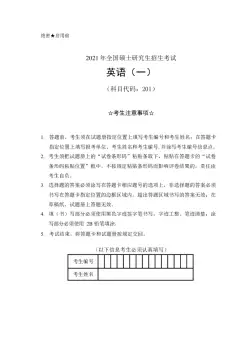
2020年全国硕士研究生招生考试
英语(二)
(科目代码:204)
☆考生注意事项☆
1. 答题前,考生须在试题册指定位置上填写考生编号和考生姓名;在答题卡
指定位置上填写报考单位、考生姓名和考生编号,并涂写考生编号信息点。
2. 考生须把试题册上的“试卷条形码”粘贴条取下,粘贴在答题卡的“试卷
条形码粘贴位置”框中。不按规定粘贴条形码而影响评卷结果的,责任由
考生自负。
3. 选择题的答案必须涂写在答题卡相应题号的选项上,非选择题的答案必须
书写在答题卡指定位置的边框区域内。超出答题区域书写的答案无效;在
草稿纸、试题册上答题无效。
4. 填(书)写部分必须使用黑色字迹签字笔书写,字迹工整、笔迹清楚;涂
写部分必须使用2B铅笔填涂。
5. 考试结束,将答题卡和试题册按规定交回。
(以下信息考生必须认真填写)
考生编号
考生姓名Section I Use of English
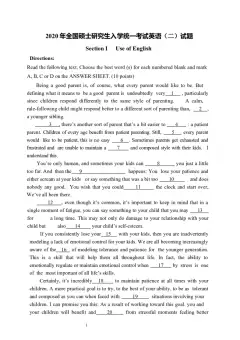
Directions:
Read the following text. Choose the best word (s) for each numbered blank and mark
A, B, C or Don the ANSWER SHEET. (10 points)
Being a good parent is what every parent would like to be. But defining what it
means to be a good parent is undoubtedly very 1 , particularly since children
respond differently to the same style of parenting. A calm, rule-following child might
respond better to a different sort of parenting than, 2 a younger one.
_3_, there's another sort of parent that's easier to 4 a patient parent.
Children of every age benefit from patient parenting. Still, _5_ every parent would like
to be patient, this is no easy _6_. Sometimes, parents get exhausted and are unable to
maintain a _7_ style with their kids. I understand this.
You're only human, and sometimes your kids can 8 you just a little too far.
And then the_9_ happens: You lose your patience and either scream at your kids or
say something that was too 10 and does nobody any good. You wish that you could
11 the clock and start over, We've all been there.
12 even though it's common, it's vital to keep in mind that in a single
moment of fatigue, you can say something to your child that you may 13 for
a long time. This may not only do damage to your relationship with your child but
also 14 your child's self-esteem.
If you consistently lose your 15 with your kids, then you are mode ling a lack
of emotional control for your kids. We are all becoming increasingly aware of
the 16 of modeling patience for the younger generation. This is a skill that will
help them all throughout life. In fact, the ability to maintain emotional control
when 17 by stress is one of the most significant of all life's skills.
Certainly, it's 18 to maintain patience at all times with your kids. A more
practical goal is to try to be as calm as you can when faced with 19 situations
involving your children. I can promise you this: As a result of working toward this goal,
you and your children will benefit and 20 from stressful moments feeling better
physically and emotionally.1. [A] tedious [B] pleasant [C] instructive [D] tricky
2. [A] in addition [B] for example [C] at once [D] by accident
3. [A] Fortunately [B] Occasionally [C] Accordingly [D] Eventually
4. [A] amuse [B] assist [C] describe [D] train
5. [A] while [B] because [C] unless [D] once
6. [A] answer [B] task [C] choice [D] access
7. [A] tolerant [B] formal [C] rigid [D] critical
8. [A] move [B] drag [C] push [D] send
9. [A] mysterious [B] illogical [C] suspicious [D] inevitable
10. [A] boring [B] naive [C] harsh [D] vague
11. [A] tum back [B] take apart [C] set aside [D] cover up
12. [A] Overall [B] Instead [C] However [D] Otherwise
13. [A] like [B] miss [C] believe [D] regret
14. [A] raise [B] affect [C] justify [D] reflect
15. [A] time [B] bond [C] race [D] cool
16. [A] nature [B] secret [C] importance [D] context
17. [A] cheated [B] defeated [C] confused [D] confronted
18. [A] terrible [B] hard [C] strange [D] wrong
19. [A] trying [B] changing [C] exciting [D] surprising
20. [A] hide [B] emerge [C] withdraw [D] escape
Section II Reading Comprehension
Part A
Directions:
Read the following four texts. Answer the questions after each text by choosing A,
B, C or D. Mark your answers on the ANSWER SHEET. (40 points)Text 1
Rats and other animals need to be highly attuned to social signals from others so
they can identify friends to cooperate with and enemies to avoid. To find out if this
extends to non-living beings, Laleh Quinn at the University of California, San Diego,
and her colleagues tested whether rats can detect social signals from robotic rats.
They housed eight adult rats with two types of robotic rat - one social and one
asocial - for four days. The robot rats were quite minimalist, resembling a chunkier
version of a computer mouse with wheels to move around and colourful markings.
During the experiment, the social robot rat followed the living rats around,
played with the same toys, and opened cage doors to let trapped rats escape.
Meanwhile, the asocial robot simply moved forwards and backwards and side to side.
Next, the researchers trapped the robots in cages and gave the rats the
opportunity to release them by pressing a lever. Across 18 trials each, the living rats
were 52 per cent more likely on average to set the social robot free than the asocial one.
This suggests that the rats perceived the social robot as a genuine social being. They may
have bonded more with the social robot because it displayed behaviors like communal
exploring and playing. This could lead to the rats better remembering having freed it earlier,
and wanting the robot to return the favour when they get trapped, says Quinn.
"Rats have been shown to engage in multiple forms of reciprocal help and
cooperation, including what is referred to as direct reciprocity - where a rat will help
another rat that has previously helped them," says Quinn.
The readiness of the rats to befriend the social robot was surprising given its
minimal design. The robot was the same size as a regular rat but resembled a simple
plastic box on wheels. "We'd assumed we'd have to give it a moving head and tail,
facial features, and put a scent on it to make it smell like a real rat, but that wasn't
necessary," says Janet Wiles at the University of Queensland in Australia, who helped
with the research.
The finding shows how sensitive rats are to social cues, even when they come
from basic robots. Similarly, children tend to treat robots as if they are fellow beings,
even when they display only simple social signals. "We humans seem to be fascinated
by robots, and it turns out other animals are too," says Wiles.21. Quinn and her colleagues conducted a test to see if rats can ___
[A] pick up social signals from non-living rats
[B] distinguish a friendly rat from a hostile one
[C] attain sociable traits through special training
[D] send out warning messages to their fellows
22.What did the asocial robot do during the experiment?
[A] It followed the social robot.
[B] It played with some toys.
[C] It set the trapped rats free.
[D] It moved around alone.
23. According to Quinn, the rats released the social robot because they ___
[A] tried to practice a means of escape
[B] expected it to do the same in return
[C] wanted to display their intelligence
[D] considered that an interesting game
24. Janet Wiles notes that rats ___
[A] can remember other rats' facial features
[B] differentiate smells better than sizes
[C] respond more to actions than to looks
[D] can be scared by a plastic box on wheels
25. It can be learned from the text that rats ___
[A] appear to be adaptable to new surroundings
[B] are more socially active than other animals
[C] behave differently from children in socializing
[D] are more sensitive to social cues than expectedText2
It is true that CEO pay has gone up - top ones may make 300 times the pay
of typical workers on average, and since the mid-1970s, CEO pay for large publicly
traded American corporations has, by varying estimates, gone up by about 500%. The
typical CEO of a top American corporation now makes about $18.9 million a year.
The best model for understanding the growth of CEO pay is that of limited CEO
talent in a world where business opportunities for the top firms are growing rapidly.
The efforts of America's highest-earning 1% have been one of the more dynamic
elements of the global economy. It's not popular to say, but one reason their pay has
gone up so much is that CEOs really have upped their game relative to many other
workers in the U.S. economy.
Today's CEO, at least for major American firms, must have many mere skills than
simply being able to "run the company." CEOs must have a good sense of
financial markets and maybe even how the company should trade in them .T hey also
need better public relations skills than their predecessors, as the costs of even a minor
slipup can be significant. Then there's the fact that large American companies are
much more globalized than ever before, with supply chains spread across a
larger number of countries. To lead in that system requires knowledge that is fairly
mind-boggling. Plus, virtually all major American companies are becoming tech
companies, often with their own research and development. And beyond this, major
CEOs still have to do all the day-to-day work they have always done.
The common idea that high CEO pay is mainly about ripping people off doesn't
explain history very well. By most measures, corporate governance has become a lot
tighter and more rigorous since the 1970s. Yet it is principally during this period of
stronger governance that CEO pay has been high and rising. That suggests it is in the
broader corporate interest to recruit top candidates for increasingly tough jobs.
Furthermore, the highest CEO salaries are paid to outside candidates, not to the
cozy insider picks, another sign that high CEO pay is not some kind of depredation at
the expense of the rest of the company. And the stock market reacts positively when
companies tie CEO pay to, say, stock prices, a sign that those practices build up
corporate value not just for the CEO.26. Which of the following has contributed to CEO pay rise?
[A] The growth in the number of corporations.
[B] The general pay rise with a better economy.
[C] Increased business opportunities for top firms.
[D] Close cooperation among leading economies.
27. Compared with their predecessors, today's CEOs are required to_ ___
[A] foster a stronger sense of teamwork
[B] finance more research and development
[C] establish closer ties with tech companies
[D] operate more globalized companies
28. CEO pay has been rising since the 1970s despite ____
[A] continual internal opposition
[B] strict corporate governance
[C] conservative business strategies
[D] repeated government warnings
29. High CEO pay can be justified by the fact that it helps ___
[A] confirm the status of CEOs
[B] motive inside candidates
[C] boost the efficiency of CEOs
[D] increase corporate value
30.The most suitable title for this text would be ___
[A] CEOs Are Not Overpaid
[B] CEO Pay: Past and Present
[C] CEOs' Challenges of Today
[D] CEO Traits: Not Easy to DefineText3
Madrid was hailed as a public health guiding light last November when it rolled
out ambitious restrictions on the most polluting cars. Seven months and one election
day later, a new conservative city council suspended enforcement of the clean air
zone, a first step toward its possible termination. Mayor Jose Luis Martinez-Almeida
made opposition to the zone a centrepiece of his election campaign, despite its
success in improving air quality. A judge has now overruled the city's decision to
stop levying fines, ordering them restored. But with legal battles ahead, the zone's future
looks uncertain at best.
Madrid's back and forth on clean air is a pointed reminder of the limits to the
patchwork, city-by-city approach that characterises efforts on air pollution across
Europe, Britain very much included.
Among other weaknesses, the measures cities must employ when left to tackle
dirty air on their own are politically controversial, and therefore vulnerable. That's
because they inevitably put the costs of cleaning the air on to individual drivers-who
must pay fees or buy better vehicles-rather than on to the car manufacturers whose
cheating is the real cause of our toxic pollution. It's not hard to imagine a similar
reversal happening in London. The new ultra-low emission zone (Ulez) is likely to
be a big issue in next year's mayoral election. And if Sadiq khan wins and extends it to
the North and South Circular roads in 2021 as he intends, it is sure to spark intense
opposition from the far larger number of motorists who will then be affected.
It's not that measures such as London's Ulez are useless. Far from it. Local
officials are using the levers that are available to them to safeguard residents' health
in the face of a serious threat. The zones do deliver some improvements to air quality,
and the science tells us that means real health benefits.
But mayors and councilors can only do so much about a problem that is far
bigger than any one city or town. They are acting because national governments -
Britain's and others across Europe -have failed to do so.
Restrictions that keep highly polluting cars out of certain areas - city centres,
"school streets", even individual roads - are a response to the absence of a larger
effort to properly enforce existing regulations and require auto companies to bring
their vehicles into compliance. Wales has introduced special low speed limits
to minimise pollution. We're doing everything but insist that manufacturers clean up
their cars.31. Which of the following is true about Madrid's clean air zone?
[A] Its effects are questionable.
[B] It has been opposed by a judge.
[C] It needs tougher enforcement.
[D] Its fate is yet to be decided.
32. Which is considered a weakness of the city-level measures to tackle dirty air?
[A] They are biased against car manufacturers.
[B] They prove impractical for city councils.
[C] They are deemed too mild by politicians.
[D] They put the burden on individual motorists.
33. The author believes that the extension of London's Ulez will ___
[A] arouse strong resistance
[B] ensure Khan's electoral success
[C] improve the city's traffic
[D] discourage car manufacturing
34. Who does the author think should have addressed the problem?
[A] Local residents.
[B] Mayors.
[C] Councilors.
[D] National governments.
35. It can be learned from the last paragraph that auto companies ___
[A] will raise low-emission car production
[B] should be forced to follow regulations
[C] will upgrade the design of their vehicles
[D] should be put under public supervisionText4
Now that members of Generation Z are graduating college this spring-the most
commonly-accepted definition says this generation was born after 1995, give or take
a year-the attention has been rising steadily in recent weeks. Gen Zs are about to hit
the streets looking for work in a labor market that's tighter than it's been in decades.
And employers are planning on hiring about 17 percent more new graduates for jobs
in the U.S. this year than last, according to a survey conducted by the National
Association of Colleges and Employers. Everybody wants to know how the people
who will soon inhabit those empty office cubicles will differ from those who came
before them.
If "entitled" 1s the most common adjective, fairly or not, applied to
millennials (those born between 1981 and 1995), the catchwords for Generation
Z are practical and cautious. According to the career counselors and experts who
study them, Generation Zs are clear-eyed, economic pragmatists. Despite
graduating into the best economy in the past 50 years, Gen Zs know what an
economic train wreck looks like. They were impressionable kids during the crash
of 2008, when many of their parents lost their jobs or their life savings or both.
They aren't interested in taking any chances. The booming economy seems to
have done little to assuage this underlying generational sense of anxious urgency,
especially for those who have college debt. College loan balances in the U.S.
now stand at a record $1.5 trillion, according to the Federal Reserve.
One survey from Accenture found that 88 percent of graduating seniors this year
chose their major with a job in mind. In a 2019 survey of University of Georgia
students, meanwhile, the career office found the most desirable trait in a future
employer was the ability to offer secure employment (followed by professional
development and training, and then inspiring purpose). Job security or stability was
the second most important career goal ( work-life balance was number one), followed
by a sense of being dedicated to a cause or to feel good about serving the greater good.
That's a big change from the previous generation. "Millennials wanted more
flexibility in their lives," notes Tanya Michelsen, Associate Director of YouthSight, a
UK-based brand manager that conducts regular 60-day surveys of British youth, in
findings that might just as well apply to American youth. "Generation Zs are looking
for more certainty and stability, because of the rise of the gig economy. They have
trouble seeing a financial future and they are quite risk averse."36. Generation Zs graduating college this spring ___
[A] are recognized for their abilities
[B] are optimistic about the labor market
[C] are in favor of office job offers
[D] are drawing growing public attention
36. Generation Zs are keenly aware_ ___
[A] what their parents expect of them
[B] how valuable a counselor's advice is
[C] what a tough economic situation is like
[D] how they differ from past generations
37. The word "assuage"(Line9, Para. 2) is closest in meaning to_ __
[A] deepen
[B] define
[C] maintain
[D] relieve
38. It can be learned from Paragraph 3 that Generation Zs_ __
[A] give top priority to professional training
[B] have a clear idea about their future jobs
[C] care little about their job performance
[D] think it hard to achieve work-life balance
40. Michelsen thinks that compared with millennials, Generation Zs are ____
[A] less realistic
[B] less adventurous
[C] more diligent
[D] more generousPartB
Directions:
Read the following text and answer the questions by choosing the most suitable
subheading from the list A-G for each numbered paragraphs ( 41-45). There are two extra
subheadings which you do not need to use. Mark your answers on the ANSWER
SHEET. (10 points)
[A] Give compliments, just not too many
[B] Put on a good face, always
[C] Tailor your interactions
[D] Spend time with everyone
[E] Reveal, don't hide, information
[F] Slow down and listen
[G] Put yourselves in others' shoes
Five Ways to Win Over Everyone in the Office
Is it possible to like everyone in your office? Think about how tough it is to get
together 15 people, much less 50, who all get along perfectly. But unlike in
friendships, you need coworkers. You work with them every day, and you depend on
them just as they depend on you. Here are some ways that you can get the whole
office on your side.
41. -----------
If you have a bone to pick with someone in your workplace, you may try to stay
tight-lipped around them. But you won't be helping either one of you. A Harvard
Business School study found that observers consistently rated those who were frank
about themselves more highly, while those who hid lost trustworthiness. The lesson is
not that you should make your personal life an open book, but rather, when given the
option to offer up details about yourself or painstakingly conceal them, you should
just be honest.
42. -----------
Just as important as being honest about yourself is being receptive to others. We
often feel the need to tell others how we feel, whether it's a concern about a project, astray thought, or a compliment. Those are all valid, but you need to take time to hear
out your coworkers, too. In fact, rushing to get your own ideas out there can cause
colleagues to feel you don't value their opinions. Do your best to engage coworkers m
a genuine, back-and-forth conversation, rather than prioritizing your own thoughts.
43. -----------
It's common to have a "cubicle mate" or special confidant in a work setting. But
in addition to those trusted coworkers, you should expand your horizons and find out
about all the people around you. Use your lunch and coffee breaks to meet up with
colleagues you don't always see. Find out about their lives and interests beyond the
job. It requires minimal effort and goes a long way. This will help to grow your
internal network, in addition to being a nice break in the work day.
44 .. ____________
Positive feedback is important for anyone to hear. And you don't have to be
someone's boss to tell them they did an exceptional job on a particular project. This
will help engender good will in others. But don't overdo it or be fake about it. One
study found that people responded best to comments that shifted from negative to
positive, possibly because it suggested they had won somebody over.
45. __________
This one may be a bit more difficult to pull off, but it can go a long way to
achieving results. Remember in dealing with any coworker what they appreciate from
an interaction. Watch out for how they verbalize with others. Some people like small
talk in a meeting before digging into important matters, while others are more
straightforward. Jokes that work on one person won't necessarily land with another.
So, adapt your style accordingly to type. Consider the person that you're dealing with in
advance and what will get you to your desired outcome.Section III Translation
46. Directions:
Translate the following text into Chinese. Write your translation on the ANSWER
SHEET. (15 points)
It's almost impossible to go through life without expenencmg some kind of
failure. But, the wonderful thing about failure is that it's entirely up to us to decide
how to look at it.
We can choose to see failure as "the end of the world." Or, we can look at failure
as the incredible learning experience that it often is. Every time we fail at something,
we can choose to look for the lesson we're meant to learn. These lessons are very
important; they're how we grow, and how we keep from making that same mistake
again. Failures stop us only if we let them.
Failure can also teach us things about ourselves that we would never have
learned otherwise. For instance, failure can help you discover how strong a person
you are. Failing at something can help you discover your truest friends, or help you find
unexpected motivation to succeed.
Section IV Writing
Part A
47. Directions:
Suppose you are planning a tour of a historical site for a group of international
students. Write them an email to
1) tell them about the site, and
2) give them some tips for the tour.
You should write about 100 words on the ANSWER SHEET.
Do not use your own name. use "Li Ming" instead. (10 points)PartB
48. Directions:
Write an essay based on the following chart. In your writing, you should
1) interpret the chart, and
2) give your comments.
You should write about 150 words on the ANSWER SHEET. (15 points)
m.matfaJ
/ 21.3%
#J:J~W-59.5%
~~~~~-=f:l-JLl3II~ § agijijw