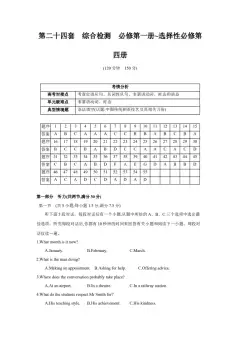
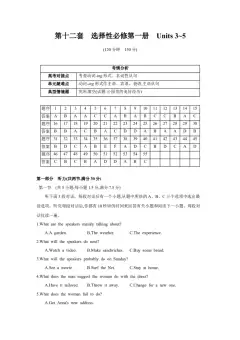
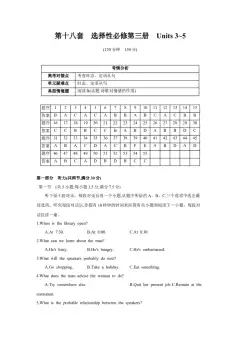
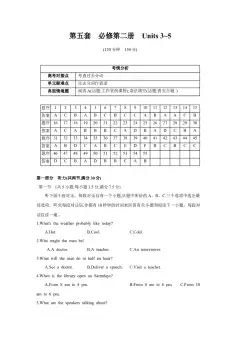
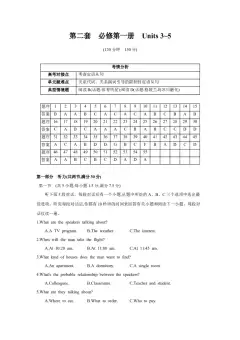
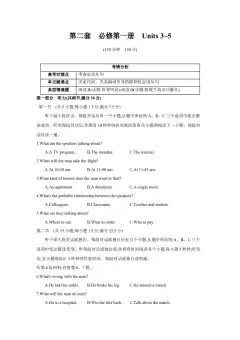
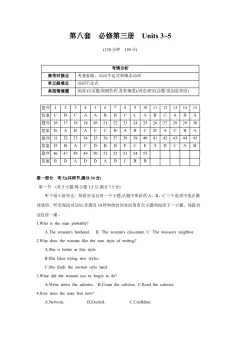
第二十一套 选择性必修第四册 Units 3~5
(120分钟 150分)
考情分析
高考对接点 考查不定式、长句
单元疑难点 不定式、长句
典型情境题 阅读C(话题:经常使用数字设备安抚儿童的情绪可能适得其反)
第一部分 听力(共两节,满分30分)
第一节 (共5小题;每小题1.5分,满分7.5分)
听下面5段对话。每段对话后有一个小题,从题中所给的A、B、C三个选项中选出最
佳选项。听完每段对话后,你都有10秒钟的时间来回答有关小题和阅读下一小题。每段对
话仅读一遍。
1.What will the man do tomorrow?
A.Visit Nancy. B. Go to the hospital. C.Attend Mike's birthday.
2.Who will come to the dinner?
A.The man's father. B.The woman's sister. C.The man's mother.
3.What is the relationship between the speakers?
A.Teacher and student. B.Nurse and patient. C.Boss and employee.
4.What are the speakers most probably talking about?
A.A book. B.A film. C.An actor.
5.Where does the conversation take place?
A.In the classroom. B.In the library. C.In the dormitory.
第二节 (共15小题;每小题1.5分,满分22.5分)
听下面5段对话或独白。每段对话或独白后有几个小题,从题中所给的A、B、C三个
选项中选出最佳选项。听每段对话或独白前,你将有时间阅读各个小题,每小题5秒钟;听完
后,各小题将给出5秒钟的作答时间。每段对话或独白读两遍。
听第6段材料,回答第6、7题。
6.Where will the woman go?
A.To the school. B.To her office. C.To the airport.
7.What does the woman ask the man to do?A.Meet her boss. B.Look after a baby. C.Look for some toys.
听第7段材料, 回答第8、9题。
8.Where has Barbara been?
A.Milan. B.Florence. C.Rome.
9.What has Barbara got in her suitcase?
A.Books. B.Clothes. C.Shoes.
听第8段材料,回答第10至12题。
10.What made the chair valuable?
A.It is an antique chair.
B.It is made of rare material.
C.It is passed on through generations.
11.What do we know about Koloman Moser?
A.He had a great influence on painting.
B.He was an expert on old furniture.
C.He came from Austria.
12.Where will the speakers most probably go?
A.To an old furniture store.
B.To the woman's home.
C.To the man's home.
听第9段材料, 回答第13至16题。
13.What is the man?
A.A teacher. B.A doctor. C.A host.
14.What is the conversation mainly about?
A.How to get bargains.
B.How to save money.
C.How to be a good housewife.
15.Where does the woman like shopping?
A.In outdoor markets. B.In supermarkets. C.In department stores.
16.What does the woman highly recommend?
A.Fixing things by ourselves.
B.Hiring someone to repair things.
C.Asking friends to help with the repairs.听第10段材料, 回答第17至20题。
17.What has the least change according to the speaker?
A.Shopping. B.Going to work. C.School education.
18.How many language lessons are offered for free on Openculture.com?
A.200. B.300. C.1,500.
19.What do we know about the offered courses on Openculture.com?
A.There are fewer than a thousand.
B.They are expensive to take online.
C.There is a good selection from top schools.
20.What is the speaker's attitude toward online learning?
A.Optimistic. B.Doubtful. C.Unconcerned.
第二部分 阅读(共两节,满分50分)
第一节 (共15小题;每小题2.5分,满分37.5分)
阅读下列短文,从每题所给的A、B、C、D四个选项中选出最佳选项。
A
The Bay Area Science Festival is back! This year the festival is offering a great mix of both
in-person and virtual events for the curious of all ages. Here are a few recommendations related to
environmental science.
Changing Shorelines
April 25, 6 pm-7 pm
This in-person tour and walk through the history of south San Francisco's shoreline will be an
exploration of how both climate change and sea-level rise have affected the shifts in shorelines—
and you'll learn about ways to protect them.
Wildfire from Space
April 26, 7 pm-8 pm
The event hosted by Robert Simmons from Planet Labs, offers virtual and in-person
opportunities to learn about wildfire through satellite imagery. See wildfire from space and learn
how the latest satellite technology helps agencies and communities manage emergency response
during burns.
Virtual Tour of Recology
April 27, 1 pm-2 pmWhat happens to the items you place in your roadside bins? This virtual event will help you
learn about the history of Recology, what it takes to recycle all that stuff, and what you can do to
create change that has impact.
Greywater and Wetlands
April 30, 2 pm-4 pm
This in-person tour of the EcoCenter will explore environmental justice themes through the
history of the Bayview-Hunters Point neighborhood. You'll learn how a shipping terminal became
a restored wetland habitat. Plus, you'll have a chance to transplant the native salt grass that helps
restore wetlands and provides habitat for migrating birds.
21.Which event is offered in two ways?
A.Changing Shorelines. B.Wildfire from Space.
C.Virtual Tour of Recology. D.Greywater and Wetlands.
22.What's the theme of Virtual Tour of Recology?
A.Wildfire. B.Recycling.
C.Shorelines protection. D.Wetlands restoration.
23.What can people learn during Greywater and Wetlands?
A.How to reuse old stuff.
B.How to grow various plants.
C.How to remove environmental injustice.
D.How to create better environment for birds.
B
If your image of a computer programmer is a young man, there's a good reason. Data from
many big tech companies have shown how few of their employees working in programming and
technical jobs are female. Google has the highest rate: 17% of its technical staff is female.
It wasn't always this way. Decades ago, it was women who pioneered computer
programming. But too often, that's a part of history that even people in the computing industry
don't know.
Last week, I took a trip to the birthplace for today's computer revolution, Stanford University,
and randomly asked over a dozen students if they knew who was the first computer programmer.
Only one student got close. “It's a woman,” she said, searching her mind for a name. “It's not
necessarily an electronic computer. I think it's more like a mechanic computer.”She's probably thinking of Ada Lovelace, who was born in England on December 10,1815.
Lovelace was Lord Byron's child, and her mother, Lady Byron, did not want her to turn out to be
like her father, a romantic poet. So Lady Byron used mathematics to keep her from becoming a
poet.
But Lovelace saw poetry in math. At 17, she met Charles Babbage, who showed her his plans
for the Analytical Engine that he believed would be able to do complex mathematical calculations.
He asked her to write about his work for a scientific journal. In the article, Lovelace expressed a
vision for the machine that went beyond calculations.
“A computer could do anything. Letters of the alphabet, musical notes and even the positions
on a chess board could be represented by numbers,” wrote Lovelace. She even gave an example
on how to load an instruction into the machine.
Babbage's machine was never built. But his designs and Lovelace's article were read by
people building the first computer a century later. In 1979, a new computer language was named
“Ada” in recognition of her pioneering work with Charles Babbage.
24.What phenomenon is described in the first paragraph?
A.Women dislike working as programmers.
B.The environment in big companies is not friendly.
C.Women play a key role in computer programming.
D.Most of the programmers in big companies are male.
25.What can we learn about Ada Lovelace?
A.She was a poet.
B.She loved math.
C.She wanted to follow her mother's step.
D.She was the first to suggest Analytical Engine.
26.What did Charles Babbage ask Ada Lovelace to do?
A.Program for his computer.
B.Write a poem about his invention.
C.Introduce his Analytical Engine in a journal.
D.Do some complex mathematical calculations.
27.What can be the best title for the text?
A.Ada, an advanced computer languageB.Charles Babbage, the pioneer of computers
C.Analytical Engine, the first modern computer
D.Ada Lovelace, the first computer programmer
C
Handing a fussy preschooler a digital device seems to offer a quick fix. But this calming
strategy could be linked to worse behavior challenges down the road, new findings suggest.
The study included 422 parents and 422 children aged 3-5 who participated between August
2018 and January 2020. Researchers analyzed parent responses to how often they used devices as
a calming tool and its associations with symptoms of emotional reactivity or dysregulation (失调)
over a six-month period.
“Our findings suggest that using devices as a way to calm down agitated (焦虑不安
的)children may especially be problematic to those who already struggle with emotional coping
skills,” said lead author Jenny Radesky, M.D. She notes that the preschool-to-kindergarten period
is a developmental stage when children may be more likely to exhibit difficult behaviors, such as
tantrums, defiance and intense emotions. This may make it even more tempting to use devices as
a parenting strategy.
“Parents may experience immediate relief from using devices if they quickly and effectively
reduce children's negative and challenging behaviors,” Radesky says. “This feels rewarding to
both parents and children and can motivate them both to maintain this cycle.”
Actually, young kids have their own unique profiles of what types of sensory input calm
them down. This could include swinging, hugging, jumping on a trampoline, listening to music or
looking at a book. If you see your child getting uneasy or impatient, channel that energy into body
movement or sensory approaches.
When children are calm, parents also have opportunities to teach them emotional coping
skills, Radesky says. For example, they can talk to them about how their favorite stuffed animal
might be feeling and how they handle their big emotions and calm down.
“All of these solutions help children understand themselves better, and feel more competent
to manage their feelings,” Radesky said. “It takes repetition by parents who also need to try to stay
calm and not overreact to the child's emotions, but it helps build emotion regulation skills that last
a lifetime.”28.Why do parents give their children digital devices according to the text?
A.To free themselves of the duty to look after children.
B.To comfort the children in a bad mood.
C.To build a better relationship between themselves and their children.
D.To expose their children to advanced technology earlier.
29.What does the study focus on?
A.The parent-child relationship.
B.The ways to better calm children down.
C.The emotional coping skills of children.
D.The impact of frequent use of digital devices on children.
30.What does the underlined word “tempting” in paragraph 3 probably mean?
A.Attractive. B.Challenging. C.Efficient. D.Valuable.
31.Which of the following statements will Radesky agree with?
A.It's hard to comfort children.
B.Digital devices do little harm to children.
C.Many parents are tolerant towards their children.
D.Parents should help children build emotional coping skills.
D
Our research not only exposes the gendered nature of the confidence critique, but it also
disrupts the positive association between confidence and workplace success. While it's true that
attending to self-confidence has some benefits for women, for instance in our study it helped them
to break down issues into realizable actions, facilitating a positive sense of agency, and providing
a psychological relief for anxiety, in the long term, these are outweighed by broader negative
impacts on women's mental health and gender equality.
First, we found that the therapeutic effects of focusing on confidence are only temporary.
Confidence was linked to more harmful, longer-term effects, such as self-criticism, self-doubt, and
overall poorer mental health. For instance, even when some women were unfairly treated in an
evaluation or promotion, or suffered threat by male colleagues, they felt regretful that they did not
“put themselves out there” or “seize opportunities” in those difficult moment(s). Rather than
attributing blame to their supervisors or colleagues, women tended to take full responsibility for
matters outside of their control and, moreover, blame themselves. In psychoanalysis, self-blamingis a destructive and painful response to a physical loss or disappointment. The women in our study
recognized that they had been unfairly treated. However, rather than directing their energy
towards the organization, they were more likely to blame themselves as a way to maintain the
fantasy that their ambitions could be attained by exuding (显露) the right amount of self-
confidence.
Second, a focus on self-confidence is an individually oriented strategy, and distracts senior
leaders from addressing more rooted organizational barriers to gender equality, including
stereotyping, work design, and the privileging of line roles over functional roles, which are more
likely to be filled by women.
Third, the overt focus on confidence leaves the underlying assumption that continuously
exuding confidence is a positive aspiration. Our research on inclusive leadership presents a more
nuanced (微妙的) picture. While confidence may be valuable in some situations (such as
uncertainty), demonstrating humility and vulnerability has a humanizing effect necessary for
creating psychological safety in others, and relatability. In other words, reflection, and openness
can be healthy and valuable in terms of creating a more inclusive workplace.
32.What can be inferred about long-term effects of focusing on self-confidence for women?
A.It has long-term benefits. B.It is key to workplace success.
C.It is linked to poorer mental health. D.It makes women take less responsibility.
33.What is the benefit of demonstrating humility and vulnerability in the workplace?
A.Creating a more inclusive workplace.
B.Contributing to workplace success.
C.Leading to higher self-confidence.
D.Reducing anxiety and self-doubt.
34.What is the main idea of the text?
A.The therapeutic effects of self-confidence in the workplace.
B.The benefits of women taking responsibility for their actions.
C.The negative effects of focusing on self-confidence on women's mental health.
D.The importance of exuding confidence in the workplace.
35.Where does this text probably come from?
A.A scientific research article. B.A fictional novel.
C.A personal blog post. D.A textbook.第二节 (共5小题;每小题2.5分,满分12.5分)
阅读下面短文,从短文后的选项中选出可以填入空白处的最佳选项。选项中有两项为多
余选项。
Have you tried barefoot gardening and dynamic stretches to strengthen long-forgotten
muscles while moving with intention through your garden routine? We know about the dietary and
financial benefits offered by fresh, organically grown products from our gardens. 3 6 .The
following tips are for gardeners who want to move away from movement monoculture (单作).
Switch positions often. Gardeners often hunch (弓身) over or work in positions that use the
same muscle groups repeatedly.This is the exact cause for pain. 3 7 . For example, when
weeding or planting, start in a squat (蹲), later move into a lunge, using an arm for support.
Tap into your central power. Gardeners often use smaller muscle groups—their arms, for
example—when hoeing and harvesting. 3 8 . They should employ larger muscle groups, such
as the torso and hips, to tap into the energy and ability to keep moving over much longer periods.
3 9 . Gardening season inevitably means lifting and carrying heavy loads. Experts advises
holding loads close to the body to prevent stress on muscles and connective tissues. When lifting,
hinge from your hips, keeping your spine straight.
Stretch it out. 4 0 . Pay particular attention to opening up your hips and encouraging
flexibility in your back. Instead of doing static stretches, stretch like a rainbow. Move in a 360-
degree range of motion so you can find the area that needs to be opened up the most.
A.Keep loads close
B.This leads to muscle burnout
C.Finally, end every gardening session with a period of stretching
D.However, when we use the garden as our personal gym, those benefits multiply
E.Working at different times allows your body to adapt to the garden environment
F.Experts recommend that gardeners move into a new position every 2 to 3 minutes
G.How often you will get in the garden depends on your goals and the size of your land
第三部分 语言运用(共两节,满分30分)
第一节 (共15小题;每小题1分,满分15分)
阅读下面短文,从每题所给的A、B、C、D四个选项中选出可以填入空白处的最佳选项。My daughter Emma complained I always got 4 1 at her. I had to admit I've been
overreacting to every little problem. I couldn't help looking on the 4 2 side. The doctor said I
was 4 3 . I had to find some way to get out of this cycle of negativity.
Not long after, a friend showed me his macro lens (微距镜头), which he attached to his
smartphone to take extremely close-up photographs. His photos made very small subjects look
larger than life. I was 4 4 to it immediately.
I got one for myself.I headed out into the yard. I spotted a butterfly. Through my new lens, I
could see how it 4 5 its color, depending on the angle of light. Beautiful. Every day I went to
the yard to look for something interesting to 4 6 . Some insects flew away as soon as I got
near them, so I trained myself to slow my breathing and relax my body. Anything bothering me
would 4 7 . Looking through my macro lens took me to amazing things I had walked past
without 4 8 . I'd capture a leaf, and a spider. Focusing my energy and lens on something so
small brought me the 4 9 I'd ever felt.
Macrophotography became my outlet. It also went into other parts of my 5 0 . One day
when Emma displeased me, I took deep breaths. Then I 5 1 explained why her behavior
52 me.
I've made peace with depression after I discovered macrophotography. I can 5 3 darker
days now. I can feel my anger or sadness, and then find a way out. It takes 5 4 and shadow to
make an interesting photograph. I think the same is 5 5 of life.
41.A.excited B.mad C.cautions D.impressed
42.A.dark B.far C.usual D.opposite
43.A.conservative B.depressed C.confused D.aggressive
44.A.appointed B.selected C.recommended D.attracted
45.A.changed B.lost C.recovered D.determined
46.A.photograph B.collect C.share D.exhibit
47.A.break up B.stick out C.fade away D.hold on
48.A.greeting B.remarking C.regretting D.noticing
49.A.respect B.peace C.power D.guidance
50.A.work B.life C.body D.mind
51.A.calmly B.gradually C.eventually D.frequently
52.A.touched B.seized C.interrupted D.bothered53.A.imagine B.praise C.face D.forget
54.A.patience B.colour C.light D.time
55.A.true B.precious C.fair D.critical
第二节 (共10小题;每小题1.5分,满分15分)
阅读下面短文,在空白处填入1个适当的单词或括号内单词的正确形式。
Beijing, a traditional and modern city, features profound culture. Before tall buildings sprung
up like mushrooms, hutongs dominated this city in the past and cultivated the unique and long-
lasting culture. 5 6 (make) them adaptable to modern need, the Beijing municipal government
has carried 5 7 a series of policies to repair and restore the city's ancient blocks and streets in
recent years.
Yangmeizhu Xiejie is a key project in Beijing's Dashilan Organic Renewal Plan. 5 8
(locate) in Dashilan, a cultural and commercial landmark since the Qing Dynasty, the time-
honored street is a traditional Beijing hutong alley lined by single-story residences. For centuries,
the 496-meter-long street 5 9 (know) for its good-natured atmosphere, 6 0 writers and
artists can cooperate and perfect their crafts. According to the plan, 792 out of 1,650 households
were relocated, 6 1 the old hutong preserving Beijing's traditional lifestyle remains
protected.
Compared to the previous one, now the street features 6 2 (attractive) local shops with a
perfect combination of traditional craftsmanship and modern style. The Old Beijing Rabbit
Figurine store is a 6 3 (shine) example. Opened by a fifth-generation heir to the art of
creating clay rabbit sculptures, it marks 6 4 symbol of happiness and good luck in the city
and conveys a sense of joy to 6 5 (visitor). They say that in Yangmeizhu Xiejie, an open
market atmosphere and a sensational atmosphere of literature coexist.
第四部分 写作(共两节,满分40分)
第一节 (满分15分)
请你以“Sharing Brings Benefits”为题,写一篇短文投稿给你校英文报,介绍分享带来的收
获。内容包括:
1.分享知识可以……
2.分享经验可以……
3.分享快乐可以……注意:
1.写作词数应为 80左右;
2.请按如下格式在相应位置作答。
Sharing Brings Benefits
_______________________________________________________________________________
_______________________________________________________________________________
_______________________________________________________________________________
_______________________________________________________________________________
_______________________________________________________________________________
_______________________________________________________________________________
第二节 (满分25分)
阅读下面材料, 根据其内容和所给段落开头语续写两段, 使之构成一篇完整的短文。
Late one evening, Michael was waiting for his train at a small-town station. He had been
visiting his family, and now he was on his way back to the city where he worked. While he was
waiting, a stranger approached him. The man, who looked to be in his late fifties, had a warm,
inviting smile. He introduced himself as Peter and struck up a conversation with Michael. They
talked about their lives, their dreams, and the paths they had taken, finding that despite their age
difference, they had much in common.
Peter shared his story of being an artist who had once been quite successful. His paintings
were displayed in well-known galleries, and he enjoyed a loyal following of admirers. However, a
series of unfortunate events had led to the decline of his career. His marriage had fallen apart, and
he suffered a severe creative block, which took a toll on his work. He had lost his inspiration and
had stopped painting altogether. He now spent his days traveling, trying to find the spark that
would relight his passion for art. As they spoke, Michael found himself drawn to Peter's story and
the feelings the man shared with him.
As their train arrived, they realized they were going to be on the same train, in the same
compartment. They continued their conversation throughout the journey, sharing stories of their
families, their travels, and the various experiences that had shaped their lives. As the night wore
on, Peter shared some of his past works with Michael, which were stored on his tablet. Michaelwas moved by the beauty and emotion captured in Peter's paintings. Just as the train was about to
reach Michael's destination, Peter handed him a small, wrapped package.
注意:
1.续写词数应为150左右;
2.请按如下格式在相应位置作答。
A few weeks later, Michael was thinking about Peter and their encounter.________________
_______________________________________________________________________________
_______________________________________________________________________________
_______________________________________________________________________________
_______________________________________________________________________________
_______________________________________________________________________________
_______________________________________________________________________________
As Michael unwrapped the small package Peter had given him, he was surprised at what he
found inside.____________________________________________________________________
_______________________________________________________________________________
_______________________________________________________________________________
_______________________________________________________________________________
_______________________________________________________________________________
_______________________________________________________________________________
_______________________________________________________________________________