文档内容
2019年 1 2 月大学英语四级考试真题(一)
Part I Writing (30 minutes)
Directions: For this part, you are allowed 30 minutes to write a letter to a foreign friend who wants to
teach English in China. Please recommend a city to him. You should write at least 120 words but no more
than 180 words.
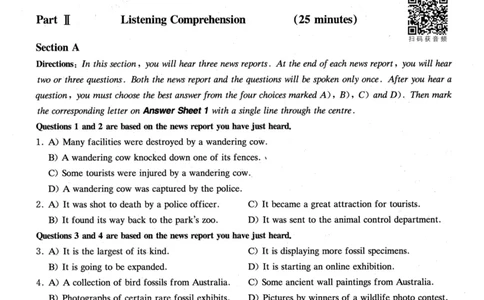
Part H Listening Comprehension (25 minutes)
扫码获音频
Section A
Directions: In this section, you will hear three news reports. At the end of each news report, you will hear
two or three questions. Both the news report and the questions will be spoken only once. After you hear a
question, you must choose the best answer from the four choices marked A ), B) , C) and D). Then mark
the corresponding letter on Answer Sheet 1 with a single line through the centre.
Questions 1 and 2 are based on the news report you have just heard.
1. A) Many facilities were destroyed by a wandering cow.
、
B) A wandering cow knocked down one of its fences.
C) Some tourists were injured by a wandering cow.
D) A wandering cow was captured by the police.
2. A) It was shot to death by a police officer. C) It became a great attraction for tourists.
B) It found its way back to the park's zoo. D) It was sent to the animal control department.
Questions 3 and 4 are based on the news report you have just heard.
3. A) It is the largest of its kind. C) It is displaying more fossil specimens.
B) It is going to be expanded. D) It is starting an online exhibition.
4. A) A collection of bird fossils from Australia. C) Some ancient wall paintings from Australia.
B) Photographs of certain rare fossil exhibits. D) Pictures by winners of a wildlife photo contest.
Questions 5 to 7 are based on the news report you have just heard.
5. A) Pick up trash. C) Deliver messages.
B) Amuse visitors. D) Play with children.
6. A) They are especially intelligent. C) They are quite easy to tame.
B) They are children's favorite. D) They are clean and pretty.
7. A) Children may be harmed by the rooks. C) Children may contract bird diseases.
B) Children may be tempted to drop litter. D) Children may overfeed the rooks.
Section B
Directions: In this section, you will hear two long conversations. At the end of each conversation, you will
四级2019年12月 1hear four questions. Both the conversation and the questions will be spoken only once. After you hear a
。).
question, you must choose the best answer from the four choices marked A ), B), C) and Then mark
the corresponding letter on Answer Sheet T with a single line through the centre.
Questions 8 to 11 are based on the conversation you have just heard.
8. A) It will be produced at Harvard University. C) It will cover different areas of science.
B) It will be hosted by famous professors. D) It will focus on recent scientific discoveries.
9. A) It will be more futuristic. C) It will be more entertaining.
B) It will be more systematic. D) It will be easier to understand.
10. A) People interested in science. C) Children in their early teens.
B) Youngsters eager to explore. D) Students majoring in science.
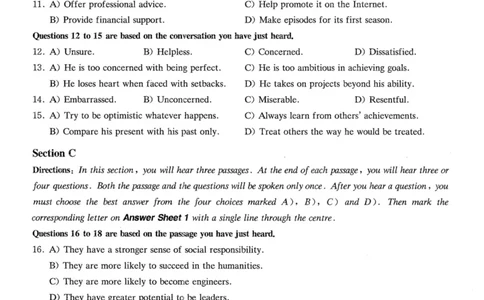
11. A) Offer professional advice. C) Help promote it on the Internet.
B) Provide financial support. D) Make episodes for its first season.
Questions 12 to 15 are based on the conversation you have just heard.
12. A) Unsure. B) Helpless. C) Concerned. D) Dissatisfied.
13. A) He is too concerned with being perfect. C) He is too ambitious in achieving goals.
B) He loses heart when faced with setbacks. D) He takes on projects beyond his ability.
14. A) Embarrassed. B) Unconcerned. C) Miserable. D) Resentful.
15. A) Try to be optimistic whatever happens. C) Always learn from others, achievements.
B) Compare his present with his past only. D) Treat others the way he would be treated.
Section C
Directions: In this section, you will hear three passages. At the end of each passage, you will hear three or
four questions. Both the passage and the questions will be spoken only once. After you hear a question, you
must choose the best answer from the four choices marked A ), B), C) and D). Then mark the
corresponding letter on Answer Sheet 1 with a single line through the centre.
Questions 16 to 18 are based on the passage you have just heard.
16. A) They have a stronger sense of social responsibility.
B) They are more likely to succeed in the humanities.
C) They are more likely to become engineers.
D) They have greater potential to be leaders.
17. A) Praise girls who like to speak up frequently.
B) Encourage girls to solve problems on their own.
C) Insist that boys and girls work together more.
D) Respond more positively to boys' comments.
18. A) Offer personalized teaching materials. C) Place great emphasis on test scores.
B) Provide a variety of optional courses. D) Pay extra attention to top students.
Questions 19 to 21 are based on the passage you have just heard.
19. A) It often rains cats and dogs. C) It does not rain as much as people think.
B) It seldom rains in summer time. D) It is one of the most rainy cities in the US.
四级2019年12月 2 ,20. A) They drive most of the time. C) They have got used to the rain.
B) The rain is usually very light. D) The rain comes mostly at night.
21. A) It has a lot of places for entertainment.
B) It has never seen thunder and lightning.
C) It has fewer cloudy days than any other coastal city.
D) It has mild weather both in summer and in winter.
Questions 22 to 25 are based on the passage you have just heard.
22. A) It occurs when people are doing a repetitive activity.
B) It results from exerting one's muscles continuously.
C) It happens when people engage in an uncommon activity.
D) It comes from straining one's muscles in an unusual way.
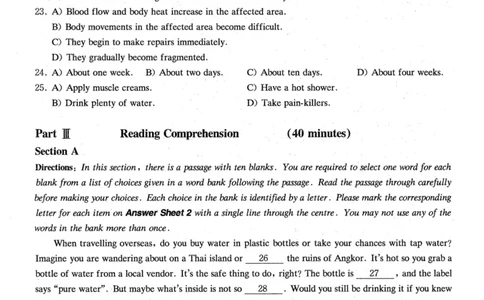
23. A) Blood flow and body heat increase in the affected area.
B) Body movements in the affected area become difficult.
C) They begin to make repairs immediately.
D) They gradually become fragmented.
24. A) About one week. B) About two days. C) About ten days. D) About four weeks.
25. A) Apply muscle creams. C) Have a hot shower.
B) Drink plenty of water. D) Take pain-killers.
Part 犯 Reading Comprehension (40 minutes)
Section A
Directions; In this section, there is a passage with ten blanks. You are required to select one word for each
blank from a list of choices given in a word bank following the passage. Read the passage through carefully
before making your choices. Each choice in the bank is identified by a letter. Please mark the corresponding
letter for each item on Answer Sheet 2 with a single line through the centre. You may not use any of the
words in the bank more than once.
When travelling overseas, do you buy water in plastic bottles or take your chances with tap water?
Imagine you are wandering about on a Thai island or 26 the ruins of Angkor. It's hot so you grab a
bottle of water from a local vendor. It5s the safe thing to do, right? The bottle is 27 , and the label
says “pure water”. But maybe what's inside is not so 28 . Would you still be drinking it if you knew
that more than 90 percent of all bottled water sold around the world 29 microplastics?
That5s the conclusion of a recently 30 study, which analysed 259 bottles from 11 brands sold in
nine countries, 31 an average of 325 plastic particles per litre of water. These microplastics
included a 32 commonly known as PET and widely used in the manufacture of clothing and food
and 33 containers. The study was conducted at the State University of New York on behalf of Orb
Media, a journalism organisation. About a million bottles are bought every minute, not only by thirsty
tourists but also by many of the 2.1 billion worldwide who live with unsafe drinking water.
Confronted with this 34 , several bottled-water manufacturers including Nestle and Coca-Cola
undertook their own studies using the same methodology. These studies showed that their water did
contain microplastics, but far less than the Orb study suggested. Regardless, the World Health
四级2019年12月 3Organisation has launched a review into the 35 health risks of drinking water from plastic bottles.
A) adequate F) instant K) released
B) admiring G) liquid L) revealing
C) contains H) modified M) sealed
D) defending I) natural N) solves
E) evidence J) potential O) substance
Section B
Directions: In this section, you are going to read a passage with ten statements attached to it. Each
statement contains information given in one of the paragraphs. Identify the paragraph from which the
information is derived. You may choose a paragraph more than once. Each paragraph is marked with a
letter. Answer the questions by marking the corresponding letter on Answer Sheet 2.
The quiet heroism of mail delivery
A) On Wednesday, a polar wind brought bitter cold to the Midwest. Overnight, Chicago reached a low of
21 degrees Fahrenheit below zero, making it slightly colder than Antarctica (南极洲),‘Alaska, and
the North Pole. Wind chills were 64 degrees below zero in Park Rapids, Minnesota, and 45 degrees
below zero in Buffalo, North Dakota, according to the National Weather Service. Schools,
restaurants, and businesses closed, and more than 1,000 flights were canceled.
B) Even the United States Postal Service (USPS) suspended mail delivery. "Due to this arctic outbreak
and concerns for the safety of USPS employees,USPS announced Wednesday morning, “the Postal
Service is suspending delivery Jan. 30 in some 3-digit ZIP Code locations.n Twelve regions were listed
as unsafe on Wednesday; on Thursday, eight remained.
C) As global surface temperatures increase, so does the likelihood of extreme weather. In 2018 alone,
wildfires, volcanic eruptions, hurricanes, mudslides, and other natural disasters cost at least
$ 49 billion in the United States. As my colleague Vann Newkirk reported, Puerto Rico is still
confronting economic and structural destruction and resource scarcity from 20175s Hurricane Maria.
Natural disasters can wreck a community's infrastructure, disrupting systems for months or years.
Some services, however, remind us that life will eventually return, in some form, to normal.
D) Days after the deadly 2017 wildfires in Santa Rosa, California, a drone (无人机)caught footage (连续
镜 头)of a USPS worker, Trevor Smith, driving through burned homes in that familiar white van,
collecting mail in an affected area. The video is striking: The operation is familiar, but the scene looks
like the end of the world. According to Rae Ann Haight, the program manager for the national
preparedness office at USPS, Smith was fulfilling a request made by some of the home owners to pick
up any mail that was left untouched. For Smith, this was just another day on the job. "I followed my
route like I normally do,“ Smith told a reporter, "As I came across a box that was up but with no
house, I checked, and there was mail- outgoing mail—in it. And so I picked those up and carried on.”
E) USPS has sophisticated emergency plans for natural disasters. Across the country, 285 emergency
management teams are devoted to crisis control. These teams are trained annually using a framework
known as the three Ps: people, property, product. After mail service stops due to weather, the
agency's top priority is ensuring that employees are safe. Then it evaluates the health of infrastructure,
四级2019年12月 4such as the roads that mail carriers drive on. Finally, it decides when and how to re-open operations.
If the destruction is extreme, mail addressed to the area will get sent elsewhere. In response to
Hurricane Katrina in 2005, USPS redirected incoming New Orleans mail to existing mail facilities in
Houston. Mail that was already processed in New Orleans facilities was moved to an upper floor so it
would be protected from water damage.
F) As soon as it's safe enough to be outside, couriers (邮递员)start distributing accumulated mail on the
still-accessible routes. USPS urges those without standing addresses to file change-of-address forms with
their new location. After Hurricane Katrina hit in 2005, mail facilities were set up in dozens of
locations across the country in the two weeks that USPS was unable to provide street delivery.
G) Every day, USPS processes, on average, 493. 4 million pieces of mail--anything from postcards to
Social Security checks to medicine. Spokespeople from both USPS and UPS told me all mail is
important. But some mail can be extremely sensitive and timely. According to data released in January
2017, 56 percent of bills are paid online, which means that just under half of payments still rely on
delivery services to be completed.
H) It can be hard to identify which parcels are carrying crucial items such as Social Security checks, but
USPS and UPS try their best to prioritize sensitive material. They will coordinate with the Social
Security Administration to make sure that Social Security checks reach the right people in a timely
fashion. After Hurricane Florence and Hurricane Michael last fall, USPS worked with state and local
election boards to make sure that absentee ballots were available and received on time.
I) Mail companies are logistics (物 流 )companies, which puts them in a special position to help when
disaster strikes. In a 2011 USPS case study, the agency emphasized its massive infrastructure as a
“unique federal asset“ to be called upon in a disaster or terrorist attack. "I think we're unique as a
federal agency,“ USPS official Mike Swigart told me, “because we're in literally every community in
this country... We're obligated to deliver to that point on a daily basis.w
J) Private courier companies, which have more dollars to spend, use their expertise in logistics to help
revitalize damaged areas after a disaster. For more than a decade, FedEx has supported the American
Red Cross in its effort to get emergency supplies to areas affected by disasters, both domestically and
internationally. In 2012, the company distributed more than 1,200 MedPacks to Medical Reserve
Corps groups in California. They also donated space for 3.1 million pounds of charitable shipping
globally. Last October, the company pledged $ 1 million in cash and transportation support for
Hurricanes Florence and Michael. UPS's charitable arm, the UPS Foundation, uses the company's
logistics to help disaster-struck areas rebuild, "We realize that as a company with people, trucks,
warehouses, we needed to play a larger role,“ said Eduardo Martinez, the president of the UPS
Foundation. The company employs its trucks and planes to deliver food, medicine, and water. The
day before I spoke to Martinez in November, he had been touring the damage from Hurricane Michael
in Florida with the American Red Cross. "We have an obligation to make sure our communities are
thriving,M he said.
K) Rebuilding can take a long time, and even then, impressions of the disaster may still remain. Returning
to a normal life can be difficult, but some small routines—mail delivery being one of them- may help
residents remember that their communities are still their communities. "When they see that carrier
四级2019年12月 5back out on the street,w Swigart said, "that's the first sign to them that life is starting to return to
normal.w
36. The United States Postal Service has a system to ensure its employees, safety.
37. One official says USPS is unique in that it has more direct reach to communities compared with other
federal agencies.
38. Natural disasters can have a long-lasting impact on community life.
39. Mail delivery service is still responsible for the completion of almost half of payments.
40. The sight of a mailman on the street is a reassuring sign of life becoming normal again.
41. After Hurricane Katrina interrupted routine delivery, temporary mail service points were set up.
42. Postal service in some regions in the U. S. was suspended due to extreme cold weather.
43. Private postal companies also support disaster relief efforts by distributing urgent supplies.
44. A dedicated USPS employee was on the job carrying out duties in spite of extreme conditions.
45. Postal services work hard to identify items that require priority treatment.
Section C
Directions: There are 2 passages in this section. Each passage is followed by some questions or unfinished
statements. For each of them there are four choices marked A ), B) , C) and D ). You should decide on the
best choice and mark the corresponding letter on Answer Sheet 2 with a single line through the centre.
Passage One
Questions 46 to 50 are based on the following passage.
Professor Ashok Goel of Georgia Tech developed an artificially intelligent teaching assistant to help
handle the enormous number of student questions in the online class, Knowledge-Based Artificial
Intelligence. This online course is a core requirement of Georgia Tech's online Master of Science in
Computer Science program. Professor Goel already had eight teaching assistants, but that wasn't enough
to deal with the overwhelming number of daily questions from students.
Many students drop out of online courses because of the lack of teaching support. When students feel
isolated or confused and reach out with questions that go unanswered, their motivation to continue begins
to fade. Professor Goel decided to do something to remedy this situation and his solution was to create a
virtual assistant named Jill Watson, which is based on the IBM Watson platform.
Goel and his team developed several versions of Jill Watson before releasing her to the online forums.
At first, the virtual assistant wasn't too great. But Goel and his team sourced the online discussion forum
to find all the 40,000 questions that had ever been asked since the class was launched. Then they began to
feed Jill with the questions and answers. After some adjustments and sufficient time, Jill was able to
answer the students, questions correctly 97% of the time. The virtual assistant became so advanced and
realistic that the students didn't know she was a computer. The students, who were studying artificial
intelligence, were interacting with the virtual assistant and couldn't tell it apart from a real human being.
Goel didn5t inform them about Jill's true identity until April 26. The students were actually very positive
about the experience.
The goal of Professor Goefs virtual assistant next year is to take over answering 40% of all the
questions posed by students on the online forum. The name Jill Watson will, of course, change to
something else next semester. Professor Goel has a much rosier outlook on the future of artificial
intelligence than, say, Elon Musk, Stephen Hawking, Bill Gates or Steve Wozniak.
四级2019年 12月 646. What do we learn about Knowledge-Based Artificial Intelligence?
A) It is a robot that can answer studentsJ questions.
B) It is a course designed for students to learn online.
C) It is a high-tech device that revolutionizes teaching.
D) It is a computer program that aids student learning.
47. What problem did Professor Goel meet with?
A) His students were unsatisfied with the assistants.
B) His course was too difficult for the students.
C) Students5 questions were too many to handle.
D) Too many students dropped out of his course.
48. What do we learn about Jill Watson?
A) She turned out to be a great success. C) She was unwelcome to students at first.
B) She got along pretty well with students. D) She was released online as an experiment.
49. How did the students feel about Jill Watson?
A) They thought she was a bit too artificial. C) They could not but admire her knowledge.
B) They found her not as capable as expected. D) They could not tell her from a real person.
50. What does Professor Goel plan to do next with Jill Watson?
A) Launch different versions of her online.
B) Feed her with new questions and answers.
C) Assign her to answer more of students5 questions.
D) Encourage students to interact with her more freely.
Passage Two
Questions 51 to 55 are based on the following passage.
Thinking small, being engaging, and having a sense of humor don't hurt. Those are a few of the traits
of successful science crowdfunding efforts that emerge from a recent study that examined nearly 400
campaigns. But having a large network and some promotional skills may be more crucial.
Crowdfunding, raising money for a project through online appeals, has taken off in recent years for
everything from making movies to producing water-saving gadgets. Scientists have tried to tap Internet
donors, too, with mixed success. Some raised more than twice their goals, but others have fallen short of
reaching even modest targets.
To determine what separates science crowdfunding triumphs from failures, a team led by science
communications scholar Mike Schafer of the University of Zurich examined the content of the webpages
for 371 recent campaigns.
Four traits stood out for those that achieved their goals, the researchers report in Public
Understanding of Science. For one, they use a crowdfunding platform that specializes in raising money for
science, and not just any kind of project. Although sites like Kickstarter take all comers, platforms such as
Experiment, com and Petridish, org only present scientific projects. For another, they present the project
with a funny video because good visuals and a sense of humor improved success. Most of them engage with
potential donors, since projects that answered questions from interested donors fared better. And they
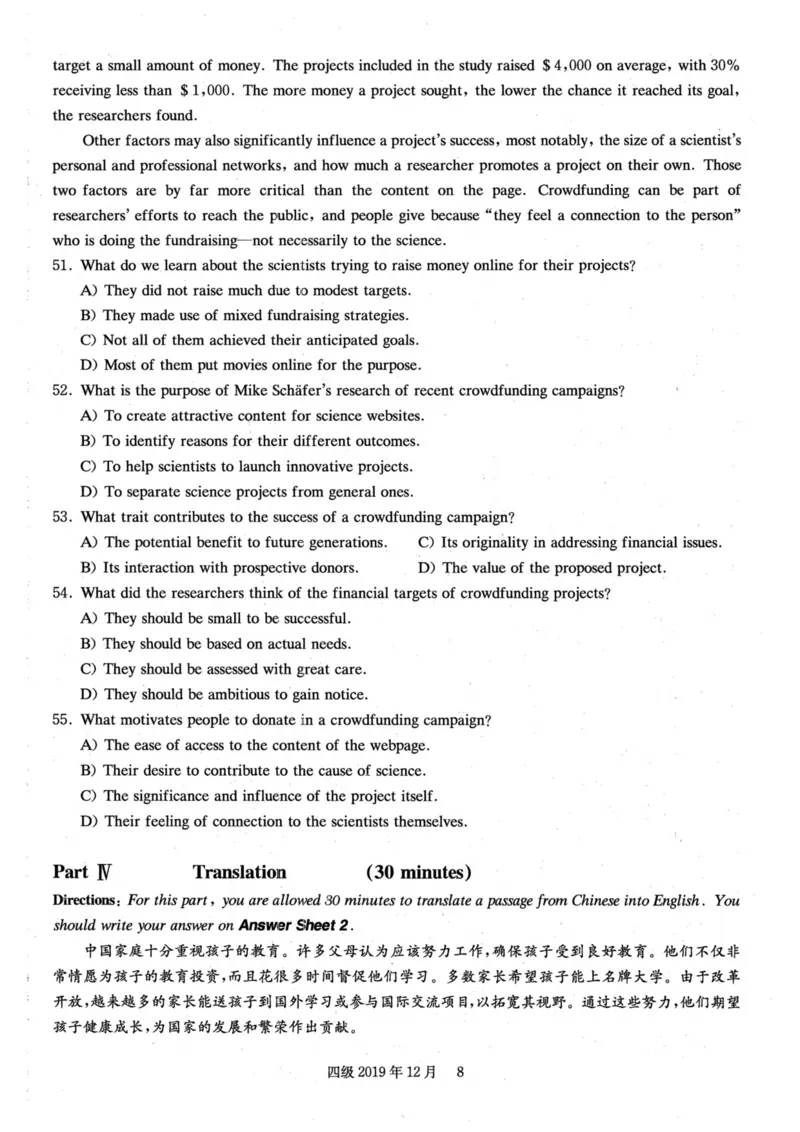
四级2019年12月 7target a small amount of money. The projects included in the study raised $ 4,000 on average, with 30%
receiving less than $ 1,000. The more money a project sought, the lower the chance it reached its goal,
the researchers found.
Other factors may also significantly influence a project's success, most notably, the size of a scientist's
personal and professional networks, and how much a researcher promotes a project on their own. Those
two factors are by far more critical than the content on the page. Crowdfunding can be part of
researchers5 efforts to reach the public, and people give because “they feel a connection to the person”
who is doing the fundraising- not necessarily to the science.
51. What do we learn about the scientists trying to raise money online for their projects?
A) They did not raise much due to modest targets.
B) They made use of mixed fundraising strategies.
C) Not all of them achieved their anticipated goals.
D) Most of them put movies online for the purpose.
52. What is the purpose of Mike Schafer5s research of recent crowdfunding campaigns?
A) To create attractive content for science websites.
B) To identify reasons for their different outcomes.
C) To help scientists to launch innovative projects.
D) To separate science projects from general ones.
53. What trait contributes to the success of a crowdfunding campaign?
A) The potential benefit to future generations. C) Its originality in addressing financial issues.
B) Its interaction with prospective donors. D) The value of the proposed project.
54. What did the researchers think of the financial targets of crowdfunding projects?
A) They should be small to be successful.
B) They should be based on actual needs.
C) They should be assessed with great care.
D) They should be ambitious to gain notice.
55. What motivates people to donate in a crowdfunding campaign?
A) The ease of access to the content of the webpage.
B) Their desire to contribute to the cause of science.
C) The significance and influence of the project itself.
D) Their feeling of connection to the scientists themselves.
Part N Translation (30 minutes)
Directions: For this part, you are allowed 30 minutes to translate a passage from Chinese into English. You
should write your answer on Answer Sheet 2.
中国家庭十分重视孩子的教育。许多父母认为应该努力工作,确保孩子受到良好教育。他们不仅非
常情愿为孩子的教育投资,而且花很多时间督促他们学习。多数家长希望孩子能上名牌大学。由于改革
开放,越来越多的家长能送孩子到国外学习或参与国际交流项目,以拓宽其视野。通过这些努力,他们期望
孩子健康成长,为国家的发展和繁荣作出贡献。
四级2019年12月 82019年 1 2 月大学英语四级考试真题(二)
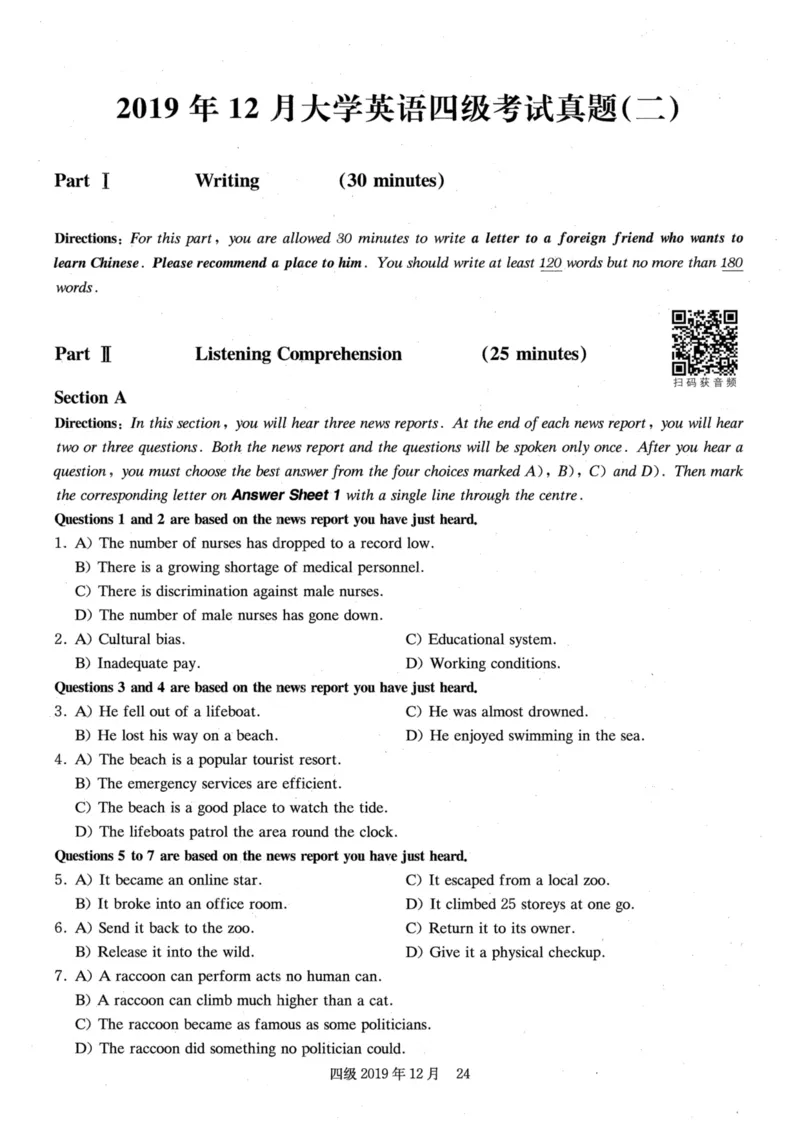
Part I Writing (30 minutes)
Directions: For this part, you are allowed 30 minutes to write a letter to a foreign friend who wants to
learn Chinese. Please recommend a place to him. You should write at least 120 words but no more than 180
words .
Part H Listening Comprehension (25 minutes)
扫码获音频
Section A
Directions: In this section, you will hear three news reports. At the end of each news report, you will hear
two or three questions. Both the news report and the questions will be spoken only once. After you hear a
question, you must choose the best answer from the four choices marked A ), B), C) and D). Then mark
the corresponding letter on Answer Sheet 1 with a single line through the centre.
Questions 1 and 2 are based on the news report you have just heard.
1. A) The number of nurses has dropped to a record low.
B) There is a growing shortage of medical personnel.
C) There is discrimination against male nurses.
D) The number of male nurses has gone down.
2. A) Cultural bias. C) Educational system.
B) Inadequate pay. D) Working conditions.
Questions 3 and 4 are based on the news report you have just heard.
3. A) He fell out of a lifeboat. C) He was almost drowned.
B) He lost his way on a beach. D) He enjoyed swimming in the sea.
4. A) The beach is a popular tourist resort.
B) The emergency services are efficient.
C) The beach is a good place to watch the tide.
D) The lifeboats patrol the area round the clock.
Questions 5 to 7 are based on the news report you have just heard.
5. A) It became an online star. C) It escaped from a local zoo.
B) It broke into an office room. D) It climbed 25 storeys at one go.
6. A) Send it back to the zoo. C) Return it to its owner.
B) Release it into the wild. D) Give it a physical checkup.
7. A) A raccoon can perform acts no human can.
B) A raccoon can climb much higher than a cat.
C) The raccoon became as famous as some politicians.
D) The raccoon did something no politician could.
四级2019年12月 24Section B
Directions: In this section, you will hear two long conversations. At the end of each conversation, you will
hear four questions. Both the conversation and the questions will be spoken only once. After you hear a
question, you must choose the best answer from the four choices marked A ), B ), C) and D). Then mark
the corresponding letter on Answer Sheet 1 with a single line through the centre.
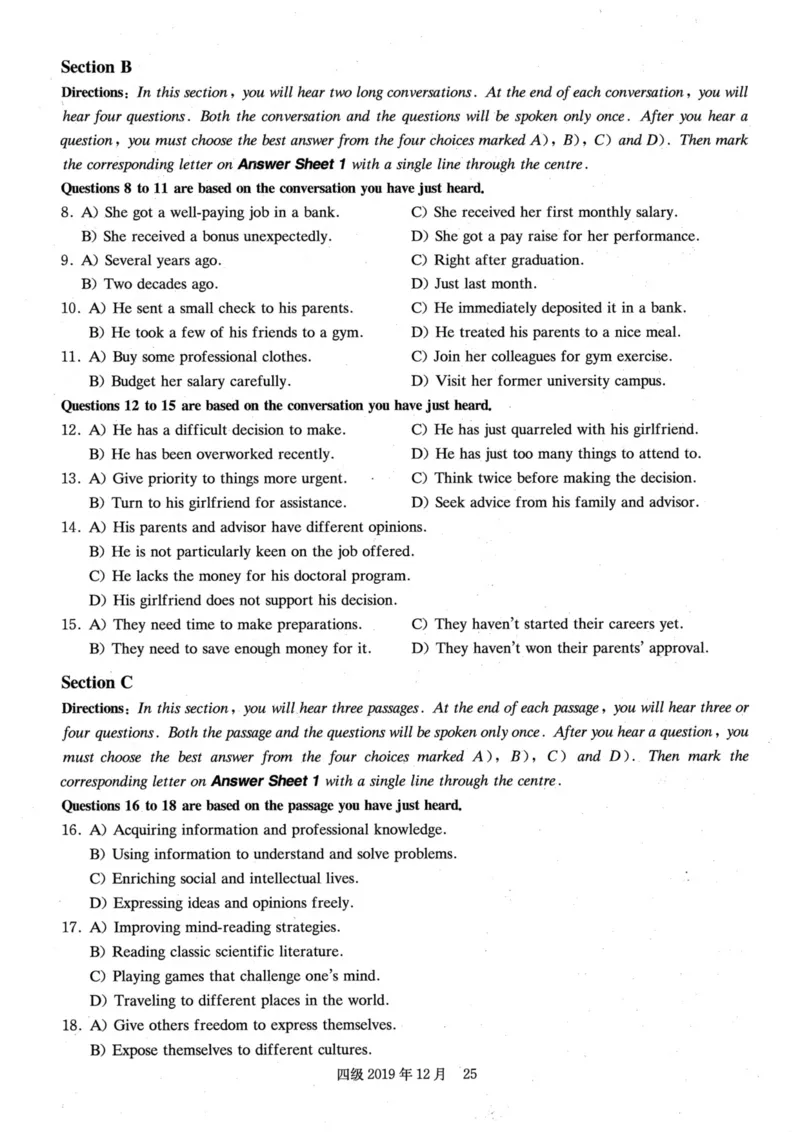
Questions 8 to 11 are based on the conversation you have just heard.
8. A) She got a well-paying job in a bank. C) She received her first monthly salary.
B) She received a bonus unexpectedly. D) She got a pay raise for her performance.
9. A) Several years ago. C) Right after graduation.
B) Two decades ago. D) Just last month.
10. A) He sent a small check to his parents. C) He immediately deposited it in a bank.
B) He took a few of his friends to a gym. D) He treated his parents to a nice meal.
11. A) Buy some professional clothes. C) Join her colleagues for gym exercise.
B) Budget her salary carefully. D) Visit her former university campus.
Questions 12 to 15 are based on the conversation you have just heard.
12. A) He has a difficult decision to make. C) He has just quarreled with his girlfriend.
B) He has been overworked recently. D) He has just too many things to attend to.
13. A) Give priority to things more urgent. C) Think twice before making the decision.
B) Turn to his girlfriend for assistance. D) Seek advice from his family and advisor.
14. A) His parents and advisor have different opinions.
B) He is not particularly keen on the job offered.
C) He lacks the money for his doctoral program.
D) His girlfriend does not support his decision.
15. A) They need time to make preparations. C) They haven't started their careers yet.
B) They need to save enough money for it. D) They haven't won their parents' approval.
Section C
Directions : In this section, you will hear three passages. At the end of each passage, you will hear three or
four questions. Both the passage and the questions will be spoken only once. After you hear a question, you
must choose the best answer from the four choices marked A ), B ), C) and D). Then mark the
corresponding letter on Answer Sheet 1 with a single line through the centre.
Questions 16 to 18 are based on the pass狰 you have just heard.
16. A) Acquiring information and professional knowledge.
B) Using information to understand and solve problems.
C) Enriching social and intellectual lives.
D) Expressing ideas and opinions freely.
17. A) Improving mind-reading strategies.
B) Reading classic scientific literature.
C) Playing games that challenge one's mind.
D) Traveling to different places in the world.
18. A) Give others freedom to express themselves.
B) Expose themselves to different cultures.
四级2019年 12月 25C) Discard personal biases and prejudices.
D) Participate in debates or discussions.
Questions 19 to 21 are based on the passage you have just heard.
19. A) The nature of relationships between dogs.
B) The reason a great many people love dogs.
C) Why dogs can be faithful friends of humans.
D) How dogs feel about their bonds with humans.
20. A) They have an unusual sense of responsibility.
B) They can respond to humans' questions.
C) They can fall in love just like humans.
D) They behave like other animals in many ways.
21. A) They have their own joys and sorrows.
B) They experience true romantic love.
C) They help humans in various ways.
D) They stay with one partner for life.
Questions 22 to 25 are based on the passage you have just heard.
22. A) A cow bone. C) A historical site.
B) A rare animal. D) A precious stone.
23. A) Measuring it. C) Dating it.
B) Preserving it. D) Identifying it.
24. A) The site should have been protected.
B) The boy's family had acted correctly.
C) The boy should have called an expert.
D) The channel needs to interviev/ the boy.
25. A) Search for similar fossils elsewhere. C) Conduct a more detailed search.
B) Ask the university to reward Jude. D) Seek additional funds for the search.
Part Reading Comprehension (40 minutes)
Section A
Directions: In this section, there is a passage with ten blanks. You are required to select one word for each
blank from a list of choices given in a word bank following the passage. Read the passage through carefully
before making your choices. Each choice in the bank is identified by a letter. Please mark the corresponding
letter for each item on Answer Sheet 2 with a single line through the centre. You may not use any of the
words in the bank more than once.
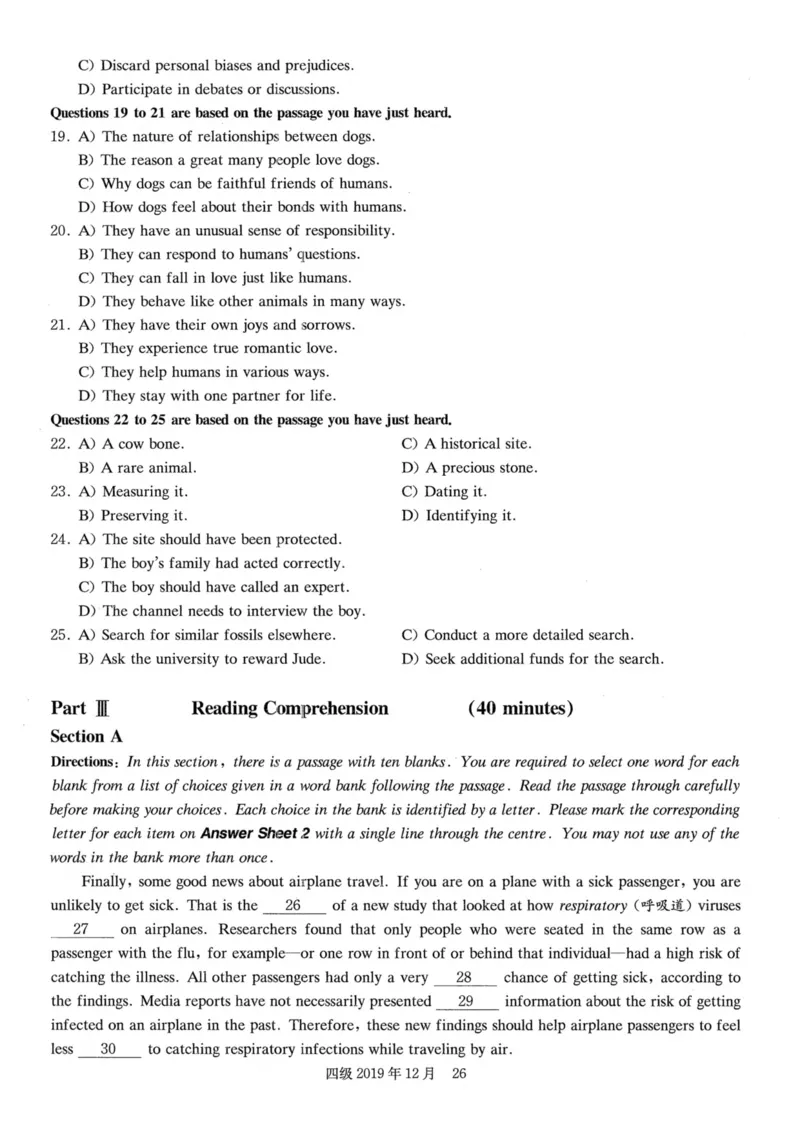
Finally, some good news about airplane travel. If you are on a plane with a sick passenger, you are
unlikely to get sick. That is the 26 of a new study that looked at how respiratory (呼吸道)viruses
27 on airplanes. Researchers found that only people who were seated in the same row as a
passenger with the flu, for example- or one row in front of or behind that individual一had a high risk of
catching the illness. All other passengers had only a very 28 chance of getting sick, according to
the findings. Media reports have not necessarily presented 29 information about the risk of getting
infected on an airplane in the past. Therefore, these new findings should help airplane passengers to feel
less 30 to catching respiratory infections while traveling by air.
四级2019年12月 26Prior to the new study, little was known about the risks of getting 31 infected by common
respiratory viruses, such as the flu or common cold, on an airplane, the researchers said. So, to 32
the risks of infection, the study team flew on 10 different 3 3 in the U. S. during the flu season.
The researchers found that passengers sitting within two seats on 34 side of a person infected with
the flu, as well as those sitting one row in front of or behind this individual, had about an 80 percent
chance of getting sick. But other passengers were 35 safe from infection. They had a less than
3 percent chance of catching the flu.
A) accurate F) explorations K) slim
B) conclusion G) flights L) spread
C) directly H) largely M) summit
D) either I) nearby N) vividly
E) evaluate J) respond O) vulnerable
Section B
Directions : In this section, you are going to read a passage with ten statements attached to it. Each
statement contains information given in one of the paragraphs. Identify the paragraph from which the
information is derived. You may choose a paragraph more than once. Each paragraph is marked with a
letter. Answer the questions by marking the corresponding letter on Answer Sheet 2.
Is Breakfast Really the Most Important Meal of the Day?
A) Along with old classics like “carrots give you night vision" and "Santa doesn't bring toys to misbehaving
children”, one of the most well-worn phrases of tired parents everywhere is that breakfast is the most
important meal of the day. Many of us grow up believing that skipping breakfast is a serious mistake,
even if only two thirds of adults in the UK eat breakfast regularly, according to the British Dietetic
Association, and around three-quarters of Americans.
B) “The body uses a lot of energy stores for growth and repair through the night,“ explains diet specialist
Sarah Elder. "Eating a balanced breakfast helps to up our energy, as well as make up for protein and
calcium used throughout the night.M But there's widespread disagreement over whether breakfast
should keep its top spot in the hierarchy (等级)of meals. There have been concerns around the sugar
content of cereal and the food industry's involvement in pro-breakfast research一and even one claim
from an academic that breakfast is “dangerous”.
C) What's the reality? Is breakfast a necessary start to the day or a marketing tactic by cereal companies?
The most researched aspect of breakfast (and breakfast-skipping) has been its links to obesity.
Scientists have different theories as to why there's a relationship between the two. In one US study
that analysed the health data of 50,000 people over seven years, researchers found that those who
made breakfast the largest meal of the day were more likely to have a lower body mass index (BMI)
than those who ate a large lunch or dinner. The researchers argued that breakfast helps reduce daily
calorie intake and improve the quality of our diet一since breakfast foods are often higher in fibre and
nutrients.
D) But as with any study of this kind, it was unclear if that was the cause一or if breakfast-skippers were
just more likely to be overweight to begin with. To find out, researchers designed a study in which 52
obese women took part in a 12-week weight loss programme. All had the same number of calories over
四级2019年12月 27the day, but half had breakfast, while the other half did not. What they found was that it wasn't
breakfast itself that caused the participants to lose weight: it was changing their normal routine.
E) If breakfast alone isn't a guarantee of weight loss, why is there a link between obesity and breakfast
skipping? Alexandra Johnstone, professor of appetite research at the University of Aberdeen, argues
that it may simply be because breakfast-skippers have been found to be less knowledgeable about
nutrition and health. "There are a lot of studies on the relationship between breakfast eating and
possible health outcomes, but this may be because those who eat breakfast choose to habitually have
health-enhancing behaviours such as regular exercise and not smoking,w she says.
F) A 2016 review of 10 studies looking into the relationship between breakfast and weight management
concluded there is ulimited evidencew supporting or refuting (反 驳 )the argument that breakfast
influences weight or food intake, and more evidence is required before breakfast recommendations can
be used to help prevent obesity.
G) Researches from the University of Surrey and University of Aberdeen are halfway through research
looking into the mechanisms behind how the time we eat influences body weight. Early findings suggest
that a bigger breakfast is beneficial to weight control. Breakfast has been found to affect more than
just weight. Skipping breakfast has been associated with a 27% increased risk of heart disease, a 21%
higher risk of type 2 diabetes in men, and a 20% higher risk of type 2 diabetes in women. One reason
may be breakfast's nutritional value- partly because cereal is fortified (增加营养价值)with vitamins.
In one study on the breakfast habits of 1,600 young people in the UK, researchers found that the fibre
and micronutrient intake was better in those who had breakfast regularly. There have been similar
findings in Australia, Brazil, Canada and the US.
H) Breakfast is also associated with improved brain function, including concentration and language use. A
review of 54 studies found that eating breakfast can improve memory, though the effects on other
brain functions were inconclusive. However, one of the review's researchers, Mary Beth Spitznagel,
says there is “reasonable“ evidence breakfast does improve concentration- there just needs to be more
research. uLooking at studies that tested concentration, the number of studies showing a benefit was
exactly the same as the number that found no benefit,w she says. "And no studies found that eating
breakfast was bad for concentration.w
I) What's most important, some argue, is what we eat for breakfast. High-protein breakfasts have been
found particularly effective in reducing the longing for food and consumption later in the day,
according to research by the Australian Commonwealth Scientific and Industrial Research
Organisation. While cereal remains a firm favourite among breakfast consumers in the UK and US, a
recent investigation into the sugar content of 'adult' breakfast cereals found that some cereals contain
more than three-quarters of the recommended daily amount of free sugars in each portion, and sugar
was the second or third highest ingredient in cereals.
J) But some research suggests if we're going to eat sugary foods, it's best to do it early. One study
recruited 200 obese adults to take part in a 16-week-long diet, where half added dessert to their
breakfast, and half didn't. Those who added dessert lost an average of 40 pounds more—however, the
study was unable to show the long-term effects. A review of 54 studies found that there is no consensus
yet on what type of breakfast is healthier, and concluded that the type of breakfast doesn't matter as
much as simply eating something.
K) While there's no conclusive evidence on exactly what we should be eating and when, the consensus is
四级2019年 12月 28that we should listen to our own bodies and eat when we're hungry. wBreakfast is most important for
people who are hungry when they wake up,“ Johnstone says. "Each body starts the day differently—
and those individual differences need to be researched more closely,“ Spitznagel says. "A balanced
breakfast is really helpful, but getting regular meals throughout the day is more important to leave
blood sugar stable through the day, which helps control weight and hunger levels,“ says Elder.
uBreakfast isn't the only meal we should be getting right.w
36. According to one professor, obesity is related to a lack of basic awareness of nutrition and health.
37. Some scientists claim that people should consume the right kind of food at breakfast.
38. Opinions differ as to whether breakfast is the most important meal of the day.
39. It has been found that not eating breakfast is related to the incidence of certain diseases in some
countries.
40. Researchers found it was a change in eating habits rather than breakfast itself that induced weight
loss.
41. To keep oneself healthy, eating breakfast is more important than choosing what to eat.
42. It is widely considered wrong not to eat breakfast.
43. More research is needed to prove that breakfast is related to weight loss or food intake.
44. People who prioritise breakfasts tend to have lower calorie but higher nutritional intake.
45. Many studies reveal that eating breakfast helps people memorise and concentrate.
Section C
Directions : There are 2 passages in this section. Each passage is followed by some questions or unfinished
statements. For each of them there are four choices marked A ), B) , C) and D). You should decide on the
best choice and mark the corresponding letter on Answer Sheet 2 with a single line through the centre.
Passage One
Questions 46 to 50 are based on the following passage.
Textbooks represent an 11 billion dollar industry, up from $ 8 billion in 2014. Textbook publisher
Pearson is the largest publisher—•of any kind一in the world.
It costs about $ 1 million to create a new textbook. A freshman textbook will have dozens of
contributors, from subject-matter experts through graphic and layout artists to expert reviewers and
classroom testers. Textbook publishers connect professors, instructors and students in ways that
alternatives, such as open e-textbooks and open educational resources, simply do not. This connection
happens not only by means of collaborative development, review and testing, but also at conferences
where faculty regularly decide on their textbooks and curricula for the coming year.
It is true that textbook publishers have recently reported losses, largely due to students renting or
buying used print textbooks. But this can be chalked up to the excessively high cost of their books- which
has increased over 1,000 percent since 1977. A restructuring of the textbook industry may well be in
order. But this does not mean the end of the textbook itself.
While they may not be as dynamic as an iPad, textbooks are not passive or lifeless. For example, over
the centuries, they have simulated (模拟)dialogues in a number of ways. From 1800 to the present day,
textbooks have done this by posing questions for students to answer inductively (归纳性地).That means
students are asked to use their individual experience to come up with answers to general questions. Today's
psychology texts, for example, ask: ”How much of your personality do you think you inherited?w while
四级2019年12月 29 /ones in physics say: ”How can you predict where the ball you tossed will land?”
Experts observe that wtextbooks come in layers, something like an onion.w For an active learner,
engaging with a textbook can be an interactive experience. Readers proceed at their own pace. They
“customize“ their books by engaging with different layers and linkages. Highlighting, Post-It notes, dog
ears and other techniques allow for further customization that students value in print books over digital
forms of books.
46. What does the passage say about open educational resources?
A) They contribute to teaching as much as to learning.
B) They don't profit as much as traditional textbooks do.
C) They can't connect professors and students as textbooks do.
D) They compete fiercely for customers with textbook producers.
47. What is the main cause of the publishers3 losses?
A) Failure to meet student need. C) Emergence of e-books.
B) Industry restructuring. D) Falling sales.
48. What does the textbook industry need to do?
A) Reform its structures. C) Find replacements for printed textbooks.
B) Cut its retail prices. D) Change its business strategy periodically.
49. What are students expected to do in the learning process?
A) Think carefully before answering each question.
B) Ask questions based on their own understanding.
C) Answer questions using their personal experience.
D) Give answers showing their respective personality.
50. What do experts say about students using textbooks?
A) They can digitalize the prints easily. C) They can purchase customized versions.
B) They can learn in an interactive way. D) They can adapt the material themselves.
Passage Two
Questions 51 to 55 are based on the following passage.
When we think of animals and plants, we have a pretty good way of dividing them into two distinct
groups: one converts sunlight into energy and the other has to eat food to make its energy. Well, those
dividing lines come crashing down with the discovery of a sea slug (海姑蝙)that's truly half animal and
half plant. It's pretty incredible how it has managed to hijack the genes of the algae (藻类)on which it
feeds.
The slugs can manufacture chlorophyll, the green pigment (色素)in plants that captures energy from
sunlight, and hold these genes within their body. The term kleptoplasty is used to describe the practice of
using hijacked genes to create nutrients from sunlight. And so far, this green sea slug is the only known
animal that can be truly considered solar-powered, although some animals do exhibit some plant-like
behaviors. Many scientists have studied the green sea slugs to confirm that they are actually able to create
energy from sunlight.
In fact, the slugs use the genetic material so well that they pass it on to their future generations. Their
babies retain the ability to produce their own chlorophyll, though they can't generate energy from sunlight
until theyve eaten enough algae to steal the necessary genes, which they can't yet produce on their own.
“There's no way on earth that genes from an alga should work inside an animal cell,“ says Sidney
四级2019年12月 30Pierce from the University of South Florida. "And yet here, they do. They allow the animal to rely on
sunshine for its nutrition. So if something happens to their food source, they have a way of not starving to
death until they find more algae to eat.w
The sea slugs are so good at gathering energy from the sun that they can live up to nine months
without having to eat any food. They get all their nutritional needs met by the genes that they've hijacked
from the algae.
51. What is the distinctive feature of a sea slug?
A) It looks Hke both a plant and an animal.
B) It converts some sea animals into plants.
C) It lives half on animals and half on plants.
D) It gets energy from both food and sunlight.
52. What enables the sea slug to live like a plant?
A) The genes it captures from the sea plant algae.
B) The mechanism by which it conserves energy.
C) The nutrients it hijacks from other species.
D) The green pigment it inherits from its ancestors.
53. What does the author say about baby sea slugs?
A) They can live without sunlight for a long time.
B) They can absorb sunlight right after their birth.
C) They can survive without algae for quite some time.
D) They can produce chlorophyll on their own.
54. What does Sidney Pierce say about genes from an alga?
A) They are stolen from animals like the sea slug.
B) They can't function unless exposed to sunlight.
C) They don't usually function inside animal cells.
D) They can readily be converted to sea slug genes.
55. What do we learn about sea slugs from the passage?
A) They behave the way most plant species do.
B) They can survive for months without eating.
C) They will turn into plants when they mature.
D) They will starve to death without sunlight.
Part N Translation (30 minutes)
Directions: For this part, you are allowed 30 minutes to translate a passage from Chinese into English. You
should write your answer on Answer Sheet 2.
中国的家庭观念与其文化传统有关。和睦的大家庭曾非常令人羡慕。过去四代同堂并不少见。由于
这个传统,许多年轻人婚后继续与父母同住。今天,这个传统正在改变。随着住房条件的改善,越来越多
年轻夫妇选择与父母分开住。但他们之间的联系仍然很密切。许多老年人仍然帮着照看孙辈。年轻夫妇
也抽时间探望父母,特别是在春节和中秋节等重要节日。
四级2019年12月 312019年 1 2 月大学英语四级考试真题(三)
Part I Writing (30 minutes)
Directions: For this part, you are allowed 30 minutes to write a letter to a foreign friend who wants to
study in China. Please recommend a university to him. You should write at least 120 words but no more than
180 words.
Part H Listening Comprehension (25 minutes)
说明:由于2019年 12月四级考试全国共考了两套听力,本套真题听力与前两套内容相同,只是选项顺序不
同,因此在本套真题中不再重复出现。
Part K Reading Comprehension (40 minutes)
Section A
Directions: In this section, there is a passage with ten blanks. You are required to select one word for each
blank from a list of choices given in a word bank following the passage. Read the passage through carefully
before making your choices. Each choice in the bank is identified by a letter. Please mark the corresponding
letter for each item on Answer Sheet 2 with a single line through the centre. You may not use any of the
words in the bank more than once.
Millions of people travel by plane every single day. If you're planning on being one of them soon, you
might not be looking forward to the 26 feeling air travel often leaves you with.
Besides the airport crowds and stress, traveling at a high altitude has real effects on the body.
Although the pressure of the cabin is 27 to prevent altitude sickness, you could still 28
sleepiness or a headache. The lower oxygen pressure found in an aircraft cabin is 29 to that at
6,000- 8,000 feet of altitude. A drop in oxygen pressure can cause headaches in certain 30 To
help prevent headaches, drink plenty of water, and avoid alcohol and coffee.
Airplane food might not really be as tasteless as you 31 thought. The air you breathe in a plane
dries out your mouth and nose, which can affect your sense of taste. Perception of sweet and salty foods
dropped by almost 30 percent in a simulation of air travel. However, you can make your taste buds active
again by drinking water. A dry mouth may 32 taste sensitivity, but taste is restored by drinking
fluids.
Although in-flight infections 33 in dry environments Hke airplanes, your risk of getting sick
from an airplane is actually low because of the air 34 used. Unless you're sitting next to someone
who is coughing or sneezing, you shouldn't worry too much about getting sick. However, bacteria have
been shown to live on cabin surfaces, so wash your hands 35
四级2019年12月 47A) adjusted F) frequently K) reduce
B) channels G) individuals L) renovated
C) equivalent H) originally M) smooth
D) experience I) particular N) thrive
E) filters J) primarily O) unpleasant
Section B
Directions : In this section, you are going to read a passage with ten statements attached to it. Each
statement contains information given in one of the paragraphs. Identify the paragraph from which the
information is derived. You may choose a paragraph more than once. Each paragraph is marked with a
letter. Answer the questions by marking the corresponding letter on Answer Sheet 2.
A South Korean city designed for the future takes on a life of its own
A) Getting around a city is one thing- and then there's the matter of getting from one city to another.
One vision of the perfect city of the future is a place that offers easy access to air travel. In 2011, a
University of North Carolina business professor named John Kasarda published a book called
Aerotropolis : The Way We,ll Live Next. Kasarda says future cities should be built intentionally around
or near airports. The idea, as he has put it, is to offer businesses “rapid, long-distance connectivity on
a massive scale.w
B) "The 18th century really was a waterborne (水运的)century, the 19th century a rail century, the 20th
century a highway, car, truck century一and the 21st century will increasingly be an aviation century,
as the globe becomes increasingly connected by air,“ Kasarda says. Songdo, a city built from scratch in
South Korea, is one of Kasarda's prime examples. It has existed for just a few years. "From the
outset, it was designed on the basis of connectivity and competitiveness, says Kasarda. "The
government built the bridge directly from the airport to the Songdo International Business District.
And the surface infrastructure was built at the same time as the new airport.
C) Songdo is a stone5s throw from South Korea's Incheon Airport, its main international hub (才区纽).But
it takes a lot more than a nearby airport to be a city of the future. Just building a place as an
“international business district“ doesn't mean it will become one. Park Yeon Soo conceived (构想)this
city of the future back in 1986. He considers Songdo his baby. Park sees himself as a visionary. Thirty
years after he imagined the city, Park's baby is close to 70 percent built, with 36,000 people living in
the business district and 90,000 residents in greater Songdo. It's about an hour outside Seoul, built on
former tidal flats along the Yellow Sea. There's a Coast Guard building and a tall trade tower, as well
as a park, golf course and university.
D) Chances are you've actually seen this place. Songdo appears in the most famous music video ever to
come out of South Korea. "Gangnam Style“ refers to the fashionable Gangnam district in Seoul. But
some of the video was filmed in Songdo. "I don't know if you remember, there was a scene in a subway
station. That was not Gangnam. That was actually Songdo,says Jung Won Son, a professor of urban
development at London5s Bartlett School of Planning. "Part of the reason to shoot there is that it's new
and nice.”
E) The city was supposed to be a hub for global companies, with employees from all over the world. But
四级2019年12月 48that's not how it has turned out. Songdo's reputation is as a futuristic ghost town. But the reality is
more complicated. A bridge with big, light-blue loops leads into the business district. In the center of
the main road, there's a long line of flags of the world. On the corner, there's a Starbucks and a
7-Eleven一all of the international brands that you see all over the world nowadays.
F) The city is not empty. There are mothers pushing baby carriages, old women with walkers■—even in
the middle of the day, when it's 90 degrees out. Byun Young-Jin chairs the Songdo real estate
association and started selling property here when the first phase of the city opened in 2005. He says
demand has boomed in the past couple of years. Most of his clients are Korean. In fact, the developer
says, 99 percent of the homes here are sold to Koreans. Young families move here because the schools
are great. And that's the problem: Songdo has become a popular Korean city一more popular as a
residential area than a business one. It's not yet the futuristic international business hub that planners
imagined. "It's a great place to live. And it's becoming a great place to work,“ says Scott Summers,
vice-president of Gale International, the developer of the city. The floor-to-ceiling windows of his
company's offices overlook Songdo Central Park, with a canal full of small boats and people fishing.
Shimmering (闪烁的)glass towers line the canafs edge.
G) "What's happened is that our focus on creating that quality of life first has enabled the residents to live
here,“ Summers says. But there needs to be strong economic incentives for companies to locate here.
The city is still unfinished, and it feels a bit like a theme park. It doesn't feel all that futuristic.
There's a high-tech underground trash disposal system. Buildings are environmentally friendly.
Everybody's television set is connected to a system that streams personalized language or exercise
classes.
H) But this is not Star Trek, And to some of the residents, Songdo feels hollow. "I'm, like, in prison for
weekdays. That's what we call it in the workplacesays a woman in her 20s. She doesn't want to use
her name for fear of being fired from her job. She goes back to Seoul every weekend. "L say I'm
prison-breaking on Friday nights.,f But she has to make the prison break in her own car. There's no
high-speed train connecting Songdo to Seoul, just over 20 miles away.
I) Park Yeon Soo, the man who first imagined Songdo, feels frustrated, too. He says he built South
Korea a luxury vehicle, “like Mercedes or BMW. It's a good car now. But we're waiting for a good
driver to accelerate.But there are lots of other good cars out there, too. The world is dotted with
futuristic, high-tech cities trying to attract the biggest international companies.
J) Songdo's backers contend that it's still early, and business space is filling up- about 70 percent of
finished offices are now occupied. Brent Ryan, who teaches urban design at MIT, says Songdo proves
a universal principle. "There have been a lot of utopian (乌托邦的)cities in history. And the reason
we don't know about a lot of them is that they have vanished entirely." In other words, when it comes
to cities一or anything else■—it is hard to predict the future.
36. Songdo's popularity lies more in its quality of life than its business attraction.
37. The man who conceived Songdo feels disappointed because it has fallen short of his expectations.
38. A scene in a popular South Korean music video was shot in Songdo.
39. Songdo still lacks the financial stimulus for businesses to set up shop there.
40. Airplanes will increasingly become the chief means of transportation, according to a professor.
四级2019年12月 4941. Songdo has ended up different from the city it was supposed to be.
42. Some of the people who work in Songdo complain about boredom in the workplace.
43. A business professor says that a future city should have easy access to international transportation.
44. According to an urban design professor, it is difficult for city designers to foresee what will happen in
the future.
45. Park Yeon Soo, who envisioned Songdo, feels a parental connection with the city.
Section C
Directions: There are 2 passages in this section. Each passage is followed by some questions or unfinished
statements. For each of them there are four choices marked A ), B), C) and D). You should decide on the
best choice and mark the corresponding letter on Answer Sheet 2 with a single line through the centre.
Passage One
Questions 46 to 50 are based on the following passage.
The fifth largest city in the US passed a significant soda tax proposal that will levy (征税)1.5 cents
per liquid ounce on distributors.
Philadelphia's new measure was approved by a 13 to 4 city council vote. It sets a new bar for similar
initiatives across the country. It is proof that taxes on sugary drinks can win substantial support outside
super-liberal areas. Until now, the only city to successfully pass and implement a soda tax was Berkeley,
California, in 2014.
The tax will apply to regular and diet sodas, as well as other drinks with added sugar, such as
Gatorade and iced teas. It's expected to raise $ 410 million over the next five years, most of which will go
toward funding a universal pre-kindergarten program for the city.
While the city council vote was met with applause inside the council room, opponents to the measure,
including soda lobbyists, made sharp criticisms and a promise to challenge the tax in court.
“The tax passed today unfairly singles out beverages——including low- and no-calorie choices,w said
Lauren Kane, spokeswoman for the American Beverage Association. "But most importantly, it is against
the law. So we will side with the majority of the people of Philadelphia who oppose this tax and take legal
action to stop it.”
An industry-backed anti-tax campaign has spent at least $ 4 million on advertisements. The ads
criticized the measure, characterizing it as a “grocery tax.n
Public health groups applauded the approved tax as a step toward fixing certain lasting health issues
that plague Americans. "The move to recapture a small part of the profits from an industry that pushes a
product that contributes to diabetes, obesity and heart disease in poorer communities in order to reinvest in
those communities will sure be inspirational to many other places,w said Jim Krieger, executive director of
Healthy Food America. "Indeed, we are already hearing from some of them. It's not 'just Berkeley7
anymore.w
Similar measures in California's Albany, Oakland, San Francisco and Colorado's Boulder are
becoming hot-button issues. Health advocacy groups have hinted that even more might be coming.
46. What does the passage say about the newly-approved soda tax in Philadelphia?
A) It will change the lifestyle of many consumers.
B) It may encourage other US cities to follow suit.
四级2019年12月 50C) It will cut soda consumption among low-income communities.
• I 1 ,
D) It may influence the marketing strategies of the soda business.
47. What will the opponents probably do to respond to the soda tax proposal?
A) Bargain with the city council.
B) Refuse to pay additional tax.
C) Take legal action against it.
D) Try to win public support.
48. What did the industry-backed anti-tax campaign do about the soda tax proposal?
A) It tried to arouse hostile feelings among consumers.
B) It tried to win grocersJ support against the measure.
C) It kept sending letters of protest to the media.
D) It criticized the measure through advertising.
49. What did public health groups think the soda tax would do?
A) Alert people to the risk of sugar-induced diseases.
B) Help people to fix certain long-time health issues.
C) Add to the fund for their research on diseases.
D) Benefit low-income people across the country.
50. What do we learn about similar measures concerning the soda tax in some other cities?
A) They are becoming rather sensitive issues.
B) They are spreading panic in the soda industry.
C) They are reducing the incidence of sugar-induced diseases.
D) They are taking away a lot of profit from the soda industry.
Passage Two
Questions 51 to 55 are based on the following passage.
Popping food into the microwave for a couple of minutes may seem utterly harmless, but Europe's
stock of these quick-cooking ovens emit as much carbon as nearly 7 million cars, a new study has found.
And the problem is growing. With costs falling and kitchen appliances becoming “status“ items, owners
are throwing away microwaves after an average of eight years. This is pushing sales of new microwaves
which are expected to reach 135 million annually in the EU by the end of the decade.
A study by the University of Manchester calculated the emissions of CO - the main greenhouse gas
2
responsible for climate change- at every stage of microwaves, from manufacture to waste disposal. "It is
electricity consumption by microwaves that has the biggest impact on the environment,w say the authors.
The authors also calculate that the emissions from using 19 microwaves over a year are the same as those
from using a car. According to the same study, efforts to reduce consumption should focus on improving
consumer awareness and behaviour. For example, consumers could use appliances in a more efficient way
by adjusting the time of cooking to the type of food.
However, David Reay, professor of carbon management, argues that, although microwaves use a
great deal of energy, their emissions are minor compared to those from cars. In the UK alone, there are
around 30 million cars. These cars emit more than all the microwaves in the EU. Backing this up, recent
data show that passenger cars in the UK emitted 69 million tons of CO in 2015. This is 10 times the
2
四级2019年12月 51amount this new microwave oven study estimates for annual emissions for all the microwave ovens in the
EU. Further, the energy used by microwaves is lower than any other form of cooking. Among common
kitchen appliances used for cooking, microwaves are the most energy efficient, followed by a stove and
finally a standard oven. Thus, rising microwave sales could be seen as a positive thing.
51. What is the finding of the new study?
A) Quick-cooking microwave ovens have become more popular.
B) The frequent use of microwaves may do harm to our health.
C) CO emissions constitute a major threat to the environment.
2
D) The use of microwaves emits more CO than people think.
2
52. Why are the sales of microwa ves expected to rise?
A) They are becoming more affordable.
B) They have a shorter life cycle than other appliances.
C) They are getting much easier to operate.
D) They take less time to cook than other appliances.
53. What recommendation does the study by the University of Manchester make?
A) Cooking food of different varieties.
B) Improving microwave users5 habits.
C) Eating less to cut energy consumption.
D) Using microwave ovens less frequently.
54. What does Professor David Reay try to argue?
A) There are far more emissions from cars than from microwaves.
B) People should be persuaded into using passenger cars less often.
C) The UK produces less CO than many other countries in the EU.
2
D) More data are needed to show whether microwaves are harmful.
55. What does Professor David Reay think of the use of micro waves?
A) It will become less popular in the coming decades.
B) It makes everyday cooking much more convenient.
C) It plays a positive role in environmental protection.
D) It consumes more power than conventional cooking.
Part N Translation (30 minutes)
Directions : For this part, you are allowed 30 minutes to translate a passage from Chinese into English. You
should write your answer on Answer Sheet 2.
中国汉族人的全名由姓和名组成。中文姓名的特点是,姓总是在前,名跟在其后。千百年来,父姓一
直世代相传。然而,如今,孩子跟母亲姓并不罕见。一般来说,名有一个或两个汉字,通常承载父母对孩子
的愿望。从孩子的名字可以推断出父母希望孩子成为什么样的人,或者期望他们过什么样的生活。父母
非常重视给孩子取名,因为名字往往会伴随孩子一生。
四级2019年12月 52