考点巩固卷 15 阅读理解之议论文
2023 年高考真题
【2023 ▪全国乙卷】
If you want to tell the history of the whole world, a history that does not privilege one part of humanity, you
cannot do it through texts alone, because only some of the world has ever had texts, while most of the world, for
most of the time, has not. Writing is one of humanity’s later achievements, and until fairly recently even many
literate (有文字的) societies recorded their concerns not only in writing but in things.
Ideally a history would bring together texts and objects, and some chapters of this book are able to do just
that, but in many cases we simply can’t. The clearest example of this between literate and non-literate history is
perhaps the first conflict, at Botany Bay, between Captain Cook’s voyage and the Australian Aboriginals. From
the English side, we have scientific reports and the captain’s record of that terrible day. From the Australian side,
we have only a wooden shield (盾) dropped by a man in flight after his first experience of gunshot. If we want to
reconstruct what was actually going on that day, the shield must be questioned and interpreted as deeply and
strictly as the written reports.
In addition to the problem of miscomprehension from both sides, there are victories accidentally or
deliberately twisted, especially when only the victors know how to write. Those who are on the losing side often
have only their things to tell their stories. The Caribbean Taino, the Australian Aboriginals, the African people of
Benin and the Incas, all of whom appear in this book, can speak to us now of their past achievements most
powerfully through the objects they made: a history told through things gives them back a voice. When we
consider contact (联系) between literate and non-literate societies such as these, all our first-hand accounts are
necessarily twisted, only one half of a dialogue. If we are to find the other half of that conversation, we have to
read not just the texts, but the objects.
32. What is the first paragraph mainly about?
A. How past events should be presented. B. What humanity is concerned about.
C. Whether facts speak louder than words. D. Why written language is reliable.
33. What does the author indicate by mentioning Captain Cook in paragraph 2?
A. His report was scientific. B. He represented the local people.
C. He ruled over Botany Bay. D. His record was one-sided.
34. What does the underlined word “conversation” in paragraph 3 refer to?
A. Problem. B. History. C. Voice. D. Society.
35. Which of the following books is the text most likely selected from?
资料收集整理【淘宝店铺:向阳百分百】 1A. How Maps Tell Stories of the World B. A Short History of Australia
C. A History of the World in 100 Objects D. How Art Works Tell Stories
2021-2022 年高考真题
【2022▪北京卷】
Quantum ( 量子 ) computers have been on my mind a lot lately. A friend has been sending me articles on
how quantum computers might help solve some of the biggest challenges we face as humans. I’ve also had
exchanges with two quantum-computing experts. One is computer scientist Chris Johnson who I see as someone
who helps keep the field honest. The other is physicist Philip Taylor.
For decades, quantum computing has been little more than a laboratory curiosity. Now, big tech companies
have invested in quantum computing, as have many smaller ones. According to Business Weekly, quantum
machines could help us “cure cancer, and even take steps to turn climate change in the opposite direction.” This is
the sort of hype ( 炒作 ) that annoys Johnson. He worries that researchers are making promises they can’t keep.
“What’s new,” Johnson wrote, “is that millions of dollars are now potentially available to quantum computing
researchers.”
As quantum computing attracts more attention and funding, researchers may mislead investors, journalists,
the public and, worst of all, themselves about their work’s potential. If researchers can’t keep their promises,
excitement might give way to doubt, disappointment and anger, Johnson warns. Lots of other technologies have
gone through stages of excitement. But something about quantum computing makes it especially prone to hype,
Johnson suggests, perhaps because “‘quantum’ stands for something cool you shouldn’t be able to understand.”
And that brings me back to Taylor, who suggested that I read his book Q for Quantum.
After I read the book, Taylor patiently answered my questions about it. He also answered my questions about
PyQuantum, the firm he co-founded in 2016. Taylor shares Johnson’s concerns about hype, but he says those
concerns do not apply to PyQuantum.
The company, he says, is closer than any other firm “by a very large margin ( 幅度 )” to building a “useful”
quantum computer, one that “solves an impactful problem that we would not have been able to solve otherwise.”
He adds, “People will naturally discount my opinions, but I have spent a lot of time quantitatively comparing what
we are doing with others.”
Could PyQuantum really be leading all the competition “by a wide margin”, as Taylor claims? I don’t know.
I’m certainly not going to advise my friend or anyone else to invest in quantum computers. But I trust Taylor, just
as I trust Johnson.
31. Regarding Johnson’s concerns, the author feels ________.
第2页,共14页A. sympathetic B. unconcerned C. doubtful D. excited
32. What leads to Taylor’s optimism about quantum computing?
A. His dominance in physics.
B. The competition in the field.
C. His confidence in PyQuantum.
D. The investment of tech companies.
33. What does the underlined word “prone” in Paragraph 3 most probably mean?
A. Open. B. Cool. C. Useful. D. Resistant.
34. Which would be the best title for the passage?
A. Is Johnson More Competent Than Taylor?
B. Is Quantum Computing Redefining Technology?
C. Will Quantum Computers Ever Come into Being?
D. Will Quantum Computing Ever Live Up to Its Hype?
【2021▪新高考I卷】
Popularization has in some cases changed the original meaning of emotional (情感的) intelligence.
Many people now misunderstand emotional intelligence as almost everything desirable in a person’s
makeup that cannot be measured by an IQ test, such as character, motivation, confidence, mental
stability, optimism and “people skills.” Research has shown that emotional skills may contribute to
some of these qualities, but most of them move far beyond skill-based emotional intelligence.
We prefer to describe emotional intelligence as a specific set of skills that can be used for either
good or bad purposes. The ability to accurately understand how others are feeling may be used by a
doctor to find how best to help her patients, while a cheater might use it to control potential victims.
Being emotionally intelligent does not necessarily make one a moral person.
Although popular beliefs regarding emotional intelligence run far ahead of what research can
reasonably support, the overall effects of the publicity have been more beneficial than harmful. The most
positive aspect of this popularization is a new and much needed emphasis (重视) on emotion by
employers, educators and others interested in promoting social well-being. The popularization of
emotional intelligence has helped both the public and researchers re-evaluate the functionality of emotions
and how they serve people adaptively in everyday life.
Although the continuing popular appeal of emotional intelligence is desirable, we hope that such
attention will excite a greater interest in the scientific and scholarly study of emotion. It is our hope
that in coming decades, advances in science will offer new perspectives (视角) from which to study how
资料收集整理【淘宝店铺:向阳百分百】 3people manage their lives. Emotional intelligence, with its focus on both head and heart, may serve to
point us in the right direction.
32. What is a common misunderstanding of emotional intelligence?
A. It can be measured by an IQ test.
B. It helps to exercise a person's mind.
C. It includes a set of emotional skills.
D. It refers to a person’s positive qualities.
33. Why does the author mention “doctor” and “cheater” in paragraph 2?
A. To explain a rule.
B. To clarify a concept.
C. To present a fact.
D. To make a prediction.
34. What is the author's attitude to the popularization of emotional intelligence?
A. Favorable. B. Intolerant. C. Doubtful. D. Unclear.
35. What does the last paragraph mainly talk about concerning emotional intelligence?
A. Its appeal to the public.
B. Expectations for future studies.
C. Its practical application.
D. Scientists with new perspectives.
2023 年名校模拟题
(2023·河北保定·统考一模)The two terms nature and nurture have been subjects of comparison since the
16th century. The argument is centered on the question as to whether it is nature or nurture that makes us who we
are.
Nature provides the starting point for an organism that will interact with nurture, the environment, during the
organism’s life. Nature does not just affect an organism during its lifetime, but it also can directly affect the
expression of genes in offspring (后代). For the Geneticists, they believe that our lives are entirely determined by
genetics, which is nature. An opposing view is that there is no indication that genes (基因) determines one’s
personality, rather there is growing evidence that nurture serves as the determining factor in personality
development.
Nurture refers to the conditions under which living things grow and develop after birth. When applied to
human beings, it means how the person is raised, which includes nutrition, education, care, as well as the kind of
surroundings, such as cultural influence, family and friends.
第4页,共14页The argument of nature and nurture as to which is more important is necessitated by an attempt to
differentiate how much effect genetics has on a person’s development against how easily humans are influenced
by one’s environment.
While nurture undeniably plays its part on the growth and development of one’s personality, nature
dramatically outweighs nurture, for nature can be likened to a foundation. The impact of nurture on the
development of persons cannot be totally denied. However, nature is regarded as being of most importance
because of the fact that it affords an opportunity and creates a foundation and the basis for the question of nurture
to arise at the very first instance. Even without nurture, the nature impact can still stand independently without
necessarily causing destruction. More so, even when the nurture impact is successfully effected, it does not
remove the genetic characteristics of a person. It therefore stands correctly that nature is that which determines the
substance of a person.
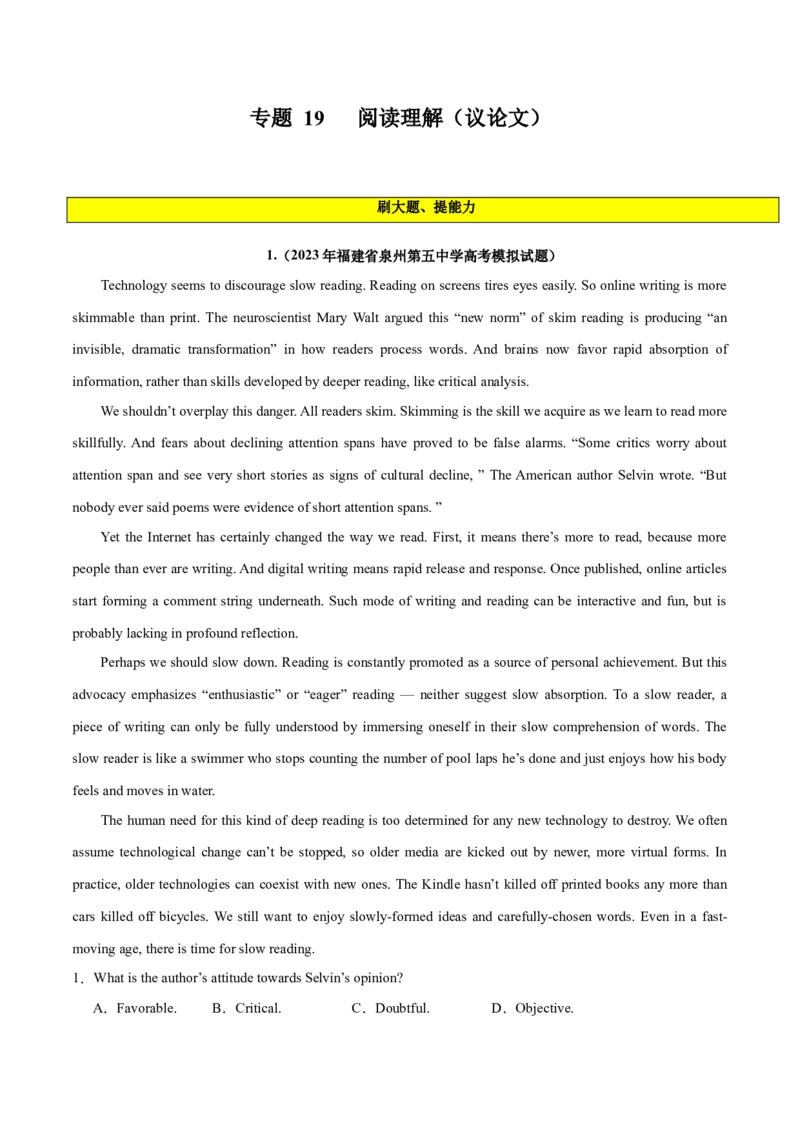
1.What can we learn from Paragraph 2?
A.Nature’s role is supported by additional evidence.
B.Personality development is determined by nurture.
C.Nature impacts gene expression in later generation.
D.Environment shapes personality more than genetics.
2.What does Paragraph 3 mainly talk about?
A.What nurture means to human beings.
B.How living things develop after birth.
C.How nurture shapes human development.
D.How surroundings influence human beings.
3.How does the author stress the greater importance of nature?
A.By giving examples.
B.By making contrast.
C.By conducting experiments.
D.By citing research data.
4.What is the best title for the text?
A.A Long Story of Nature and Nurture
B.A New Research on Nature and Nurture
C.Who Can Tell What Makes Who We Are?
D.Which Is More Important, Nature or Nurture?
资料收集整理【淘宝店铺:向阳百分百】 5(2023·辽宁鞍山·统考二模)We have long been attracted by quick solutions that could increase our
intelligence. Today, people’s hopes lie in brain training apps, some of which claim to result in “smarter minds”.
But is this quick solution all it is said to be?
There are plenty of brain training apps, but they all share the same characteristics: they turn mental exercises
like simple arithmetic (算术), memory tests and logic and pattern-matching problems into quick games. Some
apps tell us that the more you play these mini-games, the smarter you will get. It is really a big promise.
Many of the apps say they are based on “science”, a claim I found surprising as a former neuroscientist (神经
系统科学家). The concept that increasing intelligence would be as simple as practicing a few mini-games every
day flies in the face of what we have discovered about how humans think and learn.
After surveying thousands of users across a wide variety of apps, researchers at Western University in
Canada discovered that brain training had no great effect on cognitive (认知的) functioning in the real world. The
positive effects that have been found are limited to the very specific mini-games and tasks that users are trained
on, such as the ability to memorize lists of words or numbers, or perform mental arithmetic, with little benefit to
other skills.
If you are expecting them to improve your ability to write a novel or make a complex computer program, I
am afraid you will want to look elsewhere. Puzzle video games such as “Baba Is You” and “Return of the Obra
Dinn”, see players apply their skill at logic, memory and concentration in a far more complex way than any brain
training mini-game.
5.What does the author say about brain training apps?
A.They have scientific support. B.They work in the form of games.
C.They require problem-solving skills. D.They are based on complex arithmetic.
6.What does the underlined part “flies in the face of” in paragraph 3 mean?
A.Goes into details of. B.Takes advantage of.
C.Goes against. D.Comes from.
7.Which best describes the effects that brain training apps have on memory?
A.Limited. B.Indirect. C.Damaging. D.Far-reaching.
8.What is the author’s attitude to “Baba Is You”?
A.Doubtful. B.Intolerant. C.Uninterested. D.Favorable.
(2023秋·辽宁沈阳·高三校联考一模)What may well be the oldest metal coins in the world have been
identified at an ancient abandoned city known as Guanzhuang in China. Like many Bronze Age (青铜时代) coins
from the region, they were cast in the shape of spades (铲) with finely carved handles. These ancient coins existed
during an in-between period between barter (以物易物) and money, when coins were a novel concept, but
第6页,共14页everybody knew that agricultural tools were valuable.
Reading about this incredible discovery, I kept thinking about the way modern people represent computer
networks by describing machines as having “addresses”, like a house. We also talk about one computer using a
“port” to send information to another computer, as if the data were a floating boat with destination. It’s as if we
are in the Bronze Age of information technology, grasping desperately for real-world reference to transform our
civilization.
Now consider what happened to spade coins. Over centuries. metalworkers made these coins into more
abstract shapes. Some became almost human figures. Others’ handles were reduced to small half-circles. As spade
coins grew more abstract. people carved them with number values and the locations where they were made. They
became more like modern coins, flat and covered in writing. Looking at one of these later pieces, you would have
no idea that they were once intended to look like a spade.
This makes me wonder if we will develop an entirely new set of symbols that allow us to interact with our
digital information more smoothly.
Taking spade coins as our guide, we can guess that far-future computer networks will no longer contain any
recognizable references to houses. But they still might bring some of the ideas we associate with home to our
mind. In fact, computer networks — if they still exist at all — are likely to be almost the indispensable part of our
houses and cities, their sensors inset (嵌入) with walls and roads. Our network addresses might actually be the
same as our street addresses. If climate change leads to floods, our mobile devices might look more like boats than
phones, assisting us to land.
My point is that the metaphors (比喻) of the information age aren’t random. Mobile devices do offer us
comfort after a long day at work. In some sense, our desire to settle on the shores of data lakes could change the
way we understand home, as well as how we build computers. So as we cast our minds forward, we have to think
about what new abstractions will go along with our information technology. Perhaps the one thing we count on is
that humans will still appreciate the comforts of home.
9.Why were many Bronze Age coins made into the shape of a spade?
A.These coins also served as agricultural tools.
B.This stylish design made the coins valuable.
C.A lot of emphasis was put on agriculture.
D.The handles made the coins easily exchanged.
10.Why does the author relate computers to spade coins?
A.To show they both used to be new concepts when first invented.
B.To highlight their same importance in our civilizational transformation.
资料收集整理【淘宝店铺:向阳百分百】 7C.To suggest computers will experience dramatic changes as coins did.
D.To explain abstract digital worlds are different from concrete coins.
11.What does the underlined word “indispensable” in Paragraph 5 probably mean?
A.Flexible. B.Wasteful. C.Essential. D.Alternative.
12.Which of the following would be the best title for the passage?
A.How Agriculture Loses to Digital Industry
B.What Coins and Computers Bring Us
C.What Bronze Age and Information Age Have In Common
D.What Ancient Money Tells Us About the Future Digital World
(2023春·河北·高三校联考一模)Even though people have been paralyzed (瘫痪的) playing sports like
rugby and football, extreme sports take the whole ordeal (磨难) to the next level. Sports like downhill cycling are
very dangerous because one would be going downhill, over rocky or dirt zone, through forests, even at potentially
deadly speeds. A slip up could be your downfall.
Nobody who gets into extreme sports goes with the desire to do harm to themselves. With that, athletes train
for years and years before they attempt anything extreme. To most people, extreme sports are extreme simply
because they take more skill than what an average person has. An athlete with skill and training makes an extreme
thing become a daily routine. That does not wipe out the danger, but it greatly reduces it.
Even when there is a lot of skill involved, things might not go the athlete’s way, not at all. Luck and
circumstances have a lot to do with how things develop, whether above 8000 meters or in a wood, going downhill.
In some places, crossing the street is an extreme sport, considering how wild traffic can get.
Some view parkour — the sports of running, jumping and climbing under, around and through buildings —
as an extreme sport, while it is more of a life philosophy, where the athlete does not have to do anything remotely
dangerous. Free soloing, which means climbing a rock or ice face without safety gear, is absolutely deadly, where
one slip means almost certain death, depending on the height, of course. Skateboarding is relatively safe, but if
you constantly find ridiculous places to practice on, like the fence of a bridge, then things can get very
complicated. The extreme part depends on the athlete.
To summarize, yes, extreme sports are dangerous, but the danger depends on the athlete, their choice of sport,
direction in which they take it, as well as the circumstances. Some things are out of our reach of control, while
others we can influence through exercise and healthier risk choices.
13.Why is downhill cycling mentioned in Paragraph 1?
A.To call for attention to extreme sports.
第8页,共14页B.To introduce the origin of extreme sports.
C.To illustrate the danger of extreme sports.
D.To show the complexity of the extreme sports.
14.What does Paragraph 2 mainly talk about regarding extreme sports?
A.Extreme sports differ from one another.
B.Skill matters a lot in maintaining safety.
C.Athlete’s luck is a key factor that influences safety.
D.Extreme sports are more dangerous than regular sports.
15.Which would best describe the author’s attitude towards the danger of extreme sports?
A.Doubtful. B.Objective.
C.Intolerant. D.Uninterested.
16.Which of the following is the best title of the text?
A.Do Extreme Sports Test Your Courage?
B.Why Should Extreme Sports Be Banned?
C.Why Do We Love Extreme Sports so Much?
D.Are Extreme Sports Really That Dangerous?
(2023秋·辽宁大连·高三统考一模)We live in an age when all scientific knowledge — from the safety of
vaccines (疫苗) to the reality of climate change — faces organized and often angry opposition. Doubters have
declared war on the consensus (共识) of experts. It seems that people have turned argumentative overnight.
In a sense, all this is not surprising. Our lives are affected by science and technology as never before. The
world seems full of real and imaginary dangers. Though scientists agree that the Ebola virus is spread only by
direct contact with blood or body fluids (液体), if you type “airborne Ebola” into an Internet search engine, you’ll
find that some people believe that this virus has almost supernatural powers.
In this often confusing world, we need to rely on science to decide whether what we choose to believe has a
basis in the laws of nature or not. But science doesn’t come naturally to most of us. Science has often led us to
truths that are really mind-blowing. For example, although the roundness of the Earth has been known for
thousands of years, some still feel it hard to accept.
Even when people become scientifically educated, most of them still try to make sense of the world by
relying on personal experience, stories or emotions rather than statistics. When they hear a number of cancer cases
in a town with a dangerous waste dump (垃圾场), they believe pollution caused the cancers. Yet two things
happening together doesn’t mean one caused the other. Even when they turn to the Internet, they let in only the
information they agree with to strengthen beliefs that have already been shaped by their worldview.
资料收集整理【淘宝店铺:向阳百分百】 9How can scientists convince doubters? Throwing more facts at people may not be enough. More efforts are
supposed to be made.
17.What’s the text mainly about?
A.How people view the world. B.What challenges science faces.
C.Whether science is worth respect. D.Why people show disbelief in science.
18.What does the underlined word “mind-blowing” probably mean?
A.Unbelievable. B.Desirable. C.Dangerous. D.Obvious.
19.How do “people” in paragraph 4 understand the world?
A.They apply logical thinking.
B.They stick to their own beliefs.
C.They form the views on assumptions.
D.They rely on the information on the Internet.
20.How does the author prove his opinions?
A.Through comparison. B.Through quotation.
C.By giving examples. D.By making definitions.
(2023秋·浙江·高三德清县高级中学校联考一模)The personal grievance provisions of New Zealand’s
Employment Relations Act 2000 (ERA) prevent an employer from firing an employee without good cause.
Instead, dismissals must be justified. Employers must both show cause and act in a procedurally fair way.
Personal grievance procedures were designed to guard the jobs of ordinary workers from “unjustified
dismissals”. The premise was that the common law of contract lacked sufficient protection for workers against
arbitrary conduct by management. Long gone are the days when a boss could simply give an employee contractual
notice.
But these provisions create difficulties for businesses when applied to highly paid managers and executives.
As countless boards and business owners will attest, constraining firms from firing poorly performing, high-
earning managers is a handbrake on boosting productivity and overall performance. The difference between C-
grade and A-grade managers may very well be the difference between business success or failure. Between
preserving the jobs of ordinary workers or losing them. Yet mediocrity is no longer enough to justify a dismissal.
Consequently and paradoxically laws introduced to protect the jobs of ordinary workers may be placing those
jobs at risk.
If not placing jobs at risk, to the extent employment protection laws constrain business owners from
dismissing under-performing managers, those laws act as a constraint on firm productivity and therefore on
workers’ wages. Indeed, in “An International Perspective on New Zealand’s Productivity Paradox” (2014), the
第10页,共14页Productivity Commission singled out the low quality of managerial capabilities as a cause of the country’s poor
productivity growth record.
Nor are highly paid managers themselves immune from the harm caused by the ERA’s unjustified dismissal
procedures. Because employment protection laws make it costlier to fire an employee, employers are more
cautious about hiring new staff. This makes it harder for the marginal manager to gain employment. And firms pay
staff less because firms carry the burden of the employment arrangement going wrong.
Society also suffers from excessive employment protections. Stringent job dismissal regulations adversely
affect productivity growth and hamper both prosperity and overall well-being.
Across the Tasman Sea, Australia deals with the unjustified dismissal paradox by excluding employees
earning above a specified “high-income threshold” from the protection of its unfair dismissal laws. In New
Zealand, a 2016 private members’ Bill tried to permit firms and high-income employees to contract out of the
unjustified dismissal regime. However, the mechanisms proposed were unwieldy and the Bill was voted down
following the change in government later that year.
21.The personal grievance provisions of the ERA are intended to ________.
A.discipline dubious corporate practices B.promote traditional hiring procedures
C.regulate the privileges of the employers D.safeguard the rights of ordinary workers
22.It can be learned from paragraph 3 that the provisions may ________.
A.hinder business development B.justify managers’ authority
C.affect the public image of the firms D.worsen labor-management relations
23.Which of the following can be inferred from the passage?
A.ERA’s sensible approach corresponds with the international trend of democracy.
B.The society will see a rise in well-being with the ERA’s procedures carried out.
C.Non-proficient managerial capabilities make employees suffer from salary cuts.
D.High-income threshold in Australia is relatively beneficial to business owners.
24.What’s the author’s attitude towards the personal grievance provisions issued by ERA?
A.Appreciative B.Skeptical C.Optimistic D.Contradictory
(2023·宁夏银川·银川一中校考一模)I have frequently taught Research Methods and Design to college
students at several institutions. I love teaching this course. One reason, of course, is that I enjoy thinking about
research methodology (方法学) and sharing it with others. The other reason, however, is the obvious impact that it
has on students. Every term, one (if not more) student tells me how taking this course has affected him/her: “I
used to just read articles and believe what they said, but now I find myself asking ‘Is this true? How do they
know? Is this a well designed study?” That is what I want the students to achieve in this course.
资料收集整理【淘宝店铺:向阳百分百】 11This brings to mind something written by Dorothy L. Sayers in 1948. One of her books, The Lost Tools of
Learning speaks to Sayers’ thoughts on education. “By teaching our young men and women to read, we have left
them at the mercy of the printed words. By the invention of the film and the radio,we have made certain that no
dislike for reading shall protect them from the constant battery of words, words, words. They do not know what
the words mean: they are victims to words in their emotions instead of being the masters of them in their
intelligence.”
We are well past the 1940s, but her observation is still relevant. Sayers’ point is well taken. In the world of
24-hour news and social media that often resembles (类似) the Wild West, the ability to carry out evaluations has
never been more important. In order to resist the distortions with which we are constantly bombed in the media,
as well as be able to present a persuasive argument, we must be able to reason well, and think and give a
judgement carefully.
When my students begin the Research Methods and Design course, they are generally not content to read all
those research article I give. However, by the end of the course, they are excited about their newly obtained
abilities.
25.What is the author’s course goal for her students?
A.Thinking critically. B.Reading deeply.
C.Designing studies well. D.Questioning themselves.
26.What did Sayers imply about education?
A.It was boring. B.It was worrying.
C.It was conventional. D.It was useless.
27.What does the underlined word “distortions” in paragraph 3 refer to?
A.Popular news. B.Various evaluations.
C.Persuasive arguments. D.Misleading information.
28.Why does the author write the text?
A.To review a book. B.To introduce a writer.
C.To suggest a practical skill. D.To criticize social media.
(2023春·河南·高三校联考一模)A worrying rise in social media posts, suggesting that people leave their
Halloween pumpkins in the woods to feed wildlife after October 31, has made wildlife experts concerned.
Thousands of pumpkins are discarded in woods across Britain. While well-meaning pumpkin carvers might think
they are doing the local animals groups a kindness, leaving your leftover jack-o’-lantern in the woodland is
actually doing more harm than good.
第12页,共14页“A myth seems to have built up that leaving pumpkins in woods helps wildlife, but behind it are many hidden
issues.” said Paul Bunton, engagement and communication officer at The Woodland Trust, according to The
Telegraph.
One of the main issues is that the leftover of the Halloween pumpkins are often eaten by already struggling
hedgehogs(刺猬). In early November, hedgehogs are looking to gain as much weight as possible to survive their
winter hibernation. However, eating pumpkin is harmful to their little hedgehog stomachs, leading to diarrhea and
dehydration. This means they may struggle to put on weight, and in some cases can even be fatal.
Moreover, leftover Halloween pumpkins can contain candles and plastic decorations which can also be fatal
to wildlife if mistakenly eaten. The rotting leftover can also attract less popular wildlife, such as rats, to an area.
According to The Woodland Trust, the additional nutrients in the pumpkins can negatively affect the soil balance
as well. “Pumpkin flesh can have a really harmful effect on woodland soils,plants, and fungi(真菌),” Bunton
pointed out.
So what should you do with your beautifully carved pumpkin creation after October 31? Most experts
recommend composting (堆肥) it yourself at home if you can, or asking if a local farm will accept it as a donation.
You could even try some scientific experiments to produce more energy from the throw-away wasted. Either way,
the hedgehogs will thank vou.
29.What does the underlined word “discarded” mean in paragraph 1?
A.Processed. B.Recycled. C.Deserted. D.Preserved.
30.Why do hedgehogs try to eat so many pumpkins in early November?
A.To enjoy the sweet food. B.To fill their stomachs.
C.To prepare for the winter. D.To improve their health.
31.What is paragraph 4 mainly about?
A.The additional nutrients in the leftover pumpkins.
B.The damages of candles and plastic in the pumpkins.
C.The attraction of the rotting leftovers to some wildlife.
D.Further explanation of the effect of leftover pumpkins.
32.What are people advised to do with the leftover pumpkins after Halloween?.
A.Stop leaving your pumpkins in the woods.
B.Keep your beautiful pumpkin creations at home.
C.Feed the hedgehogs with the leftover pumpkins.
D.Bury the pumpkins leftover deep under the ground.
资料收集整理【淘宝店铺:向阳百分百】 13