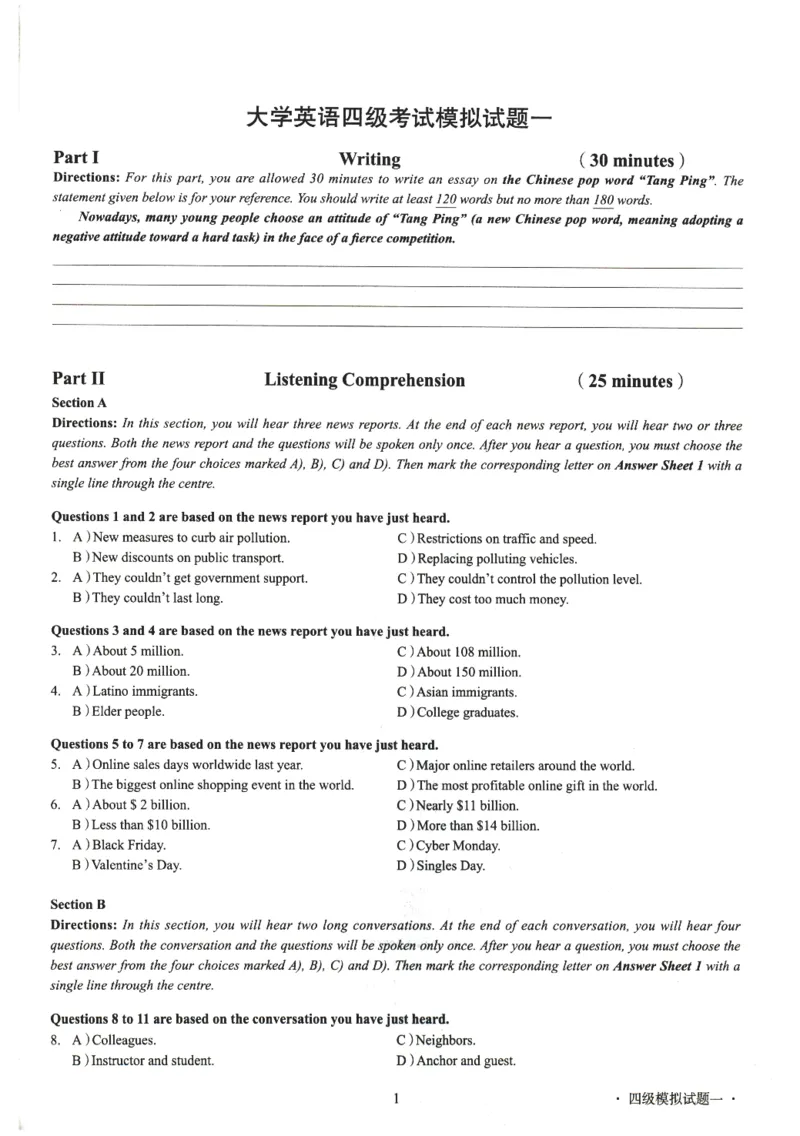
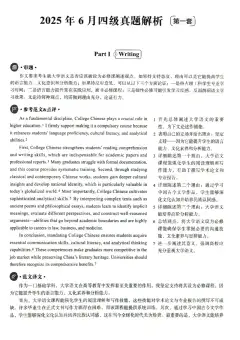
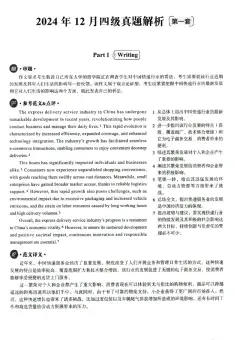
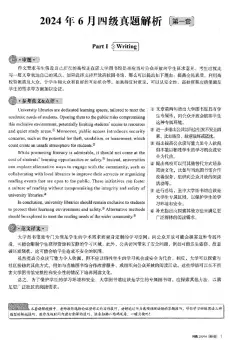
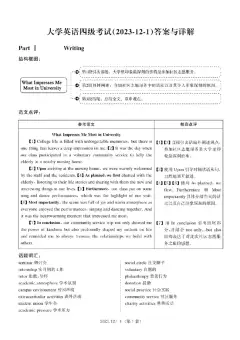
大学英语四级考试模拟试题一
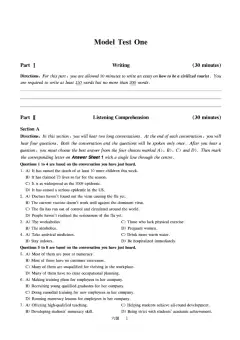
Part I Writing (30 minutes)
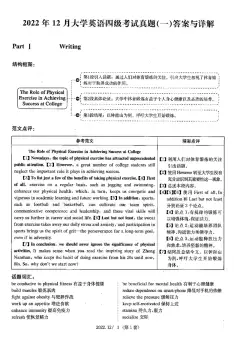
Directions: For this part, you are allowed 30 minutes to write an essay on the Chinese pop word “Tang Ping”, The
statement given below is for your reference. You should write at least 120 words but no more than 180 words.
Nowadays, many young people choose an attitude of “Tang Ping” (a new Chinese pop word, meaning adopting a
negative attitude toward a hard task) in the face of a fierce competition.
Part II Listening Comprehension ( 25 minutes )
Section A
Directions: In this section, you will hear three neyvs reports. At the end of each news report, you will hear two or three
questions. Both the news report and the questions will be spoken only once. After you hear a question, you must choose the
best answer from the four choices marked A), B), C) and D). Then mark the corresponding letter on Answer Sheet 1 with a
single line through the centre.
Questions 1 and 2 are based on the news report you have just heard.
1. A )New measures to curb air pollution. C ) Restrictions on traffic and speed.
B ) New discounts on public transport. D ) Replacing polluting vehicles.
2. A ) They couldn't get government support. C ) They couldn't control the pollution level.
B ) They couldn't last long. D ) They cost too much money.
Questions 3 and 4 are based on the news report you have just heard.
3. A) About 5 million. C ) About 108 million.
B ) About 20 million. D) About 150 million.
4. A ) Latino immigrants. C ) Asian immigrants.
B ) Elder people. D) College graduates.
Questions 5 to 7 are based on the news report you have just heard.
5. A) Online sales days worldwide last year. C ) Major online retailers around the world.
B ) The biggest online shopping event in the world. D ) The most profitable online gift in the world.
6. A) About $ 2 billion. C) Nearly $ 11 billion.
B ) Less than $ 10 billion. D ) More than $ 14 billion.
7. A ) Black Friday. C ) Cyber Monday.
B ) Valentine's Day. D ) Singles Day.
Section B
Directions: In this section, you will hear two long conversations. At the end of each conversation, you will hear four
questions. Both the conversation and the questions will be spoken only once. After you hear a question, you must choose the
best answer from the four choices marked A), B), C) and D). Then mark the corresponding letter on Answer Sheet 1 with a
single line through the centre.
Questions 8 to 11 are based on the conversation you have just heard.
8. A) Colleagues. C) Neighbors.
B ) Instructor and student. D) Anchor and guest.
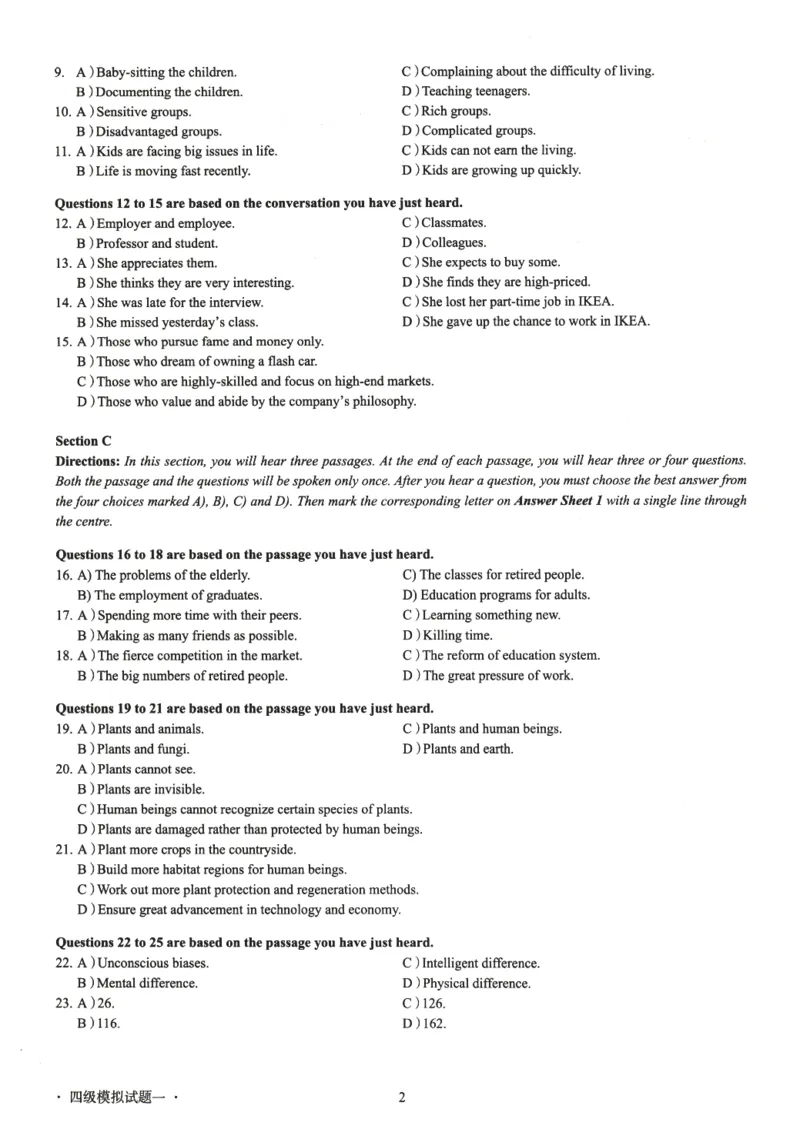
1 • 四级模拟试题一-9. A) Baby-sitting the children. C ) Complaining about the difficulty of living.
B ) Documenting the children. D) Teaching teenagers.
10. A) Sensitive groups. C) Rich groups.
B) Disadvantaged groups. D) Complicated groups.
11. A) Kids are facing big issues in life. C) Kids can not earn the living.
B ) Life is moving fast recently. D ) Kids are growing up quickly.
Questions 12 to 15 are based on the conversation you have just heard.
12. A) Employer and employee. C) Classmates.
B ) Professor and student. D) Colleagues.
13. A) She appreciates them. C ) She expects to buy some.
B ) She thinks they are very interesting. D) She finds they are high-priced.
14. A) She was late for the interview. C ) She lost her part-time job in IKEA.
B ) She missed yesterday's class. D) She gave up the chance to work in IKEA.
15. A ) Those who pursue fame and money only.
B ) Those who dream of owning a flash car.
C ) Those who are highly-skilled and focus on high-end markets.
D ) Those who value and abide by the company Js philosophy.
Section C
Directions: In this section, you will hear three passages. At the end of each passage, you will hear three or four questions.
Both the passage and the questions will be spoken only once. After you hear a question, you must choose the best answer from
the four choices marked A), B), C) and D). Then mark the corresponding letter on Answer Sheet 1 with a single line through
the centre.
Questions 16 to 18 are based on the passage you have just heard.
16. A) The problems of the elderly. C) The classes for retired people.
B) The employment of graduates. D) Education programs for adults.
17. A) Spending more time with their peers. C ) Learning something new.
B ) Making as many friends as possible. D) Killing time.
18. A) The fierce competition in the market. C ) The reform of education system.
B) The big numbers of retired people. D ) The great pressure of work.
Questions 19 to 21 are based on the passage you have just heard.
19. A) Plants and animals. C ) Plants and human beings.
B) Plants and fungi. D) Plants and earth.
20. A) Plants cannot see.
B ) Plants are invisible.
C) Human beings cannot recognize certain species of plants.
D) Plants are damaged rather than protected by human beings.
21. A) Plant more crops in the countryside.
B ) Build more habitat regions for human beings.
C ) Work out more plant protection and regeneration methods.
D) Ensure great advancement in technology and economy.
Questions 22 to 25 are based on the passage you have just heard.
22. A) Unconscious biases. C) Intelligent difference.
B) Mental difference. D) Physical difference.
23. A )26. C) 126.
B)116. D)162.
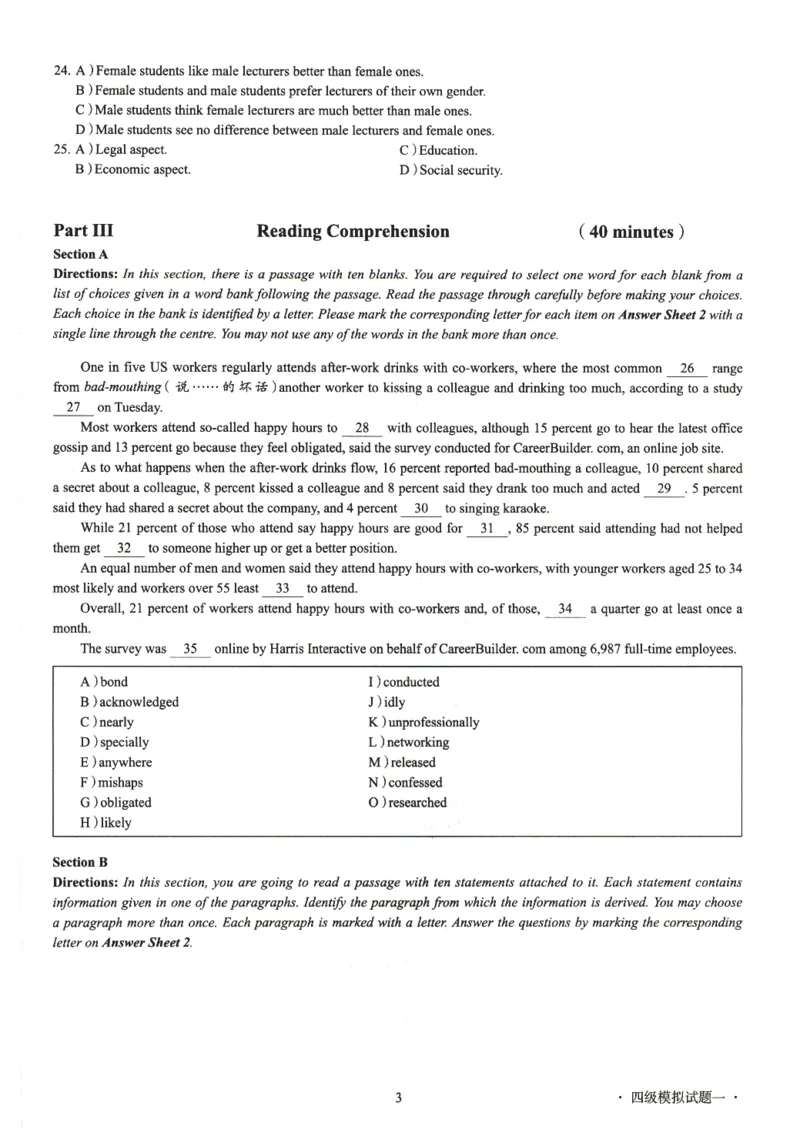
• 四级模拟试题一- 224. A) Female students like male lecturers better than female ones.
B ) Female students and male students prefer lecturers of their own gender.
C ) Male students think female lecturers are much better than male ones.
D ) Male students see no difference between male lecturers and female ones.
25. A) Legal aspect. C) Education.
B) Economic aspect. D) Social security.
Part III Reading Comprehension (40 minutes )
Section A
Directions: In this section, there is a passage with ten blanks. You are required to select one word for each blank from a
list of choices given in a word bank following the passage. Read the passage through carefully before making your choices.
Each choice in the bank is identified by a letter. Please mark the corresponding letter for each item on Answer Sheet 2 with a
single line through the centre. You may not use any of the words in the bank more than once.
One in five US workers regularly attends after-work drinks with co-workers, where the most common 26 range
from bad-mouthing ( 说 ....的坏话)another worker to kissing a colleague and drinking too much, according to a study
27 on Tuesday.
Most workers attend so-called happy hours to 28 with colleagues, although 15 percent go to hear the latest office
gossip and 13 percent go because they feel obligated, said the survey conducted for CareerBuilder. com, an online job site.
As to what happens when the after-work drinks flow, 16 percent reported bad-mouthing a colleague, 10 percent shared
a secret about a colleague, 8 percent kissed a colleague and 8 percent said they drank too much and acted 29 . 5 percent
said they had shared a secret about the company, and 4 percent 30 to singing karaoke.
While 21 percent of those who attend say happy hours are good for 31 , 85 percent said attending had not helped
them get 32 to someone higher up or get a better position.
An equal number of men and women said they attend happy hours with co-workers, with younger workers aged 25 to 34
most likely and workers over 55 least 33 to attend.
Overall, 21 percent of workers attend happy hours with co-workers and, of those, 34 a quarter go at least once a
month.
The survey was 35 online by Harris Interactive on behalf of CareerBuilder. com among 6,987 full-time employees.
A)bond I) conducted
B) acknowledged J) idly
C) nearly K) unprofessionally
D) specially L) networking
E) anywhere M) released
F) mishaps N) confessed
G) obligated 0) researched
H) likely
Section B
Directions: In this section, you are going to read a passage with ten statements attached to it. Each statement contains
information given in one of the paragraphs. Identify the paragraph from which the information is derived. You may choose
a paragraph more than once. Each paragraph is marked with a letter. Answer the questions by marking the corresponding
letter on Answer Sheet 2.
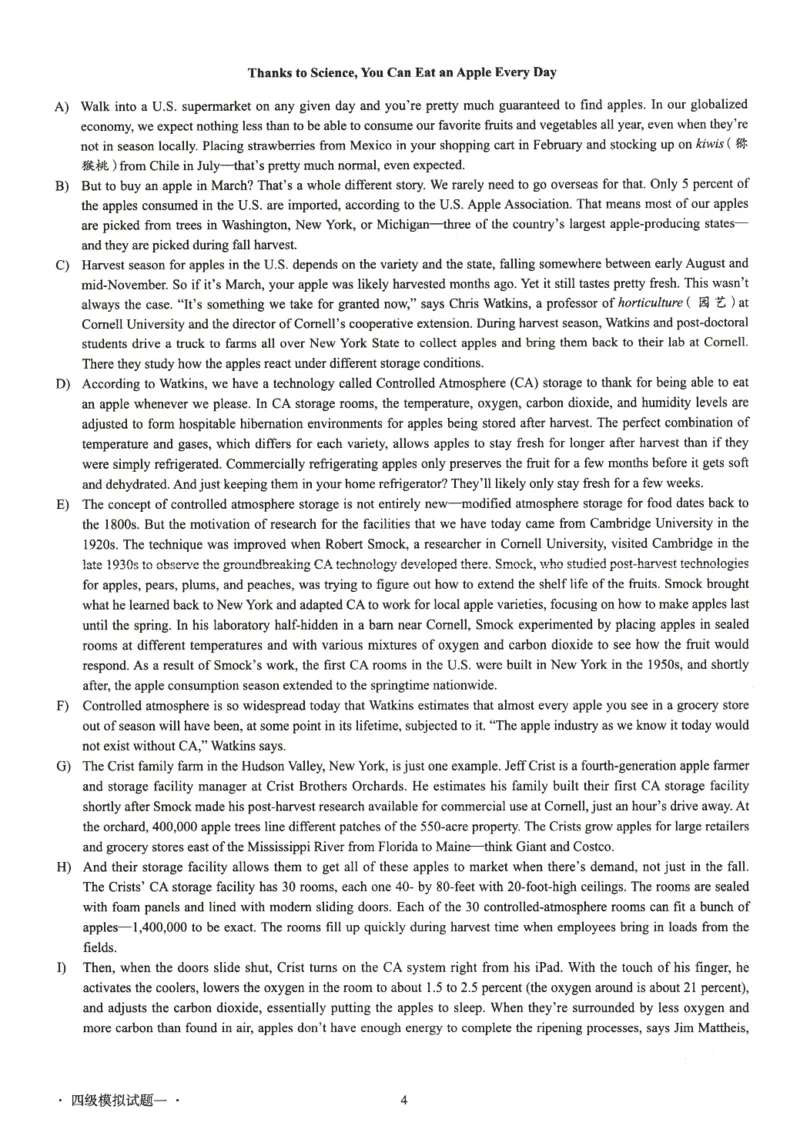
3 • 四级模拟试题一-Thanks to Science, You Can Eat an Apple Every Day
A) Walk into a U.S. supermarket on any given day and you're pretty much guaranteed to find apples. In our globalized
economy, we expect nothing less than to be able to consume our favorite fruits and vegetables all year, even when they5re
not in season locally. Placing strawberries from Mexico in your shopping cart in February and stocking up on kiwis (猾
猴密& ) from Chile in July—that's pretty much normal, even expected.
B) But to buy an apple in March? That's a whole different story. We rarely need to go overseas fbr that. Only 5 percent of
the apples consumed in the U.S. are imported, according to the U.S. Apple Association. That means most of our apples
are picked from trees in Washington, New York, or Michigan—three of the country's largest apple-producing states—
and they are picked during fall harvest.
C) Harvest season for apples in the U.S. depends on the variety and the state, falling somewhere between early August and
mid-November. So if it's March, your apple was likely harvested months ago. Yet it still tastes pretty fresh. This wasn't
always the case. "It's something we take for granted now,“ says Chris Watkins, a professor of horticulture ( 园艺)at
Cornell University and the director of Cornell's cooperative extension. During harvest season, Watkins and post-doctoral
students drive a truck to farms all over New York State to collect apples and bring them back to their lab at Cornell.
There they study how the apples react under different storage conditions.
D) According to Watkins, we have a technology called Controlled Atmosphere (CA) storage to thank fbr being able to eat
an apple whenever we please. In CA storage rooms, the temperature, oxygen, carbon dioxide, and humidity levels are
adjusted to form hospitable hibernation environments fbr apples being stored after harvest. The perfect combination of
temperature and gases, which differs for each variety, allows apples to stay fresh for longer after harvest than if they
were simply refrigerated. Commercially refrigerating apples only preserves the fruit fbr a few months before it gets soft
and dehydrated. And just keeping them in your home refrigerator? They* 11 likely only stay fresh fbr a few weeks.
E) The concept of controlled atmosphere storage is not entirely new- modified atmosphere storage fbr food dates back to
the 1800s. But the motivation of research for the facilities that we have today came from Cambridge University in the
1920s. The technique was improved when Robert Smock, a researcher in Cornell University, visited Cambridge in the
late 1930s to observe the groundbreaking CA technology developed there. Smock, who studied post-harvest technologies
fbr apples, pears, plums, and peaches, was trying to figure out how to extend the shelf life of the fruits. Smock brought
what he learned back to New York and adapted CA to work fbr local apple varieties, focusing on how to make apples last
until the spring. In his laboratory half-hidden in a bam near Cornell, Smock experimented by placing apples in sealed
rooms at different temperatures and with various mixtures of oxygen and carbon dioxide to see how the fruit would
respond. As a result of Smock,s work, the first CA rooms in the U.S. were built in New York in the 1950s, and shortly
after, the apple consumption season extended to the springtime nationwide.
F) Controlled atmosphere is so widespread today that Watkins estimates that almost every apple you see in a grocery store
out of season will have been, at some point in its lifetime, subjected to it. "The apple industry as we know it today would
not exist without CA,“ Watkins says.
G) The Crist family farm in the Hudson Valley, New York, is just one example. Jeff Crist is a fourth-generation apple farmer
and storage facility manager at Crist Brothers Orchards. He estimates his family built their first CA storage facility
shortly after Smock made his post-harvest research available fbr commercial use at Cornell, just an hour's drive away. At
the orchard, 400,000 apple trees line different patches of the 550-acre property. The Crists grow apples for large retailers
and grocery stores east of the Mississippi River from Florida to Maine- think Giant and Costco.
H) And their storage facility allows them to get all of these apples to market when there,s demand, not just in the fall.
The Crists, CA storage facility has 30 rooms, each one 40- by 80-feet with 20-foot-high ceilings. The rooms are sealed
with fbam panels and lined with modem sliding doors. Each of the 30 controlled-atmosphere rooms can fit a bunch of
apples——1,400,000 to be exact. The rooms fill up quickly during harvest time when employees bring in loads from the
fields.
I) Then, when the doors slide shut, Crist turns on the CA system right from his iPad. With the touch of his finger, he
activates the coolers, lowers the oxygen in the room to about 1.5 to 2.5 percent (the oxygen around is about 21 percent),
and adjusts the carbon dioxide, essentially putting the apples to sleep. When they,re surrounded by less oxygen and
more carbon than found in air, apples don't have enough energy to complete the ripening processes, says Jim Mattheis,
• 四级模拟试题一- 4a researcher at the USDA's Tree Fruit Research Laboratory located in Wenatchee, Washington. That's because like
humans, apples breathe, taking in oxygen and releasing carbon dioxide.
J) Sleepier apples have slower respiration rates and stay firm, colorful, flavorful and nutritionally dense fbr longer. The trick
is to avoid bringing the oxygen levels too low, otherwise the apples will ferment. But not all apples ripen quite the same
way, so figuring out the right way to do CA is kind of like a puzzle. "Apples are like people- they are not all the same.
One recipe fbr growing doesn't work with all the different varieties, and it's the same in the post-harvest environment,
Mattheis says. Some varieties are notoriously trickier to care for. For example, Honeycrisps are sensitive to low
temperatures so you can't put them in cold environments right after they've been harvested. And Fujis don't always react
well to high carbon dioxide levels, so you have to monitor them closely.
K) With new apple varieties being developed frequently, post-harvest researchers like Watkins and Mattheis are hard at
work. In their labs they test out what type of CA environment works best fbr these newly bred varieties. Then they take
their research to growers like Crist so that when they open their CA rooms as the market demands, their apples are good
looking and tasty.
36. Apples absorb oxygen and send out carbon dioxide, just as people do.
37. According to Watkins, but fbr the CA technology, it would be impossible fbr modem apple industry to come into being.
38. What people expect is exactly the availability of fruits and vegetables throughout the year.
39. Watkins and Mattheis endeavor to experiment on varying CA environment in order to suit specific apple varieties.
40. Thanks to Controlled Atmosphere storage technology, American people can eat apples anytime they like.
41. The apples the Crist family harvest are available fbr sale all the year round thanks to their CA storage facility.
42. Different varieties of apples demand different growing approaches.
43. The U.S. Apple Association reveals that imported apples merely account for five percent of total apple consumption.
44. It is estimated that Jeff Crist's great grandparents adopted Smock's technology by setting up their first CA storage
facility.
45. Robert Smock managed to improve the CA technology after he paid a visit to Cambridge.
Section C
Directions: There are 2 passages in this section. Each passage is followed by some questions or unfinished statements.
For each of them there are four choices marked A), B), C) and D). You should decide on the best choice and mark the
corresponding letter on Answer Sheet 2 with a single line through the centre.
Passage One
Questions 46 to 50 are based on the following passage.
When researcher Josh Santarpia stands at the foot of a bed, taking measurements with a device that can detect tiny,
invisible particles of saliva (唾液)that come out of someone's mouth and move through the air, he can tell whether the sick
person is speaking or not just by looking at the read-out on his instrument.
“So clearly, the particles which that person is putting out are being breathed in by someone that is five feet away from
them, at the foot of their bed/5 says Santarpia, who studies biological aerosols (气溶胶)at the University of Nebraska Medical
Center. <4Do they contain virus? I don't know fbr sure.”
He and his colleagues are doing their best to find out. Already, using another device that looks like a fancy dust collector,
they've sucked up air samples from 11 isolation rooms that housed 13 people who tested positive for COVID-19 infection, all
of whom had a variety of mild symptoms.
In those air samples, researchers found the genetic fingerprint of the virus. 4<It was more than half of the samples that we
took. It was fairly everywhere,says Santarpia, Ubut the concentrations were really pretty low.”
Finding the genetic material doesn't necessarily mean that there5s living virus that could potentially make someone sick,
he cautions. Some primary evidence indicates that this might be the case, but the team wants to do more work “and try and be
as certain as we possibly can whether or not certain samples had infectious virus in them or not.”
They want to know that with a high degree of confidence because the question of whether or not the coronavirus (冠
状病毒)can be transported by the air is extremely controversial right now- and it's a question that has real implications for
what people should do to avoid getting infected.
5 • 四级模拟试题一-“I personally think that transmission by breathing in virus in the air is happening,M says Linsey Marr, an aerosol scientist
at Virginia Tech. But she says so far, health experts have largely discounted the possibility of transmitting this coronavirus in
this way.
46. What is Josh Santaqjia able to do with his instrument?
A) Read out whether the sick person is spreading the virus or not.
B) Determine if aerosol transmission of COVID-19 occurs or not.
C) Make sure if the patient taking the measurement is speaking or not.
D) Detect whether the particles of saliva of COVID-19 patients are infectious.
47. What did the research conducted by Santarpia and his colleagues suggest?
A) They knew exactly if aerosols contained the virus or not.
B) The virus was found within less than 50% of the samples.
C) The COVID-19 infected patients had serious symptoms.
D) The fingerprint of the virus they found was not concentrated.
48. What does Santarpia warn people?
A) They should not use things that COVID-19 patients touched.
B) They should wear a mask whenever they are exposed to others.
C) Spotting the genetic fingerprint of the virus may not signify danger.
D) It doesn't mean there is no risk to find the genetic material of virus.
49. What does Santarpia's research team try to make sure?
A) How much coronavirus could be tested in the air samples.
B) What they can do to test the coronavirus in a scientific way.
C) How people should protect themselves from getting infected.
D) Whether there was coronavirus in the air samples or not.
50. As fbr COVID-19, what do we learn about Linsey Marr?
A) She shares a common point of view with most health experts.
B) She deems breathing in the coronavirus can cause transmission.
C) She doubts the possibility of aerosol transmission of COVID-19.
D) She asserts that coronavirus can be eliminated through lockdown.
Passage Two
Questions 51 to 55 are based on the following passage.
Researchers for Cornell University and Intel produced a chip called Loihi that reportedly makes computers think like
biological brains, according to Daily Mail.
The researchers created the circuit on the chip, mirroring organic circuits found in the olfactory bulbs (嗅球)of a dog's
brain, which is how they process their sense of smell. The Loihi chip can identify a specific odor on the first try and even tell
other background smells, said Intel, according to Daily Mail.
The chip can even detect smells humans emit when sick with a disease- which vary depending on the illness—and
smells linked to environmental gases and drugs. The key to sniffer dogs isn't their olfactory system alone, but their incredible
ability to remember- this is why they're trained. Similarly, the artificial intelligence of the chip is trained to identify different
smells and remember them, so that next time, it knows.
The chip processes information just like mammal brains by using electrical signals to process smells. When a person
smells something, the air molecules interact with nasal receptors that forward signals to the olfactory bulb in the brain. Then
the brain translates the signals to identify which smell ifs experiencing, based on memories of previous experiences with the
specific smell.
“We are developing a method fbr Loihi to mimic (模仿)what happens in your brain when you smell something,n said
Senior Research Scientist in Intel5s Lab, Nabil Imam, in a statement, according to Daily Mail. Imam added that the work
^demonstrates Loihi's potential to provide important sensing capabilities that could benefit various industries.^^
So far, the researchers have trained it on ten harmful smells. It can be installed on robots in airports to help identify
hazardous objects, or integrated with sensors in power plants or hospitals to detect dangerous gases.
• 四级模拟试题一- 6Similar biotechnology has seen the implementation in grasshoppers recently outfitted with computer chips to sniff-out
bombs. However, this negatively affects their lifespan, limiting their use.
While sniffer dogs might one day be out of a job, the circuits using AI to mimic the process of smell bring us one step
closer to recreating the human sensory system in artificial intelligence.
51. What do we learn about Loihi?
A) It is a high-tech device that produces computer chips.
B) It is a computer program that aids creating the circuit.
C) It is a chip that uses AI technology to identify a smell.
D) It is a dog's biological organ to process its sense of smell.
52. What does the author think are crucial to sniffer dogs?
A) Agility and intelligence.
B) Stamina and flexibility.
C) Sensitivity and information processing.
D) Olfactory system and memory capacity.
53. How does the human sense of smell work?
A) The nose decodes smells and makes judgments.
B) The brain processes smell signals and identifies it.
C) The air molecules interact with the olfactory bulb.
D) The nasal receptors translate signals into a specific smell.
54. What have the researchers done with Loihi?
A) Trained it on 20 harmful smells.
B) Applied it to various industries.
C) Installed it on robots to help identify bombs.
D) Tried to make it work like the human brain.
55. What is the defect in applying biotechnology to grasshoppers?
A) They are less sensitive than sniffer dogs.
B) The harm to their life limits their application.
C) They are in danger for being exposed to bombs.
D) The sensory system in them is under severe threat.
Part IV Translation (30 minutes)
Directions: For this part, you are allowed 30 minutes to translate a passage from Chinese into English. You should write
your answer on Answer Sheet 2.
蕤 (rime)是难得一见的自然奇观。每年的12月下旬到次年的2月期间,如果你到吉林来,就有可能观赏到
雾淞” 麻雾淞仪态万方,独具丰韵。每当雾淞来临,吉林松花江畔、长白山地区就成为如诗如画的仙境。吉林雾
淞和泰山日出、黄山云海、钱塘涌潮旦iantang River tidal bore)并称中国四大气象奇观(meteorological wonders) 雾
o
淞为吉林的冬天增添了魅力拓洁另丁最为吉林的一张名片。
7 • 四级模拟试题一-大学英语四级考试模拟试题二
Part I Writing (30 minutes)
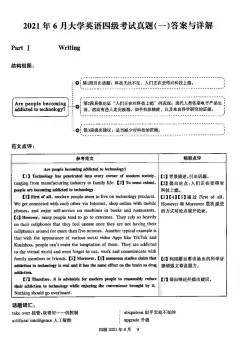
Directions: For this part, you are allowed 30 minutes to write an essay on the use of short video apps. You can start your
essay with the sentence uShort video apps are becoming increasingly popular in China.w You should write at least 120
words but no more than 180 words.
Part II Listening Comprehension (25 minutes)
Section A
Directions: In this section, you will hear three news reports. At the end of each news report, you wi" hear two or three
questions. Both the news report and the questions will be spoken only once. After you hear a question, you must choose the
best answer from the four choices marked A), B), C) and D). Then mark the corresponding letter on Answer Sheet 1 with a
single line through the centre.
Questions 1 and 2 are based on the news report you have just heard.
1. A ) In the world's highest skyscraper. C )On the 63rd floor of Buij Khalifa.
B )In New Year's fireworks display. D )In the Address Downtown Dubai.
2. A) Residents345 names. C ) The cause of the fire.
B) Casualties. D ) Security personnefs duty.
Questions 3 and 4 are based on the news report you have just heard.
3. A ) About 125 million. C ) About 310 million.
B ) About 200 million. D ) About 350 million.
4. A )To change the traditional role of girls. C ) To improve girls' educational options.
B ) To enforce religious unions. D )To improve legal protections for girls.
Questions 5 to 7 are based on the news report you have just heard.
5. A) Greece's relations with the UK. C) Last month5s Paris attacks.
B ) Refugee crisis in Europe. D ) Russia's energy crisis.
6. A) Greek Foreign Minister. C ) US Secretary of State.
B ) A news correspondent. D ) Greek Prime Minister.
7. A) Its economic problems. C )Its citizens' security.
B )Its education. D )Its human rights.
Section B
Directions: In this section, you will hear two long conversations. At the end of each conversation, you will hear four
questions. Both the conversation and the questions will be spoken only once. After you hear a question, you must choose the
best answer from the four choices marked A), B), C) and D). Then mark the corresponding letter on Answer Sheet 1 with a
single line through the centre.
Questions 8 to 11 are based on the conversation you have just heard.
8. A) She is hard-working. C ) She is busy in the morning.
B ) She has to catch an early bus. D) She gets up late in the morning.
19 • 四级模拟试题二•9. A) It*s better than evening exercise. C ) Young people do not need to take exercise.
B )lt helps him work more efficiently. D) Morning exercise is generally informative.
10. A)He has to go to parties in the evening. C ) The air is not fresh in the evening.
B )He has to prepare dinner for the family. D )He can't afford the time.
11. A )Go home. C ) Go to the bus stop.
B ) Go to his office. D ) Send his son to school.
Questions 12 to 15 are based on the conversation you have just heard.
12. A)To make a business report to the woman.
B ) To be interviewed for a job in the woman's company.
C )To sell some handiwork to the woman.
D )To inquire about the result of an interview.
13. A) Administration. C) Commerce.
B) Literature. D) Journalism.
14. A )He thinks it is exciting and challenging. C )He thinks it is well-paid.
B)He thinks it contributes a lot to society. D )He thinks it is quite easy.
15. A) The woman thinks Mr. Ford lacks experience. C ) Mr. Ford seems to meet every requirement fbr the job.
B ) Mr. Ford will work in foreign countries. D ) The woman alone will decide whether to hire Mr. Ford.
Section C
Directions: In this section, you will hear three passages. At the end of each passage, you will hear three or four questions.
Both the passage and the questions will be spoken only once. After you hear a question, you must choose the best answer from
the four choices marked A), B), C) and D). Then mark the corresponding letter on Answer Sheet 1 with a single line through
the centre.
Questions 16 to 18 are based on the passage you have just heard.
16. A) Broccoli. C ) A turkey sandwich.
B )Ice cream. D ) A glass of milk.
17. A) Real food is fuel for body's needs.
B ) Real food is high in fat and sugar.
C ) Real food is primarily for taste satisfaction.
D ) Real food is delicious.
18. A) We should store food in refrigerator.
B ) We should choose food that looks good.
C ) We should distinguish between real food and pleasure food.
D ) We should remove pleasure foods from our kitchen.
Questions 19 to 21 are based on the passage you have just heard.
19. A) Housewives. C ) Guests of dinner party.
B ) Restaurant manager. D ) Hosts of dinner party.
20. A) You may find yourself less stressed. C ) You will have little time to enjoy the party.
B ) You won't get up so early on the party day. D ) Your guests will be much happier.
21. A) Inform your guests of the date and the time beforehand.
B ) List the ingredients and drinks for the party and buy them.
C ) Practice cooking according to menu.
D ) Prepare some proper music fbr the party.
Questions 22 to 25 are based on the passage you have just heard.
22. A) Surprised. C ) Frightened.
B ) Angry. D ) Worried.
・四级模拟试题二- 2023. A ) Anger. C ) Dislike.
B ) Surprise. D ) Fear.
24. A ) Women are better than men at recognizing facial expressions.
B ) Adults are better than children at recognizing facial expressions.
C ) Older people are better than younger people at recognizing facial expressions.
D ) Americans are better than Chinese at recognizing facial expressions.
25. A) Words and feelings. C ) Gestures and feelings.
B ) Words, gestures and feelings. D ) Culture and understanding.
Part III Reading Comprehension ( 40 minutes )
Section A
Directions: In this section, there is a passage with ten blanks. You are required to select one word for each blank from a
liqt of choices given in a word bank following the passage. Read the passage through carefully before making your choices.
Each choice in the bank is identified by a letter. Please mark the corresponding letter for each item on Answer Sheet 2 with a
single line through the centre. You may not use any of the words in the bank more than once.
Humans use water fbr three basic purposes: agriculture, industry, and domestic and municipal use (water for drinking,
cooking, cleaning, and so forth). And the amount of water 26 to each person decreases as the population grows,
27 the possibility of water shortages. Water shortages will not come all at once in every part of the world, just as the
world's population is 28 distributed by region, so is the annual 29 of renewable water. Rainfall and snowfall are
30 by uneven weather patterns and landscape, and as a result, some areas of the world get more precipitation than others.
This leads the uneven 31 of water all over the world.
Natural water scarcity has prompted many nations to try to increase their water supplies by building dams to catch
water that otherwise would escape to the sea, or by sinking more and deeper wells. But these efforts can have 32 side
effects that can contribute to water scarcity. Instead of building dams, some countries choose to increase their 33 to
groundwater. But this practice increases the risk of overpumping aquifers (蓄水层).
Pollution also affects the water supply, reducing the available water by making it toxic or otherwise 34 fbr human
use.
Water shortages could also lead to international conflicts as countries 35 fbr limited water resources. Political
tensions over water often appear when different nations lay claim to the same river, lake, or aquifer. According to the UN,
more than 300 river basins and aquifers worldwide cross national boundaries are creating the potential fbr conflicts.
: A) access I) unevenly
1 B) positively J) unfit
i C) deliberately K) starved
। D) compete L) raising
( E) negative M)approach
F) distribution N) arising
G) available 0 )supply
H) determined
Section B
Directions: In this section, you are going to read a passage with ten statements attached to it. Each statement contains
information given in one of the paragraphs. Identify the paragraph from which the information is derived. You may choose
a paragraph more than once. Each paragraph is marked with a letter. Answer the questions by marking the corresponding
letter on Answer Sheet 2.
21 • 四级模拟试题二・How Your Language Affects Your Wealth and Health
A ) Does the language we speak determine how healthy and rich we will be? New research by Keith Chen of Yale Business
School suggests so. The structure of languages affects our judgments and decisions about the future and this might have
dramatic long-term consequences.
B ) There has been a lot of research into how we deal with the future. For example, the famous marshmallow (才帛 花糖)
studies of Walter Mischel and colleagues showed that being able to resist temptation is predictive of future success.
Four-year-old kids were given a marshmallow and were told that if they do not eat that marshmallow and wait fbr the
experimenter to come back, they will get two marshmallows instead of one. Follow-up studies showed that the kids who
were able to wait fbr the bigger future reward became more successfill young adults.
C ) Resisting our impulses fbr immediate pleasure is often the only way to attain the outcomes that are important to us. We
want to keep a slim figure but we also want that last slice of pizza. We want a comfortable retirement, but we also want
to drive that dazzling car, go on that dream vacation, or get those gorgeous shoes. Some people are better at delaying
gratification (5茜足)than others. Those people have a better chance of accumulating wealth and keeping a healthy life
style. They are less likely to be impulse buyers or smokers, or to engage in unsafe sex.
D ) Chen's recent findings suggest that an unlikely factor, language, strongly affects our future-oriented behavior. Some
languages strongly distinguish the present and the future. Other languages only weakly distinguish the present and the
future. Chen's recent research suggests that people who speak languages that weakly distinguish the present and the
future are better prepared for the future. They accumulate more wealth and they are better able to maintain their health.
The way these people conceptualize the future is similar to the way they conceptualize the present. As a result, the future
does not feel very distant and it is easier for them to act in accordance with their future interests.
E) Different languages have different ways of talking about the future. Some languages, such as English, Korean, and
Russian, require their speakers to refer to the future explicitly (明确 地).Every time English-speakers talk about the
future, they have to use future markers such as “will" or “going to." In other languages, such as Mandarin, Japanese, and
German, future markers are not obligatory (强制,性的).The future is often talked about similar to the way present is
talked about and the meaning is understood from the context. A Mandarin speaker who is going to go to a seminar might
say “Wo qu ting jiangzuo,^^ which translates to “I go listen seminar.^^ Languages such as English constantly remind their
speakers that future events are distant. For speakers of languages such as Mandarin future feels closer. As a consequence,
resisting immediate impulses and investing fbr the future is easier for Mandarin speakers.
F ) Chen analyzed individual-level data from 76 developed and developing countries. This data includes people's economic
decisions, such as whether they saved any money last year, the languages they speak at home, demographics (人 口统
计资料),and cultural factors such as “saving is an important cultural value fbr me." He also analyzed individual-level
data on people's retirement assets, smoking and exercising habits, and general health in older age. Lastly, he analyzed
national-level data that includes national savings rates, country GDP and GDP growth rates, country demographics, and
proportions of people speaking different languages.
G) People's savings rates are affected by various factors such as their income, education level, age, religious connection,
their countries' legal systems, and their cultural values. After those factors were accounted for, the effect of language
on people's savings rates turned out to be big. Speaking a language that has obligatory future markers, such as English,
makes people 30 percent less likely to save money for the future. This effect is as large as the effect of unemployment.
Being unemployed decreases the likelihood of saving by about 30 percent as well.
H) Similar analyses showed that speaking a language that does not have obligatory future markers, such as Mandarin, makes
people accumulate more retirement assets, smoke less, exercise more, and generally be healthier in older age. CountriesJ
national savings rates are also affected by language. Having a larger proportion of people speaking languages that does
not have obligatory future markers makes national savings rates higher.
I) At a more practical level, researchers have been looking fbr ways to help people act in accordance with their long-term
interests. Recent findings suggest that making the future feel closer to the present might improve future-oriented behavior.
For instance, researchers recently presented people with renderings of their future selves made using age-progression
algorithms (算法)that forecast how physical appearances would change over time. One group of participants saw a
digital representation of their current selves in a virtual mirror, and the other group saw an age-morphed version of their
• 四级模拟试题二- 22future selves. Those participants who saw the age-morphed version of their future selves allocated more money toward a
hypothetical savings account. The intervention brought people's future to the present and as a result they saved more for
the future.
J) Chen's research shows that language structures our future-related thoughts. Language has been used before to alter
time perception with surprising effects. Ellen Langer and colleagues famously improved older people's physical health
by simple interventions including asking them to talk about the events of twenty years ago as if it they were happening
now. Talking about the past as if it were the present changed people's mindsets and their mindsets affected their physical
states. Chen5 s research points at the possibility that the way we talk about the future can shape our mindsets. Language
can move the future back and forth in our mental space and this might have dramatic influences on our judgments and
decisions.
36. Usually, preventing ourselves from enjoying immediate pleasure impulsively is the only way to achieve the outcomes
that are important to us.
37. The structure of languages influences us when we are making a judgment or decision about the future.
38. Speaking a language that has obligatory future markers and being unemployed nearly share the same percentage of
decreasing the likelihood of saving.
39. According to the well-known marshmallow studies, people who can resist temptation tend to be successful in the future.
40. People who speak languages like English are more likely to feel that the future events are distant.
41. National savings rates of countries are influenced by language as well.
42. In Chen's recent research, people who speak languages in which the present and the future are weakly distinguished are
more prepared fbr the future.
43. Recent findings show that it is possible to improve fiiture-oriented behavior through making the future feel closer to the
present.
44. Through simple interventions, Ellen Langer and colleagues made the physical health of the older people changed for the
better.
45. Chen made an analysis of individual-level statistics from 76 developed and developing nations.
Section C
Directions: There are 2 passages in this section. Each passage is followed by some questions or unfinished statements.
For each of them there are four choices marked A), B), C) and D). You should decide on the best choice and mark the
corresponding letter on Answer Sheet 2 with a single line through the centre.
Passage One
Questions 46 to 50 are based on the following passage.
Babies cry to call attention to their immediate needs: food, or rest, or a diaper change or cuddles. But without intending
to, crying babies might also provide insight into a defining trait that will develop later in life. As Matt Stevens of the New
York Times reports, a new study has found that the pitch of a baby's cry could predict what he or she will sound like as an
adult.
Researchers in the U.K. and France wondered if vocal pitch might be determined even earlier than age seven- during
infancy, perhaps, or even in the womb (子宫).To find out, the team recorded the cries of 15 French babies- six girls and
nine boys, from two to five months old. Researchers then compared those recordings to recordings of the same children at age
four or five. The team found that the pitch of babies* cries was a ^substantial predictor“ of vocal pitch at four or five years of
age. ""Differences in voice pitch,“ the researchers conclude, umay- at least partly—arise very early in
The authors of the study suggest that these differences might develop in the womb, when fetuses are exposed to varying
levels of hormones.
As Carl Engelking of Discover reports, the team also analyzed the children's 2D:4D digit ratio, or the ratio between the
lengths of the index finger and the ring finger. Studies have suggested that this ratio can reveal how much testosterone (睾丸
激素)a person was exposed to in the womb.
23 • 四级模拟试题二-Researchers found that 2D:4D digit ratio in the right hand correlated positively with differences in vocal frequency in
both baby cries and children's speech (this is consistent with other studies showing that 2D:4D ratios are expressed more
strongly in the right hand). In other words, as a statement announcing the new research explains, 4<if the index finger on the
right hand is longer than the ring finger, a baby will be likely to grow up to have a high-pitched voice. Conversely, if it is
shorter, they will be more likely to have a lower-pitched voice.”
46. What has the new study found about the pitch of a baby's cry?
A) The more loudly a baby cries, the more love it craves for.
B) The more loudly a baby cries, the healthier it will become.
C) How a baby cries can show what parents sounded like in their babyhood.
D) How an adult sounds can be predicted by how he or she cried as a baby.
47. What do we learn about the study conducted by the British and French researchers?
A) The research targeted 6 baby boys and 9 baby girls in all.
B) The researchers aimed at enhancing children's vocal function.
C) They compared recordings of the same children in different ages.
D) They compared recordings of boys to those of girls in different ages.
48. What does the study authors suggest about the differences in voice pitch?
A) They might occur in the womb.
B) They vary from person to person.
C) They may arise from teenage years.
D) They are most prominent in adults.
49. What does 2D:4D digit ratio refer to?
A) The ratio between 2D and 4D digital technology.
B) The ratio between 2-digit numbers and 4-digit numbers.
C) The relationship in length between the index finger and the ring finger.
D) The relationship in width between the index finger and the ring finger.
50. What does the study show about the index finger and the ring finger of a baby's right hand?
A) The longer the former, the shorter the latter will be.
B) The shorter the former, the much shorter the latter is.
C) If the former is longer, the baby will be more likely to have a lower-pitched voice.
D) If the latter is longer, the baby will probably grow up to have a lower-pitched voice.
Passage Two
Questions 51 to 55 are based on the following passage.
As parents, we want our children to reach their full academic potential. We read to them, encourage their special talents,
and support them when they have problems. If they choose to participate in music or sports, we also help them reach their
potential in those areas. These are all good goals.
There is, however, an even more important goal. It is a goal more difficult than excellence in arithmetic or soccer or the
violin. Parents are responsible fbr providing their children with a moral compass. They need to nurture and treasure goodness
in their children. Every child has the capacity to become a good, decent human being. To fulfill this capacity, children need
the guidance and support of parents and other adults. Raising good, moral children is the most important job we will have.
What is a good, decent human being? While we may differ on some details, most would agree that respect fbr others,
kindness and caring, honesty and honor, and a reverence (尊重)fbr life are key. Good, decent human beings are people with
a firm sense of direction and purpose- a moral compass- to guide their lives. Children need our help to develop these
characteristics and values.
While most people try to act with honor and kindness, doing so consistently is difficult and requires lifelong effort.
Goodness is not easy for an adult, and it is even more difficult fbr a child. They do not have the knowledge, experiences, or
cognitive skills to understand the impact and consequences of their actions.
• 四级模拟试题二- 24Reinforcement is sometimes an efficient approach to building positive behavior. The child behaves in a desired way
and the parents provide reinforcement. The behavior then typically increases in frequency. This approach works for teaching
“Please" and “Thank you”. The new behavior is maintained, because it helps the child get along in the world.
Loving, everyday interactions are the beginning of raising moral children. The child who falls and receives adult
concern learns how to treat others kindly when they stumble (绊倒).The child who makes a mistake and is encouraged to
try again learns how to support others. When parents intercede (调解)graciously for their child, the child can see the basis
for friendship. When we treat children with respect and care, we provide a positive model of how to behave. These early
experiences establish patterns for their treatment of others.
51. What does the author say is an even more important goal for parents?
A )To help their children to learn more about sports or music.
B ) To encourage their children to develop their special talents.
C )To provide more timely assistance whenever it is needed.
D ) To make their children grow up to be a good, moral person.
52. What do most people think can be crucial to becoming a decent human being?
A) Perseverance and bravery.
B ) Calmness and concentration.
C ) Kindness and honesty.
D ) Honor and self-esteem.
53. Why is it difficult fbr a child to act with honor and kindness?
A) Because it is difficult to follow adults' example.
B ) Because a child is not mature enough to do so.
C ) Because the concept of ugoodness^^ is abstract.
D ) Because a child does not have a model to follow.
54. Why does the author talk about teaching "Please" and "Thank you”?
A )To stress that saying “Please" and "Thank you“ is a good habit.
B ) To demonstrate that politeness is the nature of a moral compass.
C)To explain that politeness helps the child get along in the world.
D )To show reinforcement is beneficial to building positive behavior.
55. What is the purpose of the last paragraph?
A )To emphasize the importance of adults' concern when a child fails.
B ) To reveal how adults can guide their children to develop friendship.
C ) To explain why adults should treat children with respect and care.
D )To show how love and daily interactions can shape a moral child.
Part IV Translation (30 minutes )
Directions: For this part, you are allowed 30 minutes to translate a passage from Chinese into English. You should write
your answer on Answer Sheet 2.
近年来,中国航天工业取得了巨大的进步。去年是中国航天的关键一年。这一年里中国航天发生了两件大事。
其一就是中国发射了嫦娥四号月球鲤喷(probe),使中国成为世界上首个在月球背面实现着陆的国家。另一件就
是长征五号火箭发射成功,因为长征五号是中国新一代运载火箭,也是中国运载能力最大的火箭。长征五号火箭的
成功发射将会为中国更多太空探险任务铺平道路。
25 • 四级模拟试题二-大学英语四级考试模拟试题三
Part I Writing (30 minutes)
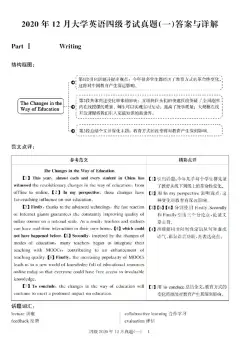
Directions: For this part, you are allowed 30 minutes to write on the topic EQ (Emotional Quotient). You should write at
least 120 words but no more than 180 words.
Part II Listening Comprehension ( 25 minutes )
Section A
Directions: In this section, you will hear three news reports. At the end of each news report, you will hear two or three
questions. Both the news report and the questions will be spoken only once. After you hear a question, you must choose the
best answer from the four choices marked A), B), C) and D). Then mark the corresponding letter on Answer Sheet 1 with a
single line through the centre.
Questions 1 and 2 are based on the news report you have just heard.
1. A) Because the surrounding forest will be cut down.
B ) Because it doesn't signify Japanese style.
C) Because it will cost too much money.
D ) Because it can't hold 80,000 seats.
2. A) In November 2019. C) In July 2019.
B ) In the summer of 2020. D )ln July this year.
Questions 3 and 4 are based on the news report you have just heard.
3. A) The recycling of the plastic bags. C) The extinction of sea fish.
B ) Plastic trash on the streets. D ) Oceans being polluted by plastic trash.
4. A) Because fish mistake plastics for food and choke to death.
B ) Because eating plastics can cause intestinal blockage.
C ) Because fish are easily trapped in the plastic bottle.
D ) Because plastic can bio-degrade inside the fish.
Questions 5 to 7 are based on the news report you have just heard.
5. A)To offer skilled women workers higher wages.
B )To offer women more opportunities for college.
C)To achieve equality in economic opportunity.
D)To target the companies without equal pay for both genders.
6. A) Ireland. C) Sweden.
B ) Norway. D ) None of the nations.
7. A) Gender gap in payments. C ) Gender gap in political power.
B ) Gender gap in education. D ) Gender gap in health.
Section B
Directions: In this section, you will hear two long conversations. At the end of each conversation, you will hear four
questions. Both the conversation and the questions will be spoken only once. After you hear a question, you must choose the
• 四级模拟试题三- 36best answer from the four choices marked A), B), C) and D). Then mark the corresponding letter on Answer Sheet 1 with a
single line through the centre.
Questions 8 to 11 are based on the conversation you have just heard.
8. A) Their plans for the next semester. C ) Their favorite band.
B ) Why the woman can't go to the concert. D ) A psychology class.
9. A ) Work at the bookstore. C ) Cover a friend's shift.
B ) Go to the movies. D ) Go to a concert.
10. A) Because her textbook has a new edition now. C ) Because she has lost her textbook.
B ) Because her professor forced her to buy a new one. D ) Because she is not willing to use a used one.
11. A ) The woman never works on weekends. C ) Matt would like to go to the concert too.
B ) The man and the woman take the same courses. D ) The new psychology book might sell out.
Questions 12 to 15 are based on the conversation you have just heard.
12. A) Play basketball with friends from work. C ) Get in shape and compete in a cycling race.
B ) Try out for the company baseball team. D ) Enjoy a TV play while having snacks.
13. A) Her husband's spending too much time away from home.
B ) Her husband5s passion for sports.
C ) Her husband's health condition.
D ) Her husband's diet habits.
14. A)He should see a doctor. C)He should abandon the idea.
B )He should start with a light workout. D ) He should lose some weight.
15. A )He has been an active basketball player throughout the years.
B ) He has been exercising under a fitness instructor's guidance.
C )He has a fairly healthful diet habit.
D)He has a loving and caring wife.
Section C
Directions: In this section, you will hear three passages. At the end of each passage, you will hear three or four questions.
Both the passage and the questions will be spoken only once. After you hear a question, you must choose the best answer from
the four choices marked A), B), C) and D), Then mark the corresponding letter on Answer Sheet 1 with a single line through
the centre.
Questions 16 to 18 are based on the passage you have just heard.
16. A )It was about the ban on wearing jewelry made from ivory.
B )It passed an international law to cease illegal hunting of elephants.
C )lt announced that it should be illegal to make any transactions of ivory.
D )lt was aimed at promoting the welfare of African peasants and workers.
17. A) Illegal hunting of elephants was prohibited.
B ) The number of elephants fell by 700,000.
C ) Many African farmers or factory workers hunted elephants.
D ) Over 100 countries sold jewelry made from the tusks of elephants.
18. A )To stabilize the elephant population. C )To relieve the burden on the local people.
B )To protect the environment. D )To improve the international agreement.
Questions 19 to 21 are based on the passage you have just heard.
19. A) Important keys to recycling. C) Guidelines fbr paper recycling.
B ) The importance of technology for recycling. D) Raising the public environmental awareness.
20. A) The public would try to gain information fbr recycling by various means.
B ) The public would lose interest in recycling gradually.
C) The public would not be affected by the lack of a system.
37 ・四级模拟试题三-D ) The public would teach and learn from each other about recycling.
21. A ) To set up sites for collecting recycled materials.
B )To teach the public how to separate various kinds of recycled materials.
C)To make policies favorable for upgrading equipment for recycling.
D )To increase the demand fbr recycled materials.
Questions 22 to 25 are based on the passage you have just heard.
22. A) Writing book reports. C ) Selecting information sources.
B ) Reading magazine articles. D ) Writing research papers.
23. A) Stealing other people's ideas. C ) Giving credit to the original author.
B ) Turning in the assignment late. D ) Gathering irrelevant information.
24. A) Inexperienced students. C) Some teachers.
B ) People doing research. D) Magazine publishers.
25. A )In direct quotations. C )In shorthand.
B )In short phrases. D )In the student's own words.
Part III Reading Comprehension (40 minutes)
Section A
Directions: In this section, there is a passage with ten blanks. You are required to select one word for each blank from a
list of choices given in a yvord bank following the passage. Read the passage through carefully before making your choices.
Each choice in the bank is identified by a letter. Please mark the corresponding letter for each item on Answer Sheet 2 with a
single line through the centre. You may not use any of the words in the bank more than once.
The economic costs of noise are several. Airports are currently operating at less than 26 because of noise regulations
which restrict their hours of operation. For instance, at Washington's National Airport no jet traffic is allowed from 11 p.m.
to 7 a.m. Other airports restrict the use of certain runway. One estimate is that noise 27 reduce possible airport use by 20
percent.
The 28 cargo trade is especially affected by night restrictions.
In the case of airports, jet engines may be 29 to reduce their noise level, or insulation from air traffic noise may
be provided by the purchase of land around airports or the insulation of buildings. One estimate is that $5.7 billion would
be required to 30 all existing jet engines with noise control devices. However, 31 the current state of the art,
even taking this step will not reduce noise levels at all points to 32 values. Some combination of methods is probably
necessary.
If all aircraft were made quieter by existing methods, there would be a number of economic benefits. An increase in
airport capacity would 33 . Property values near airports might rise. Transportation costs to and from airports could be
reduced since the airports now could be located closer to population center.
Much research still needs to be done on the economic 34 of noise reduction and noise effects. Although some of the
effects of noise pollution are known, more must be discovered about its effects on health, productivity, property values and
the quality of life. 35 , the cost of noise pollution control to the economy as a whole needs to be investigated.
A) identification I) Furthermore
B) equip J) acceptable
C) profitable K) modified
D) capacity L) Accordingly
E) pollution M) considering
F) restrictions N)occur
G) transformed O) aspects
H) significant
• 四级模拟试题三- 38Section B
Directions: In this section, you are going to read a passage with ten statements attached to it. Each statement contains
information given in one of the paragraphs. Identify the paragraph from which the information is derived. You may choose
a paragraph more than once. Each paragraph is marked with a letter. Answer the questions by marking the corresponding
letter on Answer Sheet 2.
Green Growth
A) The enrichment of previously poor countries is the most inspiring development of our time. It is also worrying. The
environment is already under strain. What will happen when the global population rises from 7 billion today to 9.3
billion in 2050, as demographers (人口 统计学家)expect, and a growing proportion of these people can afford goods
that were once reserved for the elite? Can the planet support so much economic activity?
B ) Many policymakers adopt a top-down and Western-centric approach to such planetary problems. They discuss ambitious
regulations in global fbrums, or look to giant multinationals and wealthy NGOs to set an example. But since most people
live in the emerging world, it makes sense to look at what successful companies there are doing to make growth more
sustainable.
C ) A new study by the World Economic Forum (WEF) and the Boston Consulting Group (BCG) identifies 16 emerging-
market firms that they say are turning eco-consciousness into a source of competitive advantage. These highly profitable
companies (which the study calls “the new sustainability champions^^) are using greenery to reduce costs, motivate
workers and fbrge relationships. Their home-grown ideas will probably be easier for their peers to copy than anything
cooked up in the West.
D ) The most outstanding quality of these companies is that they turn limitations (of resources, labor and infrastructure) into
opportunities. Thus, India's Shree Cement, which has long suffered from water shortages, developed the world's most
water-efficient method for making cement, in part by using air-cooling rather than water-cooling. Manila Water, a utility
in the Philippines, reduced the amount of water it was losing, through wastage and illegal tapping, from 63% in 1997 to
12% in 2010 by making water affordable fbr the poor. Broad Group, a Chinese maker of air conditioners, taps the waste
heat from buildings to power its machines. Zhangzidao Fishery Group, a Chinese aquaculture (水产养殖)company,
recycles uneaten fish feed to fertilize crops.
E) Setting green goals is a common practice. Sekem, an Egyptian food producer, set itself the task of cultivating desert land
through organic farming. Florida Ice & Farm, a Costa Rican food and drink company, has adopted strict standards for the
amount of water it can consume in producing drinks.
F ) These firms measure themselves by their greenery, too. Florida Ice & Farm, for example, links 60% of its boss's pay
to the triple bottom line of “people, planet and profif,. The sustainability champions also encourage their workers to
come up with green ideas. Natura, a Brazilian cosmetics company, gives bonuses to staff who find ways to reduce the
行rm's impact on the environment. Masisa, a Chilean forestry company, invites employees to “imagine unimaginable
businesses^^ aimed at poorer consumers. Woolworths, a South African retailer, claims that many of its best green ideas
have come from staffs not bosses.
G) In emerging markets it is hard fbr companies to stick to one specialism, because they have to worry about so many
wider problems, from humble infrastructure to unreliable supply chains. So the sustainability champions seek to shape
the business environment in which they operate. They lobby (游说)regulators: Grupo Balbo, a Brazilian organic-sugar
producer, is working with the Brazilian government to establish a certification system for organic products. They form
partnerships with governments and NGOs. Kenya's Equity Bank has formed an alliance with groups such as The
International Fund fbr Agricultural Development to reduce its risks when lending to smallholders. Natura has worked
with its suppliers to produce sustainable packaging, including a new “green“ plastic derived from sugar cane.
H) The firms also work hard to reach and educate poor consumers, often sacrificing short-term profits to create future
markets. Masisa organizes local carpenters into networks and connects them to low-income furniture buyers. Broad
Group has developed a miniature device fbr measuring air pollution that can fit into mobile phones. Jain Irrigation, an
Indian maker of irrigation systems, uses dance and song to explain the benefits of drip irrigation to farmers who can't
read. Suntech, a Chinese solar-power company, has established a low-carbon museum to celebrate ways of reducing
carbon-dioxide emissions.
Rich because green, or green because rich?
39 • 四级模拟试题三-I) One could disagree with BCG's analysis. Phil Rosenzweig of Switzerland's IMD business school has argued that
management writers are prone to “the halo effect”: they treat the temporary success of a company as proof that it has
discovered some eternal principle of good management. The fact that some successful companies have embraced
greenery does not prove that greenery makes a firm successful. Some firms, having prospered, find they can afford to
go green. Some successful firms pursue greenery fbr public-relations purposes. And for every sustainable emerging
champion, there are surely 100 firms that have prospered by releasing waste gas into the air or pumping toxins into
rivers.
J) Nonetheless, the central message of the WEF-BCG study- that some of the best emerging-world companies are
combining profits with greenery—is thought-provoking. Many critics of environmentalism argue that it is a rich-world
luxury: that the poor need adequate food before they need super-clean air. Some even see greenery as a rich-world trick:
the West grew rich by industrializing (and polluting), but now wants to stop the rest of the world from following suit.
The WEF-BCG report demonstrates that such fears are overblown. Emerging-world companies can be just as green as
their Western rivals. Many have found that, when natural resources are scarce and consumers lack money, greenery can
be a profitable business strategy.
36. An air-conditioner manufacturer uses the waste heat from buildings to supply its machines with power.
37. Many critics of environmentalism hold the view that greenery is a rich-world luxury because that's not what the poor
people badly want.
38. Workers of the sustainability champions are motivated to bring forward green ideas.
39. It is meaningful to study what successful companies in the emerging world are doing to achieve more sustainable growth,
since most people live there.
40. It is difficult for companies in emerging markets to keep focusing on one specific problem because they have many wider
problems to worry about.
41. Although some successful firms have embraced greenery, it doesn't mean that greenery will lead to the success of a
firm.
42. It will probably be easier fbr companies to follow the home-grown ideas than those invented in the West.
43. It has been found that greenery can be profitable when natural resources are scarce and consumers are short of cash.
44. Sekem, which produces food in Egypt, set a goal to cultivate desert land through organic farming.
45. To create future markets, the firms also make effort to reach and educate poor consumers, often at the cost of short-term
profits.
Section C
Directions: There are 2 passages in this section. Each passage is followed by some questions or unfinished statements.
For each of them there are four choices marked A), B), C) and D). You should decide on the best choice and mark the
corresponding letter on Answer Sheet 2 with a single line through the centre.
Passage One
Questions 46 to 50 are based on the following passage.
Most people can remember a phone number fbr up to thirty seconds. When this short amount of time elapses, however,
the numbers are erased from the memory. How did the information get there in the first place? Information that makes its way
to the short term memory (STM) does so via the sensory storage area. The brain has a filter which only allows stimuli that is
of immediate interest to pass on to the STM, also known as the working memory.
There is much debate about the capacity and duration of the short term memory. The most accepted theory comes
from George A. Miller, a cognitive psychologist who suggested that humans can remember approximately seven chunks
of information. A chunk is defined as a meaningful unit of information, such as a word or name rather than just a letter or
number. Modem theorists suggest that one can increase the capacity of the short term memory by chunking, or classifying
similar information together. By organizing information, one can optimize the STM, and improve the chances of a memory
being passed on to long term storage.
• 四级模拟试题三- 40When making a conscious effort to memorize something, such as information for an exam, many people engage in
“rote rehearsal”. By repeating something over and over again, we are able to keep a memory alive. Unfortunately, this type
of memory maintenance only succeeds if there are no interruptions. As soon as a person stops rehearsing the information,
it has the tendency to disappear. When a pen and paper are not handy, you might attempt to remember a phone number by
repeating it aloud. If the doorbell rings or the dog barks to come in before you get the opportunity to make your phone call,
you will forget the number instantly. Therefore, rote rehearsal is not an efficient way to pass information from the short term
to long term memory. A better way is to practice “elaborate rehearsal”. This involves assigning semantic meaning to a piece
of information so that it can be filed along with other pre-existing long term memories.
Encoding information semantically also makes it more retrievable. Retrieving information can be done by recognition or
recall. Humans can recall memories that are stored in the long term memory and used often. However, if a memory seems to
be forgotten, it may eventually be retrieved by prompting. The more cues a person is given (such as pictures), the more likely
a memory can be retrieved. This is why multiple choice tests are often used fbr subjects that require a lot of memorization.
46. According to the passage, how do memories get transferred to the STM?
A) They stem from the long term memory. C ) They get rearranged when they enter the brain.
B ) They are filtered from the sensory storage area. D ) They enter STM via the nervous system.
47. How can a person remember more information in a short time according to modem theorists?
A)By organizing it. C ) By giving it a name.
B ) By repeating it. D)By writing it down on paper.
48. Why does the author mention a dog's bark?
A)To exemplify poor memory.
B )To analyze a type of interruption.
C )To compare human memory with dogs' memory.
D)To illustrate the lack of efficiency of rote rehearsal.
49. What does the author say about retrieving information?
A) Elaborate rehearsal contributes to information retrieval.
B ) Assigning semantic meaning to the information is the best.
C ) It is impossible to retrieve information without prompts.
D ) Encoding information is more efficient than chunking it.
50. What do we learn from the passage?
A) One's memory capacity can be enhanced by rote rehearsal.
B ) Putting information down is good fbr improving memory.
C ) Providing sufficient prompts helps information retrieval.
D ) Multiple choice exams are the most difficult fbr people.
Passage Two
Questions 51 to 55 are based on the following passage.
McDonald's is having a bit of an identity crisis. Recently, the burger giant announced a 5.2% drop in profits for the first
three months of this year and a 1.7% decrease in same store sales in the US. President and CEO Don Thompson emphasized
that McDonald's would be focusing on its core products, like its Big Mac, Egg McMuffin, and its famous French fries.
Thompson's back-to-basics vow comes in response to the sort of menu creep the chain experienced last year, when it
rolled out a seemingly endless stream of limited time offers, like its Mighty Wings, a steak and egg burrito (蛋卷饼),a
steak breakfast sandwich and so on.
It's vital that McDonald's craft a consistent message, so customers5 expectations are met when they choose to eat there.
When McDonald's first got off the ground in the 1940s, it had a nine-item menu made up of hamburger, cheeseburger, soft
drinks, milk, coffee, potato chips, and a slice of pie. It built its iconic (标志才生的)reputation on guaranteeing that these
food and beverage items would have the same great taste no matter the McDonald's location at which they were served.
Just as crucial, too much menu diversification, which McDonald's has suffered from lately, leads to longer customer
wait times in an industry built on speed.
41 • 四级模拟试题三-“What McDonald's workers do inside those four walls is really impressive. Everyone has their time and place, and their
entire job is done in two or three steps,“ says Howard Penney, managing director at Hedgeye Risk Management. Adding
more processes that come with a bigger menu, specifically the smoothie (奶昔)and espresso machines, has disrupted
McDonald's restaurantsJ time and motion, he says. It takes a lot longer to make a smoothie than it does to pour a fountain
Coke.
“Everything they've done to become all things to all people has slowed service,M Penney says.
Going back to its roots could be just what McDonald's needs. After all, it seems like a long shot fbr the fast food giant to
become the next Chipotle or Panera since, as Penney puts it, “the core McDonald's customer is not looking for a wrap with a
cucumber in it”.
51. How will McDonald's deal with the identity crisis it is facing?
A) Stop offering new products fbr good.
B )Go back to its main products.
C ) Work hard to make more profit.
D ) Promote its sales in the U.S.
52. What did McDonald's do last year?
A )It offered too many limited time items.
B ) It limited its offers to some extent.
C )lt adjusted the prices of many products.
D )lt barely diversified its menu.
53. What was the result of McDonald^ menu diversification?
A) McDonald's made much profit from it.
B ) McDonald's service couldn't be improved.
C ) Customers5 expectations got met.
D ) Customers had to wait a longer time.
54. What slowed McDonald's service according to Penney?
A )It wrongly tried to meet all people's needs.
B )It offered smoothie and espresso.
C) Its employees worked less hard.
D )lt had much more customers.
55. What can be inferred from the last paragraph?
A) McDonald's can learn from Chipotle or Panera.
B ) McDonald's will become the next Chipotle one day.
C ) McDonald's should always be what it was at first.
D) McDonaldJs does not need product innovation.
Part IV Translation (30 minutes )
Directions: For this part, you are allowed 30 minutes to translate a passage from Chinese into English. You should write
your answer on Answer Sheet 2.
丝绸之路(the Silk Road)起源于公元前1世纪,是一条具有重要历史意义的国际贸易路线。由于丝绸在这条
线路的贸易中占有很大比重,1877年德国著名的地理学家费迪南•冯・李希霍芬(Ferdinand von Richthofbn) 将其命
名为“丝绸之路”。它不仅是一条古代国际贸易线路,也是连接中国、印度、波斯(Persia)、希腊和罗马等国的一
座光辉灿烂的文化桥梁。中国四大发明和西方宗教正是通过这一桥梁传入各国M厂
• 四级模拟试题三- 42大学英语四级考试模拟试题四
Part I Writing (30 minutes)
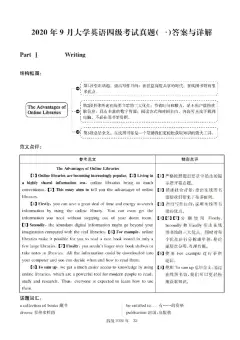
Directions: For this part, you are allowed 30 minutes to write a short essay on the importance of taking advantage of group
brainstorming to solve problems. You should write at least 120 words but no more than 180 words.
Part II Listening Comprehension (25 minutes )
Section A
Directions: In this section, you will hear three news reports. At the end of each news report, you will hear two or three
questions. Both the news report and the questions will be spoken only once. After you hear a question, you must choose the
best answer from the four choices marked A), B), C) and D). Then mark the corresponding letter on Answer Sheet 1 with a
single line through the centre.
Questions 1 and 2 are based on the news report you have just heard.
1. A )25 years old. C )49 years old.
B )26 years old. D ) 89 years old.
2. A) She is Britain's longest-ruling head of state. C ) She is the most well-known woman in the world.
B ) She is a dutiful head of Britain. D ) She is the most visible woman in the world.
Questions 3 and 4 are based on the news report you have just heard.
3. A)5. 013.
B)ll. D)26.
4. A)By train. C) By sea.
B )On foot. D )By truck.
Questions 5 to 7 are based on the news report you have just heard.
5. A ) Assessing the condition of the Great Barrier Reef. C ) Managing lands properly.
B ) Using new techniques in plantation. D ) Protecting the Great Barrier Reef.
6. A) Most sugar plantations have used new techniques. C ) Sediment has been down 12 percent.
B ) Water quality has been improved largely. D ) Pesticides loads have been down 13 percent.
7. A) Indifferent. C) Excited.
B) Disappointed. D) Angry.
Section B
Directions: In this section, you will hear two long conversations. At the end of each conversation, you will hear four
questions. Both the conversation and the questions will be spoken only once. After you hear a question, you must choose the
best answer from the four choices marked A), B), C) and D). Then mark the corresponding letter on Answer Sheet 1 with a
single line through the centre.
Questions 8 to 11 are based on the conversation you have just heard.
8. A) Conducting a training session for security guards. C) Promoting a new alarm system.
B ) Interviewing a person for a job. D ) Asking a coworker some questions.
9. A) Where the job is located. C) How soon he can start working.
B ) What training he will need. D) How much the job pays.
53 • 四级模拟试题四-10. A)He prefers to sleep until noon. C )He has classes earlier in the day.
B )He writes for the local paper in the morning. D)He wants a higher-paying evening job.
11. A )To introduce more about his work experience. C )To fill in an application form and hand it back.
B ) To talk about his future plan fbr the job. D )To take a look at the workplace where he will stay.
Questions 12 to 15 are based on the conversation you have just heard.
12. A )To organize activities fbr children. C)To bring tourists to the town.
B )To sell local farm products. D )To raise funds for a hospital.
13. A )In tents. C )ln a hospital.
B )In university buildings. D ) In an auditorium.
14. A) Play in a band. C) Serve refreshments.
B ) Work at the auction. D) Collect tickets.
15. A )He thinks it's mainly fbr children. C )He believes it is too complicated.
B )He feels it would be worthwhile. D)He thinks it may not be very profitable.
Section C
Directions: In this section, you will hear three passages. At the end of each passage, you will hear three or four questions.
Both the passage and the questions will be spoken only once. After you hear a question, you must choose the best answer from
the four choices marked A), B), C) and D). Then mark the corresponding letter on Answer Sheet 1 with a single line through
the centre.
Questions 16 to 18 are based on the passage you have just heard.
16. A ) They were common in the U.S., but not in Europe. C ) People considered them essential.
B ) Only a few people had them. D ) They were not very accurate.
17. A) They were a symbol of wealth. C )It was fashionable to wear them.
B )lt was important to be on time. D ) They were inexpensive.
18. A) Watches were of higher quality than ever before.
B ) More clocks were manufactured than watches.
C ) The availability of watches increased.
D ) Watches became less important because factories had clocks.
Questions 19 to 21 are based on the passage you have just heard.
19. A )To drive the car automatically. C ) To prevent car accidents.
B ) To measure the driver's pulse. D)To monitor the driver's health.
20. A )lt monitors the signals transmitted from the driver's brain.
B )lt can measure the driver's alcohol level in the blood.
C )lt can quicken the driver's response to emergencies.
D )lt bases its analysis on the driver's heartbeat.
21. A )It sends out signals fbr help. C )lt takes over the driving immediately.
B )lt sounds an alarm to warn the driver. D ) It stops the car automatically.
Questions 22 to 25 are based on the passage you have just heard.
22. A) Explaining the campus architecture to visitors. C ) Familiarizing new students with the campus.
B ) Providing guidance for new campus employees. D ) Advising students which classes to take.
23. A) Registration forms. C ) A list of classes.
B ) A library card. D ) A campus map.
24. A )ln the registrar's office. C )ln the math building.
B )In the library. D )In the cafeteria.
25. A) Move into their dormitories. C ) Memorize campus landmarks.
B ) Find their classrooms. D ) Complete their registration materials.
• 四级模拟试题四- 54Part III Reading Comprehension ( 40 minutes )
Section A
Directions: In this section, there is a passage with ten blanks. You are required to select one word for each blank from a
list of choices given in a word bank following the passage. Read the passage through carefully before making your choices.
Each choice in the bank is identified by a letter. Please mark the corresponding letter for each item on Answer Sheet 2 with a
single line through the centre. You may not use any of the words in the bank more than once.
Women in 2011 made no significant gains in winning more top US business jobs, according to a study, but the head of
the study said women are poised to make 26 in the year ahead.
The number of women who were board directors, corporate officers or top earners at Fortune 500 companies remained
27 unchanged, said the study by Catalyst, a nonprofit group that 28 opportunities fbr women in business.
The percentage of companies with women on the board of directors was 15.1 percent this year, compared with 14.8
percent in 2010, Catalyst said.
Also, the percentage of corporate officer positions 29 by women was 15.7 percent in 2011 and 15.4 percent in 2010, it
said. The percentage of top earners in 2011 who were women was 6.2 percent, compared to 6.7 percent in 2010, it said.
The research on the Fortune 500 companies was 30 on data as of March 31, 2011. The slight changes in the
numbers are not considered 31 significant, Catalyst said.
Nevertheless, given the changes in U.S. politics, the future for women in business looks more 32 , said Ilene Lang,
president and chief executive 33 of Catalyst.
“Overall we're 34 to see change next year,“ Lang said. uWhen we look at shareholders, decision makers, the
general public, they're looking fbr change.^^
“What they're basically saying is, 'Don't give us 35 of the status quo (现状).Get new ideas in there, get some
fresh faces,she said.
A) officer I) essentially
B)changes J) strides
C) based K) promotes
D) positions L) statistically
E) more M) confused
F) promising N)held
G) businesslike O) expecting
H) surveying
Section B
Directions: In this section, you are going to read a passage with ten statements attached to it. Each statement contains
information given in one of the paragraphs. Identify the paragraph from which the information is derived. You may choose
a paragraph more than once. Each paragraph is marked with a letter. Answer the questions by marking the corresponding
letter on Answer Sheet 2.
The Magic of Diasporas (大移居)
Immigrant networks are a rare bright spark in the world economy. Rich countries should welcome them.
A) This is not a good time to be foreign. Anti-immigrant parties are gaining ground in Europe. Britain has been fretting (烦
恼, 发愁)this week over lapses in its border controls. In America Barack Obama has failed to deliver the immi-gration
reform he promised, and Republican presidential candidates would rather electrify the border fence with Mexico than
educate the children of illegal aliens. America educates foreign scientists in its universities and then expels them, a policy
the mayor of New York calls ^national suicide^^.
B ) This illiberal turn in attitudes to migration is no surprise. It is the result of cyclical economic gloom combined with a
rise in pressure on rich countries? borders. But governments now weighing up whether or not to try to slam the door
55 • 四级模拟试题四-should consider another factor: the growing economic importance of diasporas, and the contribution they can make to a
country's economic growth.
C ) Diaspora networks- of Huguenots, Scots, Jews and many others—have always been a potent economic force, but the
cheapness and ease of modem travel has made them larger and more numerous than ever before. There are now 215m
first-generation migrants around the world: that's 3% of the world's population. If they were a nation, it would be a little
larger than Brazil. There are more Chinese people living outside China than there are French people in France. Some
22m Indians are scattered all over the globe. Small concentrations of ethnic and linguistic groups have always been
found in surprising places—Lebanese in west Africa, Japanese in Brazil and Welsh in Patagonia, for instance~~but they
have been joined by newer ones, such as west Africans in southern China.
D ) These networks of kinship (亲缘关系)and language make it easier to do business across borders. They speed the flow
of information: a Chinese trader in Indonesia who spots a gap in the market for cheap umbrellas will alert his cousin in
Shenzhen who knows someone who runs an umbrella factory. Kinship ties foster trust, so they can seal the deal and get
the umbrellas to Jakarta before the rainy season ends. Trust matters, especially in emerging markets where the rule of
law is weak. So does the knowledge of the local culture. That is why so much foreign direct investment in China still
passes through the Chinese diasporas. And modem communications make these networks an even more powerful tool of
business.
E) Diasporas also help spread ideas. Many of the emerging world's brightest minds are educated at Western universities.
An increasing number go home, taking with them both knowledge and contacts. Indian computer scientists in Bangalore
bounce ideas constantly off their Indian friends in Silicon Valley. China's technology industry is dominated by ”sea
turtles^^ (Chinese who have lived abroad and returned).
F ) Diasporas spread money, too. Migrants into rich countries not only send cash to their families; they also help companies
in their host country operate in their home country. A Harvard Business School study shows that American companies
that employ lots of ethnic Chinese people find it much easier to set up in China without a joint venture with a local firm.
G) Such arguments are unlikely to make much headway against hostility towards immigrants in rich countries. Fury against
foreigners is usually based on two (mutually incompatible) notions: that because so many migrants claim welfare they
are a drain on the public purse; and that because they are prepared to work harder for less pay they will depress the wages
of those at the bottom of the pile. The first is usually not true (in Britain, for instance, immigrants claim benefits less than
local people do), and the second is hard to establish either way. Some studies do indeed suggest that competition from
unskilled immigrants depresses the wages of unskilled locals. But others find this effect to be small or non-existent.
H) Nor is it possible to establish the impact of migration on overall growth. The sums are simply too difficult. Yet there are
good reasons for believing that it is likely to be positive. Migrants tend to be hard-working and innovative. That spurs
productivity and company formation. A recent study carried out by Duke University showed that, while immigrants make
up an eighth of America's population, they founded a quarter of the country's technology and engineering firms. And, by
linking the West with emerging markets, diasporas help rich countries to plug into fast-growing economies.
I) Rich countries are thus likely to benefit from looser immigration policy; and fears that poor countries will suffer as a
result of a “brain drain^^ are overblown. The prospect of working abroad spurs more people to acquire valuable skills,
and not all subsequently emigrate. Skilled migrants send money home, and they often return to set up new businesses.
One study found that unless they lose more than 20% of their university graduates, the brain drain makes poor countries
richer.
J ) Government as well as business gains from the spread of ideas through diasporas. Foreign-educated Indians, including
the Prime Minister, Manmohan Singh (Oxford and Cambridge) and his sidekick Montek Ahluwalia (Oxford), played a
big role in bringing economic reform to India in the early 1990s. Some 500,000 Chinese people have studied abroad and
returned, mostly in the past decade; they dominate the think-tanks that advise the government.
K) As fbr the old world, its desire to close its borders is understandable but dangerous. Migration brings youth to ageing
countries, and allows ideas to circulate in millions of mobile minds. That is good both fbr those who arrive with suitcases
and dreams and for those who should welcome them.
36. The cyclical economic depression and the rising stress on rich countries5 borders lead to the illiberal change in attitudes
towards migration.
37. Migrants into rich countries can help companies in their host country run in their native country.
・四级模拟试题四- 5638. Hard-working and innovative migrants stimulate productivity and company formation.
39. The mayor of New York names the policy that America educates foreign scientists in its universities and then forces them
to leave as "'national suicide”.
40. Both government and business benefit from the spread of ideas through diasporas.
41. It is understandable but risky fbr the old world to decline immigrants.
42. The reason why so much foreign direct investment in China still passes through the Chinese immigrants is that they
know the local culture.
43. It is not an appropriate time to immigrate when anti-immigrant parties are gaining around in Europe.
44. Some studies show that the wages of unskilled local citizens are depressed by the competition from unskilled immigrants.
45. First-generation migrants reach up to 215 million all over the world, which takes up 3% of the world's population.
Section C
Directions: There are 2 passages in this section. Each passage is followed by some questions or unfinished statements.
For each of them there are four choices marked A), B), C) and D). You should decide on the best choice and mark the
corresponding letter on Answer Sheet 2 with a single line through the centre.
Passage One
Questions 46 to 50 are based on the following passage.
Financial independence is one of the many markers used to designate the crossover from childhood into young
adulthood, and it's a milestone most Americans think young adults should reach by the age of 22, But that's not the reality fbr
most young adults who've reached this age.
The share of young adults who could be considered ufinancially independent” from their parents by their early 20s has
gone down somewhat in recent decades. A new Pew Research Center analysis of Census Bureau data finds that, in 2018, 24%
of young adults were financially independent by age 22 or younger, compared with 32% in 1980.
Looking more broadly at young adults aged 18 to 29, the share who are financially independent has been largely stable
in recent decades. Overall, young men are more likely than young women to be financially independent, but this gender gap
has diminished significantly.
The new survey findings underscore the extent to which many young adults are financially reliant on their parents. Some
45% of adults aged 18 to 29 say they have received a lot of or some financial help from their parents in the past 12 months.
According to parents of young adults, those shares may be even higher. About six-in-ten parents with children aged 18 to 29
say they have given their kids at least some financial help in the past year.
A majority of young adults who have received financial help from their parents say at least some of it was for recurring
expenses. Six-in-ten say the money went toward household expenses such as groceries or bills, and significant shares used it
to pay their tuition, rent or mortgage.
Beyond financial independence, the pace with which young adults are reaching other markers of adulthood has
slowed significantly over the past several decades. Today5s young adults are staying in school longer and are marrying and
establishing their own households later than previous generations. A growing share are living in their parents' homes well
into their 20s and even early 30s. Some of these changes are linked to economic challenges, while others may represent a
rearrangement of goals and priorities.
46. What does the author try to imply in Paragraph 1?
A) Financial independence is vital to being a young adult.
B) Financial independence marks the start of adulthood.
C) Most young Americans live their life in a unique way.
D) Many American young adults depend on their parents.
47. What is the change between young Americans in 2018 and those in 1980?
A) The latter have more financial knowledge.
B) The latter have less sense of social responsibility.
C) The former are more ambitious than the latter.
D) The former are less financially independent.
48. What do we learn about the age-group of 18 to 29 in the U.S.?
57 • 四级模拟试题四-A) Young women are fast catching up with young men financially.
B) Young men are more vulnerable to bankruptcy than young women.
C) The past decade witnessed a dramatic financial change among them.
D) About 45% of them have got financial support from their friends.
49. What do young Americans say about the financial assistance they received from their parents?
A) Most of them say it was used to cover unexpected expenses.
B) More than half of them say it was for household expenses.
C) Many say a great amount of it went toward entertainment.
D) Some say a small share of it was about paying tuition or rent.
50. What is said about the young adults nowadays in the U.S.?
A) The pace with which they reach markers of adulthood is speeding up.
B) An increasing percent of them would like to live separately from their parents.
C) They tend to spend more years in schooling and delay their marriage age.
D) They are more likely to be financially independent after getting married.
Passage Two
Questions 51 to 55 are based on the following passage.
Americans are proud of their variety and individuality, yet they love and respect few things more than a uniform,
whether it is the uniform of an elevator operator or the uniform of a five-star general. Why are uniforms so popular in the
United States?
Among the arguments fbr uniforms, one of the first is that in the eyes of most people they look more professional than
civilian clothes. People have become conditioned to expect superior quality from a man who wears a uniform. The television
repairman who wears a uniform tends to inspire more trust than one who appears in civilian clothes. Faith in the skill of a
garage mechanic is increased by a uniform. What easier way is there fbr a nurse, a policeman, a barber, or a waiter to lose
professional identity than to step out of uniform?
Uniforms also have many practical benefits. They save on other clothes. They save on laundry bills. They are tax
deductible (可减税的).They are often more comfortable and more durable than civilian clothes.
Primary among the arguments against uniforms is their lack of variety and the consequent loss of individuality
experienced by people who must wear them. Though there are many types of uniforms, the wearer of any particular type is
generally stuck with it, without change, until retirement. When people look alike, they tend to think, speak, and act similarly,
on the job at least.
Uniforms also give rise to some practical problems. Though they are long-lasting, often their initial expense is greater
than the cost of civilian clothes. Some uniforms are also expensive to maintain, requiring professional dry cleaning rather
than the home laundering possible with many types of civilian clothes.
51. What is surprising about Americans who worship variety and individuality?
A) They still judge a man by his clothes.
B ) They hold the uniform in such high regard.
C ) They enjoy having a professional identity.
D ) They will respect an elevator operator as much as a general in uniform.
52. How are people accustomed to thinking about a man in uniform?
A) He is doing quality work. C )He appears to be more practical.
B )He discards his social identity. D ) He looks superior to a person in civilian clothes.
53. What is the chief function of a uniform?
A )lt provides practical benefits to the wearer. C )lt inspires the wearer's confidence in himself
B )It makes the wearer catch the public eye. D )It provides the wearer with a professional identity.
54. What can we learn about people wearing uniforms from the passage?
A) They are usually helpful. C ) They tend to lose their individuality.
B ) They have little or no individual freedom. D ) They enjoy greater popularity.
• 四级模拟试题四- 5855. What would be the best title for this passage?
A ) Uniforms and Society C ) Practical Benefits of Wearing a Uniform
B ) The Importance of Wearing a Uniform D ) Advantages and Disadvantages of Uniforms
Part IV Translation (30 minutes )
Directions: For this part, you are allowed 30 minutes to translate a passage from Chinese into English. You should write
your answer on Answer Sheet 2.
北京这座古城是中国古代科学技术和文化艺术高度发展的杰作。几个朝代的帝王在这个龙脉宝地(precious
royal place)君临天下,并修建了雄伟壮观的长城、集全国能工巧匠之智慧的故宫、集天下园林之大成的圆明园
(Yuanmingyuan Park) 以及保留最完整的古代祭天建筑群(flocks of the sacred buildings )------天坛。北京是中国皇家
园林与宫殿建筑的代表,是凝聚中华文明精髓的世界文化遗产。
59 • 四级模拟试题四-大学英语四级考试模拟试题五
Part I Writing (30 minutes)
Directions: For this part, you are allowed 30 minutes to write a short essay on the importance of being a civilized tourist.
You should write at least 120 words but no more than 180 words.
Part II Listening Comprehension ( 25 minutes )
Section A
Directions: In this section, you will hear three news reports. At the end of each news report, you will hear two or three
questions. Both the nexvs report and the questions will be spoken only once. After you hear a question, you must choose the
best answer from the four choices marked A), B), C) and D). Then mark the corresponding letter on Answer Sheet 1 with a
single line through the centre.
Questions 1 and 2 are based on the news report you have just heard.
1. A) Unemployment and inflation. C ) Student loan rates.
B ) America's financial system. D ) Fed's raising interest rates.
2. A) Higher student loan rates. C) A tougher job market.
B ) Tighter limits on loans. D ) A looser monetary policy.
Questions 3 and 4 are based on the news report you have just heard.
3. A) People would be annoyed by the sounds of eating.
B ) People would eat as fast as possible while listening.
C ) People would eat less when noticing the sounds of eating they make.
D ) People would enjoy eating more without background music.
4. A) Watch TV or listen to music. C ) Make a crunchy snack.
B ) See other people eating. D) Wear headphones and listen to noise.
Questions 5 to 7 are based on the news report you have just heard.
5. A) New airports, better infrastructure and reduced visa restrictions.
B ) Open-mindedness that Chinese citizens have in such a big nation.
C ) China5 s domestic economy is increasing at an unprecedented speed.
D ) The government is encouraging its citizens to travel abroad.
6. A )15%. 053%.
B)20%. D) 120%.
7. A ) The concerns have prevented Chinese from traveling abroad.
B ) Chinese may be encouraged to invest outside the country.
C ) Young people are forced to start their own business.
D ) Chinese officials impose limitation on outbound tourism.
Section B
Directions: In this section, you will hear two long conversations. At the end of each conversation, you will hear four
questions. Both the conversation and the questions will be spoken only once. After you hear a question, you must choose the
best answer from the four choices marked A), B), C) and D). Then mark the corresponding letter on Answer Sheet 1 with a
single line through the centre.
• 四级模拟试题五- 70Questions 8 to 11 are based on the conversation you have just heard.
8. A) Planning a sightseeing tour. C ) Arranging his class schedule.
B ) Writing to his uncle. D ) Looking through a language textbook.
9. A) France. C ) Canada.
B ) England. D )The U.S.
10. A ) Get the university's approval in advance.
B ) Follow Susan5 s advice about traveling abroad.
C ) Take more French courses to improve his skills.
D ) Make inquiries about the requirements for teaching abroad.
11. A)He wants to change his field of study. C)He needs to get better grades.
B)He needs to earn a graduate degree. D )He,s fulfilled his graduation requirements.
Questions 12 to 15 are based on the conversation you have just heard.
12. A) In the radio studio. C )On the road.
B )ln the bicycle shop. D ) At the starting line.
13. A) Last year's tour winner. C ) President of the Ottawa Bicycle Club.
B ) A cyclist being interviewed. D ) A sports reporter for a local news show.
14. A )To meet cyclists from other countries. C )To compete for a valuable first prize.
B)To race with professional athletes. D ) To exercise and enjoy themselves.
15. A ) In any order they like. C ) Bicycle club members first, then others.
B )In groups at timed intervals. D ) Racers first, then average cyclists.
Section C
Directions: In this section, you will hear three passages. At the end of each passage, you will hear three or four questions.
Both the passage and the questions will be spoken only once. After you hear a question, you must choose the best answer from
the four choices marked A), B), C) and D). Then mark the corresponding letter on Answer Sheet 1 with a single line through
the centre.
Questions 16 to 18 are based on the passage you have just heard.
16. A ) The problems caused by the Revolutionary War.
B ) How some people became rich in the late 1700s.
C ) The importance of establishing a tax system in the Constitution.
D ) Motives fbr creating the United States Constitution.
17. A)Tax collectors. C ) Soldiers.
B ) The wealthy. D ) State officials.
18. A) They are not influenced by government policy.
B ) They are opinions that have no basis in fact.
C ) They are affected by the conditions of the time in which they are written.
D ) They would be more accurate if historians followed one ideology.
Questions 19 to 21 are based on the passage you have just heard.
19. A ) Representatives of Congress. C) President Grant.
B) Several explorers. D ) A group of animal lovers.
20. A) It is the first national park. C) It is not accessible to everyone.
B ) It is the first region explored by pioneers. D ) It is not managed by the National Park Service.
21. A )To build fires. C)To train other staff members.
B )To conduct scientific studies. D )To guide nature walks.
Questions 22 to 25 are based on the passage you have just heard.
22. A) She sat back and relaxed. C) She entered a university.
B ) She decided to retire. D) She initialized a new English program.
71 ・四级模拟试题五-23. A )12 years. C )30 years.
B ) 20 years. D ) 68 years.
24. A) She is learningE nglish and Drama. C ) She is learning how to teach old students.
B ) She is learning how tom ake sound judgments. D ) She is learning to perceive, not to judge.
25. A) They bring a great deal of useful experience to the university.
B ) They improve human relationships in the university.
C ) They bring a fear of aging among young students on the campus.
D ) They improve the reputation of the university.
Part III Reading Comprehension (40 minutes)
Section A
Directions: In this section, there is a passage with ten blanks. You are required to select one word for each blank from a
list of choices given in a word bank following the passage. Read the passage through carefully before making your choices.
Each choice in the bank is identified by a letter. Please mark the corresponding letter for each item on Answer Sheet 2 with a
single line through the centre. You may not use any of the words in the bank more than once.
Many people believe the glare from snow causes snow blindness. However, the U.S. Army has now 26 that glare
from snow does not cause snow blindness in troops in a snow-covered country. Rather, a man's eyes frequently find nothing
to focus on in a broad 27 of barren snow-covered terrain. So his gaze continually 28 and jumps back and forth over
the entire landscape in search of something to look at. Finding nothing, the eyes never stop searching and the eyeballs become
29 and the eye muscles ache. Nature 30 this irritation by producing more fluid which covers the eyeball. The fluid
covers the eyeball in 31 quantity until vision blurs, then is 32 , and the result is snow blindness.
Experiments led the Army to a simple method of overcoming this problem. Scouts ahead of a main body of troops are
trained to shake snow from evergreen bushes, creating a dotted line as they cross completely snow-covered landscape. Even
the scouts themselves throw lightweight, dark colored objects 33 on which they too can focus. The men following can
then see something. Their gaze is 34 . Their eyes fbcus on a bush and having found something to see, stop scouring the
snow-blanketed landscape. By focusing their attention on one object at a time, the men can cross the snow without becoming
hopelessly snow-blind or 35 . In this way the problem of crossing a solid white terrain is overcome.
A) landscape I) defined
B )lost J) shifts
C) blurred K) obscured
D) increasing L)expanse
E) surveyed M) offsets
F) away N)ahead
G) determined 0 )sore
H) arrested
Section B
Directions: In this section, you are going to read a passage with ten statements attached to it. Each statement contains
information given in one of the paragraphs. Identify the paragraph from which the information is derived. You may choose
a paragraph more than once. Each paragraph is marked with a letter. Answer the questions by marking the corresponding
letter on Answer Sheet 2.
• 四级模拟试题五- 72Caring for Elderly Parents Catches Many Unprepared
A) Last July, Julie Baldocchi's mother had a massive stroke and was paralyzed. Baldocchi suddenly had to become a family
caregiver, something that she wasn't prepared for. *1 was flying by the seat of my pants,“ says Baldocchi, an employment
specialist in San Francisco. Both of her parents are 83, and she knew her father couldn't handle her mother's care. The
hospital recommended putting her mother in a nursing home. Baldocchi wasn't willing to do that. But moving her back
into her parents5 home created other problems. Baldocchi, 48, is married and lives about a mile away from her parents.
She has a full-time job and has back problems that make it difficult for her to lift her mother. t4I couldn't do it all,^^ she
says. uBut I didn't even know how to find help.”
B) With help from the Family Caregiver Alliance, she eventually hired a live-in caregiver. 44But even if you plan
intellectually and legally, you're never ready for the emotional impact,“ Baldocchi says. In the first two months after her
mother's stroke, she lost about 30 pounds as stress mounted. More than 42 million Americans provide family caregiving
for an adult who needs help with daily activities, according to a 2009 survey by the AARP. An additional 61.6 million
provided at least some care during the year. And many are unprepared.
C ) While many parents lack an advance care directive, it's the most basic and important step they can take. The directive
includes several parts, including: a durable power of attorney, which gives someone legal authority to make financial
decisions on another's behalf; a health care proxy, which is similar to the power of attorney, except it allows someone
to make decisions regarding medical treatment; and a living will that outlines instructions fbr end-of-life care. (For
example, parents can say if they want to be kept alive by artificial measures.) "It's invaluable for the kids, because it's
hard to make those decisions for a parent,“ says Jennifer Cona, an elder-law attorney at Genser Dubow Genser & Cona
in Melville, N.Y. An advance care directive is the first line of defense if a situation arises, says Kathleen Kelly, executive
director of the Family Caregiver Alliance, which supports and educates caregivers. Without an advance directive, the
family will have to petition the court to be appointed the parent's legal guardian, says AgingCare.com.
D ) It's important for families to talk about long-term care so the adult children know their parents' preferences, wishes and
goals, says Lynn Feinberg, a caregiving expert at AARP. But it's not an easy conversation. Elderly parents are sometimes
suspicious of their children's financial motives, says Susan John, a financial planner at Financial Focus in Wolfeboro, N.H.
One client asked John to hold a family meeting because they needed an intermediary to talk about financial issues, she
says. And when there are many siblings, the family decisions can become a three-ring circus with much acrimony, says
Ann-Margaret Carrozza, an elder-law attorney in Glen Cove, N.Y. Families who need information and help sorting out
disagreements can call on elder-law attorneys, financial planners, geriatric care managers and caregiver support groups.
In February, AARP said it will offer its members a new caregiving support service through financial services firm
Genworth.
E) Many families are unprepared fbr quick decisions, especially when they find out that Medicare doesn't pay for long-term
care, Feinberg says. The median cost of a year in a private room at a nursing home in 2011 was $77,745, according to
Genworth. And only those who have spent most of their assets can qualify fbr Medicaid to pay fbr the nursing home.
F) Assisted living is another option. Residents can have their own apartment to maintain some independence. But the
facilities generally provide personal care services, such as meals, housekeeping and assistance with activities. Still,
it's not cheap: The national median cost in 2011 was $39,135, according to Genworth. Assisted living isn't covered by
Medicaid.
G) If they have a choice, at least 90% of elderly parents prefer to stay at home as long as they can, according to AARP
research. But if the parents can no longer safely live at home, it can be hard for children to move them into an adult care
facility. There may be another option. Sometimes the home can be modified so a parent can stay there. For example,
Baldocchi put in a chair lift fbr her mother. She also arranged fbr a home caregiver.
H) Family caregivers take over many responsibilities. One might manage a parent's finances, while another sibling will take
the parent to doctors5 appointments and shopping. Those who move in with a parent take on a significant and sustained
burden of care. Jan Walker moved into her mother's home in Leesburg, Fla. After her mother, who is 83, had fallen, she
73 • 四级模拟试题五-wasn't able to get around as well. Walker, 55, has three brothers. But she is the only daughter, is divorced and has no
children. t4I always knew that this was the role that I would have, and I guess my mind was prepared for it,“ says Walker,
who now is a full-time caregiver and works from home as a tutorial instructor for a digital scrapbooking website. <4When
you get into the trenches, it's literally baptism by fire,“ she says. "New things come up. It's not just about advance
planning for finances or medical care. It's everything,she says.
I) Caregivers need to also watch their own health. 4tThere is such a thing as caregiver burnout,“ Cona says. Among female
caregivers 50 and older, 20% reported symptoms of depression, according to a 2010 study on working caregivers by
MetLife. "It's a hard job,“ Walker says. "But most worthwhile things are hard. She was always there for me when I
needed a helping hand. It*s only natural that I be here for her now.”
36. When elderly parents cannot live at home safely, their children can change their home instead of sending them to an
adult care facility.
37. To talk about long-term care is not easy because sometimes aged parents are suspicious of their children's financial motives.
38. Besides advance planning for finances or medical care, family caregivers take over many other responsibilities.
39. The difference between a durable power of attorney and a health care proxy is that the latter allows someone to make
decisions regarding medical treatment.
40. Baldocchi did not want to send her mother to a nursing home, but she had difficulty taking care of her.
41. Over 42 million caregivers helped an adult with everyday activities in the USA in 2009.
42. If a family needs information or help to sort out disagreements, there are many people they can call on.
43. Caregivers should pay attention to their own health, or they may bum out or become depressed.
44. One will have to petition the court to be the parent's legal guardian, if there is no advance directive.
45. The national median cost of assisted living in 2011 was $39,135 and it is not covered by Medicaid.
Section C
Directions: There are 2 passages in this section. Each passage is followed by some questions or unfinished statements.
For each of them there are four choices marked A), B), C) and D). You should decide on the best choice and mark the
corresponding letter on Answer Sheet 2 with a single line through the centre.
Passage One
Questions 46 to 50 are based on the following passage.
English is what matters. It has displaced rivals to become the language of diplomacy, of business, of science, of the
Internet and of world culture. Many more people speak Chinese- but even they, in vast numbers, are trying to learn English.
So how did it happen, and why?
Take the beginnings of bilingualism (两种语言)in India, for example, which has promoted the growth of the biggest
English-speaking middle class in the new Anglosphere. That stems from a proposal by an English historian, Thomas
Macaulay, in 1835, to train a new class of English speakers: "A class of persons, Indian in blood and colour, but English in
taste, in opinion, in morals, and in intellect.^^ At a stroke, notes Mr. McCrum, English became the4<language of government,
education and advancement, at once a symbol of imperial rule as well as of sei住improvement”. India's English-speaking
middle class is now one of the engines of that country's development and a big asset in the race to catch up with China.
Bit by bit, English displaced French from diplomacy and German from science. The reason for this was America's rise
and the lasting bonds created by the British Empire. But the elastic (灵活的),forgiving nature of the language itself was
another. English allows plenty of sub-variants, from Singlish in Singapore to Estglish in Estonia: the main words are familiar,
but plenty of new ones dot the lexicon, along with distinctive grammar and syntax.
English as spoken by non-natives, however, is different. Listen to a South Korean businessman negotiating with a Pole
in English and you will hear the difference: the language is curt, emphatic, stripped-down. Yet within spoken “Globish”,as
Mr. McCrum neatly names it, hierarchies (等级)are developing. Those who can make jokes in Globish have an advantage
over those who can't.
The big shift is towards a universally useful written Globish. Spellchecking and translation software mean that anyone
can communicate in comprehensible written English. The English of e-mail, Twitter ( 一 个社交网络和微博服务网站)and
text messaging is becoming far more mutually comprehensible than spoken English, which is undermined by differences in
pronunciation, politeness and emphasis. Mr. McCrum aptly names the new language “an avenue for all thoughts”.
• 四级模拟试题五・ 7446. According to the first paragraph, what does "English is what matters“ suggest?
A ) English is spoken by most of the people in the world.
B ) More and more Chinese begin to learn English.
C ) English has become the universal language in many fields.
D ) English has won the triumph over other languages.
47. What does Paragraph 2 say about India's middle class?
A) English should become the only language fbr India's middle class.
B ) India's middle class learned the English way of living and thinking.
C ) Although India's middle class learnt English, they were still Indians.
D ) India's middle class dominated the political world of this country.
48. Why did English displace French in diplomatic field and German in scientific field?
A) English-speaking countries held greater power in the world.
B ) English was a changeable language.
C ) America and the British Empire held a strong bond.
D ) English's tolerant towards its sub-variants.
49. What's the spoken Globish according to the passage?
A) It is the English spoken by people from different countries.
B ) It is a new-invented language spoken all over the world.
C ) It is a universal language different from English.
D ) It is the English developing into hierarchies.
50. What's the written Globish's advantage over the spoken one?
A) The written one is more convenient.
C ) The written one belongs to the higher class.
B ) The written one is more fractured.
D ) The written one is better for mutual understanding.
Passage Two
Questions 51 to 55 are based on the following passage.
Google researchers have used artificial intelligence (AI) to teach robots how to move like real animals (in this case,
dogs). They describe their experiment in a blog released this week.
“First, we describe how robots can learn to move like a real animal by imitating their motions, producing fast and fluent
movements like running slowly and hopping. Then, we discuss a system fbr automating the training of moving skills in the
real world, which allows robots to learn to walk on their own, with minimal human assistance,shared in the blog Xue Bin
(Jason) Peng, Student Researcher and Sehoon Ha, Research Scientist, Robotics at Google.
They achieved this impressive feat by using something called reinforcement learning (RL). They began by taking a
reference video recorded from an animal and using RL to get the robot to imitate an animal's movement.
“By providing the system with different reference motions, we are able to train an animal-shaped robot to perform a
diverse set of agile behaviors, ranging from fast walking to dynamic hops and turns. The policies are trained primarily in
simulation (模拟, 模仿),and then transferred to the real world using a space adaptation technique that can efficiently adapt
a policy using only a few minutes of data from the real robot,“ wrote the researchers in their blog.
However, it is a well-known fact that simulators provide a poor approximation of the real world, meaning that
simulations don't perform well in reality. This is where the researchers decided to use a sample-efficient space adaptation
technique.
They did so by introducing an element of randomness to the physical parameters (参数)used in the simulation by varying
physical quantities, such as the robofs mass and friction. This resulted in a machine learning model that could account for all
kinds of small changes and the complications they create.
The end result is a robot that moves like a real dog. This kind of work is crucial as it can open opportunities to use robots
to do sophisticated tasks in the real world.
51. What is Google researchers5 experiment about?
A) Developing the first AI dog-like robot.
75 • 四级模拟试题五-B) Training robots to move like a real dog.
C) Making a running dog video with AI tech.
D) Designing a new AI device to make robots.
52. How did the researchers make the breakthrough?
A) By using bionic technology.
B) By using 3-D printing tech.
C) By employing the method of RL.
D) By applying the 5G technology.
53. Why did researchers decide to use a sample-efficient space adaptation technique?
A) Because they hated to experiment on animals.
B) Because they intended to reduce research cost.
C) Because the robotic technology was unable to update.
D) Because simulators don't simulate the real world well.
54. What have researchers taken into account to simulate the reality?
A) The mass and friction of the robot.
B) The color and sound of the robot.
C) The light and the space of the lab.
D) The competence of the operator.
55. Why is the new technology Google developed so important?
A) Because it has shed new light on cloning technology.
B) Because it has opened chances for us to control robots.
C) Because it can promote the application of robotic technology.
D) Because it can enable robots to do more tasks in the laboratory.
Part IV Translation (30 minutes)
Directions: For this part, you are allowed 30 minutes to translate a passage from Chinese into English. You should write
your answer on Answer Sheet 2.
有人说,阅读决定着一个民族思维的深度和广度,对文化传承、国家发展有着重要的意义。已有专家指出,如
果仅仅满足于“浅阅读”,对于国家和人民将是灾难性的。这就是为什么在高科技浪潮中,很多网络发达的国家反
而更强调传统式阅读。近年来,很多国家都把提倡阅读、提升阅读能力列为教育改革的重点,通过实施这些措施努
力唤起“深阅读”。
• 四级模拟试题五- 76