文档文本内容
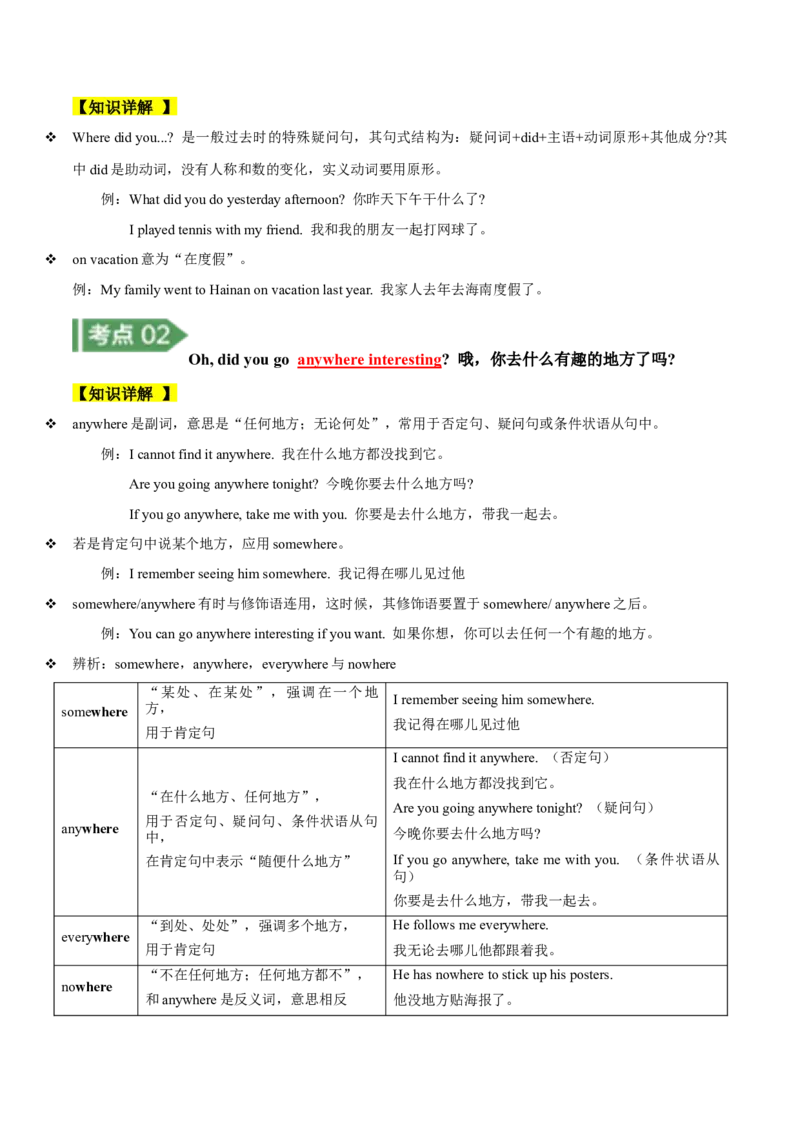
Unit 1 Where did you go on vacation?(知识讲解)—Where did you go on vacation? 你去哪里度假了?
—I went to the mountains. 我去爬山了。【知识详解 】
Where did you...? 是一般过去时的特殊疑问句,其句式结构为:疑问词+did+主语+动词原形+其他成分?其
中did是助动词,没有人称和数的变化,实义动词要用原形。
例:What did you do yesterday afternoon? 你昨天下午干什么了?
I played tennis with my friend. 我和我的朋友一起打网球了。
on vacation意为“在度假”。
例:My family went to Hainan on vacation last year. 我家人去年去海南度假了。
Oh, did you go anywhere interesting? 哦,你去什么有趣的地方了吗?
【知识详解 】
anywhere是副词,意思是“任何地方;无论何处”,常用于否定句、疑问句或条件状语从句中。
例:I cannot find it anywhere. 我在什么地方都没找到它。
Are you going anywhere tonight? 今晚你要去什么地方吗?
If you go anywhere, take me with you. 你要是去什么地方,带我一起去。
若是肯定句中说某个地方,应用somewhere。
例:I remember seeing him somewhere. 我记得在哪儿见过他
somewhere/anywhere有时与修饰语连用,这时候,其修饰语要置于somewhere/ anywhere之后。
例:You can go anywhere interesting if you want. 如果你想,你可以去任何一个有趣的地方。
辨析:somewhere,anywhere,everywhere与nowhere
“某处、在某处”,强调在一个地
I remember seeing him somewhere.
somewhere 方,
我记得在哪儿见过他
用于肯定句
I cannot find it anywhere. (否定句)
我在什么地方都没找到它。
“在什么地方、任何地方”,
Are you going anywhere tonight? (疑问句)
用于否定句、疑问句、条件状语从句
anywhere
中, 今晚你要去什么地方吗?
在肯定句中表示“随便什么地方” If you go anywhere, take me with you. (条件状语从
句)
你要是去什么地方,带我一起去。
“到处、处处”,强调多个地方, He follows me everywhere.
everywhere
用于肯定句 我无论去哪儿他都跟着我。
“不在任何地方;任何地方都不”, He has nowhere to stick up his posters.
nowhere
和anywhere是反义词,意思相反 他没地方贴海报了。【经典题】
After senior high school entrance examination, my family plan to go ________ to relax.
A.interesting somewhere B.somewhere interesting
C.anywhere interesting D.interesting anywhere
【答案】B
【详解】在中考考试结束后,我的家人计划去某个有趣的地方放松下。
考查定语后置。interesting somewhere 错误写法;somewhere interesting 某个有趣的地方; anywhere
interesting某个有趣的地方,用于否定句和问句;interesting anywhere错误写法。由于此句是肯定的陈述句,
所以是somewhere interesting。故选B。
We took quite a few photos there.我们在那里拍了相当多的照片。
【知识详解】
take photos意为“拍照、照相”,take a photo of sb./sth. 意为“给...拍照”。
例:We took many photos on the Great Wall. 我们在长城上拍了很多照片。
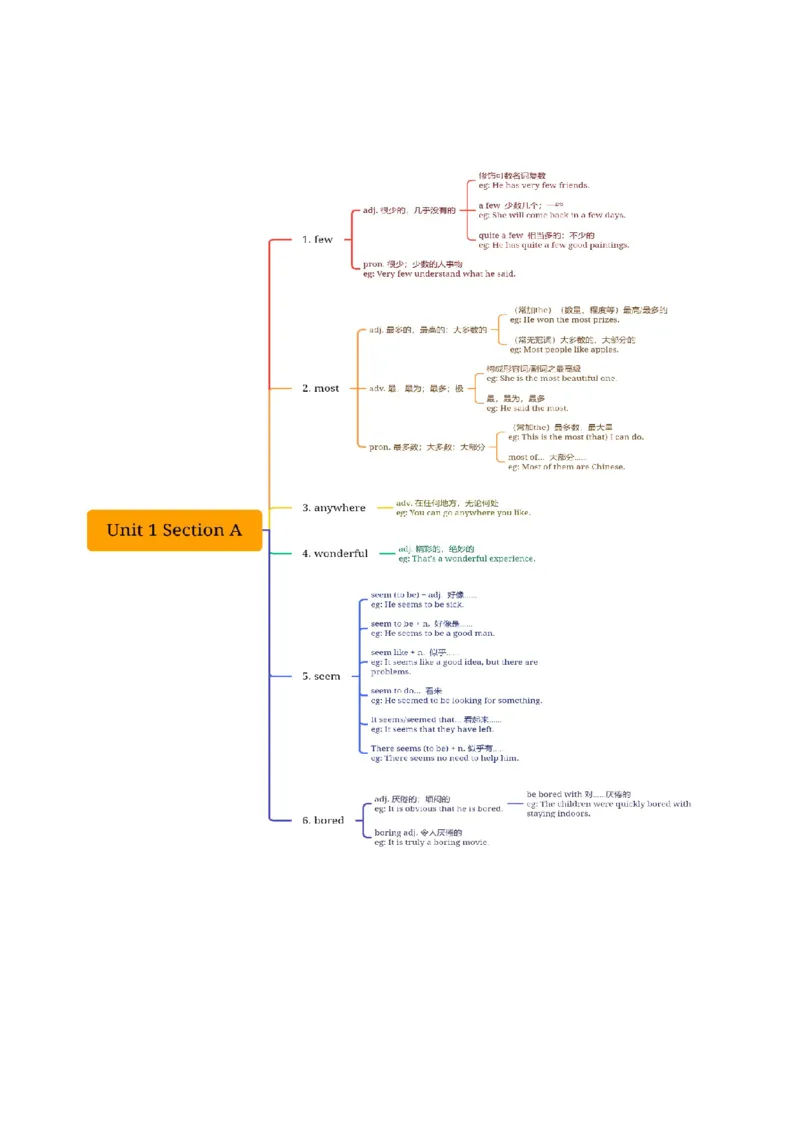
few意思是“很少;几乎没有”,而a few表示“一些”,quite a few表示“相当多的”,
都修饰可数名词。
例:He has few friends here ,s0 he feels lonely. 他在这里几乎没朋友.所以他感觉寂寞。
Quite a few students go to school by bike. 相当多的学生骑自行车上学。
辨析:few, a few与little, a little
注解 例句
few 后接可数名词,且要用复数形式,含否定意义 He has few friends. 他朋友很少。
a few 后接可数名词,且要用复数形式,不含否定意义 Please wait for a few minutes.请等几分钟。
He knows little English. 他几乎不懂英
little little后接不可数名词,含否定意义
语。
There is a little milk in the bottle.
a little a little 后接不可数名词,不含否定意义
瓶子里有少量的牛奶。
【经典题型】
Hurry up! There is ________ time left. We are late already!
A.few B.little C.a few D.a little
【答案】B
【详解】句意:快点!剩下的时间不多了。我们已经迟到了!考查不定代词辨析。few意为“几乎没有”,表否定意义,修饰可数名词复数;little意为“几乎没有”,
表否定意义,修饰不可数名词;a few意为“一点”,修饰可数名词复数;a little意为“一点”,修饰不可
数名词。空格后“time”为不可数名词,故应用little/a little修饰,A、C选项可排除。根据下文“We are late
already!”可知,此处指的是没多少时间了,表否定意义,故应用little。故选B。
It was sunny and hot, so we decided to go to the beach near our hotel.天气晴
朗且炎热,因此我们决定去我们宾馆附近的海滩。
【知识点详解】
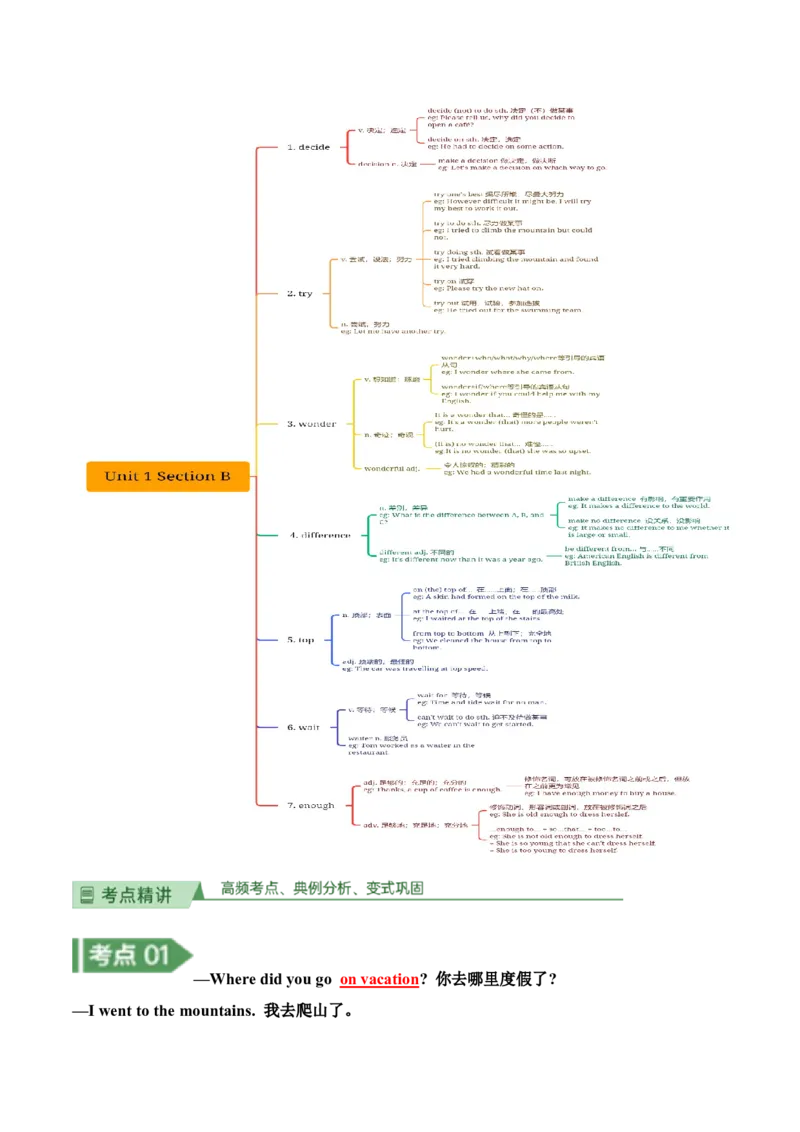
(1) decide to do sth.决定做某事
(2) decide on选定;决定,后常跟名词、代词、动词ing形式作宾语。
(3) decision 决定,decide的名词形式,可构成make a decision决定;下决心,相当于decide。
【经典题型】
Mr Zhou is good at cooking, so he decides ________ his own restaurant.
A.open B.opened C.to open D.opening
【答案】C
【详解】句意:周先生擅长烹饪,他决定开一家属于自己的餐馆。
考查动词不定式作宾语。decide to do sth.“决定去做某事”,固定搭配,动词不定式作宾语。故选C。
My sister and I tried paragliding.我的妹妹和我尝试过滑翔伞运动。
【知识点详解 】
(1) try to do sth.尽量/努力做某事
(2) try doing sth.试着做某事
(3) try 也可作名词,“尝试”,have a try
(4)try one’s best to do sth
【经典题型】
Try your best ________ with your parents and they will understand your decision.
A.to play B.talk C.to talk D.play
【答案】C
【详解】句意:尽量和父母谈谈,他们会理解你的决定。
考查动词不定式和词义辨析。play 玩;talk 谈话。根据“Try your best...with your parents and they will
understand your decision.”可知,尽量和父母谈谈,他们会理解你的决定;try one’s best to do sth“尽某人最大的努力做某事”,故选C。
What a difference a day makes!一天的变化有多大呀!
【知识点详解 】
(1) 常构成短语:make a difference 有影响;起作用
the difference(s) between...and...,意为“……和……两者间的不同点”。
(2) different adj. 不同的
(3) differently adv.不同地
【经典题型】
1、There are many (different) between British English and American English.
【答案】differences
【详解】句意:英国英语和美国英语有很多不同之处。many后加可数名词复数differences“不同,差异”。
故填differences。
2、The result shows even the closest friends may think (different).
【答案】differently
【详解】句意:结果表明,即使是最亲密的朋友也可能想法不同。根据“The result shows even the closest
friends may think…”可知这里修饰动词“think”,要用副词differently“不同地”。故填differently。
I wonder what life was like here in the past.我想知道这里过去的生活是什么
样子的。
【知识点详解 】
wonder作及物动词,意为“想知道;对.....感到好奇”,
后常接who, what, why, where 等引导的宾语从句。从句用陈述句语序。
例:I wonder why Ann is late. 我想知道安为什么迟到了。
She wondered what the child was doing. 她想知道孩子在做什么。
温馨提示:
1、wonder 相当于want to know 想知道
2、wonder 作名词讲,奇迹
3、wonder V.→ wonderful adj. → wonderfully adv.
【经典题】
He is very clever. Soon he has a idea. (wonder)
【答案】wonderful【详解】句意:他很聪明。不久他有一个很棒的主意。横线上应是形容词作定语,所以应将wonder变成
wonderful。故填wonderful。
We waited over an hour for the train.我们等了一个多小时的火车。
【知识点详解 】
(1) wait to do sth.等着去做某事
(2) wait for sb./sth. 等待某人/某物
(3) can't wait to do sth.迫不及待地做某事
【经典题型】
Lynn can’t wait (open) the present from her cousin.
【答案】to open
【详解】句意:林恩迫不及待地打开她表妹送的礼物。can’t wait to do sth.“迫不及待做某事”,动词不定式
作宾语。故填to open。
And because of the bad weather,we couldn't see anything below.
【知识点详解 】
because of表示原因,后接名词、代词、名词性短语。
because表示原因,其后跟从句。
【经典题型】
________ the outbreak (爆发) of COVID-19 on Sept. 10th, 2021, most schools in Mount Wuyi provided online
learning for students.
A.Thanks to B.Instead of C.Because of
【答案】C
【详解】句意:由于2019年9月10日新冠肺炎疫情的爆发,武夷山大部分学校都为学生提供了在线学习。
考查介词短语。Thanks to幸亏;Instead of代替,而不是;Because of由于,因为。根据“... the outbreak
(爆发) of COVID-19 on Sept. 10th, 2021, most schools in Mount Wuyi provided online learning for students.”可知,
由于疫情的爆发,武夷山的大部分学校提供了在线学习;前后为因果关系。故选C。
My father didn’t bring enough money, so we only had one bowl of rice and
some fish. 我的爸爸没有带足够多的钱,因此我们只吃了一-碗米饭和一些鱼肉。
【知识点详解 】(1) 可以作定语放在可数或不可数名词前面,也可作表语放在系动词后面。
(2)修饰形容词、副词或动词时,要放在被修饰词的后面。
(3) ...enough (for sb.) to do sth.意为“(对某人来说)做某事足够……”。
【经典题型】
1、It wasn’t _______ for us to solve the math problem. Few of us could even understand it.
A.easy enough B.enough easy C.difficult enough D.enough difficult
【答案】A
【详解】句意:解这道数学题对我们来说并不容易。我们中几乎没有人能理解它。
考查形容词辨析和enough后置。enough修饰形容词应后置,排除BD。easy容易的;difficult困难的。根
据“Few of us could even understand it.”可知,几乎没有人能理解它,所以并不容易。故选A。
2、The teenagers are kind enough ________ their help to other people.
A.offer B.offering C.to offer D.offered
【答案】C
【详解】句意:这些青少年很善良,乐于帮助别人。
考查非谓语动词。... enough to do sth.“足够……可以做某事”,此处用动词不定式to offer。故选C。
seem的用法
【知识点详解 】
(1)seem+adj./n.似乎是……
(2)seem+to do sth.好像……
(3)It seems that...好像……,可以与seem to do sth.互相转换。
【经典题型】
After working hard many days. I seem ________ the article soon.
A.to finish B.finishing C.finishes D.finished
【答案】A
【详解】句意:经过努力许多天之后,我似乎很快就会完成这篇文章了。
考查非谓语动词。seem to do sth“看起来要做某事”,固定用法。故选A。
I felt like I was a bird.我感觉像一只小鸟。
【知识点详解】
(1) feel like 给……的感觉;感受到,后可接名词、代词或从句。(2) feel like doing sth.=would like to do sth.= want to do sth 希望做某事;想做某事
【经典题型】
—What do you ________ watching today?
—Just some comedies to make me happy.
A.would like B.look like C.sound like D.feel like
【答案】D
【详解】句意:——今天你想要看什么?——只想看一些让我开心的喜剧。
考查动词短语。would like to do sth想要做某事;look like看起来像;sound like听起来像;feel like doing sth
想要做某事,根据宾语watching可知,此处用短语feel like。故选D。
感叹句的用法
【知识点详解】
(1) What+a+adj.+可数名词单数+主语+谓语+其它!
(2)What+ adj.+可数名词复数+主语+谓语+其它!
(3)What+adj.+不可数名词+主语+谓语+其它!
(4)How +adj.+主语+谓语+其它!
(5)How+adv. +主语+谓语+其它!
【经典题型】
1、— ________ great time we had last week!
— You are right! We helped a lot of people in need.
A.How B.What C.What an D.What a
【答案】D
【详解】句意: ——上周我们玩得多开心啊!——你说得对!我们帮助了很多需要帮助的人。
考查感叹句。感叹句句型结构为What+a/an+形容词+单数可数名词+主+谓,What+形容词+不可数名词+主
+谓,What+形容词+可数名词的复数+主+谓,How+形容词/副词+主+谓。分析句子可知,此处是词组have
a great time“玩得很高兴”,只有选项D符合题意,故选D。
2.________ exciting it is to play Live Action Role Playing Games!
A.What B.What a C.What an D.How
【答案】D
【详解】句意:玩真人角色扮演游戏是多么令人兴奋啊!
考查how引导的感叹句。根据标点符号及句子结构可知,该句是个感叹句,句中的形式主语it代替动词不定式to play Live Action Role Playing Games。主语it前是形容词“exciting”,所以要用how来引导,构成
“How +形容词+主语+谓语!”故选D。
辨析:much too too much too many many too
【知识点详解】
too much的含义是“太多”,充当形容词用时,too是副词,用来修饰much,后接不可数名词。
too much充当副词用时,可用来修饰动词。too much充当代词用时,后面不接名词。
much too意为“太”,much(副词)用来修饰too,只起副词作用,在句中修饰形容词或副词。
too many的中心词是many,用法与many相同,用来修饰复数可数名词。例如:
一般没有many too这种用法。
【经典题型】
I didn’t have _______ story books when I was young.
A.too much B.much too C.too many D.many too
【答案】C
【详解】句意:当我年轻时没有太多的故事书。
考查短语辨析。too much太多,修饰不可数名词;much too太,修饰形容词或副词;too many太多,修饰
可数名词复数;many too错误表达。根据“story books”为可数名词复数可知应用too many修饰,故选C。
no one/nobody 没有人。
Everyone wants to be a hero, but no one wants to die. 人人都想当一名英雄,但没有人想死。
【易混辨析】 no one,none与nothing
只能用于指人,不能与of连用。作主语时,谓语动词
No one wants to go shopping.
no one 只能用单数形式。可表示"没有人",一般用来回答
没有一个人想去购物。
who引导的特殊疑问句。表示"没有一个"。既可指人,也可指物。其后可接
of短语,"none of+可数名词复数"作主语时谓语动 None of these pens work/works.
none
词用单、复数皆可。可指数量上"一个也没有",一 这些钢笔没有一支能用。
般用来回答how many/much引导的特殊疑问句。
只能用于指物,作主语时,谓语动词只能用单数形 —What is in the box? 箱子里有
nothing 式。可用来回答what 引导的特殊疑问句及含anything 什么?
的一般疑问句。 —Nothing. 什么东西也没有。
【经典题型】
1、—What is in the biggest basket?
—________.
A.None B.Nothing C.No one
【答案】B
【详解】句意:——最大的篮子里有什么?——没有什么。
考查代词辨析。None一个也没有;Nothing没有什么;No one没有人。根据“What is in the biggest basket?”
可知此处要回答篮子里没什么东西,用Nothing。故选B。
2、—How many eggs are there in the fridge?
—________. Let’s buy some.
A.None B.Nothing C.Nobody
【答案】A
【详解】句意:——冰箱里有多少鸡蛋?——一个也没有。让我们买一些吧。
考查代词辨析。none全都不;nothing没有什么;nobody没有人。根据“How many eggs are there in the
fridge”可知此处表示一个鸡蛋也没有,用none。故选A。
How did you like it? 你认为它怎么样?
【知识点详解】
How do you like...? 意为“你觉得...怎么样?”,用于询问对方的观点或看法,
相当于What do you think of...? 或How do you feel about...?例:How do you like your new job? = What do you think of your new job? 你觉得你的新工作怎么样?
Still no one seemed to be bored. 好像仍然没有一个人感到无聊。
【知识点详解】
bored表示“感到厌倦的”,用来说明人的感受;
boring表示“令人厌烦的、无趣的”,用来说明事物的特征。
例:She is bored with her job. 她对自己的工作不感兴趣。
The lecture was deadly boring. 那讲座真是乏味极了。
以-ed结尾的形容词,通常用来修饰或者描述人,以-ing结尾的形容词,通常用来修饰或者描述物。
类似的形容词还有:interested/ interesting;excited exciting;surprised surprising。
【经典题】
The boy felt (tire) after watching TV. The programmes were all (bore).
【答案】 tired boring
【详解】句意:这个男孩看完电视后感到很累。节目都很无聊。根据“The boy felt…”可知第一空填形容词,
主语为“the boy”,应填 tired;根据“The programmes were all…”可知第二空填形容词,主语为“The
programmes”,应填boring。故填tired;boring。
I arrived in Penang in Malaysia this morning with my family. 今天早上我和
家人到达了马来西亚槟城。
【知识点详解】
辨析:get, arrive, reach(三者都有“到达”之意,但用法上有所区别)
How does he get to school?
get 不及物动词,其后若跟地点名词,要用get to
他是怎样到校的?
不及物动词,后面接地点名词时需加介词in或at, Lisa will arrive in Beijing next week.
大地点用arrive in,小地点用arrive at。 莉萨将会于下周到达北京
arrive
如果不接地点。则直接用arrive How did he arrive at the airport?
他是怎样到机场的?
Please reach the TV station on time.
reach reach是及物动词,后面可直接跟宾语,般不接地点副词
请按时到电视台
注意:当get, arrive后跟地点副词(如here, there, home等)的时候,其后不必加任何介词
例:We will get/ arrive there at nine. 我们会在九点到达那里