机密★启用前
大 学 英 语 六 级 考 试
COLLEGE ENGLISH TEST
—Band Six-
(2025年 6 月第2 套)
试 题 册
☆☆☆☆☆☆☆☆☆☆☆☆☆☆☆☆☆☆☆☆☆☆☆☆☆☆☆☆☆☆☆☆☆☆☆☆☆☆☆☆
敬 告 考 生
一、在答题前,请认真完成以下内容:
L 请检查试题册背面条形码粘贴条、答题卡的印刷质量,如有问题及时向监考员反映,
确认无误后完成以下两点要求。
2 .请将试题册背面条形码粘贴条揭下后粘贴在答题卡1 的条形码粘贴框内,并将姓名和
准考证号填写在试题册背面相应位置。
3 .请在答题卡1和答题卡2 指定位置用黑色签字笔填写准考证号、姓名和学校名称,并
用HB-2B铅笔将对应准考证号的信息点涂黑。
二、在考试过程中,请注意以下内容:
1 . 所有题目必须在答题卡上规定位置作答,在试题册上或答题卡上非规定位置的作答一
律无效。
2 .请在规定时间内在答题卡指定位置依次完成作文、听力、阅读、翻译各部分考试,作
答作文期间不得翻阅该试题册。听力录音播放完毕后,请立即停止作答,监考员将立
即收回答题卡1 ,得到监考员指令后方可继续作答。
3 . 作文题内容印在试题册背面,作文题及其他主观题必须用黑色签字笔在答题卡指定区
域内作答Q
4 .选择题均为单选题,错选、不选或多选将不得分,作答时必须使用HB-2B铅笔在答题
卡上相应位置填涂,修改时须用橡皮擦净。
三、以下情况按违规处理二
1 . 未正确填写(涂)个人信息,错贴、不贴、毁损条形码粘贴条。
2 . 未按规定翻阅试题册、提前阅读试题、提前或在收答题卡期间作答。
3 . 未用所规定的笔作答、折叠或毁损答题卡导致无法评卷。
4 •考试期间在非听力考试时间佩戴耳机。
全国大学英语四、六级考试委员会Listening Comprehension (30 minutes)
Section A
Directions : In this section, you will hear two long conversations. At the end of each conversation, you
will hear four questions. Both the coiwersation and the questions will be spoken only once.
After you hear a question, you must choose the best answer from the four choices marked
A) , B) , C) and D). Then mark the corresponding letter on Answer Sheet 1 with a
single line through the centre.
Questions 1 to 4 are based on the conversation you have just heard.
1. A) They have to make a choice by the end of the day.
B) Both candidates are very keen on getting the job.
C) They hold different views on the procedure.
D) Both candidates are quite competitive.
2. A) Both Rachel and Peter came across as respectful and professional.
B) Rachel scored moderately higher grades than Peter at school.
C) Both Rachel and Peter excelled in their academic pursuit.
D) Peter appeared slightly stronger than Rachel physically.
3. A) His use of body language. C) His unusual state of mind.
B) His accumulation of experience. D) His knowledge about the company.
4. A) Compare the candidates side by side again.
B) Ask the board to cast the deciding vote.
C) Find a way to break the tie next time.
D) Let John make the final decision.
Questions 5 to 8 are based on the conversation you have just heard.
5. A) The private label “UOrange”. C) This season's new fashion.
B) The woman's latest collection. D) The head designer's role.
6. A) Something reflecting the social norms. C) Something slightly absurd.
B) Something meeting public expectations. D) Something a bit ambiguous.
7. A) Merge styles often at opposite ends of the fashion spectrum.
B) Learn from the designs of the Asian rural mountain villagers.
C) Make velvet capes look both majestic and masculine.
D) Draw intricate patterns onto a traditional power suit.
6・18. A) Obtaining the woman's signature.
B) Seeing the woman's new creations.
C) Incorporating indigenous aspects into his work.
D) Sharing more ideas with the woman next time.
Section B
Directions : In this section, you will hear two passages. At the end cf each passage, you will hear three
or four questions. Both the passage and the questions will be spoken only once. After you
hear a question, you must choose the best answer from the four choices marked A) , B ),
C) and D). Then mark the corresponding letter on Answer Sheet 1 with a single line
through the centre.
Questions 9 to 11 are based on the passage you have just heard.
9. A) They could readily recognize their owner simply by looking.
B) They could understand the implications of human commands.
C) They could be domesticated to act as our companions.
D) They could follow pointing gestures without training.
10. A) Cultivating them to be intelligent creatures.
B) Training them to behave like domesticated dogs.
C) Understanding how humans impact their behavior.
D) Taking measures to reduce their numbers.
11. A) Tame them through repeated training.
B) Treat them with sensitivity and respect.
C) Make them responsive to our commands.
D) Watch their behavior and try to improve it.
Questions 12 to 15 are based on the passage you have just heard.
12, A) The temperature inside it varies from place to place.
B) Proper placement facilitates access to food products.
C) Its different shelves are designed for different purposes.
D) The space in an average fridge changes from top to bottom.
13. A) To slow the rising of temperature in it.
B) To provide a big box of evenly cold air.
C) To prevent germs from growing quickly.
D) To keep the food cold as long as possible.
6 • 214. A) On the top shelf. C) On the inside of its doors.
B) In the middle section. D) At the back of its bottom shelf.
15. A) They will be extra-chilly. C) They will be contaminated.
B) They will be hard to defrost. D) They will be ruined.
Questions 16 to 18 are based on the recording you have just heard.
16. A) Chronic depression.
B) Growing feebleness.
C) Hip fracture.
D) Fatal infections.
17. A) It feels real and relevant.
B) It contributes to psychology.
C) It outcompetes lots of academics' research.
D) It wins recognition outside of Birmingham.
18. A) By bringing together experts old and young.
B) By counting on advanced modem technology.
C) By making full use of her expertise.
D) By combining multiple perspectives.
Questions 19 to 21 are based on the recording you have just heard.
19. A) They don't teach basic organization.
B) They donJt focus on teaching techniques.
C) They attach little importance to recipes.
D) They hire very few distinguished chefs,
20. A) Ifs unique to celebrity chefs.
B) If s a way of transformation.
C) Ifs too demanding for them.
D) Ifs a way of life to them.
一 . ・
1- • •・・.'•, , , ■1 ,: ■ • .
21. A) Respect others so as to be respected.
B) Use time and resources in a wise way.
C) Cultivate a habit of self-discipline.
D) Learn from philosophers earnestly.
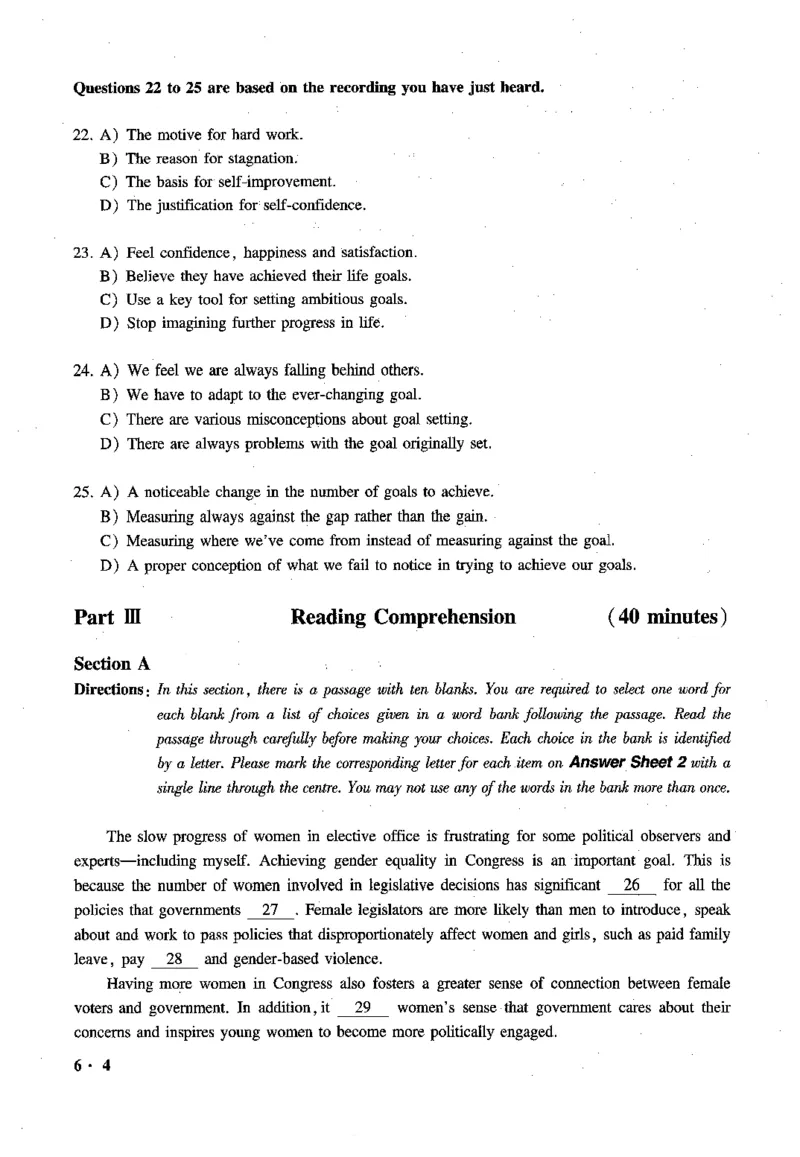
6 ,Questions 22 to 25 are based on the recording you have just heard.
22. A) The motive for hard work.
B) The reason for stagnation.
C) The basis for self-improvement.
D) The justification for self-confidence.
23. A) Feel confidence, happiness and satisfaction.
B) Believe they have achieved their life goals.
C) Use a key tool for setting ambitious goals.
D) Stop imagining further progress in life.
24. A) We feel we are always falling behind others.
B) We have to adapt to the ever-changing goal.
C) There are various misconceptions about goal setting.
D) There are always problems with the goal originally set.
25. A) A noticeable change in the number of goals to achieve.
B) Measuring always against the gap rather than the gain.
C) Measuring where we've come from instead of measuring against the goal.
D) A proper conception of what we fail to notice in trying to achieve our goals.
Part ID Reading Comprehension (40 minutes)
Section A
Directions : In this section, there is a passage with ten blanks. You are required to select one word for
each blank from a list of choices given in a word bank following the passage. Read the
passage through carefully before making your choices. Each choice in the bank is identified
by a letter. Please mark the corresponding letter for each item on Answer Sheet 2 with a
single line through the centre. You may not use any of the words in the bank more than once.
The slow progress of women in elective office is frustrating for some political observers and
experts—including myself. Achieving gender equality in Congress is an important goal. This is
because the number of women involved in legislative decisions has significant 26 for all the
policies that governments 27 . Female legislators are more likely than men to introduce, speak
about and work to pass policies that disproportionately affect women and girls, such as paid family
leave, pay 28 and gender-based violence.
Having more women in Congress also fosters a greater sense of connection between female
voters and government. In addition, it 29 women's sense that government cares about their
concerns and inspires young women to become more politically engaged.
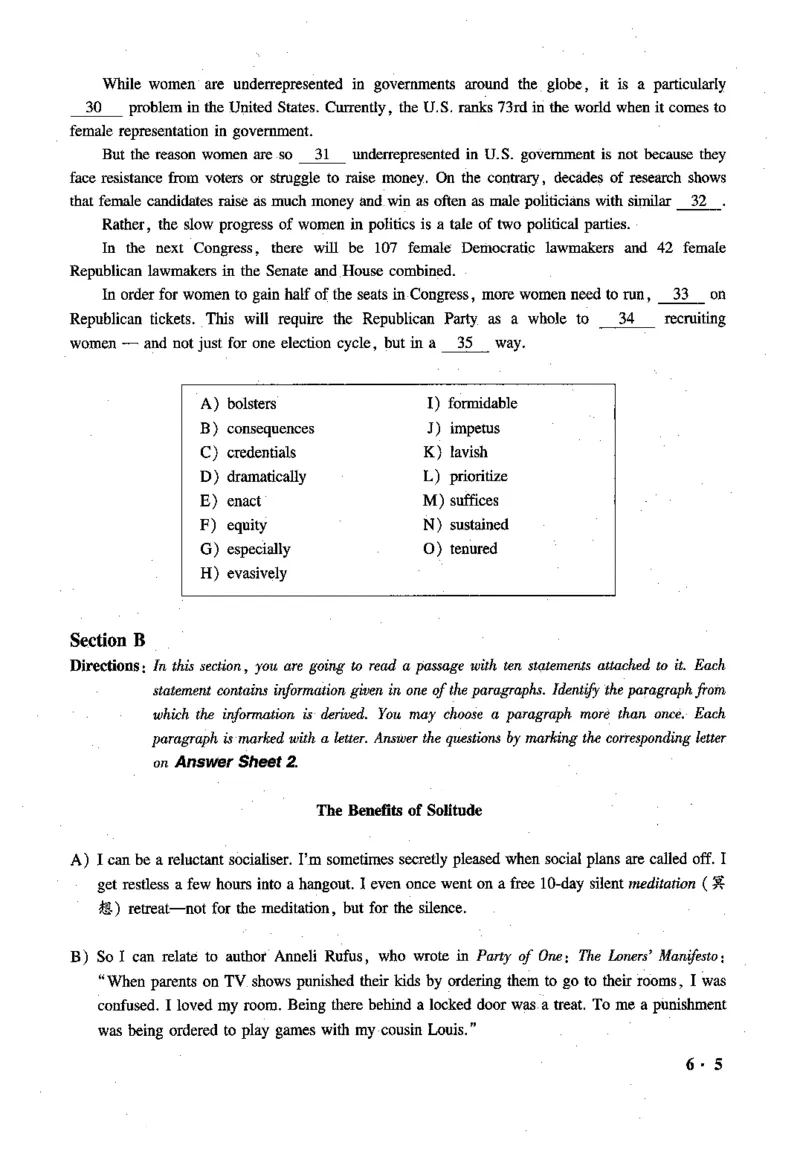
6 • 4While women are underrepresented in governments around the globe, it is a particularly
30 problem in the United States. Currently, the U.S. ranks 73rd in the world when it comes to
female representation in government.
But the reason women are so 31 underrepresented in U.S. government is not because they
face resistance from voters or struggle to raise money. On the contrary, decades of research shows
that female candidates raise as much money and win as often as male politicians with similar 32 .
Rather, the slow progress of women in politics is a tale of two political parties.
In the next Congress, there will be 107 female Democratic lawmakers and 42 female
Republican lawmakers in the Senate and House combined.
In order for women to gain half of the seats in Congress, more women need to run, 33 on
Republican tickets. This will require the Republican Party as a whole to 34 recruiting
women - and not just for one election cycle, but in a 35 way.
A) bolsters I) formidable
J\
B) consequences 7impetus
K
C) credentials lavish
LX
I
D) dramatically /prioritize
M
E) enact suffices
N\
F) equity 7sustained
o\
G) especially 7tenured
H) evasively
Section B
Directions : In this section, you are going to read a passage with ten statements attached to it. Each
statement contains information given in one of the paragraphs. Identify the paragraph from
which the information is derived. You may choose a paragraph more than once. Each
paragraph is marked with a letter. Answer the questions by marking the corresponding letter
on Answer Sheet 2.
The Benefits of Solitude
A) I can be a reluctant socialiser. Pm sometimes secretly pleased when social plans are called off. I
get restless a few hours into a hangout. I even once went on a free 10-day silent meditation (冥
想)retreat- not for the meditation, but for the silence.
B) So I can relate to author Anneli Rufiis, who wrote in Party of One: The Loners' Manifesto:
“When parents on TV shows punished their kids by ordering them to go to their rooms, I was
confused. I loved my room. Being there behind a locked door was a treat. To me a punishment
was being ordered to play games with my cousin Louis.”
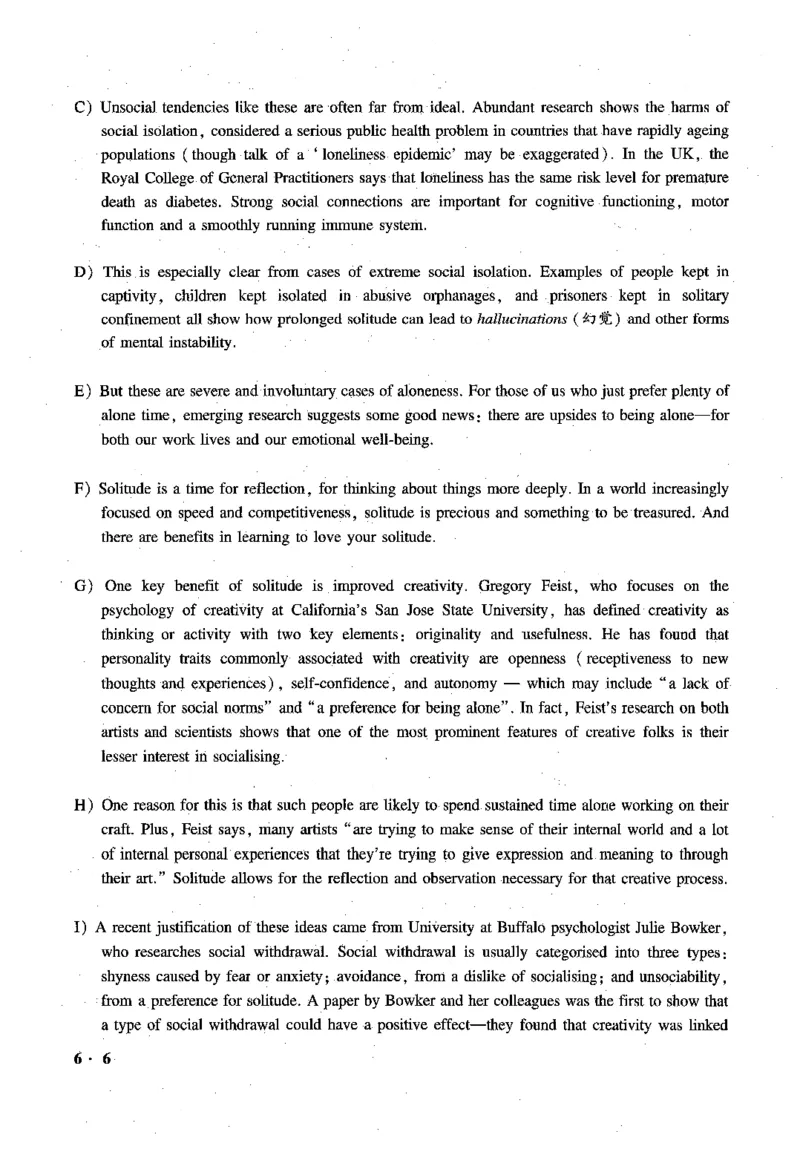
6 • 5C) Unsocial tendencies like these are often far from ideal. Abundant research shows the harms of
social isolation, considered a serious public health problem in countries that have rapidly ageing
populations (though talk of a 4 loneliness epidemic, may be exaggerated). In the UK, the
Royal College of General Practitioners says that loneliness has the same risk level for premature
death as diabetes. Strong social connections are important for cognitive functioning, motor
function and a smoothly running immune system.
D) This is especially clear from cases of extreme social isolation. Examples of people kept in
captivity, children kept isolated in abusive orphanages, and prisoners kept in solitary
confinement all show how prolonged solitude can lead to hallucinations (幺3 觉)and other forms
of mental instability.
E) But these are severe and involuntary cases of aloneness. For those of us who just prefer plenty of
alone time, emerging research suggests some good news: there are upsides to being alone- for
both our work lives and our emotional well-being.
F) Solitude is a time for reflection, for thinking about things more deeply. In a world increasingly
focused on speed and competitiveness, solitude is precious and something to be treasured. And
there are benefits in learning to love your solitude.
G) One key benefit of solitude is improved creativity. Gregory Feist, who focuses on the
psychology of creativity at California's San Jose State University, has defined creativity as
thinking or activity with two key elements : originality and usefulness. He has found that
personality traits commonly associated with creativity are openness (receptiveness to new
thoughts and experiences) , self-confidence, and autonomy - which may include “a lack of
concern for social normsv and “a preference for being aloneIn fact, Feist's research on both
artists and scientists shows that one of the most prominent features of creative folks is their
lesser interest in socialising.
H) One reason for this is that such people are likely to spend sustained time alone working on their
craft. Plus, Feist says, many artists “ are trying to make sense of their internal world and a lot
of internal personal experiences that they5re trying to give expression and meaning to through
their art." Solitude allows for the reflection and observation necessary for that creative process.
I) A recent justification of these ideas came from University at Buffalo psychologist Julie Bowker,
who researches social withdrawal. Social withdrawal is usually categorised into three types :
shyness caused by fear or anxiety ; avoidance, from a dislike of socialising ; and unsociability,
from a preference for solitude. A paper by Bowker and her colleagues was the first to show that
a type of social withdrawal could have a positive effect―they found that creativity was linked
6 • 6specifically to unsociability. They also found that unsociability had no correlation with
aggression (shyness and avoidance did). This was significant because while previous research
had suggested that unsociability might be hannless, Bowker and colleagues5 paper showed that
it could actually be beneficial. Unsociable people are likely to be u having just enough
interaction,n Bowker says. "They have a preference for being alone, but they also don't mind
being with others.”
J) Still, it turns out that solitude is important for more than creativity. It's commonly believed that
leaders need to be sociable. But this depends, among other things, oil the personalities of their
employees. One 2011 study showed that in branches of a pizza chain where employees were
more passive, outgoing bosses were associated with higher profits. But in branches where
employees were more active, introverted ( 内 向的) leaders were more effective. One reason for
this is that introverted people are less likely to feel threatened by strong personalities and
suggestions. They5re also more likely to listen.
K) Since ancient times, meanwhile, people have been aware of a link between isolation and mental
focus. After all, cultures with traditions of religious hermits ( 隐 士 )believe that solitude is
important for enlightenment. Recent research has given us a better understanding of why. One
benefit of unsociability is the brain5 s state of active mental rest, which goes hand-in-hand with
the stillness of being alone. When another person is present , your brain can't help but pay some
attention. This can be a positive distraction. But ifs still a distraction.
L) Daydreaming in the absence of such distractions activates the brain's default-mode network.
Among other functions, this network helps to consolidate memory and understand others,
emotions. Giving free rein to a wandering mind not only helps with focus in the long term but
strengthens your sense of both yourself and others. Paradoxically, therefore, periods of solitude
actually help when it comes time to socialise once more. And the occasional absence of focus
ultimately helps concentration in the long run.
M) A more recent advocate of thoughtful and productive solitude is Susan Cain, author of Quiet:
The Power of Introverts in a World That Can't Stop Talking and founder of Quiet Revolution, a
company that promotes quiet and introvert-friendly workplaces. u These days, we tend to
believe that creativity emerges from a decidedly unreserved socialising process, but in fact it
requires sustained attention and deep focus, " she says. " Also, humans are such absorbent
social beings that when we surround ourselves with others, we automatically take in their
opinions and aesthetics. To truly chart our own path or vision, we have to be willing to isolate
ourselves, at least for some period of
N) Still, the line between useful solitude and dangerous isolation can be blurry. u Almost anything
can be adaptive and maladaptive, depending on how extreme they get,“ Feist says. A disorder
6 • 7has to do with dysfunction. If someone stops caring about people and cuts off all contact, this
could point to an irrational neglect of social relations. But creative unsociability is a far cry from
this. In fact, Feist says, “there's a real danger with people who are never alone.Ifs hard to
examine one's own thoughts, feelings and motives, to be self-aware, and fully relaxed unless
you have occasional solitude. In addition, introverts tend to have fewer but stronger
friendships — which has been linked to greater happiness.
O) As with many things, quality reigns over quantity. Nurturing a few solid relationships without
feeling the need to constantly populate your life with endless chatting ultimately may be better
for you.
P) Thus, if your personality tends toward unsociability, you shouldn't feel the need to change. Of
course, that comes with qualifications. But as long as you have regular social contact, you are
choosing solitude rather than being forced into it, you have at least a few good friends and your
solitude is good for your well-being or productivity, there5 s no point agonising over how to fit a
square personality into a round hole.
36. Lots of research demonstrates that being socially isolated is harmful to the elderly.
37. Being alone enables artists to think and observe, which is a must for their creation.
38. To one writer, being forced to play with others was a penalty while being kept alone in a room
was quite a pleasure.
39. Recent research shows for the first time that there is a specific link between being creative and
being unsociable.
40. We must be willing to stay alone at least for some in time order to plot our own course.
41. According to new research, for people who prefer being alone, solitude can be beneficial to
their work lives and emotional health.
42. It may turn out to be better for one to cultivate a few steady relationships than to busy
themselves socialising.
43. Allowing your mind to wander freely is conducive to sharpening your focus in the long run.
44. Research conducted on artists and scientists indicates that creative people are less interested in
hanging out with others.
6 • 845. According to Feist, you will have difficulty knowing yourself if you do not stay alone
occasionally.
Section C
Directions : There are 2 passages in this section. Each passage is followed by some questions or
unfinished statements. For each of them there are four choices marked A) , B) , C) and
D). You should decide on the best choice and mark the corresponding letter on Answer
Sheet 2 with a single line through the centre.
Passage One
Questions 46 to 50 are based on the following passage.
Simulators are most often utilized within industries such as nuclear power, aviation and surgery
where failure results in disastrous consequences. To maximize the value from a simulation learning
experience, participants should immediately and directly apply their learning to a specific
intervention within their organization.
Most organizations aspire to deploy significant change programs, only to find them nearly
impossible to implement. That is largely because successful change requires more than a vision ; it
requires a workforce that not only doesn't resist change, but embraces it.
To achieve success, an organization must build a transformation program that will allow
change to be rapidly pulled across its departments and throughout its layers. Regardless of the level
of senior management commitment, unless key thought leaders at all levels embrace the change, the
initiative will wither and die. To create this kind of widespread passion, learning leaders must
expose the workforce to what could be, which will enable them to rethink their mental models,
enable them to break free from their deep-rooted paradigms and embrace the opportunity to learn.
Allowing participants to enter a simulated environment provides them with the opportunity to
experience alternative realities which can prompt them to rethink their current beliefs.
Behavioral change is not easy for most adults. Lectures , training programs and workshops can
explain the intellectual elements of transfonnation, but they are seldom effective at getting to the
behavioral aspects that lie at the heart of a significant change initiative. Further, under normal
working conditions, managers rarely see the full effect of their employee development efforts. As
such, an intervention like a simulation can provide the stimulus for change.
An effective simulation can be better than experience as a learning tool because it accelerates
time, compresses space, and unlike reality, is specifically designed to maximize participant
learning. Simulations provide an immersive learning experience where skills, processes and
knowledge all can be highlighted in a way reality cannot. The ability to explore, experiment and
repeatedly apply new knowledge in unlimited, risk-free models is what makes simulation one of the
most productive forms of learning.
Well-designed simulations can enable individuals and groups to develop a deep level of
understanding about how their decisions and intuitive responses to business stimuli affect their fellow
6 • 9participants and the organization as a whole. To reap the benefits, however, simulations must feel
like reality. At the end of the successful simulation, participants must declare “this is us." If they don't,
they will view the experience as a game, which can be difficult to apply on the job, or worse, irrelevant
to everyday work tasks. To maximize benefits from simulation, participants should immediately apply the
learning from the experience to forge a smooth link between learning and doing.
46. What do we learn about successful changes in organizations?
A) They can be immediately implemented with great ease.
B) They are usually led by organization leaders of vision.
C) They call for enthusiastic support from the workforce.
D) They often result from simulation learning experiences.
47. What should learning leaders do to arouse learners9 passion for change?
A) Allow them to see what could possibly be achieved.
B) Help them break free from their old paradigms.
C) Encourage them to rethink their thought models.
D) Stimulate them to embrace fresh opportunities.
48. What does the passage say about lectures, training programs and workshops?
A) They are generally incapable of changing workers5 behaviors on the job.
B) They are interventions different from simulations in creating stimuli for change.
C) They aim at transforming the behaviors of the workers in an organization.
D) They help managers achieve the full effect of employee development efforts.
49. What makes simulation one of the most fruitful forms of learning?
A) Its capability of saving time by accelerating the immersive learning experience.
B) Its potential for learners to examine their skills, knowledge and learning process.
C) Its capability of providing all participants with a practical learning experience.
D) Its potential for learners to explore, experiment and practice without any risk.
50. What should participants do in a simulation to reap the greatest benefits possible?
A) Take the experience as a mere game.
B) Apply promptly what they learn to their jobs.
C) Develop a deep level of understanding.
D) Strive to connect closely with their leaders.
Passage Two
Questions 51 to 55 are based on the following passage.
GDP growth is not a good indicator of how well a country is performing, and should not be the
6 • 10primary goal of governments. Unlimited growth is not sustainable, and economic thinking is moving
toward the idea that we should aim for sustainability in our economic models. But while a
sustainable economy is vital to our future, it is a means to an end, not an end in itself.
The idea that governments should focus on happiness has its critics. There are concerns about
how happiness can be measured. Is happiness not a fleeting and subjective psychological state?
Don't different people experience different levels of happiness? Even on the broadest interpretation
of ' happiness5 as prosperity or 4 life satisfaction*, people want different things.
Of course, governments cannot impose life satisfaction on citizens. But our happiness relies on
collaborative efforts as a society. A government's obligation lies in creating conditions that promote
prosperity. And there is good reason to suppose that such conditions exist, are globally applicable,
and are discoverable through research.
In a recently published article, philosopher Julian Baggini suggests we should focus on ' real
wealth, for citizens, which does not depend on GDP growth. Access is key: people do not need to
own, but rather access things that enable them to live well. Technological advances and changes in
social behavior enable us to make more efficient use of the assets that we already have. And
focusing on access to the resources people need to live better lives could help reduce inequality.
As far as it goes, this has much in common with proposals tabled by 'happiness' advocates.
But it sets the bar far too low for what governments can and should be doing for their citizens.
For example, it's not clear how a 4 real wealth5 economy would remedy the epidemic of mental
ill-health that plagues our society. In Western countries, at least — poor mental health is more
detrimental to wellbeing than poverty. Over and above a vastly improved provision of therapeutic
mental healthcare, there are preventative measures for improving mental health that governments
could and should adopt. The WHO recommends establishing institutions that facilitate community
participation - educational programs and interventions that provide skills for promoting mental
wellbeing. It says a lot, however, that the WHO feels the need to appeal to the economic benefits
of improving mental health to persuade governments that the cost of taking proposed measures is
justified. As long as the economy is their priority, governments need go no further than ensuring
citizens* continued productivity.
To demand that governments set the ' happiness, of citizens as their highest priority is to
demand that they view citizens as ends in themselves.
51. What does the passage say is the more recent thinking of economic growth?
A) It should be made sustainable.
B) It is vital to the future of humanity.
C) It should be governments' chief concern.
D) It is an indicator of government performance.
52. Why are some people opposed to the idea that governments should focus on happiness?
A) Governments cannot impose happiness on citizens.
B) Peopled happiness is built upon their own endeavor.
6 - 11C) Happiness means different things to different people.
D) Happiness depends on sustainable economic growth.
53. What does philosopher Julian Baggini suggest governments do in a recently published article?
A) Try to reduce inequality between the rich and the poor.
B) Provide people with access to resources for a better life.
C) Change people's behaviors to put social wealth to better use.
D) Make use of advanced technologies to improve people's lives.
54. Why does the WHO feel the need to appeal to the economic benefits of improving mental health
to justify its recommendations?
A) Mental health programs cannot be executed without GDP growth.
B) Psychological interventions are conducive to people's wellbeing.
C) Poor mental health is detrimental to a nation's economic system.
D) Governments still take economic development as their priority.
55. What message does the author try to convey at the end of the passage?
A) Govemments, goal should be prosperity-driven.
B) Govemments, goal should be people-oriented.
C) Governments should consider citizens5 views in decision-making.
D) Governments should set sustained productivity as their top priority.
Part IV Translation (30 minutes)
Directions : For this part, you are allowed 30 minutes to translate a passage from Chinese into English.
You should write your answer on Answer Sheet 2.
粤港澳大湾区(Guangdong - Hong Kong - Macao Greater Bay Area)具有得天独厚的地理
位置所兔毒蔽通基础设施和丰富的产业资源。大湾区是中国开放程度最高、经济活力最
强的区域之一,在国家经济发展中具有重要的战略地位。大湾区不仅将建成充满活力的世界级
城市群和具有全球影响力的国际科技创新中心,还将打造成适合工作、购物、旅游的优质生活
圈。随着改革开放的不断深入,大湾区的建设将进一步推动区域经济发展。到2035年,大湾区
将实现成为国际一流湾区的目标。
6 • 12未得到监考教师指令前,不得翻阅该试题册!
Writing''
「
二、 (30minutes)
: ,、 」
(请于正式开考后半小时内完成该部分,之后将进行听力考试)
Directions : For this part, you are allowed 30 minutes to write an essay that begins with the
sentence “As social media is used more and more extensively, there is a growing
awareness of the importance of using it properly and responsibly.n You can
make comments, cite examples or use your personal experiences to develop your essay.
You should write at least 150 words but no more than 200 words.
You should copy the sentence given in quotes at the beginning of your essay.
请用黑色签字笔在答题卡1指定区域内作答作文题,在试题册上的作答无效!