第二学期期中测试题
英语试卷
第一卷 (客观题,共70分)
一、听力测试(本大题共20分,每小题1分)
第一节(共10小题)
听下面10段短对话,每段对话后有一个小题,从题中A、B、C三个选项中选出最佳选项。听完每段
对话后,你都有10秒钟的时间来回答有关小题和阅读下一小题。每段对话读两遍。
听第1至10段材料,回答第1至10题。
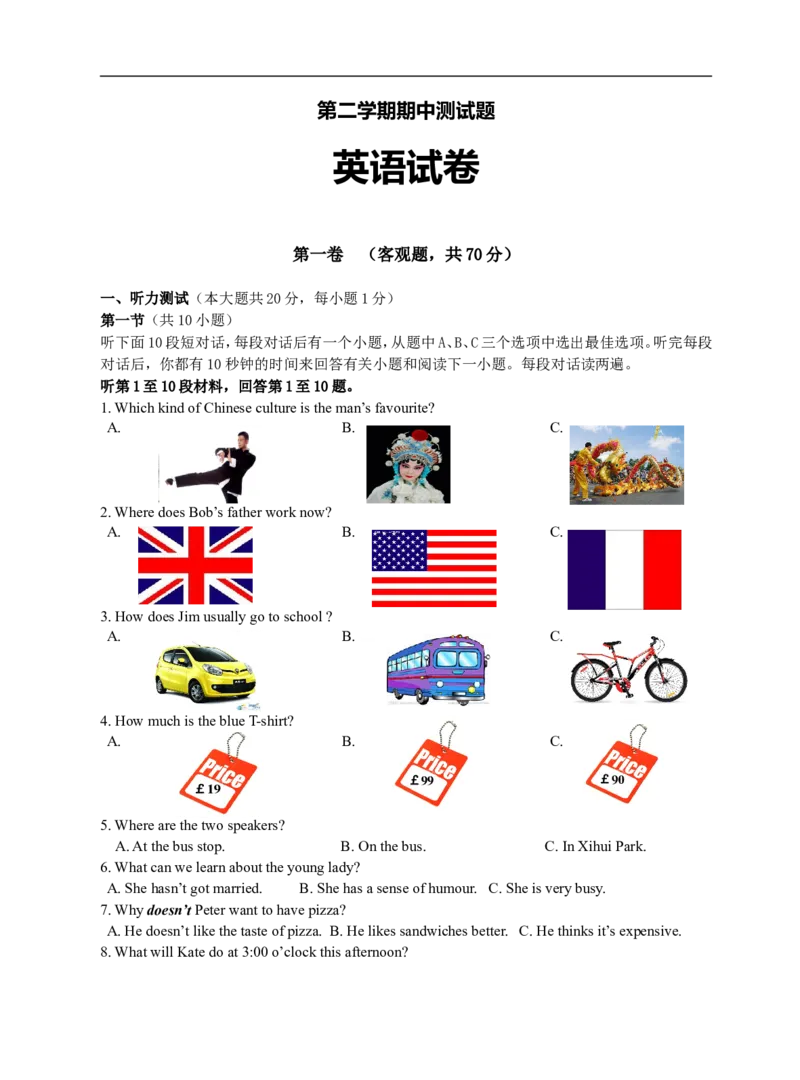
1. Which kind of Chinese culture is the man’s favourite?
A. B. C.
2. Where does Bob’s father work now?
A. B. C.
3. How does Jim usually go to school ?
A. B. C.
[来源:学#科#网]
4. How much is the blue T-shirt?
A. B. C.
££9999 ££9900
££ 11 99
5. Where are the two speakers?
A. At the bus stop. B. On the bus. C. In Xihui Park.
6. What can we learn about the young lady?
A. She hasn’t got married. B. She has a sense of humour. C. She is very busy.
7. Why doesn’t Peter want to have pizza?
A. He doesn’t like the taste of pizza. B. He likes sandwiches better. C. He thinks it’s expensive.
8. What will Kate do at 3:00 o’clock this afternoon?A. Have a piano lesson. B. Play volleyball with friends. C. Have a music lesson.
9. What has the man done many times before?
A. He has jumped over the gate. B. He has swum across the river. C. He has climbed the tree. 10.
What has happened in the woman’s hometown?
A. There has been an earthquake. B. There has been a fire. C. There has been a flood.
第二节(共10小题)
听下面3段长对话和短文,每段对话和短文后有几个小题,从题中A、B、C三个选项中选出最佳选
项。听每段对话和短文前,你将有时间阅读各个小题,每小题5秒钟,听完后,每小题将给出5秒
钟的作答时间。每段对话和短文读两遍。
听第11段材料,回答第11、12题。
[来源:Z#xx#k.Com]
11. Why have Betty’s parents gone to Beijing?
A. To do some shopping. B. To enjoy the festival. C. To look after her sister.
12. What will Betty bring to Joe’s home?
A. Some dumplings. B. Some rice dumplings. C. Some drinks.
听第12段材料,回答第13至15题。请根据短文内容,选择正确答案,完成信息记录表。
New York City
Things they have done They have seen the Statue of Liberty, the United Nations
building and 13 .
Things they will do They will see a nice 14 tonight.
They will 15 on the last day.
13. A. Times Square B. Central Park C. Wall Street
14. A. show B. film C. match
15. A. rest at the hotel B. visit a friend C. go shopping
听第13段材料,回答第16至20题。
16. Where does Andy go hiking?
A. In the hills in the north-east of the city.
B. In the mountains in the south of the city.
C. In the mountains in the south-east of the city.
17. Who often goes hiking with Andy?
A. His classmate Timmy. B. His friend Tommy. C. His cousin Ricky.
18. When do the boys usually go hiking?
A. On Sundays from 8 to 11 a.m.
B. On Saturdays from 1 to 3 p.m.
C. On Sundays from 2 to 5 a.m.
19. What do the boys do to be safe?
A. They both take a map.
B. They take their mobile phones for help.
C. They only take short, easy ways.
20. Why is hiking good for Andy?
A. He gets exercise and enjoys nature.
B. He does not want to do his homework.
C. He can think about the problems that he has while hiking.
二、单项填空(本大题共14小题,每小题1分,共14 分)从A、B、C、D四个选项中,选出可以填入空白处的最佳选项。
21. ________ book named Harry Potter is ________ good friend of mine.
A. A; a B. The; the C. The; a D. A; the
22. Jim _______ ride to school. But now he _______ walking to school because he wants to keep fit.
A. was used to; used to B. got used to; is used to
C. used to; is used to D. used to; used to
23. The poor man lives ________ in the ________ house.
A. alone; lonely B. alone; alone C. lonely; lonely D. lonely; alone
24. --- ________ have you kept the book ?
--- Since last Month. I ________ return it to the library today or I can’t borrow one next time.
A. How often; must B. How long; have to C. How soon; have to D. When; must
25. --- What do you think of my answer to the questions?
--- Sorry. I ________ about something else.
A. thought B. had thought C. am thinking D. was thinking
26. ---Your father’s never been to other countries, has he?
--- ________. He plans to go abroad for a second time.
A. No, he has B. Yes, he hasn’t C. Yes, he has D. No, he hasn’t
27. --- Where is Mr. Smith? --- He ________ Guangzhou. He ________ there for a week.
A. has gone to; has been to B. has gone to; has been
C. has been to; has gone to D. has been in; has gone to
28. Lucy had few close friends. So she didn’t know ________ about the trouble.
A. who to talk B. who to talk to C. who to say D. what to talk
29. Everyone except Tom and Jim ________ the film twice.
A. has seen B. have seen C. saw D. are seen
30. My aunt ________ be at home now, for she left for France this morning. She won’t be back
________ next month.
A. can’t; until B. maybe; before C. may not; after D. mustn’t ; until
31. --- What a beautiful car! When ________ you ________ it? --- I ________ it for two years.
A. did; buy; bought B. did; buy; have had
C. have; bought; have bought D. have; bought; have had
32. How many ________ has the teacher given you on how to learn English well ?
A. advices B. pieces of advices C. advice D. pieces of advice
33. ---Is Mr. Liu a teacher with a lot of teaching ________?
---Yes, she is. He always tells us some funny ________ after class.
A. experience; experience B. experiences; experiences
C. experiences; experience D. experience; experiences
34. ---Thank you very much for showing me how to use the computer. --- ________.
A. No, thanks B. My pleasure C. That’s right D. With pleasure
三、完形填 空(本大题共10小题,每小题1分,共10分)
先通读下面的短文,掌握其大意,然后从A、B、C、D四个选项中,选出可以填入空白处的最佳选项。
“Where is the unive rsity(大学)?”This is a question that many visitors to Cambridge(剑桥大
学) ask. But no one can give them a 35 answer, for no one can find any walls 36 the university.
The university is the city. You can find classroom buildings, 37 , museums and offices of the
university all over the city. And most of its members are the students and 38 of the thirty-one
colleges.
Cambridge was 39 a common town before the first students and teachers 40 800 years ago. It
grew up by the river Cranta, and the river was once 41 the Cam. A 42 was built over the river as
early as 875. So the town got its name “Cambridge”.
In the fourteenth and fifteenth centuries more and more land was used for college buildings. The
town grew much 43 in the nineteenth century after the opening of the railway in 1845. Cambridge
became a city in 1951 and now there are over 100,000 people in it. Many young students in
other countries 44 to study at Cambridge. It has become a well-known place all around the world.
35. A. true B. clear C. right D. real
36. A. on B. around C. near D. by
37. A. libraries B. parks C. zoos D. markets
38. A. parents B. farmers C. workers D. teachers
39. A. yet B. already C. very D. also
40. A. reached B. got C. arrived D. arrived in
41. A. said B. called C. spoken D. talked
42. A. bridge B. building C. station D. house
43. A. smaller B. slower C. faster D. cleaner
44. A. stop B. hate C. dream D. need
四、阅读理解(本大题共13小题,每小题2分,共26分)
阅读下面的短文,然后根据短文内容,从每小题所给的四个选项中选择最佳选项。
A
Museum of Transport at Boylet St , Cheetham, Manchester
Enjoy a trip to the Museum of Transport, a working museum showing the development (发展) of road
public transport in Manchester. There are over 80 buses from 1890 to 1980. Over 100 shows, from
hours-bus to modern train. The museum has small shows describing the history of bus, coach and train.
If you are interested in it, welcome to click here and you can see some pictures of them on the screen
and get more information about them.
Opening hours and ticket prices
Wednesdays, Saturdays, Sundays, and public holidays
9:00 a.m. ~ 4:00 p.m. (Nov. ~ Feb. )
10:00 a.m. ~ 5:00 p.m. (Mar. ~ Oct.)
Adults $3. 00, Students $1.75, Children under 5 free.
Family ticket ( up to two adults and three children) $ 9.00
E-mail : www. gmts. co. uk
45. You may read this advertisement in __________.
A. a radio program B. a newspaper C. a TV program D. a website46. If you would like to visit the Museum of Transport , when will it be possible?
A. At 9:30 a.m. on October 26th B. At 2:00 p.m. on Tuesdays
C. At 4:30 p.m. on May Day D. At 4:10 p.m. on New Year’s Day
47. If you and your elder brother are both middle school students, your parents take both of you to visit
the museum, you should pay at least __________ in all.
A. $6 B. $9 C. $9.5 D. $12
B
Mr. Grey was the manager of a small office in London. He lived in the country, and went to work
by train. He liked walking from the station to his office if it wasn’t raining, because it gave him some
exercise.
One morning he was walking along the street when a stranger stopped him and said to him,
“You may not remember me, sir, but seven years ago I came to London without any money in my
pockets. I stopped you in this street and asked you to lend me some money and you lent me£5,
because you said you were always ready to take a chance (机会) to give a man a start on the way to
success.”
Mr. Grey thought for a few minutes and then said, “Yes, I remember you. Go on with your story!”
“Well,” answered the stranger, “would you like to take another chance?”
48. Mr. Grey liked walking to his office because __________.
A. he couldn’t pay for the buses B. he wanted to save money
C. he wanted to lose weight D. he could do some exercise on the way
49. Mr. Grey was always ready to lend money to a stranger to __________.
A. help him on the way to success B. give himself a start in life
C. make him rich D. get more money
50. By saying “ Would you like to take another chance ? ”, the stranger __________.
A. wanted to return Mr. Grey the money B. asked Mr. Grey for money again
C. told Mr. Grey that he had success at last D. would like to make friends with him
C
Now, there is a new-type school in New York, which has no everyday lessons, no class teachers
and even no school buildings. It is called “City-as-School”. The name just means the city itself is the
place where students learn their lessons. They are from the age of 15 to 18. The students choose areas
of work wh ich interest them. Then they help to do that work. One girl spends her week in a Mayor’s
(市长的) office helping the public with problems like housing. Then she goes to help in a theatre for
a day and she spends a week for first-year courses at college.
Well, students have to pass Maths and science exams before they enter the “school”. These
subjects are not easy to provide in “City-as-School”. Teachers watch the progress(进步)of the
students. The success rate is high. 80% of the students go to college after the “City-as-School”.
The students like the duty of their work. They have the sense of purpose(目标). They know a lot
about different kinds of work in the city. One of the students, Liz Martin, writes “I want to say that I do
not know where I will be right now if I have never become part of City-as-School. Leaving the highschool I once studied in and going to City-as-School was the best decision (决定) I have ever made.
The way the school works to get you to go out there and learn different fields instead of sitting in a
classroom is wonderful. For all those who are in between school and dropping out, go to CAS and it
will change your life forever.”
City-as-School High School is the country’s model for high school students.
51. What do students do in“City-as-School” most of the time?
A. They do whatever they like. B. They learn Maths and Science.
C. They help with work in some areas. D. They learn all the college courses.
52. According to the passage,“City-as–School” can help __________.
A. students learn a lot about different kinds of work B. all the students go to college
C. students make much mone y while studying D. students forget the duty of their work
53. What is the best title for the passage?
A. A New City B. A New School
C. A New-type School D. A Girl in New York
[来源:Zxxk.Com]
D
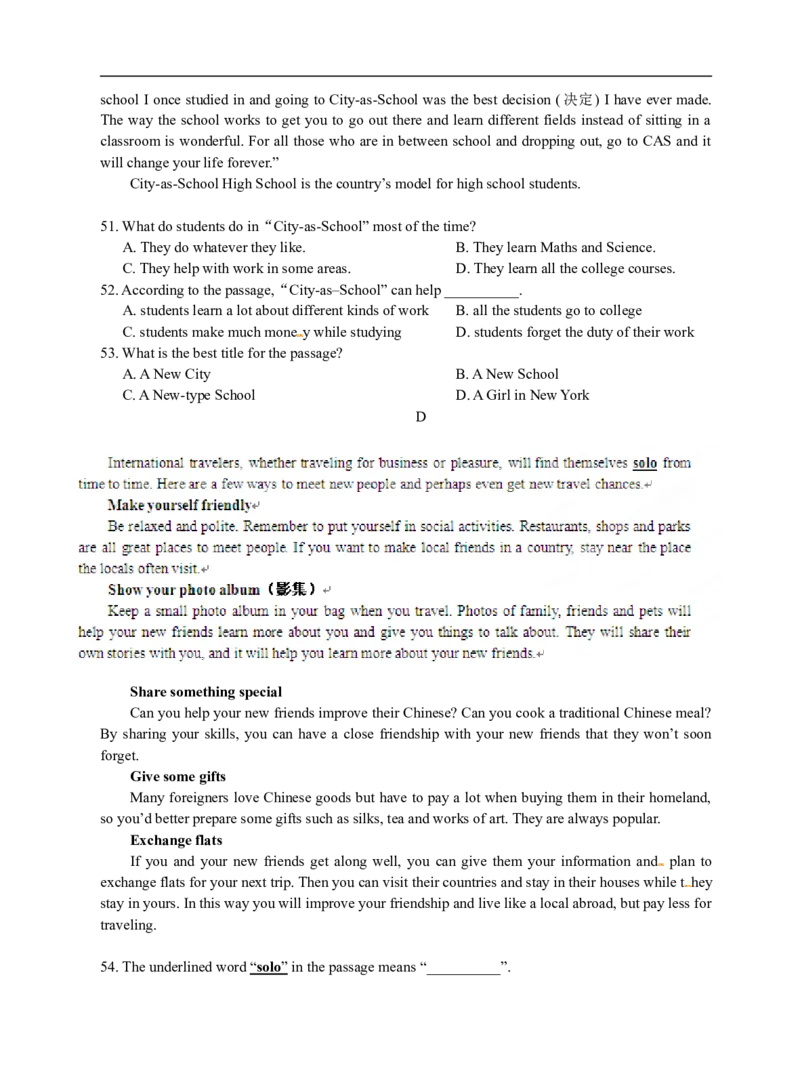
Share something special
Can you help your new friends improve their Chinese? Can you cook a traditional Chinese meal?
By sharing your skills, you can have a close friendship with your new friends that they won’t soon
forget.
Give some gifts
Many foreigners love Chinese goods but have to pay a lot when buying them in their homeland,
so you’d better prepare some gifts such as silks, tea and works of art. They are always popular.
Exchange flats
If you and your new friends get along well, you can give them your information and plan to
exchange flats for your next trip. Then you can visit their countries and stay in their houses while t hey
stay in yours. In this way you will improve your friendship and live like a local abroad, but pay less for
traveling.
54. The underlined word “ solo ” in the passage means “__________”.A. free B. alone C. worried D. close
55. In which way can’t a photo album help you?
A. Giving you a topic to talk about.
B. Clearing your worries about your pets.
C. Helping your new friends to learn more about you.
[来源:Z+xx+k.Com]
D. Encouraging (鼓励) your new friends to talk about themselves.
56. From the passage we can learn that __________.
A. exchanging flats is popular in China
B. goods in foreign countries are cheaper
C. sharing your special skills can help you develop friendship
D. international travelers always get into trouble
57. This passage is mainly about how to ___________.
A. travel more often both at home and abroad B. improve friendship with foreigners
C. make friends when traveling in foreign countries D. prepare for a business trip
第二卷(主观题,共40分)
五、词汇检测(本大题共8小题,每小题1分,共8分)
(A) 根据句意和汉语注释,写出单词的正确形式。
1. Parents should have more ______________ (交流) with their children.
2. Finally, the climber ______________ (设法完成) to get to the top of the mountain.
3. The rich man has a lot of poor ______________ (亲戚). He gives them much money every year.
4. It is amazing that a cow has four ______________ (胃).
(B) 根据句意,写出括号内所给单词的适当形式空。
5. It’s ______________ (possible) for dogs to fly. Stop daydreaming, Eddie.
6. Most children are afraid of real ______________ (mouse), but th ey like Mickey Mouse.
7. The poor boy’s parents have been ______________ (die) for years.
8. If you want to see some ______________ (Europe) buildings, Rome is a good place to visit.
六、动词填空(本大题共8小题,每小题1分,共8分)
用括号内所给动词的适当形式填空。
1. When I got home, my parents ______________ (discuss) the traveling plan happily.
2. The students will not go to the Summer Palace if it ______________ ( rain) tomorrow.
3. He ______________ (not realize) the importance of learning English until two years ago.
4. Many people are against ______________ (smoke) in public places.
5. The queen refused ___________ ___ (accept ) an interview when she went to Africa.
6. I hear that you ______________ (lie) in bed for a lot of days. Are you feeling better now?
7. ---Where is Jack? --- He ______________ (ride) an indoor roller coaster over there.
8. I like reading the book very much. I ______________ (renew) it in a week.
七、短文填空(本大题共10空,每空0.5分,共5分)
先通读下面的短文,然后根据短文内容和所给首字母,在空格内填入一个适当的单词,使短
文意思完整。所填单词在题后横线上必须完整写出。
According to the school rules, students should wear school uniforms. H (1), for most
students, school uniforms are not e (2) what they like. “Why not wear the school uniform just one
day a week? Always wearing the same clothes makes me feel t (3) of them.” A senior student froma high school said. Most students don’t like the school uniforms’ simple colors, b (4) designs and
bad quality. And a teacher at a high school in Guangzhou said. “ A (5) a teacher and mother, I hope
the school will improve the quality of school uniforms soon.” What has caused(导致)all these p
(6)? Chen Hong, a uniform designer in Shenzhen, pointed out. “There are no professionals (专业人员)
who work for students. “Besides, high quality means a h (7) price.” said Chen. “But in some
schools the price for each student’s uniform is only 50 to 60 yuan. How can we make high quality
clothes with so l (8) money?”
Even with these problems, uniform factories are working hard to change the s (9). It won’t be
long b (10) the perfect school uniforms come onto the market, which will help the students
remember the history of their school and make them feel pleased with their school.
八、完成句子(本大题共6题,每小题1.5分,共9分)
根据所给的汉语,用英语完成句子。
1. 他小学毕业后通过电邮继续与同学保持联系。
He _______________________________ his classmates by e-mail after he left the primary school.
2. 我们每人应该准时上交一篇关于这部影片的评论。
We each _______________________________ about the film on time.
3. 在过去的十年里,我们认为我们的生活条件发生了很大的变化。
We think that our _______________________________ in the past ten years.
4. 那位年轻的医生不能决定如何处理那个病人的断手指。
The young doctor can’t _______________________________ the sick man’s broken finger.
5. 那位作家曾经把这部小说翻译成了几种外语了吗?
Has the writer ever _______________________________ foreign languages?
6. 大多数德国人出差时有读书的习惯。
Most people _______________________________ when they are on business.
九、书面表达(本大题共10分)
假设你是李明,你的笔友Peter来信谈到他所居住的城市,并希望了解你家乡无锡的情况,请
你用英语写一封回信。内容提示如下:
1. 无锡位于中国东部,由诸如惠山区(Huishan District)、锡山区等6个区组成;
2. 因太湖(Tai Lake)而出名,过去许多工厂经常向湖里倾倒废弃物;
3. 最近政府已经采取措施减少污染,……
4. 每天我们都能看到一大群游客;每年来无锡的最好的时间是春天;
5. 我希望……
注意:
1. 短文须包括所给内容要点,要求语句通顺,意思连贯;
2. 第3和5要点内容共须用2~3句话展开合理想象,作适当发挥;
3. 词数80个左右,短文的开头和结尾句已给出,不计入总词数。
Dear Peter,
It’s very kind of you to write to me and let me know about your beautiful city. Now I’d like to tell
you something about my hometown Wuxi. ____________________________________________
__________________________________________________________________________________
I’m looking forward to hearing from you.
YoursLi Ming初二英语期中考试听力材料
第一节(共10小题)
听下面10段短对话,每段对话后有一个小题,从题中A、B、C三个选项中选出最佳选项。听完每段
对话后,你都有10秒钟的时间来回答有关小题和阅读下一小题。每段对话读两遍。
听第1至10段材料,回答第1至10题。
1. W: I like Chinese opera. It’s wonderful. What about you? Do you like Chinese
culture?
M: I like it too. But the dragon dance on May Day is my favourite.
2. W: Bob, I hear your father works in Paris, right?
M: No. That was two years ago. Since then he’s worked in New York.
3. W: Hey, Jim! You rode to school today? Didn’t your father bring you to
school in
his car as usual?
M: No, he went to London on business. And there is no bus stop near my
home.
4. W: These T-shirts look beautiful. How much are they?
M: The yellow T-shirt is 19 pounds, the white one is 90 pounds and the
blue one
is 99 pounds.
5. W: Excuse me, does this bus go to Xihui Park?
M: Yes. Let’s get on it.
6. M: Are you married, young lady?
W: Wait a minute. I’ll ask my husband first.
7. W: Peter, would you like to go out to eat some pizza?
M: No, thanks. I need to save money, so how about sandwiches?
8. W: Will Kate join us in playing volleyball at three p.m.?
M: No. She will have a piano lesson then.
9. W: Can’t you climb that tree?
M: Of course I can. I’ve done it many times before.
10. W: There has been an earthquake in my hometown. I hope everybody is safe.
M: I hope so, too. My uncle and aunt live there.第二节(共10小题)
听下面3段长对话和短文,每段对话和短文后有几个小题,从题中A、B、C三个选项中选出最佳选
项。听每段对话和短文前,你将有时间阅读各个小题,每小题5秒钟,听完后,每小题将给出5秒
钟的作答时间。每段对话和短文读两遍。
听第11段材料,回答第11、12题。
[来源:学科网]
W: Joe, where are you spending the Dragon Boat Festival?
M: With my family at home. What about you, Betty?
W: I will be on my own. My parents have gone to Beijing to look after my
sister. She has just had a baby.
M: You are welcome to join us. I’m sure my parents will welcome you.
W: That would be lovely! But you must ask them first.
M: I’ll talk to them this evening.
W: Tell them that I can bring some rice dumplings along too.
M: That’s cool!
听第12段材料,回答第13至15题。请根据短文内容,选择正确答案,完成信息记录表。
Dear Jimmy,
New York City is certainly busy! My sister and I have seen the Statue of
Liberty, the United Nations building and Central Park in the past three days. The
Statue of Liberty is amazing! Did you know that it was a gift to the USA from
France? That’s quite a gift! Tonight we will see a nice show. People all know
New York for its fashion designers and fashion models. We plan to go shopping
on the last day. I will show you photos of New York when I am back to
London.
Yours
Helen
听第13段材料,回答第16至20题。
When Andy gets bored, he knows he needs to get some exercise. His favourite
way to exercise is to go on a hike up into the mountains in the south-east of the
city. He often i nvites his friend Tommy to go with him. Andy and Tomm y
usually hike on Sunday mornings from eight o’clock to eleven and they like
taking different ways each time. The boys are careful because they want to besafe. If either boy would have an accident, they could use their mobile phones to
call for help. For them it is a pleasure to have the fresh air and hear the birds
sing. They can relax on a mountain! It is great exercise and fun to be with your
friend too.初二英语期中考试 参考答案
五、词汇检测(本大题共8分,每小题1分)
1. communication 2. managed 3. relatives 4.stoma chs
5. impossible 6. mice 7. dead 8. European
六、动词填空 (本大题共8分,每小题1分)
1. were discussing 2. rains 3. didn’t realize 4. smoking
5. to accept 6. have lain 7. is riding 8. will renew
七、短文填空(本大题共5分,每空0.5分)
1.However 2. exactly 3. tired 4. boring 5. As
6.problems 7. high 8. little 9. situation 10. before
九、书面表达(本大题共10分)One possible version:
Dear Peter,
It’s very kind of you to write to me and let me know about your beautiful city. Now
I’d like to tell you something about my hometown Wuxi. Wuxi lies/ is in the east of/
eastern part of China. It is made up of six destricts such as Huishan Destrict and
Xishan Destrict. It is famous for Ta i Lake . Many factorie s used to pu t it s wast e
into the lake./ In the past, many factories put its waste into the lake . Recently the
government has taken action to reduce pollution. (Wuxi has become one of the
most beautiful cities.) Every day we can see a huge army of / a large group of/
… visitor s here . Th e bes t tim e to visi t Wux i i s (in ) spring . ( I hop e you can com eand visit soon . I ’ ll show you around it . I ’ m sure you ’ ll have great fun.)
I’m looking forward to hearing from you.
Yours
Li Ming