文档文本内容
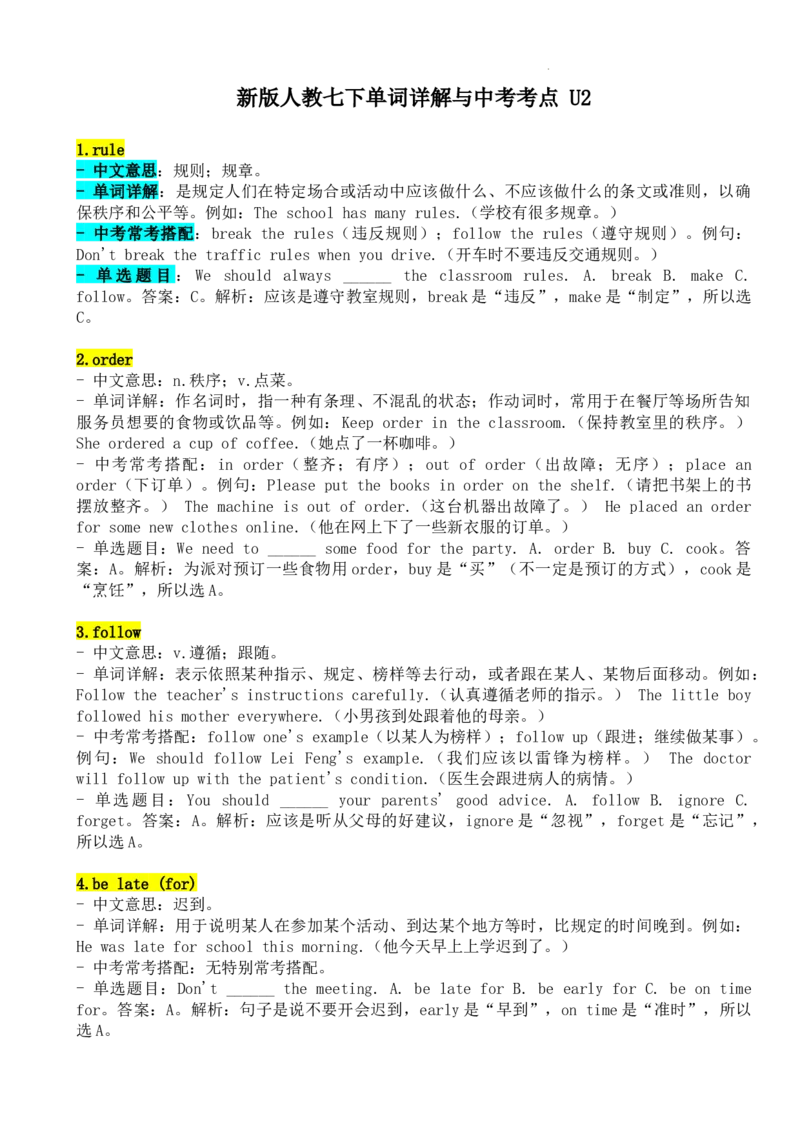
新版人教七下单词详解与中考考点 U2
1.rule
- 中文意思:规则;规章。
- 单词详解:是规定人们在特定场合或活动中应该做什么、不应该做什么的条文或准则,以确
保秩序和公平等。例如:The school has many rules.(学校有很多规章。)
- 中考常考搭配:break the rules(违反规则);follow the rules(遵守规则)。例句:
Don't break the traffic rules when you drive.(开车时不要违反交通规则。)
- 单选题目:We should always ______ the classroom rules. A. break B. make C.
follow。答案:C。解析:应该是遵守教室规则,break是“违反”,make是“制定”,所以选
C。
2.order
- 中文意思:n.秩序;v.点菜。
- 单词详解:作名词时,指一种有条理、不混乱的状态;作动词时,常用于在餐厅等场所告知
服务员想要的食物或饮品等。例如:Keep order in the classroom.(保持教室里的秩序。)
She ordered a cup of coffee.(她点了一杯咖啡。)
- 中考常考搭配:in order(整齐;有序);out of order(出故障;无序);place an
order(下订单)。例句:Please put the books in order on the shelf.(请把书架上的书
摆放整齐。) The machine is out of order.(这台机器出故障了。) He placed an order
for some new clothes online.(他在网上下了一些新衣服的订单。)
- 单选题目:We need to ______ some food for the party. A. order B. buy C. cook。答
案:A。解析:为派对预订一些食物用order,buy是“买”(不一定是预订的方式),cook是
“烹饪”,所以选A。
3.follow
- 中文意思:v.遵循;跟随。
- 单词详解:表示依照某种指示、规定、榜样等去行动,或者跟在某人、某物后面移动。例如:
Follow the teacher's instructions carefully.(认真遵循老师的指示。) The little boy
followed his mother everywhere.(小男孩到处跟着他的母亲。)
- 中考常考搭配:follow one's example(以某人为榜样);follow up(跟进;继续做某事)。
例句:We should follow Lei Feng's example.(我们应该以雷锋为榜样。) The doctor
will follow up with the patient's condition.(医生会跟进病人的病情。)
- 单选题目:You should ______ your parents' good advice. A. follow B. ignore C.
forget。答案:A。解析:应该是听从父母的好建议,ignore是“忽视”,forget是“忘记”,
所以选A。
4.be late (for)
- 中文意思:迟到。
- 单词详解:用于说明某人在参加某个活动、到达某个地方等时,比规定的时间晚到。例如:
He was late for school this morning.(他今天早上上学迟到了。)
- 中考常考搭配:无特别常考搭配。
- 单选题目:Don't ______ the meeting. A. be late for B. be early for C. be on time
for。答案:A。解析:句子是说不要开会迟到,early是“早到”,on time是“准时”,所以
选A。
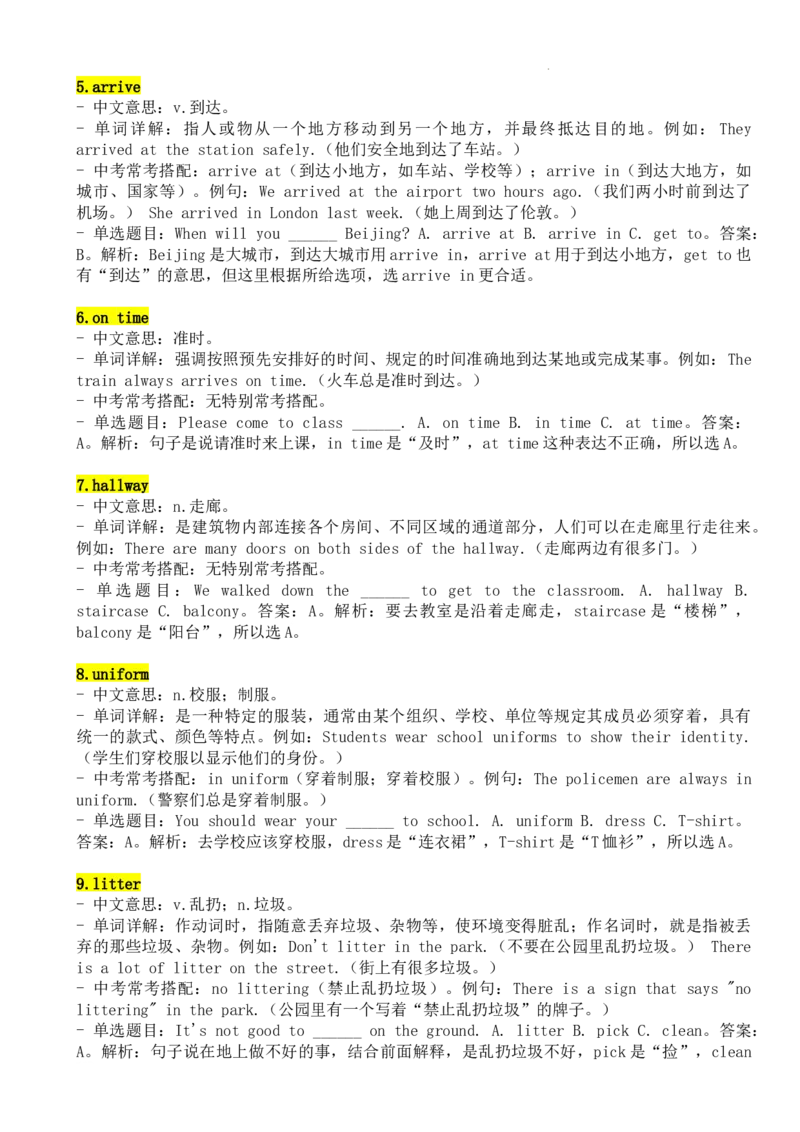
学科网(北京)股份有限公司5.arrive
- 中文意思:v.到达。
- 单词详解:指人或物从一个地方移动到另一个地方,并最终抵达目的地。例如:They
arrived at the station safely.(他们安全地到达了车站。)
- 中考常考搭配:arrive at(到达小地方,如车站、学校等);arrive in(到达大地方,如
城市、国家等)。例句:We arrived at the airport two hours ago.(我们两小时前到达了
机场。) She arrived in London last week.(她上周到达了伦敦。)
- 单选题目:When will you ______ Beijing? A. arrive at B. arrive in C. get to。答案:
B。解析:Beijing是大城市,到达大城市用arrive in,arrive at用于到达小地方,get to也
有“到达”的意思,但这里根据所给选项,选arrive in更合适。
6.on time
- 中文意思:准时。
- 单词详解:强调按照预先安排好的时间、规定的时间准确地到达某地或完成某事。例如:The
train always arrives on time.(火车总是准时到达。)
- 中考常考搭配:无特别常考搭配。
- 单选题目:Please come to class ______. A. on time B. in time C. at time。答案:
A。解析:句子是说请准时来上课,in time是“及时”,at time这种表达不正确,所以选A。
7.hallway
- 中文意思:n.走廊。
- 单词详解:是建筑物内部连接各个房间、不同区域的通道部分,人们可以在走廊里行走往来。
例如:There are many doors on both sides of the hallway.(走廊两边有很多门。)
- 中考常考搭配:无特别常考搭配。
- 单选题目:We walked down the ______ to get to the classroom. A. hallway B.
staircase C. balcony。答案:A。解析:要去教室是沿着走廊走,staircase 是“楼梯”,
balcony是“阳台”,所以选A。
8.uniform
- 中文意思:n.校服;制服。
- 单词详解:是一种特定的服装,通常由某个组织、学校、单位等规定其成员必须穿着,具有
统一的款式、颜色等特点。例如:Students wear school uniforms to show their identity.
(学生们穿校服以显示他们的身份。)
- 中考常考搭配:in uniform(穿着制服;穿着校服)。例句:The policemen are always in
uniform.(警察们总是穿着制服。)
- 单选题目:You should wear your ______ to school. A. uniform B. dress C. T-shirt。
答案:A。解析:去学校应该穿校服,dress是“连衣裙”,T-shirt是“T恤衫”,所以选A。
9.litter
- 中文意思:v.乱扔;n.垃圾。
- 单词详解:作动词时,指随意丢弃垃圾、杂物等,使环境变得脏乱;作名词时,就是指被丢
弃的那些垃圾、杂物。例如:Don't litter in the park.(不要在公园里乱扔垃圾。) There
is a lot of litter on the street.(街上有很多垃圾。)
- 中考常考搭配:no littering(禁止乱扔垃圾)。例句:There is a sign that says "no
littering" in the park.(公园里有一个写着“禁止乱扔垃圾”的牌子。)
- 单选题目:It's not good to ______ on the ground. A. litter B. pick C. clean。答案:
A。解析:句子说在地上做不好的事,结合前面解释,是乱扔垃圾不好,pick是“捡”,clean
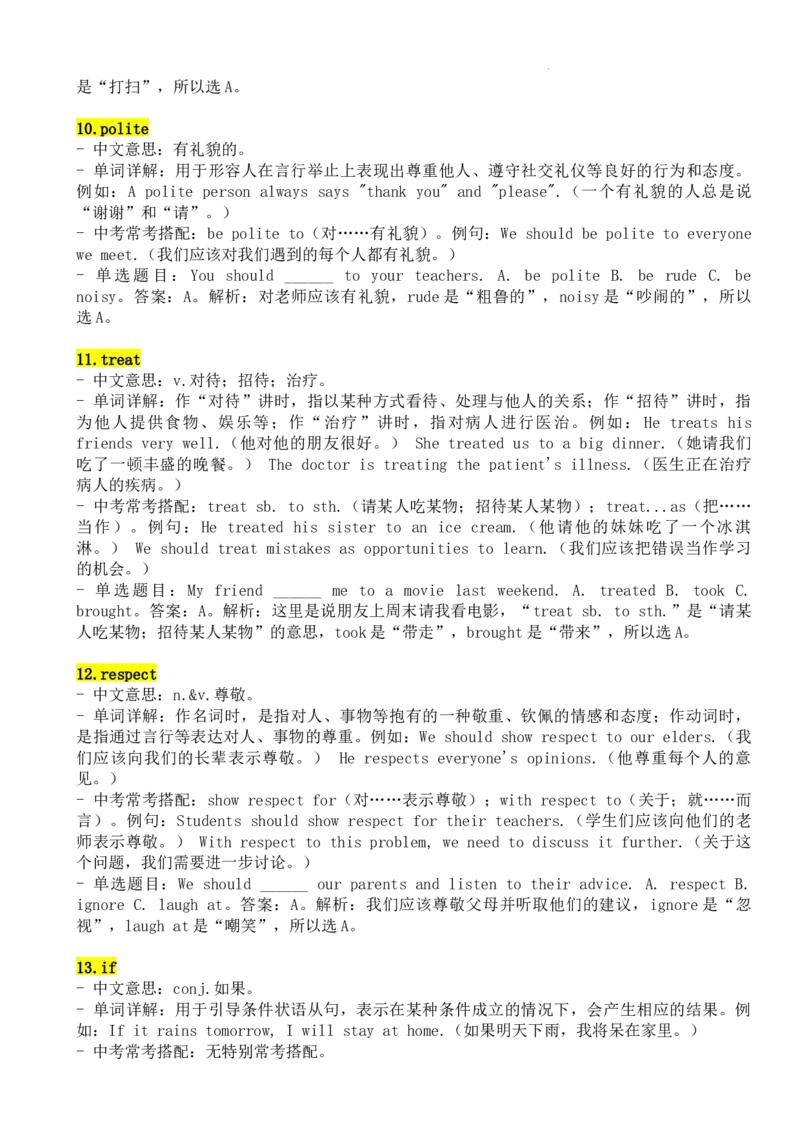
学科网(北京)股份有限公司是“打扫”,所以选A。
10.polite
- 中文意思:有礼貌的。
- 单词详解:用于形容人在言行举止上表现出尊重他人、遵守社交礼仪等良好的行为和态度。
例如:A polite person always says "thank you" and "please".(一个有礼貌的人总是说
“谢谢”和“请”。)
- 中考常考搭配:be polite to(对……有礼貌)。例句:We should be polite to everyone
we meet.(我们应该对我们遇到的每个人都有礼貌。)
- 单选题目:You should ______ to your teachers. A. be polite B. be rude C. be
noisy。答案:A。解析:对老师应该有礼貌,rude是“粗鲁的”,noisy是“吵闹的”,所以
选A。
11.treat
- 中文意思:v.对待;招待;治疗。
- 单词详解:作“对待”讲时,指以某种方式看待、处理与他人的关系;作“招待”讲时,指
为他人提供食物、娱乐等;作“治疗”讲时,指对病人进行医治。例如:He treats his
friends very well.(他对他的朋友很好。) She treated us to a big dinner.(她请我们
吃了一顿丰盛的晚餐。) The doctor is treating the patient's illness.(医生正在治疗
病人的疾病。)
- 中考常考搭配:treat sb. to sth.(请某人吃某物;招待某人某物);treat...as(把……
当作)。例句:He treated his sister to an ice cream.(他请他的妹妹吃了一个冰淇
淋。) We should treat mistakes as opportunities to learn.(我们应该把错误当作学习
的机会。)
- 单选题目:My friend ______ me to a movie last weekend. A. treated B. took C.
brought。答案:A。解析:这里是说朋友上周末请我看电影,“treat sb. to sth.”是“请某
人吃某物;招待某人某物”的意思,took是“带走”,brought是“带来”,所以选A。
12.respect
- 中文意思:n.&v.尊敬。
- 单词详解:作名词时,是指对人、事物等抱有的一种敬重、钦佩的情感和态度;作动词时,
是指通过言行等表达对人、事物的尊重。例如:We should show respect to our elders.(我
们应该向我们的长辈表示尊敬。) He respects everyone's opinions.(他尊重每个人的意
见。)
- 中考常考搭配:show respect for(对……表示尊敬);with respect to(关于;就……而
言)。例句:Students should show respect for their teachers.(学生们应该向他们的老
师表示尊敬。) With respect to this problem, we need to discuss it further.(关于这
个问题,我们需要进一步讨论。)
- 单选题目:We should ______ our parents and listen to their advice. A. respect B.
ignore C. laugh at。答案:A。解析:我们应该尊敬父母并听取他们的建议,ignore是“忽
视”,laugh at是“嘲笑”,所以选A。
13.if
- 中文意思:conj.如果。
- 单词详解:用于引导条件状语从句,表示在某种条件成立的情况下,会产生相应的结果。例
如:If it rains tomorrow, I will stay at home.(如果明天下雨,我将呆在家里。)
- 中考常考搭配:无特别常考搭配。
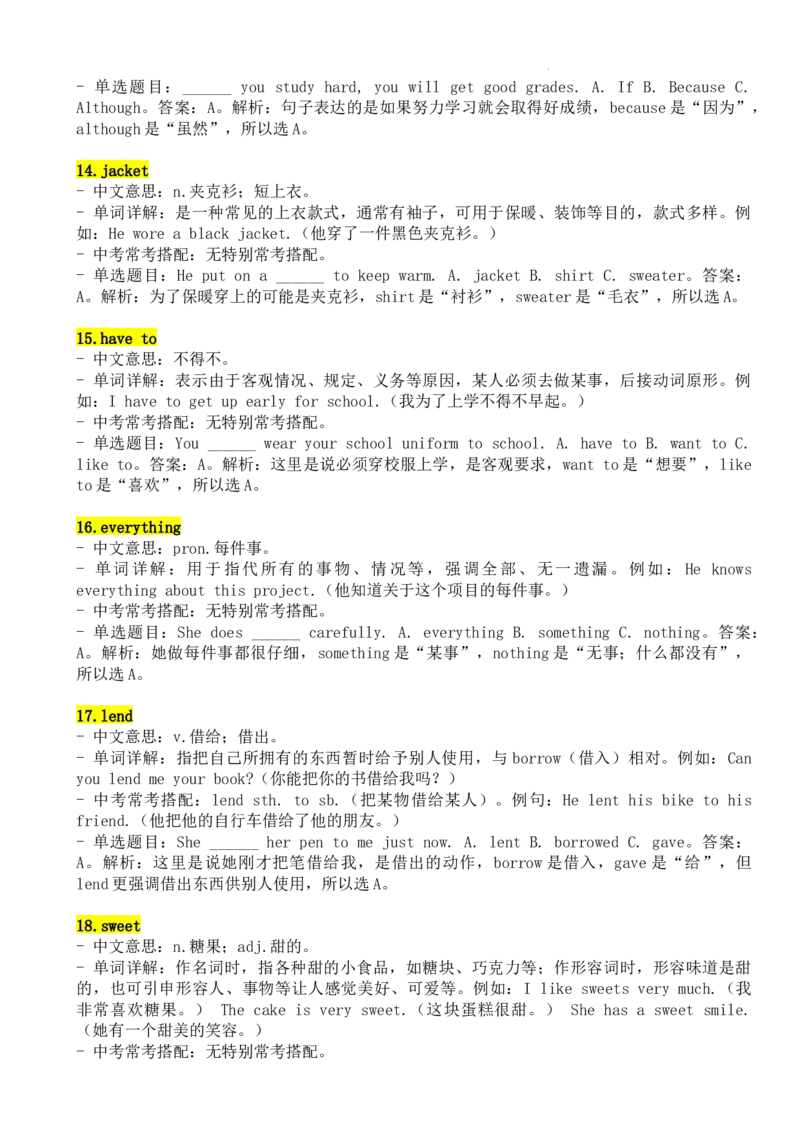
学科网(北京)股份有限公司- 单选题目:______ you study hard, you will get good grades. A. If B. Because C.
Although。答案:A。解析:句子表达的是如果努力学习就会取得好成绩,because是“因为”,
although是“虽然”,所以选A。
14.jacket
- 中文意思:n.夹克衫;短上衣。
- 单词详解:是一种常见的上衣款式,通常有袖子,可用于保暖、装饰等目的,款式多样。例
如:He wore a black jacket.(他穿了一件黑色夹克衫。)
- 中考常考搭配:无特别常考搭配。
- 单选题目:He put on a ______ to keep warm. A. jacket B. shirt C. sweater。答案:
A。解析:为了保暖穿上的可能是夹克衫,shirt是“衬衫”,sweater是“毛衣”,所以选A。
15.have to
- 中文意思:不得不。
- 单词详解:表示由于客观情况、规定、义务等原因,某人必须去做某事,后接动词原形。例
如:I have to get up early for school.(我为了上学不得不早起。)
- 中考常考搭配:无特别常考搭配。
- 单选题目:You ______ wear your school uniform to school. A. have to B. want to C.
like to。答案:A。解析:这里是说必须穿校服上学,是客观要求,want to是“想要”,like
to是“喜欢”,所以选A。
16.everything
- 中文意思:pron.每件事。
- 单词详解:用于指代所有的事物、情况等,强调全部、无一遗漏。例如:He knows
everything about this project.(他知道关于这个项目的每件事。)
- 中考常考搭配:无特别常考搭配。
- 单选题目:She does ______ carefully. A. everything B. something C. nothing。答案:
A。解析:她做每件事都很仔细,something是“某事”,nothing是“无事;什么都没有”,
所以选A。
17.lend
- 中文意思:v.借给;借出。
- 单词详解:指把自己所拥有的东西暂时给予别人使用,与 borrow(借入)相对。例如:Can
you lend me your book?(你能把你的书借给我吗?)
- 中考常考搭配:lend sth. to sb.(把某物借给某人)。例句:He lent his bike to his
friend.(他把他的自行车借给了他的朋友。)
- 单选题目:She ______ her pen to me just now. A. lent B. borrowed C. gave。答案:
A。解析:这里是说她刚才把笔借给我,是借出的动作,borrow 是借入,gave 是“给”,但
lend更强调借出东西供别人使用,所以选A。
18.sweet
- 中文意思:n.糖果;adj.甜的。
- 单词详解:作名词时,指各种甜的小食品,如糖块、巧克力等;作形容词时,形容味道是甜
的,也可引申形容人、事物等让人感觉美好、可爱等。例如:I like sweets very much.(我
非常喜欢糖果。) The cake is very sweet.(这块蛋糕很甜。) She has a sweet smile.
(她有一个甜美的笑容。)
- 中考常考搭配:无特别常考搭配。
学科网(北京)股份有限公司- 单选题目:The fruit is really ______. A. sweet B. sour C. bitter。答案:A。解析:
根据句子说水果真的很,结合常识应该是甜的,sour是“酸的”,bitter是“苦的”,所以选
A。
19.snack
- 中文意思:n.点心;小吃。
- 单词详解:指在正餐之间吃的一些小量的食物,种类多样,如薯片、饼干等。例如:I had a
snack between lunch and dinner.(我在午餐和晚餐之间吃了一份小吃。)
- 中考常考搭配:无特别常考搭配。
- 单选题目:He ate a ______ on his way home. A. snack B. meal C. dinner。答案:A。
解析:在回家路上吃的应该是小吃,meal是“一餐饭”,deter是“晚餐”,所以选A。
20.of course
- 中文意思:当然。
- 单词详解:用于表示肯定、同意或强调某事是理所当然的。例如:Can you help me? Of
course!(你能帮我吗?当然!)
- 中考常考搭配:无特别常考搭配。
- 单选题目:—Can you come to my party? —______! A. Of course B. Maybe C. No way。
答案:A。解析:对方问能否来参加派对,回答当然可以,maybe是“也许”,no way是“没
门”,所以选A。
21.mobile
- 中文意思:adj.可移动的。
- 单词详解:用于形容物体可以轻易地移动位置,常与 phone组成mobile phone(手机)。例
如:A mobile phone is very convenient.(一部手机非常方便。)
- 中考常考搭配:无特别常考搭配。
- 单选题目:A ______ chair is easy to move around. A. mobile B. fixed C. wooden。答
案:A。解析:容易移动的椅子是可移动的椅子,fixed是“固定的”,wooden是“木制的”,
所以选A。
22.mobile phone
- 中文意思:手机。
- 单词详解:一种便于携带、可进行通讯、上网、拍照等多种功能的电子设备。例如:Most
people use mobile phones every day.(大多数人每天都使用手机。)
- 中考常考搭配:on mobile phone(通过手机);use mobile phone(使用手机)。例句:He
talked to his friend on mobile phone.(他通过手机和他的 friend 通话。) Don't use
mobile phone in class.(不要在课堂上使用手机。)
- 单选题目:We can communicate with others ______. A. by mobile phone B. with
mobile phone C. on mobile phone。答案:A 或 C。解析:“by mobile phone”和“on
mobile phone”都有“通过手机”的意思,在这里都可以使用,所以选A或C。
23. turn off
- 中文意思:关掉(水、电或煤气等)。
- 单词详解:通过操作相应的开关、阀门等,使电器设备、水源、气源等停止运行或供应,以
达到节省能源、防止意外等目的。例如:Please turn off the TV before you go to bed.
(睡觉前请关掉电视。)
- 中考常考搭配:turn on(打开);turn up(调大音量、温度等);turn down(调小音量、
学科网(北京)股份有限公司温度等)。例句:Turn on the light if it's too dark.(如果太暗就打开灯。) Turn up
the radio a little, I can't hear it clearly.(把收音机音量调大一点,我听不清楚。)
Turn down the heater, it's too hot in here.(把暖气调小一点,这里太热了。)
- 单选题目:Please ______ the computer when you finish using it. A. turn off B.
turn on C. turn up。答案:A。解析:用完电脑后应该是关掉它,turn on是打开,turn up
是调大,所以选A。
24. queue
- 中文意思:队;行列。
- 单词详解:指人们为了等待做某事(如购票、上车等)而按顺序排成的一列或一行。例如:
There is a long queue at the bus stop.(公交车站有一长队人。)
- 中考常考搭配:stand in a queue(排队);join the queue(排队;加入队列)。例句:
We should stand in a queue when waiting for the bus.(等公交车时我们应该排队。) He
joined the queue to buy tickets.(他加入队列买票。)
- 单选题目:We should ______ when we are waiting to enter the museum. A. stand in a
queue B. jump the queue C. break the queue。答案:A。解析:等待进入博物馆时应该排队,
jump the queue是插队,break the queue可理解为破坏队列秩序,所以选A。
25. jump the queue
- 中文意思:插队。
- 单词详解:指不按照正常排队的顺序,强行插到队伍前面去的不文明行为。例如:It's not
polite to jump the queue.(插队是不礼貌的。)
- 中考常考搭配:无特别常考搭配。
- 单选题目:Don't ______ when you are waiting for your turn. A. jump the queue B.
stand in a queue C. wait for the queue。答案:A。解析:等待轮到自己时不要插队,
stand in a queue是排队,wait for the queue这种表达不太准确,所以选A。
26. wait for
- 中文意思:等待。
- 单词详解:表示在某个地方或处于某种状态下,期待某人或某事的出现、发生等,常后接等
待的对象。例如:I'm waiting for my friend at the station.(我正在车站等我的朋友。)
- 中考常考搭配:wait for sb. to do sth.(等待某人做某事)。例句:She is waiting for
her mother to come back.(她正在等待她的母亲回来。)
- 单选题目:He ______ the bus at the bus stop. A. waits for B. looks for C. asks
for。答案:A。解析:在公交站应该是等公交车,looks for是寻找,asks for是请求、要求,
所以选A。
27. just
- 中文意思:只是;正好。
- 单词详解:作副词时,有多种含义,可表示仅仅、只是强调程度不高;也可表示恰好、正好
的意思,用于描述时间、数量、程度等方面的巧合情况。例如:He is just a child.(他只是
个孩子。) The book is just what I need.(这本书正好是我需要的。)
- 中考常考搭配:just now(刚才;此刻);just then(就在那时)。例句:I saw him just
now.(我刚才看见他了。) Just then, the phone rang.(就在那时,电话响了。)
- 单选题目:I have ______ enough money to buy this book. A. just B. only C. even。
答案:A。解析:这里说正好有足够的钱买这本书,only强调唯一,even表示甚至,所以选A。
学科网(北京)股份有限公司28. leave
- 中文意思:v.离开;留下。
- 单词详解:作“离开”讲时,指人或物从一个地方移动到另一个地方,不再处于原来的位置;
作“留下”讲时,指把某物或某人留在某个地方,或者使某种状态、情况等保留下来。例如:
He left the room quietly.(他悄悄地离开了房间。) She left a message for me.(她给
我留了个信息。)
- 中考常考搭配:leave for(动身去;前往);leave behind(留下;遗留)。例句:They
are leaving for Paris tomorrow.(他们明天动身去巴黎。) Don't leave your things
behind.(不要把你的东西落下。)
- 单选题目:He ______ his hometown to work in the big city. A. left B. came C.
went。答案:A。解析:他离开家乡去大城市工作,came是来,went是去,但没有表达离开原
来地方的意思,所以选A。
29. absent
- 中文意思:adj.缺席的;不在的。
- 单词详解:用于描述人或物没有出现在应该出现的地方、场合等情况。例如:He was absent
from school today.(他今天没去上学。)
- 中考常考搭配:be absent from(缺席;不在)。例句:She was absent from the meeting
yesterday.(她昨天没参加会议。)
- 单选题目:Tom ______ class because he was sick. A. was absent from B. was present
in C. attended。答案:A。解析:因为生病汤姆没上课,was present in 是在……出席,
attended是参加,所以选A。
30. be absent from
- 中文意思:缺席;不在。
- 单词详解:强调某人或某物在特定的活动、场合、地点等没有出现的状态。例如:Many
students were absent from the lecture.(很多学生没听那场讲座。)
- 中考常考搭配:无特别常考搭配。
- 单选题目:Why were you ______ the party last night? A. absent from B. present at
C. involved in。答案:A。解析:问昨晚为什么没参加派对,present at是出席,involved
in是涉及、卷入,所以选A。
31. shh
- 中文意思:嘘(用以让别人安静下来)。
- 单词详解:是一个拟声词,在需要别人保持安静的场合发出这个声音,起到提醒、示意的作
用。例如:Shh! The baby is sleeping.(嘘!宝宝在睡觉。)
- 中考常考搭配:无特别常考搭配。
- 单选题目:______! We are in the library. A. Shh B. Hey C. Wow。答案:A。解析:在
图书馆需要安静,所以用Shh,Hey是打招呼,Wow是表示惊叹,所以选A。
32. quietly
- 中文意思:轻声地;安静地。
- 单词详解:用于描述动作或声音的程度,是一种比较轻柔、不吵闹、不喧哗的状态。例如:
He walked quietly into the room.(他轻声地走进房间。)
- 中考常考搭配:无特别常考搭配。
- 单 选 题 目 : Please talk ______ in the reading room. A. quietly B. loudly C.
clearly。答案:A。解析:在阅览室应该轻声交谈,loudly是大声地,clearly是清楚地,所
学科网(北京)股份有限公司以选A。
33. belt
- 中文意思:n.安全带;腰带;皮带。
- 单词详解:可指汽车、飞机等交通工具上用于保障乘客安全的安全带;也可指系在腰间用于
固定衣服或装饰的腰带;还可指用于捆绑、固定物品的皮带等。例如:Fasten your seat belt
before the plane takes off.(飞机起飞前系好安全带。) She wore a beautiful belt
with her dress.(她穿连衣裙时系了一条漂亮的腰带。)
- 中考常考搭配:put on a belt(系上腰带、皮带等);fasten the seat belt(系紧安全
带)。例句:He put on his belt and went out.(他系上腰带就出去了。) Remember to
fasten the seat belt when you drive.(开车时记得系紧安全带。)
- 单选题目:You should ______ your seat belt when you are in the car. A. put on B.
take off C. fasten。答案:C。解析:在车里应该系紧安全带,put on是穿上、戴上(强调动
作),take off是脱下、摘下,所以选C。
34. feed
- 中文意思:v.喂养;饲养。
- 单词详解:指给人、动物提供食物,使其能够生存、成长等。例如:She feeds her baby
with milk.(她用牛奶喂养她的婴儿。) He feeds the chickens every morning.(他每天早
上喂鸡。)
- 中考常考搭配:feed on(以……为食)。例句:Cows feed on grass.(奶牛以草为食。)
- 单选题目:My mother ______ the cat every day. A. feeds B. eats C. drinks。答案:
A。解析:妈妈每天给猫喂食,eats是吃,drinks是喝,所以选A。
35. noise
- 中文意思:n.声音;噪声。
- 单词详解:指的是各种各样的声音,既可以是让人不舒服、吵闹的噪声,也可以是一般的声
响。例如:There is too much noise in the street.(街上噪声太大了。) The noise of
the rain was very soft.(雨的声音很轻柔。)
- 中考常考搭配:make noise(制造噪声);noisy 是其形容词形式,常见搭配有 be noisy
(吵闹的)。例句:Don't make noise in the classroom.(不要在教室里制造噪声。) The
children are very noisy.(孩子们很吵闹。)
- 单选题目:Please don't ______ in the library. A. make noise B. listen to music C.
read books。答案:A。解析:在图书馆不要制造噪声,listen to music和read books本身在
图书馆是可以做的事,但这里强调不要做的是制造噪声,所以选A。
36. unhappy
- 中文意思:adj.不快乐的。
- 单词详解:是 happy 的反义词,用于形容人心情不愉快、不高兴的状态。例如:He looks
unhappy. What happened to him?(他看起来不快乐。他怎么了?)
- 中考常考搭配:无特别常考搭配。
- 单选题目:She was ______ because she lost her favorite doll. A. happy B. unhappy
C. excited。答案:B。解析:因为丢了最喜欢的洋娃娃所以她不快乐,happy是快乐,excited
是兴奋,所以选B。
37. Dr(= doctor)
- 中文意思:n.博士;医生。
学科网(北京)股份有限公司- 单词详解:既可以指在医学领域从事治病救人工作的医生;也可以指在学术领域获得博士学
位的人。例如:Dr. Smith is a famous doctor.(史密斯医生是一位著名的医生。) Dr. Lee
has a PhD in physics.(李博士拥有物理学博士学位。)
- 中考常考搭配:无特别常考搭配。
- 单选题目:______ Wang is my family doctor. A. Dr B. Mr C. Mrs。答案:A。解析:这
里说的是家庭医生,用Dr表示医生,Mr是先生,Mrs是夫人,所以选A。
38. make sb's/the bed
- 中文意思:整理床铺;铺床。
- 单词详解:指把床上的被子、枕头等整理好,使其看起来整洁、美观。例如:Please make
your bed before you go to school.(上学前请整理好你的床铺。)
- 中考常考搭配:无特别常考搭配。
- 单选题目:You should ______ your bed every morning. A. make B. break C. clean。答
案:A。解析:每天早上应该整理床铺,break是打破、弄坏,clean是打扫(但一般不用于整
理床铺这个动作),所以选A。
39. either
- 中文意思:adv.也(用于否定词组后)。
- 单词详解:用于否定句中,表示“也”的意思,通常放在句末,和 too(用于肯定句末表示
“也”)相对。例如:I don't like coffee. She doesn't like coffee either.(我不喜欢
咖啡。她也不喜欢咖啡。)
- 中考常考搭配:either...or...(要么……要么……;不是……就是……)。例句:You can
either come with me or stay here.(你要么跟我来,要么留在这里。)
- 单选题目:He didn't go to the party. I didn't go ______. A. too B. also C.
either。答案:C。解析:前面是否定句,在句末表示“也”用 either,too用于肯定句末,
also用于肯定句中,所以选C。
40. Practise
- 中文意思:v.训练;练习。
- 单词详解:指通过反复做某事来提高技能、熟练程度等。例如:He practises playing the
piano every day.(他每天练习弹钢琴。)
- 中考常考搭配:practise doing sth.(练习做某事)。例句:You should practise
speaking English more.(你应该更多地练习说英语。)
- 单选题目:She ______ dancing for two hours every day. A. practises B. practices
C. played。答案:A或B。解析:practise和practice都有“练习”的意思,在这里都可以用,
played是“玩;演奏”等意思,不符合句子意思,所以选A或B。
41. hang
- 中文意思:v.悬挂。
- 单词详解:指把物体通过绳子、挂钩等方式吊起来、挂起来,使其处于悬空的状态。例如:
He hung a picture on the wall.(他把一幅画挂在墙上。)
- 中考常考搭配:hang out(闲逛;常去某处);hang up(挂断电话;挂起)。例句:We
often hang out in the park on weekends.(我们经常在周末去公园闲逛。) She hung up
the phone after the call.(通话结束后她挂断了电话。)
- 单选题目:He ______ his coat on the hook. A. hung B. hanged C. put。答案:A。解析:
这里是把外套挂在钩子上,hang的过去式是 hung(表示悬挂的意思),hanged一般用于“绞
死”的意思,put是放,但这里强调挂起来的动作,所以选A。
学科网(北京)股份有限公司42. hang out
- 中文意思:闲逛;常去某处。
- 单词详解:指人们在闲暇时间里,没有特定目的,随意地在某个地方逗留、散步、聊天等。
例如:They like to hang out at the mall on weekends.(他们喜欢在周末去商场闲逛。)
- 中考常考搭配:无特别常考搭配。
- 单选题目:We often ______ in the coffee shop after school. A. hang out B. study
C. work。答案:A。解析:放学后经常在咖啡店应该是闲逛,study是学习,work是工作,所
以选A。
43. weekday
- 中文意思:工作日(星期一至星期五的任何一天)。
- 单词详解:用于区分一周当中正常上班、上学的日子和周末休息日,通常指周一到周五。例
如:I'm busy on weekdays.(我工作日很忙。)
- 中考常考搭配:on weekdays(在工作日)。例句:The library is open on weekdays.(图
书馆在工作日开放。)
- 单选题目:We have classes ______ from Monday to Friday. A. on weekdays B. on
weekends C. every day。答案:A。解析:从周一到周五是工作日,上课时间通常在工作日,
on weekends是在周末,every day是每天,所以选A。
44. awful
- 中文意思:糟糕的。
- 单词详解:用于形容事物的状况、品质、感觉等非常不好,令人不愉快或不满意。例如:The
weather is awful today.(今天天气很糟糕。)
- 中考常考搭配:无特别常考搭配。
- 单选题目:The movie was so ______ that I left halfway. A. awful B. wonderful C.
exciting。答案:A。解析:因为电影很糟糕所以才会中途离开,wonderful 是精彩的,
exciting是令人兴奋的,所以选A。
45. become
- 中文意思:v.成为。
- 单词详解:表示从一种状态、身份、情况等转变为另一种,强调变化的过程。例如:He
wants to become a doctor.(他想成为一名医生。)
- 中考常考搭配:become of(发生;结果是)。例句:What has become of him?(他发生了
什么事?)
- 单选题目:She hopes to ______ a famous singer in the future. A. become B. make C.
do。答案:A。解析:希望成为一名著名歌手用 become,make和do没有“成为”的意思,所以
选A。
46. better
- 中文意思:adj.较好;adv.较好地。
- 单词详解:是good或well的比较级形式,用于比较两个或多个事物、情况等,表示在某方面
更优。例如:This book is better than that one.(这本书比那本好。) He can do it
better.(他能做得更好。)
- 中考常考搭配:had better(最好,后接动词原形)。例句:You had better go to bed
early.(你最好早点上床睡觉。)
- 单选题目:You ______ study hard for the exam. A. had better B. would rather C.
学科网(北京)股份有限公司prefer to。答案:A。解析:这里是说为了考试你最好努力学习,would rather是“宁愿”,
prefer to是“更喜欢”,所以选A。
47. person
- 中文意思:n.人。
- 单词详解:泛指单个的人类个体,可用于描述不同性别、年龄、身份等的人。例如:There
is a person waiting for you outside.(外面有一个人在等你。)
- 中考常考搭配:in person(亲自);personal 是其形容词形式,常见搭配有 personal
information(个人信息)。例句:He came to the meeting in person.(他亲自来参加会
议。)
- 单选题目:You should come to pick up the package ______. A. in person B. by
person C. on person。答案:A。解析:“in person”表示“亲自”,是固定搭配,其他两种
表达错误,所以选A。
48.focus
- 中文意思:v.集中(注意力、精力等);n.焦点。
- 单词详解:作动词时,指使注意力、精力等聚集在某一点、某一事物或某一活动上;作名词
时,指人们关注的中心、重点或光学等领域中的焦点。例如:You should focus on your
studies.(你应该把注意力集中在学习上。) The focus of this meeting is about the new
project.(这次会议的焦点是关于新项目。)
- 中考常考搭配:focus on(集中(注意力、精力等)于)。例句:He always focuses on
solving problems.(他总是集中精力解决问题。)
- 单选题目:We should ______ our attention ______ the important tasks. A. focus; on
B. pay; to C. put; into。答案:A。解析:“focus...on...”表示“把……集中在……上”,
pay attention to是“注意”,put into是“放入;投入”,这里说把注意力集中在重要任务
上,所以选A。
49.focus on
- 中文意思:集中(注意力、精力等)于。
- 单词详解:强调将自己的注意力、精力、心思等专门投注到某一特定的事物、目标、任务等
上面,以便更好地完成、理解或处理它。例如:Students should focus on their homework.
(学生们应该把注意力集中在作业上。)
- 中考常考搭配:无特别常考搭配。
- 单选题目:You need to ______ the details when you read a text. A. focus on B.
look at C. think about。答案:A。解析:读文章时需要集中注意力于细节,look at 是
“看”,think about是“思考”,但这里强调专注于细节,所以选A。
50. build
- 中文意思:v.创建;建造。
- 单词详解:指通过各种方式,如使用材料、投入劳动力等,来构造、搭建、建立起建筑物、
组织、关系等具体或抽象的事物。例如:They are building a new house.(他们正在建造一
座新房子。) We should build good relationships with others.(我们应该与他人建立良
好的关系。)
- 中考常考搭配:build up(逐步建立;增强)。例句:He is trying to build up his
confidence.(他正在努力增强自己的信心。)
- 单选题目:They ______ a bridge over the river last year. A. built B. build C.
building。答案:A。解析:last year 是过去时间,句子用一般过去时,build 的过去式是
学科网(北京)股份有限公司built,所以选A。
51. spirit
- 中文意思:n.精神;情绪。
- 单词详解:可指人的内在精神力量、意志力、活力等,也可指群体的风气、氛围等所体现出
的精神特质,还可指人的情绪状态。例如:He has a strong spirit.(他有很强的精神力
量。) The team spirit is very good.(团队精神非常好。) She is in high spirits
today.(她今天情绪高涨。)
- 中考常考搭配:in spirit(在精神上);team spirit(团队精神)。例句:I'll be with
you in spirit.(我会在精神上支持你。) We need to improve our team spirit.(我们需
要提高我们的团队精神。)
- 单 选 题 目 : The ______ of the class is very positive. A. spirit B. mood C.
feeling。答案:A。解析:这里说班级的精神状态很积极,mood是“心情”,feeling是“感
觉”,更强调班级整体的风气、精神特质用spirit,所以选A。
52. think about
- 中文意思:思考。
- 单词详解:表示对某一事物、问题、情况等进行思索、考虑,权衡利弊等。例如:You
should think about this problem carefully.(你应该仔细思考这个问题。)
- 中考常考搭配:无特别常考搭配。
- 单选题目:Please ______ what you want to do next. A. think about B. talk about C.
worry about。答案:A。解析:请思考接下来你想做什么,talk about 是“谈论”,worry
about是“担心”,所以选A。
53. relax
- 中文意思:v.放松;休息。
- 单词详解:指使身体或精神从紧张、疲劳等状态中恢复到较为轻松、舒适的状态。例如:You
can relax on the beach.(你可以在海滩上放松。)
- 中考常考搭配:relax oneself(自我放松)。例句:He relaxes himself by listening to
music.(他通过听音乐自我放松。)
- 单选题目:After a long day's work, you should ______ to relieve the stress. A.
relax B. exercise C. study。答案:A。解析:工作了一整天后,应该放松来缓解压力,
exercise是“锻炼”,study是“学习”,所以选A。
54. advice
- 中文意思:n.建议;意见。
- 单词详解:指人们针对某一问题、情况等给出的指导性的话语、看法,通常是希望对方能够
采纳并按照其行事。例如:Can you give me some advice on how to learn English better?
(你能给我一些关于如何更好地学习英语的建议吗?)
- 中考常考搭配:give advice(给出建议);take advice(接受建议)。例句:The teacher
gives good advice to students.(老师给学生们很好的建议。) You should take the
advice of your parents.(你应该接受你父母的建议。)
- 单选题目:You should ______ the advice of your friends. A. give B. take C. make。
答案:B。解析:应该接受朋友的建议,give是“给出”,make没有“接受”的意思,所以选
B。
55. understand
学科网(北京)股份有限公司- 中文意思:v.理解;领会。
- 单词详解:指能够明白、懂得他人所说的话、所表达的意思,或者能够把握事物的本质、原
理等。例如:I understand what you mean.(我理解你所说的意思。)
- 中考常考搭配:make oneself understood(使自己被理解)。例句:He tried to make
himself understood in English.(他试图用英语使自己被理解。)
- 单选题目:Can you ______ what the teacher is saying? A. understand B. hear C.
listen to。答案:A。解析:这里问的是能否理解老师正在说的话,hear是“听到”,listen
to是“听”,但重点是理解内容,所以选A。
56. untidy
- 中文意思:adj.不整洁的。
- 单词详解:用于形容事物的外观、布置等显得杂乱无章、不干净、不整齐的状态。例如:His
room is very untidy.(他的房间非常不整洁。)
- 中考常考搭配:无特别常考搭配。
- 单选题目:The classroom was ______ after the party. A. tidy B. untidy C. clean。
答案:B。解析:派对过后教室应该是不整洁的,tidy是“整洁的”,clean是“干净的”,所
以选B。
学科网(北京)股份有限公司