文档文本内容
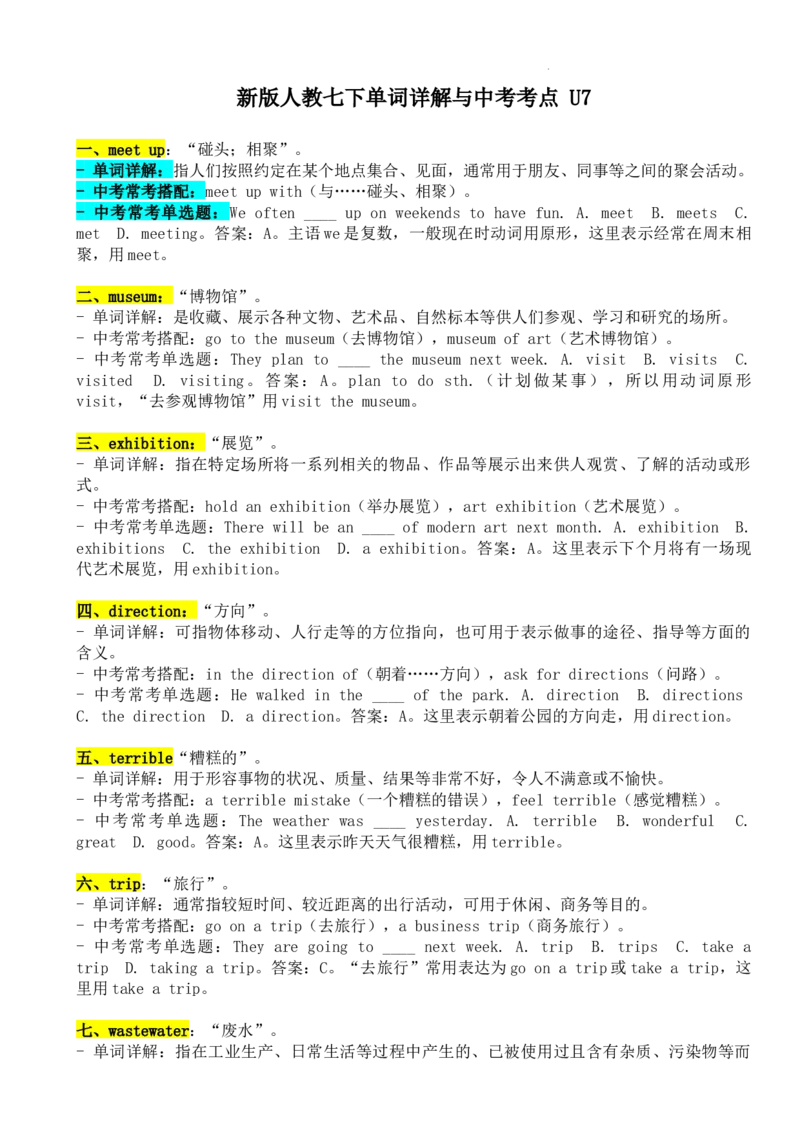
新版人教七下单词详解与中考考点 U7
一、meet up:“碰头;相聚”。
- 单词详解:指人们按照约定在某个地点集合、见面,通常用于朋友、同事等之间的聚会活动。
- 中考常考搭配:meet up with(与……碰头、相聚)。
- 中考常考单选题:We often ____ up on weekends to have fun. A. meet B. meets C.
met D. meeting。答案:A。主语we是复数,一般现在时动词用原形,这里表示经常在周末相
聚,用meet。
二、museum:“博物馆”。
- 单词详解:是收藏、展示各种文物、艺术品、自然标本等供人们参观、学习和研究的场所。
- 中考常考搭配:go to the museum(去博物馆),museum of art(艺术博物馆)。
- 中考常考单选题:They plan to ____ the museum next week. A. visit B. visits C.
visited D. visiting。答案:A。plan to do sth.(计划做某事),所以用动词原形
visit,“去参观博物馆”用visit the museum。
三、exhibition:“展览”。
- 单词详解:指在特定场所将一系列相关的物品、作品等展示出来供人观赏、了解的活动或形
式。
- 中考常考搭配:hold an exhibition(举办展览),art exhibition(艺术展览)。
- 中考常考单选题:There will be an ____ of modern art next month. A. exhibition B.
exhibitions C. the exhibition D. a exhibition。答案:A。这里表示下个月将有一场现
代艺术展览,用exhibition。
四、direction:“方向”。
- 单词详解:可指物体移动、人行走等的方位指向,也可用于表示做事的途径、指导等方面的
含义。
- 中考常考搭配:in the direction of(朝着……方向),ask for directions(问路)。
- 中考常考单选题:He walked in the ____ of the park. A. direction B. directions
C. the direction D. a direction。答案:A。这里表示朝着公园的方向走,用direction。
五、terrible“糟糕的”。
- 单词详解:用于形容事物的状况、质量、结果等非常不好,令人不满意或不愉快。
- 中考常考搭配:a terrible mistake(一个糟糕的错误),feel terrible(感觉糟糕)。
- 中考常考单选题:The weather was ____ yesterday. A. terrible B. wonderful C.
great D. good。答案:A。这里表示昨天天气很糟糕,用terrible。
六、trip:“旅行”。
- 单词详解:通常指较短时间、较近距离的出行活动,可用于休闲、商务等目的。
- 中考常考搭配:go on a trip(去旅行),a business trip(商务旅行)。
- 中考常考单选题:They are going to ____ next week. A. trip B. trips C. take a
trip D. taking a trip。答案:C。“去旅行”常用表达为go on a trip或take a trip,这
里用take a trip。
七、wastewater:“废水”。
- 单词详解:指在工业生产、日常生活等过程中产生的、已被使用过且含有杂质、污染物等而
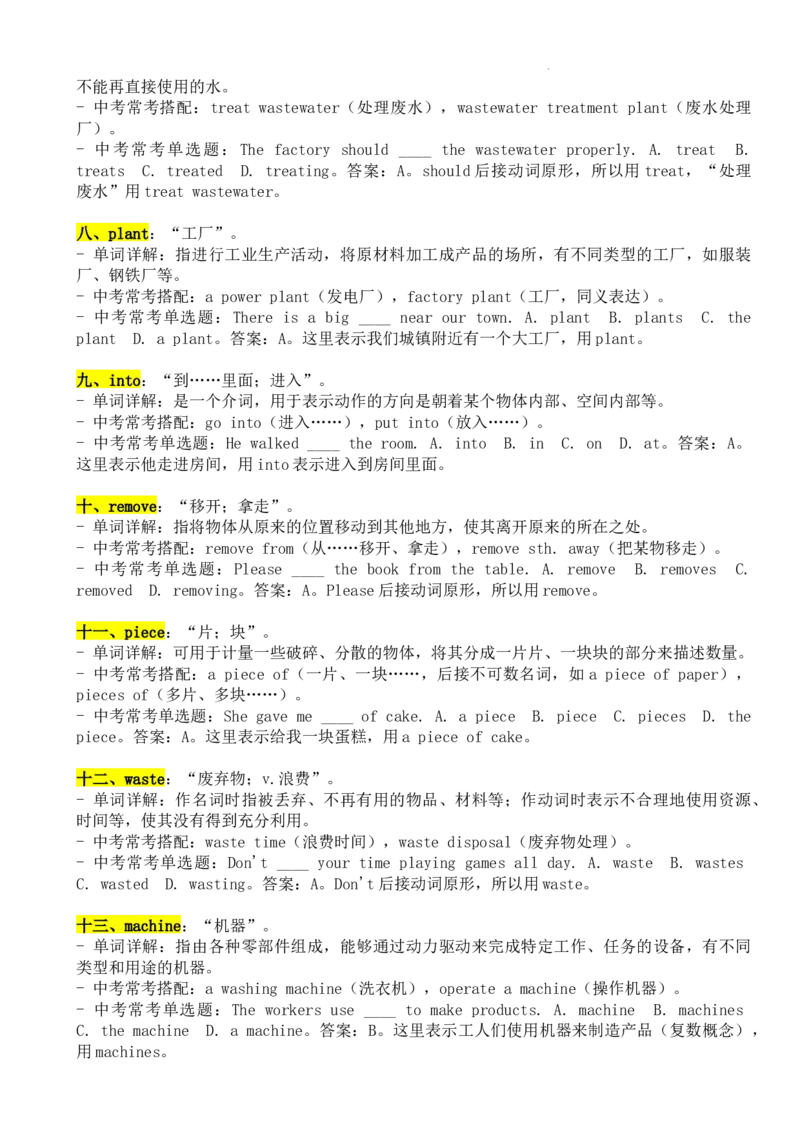
学科网(北京)股份有限公司不能再直接使用的水。
- 中考常考搭配:treat wastewater(处理废水),wastewater treatment plant(废水处理
厂)。
- 中考常考单选题:The factory should ____ the wastewater properly. A. treat B.
treats C. treated D. treating。答案:A。should后接动词原形,所以用 treat,“处理
废水”用treat wastewater。
八、plant:“工厂”。
- 单词详解:指进行工业生产活动,将原材料加工成产品的场所,有不同类型的工厂,如服装
厂、钢铁厂等。
- 中考常考搭配:a power plant(发电厂),factory plant(工厂,同义表达)。
- 中考常考单选题:There is a big ____ near our town. A. plant B. plants C. the
plant D. a plant。答案:A。这里表示我们城镇附近有一个大工厂,用plant。
九、into:“到……里面;进入”。
- 单词详解:是一个介词,用于表示动作的方向是朝着某个物体内部、空间内部等。
- 中考常考搭配:go into(进入……),put into(放入……)。
- 中考常考单选题:He walked ____ the room. A. into B. in C. on D. at。答案:A。
这里表示他走进房间,用into表示进入到房间里面。
十、remove:“移开;拿走”。
- 单词详解:指将物体从原来的位置移动到其他地方,使其离开原来的所在之处。
- 中考常考搭配:remove from(从……移开、拿走),remove sth. away(把某物移走)。
- 中考常考单选题:Please ____ the book from the table. A. remove B. removes C.
removed D. removing。答案:A。Please后接动词原形,所以用remove。
十一、piece:“片;块”。
- 单词详解:可用于计量一些破碎、分散的物体,将其分成一片片、一块块的部分来描述数量。
- 中考常考搭配:a piece of(一片、一块……,后接不可数名词,如 a piece of paper),
pieces of(多片、多块……)。
- 中考常考单选题:She gave me ____ of cake. A. a piece B. piece C. pieces D. the
piece。答案:A。这里表示给我一块蛋糕,用a piece of cake。
十二、waste:“废弃物;v.浪费”。
- 单词详解:作名词时指被丢弃、不再有用的物品、材料等;作动词时表示不合理地使用资源、
时间等,使其没有得到充分利用。
- 中考常考搭配:waste time(浪费时间),waste disposal(废弃物处理)。
- 中考常考单选题:Don't ____ your time playing games all day. A. waste B. wastes
C. wasted D. wasting。答案:A。Don't后接动词原形,所以用waste。
十三、machine:“机器”。
- 单词详解:指由各种零部件组成,能够通过动力驱动来完成特定工作、任务的设备,有不同
类型和用途的机器。
- 中考常考搭配:a washing machine(洗衣机),operate a machine(操作机器)。
- 中考常考单选题:The workers use ____ to make products. A. machine B. machines
C. the machine D. a machine。答案:B。这里表示工人们使用机器来制造产品(复数概念),
用machines。
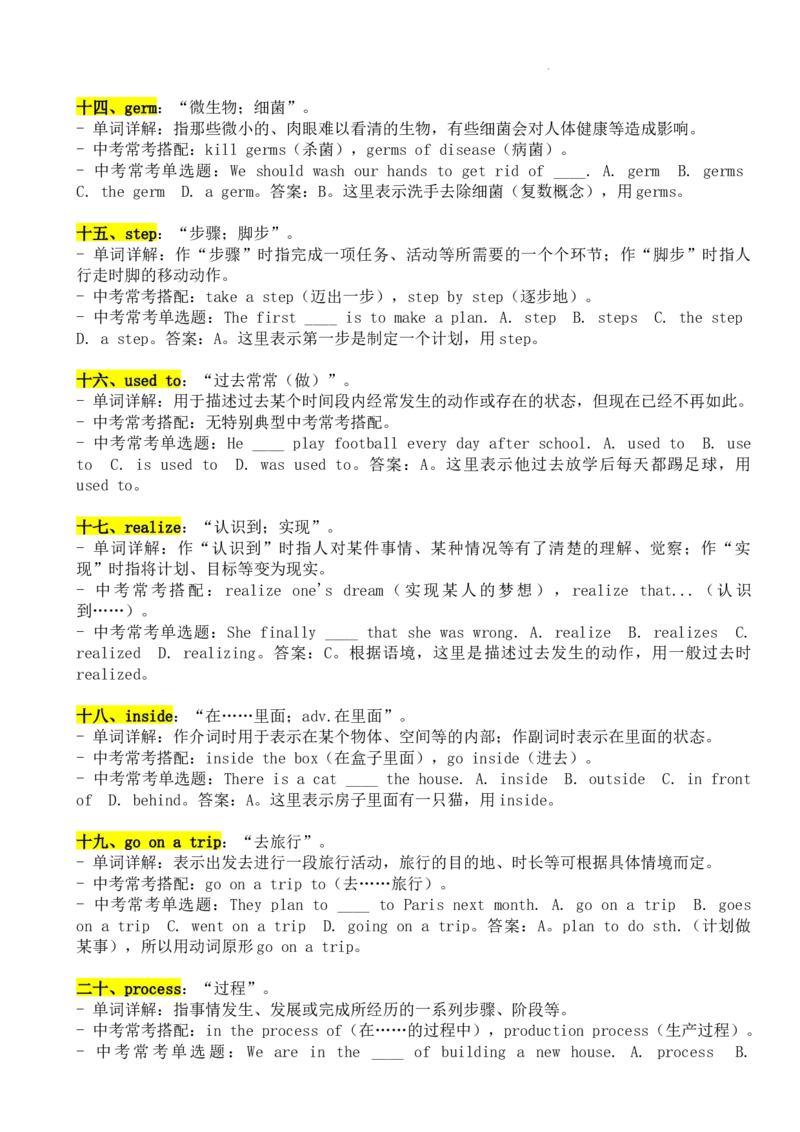
学科网(北京)股份有限公司十四、germ:“微生物;细菌”。
- 单词详解:指那些微小的、肉眼难以看清的生物,有些细菌会对人体健康等造成影响。
- 中考常考搭配:kill germs(杀菌),germs of disease(病菌)。
- 中考常考单选题:We should wash our hands to get rid of ____. A. germ B. germs
C. the germ D. a germ。答案:B。这里表示洗手去除细菌(复数概念),用germs。
十五、step:“步骤;脚步”。
- 单词详解:作“步骤”时指完成一项任务、活动等所需要的一个个环节;作“脚步”时指人
行走时脚的移动动作。
- 中考常考搭配:take a step(迈出一步),step by step(逐步地)。
- 中考常考单选题:The first ____ is to make a plan. A. step B. steps C. the step
D. a step。答案:A。这里表示第一步是制定一个计划,用step。
十六、used to:“过去常常(做)”。
- 单词详解:用于描述过去某个时间段内经常发生的动作或存在的状态,但现在已经不再如此。
- 中考常考搭配:无特别典型中考常考搭配。
- 中考常考单选题:He ____ play football every day after school. A. used to B. use
to C. is used to D. was used to。答案:A。这里表示他过去放学后每天都踢足球,用
used to。
十七、realize:“认识到;实现”。
- 单词详解:作“认识到”时指人对某件事情、某种情况等有了清楚的理解、觉察;作“实
现”时指将计划、目标等变为现实。
- 中考常考搭配:realize one's dream(实现某人的梦想),realize that...(认识
到……)。
- 中考常考单选题:She finally ____ that she was wrong. A. realize B. realizes C.
realized D. realizing。答案:C。根据语境,这里是描述过去发生的动作,用一般过去时
realized。
十八、inside:“在……里面;adv.在里面”。
- 单词详解:作介词时用于表示在某个物体、空间等的内部;作副词时表示在里面的状态。
- 中考常考搭配:inside the box(在盒子里面),go inside(进去)。
- 中考常考单选题:There is a cat ____ the house. A. inside B. outside C. in front
of D. behind。答案:A。这里表示房子里面有一只猫,用inside。
十九、go on a trip:“去旅行”。
- 单词详解:表示出发去进行一段旅行活动,旅行的目的地、时长等可根据具体情境而定。
- 中考常考搭配:go on a trip to(去……旅行)。
- 中考常考单选题:They plan to ____ to Paris next month. A. go on a trip B. goes
on a trip C. went on a trip D. going on a trip。答案:A。plan to do sth.(计划做
某事),所以用动词原形go on a trip。
二十、process:“过程”。
- 单词详解:指事情发生、发展或完成所经历的一系列步骤、阶段等。
- 中考常考搭配:in the process of(在……的过程中),production process(生产过程)。
- 中考常考单选题:We are in the ____ of building a new house. A. process B.
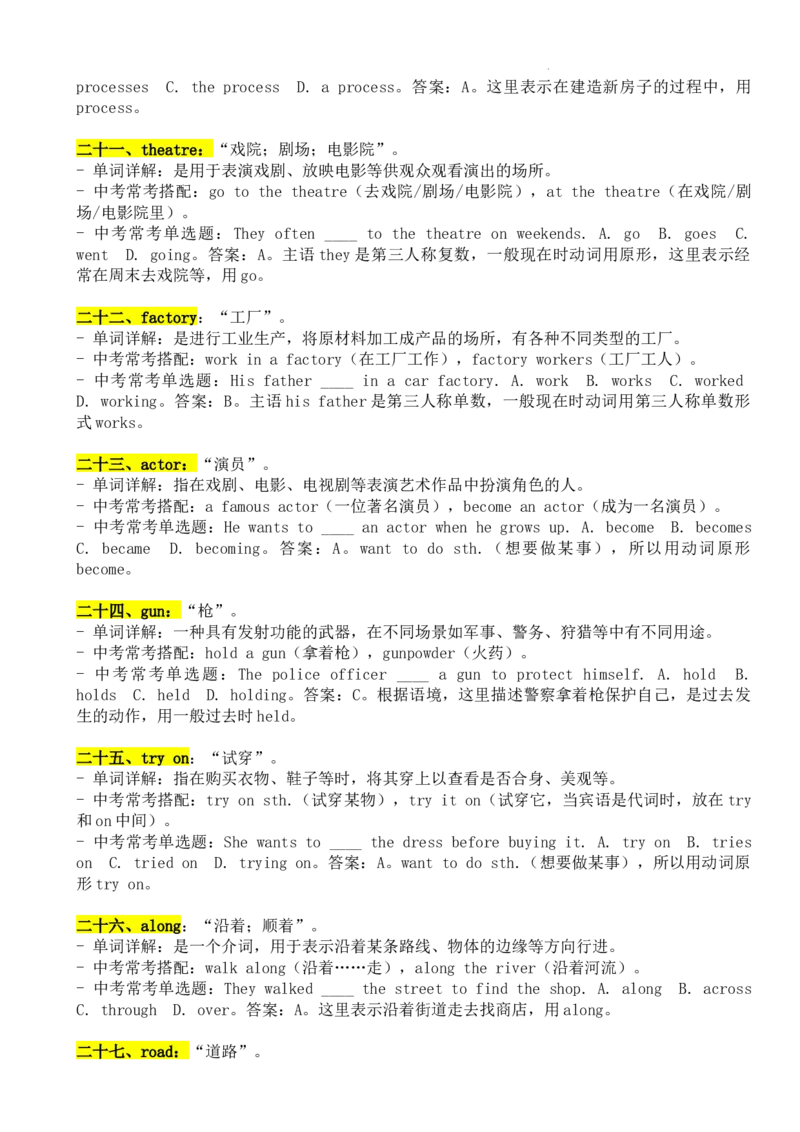
学科网(北京)股份有限公司processes C. the process D. a process。答案:A。这里表示在建造新房子的过程中,用
process。
二十一、theatre:“戏院;剧场;电影院”。
- 单词详解:是用于表演戏剧、放映电影等供观众观看演出的场所。
- 中考常考搭配:go to the theatre(去戏院/剧场/电影院),at the theatre(在戏院/剧
场/电影院里)。
- 中考常考单选题:They often ____ to the theatre on weekends. A. go B. goes C.
went D. going。答案:A。主语they是第三人称复数,一般现在时动词用原形,这里表示经
常在周末去戏院等,用go。
二十二、factory:“工厂”。
- 单词详解:是进行工业生产,将原材料加工成产品的场所,有各种不同类型的工厂。
- 中考常考搭配:work in a factory(在工厂工作),factory workers(工厂工人)。
- 中考常考单选题:His father ____ in a car factory. A. work B. works C. worked
D. working。答案:B。主语his father是第三人称单数,一般现在时动词用第三人称单数形
式works。
二十三、actor:“演员”。
- 单词详解:指在戏剧、电影、电视剧等表演艺术作品中扮演角色的人。
- 中考常考搭配:a famous actor(一位著名演员),become an actor(成为一名演员)。
- 中考常考单选题:He wants to ____ an actor when he grows up. A. become B. becomes
C. became D. becoming。答案:A。want to do sth.(想要做某事),所以用动词原形
become。
二十四、gun:“枪”。
- 单词详解:一种具有发射功能的武器,在不同场景如军事、警务、狩猎等中有不同用途。
- 中考常考搭配:hold a gun(拿着枪),gunpowder(火药)。
- 中考常考单选题:The police officer ____ a gun to protect himself. A. hold B.
holds C. held D. holding。答案:C。根据语境,这里描述警察拿着枪保护自己,是过去发
生的动作,用一般过去时held。
二十五、try on:“试穿”。
- 单词详解:指在购买衣物、鞋子等时,将其穿上以查看是否合身、美观等。
- 中考常考搭配:try on sth.(试穿某物),try it on(试穿它,当宾语是代词时,放在try
和on中间)。
- 中考常考单选题:She wants to ____ the dress before buying it. A. try on B. tries
on C. tried on D. trying on。答案:A。want to do sth.(想要做某事),所以用动词原
形try on。
二十六、along:“沿着;顺着”。
- 单词详解:是一个介词,用于表示沿着某条路线、物体的边缘等方向行进。
- 中考常考搭配:walk along(沿着……走),along the river(沿着河流)。
- 中考常考单选题:They walked ____ the street to find the shop. A. along B. across
C. through D. over。答案:A。这里表示沿着街道走去找商店,用along。
二十七、road:“道路”。
学科网(北京)股份有限公司- 单词详解:指供人、车辆等通行的地面通道,有不同类型如公路、马路等。
- 中考常考搭配:on the road(在道路上),main road(主干道)。
- 中考常考单选题:There are many cars ____ the road. A. on B. in C. at D. by。答
案:A。“在道路上”用on the road。
二十八、create:“创造”。
- 单词详解:指通过想象力、创造力等产生新的事物、想法、作品等。
- 中考常考搭配:create something new(创造新事物),create a work of art(创作一件
艺术品)。
- 中考常考单选题:He can ____ many interesting stories. A. create B. creates C.
created D. creating。答案:A。can后接动词原形,所以用create。
二十九、record:动词为“记录;”,名词为“记录”。
- 单词详解:作动词时,可指把信息、事件、声音等用文字、图像、音频等方式保存下来;作
名词时指保存下来的相关内容。
- 中考常考搭配:keep a record(保持记录),record something down(把某物记录下来)。
- 中考常考单选题:He ____ his daily activities in a notebook. A. record B. records
C. recorded D. recording。答案:B。主语he是第三人称单数,一般现在时动词用第三人称
单数形式records。
三十、skill:“技能”。
- 单词详解:指通过学习、训练等获得的能够完成特定任务、活动的能力。
- 中考常考搭配:learn a skill(学习一项技能),practical skills(实用技能)。
- 中考常考单选题:She has many ____, such as painting and dancing. A. skill B.
skills C. the skill D. a skill。答案:B。many后接可数名词复数,这里表示她有很多技
能,用skills。
三十一、write down:“写下;记下”。
- 单词详解:指用文字将信息、想法、事项等记录在纸张等载体上。
- 中考常考搭配:write down sth.(写下某物),write it down(写下它,当宾语是代词时,
放在write和down中间)。
- 中考常考单选题:Please ____ your name on the paper. A. write down B. writes down
C. wrote down D. writing down。答案:A。Please后接动词原形,所以用write down。
三十二、explore:“探索”。
- 单词详解:指对未知的地方、领域、知识等进行考察、研究、了解等活动。
- 中考常考搭配:explore the world(探索世界),explore new ideas(探索新想法)。
- 中考常考单选题:They like to ____ the ancient city. A. explore B. explores C.
explored D. exploring。答案:A。like to do sth.(喜欢做某事),所以用动词原形
explore。
三十三、tent:“帐篷”。
- 单词详解:一种可折叠、便于携带的遮蔽物,通常用于户外露营等活动,提供休息、住宿的
空间。
- 中考常考搭配:put up a tent(搭建帐篷),sleep in a tent(在帐篷里睡觉)。
- 中考常考单选题:They plan to ____ a tent by the lake. A. put up B. puts up C.
putted up D. putting up。答案:A。plan to do sth.(计划做某事),所以用动词原形put
学科网(北京)股份有限公司up。
三十四、cucumber:“黄瓜”。
- 单词详解:一种常见的蔬菜,通常呈长条状,可生食、凉拌、炒菜等多种烹饪方式。
- 中考常考搭配:cucumber salad(黄瓜沙拉),pick cucumbers(摘黄瓜)。
- 中考常考单选题:She likes to eat ____. A. cucumber B. cucumbers C. the cucumber
D. a cucumber。答案:B。这里表示她喜欢吃黄瓜(复数概念),用cucumbers。
三十五、from…to…:“从……到……”。
- 单词详解:用于表示范围、时间、地点等的起始点和终止点。
- 中考常考搭配:from Monday to Friday(从周一到周五),from here to there(从这里到
那里)。
- 中考常考单选题:The meeting will be held ____ 9:00 to 11:00. A. from B. to C.
between D. among。答案:A。这里表示会议将从9点到11点举行,用from…to…结构。
三十六、straight:作副词意为“直接;立即;笔直地”,作形容词意为“直的”。
- 单词详解:作形容词可形容物体形状是笔直的,如直线、直的道路等;作副词可表示动作的
方式是径直、不拐弯抹角地,或时间上很快、马上。
- 中考常考搭配:go straight(直走),look straight ahead(直视前方)。
- 中考常考单选题:Please draw a ____ line. A. straight B. straightly C. more
straight D. most straight。答案:A。这里表示画一条直线,用形容词straight。
三十七、fill:“装满;盛满”。
- 单词详解:指将容器等用东西填满,使其达到容纳的最大限度。
- 中考常考搭配:fill with(用……装满),be filled with(充满……)。
- 中考常考单选题:Please ____ the glass with water. A. fill B. fills C. filled
D. filling。答案:A。Please后接动词原形,所以用fill。
三十八、basket:“篮子;筐”。
- 单词详解:一种用藤条、柳条等编织而成的容器,可用于盛放物品,如水果、蔬菜等。
- 中考常考搭配:a basket of(一篮子……),carry a basket(提着篮子)。
- 中考常考单选题:She put some apples in a ____. A. basket B. baskets C. the
basket D. a basket。答案:A。这里表示把一些苹果放在一个篮子里,用basket。
三十九、teach:“(taught)教”。
- 单词详解:指通过讲解、示范等方式让别人学习知识、技能等。
- 中考常考搭配:teach sb. sth.(教某人某事),teach oneself(自学)。
- 中考常考单选题:My mother ____ me English. A. teach B. teaches C. taught D.
teaching。答案:B。主语my mother是第三人称单数,一般现在时动词用第三人称单数形式
teaches。
四十、branch:“分支;树枝”。
- 单词详解:作“分支”时可指学科、组织等的细分部分;作“树枝”时指树木的枝干部分。
- 中考常考搭配:a branch of(……的分支),on the branch(在树枝上)。
- 中考常考单选题:There are many leaves on the ____. A. branch B. branches C. the
branch D. a branch。答案:A。这里表示树枝上有很多树叶,用branch。
学科网(北京)股份有限公司四十一、leaf:“(pl.leaves)树叶”。
- 单词详解:是树木的重要组成部分,通常为绿色,有不同的形状和大小,通过光合作用为树
木提供养分。
- 中考常考搭配:fallen leaves(落叶),pick up leaves(捡起树叶)。
- 中考常考单选题:The ground was covered with ____ in autumn. A. leaf B. leaves
C. the leaf D. a leaf。答案:B。这里表示秋天地面被树叶覆盖(复数概念),用leaves。
四十二、finally:“最后”。
- 单词详解:用于表示一系列事情、步骤等的最后一个环节或阶段,强调顺序上的末尾。
- 中考常考搭配:无特别典型中考常考搭配。
- 中考常考单选题:First, we clean the room. Then, we decorate it. ____, we put up
some pictures. A. Finally B. At last C. In the end D. Lastly。答案:A。这里表示
一系列动作的最后一步,用Finally。
四十三、think of:“考虑;想起”。
- 单词详解:作“考虑”时指对某事进行思考、权衡;作“想起”时指脑海中突然浮现出某人、
某事的记忆。
- 中考常考搭配:think of doing sth.(考虑做某事),think of sb.(想起某人)。
- 中考常考单选题:I often ____ my old friends when I see the old photos. A. think
of B. think about C. think over D. think up。答案:A。这里表示看到旧照片时经常想
起老朋友,用think of。
四十四、grain:“谷物;谷粒”。
- 单词详解:指各种粮食作物的种子,如小麦、大米等的颗粒,是人类重要的食物来源之一。
- 中考常考搭配:a grain of(一粒……),grain production(谷物生产)。
- 中考常考单选题:There is only ____ of rice left in the bowl. A. a grain B.
grains C. the grain D. a grains。答案:A。这里表示碗里只剩下一粒米,用a grain of
rice。
四十五、fresh:“新鲜的”。
- 单词详解:可形容食物是刚采摘、刚制作等,保持着良好的品质和口感;也可形容空气、环
境等清新。
- 中考常考搭配:fresh fruit(新鲜水果),fresh air(新鲜空气)。
- 中考常考单选题:We should eat ____ vegetables every day. A. fresh B. stale C.
rotten D. dried。答案:A。这里表示每天应该吃新鲜蔬菜,用fresh。
四十六、certainly:“肯定地;当然”。
- 单词详解:用于表达一种确定、无疑的态度,或者作为对别人请求、提问等的肯定回应。
- 中考常考搭配:无特别典型中考常考搭配。
- 中考常考单选题:—Can you help me? —____. A. Certainly B. Maybe C. Perhaps D.
Probably。答案:A。这里是对能否帮忙的肯定回应,用Certainly。
四十七、diary:“日记;日记本”。
- 单词详解:指个人用来记录每天发生的事情、自己的想法、感受等的本子或文字内容。
- 中考常考搭配:keep a diary(写日记),read a diary(读日记)。
- 中考常考单选题:She likes to ____ in her diary every night. A. write B. writes
C. wrote D. writing。答案:A。like to do sth.(喜欢做某事),所以用write。
学科网(北京)股份有限公司四十八、entry:“(日记的)一则;入口”。
- 单词详解:作“(日记的)一则”时指日记中的一篇内容;作“入口”时指进入某个地方的
通道、门口等。
- 中考常考搭配:make an entry(做一则日记记录),at the entry(在入口处)。
- 中考常考单选题:She wrote a long ____ in her diary today. A. entry B. entries
C. the entry D. a entry。答案:A。这里表示在日记里写了一则很长的内容,用entry。
四十九、agree:“赞成;同意”。
- 单词详解:指对别人的观点、提议等表示认可、赞同。
- 中考常考搭配:agree to do sth.(同意做某事),agree on(就……达成一致)。
- 中考常考单选题:He ____ to go to the park with us. A. agree B. agrees C. agreed
D. agreeing。答案:C。根据语境,这里是描述过去发生的动作,用一般过去时agreed。
五十、agree with:“赞成;同意”。
- 单词详解:后接人或观点等,表示与某人的观点一致或赞成某人的提议等。
- 中考常考搭配:无特别典型中考常考搭配。
- 中考常考单选题:I ____ with your idea. A. agree B. agrees C. agreed D.
agreeing。答案:A。这里表示赞成你的想法,用 agree with,主语I是第一人称,一般现在时
用agree。
学科网(北京)股份有限公司