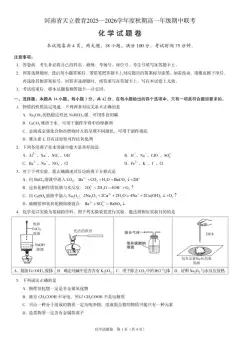
河南省天立教育2025—2026学年度秋期高一年级期中联考
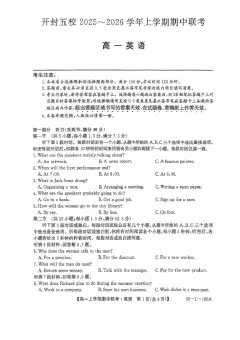
英语试题卷
本试题卷共8页,四大题,67小题,满分150分。考试时间120分钟。
注意事项:
1. 答卷前,考生务必将自己的姓名、班级、考场号、座位号、考生号填写在答题卡上。
2. 回答选择题时,选出每小题答案后,用铅笔把答题卡上对应题目的答案标号涂黑。如需改动,用橡皮擦干净后,
再选涂其他答案标号。回答非选择题时,将答案写在答题卡上。写在本试卷上无效。
3. 考试结束后,将本试题卷和答题卡一并交回。
第一部分 听力(共两节,满分30分)
做题时,先将答案标在试卷上。录音内容结束后,你将有两分钟的时间将试卷上的答案转涂到答题卡上。
第一节(共5小题;每小题1.5分,满分7.5分)
听下面5段对话。每段对话后有一个小题,从题中所给的A、B、C三个选项中选出最佳选项。听完每段对话
后,你都有10秒钟的时间来回答有关小题和阅读下一小题。每段对话仅读一遍。
1. What does the man advise the woman to do?
A. See a doctor. B. Take some medicine.C. Have a
good rest.
2. How does the man feel about his trip?
A. Satisfied. B. Disappointed. C. Excited.
3. What is the woman going to do?
A. Attend a meeting. B. Give a presentation. C. Prepare
for a speech.
4. Why is the man late?
A. His alarm clock didn’t go off. B. He was caught in a traffic jam.
C. He forgot about the appointment.
5. Where are the speakers?
A. At a restaurant. B. At a supermarket. C. At a coffee
shop.
第二节(共15小题;每小题1.5分,满分22.5分)
听下面5段对话或独白。每段对话或独白后有几个小题,从题中所给的 A、B、C三个选项中选出最佳选项。
听每段对话或独白前,你将有时间阅读各个小题,每小题5秒钟;听完后,各小题将给出5秒钟的作答时间。每段
对话或独白读两遍。
听第6段材料,回答第6、7题。
6. What is the woman doing?
A. Complaining about her neighbor. B. Reporting a crime. C. Asking for
advice.
7. What does the man suggest the woman do?A. Call the police. B. Talk to her neighbor directly. C.
Write a letter to the community center.
听第7段材料,回答第8、9题。
8. What are the speakers mainly talking about?
A. A sports event. B. A school club.C. A weekend
activity.
9. What will the man do this Friday?
A. Watch a game. B. Visit his parents. C. Attend a
lecture.
听第8段材料,回答第10至12题。
10. What is the relationship between the speakers?
A. Interviewer and interviewee. B. Boss and employee. C. Teacher
and student.
11. What does the woman say is her greatest strength?
A. Teamwork spirit. B. Communication skills. C .
Problem-solving ability.
12. When will the woman know the result?
A. In two days. B. By the end of this week. C .
Next Monday.
听第9段材料,回答第13至16题。
13. What is the main purpose of the project?
A. To study plant growth. B. To reduce plastic waste. C. To
clean up the river.
14. How long will the project last?
A. For one month. B. For two months. C. For three
months.
15. What does the woman need to bring for the first activity?
A. A notebook. B. A water bottle.C. Some gloves.
16. What is the man’s concern about the project?
A. The cost. B. The weather. C. The time.
听第10段材料,回答第17至20题。
17. What is the talk mainly about?
A. The importance of a balanced diet. B. The benefits of regular exercise.
C. How to reduce stress.
18. How often does the speaker suggest doing exercise?
A. At least three times a week. B. At least four times a week. C .
Every day.
19. What does the speaker say about walking?
A. It is the most effective exercise. B. It is suitable for all ages.C. Itneeds special equipment.
20. What is the speaker’s final advice?
A. To start with light activities. B. To find a partner for exercise.C.
To set a clear goal first.
第二部分 阅读(共两节,满分50分)
第一节(共15小题;每小题2.5分,满分37.5分)
阅读下列短文,从每题所给的A、B、C、D四个选项中选出最佳选项。
A
Four Excellent Museums for Kids to Explore
An injection of knowledge, Leeds
The Thackray Museum of Medicine in Leeds is giving a huge makeover recently. It features a Victorian street full of
real smells and bugs, and presents shows of the impact of some terrible infectious diseases — cholera and smallpox before
vaccinations. There are talks, displays, games as well as some information about health heroes over the years.
Adults: £12; children aged 5-15: £10; children under 5: free.
Follow that train, Walthamstow, London
A huge steam engine stands at the entrance to the small, indoor-outdoor Walthamstow Pumphouse Museum. Two 1967
Victoria Line carriages sit side by side with the cabs open to the would-be train drivers. Fireman Frank display s the fire
engine featured in TV programs such as London’s Burning.
Free entrance.
Life through a lens, Edinburgh
The Camera Obscura and World of Illusions experience in Edinburgh presents a unique view of the city in the past.
With over 100 interactive exhibits on five floors, it is completely kid-friendly with no “don’t touch” signs. There’s a
perspective room where younger children can dance with their own shadow, match their face with a monkey’s, serve their
head on a plate and even lie on a shark.
Adults: £16; children aged 5-15: £12; children under 5: free.
Go back in time, Chichester, West Sussex
Anybody who wants to see, touch and even smell what life was like in ancient times should head to the Weald and
Downland Living Museum — a museum with rural buildings ranging from early medieval England to the Victorian Age,
and a multisensory, living presentation. There are also farm animals to visit, a wood and playground to burn off energy, and
traditional games in one big house if it rains.
Family ticket: £42.
21. What is shown in the Thackray Museum of Medicine recently?
A.Vaccinations used to treat COVID-19. B.Streets of the Victorian period.
C.Information of inventors.D.Some epidemics years ago.
22. How much does it cost a couple with a child of five to experience the perspective room?
A.£76. B.£44. C.£32. D.£16.23. What’s the common subject of the four museums?
A.Protecting the rural areas. B.Raising awareness of safety.
C.Learning about life in the past. D.Inspiring children to learn engineering.
B
At first sight, Easthope doesn’t seem much like a Cassandra(希腊神话人物). She smiles a lot. Her manner is kind
and motherly; pushed to name her profession, you might guess at nurse or teacher. But look closer.
Easthope is an emergency planner whose job is to support the survivors of major disasters, in which capacity she acted
following the 2004 Indian Ocean tsunami and the fire at Grenfell Tower. For two decades, the public knew nothing about
this vital work, which went on behind the scenes, though she was hugely admired in what we might call professional
disaster circles: a voice of calm and a fountain of wisdom. But in 2023, she published a best-selling book about her career,
When the Dust Settles, and that changed. People became very interested in what she did.
“At literary festivals, most authors get questions about their writing process,” Easthope says. “But I wouldn’t get those.
What people wanted from me was to know how I lived with the knowledge that I have. Wasn’t I afraid? How did I handle
it? I would tell them that I didn’t live afraid, and I would give them basic advice. But this wasn’t enough.” In the end, she
felt she had no choice but to write a second book, one in which she would try to distill(浓缩)all that she has learned for
the benefit of each individual.
While her publisher describes Come What May as a road map for resilience(韧性), the word is one Easthope
dislikes. Ready, she suggests, is a better one. Easthope also reminds people that small things, like losing hair during illness
or consuming too much food after someone dies, still matter. She encourages people to remember, not to forget, what
happened during disasters, because such events leave a long-lasting effect.
24. What might a Cassandra be like according to paragraph 1?
A.Severe and forbidding. B.Modest and outgoing.
C.Sincere and energetic. D.Cheerful and approachable.
25. What led to increased public awareness of Easthope’s work in 2023?
A.Her sudden rise to fame through the media. B.The release of a bestseller.
C.Her involvement in the 2004 tsunami relief. D.The growth of professional disaster circles.
26. Why are readers’ questions cited in paragraph 3?
A.To reveal Easthope’s personal fears. B.To explain Easthope’s writing process.
C.To show Easthope’s writing motivation. D.To present public doubts about Easthope’s work.
27. What does Easthope agree on handling disasters?
A.Resilience matters most. B.Forgetting aids recovery.
C.Positive thinking takes the lead. D.Minor sufferings deserve attention.
C
Group interactions are an essential part of personal and professional life, and mastering them can significantly benefit
our social, work, and personal environments. Communication is a complex(复杂的)process, with body language playing
a vital role in how messages are perceived and understood. Understanding body language can significantly improve groupinteractions, making them more positive and productive.
Unlike verbal language, body language often reveals true thoughts and feelings unconsciously. It can share emotions
more directly than words. For example, a bright smile and relaxed shoulders usually show happiness, while leaning back
means being not interested. Even small movements, like tapping fingers or avoiding eye contact, can suggest nervousness,
which words may try to hide.
Gestures are a valuable component of body language, aiding in clarifying and emphasizing spoken messages during
group interactions. Skillful use of gestures can help show passion, support understanding, and maintain engagement(参
与)within a group setting. Descriptive gestures, such as using hands to illustrate a concept or directional movements to
indicate options, can provide visual strengthening to verbal communication. These gestures help ensure that the group can
follow the discussion, especially in complex or technical conversations.
However, too much gestures may become distracting or annoying in group settings. The key is to ensure gestures are
purposeful and relevant, naturally adding to the verbal message. Practicing consistency(一致性)in gestures that match
the tone and content of your speech helps strengthen the intended message, enabling clearer communication and
understanding among group members.
Despite its importance, common misunderstandings about body language often cause misinterpretation. A usual one is
treating single movements as absolute cues(暗示): many think crossed arms equal defensiveness, but it could just be a
comfortable posture or a response to cold. Another is ignoring context-avoiding eye contact in a serious talk might seem
dishonest, but it could result from cultural respect for others. These oversimplified judgments ignored the complexity of
body language and its influencing factors.
28. What can we learn about the relationship between body language and verbal language?
A.Words share emotions more directly. B.Verbal language is more widely used.
C.They have the same cultural meanings. D.Body language is more truthful at times.
29. How can descriptive gestures help group interactions?
A.Hiding nervousness easily. B.Clarifying the group setting.
C.Emphasizing key points. D.Avoiding communication mistakes.
30. What does the author suggest in paragraph 4?
A.Be mindful of overusing gestures. B.Use certain gestures on purpose.
C.Maintain unity in language tones. D.Stick to your intended message.
31. Why people often treat single movements as absolute cues?
A.They are often influenced by others. B.They fail to understand other factors.
C.They are used to observing contexts. D.They have simple communication skills.
D
Crowded by defenders, Charlie Villanueva,one hand lifting the ball high, jump toward the basket. For a moment, he
seems to hang in the air. Then, he pushes the ball down through the basket — a slam dunk(扣篮)! His career may look
like a slam dunk, being a national champion at the University of Connecticut, and setting beginner records with the Toronto
Raptors.However, life wasn’t always easy for him. His success comes not only from his basketball skills but also from how he
dealt with a skin disease called alopecia areata(斑秃), which isn’t infectious. It happens when the body’s immune system
goes wrong and attacks its own hair-growing cells. Charlie was affected at age 10 and lost all his hair by age 12. This made
him a target for bullying(欺凌), leading him to shut away from others and hide under caps and hoods.
With the support of his mother, Charlie found refuge in basketball. He turned his depression and stress into motivation,
improving his skills to the point where his gift became more important than his condition. The bullying stopped, and his
basketball career took off.
All along the way, Charlie has continuously applied himself to helping others. Ever since his first year as a new player,
he has served as a spokesperson for the National Alopecia Areata Foundation, and went on to set up the Charlie Villanueva
Foundation, an organization aimed at supporting families with children suffering from alopecia and stopping all forms of
bullying. As the son of immigrants from the Dominican Republic, he has even worked towards ending poverty in that
country.
Charlie encourages young people to accept their individuality and have confidence in themselves. “We’re all unique in
our own ways,” he says, encouraging them to remember that with dedication and self-belief, any dream is within reach.
32. Why is Charlie’s slam dunk mentioned in Paragraph 1?
A.To compare him with other champions. B.To explain how a slam dunk is performed.
C.To highlight his skills and achievements. D.To show a specific moment in a game.
33. What made Charlie avoid his classmates?
A.An infectious skin disease. B.His being made fun of.
C.An error in the immune system. D.His average ability to play basketball.
34. Which of the following best describes Charlie?
A.Strong-willed and helpful. B.Strict and responsible.
C.Warm-hearted and humorous. D.Independent and creative.
35. What message does the author want to express in the text?
A.Luck often comes to those who are ready. B.Actions speak louder than words.
C.A thousand -mile journey begins with the first step. D.What doesn’t kill you makes you stronger.
第二节(共5小题;每小题2.5分,满分12.5分)
阅读下面短文,从短文后的选项中选出可以填入空白处的最佳选项。选项中有两项为多余选项。
Becoming a super learner is one of the most important skills you need to succeed in the 21st century. In the age of
technological change, staying ahead depends on continual self-education — a lifelong mastery of new skills, and ideas. 3 6
Super learners read a lot.
Reading is to the mind what exercise is to the body. It gives us the freedom to travel through space and time, and offers
a deeper view of ideas and knowledge. In fact, many of the most successful people share this appreciation for reading. 3 7
Super learners view learning as a process.
Learning is a journey, a discovery of new knowledge, not a final stop. It’s an enjoyable lifelong process that super
learners value. 38 Instead, they keep mastering new principles, processes, worldviews, thinking models, etc. The“ongoing and self-motivated pursuit of knowledge is important for their growth.”
3 9
Keeping your brain healthy keeps it sharp. What you do or don’t do for your brain can significantly change how you
record and process information. Everyone wants to live an active life for as long as possible, which depends on brain health.
Fruit, vegetables and protein from fish can slow the decline and protect a healthy brain.
Super learners take short breaks, early and often.
According to recent research, taking short breaks, early and often, is likely to help you learn things better. 40 .
“Anything less than 30 is just not enough, but anything more than 50 is too much information for your brain to take in at one
time,” they say.
A.Experts recommend 30~50 minutes sessions.
B.Super learners have a growth mindset.
C.Super learners take care of their brains.
D.They don’t have an end goal.
E.Better learning approaches can make the learning process enjoyable.
F.Elon Musk grew up reading two books a day, and Bill Gates reads 50 books per year.
G.If you aim to learn a new skill, some of these habits can be useful for you.
第三部分 语言运用(共两节,满分30分)
第一节(共15小题;每小题1分,满分15分)
阅读下面短文,从每题所给的A、B、C、D四个选项中选出最佳选项。
My son “graduated” from elementary school this week. I put the word in quotations(引语)because as a rising 6th
grader, he wasn’t receiving a 41 — and because the school used a 42 term to describe the milestone. On
reflection, the school’s term felt even more 43 than the traditional name of the 44 of one stage of a person’s
education: they called it Moving On.
At the Moving On Ceremony, each member of the 5th grade class 45 one sentence of reflection on what they
were thankful for or would 46 about their primary school years. One 47 words caught my attention — he said
he was — 4 8 for what he called “a step on the ladder”. I was really 4 9 by this 11-year-old’s ability to summarize
the emotional heart of the “moving on” moment. That was totally beyond my imagination.
Growing up is the work of a 5 0 — a ladder that has no top. And the gift of a “moving on” moment is that we get
to celebrate the firm foothold(立足点)we’ve gained on our 51 step, even as we reach upward toward the next. We
get to — 52 — not beyond what we’ve learned and accomplished so far, 53 because we are able to build on
today’s experiences to move ahead toward tomorrow.
We look forward to our son 54 more graduations in his lifetime. But perhaps more than that, we pray that he will
have the ability to recognize many “moving on” moments to celebrate and enjoy with 5 5 .
41. A.prize B.letter C.degree D.gift
42. A.normal B.different C.traditional D.popular43. A.interesting B.successful C.creative D.meaningful
44. A.end B.goal C.process D.task
45. A.translated B.learned C.shared D.completed
46. A.complain B.miss C.worry D.imagine
47. A.teacher’s B.parent’s C.cleaner’s D.student’s
48. A.responsible B.grateful C.concerned D.famous
49. A.struck B.confused C.inspired D.disappointed
50. A.moment B.month C.year D.lifetime
51. A.current B.previous C.future D.upward
52. A.work out B.calm down C.think over D.move forward
53. A.but B.though C.and D.also
54. A.holding B.preparing C.discovering D.experiencing
55. A.kindness B.gratitude C.bravery D.patience
第二节(共10小题;每小题1.5分,满分15分)
阅读下面短文,在空白处填入1个适当的单词或括号内单词的正确形式。
For learning Chinese, the correct pronunciation of the words 56 (be) very important. Native speakers perfect these
sounds as they grow up, but for new learners, this may take time.
For Mandarin learners, pronunciation is one of the 57 (challenge) most people tend to meet with. Error-making is
a — 5 8 (nature) part of learning any language, not just Mandarin, and we all have our own fair share of weak points.
We can easily spot some Mandarin pronunciation mistakes 59 are a lot more common than others. Pronunciation
in Mandarin is important, because a simple shift in tone can completely change the meaning of a word. Unlike other East
Asian languages, Mandarin depends heavily 60 tone to convey the proper meaning, so correct Chinese pronunciation is
essential.
Sometimes, 61 the difference in sound is clear enough, learners make the mistake of pronouncing it the same
way. The best approach to 62 (solve) this is to use a Mandarin pronunciation guide which tells you exactly how
different sounds 6 3 (make) and where they come from so you can differentiate(区别)between them properly.
English has stressed syllables within words, while Mandarin does not. Mandarin can make changes to the tone of the
vowel, which in turn, changes the meaning. Mandarin does have stress within a sentence. 64 (improve) your Mandarin
pronunciation, listen to native Mandarin speakers as much as possible and talk with them too. Besides having general
conversations with people 65 (regular), you should make sure you have a teacher who can help you identify where
you’re going wrong. Remember, practice makes perfect!
第四部分 写作(共两节,满分40分)
第一节(满分15分)
66. 假定你是李华,你的新西兰朋友Jack将要来中国当高中交换生,发邮件向你询问适合课间进行的运动,请你回复
邮件。内容包括:1.推荐一项运动;
2.说明推荐理由。
注意:1.写作词数应为80左右;
2.请按如下格式在答题卡的相应位置作答。
Dear Jack,
Yours sincerely,
Li Hua
第二节(满分25分)
67. 阅读下面材料,根据其内容和所给段落开头语续写两段,使之构成一篇完整的短文。
The first week of the new semester always carried a strange kind of energy — new classes, new faces, and the quiet
hope of starting over. As a 11th-grade transfer student, I walked into the noisy classroom with my head low, clutching(紧
握)my backpack strap like a lifeline. Everything felt foreign — the laughter, the inside jokes, the invisible circles I wasn’t
part of. My new desk mate, Olivia, sat by the window, her notebook perfectly organized, her confidence filling the space
between us. When she noticed me hesitating, she smiled, slid a neatly written class schedule across the desk, and in a soft
voice said she’d show me around at lunch. That small gesture made me want to belong — to be seen.
So when she mentioned the debate club after class, I told her I’d been on the debate team and had even won a regional
contest. It wasn’t planned. The lie just slipped out, smooth and effortless, like it had been waiting for its cue. Her eyes lit up,
and for the first time, I felt noticed — no longer just the quiet new kid.
A few days later, Olivia came running up with a sign- up sheet.“ The annual school-wide debate competition is in a
month — we should team up!” she exclaimed, her enthusiasm unshakable. I tried to match her energy, but the panic settled
deeper each time I imagined standing on stage. Four weeks to prepare — it felt endless and terrifying at the same time.
At our first rehearsal(排练), I stumbled over debate terms, struggled to organize arguments, and froze when asked
to practice rebuttals(反驳). Some teammates exchanged eye rolls and quiet laughs that stung more than their whispers.
Olivia didn’t say anything; her smile faded, polite yet puzzled.
By Friday, the lie felt heavier than the weight on my shoulders. Each “keep going” she offered sounded like a test I
couldn’t pass. That night, I stared at my debate notes, the words swimming before my eyes. I knew I couldn’t keep
pretending. Something had to give.
注意:1.续写词数应为150左右;
2.请按如下格式在答题卡的相应位置作答。
During the next rehearsal, I finally admitted the truth to everyone.
A month later, Olivia and I stepped onto the stage together, ready for the big day.