2015 年 12 月大学英语六级考试真题(第 1 套)
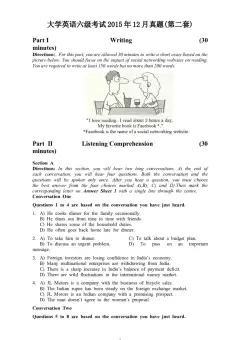
Part I Writing (30 minutes)
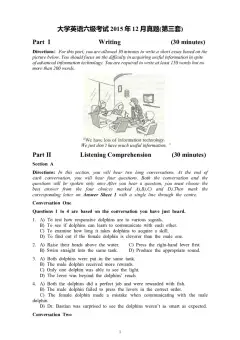
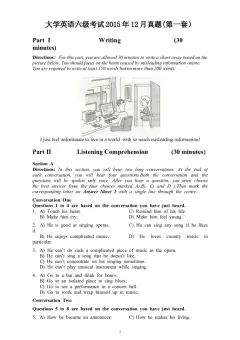
Directions: For this part, you are allowed 30 minutes to write a short essay based on the
picture below. You should focus on the harm caused by misleading information online.
Youarerequiredtowriteat least150words but nomorethan200words.
“I justfeel unfortunate toliveina worldwithsomuchmisleadinginformation!”
Part II Listening Comprehension (30 minutes)
Section A
Directions: In this section, you will hear two long conversations. At the end of each
conversation, you will hear four questions. Both the conversation and the questions will be
spoken only once. After you hear a question, you must choose the best answer from the
four choices marked A), B), C) and D). Then mark the corresponding letter on Answer
Sheet 1 withasinglelinethroughthecentre.
Questions 1to4are basedon theconversation youhavejustheard.
1.A)Touchhis heart. C)Remindhim ofhis life.
B) Makehimcry. D)Make him feel young.
2.A) Heisgood at singingoperas. C)Hecan singanysongifhe likes it.
B) Heenjoys complicated music. D)He loves countrymusic inparticular.
3.A) Hecan’t dosucha complicatedpiece of musicas theopera.
B) Hecan’t singa songthat hedoesn’t like.
C)Hecan’t concentrateonhissinging sometimes.
D)He can’t playmusical instrumentwhilesinging.
4.A) Gotoabarand drinkforhours.
B) Gotoanisolatedplace tosingblues.
C)Gotoseeaperformance inaconcerthall.
D)Gotoworkand wrap himselfupinmusic.
Questions 5to8are basedon theconversation youhavejustheard.
5.A) Howhebecamean announcer. C)Howhe makes his living.
B) Howhewrites news stories. D)How hedoes hisjob.
6.A)They writethe first versionof news stories.
B) Theygather news stories onthespot.
C)Theypolishincomingnews stories.
D)They writecomments onmajornews stories.7.A) Readingthrough thenews stories ina given periodoftime.
B) Havinglittletimetoread thenews before going ontheair.
C)Havingtochange thetoneofhis voicefrom timetotime.
D)Gettingall thewords and phrases pronounced correctly.
8.A) It shows where advertisementscomein.
B) It gives asignal forhim toslowdown.
C)It alerts himtosomethingimportant.
D)It serves as a reminder ofsadnews.
Section B
Directions:In this section, you will hear two passages.At the end of each passage, you will
hear three or four questions. Both the passage and the questions will be spoken only once.
After you hear a question, you must choose the best answer from the four choices marked
A),B),C) and D).Then mark the corresponding letter on Answer Sheet 1 with a single line
throughthecentre.
Questions 9to11are basedon thepassageyou havejustheard.
9.A)They offerstudents awide variety ofcourses.
B) Theyattract studentsfrom all over theworld.
C)Theyadmitmore students thantheycan handle.
D)Theyhave troubledealing withoverseas students.
10.A)Everyone will benefit from educationsoonerorlater.
B) Agood educationcontributes tothe prosperityofa nation.
C)Agood educationis necessaryforone toclimbthesocialladder.
D)Everyone has a right toan educationappropriate tohispotential.
11.A)He likesstudents withhigh motivation.
B) Heenjoys teaching intelligent students.
C)Hetailors histeaching tostudents’needs.
D)He treats all his studentsina fairmanner.
Questions 12to15are basedon thepassageyou havejustheard.
12.A)It ismostlyimportedfrom theMiddleEast.
B) It is a sureindicator ofitseconomic activity.
C)It has adirect impact ontheinternational oil market.
D)It equals more than30millionbarrels ofoil eachday.
13.A) It eventually turns intoheat.
B) It is usedinavariety of forms.
C)Its useis chieflyresponsiblefor air pollution.
D)Part ofit is lostintheprocess oftransmission.
14.A)Whenit is usedinrural areas. C)Whenit operates at nearcapacity.
B)Whenit is environment-friendly. D)Whenit operates at regulartimes.
15.A)Traffic jams incities. C)Fuel shortage.
B) Inefficient useofenergy. D) Global warming.
SectionCDirections: In this section, you will hear three recordings of lectures or talks followed by
three or four questions.The recordings will be played only once. After you hear a question,
you must choose the best answer from the four choices marked A),B), C) and D). Then
markthecorrespondingletter onAnswer Sheet 1 withasingle linethroughthecentre.
Questions 16to18are basedon therecordingyou havejustheard.
16.A) Smellingscentedcandles. C)Talkingwithyourparents often.
B) Settinganalarm forwaking up. D)Listeningtoan upsettingsong.
17.A) Handletheoverwhelmingunopened mail andtinytasks withinoneminute.
B) Doanything that canbe doneinless thanoneminutewithout delay.
C)Doeverythingthat can’t bedone ina minutewithinoneminute.
D)Documents must beprintedout and filedwithinone minute.
18.A)Strict habits. C)Hard rules.
B) Positiveattitude. D) Decision-makingmethods.
Questions 19to22are basedon therecordingyou havejustheard.
19.A)It takes great pains for aperson tobevery rich.
B) Not Everyonewants tobetoorich.
C)Apersonwill neverbesatisfiedwithhis wealth.
D)Aperson willneverhave thefeelingofbeingwealthy.
20.A)Introducinga topic. C)Makinga complaint.
B) Tellingajoke. D) Makinga decision.
21.A)Theywere well paidbytheGermangovernment.
B) TheygatheredmostlyinLondonduringthewar.
C)Theydidn’t provideany valuableinformation forGermany.
D)Theyworked for boththeirowncountryand theirenemies.
22.A)Somecommonchicken foodinAmerica.
B) Thelivingandworking conditionsof Americans.
C)TheGermanandBritish spies inWorldWarTwo.
D)Someexpressions relatedtomoney.
Questions 23to25are basedon therecordingyou havejustheard.
23.A)Thehusband isthehead of thehousehold.
B) Thehusbandusuallymakes bigdecisions.
C)Thewifelives withinher husband’s income.
D)Thewife works and does twokinds ofjobs.
24.A)Theirmother wouldhelpthem toget ready forschool andtomaketheirbreakfast.
B)Theyhadtohelptheirmotherandfathertotakecareoftheiryoungersistersandbrothers.
C)Theirmotherhad toget upearlyinthemorningtodrivethem toschool.
D)Theywere spoiledbytheir parents and didn’t want togo toschool.
25.A)Theroles ofthefather,mother, andchildren havechanged.
B) Anincreasingnumber ofwomen workoutsidethehome.
C)Changes havetaken place inthestructure ofanAmerican family.
D)Theincreasingly rapid paceof lifemakes peopleunder greaterpressure.Part Ⅲ Reading Comprehension (40 minutes)
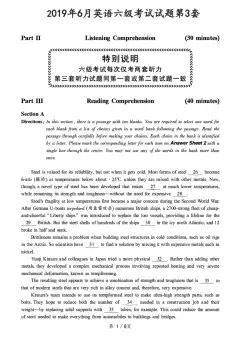
Section A
Directions: In this section, there is a passage with ten blanks. You are required to select
one word for each blank from a list of choices given in a word bank following the passage.
Read the passage through carefully before making your choices. Each choice in the bank is
identifiedby a letter.Please mark the correspondingletter for eachitemon Answer Sheet 2
with a single line through the centre. You may not use any of the words in the bank more
thanonce.
Questions 26to35are basedon thefollowingpassage.
According to a report from the Harvard School of Public Health, many everyday
products, including some bug sprays and cleaning fluids, could lead to an increased risk of
brain and behavioral disorders in children. The developing brain, the report says, is
particularly 26 to the toxic effects of certain chemicals these products may contain, and
thedamagethey causecanbe 27 .
The official policy, however, is still evolving. Health and environmental 28 have
longurged U.S.government agencies to 29 the use of some of the 11 chemicals the
report cites and called for more studies on their long-term effects. In 2001, for example, the
Environmental ProtectionAgency 30 the type and amount of lead that could be present
inpaint and soilinhomes andchild-care 31 , after concerns were raised about lead
poisoning.Theagencyis now 32 the toxic effects of some of the chemicals in the
latestreport.
But the threshold for regulation is high. Because children’s brain and behavioral
disorders, like hyperactivity and lower grades, can also be linked to social and genetic
factors,it’s tough topinthem onexposuretospecific chemicals withsolid 33 evidence,
which is what the EPA requires. Even the Harvard study did not prove a
direct 34 butnotedstrongassociations betweenexposureandriskof behavioralissues.
Nonetheless,it’s smart to 35 caution. While it may be impossible to prevent kids
from drinking tap water that may contain trace amounts of chemicals, keeping kids away
from lawns recentlysprayedwithchemicalsand freshly dry-cleaned clothes can’t hurt.
A)advocates I) particles
B) compact J)permanent
C)correlation K)restricted
D)exercise L) simulating
E) facilities M)statistical
F) interaction N)tighten
G)investigating O)vulnerable
H)overwhelmedSectionB
Directions: In this section, you are going toread a passage withten statements attached to
it. Each statement contains information given in one of the paragraphs. Identify the
paragraph from which the information is derived. You may choose a paragraph more than
once. Each paragraph is marked with a letter. Answer the questions by marking the
correspondingletter onAnswer Sheet 2.
TheImpossibilityofRapid Energy Transitions
[A] Politicians are fond of promising rapid energy transitions. Whether it is a transition
from imported to domestic oil or from coal-powered electricity production to natural-
gas power plants, politicians love to talk big. Unfortunately for them (and often the
taxpayers), our energy systems are a bit like an aircraft carrier: they are unbelievably
expensive, they’re built to last for a very long time, they have a huge amount of
inertia (meaning it takes a lot of energy to set them moving), and they have a lot of
momentum once they are set in motion. No matter how hard you try, you can’t turn
somethingthat large onadime (10美分硬币),or evenafew thousand dimes.
[B] In physics, moving objects have two characteristics relevant to understanding the
dynamics of energy systems: inertia and momentum. Inertia is the resistance of
objects to efforts to change their state of motion. If you try to push a boulder(大圆
石), it pushes you back. Once you have started the boulder rolling, it develops
momentum, which is defined by its mass and velocity. Momentum is said to be
“conserved,” that is, once you build it up, it has to go somewhere. So a heavy object,
likea football player moving at a high speed, has a lot of momentum—that is,once he
is moving, it is hard to change his state of motion. If you want to change his course,
you have only a few choices: you can stop him, transferring (possibly painfully) some
of his kinetic energy(动能)to your own body, or you can approach alongside and
slowlyapplypressure tograduallyalter hiscourse.
[C] But there are other kinds of momentum as well. After all, we don’t speak only of
objects or people as having momentum; we speak of entire systems having
momentum. Whether it’s a sports team or a presidential campaign, everybody relishes
havingthebigmomentum,becauseit makes them harder tostoporchange direction.
[D] One kind of momentum is technological momentum. When a technology is deployed,
its impacts reach far beyond itself. Consider the incandescent(白炽灯的)bulb, an
object currently hated by many environmentalists and energy-efficiency advocates.
The incandescent light bulb, invented by Thomas Edison, which came to be the
symbol of inspiration, has been developed into hundreds, if not thousands, of forms.
Today, a visit to a lighting store reveals a stunning array of choices. There are
standard-shaped bulbs, flame-shaped bulbs, colored globe-shaped bulbs, and more. It
isquiteeasy, withallthat choice, tochange alight bulb.
[E] But the momentum of incandescent lighting does not stop there. All of those
specialized bulbs led to the building of specialized light fixtures, from the desk lamp
you study by, to the ugly but beloved hand-painted Chinese lamp you inherited from
your grandmother, to the ceiling fixture in your closet, to the light in your oven or
refrigerator, and to the light that the dentist points at you. It is easy to change a light
bulb,sure, but itis harder tochange thebulband itsfixture.
[F] And there is more to the story, because not only are the devices that house
incandescent bulbs shaped to their underlying characteristics, but rooms and entirebuildings have been designed in accordance with how incandescent lighting reflects
offwalls andwindows.
[G] As lighting expert Howard Brandston points out, “Generally, there are no bad light
sources, only bad applications.” There are some very commendable characteristics of
the CFL [compact fluorescent(荧光的)light bulb], yet the selection of any light
source remains inseparable from the luminaire(照明装置)that houses it, along
with the space in which both are installed, and lighting requirements that need to be
satisfied. The lamp, the fixture, and the room, all three must work in concert and for
thetrue benefits of end-users.If theCFL should be used for lighting a particular space,
or an object within that space, the fixture must be designed to work with that lamp,
and that fixture with the room. It is a symbiotic(共生的)relationship. A CFL
cannot be simply installed in an incandescent fixture and then expected to produce a
visual appearance that is more than washed out, foggy, and dim. The whole fixture
must be replaced—light source and luminaire—and this is never an inexpensive
proposition.
[H] And Brandston knows a thing or two about lighting, being the man who illuminated
theStatueofLiberty.
[I] Another type of momentum we have to think about when planning for changes in our
energy systems is labor-pool momentum. It is one thing to say that we are going to
shift 30 percent of our electricity supply from, say, coal to nuclear power in 20 years.
But it is another thing to have a supply of trained talent that could let you carry out
this promise. That is because the engineers, designers, regulators, operators, and all of
the other skilled people needed for the new energy industry are specialists who have
to be trained first (or retrained, if they are the ones being laid off in some related
industry), and education, like any other complicated endeavor, takes time. And not
only do our prospective new energy workers have to be trained, they have to be
trained in the right sequence. One needs the designers, and perhaps the regulators,
before the builders and operators, and each group of workers in training has to know
there is work waiting beyond graduation. In some cases, colleges and universities
might have tochangetheir trainingprograms,addinganotherlayer of difficulty.
[J] By far the biggest type of momentum that comes into play when it comes to changing
our energy systems is economic momentum. The major components of our energy
systems, such as fuel production, refining, electrical generation and distribution, are
costly installations that have lengthy life spans. They have to operate for long periods
of time before the costs of development have been recovered. When investors put up
money to build, say, a nuclear power plant, they expect to earn that money back over
the planned life of the plant, which is typically between 40 and 60 years. Some coal
power plants in the United States have operated for more than 70 years! The oldest
continuously operated commercial hydro-electric plant in the United States is on New
York’s HudsonRiver,and itwent intocommercial service in1898.
[K] As Vaclav Smil points out, “All the forecasts, plans, and anticipations cited above
have failed so miserably because their authors and promoters thought the transitions
they hoped to implement would proceed unlike all previous energy transitions, and
thattheirprogress could beacceleratedinan unprecedentedmanner.”
[L] When you hear people speaking of making a rapid transition toward any type of
energy, whether it is a switch from coal to nuclear power, or a switch from gasoline-
powered cars to electric cars, or even a switch from an incandescent to a fluorescentlight, understanding energy system inertia and momentum can help you decide
whethertheir plans are feasible.
36. Not onlymovingobjects andpeople but all systems have momentum.
37. Changing the current energy system requires the systematic training of professionals
andskilledlabor.
38. Changingalight bulbiseasier thanchangingthe fixturehousingit.
39. Efforts toacceleratethecurrent energy transitionsdidn’tsucceedas expected.
40. Tochange thelight source is costlybecauseyou have tochangethewholefixture.
41. Energysystems, likeanaircraft carrier setinmotion,have huge momentum.
42. The problem with lighting, if it arises, often doesn’t lie in light sources but in their
applications.
43. The biggest obstacle to energy transition is that the present energy system is too
expensivetoreplace.
44. Theapplicationofa technologycan impact areas beyond itself.
45. Physical characteristics of moving objects help explain the dynamics of energy
systems.
SectionC
Directions: There are 2 passages in this section. Each passage is followed by some
questions or unfinished statements. For each of them there are four choices marked A), B),
C) and D). You should decide on the best choice and mark the corresponding letter on
AnswerSheet 2withasinglelinethroughthecentre.
PassageOne
Questions 46to50are basedon thefollowingpassage.
One hundred years ago, “Colored” was the typical way of referring to Americans of
African descent. Twenty years later, it was purposefully dropped to make way for “Negro.”
By the late 1960s, that term was overtaken by “Black.” And then, at a press conference in
Chicago in 1988, Jesse Jackson declaredthat “African American” was the term to embrace.
This one was chosen because it echoed the labels of groups, such as “Italian Americans”
and“IrishAmericans,”that hadalreadybeen freed ofwidespreaddiscrimination.
A century’s worth of calculated name changes point to the fact that naming any group
is a politically freighted exercise. A 2001 study cataloged all the ways in which the term
“Black” carried connotations(涵义)that were more negative than those of “African
American.”
But if it was known that “Black” people were viewed differently from “African
Americans,” researchers, until now, hadn’t identified what that gap in perception was
derived from. A recent study, conducted by Emory University’s Erika Hall, found that
“Black” people are viewed more negatively than “African Americans” because of a
perceived difference in socioeconomic status. As a result, “Black” people are thought of as
less competent andas havingcolderpersonalities.The study’s most striking findings shed light on the racial biases permeating the
professional world. Even seemingly harmless details on a resume, it appears, can tap into
recruiters’ biases. A job application might mention affiliations with groups such as the
“Wisconsin Association of African-American Lawyers” or the “National Black Employees
Association,” the names of which apparently have consequences, and are also beyond their
members’control.
In one of the study’s experiments, subjects were given a brief description of a man
from Chicago with the last name Williams. To one group, he was identified as “African-
American,” and another was told he was “Black.” With little else to go on, they were asked
toestimateMr.Williams’s salary, professional standing,andeducational background.
The “African-American” group estimatedthat he earned about $37,000 a year and had
a two-year college degree. The “Black” group, on the other hand, put his salary at about
$29,000, and guessed that he had only “some” college experience. Nearly three-quarters of
the first group guessed that Mr. Williams worked at a managerial level, while only 38.5
percent ofthesecondgroup thought so.
Hall’s findings suggest there’s an argument to be made for electing to use “African
American,” though one can’t help but get the sense that it’s a decision that papers over the
urgency of continued progress. Perhaps a new phrase is needed, one that can bring
everyone one big step closer to realizing Du Bois’s original, idealistic hope: “It’s not the
name—it’s theThingthat counts.”
46.WhydidJesseJacksonembracetheterm“AfricanAmerican”forpeopleofAfricandescent?
A)It isfree from racial biases.
B) It represents social progress.
C)It is intheinterest of commonAmericans.
D)It follows thestandard namingpractice.
47.What does the authorsayabout thenamingof anethnic group?
A)It advances withthetimes.
B) It is basedonracial roots.
C)It merits intensivestudy.
D)It ispoliticallysensitive.
48.What doErika Hall’s findings indicate?
A)Racialbiases are widespreadintheprofessional world.
B) Manyapplicants don’tattend todetailsontheir resumes.
C)Jobseekers shouldall be careful about their affiliations.
D)Mostrecruiters are unable tocontroltheir racial biases.
49.What does Erika Hall findinherexperiment about amanwiththelast nameWilliams?
A)AfricanAmericans fare betterthanmanyother ethnicgroups.
B) Blackpeople’s socioeconomicstatusinAmerica remains low.
C)People’s conceptionofaperson has much todowiththeway heor sheis labeled.
D) One’s professional standingandincomeare related totheireducational background.
50.What is Dr.DuBois’s ideal?A)AllAmericans enjoyequal rights.
B)Aperson is judged bytheirworth.
C)Anew term is created toaddressAfricanAmericans.
D)Allethnic groups share thenation’scontinued progress.
PassageTwo
Questions 51to55are basedon thefollowingpassage.
Across the board, American colleges and universities are not doing a very good job of
preparing their students for the workplace or their post-graduation lives. This was made
clear by the work of two sociologists, Richard Arum and Josipa Roksa. In 2011 they
released a landmark study titled “Academically Adrift,” which documented the lack of
intellectual growth experienced by many people enrolled in college. In particular, Arum
and Roksa found, college students were not developing the critical thinking, analytic
reasoning and other higher-level skills that are necessary to thrive in today’s knowledge-
based economy and to lead our nation in a time of complex challenges and dynamic
change.
Arum and Roksa placed the blame for students’ lack of learning on a watered-down
college curriculum and lowered undergraduate work standards. Although going to college
is supposed to be a full-time job, students spent, on average, only 12 to 14 hours a week
studying and many were skating through their semesters without doing a significant
amount of reading and writing. Students who take more challenging classes and spend
more time studying do learn more. But the priorities of many undergraduates are with
extracurricularactivities,playing sports,and partyingand socializing.
Laura Hamilton, the author of a study on parents who pay for college, will argue in a
forthcoming book that college administrations are overly concerned with the social and
athletic activities of their students. In Paying for the Party, Hamilton describes what she
calls the “party pathway,” which eases many students through college, helped along by
various clubs that send students into the party scene and a host of easier majors. By
sanctioning this water-down version of college, universities are “catering to the social and
educational needs of wealthy students at the expense of others” who won’t enjoy the
financial backing orsocialconnections ofricher students once theygraduate.
These students need to build skills and knowledge during college if they are to use
their degrees as a stepping-stone to middle-class mobility. But more privileged students
must not waste this opportunity either. As recent graduates can testify, the job market isn’t
kind to candidate who can’t demonstrate genuine competence, along with a well-cultivated
willingness to work hard. Nor is the global economy forgiving of an American workforce
with increasingly weak literacy, math and science abilities. College graduates will still fare
better than those with only a high school education, of course. But a university degree
unaccompanied by a gain in knowledge or skills is an empty achievement indeed. For
students who have been coasting through college, and for American universities that have
been demanding less work, offering more attractions and charging higher tuition, the party
maysoonbe over.
51.What isArum andRoksa’sfindingabout higher educationinAmerica?A)It aims at stimulatingtheintellectual curiosityof collegestudents.
B) It fails toprepare students toface thechallengesof moderntimes.
C)It has experienceddramatic changes inrecent years.
D)It has triedhard tosatisfystudents’various needs.
52.What isresponsible for thestudents’lack ofhigher-level skills?
A)Thedilutedcollege curriculum.
B) Theboringclassroom activities.
C)Theabsenceof rigorous discipline.
D)Theoutdated educationalapproach.
53.What does Laura Hamiltonsayabout college administrations?
A)Theyfail togive adequatehelptotheneedy students.
B) Theytendtooffer toomanyless challengingcourses.
C)Theyseemtobeout of touchwithsociety.
D)Theyprioritizenon-academicactivities.
54.What can belearnedabout thesocially andfinancially privilegedstudents?
A)Theytendtohave asense ofsuperiority overtheirpeers.
B) Theycan affordtochooseeasier majors inordertoenjoythemselves.
C)Theyspendalot oftimebuildingstrongconnections withbusinesses.
D)Theycan climbthesocialladder even without adegree.
55.What does theauthor suggest inthelast paragraph?
A)Americanhigher educationhas lostitsglobal competitiveness.
B) Peopleshouldnot expect toomuchfrom Americanhigher education.
C)Thecurrent situationinAmerican higher educationmaynot lastlong.
D)It will takealongtimetochange thecurrent trend inhigher education.
Part IV Translation (30 minutes)
Directions: For this part, you are allowed 30 minutes to translate a passage from Chinese
intoEnglish.Youshouldwriteyour answeron Answer Sheet 2.
在中国,父母总是竭力帮助孩子,甚至为孩子做重要决定,而不管孩子想要什么,因为
他们相信这样做是为孩子好。结果,孩子的成长和教育往往屈从于父母的意愿。
如果父母决定为孩子报名参加一个课外班,以增加其被重点学校录取的机会,他们会坚
持自己的决定,即使孩子根本不感兴趣。
然而在美国,父母很可能会尊重孩子的意见,并在决策时更注重他们的意见。
中国父母十分重视教育或许值得称赞。然而,他们应向美国父母学习在涉及教育时如
何平衡父母与子女间的关系。