机密*启用前
大 学 英 语 六 级 考 试
COLLEGE ENGLISH TEST
—Band Six—
(2018 年 12 月第 3 套)
试 题 册
敬 告 考 生
一、在答题前,请认真完成以下内容:
1. 请检查试题册背面条形码粘贴条、答题卡的印刷质量,如有问题及时向监考员反映,确
认无误后完成以下两点要求。
2. 请将试题册背面条形码粘贴条揭下后粘贴在答题卡1的条形码粘贴框内,并将姓名和准
考证号填写在试题册背面相应位置。
3. 请在答题卡1和答题卡2指定位置用黑色签字笔填写准考证号、姓名和学校名称,并用
HB-2B铅笔将对应准考证号的信息点涂黑。
二、在考试过程中,请注意以下内容:
1. 所有题目必须在答题卡上规定位置作答,在试题册上或答题卡上非规定位置的作答一律
无效。
2. 请在规定时间内在答题卡指定位置依次完成作文、听力、阅读、翻译各部分考试,作答
作文期间不得翻阅该试题册。听力录音播放完毕后,请立即停止作答,监考员将立即收回答
题卡1,得到监考员指令后方可继续作答。
3. 作文题内容印在试题册背面,作文题及其他主观题必须用黑色签字笔在答题卡指定区域
内作答。
4. 选择题均为单选题,错选、不选或多选将不得分,作答时必须使用HB-2B铅笔在答题卡
上相应位置填涂,修改时须用橡皮擦净。
三、以下情况按违规处理:
1. 未正确填写(涂)个人信息,错贴、不贴、毁损条形码粘贴条。
2. 未按规定翻阅试题册、提前阅读试题、提前或在收答题卡期间作答。
3. 未用所规定的笔作答、折叠成毁损答题卡导致无法评卷。
4. 考试期间在非听力考试时间佩戴耳机。
全国大学英语四、六级考试委员会
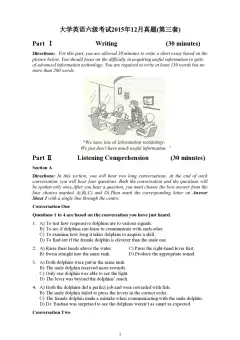
- 1 -Part I Writing (30 minutes)
Directions: For this part, you are allowed 30 minutes to write an essay on how to balance academic study and
extracurricular activities. You should write at least 150 words but no more than 200 words.
Part II Listening Comprehension (30 minutes)
特别说明:由于 2018 年 12月六级考试全国共考了 2 套听力,本套听力试题同第1套或第2套试题一致,因
此在本套真题中不再重复出现。
Part III Reading Comprehension
(40 minutes)
Section A
Directions: In this section, there is a passage with ten blanks. You are required to select one word for each blank
from a list of choices given in a word bank following the passage. Read the passage through carefully before
making your choices. Each choice in the bank is identified by a letter. Please mark the corresponding letter for
each item on Answer Sheet 2 with a single line through the centre. You may not use any of the words in the bank
more than once.
Questions 26 to 35 are based on the following passage.
In what’s probably the craziest headline I’ve ever written, I’ve reported that 26 in livestock protection are
happening with scientists painting eyes on the butts of cows. The experiment is based upon the idea that farmers
who’re protecting their herd from lions would shoot and kill lions in an effort to protect their livestock. While this
makes a lot of sense, it results in many lion deaths that 27 would have been unnecessary. Researchers in Australia
have been 28 and testing a method of trickery to make lions think they are being watched by the painted eyes on
cow butts.
This idea is based on the principle that lions and other 29 are far less likely to attack when they feel they are
being watched. As conservation areas become smaller, lions are increasingly coming into contact with human
populations, which are expanding to the 30 of these protected areas.
Efforts like painting eyes on cow butts may seem crazy at first, but they could make actual headway in the
fight for conservation. “If the method works, it could provide farmers in Botswana—and 31 —with a low-
cost, sustainable tool to protect their livestock, and a way to keep lions safe from being killed.”
Lions are 32 ambush(埋伏)hunters, so when they feel their prey has 33 them, they usually give up on the
hunt. Researchers are 34 testing their idea on a select herd of cattle. They have painted half of the cows with eyes
and left the other half as normal. Through satellite tracking of both the herd and the lions in the area, they will be
- 2 -able to 35 if their psychological trickery will work to help keep farmers from shooting lions.
A)advances I)otherwise
B)boundaries predators
C)challenging primarily L)
D)currently retorted M)
E)determine spotted
F)devising N) testimonies
G)elsewhere O)wrestle
H)nevertheless
Section B
Directions: In this section, you are going to read a passage with ten statements attached to it. Each statement
contains information given in one of the paragraphs. Identify the paragraph from which the information is
derived. You may choose a paragraph more than once. Each paragraph is marked with a letter. Answer the
questions by marking the corresponding letter on Answer Sheet 2.
Resilience Is About How You Recharge, Not How You Endure
[A] As constant travelers and parents of a 2-year-old, we sometimes fantasize about how much work we can
do when one of us gets on a plane, undistracted by phones, friends, or movies. We race to get all our ground work
done: packing, going through security, doing a last-minute work call, calling each other, then boarding the plane.
Then, when we try to have that amazing work session in flight, we get nothing done. Even worse, after refreshing
our email or reading the same studies over and over, we are too exhausted when we land to soldier on with(继续
处理)the emails that have inevitably still piled up.
[B] Why should flying deplete us? We’re just sitting there doing nothing. Why can’t we be tougher, more
resilient(有复原力的)and determined in our work so we can accomplish all of the goals we set for ourselves?
Based on our current research, we have come to realize that the problem is not our hectic schedule or the plane
travel itself; the problem comes from a misconception of what it means to be resilient, and the resulting impact of
overworking.
[C] We often take a militaristic, “tough” approach to resilience and determination like a Marine pulling
himself through the mud, a boxer going one more round, or a football player picking himself up off the ground for
one more play. We believe that the longer we tough it out, the tougher we are, and therefore the more successful
we will be. However, this entire conception is scientifically inaccurate.
[D] The very lack of a recovery period is dramatically holding back our collective ability to be resilient and
successful. Research has found that there is a direct correlation between lack of recovery and increased incidence
of health and safety problems. And lack of recovery—whether by disrupting sleep with thoughts of work or
- 3 -having continuous cognitive arousal by watching our phones—is costing our companies $62 billion a year in lost
productivity.
[E] And just because work stops, it doesn’t mean we are recovering. We “stop” work sometimes at 5 pm,
but then we spend the night wrestling with solutions to work problems, talking about our work over dinner, and
falling asleep thinking about how much work we’ll do tomorrow. In a study just released, researchers from
Norway found that 7.8% of Norwegians have become workaholics(工作狂). The scientists cite a definition of
“workaholism” as “being overly concerned about work, driven by an uncontrollable work motivation, and
investing so much time and effort in work that it impairs other important life areas.”
[F] We believe that the number of people who fit that definition includes the majority of American workers,
which prompted us to begin a study of workaholism in the U.S.. Our study will use a large corporate dataset from
a major medical company to examine how technology extends our working hours and thus interferes with
necessary cognitive recovery, resulting in huge health care costs and turnover costs for employers.
[G] The misconception of resilience is often bred from an early age. Parents trying to teach their children
resilience might celebrate a high school student staying up until 3 am to finish a science fair project. What a
distortion of resilience! A resilient child is a well-rested one. When an exhausted student goes to school, he risks
hurting everyone on the road with his impaired driving; he doesn’t have the cognitive resources to do well on his
English test; he has lower self-control with his friends; and at home, he is moody with his parents. Overwork and
exhaustion are the opposite of resilience and the bad habits we acquire when we’re young only magnify when we
hit the workforce.
[H] As Jim Loehr and Tony Schwartz have written, if you have too much time in the performance zone, you
need more time in the recovery zone, otherwise you risk burnout. Gathering your resources to “try hard” requires
burning energy in order to overcome your currently low arousal level. It also worsens exhaustion. Thus the more
imbalanced we become due to overworking, the more value there is in activities that allow us to return to a state of
balance. The value of a recovery period rises in proportion to the amount of work required of us.
[I] So how do we recover and build resilience? Most people assume that if you stop doing a task like
answering emails or writing a paper, your brain will naturally recover, so that when you start again later in the day
or the next morning, you’ll have your energy back. But surely everyone reading this has had times when you lie in
bed for hours, unable to fall asleep because your brain is thinking about work. If you lie in bed for eight hours,
you may have rested, but you can still feel exhausted the next day. That’s because rest and recovery are not the
same thing.
[J] If you’re trying to build resilience at work, you need adequate internal and external recovery periods. As
researchers Zijlstra, Cropley and Rydstedt write in their 2014 paper: “Internal recovery refers to the shorter
periods of relaxation that take place within the frames of the work day or the work setting in the form of short
- 4 -scheduled or unscheduled breaks, by shifting attention or changing to other work tasks when the mental or
physical resources required for the initial task are temporarily depleted or exhausted. External recovery refers to
actions that take place outside of work—e.g. in the free time between the work days, and during weekends,
holidays or vacations.” If after work you lie around on your bed and get irritated by political commentary on your
phone or get stressed thinking about decisions about how to renovate your home, your brain has not received a
break from high mental arousal states. Our brains need a rest as much as our bodies do.
[K] If you really want to build resilience, you can start by strategically stopping. Give yourself the
resources to be tough by creating internal and external recovery periods. Amy Blankson describes how to
strategically stop during the day by using technology to control overworking. She suggests downloading the
Instant or Moment apps to see how many times you turn on your phone each day. You can also use apps like
Offtime or Unplugged to create tech free zones by strategically scheduling automatic airplane modes. The average
person turns on their phone 150 times every day. If every distraction took only 1 minute, that would account for
2.5 hours a day.
[L] In addition, you can take a cognitive break every 90 minutes to charge your batteries. Try to not have
lunch at your desk, but instead spend time outside or with your friends—not talking about work. Take all of your
paid time off, which not only gives you recovery periods, but raises your productivity and likelihood of
promotion.
[M] As for us, we’ve started using our plane time as a work-free zone, and thus time to dip into the recovery
phase. The results have been fantastic. We are usually tired already by the time we get on a plane, and the
crowded space and unstable internet connection make work more challenging. Now, instead of swimming
upstream, we relax, sleep, watch movies, or listen to music. And when we get off the plane, instead of being
depleted, we feel recovered and ready to return to the performance zone.
36. It has been found that inadequate recovery often leads to poor health and accidents.
37. Mental relaxation is much needed, just as physical relaxation is.
38. Adequate rest not only helps one recover, but also increases one’s work efficiency.
39. The author always has a hectic time before taking a flight.
40. Recovery may not take place even if one seems to have stopped working.
41. It is advised that technology be used to prevent people from overworking.
42. Contrary to popular belief, rest does not equal recovery.
- 5 -43. The author has come to see that his problem results from a misunderstanding of the meaning of resilience.
44. People’s distorted view about resilience may have developed from their upbringing.
45. People tend to think the more determined they are, the greater their success will be.
Section C
Directions: There are 2 passages in this section. Each passage is followed by some question or unfinished
statements. For each of them there are four choices marked A), B), C)and D). You should decide on the best
choice and mark the corresponding letter on Answer Sheet 2 with a single line through the centre.
Passage One
Questions 46 to 50 are based on the following passage.
Children with attention problems in early childhood were 40% less likely to graduate from high school, says
a new study from Duke University.
The study included 386 kindergarteners from schools in the Fast Track Project, a multi-site clinical trial in
the U.S. that in 1991 began tracking how children developed across their lives.
With this study, researchers examined early academic attention and socio-emotional skills and how each
contributed to academic success into young adulthood.
They found that early attention skills were the most consistent predictor of academic success, and that
likability by peers also had a modest effect on academic performance.
By fifth grade, children with early attention difficulties had lower grades and reading achievement scores
than their peers. As fifth-graders, children with early attention problems obtained average reading scores at least
3% lower than their contemporaries’ and grades at least 8% lower than those of their peers. This was after
controlling for IQ, socio-economic status and academic skills at school entry.
Although these may not seem like large effects, the impact of early attention problems continued throughout
the children’s academic careers. Lower reading achievement scores and grades in fifth grade contributed to
reduced grades in middle school and thereby contributed to a 40% lower high school graduation rate.
“The children we identified as having attention difficulties were not diagnosed with attention deficit
hyperactivity disorder(注意力缺乏多动症)(ADHD), although some may have had the disorder. Our
findings suggest that even more modest attention dean of Duke’s Trinity College of Arts & Sciences, whose
research has focused on ADHD and interventions to improve academic performance in children with attention
difficulties.
Social acceptance by peers in early childhood also predicted grades in fifth grade. Children not as liked by
their first-grade peers had slightly lower grades in fifth grade, while those with higher social acceptance had
higher grades.
“This study shows the importance of so-called ‘non-cognitive’ or soft skills in contributing to children’s
- 6 -positive peer relationships, which, in turn, contribute to their academic success,” said Kenneth Dodge, director of
the Duke Center for Child and Family Policy.
The results highlight the need to develop effective early interventions to help those with attention problems
stay on track academically and for educators to encourage positive peer relationships, the researchers said.
“We’re learning that student success requires a more comprehensive approach, one that incorporates not only
academic skills but also social, self-regulatory and attention skills,” Dodge said. “If we neglect any of these areas,
the child’s development lags. If we attend to these areas, a child’s success may reinforce itself with positive
feedback loops.”
46. What is the focus of the new study from Duke University?
A)The contributors to children’s early attention.
B)The predictors of children’s academic success.
C)The factors that affect children’s emotional well-being.
D) The determinants of children’s development of social skills.
47. How did the researchers ensure that their findings are valid?
A)By attaching equal importance to all possible variables examined.
B)By collecting as many typical samples as were necessary.
C)By preventing them from being affected by factors not under study.
D)By focusing on the family background of the children being studied.
48. What do we learn from the findings of the Duke study?
A)Modest students are generally more attentive than their contemporaries.
B)There are more children with attention difficulties than previously thought.
C)Attention deficit hyperactivity disorder accounts for most academic failures.
D)Children’s academic performance may suffer from even slight inattention.
49. What does the Duke study find about children better accepted by peers?
A)They do better academically.
B)They are easy to get on with.
C)They are teachers’ favorites.
D)They care less about grades.
50. What can we conclude from the Duke study?
A)Children’s success is related to their learning environment.
B)School curriculum should cover a greater variety of subjects.
C)Social skills are playing a key role in children’s development.
D)An all-round approach should be adopted in school education.
- 7 -Passage Two
Questions 51 to 55 are based on the following passage
On Jan.9,2007, Steve Jobs formally announced Apple’s “revolutionary mobile phone” — a device that
combined the functionality of an iPod, phone and Internet communication into a single unit, navigated by touch.
It was a huge milestone in the development of smartphones, which are now owned by a majority of
American adults and are increasingly common across the globe.
As smartphones have multiplied, so have questions about their impact on how we live and how we work.
Often the advantages of convenient, mobile technology are both obvious and taken for granted, leaving more
subtle topics for concerned discussion: Are smartphones disturbing children’s sleep? Is an inability to get away
from work having a negative impact on health? And what are the implications for privacy?
But today, on the 10th anniversary of the iPhone, let’s take a moment to consider a less obvious advantage:
the potential for smartphone technology to revolutionize behavioral science. That’s because, for the first time in
human history, a large proportion of the species is in continuous contact with technology that can record key
features of an individual’s behavior and environment.
Researchers have already begun to use smartphones in social scientific research, either to query people
regularly as they engage in their normal lives or to record activity using the device’s built-in sensors. These
studies are confirming, challenging and extending what’s been found using more traditional approaches, in which
people report how they behaved in real life or participate in relatively short and artificial laboratory-based tasks.
Such studies are just first steps. As more data are collected and methods for analysis improve, researchers
will be in a better position to identify how different experiences, behaviors and environments relate to each other
and evolve over time, with the potential to improve people’s productivity and wellbeing in a variety of domains.
Beyond revealing population-wide patterns, the right combination of data and analysis can also help individuals
identify unique characteristics of their own behavior, including conditions that could indicate the need for some
form of intervention—such as an unusual increase in behaviors that signal a period of depression.
Smartphone-based data collection comes at an appropriate time in the evolution of psychological science.
Today, the field is in transition, moving away from a focus on laboratory studies with undergraduate participants
towards more complex, real-world situations studied with more diverse groups of people. Smartphones offer new
tools for achieving these ambitions, providing rich data about everyday behaviors in a variety of contexts.
So here’s another way in which smartphones might transform the way we live and work: by offering insights
into human psychology and behavior and, thus, supporting smarter social science.
51. What does the author say about the negative impact of smartphones?
A)It has been overshadowed by the positive impact.
B)It has more often than not been taken for granted.
C)It is not so obvious but has caused some concern.
D)It is subtle but should by no means be overstated.
52. What is considered a less obvious advantage of smartphone technology?
- 8 -A)It systematically records real human interactions.
B)It helps people benefit from technological advances.
C)It brings people into closer contact with each other.
D)It greatly improves research on human behavior.
53.What characterizes traditional psychological research?
A)It is based on huge amounts of carefully collected data.
B)It relies on lab observations and participants’ reports.
C)It makes use of the questionnaire method.
D)It is often expensive and time-consuming.
54. How will future psychological studies benefit individuals?
A)By helping them pin down their unusual behaviors.
B)By helping them maintain a positive state of mind.
C)By helping them live their lives in a unique way.
D)By helping them cope with abnormal situations.
55. What do we learn about current psychological studies?
A)They are going through a period of painful transition.
B)They are increasingly focused on real-life situations.
C)They are conducted in a more rigorous manner.
D)They are mainly targeted towards undergraduates.
Part IV Translation (30 minutes)
Directions: For this part, you are allowed 30 minutes to translate a passage from Chinese into English. You
should write your answer on Answer Sheet 2.
近年来,中国政府进一步加大体育馆建设投资,以更好地满足人们快速增长的健身需求。除了新建
体育馆外,许多城市换采取了改造旧工厂和商业建筑等措施,来增加当地体育馆的数量。在政府资金的
支持下,越来越多的体育馆向公众免费开放,或者只收取少量费用。许多体育馆通过应用现代信息技术
大大提高了服务质量。人民可以方便地在线预订场地和付费。可以预见,随着运动设施的不断改善,愈
来愈多的人将会去体育馆健身。
- 9 -