机密*启用前
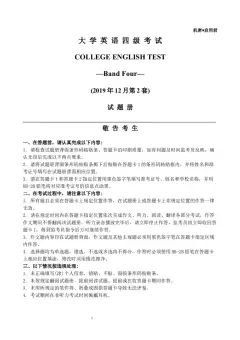
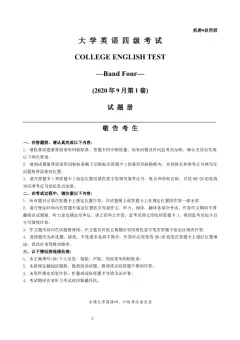
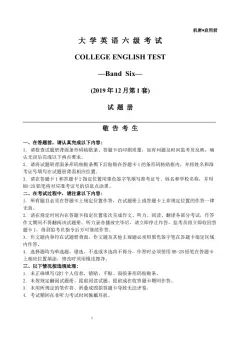
大 学 英 语 四 级 考 试
COLLEGE ENGLISH TEST
—Band Four—
(2019 年 12 月第 1 套)
试 题 册
敬 告 考 生
一、在答题前,请认真完成以下内容:
1. 请检查试题册背面条形码粘贴条、答题卡的印刷质量,如有问题及时向监考员反映,确
认无误后完成以下两点要求。
2. 请将试题册背面条形码粘贴条揭下后粘贴在答题卡1的条形码粘贴框内,并将姓名和准
考证号填写在试题册背面相应位置。
3. 请在答题卡1和答题卡2指定位置用黑色签字笔填写准考证号、姓名和学校名称,并用
HB-2B铅笔将对应准考证号的信息点涂黑。
二、在考试过程中,请注意以下内容:
1. 所有题目必须在答题卡上规定位置作答,在试题册上或答题卡上非规定位置的作答一律
无效。
2. 请在规定时间内在答题卡指定位置依次完成作文、听力、阅读、翻译各部分考试,作答
作文期间不得翻阅该试题册。听力录音播放完毕后,请立即停止作答,监考员将立即收回答
题卡1,得到监考员指令后方可继续作答。
3. 作文题内容印在试题册背面,作文题及其他主观题必须用黑色签字笔在答题卡指定区域
内作答。
4. 选择题均为单选题,错选、不选或多选将不得分,作答时必须使用HB-2B铅笔在答题卡
上相应位置填涂,修改时须用橡皮擦净。
三、以下情况按违规处理:
1. 未正确填写(涂)个人信息,错贴、不贴、毁损条形码粘贴条。
2. 未按规定翻阅试题册、提前阅读试题、提前或在收答题卡期间作答。
3. 未用所规定的笔作答、折叠成毁损答题卡导致无法评卷。
4. 考试期间在非听力考试时间佩戴耳机。
1全国大学英语四、六级考试委员会
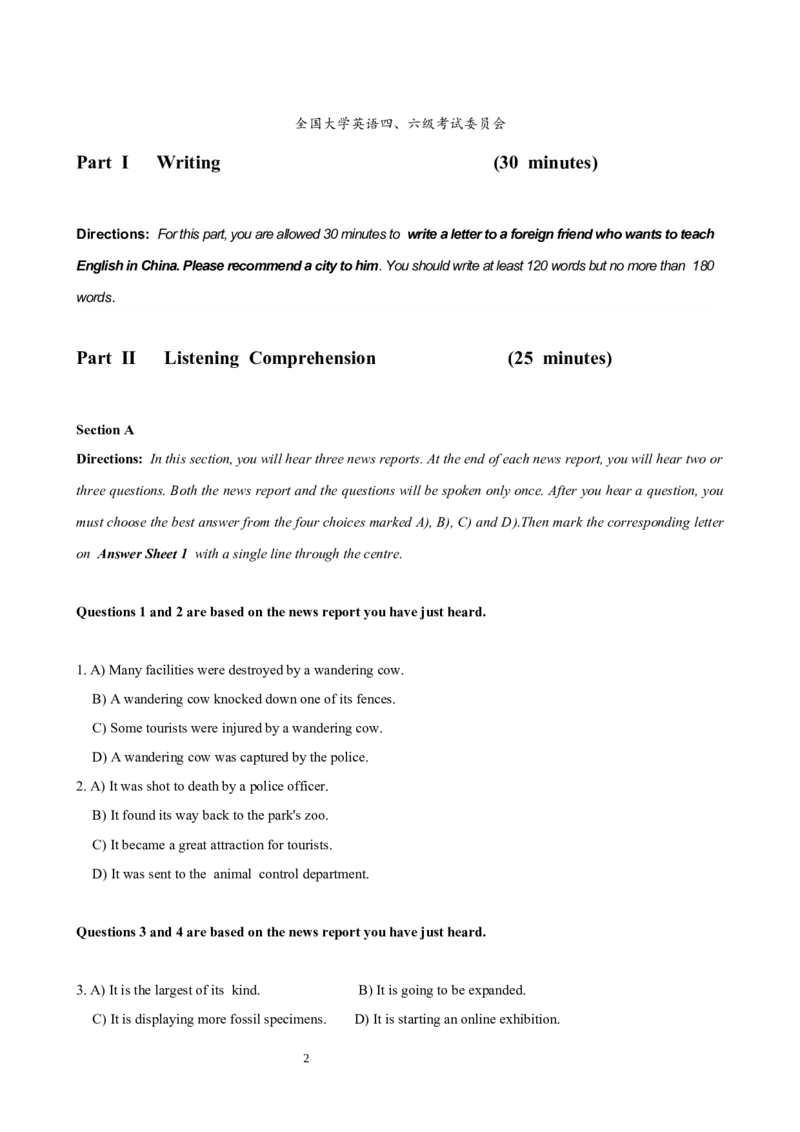
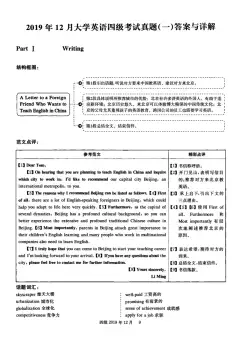
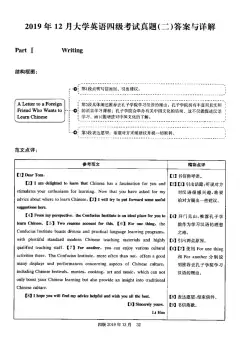
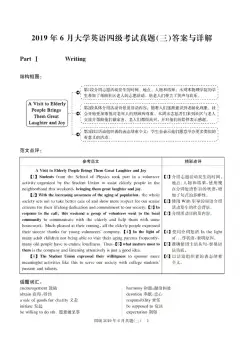
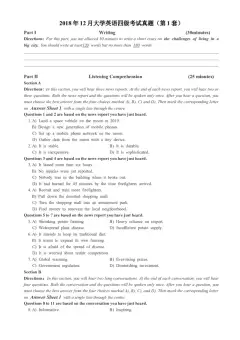
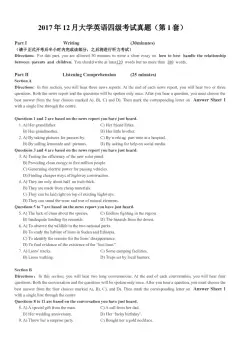
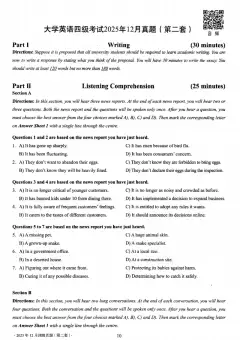
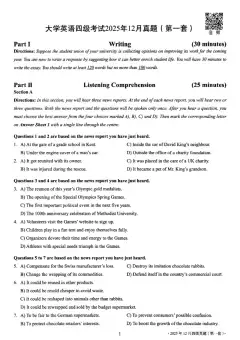
Part I Writing (30 minutes)
Directions: For this part, you are allowed 30 minutes to write a letter to a foreign friend who wants to teach
English in China. Please recommend a city to him. You should write at least 120 words but no more than 180
words.
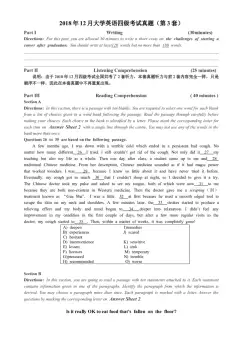
Part II Listening Comprehension (25 minutes)
Section A
Directions: In this section, you will hear three news reports. At the end of each news report, you will hear two or
three questions. Both the news report and the questions will be spoken only once. After you hear a question, you
must choose the best answer from the four choices marked A), B), C) and D).Then mark the corresponding letter
on Answer Sheet 1 with a single line through the centre.
Questions 1 and 2 are based on the news report you have just heard.
1. A) Many facilities were destroyed by a wandering cow.
B) A wandering cow knocked down one of its fences.
C) Some tourists were injured by a wandering cow.
D) A wandering cow was captured by the police.
2. A) It was shot to death by a police officer.
B) It found its way back to the park's zoo.
C) It became a great attraction for tourists.
D) It was sent to the animal control department.
Questions 3 and 4 are based on the news report you have just heard.
3. A) It is the largest of its kind. B) It is going to be expanded.
C) It is displaying more fossil specimens. D) It is starting an online exhibition.
24. A) A collection of bird fossils from Australia.
B) Photographs of certain rare fossil exhibits.
C) Some ancient wall paintings from Australia.
D) Pictures by winners of a wildlife photo contest
Questions 5 to 7 are based on the news report you have just heard.
5. A) Pick up trash.
B) Amuse visitors.
C) Deliver messages.
D) Play with children.
6. A) They are especially intelligent. C) They are quite easy to tame.
B) They are children's favorite. D) They are clean and pretty.
7. A) Children may be harmed by the rooks. C) Children may contract bird diseases.
B) Children may be tempted to drop litter. D) Children may overfeed the rooks.
Section B
Directions: In this section, you will hear two long conversations. At the end of each conversation, you will hear
four questions. Both the conversation and the questions will be spoken only once. After you hear a question, you
must choose the best answer from the four choices marked A), B), C) and D). Then mark the corresponding letter
on Answer Sheet 1 with a single line through the centre.
Questions 8 to 11 are based on the conversation you have just heard.
8. A) It will be produced at Harvard University.
B) It will be hosted by famous professors.
C) It will cover different areas of science.
D) It will focus on recent scientific discoveries.
9. A) It will be more futuristic. C) It will be more entertaining.
B) It will be more systematic. D) It will be easier to understand.
10. A) People interested m science. C) Children in their early teens.
B) Youngsters eager to explore. D) Students majoring science.
311. A) Offer professional advice. C) Help promote it on the Internet.
B) Provide financial support. D) Make episodes for its first season.
Questions 12 to 15 are based on the conversation you have just heard.
12. A) Unsure. B) Helpless. C) Concerned. D) Dissatisfied.
13. A) He is too concerned with being perfect.
B) He loses heart when faced with setbacks.
C) He is too ambitious in achieving goals.
D) He takes on projects beyond his ability.
14. A) Embarrassed. B) Unconcerned. C) Miserable. D) Resentful.
15. A) Try to be optimistic whatever happens.
B) Compare his present with his past only.
C) Always learn from others’ achievements.
D) Treat others the way he would be treated.
Section C
Directions: In this section, you will hear three passages. At the end of each passage, you will hear three or four
questions. Both the passage and the questions will be spoken only once. After you hear a question, you must
choose the best answer from the four choices marked A), B), C) and D). Then mark the corresponding letter on
Answer Sheet 1 with a single line through the centre.
Questions 16 to 18 are based on the passage you have just heard.
16. A) They have a stronger sense of social responsibility.
B) They are more likely to succeed in the humanities.
C) They are more likely to become engineers.
D) They have greater potential to be leaders.
17. A) Praise girls who like to speak up frequently.
B) Encourage girls to solve problems on their own.
C) Insist that boys and girls work together more.
D) Respond more positively to boys comments.
418. A) Offer personalized teaching materials.
B) Provide a variety of optional courses.
C) Place great emphasis on test scores.
D) Pay extra attention to top students.
Questions 19 to 21 are based on the passage you have just heard.
19. A) It often rains cats and dogs.
B) It seldom rains in summer time.
C) It does not rain as much as people think.
D) It is one of the most rainy cities in the US.
20. A) They drive most of the time.
B) The rain is usually very light.
C) They have got used to the rain.
D) The rain comes mostly at night.
21. A) It has a lot of places for entertainment.
B) It has never seen thunder and lightning.
C) It has fewer cloudy days than any other coastal city.
D) It has mild weather both in summer and in winter.
Questions 22 to 25 are based on the passage you have just heard.
22. A) It occurs when people are doing a repetitive activity.
B) It results from exerting one's muscles continuously.
C) It happens when people engage in an uncommon activity.
D) It comes from straining one's muscles in an unusual way.
23. A) Blood flow and body heat increase in the affected area.
B) Body movements in the affected area become difficult.
C) They begin to make repairs immediately.
D) They gradually become fragmented.
24. A) About one week. C) About ten days.
B) About two days. D) About four weeks.
25. A) Apply muscle creams. C) Have a hot shower.
5B) Drink plenty of water. D) Take pain-killers.
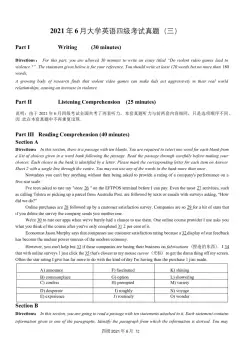
Part III Reading Comprehension (40 minutes)
Section A
Directions: In this section, there is a passage with ten blanks. You are required to select one word for each blank
from a list of choices given in a word bank following the passage. Read the passage through carefully before
making your choices. Each choice in the bank is identified by a letter. Please mark the corresponding letter for
each item on Answer Sheet 2 with a single line through the centre. You may not use any of the words in the bank
more than once.
Questions 26 to 35 are based on the following passage.
When travelling overseas, do you buy water in plastic bottles or take your chances with tap water? Imagine
you are wandering about on a Thai island or 26 the ruins of Angkor. It’s hot so you grab a bottle of water
from a local vendor. It’s the safe thing to do, right? The bottle is 27 , and the label says “pure water”. But
maybe what’s inside is not so 28 . Would you still be drinking it if you knew that more than 90 percent of all
bottled water sold around the world 29 microplastics?
That’s the conclusion of a recently 30 study, which analysed 259 bottles from 11 brands sold in nine
countries, 31 an average of 325 plastic particles per litre of water. These microplastics included a 32
commonly known as PET and widely used in the manufacture of clothing and food and 33 containers. The
study was conducted at the State University of New York on behalf of Orb Media, a journalism organisation.
About a million bottles are bought every minute, not only by thirsty tourists but also by many of the 2.1 billion
worldwide who live with unsafe drinking water.
Confronted with this 34 , several bottled-water manufacturers including Nestle and Coca-Cola
undertook their own studies using the same methodology. These studies showed that their water did contain
microplastics, but far less than the Orb study suggested. Regardless, the World Health Organisation has launched
a review into the 35 health risks of drinking water from plastic bottles.
A) adequate I) natural
B) admiring J) potential
C) contains K) released
D) defending L) revealing
6E) evidence M) sealed
F) instant N) solves
G) liquid O) substance
H) modified
Section B
Directions: In this section, you are going to read a passage with ten statements attached to each statement
contains information given in one of the paragraphs. Identify the paragraph from which the information is
derived. You may choose a paragraph more than once. Each paragraph is marked with a letter. Answer the
questions by marking the corresponding letter on Answer Sheet 2.
The quiet heroism of mail delivery
A) On Wednesday, a polar wind brought bitter cold to the Midwest. Overnight, Chicago reached a low of 21
degrees Fahrenheit below zero, making it slightly colder than Antarctica (南极洲), Alaska, and the North Pole
Wind chills were 64 degrees below zero in Park Rapids, Minnesota and 45 degrees below zero in Buffalo, North
Dakota, according to the National Weather Service. Schools, restaurants, and businesses closed, and more than
1,000 flights were canceled.
B) Even the United States Postal Service (USPS) suspended mail delivery. “Due to this arctic outbreak and
concerns for the safety of USPS employees,” USPS announced Wednesday morning, “the Postal Service is
suspending delivery Jan. 30 in some 3-digit ZIP Code locations.” Twelve regions were listed as unsafe on
Wednesday, on Thursday, eight remained.
C) As global surface temperatures increase, so does the likelihood of extreme weather. In 2018 alone, wildfires,
volcanic, eruptions, hurricanes, mudslides, and other natural disasters cost at least $49 billion in the United
States. As my colleague Vann Newkirk reported, Puerto Rico is still confronting economic and structural
destruction and resource scarcity from 2017’s Hurricane Maria. Natural disasters can wreck a community’s
infrastructure, disrupting systems for months or years. Some services, however, remind us that life will eventually
return, in some form, to normal.
D) Days after the deadly 2017 wildfires in Santa Rosa, California, a drone (无人机)caught footage (连续镜
头)of a USPS worker, Trevor Smith, driving through burned homes in that familiar white van, collecting mail in
7an affected area. The video is striking: The operation is familiar, but the scene looks like the end of the world.
According to Rae Ann Haight, the program manager for the national-preparedness office at USPS, Smith was
fulfilling a request made by some of the home owners to pick up any mail that was left untouched. For Smith, this
was just another day on the job. “I followed my route like I normally do,” Smith told a reporter. “As I came
across a box that was up but with no house, I checked, and there was mail—outgoing mail—in it. And so we
picked those up and carried on.”
E) USPS has sophisticated emergency plans for natural disasters. Across the country, 285 emergency
management teams are devoted to crisis control. These teams are trained annually using a framework known as
the three Ps: people, property, product. After mail service stops due to weather, the agency’s top priority is
ensuring that employees are safe. Then it evaluates the health of infrastructure, such as the roads that mail carriers
drive on. Finally, it decides when and how to re-open operations. If the destruction is extreme, mail addressed to
the area will get sent elsewhere. In response to Hurricane Katrina in 2005, USPS redirected incoming New
Orleans mail to existing mail facilities in Houston. Mail that was already processed in New Orleans facilities was
moved to an upper floor so it would be protected from water damage.
F) As soon as it’s safe enough to be outside, couriers (邮递员) start distributing accumulated mail on the still-
accessible routes. USPS urges those without standing addresses to file change-of-address forms with their new
location. After Hurricane Katrina hit in 2005, mail facilities were set up in dozens of locations across the country
in the two weeks that USPS was unable to provide street delivery.
G) Every day, USPS processes, on average, 493.4 million pieces of mail—anything from postcards to Social
Security checks to medicine. Spokespeople from both USPS and UPS told me all mail is important. But some mail
can be extremely sensitive and timely. According to data released in January 2017, 56 percent of bills are paid
online, which means that just under half of payments still rely on delivery services to be completed.
H) It can be hard to identify which parcels are carrying crucial items such as Social Security checks, but USPS
and UPS try their best to prioritize sensitive material. They will coordinate with the Social Security
Administration to make sure that Social Security checks reach the right people in a timely fashion. After
Hurricane Florence and Hurricane Michael last fall, USPS worked with state and local election boards to make
sure that absentee ballots were available and received or time.
8I) Mail companies are logistics (物流)companies, which puts them in a special position to help when disaster
strikes. In a 2011 USPS case study, the agency emphasized its massive infrastructure as a “unique federal asset” to
be called upon in a disaster or terrorist attack. “I think we’re unique as a federal agency,” USPS official Mike
Swigart told me, “because we’re in literally every community in this country…We’re obligated to deliver to that
point on a daily basis.”
J) Private courier companies, which have more dollars to spend, use their expertise in logistics to help revitalize
damaged areas after a disaster. For more than a decade, FedEx has supported the American Red Cross in its effort
to get emergency supplies to areas affected by disasters, both domestically and internationally. In 2012, the
company distributed more than 1,200 MedPacks to Medical Reserve Corps groups in California. They also
donated space for 3.1 million pounds of charitable shipping globally. Last October, the company pledged $1
million in cash and transportation support for Hurricanes Florence and Michael. UPS's charitable arm, the UPS
Foundation, uses the company’s logistics to help disaster-struck areas rebuild. “We realize that as a company with
people, trucks, warehouses, we needed to play a larger role,” said Eduardo Martinez, the president of the UPS
Foundation. The company employs its trucks and planes to deliver food, medicine, and water. The day before I
spoke to Martinez in November, he had been touring the damage from Hurricane Michael in Florida with the
American Red Cross. “We have an obligation to make sure our communities are thriving,” he said.
K) Rebuilding can take a long time, and even then, impressions of the disaster may still remain. Returning to a
normal life can be difficult, but some small routines—mail delivery being one of them—may help residents
remember that their communities are still their communities. “When they see that carrier back out on the street,”
Swigart said, “that’s the first sign to them that life is starting to return to normal.”
36. The United States Postal Service has a system to ensure its employees’ safety.
37. One official says USPS is unique in that it has more direct reach to communities compared with other federal
agencies.
38. Natural disasters can have a long-lasting impact on community life.
939. Mail delivery service is still responsible for the completion of almost half of payments.
40. The sight of a mailman on the street is a reassuring sign of life becoming normal again.
41. After Hurricane Katrina interrupted routine delivery, temporary mail service points were set up.
42. Postal service in some regions in the U.S. was suspended due to extreme cold weather.
43. Private postal companies also support disaster relief efforts by distributing urgent supplies.
44. A dedicated USPS employee was on the job carrying out duties in spite of extreme conditions.
45. Postal services work hard to identify items that require priority treatment.
Section C
Directions: There are 2 passages in this section. Each passage is followed by some questions or unfinished
statements. For each of them there are four choices marked A), B), C) and D). You should decide on the best
choice and mark the corresponding letter on Answer Sheet 2 with a single line through the centre.
Passage One
Questions 46 to 50 are based on the following passage.
Professor Ashok Goel of Georgia Tech developed an artificially intelligent teaching assistant to help handle
the enormous number of student questions in the online class, Knowledge-Based Artificial Intelligence. This
online course is a core requirement of Georgia Tech’s online Master of Science in Computer Science program
Professor Goel already had eight teaching assistants, but that wasn’t enough to deal with the overwhelming
number of daily questions from students.
Many students drop out of online courses because of the lack of teaching support. When students feel
isolated or confused and reach out with questions that go unanswered, their motivation to continue begins to fade.
Professor Goel decided to do something to remedy this situation and his solution was to create a virtual assistant
named Jill Watson, which is based on the IBM Watson platform.
Goel and his team developed several versions of Jill Watson before releasing her to the online forums. At
10first, the virtual assistant wasn’t too great. But Goel and his team sourced the online discussion forum to find all
40,000 questions that had ever been asked since the class was launched. Then they began to feed Jill with the
questions and answers. After some adjustments, and sufficient time, Jill was able to answer the students’ questions
correctly 97% of the time. The virtual assistant became so advanced and realistic that the students didn’t know she
was a computer. The students, who were studying artificial intelligence, were interacting with the virtual assistant
and couldn’t tell it apart from a real human being. Goel didn’t inform them about Jill’s true identity until April 26.
The students were actually very positive about the experience.
The goal of Professor Goel’s virtual assistant next year is to take over answering 40% of all the questions
posed by students on the online forum. The name Jill Watson will, of course, change to something else next
semester. Professor Goel has a much rosier outlook on the future of artificial intelligence than, say, Elon Musk,
Stephen Hawking, Bill Gates or Steve Wozniak.
46. What do we learn about Knowledge-Based Artificial Intelligence?
A) It is a robot that can answer students' questions.
B) It is a course designed for students to learn online.
C) It is a high-tech device that revolutionizes teaching.
D) It is a computer program that aids student learning.
47. What problem did Professor Goel meet with?
A) His students were unsatisfied with the assistants.
B) His course was too difficult for the students.
C) Students' questions were too many to handle.
D) Too many students dropped out of his course.
48. What do we learn about Jill Watson?
A) She turned out to be a great success.
B) She got along pretty well with students.
C) She was unwelcome to students at first.
D) She was released online as an experiment.
49. How did the students feel about Jill Watson?
A) They thought she was a bit too artificial.
11B) They found her not as capable as expected.
C) They could not but admire her knowledge.
D) They could not tell her from a real person.
50. What does Professor Goel plan to do next with Jill Watson?
A) Launch different versions of her online.
B) Feed her with new questions and answers.
C) Assign her to answer more of students’ questions.
D) Encourage students to interact with her more freely.
Passage Two
Questions 51 to 55 are based on the following passage.
Thinking small, being engaging, and having a sense of humor don’t hurt. Those are a few of the traits of
successful science crowdfunding efforts that emerge from a recent study that examined nearly 400 campaigns. But
having a large network and some promotional skills may be more crucial.
Crowdfunding, raising money for a project through online appeals, has taken off in recent years for
everything from making movies to producing water-saving gadgets. Scientists have tried to tap Internet donors,
too, with mixed success. Some raised more than twice their goals, but others have fallen short of reaching even
modest targets.
To determine what separates science crowdfunding triumphs from failures, a team led by science
communications scholar Mike Schafer of the University of Zurich examined the content of the webpages for 371
recent campaigns.
Four traits stood out for those that achieved their goals, the researchers report in Public Understanding of
Science. For one, they use a crowdfunding platform that specializes in raising money for science, and not just any
kind of project. Although sites like Kickstarter take all comers, platforms such as Experiment. corn and Petridish
org only present scientific projects. For another, they present the project with a funny video because good visuals
and a sense of humor improved success. Most of them engage with potential donors, since projects that answered
questions from interested donors fared better. And they target a small amount of money. The projects included in
the study raised $4000 on average, with 30% receiving less than $1000. The more money a project sought, the
lower the chance it reached its goal, the researchers found.
12Other factors may also significantly influence a project’s success, most notably, the size of a scientist's
personal and professional networks, and how much a researcher promotes a project on their own. Those two
factors are by far more critical than the content on the page. Crowdfunding can be part of researchers’ efforts to
reach the public, and people give because “they feel a connection to the person” who is doing the fundraising—
not necessarily to the science.
51. What do we learn about the scientists trying to raise money online for their projects?
A) They did not raise much due to modest targets.
C) Not all of them achieved their anticipated goals.
B) They made use of mixed fundraising strategies.
D) Most of them put movies online for the purpose.
52. What is the purpose of Mike Schafer’s research of recent crowdfunding campaigns?
A) To create attractive content for science websites.
C) To help scientists to launch innovative projects.
B) To identify reasons for their different outcomes.
D) To separate science projects from general ones.
53. What trait contributes to the success of a crowdfunding campaign?
A) The potential benefit to future generations.
C) Its originality in addressing financial issues.
B) Its interaction with prospective donors.
D) The value of the proposed project.
54. What did the researchers think of the financial targets of crowdfunding projects?
A) They should be small to be successful.
C) They should be assessed with great care.
B) They should be based on actual needs.
D) They should be ambitious to gain notice.
55. What motivates people to donate in a crowdfunding campaign?
A) The ease of access to the content of the webpage.
B) Their desire to contribute to the cause of science.
C) The significance and influence of the project itself.
D) Their feeling of connection to the scientists themselves.
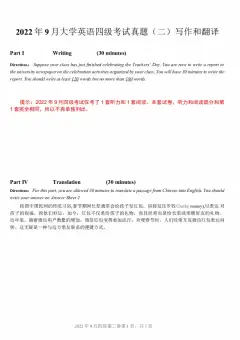
13Part IV Translation (30 minutes)
Directions: For this part, you are allowed 30 minutes to translate a passage from Chinese into English. You
should write your answer on Answer Sheet 2.
中国家庭十分重视孩子的教育。许多父母认为应该努力工作,确保孩子受到良好教育。他们不仅非
常情愿为孩子的教育投资而且花很多时间督促他们学习。多数家长希望孩子能上名牌大学。由于改革开
放,越来越多的家长能送孩子到国外学习或参与国际交流项目,以拓宽其视野。通过这些努力,他们期
望孩子健康成长,为国家的发展和繁荣作出贡献。
14