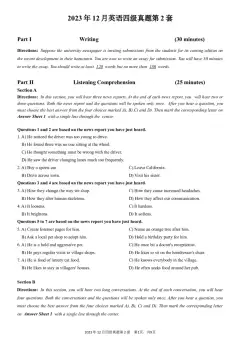
2023 年 12 月英语四级真题第 2 套
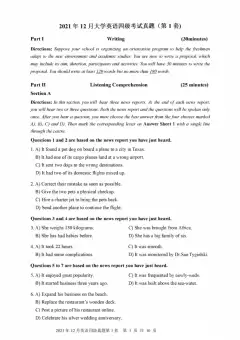
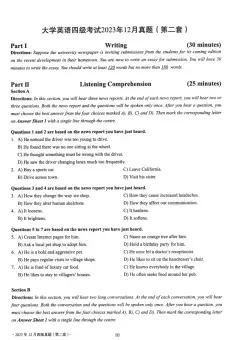
Part I Writing (30 minutes)
Directions: Suppose the university newspaper is inviting submissions from the students for its coming edition on
the recent development in their hometown. You are now to write an essay for submission. You will have 30 minutes
to write the essay. You should write at least 120 words but no more than 180 words.
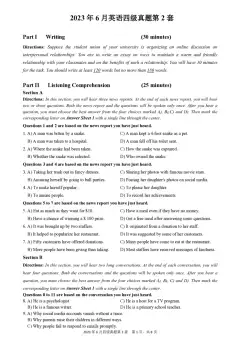
Part II Listening Comprehension (25 minutes)
Section A
Directions: In this section, you will hear three news reports. At the end of each news report, you will hear two or
three questions. Both the news report and the questions will be spoken only once. After you hear a question, you
must choose the best answer from the four choices marked A), B),C) and D). Then mark the corresponding letter on
Answer Sheet 1 with a single line through the center.
Questions 1 and 2 are based on the news report you have just heard.
1. A) He noticed the driver was too young to drive.
B) He found there was no one sitting at the wheel.
C) He thought something must be wrong with the driver.
D) He saw the driver changing lanes much too frequently.
2. A) Buy a sports car. C) Leave California.
B) Drive across town. D) Visit his sister.
Questions 3 and 4 are based on the news report you have just heard.
3. A) How they change the way we shop. C) How they cause increased headaches.
B) How they alter human skeletons. D) How they affect our communication.
4. A) It loosens. C) It hardens.
B) It brightens. D) It softens.
Questions 5 to 7 are based on the news report you have just heard.
5. A) Create Internet pages for him. C) Name an orange tree after him.
B) Ask a local pet shop to adopt him. D) Hold a birthday party for him.
6. A) He is a bold and aggressive pet. C) He once bit a doctor's receptionist.
B) He pays regular visits to village shops. D) He likes to sit on the hairdresser's chair.
7. A) He is fond of luxury cat food. C) He knows everybody in the village.
B) He likes to stay in villagers' houses. D) He often seeks food around her pub.
Section B
Directions: In this section, you will hear two long conversations. At the end of each conversation, you will hear
four questions. Both the conversations and the questions will be spoken only once. After you hear a question, you
must choose the best answer from the four choices marked A), B), C) and D). Then mark the corresponding letter
on Answer Sheet 1 with a single line through the center.
2023年12月四级真题第2套 第1页,共9页Questions 8 to 11 are based on the conversation you have just heard.
8. A) Who to order the food. C) When to go for their meal.
B) Whether to have sandwiches. D) Where to have their lunch.
9. A) In the shopping center nearby. C) At the Sandwich Place on Camden Street.
B) In the expensive Italian style diner. D) At the American restaurant they frequent.
10. A) There is to be a conference call. C) There will be crowds of people waiting for her.
B) She has to meet with her boss then. D) She will have a photo taken with Brigette Clark.
11. A) She doesn't deem homemade soup tasty. C) She feels Jeremy would rather dine out.
B) She doesn't think his wife cooks well. D) She has found the soup smells terrible.
Questions 12 to 15 are based on the conversation you have just heard.
12. A) A landlady. C)A receptionist.
B) A waitress. D) A saleswoman.
13. A) He was involved in a terrible car accident last April. C) He is expected to undergo a knee operation.
B) He has much difficulty getting up and down stairs. D) He prefers to stay next door to the children.
14.A) To please his parents-in-law. C) To satisfy his curiosity.
B) To find the best trip for his kids. D) To compare prices.
15. A) Visit a local art gallery. C) Take some photos of the islands.
B) Go on a boat trip. D) Try her hand-made clothing.
Section C
Directions: In this section, you will hear three passages. At the end of each passage, you will hear three or four
questions. Both the passages and the questions will be spoken only once. After you hear a question, you must
choose the best answer from the four choices marked A), B), C) and D). Then mark the corresponding letter on
Answer Sheet 1 with a single line through the center.
Questions 16 to 18 are based on the passage you have just heard.
16. A) They are more intelligent than many of us. C) They have begun to affect our social behavior.
B) They have already become our new friends. D) They play increasingly more important roles.
17. A) Whether it might have any effect on the way we negotiate.
B) Whether it might actually outperform human negotiators.
C) Whether it can facilitate business transactions.
D) Whether it can speed up legal procedures.
18. A) Choose to be tough. C) Use deceptive strategies.
B) Sympathize with their opponent. D) Appear to be pleasant.
Questions 19 to 21 are based on the passage you have just heard.
19. A) They were perceived differently by some academics.
B) They still existed six months after the course ended.
C) They varied greatly among the course participants.
D) They were only measurable within seven weeks.
2023年12月四级真题第2套 第2页,共9页20. A) They can be easily seen among participants in a healthy weight range.
B) They should be attributed to participants' change in diet behaviors.
C) They are linked to cooking confidence and cooking satisfaction.
D) They actually result from eating more fruits and vegetables.
21. A) Gender. C) Health.
B) Confidence. D) Practice.
Questions 22 to 25 are based on the passage you have just heard.
22. A) It keeps others away. C) It remains visible.
B) It causes discomfort. D) It varies in size.
23. A) It makes us feel uncomfortable. C) It brings the acquaintance closer to us.
B) It renders the acquaintance a stranger. D) It causes the bubble around us to vanish.
24. A) In personal space. C) Within a distance of 18 inches.
B) In social space. D) Over 2 feet away from one another.
25. A) When we begin to feel fear. C) When we are 3 or 4 years old.
B) When we develop a sense of space. D) When we enter our teens.
Part III Reading Comprehension (40 minutes)
Section A
Directions: In this section, there is a passage with ten blanks. You are required to select one word for each blank
from a list of choices given in a word bank following the passage. Read the passage through carefully before
making your choices. Each choice in the bank is identified by a letter. Please mark the corresponding letter for
each item on Answer Sheet 2 with a single line through the centre. You may not use any of the words in the bank
more than once.
A number of studies have looked at how family life can affect productivity and satisfaction in the
workplace. However, there has been ___26___ little research on the influence of leisure activities. So Ciara
Kelly and colleagues recruited 129 hobbyists to look at how the time spent on their hobbies ___27___ their
work life.
The researchers found that when participants spent longer than ___28___ on their leisure activity, their
belief in their ability to perform their job was strengthened. But this was only the ___29___ when they had a
serious hobby that was dissimilar to their job, or when their hobby was similar to their work but they only did
it ___30___. When their hobby was both serious and similar to their job, then spending more time on it
actually decreased their work ___31___.
Why might that be? To maintain a serious hobby, people need to invest significant psychological
resources, say the authors—so if the activity has the same kinds of demands as their work, they may be left
___32___ and unable to perform well at their job. But if their hobby is quite different from their career, it may
not ___33___ in the same way but instead help them develop other knowledge and skills that can ___34___
their confidence at work. "Consider a scientist who is a keen rock climber,” says Kelly. "Since climbing is so
2023年12月四级真题第2套 第3页,共9页far ___35___ from their day-to-day work activities, they can still recover from the demands of their job with
plenty of resources."
A) boost I) normal
B) case J) prevalent
C) casually K) relative
D) efficiency L) removed
E) estate M) scratch
F) exhausted N) shaped
G) faculty O) surprisingly
H) interfere
Section B
Directions: In this section, you are going to read a passage with ten statements attached to it. Each statement
contains information given in one of the paragraphs. Identify the paragraph from which the information is derived.
You may choose a paragraph more than once. Each paragraph is marked with a letter. Answer the questions by
making the corresponding letter on Answer Sheet 2.
More fathers are taking paternity leave, but mothers are still doing all the work
A) Attitudes towards paternity leave (陪产假) have drastically changed in America in the last five years as more
fathers feel comfortable taking extended time off, but gender bias persists when it comes to career prospects
and the home, according to a new study of working parents.
B) Research by the Boston College Center for Work & Family, which surveyed new parents at four large US
companies who were qualified for taking at least six weeks paid parental leave, found that 81% of the
1,240employees surveyed said the notion of fathers taking leave has become more acceptable.
C) Of those surveyed, 62% of fathers took the maximum amount of time off compared to 93% of mothers, and
around three-quarters of workers said their employer was equally supportive of mothers and fathers taking
parental leave and over half said leave policies had made workplace culture better.
D) The US is one of only three countries in the world not to offer statutory (法定的) paid leave, but increasingly
states and companies are starting to take up the issue. So far, eight states and the District of Columbia have their
own paid family leave laws.
E) Brad Harrington, executive director of the center and lead author of the study, estimates only 20% to 30%of
companies in the US offer paid parental leave. He feels the research findings reflect an obvious change in
corporate attitudes to new fathers taking time off.
F) "We did a study on paternity leave five years ago. Compared with those findings, these numbers were shocking
to me. I did not expect 80% of people to say the organisation finds dads taking this leave acceptable and
three-quarters to say it's equally supportive of women and men taking leave," Harrington said.
G) The previous study found that nearly three-quarters of fathers saw two to four weeks as an appropriate duration
for paternity leave and 76% said they would prefer not to take all their time off at once.
2023年12月四级真题第2套 第4页,共9页H) Since then, there have been a number of legal cases against companies involving paternity leave—including
cases against JPMorgan Chase and Estée Lauder—which have helped put pressure on companies to make their
parental leave policies gender neutral.
I) However, the study also shows how traditional gender roles endure both at work, where more women than men
reported changes in their perceived career potential, and at home—even among workers who claim to have a
strong desire for equality.
J) The vast majority of men, 97%, said one of the top reasons to take leave was to share caregiving with their
partner. But when they were asked about how caregiving and household tasks were divided, their answers
painted a different picture. While about 75% of employees said both genders should give the same amount of
care, the majority of men and nearly half of women admitted that in reality the female actually did most of it. A
tiny fraction, 2%, of men said they did more of the childcare.
K) Men and women's experiences of the return to work following parental leave were also considerably different.
Of the women surveyed, 32% reported a downturn in their job satisfaction, while 14% said it increased. In
comparison, 17% of men said their job satisfaction went down and 20% said it went up. Meanwhile, more
women reported an increase in their responsibilities and manager expectations after childbirth. Half of the
women said they used flexible work arrangements after becoming a parent, while just 27% of men did. Similar
percentages of men and women said they enjoyed their careers and that it gave them a sense of achievement,
while around half of women and 44% of men said it was a key part of their identity.
L) On the subject of career advancement, 59% of women and 49% of men said leave could be limiting and both
genders said they feared it would have an impact on their progress long-term. But on opportunity for
promotion, more than double the number of women, 30% compared with 15% of men, believed their chances to
be lower after becoming a parent. Despite progress, the struggle for women to reach the highest positions of
power is demonstrated in this year's Fortune 500 list, which featured a record 33 female CEOs, but this still
represents a tiny fraction of the total.
M) Harrington said culture change depends on companies putting more focus on men and their responsibilities. "By
that I mean companies need to give men paternity leave and encourage men to take time off to be with their
kids early on in the kids' life. They also need to recognise that men have to make significant adjustments when
they become parents. Companies cannot do all these things to enhance women's advancement and then turn
around and say, ‘Oh, but we don't expect the men to take over for the women at home."
N) In May, the American Civil Liberties Union (ACLU) and Outten & Golden LLP announced a historic
class-action $5m settlement with JPMorgan Chase on behalf of male employees who claim they were illegally
denied access to paid parental leave. Derek Rotondo, 35, filed the discrimination charge against his company
after he was allegedly told by his HR department that mothers were considered primary caregivers. Thus, they
were allowed to take 16 weeks of paid parental leave. Fathers, however, could take just two weeks.
O) The father of two from Columbus, Ohio, who still works at the company as an associate and investigator, said
he has witnessed a “domino effect (多米诺效应)” across companies since the settlement, but that there is
still substantial progress to be made towards changing attitudes towards paternity leave.
P) "I do think there's still some way to go...there's still going to be sort of the unstated expectation for new dads to
essentially come right back to work, but I think the research is showing that's starting to change." He said equal
2023年12月四级真题第2套 第5页,共9页parental leave is an essential component to creating gender equality in the workplace. "The old standard of
women staying home, having babies and cooking doesn't apply and hasn't applied for a long time."
36. In the absence of Federal legislation, some states in the US have passed laws concerning paid family leave.
37. Most fathers admitted that even during their paternity leave they actually did much less childcare than the
mother.
38. According to one father, equal parental leave is indispensable to achieving gender equality in the workplace.
39. One survey indicated there is now less objection to paternity leave.
40. Compared to five years ago, according to one researcher, many more people said their organisation gave the
same support to men and women taking parental leave.
41. One study finds that even workers who claim to desire gender equality stick to traditional gender roles both at
work and at home.
42. The majority of workers surveyed said parental leave policies had improved workplace culture.
43. In spite of progress, the number of women in top positions of big companies remains extremely small.
44. According to one estimate, less than one third of companies in the US provide paid parental leave.
45. A number of lawsuits have pressured companies to formulate gender neutral policies on parental leave.
Section C
Directions: There are 2 passages in this section. Each passage is followed by some questions or unfinished
statements. For each of them there are four choices marked A),B),C)and D).You should decide on the best choice
and mark the corresponding letter on Answer Sheet 2 with a single line through the centre.
Passage One
Questions 46 to 50 are based on the following passage.
Having a rival can keep you committed to achieving your goals and enhance your overall performance. But
before you go out and find an entrepreneur to outcompete, it's important to understand and avoid the traps that
often come with rivalry. After all, competitive rivalry can also hinder effective decision-making and increase your
willingness to take risks, behaviors that can ultimately hurt your venture's success.
Finding someone you're committed to outcompeting can be a great way to stay focused on your goals and
push your venture to the next level. But when you're intently focused on outperforming your rivals, you may begin
to develop a "win-at-all-costs" mentality that causes you to ignore how you achieve success. One group of
researchers, for example, examined the link between rivalry and unethical behavior. They found that when people
compete against their rivals, they are more willing to behave unethically to win. But such behavior may stain your
reputation and strain relationships important to your success. One way to avoid this trap is to stop and reflect on
what's important. While outperforming your rivals may provide short-term benefits, the loss of your integrity will
have long-term consequences.
One reason having a rival can enhance your venture's performance is that it creates a level of excitement that
drives you to work harder. But this eagerness to win may also hurt your venture's success, particularly when it
causes you to make impulsive, insensible decisions. But it's possible to avoid such costly mistakes by making a
2023年12月四级真题第2套 第6页,共9页habit of engaging in critical thinking, such as considering opposing viewpoints and conducting cost-benefit
analyses, especially for those decisions that are complex and can determine the future of your venture.
The sense of eagerness that comes with having a rival can not only cause you to make poorer decisions, but it
can also lead you to take greater risks that put your venture in peril. One way you can overcome the risk-inducing
effects of rivalry that stand to endanger your venture's success is to remain attentive to your emotional state and
actively monitor how such feelings are affecting your decision-making.
46. How can competitive rivalry benefit entrepreneurs according to the passage?
A) By enabling them to outcompete other entrepreneurs.
B) By enabling them to make their venture a success.
C) By helping them to reach long-term goals.
D) By helping them to stay goal-oriented.
47. What is one of the traps entrepreneurs may often fall into when competing with rivals?
A) They may adopt strategies that are bound to ruin their venture.
B) They may resort to unethical means to outperform their rivals.
C) They may be too eager to succeed while ignoring the huge labor cost.
D) They may be intently focused on winning at the current market level.
48. What are entrepreneurs advised to do to avoid traps that often accompany rivalry?
A) Deliberate on what really matters. C) Estimate the long-term consequences.
B) Prioritize reaping immediate benefits. D) Reflect on what successes are achievable.
49. How can entrepreneurs avoid making impulsive and insensible decisions?
A) By engaging themselves in critical reasoning.
B) By developing a habit of keeping their integrity.
C) By criticizing themselves for previous poor performances.
D) By refraining from being too excited about their successes.
50. How can entrepreneurs overcome the risk-inducing effects of rivalry?
A) By paying close attention to their current performance.
B) By taking steps that stand to endanger their rivals' success.
C) By monitoring how their decision-making impacts their mentality.
D) By keeping their emotions in check to avoid making poor decisions.
Passage Two
Questions 51 to 55 are based on the following passage.
A multitasker is one who can perform two or more tasks effectively at the same time, which—apart from the
obvious differences—is similar to what a computer does. The concept does indeed come from the realms of
technology, where it is used to refer to an operating system that can execute multiple tasks at the same time.
However, the question is: can a person really be a multitasker?
For most scientists, the answer is no. So much so that, according to experts in neuroscience (神经系统科学),
our brains do not handle multitasking situations well. As soon as two tasks require our attention, productivity
2023年12月四级真题第2套 第7页,共9页suffers. What we call multitasking, therefore, is in reality the ability to move more or less quickly from one task to
another. This requires two essential conditions: that one of the tasks needs to be automatic, like walking or eating,
and that they both need different mental processes. Answering the phone and writing at the same time, for example.
However, on the other side of the coin there are people who maintain that it is possible to be, or at least seem
to be, multitasking. A recent study concluded that regardless of whether people are actually handling several tasks
or not, the mere fact that they perceive this activity as multitasking has a positive effect on their performance.
The business perspective offers a different view: multitasking is understood as the ability to adapt to all types
of environment within a company and effectively undertake different activities within a set time frame. Indeed,
many companies look for people who are skilled in multitasking to improve their productivity. From this different
perspective, you can not only be multitasking but this ability can also be taught: something that is easier in fluid
organisations, which favour flexibility in their working practices.
The benefits of multitasking are clear. Being quicker and more efficient increases our performance and the
number of tasks completed. But having to pay attention to several things at once means that the powers of
concentration are reduced and that can lead to more mistakes.
51. What does a “multitasker” originally refer to?
A) An operating system capable of doing several tasks at once.
B) A skilled worker executing more than one task at the same time.
C) A sophisticated technology doing several tasks effectively at once.
D) An efficient person able to perform multiple tasks at the same time.
52. Why can't people really be multitaskers according to neuroscientists?
A) They are not sufficiently exposed to multitasking situations.
B) They are not comparable to mechanical operating systems.
C) Their brains do not allow them to multitask.
D) Their attention span cannot be expanded.
53. What do we learn from the conclusion of a recent study on multitasking?
A) People make greater achievements by maintaining whatever they are doing is multitasking.
B) People's performance benefits from the perception of what they are doing as multitasking.
C) People's active mental processes exert a positive effect on their multitasking.
D) People can improve their capabilities by handling multitasking situations.
54. How does the business world view multitasking?
A) It is a rare skill often found in fluid organisations.
B) It is an adaptable capability required of all workers.
C) It is an essential quality many employees lack.
D) It is a desirable ability that can be developed.
55. What does the author imply we should do if we have to focus on some task and do it well?
A) Work in a flexible way. C) Avoid multitasking.
B) Learn from mistakes. D) Increase efficiency.
2023年12月四级真题第2套 第8页,共9页Part IV Translation (30 minutes)
Directions: For this part, you are allowed 30 minutes to translate a passage from Chinese into English. You
should write your answer on Answer Sheet 2.
改革开放以来,中国人的饮食(diet)发生了显著变化。过去由于经济落后,食品种类有限、数量不足,人们仅
仅满足于吃得饱。如今中国经济快速发展,食品不仅更加丰富多样,质量也大幅提高。随着生活水平不断提升,
人们对饮食的要求越来越高,更加注重吃得营养健康。因此,目前市场上推出的低脂、低糖、有机食品受到人们
的普遍欢迎。
2023年12月四级真题第2套 第9页,共9页