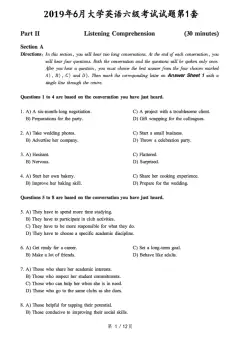
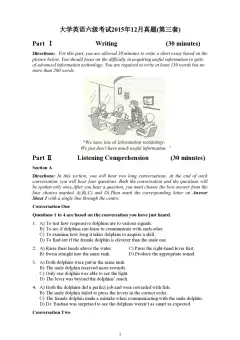
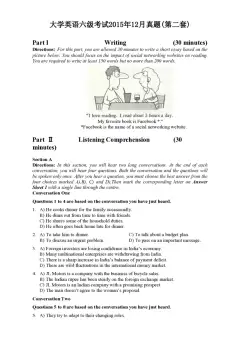
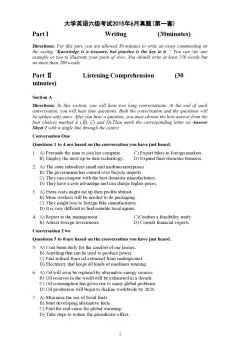
2023 年 12 月英语六级真题第 3 套
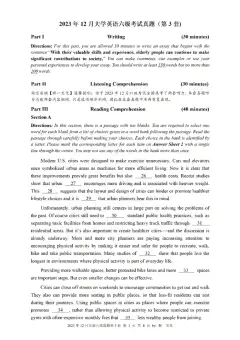
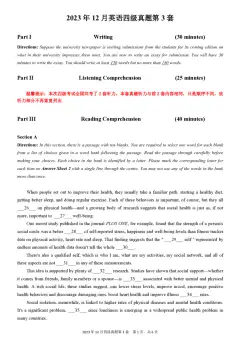
Part I Writing (30 minutes)
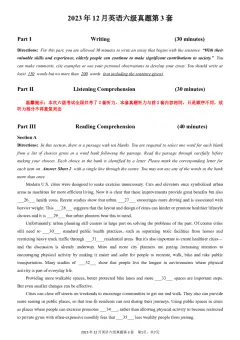
Directions: For this part, you are allowed 30 minutes to write an essay that begins with the sentence “With their
valuable skills and experience, elderly people can continue to make significant contributions to society.” You can
make comments, cite examples or use your personal observations to develop your essay. You should write at least
150 words but no more than 200 words (not including the sentence given).
Part II Listening Comprehension (30 minutes)
温馨提示:本次六级考试全国共考了2套听力,本套真题听力与前2套内容相同,只是顺序不同,故
听力部分不再重复列出
Part III Reading Comprehension (40 minutes)
Section A
Directions: In this section, there is a passage with ten blanks. You are required to select one word for each blank
from a list of choices given in a word bank following the passage. Read the passage through carefully before
making your choices. Each choice in the bank is identified by a letter. Please mark the corresponding letter for
each item on Answer Sheet 2 with a single line through the centre. You may not use any of the words in the bank
more than once.
Modern U.S. cities were designed to make exercise unnecessary. Cars and elevators once symbolized urban
areas as machines for more efficient living. Now it is clear that these improvements provide great benefits but also
___26___ health costs. Recent studies show that urban ___27___ encourages more driving and is associated with
heavier weight. This ___28___ suggests that the layout and design of cities can hinder or promote healthier lifestyle
choices and it is ___29___ that urban planners bear this in mind.
Unfortunately, urban planning still centers in large part on solving the problems of the past. Of course cities
still need to ___30___ standard public health practices, such as separating toxic facilities from homes and
restricting heavy truck traffic through ___31___ residential areas. But it's also important to create healthier
cities—and the discussion is already underway. More and more city planners are paying increasing attention to
encouraging physical activity by making it easier and safer for people to recreate, walk, bike and take public
transportation. Many studies of ___32___ show that people live the longest in environments where physical activity
is part of everyday life.
Providing more walkable spaces, better protected bike lanes and more ___33___ spaces are important steps.
But even smaller changes can be effective.
Cities can close off streets on weekends to encourage communities to get out and walk. They also can provide
more seating in public places, so that less-fit residents can rest during their journeys. Using public spaces in cities
as places where people can exercise promotes ___34___, rather than allowing physical activity to become restricted
to private gyms with often-expensive monthly fees that ___35___ less wealthy people from joining.
2023年12月英语六级真题第3套 第1页,共7页A) correlation I) longevity
B) dense J) navigate
C) deter K) recreational
D) equity L) rotten
E) foster M) sprawl
F) imperative N) vibrate
G) impose O) vicinity
H) irrespective
Section B
Directions: In this section, you are going to read a passage with ten statements attached to it. Each statement
contains information given in one of the paragraphs. Identify the paragraph from which the information is derived.
You may choose a paragraph more than once. Each paragraph is marked with a letter. Answer the questions by
making the corresponding letter on Answer Sheet 2.
Can Learning a Foreign Language Prevent Dementia?
A) You may have heard that learning another language is one method for preventing or at least postponing the
onset of dementia. Dementia refers to the loss of cognitive abilities, and one of its most common forms is
Alzheimer's disease (阿尔茨海默氏病). At this time, the causes of the disease are not well understood, and
consequently, there are no proven steps that people can take to prevent it. Nonetheless, some researchers have
suggested that learning a foreign language might help delay the onset of dementia.
B) To explore this possibility more deeply, let's look at some of the common misconceptions about dementia and
the aging brain. First of all, dementia is not an inevitable part of the normal aging process. Most older adults do
not develop Alzheimer's disease or other forms of dementia. It is also important to remember that dementia is
not the same thing as normal forgetfulness. At any age, we might experience difficulty finding the exact word
we want or have trouble remembering the name of the person we just met. People with dementia have more
serious problems, like feeling confused or getting lost in a familiar place. Think of it this way: If you forget
where you parked your car at the mall, that's normal; if you forget how to drive a car, that may be a signal that
something more serious is going on.
C) The idea that dementia can be prevented is based on the comparison of the brain to a muscle. When people talk
about the brain, they sometimes say things like "It is important to exercise your brain" or "To stay mentally fit,
you have to give your brain a workout." Although these are colorful analogies, in reality the brain is not a
muscle. Unlike muscles, the brain is always active and works even during periods of rest and sleep. In addition,
although some muscle cells have a lifespan of only a few days, brain cells last a lifetime. Not only that, but it
has been shown that new brain cells are being created throughout one's lifespan.
D) While it makes for a colorful analogy, comparing the brain to a muscle is inaccurate and misleading. So, if the
brain is not a muscle, can it still be exercised? Once again, researchers don't know for sure. There are now
many computer, online, and mobile device applications that claim to be able to “train your brain,” and they
typically tap into a variety of cognitive abilities. However, research suggests that although this type of training
may improve one's abilities at the tasks themselves, they don't seem to improve other abilities. In other words,
practicing a letter-detection task will, over time, improve your letter-detection skills, but it will not necessarily
2023年12月英语六级真题第3套 第2页,共7页enhance your other perceptual abilities.
E) However, there is some reason to believe that learning languages might be different. The best evidence that
foreign language learning confers cognitive benefits comes from research with those who are already bilingual
(双语的). Bilingualism most commonly occurs when children are exposed to two languages, either in the home
(mom speaks Dutch, dad speaks Spanish) or more formally in early schooling. But bilingualism certainly
occurs in adulthood as well.
F) Bilingualism and multilingualism are actually more common than you might think. In fact, it has been estimated
that there are fewer monolingual speakers in the world than bilinguals and multilinguals. Although in many
countries most inhabitants share just one language, other countries have several official languages. Switzerland,
for example, has four official languages: German, French, Italian, and Romansh. Throughout large parts of
Africa, Arabic, Swahili, French, and English are often known and used by individuals who speak a different,
native language in their home than they do in the marketplace. So bilingualism and multilingualism are to be
found throughout the world. And with regard to cognitive abilities, the research on those who speak more than
one language paints an encouraging picture.
G) For one thing, bilinguals are better at multitasking. One explanation of this superiority is that speakers of two
languages are continually inhibiting one of their languages, and this process of inhibition confers general
cognitive benefits to other activities. In fact, bilingual individuals outperform their monolingual counterparts on
a variety of cognitive tasks, such as following complex instructions, and switching to new instructions. For the
sake of completeness, it should be noted that the advantages of being bilingual are not universal across all
cognitive domains. Bilingual individuals have been shown to have smaller vocabularies and to take longer in
retrieving words from memory when compared to monolinguals. In the long run, however, the cognitive and
linguistic advantages of being bilingual far outweigh these two drawbacks.
H) If the benefits of being bilingual spill over to other aspects of cognition, then we would expect to see a lower
incidence of Alzheimer's disease in bilinguals than in monolinguals, or at least a later onset of Alzheimer's for
bilinguals. In fact, there is evidence to support this claim. The psychologist Ellen Bialystok and her colleagues
obtained the histories of 184 individuals who had made use of a memory clinic in Toronto. For those who
showed signs of dementia, the monolinguals in the sample had an average age of 71.4 years at time of onset.
The bilinguals, in contrast, received their diagnosis at 75.5 years, on average. In a study of this sort, a difference
of four years is highly significant, and could not be explained by other systematic differences between the two
groups. For example, the monolinguals reported, on average, a year and a half more schooling than their
bilingual counterparts, so the effect was clearly not due to formal education.
I) A separate study, conducted in India, found strikingly similar results: bilingual patients developed symptoms of
dementia 4.5 years later than monolinguals, even after other potential factors, such as gender and occupation,
were controlled for. In addition, researchers have reported other positive effects of bilingualism for cognitive
abilities in later life, even when the person acquired the language in adulthood. Crucially, Bialystok suggested
that the positive benefits of being bilingual were only found in those who used both languages all the time.
J) But encouraging as these kinds of studies are, they still have not established exactly how or why differences
between bilinguals and monolinguals exist. Because these studies looked back at the histories of people who
were already bilingual, the results can only say that a difference between the two groups was found, but not
why that difference occurred. Further research is needed to determine what caused the differences in age of
2023年12月英语六级真题第3套 第3页,共7页onset between the two groups.
K) Other studies of successful aging suggest that being connected to one's community and having plenty of social
interaction is also important in delaying or even preventing the onset of dementia. Once again, however, the
results are far less clear than the popular media might lead you to believe. Older individuals who lead active
social lives are, almost by definition, healthier than their counterparts who rarely leave their homes or interact
with others. So we can't really say whether being socially active prevents the onset of dementia, or if people
who don't have dementia are more likely to be socially active.
L) But even if studying a foreign language is not a magical cure-all, there is one thing it will do: It will make you a
better speaker of a foreign language. Doing that confers a whole host of advantages we do know about.
36. Research indicates that brain training is likely to boost one's ability at specific tasks, but not one's other
cognitive abilities.
37. According to estimates, the number of people who speak two languages or more is greater than those who
speak one language only.
38. For the time being, we do not know what causes people to lose their cognitive abilities, or what we can do to
prevent it.
39. It is hard to determine whether people who are free from dementia tend to have more social activities, or more
social activities keep people away from dementia.
40. There is evidence that learning foreign languages might be beneficial to boosting one's cognitive abilities.
41. It was suggested that only those who always spoke two languages could benefit from bilingualism.
42. The brain is different from muscles in that it keeps working even when the body is at rest.
43. People who speak two languages do better at a number of cognitive tasks than those who speak only one
language.
44. Dementia is different from being merely forgetful and entails more serious trouble.
45. It is claimed that more monolinguals suffer from Alzheimer's disease than bilinguals.
Section C
Directions: There are 2 passages in this section. Each passage is followed by some questions or unfinished
statements. For each of them there are four choices marked A),B),C)and D).You should decide on the best choice
and mark the corresponding letter on Answer Sheet 2 with a single line through the centre.
Passage One
Questions 46 to 50 are based on the following passage.
Research is meant to benefit society by raising public awareness and creating products and innovations that
enhance development. For research to serve its full purpose, the results must leave the confines of research
laboratories and academic journals.
Findings effectively communicated can go a long way to serve the interests of the public. They can help
address social injustices or improve treatments offered to patients.
Many researchers seem to be content with sharing the results of their studies in academic journals or at
conferences. But few journals allow everybody to read the findings. Even articles freely available are usually
written in academic language incomprehensible to the average reader.
2023年12月英语六级真题第3套 第4页,共7页For researchers in the tenure-track system, their main goal is winning tenure, which in part can be achieved by
getting a number of papers published in prominent journals. Pressures like this mean community-level outreach is
not prioritised.
Many researchers lack the writing skills to describe their results to a general audience. They may also worry
about whether the public will understand their findings, or about findings being used to influence controversial
policies. These concerns cause some researchers to shy away from communicating their findings outside the
academic community.
Propagating research findings beyond academic publications is particularly crucial for addressing certain
social discrepancies. It can help families, communities, healthcare providers, policymakers, government agencies
and other stakeholders to understand and respond to crises that plague society.
The benefits of sharing findings flow both ways. Engaging with other researchers and the public can lead to
unexpected new connections and new ideas that could suggest fruitful new directions for research.
To benefit both researchers and the communities, the need to find innovative, accessible ways to share the
work cannot be overstated.
Institutions and funding organisations should support more researchers to publish in open access journals so
that the public doesn't have to pay to read them. Institutions and researchers should invest in partnerships that
expand capacity for sharing results more broadly.
Furthermore, ethics committees should make it mandatory for researchers to share their results with the public.
Every research participant should opt in or out of receiving results, as part of the process of giving informed
consent.
There could be misunderstanding of the findings presented by the researcher because of technical terms. But
this can be resolved by researchers engaging the services of professional writers or communication officers to help
with translating their study into more accessible language and share it widely with media outlets and the public.
Sharing results with the people who are most affected by them makes us better researchers and ensures that
our work can be used to improve people's lives. Institutions and collaborators must recognise the value of doing so.
46. How can research serve its full purpose according to the author?
A) With researchers being aware of public interests.
B) With its findings published in prominent journals.
C) With researchers creating products that enhance social development.
D) With its findings properly communicated beyond the academic circle.
47. Why do ordinary readers find it difficult to access the results of researchers' studies?
A) They cannot understand the academic language used for reporting these results.
B) They feel intimidated by the jargon researchers use to describe their findings.
C) They do not attend conferences where these results are freely available.
D) They have few chances to locate the journals that publish these findings.
48. What is one of the reasons some researchers won't prioritise communicating their findings to the public?
A) They can thrive on the papers published.
B) Their top consideration is to win tenure.
C) Their main goal is gaining recognition in their field.
2023年12月英语六级真题第3套 第5页,共7页D) They have to struggle to reach out to the community.
49. How can sharing findings benefit researchers themselves?
A) By helping them to identify new research directions.
B) By enabling them to understand crises plaguing society.
C) By enabling them to effectively address social discrepancies.
D) By helping them to forge ties with government agencies.
50. Why are researchers advised to engage the services of professional writers or communication officers?
A) To satisfy ethics committees' mandatory requirements of researchers.
B) To translate their study into languages accessible to readers overseas.
C) To make their publications correctly understood by the public.
D) To render their findings acceptable by prominent journals.
Passage Two
Questions 51 to 55 are based on the following passage.
Spiders make their presence felt in late August and through early autumn. This is the mating season of some of
the most common varieties, when male house spiders come out of hidden corners to look for females, and garden
spiders reach adult size and spin their most dazzling webs.
Yet while the spider is a familiar fixture of nursery poems or songs and Halloween decorations, its relationship
with humans is complicated. Fear of spiders is common and has serious impacts on the lives of sufferers. Its
prevalence appears unrelated to any rational assessment of risk. Spiders in the UK are almost all harmless.
Farmland species perform valuable ecosystem services, by preying on insects that are our competitors for crops.
But they are a constant source of human anxieties—with a cultural association with witches and wickedness dating
back to the middle ages.
Does this perhaps explain, in part, the lack of data about how spiders are faring in our age of ecological crisis?
British butterflies are the most studied group of insects in the world, due to the long tradition of collecting and
observing them. But spider conservationists point out that it was only in the 1980s that the classification of house
spiders was properly sorted out. And while information about insect populations is gathered by experiments that
measure the numbers hitting windscreens or traps, there have been few attempts to count spiders.
The huge reductions in the numbers of flying insects can only mean a reduction in spiders' food supply. A
recent landmark study identified a 75% fall in insect populations between 1989 and 2016, with pesticide use
thought to be to blame along with the destruction of wild areas for development. This means the overall picture for
spiders is worrying, as it is for most creatures. But conservationists are most concerned about those varieties that
are threatened due to habitat loss and fragmentation, which makes it impossible for them to migrate.
Of around 650 spider species regularly recorded in the UK, the majority thrive in marshes and wasteland.
Conservation efforts, often led by determined individuals, have helped some species to recover by reintroducing
them to new areas. With rewilding now firmly on the environmental policy agenda, the hope is that in future,
spiders will be enabled to migrate by themselves, adapting to climate change by moving along wildlife corridors.
It seems unlikely that spiders will ever attract the same level of human enthusiasm as bees, birds or butterflies,
in spite of their unique status as nature's spinners. But as they reveal themselves in all their splendour this autumn,
it would be a good thing if more animal lovers recognised the ways in which spiders are simply terrific.
2023年12月英语六级真题第3套 第6页,共7页51. What do we learn about spiders in the UK since the middle ages?
A) They have been generally misconceived.
B) They have adversely impacted crop growth.
C) They have been a constant reminder of bad luck.
D) They have made their presence felt when spinning webs.
52. What have spiders been associated with in the UK for centuries?
A) Harm. C) Suffering.
B) Evil. D) Aggression.
53. What partly accounts for the reduction in spiders' food supply?
A) The long tradition of collecting insects. C) Chemicals used for killing insects.
B) Fast reproduction of their competitors. D) The extinction of a lot of wildlife.
54. What does the passage say is conservationists’ biggest worry?
A) A variety of spiders are threatened due to pollution of marshes and wasteland.
B) Certain species of spiders are endangered due to loss of their natural homes.
C) An increasing number of spiders are being killed by deadly pesticides.
D) More and more spider species are found losing their ability to migrate.
55. What wish does the author express close to the end of the passage?
A) More people would recognise spiders' unique status in the ecosystem.
B) People would show greater enthusiasm for spiders than for butterflies.
C) There would be sufficient corridors for spiders to move along.
D) There would be more people appreciating spiders' splendour.
Part IV Translation (30 minutes)
Directions: For this part, you are allowed 30 minutes to translate a passage from Chinese into English. You
should write your answer on Answer Sheet 2.
近年来,中国老龄人口持续增长。中国政府正采取各种措施,推进养老服务体系建设,使老年人晚年
生活健康幸福。全国兴建了各类养老服务机构。为了提升养老机构的服务质量,政府颁布了一系列标准,
加强对养老机构的监管。许多城市为方便老年人用餐,开设了社区食堂,为他们提供价格实惠的饭菜。行
动不便的老年人还能享受上门送餐服务。同时,中国还在积极探索居家和社区养老等其他养老模式,以确
保所有老年人老有所养。
2023年12月英语六级真题第3套 第7页,共7页