大学英语六级考试2015年6月真题(第三套)
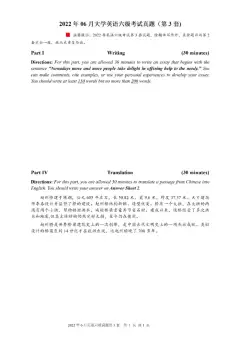
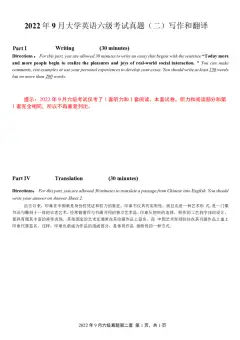
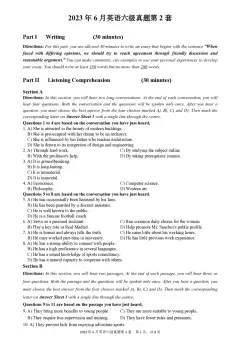
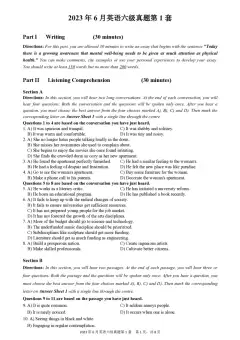
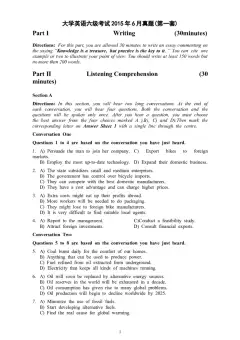
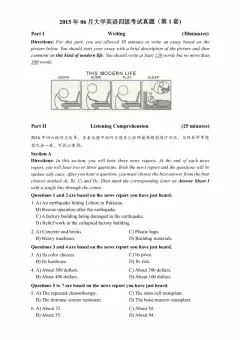
Part I Writing (30 minutes)
Directions: For this part, you are allowed 30 minutes to write an essay commenting on
the saying“If you cannot do great things, do small things in a great way."You can cite
examplesto illustrate yourpointofview.Youshouldwrite atleast150wordsbutnomore
than200words.
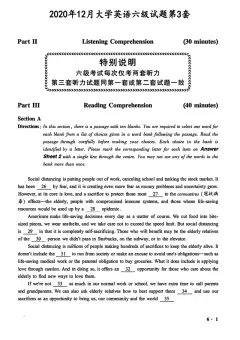
Part Ⅱ Listening Comprehension (30 minutes)
SectionA
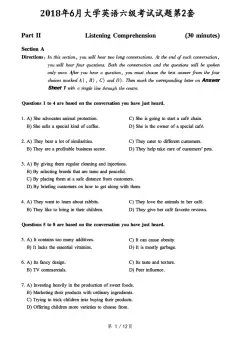
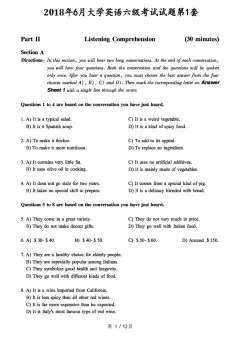
Directions: In this section, you will hear two long conversations. At the end of each
conversation, you will hear four questions. Both the conversation and the questions will
bespokenonlyonce.Afteryouhearaquestion,youmustchoosethebestanswerfromthe
four choices marked A),B), C) and D).Then mark the corresponding letter on Answer
Sheet1withasinglelinethroughthecentre.
ConversationOne
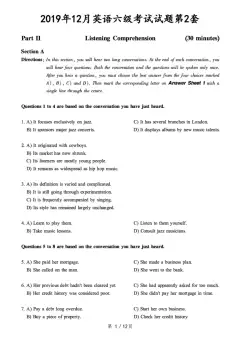
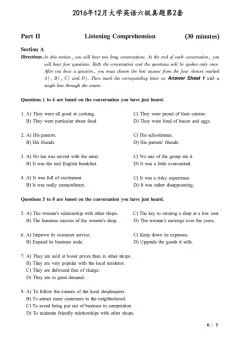
Questions1to4arebasedontheconversationyouhavejustheard.
1. A)Itiswellpaid. C)Itisdemanding.
B)Itisstimulating. D)Itisfairlysecure.
2. A)Aquickpromotion. C)Movingexpenses.
B)Freeaccommodation. D)Alighterworkload.
3. A)Hehasdifficultycommunicatingwithlocalpeople.
B)Hehastospendalotmoretravelingbackandforth.
C)Hehastroubleadaptingtothelocalweather.
D)Hehastosignalong-termcontract.
4. A)Thewomanwillhelpthemanmakeachoice.
B)Themanisgoingtoattendajobinterview.
C)Themanisintheprocessofjobhunting.
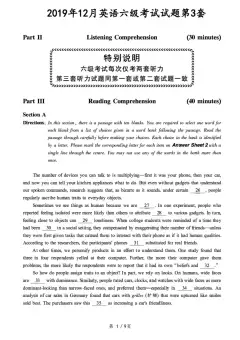
D)Thewomansympathizeswiththeman.
ConversationTwo
Questions5to8arebasedontheconversationyouhavejustheard.
5. A)Toinquireabouttheinterestratesatthewoman’sbank.
B)Toinquireaboutthecurrentfinancialmarketsituation.
C)Toseeifhecanfindajobinthewoman’scompany.
D)Toseeifhecangetaloanfromthewoman’sbank.
6. A)Thereisnodifferencebetweenrateandyield.
B)Themanhasagoodunderstandingofrateandyield.
C)Therateisthepercentageofsimpleinterestpaidonthemoney.
D)Theyieldisonlyinfluencedbytheamountofmoney.
7. A)Long-terminvestment. C)Anyhigh-interestdeposit.
B)Athree-monthdeposit. D)Anyhigh-yieldinvestment.
8. A)Shetreatedhimtoameal. C)Sheofferedhimdiningcoupons.
B)Shegavehimloansatlowrates. D)Sheraisedinterestratesforhim.SectionB
Directions: In this section, you will hear two passages. At the end of each passage, you
will hear three or four questions. Both the passage and the questions will be spoken only
once.After you hear a question, you must choose the best answer from the four choices
marked A),B),C) and D).Then mark the corresponding letter on Answer Sheet 1 with a
singlelinethroughthecentre.
PassageOne
Questions9to12arebasedonthepassageyouhavejustheard.
9. A)ItisaPortuguesecompanysellingcoffeeinNewYork.
B)Itsmostimportanttaskistoconductcoffeestudies.
C)Itrepresentsseveralcountriesthatexportcoffee.
D)Itsroleistoregulateinternationalcoffeeprices.
10.A)ThefreezingweatherinBrazil.
C)Theincreasedcoffeeconsumption.
B)Theimpactofglobalwarming.
D)Thefluctuationofcoffeeprices.
11.A)Heisdoingabachelor’sdegree. C)Heisaheavycoffeedrinker.
B)Heisyoung,handsomeandsingle. D)Heistall,richandintelligent.
12.A)Avisittoseveralcoffee-growingplantations.
B)Coffeepricesandhisadvertisingcampaign.
C)Avacationonsomebeautifultropicalbeach.
D)Aquickpromotionandahandsomeincome.
PassageTwo
Questions13to15arebasedonthepassageyouhavejustheard.
13.A)Theywereheldupinatrafficjam.
B)Theyboardedawrongcoachinahurry.
C)Theywerelateforthefirstmorningbus.
D)Theyweredelayedbythetrainforhours.
14.A)Itwascanceledbecauseofanunexpectedstrike.
C)Itwasspoiledbypooraccommodations.
B)Itwasthemostexcitingtriptheyeverhad.
D)Itwaspostponedduetoterribleweather.
15.A)Gooverseas. C)Takeromanticcruises.
B)Stayathome. D)Takeescortedtrips.
SectionC
Directions: In this section, youwill hearthreerecordingsoflectures or talks followed by
threeorfourquestions.Therecordingswillbeplayedonlyonce.Afteryouhearaquestion,
you must choose the best answer from the four choices marked A),B), C) and D).Then
markthecorrespondingletteronAnswerSheet1withasinglelinethroughthecentre.
Questions16to19arebasedontherecordingyouhavejustheard.
16.A)Theirextraordinaryintelligence. C)Thewaytheycommunicate.
B)Thespecialbonesintheirfins. D)Thewaytheygetwater.
17.A)Theylovetokeepthemaspetsjustlikecatsanddogs.
B)Theylovethembutcannotlivewiththem.
C)Theycanfindmanystoressellingsuchsouvenirs.D)Theybelievesuchsouvenirscanbringgoodluck.
18.A)Theymadethemswimaroundtheirships.
B)Theypaintedtheirimagesonsomeitems.
C)Theyhuntedthemingreatnumbers.
D)Theytrainedthemtoperformtricks.
19.A)TheyarehuntedinmanyplacesexceptJapan.
B)Theyhavebeenprotectedthankstoliteratureandfilm.
C)Theyhaveadaptedtothelifeincaptivity.
D)Theyarelosingtheirhabitatandcleansea.
Questions20to22arebasedontherecordingyouhavejustheard.
20.A)Itwon’thaveanyside-effect.
B)Itcankilldrug-resistanttumours.
C)Itcanbeaseffectiveasconventionaltreatments.
D)Itcanstopcancercellsfromspreadinginthebody.
21.A)Howtofindawaytodelivervirusestotumourseffectively.
B)Howtoinjectvirusesdirectlyintotumours.
C)Howtoallowvirusestodowhatchemotherapydrugsdo.
D)Howtostrengthenthebody’simmunesystem.
22.A)Touseittocure75%ofthepatientswithmalignantcancers.
B)Tomakeitacceptedbythepatientswithincurablecancers.
C)Toapplyittothosewithsecondarycancers.
D)Toapplyittotreatallkindsofcancers.
Questions23to25arebasedontherecordingyouhavejustheard.
23.A)ItallowsusersofsomeKindledevicestoborrowbooksfromlocallibraries.
B)IthasbenefitedmorethaneleventhousandlocallibrariesintheUS.
C)Ithasledtoadebatebetweenpublishersandlibrariesovere-booklending.
D)Itaimsatallowingeveryonetoreadbooksanytimetheylike.
24.A)Theycanpurchaseanykindofmediaproduct.
B)Theycanlendbookstoreadersrepeatedly.
C)Theycandealwithdigitalproductsastheylike.
D)Theycanlimitthetimethereaderskeepacertainbook.
25.A)Byallowinglibrariestopurchasee-booksforlendinginperpetuity.
B)Byadoptingthetechnologyknownasdigitalrightsmanagement.
C)Byrequiringlibrariestopurchasemoreofitse-book.
D)Bypersuadingthecriticstosupportthepublishers.
Part Ⅲ Reading Comprehension (40minutes)
SectionA
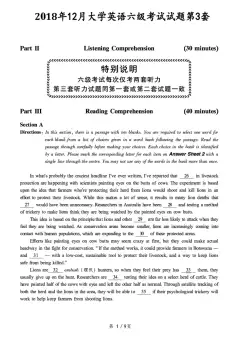
Directions: In this section, there is a passage with ten blanks. You are required to select
onewordforeachblankfromalistofchoicesgiveninawordbankfollowingthepassage.
Read the passage through carefully before making your choices. Each choice in the bank
is identified by a letter. Please mark the corresponding letter for each item on Answer
Sheet 2 with a single line through the centre. You may not use any of the words in the
bankmorethanonce.
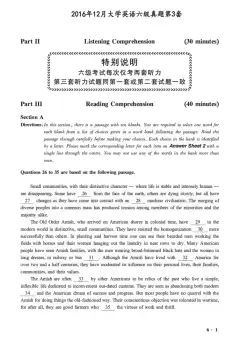
Questions26to35arebasedonthefollowingpassage.Travel websites have been around since the 1990s, when Expedia, Travelocity, and
other holiday booking sites were launched, allowing travelers to compare flight and hotel
prices with the click of a mouse. With information no longer__26__by travel agents or
hidden in business networks, the travel industry was revolutionized, as greater
transparencyhelped__27__prices.
Today, the industry is going through a new revolution—this time transforming
service quality. Online rating platforms— __28__ in hotels, restaurants, apartments, and
taxis—allowtravelerstoexchangereviewsandexperiencesforalltosee.
Hospitality businesses are now ranked, analyzed, and compared not by industry
__29__, but by the very people for whom the service is intended—the customer. This
has __30__ a new relationship between buyer and seller. Customers have always voted
with their feet; they can now explain their decision to anyone who is interested. As a
result, businesses are much more __31__, often in very specific ways, which creates
powerful__32__toimproveservice.
Although some readers might not care for gossipy reports of unfriendly bellboys
(行李员)in Berlin or malfunctioning hotel hairdryers in Houston, the true power of
online reviews lies not just in the individual stories, but in the websites’ __33__ to
aggregatealargevolumeofratings.
The impact cannot be __34__. Businesses that attract top ratings can enjoy rapid
growth, as new customers are attracted by good reviews and __35__ provide yet more
positive feedback. So great is the influence of online ratings that many companies now
hiredigitalreputationmanagerstoensureafavorableonlineidentity.
A) accountable K) professionals
B) capacity L) slash
C) controlled M)specializing
D)entail N)spectators
E)forged O)subsequently
F) incentives
G) occasionally
H) overstated
I) persisting
J) pessimistic
SectionB
Directions: Inthissection,youaregoingtoreadapassagewith tenstatements attached
to it. Each statement contains information given in one of the paragraphs. Identify theparagraph from which the information is derived. You may choose a paragraph more
than once.Each paragraphis markedwith a letter . Answer the questions bymarking the
correspondingletteronAnswerSheet2.
PlasticSurgery
Abettercreditcardisthesolutiontoeverlargerhackattacks.
[A] A thin magnetic stripe (magstripe) is all that stands between your credit-card
informationandthebadguys.Andthey’vebeenworkinghardtobreakin.That’swhy
2014 is shaping up as a major showdown: banks, law enforcement and technology
companies are all trying to stop a network of hackers who are succeeding in stealing
accountnumbers, names, email addresses and other crucial data used in identity theft.
More than 100 million accounts at Target, Neiman Marcus and Michaels stores were
affectedinsomewayduringthemostrecentattacks,startinglastNovember.
[B] Swipe(刷卡)is the operative word: cards are increasingly vulnerable to attacks
when you make purchases in a store. In several recent incidents, hackers have been
able to obtain massive information of credit,-debit-(借记)or prepaid-card numbers
using malware, i.e. malicious software, inserted secretly into the retailers’ point-of-
sale system—the checkout registers. Hackers then sold the data to a second group of
criminalsoperatinginshadowycornersofthe web.Notlongafter,thestolen datawas
showinguponfakecardsandbeingusedforonlinepurchases.
[C]Thesolutioncouldcostaslittleas$2extraforeverypieceofplasticissued.Thefixis
a security technology used heavily outside the U.S. While American credit cards use
the 40-year-old magstripe technology to process transactions, much of the rest of the
world uses smarter cards with a technology called EMV (short for Europay,
MasterCard, Visa) that employs a chip embedded in the card plus a customer PIN
(personalidentificationnumber)toauthenticate(验证)everytransactiononthespot.
If a purchaser fails to punch in the correct PIN at the checkout, the transaction gets
rejected.(Onlinepurchasescanbemadebysettingupaseparatetransactioncode.
[D] Why haven’t big banks adopted the more secure technology? When it comes to
mailing out new credit cards, it’s all about relative costs, says David Robertson, who
runs the Nilson Report, an industry newsletter. “The cost of the card, putting the
sticker on it, coding the account number and expiration date, embossing(凸印)it,
the small envelope—all put together, you’re in the dollar range. ” A chip- and-PIN
card currently costs closer to $3, says Robertson, because of the price of chips. (Once
largeissuersconverttogether,thechipcostsshoulddrop.
[E] Multiply $3 by the more than 5 billion magstripe credit and prepaid cards in
circulation in the U.S. Then consider that there’s an estimated $12.4 billion in card
fraud on a global basis, says Robertson. With 44% of that in the U.S. , American
credit-card fraud amounts to about $5.5 billion annually. Card issuers have so far
calculated that absorbing the liability for even big hacks like the Target one is still
cheaperthanreplacingallthatplastic.
[F] That leaves American retailers pretty much alone the world over in relying on
magstripe technology to charge purchases—and leaves consumers vulnerable. Each
magstripe has three tracks of information, explains payments security expert Jeremy
Gumbley, the chief technology officer of Credit Call, an electronic-payments
company. The first and third are used by the bank or card issuer. Your vital account
information lives on the second track, which hackers try to capture. “Malware is
scanningthroughthememoryinrealtimeandlookingfordata,”hesays.“Itcreatesa
textfilethatgetsstolen.”[G] Chip-and-PIN cards, by contrast, make fake cards or skimming impossible because
theinformationthatgetsscannedisencrypted(加密).ThehistoricalreasontheU.S.
has stuck with magstripe, ironically enough, is once superior technology. Our cheap,
ultra-reliable wired networks made credit- card authentication over the phone
frictionless. In France, card companies created EMV in part because the telephone
monopoly was so maddeningly inefficient and expensive. The EMV solution allowed
transactionstobeverifiedlocallyandsecurely.
[H] Some bigbanks,like Wells Fargo,are nowofferingto convertyourmagstripe cardto
a chip-and-PIN model. (It’s actually a hybrid(混合体)that will still have a
magstripe, since most U.S. merchants don’t have EMV terminals.) Should you take
themuponit?Ifyoutravelinternationally,theanswerisyes.
[I] Keep in mind, too, that credit cards typically have better liability protection than debit
cards.If someone usesyour creditcardfraudulently(欺诈性的),it’s the issuer or
merchant, not you, that takes the hit. Debit cards have different liability limits
depending on the bank and the events surrounding any fraud. “If it’s available, the
logicalthing is to geta chip-and-PIN cardfrom your bank,” says Eric Adamowsky, a
co-founder of Credit Cardlnsider.com. “I would use credit cards over debit cards
becauseofliabilityissues.”Cashstillworksprettywelltoo.
[J] Retailers andbanks standto benefitfrom the lower fraud levels of chip-and-PIN cards
but have been reluctant for years to invest in the new infrastructure (基础设施)
needed for the technology, especially if consumers don’t have access to it. It’s a
chicken-and-egg problem: no one wants to spend the money on upgraded point-of-
salesystems thatcanreadthe chipcardsif shoppersaren’tcarryingthem—yetthere’s
little point in consumers’ carrying the fancy plastic if stores aren’t equipped to use
them. (An earlier effort by Target to move to chip and PIN never gained progress.)
According to Gumbley, there’s a “you-first mentality. The logjam(僵局)has to be
broken.”
[K] JPMorgan Chase CEO Jamie Dimon recently expressed his willingness to do so,
noting that banks and merchants have spent the past decade suing each other over
interchange fees—the percentage of the transaction price they keep—rather than deal
with the growing hacking problem. Chase offers a chip- enabled card under its own
brand and several others for travel-related companies such as British Airways and
Ritz-Carlton.
[L] The Target and Neiman hacks have also changed the cost calculation: although
retailers have been reluctant to spend the $6.75 billion that Capgemini consultants
estimate it will take to convert all their registers to be chip-and-PIN-compatible, the
potentialliability they now face is dramatically greater. Target has beenhit with class
actions from hacked consumers. “It’s the ultimate nightmare,” a retail executive from
awell-knownchainadmittedtoTIME.
[M] The card-payment companies MasterCard andVisa are pushinghard for change. The
two firms have warned all parties in the transaction chain—merchant, network,
bank—that if they don’t become EMV-compliant by October 2015, the party that is
leastcompliantwillbearthefraudrisk.
[N] Inthe meantime, app-equippedsmartphonesanddigitalwallets—allofwhich canuse
EMVtechnology—arebeginningtomakeinroads(侵染)oncardsandcash.PayPal,
for instance, is testing an app that lets you use your mobile phone to pay on the fly at
local merchants—without surrendering any card information to them. And further
down the road is biometric authentication, which could be encrypted with, say, a
fingerprint.[O] Credit and debit cards, though, are going to be with us for the foreseeable future, and
so are hackers, if we stick with magstripe technology. “It seems crazy to me,” says
Gumbley, who is English, “that a cutting-edge-technology country is depending on a
40-year-old technology.” That’s why it may be up to consumers to move the needle
onchipandPIN.SaysRobertson:“ When you get the consumer into a position of
worryandinconvenience,that’swheretherubberhitstheroad.”
36.ItisbesttouseanEMVcardforinternationaltravel.
37.Personalinformationoncreditanddebitcardsisincreasinglyvulnerabletohacking.
38. The French card companies adopted EMV technology partly because of inefficient
telephoneservice.
39. While many countries use the smarter EMV cards, the U.S. still clings to its old
magstripetechnology.
40.Attemptsarebeingmadetopreventhackersfromcarryingoutidentitytheft.
41.Creditcardsaremuchsafertousethandebitcards.
42. Big banks have been reluctant to switch to more secure technology because of the
highercostsinvolved.
43. The potential liability for retailers using magstripe is far more costly than upgrading
theirregisters.
44. The use of magstripe cards by American retailers leaves consumers exposed to the
risksoflosingaccountinformation.
45. Consumers will be a driving force behind the conversion from magstripe to EMV
technology.
SectionC
Directions: There are 2 passages in this section. Each passage is followed by some
questionsorunfinishedstatements.ForeachofthemtherearefourchoicesmarkedA),B),
C) and D). You should decide on the best choice and mark the corresponding letter on
AnswerSheet2withasinglelinethroughthecentre.
PassageOne
Questions46to50arebasedonthefollowingpassage.
What’s the one word of advice a well-meaning professional would give to a recent
collegegraduate?China?India?Brazil?Howabouttrade?
When the Commerce Department reported last week that the trade deficit in June
approached $50 billion, it set off a new round of economic doomsaying. Imports, which
soared to $200.3 billion in the month, are subtracted in the calculation of gross domestic
product. The larger the trade deficit,the smaller the GDP. Should such imbalances
continue,pessimistssay,theycouldcontributetoslowergrowth.
But there's another way of looking at the trade data.Over the past two years, the
figures on imports and exports seem not to signal a double-dip recession--a renewed
decline in the broad level of economic activity in the United States-but an economic
expansion.
The rising volume of trade—more goods and services shuttling in and out of the
United States — is good news for many sectors. Companies engaged in shipping,
trucking,rail freight,delivery, and logistics(物流) have all been reporting better than
expected results. The rising numbers signify growing vitality in foreign markets—when
weimportmorestuff, itputsmorecashinthehandsofpeoplearoundtheworld,andU.S.exports are rising because more foreigners have the ability to buy the things we produce
and market. The rising tide of trade is also good news for people who work in trade-
sensitive businesses, especially those that produce commodities for which global demand
setstheprice-agriculturalgoods,mining,metals,oil.
And while exports always seem to lag, U.S. companies are becoming more involved
in the global economy with each passing month.General Motors sells as many cars in
China as in America each month. While that may not do much for imports, it does help
GM'sbalancesheet—andhencemakesthejobsofU.S.-basedexecutivesmorestable.
One great challenge for the U.S. economy is slack domestic consumer
demand.Americans are paying down debt, saving more, and spending more carefully.
That's tobeexpected,givenwhatwe'vebeenthrough.Butthere’sabiggerchallenge.Can
U.S.-based businesses,large and small, figure out how to get a piece of growing global
demand?Unless you wantto pickupandmove to India, orBrazil, orChina,the bestway
to do that is through trade. It may seem obvious, but it's no longer enough simply to do
businesswithourfriendsandneighborshereathome.
Companies and individuals who don't have a strategy to export more,or to get more
involved in foreign markets, or to play a role in global trade, are shutting themselves out
ofthelion’sshareofeconomicopportunityinourworld.
46.HowdopessimistsinterprettheU,S.tradedeficitinJune?
A)ItreflectsAmericans'preferenceforimportedgoods.
B)ItsignifiesachangeinAmericaneconomicstructure.
C)Itcouldleadtoslowergrowthofthenationaleconomy.
D)ItistheresultofAmerica'sgrowingfocusondomesticmarket.
47.Whatdoestheauthorsayaboutthetradedataofthepasttwoyears?
A)ItindicatesthateconomicactivitiesintheU.S.haveincreased.
B)Itsignalsdecreasingdomesticdemandforgoodsandservices.
C)Itreflectsthefluctuationsintheinternationalmarket.
D)ItshowsthatU.S.economyisslippingfurtherintorecession.
48.Whoparticularlybenefitfromtherisingvolumeoftrade?
A)Peoplewhohaveexpertiseininternationaltrade.
C)Producersofagriculturalgoodsandrawmaterials.
B)Consumerswhofavorimportedgoodsandservices.
D)Retailersdealinginforeigngoodsandservices.
49.WhatisoneofthechallengesfacingtheAmericaneconomy?
A)Decreasingproductivity.
B)Competitionfromoverseas.
C)People'sreluctancetospend.
D)Slacktradeactivities.
50.Whatistheauthor'sadvicetoU.S.companiesandindividuals?
A)Toimportmorecheapgoodsfromdevelopingcountries.
B)Toincreasetheirmarketshareoverseas.
C)Tobealerttofluctuationsinforeignmarkets.
D)Tomovetheircompaniestowherelaborischeaper.
PassageTwo
Questions51to55arebasedonthefollowingpassage.
A recurring criticism of the UK's university sector is its perceived weakness in
translatingnewknowledgeintonewproductsandservices.
Recently, the UK National Stem Cell Network warned the UK could lose its placeamong the world leaders in stem cell research unless adequate funding and legislation
could be assured.We should take this concern seriously as universities are key in the
nationalinnovationsystem.
However, we do have to challenge the unthinking complaint that the sector does not
doenoughintakingideastomarket.Themostrecentcomparativedataontheperformance
of universities and research institutions in Australia, Canada,USA and UK shows that,
from a relatively weak starting position, the UK now leads on many indicators of
commercialisationactivity.
When viewed at the national level, the policy interventions of the past decade have
helped transform the performance of UK universities.Evidence suggests the UK’s
position is much stronger than in the recent past and is still showing improvement.But
national data masks the very large variation in the performance of individual universities.
The evidence shows that a large number of universities have fallen off the back of the
pack,afewperformstronglyandtherestchasetheleaders.
This type of uneven distribution is not peculiar to the U.K. and is mirrored across
other economies. In the UK, research is concentrated: less than 25% of universities
receive 75% of the research funding. These same universities are also the institutions
producing the greatest share of PhD graduates, science citations, patents and licence
income. The effect of policies generating long-term resource concentration has also
created a distinctive set of universities which are research-led and commercially active. It
seems clear that the concentration of research and commercialisation work creates
differencesbetweenuniversities.
The core objective for universities which are research-led must be to maximise the
impact of their research efforts. These universities should be generating the widest range
ofsocial,economic andenvironmentalbenefits.Inreturn forthescale.ofinvestment,they
shouldsharetheirexpertiseinordertobuildgreaterconfidenceinthesector.
Part of the economic recovery of the UK will be driven by the next generation of
research commercialisations pilling out of our universities. There are three dozen
universities in the UK which are actively engaged in advanced research training and
commercialisationwork.
If there was a greater coordination of technology transfer offices within regions and
a simultaneous investment in the scale and functions of our graduate schools, universities
could,andshould,playakeyroleinpositioningtheUKforthenextgrowthcycle.
51.WhatdoestheauthorthinkofUKuniversitiesintermsofcommercialisation?
A)Theystillhaveaplaceamongtheworldleaders.
C)Theydonotregarditastheirresponsibility.
B)Theyhavelosttheirleadingpositioninmanyways.
D)Theyfailtoconvertknowledgeintomoney.
52. What does the author say about the national data on UK universities’ performance in
commercialisation?
A)Itmasksthefatalweaknessesofgovernmentpolicy.
B)Itdoesnotreflectthedifferencesamonguniversities.
C)ItdoesnotrankUKuniversitiesinascientificway.
D)Itindicatestheirineffectiveuseofgovernmentresources.
53. We can infer from Paragraph 5 that “policy interventions”(Line 1, Para. 4) refers
to .
A)concentrationofresourcesinalimitednumberofuniversities
B)compulsorycooperationbetweenuniversitiesandindustriesC)governmentaidtonon-research-orienteduniversities
D)fairdistributionoffundingforuniversitiesandresearchinstitutions
54.Whatdoestheauthorsuggestresearch-leduniversitiesdo?
A)Fullyutilisetheirresearchtobenefitallsectorsofsociety.
B)Generouslysharetheirfacilitieswiththoseshortoffunds.
C)Publicisetheirresearchtowininternationalrecognition.
D)Spreadtheirinfluenceamongtopresearchinstitutions.
55.HowcantheuniversitysectorplayakeyroleintheUK’seconomicgrowth?
A)Byestablishingmoreregionaltechnologytransferoffices.
B)Byaskingthegovernmenttoinvestintechnologytransferresearch.
C)Bypromotingtechnologytransferandgraduateschooleducation.
D)Byincreasingtheefficiencyoftechnologytransferagencies.
Part Ⅳ Translation (30 minutes)
Directions: For this part, you are allowed 30 minutes to translate a passage from
ChineseintoEnglish.YoushouldwriteyouransweronAnswerSheet2.
中国传统的待客之道要求饭菜丰富多样,让客人吃不完。中国宴席上典型的菜单包括开
席的一套凉菜及其后的热菜,例如肉类、鸡鸭、蔬菜等。大多数宴席上,全鱼被认为是必不可
少的,除非已经上过各式海鲜。如今,中国人喜欢把西方特色菜与传统中式菜肴融于一席,因
此牛排上桌也不少见。沙拉也已流行起来,尽管传统上中国人一般不吃任何未经烹饪的菜肴。
宴席通常至少有一道汤,可以最先或最后上桌。甜点和水果通常标志宴席的结束。