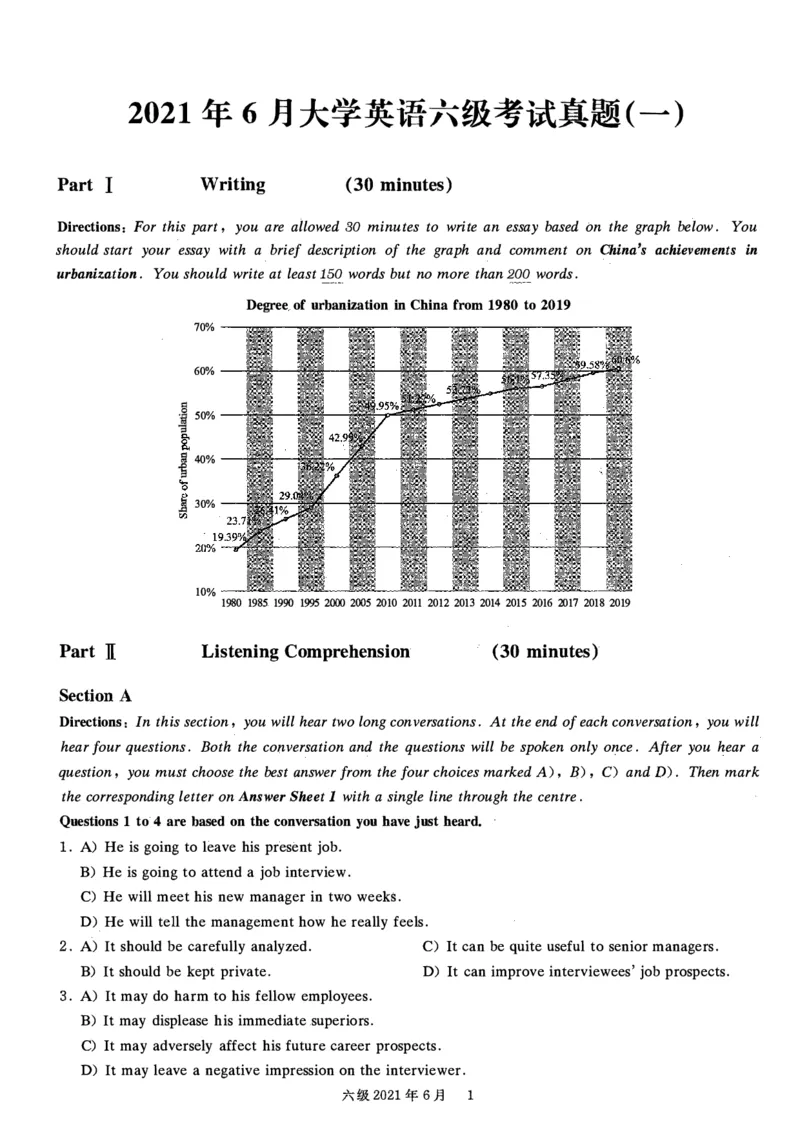
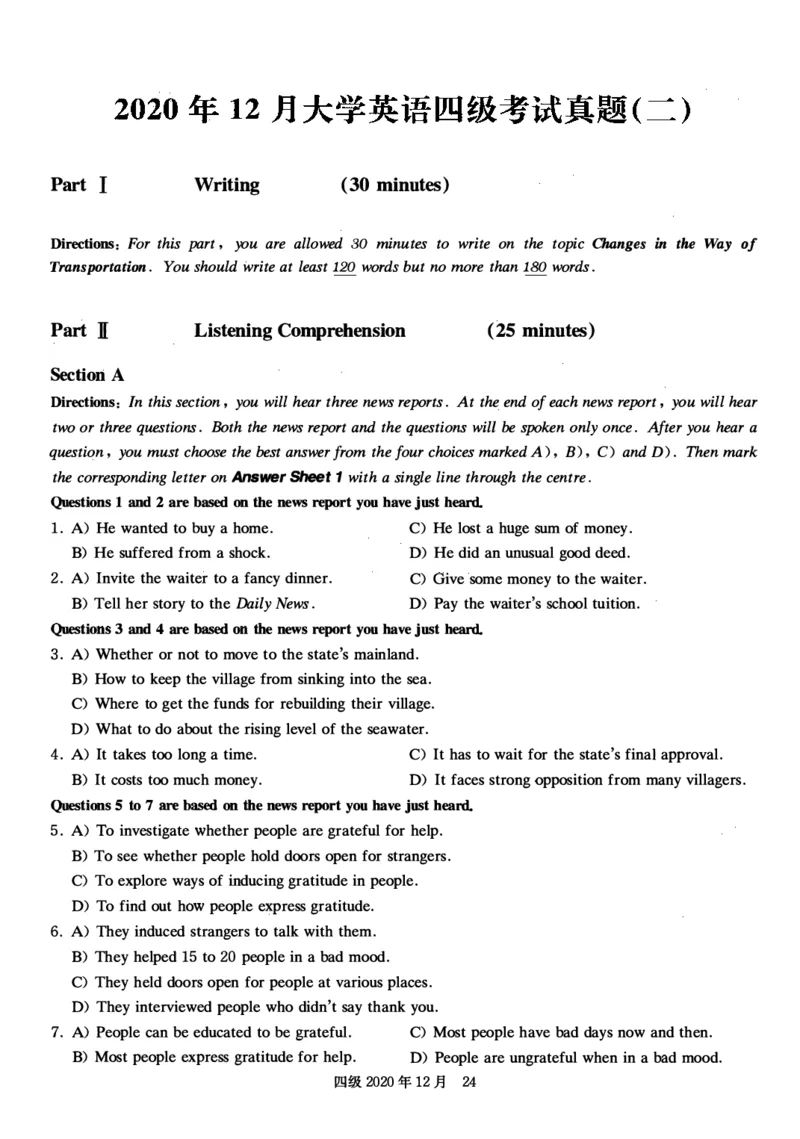
2020年12月大学英语六级试题第2套
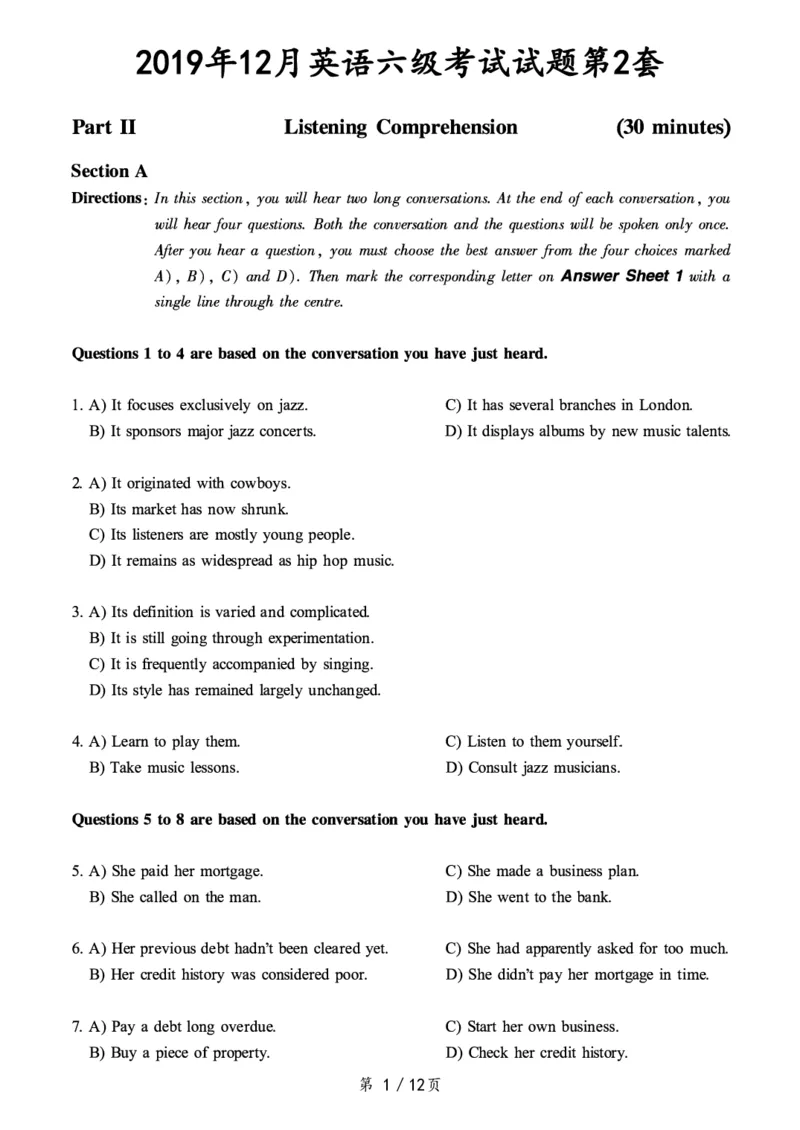
Part II Listening Comprehension (30 minutes)
Section A
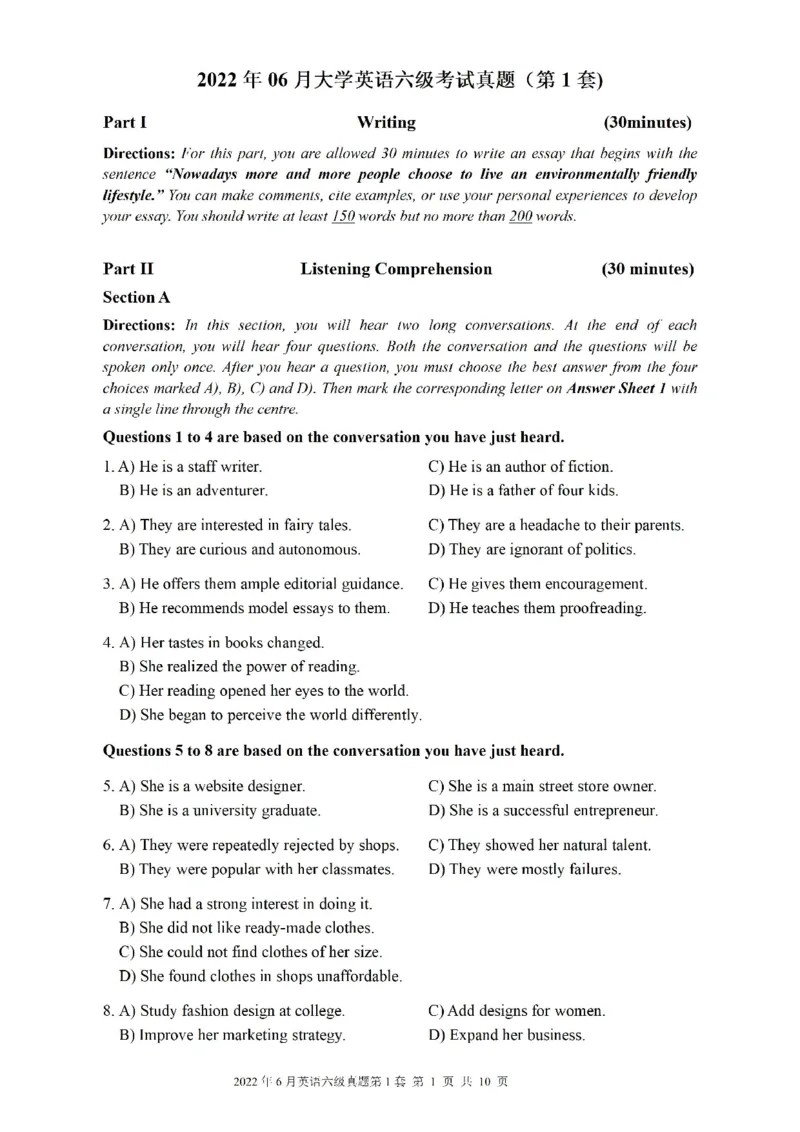
Directions : In thi,s section, you will hear two long conversations. At the end of each conversation, you
will hear four questions. Both the conversation and the questions will be spoken only once.
After you hear a question, you must choose the best answer from the four choices marked
A) , B) , C) and D) . Then mark the corresponding letter on Answer Sheet 1 with a
single line through the centre.
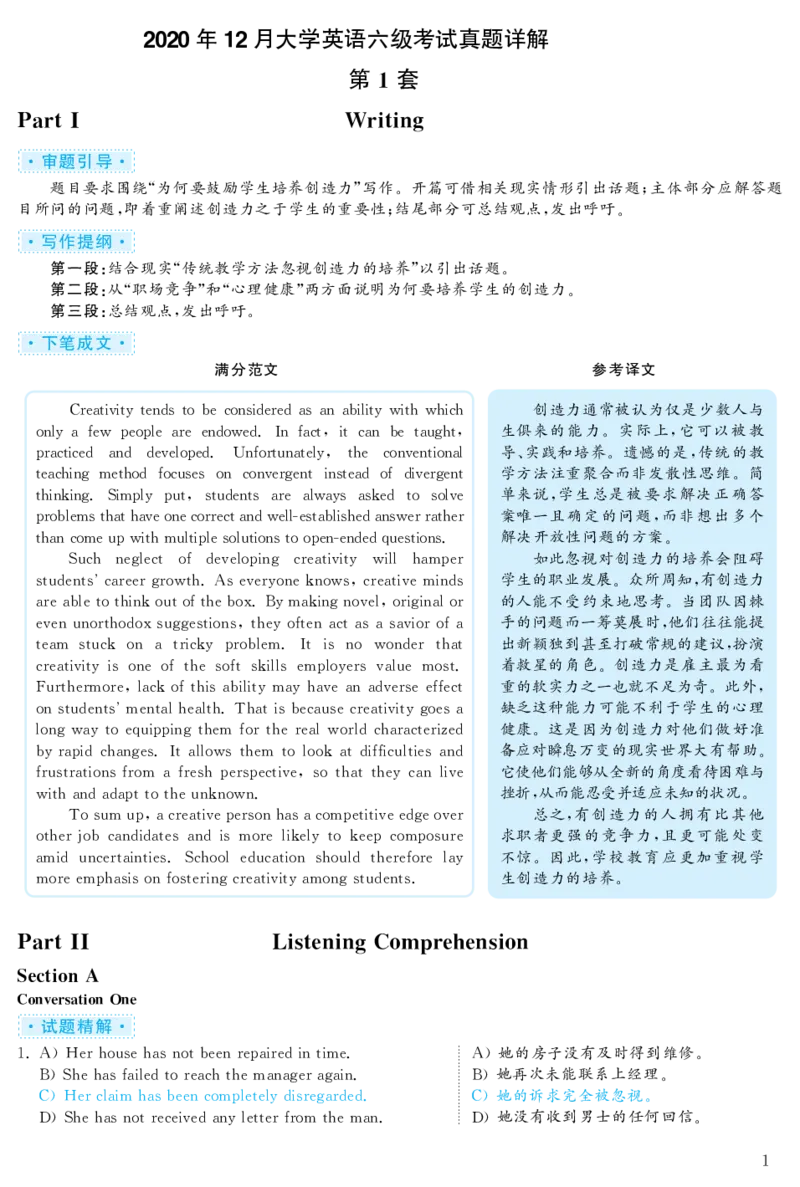
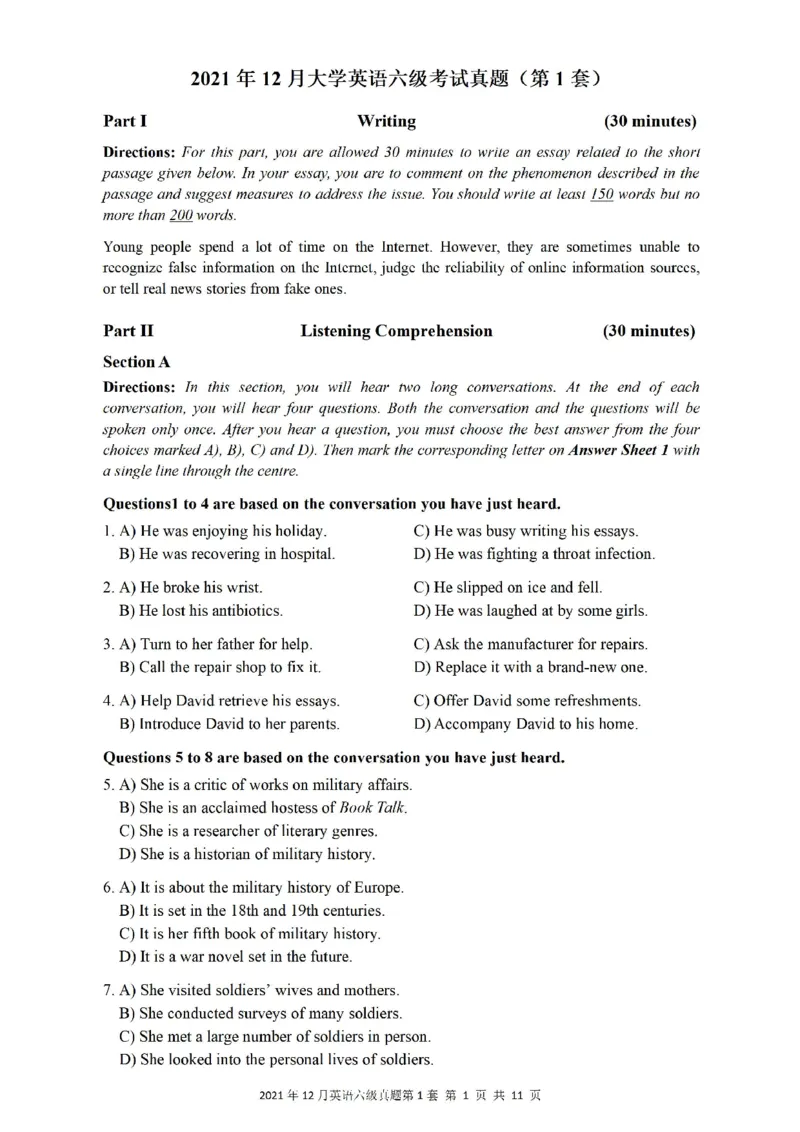
Questions 1 to 4 are based on the conversation you have just heard.
1. A) A driving test. C) Traffic routes.
B) A video game. D) Cargo logistics.
2. A) He found it instructive and realistic.
B) He bought it when touring Europe.
C) He was really drawn to its other versions.
D) He introduced it to his brother last year.
3. A) Traveling all over the country.
B) Driving from one city to another.
C) The details in the driving simulator.
D) The key role of the logistics industry.
4. A) Clearer road signs.
B) More people driving safely.
C) Stricter traffic rules.
D) More self-driving trucks on the road.
Questions 5 to 8 are based on the conversation you have just heard.
5. A) It isn't so enjoyable as he expected.
B) It isn't so motivating as he believed.
C) It doesn't enable him to earn as much money as he used to.
D) It doesn't seem to offer as much freedom as he anticipated.
6. A) Not all of them care about their employees' behaviors.
B) Few of them are aware of their employees' feelings.
C) Few of them offer praise and reward to their employees.
D) Not all of them know how to motivate their employees.
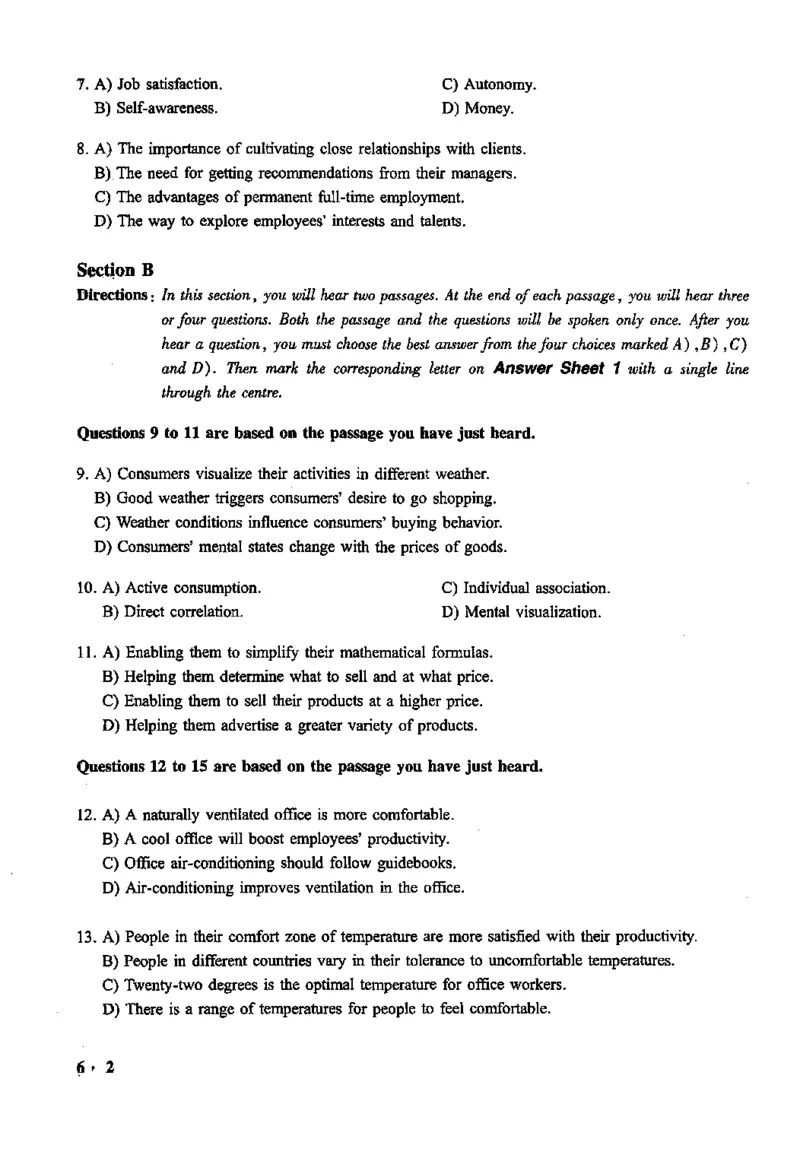
6 · 17. A) Job satisfaction. C) Autonomy.
B) Self-awareness. D) Money.
8. A) The importance of cultivating close relationships with clients.
B).The need for getting recommendations from their managers.
C) The advantages of permanent full-time employment.
D) The way to explore employees' interests and talents.
Sectjon B
Dir~ctions : In this section, you will hear two passages. At the end of each passage , you will hear three
or four questions. Both the passage and the questions will be spoken only once. After you
hear a question, you must choose the best answer from the four choices marked A) , B) , C)
and D) . Then mark the corresponding letter on Answer Sheet 1 with a single line
through the centre.
Questions 9 to 11 are based on the passage you have just heard.
9. A) Consumers visualize their activities in different weather.
B) Good weather triggers consumers' desire to go shopping.
C) Weather conditions influence consumers' buying behavior.
D) Consumers' mental states change with the prices of goods.
10. A) Active consumption. C) Individual association.
B) Direct correlation. D) Mental visualization.
11. A) Enabling them to simplify their mathematical formulas.
B) Helping them determine what to sell and at what price.
C) Enabling them to sell their products at a higher price.
D) Helping them advertise a greater variety of products.
Questions 12 to 15 are based on the passage you have just heard.
12. A) A naturally ventilated office is more comfortable.
B) A cool office will boost employees' productivity.
C) Office air-conditioning should follow guidebooks.
D) Air-conditioning improves ventilation in the office.
13. A) People in their comfort zone of temperature are more satisfied with their productivity.
B) People in different countries vary in their tolerance to uncomfortable temperatures.
C) Twenty-two degrees is the optimal temperature for office workers.
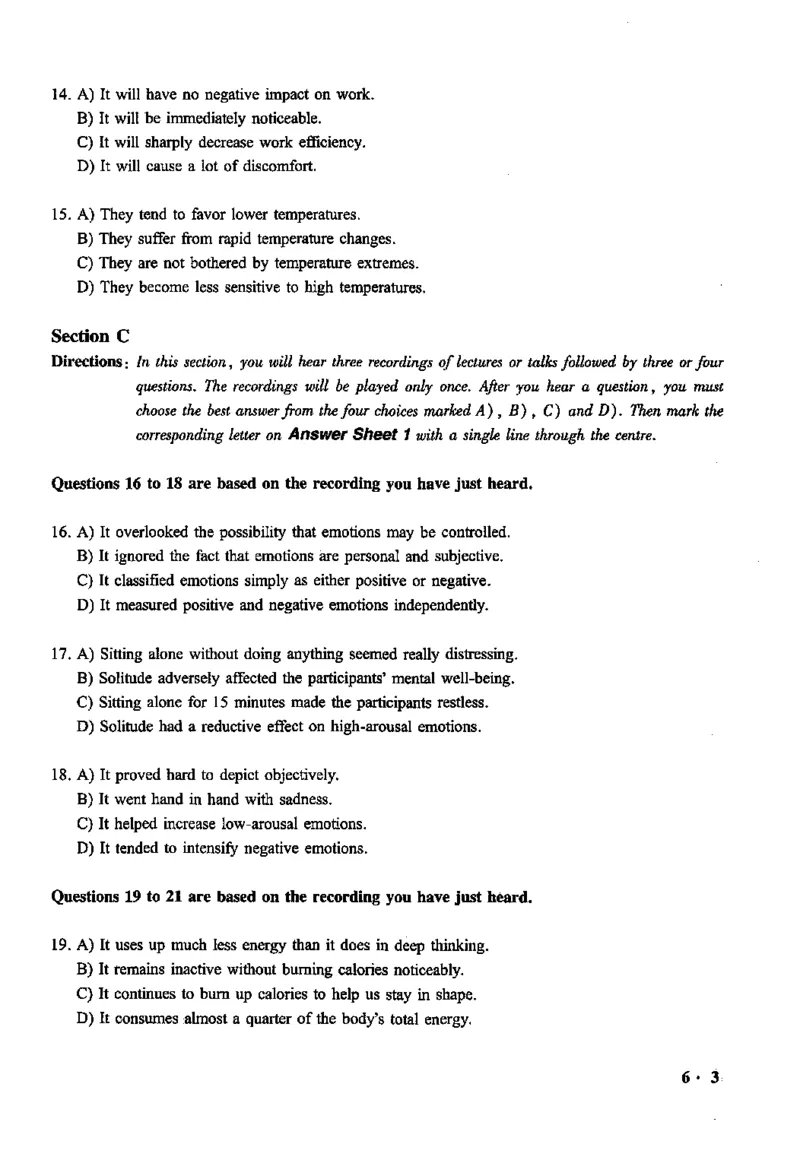
D) There is a range of temperatures for people to feel comfortable.14. A) It will have no negative impact on work.
B) It will be immediately noticeable.
C) It will sharply decrease work efficiency.
D) It will cause a lot of discomfort.
15. A) They tend to favor lower temperatures.
B) They suffer from rapid temperature changes.
C) They are not bothered by temperature extremes.
D) They become less sensitive to high temperatures.
Section C
Directions: In thi,s section, you will hear three recordings of lectures or talks followed by three or four
questions. The recordings will be played only once. After you hear a question, you must
choose the best answer from the four choices marked A) , B) , C) and D). Then mark the
corresponding letter on Answer Sheet 1 with a single line through the centre.
Questions 16 to 18 are based on the recording you have just heard.
16. A) It overlooked the possibility that emotions may be controlled.
B) It ignored the fact that emotions are personal and subjective.
C) It classified emotions simply as either positive or negative.
D) It measured positive and negative emotions independently.
17. A) Sitting alone without doing anything seemed really distressing.
B) Solitude adversely affected the participants' mental well-being.
C) Sitting alone for 15 minutes made the participants restless.
D) Solitude had a reductive effect on high-arousal emotions.
18. A) It proved hard to depict objectively.
B) It went hand in hand with sadness.
C) It helped increase low-arousal emotions.
D) It tended to intensify negative emotions.
Questions 19 to 21 are based on the recording you have just heard.
19. A) It uses up much less energy than it does in deep thinking.
B) It remains inactive without burning calories noticeably.
C) It continues to burn up calories to help us stay in shape.
D) It consumes :almost a quarter of the body's total energy.
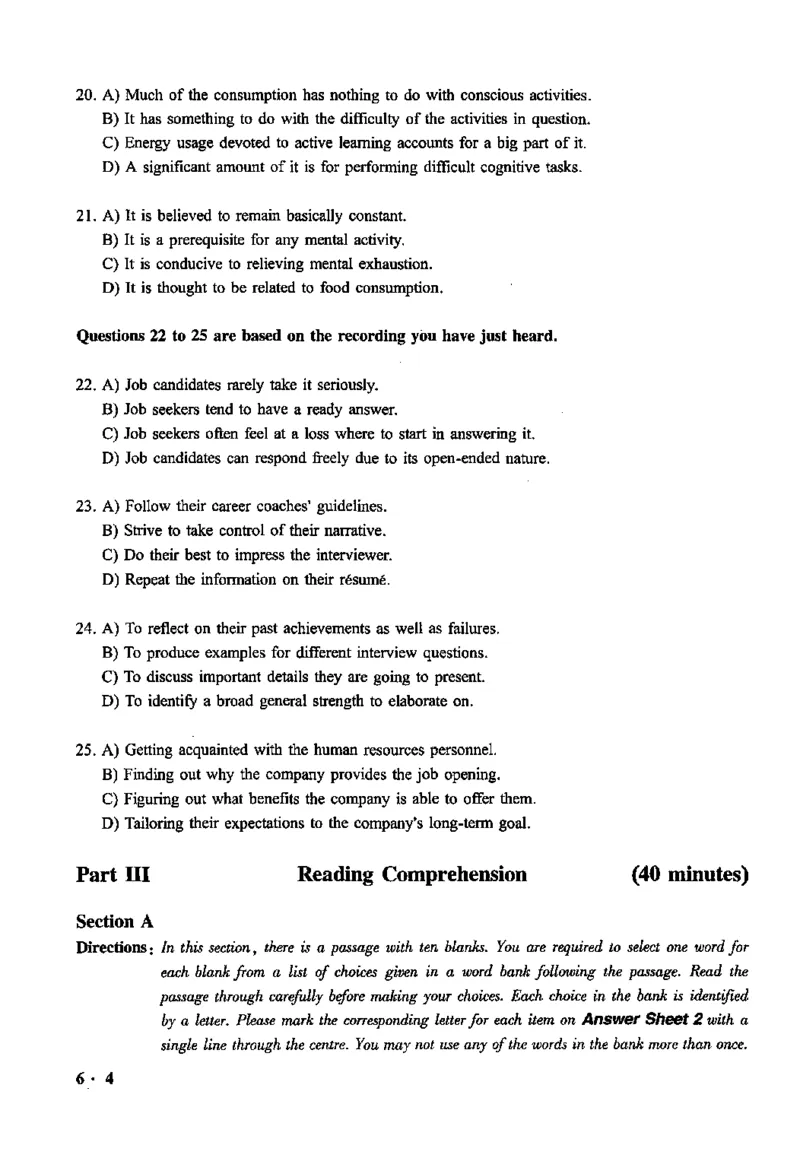
6 • j20. A) Much of the consumption has nothing to do with conscious activities.
B) It has something to do with the difficulty of the activities in question.
C) Energy usage devoted to active learning accounts for a big part of it.
D) A significant amount of it is for performing difficult cognitive tasks.
21. A) It is believed to remain basically constant.
B) It is a prerequisite for any mental activity.
C) It is conducive to relieving mental exhaustion.
D) It is thought to be related to food consumption.
Questions 22 to 25 are based on the recording you have just heard.
22. A) Job candidates rarely take it seriously.
B) Job seekers tend to have a ready answer.
C) Job seekers often feel at a loss where to start in answering it.
D) Job candidates can respond freely due to its open-ended nature.
23. A) Follow their career coaches' guidelines.
B) Strive to take control of their narrative.
C) Do their best to impress the interviewer.
D) Repeat the information on their resume.
24. A) To reflect on their past achievements as well as failures.
B) To produce examples for different interview questions.
C) To discuss important details they are going to present.
D) To identify a broad general strength to elaborate on.
25. A) Getting acquainted with the human resources personnel.
B) Finding out why the company provides the job opening.
C) Figuring out what benefits the company is able to offer them.
D) Tailoring their expectations to the company's long-term goal.
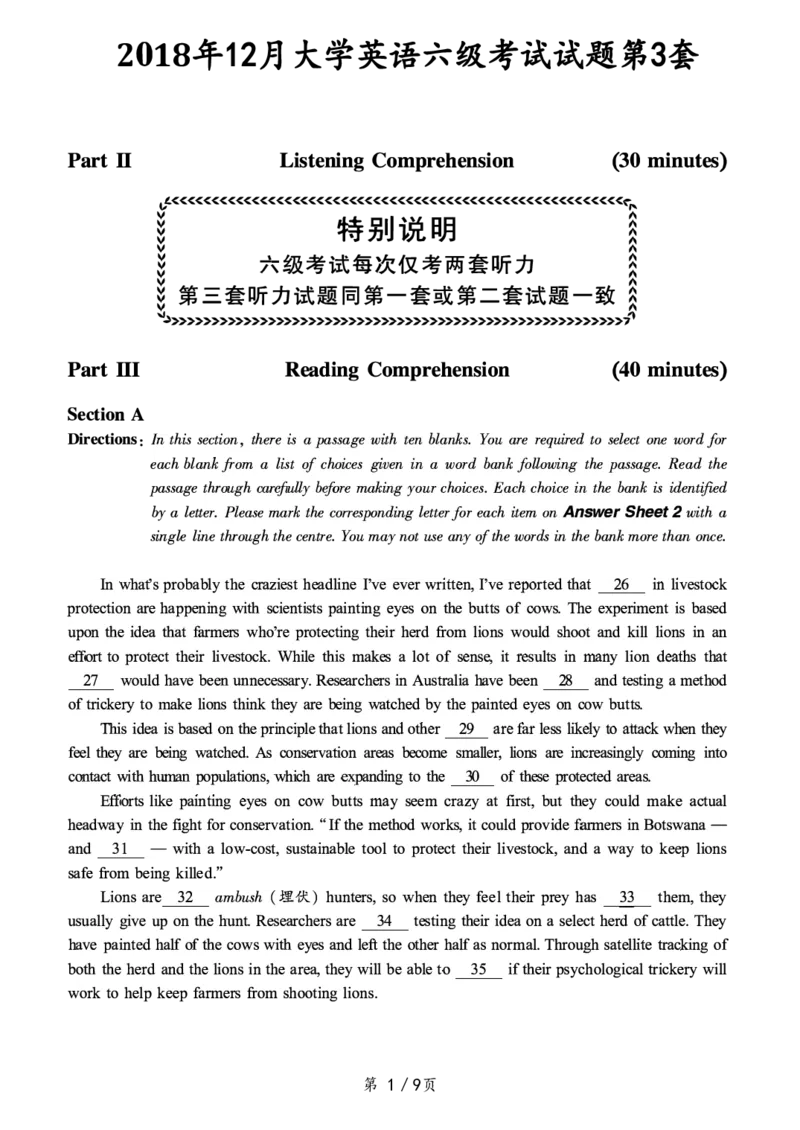
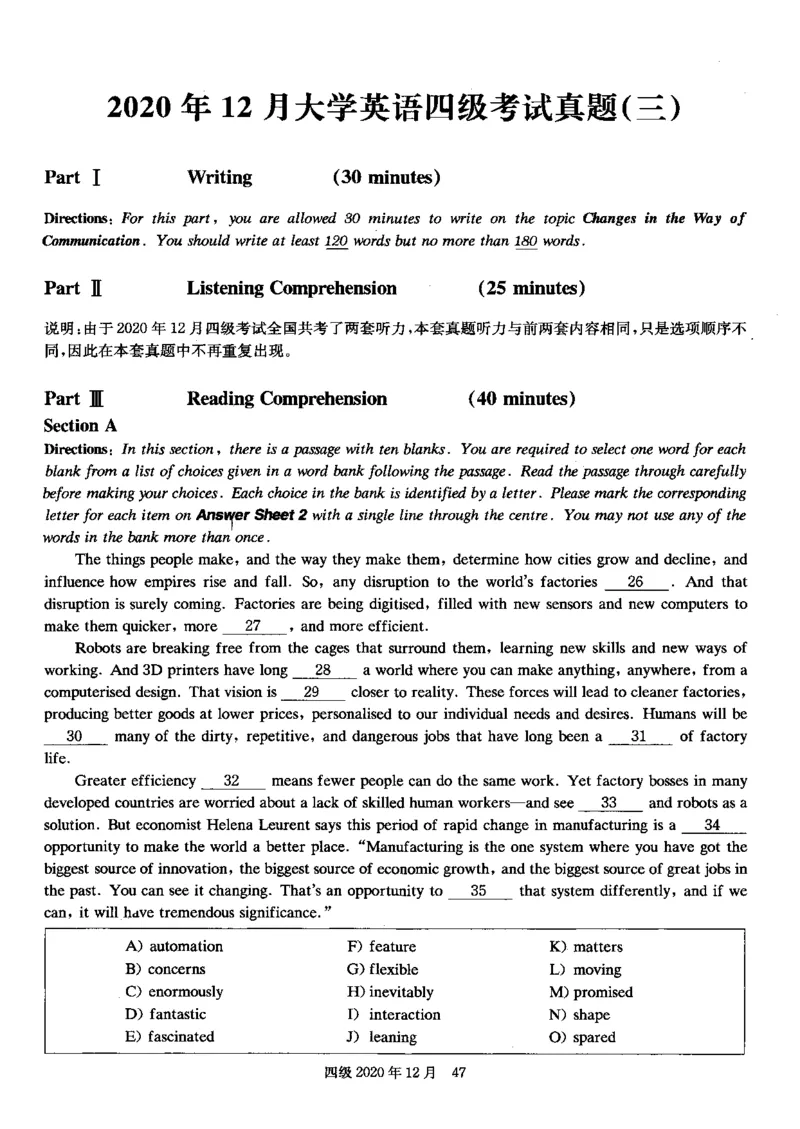
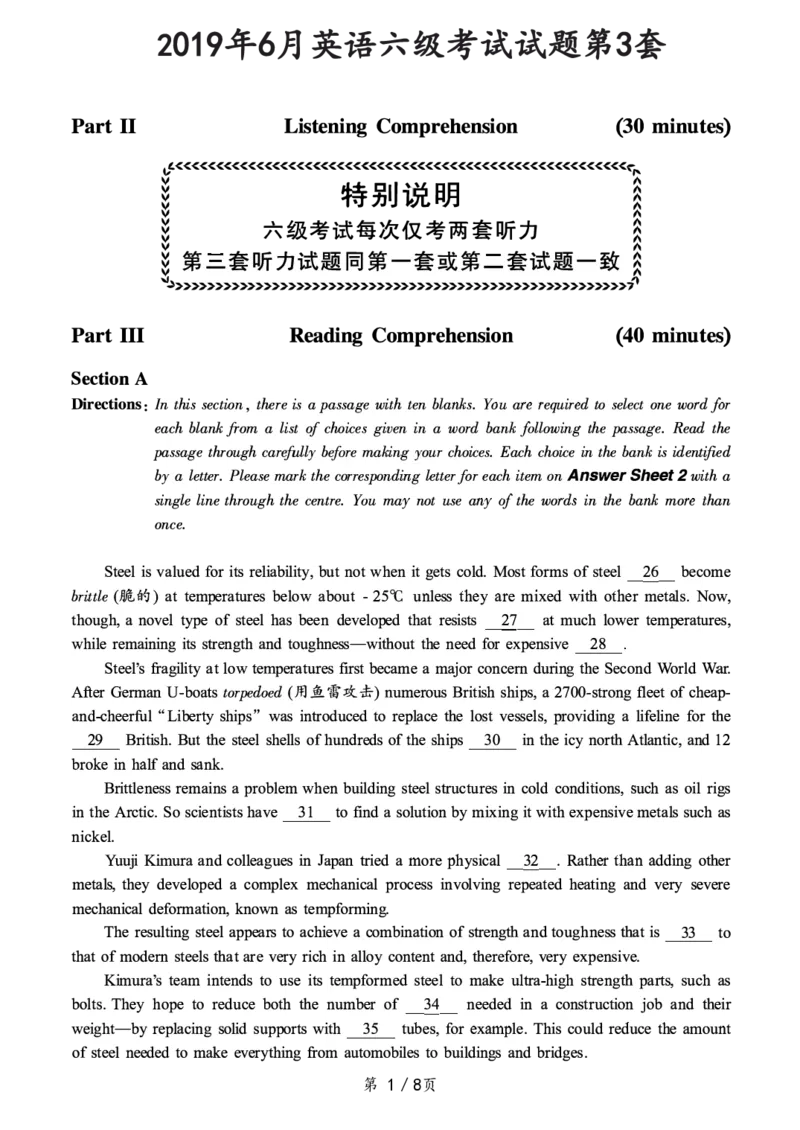
Part III Reading Comprehension (4 0 minutes)
Section A
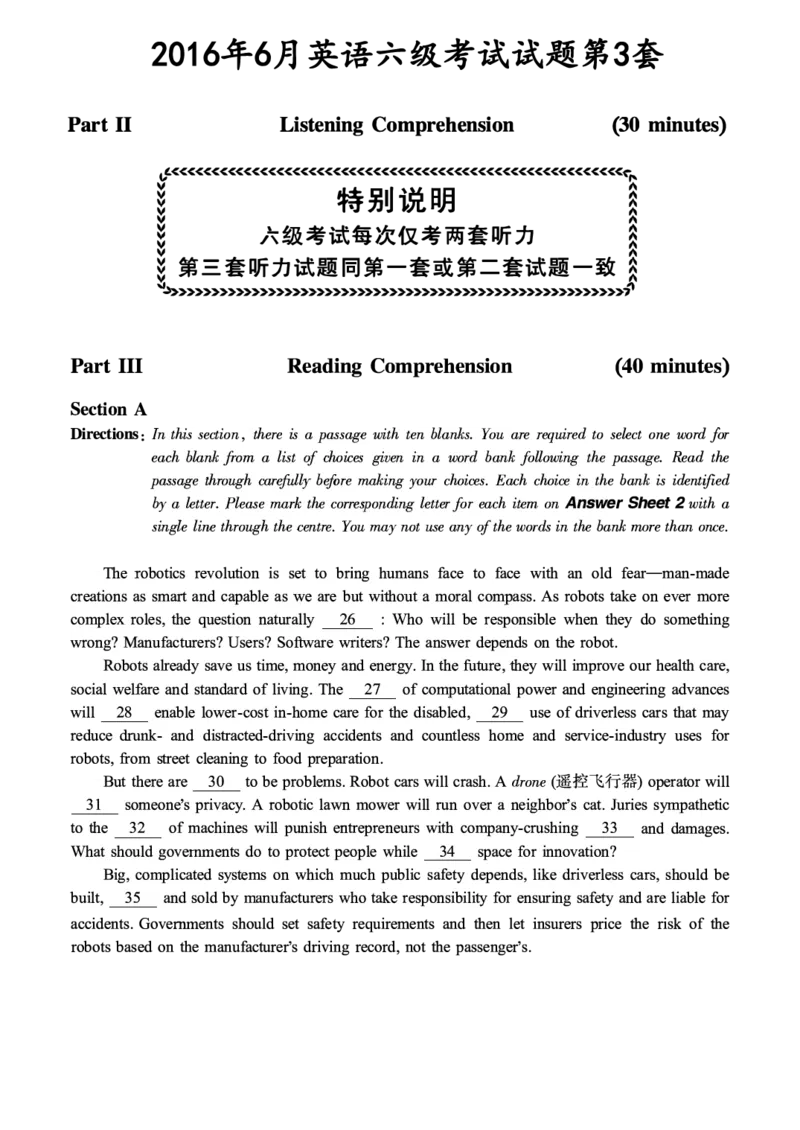
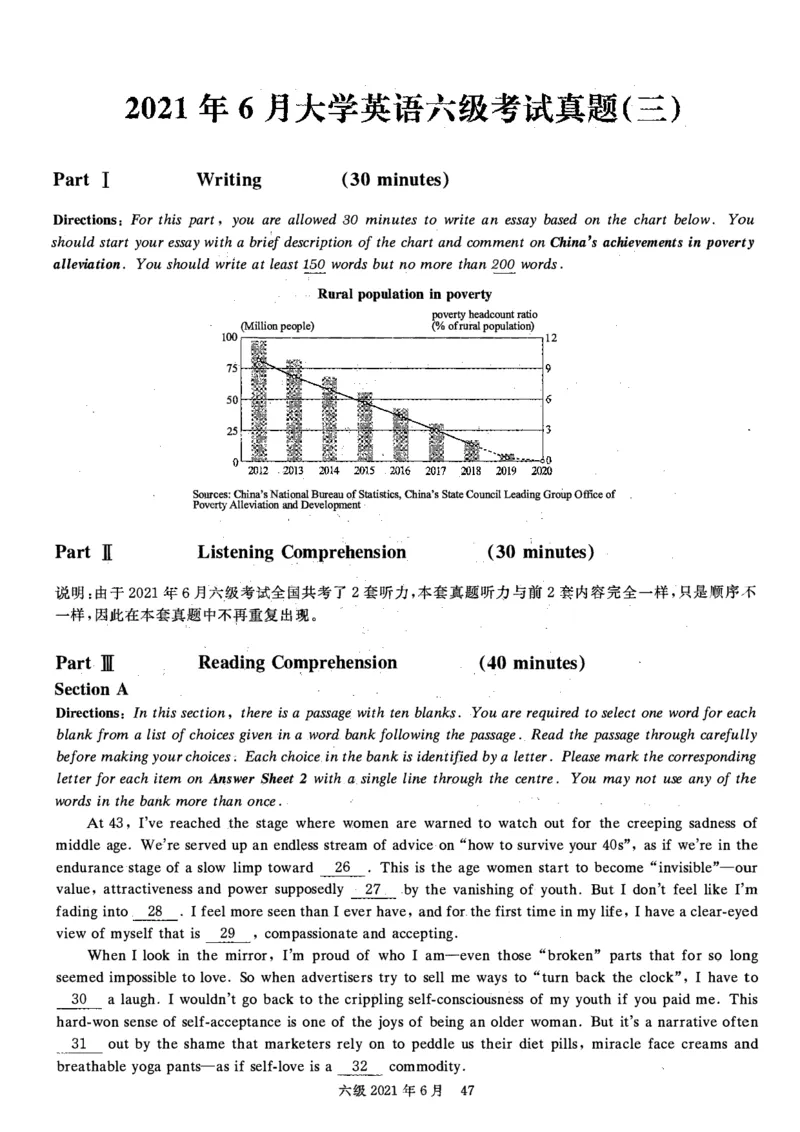
Directions: In this section, there is a passage with ten blanks. You are required to select one word for
each blank from a list of choices given in a word bank following the passage. Read the
passage through carefully before making your choices. Each choice in the bank is identified
by a letter. Please mark the corresponding letter for each item on Answer Sheet 2 with a
single line through the centre. You may not use any of the words in the bank more than once.
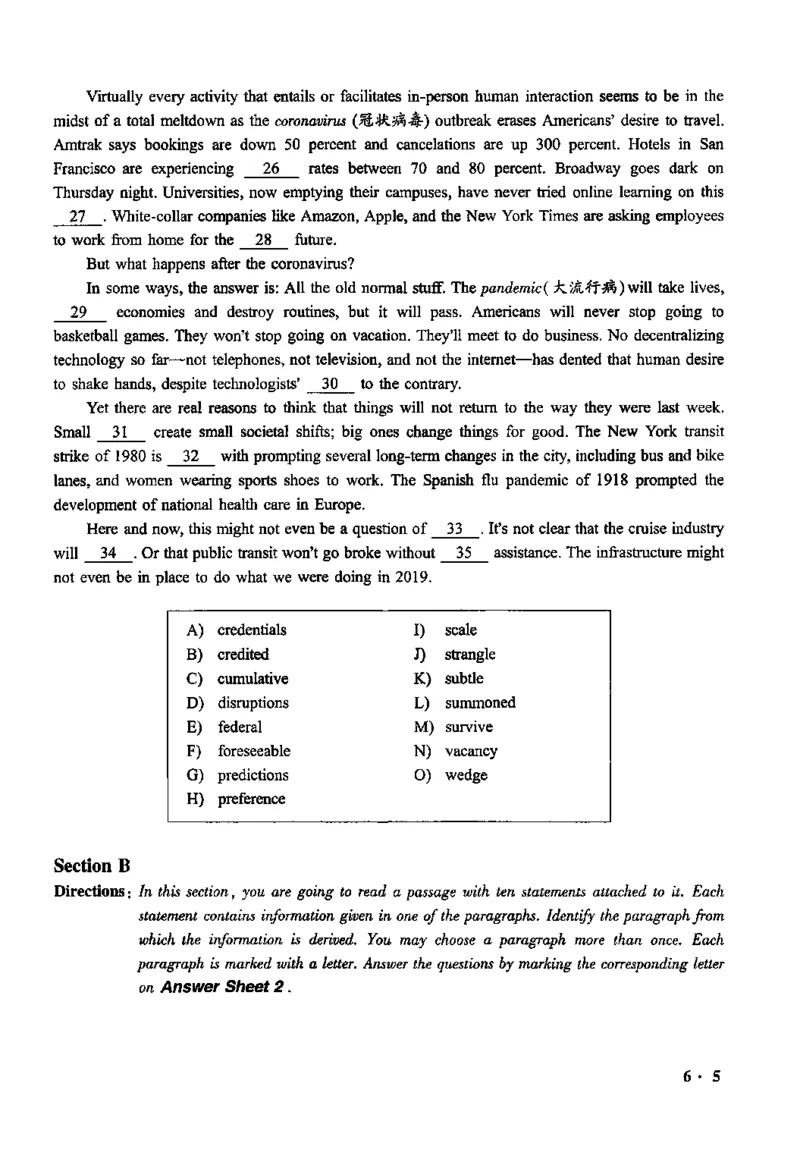
6 · 4Virtually every activity that entails or facilitates in-person human interaction seems to be in the
midst of a total meltdown as the coronavirus (;ff.:ll{.~-4) outbreak erases Americans' desire to travel.
Amtrak says bookings are down 50 percent and cancelations are up 300 percent. Hotels in San
Francisco are experiencing 26 rates between 70 and 80 percent. Broadway goes dark on
Thursday night. Universities, now emptying their campuses, have never tried online learning on this
27 . White-collar companies like Amazon, Apple, and the New York Times are asking employees
to work from home for the -28- future.
But what happens after the coronavirus?
In some ways, the answer is: All the old normal stuff. The pandemic( k$Jl.ft~) will take lives,
29 economies and destroy routines, but it will pass. Americans will never stop going to
basketball games. They won't stop going on vacation. They'll meet to do business. No decentralizing
technology so far-not telephones, not television, and not the internet-has dented that human desire
to shake hands, despite technologists' _19__ to the contrary.
Yet there are real reasons to think that things will not return to the way they were last week.
Small 31 create small societal shifts; big ones change things for good. The New York transit
strike of 1980 is 32 with prompting several long-term changes in the city, including bus and bike
lanes, and women wearing sports shoes to work. The Spanish flu pandemic of 1918 prompted the
development of national health care in Europe.
Here and now, this might not even be a question of ---1!_. It's not clear that the cruise industry
will ___l!__. Or that public transit won't go broke without 35 assistance. The infrastructure might
not even be in place to do what we were doing in 2019.
A) credentials I) scale
B) credited J) strangle
C) cumulative K) subtle
D) disruptions L) summoned
E) federal M) survive
F) foreseeable N) vacancy
G) predictions 0) wedge
H) preference
Section B
Directions : In this section , you are going to read a passage with ten statements attached to it. Each
statement contains information given in one of the paragraphs. Identify the paragraph from
which the information is derived. You may choose a paragraph more than once. Each
paragraph is marked with a letter. Answer the questions by marking the corresponding leuer
on Answer Sheet 2.
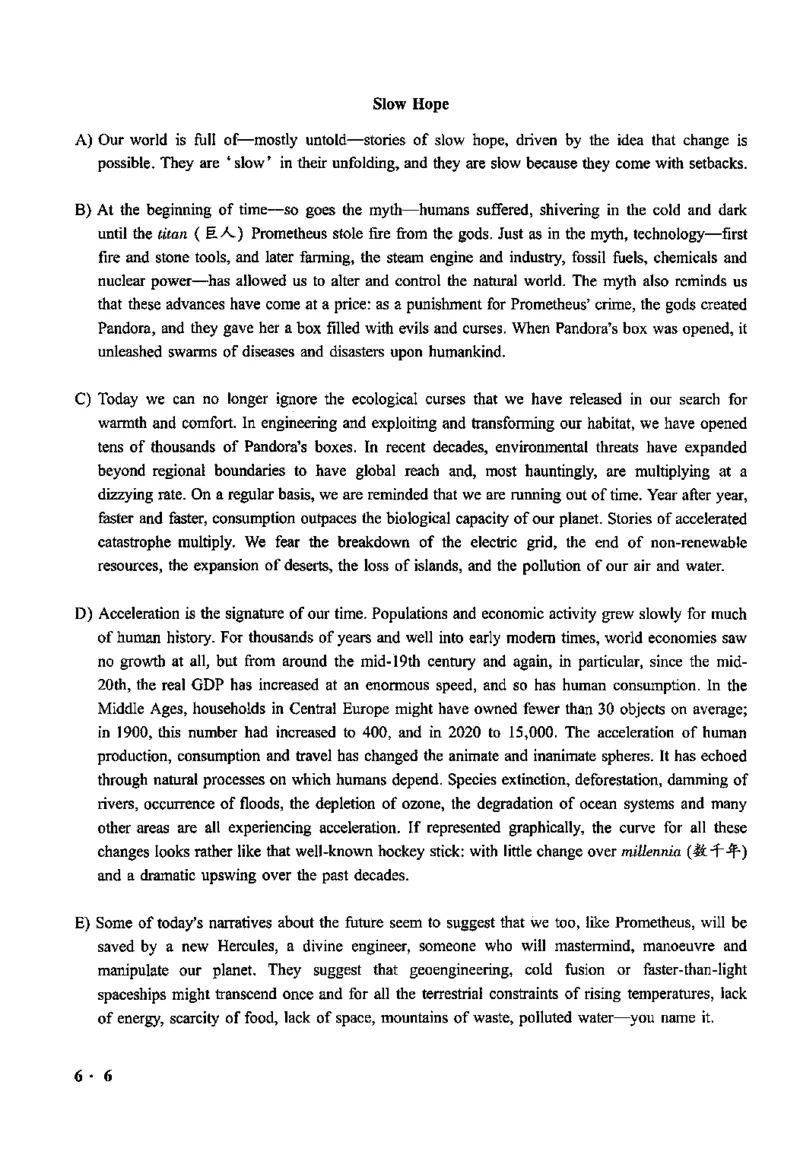
6 • SSlow Hope
A) Our world is full of-mostly untold-stories of slow hope, driven by the idea that change is
possible. They are 'slow' in their unfolding, and they are slow because they come with setbacks.
B) At the beginning of time-so goes the myth-humans suffered, shivering in the cold and dark
until the titan ( EA.) Prometheus stole fire from the gods. Just as in the myth, technology-first
fire and stone tools, and later farming, the steam engine and industry, fossil fuels, chemicals and
nuclear power-has allowed us to alter and control the natural world. The myth also reminds us
that these advances have come at a price: as a punishment for Prometheus' crime, the gods created
Pandora, and they gave her a box filled with evils and curses. When Pandora's box was opened, it
unleashed swarms of diseases and disasters upon humankind.
C) Today we can no longer ignore the ecological curses that we have released in our search for
warmth and comfort. In engineering and exploiting and transforming our habitat, we have opened
tens of thousands of Pandora's boxes. In recent decades, environmental threats have expanded
beyond regional boundaries to have global reach and, most hauntingly, are multiplying at a
dizzying rate. On a regular basis, we are reminded that we are running out of time. Year after year,
faster and faster, consumption outpaces the biological capacity of our planet. Stories of accelerated
catastrophe multiply. We fear the breakdown of the electric grid, the end of non-renewable
resources, the expansion of deserts, the loss of islands, and the pollution of our air and water.
D) Acceleration is the signature of our time. Populations and economic activity grew slowly for much
of human history. For thousands of years and well into early modem times, world economies saw
no growth at all, but from around the mid-l 9th century and again, in particular, since the mid-
20th, the real GDP has increased at an enormous speed, and so has human consumption. In the
Middle Ages, households in Central Europe might have owned fewer than 30 objects on average;
in 1900, this number had increased to 400, and in 2020 to 15,000. The acceleration of human
production, consumption and travel has changed the animate and inanimate spheres. It has echoed
through natural processes on which humans depend. Species extinction, deforestation, damming of
rivers, occurrence of floods, the depletion of ozone, the degradation of ocean systems and many
other areas are all experiencing acceleration. If represented graphically, the curve for all these
changes looks rather like that well-known hockey stick: with little change over millennia ( ~ f-Jf-)
and a dramatic upswing over the past decades.
E) Some of today's narratives about the future seem to suggest that we too, like Prometheus, will be
saved by a new Hercules, a divine engineer, someone who will mastermind, manoeuvre and
manipulate our planet. They suggest that geoengineering, cold fusion or faster-than-light
spaceships might transcend once and for all the terrestrial constraints of rising temperatures, lack
of energy, scarcity of food, lack of space, mountains of waste, polluted water-you name it.
6 · 6F) Yet, if we envisage our salvation to come from a deus ex machina (NF-111 ::t.;tf), from a divine
engineer or a tech solutionist who will miraculously conjure up a new source of energy or another
cure-all with revolutionary potency, we might be looking in the wrong place. The fact that we
now imagine our planet as a whole does not mean that the ' rescue' of our planet will come with
one big global stroke of genius and technology. It will more likely come by many small acts.
Global heating and environmental degradation are not technological problems. They are highly
political issues that are informed by powerful interests. Moreover, if history is a guide, then we
can assume that any major transformations will once again be followed by a huge set of
unintended consequences. So what do we do?
G) This much is clear: we need to find ways that help us flatten the hockey-stick curves that reflect
our ever-faster pace of ecological destruction and social acceleration. If we acknowledge that
human manipulation of the Earth has been a destructive force, we can also imagine that human
endeavours can help us build a less destructive world in the centuries to come. We might keep
making mistakes. But we will also keep learning from our mistakes.
H) To counter the fears of disaster, we need to identify stories, visions and actions that work quietly
towards a more hopeful future. Instead of one big narrative, a story of unexpected rescue by a
larger-than-life hero, we need multiple stories: we need stories, not only of what Rob Nixon of
Princeton University has called the ' slow violence ' of environmental degradation ( that is, the
damage that is often invisible at first and develops slowly and gradually), but also stories of what I
call ' slow hope' .
I) We need an acknowledgement of our present ecological plight but also a language of positive
change, visions of a better future. In The Principle of Hope (1954-1959), Ernst Bloch, one of the
leading philosophers of the future, wrote that ' the most tragic form of loss ... is the loss of the
capacity to imagine that things could be different' . We need to identify visions and paths that will
help us imagine a different, more just and more ecological world. Hope, for Bloch, has its starting
point in fear, in uncertainty, and in crisis: it is a creative force that goes hand in hand with utopian
(i½.fc,JfHr-J) 'wishful images'. It can be found in cultural products of the past-in fairy tales, in
fiction, in architecture, in music, in the movies-in products of the human mind that contain ' the
outlines of a better world' . What makes us ' authentic' as humans are visions of our ' potential' .
In other words: living in hope makes us human.
J) The power of small, grassroots movements to make changes that spread beyond their place of
origin can be seen with the Slow Food movement, which began in Italy in the 1980s. The rise of
fast-food restaurants after the Second World War produced a society full of cheap, industrially
made foodstuffs. Under the leadership of Carlo Petrini, the Slow Food movement began in
Piedmont, a region of Italy with a long history of poverty, violence and resistance to oppression.
The movement transformed it into a region hospitable to traditional food cultures-based on
6 · 7native plants and breeds of animals. Today, Slow Food operates in more than 160 countries, poor
and rich. It has given rise to thousands of projects around the globe, representing democratic
politics, food sovereignty, biodiversity and sustainable agriculture.
K) The unscrupulous ( Jc. P)f ffi ,&. . a!J) commodification of food and the destruction of foodstuffs will
continue to devastate soils, livelihoods and ecologies. Slow Food cannot undo the irresistible
developments of the global food economy, but it can upset its theorists, it can ' speak differently' ,
and it can allow people and their local food traditions and environments to flourish. Even in the
United States-the fast-food nation-small farms and urban gardens are on the rise. The US
Department of Agriculture provides an Urban Agriculture Toolkit and, according to a recent
report, American millennials ( ♦t -l¾ - -ft) are changing their diets. In 2017, 6 per cent of US
consumers claimed to be strictly vegetarian, up from 1 per cent in 2014. As more people realise
that ' eating is an agricultural act' , as the US poet and environmental activist Wendell Berry put it
in 1989, slow hope advances.
36. It seems some people today dream that a cutting-edge new technology might save them from the
present ecological disaster.
3 7. According to one great thinker, it is most unfortunate if we lose the ability to think differently.
38. Urgent attention should be paid to the ecological problems we have created in our pursuit of a
comfortable life.
39. Even in the fast-food nation America, the number of vegetarians is on the rise.
40. The deterioration of the ecological system is accelerating because of the dramatic increase of
human production and consumption.
41. It is obvious that solutions must be found to curb the fast worsening environment and social
acceleration.
42. Many people believe changing the world is possible, though it may take time and involve
setbacks.
43. It might be wrong to expect that our world would be saved at one stroke with some miraculous
technology.
44. It is human nature to cherish hopes for a better world.
45. Technology has given us humans the power to change the natural world, but we have paid a price
for the change.
6 • 8Section C
Directions: There are 2 passages in this section. Each passage is followed by some questions or
unfinished statements. For each of them there are four choices marked A), B), C) and
D) . You should decide on the best choice and mark the corresponding letter on Answer
Sheet 2 with a single line through the centre.
Passage One
Questions 46 to 50 are based on the following passage.
Vegetarians would prefer not to be compelled to eat meat. Yet the reverse compulsion ( 51 if!) 1s
hidden in the proposals for a new plant-based "planetary diet." Nowhere is this more visible than in
India.
Earlier this year, the EAT-Lancet Commission released its global report on nutrition and called
for a global shift to a more plant-based diet and for " substantially reducing consumption of animal
source foods." In countries like India, that call could become a tool to aggravate an already tense
political situation and stress already undernourished populations.
The EAT report presumes that "traditional diets" in countries like India include little red meat,
which might be consumed only on special occasions or as minor ingredients in mixed dishes.
In India, however, there is a vast difference between what people would wish to consume and
what they have to consume because of innumerable barriers around class, religion, culture, cost,
geography, etc. Policymakers in India have traditionally pushed for a cereal-heavy "vegetarian diet"
on a meat-eating population as a way of providing the cheapest sources of food.
Currently, under an aggressive Hindu nationalist government, Muslims, Christians, disadvantaged
classes and indigenous communities are being compelled to give up their traditional foods.
None of these concerns seem to have been appreciated by the EAT-Lancet Commission's
representative, Brent Loken, who said " India has got such a great example" in sourcing protein from
plants.
But how much of a model for the world is India's vegetarianism? In the Global Hunger Index
2019, the country ranks 102nd out of 117. Data from the National Family Health Survey indicate that
only 10 percent of infants of 6 to 23 months are adequately fed.
Which is why calls for a plant-based diet modeled on India risk offering another whip with
which to beat already vulnerable communities in developing countries.
A diet directed at the affluent West fails to recognize that in low-income countries
undernourished children are known to benefit from the consumption of milk and other animal source
foods, improving cognitive functions, while reducing the prevalence of nutritional deficiencies as well
as mortality.
EAT-Lancet claimed its intention was to "spark conversations" among all Indian stakeholders.
Yet vocal critics of the food processing industry and food fortification strategies have been left out of
the debate. But the most conspicuous omission may well be the absence of India's farmers.
The government, however, seems to have given the report a thumps-up. Rather than addressing
6 · 9chronic hunger and malnutrition through an improved access to wholesome and nutrient-dense foods,
the government is opening the door for company-dependent solutions, ignoring the environmental and
economic cost, which will destroy local food systems. It's a model full of danger for future
generations.
46. What is more visible in India than anywhere else according to the passage?
A} People's positive views on the proposals for a "planetary·diet."
B) People's reluctance to be compelled to eat plant-based food.
C) People's preferences for the kind of food they consume.
D) People's unwillingness to give up their eating habits.
47. What would the EAT-Lancet Commission's report do to many people in countries like India?
A} Radically change their dietary habits.
B) Keep them further away from politics.
C) Make them even more undernourished.
D) Substantially reduce their food choices.
48. What do we learn from the passage about food consumption in India?
A) People's diet will not change due to the EAT-Lancet report.
B) Many people simply do not have access to foods they prefer.
C) There is a growing popularity of a cereal-heavy vegetarian diet.
D) Policymakers help remove the barriers to people's choice of food.
49. What does the passage say about a plant-based diet modeled on India?
A) It may benefit populations whose traditional diet is meat-based.
B) It may be another blow to the economy in developing countries.
C) It may help narrow the gap between the rich and poor countries.
D) It may worsen the nourishment problem in low-income countries.
50. How does the Indian government respond to the EAT-Lancet Commission's proposals?
A) It accepts them at the expense of the long-term interests of its people.
B) It intends them to spark conversations among all Indian stakeholders.
C) It gives them approval regardless of opposition from nutrition experts.
D) It welcomes them as a tool to address chronic hunger and malnutrition.
Passage Two
Questions 51 to 55 are based on the following passage.
Back in 1964, in his book Games People Play, psychiatrist Eric Berne described a pattern of
conversation he called "Why Don't You-Yes But", which remains one of the most irritating aspects
6 · 10of everyday social life. The person adopting the strategy is usually a chronic complainer. Something is
terrible about their relationship, job, or other situation, and they moan about it ceaselessly, but find
some excuse to dismiss any solution that's proposed. The reason, of course, is that on some level they
don't want a solution; they want to be validated in their position that the world is out to get them. If
they can "win,, the game-dismissing every suggestion until their interlocutor( ~it-:::t") gives up in
annoyance-they get to feel pleasurably righteous ( .iE. ~ al.J ) in their resentments and excused from
any obligation to change.
Part of the trouble here is the so-called responsibility /fault fallacy ( ifi ~) . When you're feeling
hard done by-taken for granted by your partner, say, or obliged to work for a half-witted boss-it's
easy to become attached to the position that it's not your job to address the matter, and that doing so
would be an admission of fault. But there's a confusion here. For example, if I were to discover a
newborn at my front door, it wouldn't be my fault, but it most certainly would be my responsibility.
There would be choices to make, and no possibility of avoiding them, since trying to ignore the
matter would be a choice. The point is that what goes for the baby on the doorstep is true in all cases:
even if the other person is 100% in the wrong, there's nothing to be gained, long-term, from using
this as a justification to evade responsibility.
Should you find yourself on the receiving end of this kind of complaining, there's an ingenious
way to shut it down-which is to agree with it, ardently. Psychotherapist Lori Gottlieb describes this
as "over-validation". For one thing, you'll be spared further moaning, since the other person's
motivation was to confirm her beliefs, and now you're confirming them. But for another, as Gottlieb
notes, people confronted with over-validation often hear their complaints afresh and start arguing
back. The notion that they're utterly powerless suddenly seems unrealistic-not to mention rather
annoying-so they're prompted instead to generate ideas about how they might change things.
"And then, sometimes, something magical might happen," Gottlieb writes. The other person
"might realise she's not as trapped as you are saying she is, or as she feels." Which illustrates the
irony of the responsibility/fault fallacy: evading responsibility feels comfortable, but turns out to be a
prison; whereas assuming responsibility feels unpleasant, but ends up being freeing.
51. What is characteristic of a chronic complainer, according to psychiatrist Eric Berne?
A) They only feel angry about their ill treatment and resent whoever tries to help.
B) They are chronically unhappy and ceaselessly find fault with people around them.
C) They constantly dismiss others' proposals while taking no responsibility for tackling the problem.
D) They lack the knowledge and basic skills required for successful conversations with their
interlocutors.
52. What does the author try to illustrate with the example of the newborn on one's doorstep?
A) Peopl~ tend to think that one should not be held responsible for others' mistakes.
B) It is easy to become attached to the position of overlooking one's own fault.
C) People are often at a loss when confronted with a number of choices.
D) A distinction should be drawn between responsibility and fault.
6 · 1153. What does the author advise people to do to chronic complainers?
A) Stop them from going further by agreeing with them.
B)Listen to their complaints ardently and sympathetically.
C) Ask them to validate their beliefs with further evidence.
D) Persuade them to clarify the confusion they have caused.
54. What happens when chronic complainers receive over-validation?
A) They are motivated to find ingenious ways to persuade their interlocutor.
B) They are prompted to come up with ideas for making possible changes.
C) They are stimulated to make more complaints.
D) They are encouraged to start arguing back.
55. How can one stop being a chronic complainer according to the author?
A) Analysing the so-called responsibility/fault fallacy.
B) Avoiding hazardous traps in everyday social life.
C) Assuming responsibility to free oneself.
D) Awaiting something magical to happen.
Part IV Translation (30 minutes)
Directions: For this part, you are allowed 30 minutes to translate a passage from Chinese into English.
You should write your answer on Answer Sheet 2.
m�tl::Jcm(Hong Kong-Zhuhai-Macau Bridge)�* 55 01E, ;liH1G�-J:Di�!AJ�'iit1¥JI�
tt*o ::kffi���-m�•®*,.�WL•*l¥JM•m•ffl��--o::km���M$Z�
��fi�n•
a1nitfiatraJJA 3 ,J\BtmiffiiU 30 ir
%1t41 o J!JMMJ.te::k1¥Jffl1Inti�±:ictff1t:%iiEl!ij
-�e�1¥J§ffl•mo ��mmg--��'�*��m*o :ictff����-�Bl¥J:ic��A
�i�ttlB�Jcif IB�LlJ .}11.f��*Ji( 1¥JfPJ
o � OO�m�::ktl gmJJlf:Ett7ic�tlflr�����Ln��
g fflMI!� l¥J !ii! g
0
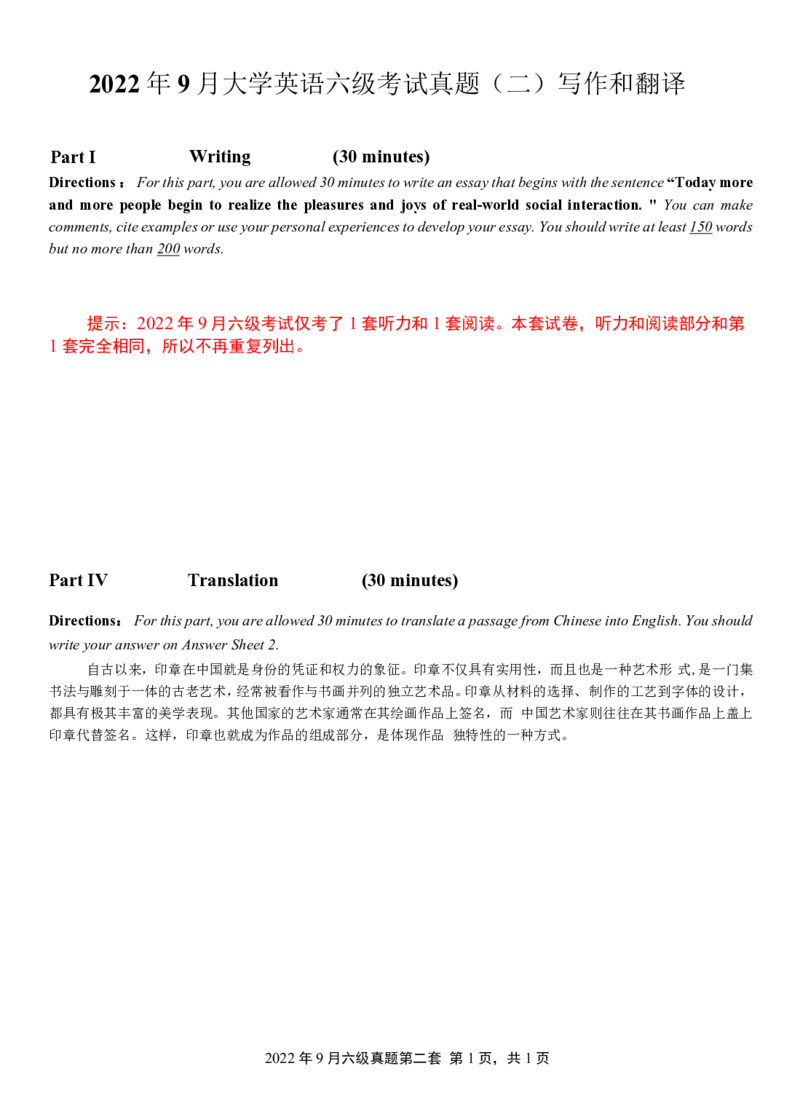
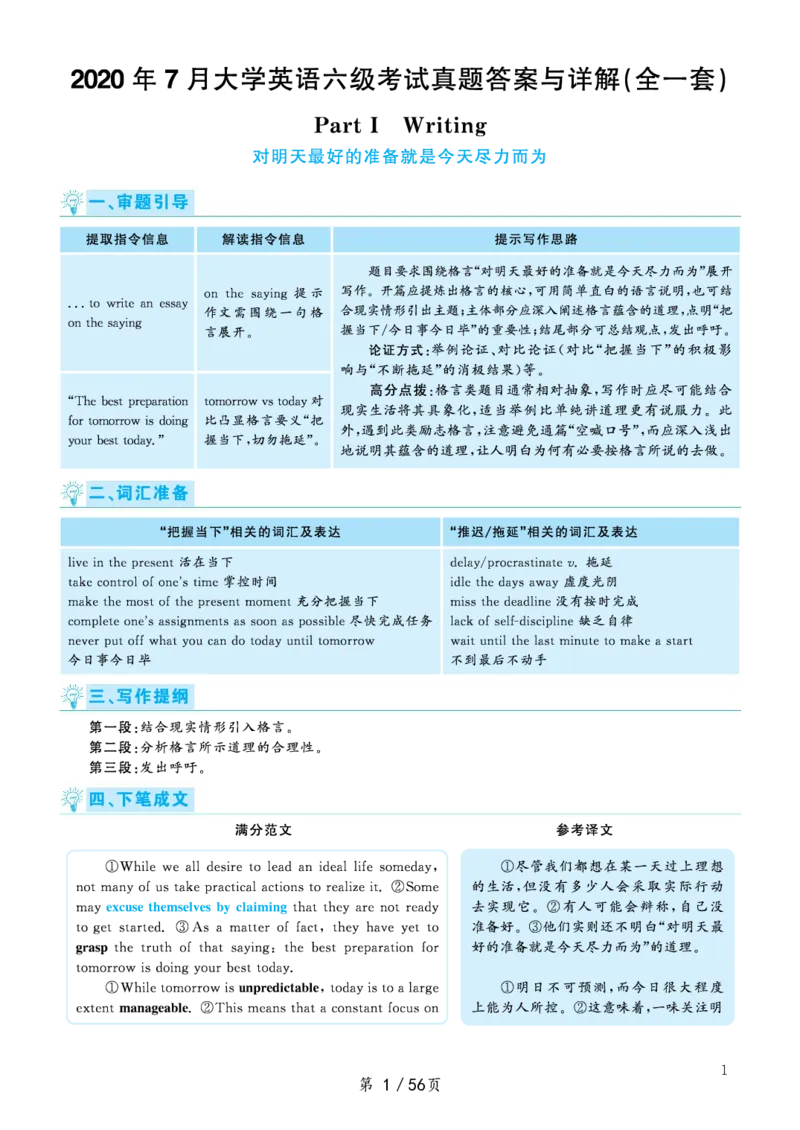
Part I Writing (30 minutes)
Directions: For this part, you are allowed 30 minutes to write an essaJ on why students should be
encouraged to develop effective communication skills. You should write at. least. 150
words but no more than 200 words.
6 · 12