2023 年 12 月英语六级真题第 1 套
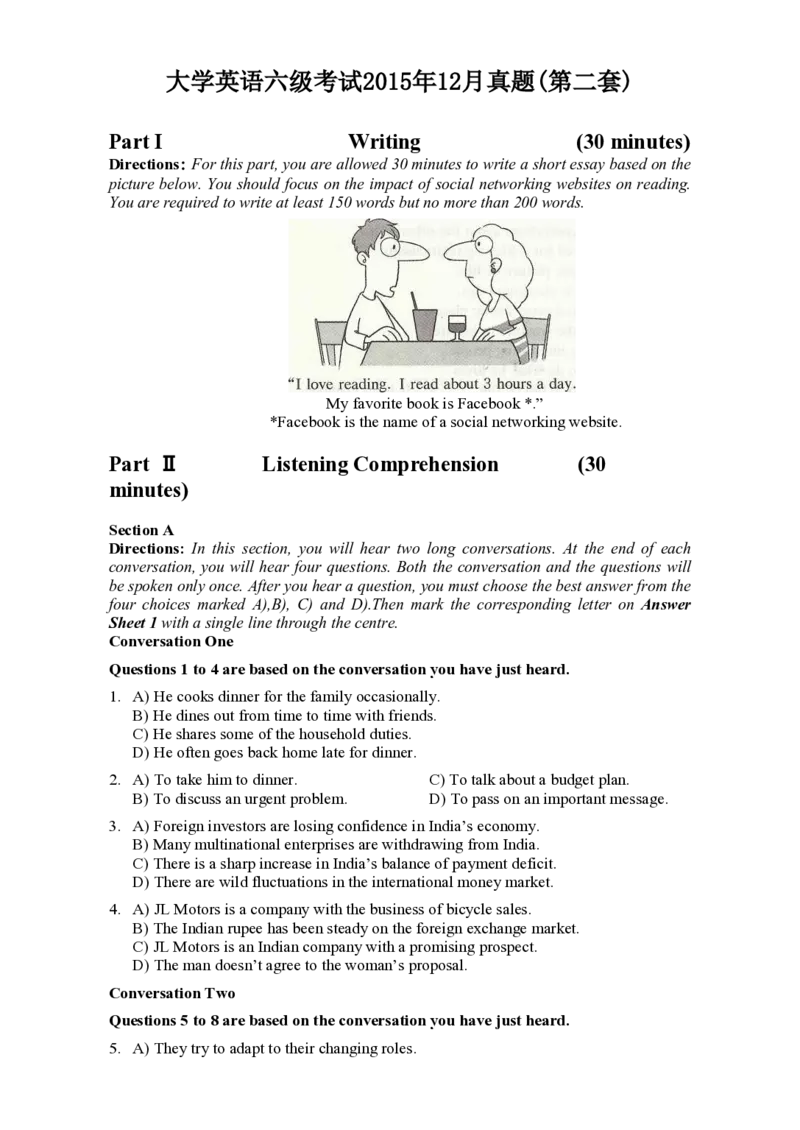
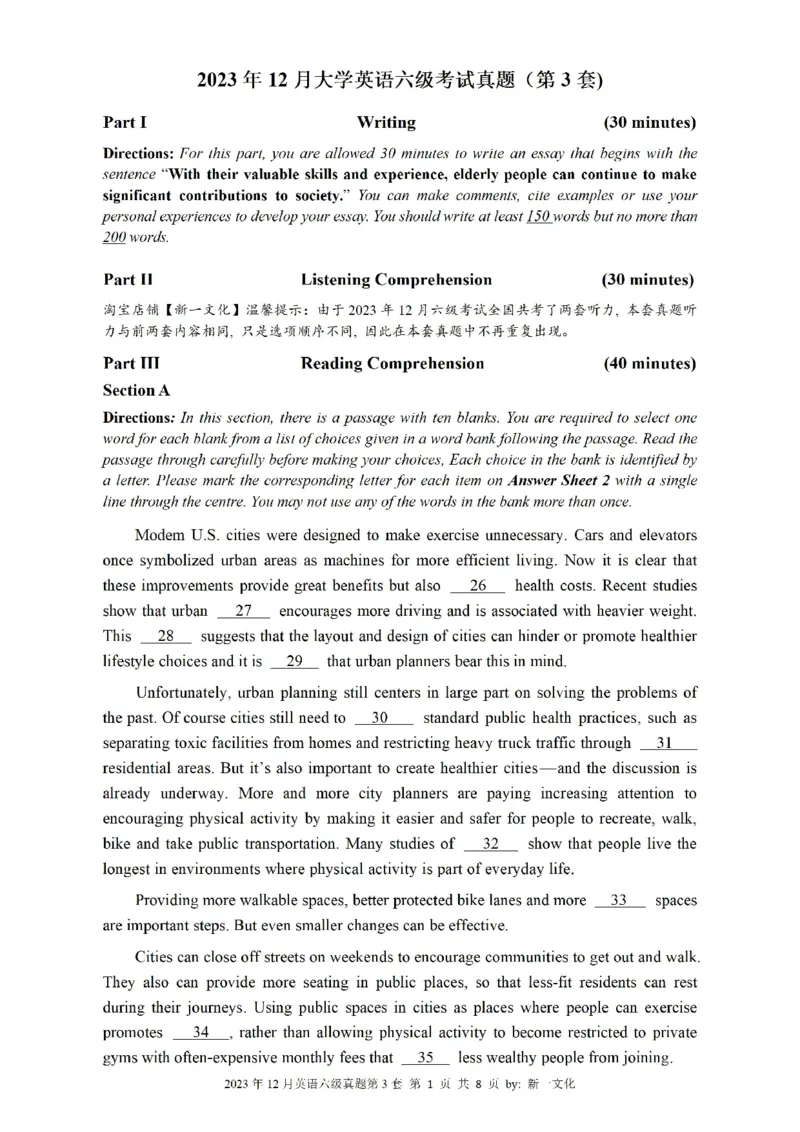
Part I Writing (30 minutes)
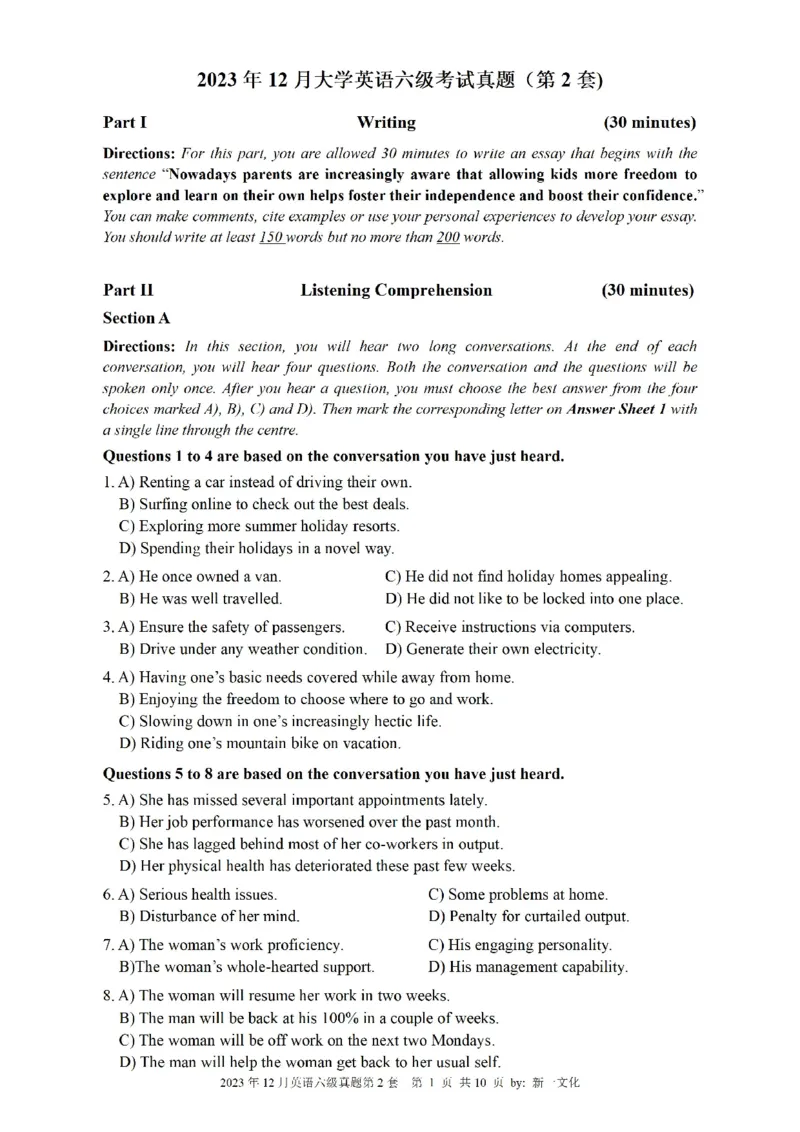
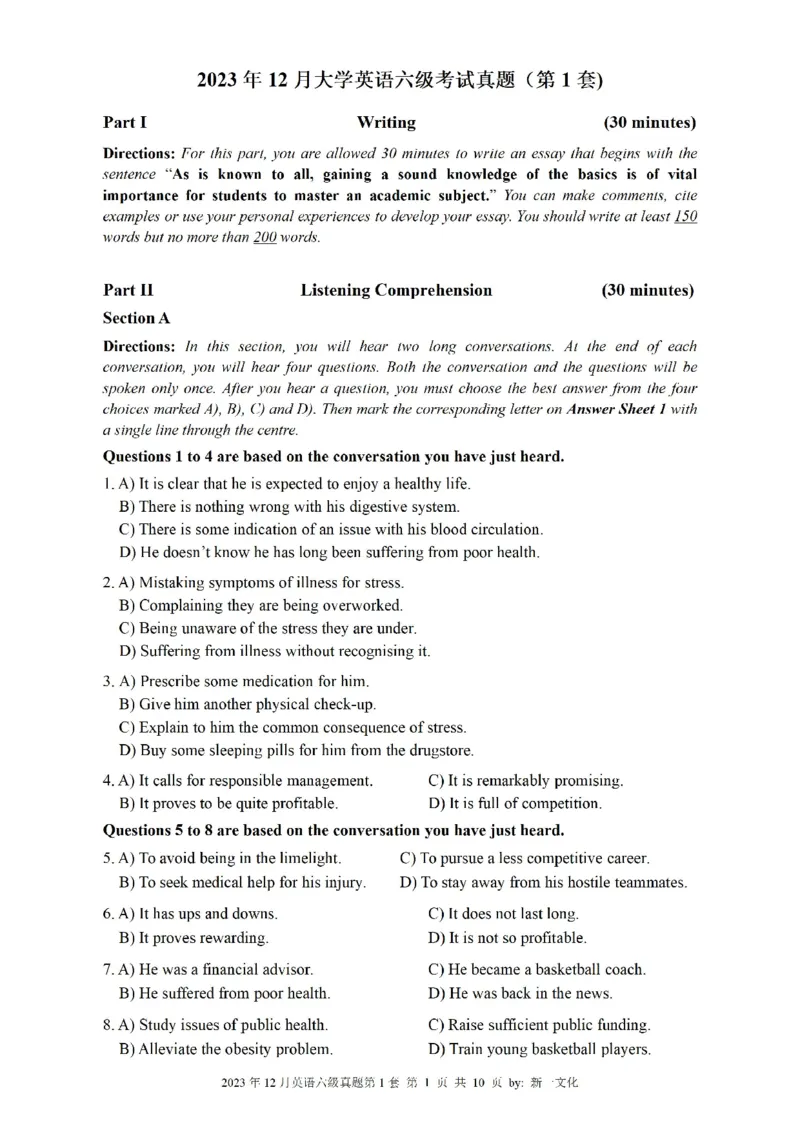
Directions: For this part, you are allowed 30 minutes to write an essay that begins with the sentence "As is known
to all, gaining a sound knowledge of the basics is of vital importance for students to master an academic
subject." You can make comments, cite examples or use your personal experiences to develop your essay. You
should write at least 150 words but no more than 200 words (not including the sentence given).
Part II Listening Comprehension (30 minutes)
Section A
Directions: In this section, you will hear two long conversations. At the end of each conversation, you will hear
four questions. Both the conversation and the questions will be spoken only once. After you hear a question, you
must choose the best answer from the four choices marked A), B), C) and D). Then mark the corresponding letter
on Answer Sheet 1 with a single line through the centre.
Questions 1 to 4 are based on the conversation you have just heard.
1. A) It is clear that he is expected to enjoy a healthy life.
B) There is nothing wrong with his digestive system.
C) There is some indication of an issue with his blood circulation.
D) He doesn't know he has long been suffering from poor health.
2. A) Mistaking symptoms of illness for stress. C) Being unaware of the stress they are under.
B) Complaining they are being overworked. D) Suffering from illness without recognising it.
3. A) Prescribe some medication for him. C) Explain to him the common consequence of stress.
B) Give him another physical check-up. D) Buy some sleeping pills for him from the drugstore.
4. A) It calls for responsible management. C) It is remarkably promising.
B) It proves to be quite profitable. D) It is full of competition.
Questions 5 to 8 are based on the conversation you have just heard.
5. A) To avoid being in the limelight. C) To pursue a less competitive career.
B) To seek medical help for his injury. D) To stay away from his hostile teammates.
6. A) It has ups and downs. C) It does not last long.
B) It proves rewarding. D) It is not so profitable.
7. A) He was a financial advisor. C) He became a basketball coach.
B) He suffered from poor health. D) He was back in the news.
8. A) Study issues of public health. C) Raise sufficient public funding.
B) Alleviate the obesity problem. D) Train young basketball players.
Section B
Directions: In this section, you will hear two passages. At the end of each passage, you will hear three or four
questions. Both the passage and the questions will be spoken only once. After you hear a question, you must choose
the best answer from the four choices marked A), B), C) and D). Then mark the corresponding letter on Answer
Sheet 1 with a single line through the centre.
Questions 9 to 11 are based on the passage you have just heard.
9. A) When she started teaching at Edinburgh University in Scotland.
B) While she was doing her doctoral studies on American Literature.
2023年12月英语六级真题第1套 第1页,共9页C) After publishing her first novel Behind the Scenes at the Museum.
D) After winning the 1986 Woman's Own Short Story Competition.
10. A) The themes of love and loss. C) The sins and flaws of eccentrics.
B) The code of human behaviour. D) The manners of fashionable circles.
11. A) They are usually ignorant of complex human relations.
B) They successfully imitate the manners of celebrities.
C) They often get rewarded instead of being punished.
D) They are generally looked down upon in society.
Questions 12 to 15 are based on the passage you have just heard.
12. A) It is what members use to alleviate tension in a team.
B) It is what employers are increasingly seeking after.
C) It is conducive to getting over a recession.
D) It is necessary for learning a new task.
13. A) Make better choices. C) Achieve recognition duly.
B) Follow innovative ideas. D) Accumulate work experience.
14. A) Workers show more emotional intelligence. C) People usually work flexible hours.
B) Workers use brains more than muscles. D) People often work in teams.
15. A) Leave the group as soon as possible. C) Decide on new priorities speedily.
B) Anticipate setbacks well in advance. D) Stick to original goals confidently.
Section C
Directions: In this section, you will hear three recordings of lectures or talks followed by three or four questions.
The recordings will be played only once. After you hear a question, you must choose the best answer from the four
choices marked A), B), C) and D). Then mark the corresponding letter on Answer Sheet 1 with a single line
through the centre.
Questions 16 to 18 are based on the recording you have just heard.
16. A) What differentiates people from animals. C) Where humans' great cognitive capacity originates.
B) Why philosophers disagree with scientists. D) When being creative becomes a biological mandate.
17. A) It is what tells apart two adjacent generations. C) It is something only geniuses can achieve.
B) It is what sharpens our appetite for novelty. D) It is something every human being can do.
18. A) It seeks inspiration for novel inventions. C) It uses existing ideas to create new ones.
B) It constantly absorbs new information. D) It repeats precedent on a regular basis.
Questions 19 to 21 are based on the recording you have just heard.
19. A) Dogs know when their owners are not feeling well.
B) Dogs have the cognition for telling right from wrong.
C) Dogs have an aptitude for developing skills to interact with humans.
D) Dogs know when their human companions can no longer stand them.
20. A) They can readily detect different ill smells of viruses.
B) They can easily tell what bacteria cause odor change.
C) They are particularly sensitive to strange smells.
2023年12月英语六级真题第1套 第2页,共9页D) They have an extremely powerful sense of smell.
21. A) It can ensure owners suffer fewer chronic diseases.
B) It can benefit owners both physically and mentally.
C) It can reduce owners' risk of getting cancer or diabetes.
D) It can alert owners to the seriousness of their conditions.
Questions 22 to 25 are based on the recording you have just heard.
22. A) Crack down on courses like science, technology, engineering and math.
B) Restrict the ability of creative arts courses to recruit new students.
C) Look at how to reform technical and vocational education.
D) Ensure creative arts students get better value for money.
23. A) Seemingly reasonable. C) Extremely irrational.
B) Clearly well-grounded. D) Apparently simplistic.
24. A) A high proportion of them haven't tried to save money.
B) Most of them never hope to buy a house or to retire.
C) Forty percent of them earn less than £25,000 a year.
D) The majority of them have fairly well-paying jobs.
25. A) The context of a bank balance. C) The specific degree a student earns.
B) Britain's economy as a whole. D) Britain's defective educational system.
Part III Reading Comprehension (40 minutes)
Section A
Directions: In this section, there is a passage with ten blanks. You are required to select one word for each blank
from a list of choices given in a word bank following the passage. Read the passage through carefully before
making your choices. Each choice in the bank is identified by a letter. Please mark the corresponding letter for
each item on Answer Sheet 2 with a single line through the centre. You may not use any of the words in the bank
more than once.
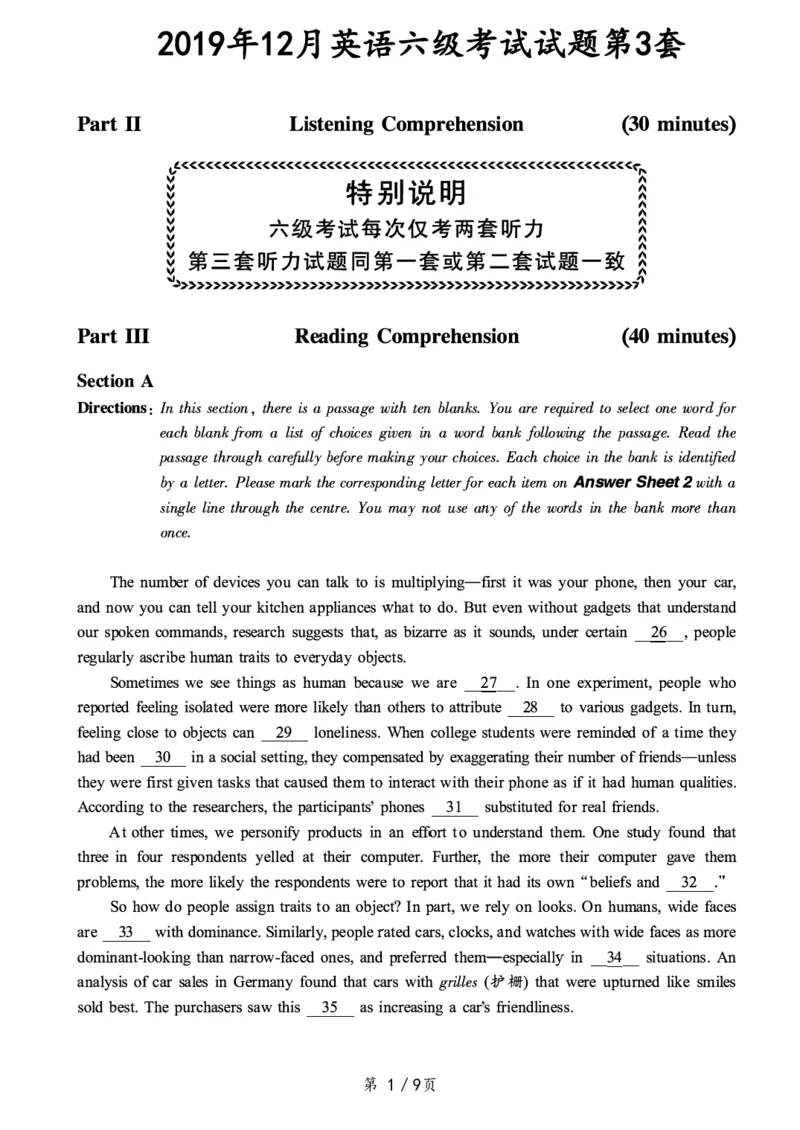
The desert is deceiving. At first glance it looks lifeless, barren, and bone-dry. For most passersby humming
through the Mojave on their way to try their luck in Las Vegas or heading towards the Grand Canyon, it's just a
___26___ stretch of land with some mountains in the distance and more ___27___ to be a setting for a movie that
takes place on Mars. The desert, however, is ___28___ with life, mystery, and magic.
The Mojave desert sees less than two inches of rain a year, and like most deserts, is a land of ___29___.
Temperature fluctuations vary from freezing to ___30___ hot, not only between seasons, but even within the same
day.
At the heart of this vast, 25,000-square-mile desert is Mojave National Preserve. The folks managing and
working there wear the wide-brimmed (宽边的) hats that have become ___31___ with places like Yosemite. The
preserve is rich with history, culture, biodiversity, and endless opportunities to ___32___ your interest, especially
for anyone who loves the outdoors. For a photographer, it requires patience and ___33___ a few spare tires to
maneuver the network of unpaved “roads”, but the rewards are plenty.
2023年12月英语六级真题第1套 第3页,共9页Photographing here requires a good, ___34___ pair of shoes and a lot of preparation. Plenty of water, spare
tires, and a full tank of gas are needed to explore this unit of the national park system, which is the third largest in
the country.
Like all deserts, though, if you are patient, you will be rewarded, as they often reveal their secrets slowly.
During my last outing, I was surprised to see how much of the area was shaped by ancient volcanoes and
geological forces, much of which remains today, giving the area a ___35___ feel and painting a colorful
background for great photographs.
A) apt I) sparingly
B) burning J) sprinkle
C) extremes K) steer
D) flat L) stimulate
E) fractions M) sturdy
F) overflowing N) synonymous
G) parasites O) unique
H) probably
Section B
Directions: In this section, you are going to read a passage with ten statements attached to it. Each statement
contains information given in one of the paragraphs. Identify the paragraph from which the information is derived.
You may choose a paragraph more than once. Each paragraph is marked with a letter. Answer the questions by
making the corresponding letter on Answer Sheet 2.
African countries must get smarter with their agriculture
A) On the hills of central Kenya, almost lime-green with the sparkle of tea bushes in the sunlight, farmers know all
about climate change. "The rainy season is no longer predictable,” says one. "When it is supposed to rain it
doesn't, then it all comes at once." Climate change is an issue that will affect everyone on the planet. For
Africans its consequences will be particularly bitter: whereas other regions were able to grow rich by burning
coal and oil, Africa will pay much of the human price without having enjoyed the benefits. "Africa only
represents 2% of global greenhouse-gas emissions but it is the continent that is expected to suffer the most from
climate impacts," says Mafalda Duarte, who runs the World Bank's $8bn Climate Investment Funds.
B) Although there are huge uncertainties as to the precise impacts of climate change, enough is known to say that
global warming represents one of the main threats to Africa's prosperity. Parts of the continent are already
warming much more quickly than the average: temperatures in southern Africa have increased by about twice
the global rate over the past 50 years. Even if the world were to cut emissions enough to keep global warming
below 1.5°C, heat-waves would intensify in Africa and diseases would spread to areas not currently affected.
Farming would also be hit hard. About 40% of the land now used to grow maize (玉米) would no longer be
suitable for it. Overall, it is estimated that maize yields would fall by 18-22%.
C) Africa is particularly vulnerable, in part because it is already struggling to feed itself and it will have to vastly
increase yields and productivity if it is to put food on the plates of a fast-growing population, even without
2023年12月英语六级真题第1套 第4页,共9页climate change. The UN's Food and Agriculture Organisation reckons that by 2050 global food production
would have to rise by about 70% over its level of 2009 to meet demand from a population that is growing in
numbers and appetite. Much of this new demand will be in Africa. Yet the continent already imports about
$50bn-worth of food a year and that figure is expected to more than double over the next five years.
Self-sufficiency is not Africa's goal, but the fact that it spends more money importing food than it does buying
capital goods suggests it has room for improvement.
D) Finding out why is not hard. Most farms are tiny, ploughed by hand and reliant on rain. More than half of
Africa's people make their living from farming. Although its total harvest has climbed over the past few
decades, this is mainly because there are more people farming more land. But in many places there is no spare
land to farm. Plots in Rwanda are so small that you could fit 250 of them onto the average American farm. And
although output per worker has improved by more than half over the past 30 years in Africa, that is still far
behind the 2.5 times improvement in Asia. Yields of maize are generally less than two tonnes per hectare, a
fifth the level in America.
E) The low productivity of African farmers is reflected in national economic statistics—despite absorbing so much
labour, farming generates just 15% of GDP. "They can't even feed their families," says Jennifer Blanke, a
vice-president of the African Development Bank in charge of agriculture. "Farm productivity hasn't improved
in many parts of Africa for 100 years."
F) One reason is that in the first few decades of independence, many African governments neglected farming as
they focused on industrialising their economies. Others damaged it by pushing down the prices that state
monopolies paid for their crops in order to subsidise workers in cities with cheap food. Ghana taxed cocoa (可
可粉) exports so heavily that production collapsed by half between the 1960s and 1980s, despite a jump in the
global price of cocoa. Yet over the past two decades or so governments and donors have begun to look again at
farming as a way of providing jobs for the 13 million young people entering the workforce each year. Much of
the focus has been on getting small farmers to use fertiliser and, more important, better seeds. The results can
be impressive. Improved varieties of sorghum (高粱), for instance, can produce a crop that is 40%larger than
the usual variety. Infrastructure is important. A World Bank irrigation project in Ethiopia helped farmers
increase their potato harvest from about 8 tonnes per hectare to 35 tonnes.
G) Better techniques help, too. Small coffee farmers in Kenya are able to increase their incomes by 40% by
following a few simple guidelines on caring for their bushes, such as trimming all but three of their stems.
Many of their neighbours do not follow the advice, because it seems counter-intuitive. More stems ought to
lead to more coffee beans, they say. Yet after seeing those following the advice get bigger harvests for a season
or two, many others start doing the same.
H) One way of spreading knowledge is to link farms to big buyers of their harvests. When Diageo, a British drinks
giant, built a brewery in western Kenya, it wanted to use local crops to make a beer cheap enough to compete
with illicit home brew. It organised farmers into groups, improved supply chains for them to get seeds and
fertiliser and then agreed to buy their grain. It now provides a market to about 17,000 farmers. Across the
region it has doubled its use of local raw material to about 80% over five years, says John O'Keeffe, who runs
its Africa business.
I) An even more important change is the move from traditional farming to building businesses that can profitably
bring technology and investment to small farmers. Taita Ngetich, a young Kenyan, was studying engineering
2023年12月英语六级真题第1套 第5页,共9页when he wanted to earn a little money on the side. He scraped together 20,000 Kenyan shillings (about $200) to
plant tomatoes. Everything went wrong. The crop was attacked by pests. "Then there was a massive flood that
swallowed all our capital,” he says. Mr Ngetich persevered by looking into buying a greenhouse to protect his
plants from bugs and rain. The cheapest ones cost more than $2,500 each, so he designed his own for half the
price. Soon neighbouring farmers started placing orders with him, and now his firm, Illuminum Greenhouses,
has sold more than 1,400 greenhouses that provide livelihoods to about 6,000people. The business does not stop
there; he also supplies fertiliser, high-quality seedlings and smart sensors that increase yields.
J) Illuminum's success shows how technology can help even small farms become more productive. Because such a
large share of Africa's population earns a living from agriculture, even small improvements in productivity can
lift the incomes of millions of people. But over the longer run small-scale farming can go only so far, especially
in the face of climate change and population pressure.
K) "If we really want to lift people out of poverty we have to finance projects that will get them an income of at
least $100 a month so that they can pay for health care and education,” says Mr Ngetich. "Projects that give
them an extra $2 a month from growing beans or maize aren't going to get them there." Getting those big jumps
will need better jobs in factories and cities.
36. It is said that agricultural productivity in many African countries has remained low for a century.
37. Building connections between farms and major purchasers of their produce can promote African farmers' use of
advanced farming techniques.
38. Parts of Africa are getting warmer much faster than the average, with southern Africa witnessing roughly twice
the global warming rate over the last half century.
39. Improved farming practices have enabled Kenyan farmers to increase farm produce remarkably.
40. Africa is especially susceptible to the effects of global warming partly because it has difficulty feeding its
increasing population even without climate change.
41. The use of fertiliser and improved seeds can help Africa's small farmers impressively increase crop yields.
42. It has proved even more important to shift from traditional farming to setting up businesses that can bring
technology and investment to small farmers in Africa.
43. Everyone in the world will have to bear the consequences of climate change, especially Africans.
44. Improvement in farm output per worker in Africa falls far short of that in Asia.
45. In the long term, the potential for small farms in Africa to increase productivity is quite limited, especially
owing to the warming climate and a growing population.
Section C
Directions: There are 2 passages in this section. Each passage is followed by some questions or unfinished
statements. For each of them there are four choices marked A), B), C) and D). You should decide on the best choice
and mark the corresponding letter on Answer Sheet 2 with a single line through the centre.
Passage One
Questions 46 to 50 are based on the following passage.
One of the great successes of the Republican Party in recent decades is the relentless propagation of a simple
formula for economic growth: tax cuts.
2023年12月英语六级真题第1套 第6页,共9页The formula doesn't work, but that has not affected its popularity. And while the cult of tax cuts has attracted
many critics, it lacks for obvious rivals.
Democratic politicians have tended to campaign on helping people left behind by economic growth. When
Democrats do talk about encouraging economic growth, they often sound like Republicans.
This is not just a political problem for Democrats; it is an economic problem for the United States. The nation
needs a better story about the drivers of economic growth. The painful lessons of recent decades point to a
promising candidate: higher wages.
Raising the wages of American workers ought to be the priority of economic policymakers. We'd all be better
off paying less attention to quarterly updates on the growth of the nation's gross domestic product (GDP)and
focusing instead on the growth of workers’ paychecks.
Set aside, for the moment, the familiar argument for higher wages: fairness. The argument here is that higher
wages can fuel the engine of economic growth.
Perhaps the most famous illustration of the benefits is the story of Henry Ford's decision in 1914 to pay $5a
day to workers on his Model T assembly lines. He did it to increase production—-he was paying a premium to
maintain a reliable workforce. The unexpected benefit was that Ford's factory workers became Ford customers, too.
The same logic still holds: Consumption drives the American economy, and workers who are paid more can
spend more.
Mainstream economists insist that it is impossible to order up a sustainable increase in wages because
compensation levels reflect the unerring judgment of market forces.
The conventional wisdom held that productivity growth was the only route to higher wages. Through that lens,
efforts to negotiate higher wages were counterproductive. Minimum-wage laws would raise unemployment
because there was only so much money in the wage pool, and if some people got more, others would get none.
It was in the context of this worldview that it became popular to argue that tax cuts would drive prosperity.
Rich people would invest, productivity would increase, wages would rise.
In the real world, things are more complicated. Wages are influenced by a tug of war between employers and
workers, and employers have been winning. One clear piece of evidence is the widening gap between productivity
growth and wage growth since roughly 1970. Productivity has more than doubled; wages have lagged far behind.
A focus on wage growth would provide an antidote (矫正方法) to the attractive simplicity of the belief in the
magical power of tax cuts.
46. Why does the formula of tax cuts remain popular though ineffective?
A) Its critics' voice has not been heard throughout the country.
B) There seem to be no other options available to replace it.
C) The cult of tax cuts has been relentlessly propagated by all policymakers.
D) There appears to be a misunderstanding of the formula among the public.
47. What does the author think is a more effective measure for driving economic growth in the U.S.?
A) Aiding people left behind by economic growth. C) Increasing the compensation for labor.
B) Prioritizing the growth of the nation's GDP. D) Introducing even more extensive tax cuts.
48. What is the logic underlying the author's viewpoint?
A) The growth of workers' paychecks ultimately boosts the nation's economy.
2023年12月英语六级真题第1套 第7页,共9页B) Paying a premium to maintain a reliable workforce attracts more customers.
C) Consumption stimulates the desire for higher wages.
D) Familiar arguments for higher wages are outdated.
49. What is the basis for higher wages according to the conventional wisdom?
A) Fairness in distribution. C) The priority of economic policymakers.
B) Increase in productivity. D) The unerring judgment of market forces.
50. What do we learn about things in the real world in America for the past 50 years or so?
A) People have failed to see a corresponding increase in wages and in productivity.
B) People have been disheartened by the widening gap between the haves and have-nots.
C) People have witnessed a tug of war between Republicans and Democrats over tax cuts.
D) People have seen the link disappearing between productivity and workers' well-being.
Passage Two
Questions 51 to 55 are based on the following passage.
Journal editors decide what gets published and what doesn't, affecting the careers of other academics and
influencing the direction that a field takes. You'd hope, then, that journals would do everything they can to establish
a diverse editorial board, reflecting a variety of voices, experiences, and identities.
Unfortunately a new study in Nature Neuroscience makes for disheartening reading. The team finds that the
majority of editors in top psychology and neuroscience journals are male and based in the United States: a situation
that may be amplifying existing gender inequalities in the field and influencing the kind of research that gets
published.
Men were found to account for 60% of the editors of psychology journals. There were significantly more male
than female editors at each level of seniority, and men made up the majority of editors in over three quarters of the
journals. Crucially, the proportion of female editors was significantly lower than the overall proportion of women
psychology researchers.
The differences were even starker in the neuroscience journals: 70% of editors were male, and men held the
majority of editorial positions in 88% of journals. In this case, the proportion of female editors was not significantly
lower than the proportion of female researchers working in neuroscience—a finding that reveals enduring gender
disparities in the field more broadly.
Based on their results, the team concludes that "the ideas, values and decision-making biases of men are
overrepresented in the editorial positions of the most recognized academic journals in psychology and
neuroscience."
Gender inequality in science is often attributed to the fact that senior academics are more likely to be male,
because historically science was male-dominated: it's argued that as time goes on and more women rise to senior
roles, the field will become more equal. Yet this study showed that even the junior roles in psychology journals
tended to be held disproportionately by men, despite the fact that there are actually more female than male junior
psychology faculty.
This implies that a lack of female academics is not the problem. Instead, there are structural reasons that
women are disadvantaged in science. Women receive lower salaries and face greater childcare demands, for
instance, which can result in fewer publications and grants—the kinds of things that journals look for when
2023年12月英语六级真题第1套 第8页,共9页deciding who to appoint. Rather than simply blaming the inequality of editorial boards on tradition, we should be
actively breaking down these existing barriers.
A lack of diversity among journal editors also likely contributes to psychology's WEIRD problem. If journal
editors are largely men from the United States, then they will probably place higher value on papers that are
relevant to Western, male populations, whether consciously or not.
51. What would we expect an editorial board of an academic journal to exhibit in view of its important
responsibilities?
A) Insight. C) Integrity.
B) Expertise. D) Diversity.
52. What do we learn from the findings of a new study in Nature Neuroscience?
A) The majority of top psychology and neuroscience journals reflect a variety of voices, experiences and
identities.
B) The editorial boards of most psychology and neuroscience journals do influence the direction their field takes.
C) The editorial boards of the most important journals in psychology and neuroscience are male-dominated.
D) The majority of editors in top psychology and neuroscience journals have relevant backgrounds.
53. What fact does the author highlight concerning the gender differences in editors of psychology journals?
A) There were quite a few female editors who also distinguished themselves as influential psychology
researchers.
B) The number of female editors was simply disproportionate to that of women engaged in psychology research.
C) The proportion of female editors was increasingly lower at senior levels.
D) There were few female editors who could move up to senior positions.
54. What can we infer from the conclusion drawn by the team of the new study on the basis of their findings?
A) Women's views are underrepresented in the editorial boards of top psychology and neuroscience journals.
B) Male editors of top psychology and neuroscience journals tend to be biased against their female colleagues.
C) Male researchers have enough representation in the editorial boards to ensure their publications.
D) Female editors have to struggle to get women’s research articles published in academic journals.
55. What does the author suggest we do instead of simply blaming the inequality of editorial boards on tradition?
A) Strike a balance between male and female editors. C) Enlarge the body of female academics.
B) Increase women’s employment in senior positions. D) Implement overall structural reforms.
Part IV Translation (30 minutes)
Directions: For this part, you are allowed 30 minutes to translate a passage from Chinese into English. You
should write your answer on Answer Sheet 2.
在中国,随着老龄化社会的到来,养老受到普遍关注。人们谈论最多的是应当采取什么样的养老模式。
多数人认为,养老模式需要多元化。可以通过政府引导和社会参与,建立更多更好的养老服务机构,改进
社区服务中心,鼓励居家自助养老,还可以推行家庭养老与社会养老相结合的模式。随着政府和社会对养
老服务事业投入的持续增加,养老设施将不断升级,服务质量逐步改进,老年人的生活将会更加方便舒适、
健康快乐。
2023年12月英语六级真题第1套 第9页,共9页