大学英语六级考试2015年6月真题(第二套)
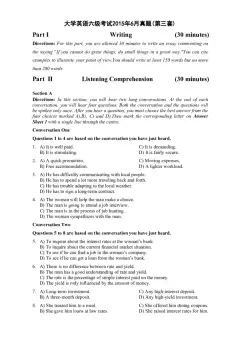
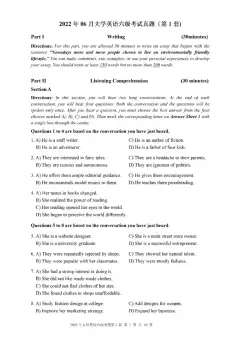
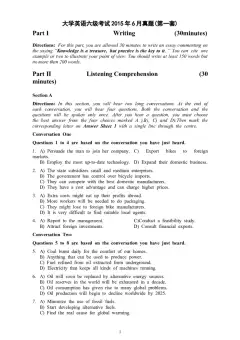
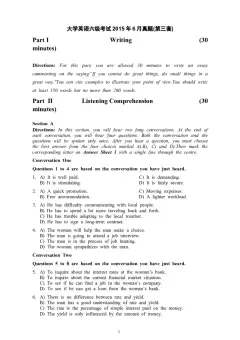
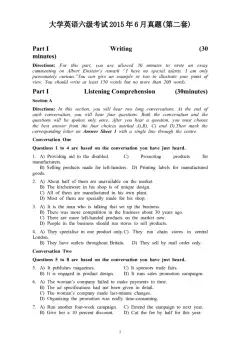
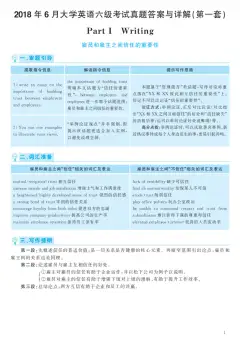
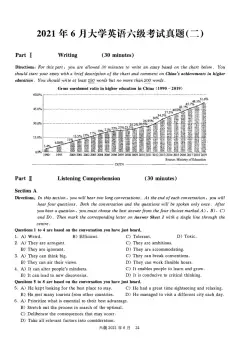
Part I Writing (30 minutes)
Directions: For this part, you are allowed 30 minutes to write an essay commenting on
Albert Einstein’s remark “I have no special talents. I am only passionately curious.”
You cangive an exampleor two to illustrate yourpointof view. Youshould write atleast
150wordsbutnomorethan200words.
Part I Listening Comprehension (30minutes)
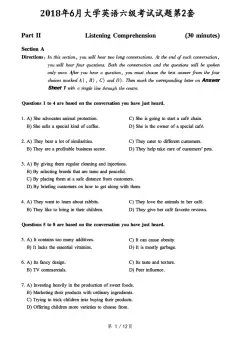
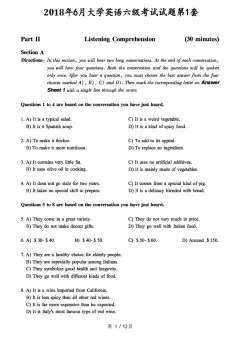
SectionA
Directions: In this section, you will hear two long conversations. At the end of each
conversation, you will hear four questions. Both the conversation and the questions will
bespokenonlyonce.Afteryouhearaquestion,youmustchoosethebestanswerfromthe
four choices marked A),B), C) and D).Then mark the corresponding letter on Answer
Sheet1withasinglelinethroughthecentre.
ConversationOne
Questions1to4arebasedontheconversationyouhavejustheard.
1. A)Providingaidtothedisabled. C)Promotingproductsformanufacturers.
B)Sellingproductsmadeforleft-handers. D)Printinglabelsformanufacturedgoods.
2. A)Abouthalfofthemareunavailableonthemarket.
B)Thekitchenwareinhisshopisofuniquedesign.
C)Allofthemaremanufacturedinhisownplant.
D)Mostofthemarespeciallymadeforhisshop.
3. A)Itisthemanwhoistalkingthatsetupthebusiness.
B)Therewasmorecompetitioninthebusinessabout30yearsago.
C)Therearemoreleft-handedproductsonthemarketnow.
D)Peopleinthebusinessshouldrunstorestosellproducts.
4. A)Theyspecialiseinoneproductonly. C)TheyrunchainstoresincentralLondon.
B)TheyhaveoutletsthroughoutBritain. D)Theysellbymailorderonly.
ConversationTwo
Questions5to8arebasedontheconversationyouhavejustheard.
5. A)Itpublishesmagazines. C)Itsponsorstradefairs.
B)Itisengagedinproductdesign. D)Itrunssalespromotioncampaigns.
6. A)Thewoman’scompanyfailedtomakepaymentsintime.
B)Theadspecificationshadnotbeengivenindetail.
C)Thewoman’scompanymadelast-minutechanges.
D)Organisingthepromotionwasreallytime-consuming.
7. A)Runanotherfour-weekcampaign. C)Extendthecampaigntonextyear.
B)Givehera10percentdiscount. D)Cutthefeebyhalfforthisyear.
8. A)Calmdownandmakepeace. C)Stopnegotiatingforthetimebeing.
B)Improvetheirpromotionplans. D)Reflectontheirrespectivemistakes.
SectionB
Directions: In this section, you will hear two passages.At the end of each passage, youwill hear three or four questions.Both the passage and the questions will be spoken only
once. After you hear a question, you must choose the best answer from the four choices
marked A), B), C) and D). Then mark the corresponding letter on Answer Sheet 1 with a
singlelinethroughthecentre.
PassageOne
Questions9to12arebasedonthepassageyouhavejustheard.
9. A)Theyarelabeledpetanimalsbytheresearchers.
B)Theylookspotlesslycleanthroughouttheirlives.
C)Theyarelookedafterbyanimal-careorganizations.
D)Theysacrificetheirlivesforthebenefitofhumans.
10.A)Theymaybehaveabnormally.
B)Theymaybreedoutofcontrol.
C)Theymayaffecttheresultsofexperiments.
D)Theymaycausedamagetotheenvironment.
11.A)Whentheyarenolongeruseful. C)Whentheybecomeescapees.
B)whentheybecomeill. D)whentheygettooold.
12.A)Whileholdingaburialceremonyforapetmouse,theywerekillingpestmice.
B)Whileadvocatingfreedomforanimals,theykepttheirpetmouseinacage.
C)Whilecallingforanimalrights,theyallowedtheirkidstokeeppetanimals.
D)Whilelaunchinganimalprotectioncampaigns,theyweretrappingkitchenmice.
PassageTwo
Questions13to15arebasedonthepassageyouhavejustheard.
13.A)Theycontributemosttoit. C)Theyoftenfindfaultwithit.
B) Theyarecrazyaboutit. D)Theytakeitforgranted.
14.A)Tidalrestlessness. C)Economicprosperity.
B)Heatandlight. D)Historicalcontinuity.
15.A)Theylackknowledgeofthecultureofthecity.
B)Theyareadventurersfromallovertheworld.
C)Theyhavedifficultysurviving.
D)Theyfindthecityalientothem.
SectionC
Directions: In this section, youwill hearthreerecordingsoflectures or talks followed by
threeorfourquestions.Therecordingswillbeplayedonlyonce.Afteryouhearaquestion,
you must choose the best answer from the four choices marked A),B), C) and D). Then
markthecorrespondingletteronAnswerSheet1withasinglelinethroughthecentre.
Questions16to18arebasedontherecordingyouhavejustheard.
16.A)Proteinwasrecognizedasanessentialcomponentofdiet.
B)Vitaminsweresynthesizedfromfoods.
C)Effectivemeasuresofweightlossweredetermined.
D)Certainfoodswerefoundtobeharmfultogoodhealth.
17.A)Inordertourgemedicaldoctorstoparticipateinresearchstudiesonnutrition.
B)Inordertoencouragemedicaldoctorstoapplyconceptsofnutritioninthetreatmentofdisease.
C)Inordertopersuadedoctorstoconductexperimentalvitamintherapiesontheirpatients.
D)Inordertosupportthecreationofartificialvitamins.
18.A)Thepubliclostinterestinvitamins.
B)Medicalschoolsstoppedteachingnutritionalconcepts.C)Nutritionalresearchwasofpoorquality.
D)Claimsfortheeffectivenessofvitamintherapywereexaggerated.
Questions19to22arebasedontherecordingyouhavejustheard.
19.A)Howbabiesdifferentiatebetweenthesoundofthehumanvoiceandothersounds.
B)Thedifferencesbetweenababy’sandanadult’sabilitytocomprehendlanguage.
C)Howbabiesperceiveandrespondtothehumanvoiceintheirearlystagesoflanguagedevelopment.
D)Theresponseofababytosoundsotherthanthehumanvoice.
20.A)Tocontrastthereactionsofbabiestohumanandnonhumansounds.
B)Togiveexamplesofsoundsthatwillcauseababytocry.
C)Toexplainhowbabiesdistinguishbetweendifferentnonhumansounds.
D)Togiveexamplesoftypicaltoysthatbabiesdonotlike.
21.A)Babieswhoareexposedtomorethanonelanguagecanacquirelanguagesearlierthanthosetoasinglelanguage.
B)Mothersfromdifferentculturesspeaktotheirbabiesinasimilarway.
C)Babiesignorefacialexpressionsincomprehendingtheirparents’language.
D)Themothersobservedbytheresearcherswereconsciouslyteachingtheirbabiestospeak.
22.A)Theyunderstandtherhythm. C)Theycanrememberthemeasily.
B)Theyenjoythesoundsofthem. D)Theyfocusontheirparents’words.
Questions23to25arebasedontherecordingyouhavejustheard.
23.A)Britain. C)France.
B)Germany. D)Japan.
24.A)TheUnitedStateshadaleadingpositionontheworldmarketbythestartofWorldWarI.
B)Thecentreoffilm-makingmovedeastwardsfromHollywoodtoNewYork.
C)ManyfilmindustriescouldcompetewiththatofHollywood.
D)ThefilmmarketsofRussiaandJapanweretheonlypromisingones.
25.A)Indifferent. C)Negative.
B)Biased. D)Neutral.
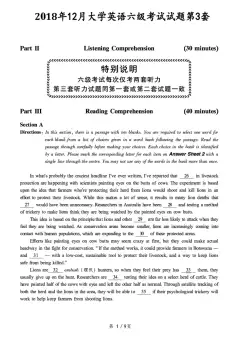
Part Ⅱ Reading Comprehension (40 minutes)
SectionA
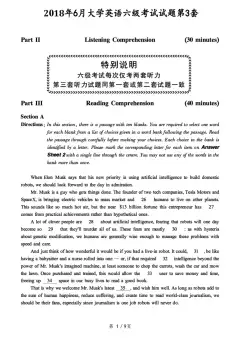
Directions: Inthis section,thereis apassagewith ten blanks.Youarerequiredtoselect
onewordforeachblankfromalistofchoicesgiveninawordbankfollowingthepassage.
Read the passage through carefully before making your choices. Each choice in the bank
is identified by a letter. Please mark the corresponding letter for each item on Answer
Sheet 2 with a single line through the centre. You may not use any of the words in the
bankmorethanonce.
Questions26to35arebasedonthefollowingpassage.
“That which does not kill us makes us stronger.” But parents can’t handle it when
teenagers put this __26__ into practice. Now technology has become the new field for
theage-oldbattlebetweenadultsandtheirfreedom-seekingkids.
Locked indoors,unable togeton theirbicycles andhangoutwith their friends,teens
have turned to social media and their mobile phones to socialize with their peers. What
they do online often __27__ what they might otherwise do if their mobility weren’t so
heavily __28__ in the age of helicopter parenting. Social media and smart-phone apps
havebecomesopopularinrecentyearsbecauseteensneedaplacetocalltheirown.They
want the freedom to __29__ their identity and the world around them. Instead of __30__
out,theyjumponline.
As teens have moved online, parents have projected their fears onto the Internet,
imagining all the __31__ dangers that youth might face —from __32__ strangers tocruelpeerstopicturesorwordsthatcouldhauntthemonGooglefortherestoftheirlives.
Rather than helping teens develop strategies for negotiating public life and the risks
of__33__with others,fearfulparentshavefocusedontracking,monitoringandblocking.
These tactics(策略)don’t help teens develop the skills they need to manage complex
social situations, __34__ risks and get help when they’re in trouble. “Protecting” kids
may felllike the right thing to do, butit __35__ the learningthat teensneed to doas they
comeofageinatechnology-soakedworld.
A)assess K)potential
B) constrained L) sneaking
C) contains M)sticking
D) explore N)undermines
E)influence O)violent
F) interacting
G) interpretation
H) magnified
I) mirrors
J) philosophy
SectionB
Directions: Inthissection,youaregoingtoreadapassagewith tenstatements attached
to it. Each statement contains information given in one of the paragraphs. Identify the
paragraph from which the information is derived. You may choose a paragraph more
than once. Each paragraph is marked with a letter. Answer the questions by marking the
correspondingletteronAnswerSheet2.
InequalityIsNotInevitable
[A] An dangerous trend has developed over this past third of a century. A country that
experienced shared growth after World WarⅡ began to tear apart, so much so that
when the Great Recession hit in late 2007, one could no longer ignore the division
thathadcome todefinetheAmerican economic landscape.How didthis “shiningcity
onahill”becometheadvancedcountrywiththegreatestlevelofinequality?
[B] Over the past year and a half, The Great Divide, a series in The New York Times, has
presenteda wide range of examples that undermine the notion that there are any truly
fundamental laws of capitalism. The dynamics of the imperial capitalism of the 19th
centuryneedn’tapplyinthedemocraciesofthe21st.Wedon’tneedtohavethismuch
inequalityinAmerica.
[C] Our current brand of capitalism is a fake capitalism. For proof of this go back to our
response to the Great Recession, where we socialized losses, even as we privatized
gains. Perfect competition should drive profits to zero, at least theoretically, but we
have monopolies making persistently high profits. C. E. O. s enjoy incomes that are
on average 295 times that of the typical worker, a much higher ratio than in the past,
withoutanyevidenceofaproportionateincreaseinproductivity.
[D]IfitisnotthecruellawsofeconomicsthathaveledtoAmerica’sgreatdivide,whatis
it? The straightforward answer: our policies and our politics! People get tired of
hearing about Scandinavian success stories, but the fact of the matter is that Sweden,
Finland and Norway have all succeeded in having about as much or faster growth inpercapita(人均的)incomesthantheUnitedStatesandwithfargreaterequality.
[E]SowhyhasAmericachosentheseinequality-enhancingpolicies?Partoftheansweris
that as World War II faded into memory, so too did the solidarity it had created. As
Americatriumphed in the Cold War, theredidn’tseem to be a realcompetitor to our
economic model. Without this international competition, we no longer had to show
thatoursystemcoulddeliverformostofourcitizens.
[F] Ideology and interests combined viciously. Some drew the wrong lesson from the
collapse of the Soviet system in 1991. The pendulum swung from much too much
government there to much too little here. Corporate interests argued for getting rid of
regulations, even when those regulations had done so much to protect and improve
ourenvironment,oursafety,ourhealthandtheeconomyitself.
[G] But this ideology was hypocritical(虚伪的). The bankers, among the strongest
advocatesoflaissez-faire(自由放任的)economics, were onlytoowilling toaccept
hundreds of billions of dollars from the government in the aid programs that have
been a recurring feature of the global economy since the beginning of the Thatcher-
Reaganeraof“free”marketsandderegulation.
[H] The American political system is overrun by money. Economic inequality translates
intopoliticalinequality,andpoliticalinequalityyieldsincreasingeconomicinequality.
So corporate welfare increases as we reduce welfare for the poor. Congress maintains
subsidies for rich farmers as we cut back on nutritional support for the needy. Drug
companies have been given hundreds of billions of dollars as we limit Medicaid
benefits. The banks thatbrought onthe global financialcrisis got billions while a tiny
bit went to the homeowners and victims of the same banks’ predatory(掠夺性的)
lending practices. This last decision was particularly foolish. There were alternatives
to throwing money at the banks and hoping it would circulate through increased
lending.
[I] Our divisions are deep. Economic and geographic segregation have immunized those
at the top from the problems of those down below. Like the kings of ancient times,
theyhavecometoperceivetheirprivilegedpositionsessentiallyasanaturalright.
[J] Our economy, our democracy and our society have paid for these gross inequalities.
Thetrue testof aneconomy is nothowmuchwealth its princescanaccumulate in tax
havens(庇护所),but how well off the typical citizen is. But average incomes are
lower than they were a quarter-century ago. Growth has gone to the very, very top,
whose share has almost increased four times since 1980. Money that was meant to
have trickled(流淌)down has instead evaporated in the agreeable climate of the
CaymanIslands.
[K] With almost a quarter of American children younger than 5 living in poverty, and
with America doing so little for its poor, the deprivations of one generation are being
visited upon the next. Of course, no country has ever come close to providing
complete equality of opportunity. But why is America one of the advanced countries
where the life prospects of the young are most sharply determined by the income and
educationoftheirparents?
[L] Among the most bitter stories in The Great Divide were those that portrayed the
frustrations of the young, who long to enter our shrinking middle class. Soaring
tuitionsanddecliningincomes haveresultedinlarger debtburdens.Thosewithonlya
high school diploma have seen their incomes decline by 13 percent over the past 35
years.
[M] Where justice is concerned, there is also a huge divide. In the eyes of the rest of theworld and a significant part of its own population, mass imprisonment has come to
define America—a country, it bears repeating, with about 5 percent of the world’s
populationbutaroundafourthoftheworld’sprisoners.
[N] Justice has become a commodity, affordable to only a few. While Wall Street
executives used their expensive lawyers to ensure that their ranks were not held
accountablefor the misdeeds thatthe crisis in 2008so graphically revealed, the banks
abused our legal system to foreclose(取消赎回权)onmortgages and eject tenants,
someofwhomdidnotevenowemoney.
[O] More than a half-century ago, America led the way in advocating for the Universal
Declaration of Human Rights, adopted by the United Nations in 1948. Today, access
to health care is among the most universally accepted rights, at least in the advanced
countries. America, despite the implementation of the Affordable Care Act, is the
exception. In the relief that many felt when the Supreme Court did not overturn the
Affordable Care Act, the implications of the decision for Medicaid were not fully
appreciated. Obamacare’s objective —to ensure that all Americans have access to
health care—has been blocked: 24 states have not implemented the expanded
Medicaid program, which was the means by which Obamacare was supposed to
deliveronitspromisetosomeofthepoorest.
[P]Weneednotjustanewwaronpovertybutawartoprotectthemiddleclass.Solutions
to these problems do not have to be novel. Far from it. Making markets act like
marketswouldbeagoodplacetostart.Wemustendtherent-seekingsocietywehave
gravitatedtoward,inwhichthewealthyobtainprofitsbymanipulatingthesystem.
[Q] The problem of inequality is not so much a matter of technical economics. It’s really
a problem of practical politics. Inequality is not just about the top marginal tax rate
butalso aboutour children’s accessto food andthe right to justice forall. If we spent
moreoneducation,healthandinfrastructure(基础设施), wewouldstrengthenour
economy,nowandinthefuture.
36.Intheory,freecompetitionissupposedtoreducethemarginofprofitstotheminimum.
37.The United States is now characterized by a great division between the rich and the
poor.
38.Americalacked theincentive to carefor themajority ofits citizens asit foundnorival
foritseconomicmodel.
39.Thewealthytophavecometotakeprivilegesforgranted.
40.Manyexamples showthe basic laws ofimperialcapitalism nolonger applyin present-
dayAmerica.
41.Theauthorsuggestsareturntothetruespiritofthemarket.
42.Aquarteroftheworld’sprisonerpopulationisinAmerica.
43.Governmentregulation in America went from oneextreme to the other in the past two
decades.
44.Justice has become so expensive that only a small number of people like corporate
executivescanaffordit.
45.Nocountryintheworldso farhasbeenabletoprovidecompletelyequalopportunities
forall.
SectionCDirections: There are 2 passages in this section. Each passage is followed by some
questions or unfinished statements. For each of them there are four choices marked A),
B), C) and D). You should decide on the best choice and mark the corresponding letter
onAnswerSheet2withasinglelinethroughthecentre.
PassageOne
Questions46to50arebasedonthefollowingpassage.
I’ll admit I’ve never quite understood the obsession ( 难 以 破除 的 成 见 )
surrounding genetically modified (GM) crops. To environmentalist opponents, GM foods
aresimplyevil,anunderstudied,possiblyharmfultoolusedbybigagriculturalbusinesses
to control global seed markets and crush local farmers. They argue that GM foods have
never delivered on their supposed promise, that money spent on GM crops would be
better channeled to organic farming andthatconsumers should beprotected with warning
labels on any products that contain genetically modified ingredients. To supporters, GM
crops are a key part of the effort to sustainably provide food to meet a growing global
population. But more than that, supporters see the GM opposition of many
environmentalists as fundamentally anti-science, no different than those who question the
basicsofman-madeclimatechange.
For both sides, GM foods seem to act as a symbol: you’re pro-agricultural business
oranti-science. Butscienceis exactly whatweneedmoreofwhenitcomes to GM foods,
which is whyI washappytosee Naturedevote a specialseries of articles to theGM food
controversy. The conclusion: while GM crops haven’t yet realized their initial promise
andhavebeendominatedbyagriculturalbusinesses,thereisreasontocontinuetouseand
develop them to help meet the enormous challenge of sustainably feeding a growing
planet.
That doesn’t mean GM crops are perfect, or a one-size-fits-all solution to global
agriculture problems. But anything that can increase farming efficiency—the amount of
crops we can produce per acre of land—will be extremely useful. GM crops can and
almost certainly will be part of that suite of tools, but so will traditional plant breeding,
improved soil and crop management—and perhaps most important of all, better storage
andtransportinfrastructure(基础设施),especiallyinthedevelopingworld.(Itdoesn’t
do much good for farmers in places like sub-Saharan Africa to produce more food if they
can’tget it to hungry consumers.) I’d like to see more non-industry research done onGM
crops—not just because we’d worry less about bias, but also because seed companies
like Monsanto and Pioneer shouldn’t be the only entities working to harness genetic
modification. I’d like to see GM research on less commercial crops, like corn. I don’t
think it’s vital to label GM ingredients in food, but I also wouldn’t be against it—and
industry would be smart to go along with labeling, just as a way of removing fears about
thetechnology.
Most of all, though, I wish a tenth of the energy that’s spent endlessly debating GM
crops was focused on those more pressing challenges for global agriculture. There are
muchbiggerbattlestofight.
46.HowdoenvironmentalistopponentsviewGMfoodsaccordingtothepassage?
A)Theywilleventuallyruinagricultureandtheenvironment.
B)Theyareusedbybigbusinessestomonopolizeagriculture.
C)Theyhaveprovedpotentiallyharmfultoconsumers’health.
D)Theyposeatremendousthreattocurrentfarmingpractice.
47.What does the author say is vital to solving the controversy between the two sides ofthedebate?
A)BreakingtheGMfoodmonopoly.
B)Morefriendlyexchangeofideas.
C)RegulatingGMfoodproduction.
D)MorescientificresearchonGMcrops.
48.WhatisthemainpointoftheNaturearticles?
A)FeedingthegrowingpopulationmakesitimperativetodevelopGMcrops.
B)PopularizingGMtechnologywillhelpittoliveuptoitsinitialpromises.
C)MeasuresshouldbetakentoensurethesafetyofGMfoods.
D)Bothsupportersandopponentsshouldmakecompromises.
49.Whatistheauthor’sviewonthesolutiontoagriculturalproblems?
A)IthastodependmoreandmoreonGMtechnology.
B)Itisvitaltothesustainabledevelopmentofhumansociety.
C)GMcropsshouldbealloweduntilbetteralternativesarefound.
D)Whateverisusefultoboostfarmingefficiencyshouldbeencouraged.
50.WhatdoestheauthorthinkoftheongoingdebatearoundGMcrops?
A)Itarisesoutofignoranceofandprejudiceagainstnewscience.
B)Itdistractsthepublicattentionfromotherkeyissuesoftheworld.
C)Effortsspentonitshouldbeturnedtomoreurgentissuesofagriculture.
D)Neithersideislikelytogiveinuntilmoreconvincingevidenceisfound.
PassageTwo
Questions51to55arebasedonthefollowingpassage.
Early decision—you apply to one school? and admission is binding—seems like a
great choice for nervous applicants. Schools let in a higher percentage of early-decision
applicants, which arguably means that you have a better chance of getting in. And if you
do, you’re done with the whole agonizing process by December. But what most students
andparentsdon’trealizeisthatschoolshavehiddenmotivesforofferingearlydecision.
Early decision, since it’s binding, allows schools to fill their classes with qualified
students; it allows admissions committees to select the students that are in particular
demandfortheircollegeandknowthosestudentswillcome.Italsogivesschoolsahigher
yield rate, which is often used as one of the ways to measure college selectivity and
popularity.
The problem is that this process effectively shortens the window of time students
have to make one of the most important decisions of their lives up to that point. Under
regular admissions, seniors have until May 1 to choose which school to attend; early
decision effectively steals six months from them, months that could be used to visit more
schools, do more research, speak to current students and alumni(校友)and arguably
makeamoreinformeddecision.
There are, frankly, an astonishing number of exceptional colleges in America, and
for any given student, there are a number of schools that are a great fit. When students
become too fixated(专注)on a particular school early in the admissions process, that
fixation can lead to severe disappointment if they don’t get in or, if they do? the
possibilitythattheyarenowboundtogotoaschoolthat,giventimeforfurtherreflection,
maynotactuallyberightforthem.
Insofar as early decision offers a genuine admissions edge, that advantage goes
largely to students who already have numerous advantages. The students who use early
decision tend to be those who have received higher-quality college guidance, usually a
result of coming from a more privileged background. In this regard, there’s an argumentagainst early decision, as students from lower-income families are far less likely to have
theadmissionsknow-howtonavigatetheoftenconfusingearlydeadlines.
Students whohave donetheir research andare confidentthatthere’s oneschoolthey
would bethrilled to get into should,under the currentsystem, probably apply under early
decision. But for students who haven’t yet done enough research, or who are still
constantly changing their minds on favorite schools, the early-decision system needlessly
and prematurely narrows the field of possibility just at a time when students should be
openingthemselvestoawholerangeofthrillingoptions.
51.Whatarestudentsobligedtodounderearlydecision?
A)Lookintoalotofschoolsbeforetheyapply.
B)Attendtheschooloncetheyareadmitted.
C)Thinktwicebeforetheyaccepttheoffer.
D)Consultthecurrentstudentsandalumni.
52.Whydoschoolsofferearlydecision?
A)Tomakesuretheygetqualifiedstudents.
B)Toavoidcompetitionwithothercolleges.
C)Toprovidemoreopportunitiesforapplicants.
D)Tosavestudentstheagonyofchoosingaschool.
53.Whatissaidtobetheproblemwithearlydecisionforstudents?
A)Itmakestheirapplicationprocessmorecomplicated.
B)Itplacestoohighademandontheirresearchability.
C)Itallowsthemlittletimetomakeinformeddecisions.
D)Itexertsmuchmorepsychologicalpressureonthem.
54.Whyaresomepeopleopposedtoearlydecision?
A)Itinterfereswithstudents’learninginhighschool.
B)Itisbiasedagainststudentsatordinaryhighschools.
C)Itcausesunnecessaryconfusionamongcollegeapplicants.
D)Itplacesstudentsfromlower-incomefamiliesatadisadvantage.
55.Whatdoestheauthoradvisecollegeapplicantstodo?
A)Refrainfromcompetingwithstudentsfromprivilegedfamilies.
B)Avoidchoosingearlydecisionunlesstheyarefullyprepared.
C)Findsufficientinformationabouttheirfavoriteschools.
D)Lookbeyondthefewsupposedlythrillingoptions.
Part Ⅳ Translation (30 minutes)
Directions: For this part, you are allowed 30 minutes to translate a passage from
ChineseintoEnglish.YoushouldwriteyouransweronAnswerSheet2.
汉朝是中国历史上最重要的朝代之一。汉朝统治期间有很多显著的成就。它
最先向其他文化敞开大门,对外贸易兴旺。汉朝开拓的丝绸之路通向了中西亚乃至
罗马。各类艺术一派繁荣,涌现了很多文学、历史、哲学巨著。公元100年中国第
一部字典编纂完成,收人9000个字,提供释义并列举不同的写法。其间,科技方面也
取得了很大进步,发明了纸张、水钟、日晷(sundials)以及测量地震的仪器。汉朝历
经400年,但统治者的腐败最终导致了它的灭亡。