



文档内容
2019年12月英语六级考试试题第3套
Part II Listening Comprehension (30 minutes)
�L<<<<<<<<<<<<<<<<<<<<<<<<<<<<<<<<<<<<<<<<<<<<<<<<<<<<<<<<�
� %= �IJ i� a� � �
A�*����*���n
� �
� m=��n���m-��m=���-� �
"'..)>>>>>>>>>>>>>>>>>>>>>>>>>>>>>>>>>>>>>>>>>>>>>>>>>>>>>>>>,�
Part III Reading Comprehension (4 0 minutes)
Section A
Directions: In this section, there is a passage with ten blanks. You are required to select one word for
each blank from a list of choices given in a word bank following the passage. Read the
passage through carefully before making your choices. Each choice in the bank is identified
by a letter. Please mark the corresponding letter for each item on Answer Sheet 2 with a
single line through the centre. You may not use any of the words in the bank more than
once.
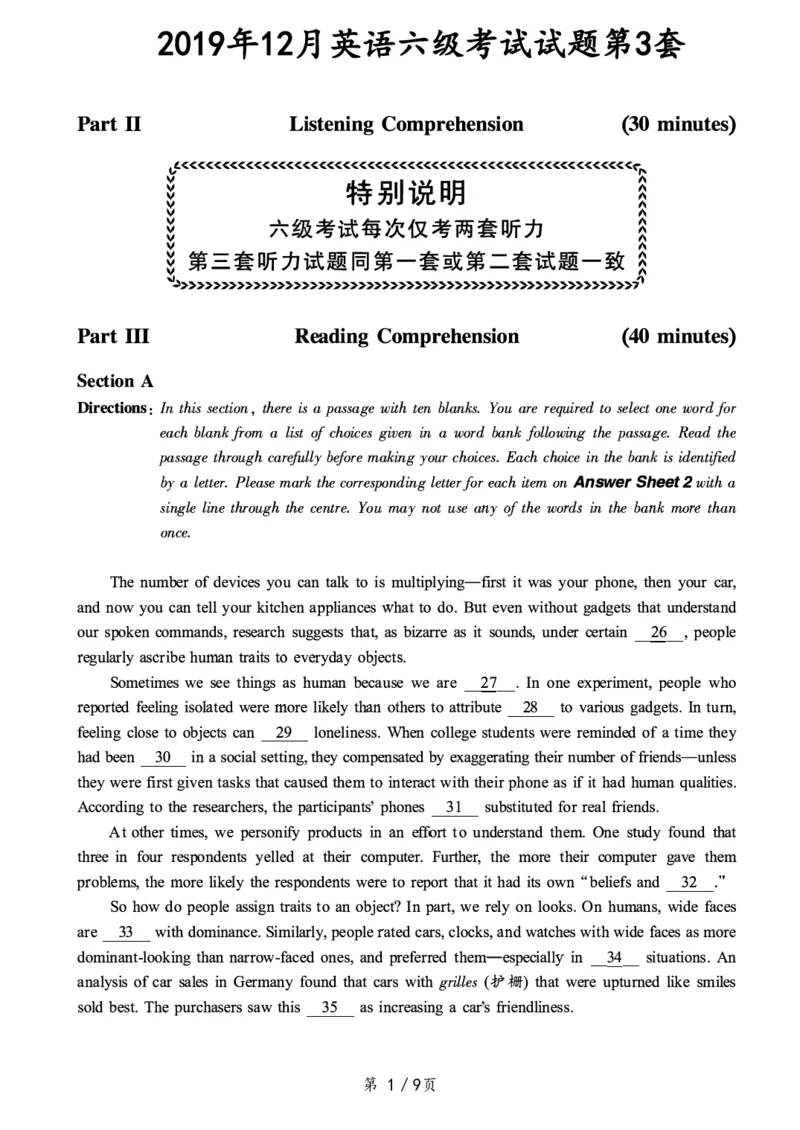
The number of devices you can talk to is multiplying-first it was your phone, then your car,
and now you can tell your kitchen appliances what to do. But even without gadgets that understand
our spoken commands, research suggests that, as bizarre as it sounds, under certain 26 , people
regularly ascribe human traits to everyday objects.
Sometimes we see things as human because we are 27 . In one experiment, people who
reported feeling isolated were more likely than others to attribute 28 to various gadgets. In tum,
feeling close to objects can 29 loneliness. When college students were reminded of a time they
had been 30 in a social setting, they compensated by exaggerating their number of friends-unless
they were first given tasks that caused them to interact with their phone as if it had human qualities.
According to the researchers, the participants' phones 31 substituted for real friends.
At other times, we personify products in an effort to understand them. One study found that
three in four respondents yelled at their computer. Further, the more their computer gave them
problems, the more likely the respondents were to report that it had its own "beliefs and 32
So how do people assign traits to an object? In part, we rely on looks. On humans, wide faces
are 33 with dominance. Similarly, people rated cars, clocks, and watches with wide faces as more
dominant-looking than narrow-faced ones, and preferred them-especially in 34 situations. An
analysis of car sales in Germany found that cars with grilles ( ctt ,#JJt) that were upturned like smiles
sold best. The purchasers saw this 35 as increasing a car's friendliness.
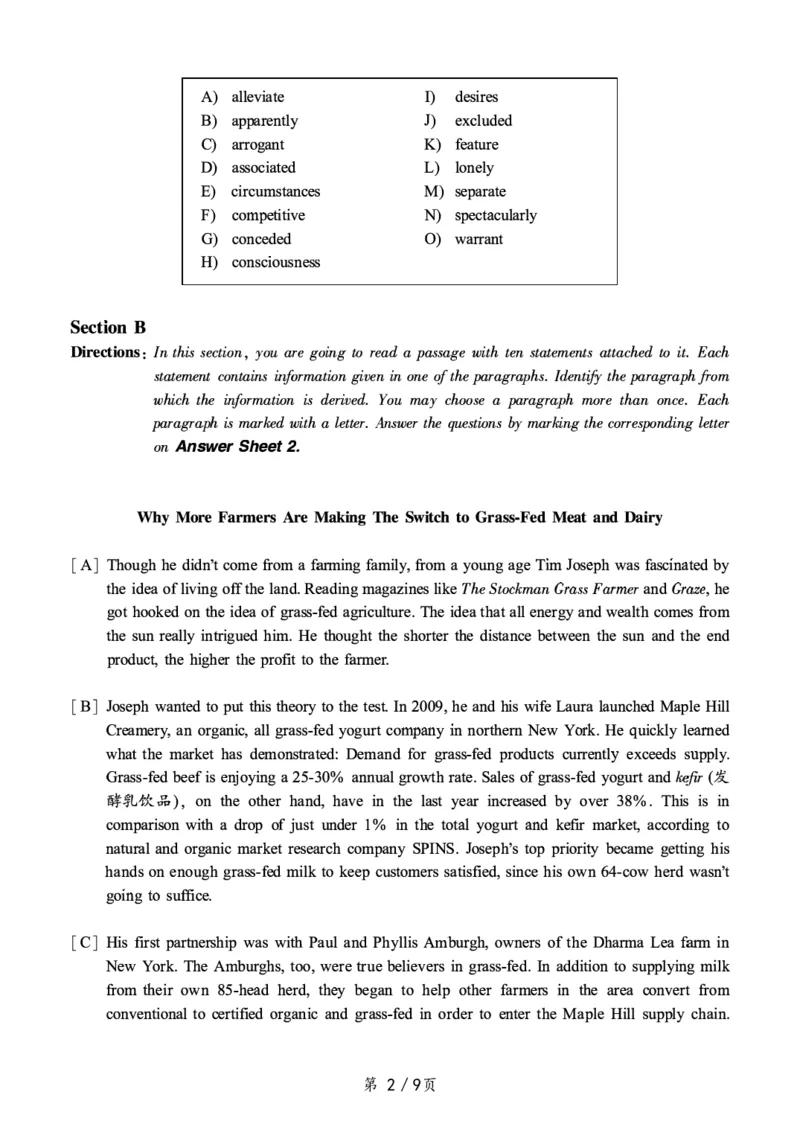
第 1/9页A) alleviate I) desires
B) apparently J) excluded
C) arrogant K) feature
D) associated L) lonely
E) circumstances M) separate
F) competitive N) spectacularly
G) conceded 0) warrant
H) consc10usness
Section B
Directions: In this section, you are going to read a passage with ten statements attached to it. Each
statement contains information given in one of the paragraphs. Identify the paragraph from
which the information is derived. You may choose a paragraph more than once. Each
paragraph is marked with a letter. Answer the questions by marking the corresponding letter
on Answer Sheet 2.
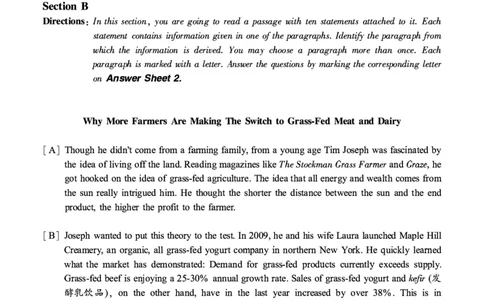
Why More Farmers Are Making The Switch to Grass-Fed Meat and Dairy
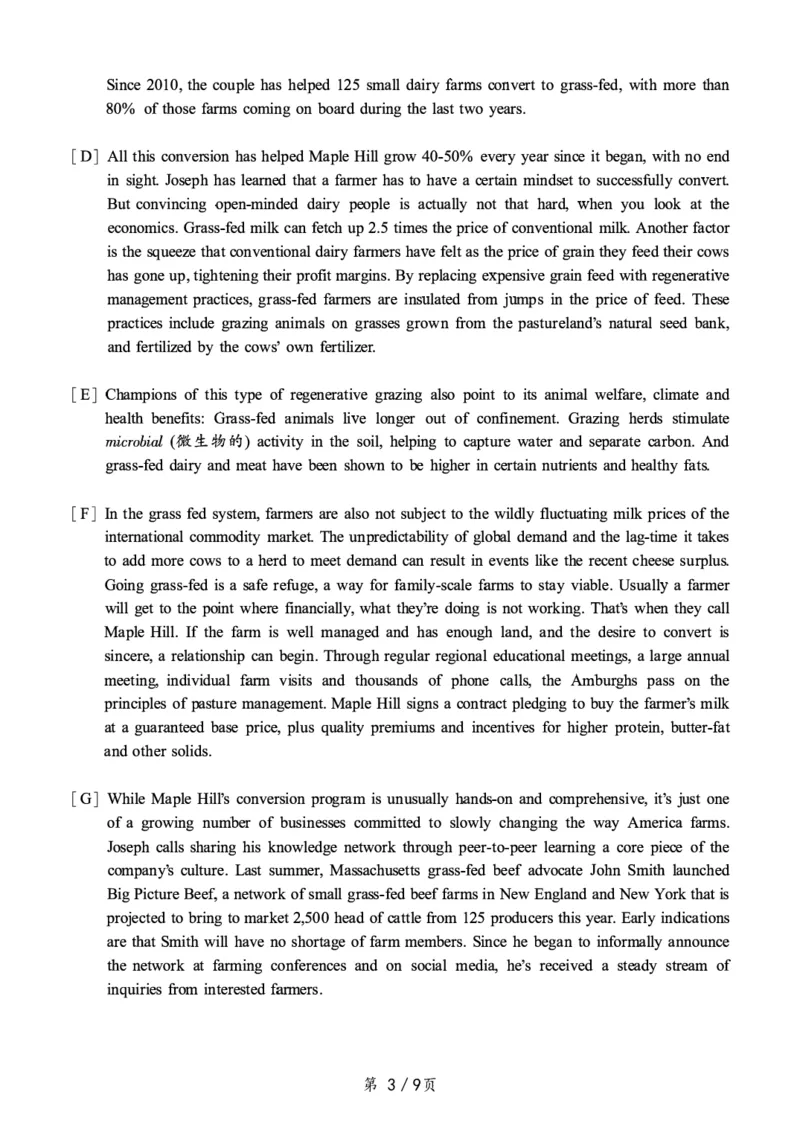
[ A] Though he didn't come from a farming family, from a young age Tim Joseph was fascinated by
the idea of living off the land. Reading magazines like The Stockman Grass Farmer and Graze, he
got hooked on the idea of grass-fed agriculture. The idea that all energy and wealth comes from
the sun really intrigued him. He thought the shorter the distance between the sun and the end
product, the higher the profit to the farmer.
[ B] Joseph wanted to put this theory to the test. In 2009, he and his wife Laura launched Maple Hill
Creamery, an organic, all grass-fed yogurt company in northern New York. He quickly learned
what the market has demonstrated: Demand for grass-fed products currently exceeds supply.
Grass-fed beef is enjoying a 25-30% annual growth rate. Sales of grass-fed yogurt and kefir (�
�JUkJ'� ), on the other hand, have in the last year increased by over 38%. This is in
comparison with a drop of just under 1 % in the total yogurt and kefir market, according to
natural and organic market research company SPINS. Joseph's top priority became getting his
hands on enough grass-fed milk to keep customers satisfied, since his own 64-cow herd wasn't
going to suffice.
[ C] His first partnership was with Paul and Phyllis Amburgh, owners of the Dharma Lea farm in
New York. The Amburghs, too, were true believers in grass-fed. In addition to supplying milk
from their own 85-head herd, they began to help other farmers in the area convert from
conventional to certified organic and grass-fed in order to enter the Maple Hill supply chain.
第 2/9页Since 2010, the couple has helped 125 small dairy farms convert to grass-fed, with more than
80% of those farms corning on board during the last two years.
[ D] All this conversion has helped Maple Hill grow 40-50% every year since it began, with no end
in sight. Joseph has learned that a farmer has to have a certain mindset to successfully convert.
But convincing open-minded dairy people is actually not that hard, when you look at the
economics. Grass-fed milk can fetch up 2.5 times the price of conventional milk. Another factor
is the squeeze that conventional dairy farmers have felt as the price of grain they feed their cows
has gone up, tightening their profit margins. By replacing expensive grain feed with regenerative
management practices, grass-fed farmers are insulated from jumps in the price of feed. These
practices include grazing animals on grasses grown from the pastureland's natural seed bank,
and fertilized by the cows' own fertilizer.
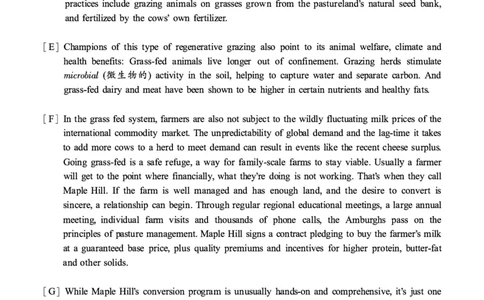
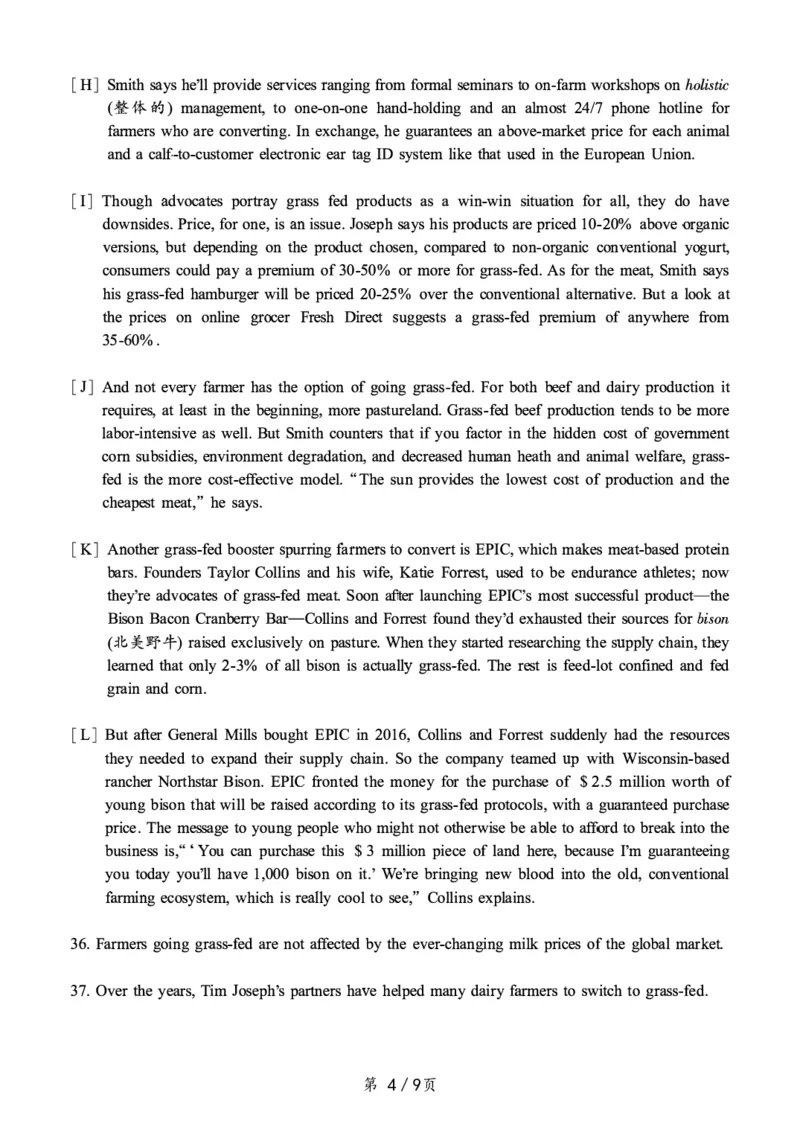
[ E] Champions of this type of regenerative grazing also point to its animal welfare, climate and
health benefits: Grass-fed animals live longer out of confinement. Grazing herds stimulate
microbial (,{;ft± 4h al.]) activity in the soil, helping to capture water and separate carbon. And
grass-fed dairy and meat have been shown to be higher in certain nutrients and healthy fats.
[ F] In the grass fed system, farmers are also not subject to the wildly fluctuating milk prices of the
international commodity market. The unpredictability of global demand and the lag-time it takes
to add more cows to a herd to meet demand can result in events like the recent cheese surplus.
Going grass-fed is a safe refuge, a way for family-scale farms to stay viable. Usually a farmer
will get to the point where financially, what they're doing is not working. That's when they call
Maple Hill. If the farm is well managed and has enough land, and the desire to convert is
sincere, a relationship can begin. Through regular regional educational meetings, a large annual
meeting, individual farm visits and thousands of phone calls, the Amburghs pass on the
principles of pasture management. Maple Hill signs a contract pledging to buy the farmer's milk
at a guaranteed base price, plus quality premiums and incentives for higher protein, butter-fat
and other solids.
[ G] While Maple Hill's conversion program is unusually hands-on and comprehensive, it's just one
of a growing number of businesses committed to slowly changing the way America farms.
Joseph calls sharing his knowledge network through peer-to-peer learning a core piece of the
company's culture. Last summer, Massachusetts grass-fed beef advocate John Smith launched
Big Picture Beef, a network of small grass-fed beef farms in New England and New York that is
projected to bring to market 2,500 head of cattle from 125 producers this year. Early indications
are that Smith will have no shortage of farm members. Since he began to informally announce
the network at farming conferences and on social media, he's received a steady stream of
inquiries from interested farmers.
第 3/9页[ HJ Smith says he'll provide services ranging from formal seminars to on-farm workshops on holistic
(�,ff.. a!]) management, to one-on-one hand-holding and an almost 24/7 phone hotline for
farmers who are converting. In exchange, he guarantees an above-market price for each animal
and a calf-to-customer electronic ear tag ID system like that used in the European Union.
[ I] Though advocates portray grass fed products as a win-win situation for all, they do have
downsides. Price, for one, is an issue. Joseph says his products are priced 10-20% above organic
versions, but depending on the product chosen, compared to non-organic conventional yogurt,
consumers could pay a premium of 30-50% or more for grass-fed. As for the meat, Smith says
his grass-fed hamburger will be priced 20-25% over the conventional alternative. But a look at
the prices on online grocer Fresh Direct suggests a grass-fed premium of anywhere from
35-60%.
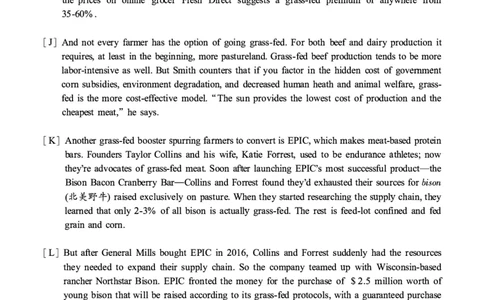
[ J] And not every farmer has the option of going grass-fed. For both beef and dairy production it
requires, at least in the beginning, more pastureland. Grass-fed beef production tends to be more
labor-intensive as well. But Smith counters that if you factor in the hidden cost of government
corn subsidies, environment degradation, and decreased human heath and animal welfare, grass
fed is the more cost-effective model. " The sun provides the lowest cost of production and the
cheapest meat," he says.
[ K] Another grass-fed booster spurring farmers to convert is EPIC, which makes meat-based protein
bars. Founders Taylor Collins and his wife, Katie Forrest, used to be endurance athletes; now
they're advocates of grass-fed meat. Soon after launching EPIC's most successful product-the
Bison Bacon Cranberry Bar-Collins and Forrest found they'd exhausted their sources for bison
( �t -k Jf 4) raised exclusively on pasture. When they started researching the supply chain, they
learned that only 2-3% of all bison is actually grass-fed. The rest is feed-lot confined and fed
grain and corn.
[ L] But after General Mills bought EPIC in 2016, Collins and Forrest suddenly had the resources
they needed to expand their supply chain. So the company teamed up with Wisconsin-based
rancher Northstar Bison. EPIC fronted the money for the purchase of $ 2.5 million worth of
young bison that will be raised according to its grass-fed protocols, with a guaranteed purchase
price. The message to young people who might not otherwise be able to afford to break into the
business is," ' You can purchase this $ 3 million piece of land here, because I'm guaranteeing
you today you'll have 1,000 bison on it.' We're bringing new blood into the old, conventional
farming ecosystem, which is really cool to see," Collins explains.
36. Farmers going grass-fed are not affected by the ever-changing milk prices of the global market.
37. Over the years, Tim Joseph's partners have helped many dairy farmers to switch to grass-fed.
第 4/9页38. One advocate believes that many other benefits should be taken into consideration when we assess
the cost-effectiveness of grass-fed farming.
39. Many dairy farmers were persuaded to switch to grass-fed when they saw its advantage in terms
of profits.
40. Tim Joseph's grass-fed program is only one example of how American farming practice is
changing.
41. Tim Joseph was fascinated by the notion that sunlight brings energy and wealth to mankind.
42. One problem with grass-fed products is that they are usually more expensive than conventional
ones.
43. Grass fed products have proved to be healthier and more nutritious.
44. When Tim Joseph started his business, he found grass-fed products fell short of demand.
45. A snack bar producer discovered that the supply of purely grass-fed bison meat was scarce.
Section C
Directions : There are 2 passages in this section. Each passage is followed by some questions or
unfinished statements. For each of them there are four choices marked A ) , B ) , C) and
D) . You should decide on the best choice and mark the corresponding letter on Answer
Sheet 2 with a single line through the centre.
Passage One
Questions 46 to 50 are based on the following passage.
Schools are not just a microcosm ( � JJ ) of society; they mediate it too. The best seek to
alleviate the external pressures on their pupils while equipping them better to understand and handle
the world outside-at once sheltering them and broadening their horizons. This is ambitious in any
circumstances, and in a divided and unequal society the two ideals can clash outright ( ..t AiJ-tk.).
Trips that many adults would consider the adventure of a lifetime-treks in Borneo, a sports tour
to Barbados-appear to have become almost routine at some state schools. Parents are being asked
for thousands of pounds. Though schools cannot profit from these trips, the companies that arrange
them do. Meanwhile, pupils arrive at school hungry because their families can't afford breakfast. The
Child Poverty Action Group says nine out of 30 in every classroom fall below the poverty line. The
discrepancy is startlingly apparent. Introducing a fundraising requirement for students does not help,
as better-off children can tap up richer aunts and neighbours.
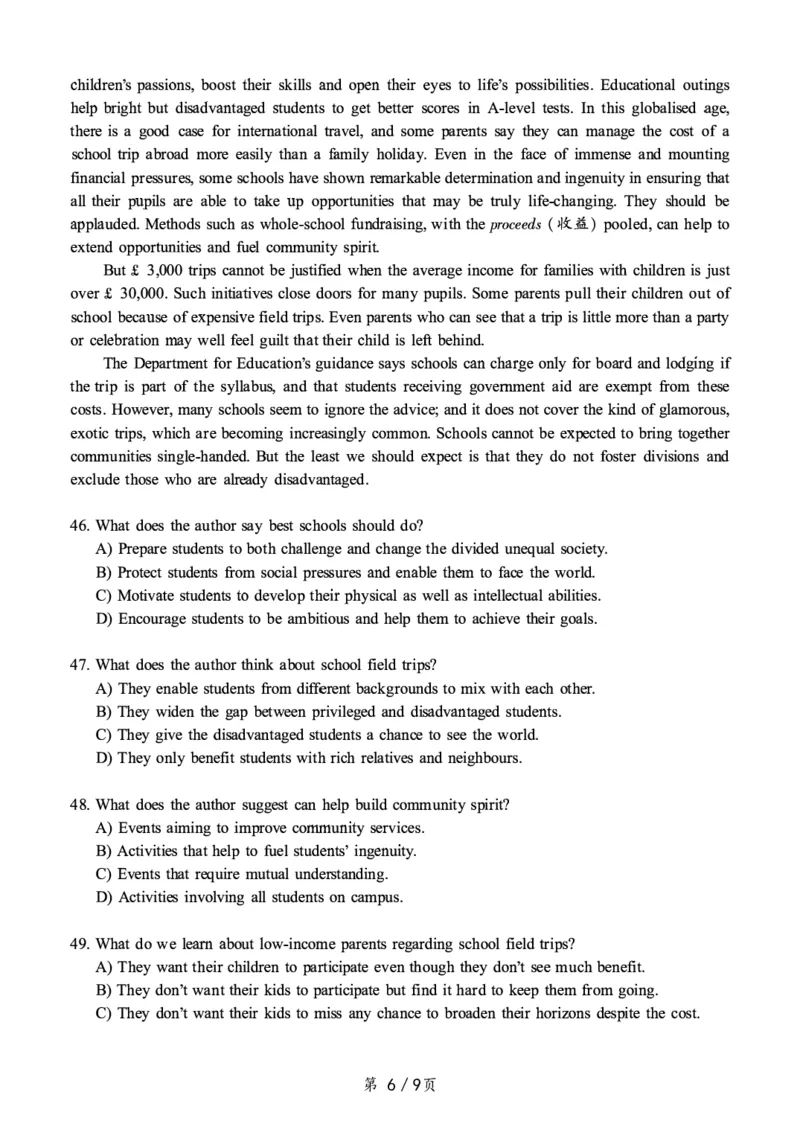
Probing the rock pools of a local beach or practising French on a language exchange can fire
第 5/9页children's passions, boost their skills and open their eyes to life's possibilities. Educational outings
help bright but disadvantaged students to get better scores in A-level tests. In this globalised age,
there is a good case for international travel, and some parents say they can manage the cost of a
school trip abroad more easily than a family holiday. Even in the face of immense and mounting
financial pressures, some schools have shown remarkable determination and ingenuity in ensuring that
all their pupils are able to take up opportunities that may be truly life-changing. They should be
applauded. Methods such as whole-school fundraising, with the proceeds ( ��A) pooled, can help to
extend opportunities and fuel community spirit.
But £ 3,000 trips cannot be justified when the average income for families with children is just
over £ 30,000. Such initiatives close doors for many pupils. Some parents pull their children out of
school because of expensive field trips. Even parents who can see that a trip is little more than a party
or celebration may well feel guilt that their child is left behind.
The Department for Education's guidance says schools can charge only for board and lodging if
the trip is part of the syllabus, and that students receiving government aid are exempt from these
costs. However, many schools seem to ignore the advice; and it does not cover the kind of glamorous,
exotic trips, which are becoming increasingly common. Schools cannot be expected to bring together
communities single-handed. But the least we should expect is that they do not foster divisions and
exclude those who are already disadvantaged.
46. What does the author say best schools should do?
A) Prepare students to both challenge and change the divided unequal society.
B) Protect students from social pressures and enable them to face the world.
C) Motivate students to develop their physical as well as intellectual abilities.
D) Encourage students to be ambitious and help them to achieve their goals.
47. What does the author think about school field trips?
A) They enable students from different backgrounds to mix with each other.
B) They widen the gap between privileged and disadvantaged students.
C) They give the disadvantaged students a chance to see the world.
D) They only benefit students with rich relatives and neighbours.
48. What does the author suggest can help build community spirit?
A) Events aiming to improve community services.
B) Activities that help to fuel students' ingenuity.
C) Events that require mutual understanding.
D) Activities involving all students on campus.
49. What do we learn about low-income parents regarding school field trips?
A) They want their children to participate even though they don't see much benefit.
B) They don't want their kids to participate but find it hard to keep them from going.
C) They don't want their kids to miss any chance to broaden their horizons despite the cost.
第 6/9页D) They want their children to experience adventures but they don't want them to run risks.
50. What is the author's expectation of schools?
A) Bringing a community together with ingenuity.
B) Resolving the existing discrepancies in society.
C) Avoiding creating new gaps among students.
D) Giving poor students preferential treatment.
Passage Two
Questions 51 to 55 are based on the following passage.
Rising temperatures and overfishing in the pristine ( 3f... � it � � ) waters around the Antarctic
could see king penguin populations pushed to the brink of extinction by the end of the century,
according to a new study. The study's report states that as global warming transforms the environment
in the world's last great wilderness, 70 percent of king penguins could either disappear or be forced to
find new breeding grounds.
Co-author Celine Le Bohec, from the University of Strasbourg in France, warned: "If there're no
actions aimed at halting or controlling global warming, and the pace of the current human-induced
changes such as climate change and overfishing stays the same, the species may soon disappear." The
findings come amid growing concern over the future of the Antarctic. Earlier this month a separate
study found that a combination of climate change and industrial fishing is threatening the krill (��)
population in Antarctic waters, with a potentially disastrous impact on whales, seals and penguins. But
today's report is the starkest warning yet of the potentially devastating impact of climate change and
human exploitation on the Antarctic's delicate ecosystems.
Le Bohec said: "Unless current greenhouse gas emissions drop, 70 percent of king penguins-1.1
million breeding pairs-will be forced to relocate their breeding grounds, or face extinction by 2100."
King penguins are the second-largest type of penguin and only breed on specific isolated islands in
the Southern Ocean where there is no ice cover and easy access to the sea. As the ocean warms, a
body of water called the Antarctic Polar Front-an upward movement of nutrient-rich sea that
supports a huge abundance of marine life-is being pushed further south. This means that king
penguins, which feed on fish and krill in this body of water, have to travel further to their feeding
grounds, leaving their hungry chicks for longer. And as the distance between their breeding grounds
and their food grows, entire colonies could be wiped out.
Le Bohec said: "The plight of the king penguin should serve as a warning about the future of
the entire marine environment in the Antarctic. Penguins, like other seabirds and marine mammals,
occupy higher levels in the food chain and they are what we call bio-indicators of their ecosystems."
Penguins are sensitive indicators of changes in marine ecosystems. As such, they are key species for
understanding and predicting impacts of global change on Antarctic and sub-Antarctic marine
ecosystems. The report found that although some king penguins may be able to relocate to new
breeding grounds closer to their retreating food source, suitable new habitats would be scarce. Only a
handful of islands in the Southern Ocean are suitable for sustaining large breeding colonies.
第 7/9页51. What will happen by 2100, according to a new study?
A) King penguins in the Antarctic will be on the verge of dying out.
B) Sea water will rise to a much higher level around the Antarctic.
C) The melting ice cover will destroy the great Antarctic wilderness.
D) The pristine waters around the Antarctic will disappear forever.
52. What do we learn from the findings of a separate study?
A) Shrinking krill population and rising temperatures could force Antarctic whales to migrate.
B) Human activities have accelerated climate change in the Antarctic region in recent years.
C) Industrial fishing and climate change could be fatal to certain Antarctic species.
D) Krill fishing in the Antarctic has worsened the pollution of the pristine waters.
53. What does the passage say about king penguins?
A) They will tum out to be the second-largest species of birds to become extinct.
B) Many of them will have to migrate to isolated islands in the Southern Ocean.
C) They feed primarily on only a few kinds of krill in the Antarctic Polar Front.
D) The majority of them may have to find new breeding grounds in the future.
54. What happens when sea levels rise in the Antarctic?
A) Many baby king penguins can't have food in time.
B) Many king penguins could no longer live on krill.
C) Whales will invade king penguins' breeding grounds.
D) Whales will have to travel long distances to find food.
55. What do we learn about the Southern Ocean?
A) The king penguins there are reluctant to leave for new breeding grounds.
B) Its conservation is key to the sustainable propagation of Antarctic species.
C) It is most likely to become the ultimate retreat for species like the king penguin.
D) Only a few of its islands can serve as huge breeding grounds for king penguins.
Part IV Translation (30 minutes)
Directions: For this part, you are allowed 30 minutes to translate a passage from Chinese into
English. You should write your answer on Answer Sheet 2.
{i1f;tt( lotus flower) ¾q:r 00 Ef9�:;ftz�, 1*5¥:Jdi'J%�o q:r OOi"F$±-t!r:1rEt9ltA
*
tS f01t!!:lftl53�1r
{i1f ;tt1:.-K a {i1f ;ft�% Mffi , ]( B m' ��JJ!x: , 1�J!t f;fJ if , ;ft m-Kits 1W --t-A , IN '31 § 4H-t!! Ef9 wt�
1ruttx_m1;t {i1f ;{tJ'l.;;g $ fift � ff� , re£ fi��1t7]( Im , X fiMHt� lzfil , � r:iJ �1tJk 1m:, ?mxY t� �, i:!Jc� lf
a
m m
O
{rif ;ft:ifl!Mf �Erm�-�' ili 5� mj�� '�AiE�iR' � ft '##ffl * ttritu A Ef9 � fi6 &b 1!' *¾w:
,,A.1ffi1 %i tl1 1: Ef9I� :®ItJ {i1f ;tt�* Ef9 :tt!r1r -m¾i"F $ffi�� :!ff� f:2 # :3'cJliJz:ttg
a a
第 8/9页Part I Writing (30 minutes)
cit-=.F iE �,t�J§ =!f.,J,a.tl*J �Jix3�$�, z.J§�il!fru1r:n�i.it)
Directions: For this part, you are allowed 30 minutes to write an essay on the importance of
having a sense of community responsibility. You should write at least 150 words but
no more than 200 words.
第 9/9页