2023年 12月大学英语六级考试真题(第 2 套)
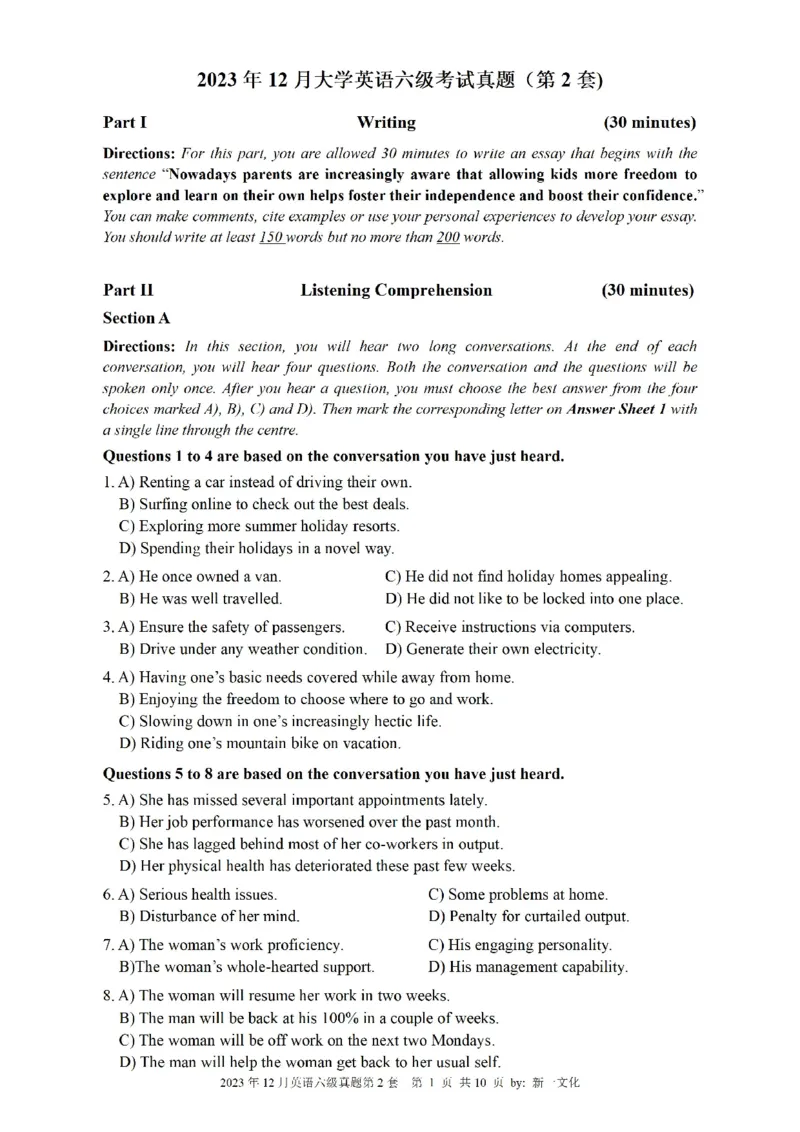
Part I Writing (30 minutes)
Directions: For this part, you are allowed 30 minutes to write an essay that begins with the
sentence '"Nowadays parents are increasingly aware that allowing kids more freedom to
explore and learn on their own helps foster their independence and boost their confidence.”
You can make comments, cite examples or use your personal experiences to develop your essay.
You should write at least 150 words but no more than 200 words.
Part II Listening Comprehension (30 minutes)
Section A
Directions: In this section, you will hear two long conversations. At the end of each
conversation, you will hear four questions. Both the conversation and the questions will be
spoken only once. After you hear a question, you must choose the best answer from the four
choices marked A), B), C) and D). Then mark the corresponding letter on Answer Sheet 1 with
a single line through the centre.
Questions 1 to 4 are based on the conversation you have just heard.
1. A) Renting a car instead of driving their own.
B) Surfing online to check out the best deals.
C) Exploring more summer holiday resorts.
D) Spending their holidays in a novel way.
2. A) He once owned a van. C) He did not find holiday homes appealing.
B) He was well travelled. D) He did not like to be locked into one place.
3. A) Ensure the safety of passengers. C) Receive instructions via computers.
B) Drive under any weather condition. D) Generate their own electricity.
4. A) Having one's basic needs covered while away from home.
B) Enjoying the freedom to choose where to go and work.
C) Slowing down in one's increasingly hectic life.
D) Riding one's mountain bike on vacation.
Questions 5 to 8 are based on the conversation you have just heard.
5. A) She has missed several important appointments lately.
B) Her job performance has worsened over the past month.
C) She has lagged behind most of her co-workers in output.
D) Her physical health has deteriorated these past few weeks.
6. A) Serious health issues. C) Some problems at home.
B) Disturbance of her mind. D) Penalty for curtailed output.
7. A) The woman's work proficiency. C) His engaging personality.
B)The woman's whole-hearted support. D) His management capability.
8. A) The woman will resume her work in two weeks.
B) The man will be back at his 100% in a couple of weeks.
C) The woman will be off work on the next two Mondays.
D) The man will help the woman get back to her usual self.
2023年12月英语六级真题第2套 第 1 页 共 10页 by:新一文化Section B
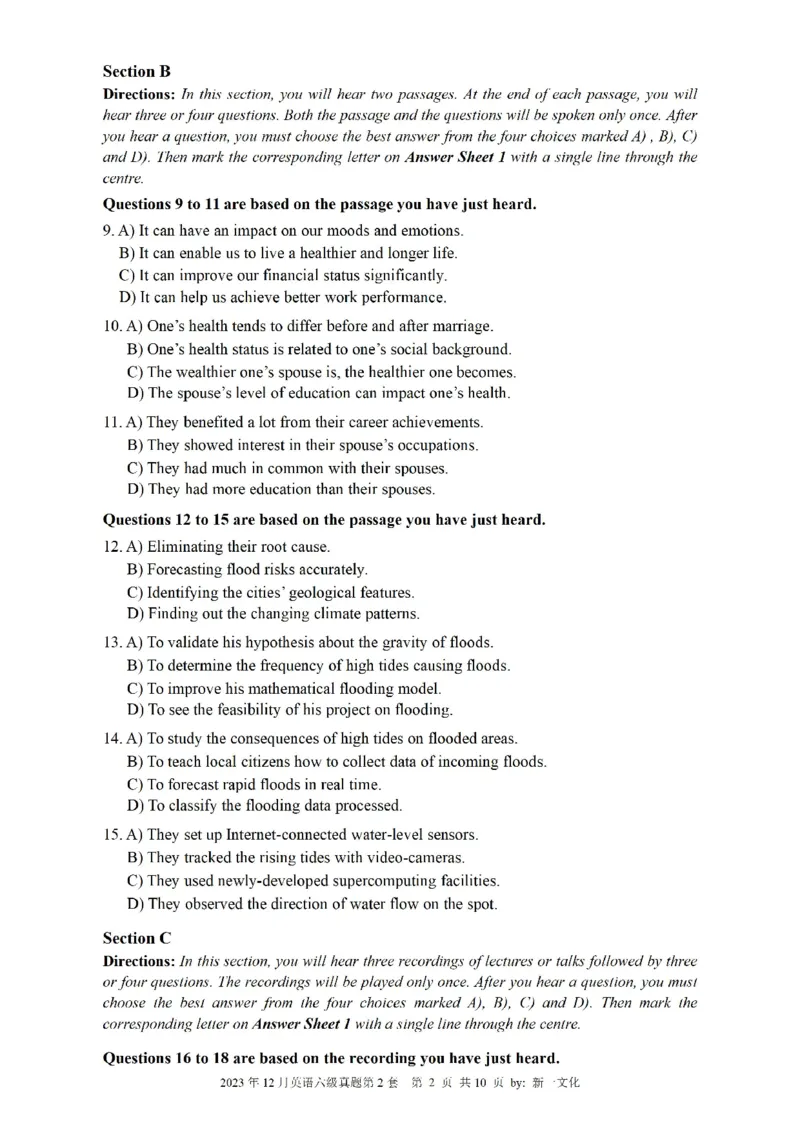
Directions: In this section, you will hear two passages. At the end of each passage, you will
hear three or four questions. Both the passage and the questions will be spoken only once. After
you hear a question, you must choose the best answer from the four choices marked A) , B), C)
and D). Then mark the corresponding letter on Answer Sheet 1 with a single line through the
centre.
Questions 9 to 11 are based on the passage you have just heard.
9. A) It can have an impact on our moods and emotions.
B) It can enable us to live a healthier and longer life.
C) It can improve our financial status significantly.
D) It can help us achieve better work performance.
10. A) One's health tends to differ before and after marriage.
B) One's health status is related to one's social background.
C) The wealthier one's spouse is, the healthier one becomes.
D) The spouse's level of education can impact one's health.
11. A) They benefited a lot from their career achievements.
B) They showed interest in their spouse's occupations.
C) They had much in common with their spouses.
D) They had more education than their spouses.
Questions 12 to 15 are based on the passage you have just heard.
12. A) Eliminating their root cause.
B) Forecasting flood risks accurately.
C) Identifying the cities9 geological features.
D) Finding out the changing climate patterns.
13. A) To validate his hypothesis about the gravity of floods.
B) To determine the frequency of high tides causing floods.
C) To improve his mathematical flooding model.
D) To see the feasibility of his project on flooding.
14. A) To study the consequences of high tides on flooded areas.
B) To teach local citizens how to collect data of incoming floods.
C) To forecast rapid floods in real time.
D) To classify the flooding data processed.
15. A) They set up Internet-connected water-level sensors.
B) They tracked the rising tides with video-cameras.
C) They used newly-developed supercomputing facilities.
D) They observed the direction of water flow on the spot.
Section C
Directions: In this section, you will hear three recordings of lectures or talks followed by three
or four questions. The recordings will be played only once. After you hear a question, you must
choose the best answer from the four choices marked A), B), C) and D). Then mark the
corresponding letter on Answer Sheet 1 with a single line through the centre.
Questions 16 to 18 are based on the recording you have just heard.
2023年12月英语六级真题第2套 第 2 页 共 10页 by:新一文化16. A) To argue about the value of a college degree.
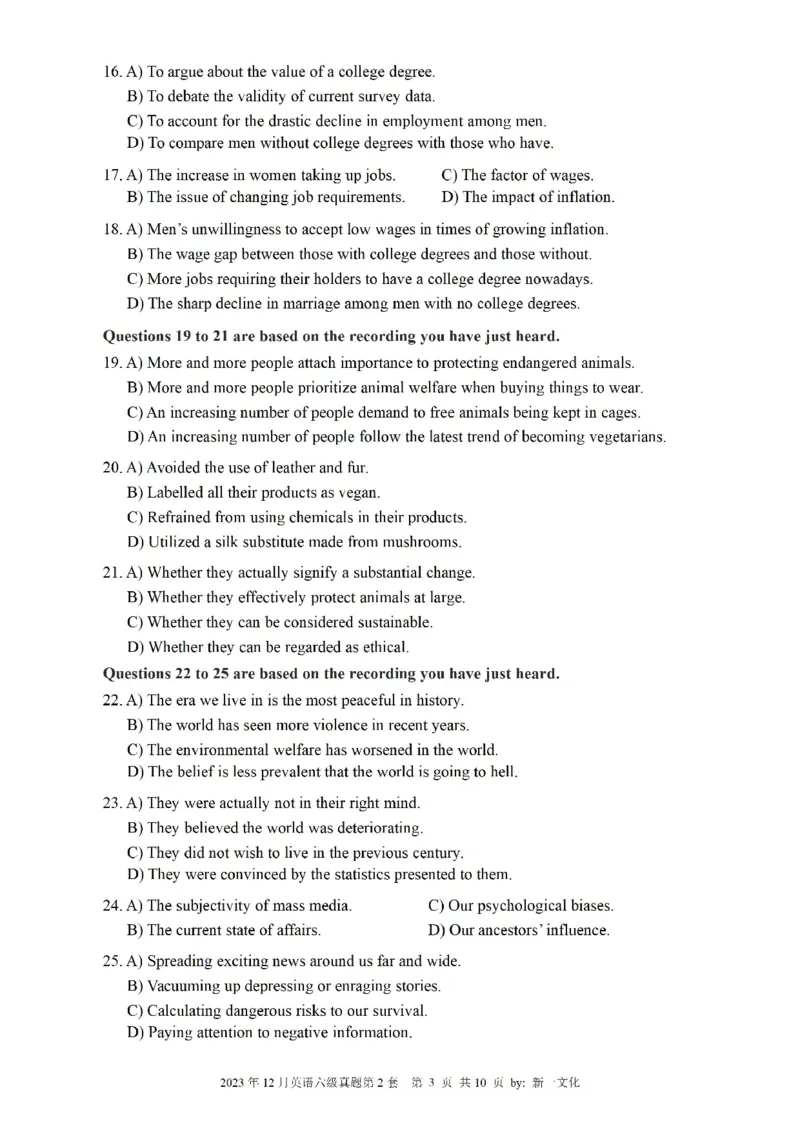
B) To debate the validity of current survey data.
C) To account for the drastic decline in employment among men.
D) To compare men without college degrees with those who have.
17. A) The increase in women taking up jobs. C) The factor of wages.
B) The issue of changing job requirements. D) The impact of inflation.
18. A) Men's unwillingness to accept low wages in times of growing inflation.
B) The wage gap between those with college degrees and those without.
C) More jobs requiring their holders to have a college degree nowadays.
D) The sharp decline in marriage among men with no college degrees.
Questions 19 to 21 are based on the recording you have just heard.
19. A) More and more people attach importance to protecting endangered animals.
B) More and more people prioritize animal welfare when buying things to wear.
C) An increasing number of people demand to free animals being kept in cages.
D) An increasing number of people follow the latest trend of becoming vegetarians.
20. A) Avoided the use of leather and fur.
B) Labelled all their products as vegan.
C) Refrained from using chemicals in their products.
D) Utilized a silk substitute made from mushrooms.
21. A) Whether they actually signify a substantial change.
B) Whether they effectively protect animals at large.
C) Whether they can be considered sustainable.
D) Whether they can be regarded as ethical.
Questions 22 to 25 are based on the recording you have just heard.
22. A) The era we live in is the most peaceful in history.
B) The world has seen more violence in recent years.
C) The environmental welfare has worsened in the world.
D) The belief is less prevalent that the world is going to hell.
23. A) They were actually not in their right mind.
B) They believed the world was deteriorating.
C) They did not wish to live in the previous century.
D) They were convinced by the statistics presented to them.
24. A) The subjectivity of mass media. C) Our psychological biases.
B) The current state of affairs. D) Our ancestors9 influence.
25. A) Spreading exciting news around us far and wide.
B) Vacuuming up depressing or enraging stories.
C) Calculating dangerous risks to our survival.
D) Paying attention to negative information.
2023年12月英语六级真题第2套 第 3 页 共 10页 by:新一文化Part III Reading Comprehension (40 minutes)
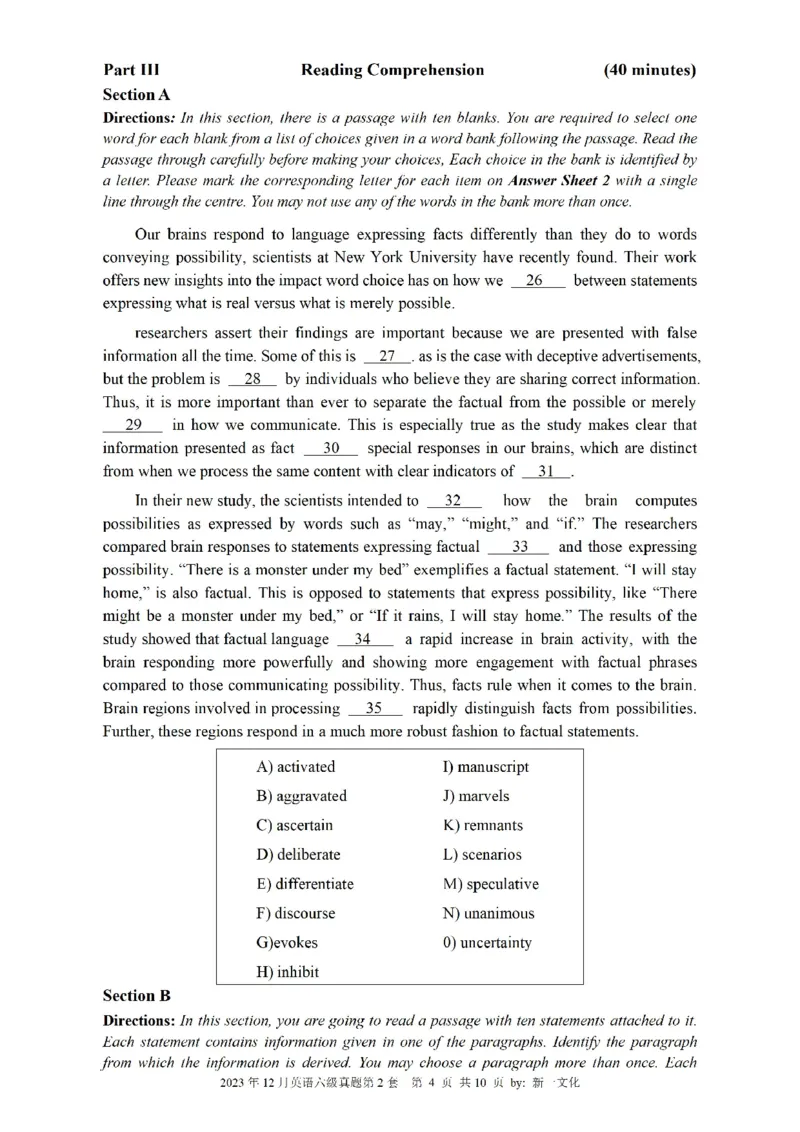
Section A
Directions; In this section, there is a passage with ten blanks. You are required to select one
word for each blank from a list of choices given in a word bankf ollowing the passage. Read the
passage through carefully before making your choices, Each choice in the bank is identified by
a letter. Please mark the corresponding letter for each item on Answer Sheet 2 with a single
line through the centre. You may not use any of the words in the bank more than once.
Our brains respond to language expressing facts differently than they do to words
conveying possibility, scientists at New York University have recently found. Their work
offers new insights into the impact word choice has on how we 26 between statements
expressing what is real versus what is merely possible.
researchers assert their findings are important because we are presented with false
information all the time. Some of this is 27 . as is the case with deceptive advertisements,
but the problem is 28 by individuals who believe they are sharing correct information.
Thus, it is more important than ever to separate the factual from the possible or merely
29 in how we communicate. This is especially true as the study makes clear that
information presented as fact 30 special responses in our brains, which are distinct
from when we process the same content with clear indicators of 31 .
In their new study, the scientists intended to 32 how the brain computes
possibilities as expressed by words such as "may,“ "might," and "if." The researchers
compared brain responses to statements expressing factual 33 and those expressing
possibility. "There is a monster under my bed“ exemplifies a factual statement. "I will stay
home,^^ is also factual. This is opposed to statements that express possibility, like "There
might be a monster under my bed," or "If it rains, I will stay home.^^ The results of the
study showed that factual language 34 a rapid increase in brain activity, with the
brain responding more powerfully and showing more engagement with factual phrases
compared to those communicating possibility. Thus, facts rule when it comes to the brain.
Brain regions involved in processing 35 rapidly distinguish facts from possibilities.
Further, these regions respond in a much more robust fashion to factual statements.
A) activated I) manuscript
B) aggravated J) marvels
C) ascertain K) remnants
D) deliberate L) scenarios
E) differentiate M) speculative
F) discourse N) unanimous
G)evokes 0) uncertainty
H) inhibit
Section B
Directions: In this section, you are going to read a passage with ten statements attached to it.
Each statement contains information given in one of the paragraphs. Identify the paragraph
from which the information is derived. You may choose a paragraph more than once. Each
2023年12月英语六级真题第2套 第 4 页 共 10页 by:新一文化paragraph is marked with a letter. Answer the questions by marking the corresponding letter on
Answer Sheet 2.
Treasure Fever
A) Most visitors come to Cape Canaveral, on the northeast coast of Florida, for the tourist
attractions. It's home to the second-busiest cruise ship port in the world and is a
gateway to the cosmos. Nearly 1.5 million visitors flock here every year to watch
rockets, spacecraft, and satellites blast off into the solar system from Kennedy Space
Center Visitor Complex. Nearly 64 kilometers of undeveloped beach and 648 square
kilometers of protected refuge fan out from the cape's sandy shores.
B) Yet some of Cape Canaveral's most legendary attractions lie unseen, wedged under the
sea's surface in mud and sand, for this part of the world has a reputation as a deadly
ship trap. Over the centuries, dozens of majestic Old World sailing ships smashed and
sank on this irregular stretch of windy Florida coast. They were vessels built for war
and commerce, crossing the globe carrying everything from coins to cannons, boxes of
silver and gold, chests of jewels and porcelain, and pearls from the Caribbean.
C) Cape Canaveral contains one of the greatest concentrations of colonial shipwrecks in
the world. In recent years, advances in radar, diving, detection equipment, computers,
and GPS have transformed the hunt. The naked eye might see a pile of rocks, but
technology can reveal the precious artifacts (人工制品)that lie hidden on the ocean
floor.
D) As technology renders the seabed more accessible, the hunt for treasure-filled ships has
drawn a fresh tide of salvors (才丁捞人员)and their investors一as well as marine
archaeologists (考古学家)wanting to bring to light the lost relics. But of late, when
salvors have found vessels, their rights have been challenged in court. The big question:
who should have control of these treasures?
E) High-stakes fights over shipwrecks pit archaeologists against treasure hunters in a
vicious cycle of accusations. Archaeologists regard themselves as protectors of history,
and they see salvors as careless destroyers. Salvors feel they do the hard work of
searching for ships, only to have them stolen from under them when discovered. This
kind of clash inevitably takes place on a grand scale. Aside from the salvors, their
investors, and the maritime archaeologists who serve as expert witnesses, the battles
sweep in local and international governments and organizations like UNESCO that
work to protect under-water heritage. The court cases that ensue stretch on for years.
Are finders keepers, or do the ships belong to the countries that made them and sent
them sailing centuries ago? Where once salvors and archaeologists worked side by side,
now they belong to opposing, and equally contemptuous, tribes.
F) Nearly three million vessels lie wrecked on the Earth's ocean floor——from old canoes to
the Titanic一and likely less than one percent have been explored. Some- like an
ancient Roman ship found off Antikythera, Greece, dated between 70 and 60 BC and
carrying astonishingly sophisticated gears and dials for navigating by the sun-are
critical to a new understanding of our past. No wonder there is an eternal stirring among
everybody from salvors to scholars to find them.
G) In May 2016, a salvor named Bobby Pritchett, president of Global Marine Exploration
2023年12月英语六级真题第2套 第 5 页 共 10页 by:新一文化(GME) in Tampa, Florida, announced that he had discovered scattered remains of a ship
buried a kilometer off Cape Canaveral. Over the prior three years, he and his crew had
obtained 14 state permits to survey a nearly 260-square-kilometer area off the cape;
they worked 250 days a year, backed by investor funds of, he claims, US $4 million. It
was hard work. Crew members were up at dawn, dragging sensors from their expedition
vessels back and forth, day in and day out, year after year, to detect metal of any kind.
Using computer technology, Pritchett and his crew created intricate, color-coded maps
marked with the GPS coordinates of thousands of finds, all invisible under a meter of
sand.
H) One day in 2015, the magnetometer (磁力计)picked up metal that turned out to be an
iron cannon; when the divers blew the sand away, they also discovered a more precious
bronze cannon with markings indicating French royalty and, not far off, a famous
marble column carved with the coat of arms of France, known from historical paintings.
The discovery was cause for celebration. The artifacts indicated the divers had likely
found the wreck of La Trinite, a 16th-century French vessel that had been at the center
of a bloody battle between France and Spain that changed the fate of the United States
of America.
I) And then the legal storm began, with GME and Pritchett pitted against Florida and
France. The Sunken Military Craft Act of 2004, a US federal act, protects any vessel
that was on a military mission, allowing the originating country to claim their ship even
centuries later. In 2018, two long years after Pritchetfs discovery, the federal district
court ruled in favor of France. For Pritchett, the decision was devastating. Millions of
dollars of investor funding and years of labor were lost.
J) But this is far from the first time a salvor has lost all rights to a discovery. In 2012, for
instance, Spain won a five-year legal battle against Odyssey Marine Exploration, which
had hauled 594,000 gold and silver coins from a Spanish wreck off the coast of Portugal
across the Atlantic to the United States. "Treasure hunters can be naive^^ says attorney
,
David Concannon, who has had several maritime archaeologists as clients and
represented two sides in the battles over the Titanic for 20 years. "Many treasure
hunters don't understand they are going to have to fight for their rights against a
government that has an endless supply of money for legal battles that treasure hunters
are likely to lose.”
K) Putting an inflated price on artifacts rather than viewing them as cultural and historical
treasures that transcend any price is what irritates many archaeologists. For the
archaeologist, everything in a wreck matters- hair, fabric, a fragment of a newspaper,
rat bones一all things speak volumes. Archaeologists don't want artifacts ending up in a
private collection instead of taking humanity on a journey of understanding.
L) George Bass is one of the pioneers of under-water archaeology, and a researcher at
Texas A&M University. He has testified in court against treasure hunters, but says
archaeology is not without its own serious problems. He believes archaeologists need to
do a better job themselves instead of routinely criticizing treasure hunters.
“Archaeology has a terrible reputation for not publishing enough on its excavations (发
掘) and finds,“ he says. Gathering data, unearthing and meticulously preserving and
2023年12月英语六级真题第2套 第 6 页 共 10页 by:新一文化examining finds, verifying identity and origin, piecing together the larger story, and
writing and publishing a comprehensive paper or book can take decades. A bit cynically,
Bass describes colleagues who never published because they waited so long they
became ill or died. Who is more at fault, Bass asks, the professional archaeologist who
carefully excavates a site and never publishes on it or the treasure hunter who locates a
submerged wreck, salvages part, conserves part, and publishes a book on the operation?
M) Pritchett concedes that his find deserves careful excavation and preservation. <CI think
what I found should go in a museum,he says. "But I also think I should get paid for
what I found.Indeed, it's a bit of a mystery why governments, archaeologists, and
treasure hunters can't work together- and why salvors aren't at least given a substantial
finder's fee before the original owner takes possession of the vessel and its artifacts.
36. Exploration of shipwrecks on the sea floor is crucial in updating our understanding of
humanity's past.
37. Quite a number of majestic ships sailing from Europe to America were wrecked off the
Florida coast over the centuries.
38. Pritchett suffered a heavy loss when a US district court ruled against him.
39. Recently, people who found treasures in shipwrecks have been sued over their rights to
own them.
40. Pritchett claims he got support of millions of dollars from investors for his shipwreck
exploration.
41. One pioneer marine scientist thinks archaeologists should make greater efforts to
publish their findings.
42. With technological advancement in recent years, salvors now can detect the invaluable
man-made objects lying buried under the sea.
43. According to a lawyer, many treasure hunters are susceptible to loss because they are
unaware they face a financially stronger opponent in court.
44. Salvors of treasures in sunken ships and marine archaeologists are now hostile to each
other.
45. Archaeologists want to see artifacts help humans understand their past instead of being
sold to private collectors at an outrageous price.
Section C
Directions: There are 2 passages in this section. Each passage is followed by some questions
or unfinished statements. For each of them there are four choices marked A), B), C) and D).
You should decide on the best choice and mark the corresponding letter on Answer Sheet 2
with a single line through the centre.
Passage One
Questions 46 to 50 are based on the following passage.
Could you get by without using the internet for four and a half years? That's exactly
what singer and actress Selena Gomez has done in a bid to improve her mental health.
She has spoken extensively about the relationship between her social media usage and
2023年12月英语六级真题第2套 第 7 页 共 10页 by:新一文化her mental wellbeing, recalling feeling like "an addict^^ when she became Instagram's most
followed user in 2016. “Taking a break from social media was the best decision that I've
ever made for my mental health”, says she. "The unnecessary hate and comparisons went
away once I put my phone down.^^
Ditching the web at large, however, is a far more subtle and complicated prospect. The
increasing digitisation of our society means that everything from paying a gas bill to
plotting a route to a friend^ house and even making a phone call is at the mercy of your
internet connection. Actively opting out of using the internet becomes a matter of privilege.
Ms Gomez9s multi-millionaire status has allowed her to take the “social" out of social
media, so she can continue to leverage her enormous fame while keeping the trolls (恶意挑
衅的帖子)at bay. The fact that she's still the second most-followed woman on Instagram
suggests it's entirely possible to maintain a significant web profile to promote various
projects一by way of a dedicated team一without being exposed to the cruel comments, hate
mail and rape or death threats.
It goes without saying that this is fundamentally different from how the rest of us
without beauty deals and films to publicise use the likes of Instagram, TikTok and Twitter,
but even the concept of a digital detox (戒瘾)requires having a device and connectivity to
choose to disconnect from.
The UK's digital divide has worsened over the past two years, leaving poorer families
without broadband connections in their homes. Digital exclusion is a major threat to wider
societal equality in the UK, so witnessing companies like Facebook championing the
metaverse (元宇宙)as the next great frontier when school children are struggling to
complete their homework feels particularly irritating.
Consequently, it's worth bearing in mind that while deleting all social media accounts
will undoubtedly make some feel infinitely better, many other people benefit from the
strong sense of community that sharing platforms can breed.
Internet access will continue to grow in importance as we edge further towards web
3.0, and greater resources and initiatives are needed to provide the underprivileged with the
connectivity they desperately need to learn, work and live. It's crucial that people who feel
that social media is having a detrimental effect on their mental health are allowed to switch
off and for those living in digital exclusion to be able to switch on in the first place.
46 . What do we learn about singer and actress Selena Gomez in the past four and a half years?
A) She has had worsening mental problems.
B) She has won Instagram's most followers.
C) She has refrained from using social media.
D) She has succeeded in a bid on the internet.
47 .Why does actively opting out of using the internet become a matter of privilege?
A) Most people find it subtle and complicated to give up using the internet.
B) Most people can hardly ditch the web while avoiding hate and comparisons.
C) Most people can hardly get by without the internet due to growing digitisation.
D) Most people have been seriously addicted to the web without being aware of it.
48 .Why does the author say "witnessing companies...feels particularly irritating^^ (Lines 2-4,
Para. 6)?
2023年12月英语六级真题第2套 第 8 页 共 10页 by:新一文化A) The UK digital divide would further worsen due to the metaverse.
B) The concept of the metaverse is believed to be still quite illusory.
C) School children would be drawn farther away from the real world.
D) Most families in the UK do not have stable broadband connections.
49 .What is worth bearing in mind concerning social media platforms?
A) They are conducive to promoting societal equality.
B) They help many people feel connected with others.
C) They provide a necessary device for a digital detox.
D) They create a virtual community on the internet.
5O .What does the author think is really important for those living in digital exclusion?
A) Having access to the internet.
B) Edging further towards web 3.0.
C) Getting more educational resources.
D) Opening more social media accounts.
Passage Two
Questions 51 to 55 are based on the following passage.
Psychologists have long been in disagreement as to whether competition is a learned
or a genetic component of human behavior. Whatever it is, you cannot but recognize the
effect competition is exerting in academics and many other areas of contemporary life.
Psychologically speaking, competition has been seen as an inevitable consequence of
human drives. According to Sigmund Freud, humans are bom screaming for attention and
full of organic drives for fulfillment in various areas. Initially, we compete for the attention
of our parents. Thereafter, we are at the mercy of a battle between our base impulses for
self-fulfillment and social and cultural norms which prohibit pure indulgence.
Current work in anthropology (人类学)has suggested, however, that this view of the
role of competition in human behavior may be incorrect. Thomas Hobbes, one of the great
philosophers of the seventeenth century, is perhaps best remembered for his
characterization of the "natural world,“ that is, the world before the imposition of the will
of humanity, as being "nasty, brutish, and short.^^ This image of the pre-rational world is
still widely held, reinforced by Charles Darwin 9s highly influential work, The Origin of
Species, which established the doctrine of natural selection. This doctrine, which takes for
granted that those species best able to adapt to and master the natural environment in which
they live will survive, has suggested that the struggle for survival is an inherent human trait
which determines a person's success. Darwin's theory has even been summarized as
""survival of the fittest”- a phrase Darwin himself never used- further highlighting
competition9 role in success. As it has often been pointed out, however, there is nothing in
the concept of natural selection that suggests that competition is the most successful
strategy for '"survival of the Darwin asserted in The Origin of Species that the
struggles he was describing should be viewed as metaphors and could easily include
dependence and cooperation.
Many studies have been conducted to test the importance placed on competition as
opposed to other values, such as cooperation-by various cultures, and generally conclude
that Americans uniquely praise competition as natural, inevitable, and desirable. In 1937,
2023年12月英语六级真题第2套 第 9 页 共 10页 by:新一文化the world-renowned anthropologist Margaret Mead published Cooperation and Competition
among Primitive Peoples, based on her studies of several societies that did not prize
competition, and, in fact, seemed at times to place a negative value on it. One such society
was the Zuni Indians of Arizona, and they, Mead found, valued cooperation far more than
competition. After studying dozens of such cultures, Mead's final conclusion was that
competitiveness is a culturally created aspect of human behavior, and that its prevalence in
a particular society is relative to how that society values it.
5 l.What does the author think is easy to see in many areas of contemporary life?
A) The disagreement on the inevitability of competition.
B) The consequence of psychological investigation.
C) The effect of human drives.
D) The impact of competition.
52 . According to psychology, what do people strive to do following the initial stage of their
life?
A) Fulfill individual needs without incurring adverse effects of human drives.
B) Indulge in cultural pursuits while keeping their base impulses at bay.
C) Gain extensive recognition without exposing pure indulgence.
D) Satisfy their own desires while observing social conventions.
53 .What do we learn about the “natural world^^ characterized by Thomas Hobbes?
A) It gets misrepresented by philosophers and anthropologists.
B) It gets distorted in Darwin's The Origin of Species.
C) It is free from the rational intervention of humans.
D) It is the pre-rational world rarely appreciated nowadays.
54 .What can we conclude from Darwin's assertion in The Origin of Species?
A) All species inherently depend on others for survival.
B) Struggles for survival do not exclude mutual support.
C) Competition weighs as much as cooperation as a survival strategy.
D) The strongest species proves to be the fittest in natural selection.
55 .What conclusion did Margaret Mead reach after studying dozens of different cultures?
A) It is characteristic of humans to be competitive.
B) Americans are uniquely opposed to cooperation.
C) Competition is relatively more prevalent in Western societies.
D) People's attitude towards competition is actually culture-bound.
Part IV Translation (30 minutes)
Directions: For this part, you are allowed 30 minutes to translate a passage from Chinese into
English. You should write your answer on Answer Sheet 2.
随着经济与社会的发展,中国人口结构发生了显著变化,逐渐步入老龄化社会。中国老年人
口将持续增加,人口老龄化趋势将更加明显。为了应对人口老龄化带来的种种挑战,国家正积极采
取措施,加大对养老的支持。通过改革社会保障(socialsecurity)制度,政府不断增加社会保障经费,
逐步扩大社会保障覆盖范围,使更多老年人受益。政府还鼓励各种社会团体为老年人提供服务。
在政府和社会团体的共同努力下,老年人将生活得更加幸福。
2023年12月英语六级真题第2套 第 10页 共 10页 by:新一文化