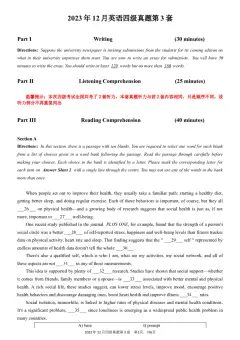
2023 年 12 月英语四级真题第 3 套
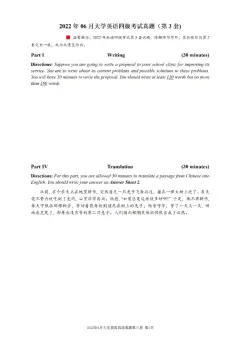
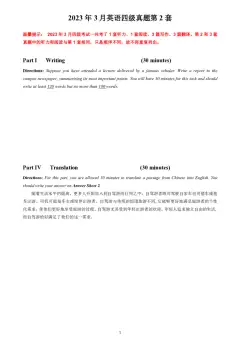
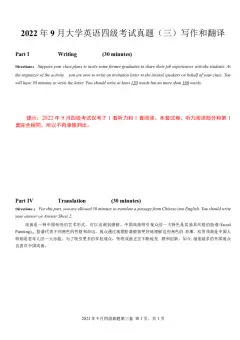
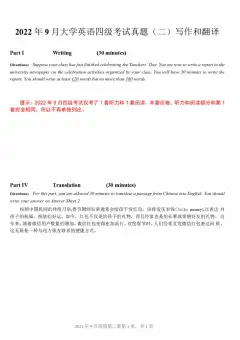
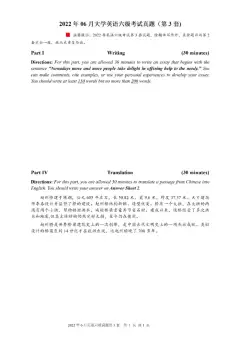
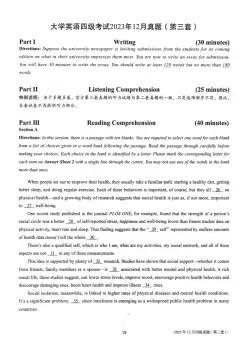
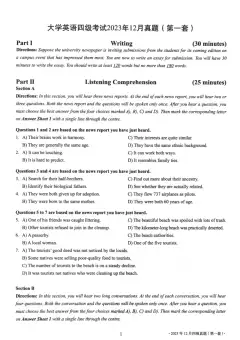
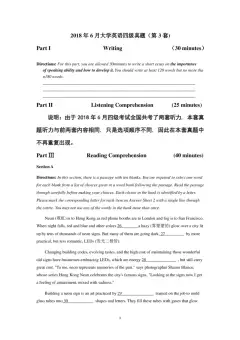
Part I Writing (30 minutes)
Directions: Suppose the university newspaper is inviting submissions from the students for its coming edition on
what in their university impresses them most. You are now to write an essay for submission. You will have 30
minutes to write the essay. You should write at least 120 words but no more than 180 words.
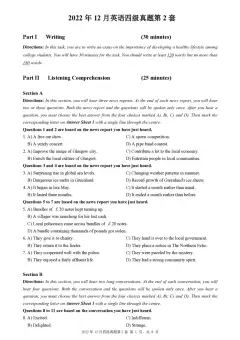
Part II Listening Comprehension (25 minutes)
温馨提示:本次四级考试全国共考了2套听力,本套真题听力与前2套内容相同,只是顺序不同,故
听力部分不再重复列出
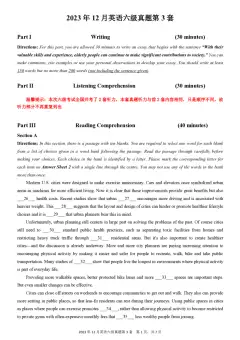
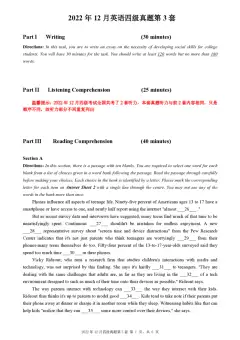
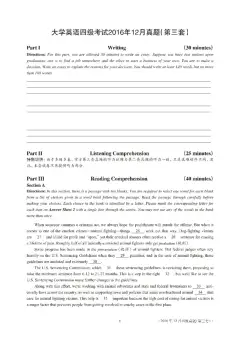
Part III Reading Comprehension (40 minutes)
Section A
Directions: In this section, there is a passage with ten blanks. You are required to select one word for each blank
from a list of choices given in a word bank following the passage. Read the passage through carefully before
making your choices. Each choice in the bank is identified by a letter. Please mark the corresponding letter for
each item on Answer Sheet 2 with a single line through the centre. You may not use any of the words in the bank
more than once.
When people set out to improve their health, they usually take a familiar path: starting a healthy diet,
getting better sleep, and doing regular exercise. Each of these behaviors is important, of course, but they all
___26___ on physical health—and a growing body of research suggests that social health is just as, if not
more, important to ___27___ well-being.
One recent study published in the journal PLOS ONE, for example, found that the strength of a person's
social circle was a better ___28___ of self-reported stress, happiness and well-being levels than fitness tracker
data on physical activity, heart rate and sleep. That finding suggests that the " ___29___ self " represented by
endless amounts of health data doesn't tell the whole ___30___.
There's also a qualified self, which is who I am, what are my activities, my social network, and all of
these aspects are not ___31___ in any of these measurements.
This idea is supported by plenty of ___32___ research. Studies have shown that social support—whether
it comes from friends, family members or a spouse—is ___33___ associated with better mental and physical
health. A rich social life, these studies suggest, can lower stress levels, improve mood, encourage positive
health behaviors and discourage damaging ones, boost heart health and improve illness ___34___ rates.
Social isolation, meanwhile, is linked to higher rates of physical diseases and mental health conditions.
It's a significant problem, ___35___ since loneliness is emerging as a widespread public health problem in
many countries.
2023年12月四级真题第3套 第1页,共6页A) base I) prompt
B) eagerly J) puzzle
C) especially K) quantified
D) focus L) recovery
E) indicator M) reflected
F) overall N) story
G) preached O) strongly
H) prior
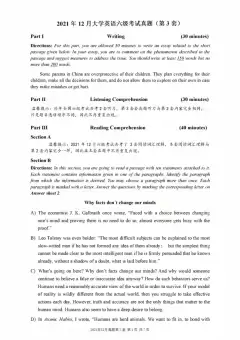
Section B
Directions: In this section, you are going to read a passage with ten statements attached to it. Each statement
contains information given in one of the paragraphs. Identify the paragraph from which the information is derived.
You may choose a paragraph more than once. Each paragraph is marked with a letter. Answer the questions by
making the corresponding letter on Answer Sheet 2.
Teenagers and social networking
A) As a parent of two boys at primary school, I worry about the issues associated with teenagers and social media.
Newspapers are constantly filled with frightening accounts of drug addiction and aggressive behaviour
supposedly caused by violent videogames. But even when these accounts touch on real concerns, they do not
really reflect the great mass of everyday teenage social behaviour: the online chat, the texting, the surfing, and
the emergence of a new teenage sphere that is conducted digitally.
B) New technologies always provoke generational panic, which usually has more to do with adult fears than with
the lives of teenagers. In the 1930s, parents worried that radio was gaining "an irresistible hold of their
children". In the 80s, the great danger was the Sony Walkman (随身听). When you look at today's digital
activity, the facts are much more positive than you might expect.
C) Indeed, social scientists who study young people have found that their digital use can be inventive and even
beneficial. This is true not just in terms of their social lives, but their education too. So if you use a ton of social
media, do you become unable, or unwilling, to engage in face-to-face contact? The evidence suggests not.
Research by Amanda Lenhart of the Pew Research Centre, a US think tank, found that the most passionate
texters are also the kids most likely to spend time with friends in person. One form of socialising doesn't
replace the other. It expands it.
D) "Kids still spend time face to face," Lenhart says. Indeed, as they get older and are given more freedom, they
often ease up on social networking. Early on, the web is their “third space”, but by the late teens, it's replaced in
reaction to greater independence. They have to be on Facebook, to know what's going on among friends and
family, but they are ambivalent (有矛盾心理的) about it, says Rebecca Eynon, a research fellow at the Oxford
Internet Institute, who has interviewed about 200 British teenagers over three years. As they gain experience
with living online, they begin to adjust their behaviour, struggling with new communication skills, as they do in
the real world.
E) Parents are wrong to worry that kids don't care about privacy. In fact, they spend hours changing Facebook
settings or using quick-delete sharing tools, such as Snapchat, to minimise their traces. Or they post a
2023年12月四级真题第3套 第2页,共6页photograph on Instagram, have a pleasant conversation with friends and then delete it so that no traces remain.
F) This is not to say that kids always use good judgment. Like everyone else, they make mistakes—sometimes
serious ones. But working out how to behave online is a new social skill. While there's plenty of drama and
messiness online, it is not, for most teens, a cycle of non-stop abuse: a Pew study found only 15% of teens said
someone had bullied them online in the last 12 months.
G) But surely all this short-form writing is affecting literacy? Certainly, teachers worry. They say that kids use
overly casual language and text-speak in writing, and don't have as much patience for long reading and
complex arguments. Yet studies of first-year college papers suggest these anxieties may be partly based on
misguided nostalgia (怀旧). When Stanford University scholar Andrea Lunsford gathered data on the rates of
errors in “freshman composition” papers going back to 1917, she found that they were virtually identical to
today.
H) But even as error rates stayed stable, student essays have blossomed in size and complexity. They are now six
times longer and, unlike older "what I did this summer” essays, they offer arguments supported by evidence.
Why? Computers have vastly increased the ability of students to gather information, sample different points of
view and write more fluidly.
I) When linguist Naomi Baron studied students' instant messaging even there she found surprisingly rare usage of
short forms such as "u” for "you", and as students got older, they began to write in more grammatical sentences.
That is because they want to appear more adult, and they know how adults are expected to write. Clearly,
teaching teens formal writing is still crucial, but texting probably isn't destroying their ability to learn it.
J) It is probably true that fewer kids are heavy readers compared with two generations ago, when cheap paperbacks
boosted rates of reading. But even back then, a minority of people—perhaps 20%—were lifelong heavy
readers, and it was cable TV, not the internet, that struck a blow at that culture in the 1980s. Still, 15%or more
of kids are found to be deeply bookish. In fact, the online world offers kids remarkable opportunities to become
literate and creative because young people can now publish ideas not just to their friends, but to the world. And
it turns out that when they write for strangers, their sense of "authentic audience" makes them work harder,
push themselves further, and create powerful new communicative forms.
K) Few would deny that too much time online can be harmful. Some of the dangers are emotional: hurting someone
from a distance is not the same as hurting them face to face. If we're lucky, the legal environment will change to
make teenagers' online lives less likely to haunt them later on. Just last week, California passed a law allowing
minors to demand that internet firms erase their digital past and the EU has considered similar legislation.
L) Distraction is also a serious issue. When kids switch from chat to music to homework, they are indeed likely to
have trouble doing each task well. And studies show that pupils don't fact-check information online-"smart
searching” is a skill schools need to teach urgently. It's also true that too much social networking and game
playing can cut into schoolwork and sleep. This is precisely why parents still need to set firm boundaries
around it, as with any other distraction.
M) So what's the best way to cope? The same boring old advice that applies to everything in parenting: moderation.
Rebecca Eynon argues that it's key to model good behaviour. Parents who stare non-stop at their phones and
don't read books are likely to breed kids who will do the same. As ever, we ought to be careful about our own
behaviour.
2023年12月四级真题第3套 第3页,共6页36. Research has found the use of digital technology benefits not only teenagers' social lives but also their studies.
37. It is urgent that schools teach kids how to verify online information.
38. Students now write longer and more complex essays than their counterparts in previous decades while the error
rates remain unchanged.
39. Newspaper reports of teenagers give a false picture of their behaviour.
40. Parents are advised to mind their own digital behaviour and set a good example for their kids.
41. Contrary to parents’ belief, kids try hard to leave as few traces as possible on the web.
42. Students' ability to learn formal writing is unlikely to be affected by texting.
43. Historically, new technologies have always caused great fears among parents.
44. The reading culture was seriously affected by cable television some four decades ago.
45. Teachers say that kids' writing is too casual, using language characteristic of text messages.
Section C
Directions: There are 2 passages in this section. Each passage is followed by some questions or unfinished
statements. For each of them there are four choices marked A),B),C)and D).You should decide on the best choice
and mark the corresponding letter on Answer Sheet 2 with a single line through the centre.
Passage One
Questions 46 to 50 are based on the following passage.
In the history of horse racing, few horses have captured the affection of the British public like Red Rum.
Today, three decades after his retirement, he is still one of the best-known and most beloved racehorses of all time.
Red Rum was passed around to several owners before being purchased for Noel Le Mar. The agent who made
the purchase was the now-legendary horse trainer Donald "Ginger" McCain.
It wasn't apparent at the time, but Red Rum had a serious bone disease in his foot. For many horses (and many
trainers) this would mean the end of a racing career before it even began. For Ginger and Red Rum, though, it was
just an obstacle to greatness that had to be overcome.
Red Rum's true talent came out in steeplechases (障碍赛马). His power, speed and jumping ability carried
him to his first Grand National title in 1973. The very next year, Red Rum returned to take his second title. He was
the first horse to take successive firsts since Reynoldstown in 1935-1936. Red Rum's spirit and grace had already
begun to charm the leagues of Grand National fans.
In the following two years, Red Rum lost out on the title, coming in second both times. When he returned in
1977 to try again, he was largely regarded as past his prime. He was 12 years old and not expected to place highly.
He surprised sporting fans around the world when he came in a remarkable 25 lengths ahead of the nearest horse,
taking his third Grand National win. To this day, Red Rum's third win is known as one of the greatest moments in
horse racing history.
Red Rum was headed for the Grand National once again in 1978 but suffered an injury in one of his heels
shortly before the race. He was retired soon after, but his public life and fame by no means decreased with the end
of his career. Red Rum traveled all over the country for various engagements. He often led pre-race parades at
Aintree Racecourse and was a popular guest at charity benefits and public events.
2023年12月四级真题第3套 第4页,共6页46. What do we learn from the passage about Red Rum the racehorse?
A) He captured public affection long before he won national titles.
B) He won enormous fame and love from British people.
C) He became a myth three decades after his retirement.
D) He owed his great success to several well-known horse trainers.
47. What did the serious bone disease in Red Rum's foot mean to himself and his trainer?
A) It was simply a hindrance they had to get over to excel.
B) It was surely a disadvantage though not considered fatal.
C) It was actually the end of a racing career that had just begun.
D) It was really a major obstacle hard to overcome on their own.
48. What does the author say Red Rum did with his power, speed and jumping ability?
A) He won his first Grand National title at 12. C) He surprised sporting fans worldwide in 1973.
B) He took two firsts successively in 1935-1936. D) He took three Grand National wins in the 1970s.
49. What did people generally think of Red Rum when he returned to the racecourse in 1977?
A) He had already passed the peak of his racing life.
B) He would have no rival in Grand National steeplechases.
C) He had lost his charm with the leagues of Grand National fans.
D) He could be expected to repeat his glory in the prime of his career.
50. What became of Red Rum after his career ended?
A) He suffered from severe pain in a heel. C) He lived on various charity benefits.
B) He spent almost all his time traveling. D) He remained famous and popular.
Passage Two
Questions 51 to 55 are based on the following passage.
People in business often make decisions based on their own personal feelings or instincts. It is quite horrifying
to see people being guided by some unknown force. But how wise is it, really, to let your instincts drive your
decisions?
In the decision-making process, relying on instincts only makes sense when you have a vast experience to
support you. Simply "feeling" that something is right or should be done is highly subjective and can drown you.
On the other hand, there is a more rational approach to making decisions. Data and analysis have long been
associated with informed decisions. These reduce the likelihood of errors and increase the chances of success. Big,
systematic data is mostly the foundation of most of our decisions, personal and business alike. But with its extreme
usability comes a complication: what do you do if you strongly feel something should not be done, even if the data
insists that it should?
This seemingly easy question is what drives the need to understand the relationship between instincts and data
in the decision-making process. Without making things complicated, the solution to this dilemma is using data and
instincts in conjunction to arrive at the best possible decisions.
Instinctive decisions are always backed by previous experiences or information, which acknowledges that
instinctive decisions have worked in the past. Decisions are not about making the choice and braving the
consequences because you want to blindly trust your instincts. They are about combining your inner wisdom with
2023年12月四级真题第3套 第5页,共6页the knowledge of systematic data to make the best decisions.
Sometimes, rational analysis and data are impractical to be employed in certain situations. Absence of
definitive criteria, and time and resource constraints, and novel situations are instances which limit the practicality
of data. The only feasible option is to rely on what your instincts tell you. In these situations, instincts can help you
make effective and quick decisions.
Combining instinctive and rational analysis produces well-rounded decisions. It reduces the chances of
making mistakes, and has increasingly become a favorite approach to decision-making among leaders of today.
51. What does the author say businesspeople often do?
A) Strive to make sense of some unknown forces. C) Draw on a vast wealth of past experience.
B) Avoid being driven by their own feelings. D) Rely on instincts in decision-making.
52. What should we take into account in order to make informed decisions?
A) The likelihood of errors. C) The complexity of circumstances.
B) Systematic data and analysis. D) Personal feelings and business strategies.
53. What should people do in a decision-making process if instincts disagree with data?
A) Resolve the dilemma with previous experience. C) Combine the two together.
B) Figure out which of the two is more reliable. D) Prioritize instincts over data.
54. What should we do when facing various factors that limit the practicality of data?
A) Make a rational and systematic analysis. C) Resort to our inner wisdom.
B) Explore the most feasible options. D) Apply definitive criteria.
55. What does it take for decisions to become the best according to the author?
A) Applying instincts and data in conjunction. C) Recalling what has actually worked in the past.
B) Assessing all factors when making a choice. D) Refraining from trusting instincts arbitrarily.
Part IV Translation (30 minutes)
Directions: For this part, you are allowed 30 minutes to translate a passage from Chinese into English. You
should write your answer on Answer Sheet 2.
改革开放以来,中国人民生活水平不断提高,这在人们的饮食(diet)变化上得到充分体现。如今,人们
不再满足于吃得饱,而是追求吃得更加安全、更加营养、更加健康,食物也愈来愈丰富多样,不再限于本
地的农产品。物流业(logistics industry)的发展使人们很容易品尝到全国各地的特产。毫无疑问,食品质量与
饮食结构的改善为增进人们健康提供了有力的保障。
2023年12月四级真题第3套 第6页,共6页