九年级下U2 Culture shock测试卷
(A卷·夯实基础)
【牛津(广州,深圳,沈阳)版】
学校:__________班级:__________姓名:_________ 考号:___________
温馨提示:
本试卷共分第Ⅰ卷和第Ⅱ卷两部分,第Ⅰ卷为选择题;第Ⅱ卷为非选择题;满分为 90分,考试时间为
100分钟。
第Ⅰ卷 选择题
一、语法选择(共15小题,每小题1分)
Tony is Chinese American. His family members gather together and
serve a traditional Chinese meal once a week. Last week Tony
___1______his friend Amy for it.
Tony's family ___2_____ dinner when Amy arrived. The father was
cooking vegetables with hot oil. The kitchen was filled ____3______ a lot of
good smells. “You can help me set the table," Tony told his friend. They
gave each person____4_____pair of chopsticks, a soup bowl, a soup spoon, and a rice bowl on a plate.
“Where are the forks and knives?" Amy asked.
“ Oh, you won't need those,” Tony explained. “ Don't worry. I will show you how ________chopsticks. ”
Tony's mother put different foods_____6___ were strange to Amy onto big plates. She asked the kids___7____
the dishes out to the table. Amy carried roast duck. It was one the few dishes she knew.
Amy was___8_____ nervous about eating with chopsticks. Tony gave her instructions on how to do it. Amy
finally managed to hold the chopsticks. Just____9_____ she picked up a piece of chicken in her chopsticks, her
fingers suddenly lost control of them, and the chicken flew into Tony's soup with a splash (飞溅) ____10_____
at the table smiled.
Tony's father ____11___ brought out a fork and knife. He handed them to Amy . Amy felt___12_____. She ate
the rest of her dinner easily. It was delicious!
At the end of the meal, Amy____13_____ a fortune cookie (幸运签语饼干). She broke it open and read the
small note in side, “____14____ you practise hard, you will learn many things. ” Amy laughed and said, "If you let
me take home a pair of chopsticks, my fortune___15_____come true.
1. A. invites B. invited C. invite D. was inviting
2. A. was preparing B. prepared C. preparing D. will prepare
3. A. in B. of C. through D. with4. A. a B. an C. the D. /
5. A. use B. to use C. used D. using
6. A. what B. which C. who D. where
7. A. carrying B. carried C. carry D. to carry
8. A. a little B. little C. a few D. few
9. A. where B. how C. why D. when
10. A. No one B. Some one C. Every one D. Anyone
11. A. kind B. kindly C. kindness D. unkindly
12. A. more comfortable B. comfortably C. most comfortable D. much comfortable
13. A. gave B. has given C. was given D. was giving
14. A. Because B. If C. Although D. But
15. A. should B. must C. would D. may
二、完形填空(10分)
“The grass looks greener on the other side of the fence.” That’s an old 16 in English. It means other
places often look better, more 17 than the place where you live. Some people 18 that young
Chinese are beginning to feel that way. Young Chinese pay no 19 to Chinese culture. Instead, they buy
Japanese cartoon books, watch Korean TV programmes and even 20 Western holidays.
Foreign books and TV programmes are good, but Chinese 21 and actors are just as good. As for
holidays, Christmas is nice, but it can never have the meaning for Chinese that the Spring Festival has, and the West
has nothing to 22 with the Mid-Autumn Festival. And let’s not 23 the part of Chinese
culture I like best: its friendliness. Not all countries are as 24 as China.
It’s good to enjoy other cultures and to learn from them, but they cannot take the place of your own culture. It’s
good to look on the other side of the fence, but make sure you take a good long look. You will find that the grass
isn’t 25 greener on the other side of the fence.
16 A. culture B. country C. saying D. sign
17 A. interesting B. boring C. frightening D. annoying
18 A. suggest B. worry C. regret D. admit
19 A. advantage B. comment C. decision D. attention
20 A. develop B. survey C. celebrate D. expect
21 A. writers B. teachers C. workers D. inventors22 A. share B. compare C. provide D. agree
23 A. imagine B. include C. mention D. forget
24 A. traditional B. ordinary C. friendly D. beautiful
25 A. always B. sometimes C. probably D. hardly
三、阅读理解(分2节,共35分)
第一节、阅读选择(30分)
A
When I lived in Spain, some Spanish friends of mine decided to visit England by car. Before they left, they
asked me for advice on where to stay. I suggested that they should stay at “bed and breakfast” houses which
provide foreign visitors with a good chance to speak English with the family. My friends listened to my advice, but
they came back with some funny stories.
“We didn’t stay at bed and breakfast houses,” they said. “Because we found that most families were away on
holiday.”
I thought this was strange. Finally I understood what had happened. My friends spoke little English, and they
thought “vacancies” meant “holidays”, because the Spanish word for “holidays” is “vacaciones”. So they did not go
to houses where the sign outside said “VACANCIES”, which in English means there are rooms available(可用的).
They went to houses where the sign said “NO VACANCIES”, because they thought this meant the people who
owned the house were not away on holiday. But they found that these houses were all full. As a result, they stayed
at hotels!
We laughed about this and about mistakes my friends made in reading other signs. In Spanish, the word
“diversion” means fun. In English, it means that workmen are repairing the road, and that you must take a different
road. When my friends saw the word “DIVERSION” on a road sign, they thought they were going to have fun.
Instead, the road ended in a large hole.
26 Which of the following is the meaning of “NO VACANCIES” in English?
A. No rooms available. B. Rooms available.
C. Not away on holiday. D. Away on holiday.
27 If you see a road sign that says “DIVERSION” in London, you will ______.
A. fall into a hole
B. have a lot of fun and enjoy yourself
C. find that the road is full of carsD. have to take a different road
28 Where may this passage come from?
A. A scientific report. B. A travelling magazine.
C. A language grammar book. D. A tourist guidebook.
B
①What things are acceptable when you are at the dinner table and what things are serious breaches of
manners?
②I will tell you some of the most important American rules of table manners. When you sit down to eat, you
should place the napkin across your laps. You should never talk with your mouth full and should chew with your
mouth closed. If someone asks you a question while you are chewing the food before answering. You should never
drop scraps on the table, instead place them on a spare plate. Salt and pepper, but you should taste your food before
adding any. Only put food on someone else’s plate if they ask for it and if they say they do not want anything else
to eat or drink then you will not give them anything else. Do not use your knife or fork to point at others because it
is considered rude.
③In China I know it is rude to point with your chopsticks. It is common practice to place food into a friends
bowl and to put drink in their glass even after they have said they do not want any more. It is fine to drop the scraps
onto the table. Though salt and pepper are not always on the table, vinegar and soy sauce.
④Manners are different all over the world and can even change in different parts of a country. Have you ever
seen a foreigner do something you thought was impolite? Is there something you have done that they might view as
impolite? If you have, leave the message on the page to let more people notice the different table manners.
29.If someone asks you a question while you are chewing in America, you should ________.
A.answer it right away
B.ask him to repeat it
C.be chewing while answering
D.chew and swallow the food before answering
30.What can we know from the passage?
A.American people don’t talk with others at the dinner table.
B.It is common to place food into a friend’s bowl in America.
C.American people like asking others to eat as much as possible
D.It is rude to point with tableware in America and in China.
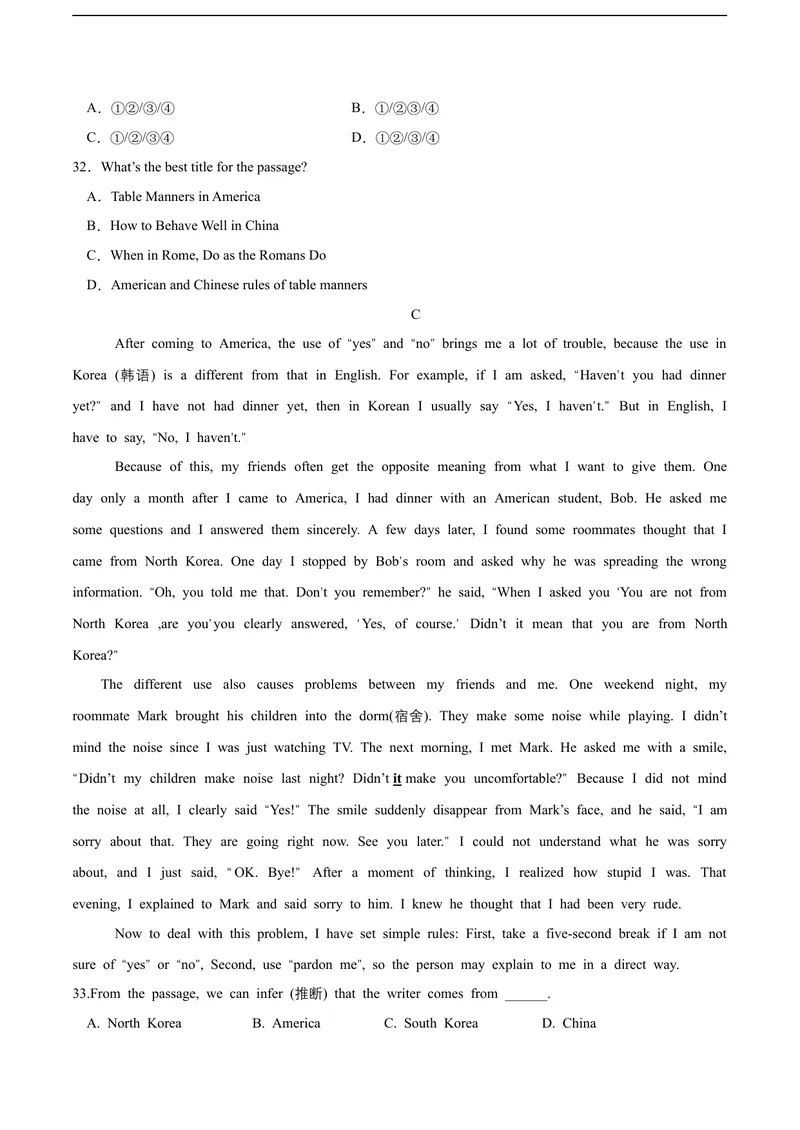
31.How can this passage be divided?A.①②/③/④ B.①/②③/④
C.①/②/③④ D.①②/③/④
32.What’s the best title for the passage?
A.Table Manners in America
B.How to Behave Well in China
C.When in Rome, Do as the Romans Do
D.American and Chinese rules of table manners
C
After coming to America, the use of “yes” and “no” brings me a lot of trouble, because the use in
Korea (韩语) is a different from that in English. For example, if I am asked, “Haven’t you had dinner
yet?” and I have not had dinner yet, then in Korean I usually say “Yes, I haven’t.” But in English, I
have to say, “No, I haven’t.”
Because of this, my friends often get the opposite meaning from what I want to give them. One
day only a month after I came to America, I had dinner with an American student, Bob. He asked me
some questions and I answered them sincerely. A few days later, I found some roommates thought that I
came from North Korea. One day I stopped by Bob’s room and asked why he was spreading the wrong
information. “Oh, you told me that. Don’t you remember?” he said, “When I asked you ‘You are not from
North Korea ,are you’you clearly answered, ‘Yes, of course.’ Didn’t it mean that you are from North
Korea?”
The different use also causes problems between my friends and me. One weekend night, my
roommate Mark brought his children into the dorm(宿舍). They make some noise while playing. I didn’t
mind the noise since I was just watching TV. The next morning, I met Mark. He asked me with a smile,
“Didn’t my children make noise last night? Didn’t it make you uncomfortable?” Because I did not mind
the noise at all, I clearly said “Yes!” The smile suddenly disappear from Mark’s face, and he said, “I am
sorry about that. They are going right now. See you later.” I could not understand what he was sorry
about, and I just said, “OK. Bye!” After a moment of thinking, I realized how stupid I was. That
evening, I explained to Mark and said sorry to him. I knew he thought that I had been very rude.
Now to deal with this problem, I have set simple rules: First, take a five-second break if I am not
sure of “yes” or “no”, Second, use “pardon me”, so the person may explain to me in a direct way.
33.From the passage, we can infer (推断) that the writer comes from ______.
A. North Korea B. America C. South Korea D. China34.In Paragraph 3, when the writer answered “Yes”,Mark might think the writer was _______.
A. rude B. kind C. helpful D. polite
35.If the writer is not sure of “yes” or “no” next time, he will say______.
A. “ pardon me” B. “yes” C. “no” D. “I don’t know”
36.The writer writes the passage mainly to remind us_______.
A. to work hard on English B. to learn to respect others
C. never to use “yes” or “no” D. to know culture differences
D
Stages of Culture Shock
1 Fun stage Culture shock begins with a new 2 Rejection(排斥) stage After beginning your new
culture. This is the stage when you first arrive in a life, you become very tired and begin to miss your
place which everything about the new culture is family. All the little problems seem to be much bigger.
strange. You are excited to be in the new It can be quite dangerous because you may develop
environment. This stage can last for quite a long time unhealthy habits like smoking and drinking. It can
because you feel you are in some kind of great make the person feel scared and helpless.
adventure.
3 Adjustment(调整) stage This is the stage when 4 Mastery(精通) stage Now you feel quite
you begin to realize that things are not so bad in the comfortable in the new environment. You can solve
host culture. Your sense of humour usually becomes most problems in the new life. If you meet people
stronger. Things are still difficult, but now you have from your country that have just arrived, you are able
survived! to help them solve their culture shock.
What to Do with Culture Shock
◆ Learn the rules of living in your host country. Try to understand how and why the local people act the way
they do.
◆ Learn new culture. Study art, music or learn a new sport.
◆ Take time to learn the language. It always helps to understand as much as possible of what
people are saying.
◆ Travel. Take the time to be a tourist and explore the country.
◆ Make friends and develop relationships. Getting to know local people will help you understand
the new culture.
◆ Communicate with friends and family back home. Writing home about your experiences and
problems can help you understand and solve them.
◆ Do something you usually do. Listening to your favourite music or doing something you like can
be relaxing when you miss your family.37 Culture shock happens when you _______.
A. become a teenager B. meet foreign people for the first time
C. move to a big city D. go to live in a foreign culture
38 What may happen during the second stage?
A. It becomes easier for you to solve the problems.
B. You feel very excited and don’t want to go home.
C. You may develop unhealthy habits.
D. You find everything about the new culture strange.
39 During Stage 3, your _______ may improve.
A. sense of humour B. body’s health
C. writing skill D. learning ability
40 Which of the following can NOT solve the culture shock problems?
A. Travel around the foreign country.
B. Only make friends with people from your country.
C. Learn the foreign language as much as possible.
D. Learn new rules and culture from local people.
第二节、阅读填空(5分)
阅读短文及文后A~E选项,选出可以填入空白处的最佳选项,并在答题卡上将该项涂黑。
The term “culture shock” is used to describe the anxiety(焦虑)produced when a person moves to a new
environment. When you visit a new place, you are forced to meet your everyday needs, like food and language in a
totally new and different way. 4 1 . . After all, it is you who must take steps to feel better. There are a few
suggestions.
4 2 . . You may feel annoyed that you are experiencing a culture shock after having prepared so long and
so hard for your trip. No matter how much information you read and how well you speak English, you can’t always
do everything perfectly.
An open mind helps. Try not to form an opinion about the new culture soon. You might be quick to judge the
food, manners and the ways to communicate and as a result would want to do things the way you are used to. Do
not think of the US culture as better or worse, just different—you will be more willing to try new things. 4 3 .
.
Participate(参与). Just watching life go by you is not going to help you much. You will have to try out afew things for yourself. 4 4 . . People around you will usually be ready to help if something goes wrong. If
you are unsure of what to do in a new environment, follow others.
Be Humorous. 4 5 . . Finally? believe that you can live with the differences and confusions(困
惑)and still learn and enjoy yourself.
A.Don’t worry about making a mistake
B.Getting over culture shock depends upon you
C.Do not expect to do things perfectly the first time
D. Try to accept the differences you are finding between your home and host cultures
E. Never forget that humor is one of the best methods for almost any difficult situation
第2卷 非选择题(共30分)
第一节、短文填空(5分)
In China, many people don’t like the number 4 or 14, since the number 4 in Chinese has the same pronunciation
as the word “die”. While some people in 1.w__________ countries don’t like the number 13, because they think it is
unlucky and they believe this number will bring bad news. Here’s a story about Mr. Smith. One day, Mr. Smith
2.i__________ 12 friends to his house to have a party. Everyone was happy at first. 3.S__________ one guest
shouted, “There are 13 people in this house now!” Some people began to be unhappy when 4. h__________ this. Mr.
Smith did not know what to do or what to say at that 5.m_________. He regretted inviting that guest. One minute
later, a woman smiled and said, “Well, I’m pregnant right now. So there are 14 people in this house, not 13.”
Everybody laughed, and they were happy again.
第二节、完成句子(每题2分,共10分)
1.我在某种程度上同意你的观点。
I agree with you .
2.我们已经习惯了在广州的忙碌生活。
We the busy life in Guangzhou.
3.为了买新房子,他努力赚更多的钱。
buy a new house,he earn more money.
4.警方指出他们尝试使炸弹爆炸。
The police stated that they tried a bomb.
5.进人前必须脱鞋。Shoes before entering.
第三节、书面表达(15分)
假设你是李芳,去年你作为交换生去了英国,就读于Rainbow Secondary School 的八年级二班,
期间同学们给予你许多帮助,请你就此写一封感谢信。内容如下:
注意:词数80个左右,已给出部分不计入总词数。
Dear students of Class Two, Grade Eight, Rainbow School, How are you?
____________________________________________________________________________________________
____________________________________________________________________________________________
___________________________________________________________________________________________
____________________________________________________________________________________________
____________________________________________________________________________________________
____________________________________________________________________________________________
____________________________________________________________________________________________
____________________________________________________________________________________________
____________________________________________________________________________________________
____________________________________________________________________________________________
____________________________________________________________________________________________
____________________________________________________________________________________________
I hope to hear from you soon.
Yours,
Li Fang