九年级下U1 Great explorations测试卷
(A卷·夯实基础)
【牛津(广州,深圳,沈阳)版】
学校:__________班级:__________姓名:_________ 考号:___________
温馨提示:
本试卷共分第Ⅰ卷和第Ⅱ卷两部分,第Ⅰ卷为选择题;第Ⅱ卷为非选择题;满分为90分,考试时间为
100分钟。
第Ⅰ卷 选择题
一、语法选择(共15小题,每小题1分,满分15分)
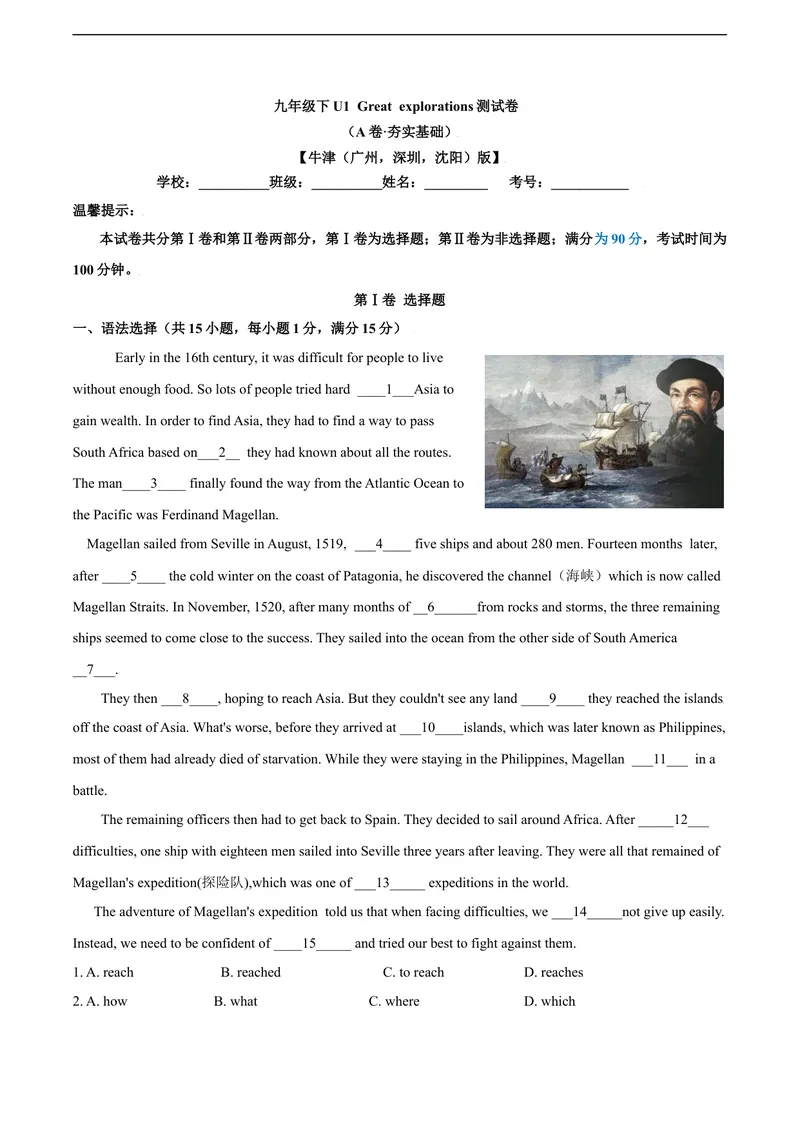
Early in the 16th century, it was difficult for people to live
without enough food. So lots of people tried hard ____1___Asia to
gain wealth. In order to find Asia, they had to find a way to pass
South Africa based on___2__ they had known about all the routes.
The man____3____ finally found the way from the Atlantic Ocean to
the Pacific was Ferdinand Magellan.
Magellan sailed from Seville in August, 1519, ___4____ five ships and about 280 men. Fourteen months later,
after ____5____ the cold winter on the coast of Patagonia, he discovered the channel(海峡)which is now called
Magellan Straits. In November, 1520, after many months of __6______from rocks and storms, the three remaining
ships seemed to come close to the success. They sailed into the ocean from the other side of South America
__7___.
They then ___8____, hoping to reach Asia. But they couldn't see any land ____9____ they reached the islands
off the coast of Asia. What's worse, before they arrived at ___10____islands, which was later known as Philippines,
most of them had already died of starvation. While they were staying in the Philippines, Magellan ___11___ in a
battle.
The remaining officers then had to get back to Spain. They decided to sail around Africa. After _____12___
difficulties, one ship with eighteen men sailed into Seville three years after leaving. They were all that remained of
Magellan's expedition(探险队),which was one of ___13_____ expeditions in the world.
The adventure of Magellan's expedition told us that when facing difficulties, we ___14_____not give up easily.
Instead, we need to be confident of ____15_____ and tried our best to fight against them.
1. A. reach B. reached C. to reach D. reaches
2. A. how B. what C. where D. which3. A. who B. whom C. whose D. which
4. A. for B. with C. without D. by
5. A. spend B. spending C. spent D. to spend
6. A. dangers B. dangerous C. dangerously D. danger
7. A. success B. successful C. successfully D. succeed
8 A. continues B. was continuing C. continued D. has continued
9. A. while B. after C. since D. until
10. A. a B. an C. the D. /
11. A. killed B. was killed C. killing D. had killed
12. A. many B. any C. few D. little
13. A. great B. the greatest C. greater D. most greatest
14. A. would B. should C. might D. need
15. A. our B. us C. ourselves D. we
二、完形填空(10分)
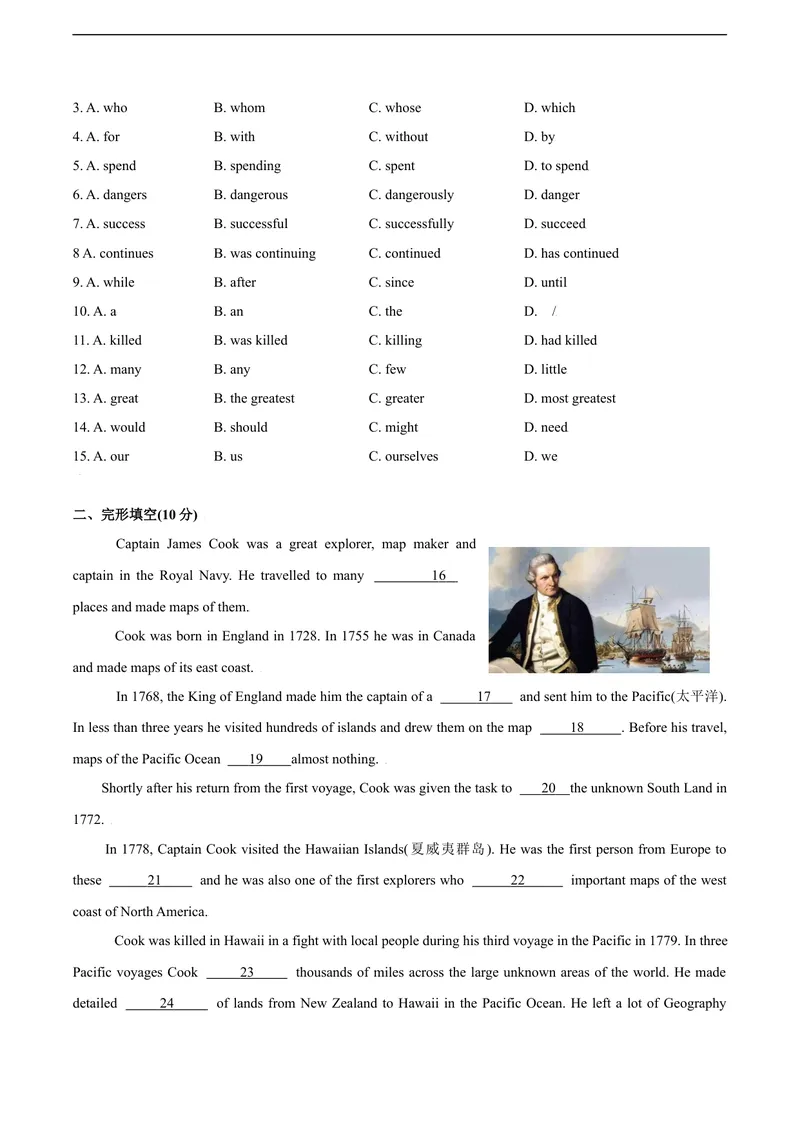
Captain James Cook was a great explorer, map maker and
captain in the Royal Navy. He travelled to many 1 6
places and made maps of them.
Cook was born in England in 1728. In 1755 he was in Canada
and made maps of its east coast.
In 1768, the King of England made him the captain of a 17 and sent him to the Pacific(太平洋).
In less than three years he visited hundreds of islands and drew them on the map 18 . Before his travel,
maps of the Pacific Ocean 19 almost nothing.
Shortly after his return from the first voyage, Cook was given the task to 20 the unknown South Land in
1772.
In 1778, Captain Cook visited the Hawaiian Islands(夏威夷群岛). He was the first person from Europe to
these 21 and he was also one of the first explorers who 22 important maps of the west
coast of North America.
Cook was killed in Hawaii in a fight with local people during his third voyage in the Pacific in 1779. In three
Pacific voyages Cook 23 thousands of miles across the large unknown areas of the world. He made
detailed 24 of lands from New Zealand to Hawaii in the Pacific Ocean. He left a lot of Geographyknowledge which was 25 to the development of the whole world.
16. A. modern B. new C. busy D. famous
17.A. train B. sea C. plane D. ship
18.A. exactly B. quickly C. hardly D. confidently
19. A. saw B. wrote C. showed D. found
20. A. come along B. look for C. lead to D. set up
21. A. islands B. cities C. countries D. coasts
22. A. sold B. brought C. invented D. made
23.A. swam B. returned C. sailed D. formed
24.A. peoples B. maps C. wealth D. money
25. A. important B. beautiful C. interesting D. foreign
三、 阅读理解(分2节,共35分)
第一节、阅读选择(15题,共30分)
A
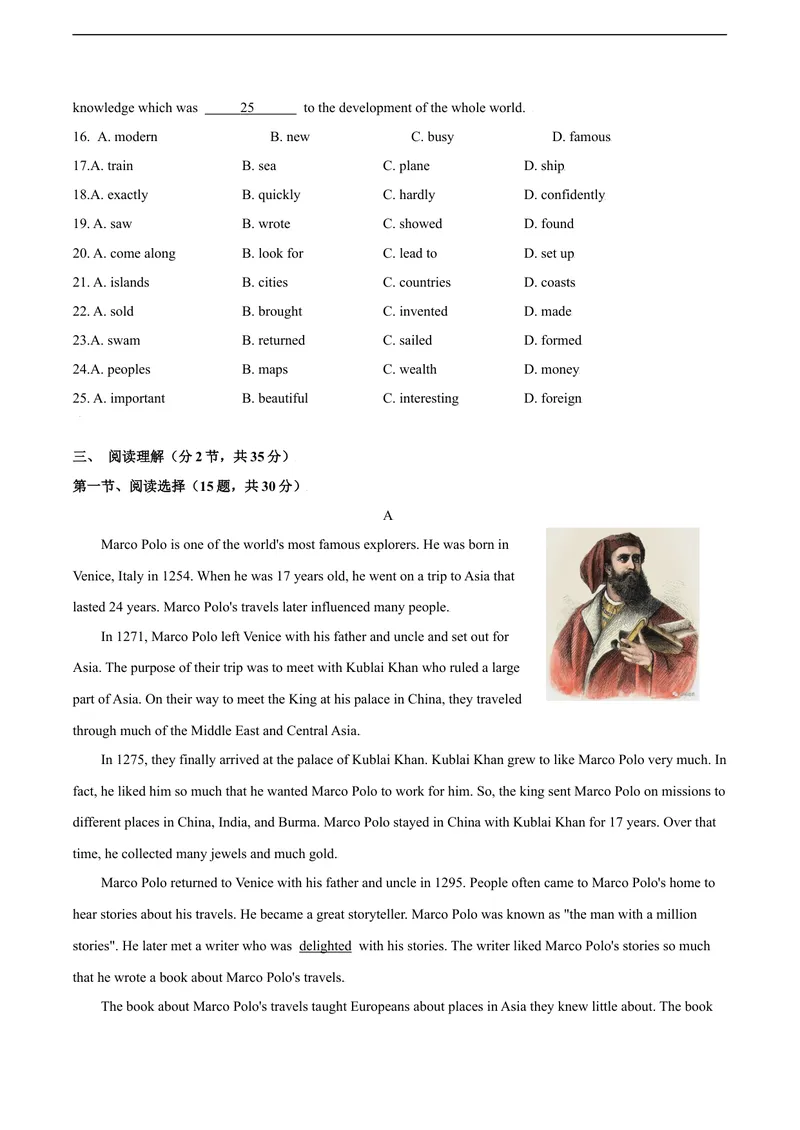
Marco Polo is one of the world's most famous explorers. He was born in
Venice, Italy in 1254. When he was 17 years old, he went on a trip to Asia that
lasted 24 years. Marco Polo's travels later influenced many people.
In 1271, Marco Polo left Venice with his father and uncle and set out for
Asia. The purpose of their trip was to meet with Kublai Khan who ruled a large
part of Asia. On their way to meet the King at his palace in China, they traveled
through much of the Middle East and Central Asia.
In 1275, they finally arrived at the palace of Kublai Khan. Kublai Khan grew to like Marco Polo very much. In
fact, he liked him so much that he wanted Marco Polo to work for him. So, the king sent Marco Polo on missions to
different places in China, India, and Burma. Marco Polo stayed in China with Kublai Khan for 17 years. Over that
time, he collected many jewels and much gold.
Marco Polo returned to Venice with his father and uncle in 1295. People often came to Marco Polo's home to
hear stories about his travels. He became a great storyteller. Marco Polo was known as "the man with a million
stories". He later met a writer who was delighted with his stories. The writer liked Marco Polo's stories so much
that he wrote a book about Marco Polo's travels.
The book about Marco Polo's travels taught Europeans about places in Asia they knew little about. The bookalso taught people about the geography of Asia. Some of these people were explorers who used the information in
Marco Polo's book on their own journeys. The best known of these explorers was Christopher Columbus.
26.Why does the author mention the Middle East?
A.To compare the Middle East to China.
B.To give an example of an Asian country.
C.To note some of the lands they traveled through.
D.To explain that it took many years to get to China.
27.What does the author imply about Christopher Columbus?
A.He knew Marco Polo well.
B.He read Marco Polo's book.
C.Marco Polo was a more important explorer.
D.Marco Polo later wrote about Columbus's travels.
28.What is the main idea of this passage?
A.Marco Polo's great storytelling. B.The return of Marco Polo to Venice.
C.The influence of Marco Polo's travels. D.Marco Polo in Kublai Khan's kingdom.
B
Now many young people are traveling around the world on their own not because they have no one to travel
with, but because they prefer to go alone.
Kristina Wegscheider from California first traveled alone when she was at college and believes that it is
something everyone should do at least once in their life. “It opens up your mind to new things and pushes you out
of your comfort zone.” Wegscheider has visited 46 countries covering all seven continents.
In foreign countries, with no one to help you read a map, look after you if you get ill, or lend you money if
your wallet is stolen, it is challenging. This is what drives young people to travel alone. It is seen as character
building and a chance to prove that they can make it on their own.
Chris Richardson decided to leave his sales job in Australia to go traveling last year. He set up a website, The
Aussie Nomad, to document his adventures. He says he wished he had traveled alone earlier.“ The people you meet,
the places you visit, or the things you do, everything is up to you and it forces you to grow as a person,” said the
30-year-old man.
Richardson describes traveling alone like “a shot in the arm”, which “makes you a more confident person that
is ready to deal with anything.” He said, “The feeling of having conquered something on my own is a major part of
what drives me each day when I’m dealing with a difficult task.” “I walk around with my head up because I knowdeep down inside that nothing is impossible if you try.”
The great 19th century explorer John Muir once said, “Only by going alone in silence can one truly get into
the heart of the wilderness.”
29.Which of the following will Kristina Wegscheider agree with?
A.Traveling alone is a necessary experience for everyone.
B.It is more meaningful to travel in foreign countries.
C.It is comfortable to travel around without a friend.
D.Traveling abroad helps people to find new things.
30.Traveling alone is challenging because________________ .
A.you have to make things on your own
B.it is hard for you to prove yourself to others
C.you can only depend on yourself whatever happens
D.it will finally build your character
31.What can we infer about Chris Richardson?
A.He started traveling alone at an early age.
B.He was once shot in the arm.
C.He used to work as a salesman.
D.His website encourages others a lot.
32.What is the best title for the passage?
A.Travel Abroad B.Travel alone C.Travel Light D.Travel Wide and Far
C
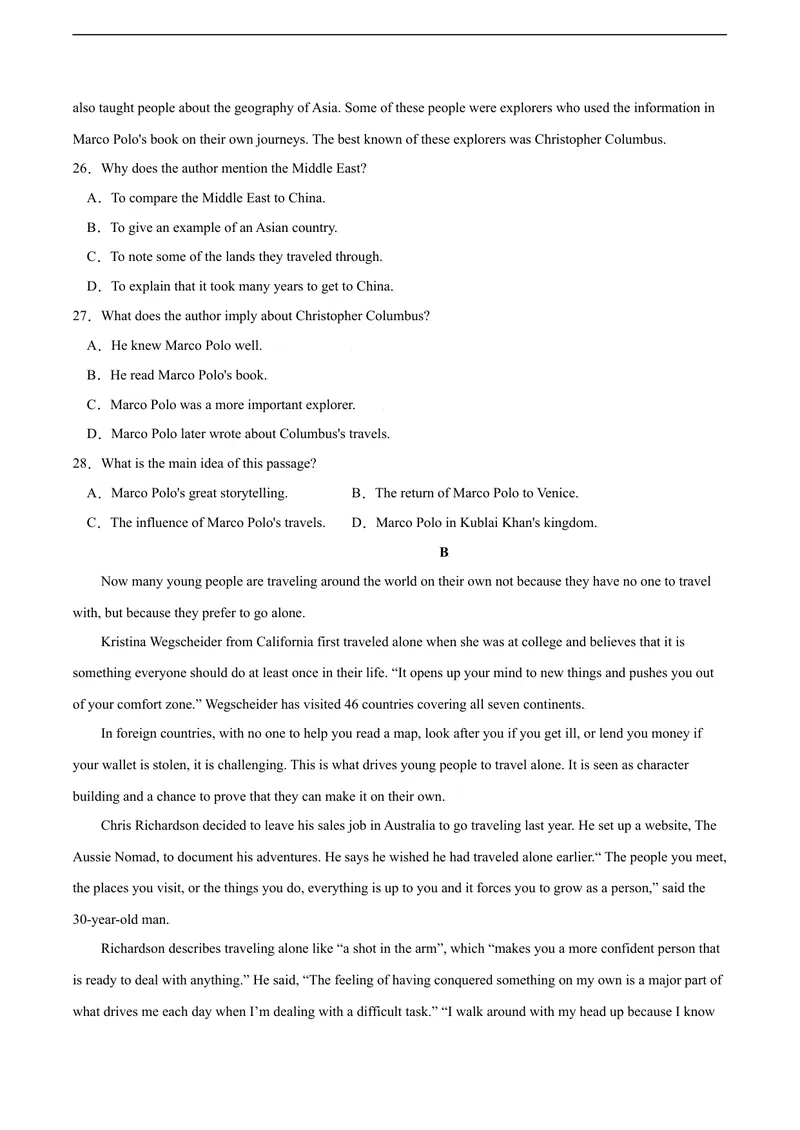
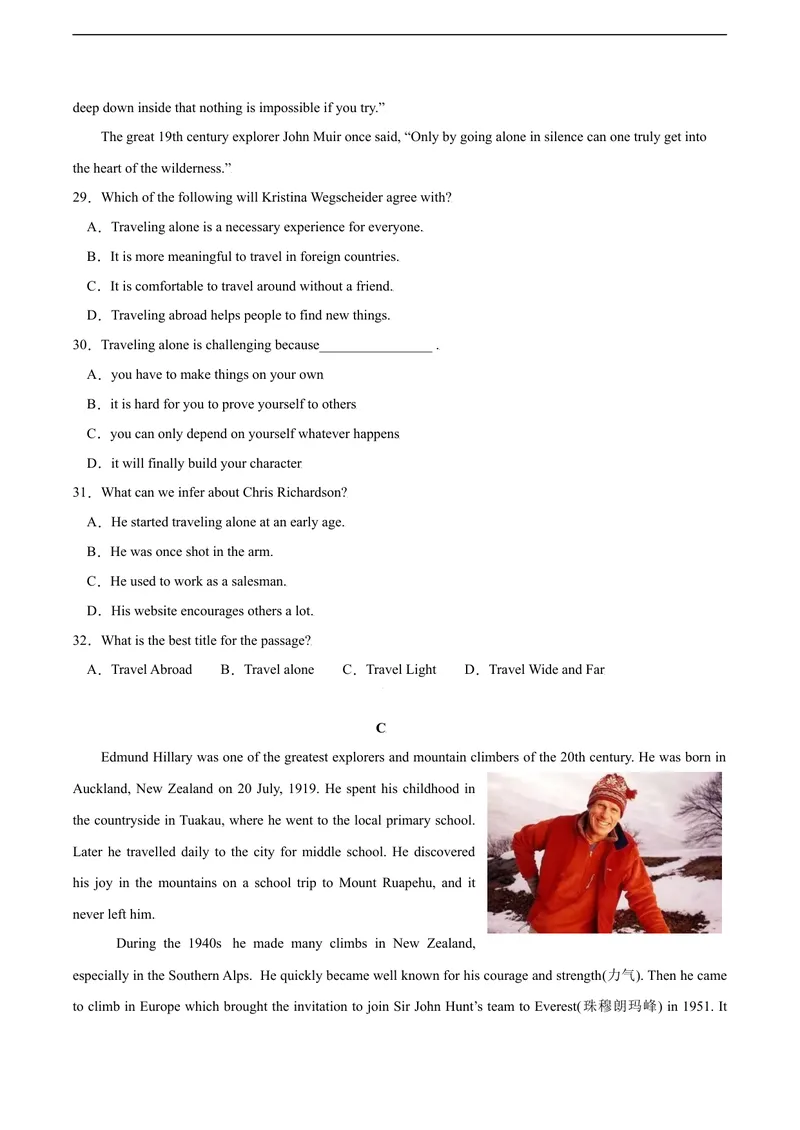
Edmund Hillary was one of the greatest explorers and mountain climbers of the 20th century. He was born in
Auckland, New Zealand on 20 July, 1919. He spent his childhood in
the countryside in Tuakau, where he went to the local primary school.
Later he travelled daily to the city for middle school. He discovered
his joy in the mountains on a school trip to Mount Ruapehu, and it
never left him.
During the 1940s he made many climbs in New Zealand,
especially in the Southern Alps. He quickly became well known for his courage and strength(力气). Then he came
to climb in Europe which brought the invitation to join Sir John Hunt’s team to Everest(珠穆朗玛峰) in 1951. Itwas a moment of history that Hillary and his guide Tenzing Norgay from Nepal were the first to climb Everest,
reaching the top on 29 May, 1953.
On 4 January, 1958, Hillary successfully led the British exploration team to the Antarctic. During the 1960s he
continued to explore the Himalayas. He also led a famous exploration team by ship and on foot to the
Ganges(恒河). Like his other adventures it was full of joy because of his great interest and sense of humour. After
leading one last exploration team in 1977, he gave up his job and lived on the farm outside Auckland.
Even after stopping working, Hillary remained an important voice in the sport of mountain climbing. He had
also kept taking part in activities in the region where he made his famous climb. For the love, respect and care for
the Sherpa people, Hillary built hospitals and schools in the mountains of Nepal. He also raised money, bought
things and worked on many of the buildings. In a 1995 interview, Hillary said, “I think the most important things
I’ve done are not those on the mountains or in the Antarctic, but the projects with my friends, the Sherpa people.
The 27 schools we’ve now set up and the hospitals are the things I would like to be remembered for.”
33 Hillary became famous because he was _______ during his climbs in New Zealand.
A. brave B. creative C. humorous D. smart
34 In what order did the following take place?
a. Hillary and his guide reached the top of Everest.
b. Hillary led the British exploration team to the Antarctic.
c. Hillary climbed the Southern Alps.
d. Hillary was invited to join Sir John Hunt’s team.
A. d-c-a-b B. c-b-d-a C. c-d-a-b D. c-a-d-b
35 Hillary thought _______ was the most important thing he had done.
A. reaching the top of Everest
B. working in the Sir John Hunt’s team
C. being the leader of the British exploration team
D. building hospitals and schools in Nepal
36 From the last paragraph, we can know Hillary was very ______.
A. healthy B. rich C. lucky D. kind
D
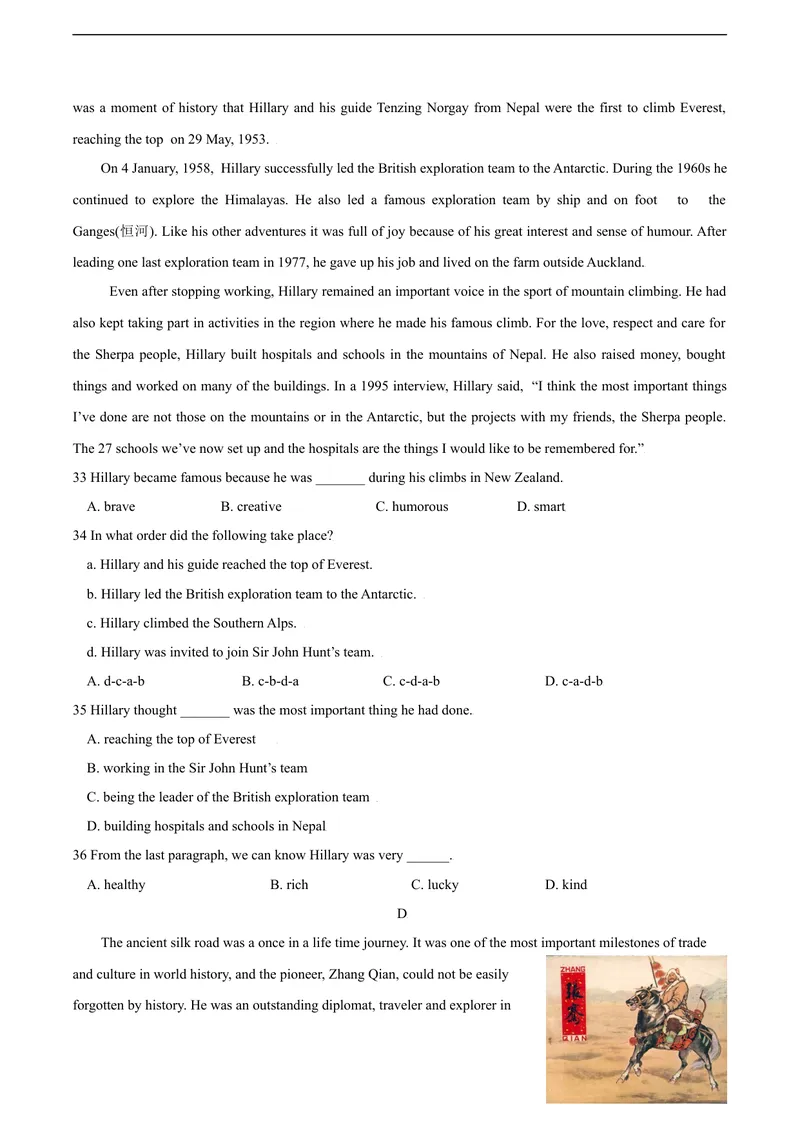
The ancient silk road was a once in a life time journey. It was one of the most important milestones of trade
and culture in world history, and the pioneer, Zhang Qian, could not be easily
forgotten by history. He was an outstanding diplomat, traveler and explorer inthe Han Dynasty of China, honored as the “the first Chinese to open their eyes to see the world” and “the Columbus
of the east”.
In 138 BC, at the reign of Emperor Wudi, Zhang Qian was sent to the west of China for an alliance with the
Yue-chi people to fight against the Xiongnu. He started his trip from Chang’an (now Xi’an in Shaanxi Province) to
Longxi (in Gansu Province). Along the way, no matter how difficult the environment was, his faith was firm. But
unfortunately, Zhang was caught by the Xiongnu people just as he left Han, and was held prisoner for ten years.
Zhang finally managed to escape with some of his men and continued to travel west without any dry food or
drinking water. Due to the excellent skill of' shooting arrows, they survived by eating some birds and other animals
along the way. When Zhang at last reached the Yue-chi in Northern India, he was disappointed to find that they
didn’t want to fight against the Xiongnu people. On the return journey, Zhang Qian and his men were again caught.
It was not until 125 BC that they returned to Chiang’an.
Though Zhang hadn’t finished his mission, he brought back first-hand information on the geography,
ethnography, and societies of Central Asia. The paths Zhang Qian explored later served as the highways connecting
Europe, the Middle East, Mesopotamia, Central Asia, and East Asia. Commodities, crops, animals, religions, ideas,
music, technology, and artifacts have been transported by diplomats, merchants and soldiers along this network of
highways, which have, since the 19th century been known as the “Silk Road”. Zhang Qian has been remembered as
the great explorer that opened up a new era of cultural exchange between East and West with long-lasting treasure
well observable today.
37.What is the passage mainly about?
A.Zhang Qian and Yue-chi people. B.The importance of the Silk Road.
C.The paths Zhang Qian explored. D.Zhang Qian and the Silk Road.
38.The word "alliance" in Paragraph 2 has the similar meaning to _________.
A.decision B.exploration C.agreement D.excitement
39.According to the passage, what is true about the Silk Road?
A.Columbus set the footprints on the ancient silk road.
B.The Silk Road was a highway to Europe in Han Dynasty.
C.Zhang Qian was a pioneer opening up the Silk Road.
D.The Silk Road has the greatest value in Chinese history.
40.Which words best describe Zhang Qian?
A.Brave and strong-minded. B.Careful and confident
C.Proud and open-minded. D.Honest and excellent.第二节、阅读填空(5分)
Alice’s Adventures in Wonderland is one of the most loved children's books of all the time. 41. ____________
It tells the story of a girl named Alice, who follows a rabbit entering a magical world called Wonderland. She has
many experiences which seem to change the rules of reasoning or common sense. The popularity of the book
comes from its imagination, interesting story, and art work.
The writer of the book is Lewis Carroll. 42._________His real name was Charles Dodgson. One day, he took
a boat ride down the Thames River to have a picnic with three little girls who were friends of the family. To keep
them entertained on the ride, he told them a story. Alice, the middle child, was the main character of the story.
43. __________ Charles later wrote the story down under the name Alice's Adventures Under Ground and gave it
to Alice as a Christmas present.
44. __________ George read it to his children and they loved it. George suggested to Charles that he make a
book from his story. Charles then wrote more parts to the story until it was around 35, 000 words. It was first
printed in 1866, with art work by John Tenniel, under the name Alice’s Adventures Under Ground. 45._________
A. Later, he gave a copy to his friend George.
B. In fact, it was not the writer's real name.
C. The book was successful immediately.
D. It is also popular among many adults.
E. They enjoyed the story very much.
第2卷 非选择题(共30分)
第一节、短文填词(5分)
Wolfgang Amadeus Mozart was a 1. g__________ musician in history. He was born on January 27, 1756.
When he was four, Mozart started 2. t__________ music lessons. By the time he was five, he had begun to write
his own music. Soon people all over 3. E__________ began learning about “the music genius”. When Mozart was
seven years old, he and his sister began playing for people in Germany. Later, they gave concerts in Vienna, Paris,
and London. Mozart never stopped surprising people with his gift. Once, he was 4.i_________ to hear some special
music in Italy. He was not allowed to see the music on paper. After he had listened to it, Mozart returned to his
room and wrote out all of the music from memory. No one had ever thought this was 5.p__________.
第二节、完成句子(每题2分,共10分)1. 许多学生会在春假期间去旅行。
Many students will ________ ________ ________ ________during the spring break.
2. 那个小男孩太小了,他不会自己穿衣服。
The boy is ________young________ dress himself
3.阅读有助于开拓我们的思维。
Reading helps ______ _______ our minds.
4. 她的父亲是音乐界的知名人士。
Her father _______ ________ _______ _______ the music world.
5.这艘船足够大,能携带25000人以及大量的货物。
This ship was______ _______ ______ carry 25,000 people as well as very large quantities of goods.
第三节、书面表达(15分)
请根据以下内容写一篇关于瓦斯科·达·伽马的英语短文_
注意:词数80个左右,已给出部分不计入总词数。
Vasco da Gama, a famous explorer, was known as the first man to sail from Europe to India.
____________________________________________________________________________________________
____________________________________________________________________________________________
_______________________________________________________________________________________________________________________________________________________________________________________
____________________________________________________________________________________________
____________________________________________________________________________________________
____________________________________________________________________________________________
____________________________________________________________________________________________
____________________________________________________________________________________________
____________________________________________________________________________________________
____________________________________________________________________________________________
____________________________________________________________________________________________