九年级下U2 Culture shock
(B卷·提升能力)
【牛津(广州,深圳,沈阳)版】
学校:__________班级:__________姓名:_________ 考号:___________
温馨提示:
本试卷共分第Ⅰ卷和第Ⅱ卷两部分,第Ⅰ卷为选择题;第Ⅱ卷为非选择题;满分为100分,考试时间
为100分钟。
第Ⅰ卷 选择题
一、语法选择(共15小题,每小题1分,满分15分)
Have you ever felt uncomfortable? Many of___1______ feel uneasy when someone stands too close
___2____ us, talks to us too ___3____ or makes eye contact with us for too long. But have you ever wondered why
those things make you uncomfortable?
It’s all about personal space, which means not only ___4____imaginary space around the body, but
also the space around all the _____5____. People feel that their space is being violated(侵犯) when they
meet with an unwelcome sound, smell or look. This is probably why a man on a crowded bus shouting
into his mobile phone or a woman next to you putting on strong perfume(香水) makes you feel
__6_______.
_____7____ people have had a stronger wish to protect their personal space or not in recent times is
hard to say. Yet studies of airlines show that people have a strong desire(渴望) to have space
to___8_____. In a survey by Trip Advisor, a travel website, people said that if they____9_____ pay more for
some extra service, they would rather have larger seats than extra food.
Although people may need their personal space, some hardly realize it. For example, people on a bus who
hold newspapers _____10_____their faces to read in fact keep a distance from strangers.
Go and watch a library table. You will notice_____11_____ one of the corner seats will usually
____12______ first, because they are the farthest way. What if someone sits_____13_____ you? Maybe you will
pile up books as if to make a wall.
Preference(偏好) for personal space are different from culture to culture. Scientists have found that
Americans generally prefer more personal space than people from ______14____ cultures. In Latin(拉丁人
的) cultures, ____15____, people are more comfortable standing near each other.
1.A.we B.us C.our D.ours
2.A.with B.in C.to D.at
3.A.loudness B.louder C.loudly D.loudest
4.A.a B.an C.the D./
5.A.sense B.senses C.sensing D.sensings
6.A.anger B.angry C.angers D.angrily
7.A.Whether B.What C.That D.Which8.A.them B.their C.themselves D.they
9.A.has to B.have to C.had to D.having to
10.A.in the front B.in front C.in the front of D.in front of
11.A.that B.what C.where D.if
12.A.be taken B.be taking C.take D.takes
13.A.opposite with B.opposite to C.opposite at D.opposite for
14.A.another B.others C.other D.the others
15.A.but B.however C.either D.although
二、完形填空 阅读短文,掌握大意,选出最佳选项。(共10小题,每小题1分, 共10分)
A young British woman had shortly arrived in Hong Kong and had not yet learned anything about the Chinese
culture.
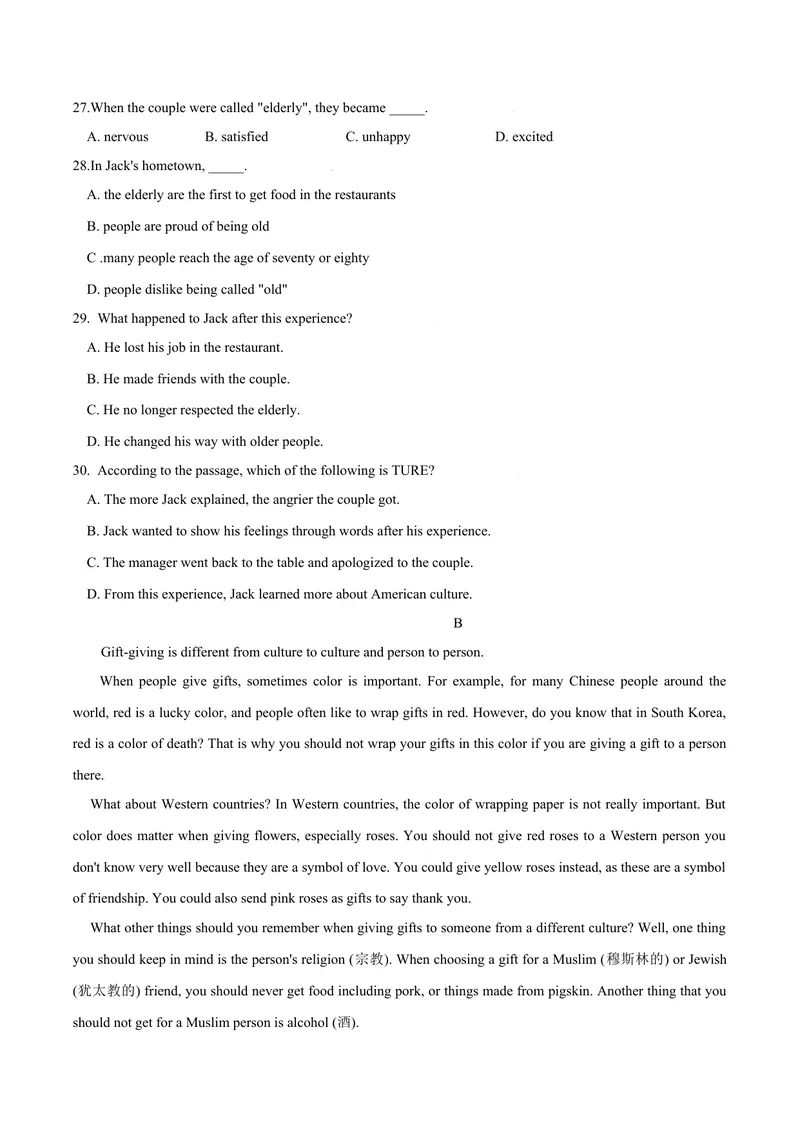
One day she went to the home of a Chinese friend and was immediately
given a cup of Chinese tea. She was not __11__and she also found this type of tea
rather __12__. However, since she had been given the tea, she felt she should
drink it. Hoping to finish it__13_so that she would not feel about having to drink
this tea which she did not__14__, she started to drink as much of it as she could. But as soon as her cup became
half-full, the host insisted on giving her more. Several times she told the host that she had had__15__, but it seemed
to have no__16__. Her cup kept being__17__, and she kept on drinking.
During the time of her__18__, she drank about twelve cups of tea. Later she found out that she should have
just left the tea, and that this would have meant that she had had enough. Influenced by her__19__culture, she felt it
too__20__to leave the tea and could not understand why the host took no notice of her protests (抗议) that
she had had enough!
11. A. tired B. happy C. thirsty D. interested
12. A. bitter B. sweet C. nice D. cold
13. A. in time B. slowly C. gradually D. quickly
14. A. take B. have C. like D. buy
15. A. some B. enough C. all D. a little
16. A. value B. end C. effect D. importance
17. A. filled B. moved C. changed D. emptied
18. A. talk B. visit C. party D. investigation
19. A. modern B. ancient C. Western D. Eastern20. A. impolite B. polite C. easy D. uneasy
三、阅读 (共两节,满分45分)
第一节 阅读理解(共20小题;每小题2分,满分40分)
阅读下列短文,从每题所给的A、B、C和D项中,选出最佳选项,并在答题卡上将该项涂黑。
A
My name is Jack. When my family moved to America in 2019 from a small village in Guangdong, China,
we brought not only our luggage, but also our village rules, customs as well as culture. One of the rules is that
young people always respect elders. This rule, unfortunately, led to my very first embarrassment in America.
I had a part-time job as a waiter in a Chinese restaurant. One time, when I was serving food to a middle-aged
couple, the wife asked me how the food could be served so quickly. I told her that I had made sure they got their
food quickly because I always respect the elderly. As soon as I said that, her face showed great displeasure. My
manager, who happened to hear what I said, took me aside and gave me a long lecture about how sensitive
Americans are and how they dislike the description "old". I then walked back to the table and apologized to
the wife. After the couple heard my reason, they understood that the problem was caused by cultural differences, so
they laughed and were no longer angry.
In my village, however, people are proud of being old. Not so many people live to be seventy or eighty, and
people who reach such an age have the most knowledge and experience. Young people always respect older people
because they know they can learn from their rich experience.
However, in the United States, people think "growing old" is a problem since "old" shows that a person is
going to retire or that the body is not working well. Here many people try to keep themselves away from growing
old by doing exercises or jogging, and women put on makeup, hoping to look young. When I told the couple in the
restaurant that I respect the elderly, they got angry because this caused them to feel they had failed to stay young. I
had told them something they didn't want to hear.
After that, I changed the way I had been with senior citizens. It is not that I don't respect them anymore; I still
respect them, but now I don't show my feelings through words.
26.Jack served the food to the couple very fast because _____.
A. the manager asked him to do so
B. he respected the elderly
C. the couple wanted him to do so
D. he wanted more pay27.When the couple were called "elderly", they became _____.
A. nervous B. satisfied C. unhappy D. excited
28.In Jack's hometown, _____.
A. the elderly are the first to get food in the restaurants
B. people are proud of being old
C .many people reach the age of seventy or eighty
D. people dislike being called "old"
29. What happened to Jack after this experience?
A. He lost his job in the restaurant.
B. He made friends with the couple.
C. He no longer respected the elderly.
D. He changed his way with older people.
30. According to the passage, which of the following is TURE?
A. The more Jack explained, the angrier the couple got.
B. Jack wanted to show his feelings through words after his experience.
C. The manager went back to the table and apologized to the couple.
D. From this experience, Jack learned more about American culture.
B
Gift-giving is different from culture to culture and person to person.
When people give gifts, sometimes color is important. For example, for many Chinese people around the
world, red is a lucky color, and people often like to wrap gifts in red. However, do you know that in South Korea,
red is a color of death? That is why you should not wrap your gifts in this color if you are giving a gift to a person
there.
What about Western countries? In Western countries, the color of wrapping paper is not really important. But
color does matter when giving flowers, especially roses. You should not give red roses to a Western person you
don't know very well because they are a symbol of love. You could give yellow roses instead, as these are a symbol
of friendship. You could also send pink roses as gifts to say thank you.
What other things should you remember when giving gifts to someone from a different culture? Well, one thing
you should keep in mind is the person's religion (宗教). When choosing a gift for a Muslim (穆斯林的) or Jewish
(犹太教的) friend, you should never get food including pork, or things made from pigskin. Another thing that you
should not get for a Muslim person is alcohol (酒).31. In which country do people think red is the color of death?
A. Japan. B. The US. C. South Korea. D. The UK.
32. How can we show our friendship to Western friends?
A. By giving them yellow roses. B. By giving them red roses.
C. By giving them some food. D. By giving them products made from pork.
33. How many colors are mentioned in this passage?
A. Two. B. Three. C. Four. D. Five.
34. Which of the following is TRUE?
A. In China, people often like to wrap gifts in pink color.
B. In Western countries, people care about the color of wrapping paper.
C. We cannot give a Muslim friend a bottle of alcohol as a gift.
D. We can give a Jewish friend some pork as a gift.
35. What's the main idea of this passage?
A. Gift-giving is connected with cultural differences.
B. When people give gifts, color is important. C. How to choose gifts for different people.
D. How to send gifts to others.
C
In the eyes of many foreigners Chinese are the best hosts (主人) and the worst guests in the world. They’re not
really bad guests but because the guest-host relationship in China is much different than in some western counties it
appears they are not nice guests. And western guests sometimes look rude (粗鲁的) in the eyes of Chinese guests.
In China guests are almost like gods. Whenever I enter a Chinese person’s home there is always fruit on the
table for me and someone is quick to bring me a cup of tea or water. In the west generally the guest is not a god.
Acting according to the host’s way of doing things is usual behavior for a guest.
My wife’s mother a very kind elderly Chinese lady doesn’t smoke. When I see some of her guests smoking in
her house as a non-smoker I feel unhappy. Usually I want to stop them directly but I must realize that in China to be
a good host she must not do that. In most North America homes if you are a guest and the hosts are not smokers
you should not smoke in their house. At the very least you could ask “Is it OK if I smoke?” “But don’t be surprised
if they say “No you can’t smoke.” In our culture if you smoke in their home you are a bad guest but if
they don’t allow you to smoke in their house they are not a rude guest.
Guests in China also have special habits. Some western people may not adapt to these habits very
soon. Thankfully my wife is Chinese so whenever we visit a Chinese family she tells me to buy them agift. However giving a gift to a host is not always necessary in my country. So if you invite
international guests to your home don’t
be too surprised if they don’t bring you a gift.
In China you probably won't need to change the guest-host relationship very much because you will
probably only be the host and Chinese are naturally very good hosts. If western hosts invite you to their
house try not to be too surprised if their style of treating you is not what you have expected.
36. Many foreigners think that Chinese hosts are the _________in the world.
A. best B. worst C. most natural D. most difficult
37. When a western guest visits a Chinese family he often _________.
A. buys some fruit B. feels like a god C. wants some gifts D. takes a cup of tea
38. If the writer’s guests want to smoke in his house what will he probably say?
A. It’s OK if you smoke here. B. Let’s smoke together.
C. Sorry you can’t smoke here. D. Smoking is a bad habit.
39. What is the meaning of the underlined phrase “adapt to” in the passage?
A. think back to B. get used to C. look forward to D. keep close to
40. What is the main idea of this passage?
A. Foreigners should learn from Chinese.
B. Hosts must do things in the guest’s way.
C. Western hosts are always nice to guests.
D. People should understand cultural difference。
D
Do you think studying in a different country is something that sounds very exciting? Certainly, it is a new
experience. However, there are also some problems you will meet. Because you may have difficulty getting used to
a new culture. This is culture shock .
Actually, at least four main periods of culture-shock appear. The first period is called “the honeymoon ( 蜜
月)”. In this period, you feel excited about living in a different place, and everything seems to be fun. You like
everything, and everybody seems to be so nice to you. Also, the happy life in a new culture seems as if it will have
no ending.
However, the second period of culture shock appears. This is the “enemy period”. You get to notice that not
everything is as good as you had thought it was. You become tired of many things about the new culture. Besides,people don’t treat you as a guest anymore. Everything that seemed to be so wonderful before is now terrible.
After you deal with your enemy feelings, you come to the third period called “getting good again”. In this
period, you will feel more active, and you try to develop understanding of everything you don’t understand. The
whole situation becomes better; you feel well from the symptoms of the first two periods, and you adapt yourself
to the new values and traditions of the new country. You get to see that even the culture is different from your own,
it has something that you can learn from.
The last period of culture shock is called “nature”. In this period, you have reached a point where you actually
feel good because you have learned enough to understand the new culture. The things that made you feel
uncomfortable or strange are now things that you understand. Now you feel comfortable, and you have adapt
yourself to the new culture.
In fact, culture shock is something you must experience when living in a foreign country. It does not seem like
a very useful experience when you are going through its four periods. However, when you have got used to a new
culture, you can more fully enjoy it. You learn how to communicate with other people, and learning about other
cultures helps you learn more about yourself.
41.When you are studying in a foreign country, what will you do?
A.Discover funny things. B.Have a chance to get rich.
C.Meet advantages and problems. D.Have the feeling of freedom.
42.According to paragraph 2, which of the following is TRUE?
A.You mainly experience the good things in a new culture.
B.You feel that the night becomes shorter.
C.You think that you are on a holiday with your family.
D.You believe everything will always be OK.
43.If you are in the second period, you will probably feel .
A.bored B.worried C.relaxed D.surprised
44.What is the meaning of the underlined phrase “symptoms” in the passage?
A.Influences. B.Illness. C.Changes. D.Differences.
45.After learning the passage, we will know .
A.how to search the culture shocks
B.how to stop the culture shock happening
C.how to communicate with people in a new culture
D.how to deal with the shock of living in a new culture第二节 阅读填空(共5小题;每小题1分,满分5分)
根据短文内容,将下面A---E五个句子分别填入文中空缺处,使得补全后的短文意思通顺,结构完整。
Sometimes it can be great having English as a first language. Being an English speaker can be greatly helpful.
It’s a language of business, culture and many kinds of activities. And it is the most popular language to learn.
46 .
First of all, it can be very difficult to communicate with speakers of other languages when all they want to do is
to practise their English. Sometimes they’re just doing it to be helpful, and I appreciate(感激) that. However, it
doesn’t exactly help the English speaker in the long run. 47 Recently I am living with a native German
speaker, who finds it much easier to speak English with me than French. 48 .
At first it might seem that English speakers are very confident and outgoing. They might also be a bit
arrogant(傲慢), as many English speakers feel no need to learn other languages. However, in my opinion, when it
comes to learning other languages, native English speakers are also very shy and do not want to speak. 49 .
Even when you do speak a foreign language, people will often think you cannot understand it. Once someone
has explained something to my roommates in French, but said it again to me in English. 50 .
On the whole, I’m glad that I can speak English and I’m not ashamed of it. However, being a native English
speaker can also have its disadvantages, though it might sound strange.
A. The English speaker usually doesn’t get a chance to practise speaking other foreign languages.
B. As a result, they are too afraid to try and learn another language, for fear of looking stupid.
C. However, there are also disadvantages of being a native(本土的) English speaker.
D. In fact, they knew I understood pretty much everything they said the first time.
E. Although it’s more convenient to communicate in English, it certainly isn’t helping my French much.
四、写作 (共四节,满分30分)
第一节 短文填空(5分)
Although I got used to American food after a few days, I really missed Chinese food. This was 1.e__________
true at dinner time.
One day, Mr. Hurst suddenly said to me, “Tomorrow is Saturday. Why don’t you cook a Chinese meal for us?” I
agreed.There was a supermarket in town that had 2 i______________ food. Mr. Hurst drove me there, and we
3 m_________ to buy what we needed for cooking a Chinese meal.
I cooked some dishes that people often eat in China. Mr. and Mrs. Hurst 4.e___________ them very much.
Mr. and Mrs. Hurst really started to like Chinese food after that, so I cooked for them in my 5.s_________ time.
That’s one of my favourite memories of my year in the US.
第二节 完成句子。(共5小题,每题2分,满分10分)
1.他们发现要在如此短的时间内解出这道数学题是很困难的。
They _______ ________ very ____________ _________ work out this Maths problem in such a short time.
2. 很多城市禁止燃放烟花爆竹。
Fireworks __________ _____________ _________ ___________ _________ in many cities..
3.她习惯早起。她通常是最早来上学的人。
She ________ ________ _________ _________up early. She is usually the earliest one to come to school.
4.昨晚我直到爸妈回家才睡觉。
Last night I __________ __________ to bed __________ my parents got home.
5.这件紫色的衬衣真好看!
__________ ____________the ___________ shirt is!
第三节:书面表达(15分)
假定你是陈军,你昨天收到了笔友戴维(David)的电子邮件,得知他要作为交流生到广州学习中文,他
想了解如何学好中文。 请你给他回复一封邮件,介绍学习中文的体会和方法。要点提示:
1. 汉语非常有用,许多外国朋友都在学习它;
2. 汉语较难,与英语不一样;
3. 必须多记词,读和写也很重要;
4. 可以通过看电视和听广播锻炼听力。
注意:词数80左右。开头和结尾已给出,不计入总词数。
Dear David,
I am glad to hear that you'll be an exchange student and come to Guangzhou to learn Chinese.
__________________________________________________________________________________________
____________________________________________________________________________________________
____________________________________________________________________________________________
________________________________________________________________________________________________________________________________________________________________________________________
____________________________________________________________________________________________
____________________________________________________________________________________________
____________________________________________________________________________________________
____________________________________________________________________________________________
____________________________________________________________________________________________
____________________________________________________________________________________________
____________________________________________________________________________________________
If you have any questions please ask me. Ill sure you'll learn Chinese well.
Hope to see you soon in Xi'an.
Yours,
Chen Jun