文档文本内容
深圳牛津英语 7 年级下册巩固练习 1(unit 05)
Part 1: Unit 5 基础巩固练习
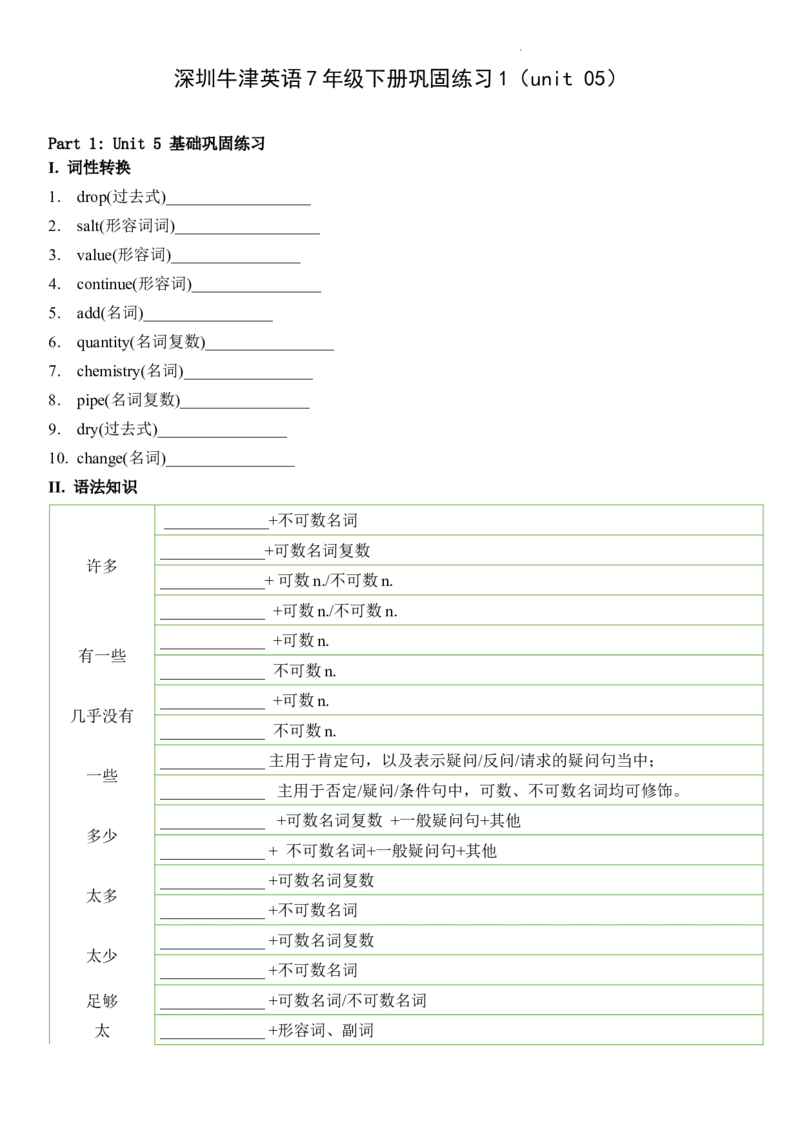
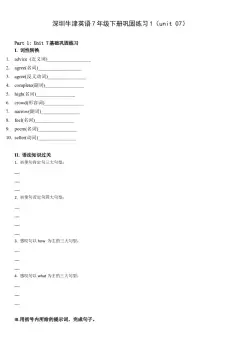
I. 词性转换
1. drop(过去式)__________________
2. salt(形容词词)__________________
3. value(形容词)________________
4. continue(形容词)________________
5. add(名词)________________
6. quantity(名词复数)________________
7. chemistry(名词)________________
8. pipe(名词复数)________________
9. dry(过去式)________________
10. change(名词)________________
II. 语法知识
_____________+不可数名词
_____________+可数名词复数
许多
_____________+ 可数n./不可数n.
_____________ +可数n./不可数n.
_____________ +可数n.
有一些
_____________ 不可数n.
_____________ +可数n.
几乎没有
_____________ 不可数n.
_____________ 主用于肯定句,以及表示疑问/反问/请求的疑问句当中;
一些
_____________ 主用于否定/疑问/条件句中,可数、不可数名词均可修饰。
_____________ +可数名词复数 +一般疑问句+其他
多少
_____________ + 不可数名词+一般疑问句+其他
_____________ +可数名词复数
太多
_____________ +不可数名词
_____________ +可数名词复数
太少
_____________ +不可数名词
足够 _____________ +可数名词/不可数名词
太 _____________ +形容词、副词
学科网(北京)股份有限公司III.用括号内所给的提示词,完成句子。
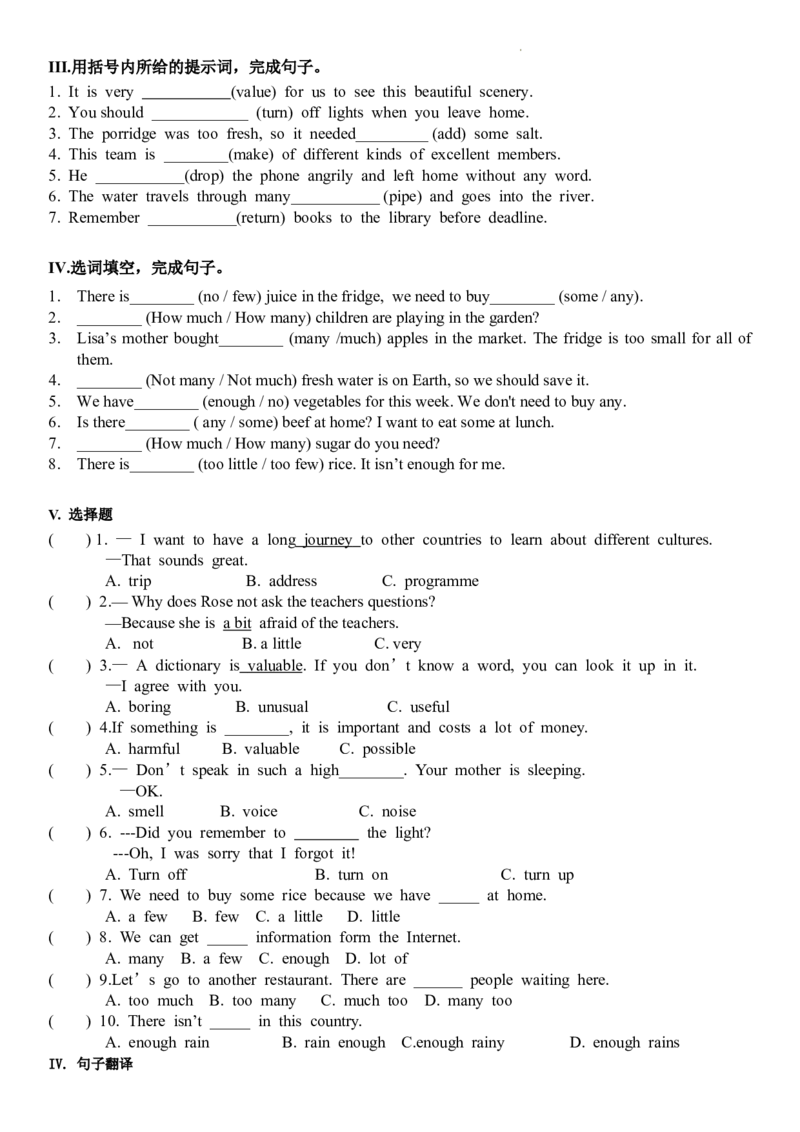
1. It is very (value) for us to see this beautiful scenery.
2. You should ____________ (turn) off lights when you leave home.
3. The porridge was too fresh, so it needed_________ (add) some salt.
4. This team is ________(make) of different kinds of excellent members.
5. He ___________(drop) the phone angrily and left home without any word.
6. The water travels through many___________ (pipe) and goes into the river.
7. Remember ___________(return) books to the library before deadline.
IV.选词填空,完成句子。
1. There is________ (no / few) juice in the fridge, we need to buy________ (some / any).
2. ________ (How much / How many) children are playing in the garden?
3. Lisa’s mother bought________ (many /much) apples in the market. The fridge is too small for all of
them.
4. ________ (Not many / Not much) fresh water is on Earth, so we should save it.
5. We have________ (enough / no) vegetables for this week. We don't need to buy any.
6. Is there________ ( any / some) beef at home? I want to eat some at lunch.
7. ________ (How much / How many) sugar do you need?
8. There is________ (too little / too few) rice. It isn’t enough for me.
V. 选择题
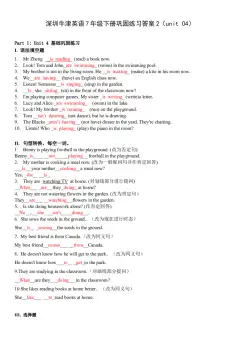
( ) 1. — I want to have a long journe y to other countries to learn about different cultures.
—That sounds great.
A. trip B. address C. programme
( ) 2.— Why does Rose not ask the teachers questions?
—Because she is a bit afraid of the teachers.
A. not B. a little C. very
( ) 3.— A dictionary is valuabl e. If you don’t know a word, you can look it up in it.
—I agree with you.
A. boring B. unusual C. useful
( ) 4.If something is ________, it is important and costs a lot of money.
A. harmful B. valuable C. possible
( ) 5.— Don’t speak in such a high________. Your mother is sleeping.
—OK.
A. smell B. voice C. noise
( ) 6. ---Did you remember to the light?
---Oh, I was sorry that I forgot it!
A. Turn off B. turn on C. turn up
( ) 7. We need to buy some rice because we have _____ at home.
A. a few B. few C. a little D. little
( ) 8. We can get _____ information form the Internet.
A. many B. a few C. enough D. lot of
( ) 9.Let’s go to another restaurant. There are ______ people waiting here.
A. too much B. too many C. much too D. many too
( ) 10. There isn’t _____ in this country.
A. enough rain B. rain enough C.enough rainy D. enough rains
IV. 句子翻译
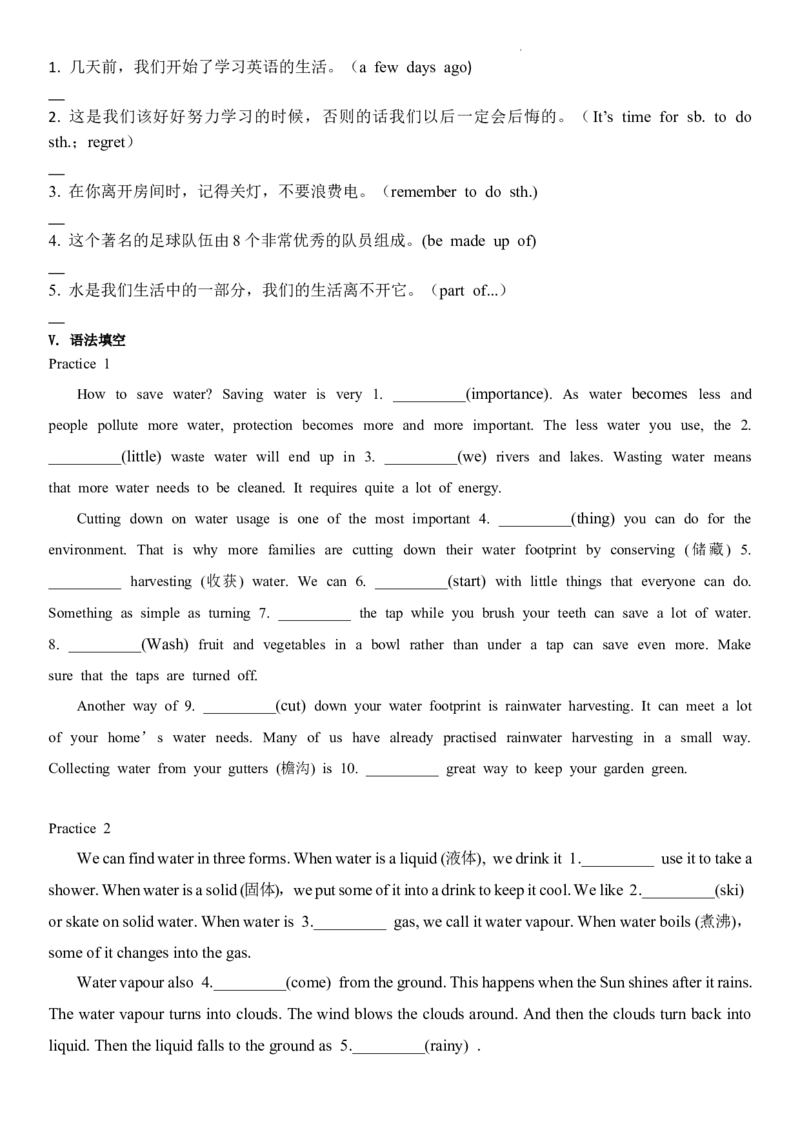
学科网(北京)股份有限公司1. 几天前,我们开始了学习英语的生活。(a few days ago)
2. 这是我们该好好努力学习的时候,否则的话我们以后一定会后悔的。(It’s time for sb. to do
sth.;regret)
3. 在你离开房间时,记得关灯,不要浪费电。(remember to do sth.)
4. 这个著名的足球队伍由8个非常优秀的队员组成。(be made up of)
5. 水是我们生活中的一部分,我们的生活离不开它。(part of...)
V. 语法填空
Practice 1
How to save water? Saving water is very 1. _________(importance). As water becomes less and
people pollute more water, protection becomes more and more important. The less water you use, the 2.
_________(little) waste water will end up in 3. _________(we) rivers and lakes. Wasting water means
that more water needs to be cleaned. It requires quite a lot of energy.
Cutting down on water usage is one of the most important 4. _________(thing) you can do for the
environment. That is why more families are cutting down their water footprint by conserving (储藏) 5.
_________ harvesting (收获) water. We can 6. _________(start) with little things that everyone can do.
Something as simple as turning 7. _________ the tap while you brush your teeth can save a lot of water.
8. _________(Wash) fruit and vegetables in a bowl rather than under a tap can save even more. Make
sure that the taps are turned off.
Another way of 9. _________(cut) down your water footprint is rainwater harvesting. It can meet a lot
of your home’s water needs. Many of us have already practised rainwater harvesting in a small way.
Collecting water from your gutters (檐沟) is 10. _________ great way to keep your garden green.
Practice 2
We can find water in three forms. When water is a liquid (液体), we drink it 1._________ use it to take a
shower. When water is a solid (固体),we put some of it into a drink to keep it cool. We like 2._________(ski)
or skate on solid water. When water is 3._________ gas, we call it water vapour. When water boils (煮沸),
some of it changes into the gas.
Water vapour also 4._________(come) from the ground. This happens when the Sun shines after it rains.
The water vapour turns into clouds. The wind blows the clouds around. And then the clouds turn back into
liquid. Then the liquid falls to the ground as 5._________(rainy) .
学科网(北京)股份有限公司Water vapour also comes 6._________ the ground. This happens 7._________ the Sun shines after it
rains. The water vapour turns into clouds. The wind blows the clouds around. And then the 8. _________(cloud)
turn back into liquid. Then the liquid falls to the ground as rain.
What makes water change its form? The 9._________(water) temperature (温度). When it is below
0℃, water is solid, such as ice or snow. When the water is warm, it is liquid. When the temperature readies
100℃ or 10. _________(high) , it becomes vapor.
Practice 3
The world is not hungry, but it is thirsty. It seems strange that nearly 3/4 of the earth is
1._________(cover) with water while we say we are short of (短缺) water. Why? Because about
97% of water on the earth is sea water which we can't drink or use for watering plants
2._________(direct). Man can only drink and use the 3% - the water that comes from rivers and
lakes. And we can’t even use all of that, 3._________ some of it has been polluted (污染)
Now more water is needed. The problem is: Can we avoid (避免) a serious water shortage
later on? Firs,we should all learn how 4._________(save) water. Secondly,we should find out the
ways to reuse it. Scientists have always been making studies in 5._________ field. Today, in most
large cities water is used only once and then 6._________(run) rivers and lakes to the sea or rivers.
But it can be used again. Even if (即使) every large city reused 7._________(it) water, still there
would not be enough. What could people turn to next?
The sea seems to have the best answer. There is a lot of water in the sea. All that needs to
be done is to get the 8._________(salty) out of the sea water. This is expensive, but it's already
used in many 9._________(part) of the world. Scientist are trying to find a cheaper way of doing
it. So you see, if we can find a way out, we'll be in no danger 10._________ drying up.
学科网(北京)股份有限公司学科网(北京)股份有限公司