深圳牛津英语 7 年级下册巩固练习答案 1(unit 06)
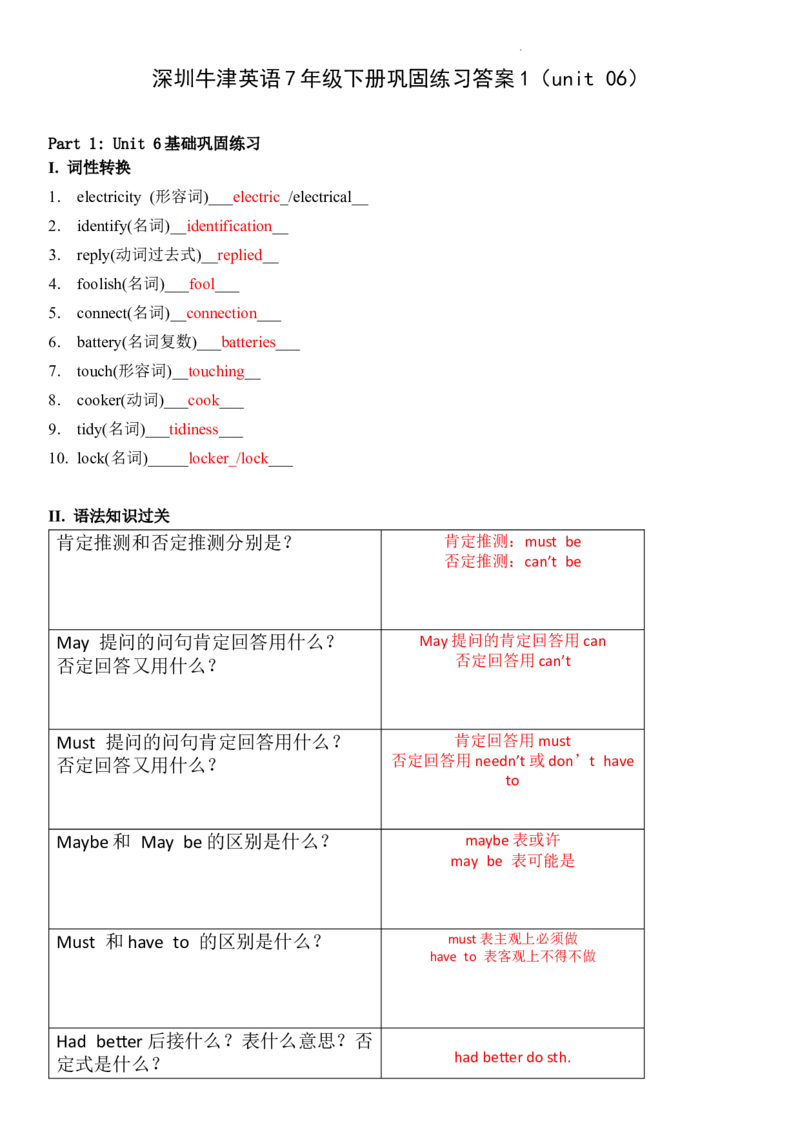
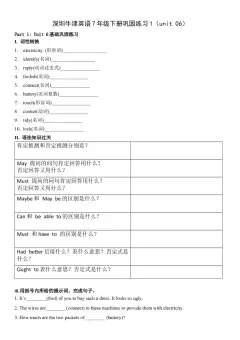
Part 1: Unit 6基础巩固练习
I. 词性转换
1. electricity (形容词)___electric_/electrical__
2. identify(名词)__identification__
3. reply(动词过去式)__replied__
4. foolish(名词)___fool___
5. connect(名词)__connection___
6. battery(名词复数)___batteries___
7. touch(形容词)__touching__
8. cooker(动词)___cook___
9. tidy(名词)___tidiness___
10. lock(名词)_____locker_/lock___
II. 语法知识过关
肯定推测和否定推测分别是? 肯定推测:must be
否定推测:can’t be
May 提问的问句肯定回答用什么? May提问的肯定回答用can
否定回答又用什么? 否定回答用can’t
Must 提问的问句肯定回答用什么? 肯定回答用must
否定回答又用什么? 否定回答用needn’t或don’t have
to
Maybe和 May be的区别是什么? maybe表或许
may be 表可能是
Must 和have to 的区别是什么? must表主观上必须做
have to 表客观上不得不做
Had better后接什么?表什么意思?否
定式是什么? had better do sth.
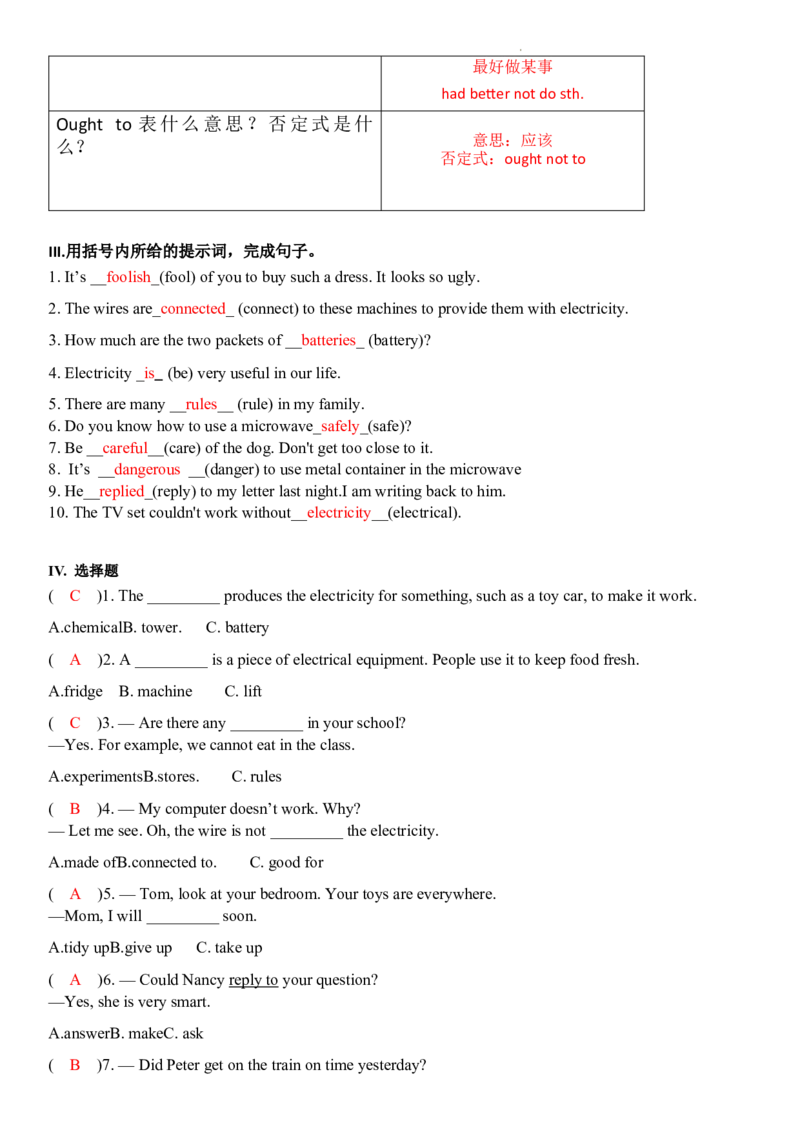
学科网(北京)股份有限公司最好做某事
had better not do sth.
Ought to 表什么意思?否定式是什
意思:应该
么?
否定式:ought not to
III.用括号内所给的提示词,完成句子。
1. It’s __foolish_(fool) of you to buy such a dress. It looks so ugly.
2. The wires are_connected_ (connect) to these machines to provide them with electricity.
3. How much are the two packets of __batteries_ (battery)?
4. Electricity _is (be) very useful in our life.
5. There are many __rules__ (rule) in my family.
6. Do you know how to use a microwave_safely_(safe)?
7. Be __careful__(care) of the dog. Don't get too close to it.
8. It’s __dangerous __(danger) to use metal container in the microwave
9. He__replied_(reply) to my letter last night.I am writing back to him.
10. The TV set couldn't work without__electricity__(electrical).
IV. 选择题
( C )1. The _________ produces the electricity for something, such as a toy car, to make it work.
A.chemicalB. tower. C. battery
( A )2. A _________ is a piece of electrical equipment. People use it to keep food fresh.
A.fridge B. machine C. lift
( C )3. — Are there any _________ in your school?
—Yes. For example, we cannot eat in the class.
A.experimentsB.stores. C. rules
( B )4. — My computer doesn’t work. Why?
— Let me see. Oh, the wire is not _________ the electricity.
A.made ofB.connected to. C. good for
( A )5. — Tom, look at your bedroom. Your toys are everywhere.
—Mom, I will _________ soon.
A.tidy upB.give up C. take up
( A )6. — Could Nancy reply to your question?
—Yes, she is very smart.
A.answerB. makeC. ask
( B )7. — Did Peter get on the train on time yesterday?
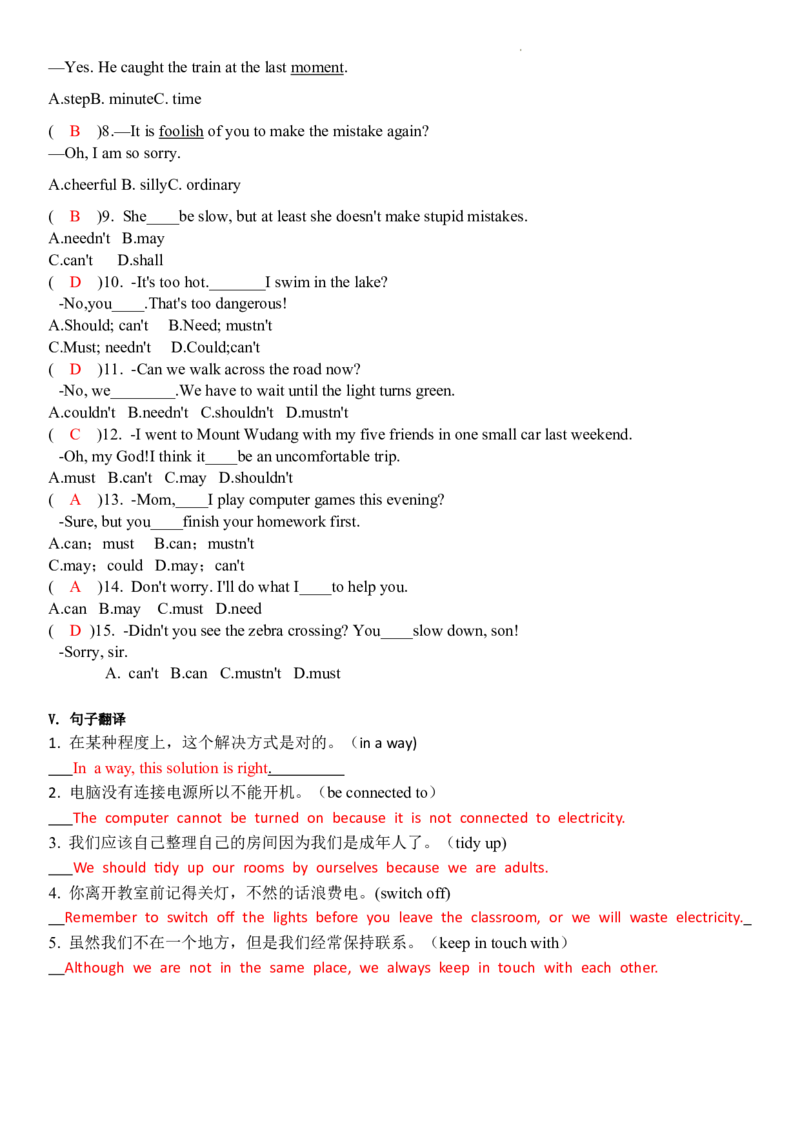
学科网(北京)股份有限公司—Yes. He caught the train at the last moment.
A.stepB. minuteC. time
( B )8.—It is foolish of you to make the mistake again?
—Oh, I am so sorry.
A.cheerful B. sillyC. ordinary
( B )9. She____be slow, but at least she doesn't make stupid mistakes.
A.needn't B.may
C.can't D.shall
( D )10. -It's too hot._______I swim in the lake?
-No,you____.That's too dangerous!
A.Should; can't B.Need; mustn't
C.Must; needn't D.Could;can't
( D )11. -Can we walk across the road now?
-No, we________.We have to wait until the light turns green.
A.couldn't B.needn't C.shouldn't D.mustn't
( C )12. -I went to Mount Wudang with my five friends in one small car last weekend.
-Oh, my God!I think it____be an uncomfortable trip.
A.must B.can't C.may D.shouldn't
( A )13. -Mom,____I play computer games this evening?
-Sure, but you____finish your homework first.
A.can;must B.can;mustn't
C.may;could D.may;can't
( A )14. Don't worry. I'll do what I____to help you.
A.can B.may C.must D.need
( D )15. -Didn't you see the zebra crossing? You____slow down, son!
-Sorry, sir.
A. can't B.can C.mustn't D.must
V. 句子翻译
1. 在某种程度上,这个解决方式是对的。(in a way)
In a way, this solution is right.
2. 电脑没有连接电源所以不能开机。(be connected to)
The computer cannot be turned on because it is not connected to electricity.
3. 我们应该自己整理自己的房间因为我们是成年人了。(tidy up)
We should tidy up our rooms by ourselves because we are adults.
4. 你离开教室前记得关灯,不然的话浪费电。(switch off)
Remember to switch off the lights before you leave the classroom, or we will waste electricity.
5. 虽然我们不在一个地方,但是我们经常保持联系。(keep in touch with)
Although we are not in the same place, we always keep in touch with each other.
学科网(北京)股份有限公司VI. 阅读理解
Practice 1
Electricity is an important part in our life. But, some people don’t know that everyone should save
electricity. When it is not completely dark, many street lamps (路灯)light up early in some streets of places.
Some people don’t turn off the lights when they leave the room. Some people are sleeping with the lights on.
They are all wrong. Here are some suggestions about stopping these things:
1.Turn on the street lamps on time. We light them from 7:00 p.m. - 5:30 a.m. in summer, and from 5:30 p.m.
- 6:00 a.m. in winter.
2.If some small areas are very dark, just turn on a few lights.
3.The distance (距离)between street lights can be 50-60 meters. It can save electricity and money.
4.If there are some activities, we can make the lights bright; if there is no activity, lights needn’t be too
bright.
5.Ask people to save electricity through TV shows, newspapers, and so on.
Electricity is valuable. It helps us live well and conveniently. We should save it at once!
( B )1. How many examples does the writer tell us about wasting electricity?
A.Two.B.Three.
C. Four.D.Five.
( D )2. What does the underlined word “suggestions” mean?
A.Energy.B.Jokes.
C. Plans.D.Advice.
( A )3. What does the writer think of electricity?
A.Valuable.
B.Fast.
C.Clean.
D.Dangerous.
( C )4. Who of the following is NOT right?
A.As a worker, Tom made the distance between two lights 55 metres.
B.Mary wrote an article about saving electricity to the newspaper.
C.Annie turned on all the lights when it was dark in a small area.
D.On the Book Fair last Sunday, Lucy made the lights bright.
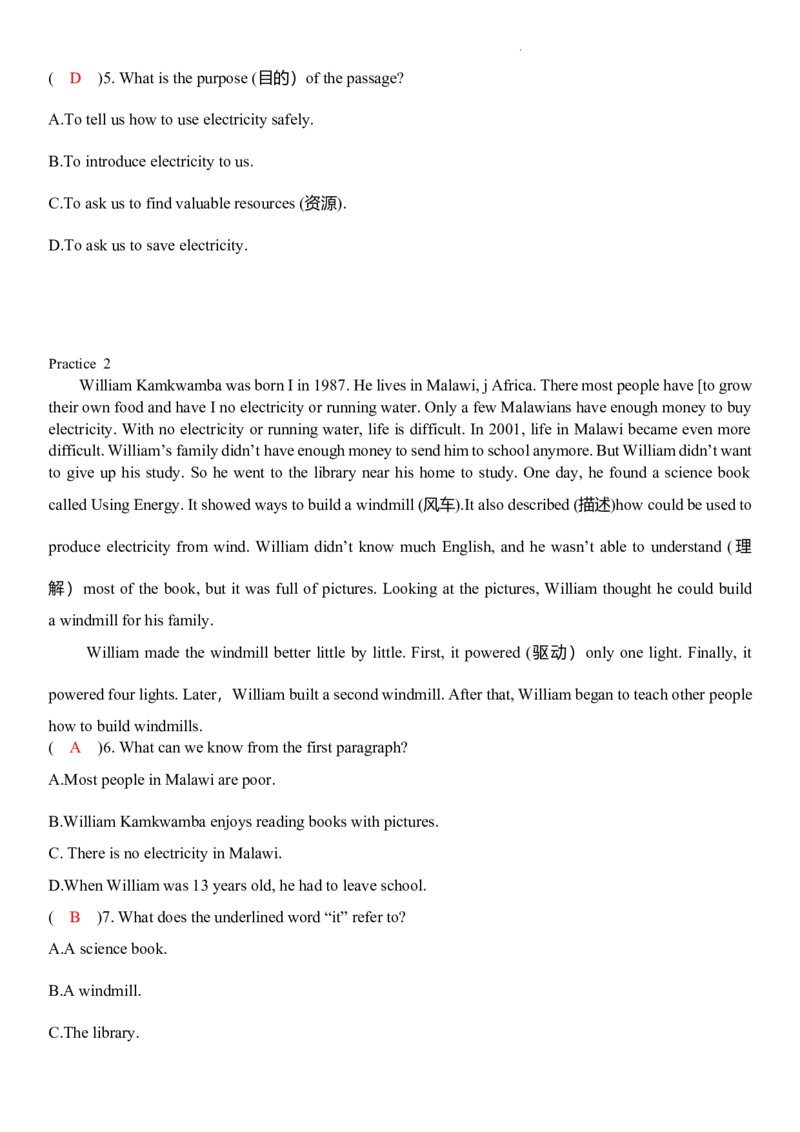
学科网(北京)股份有限公司( D )5. What is the purpose (目的)of the passage?
A.To tell us how to use electricity safely.
B.To introduce electricity to us.
C.To ask us to find valuable resources (资源).
D.To ask us to save electricity.
Practice 2
William Kamkwamba was born I in 1987. He lives in Malawi, j Africa. There most people have [to grow
their own food and have I no electricity or running water. Only a few Malawians have enough money to buy
electricity. With no electricity or running water, life is difficult. In 2001, life in Malawi became even more
difficult. William’s family didn’t have enough money to send him to school anymore. But William didn’t want
to give up his study. So he went to the library near his home to study. One day, he found a science book
called Using Energy. It showed ways to build a windmill (风车).It also described (描述)how could be used to
produce electricity from wind. William didn’t know much English, and he wasn’t able to understand (理
解)most of the book, but it was full of pictures. Looking at the pictures, William thought he could build
a windmill for his family.
William made the windmill better little by little. First, it powered (驱动)only one light. Finally, it
powered four lights. Later,William built a second windmill. After that, William began to teach other people
how to build windmills.
( A )6. What can we know from the first paragraph?
A.Most people in Malawi are poor.
B.William Kamkwamba enjoys reading books with pictures.
C. There is no electricity in Malawi.
D.When William was 13 years old, he had to leave school.
( B )7. What does the underlined word “it” refer to?
A.A science book.
B.A windmill.
C.The library.
学科网(北京)股份有限公司D.A picture.
( C )8. How did William Kamkwamba learn to make a windmill?
A.By asking for help from his teacher.
B.By reading the words in the book.
C.By looking at the pictures in the book.
D.By asking for help from his family.
( D )9. Which of the following is NOT Kamkwamba’s quality (品质)?
A.Helpful.
B.Hard-working.
C.Smart.
D.Strict.
( A )10. Which is the best title for the passage?
A. William Kamkwamba and his windwill.
B.How to live without electricity.
C.William Kamkwamba and his family.
D.How to make electricity.
Practice 3
Do you want to know some amazing things? Let’s have a look at what happened to the following four
people.
I’m Amy. I was very sad yesterday because I left my schoolbag on the school bus. But when I
got back home, I found my schoolbag on the desk in my bedroom! My parents didn’t know
about it. Whom should I thank to?
I’m Bill. Yesterday afternoon, on my way to my office, I saw a dog. Guess (猜)what? There
was a piece of paper and ten dollars in its mouth, and the dog ran into a shop and came out
with some meat in its mouth! Isn’t it amazing?
学科网(北京)股份有限公司I’m Steven. My friend Sarah’s pet cat is so amazing. The cat likes listening to music and
eating vegetables. Maybe you will say “That’s nothing. ”,but I’m sure you didn’t see a cat
dancing before. Sarah’s cat begins to dance when it hears the music. It dances differently to
different music!
I’m Kate. My pet monkey saved my life last week. I became ill suddenly and fell to the floor.
Nobody else was at home, and I couldn’t move. My pet monkey Koko helped me call 911
and soon the doctors came!
( D )11. Who sent Amy’s schoolbag back to her home?
A.Amy’s mum.
B.Amy’s dad.
C.Amy’s friend.
D.We don’t know.
( C )12. What did Bill think of the dog?
A.Foolish.B. Lazy.
C. Surprising.D. Helpful.
( B )13. What can we know about the dog?
A.The dog likes eating meat very much.
B.The dog can buy things by itself.
C.The dog bought the meat for itself.
D.The dog can write and read.
( A )14. Which of the following is NOT true about Sarah’s cat?
A.It can sing songs.
B.It likes music.
C.It can dance.
D.It likes eating vegetables very much.
( C )15. How did the monkey help Kate?
A.It took some medicine for her.
学科网(北京)股份有限公司B.It sent her to the hospital.
C.It asked for help for her.
D.It took care of her well.
学科网(北京)股份有限公司学科网(北京)股份有限公司