Unit 8 It must belong to Carla.
第9 讲
适用学科
初中英语
适用年级
九年级
适用区域
人教版新目标
课时时长(分钟)
120
知识点
1. 情态动词表推测;
2. 名词辨析;
3. 不定代词
教学目标
1. 知识与技能:
情态动词表推测
2. 过程与方法:
对变化规则所需要的条件进行判断,能够做到游刃有余,运用灵活自如。
3. 情感态度价值观:
激发对英语学习的热情,增强信心。
教学重点
1. 情态动词表推测
教学难点
1. 情态动词表推测含义
教学过程
一、导入
T: Whose sth. is this?
(Show some pictures and present the important phrases.)
T: Whose volleyball is this?
S: It must be Carla’s. She loves volleyball.
It can’t be Carla’s. She never plays volleyball.
概述
二、知识讲解
知识点1
情态动词表推测
must 意为“一定”
mustn’t 意为“不准”
can, could, may, might 意为“可能”
can’t 意为“不可能”
如:The schoolbag must be Li Hua’s.
That girl can’t be Lisa. She has gone to the library.
知识点2
whose
(1) 形容词或代词,意为“谁的;那个人的”。
如:Whose pen is this? It’s Li Ming’s.
(2) 用作关系代词,意为“……的……”。
如:He is the man whose car was stolen.
知识点3
valuable
(1) 形容词,意为“贵重的;很有用的;宝贵的”。
如:The book will be valuable to me in my work.
(2) 名词形式是value,意为“价值”。短语be of great value 相当于very valuable。
如:He doesn’t know the value of fresh air and sunlight.
知识点4
anybody
(1) 代词,意为“任何人”,常用于否定句和疑问句中。在肯定句中常用somebody 表达同一含义。
如:Did you see anybody there?
(2) anybody 也可用于肯定句中。
如:If anybody comes here, please ask him to wait.
知识点5
policeman
(1) 名词,意为“男警察”。其复数形式是policemen。
如:Have you heard of these policemen?
(2) policewoman 意为“女警察”,其复数形式是policewomen。
如:My sister is a policewoman.
知识点6
sleepy
形容词,意为“困倦的;瞌睡的”,常构成短语feel sleepy,意为“感到困倦”。
如:What do you usually do when you feel sleepy?
知识点7
辨析sound, voice, noise
(1) sound 泛指自然界中的一切声音。
(2) voice 常指“嗓音”。
(3) noise 意为“声音,噪声”。
如:Can you hear the sound of the running water?
Stop making noise. My grandma is sleeping.
知识点8
call sb.意为“给某人打电话”,相当于telephone sb.或call sb. up。
如:I think you should call your friend.
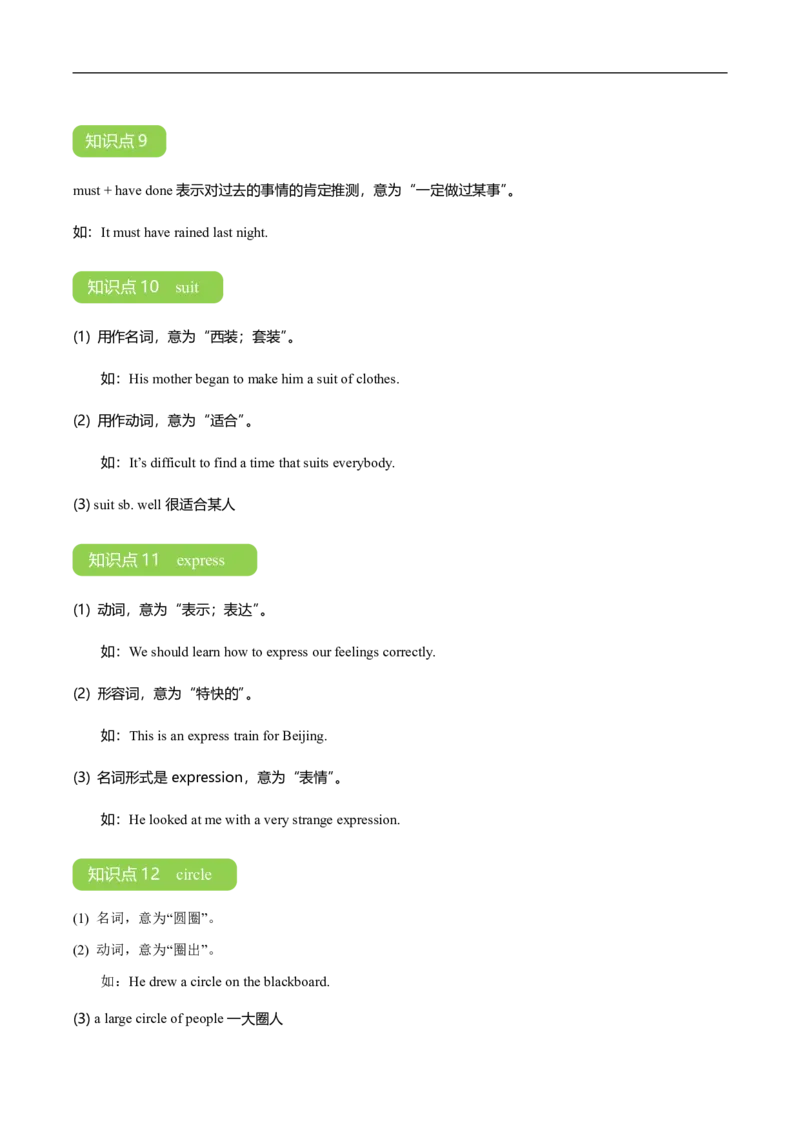
知识点9
must + have done 表示对过去的事情的肯定推测,意为“一定做过某事”。
如:It must have rained last night.
知识点10
suit
(1) 用作名词,意为“西装;套装”。
如:His mother began to make him a suit of clothes.
(2) 用作动词,意为“适合”。
如:It’s difficult to find a time that suits everybody.
(3) suit sb. well 很适合某人
知识点11
express
(1) 动词,意为“表示;表达”。
如:We should learn how to express our feelings correctly.
(2) 形容词,意为“特快的”。
如:This is an express train for Beijing.
(3) 名词形式是expression,意为“表情”。
如:He looked at me with a very strange expression.
知识点12
circle
(1) 名词,意为“圆圈”。
(2) 动词,意为“圈出”。
如:He drew a circle on the blackboard.
(3) a large circle of people 一大圈人
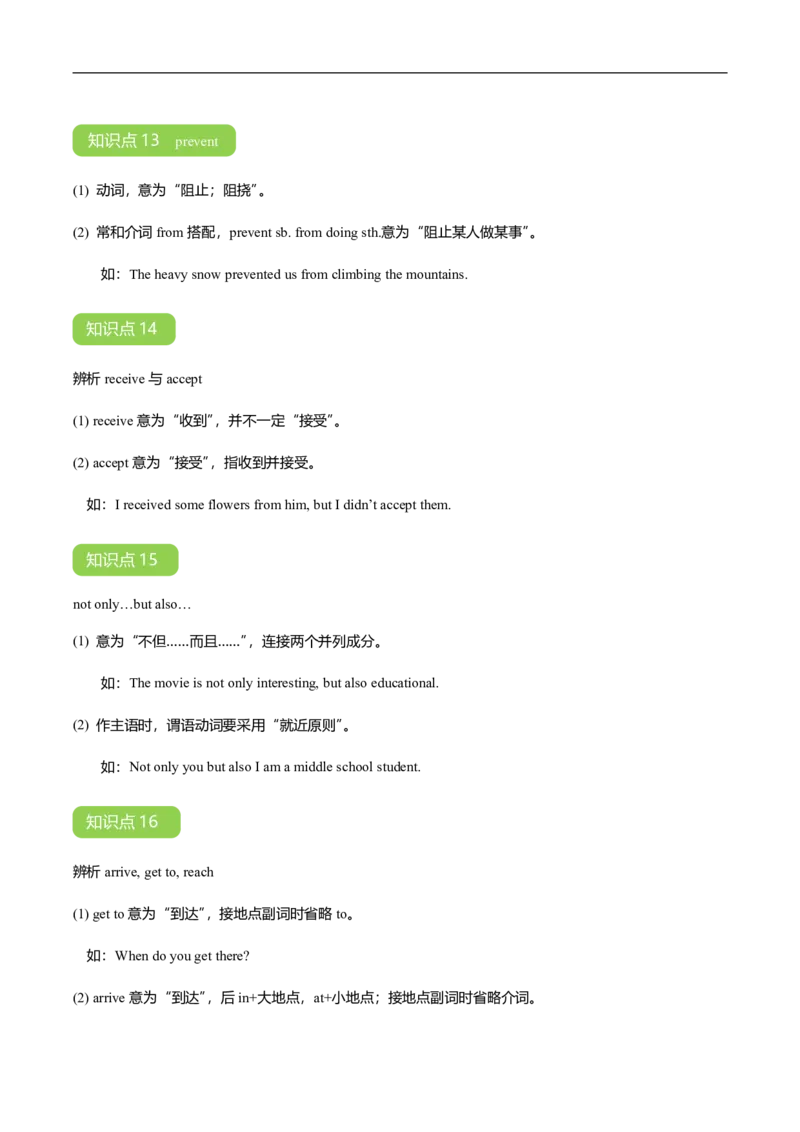
知识点13
prevent
(1) 动词,意为“阻止;阻挠”。
(2) 常和介词from 搭配,prevent sb. from doing sth.意为“阻止某人做某事”。
如:The heavy snow prevented us from climbing the mountains.
知识点14
辨析receive 与accept
(1) receive 意为“收到”,并不一定“接受”。
(2) accept 意为“接受”,指收到并接受。
如:I received some flowers from him, but I didn’t accept them.
知识点15
not only…but also…
(1) 意为“不但……而且……”,连接两个并列成分。
如:The movie is not only interesting, but also educational.
(2) 作主语时,谓语动词要采用“就近原则”。
如:Not only you but also I am a middle school student.
知识点16
辨析arrive, get to, reach
(1) get to 意为“到达”,接地点副词时省略to。
如:When do you get there?
(2) arrive 意为“到达”,后in+大地点,at+小地点;接地点副词时省略介词。
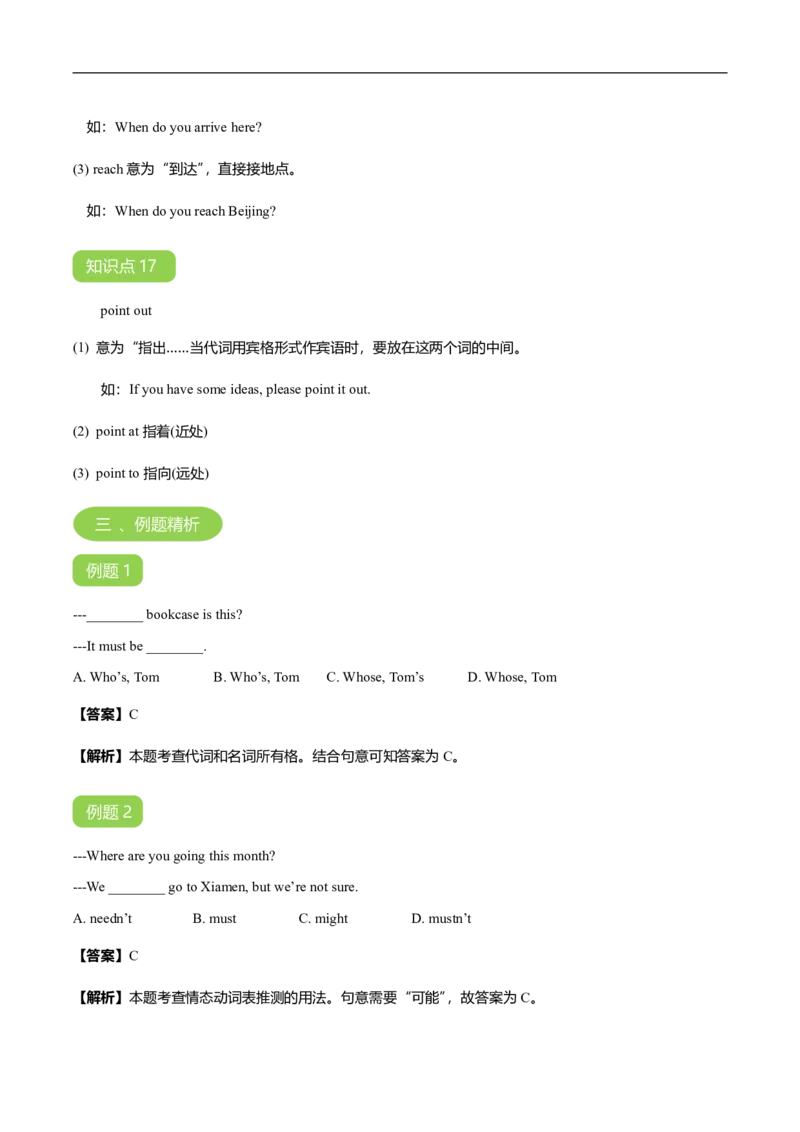
如:When do you arrive here?
(3) reach 意为“到达”,直接接地点。
如:When do you reach Beijing?
知识点17
point out
(1) 意为“指出……当代词用宾格形式作宾语时,要放在这两个词的中间。
如:If you have some ideas, please point it out.
(2) point at 指着(近处)
(3) point to 指向(远处)
例题1
---________ bookcase is this?
---It must be ________.
A. Who’s, Tom
B. Who’s, Tom
C. Whose, Tom’s
D. Whose, Tom
【答案】C
【解析】本题考查代词和名词所有格。结合句意可知答案为C。
例题2
---Where are you going this month?
---We ________ go to Xiamen, but we’re not sure.
A. needn’t
B. must
C. might
D. mustn’t
【答案】C
【解析】本题考查情态动词表推测的用法。句意需要“可能”,故答案为C。
三、例题精析
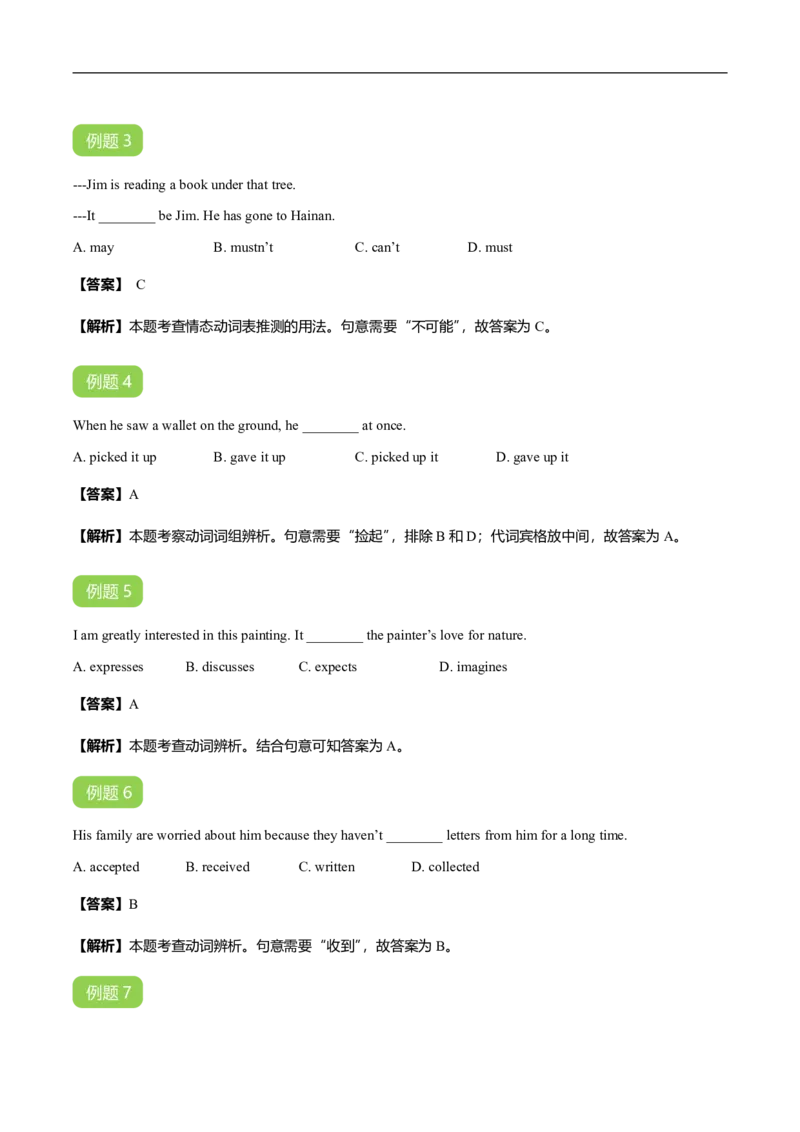
例题3
---Jim is reading a book under that tree.
---It ________ be Jim. He has gone to Hainan.
A. may
B. mustn’t
C. can’t
D. must
【答案】C
【解析】本题考查情态动词表推测的用法。句意需要“不可能”,故答案为C。
例题4
When he saw a wallet on the ground, he ________ at once.
A. picked it up
B. gave it up
C. picked up it
D. gave up it
【答案】A
【解析】本题考察动词词组辨析。句意需要“捡起”,排除B 和D;代词宾格放中间,故答案为A。
例题5
I am greatly interested in this painting. It ________ the painter’s love for nature.
A. expresses
B. discusses
C. expects
D. imagines
【答案】A
【解析】本题考查动词辨析。结合句意可知答案为A。
例题6
His family are worried about him because they haven’t ________ letters from him for a long time.
A. accepted
B. received
C. written
D. collected
【答案】B
【解析】本题考查动词辨析。句意需要“收到”,故答案为B。
例题7
The heavy rain prevented us ________ climbing the mountains.
A. in
B. on
C. from
D. of
【答案】C
【解析】本题考查介词的用法。句意需要“阻止某人做某事”用prevent sb. from doing sth.,故答案为C。
例题8
After a long walk, the old man ________ be tired now.
A. can’t
B. must
C. has to
D. need
【答案】B
【解析】本题考察情态动词表推测。句意需要“一定”,故答案为B。
四、课堂运用
1.—______ Tshirt is this?—I think it's Tom's.
A.Whose
B.Which
C.What
D.Who
2.There is some paper in the park. Let's ______.
A.pick it up
B.pick up it
C.cut up it
D.cut it up
3.—Are those books yours, Mike?
—No, they aren't. They belong to______.
A.him
B.his
C.hers
D.she
4.There are many ______ chances hidden in the challenges. Open your eyes to find them.
A.valuable
B.opposite
基础
C.surprised
D.bored
5.“I don't think I am different from ______else. I am just the son of a farmer, ”Wang Baoqiang said.
A.anyone
B.nobody
C.someone
D.everyone
【答案】
1—5 AAAAA
【解析】
1.
Whose 谁的,根据题意:----这是谁的T 恤?----这时Tom 的。
2.
pick up 为“动词+副词”型短语,若后跟代词作宾语,则代词放中间。
3.
belong to 后接名词或代词宾格,意为“属于某人的”。
4.
形容词辨析。根据题意:挑战中隐藏着许多有价值的机会。可知选valuable。
5.
代词辨析。一般情况下,肯定句中用some,否定句中用any。
巩固
1.There must ______ somebody ______ after me.
A.have; fun
B.be; run
C.have; to run
D.be; running
2.—Did he have fun ______ in China?
—Yes. He enjoyed ______ a lot. He said Chinese people were friendly.
A.work; himself
B.working; himself
C.to work; him
D.working; him
3.Planes often fly right over us, so it is very noisy sometimes. And there is also a factory near our place, and that
makes plenty of ______,too.
A.noisy
B.noise
C.voice
D.sound
4.—Let's go climbing, shall we?
—You ________ be joking! Don't you know I'm afraid of high places.
A.must
B.can
C.may
D.should
5.—Hurry, Mike! The bus is coming.
—Wait a moment, please! Let me see if there is ______ left.
A.something else
B.important something
C.nothing else
D.any other things
【答案】
1—5 DBBAA
【解析】
1. 本题考查There must be sb. doing sth.“一定有某人在做某事”。
2.本题考查have fun + doing;enjoy oneself 玩得开心。
3. 本题考查词义辨析。noisy 为形容词,意为“吵闹的”;noise 意为“声音,噪声”;voice 常指“嗓音”;
sound 泛指自然界中的一切声音。
4. 本题考查情态动词must,表肯定推测。
5. 本题考查不定代词与形容词连用时,复合不定代词在前。
拔高
take
write
study
achieve
become
If you want to ask me why we should (91) _________English, my answer will be simple and
clear. Now let me tell you the reasons one by one in the following.
In the first place, English (92) ___________ an international language. If you know English,
you (93) __________a trip round the world without being misunderstood.
In the second place, most valuable books, newspapers and magazines (94)_________in English.
If you hope to get knowledge, you must learn English.
In the third place, English is the bridge to the outside world. If you want to go abroad for further
study in the fields of medicine or technology, you will find it very important for you (95)
__________your dreams.
【答案】
1.__study__
2._ _has become__
3.__will take__
4.__are written __
5.__to achieve_
五、课堂小结
重要单词、词组句型
(1) whose :谁的,是个疑问词,作定语,后面接名词
如:Whose book is this?
This is Lily's.
(2) belong to 属于
如:That English book belongs to me.
(3) 当play 指弹奏乐器时,常在乐器前用定冠词the
play the guitar
play the piano
play the violin
当play 指进行球类运动时,则不用定冠词
play football
play basketball
play baseball
(4) if 引导的条件状语从句,主句用一般将来时,从句用一般现在时代替将来时。
If you don't hurry up, you'll be late. 如果你不快点,你将会迟到。
(5) if you have any idea= if you know 如果你知道
(6) on 关于(学术,科目)
(7) because of:由于,
because:因为
它们的用法是:because of + 名词/代词/名词性短语;because + 从句
I do it because I like it. 我做这件事是因为我喜欢。
I had to move because of my job. 因为工作的原因我得搬家。
(8) own v - owner n. listen v - listener n. learn v - learner n.
(9) catch a bus 赶公车
(10) neighbor 邻居,指人
neighborhood 邻居,指地区也可指附近地区的人
(11) local 当地的
如:local teacher 当地的教师
(12) noise :噪音,是个可数名词
如:noises
(13)anything strange 一些奇怪的东西
当形容词修饰something, anything, nothing, everything 等不定代词时,放在这些词的后。
(14) there be sb./ sth. doing :有…正在
(15) escape from …从哪里逃跑出来
He escaped from the burning building. 他从燃烧的建筑中逃出来。
(16) an ocean of + 名词,极多的,用不尽的
如:an ocean of energy.
(17) unhappy 不高兴的
反义词
happy 高兴的
(18) finally adv. 最后地
(19) dishonest 不诚实的
反义词
honest 诚实的。
(20) get on 上车
get off 下车
(21) use up 用光,用完
They have used up all the money. 他们已经用完了所有的钱。
(22) attempt to do 试图做某事
(23) wake 是个动词,意思是唤醒,常用的词组:wake up 意为醒来
Please wake me up at 8 o'clock. 请在8 点钟叫醒我。
(24) look for 寻找,强调找的过程(重要)
find 找,强调找的结果
I am looking for a pen. 我正在找一支笔。(指找的过程)
I found my pen just now. 我刚刚找到了我的笔。(指找的结果)
(25) hear 听,强调听的结果
listen 听,强调听的过程
Did you hear ? 你听到了吗?(指听的结果,听到或没听到)
I often listen to the music. 我经常听音乐。(指听的过程)
(26) try one's best to do sth. 尽某人的最大努力去做某事
He tried his best to run. 他尽他的最大努力去跑。
六、课后作业
基础
1.—I wonder if this smart phone is Mary's.
—It ______ belong to her. ______ is totally different from this one.
A.mustn't; Her
B.can't; Her
C.can't; Hers
D.may; Hers
2.—Why are you looking ______in class all day?
—Because I can't finish my homework until eleven every night.
A.awake
B.asleep
C.sleeping
D.sleepy
3.—Is that man Mr. Smith?
—It ______ be him. He has gone to New York on business.
A.may not
B.needn't
C.can't
D.mustn't
4.—Listen! I think it______ be Mr. White singing in the office.
—No. It ______be him. He's in New York now.
A.must; mustn't
B.may; mustn't
C.must; can't
D.can; can
5.The iPad isn't ______. It belongs to______.
A.he; me
B.hers; mine
C.his; me
D.her; mine
【答案】
1—5 CDCCC
【解析】
1.
考察情态动词can't 表否定推测,意为”不可能“;名词性物主代词。
2.
考察be afraid to do 害怕做某事;be afraid of …害怕。。。
3.
look sleepy 看起来困倦。
4.
考察情态动词。
5.
be sb.'s=belong to sb.
巩固
1. When you visit a museum you should ________ the instructions.
A.compare with
B.look forward to
C.pay attention to
D.try out
2.I ________ a mistake. Please don't be angry with me.
A.make
B.made
C.will make
D.had made
3.—Shall we go for a picnic tomorrow?
—Well, it all ________ the weather.
A.belongs to
B.happens to
C.depends on
D.concentrates on
4.—Mr. Li, I can't understand everything in class.
—Don't worry! I'll ________ the main points at the end.
A.record
B.review
C.require
D.remember
5. If you want to send your photos by email, connect the camera ________ your computer.
A.out
B.of
C.in
D.to
【答案】
1—5 CBCBD
【解析】
1. pay attention to 注意。句意:当你参观博物馆时要注意指示。故选C。
2. make a mistake 犯错误。由语境可知错误已经发生,故用过去时态。
3. 题意:“明天我们去野餐吗?”“这全依赖于天气。”belong to 属于;happen to 发生;depend on 依赖于;
concentrate on 集中。根据题意可知选C。
4. 题意:“并不是所有在课上讲的知识我都能理解。”“别担心!我会在最后复习那些要点。”record 记录;
review 复习;require 要求;remember 记得。根据题意可知选B。
5. connect to 把……连接起来。
拔高
There are many reasons I encourage people to travel, and I know that the experience will make one a better
person.
I remember when I was traveling that I began to know the world better. The world is not just about me, my
small town and my home. Although you will meet different people from all over the world, you will realize that
people are similar in their dreams, hopes and feelings. Enjoy exploring the different cultures, and you will also find
that people are different in some of the things they do and how they live. Once you understand their ways, it not be
strange and scary. Often we read stories about other cultures in books. Only when we visit their areas, do we find
that those stories are sometimes wrong.
One thing you may find out is that there are problems all over the world. We can’t just get money to send to
these areas and hope that will work them out. The world should get involved and help wherever there are problems.
People everywhere should be given a chance. It is so easy to ignore this if one does not travel and explore. One can
look around and see that so many people have many challenges worse than ours. One can realize that sometimes
our biggest problems are not that big after all.
On your journey you will meet a lot of new friends. Talking to strangers and finding about their lives is a great
way to spend your time. You will certainly be more confident after having to cope with problems and make many
decisions along the way.
When you travel, you have to be on your own in some situations. You will surprise yourself by how well you
can do that. All your special experiences could make an interesting book to read. It would be filled with all your
adventures and special memories.
Traveling around and seeing so much happening in the world around us is a wonderful experience. If we could
all just travel a little more and share our experiences, we would all be better people and the world would be a better
place.
1.From Paragraph 2, we can learn that_______.
A. people in their world are the same in their hopes
B. books always tell us wrong stories about cultures
C. traveling can help us better understand the world
D. people in different places have strange living habits
2. According to Paragraph 3, we can help the areas in need by _________.
A. sending them money
B. offering them chances
C. looking around
D. giving them challenges
3. The expression “ cope with” in Paragraph 4 most probably means “_______”.
A. solve
B. avoid
C. meet
D. cover
4. Which of the following would be the best title for the passage?
A. People in the World Are Family
B. Traveling Helps One Make More Friends
C. People in the World Share One Dream
D. Traveling Makes One a Better Person
5. What’s the writer’s purpose of writing the passage?
A. To share his travel experiences with other people.
B. To encourage more people to travel around.
C. To show how traveling can change the world.
D. To tell people how to travel the world.
【答案】
1—5 CBADB
【解析】
1.细节理解题。题干意为:从第二段中,我们可知_____。A.在他们世界的人们有着同样的希望。B.书中总
是告诉我们错误的文化。C.旅行可以使我们更好的了解世界。D. 在世界上不同地方的人们有着不同的生
活习惯。C 选项是ABD 的总结。
2.细节理解题。题干意为:根据第三段内容,我们能通过______帮助那些需要帮助的地区。A.给他们钱B. 给
他们提供机会C.到处看看D.给他们挑战答案在第三段第四句。
3. 细节理解题。题干意为:第四段中的cope with 是什么意思A.解决B.避免C.遇到D.覆盖根据句意推
测,可知为解决A.
4. 归纳总结题。题干意为:以下哪个是文章最好的标题A.世界上的人们是一家B.旅行使我们交到很多朋友
C.世界上的人们有着同一个梦想D.旅行使我们更加完美。答案在最后一段话中。
5. 细节理解题。题干意为:作者写这篇文章的目的是什么?A.和他人分享旅行的经历B.鼓励人们多去旅行
C.证明旅行是如何改变世界的D.告诉人们如何游历世界
七、教学反思