6-10 单元复习
第12 讲
适用学科
初中英语
适用年级
九年级
适用区域
人教版
课时时长(分钟)
120
知识点
1. 一般过去时被动语态;
2.
含有情态动词的被动语态;
3. 情态动词表推测;
4. 定语从句;
5.风俗礼仪
学习目标
1. 知识:
掌握第六单元到第十单元所涉及的重点语法项目。
2. 方法:
归纳总结、理解应用
3. 能力:
能够利用语法规则进行解题,能够准确的利用语法组织英语表达。
学习重点
1. 一般过去时被动语态;
2. 含有情态动词的被动语态;
3. 情态动词表推测
学习难点
1. 定语从句;
2. 风俗礼仪
教学过程
概述
一、导入
回顾复习以往知识点。
二、知识讲解
知识点1
被动语态定义:被动语态是动词的一种特殊形式,用来说明主语与谓语动词之间的关系。
如果主语是动作的执行者(即某人做某事),便叫主动语态;
如果主语是动作的承受者(即某事被做),便叫被动语态。
主动与被动的区别不是词序的区别,而是主语与谓语意义上的区别。
在英语中只有及物动词和一些相当于及物动词的词组才有被动语态的形式。
知识点2
被动语态的构成:由“助动词be +动词的过去分词”构成。
助动词be 有时态、人称和数的变化。被动语态后的by 短语有时可省去。
中考知识点:一般现在时的被动语态,一般过去时的被动语态,一般将来时的被动语态,含情态动词的被
动语态。
知识点3
被动语态的用法:
①不知道谁是动作的执行者(即不知道谁做)时用被动语态,省略by 短语。
如:A man was killed in the accident.一个人死于事故。
This window was broken yesterday.这扇窗子是昨天被打破的。
②不说或者众所周知是谁做时,用被动语态,省略by 短语。
如:Rice is also grown in this place.这个地方也种水稻。
A railroad will be built here in three years.三年之后这里将要修建一条铁路。
③强调动作的承受者,句尾加by 短语。
如:It was written by Lu Xun.它(书)是鲁迅写的。
A pet dog is never killed by its owner.宠物狗是不会被主人宰杀的。
知识点4
★无被动:感官动词feel, sound, smell, taste, look 及happen, take place, come true, come out 等
★特例:使役动词:let, make, have 正常加省略to 的不定式,被动时则带to
make sb. do sth.
→
be made to do sth.
常见的省略to 的不定式:一感﹙feel﹚二听﹙hear﹚三让﹙let, make, have﹚四看﹙see, watch, notice﹚五帮
﹙help﹚六发现﹙find﹚,但这些词变被动语态时必须加to
如:The boss made them work the whole night.
They were made to work the whole night.
知识点5
(1)含有动词短语的被动语态,容易把介词丢掉。
如:The girl’s little brother is taken good care of.
女孩照顾小弟弟→女孩的小弟弟由她照顾着。
(2)“be+过去分词”未必表示被动语态,而可能是系表结构。
如:He is pleased / worried / tired /…….(系表)(他高兴/焦虑/疲劳……)
He was hit / knocked down / told / shot / ….(被动)(他被击中/撞倒/关照/射中…)
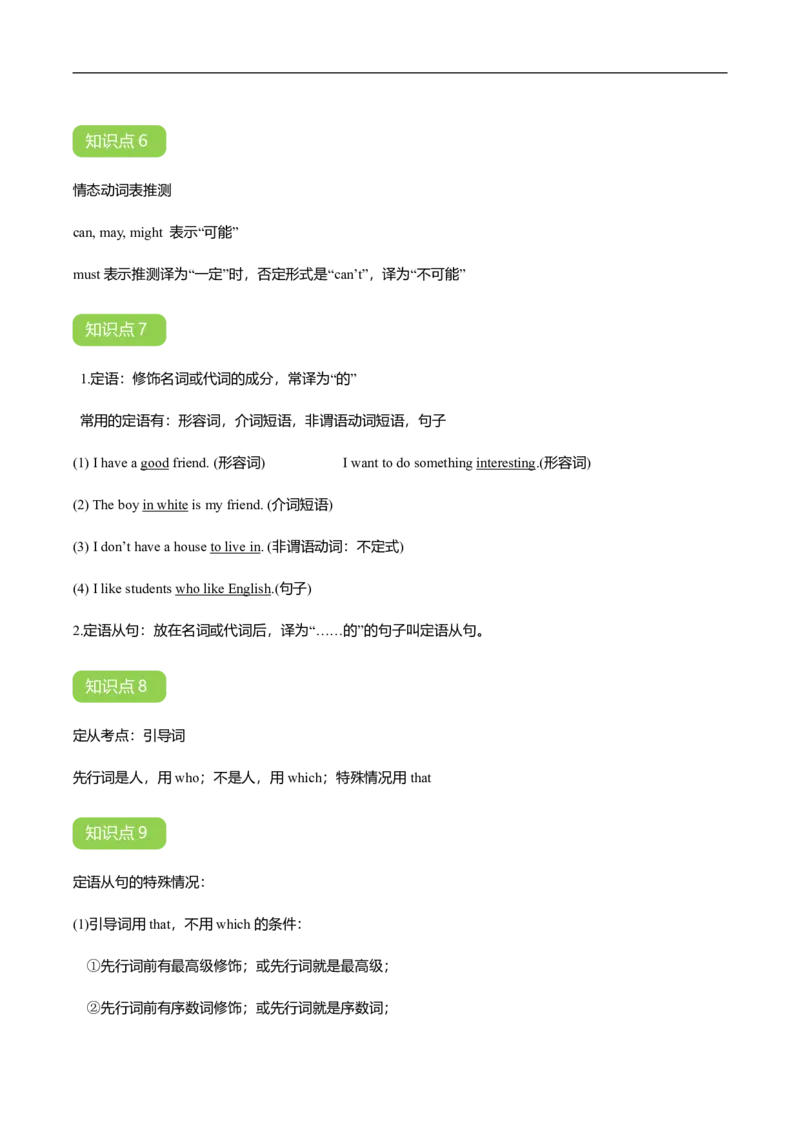
知识点6
情态动词表推测
can, may, might 表示“可能”
must 表示推测译为“一定”时,否定形式是“can’t”,译为“不可能”
知识点7
1.定语:修饰名词或代词的成分,常译为“的”
常用的定语有:形容词,介词短语,非谓语动词短语,句子
(1) I have a good friend. (形容词)
I want to do something interesting.(形容词)
(2) The boy in white is my friend. (介词短语)
(3) I don’t have a house to live in. (非谓语动词:不定式)
(4) I like students who like English.(句子)
2.定语从句:放在名词或代词后,译为“……的”的句子叫定语从句。
知识点8
定从考点:引导词
先行词是人,用who;不是人,用which;特殊情况用that
知识点9
定语从句的特殊情况:
(1)引导词用that,不用which 的条件:
①先行词前有最高级修饰;或先行词就是最高级;
②先行词前有序数词修饰;或先行词就是序数词;
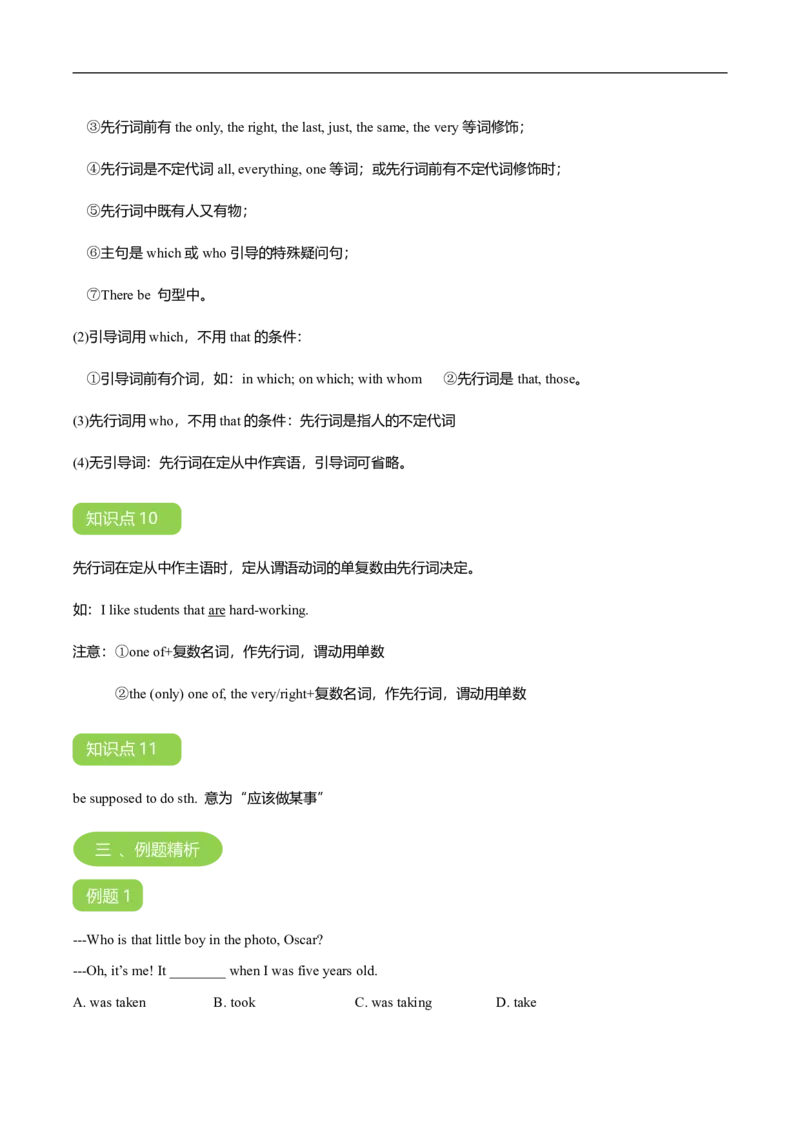
③先行词前有the only, the right, the last, just, the same, the very 等词修饰;
④先行词是不定代词all, everything, one 等词;或先行词前有不定代词修饰时;
⑤先行词中既有人又有物;
⑥主句是which 或who 引导的特殊疑问句;
⑦There be 句型中。
(2)引导词用which,不用that 的条件:
①引导词前有介词,如:in which; on which; with whom
②先行词是that, those。
(3)先行词用who,不用that 的条件:先行词是指人的不定代词
(4)无引导词:先行词在定从中作宾语,引导词可省略。
知识点10
先行词在定从中作主语时,定从谓语动词的单复数由先行词决定。
如:I like students that are hard-working.
注意:①one of+复数名词,作先行词,谓动用单数
②the (only) one of, the very/right+复数名词,作先行词,谓动用单数
知识点11
be supposed to do sth. 意为“应该做某事”
例题1
---Who is that little boy in the photo, Oscar?
---Oh, it’s me! It ________ when I was five years old.
A. was taken
B. took
C. was taking
D. take
三、例题精析
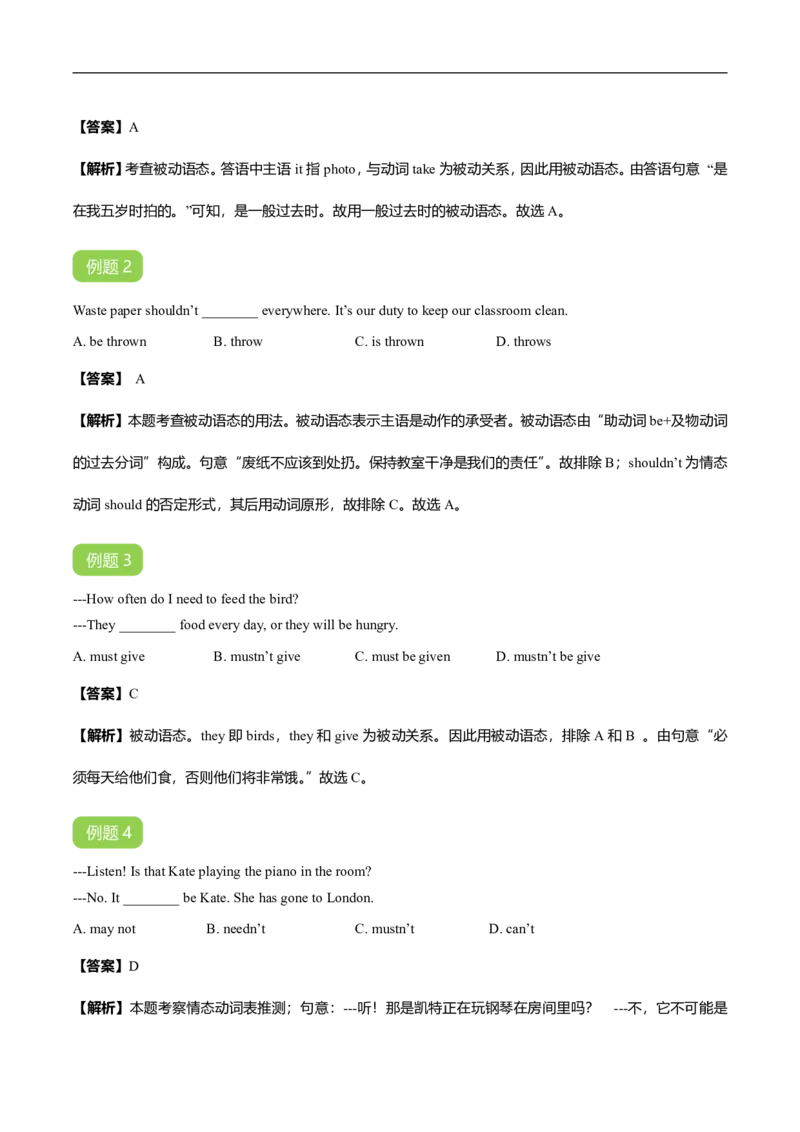
【答案】A
【解析】考查被动语态。答语中主语it 指photo,与动词take 为被动关系,因此用被动语态。由答语句意“是
在我五岁时拍的。”可知,是一般过去时。故用一般过去时的被动语态。故选A。
例题2
Waste paper shouldn’t ________ everywhere. It’s our duty to keep our classroom clean.
A. be thrown
B. throw
C. is thrown
D. throws
【答案】A
【解析】本题考查被动语态的用法。被动语态表示主语是动作的承受者。被动语态由“助动词be+及物动词
的过去分词”构成。句意“废纸不应该到处扔。保持教室干净是我们的责任”。故排除B;shouldn’t 为情态
动词should 的否定形式,其后用动词原形,故排除C。故选A。
例题3
---How often do I need to feed the bird?
---They ________ food every day, or they will be hungry.
A. must give
B. mustn’t give
C. must be given
D. mustn’t be give
【答案】C
【解析】被动语态。they 即birds,they 和give 为被动关系。因此用被动语态,排除A 和B 。由句意“必
须每天给他们食,否则他们将非常饿。”故选C。
例题4
---Listen! Is that Kate playing the piano in the room?
---No. It ________ be Kate. She has gone to London.
A. may not
B. needn’t
C. mustn’t
D. can’t
【答案】D
【解析】本题考察情态动词表推测;句意:---听!那是凯特正在玩钢琴在房间里吗?
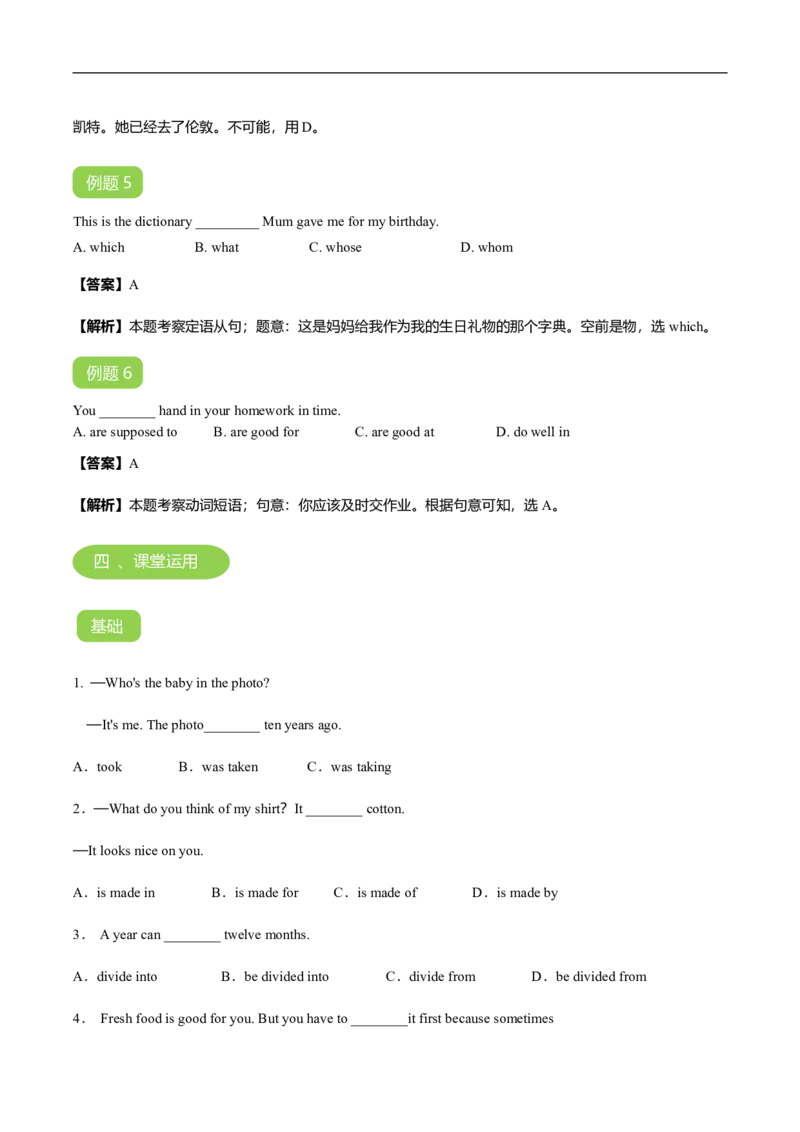
---不,它不可能是
凯特。她已经去了伦敦。不可能,用D。
例题5
This is the dictionary _________ Mum gave me for my birthday.
A. which
B. what
C. whose
D. whom
【答案】A
【解析】本题考察定语从句;题意:这是妈妈给我作为我的生日礼物的那个字典。空前是物,选which。
例题6
You ________ hand in your homework in time.
A. are supposed to
B. are good for
C. are good at
D. do well in
【答案】A
【解析】本题考察动词短语;句意:你应该及时交作业。根据句意可知,选A。
四、课堂运用
1. —Who's the baby in the photo?
—It's me. The photo________ ten years ago.
A.took
B.was taken
C.was taking
2.—What do you think of my shirt?It ________ cotton.
—It looks nice on you.
A.is made in
B.is made for
C.is made of
D.is made by
3.A year can ________ twelve months.
A.divide into
B.be divided into
C.divide from
D.be divided from
4.Fresh food is good for you. But you have to ________it first because sometimes
基础
it is a little dirty.
A.taste
B.smell
C.wash
D.plant
5.The Internet is very useful. We can get a lot of ________ from it.
A.thing
B.message
C.informations
D.information
6.The 18th Jiangsu Provincial Games will ________ in September. Many students want to be volunteers.
A.take place
B.take part
C.take action
D.take care
7.After the big earthquake,the house remained ________.It was amazing.
A.safe
B.safely
C.dangerous
D.dangerously
8. Basketball has become a more popular sport for people ________.
A.watch
B.to watched
C.watching
D.to watch
9.My mother puts too much ________ in the soup so it tastes quite ________.
A.salty;salt
B.salt;salty
C.salt;salt
D.salty;salty
10.I took a boy's bag ________ when I got off the bus,and he was very angry with me.
A.by mistake
B.by mistakes
C.by hand
D.by accident
【答案】
1—5 BCBCD 6—10 AADBA
【解析】
1.考查时态及语态。句中“The photo”与“take”是被动关系,故应用被动语态;再根据“ten years ago”
可知此处应用一般过去时,故选B。
2.考查短语的区别。be made in“在……制造”;be made for“为……制造”;be made of“由……制成”;be made
by“被……制造”。根据句意可知应选C。
3.考查短语及语态。divide...into“把……分开”。含有情态动词的被动语态结构为“情态动词+be+过去分
词”,故选B。
4.考查词义辨析。taste 品尝;smell 闻起来;wash 洗;plant 种植。根据“a little dirty”可知选C。
5.thing 指具体“事情”,是可数名词;message 是可数名词,意为“消息”;information 是不可数名词,意
为“信息”,故选D。
6.take place“发生;进行”;take part“参加”;take action“采取行动”;take care“当心”。句意:第18 届
江苏省运动会将在9 月举行。许多学生想成为志愿者。
7.remain 后跟形容词,故排除B、D。句意:在大地震后,这所房子仍保持安全。这真令人惊讶。故应选
A。
8.to watch 用来做sports 的定语。
9.salt 不可数名词,意为“盐”;salty 形容词,意为“咸的”。too much 后跟不可数名词;taste 后跟形容词。
10.考查句意及短语用法。by mistake“错误地”;by hand“手工”;by accident“偶然,意外地”。句意为“下
公交车时,我错拿了一个男孩的包,他非常生气。”故选A。
巩固
1.—Do you know that China is one of ________countries in the world?
—Yes, I do. It's much ________ than the US.
A.oldest; older
B.the oldest; older
C.the oldest; elder
D.the older; elder
2.Keys ________ used for ________ the doors.
A.is;opening
B.is;opened
C.are;opening
D.are;opened
3.It is ________ that our team will win the match.
A.believe
B.believing
C.to believe
D.believed
4.The young ________ has over twenty ________.
A.inventor;inventors
B.invention;inventions
C.inventor;inventions
D.invention;inventors
5.I saw a little girl ________ at the door.
A.to stand
B.stands
C.to standing
D.Standing
【答案】
1—5 BCDCD
【解析】
1. “one of+the+形容词最高级+可数名词复数”表示“最……之一”。根据“much”及“than”可知第二
空应用比较级。older 一般作表语,elder 一般作定语,只修饰人。故选B。
2.be used for doing“被用来做……”。
3.考查固定句型。It is believed that...“据信……”。
4.点拨考查词义辨析。inventor“发明家”;invention“发明”。句意为“这位年轻的发明家有二十多项发明。”
5.see sb. doing sth.“看到某人正在干某事”。本题考查too…to, so…that…和adj + enough 的句式区别。
拔高
decide
fill
study
do
warn
My son is a 20-year-old young man, he (91)
English and works hard in a great university. But he is
very lazy and doesn’t help with the housework at all when he’s at home.
Last week, my husband and I (92)
to visit him. I was careful to call him in advance (93)
him that we would be coming. When we arrived at the dorm(宿舍), however, we couldn’t believe our eyes, it was
a real mess. Smelly socks, clothes and books were everywhere, the trash bin (94)
with rubbish.
“You forgot our coming, didn’t you?” I asked him.
“Are you kidding?” he replied, “I(95)
the cleaning for three hours to welcome you.”
【答案】
1.__studies__
2.__decided__
3.__to warn__
4.__was filled__
5.__have done__
五、课堂小结
重要单词、词组句型
(1) by mistake 错误地;make mistakes 犯错
(2) make sb./sth+形容词:使…怎么样
It made me happy. 它使我高兴
make sb./sth+动词:让…做…
It made me laugh. 它让我发笑
(3) not…until… 直到…才…
I didn't go to bed until I finished my work. 我直到完成我的工作才去睡觉。
(4) according to +名词:根据…
according to this article 根据这篇文章
(5) fall into 落入,掉进
The leaf fell into the river. 叶子落入了河里。
fall down 摔倒
She fell down from her bike. 她从她自行车摔倒了。
(6) knock into 撞上(某人)
(7) divide sth. into … , 将…划分成,通常指将一个整体分成几个对应相对的部分
(8) since then 自从那以后。常与完成时态连用
Since then, I have left Beijing. 自从那以后,我已经离开了北京。
(9) allow sb. to do sth. 允许某人做某事
be allowed to do sth. 被允许做某事(被动语态)
(10) enough 足够
形容词+enough 如:beautiful enough 足够漂亮
enough+名词
如:enough food 足够食物
(11) it seems that +从句;看起来好像……
It seems that he feels very sad. 他看起来好像很伤心。
(12) stop doing sth. 停止正在做的事
Please stop speaking.请停止说话。
stop to do sth. 停止一件事去做另一件事
Please stop to speak. 请停下来说话。
(13) stay up 熬夜
如:I often stay up until 12:00pm. 我经常熬夜到12 点。
(14) be strict with sb. 对某人严厉
如:Mother is strict with her son. 妈妈对她的儿子很严厉。
(15) have an opportunity to do sth. 有机会做某事
(16) 花费:take , cost, spend , pay
sth. take (sb.)time to do sth.
如:It took (me)10days to read the book.
sth. cost (sb.)……
如:The book cost (me)100yuan.
sb. spend … on sth.
如:She spent 10days on this book.
sb. spend …doing sth.
如:She spent 10days reading this book.
sb. pay … for sth.
如:She paid 10yuan for this book.
(17) get in the way of : 碍事,妨碍
(18) there be sb./ sth. doing :有…正在
(19) look for 寻找,强调找的过程(重要)
find 找,强调找的结果
I am looking for a pen. 我正在找一支笔。(指找的过程)
I found my pen just now. 我刚刚找到了我的笔。(指找的结果)
(20) hear 听,强调听的结果
listen 听,强调听的过程
Did you hear ? 你听到了吗?(指听的结果,听到或没听到)
I often listen to the music. 我经常听音乐。(指听的过程)
(21) try one's best to do sth. 尽某人的最大努力去做某事
He tried his best to run. 他尽他的最大努力去跑。
(22) prefer v. 更喜欢,宁愿;
prefer sth. 更喜欢某事
I prefer English. 我更喜欢英语。
prefer to do. 宁愿做某事
I prefer to sit.我宁愿坐着。
prefer sth to sth. 同…相比更喜欢…
I prefer dogs to cats. 与猫相比我更喜欢狗。
prefer doing to doing .宁愿做某事而不愿做某事
I prefer walking to sitting. 我宁愿走路也不愿坐着。
(23) be sure to do 一定做某事,肯定做某事
(24) over the years 很多年来,常与现在完成时连用
(25)
remind sb. of sb./sth. 提醒,使…记起…
(26) be supposed to do 应该
(27) be relaxed about sth. 对某事随意、不严格
(28) drop by 访问,看望,拜访,串门
(29) on time 按时; in time 及时
(30) go out of one's way to do 特意,专门做某事
(31) get/be used to sth. 习惯于……
get/be used to doing 习惯于……
be used to do
被用于做……
be used for doing 被用于做…
used to do 过去常常做…
(32) I find it difficult to remember everything. 我发现要记住每一样事是困难的。
find/think + it +形容词to do sth.
I think it hard to study English.
六、课后作业
基础
1.—What do you think of my shirt?It ________ cotton.
—It looks nice on you.
A.is made in
B.is made for
C.is made of
D.is made by
2.A year can ________ twelve months.
A.divide into
B.be divided into
C.divide from
D.be divided from
3.The 18th Jiangsu Provincial Games will ________ in September. Many students want to be volunteers.
A.take place
B.take part
C.take action
D.take care
4.After the big earthquake,the house remained ________.It was amazing.
A.safe
B.safely
C.dangerous
D.dangerously
5.—Do you know that China is one of ________countries in the world?
—Yes, I do. It's much ________ than the US.
A.oldest; older
B.the oldest; older
C.the oldest; elder
D.the older; elder
6.I saw a little girl ________ at the door.
A.to stand
B.stands
C.to standing
D.standing
【答案】
1—6 CBAABD
【解析】
1.C
be made in“在……制造”;be made for“为……制造”;be made of“由……制成”;be made by“被……
制造”。根据句意可知应选C。
2.B
divide...into“把……分开”。含有情态动词的被动语态结构为“情态动词+be+过去分词”,故选B。
3.A
take place“发生;进行”;take part“参加”;take action“采取行动”;take care“当心”。句意:第18
届江苏省运动会将在9 月举行。许多学生想成为志愿者。
4.A
remain 后跟形容词,故排除B、D。句意:在大地震后,这所房子仍保持安全。这真令人惊讶。故应
选A。
5.B
点拨:“one of+the+形容词最高级+可数名词复数”表示“最……之一”。根据“much”及“than”
可知第二空应用比较级。older 一般作表语,elder 一般作定语,只修饰人。故选B。
6.D
点拨:see sb. doing sth.“看到某人正在干某事”。
巩固
understand
translate
remember
live
write
Do you know the poem called Jing Ye Si? The great poet, Li Bai (1) _________ it in Tang Dynasty. It is easy
for readers (2) _________ the writer’s missing of his home.
Chen Be, a 14-year-old boy, is from Inner Mongolia. He (3) _________in Guangzhou for many years. “When
I think of my hometown, I (4) _________this poem,” he said to his friends in Guangzhou.
Do you know this poem in English? Several years ago, it (5) _________beautifully by Chinese translators. It’s
“Beside my bed a pool of light. Is it hoarfrost on the ground? I lift my eyes and see the moon. I bend my head and
think of home.” Do you like it?
【答案】
1.wrote
2.to understand
3.has lived
4. will remember
5.was translated
拔高
假如在今天的英语课上,老师让你们讨论了什么是最有用的发明,是电视、电脑还是手机或相机?请你以
The most helpful invention 为题用英语写一篇短文,简要介绍一下你认为最有用的发明及原因,不少于80 词。
The most helpful invention
________________________________________________________________________
________________________________________________________________________
________________________________________________________________________
________________________________________________________________________
________________________________________________________________________
________________________________________________________________________
________________________________________________________________________
参考范文:
The most helpful invention
There are many inventions around us. But I think the most helpful invention is TV. Firstly,TV can provide us with
lots of information. We can know what's happening around the world. Secondly,we can study by watching TV.
There are many useful programs that are good for our study. I often learn English by watching English programs. It
helps me a lot. Thirdly,we can relax by watching TV. For example,we can watch talent shows on TV. That's really
a good way to relax.
七、教学反思