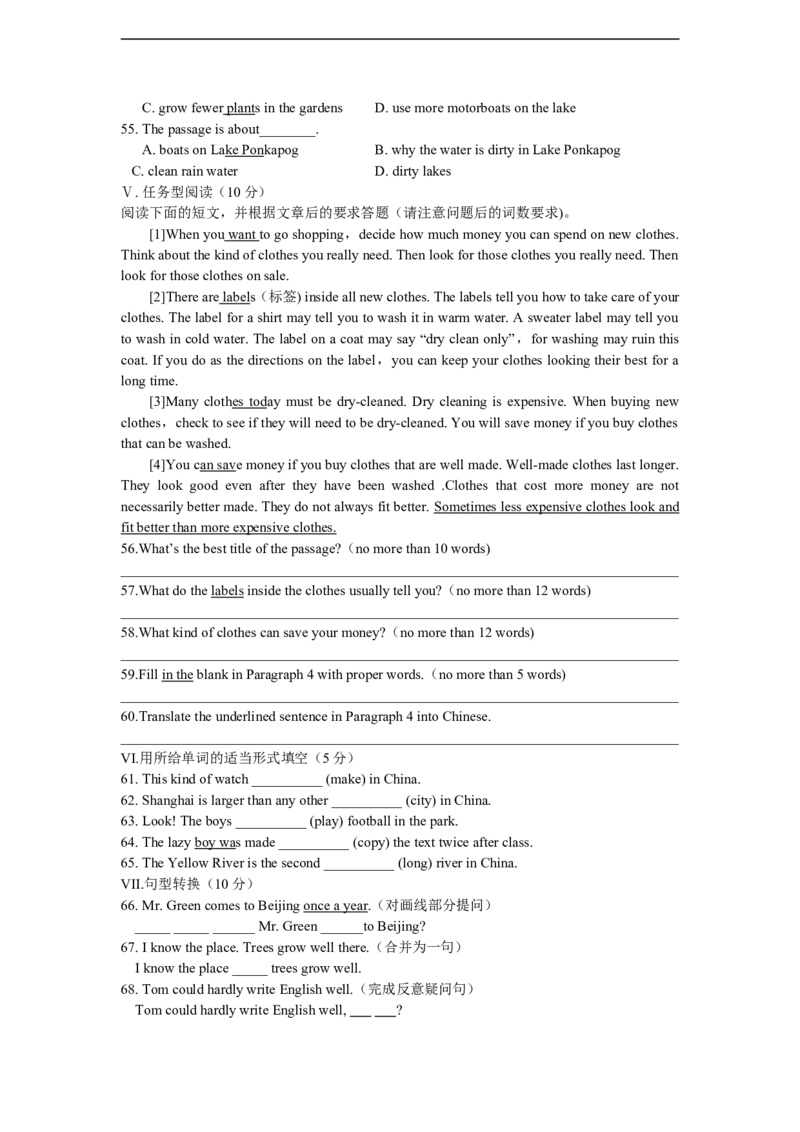
期末检测题
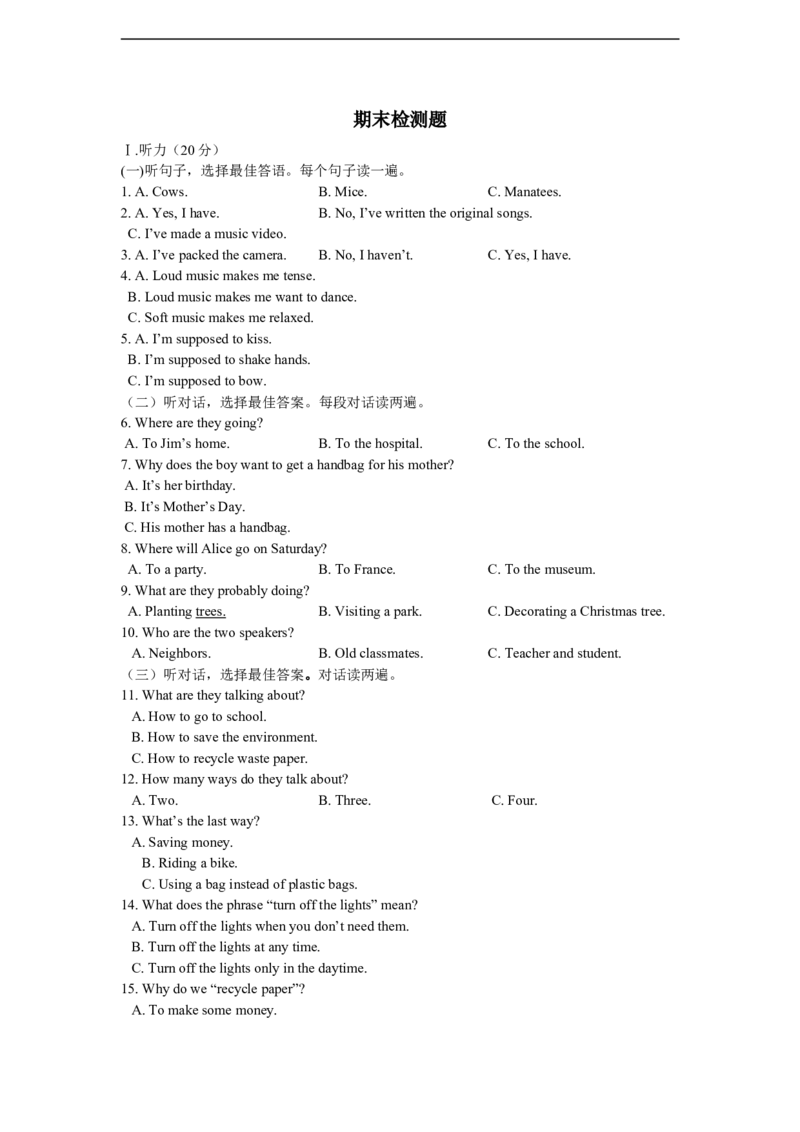
Ⅰ.听力(20 分)
(一)听句子,选择最佳答语。每个句子读一遍。
1. A. Cows.
B. Mice.
C. Manatees.
2. A. Yes, I have.
B. No, I’ve written the original songs.【来源:21·世纪·教育·网】
  C. I’ve made a music video.
3. A. I’ve packed the camera.
B. No, I haven’t.
C. Yes, I have.
4. A. Loud music makes me tense.
  B. Loud music makes me want to dance.
  C. Soft music makes me relaxed.
5. A. I’m supposed to kiss.
  B. I’m supposed to shake hands.
  C. I’m supposed to bow.
(二)听对话,选择最佳答案。每段对话读两遍。
6. Where are they going?
 A. To Jim’s home.
B. To the hospital.
C. To the school.
7. Why does the boy want to get a handbag for his mother?
 A. It’s her birthday.
 B. It’s Mother’s Day.
 C. His mother has a handbag.
8. Where will Alice go on Saturday?
  A. To a party.
B. To France.
C. To the museum.
9. What are they probably doing?
  A. Planting trees.
B. Visiting a park.
C. Decorating a Christmas tree.
10. Who are the two speakers?
   A. Neighbors.
B. Old classmates.
C. Teacher and student.
(三)听对话,选择最佳答案。对话读两遍。
11. What are they talking about?
   A. How to go to school.
   B. How to save the environment.
   C. How to recycle waste paper.
12. How many ways do they talk about?
   A. Two.
B. Three.
 C. Four.
13. What’s the last way?
   A. Saving money.
B. Riding a bike.

C. Using a bag instead of plastic bags.
14. What does the phrase “turn off the lights” mean?
   A. Turn off the lights when you don’t need them.
   B. Turn off the lights at any time.
   C. Turn off the lights only in the daytime.
15. Why do we “recycle paper”?
   A. To make some money.
   B. To save many of the things that paper can be made from.
   C. Not to waste water.
(四)听短文,判断正(T)误(F)。短文读两遍。
16. Only human beings use body language.
17. In the USA, people point to a person’s head if they think someone is clever.
18. A happy dog will look straight at you.
19. Elephants use their trunks to touch each other to show their friendship.
20. When a dolphin is angry, it often jumps into the air.2·1·c·n·j·y
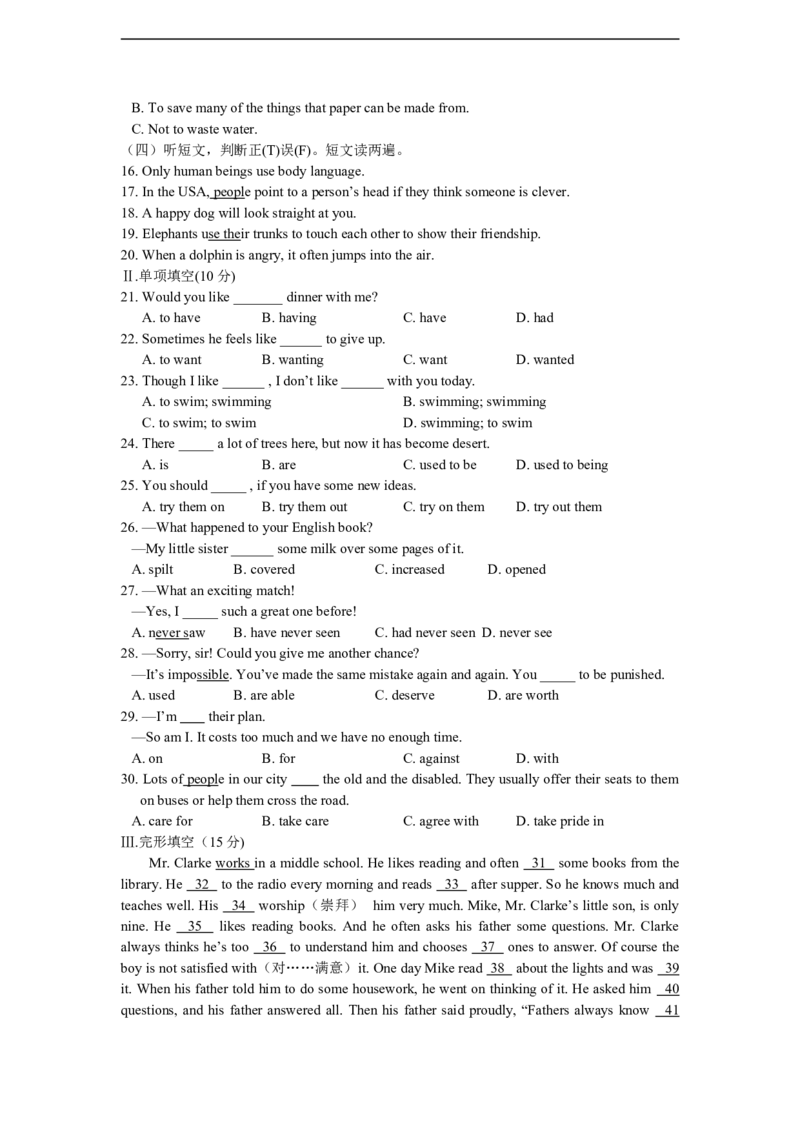
Ⅱ.单项填空(10 分)
21. Would you like _______ dinner with me?
A. to have
B. having
C. have
D. had
22. Sometimes he feels like ______ to give up.
A. to want
B. wanting
C. want
D. wanted
23. Though I like ______ , I don’t like ______ with you today.
A. to swim; swimming
B. swimming; swimming
C. to swim; to swim
D. swimming; to swim
24. There _____ a lot of trees here, but now it has become desert.
A. is
B. are
C. used to be
D. used to being
25. You should _____ , if you have some new ideas.
A. try them on
B. try them out
C. try on them
D. try out them
26. —What happened to your English book?
   —My little sister ______ some milk over some pages of it.
   A. spilt
B. covered
C. increased
D. opened
27. —What an exciting match!
   —Yes, I _____ such a great one before!
   A. never saw
B. have never seen
C. had never seen  D. never see
28. —Sorry, sir! Could you give me another chance?
   —It’s impossible. You’ve made the same mistake again and again. You _____ to be punished.
   A. used
B. are able
C. deserve
D. are worth
29. —I’m         their plan.
   —So am I. It costs too much and we have no enough time.
   A. on
B. for
C. against
D. with
30. Lots of people in our city         the old and the disabled. They usually offer their seats to them
on buses or help them cross the road.
   A. care for
B. take care
C. agree with
D. take pride in
Ⅲ.完形填空(15 分)
Mr. Clarke works in a middle school. He likes reading and often   31   some books from the
library. He   32   to the radio every morning and reads   33   after supper. So he knows much and
teaches well. His   34   worship(崇拜) him very much. Mike, Mr. Clarke’s little son, is only
nine. He   35   likes reading books. And he often asks his father some questions. Mr. Clarke
always thinks he’s too   36   to understand him and chooses   37   ones to answer. Of course the
boy is not satisfied with(对……满意)it. One day Mike read  38   about the lights and was   39
it. When his father told him to do some housework, he went on thinking of it. He asked him   40
questions, and his father answered all. Then his father said proudly, “Fathers always know   41
than sons!”The boy thought for a while and said, “  42  .”His father asked, “Oh? Why?”Mike
didn’t answer, and asked,   43  , “Who invented the lights?”“  44  ”answered Mr. Clarke. “Why
didn’t his father invent them, then?” Looking at his son, Mr. Clarke didn’t know   45  to answer!
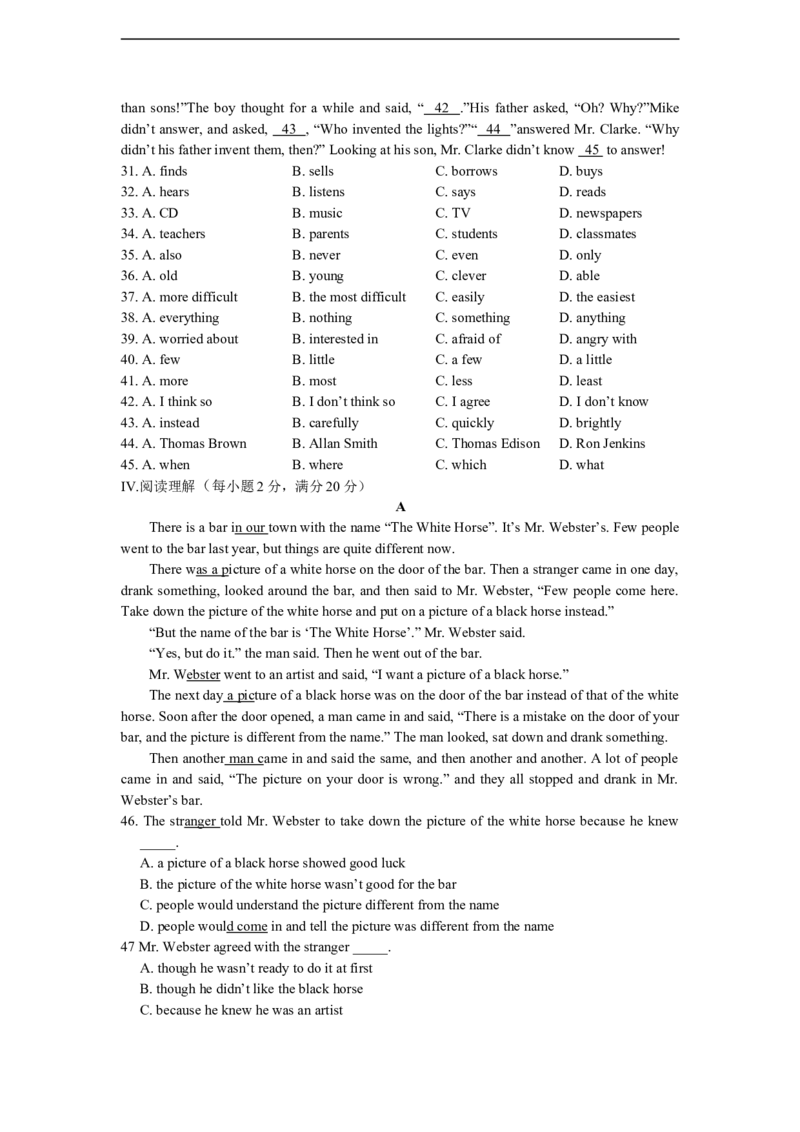
31. A. finds
B. sells
C. borrows
D. buys
32. A. hears
B. listens
C. says
D. reads
33. A. CD
B. music
C. TV
D. newspapers
34. A. teachers
B. parents
C. students
D. classmates
35. A. also
B. never
C. even
D. only
36. A. old
B. young
C. clever
D. able
37. A. more difficult
B. the most difficult
C. easily
D. the easiest
38. A. everything
B. nothing
C. something
D. anything
39. A. worried about
B. interested in
C. afraid of
D. angry with
40. A. few
B. little
C. a few
D. a little
41. A. more
B. most
C. less
D. least
42. A. I think so
B. I don’t think so
C. I agree
D. I don’t know
43. A. instead
B. carefully
C. quickly
D. brightly
44. A. Thomas Brown
B. Allan Smith
C. Thomas Edison
D. Ron Jenkins
45. A. when
B. where
C. which
D. what
IV.阅读理解(每小题2 分,满分20 分)
A
There is a bar in our town with the name “The White Horse”. It’s Mr. Webster’s. Few people
went to the bar last year, but things are quite different now.  21*cnjy*com
There was a picture of a white horse on the door of the bar. Then a stranger came in one day,
drank something, looked around the bar, and then said to Mr. Webster, “Few people come here.
Take down the picture of the white horse and put on a picture of a black horse instead.”
“But the name of the bar is ‘The White Horse’.” Mr. Webster said.
“Yes, but do it.” the man said. Then he went out of the bar.
Mr. Webster went to an artist and said, “I want a picture of a black horse.”
The next day a picture of a black horse was on the door of the bar instead of that of the white
horse. Soon after the door opened, a man came in and said, “There is a mistake on the door of your
bar, and the picture is different from the name.” The man looked, sat down and drank something.
Then another man came in and said the same, and then another and another. A lot of people
came in and said, “The picture on your door is wrong.” and they all stopped and drank in Mr.
Webster’s bar.
46. The stranger told Mr. Webster to take down the picture of the white horse because he knew
_____.
A. a picture of a black horse showed good luck
B. the picture of the white horse wasn’t good for the bar
C. people would understand the picture different from the name
D. people would come in and tell the picture was different from the name
47 Mr. Webster agreed with the stranger _____.
A. though he wasn’t ready to do it at first
B. though he didn’t like the black horse
C. because he knew he was an artist
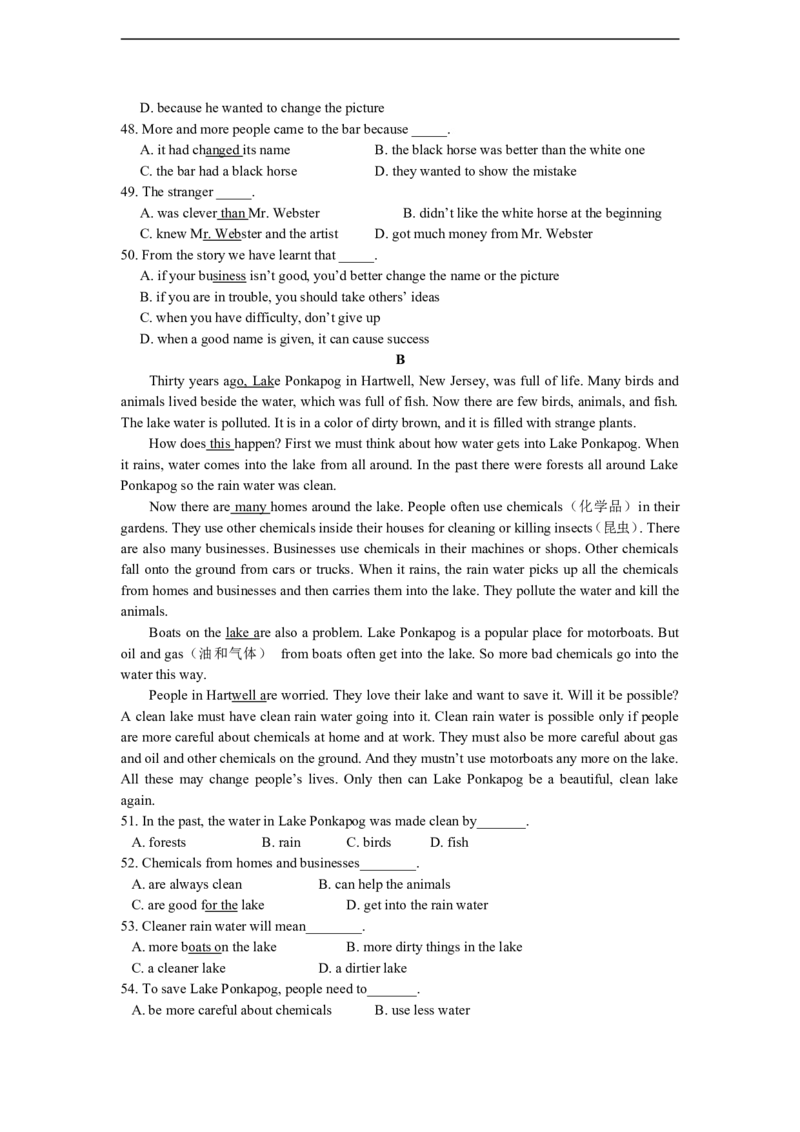
D. because he wanted to change the picture
48. More and more people came to the bar because _____.2-1-c-n-j-y
A. it had changed its name
B. the black horse was better than the white one
C. the bar had a black horse
D. they wanted to show the mistake
49. The stranger _____.
A. was clever than Mr. Webster
B. didn’t like the white horse at the beginning
C. knew Mr. Webster and the artist
D. got much money from Mr. Webster
50. From the story we have learnt that _____.
A. if your business isn’t good, you’d better change the name or the picture
B. if you are in trouble, you should take others’ ideas
C. when you have difficulty, don’t give up
D. when a good name is given, it can cause success
B
Thirty years ago, Lake Ponkapog in Hartwell, New Jersey, was full of life. Many birds and
animals lived beside the water, which was full of fish. Now there are few birds, animals, and fish.
The lake water is polluted. It is in a color of dirty brown, and it is filled with strange plants.
How does this happen? First we must think about how water gets into Lake Ponkapog. When
it rains, water comes into the lake from all around. In the past there were forests all around Lake
Ponkapog so the rain water was clean.
Now there are many homes around the lake. People often use chemicals(化学品)in their
gardens. They use other chemicals inside their houses for cleaning or killing insects(昆虫). There
are also many businesses. Businesses use chemicals in their machines or shops. Other chemicals
fall onto the ground from cars or trucks. When it rains, the rain water picks up all the chemicals
from homes and businesses and then carries them into the lake. They pollute the water and kill the
animals.
Boats on the lake are also a problem. Lake Ponkapog is a popular place for motorboats. But
oil and gas(油和气体) from boats often get into the lake. So more bad chemicals go into the
water this way.
People in Hartwell are worried. They love their lake and want to save it. Will it be possible?
A clean lake must have clean rain water going into it. Clean rain water is possible only if people
are more careful about chemicals at home and at work. They must also be more careful about gas
and oil and other chemicals on the ground. And they mustn’t use motorboats any more on the lake.
All these may change people’s lives. Only then can Lake Ponkapog be a beautiful, clean lake
again.
51. In the past, the water in Lake Ponkapog was made clean by_______.
   A. forests
B. rain          C. birds           D. fish
52. Chemicals from homes and businesses________.
   A. are always clean                   B. can help the animals
   C. are good for the lake
D. get into the rain water
53. Cleaner rain water will mean________.
   A. more boats on the lake
B. more dirty things in the lake
   C. a cleaner lake
D. a dirtier lake21*cnjy*com
54. To save Lake Ponkapog, people need to_______.
   A. be more careful about chemicals
B. use less water
C. grow fewer plants in the gardens        D. use more motorboats on the lake
55. The passage is about________.
A. boats on Lake Ponkapog

B. why the water is dirty in Lake Ponkapog
   C. clean rain water
D. dirty lakes
Ⅴ. 任务型阅读(10 分)
阅读下面的短文,并根据文章后的要求答题(请注意问题后的词数要求)。
[1]When you want to go shopping,decide how much money you can spend on new clothes.
Think about the kind of clothes you really need. Then look for those clothes you really need. Then
look for those clothes on sale.
[2]There are labels (标签) inside all new clothes. The labels tell you how to take care of your
clothes. The label for a shirt may tell you to wash it in warm water. A sweater label may tell you
to wash in cold water. The label on a coat may say “dry clean only”,for washing may ruin this
coat. If you do as the directions on the label,you can keep your clothes looking their best for a
long time.【来源:21cnj*y.co*m】
[3]Many clothes today must be dry-cleaned. Dry cleaning is expensive. When buying new
clothes,check to see if they will need to be dry-cleaned. You will save money if you buy clothes
that can be washed.
[4]You can save money if you buy clothes that are well made. Well-made clothes last longer.
They look good even after they have been washed .Clothes that cost more money are not
necessarily better made. They do not always fit better. Sometimes less expensive clothes look and
fit better than more expensive clothes.
56.What’s the best title of the passage?(no more than 10 words)
_______________________________________________________________________________
57.What do the labels inside the clothes usually tell you?(no more than 12 words)
_______________________________________________________________________________
58.What kind of clothes can save your money?(no more than 12 words)
_______________________________________________________________________________
59.Fill in the blank in Paragraph 4 with proper words.(no more than 5 words)
_______________________________________________________________________________
60.Translate the underlined sentence in Paragraph 4 into Chinese.
_______________________________________________________________________________
VI.用所给单词的适当形式填空(5 分)
61. This kind of watch __________ (make) in China.
62. Shanghai is larger than any other __________ (city) in China.
63. Look! The boys __________ (play) football in the park.
64. The lazy boy was made __________ (copy) the text twice after class.
65. The Yellow River is the second __________ (long) river in China.www.21-cn-jy.com
VII.句型转换(10 分)
66. Mr. Green comes to Beijing once a year.(对画线部分提问)

_____ _____ ______ Mr. Green ______to Beijing?
67. I know the place. Trees grow well there.(合并为一句)

I know the place _____ trees grow well.
68. Tom could hardly write English well.(完成反意疑问句)

Tom could hardly write English well,              ?
69. He found it hard to learn English well.(改为同义句)

______ _____hard for him _____ _____English well.
70. The children are taken good care of.(改为同义句)
The children are well        _______.
Ⅷ.补全对话(10 分)
根据对话内容,从方框内所给的选项中选出最佳选项。选项中有两项为多余项。
[A middle school student and her mother are visiting the security education show(安全教育展).]
M:Come on,darling,so many pictures here!
S:

 71

M:Traffic safety.
S:Sounds boring.
M:

 72

S:Maybe.Oh!Mum,look at this picture;a boy is hit by a car when he is running across the road.
73


 www-2-1-cnjy-com


M:So it is!
S:

 74


 That helps us stay safe from danger.
M:Yes,better safe than sorry.Let’s go to another hall to learn more about how to protect ourselves.
S:

 75


  Let’s go.
A.Good idea.
B.How terrible!
C.It’s my pleasure.
D.What are they about?
E.What do you think of them?
F.But it has meaning to everyone.
G.I think we are supposed to follow traffic rules.21 世纪教育网版权所有
71.

 72.

 73.

 74.

 75.
Ⅸ.书面表达(20 分)
请以“Why should we protect wild animals?”为题,用英语写一篇短文,说明为什么要保
护野生动物。词数80 以上。21·世纪*教育网
要点提示:1.为什么有些野生动物处于危险之中;
          2.为什么保护野生动物很重要;
          3.我们应该采取什么措施来保护野生动物。
Why should we protect wild animals?
_______________________________________________________________________________
_______________________________________________________________________________
_______________________________________________________________________________
_______________________________________________________________________________
_______________________________________________________________________________
_______________________________________________________________________________
_______________________________________________________________________________
_______________________________________________________________________________
期末检测题
听力原文及参考答案
Ⅰ.听力
(一)听句子,选择最佳答语。每个句子读一遍。
1. What animals are we trying to save?
2. Have you ever written an original song?
3. What have you done?
4. Why do you like soft music?
5. In China, what are you supposed to do when you meet someone for the first time?
(二)听对话,选择最佳答案。每段对话读两遍。
6. W: Why are you in such a hurry, Mike?
   M: Jim had an accident. He’s in hospital. I’m going to see him.21 教育网
   W: Sorry to hear that. Let’s go together.
7. W: What can I do for you?
M: I’m looking for a handbag for my mother.
W: Is it for her birthday?
M: No, for Mother’s Day.
8. M: Do you have any plans for this weekend, Alice?【出处:21 教育名师】
   W: Yes. I’ll go to a party on Friday evening. Then on Saturday I’m going to the museum with
Jean. There are many famous French paintings on show.
M: Enjoy your weekend.
9. M: Hey, Lucy. Let me help you.
   W: Well, thank you, Tony. Please tie the young trees to the sticks.
   M: OK. I’ll water them later.
10. M: Hi, Linda, nice to see you.
   W: Nice to see you, too.
   M: Well, we haven’t seen each other since we graduated in 1998. How’s everything?
   W: Pretty good. I’m a teacher now. I’m happy to be with my students.
(三)听对话,选择最佳答案。对话读两遍。
M: Hi, Tina! Would you like to help save the environment?
W: Yes, but what can I do?
M: Well, first, you can start by turning off the lights.
W: Yes. That’s easy. Sometimes I turn on the lights without thinking. What’s next?
M: Second, you can ride a bike or go on foot. Don’t take a bus or a taxi if you don’t have to.
W: That will save money, too. What else?
M: Try to recycle paper.
W: Mm, newspapers, magazines…We get a lot of paper at home. Good idea.
M: And at last, take a bag when you go shopping. Don’t use plastic bags.
W: OK. My parents do most of the shopping. I’ll tell them.
(四)听短文,判断正(T)误(F)。短文读两遍。
We use body language in all our daily communications. When we talk with each other, we
use body language. For example, in the USA, people point to a person’s head when they think
someone is clever. However, human beings are not the only animals who use body language.
Animals also use body language and facial expressions to tell each other how they feel and what
they think.
When a dog is happy, its ears stand up and its eyes are wide open. When it is angry, it will
look straight at you. If an elephant spreads its ears, it means “Watch out!”. To show friendship,
elephants will touch each other with their trunks. Dolphins live in groups and like to show each
other their feelings. An angry dolphin will sometimes slap its tail on the water. A happy dolphin
will play with its friends, and jump into the air. Not only humans but also animals use body
language to communicate, but the things they “say” to each other are different.
1~5 CAACB
6~10 BBCAB   11~15 BCCAB   16~20 FTFTF
II.21.A
Would you like to do sth.?意为“你愿意做某事吗?”,用于征求对方意见。
22.B
feel like 后加v.-ing 形式。句意:有时他感觉想要放弃。
23.D
like+v.-ing

 表示

 “喜欢做某事(习惯性爱好)”。like+to do sth.意为“喜欢做某事
(特定时间的具体活动)”。
24.C
used to do 意为“过去常常”。句意:过去这儿有许多树,但是现在它变成了荒漠。
25.B
try out“尝试,试用,试验”,由ideas 可知应选them,代词放在短语try out 中间,故
选B 项。
26.A
spill 洒出,溢出,cover 覆盖,increase 增加,open 打开。
27.B
由before 知用现在完成时。
28.C
deserve“理应,应受”。deserve to be punished 意为“理应受到惩罚”。
29.C
on 在……上面,for 为了,against.“反对,与……相反,违反”,with 与……一起。
30.A
care for 照顾;take care 当心;agree with 同意;take pride in 以……为骄傲。
III.31.C  find 意为“发现;找到”;sell 意为“卖;出售”;borrow 意为“借;借用”,常用于
borrow sth. from…中,意为“从……借某物”;buy 意为“买”。由上文中的He likes
reading(他喜欢读书)可知,他经常从图书馆借一些书。故选C。21·cn·jy·com
32.B  hear  意为“听到

 ;听见”,为及物动词,强调听到的结果;listen 意为“听”,为不及物
动词,强调听的动作,后跟宾语时加介词to;say 意为“说”,强调说话的内容;read 意为
“读”。由常理可知,应是“听”收音机,由空格后已有介词to,且强调的是听的动作可
知选B。
33.D  CD 意为“光盘”;

 mu
  sic 意为“音乐”;TV 意为“电视”;newspapers 意为“报纸”。
空格处作动词read(读)的宾语,应选newspapers(报纸),故选D。
34.C  由上一句

  So h

 e knows much and teaches well.(因此他知识渊博,讲课讲得很好。)可知,
他的学生很崇拜他,而不是他的老师、家长或同学崇拜他。故选C。
35.A  also 意为“也”,用于肯定句,一般位于句中;never 意为“从不”,是表示否定的频率
副词;even 意为“甚至;连;愈加”;only 意为“只有;仅仅”;由上文He likes reading…
(他喜欢读书……)以及下文迈克读书时爸爸让他去干活的场景可知,克拉克的小儿子也
喜欢读书。故选A。21 教育名师原创作品
36.B  old 意为“老的”;
  young

  意为“年轻的;幼小的”;clever 意为“聪明的”;able 意为
“能够”。由上文Mike, Mr. Clarke’s little son, is only nine. 以及And he often asks his
father some questions. 可知,克拉克先生总是认为他儿子年龄太小了而不能理解他的问题。
其中too… to… 结构意为“太……而不能……”。故选B。
37.D  more difficult

  意为

 “较难的”;the most difficult 意为“最难的”;easily 意为“容易
地”;the easiest 意为“最容易的”;由上半句…he’s too young to understand him(迈克年
龄太小了而不能理解他的问题)可知,克拉克选择最容易的问题回答。故选D。
38.C  everything 意为“一切;所有事物”;nothing 意为“没有什么;没有一件东西”;
something 意为“某事;某物”,常用于肯定句中;anything 意为“任何东西;任何事物”,
常用于否定句或疑问句。由One day Mike read     38
       about the lights…(一天,迈克读了关
于电灯的一些知识……)可知,此处应该用something,表示“一些知识”。故选C。
39.B  be worried about 意为“担心……”;be interested in 意为“对……感兴趣”;be afraid of
意为“害怕……”;be angry with 意为“生……气”。由上文他读了关于电灯的一些知识
并在下文问了父亲相关的问题可推知,他对它很感兴趣,故选B。【版权所有:21 教育】
40.C  few
  意为“不

 多;很少”,表否定的含义,修饰可数名词复数;little 意为“很少”,表否
定的含义,修饰不可数名词;a few 意为“一些;几个”,表肯定的含义,修饰可数名词复
数;a little 意为“一些”,表肯定的含义,修饰不可数名词。由questions 以及and his father
answered all(并且他的父亲回答了所有的问题)可知,此处所选词修饰可数名词复数形式
且表达肯定含义,应选a few,故选C。
41.A  more
   意为“

 更多”;most 意为“最多”;less 意为“更少”;least 意为“最少”。由上
文Then his father said proudly(然后他父亲骄傲地说)以及关键词than(比)可知,此处应
选比较级more“更多”,此句意为“父亲总是比儿子知道的多!”。故选A。
42.B  I think so

 意为

 “我想是这样”;I don’t think so 意为“我不这样认为”;I agree 意为
“我同意”;I don’t know 意为“我不知道”;由下文His father asked, “Oh? Why?” (他父
亲问道:“哦?为什么?”)可知,儿子不同意父亲的观点,故选B。
43.A  instead 意为“代替;反而;却”;carefully 意为“细致地;小心地;谨慎地”;quickly 意
为 “很快地”;brightly 意为“明亮地;光线充足地”。由句子Mike didn’t answer, and
asked,
     4
  3      , “Who invented the lights?”(迈克没有回答,________,问道:“是谁发明了电灯?”)
可知,此处instead(代替;反而;却)符合语境。故选A。
44.C  本题考查常识。众所周知,电灯是由Thomas Edison(托马斯·爱迪生)发明的。故选C。
45.D  when 意为“什么时候;何时”;where 意为“哪里”;which 意为“哪一个”;what 意
为“什么”。最后一句的动词answer(回答)是一个及物动词,所选词作它的宾语,因此应
选what(什么),此句意为“看着他的儿子,克拉克先生不知道回答什么了!”。
IV.46.D
通读全文可知,陌生人知道人们会来(酒吧)说这幅画和酒吧的名字不一样。
47.A
一开始Mr. Webster 没有准备这样做,但他还是同意了陌生人的意见。
48.D
由文章倒数第一、二段可知。
49.A
通读全文可知,这个陌生人要比Mr. Webster 聪明,因为他想出了一个吸引顾客的
方法。
50.B
通过这个故事可知,当我们身陷困难时,应该采纳别人的建议。
51.A
由第二段最后一句

 I n the past there were forests all around Lake Ponkapog so the rain
water was clean.可知。
52.D
由第三段倒数第二句

  Wh
  en it rains, the rain water picks up all the chemicals from
homes and businesses and then carries them into the lake.可知。
53.C
由最后一段第四句

  A cl
  ean lake must have clean rain water going into it.可知。
54.A
由最后一段第五句
   Clean

  rain water is possible only if people are more careful about
chemicals at home and at work.可知。
55.B
通读全文可知,本文分析了Lake Ponkapog 湖水变脏的原因。
V. 56.How to be a clever clothes shopper/Tips for being a clever clothes shopper/Advice on
buying clothes wisely
阅读全文可知,本文为购买衣服提出了一些建议,如查看衣服的标签说明,尽量不买需要干
洗的衣服,购买物美价廉的衣服等。文章是围绕如何成为一个明智的购物者及明智地购买衣
服的建议这一主旨展开的。
57.They usually

   t ell us how to take care of the clothes/how to keep the clothes looking
their best.由文中第二段的The labels tell you how to take care of your clothes.及If you
do as the directions on the label,you can keep your clothes looking their best for a long
time.可知,这些标签告诉我们如何保养衣服,或使衣服长时间看起来最好。
58.Clothes that are well made and (clothes) that can be washed.
由文中第三段最后一句

  Yo
  u will save money if you buy clothes that can be washed.及第
四段第一句You can save money if you buy clothes that are well made.可知,能够手洗及
做工好的衣服可以省钱。21cnjy.com
59.a lot of/many/several times
由上句Well-made

   clothes last longer.(做工好的衣服耐穿。)可推知,下句意为“甚至被洗过
很多次,它们仍然看起来很好”。time 作“次数”讲时为可数名词,故用复数形式times。
60.有时候不太贵的衣服比昂贵的衣服更好看、更合体。
less expensive

   c  lothes 意为“便宜一些的衣服”,其反义短语为more expensive clothes,意
为“更贵的衣服”。better than 为比较级结构,意为“比……更好”。
VI.61. is made
62. city
63. are playing
64. to copy
65. longest
VII.66. How often does, come
67. where
68. could he
69. It was, to learn
70. cared for/looked after
Ⅷ.71.D 由下句Traffic safety.(交通安全。)可知,此处询问图片的主题,故用D 项What are
they about?(它们是关于什么的?)。
72.F
由常识可知,交通安全对每个人都有意义。由上句“听起来很无聊。”可知此处应
填F 项“但是它对每个人都有意义”。
73.B
由上句“妈妈,看这张图片,一个小男孩跑过马路时被一辆车撞了。”可知本句用
“How terrible!”(太可怕了!)表示感慨。

74.G
由下句“那让我们远离危险、保持安全。”可知,应选G 项“我认为我们应该遵守
交通规则”。
75.A
由下句Let’s go.(我们去吧。)可知,此处用Good idea.(好主意。)表示同意对方的建
议。
Ⅸ.One possible version:
Why should we protect wild animals?
Have you heard of any endangered animals? Why are they in danger?
There are lots of endangered animals in the world, such as tigers and pandas. When farmers
cut down trees, tigers can no longer hide themselves and hunt. Many tigers are killed by people
who want to sell their fur for money, and there are few places where pandas can live nowadays,
too.
We are not alone in the world. We human beings could not live without all the plants and
animals. It’s important to protect wildlife since we have only one earth. We must take measures to
keep plants from being destroyed and stop animals from being killed. If each of us can plant a tree
and build a birdhouse, the world will be more beautiful. It is very easy but useful.