绝密★考试结束前
2026 年高考第二次模拟考试
英语
(考试时间:120 分钟 试卷满分:150 分)
注意事项:
1.本试卷分第Ⅰ卷(选择题)和第Ⅱ卷(非选择题)两部分。答卷前,考生务必将自己的姓名、准
考证号填写在答题卡上。
2.回答第Ⅰ卷时,选出每小题答案后,用2B 铅笔把答题卡上对应题目的答案标号涂黑。如需改动,
用橡皮擦干净后,再选涂其他答案标号。写在本试卷上无效。
3.回答第Ⅱ卷时,将答案写在答题卡上。写在本试卷上无效。
4.考试结束后,将本试卷和答题卡一并交回。
第一部分 听力(共两节,满分 30 分)
做题时,请先将答案标在试卷上。录音内容结束后,你将有两分钟的时间将试卷上的答案转涂到答
题卡上。
第一节(共5 小题;每小题1.5 分,满分7.5 分)
听下面5 段对话。每段对话后有一个小题,从题中所给的A、B、C 三个选项中选出最佳选项。听完每段
对话后,你都有10 秒钟的时间来回答有关小题和阅读下一小题。每段对话读两遍。
1.What book has the woman bought?
A.A music book.
B.A history book.
C.An English book.
【答案】C
【原文】M: Have you bought your books yet?
W: I got my English book, but the maths and history books were sold out. And I don’t have a book for my music
course.
2.What problem does the woman come across?
A.She has no enough money.
B.There is no bread available.
C.She is not sure what to order.
【答案】B
【原文】W: I think I’ll have some bread, please. I also want to order two sandwiches for my husband and son.
M: I’m sorry, madam. I’m afraid there isn’t any bread left.
3.What will the woman probably do next?
A.Arrange the party.
B.Order flowers online.
C.Help Robert buy snacks.
【答案】B
【原文】M: I’m having a party tonight. Robert will buy some snacks and drinks. And I need something different.
W: How about flowers? I can book some online.
M: Good idea.
4.Who is the woman speaking to?
A.A policeman.
B.A housekeeper.
C.A thief.
【答案】A
【原文】M: Can I help you, madam?
W: Yes, I want to report a theft that happened to my house during our absence. My husband and I went on a
holiday last week.
M: I see. What is missing?
5.What is the probable relationship between the speakers?
A.Doctor and patient.
B.Teacher and student.
C.Waiter and customer.
【答案】A
【原文】M: I have to go to the toilet quite frequently.
W: Well, it sounds as if you’ve picked up a stomach infection. Let me check your temperature and blood pressure.
第二节(共15 小题;每小题1.5 分,满分22.5 分)
听下面 5 段对话或独白。每段对话或独白后有几个小题,从题中所给的A、B、C 三个选项中选出最佳
选项,并标在试卷的相应位置。听每段对话或独白前,你将有时间阅读各个小题,每小题 5 秒钟;听完
后,各小题将给出 5 秒钟的作答时间。每段对话或独白读两遍。
听下面一段对话,回答以下小题。
6.What is Lisa doing recently?
A.Making nice meals.
B.Writing school papers.
C.Studying for final exams.
7.What does the man suggest Lisa do?
A.Redo work the next day.
B.Switch to healthier meals.
C.Create a balanced study plan.
【答案】6.B 7.C
【原文】M: Lisa, you’re skipping meals, and haven’t stepped outside in days. That’s really unhealthy.
W: But I have no choices! Three final papers are due next week and I’m way behind schedule.
M: That’s exactly why you need better planning. Pushing yourself nonstop will backfire. Your brain needs rest to
work efficiently. So make a schedule with proper breaks, meal times and short walks. Remember, all-nighters
usually mean doing work tomorrow.
W: OK. I’ll do my best.
听下面一段对话,回答以下小题。
8.Where does the conversation take place?
A.In a hospital.
B.In a hotel.
C.In a cinema.
9.What is the man going to do?
A.Change the sheets.
B.Have breakfast.
C.Meet his friends.
10.What does the man ask the woman to do in the end?
A.Take the plate away.
B.Bring some towels.
C.Turn on the light.
【答案】8.B 9.C 10.A
【原文】W: May I come in, sir?
M: Yes, thanks for coming so quickly.
W: Certainly, sir. How can I help you?
M: I’d like some fresh towels in the bathroom.
W: I’ll get them immediately. Would you like me to change the sheets?
M: Excellent. Oh, by the way, I can never find the light switch when I get back in the evening.
W: I’ll make sure to leave the lamp on after I finish cleaning up.
M: That’s good to hear. Well, it’s time for me to see my friends.
W: Enjoy your day, sir.
M: Oh, I will. Just a second, could you also take out the plate with this morning’s breakfast?
W: Yes, sir. I’ll take it with me when I finish tidying up.
听下面一段对话,回答以下小题。
11.Why does the man refuse Emma’s request for adopting a pet at first?
A.It’s too expensive.
B.It may affect her health.
C.It requires much responsibility.
12.What will Emma do if she adopts a pet?
A.Buy fewer toys.
B.Have more money.
C.Read more reports.
13.How will the speakers probably adopt a pet?
A.By making a call.
B.By searching online.
C.By visiting the shelter.
【答案】11.C 12.A 13.C
【原文】M: Emma, what’s up?
W: I just read this heartbreaking report about abandoned animals. Look, they are so cute but look so helpless. I
was thinking, could we adopt a little pet?
M: It’s not a good idea. Adopting a pet isn’t like buying a toy. You need to feed it and give it proper medical care.
And a messy home will definitely make Mom angry.
W: I’ll take care of it every day, I promise. Please, let’s adopt it.
M: And you have to budget for food and toys, which means you’ll have less pocket money.
W: That’s not a big deal at all.
M: Okay. Just promise not to cry when it chews up your favorite toy. Where can we adopt one?
W: There is a telephone number and a website below the report.
M: It’s better to go to the local shelter in person. That way you can choose the one you feel most connected with.
听下面一段对话,回答以下小题。
14.What does the man do?
A.A doctor.
B.An astronaut.
C.An interviewer.
15.What impressed Tim most on the International Space Station?
A.The space walking.
B.The weightless environment.
C.The unnoticeable moving speed.
16.Why did Tim have to exercise on the International Space Station?
A.To adjust to the environment.
B.To have fun with teammates.
C.To get ready for returning to the earth.
17.How long did it take Tim to fully recover?
A.About 2 days.
B.About 2 months.
C.About half a year.
【答案】14.B 15.C 16.C 17.B
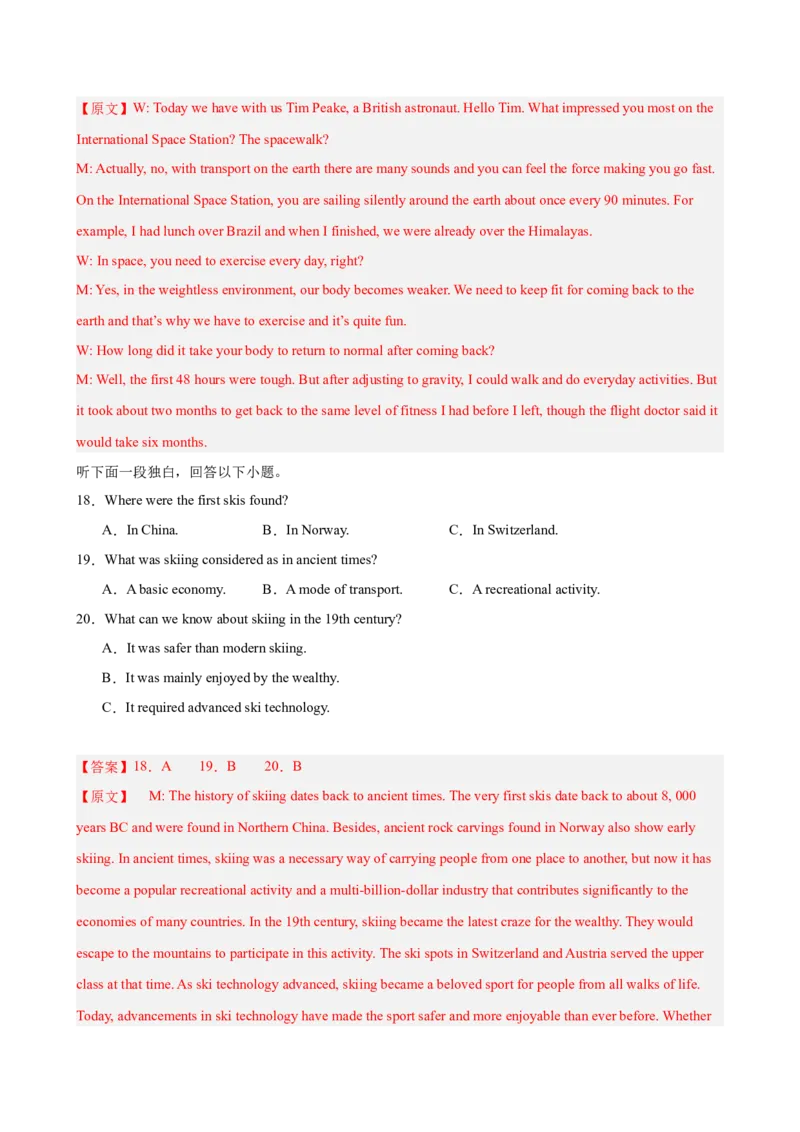
【原文】W: Today we have with us Tim Peake, a British astronaut. Hello Tim. What impressed you most on the
International Space Station? The spacewalk?
M: Actually, no, with transport on the earth there are many sounds and you can feel the force making you go fast.
On the International Space Station, you are sailing silently around the earth about once every 90 minutes. For
example, I had lunch over Brazil and when I finished, we were already over the Himalayas.
W: In space, you need to exercise every day, right?
M: Yes, in the weightless environment, our body becomes weaker. We need to keep fit for coming back to the
earth and that’s why we have to exercise and it’s quite fun.
W: How long did it take your body to return to normal after coming back?
M: Well, the first 48 hours were tough. But after adjusting to gravity, I could walk and do everyday activities. But
it took about two months to get back to the same level of fitness I had before I left, though the flight doctor said it
would take six months.
听下面一段独白,回答以下小题。
18.Where were the first skis found?
A.In China.
B.In Norway.
C.In Switzerland.
19.What was skiing considered as in ancient times?
A.A basic economy.
B.A mode of transport.
C.A recreational activity.
20.What can we know about skiing in the 19th century?
A.It was safer than modern skiing.
B.It was mainly enjoyed by the wealthy.
C.It required advanced ski technology.
【答案】18.A 19.B 20.B
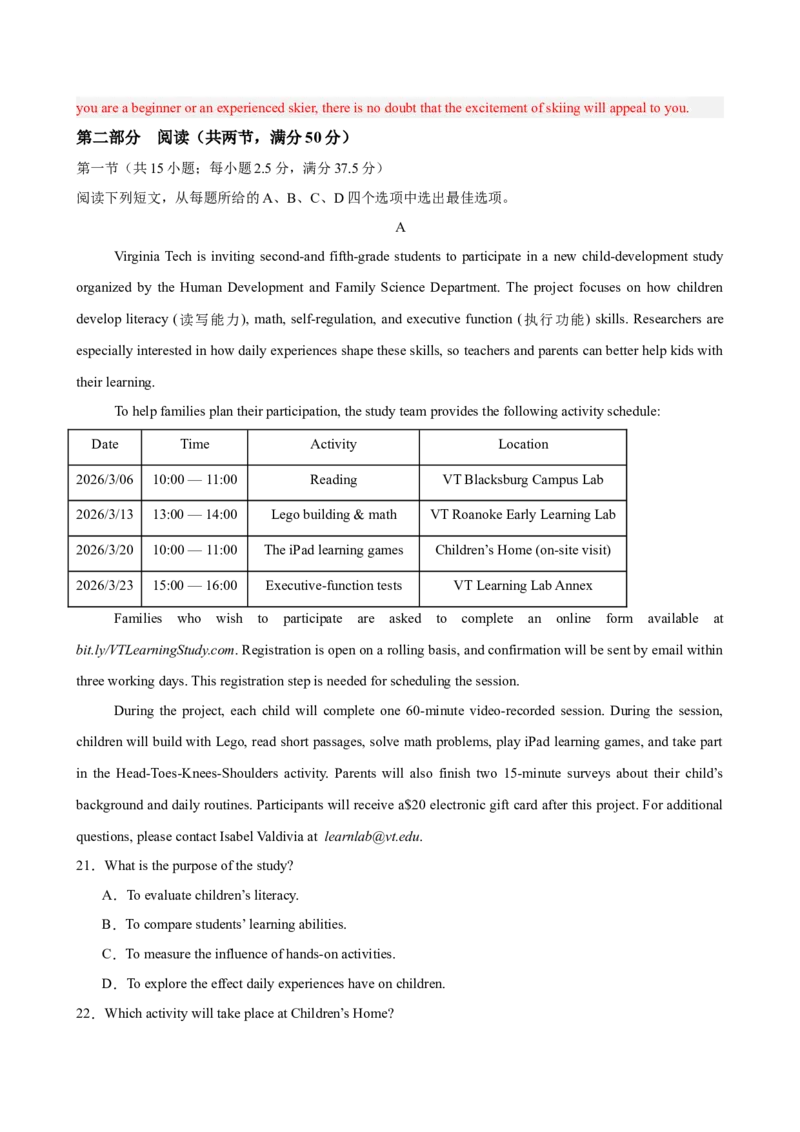
【原文】 M: The history of skiing dates back to ancient times. The very first skis date back to about 8, 000
years BC and were found in Northern China. Besides, ancient rock carvings found in Norway also show early
skiing. In ancient times, skiing was a necessary way of carrying people from one place to another, but now it has
become a popular recreational activity and a multi-billion-dollar industry that contributes significantly to the
economies of many countries. In the 19th century, skiing became the latest craze for the wealthy. They would
escape to the mountains to participate in this activity. The ski spots in Switzerland and Austria served the upper
class at that time. As ski technology advanced, skiing became a beloved sport for people from all walks of life.
Today, advancements in ski technology have made the sport safer and more enjoyable than ever before. Whether
you are a beginner or an experienced skier, there is no doubt that the excitement of skiing will appeal to you.
第二部分 阅读(共两节,满分50 分)
第一节(共15 小题;每小题2.5 分,满分37.5 分)
阅读下列短文,从每题所给的A、B、C、D 四个选项中选出最佳选项。
A
Virginia Tech is inviting second-and fifth-grade students to participate in a new child-development study
organized by the Human Development and Family Science Department. The project focuses on how children
develop literacy (读写能力), math, self-regulation, and executive function (执行功能) skills. Researchers are
especially interested in how daily experiences shape these skills, so teachers and parents can better help kids with
their learning.
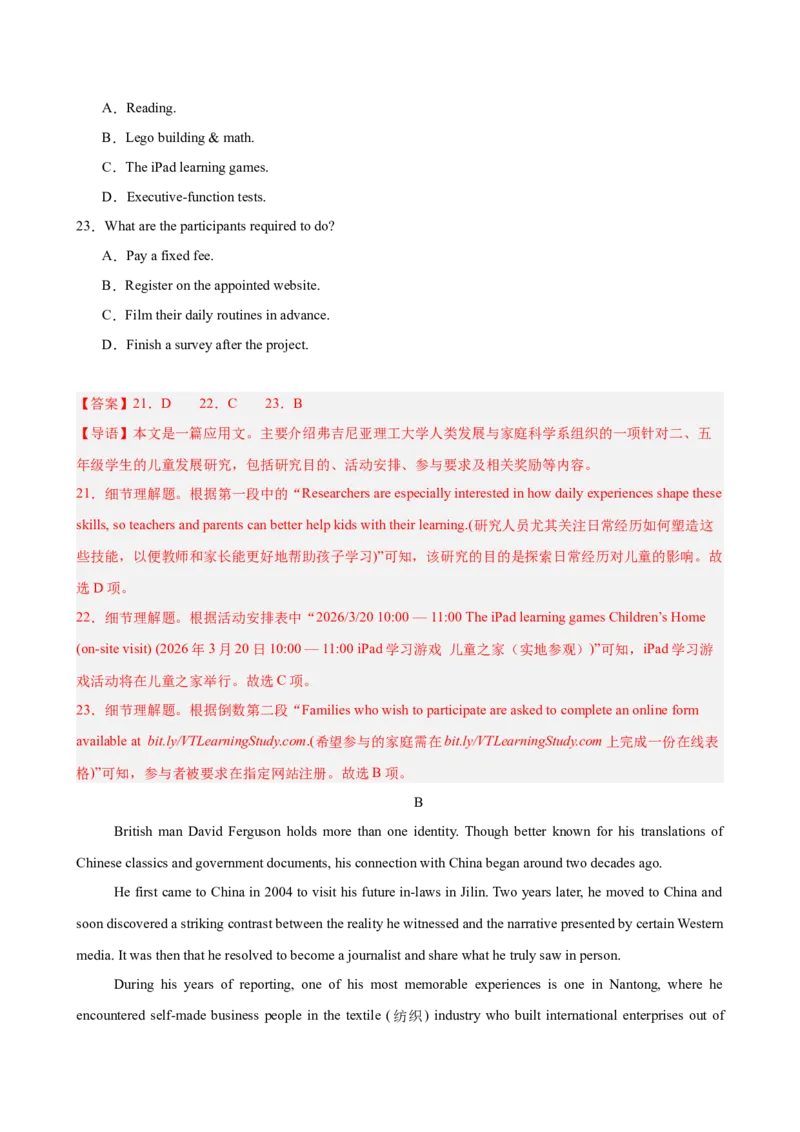
To help families plan their participation, the study team provides the following activity schedule:
Date
Time
Activity
Location
2026/3/06
10:00 — 11:00
Reading
VT Blacksburg Campus Lab
2026/3/13
13:00 — 14:00
Lego building & math
VT Roanoke Early Learning Lab
2026/3/20
10:00 — 11:00
The iPad learning games
Children’s Home (on-site visit)
2026/3/23
15:00 — 16:00
Executive-function tests
VT Learning Lab Annex
Families who wish to participate are asked to complete an online form available at
bit.ly/VTLearningStudy.com. Registration is open on a rolling basis, and confirmation will be sent by email within
three working days. This registration step is needed for scheduling the session.
During the project, each child will complete one 60-minute video-recorded session. During the session,
children will build with Lego, read short passages, solve math problems, play iPad learning games, and take part
in the Head-Toes-Knees-Shoulders activity. Parents will also finish two 15-minute surveys about their child’s
background and daily routines. Participants will receive a$20 electronic gift card after this project. For additional
questions, please contact Isabel Valdivia at learnlab@vt.edu.
21.What is the purpose of the study?
A.To evaluate children’s literacy.
B.To compare students’ learning abilities.
C.To measure the influence of hands-on activities.
D.To explore the effect daily experiences have on children.
22.Which activity will take place at Children’s Home?
A.Reading.
B.Lego building & math.
C.The iPad learning games.
D.Executive-function tests.
23.What are the participants required to do?
A.Pay a fixed fee.
B.Register on the appointed website.
C.Film their daily routines in advance.
D.Finish a survey after the project.
【答案】21.D 22.C 23.B
【导语】本文是一篇应用文。主要介绍弗吉尼亚理工大学人类发展与家庭科学系组织的一项针对二、五
年级学生的儿童发展研究,包括研究目的、活动安排、参与要求及相关奖励等内容。
21.细节理解题。根据第一段中的“Researchers are especially interested in how daily experiences shape these
skills, so teachers and parents can better help kids with their learning.(研究人员尤其关注日常经历如何塑造这
些技能,以便教师和家长能更好地帮助孩子学习)”可知,该研究的目的是探索日常经历对儿童的影响。故
选D 项。
22.细节理解题。根据活动安排表中“2026/3/20 10:00 — 11:00 The iPad learning games Children’s Home
(on-site visit) (2026 年3 月20 日10:00 — 11:00 iPad 学习游戏 儿童之家(实地参观))”可知,iPad 学习游
戏活动将在儿童之家举行。故选C 项。
23.细节理解题。根据倒数第二段“Families who wish to participate are asked to complete an online form
available at bit.ly/VTLearningStudy.com.(希望参与的家庭需在bit.ly/VTLearningStudy.com 上完成一份在线表
格)”可知,参与者被要求在指定网站注册。故选B 项。
B
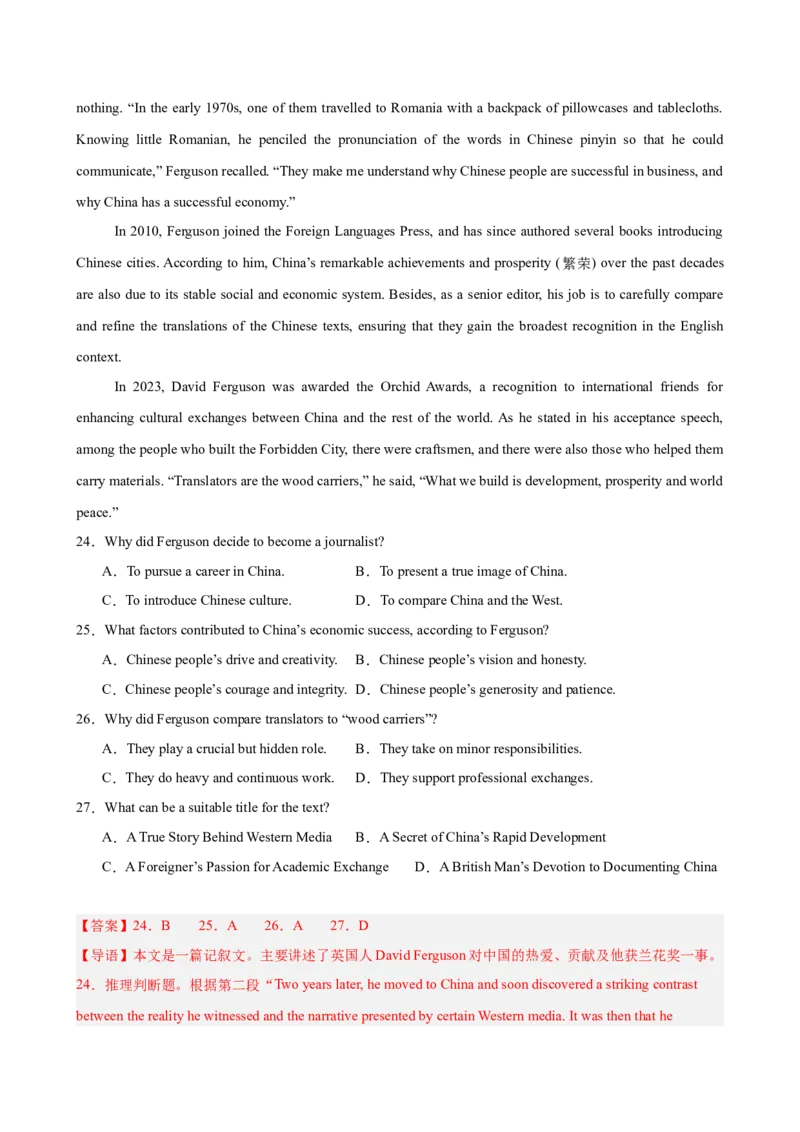
British man David Ferguson holds more than one identity. Though better known for his translations of
Chinese classics and government documents, his connection with China began around two decades ago.
He first came to China in 2004 to visit his future in-laws in Jilin. Two years later, he moved to China and
soon discovered a striking contrast between the reality he witnessed and the narrative presented by certain Western
media. It was then that he resolved to become a journalist and share what he truly saw in person.
During his years of reporting, one of his most memorable experiences is one in Nantong, where he
encountered self-made business people in the textile (纺织) industry who built international enterprises out of
nothing. “In the early 1970s, one of them travelled to Romania with a backpack of pillowcases and tablecloths.
Knowing little Romanian, he penciled the pronunciation of the words in Chinese pinyin so that he could
communicate,” Ferguson recalled. “They make me understand why Chinese people are successful in business, and
why China has a successful economy.”
In 2010, Ferguson joined the Foreign Languages Press, and has since authored several books introducing
Chinese cities. According to him, China’s remarkable achievements and prosperity (繁荣) over the past decades
are also due to its stable social and economic system. Besides, as a senior editor, his job is to carefully compare
and refine the translations of the Chinese texts, ensuring that they gain the broadest recognition in the English
context.
In 2023, David Ferguson was awarded the Orchid Awards, a recognition to international friends for
enhancing cultural exchanges between China and the rest of the world. As he stated in his acceptance speech,
among the people who built the Forbidden City, there were craftsmen, and there were also those who helped them
carry materials. “Translators are the wood carriers,” he said, “What we build is development, prosperity and world
peace.”
24.Why did Ferguson decide to become a journalist?
A.To pursue a career in China.
B.To present a true image of China.
C.To introduce Chinese culture.
D.To compare China and the West.
25.What factors contributed to China’s economic success, according to Ferguson?
A.Chinese people’s drive and creativity.
B.Chinese people’s vision and honesty.
C.Chinese people’s courage and integrity. D.Chinese people’s generosity and patience.
26.Why did Ferguson compare translators to “wood carriers”?
A.They play a crucial but hidden role.
B.They take on minor responsibilities.
C.They do heavy and continuous work.
D.They support professional exchanges.
27.What can be a suitable title for the text?
A.A True Story Behind Western Media
B.A Secret of China’s Rapid Development
C.A Foreigner’s Passion for Academic Exchange
D.A British Man’s Devotion to Documenting China
【答案】24.B 25.A 26.A 27.D
【导语】本文是一篇记叙文。主要讲述了英国人David Ferguson 对中国的热爱、贡献及他获兰花奖一事。
24.推理判断题。根据第二段“Two years later, he moved to China and soon discovered a striking contrast
between the reality he witnessed and the narrative presented by certain Western media. It was then that he
resolved to become a journalist and share what he truly saw in person. (两年后,他搬到了中国,很快就发现了
他所目睹的现实与某些西方媒体所呈现的叙述之间的鲜明对比。就在那时,他决定成为一名记者,分享
他亲眼目睹的真实情况。)”可知,Ferguson 决定成为一名记者是为了呈现一个真实的中国形象。故选B 项。
25.细节理解题。根据第三段“During his years of reporting, one of his most memorable experiences is one in
Nantong, where he encountered self-made business people in the textile (纺织) industry who built international
enterprises out of nothing. “In the early 1970s, one of them travelled to Romania with a backpack of pillowcases
and tablecloths. Knowing little Romanian, he penciled the pronunciation of the words in Chinese pinyin so that he
could communicate,” Ferguson recalled. “They make me understand why Chinese people are successful in
business, and why China has a successful economy.”(在多年的报道生涯中,他最难忘的经历之一是在南通,
在那里他遇到了纺织业中白手起家的商人,他们白手起家建立了国际企业。“20 世纪70 年代初,其中一
人背着装满枕套和桌布的背包前往罗马尼亚。由于不太懂罗马尼亚语,他用汉语拼音写下单词的发音,
以便能够交流,”Ferguson 回忆道。“他们让我明白了为什么中国人在商业上取得成功,以及为什么中
国经济取得成功。”)”可知,根据Ferguson 的说法,是中国人民的干劲和创造力促成了中国经济的成功。
故选A 项。
26.细节理解题。根据最后一段“As he stated in his acceptance speech, among the people who built the
Forbidden City, there were craftsmen, and there were also those who helped them carry materials. “Translators are
the wood carriers,” he said, “What we build is development, prosperity and world peace.”(正如他在获奖感言中
所说,在建造紫禁城的人中,有工匠,也有帮助他们搬运材料的人。“翻译者是搬运木材的人,”他说,
“我们建造的是发展、繁荣和世界和平。”)”可知,Ferguson 将翻译者比作“搬运木材的人”是因为他们
起着至关重要但隐藏的角色。故选A 项。
27.主旨大意题。文章主要讲述了英国人David Ferguson 对中国的热爱、他在中国的经历、他对中国经济
的看法、他作为翻译的贡献以及他获得的兰花奖,所以“A British Man’s Devotion to Documenting China
(一位英国人致力于记录中国)”适合作为本文的标题。故选D 项。
C
There exists a certain human experience that goes beyond cultures and generations- the sudden shake that
runs down your spine when a violin reaches its highest note, or when singers’ harmony resolves perfectly. These
electrifying feelings triggered by emotionally powerful music, sometimes accompanied by visible goosebumps,
represent a fascinating blend between art and neurology ( 神经学) . Recent advances in brain imaging have
revealed it to be a complex neurological event involving multiple brain regions.
The process begins with pattern recognition in the auditory cortex (听觉皮层) , which constantly predicts
where a musical phrase will lead. When a composer breaks these expectations on purpose, through an unexpected
key change or a delay in resolution, it creates what neuroscientists call “prediction error.” This surprise element
triggers the brain’s pleasure center associated with reward processing. Within milliseconds, the area releases
dopamine, the same substance involved in the pleasures of eating chocolate or falling in love.
The evolutionary origins of this response may come before humanity itself. Charles Darwin first noted that
music shares characteristics with animal distress calls and mating songs. The physiological markers of musical
chills, including goosebumps and changes in heart rate, mirror ancient fear and excitement responses. Some
theorists suggest music developed as an early language that promoted social unity, with chill responses
strengthening group bonding through shared emotional peaks.
Neurologists now use musical chill tests to assess lack of emotional response in depression patients, as
reduced chill response connects with an inability to feel pleasure. Music therapists working with Alzheimer’s
patients have documented cases where exhilarating songs temporarily restore access to lost memories, likely
through activation of the region relatively spared in early dementia (痴呆症) .
The next time you feel that familiar shake during a favorite song, recognize it for what it truly is. In those
chilling notes lies evidence of our incredible neural complexity, our ancient evolutionary past, and our enduring
capacity for amazing experience.
28.According to paragraph 2, what triggers the “prediction error”?
A.The release of dopamine from the brain’s pleasure center.
B.The intentional breaking of listeners’ musical expectations.
C.The auditory cortex’s failure to recognize familiar musical patterns.
D.The similarity between musical chills and other pleasant experiences.
29.What can we learn about musical chills?
A.They were developed to distinguish between fear and excitement responses.
B.Their origin lay in similar biological mechanism as animal mating behaviors.
C.They played a role in promoting social connection among early human groups.
D.Their physical indicators like goosebumps faded away in the evolution process.
30.What does the underlined word “exhilarating” in paragraph 4 mean?
A.Relaxing
B.Catchy.
C.Timeless.
D.Stimulating.
31.What does the author imply in the last paragraph?
A.Music with specific notes can trigger strong emotions.
B.Musical chills reflect multiple aspects of human nature.
C.Musical chills are a potential way to study human brains.
D.The ability to feel musical chills is unique to the human race.
【答案】28.B 29.C 30.D 31.B
【导语】这是一篇说明文。文章讲述音乐带来的颤栗感是复杂神经活动,由打破听觉预期触发,源自有
进化根源,还可用于抑郁症、老年痴呆症的诊疗,其彰显了人类的神经复杂性与进化印记。
28.细节理解题。根据第二段“When a composer breaks these expectations on purpose, through an
unexpected key change or a delay in resolution, it creates what neuroscientists call “prediction error.” (当作曲家
通过意想不到的调式变化或延迟解决,故意打破这些预期时,就会产生神经科学家所说的“预测误
差”。)”可知,作曲家故意打破听众的音乐预期会触发“预测误差”。故选B 项。
29.细节理解题。根据第三段“Some theorists suggest music developed as an early language that promoted
social unity, with chill responses strengthening group bonding through shared emotional peaks.(一些理论家认为,
音乐发展成为一种促进社会团结的早期语言,而音乐颤栗反应通过共享的情感高峰加强了群体联结。)”可
知,音乐颤栗在早期人类群体中起到了促进社会联系的作用。故选C 项。
30.词句猜测题。根据第四段“Music therapists working with Alzheimer’s patients have documented cases
where exhilarating songs temporarily restore access to lost memories, likely through activation of the region
relatively spared in early dementia (痴呆症) .(为阿尔茨海默病患者开展治疗的音乐治疗师,记录下了诸多案
例:exhilarating 歌曲能暂时帮助患者唤醒已遗忘的记忆,这一现象大概率是通过激活痴呆症早期受损程
度相对较轻的大脑区域实现的。)”并结合上下文“音乐带来强烈情感、激活大脑区域”的语境可推断,
“exhilarating”意为“令人兴奋的、刺激的”。故选D 项。
31.推理判断题。根据最后一段“In those chilling notes lies evidence of our incredible neural complexity, our
ancient evolutionary past, and our enduring capacity for amazing experience.(在那些令人颤栗的音符中,蕴含
着我们惊人的神经复杂性、古老的进化历史,以及我们持久的奇妙体验能力的证据。)”可知,作者暗示音
乐颤栗反映了人性的多个方面。故选B 项。
D
At the start and end of every school day, many Australian children head to the car park to get picked up.
While they’ re waiting, they will be breathing in a mix of harmful pollutants because many parents leave their car
engines idling (未熄火) while parked.
Children are particularly delicate. They breathe in and out more often, have a greater lung surface area
relative to their body size and are shorter than adults, placing them closer to harmful emissions from vehicles.
Even brief exposure can increase the risk of lung-related illness.
To tackle the problem, we created the Idle Off program. We ran three hands-on sessions for 40 students in
Melbourne’s inner western suburbs, where we presented information about air pollution from vehicle emissions
and what these smogs could do to human health and the climate. While raising awareness of issues is important,
we wanted to give students the tools to make a visible change. To that end, our sessions focused on how to
advocate for change. Students designed posters and gave speeches on the topic. Some stuck posters up around car
parks. Others used their prepared notes to talk to their parents about why keeping engines running while parked
was a problem worth handling.
A week after the program, we observed a drop in idling of 18% during morning drop-off and 40% during
afternoon pick-up. The differing figures made sense, because parents were often in a rush to get to work in the
mornings and were less likely to turn off their cars for a quick goodbye. After the program, the number of students
believing children were able to advocate for change rose from 68% to 97%. The parents of our participants also
perceived a growing sense of responsibility both in their children and in themselves.
The program shows children are not only capable of understanding complex issues, but able to influence
adults, shape conversations and drive actual behaviour change, which could be used to address other
environmental issues.
32.Why are the children mentioned in the first two paragraphs?
A.To show Australia’s severe air pollution.
B.To explain the reason for children’s delicacy.
C.To stress the link between idling and kids’ health.
D.To introduce the problem of leaving engines running.
33.What did the students do during the Idle Off program?
A.They surveyed the surrounding environment.
B.They designed posters and delivered speeches.
C.They questioned parents on their driving expenses.
D.They organized campaigns to ban idling in suburbs.
34.How did the program influence the students?
A.It boosted their confidence in advocacy.
B.It improved their academic performances.
C.It urged them to cycle to school every day.
D.It motivated them to request more monitors.
35.Where can you most likely read the passage?
A.In a leaflet about road traffic guidance.
B.In a textbook chapter on children’s health.
C.In a school paper on environmental activities.
D.In a news report about harmful vehicle emissions.
【答案】32.C 33.B 34.A 35.C
【导语】本文是一篇说明文。文章主要介绍了澳大利亚墨尔本内西部郊区开展的“Idle Off”项目,该项目
旨在解决家长在接送孩子时车辆未熄火导致的空气污染问题。
32.推理判断题。第一段提到“While they’ re waiting, they will be breathing in a mix of harmful pollutants
because many parents leave their car engines idling (未熄火) while parked. (当孩子们等待时,他们会吸入各种
有害污染物,因为许多家长在停车时让汽车发动机保持未熄火状态。)”第二段提到“Children are
particularly delicate. They breathe in and out more often, have a greater lung surface area relative to their body
size and are shorter than adults, placing them closer to harmful emissions from vehicles. Even brief exposure can
increase the risk of lung-related illness. (孩子们特别脆弱。他们呼吸更频繁,相对于身体大小,他们的肺表
面积更大,而且比成年人矮,使他们更接近车辆排放的有害物质。即使是短暂的接触也会增加患肺部相
关疾病的风险。)”由此可知,前两段通过描述孩子们在等待接送时暴露在车辆未熄火产生的有害污染物中,
以及他们身体对污染物的敏感性,强调了车辆未熄火与孩子们健康之间的联系。故选C。
33.细节理解题。根据第三段“Students designed posters and gave speeches on the topic. (学生们设计海报并
就这个话题发表演讲。)”可知,在“Idle Off”项目中,学生们设计了海报并发表了演讲。故选B。
34.推理判断题。根据第四段“After the program, the number of students believing children were able to
advocate for change rose from 68% to 97%. (项目结束后,认为孩子们能够倡导变革的学生比例从68%上升
到97%。)”可知,项目结束后,认为孩子们能够倡导变革的学生比例大幅上升,说明该项目增强了学生们
在倡导方面的信心。故选A。
35.推理判断题。根据文章内容,特别是第三段“To tackle the problem, we created the Idle Off program. We
ran three hands-on sessions for 40 students in Melbourne’s inner western suburbs, where we presented
information about air pollution from vehicle emissions and what these smogs could do to human health and the
climate. (为了解决这个问题,我们创建了“Idle Off”项目。我们在墨尔本内西部郊区为40 名学生举办了三
次实践课程,向他们介绍了车辆排放造成的空气污染以及这些烟雾对人类健康和气候的影响。)”可知,文
章主要介绍了“Idle Off”项目,该项目是针对学校环境活动的一个项目,旨在通过教育学生来减少车辆未
熄火,改善空气质量。因此,文章最有可能出现在学校关于环境活动的报纸上。故选C。
第二节(共5 小题;每小题2.5 分,满分12.5 分)
阅读下面短文,从短文后的选项中选出可以填入空白处的最佳选项。选项中有两项为多余选项。
Effective communication is the process of expressing your thoughts and ideas while listening to the
opinions of others. Then how to communicate effectively?
Organize your thoughts before speaking.
Before you attempt to communicate ideas, organize your thoughts using key points. 36
That way, if you go off topic, you can easily come back to your main points without getting upset.
<u><span leftindent quesindex="37">37</span>.</u>
If you’re giving a presentation, consider the listeners’ interests, differences, and levels of knowledge on the
topic you’re speaking on. For instance, if you’re lecturing a college-level Biology course, students should have a
good grasp of evolution and cell theory. Similarly, if you’re lecturing students, you may want to choose visual aids
to catch their attention.
Be clear when speaking.
Be clear about your goal so your message comes across in a way that every listener can understand. 38
You want to speak at a volume level that is guaranteed to be heard. It may be helpful to remember to be clear,
brief, consistent (一致), connected, and confident while communicating with others.
Maintain eye contact.
Eye contact builds harmony, helps convince others you’re trustworthy and shows interest. During a
conversation or presentation, maintain eye contact for as long as it feels natural. Generally, you’ll want to aim for
2 to 4 seconds at a time. 39 If you’re addressing a boardroom (董事会), look each member in the eye.
Ignoring any single person can easily be taken as a sign of disrespect.
Practise active listening skills.
40 By actively listening, you can judge how much of your message is getting through your listeners
and whether or not it’s being received correctly. If your audience doesn’t fully get what you mean, asking for their
opinions is often helpful.
A.Keep your audience in mind.
B.Communication is a two-way street.
C.Understand your audience’s specific needs.
D.This helps individuals feel personally valued.
E.Be sure to express clearly to avoid any kind of misunderstanding.
F.A good rule is to choose three key points to center your conversation around.
G.Common signs someone isn’t listening to you include looking bored and silence.
【答案】36.F 37.A 38.E 39.D 40.B
【导语】这是一篇说明文。文章围绕高效沟通这一核心话题,从梳理思路、关注听众、清晰表达、保持
眼神交流和运用积极倾听技巧五个方面,介绍了实现高效沟通的具体方法,具有很强的实用性。
36.上文“Before you attempt to communicate ideas, organize your thoughts using key points. (在你尝试表达
想法之前,先用关键点梳理你的思路。)”提出了沟通前要梳理思路的建议,下文“That way, if you go off
topic, you can easily come back to your main points without getting upset. (这样的话,如果你偏离了主题,也
能轻松回到要点上,不会慌乱。)”说明了梳理思路的好处。F 项“一个实用的原则是选择三个关键点作为
谈话的核心”承上启下,“选择三个关键点” 是对上文“organize your thoughts using key points”的具体
阐释,给出了梳理思路的可行方法,同时“作为谈话的核心”也能对应下文“come back to your main
points”的表述,逻辑连贯。故选F。
37.下文“If you’re giving a presentation, consider the listeners’ interests, differences, and levels of knowledge
on the topic you’re speaking on. For instance, if you’re lecturing a college-level Biology course, students should
have a good grasp of evolution and cell theory. Similarly, if you’re lecturing students, you may want to choose
visual aids to catch their attention. (如果你在做演讲,要考虑听众的兴趣、差异以及他们对演讲主题的认知
水平。例如,如果你在讲授大学水平的生物课程,学生们应该对进化论和细胞学说有较好的掌握。同样,
如果你给学生做讲座,你可能需要选择视觉教具来吸引他们的注意力。)”反复强调沟通时要考虑听众的情
况和需求。A 项“心中要装着你的听众”引领下文,精准概括了该段的核心内容,作为小标题统领下文
的具体建议和例子,符合语境。故选A。
38.上文“Be clear about your goal so your message comes across in a way that every listener can understand.
(明确你的沟通目标,这样你的信息就能让每个听众都理解。)”点明了清晰表达的重要性,该段的小标题
为“Be clear when speaking (说话时要清晰)”。E 项“一定要清晰地表达,避免出现任何形式的误解”承接
上文,直接呼应小标题和上文的核心观点,同时进一步说明清晰表达的目的是避免误解,贴合段落主旨。
故选E。
39.上文“During a conversation or presentation, maintain eye contact for as long as it feels natural. Generally,
you’ll want to aim for 2 to 4 seconds at a time. (在交谈或演讲过程中,保持自然时长的眼神交流。通常来说,
每次眼神交流的时长最好控制在2 到4 秒。)”介绍了保持眼神交流的方法,下文“If you’re addressing a
boardroom, look each member in the eye. Ignoring any single person can easily be taken as a sign of disrespect.
(如果你在董事会发言,要与每位成员进行眼神交流。忽视任何一个人都很容易被视为不尊重的表现。)”
强调了对不同对象都要保持眼神交流。D 项“这会让每个人都感受到自身被重视”承上启下,“This”指
代上文的“maintain eye contact”,说明了保持眼神交流的作用,同时也能呼应下文“不能忽视任何人”的
表述,逻辑通顺。故选D。
40.上文的小标题为“Practise active listening skills (运用积极倾听的技巧)”,下文“By actively listening,
you can judge how much of your message is getting through your listeners and whether or not it’s being received
correctly. (通过积极倾听,你可以判断自己的信息被听众接收了多少,以及是否被正确理解。)”说明了积
极倾听的作用。B 项“沟通是双向的过程”承上启下,点明了沟通不仅需要表达,还需要倾听的核心特点,
为下文介绍积极倾听的作用做铺垫,符合段落逻辑。故选B。
第三部分 语言运用(共两节,满分30 分)
第一节 (共15 小题;每小题1 分,满分15 分)
阅读下面短文,从每题所给的A、B、C、D 四个选项中选出可以填入空白处的最佳选项。
The summer before college, I worked at a local bookstore. I spent my days arranging shelves, scanning
books, and repeating greetings to regulars. Most tasks felt 41 , with no real joy, so I often stared at the
clock, 42 down to closing time — until Mrs. Henderson walked in.
She was an elderly woman with silver hair. Every Tuesday, she’d 43 the same section:
secondhand travel books. She never bought anything, just ran her fingers gently over the book covers, eyes soft
with 44 . She’d stay there for an hour, never acting 45 . Until one afternoon, I plucked up
courage to ask, my voice 46 , “Did you travel a lot?”
She smiled. “I planned to. But life 47 — kids, work, illness. These books are my late husband’s
— I donated them years ago.” She pulled out a tattered copy of Journey Through Tuscany. “We never 48
it to Italy, but these pages held our dreams and they were my 49 from the busy, hard days.”
That day, we talked for an hour. She shared tales of missed chances, and I shared my college fears of
failing, or feeling lost. As she left, she handed me the book and a note. “Life isn’t about the trips we take, but the
50 we share along the way. Thank you for listening. Sometimes, a stranger’s 51 is the most
precious gift — someone to hold your unspoken hopes.”
That summer, I stopped counting hours. 52 , I listened to regulars’ stories, cherished quiet
hopes, and 53 that even ordinary days have meaning. It turns out that the best moments aren’t the
ones we chase. They’re the gentle, unplanned connections that 54 us we’re never alone. A simple act
of listening can turn a boring summer job into a journey of self-discovery — one that taught me to slow down and
cherish the 55 in the ordinary.
41.A.repetitive
B.dull
C.creative
D.tough
42.A.settling
B.looking
C.winding
D.counting
43.A.pass by
B.look into
C.head for
D.pick up
44.A.curiosity
B.regret
C.eagerness
D.excitement
45.A.hurriedly
B.calmly
C.casually
D.firmly
46.A.booming
B.trembling
C.muttering
D.echoing
47.A.got in the way B.took over
C.came to light
D.fell apart
48.A.reached
B.got
C.had
D.made
49.A.burden
B.regret
C.dilemma
D.escape
50.A.plans
B.moments
C.promises
D.adventures
51.A.patience
B.curiosity
C.ear
D.honesty
52.A.Instead
B.Besides
C.Therefore
D.However
53.A.imagined
B.denied
C.realized
D.pretended
54.A.warn
B.remind
C.inform
D.assure
55.A.beauty
B.comfort
C.entertainment
D.peace
【答案】
41.B 42.D 43.C 44.C 45.A 46.B 47.A 48.D 49.D 50.B
51.C 52.A 53.C 54.B 55.A
【导语】本文为一篇记叙文,讲述了作者大学前的夏天在书店打工,觉得工作枯燥乏味,总盼着下班,
直到遇到亨德森夫人的经历。作者与这位因生活变故未能实现旅行梦想的老人交往,领悟到平凡的日子
也有意义,简单的倾听能发现平凡中的美好,这场打工经历也成为一场自我发现的旅程。
41.考查形容词词义辨析。句意:大多数工作都让人觉得枯燥,没有真正的乐趣,所以我常常盯着时钟,
数着时间直到下班——直到亨德森夫人走进来。A. repetitive 重复的;B. dull 枯燥的;C. creative 有创造力
的;D. tough 艰难的。根据下文“with no real joy”可知,这份书店的工作让作者感受不到乐趣,整体是枯
燥无味的,故选B。
42.考查动词词义辨析。句意:大多数工作都让人觉得枯燥,没有真正的乐趣,所以我常常盯着时钟,
数着时间直到下班——直到亨德森夫人走进来。A. settling 定居;B. looking 看;C. winding 蜿蜒;D.
counting 数数。根据上文“stared at the clock”和下文“down to closing time”可知,作者因工作枯燥,一直
盯着钟表数时间,盼着下班,“count down”为固定搭配,意为“倒计时、数着时间到……”,故选D。
43.考查动词短语辨析。句意:每个周二,她都会直奔同一个区域:二手旅行书区。A. pass by 路过;B.
look into 调查;C. head for 直奔、前往;D. pick up 捡起。根据下文“the same section: secondhand travel
books”可知,亨德森夫人每周二来书店,都会径直走到二手旅行书区,目标十分明确,故选C。
44.考查名词词义辨析。句意:她从不买任何东西,只是用手指轻轻摩挲着书的封面,眼中满是渴望的
温柔。A. curiosity 好奇;B. regret 遗憾;C. eagerness 渴望;D. excitement 兴奋。根据下文“ We never it
to Italy, but these pages held our dreams and they were my from the busy, hard days.”可知,亨德森夫人未能
实现旅行梦想,她对旅行始终心怀向往,看着承载着梦想的旅行书时,眼中满是对未完成旅行的渴望,
故选C。
45.考查副词词义辨析。句意:她会在那里待上一个小时,从不表现得匆忙。A. hurriedly 匆忙地;B.
calmly 平静地;C. casually 随意地;D. firmly 坚定地。根据上文“She’d stay there for an hour”可知,亨德
森夫人会在旅行书区待上整整一个小时,翻看书籍时节奏缓慢,从不显得匆忙,故选A。
46.考查动词词义辨析。句意:直到一天下午,我鼓起勇气问她,声音颤抖着:“你以前经常旅行
吗?”A. booming 轰鸣;B. trembling 颤抖;C. muttering 咕哝;D. echoing 回响。根据上文“I plucked up
courage to ask”可知,作者是鼓足了勇气才敢向亨德森夫人提问,内心十分紧张,因此说话的声音是颤抖
的,故选B。
47.考查动词短语辨析。句意:但生活总是百般阻挠——孩子、工作、疾病。A. got in the way 阻碍、挡
路;B. took over 接管;C. came to light 显露;D. fell apart 破碎。根据上文“I planned to.”和下文“kids,
work, illness”可知,亨德森夫人原本计划去旅行,却因生活问题的阻碍,最终未能实现梦想,故选A。
48.考查动词词义辨析。句意:我们从未成功去到意大利,但这些书页承载着我们的梦想,也是我从忙
碌、艰难的日子中解脱出来的方式。A. reached 到达;B. got 得到;C. had 拥有;D. made 做到。根据上文
“
But life — kids, work, illness.”可知,由于生活的种种阻碍,亨德森夫人和丈夫始终没能去到意大利,
“make it to”为固定搭配,意为“成功到达某地”,故选D。
49.考查名词词义辨析。句意:我们从未成功去到意大利,但这些书页承载着我们的梦想,也是我从忙
碌、艰难的日子中解脱出来的方式。A. burden 负担;B. regret 遗憾;C. dilemma 困境;D. escape 解脱、逃
避。根据下文“from the busy, hard days”可知,这些旅行书承载着亨德森夫人的梦想,让她在忙碌艰难的
生活中,能有精神上的慰藉和暂时的解脱,故选D。
50.考查名词词义辨析。句意:生活不在于我们踏上的旅程,而在于我们一路上分享的瞬间。A. plans 计
划;B. moments 瞬间、时光;C. promises 承诺;D. adventures 冒险。根据上文亨德森夫人的经历,以及作
者与她的交谈,并结合后文“we share along the way”可知,老人想告诉作者,生活的美好不在于未实现的
旅行计划,而在于彼此相处、分享心情的那些珍贵瞬间,故选B。
51.考查名词词义辨析。句意:有时候,一个陌生人的倾听是最珍贵的礼物——有人愿意倾听你未曾说
出口的希望。A. patience 耐心;B. curiosity 好奇;C. ear 倾听;D. honesty 诚实。根据上文“Thank you for
listening.”可知,老人认为作者的倾听对她而言是珍贵的礼物,“a stranger’s ear”在此处指“陌生人的倾
听”,故选C。
52.考查副词词义辨析。句意:相反,我开始倾听老顾客的故事,珍惜那些无声的期许,也意识到即便
是平凡的日子也有其意义。A. Instead 相反;B. Besides 此外;C. Therefore 因此;D. However 然而。根据
上文“That summer, I stopped counting hours.”可知,作者不再像以前那样数着时间盼下班,而是做出了相
反的举动,开始用心感受工作、倾听他人,故选A。
53.考查动词词义辨析。句意:相反,我开始倾听老顾客的故事,珍惜那些无声的期许,也意识到即便
是平凡的日子也有其意义。A. imagined 想象;B. denied 否认;C. realized 意识到;D. pretended 假装。根
据上文作者与亨德森夫人的交谈,以及后续倾听顾客故事的经历,并结合后文“that even ordinary days
have meaning”可知,作者的心态发生了转变,意识到平凡日子的价值,故选C。
54.考查动词词义辨析。句意:这些都是温柔的、不期而遇的联结,提醒着我们,我们从未孤单。A.
warn 警告;B. remind 提醒;C. inform 通知;D. assure 保证。根据上文“It turns out that the best moments
aren’t the ones we chase.”可知,作者发现生活中美好的瞬间都是不期而遇的,这些瞬间带来的情感联结,
会时刻提醒着人们,自己并非孤身一人,故选B。
55.考查名词词义辨析。句意:一个简单的倾听行为,就能把一个无聊的暑假工作变成一场自我发现的
旅程——这段旅程教会我放慢脚步,珍惜平凡中的美好。A. beauty 美好;B. comfort 慰藉;C.
entertainment 娱乐;D. peace 平静。根据上文“that even ordinary days have meaning”等内容可知,作者从
枯燥的工作中发现了人与人之间联结的美好,意识到平凡日子的意义,这段经历让作者学会了在平凡的
生活中,发现并珍惜其中的美好,故选A。
第二节(共10 小题;每小题1. 5 分, 满分15 分)
阅读下面材料,在空白处填入适当的内容(1 个单词)或所给单词的正确形式。
After four years of conservation and restoration work, the gilded bronze armor (鎏金铜甲) has been fully
restored to present to people the ceremonial (礼仪的) style of the Tuyuhun Kingdom during the Tang Dynasty.
This precious object 56 (dig) up from the Xuewei No. 1 Tomb in Dulan County, Qinghai Province. 57
makes it special is that it is the only surviving Tang Dynasty gilded armor in China.
Han, a researcher from an archaeological institute, said this restoration provides detailed and 58
(rely) materials which can deepen the understanding of funeral traditions, ethnic exchanges and integration, as
well as production techniques on the Qinghai-Xizang Plateau.
The tomb in Qinghai has 59 history of about 1, 300 years. It yielded piles of broken pieces of
bronze armor and lacquered horse armor. These pieces were 60 a mess and had no clear connection in
structure. Even a light touch could make them break into much 61 (small) pieces. To solve the problem,
62 (expert) employed 3D scanning to record the original shape and position of these pieces. They also used
two advanced technologies-scanning electron microscopy and ultra- depth microscopy 63 (study) how the
armors were made and what materials they were made of. 64 (eventual) , they managed to create a clear
visual model of the original armors.
Han added that the successful restoration has built a good technical system and a research method for future
lab archaeology, 65 (transform) the way archaeologists (考古学家) think about their work.
【答案】
56.was dug 57.What 58.reliable 59.a 60.in 61.smaller 62.experts 63.
to study 64.Eventually 65.transforming
【导语】本文是一篇新闻报道。青海都兰血渭一号墓出土的唐代鎏金铜甲,经专家借助3D 扫描等技术完
成修复,为实验室考古提供了技术支持,也为青藏高原相关研究提供了资料参考。
56.考查动词的时态和语态。句意:这件珍贵的物品是从青海省都兰县血渭一号墓中挖掘出来的。根据
语境可知,此处描述的是过去发生的事情,且“This precious object”与“dig”之间是被动关系,所以用一
般过去时的被动语态,主语是单数,be 动词用was。故填was dug。
57.考查主语从句。句意:让它特别的是,它是中国唯一现存的唐代鎏金铠甲。空处引导主语从句,从
句缺少主语,指物,所以用连接代词what 引导该从句,位于句首,首字母大写。故填What。
58.考查形容词。句意:考古研究所的研究员韩说,这次修复提供了详细可靠的材料,可以加深对青海-
西藏高原丧葬传统、民族交流融合以及生产技术的理解。空处和detailed 并列,修饰名词materials,应用
形容词reliable“可靠的”作定语。故填reliable。
59.考查冠词。句意:青海的这座古墓有大约1300 年的历史。have a history of...是固定短语,意为
“有……的历史”,history 是辅音音素开头的单词,所以空处应填不定冠词a。故填a。
60.考查介词。句意:这些碎片乱七八糟,结构上没有明显的联系。in a mess 是固定短语,意为“乱七
八糟”,所以空处应填介词in。故填in。
61.考查形容词比较级。句意:即使是轻轻一碰,也会使它们碎成更小的碎片。根据语境可知,此处表
示“更小的”,应用形容词比较级smaller,作定语修饰名词“pieces”。故填smaller。
62.考查名词复数。句意:为了解决这个问题,专家们采用了3D 扫描来记录这些碎片的原始形状和位置。
此处表示“专家们”,应用名词复数experts,作主语。故填experts。
63.考查非谓语动词。句意:他们还使用了两种先进的技术——扫描电子显微镜和超深度显微镜来研究
铠甲是如何制造的以及它们是由什么材料制成的。use sth. to do sth.是固定搭配,意为“用某物做某事”,
所以空处应用动词不定式形式to study。故填to study。
64.考查副词。句意:最终,他们成功地创建了原始铠甲的清晰视觉模型。空处修饰整个句子,应用副
词eventually“最终”,作状语,位于句首,首字母大写。故填Eventually。
65.考查非谓语动词。句意:韩补充说,成功的修复为未来的实验室考古学建立了良好的技术体系和研
究方法,改变了考古学家对他们工作的思考方式。此句已有谓语动词 has built,空处是非谓语动词,应
用现在分词transforming 作结果状语,表示自然而然的结果。故填transforming。
第四部分 写作(共两节, 满分40 分)
第一节(满分15 分)
66.上周末你参加了一个垃圾分类、回收科普活动。请你就此写一篇短文向校英语报投稿,内容包括:
1. 活动目的;
2. 活动经过;
3. 你的收获。
注意:1. 写作词数应为80 个左右;
2. 请按如下格式在答题卡的相应位置作答。
My Experience at an Educational Waste-Sorting Workshop
___________________________________________________________________________________________
___________________________________________________________________________________________
___________________________________________________________________________________________
___________________________________________________________________________________________
_________________________________________________________
【答案】My Experience at an Educational Waste-Sorting Workshop
Last weekend, I took part in a waste-sorting campaign to raise public awareness about recycling. The event
included an informative lecture and an interactive sorting game.
During the game, participants worked together to classify various types of waste into different bins. It was
both challenging and fun. Through this activity, I not only learned the correct way to sort waste but also realized
the importance of individual efforts in protecting our environment.
I believe that small actions can make a big difference. Let’s work together for a greener future.
【导语】本篇书面表达属于应用文。要求考生围绕参与的垃圾分类科普活动撰写短文,向校英语报投稿。
【详解】1.词汇积累
意识:awareness→consciousness
分类:classify→sort
个人努力:individual efforts→personal efforts
环保的:greener→environment-friendly
2.句式拓展
简单句变复合句
原句:Last weekend, I took part in a waste-sorting campaign to raise public awareness about recycling.
拓展句:Last weekend, I took part in a waste-sorting campaign which aimed to raise public awareness about
recycling and environmental protection.
【点睛】【高分句型1】Through this activity, I not only learned the correct way to sort waste but also realized
the importance of individual efforts in protecting our environment.(运用not only...but also...并列结构)
【高分句型2】I believe that small actions can make a big difference.(运用that 引导宾语从句作believe 的宾
语)
第二节(满分25 分)
67.阅读下面材料,根据其内容和所给段落开头语续写两段,使之构成一篇完整的短文。
Having been working hard for a long time, I decided to treat myself to a solo (独自的) trip to Türkiye. It
felt like the perfect way to mark the end of one chapter and the beginning of another.
The first few days were magical — walking through busy markets, admiring ancient architecture, and
enjoying delicious local cuisine. Istanbul, the largest city of Türkiye, offers unforgettable beauty at every turn. I
started my day watching the Hagia Sophia, one of Istanbul’s most impressive landmarks, shining in the sunlight. I
ended my day drinking the local tea. Everything was going smoothly, until a sudden announcement from the
airport made my plans in chaos — my flight to the next stop was cancelled.
My heart sank. It wasn’t just the next stop; it was an important, previously planned part of my trip. A non-
refundable, luxurious cave hotel awaited me. I’d prepaid for a private car service that was expecting me tonight,
and crucially, tomorrow’s prebooked hot air balloon ride and guided valley tours demanded an early start. Panic
seized me. Anxiously checking alternatives, I found only one flight arriving late the next afternoon.
Standing alone at the airport, holding my useless boarding pass, I was in despair (绝望). My heart ached at
the thought of losing hundreds of euros. Tears welled up in my eyes. At that moment, my travel agency was
unreachable. My only hope rested with the driver, Mr. Demir, who was the same age as my dad and supposedly
waiting at the airport of my next stop. Had the car company received the email and notified him of the
cancellation? Would he check? Would he care enough to adjust without charging me a lot of money?
Hours passed as I rearranged my flight for the next morning. Extremely tired and overwhelmed (不知所措
的), I boarded the rescheduled flight, unsure of what to expect. Eventually, I landed, but I felt like going into
continued uncertainty.
注意:
(1)续写词数应为150 个左右;
(2)请按如下格式作答。
Suddenly, a loud voice cut through the noise: “Miss Doros? From Athens?”
___________________________________________________________________________________________
___________________________________________________________________________________________
___________________________________________________________________________________________
___________________________________________________________________________________________
________________
On the way to the hotel, I appreciated what Mr. Demir had done for me again.
___________________________________________________________________________________________
___________________________________________________________________________________________
___________________________________________________________________________________________
___________________________________________________________________________________________
________________
【答案】范文
Suddenly, a loud voice cut through the noise: “Miss Doros? From Athens?” I turned around and saw a
kind-looking man with a warm smile, holding a sign with my name. It was Mr. Demir! He explained that the car
company had informed him of the flight cancellation, but he’d waited patiently, even checked three different
flights to make sure he wouldn’t miss me. “I know you have a balloon ride tomorrow,” he said gently. “I’ve talked
to the hotel and the tour company — they’ve adjusted your schedule for free.” Relief washed over me, and tears of
gratitude replaced those of despair.
On the way to the hotel, I appreciated what Mr. Demir had done for me again. I told him how worried I was
about losing my prepaid plans, and he laughed, saying, “Travel is full of surprises, but we should help each other.”
He even shared stories of local customs, making the drive feel warm and short. When we arrived, the hotel staff
greeted me with a smile, confirming my adjusted reservation. At that moment, I realized that even when plans go
wrong, kindness from strangers can turn despair into a beautiful memory of my solo trip.
【导语】本文以人物为线索展开,讲述了作者独自前往土耳其旅行,起初一切顺利。然而航班突然取消,
预定好的酒店、专车和热气球行程都面临泡汤,她十分绝望。改签航班后,司机德米尔先生早已等候,
并免费帮她调整好了所有行程。陌生人的善意让她摆脱困境,这段经历也成为了旅途中温暖难忘的回忆。
【详解】1.段落续写:
①由第一段首句内容“突然,一个响亮的声音在嘈杂声中传来:‘多罗斯小姐?来自雅典?’”可知,
第一段可描写改签航班后,司机德米尔先生早已等候,并免费帮她调整好了所有行程。
②由第二段首句内容“在前往酒店的路上,我再次感激德米尔先生为我所做的一切”可知,第二段可描
写陌生人的善意让作者摆脱困境,这段经历也成为了旅途中温暖难忘的回忆。
2.续写线索:司机早已等候——免费调整行程——作者感激——路上分享风俗故事——作者感悟
3.词汇激活
行为类
①看到:see/catch sight of
②查看:check/examine
③一扫而空:wash over/sweep away
情绪类
①担心:worried/concerned
②感激:gratitude/appreciation
【点睛】[高分句型1] I told him how worried I was about losing my prepaid plans, and he laughed, saying,
“Travel is full of surprises, but we should help each other.”(运用了how 引导宾语从句)
[高分句型2] When we arrived, the hotel staff greeted me with a smile, confirming my adjusted reservation.(运
用了when 引导时间状语从句)