绝密★考试结束前
2026 年高考第一次模拟考试
英语
(考试时间:120 分钟  试卷满分:150 分)
注意事项:
1.本试卷分第Ⅰ卷(选择题)和第Ⅱ卷(非选择题)两部分。答卷前,考生务必将自己的姓名、准
考证号填写在答题卡上。
2.回答第Ⅰ卷时,选出每小题答案后,用2B 铅笔把答题卡上对应题目的答案标号涂黑。如需改动,
用橡皮擦干净后,再选涂其他答案标号。写在本试卷上无效。
3.回答第Ⅱ卷时,将答案写在答题卡上。写在本试卷上无效。
4.考试结束后,将本试卷和答题卡一并交回。
第一部分 听力(共两节,满分 30 分)
做题时,请先将答案标在试卷上。录音内容结束后,你将有两分钟的时间将试卷上的答案转涂到答
题卡上。
第一节(共5 小题;每小题1.5 分,满分7.5 分)
听下面5 段对话。每段对话后有一个小题,从题中所给的A、B、C 三个选项中选出最佳选项。听完每段
对话后,你都有10 秒钟的时间来回答有关小题和阅读下一小题。每段对话仅读一遍。
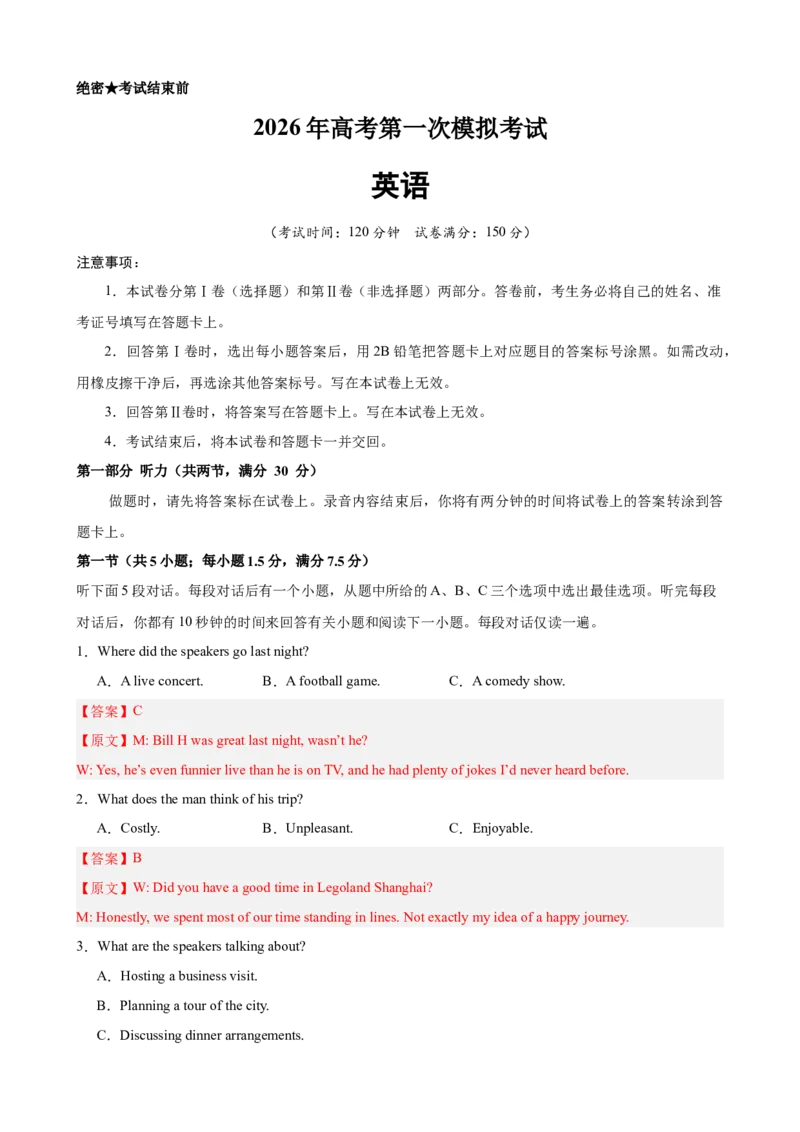
1.Where did the speakers go last night?
A.A live concert.
B.A football game.
C.A comedy show.
【答案】C
【原文】M: Bill H was great last night, wasn’t he?
W: Yes, he’s even funnier live than he is on TV, and he had plenty of jokes I’d never heard before.
2.What does the man think of his trip?
A.Costly.
B.Unpleasant.
C.Enjoyable.
【答案】B
【原文】W: Did you have a good time in Legoland Shanghai?
M: Honestly, we spent most of our time standing in lines. Not exactly my idea of a happy journey.
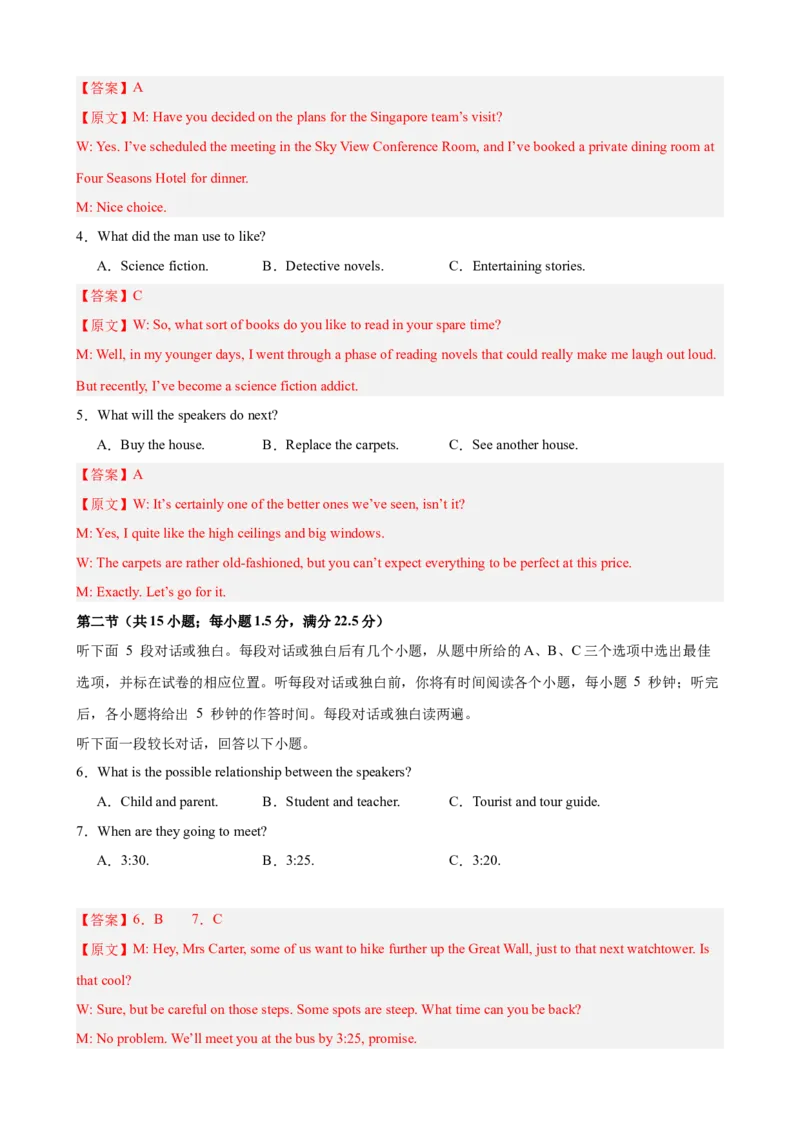
3.What are the speakers talking about?
A.Hosting a business visit.
B.Planning a tour of the city.
C.Discussing dinner arrangements.
【答案】A
【原文】M: Have you decided on the plans for the Singapore team’s visit?
W: Yes. I’ve scheduled the meeting in the Sky View Conference Room, and I’ve booked a private dining room at
Four Seasons Hotel for dinner.
M: Nice choice.
4.What did the man use to like?
A.Science fiction.
B.Detective novels.
C.Entertaining stories.
【答案】C
【原文】W: So, what sort of books do you like to read in your spare time?
M: Well, in my younger days, I went through a phase of reading novels that could really make me laugh out loud.
But recently, I’ve become a science fiction addict.
5.What will the speakers do next?
A.Buy the house.
B.Replace the carpets.
C.See another house.
【答案】A
【原文】W: It’s certainly one of the better ones we’ve seen, isn’t it?
M: Yes, I quite like the high ceilings and big windows.
W: The carpets are rather old-fashioned, but you can’t expect everything to be perfect at this price.
M: Exactly. Let’s go for it.
第二节(共15 小题;每小题1.5 分,满分22.5 分)
听下面 5 段对话或独白。每段对话或独白后有几个小题,从题中所给的A、B、C 三个选项中选出最佳
选项,并标在试卷的相应位置。听每段对话或独白前,你将有时间阅读各个小题,每小题 5 秒钟;听完
后,各小题将给出 5 秒钟的作答时间。每段对话或独白读两遍。
听下面一段较长对话,回答以下小题。
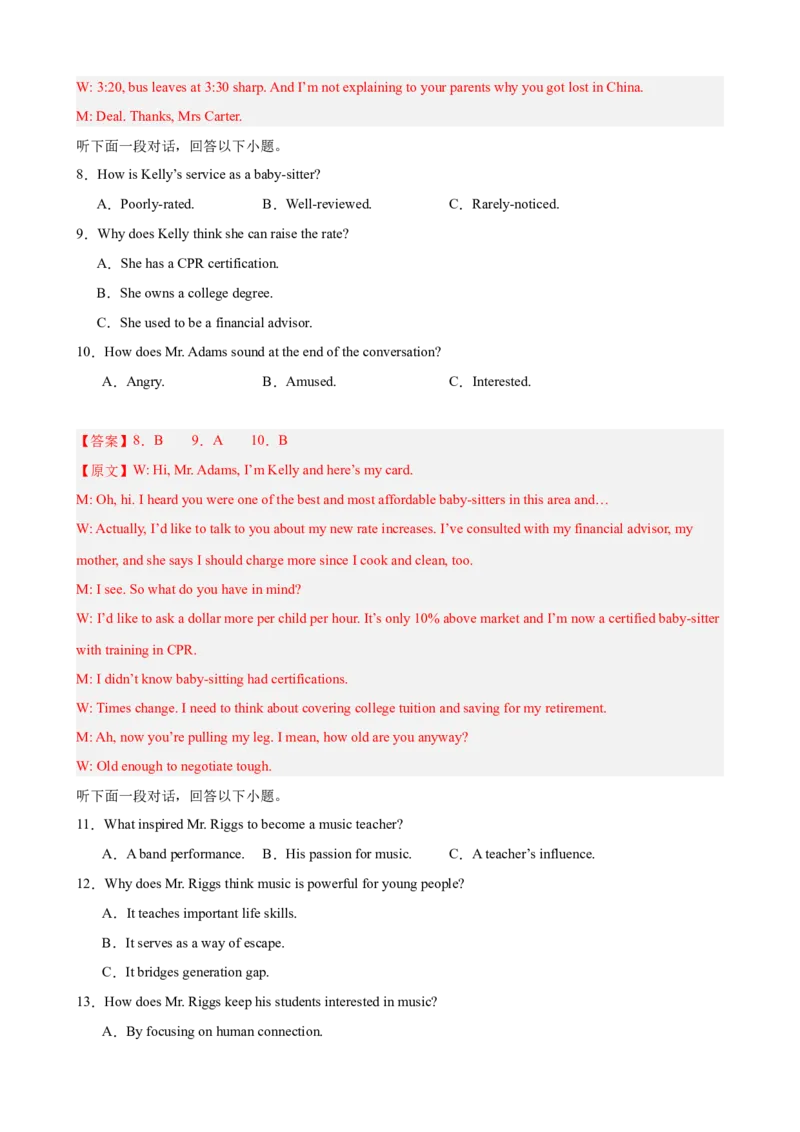
6.What is the possible relationship between the speakers?
A.Child and parent.
B.Student and teacher.
C.Tourist and tour guide.
7.When are they going to meet?
A.3:30.
B.3:25.
C.3:20.
【答案】6.B    7.C
【原文】M: Hey, Mrs Carter, some of us want to hike further up the Great Wall, just to that next watchtower. Is
that cool?
W: Sure, but be careful on those steps. Some spots are steep. What time can you be back?
M: No problem. We’ll meet you at the bus by 3:25, promise.
W: 3:20, bus leaves at 3:30 sharp. And I’m not explaining to your parents why you got lost in China.
M: Deal. Thanks, Mrs Carter.
听下面一段对话,回答以下小题。
8.How is Kelly’s service as a baby-sitter?
A.Poorly-rated.
B.Well-reviewed.
C.Rarely-noticed.
9.Why does Kelly think she can raise the rate?
A.She has a CPR certification.
B.She owns a college degree.
C.She used to be a financial advisor.
10.How does Mr. Adams sound at the end of the conversation?
A.Angry.
B.Amused.
C.Interested.
【答案】8.B    9.A    10.B
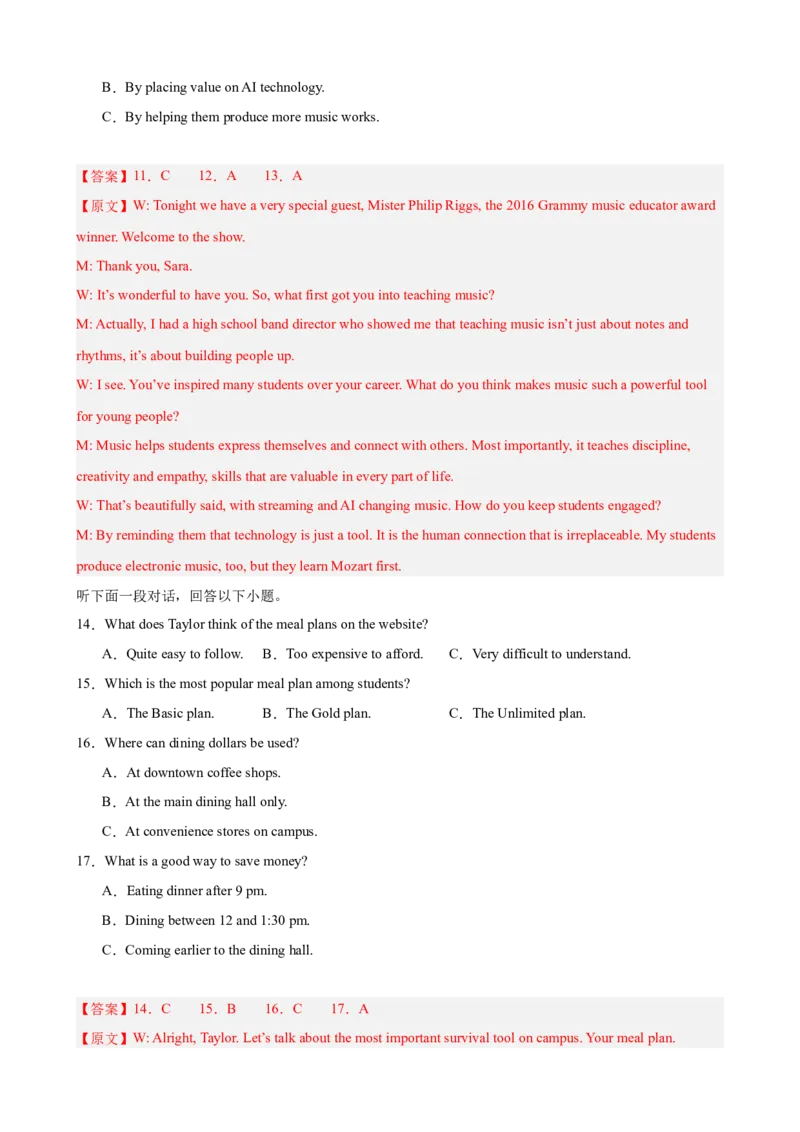
【原文】W: Hi, Mr. Adams, I’m Kelly and here’s my card.
M: Oh, hi. I heard you were one of the best and most affordable baby-sitters in this area and…
W: Actually, I’d like to talk to you about my new rate increases. I’ve consulted with my financial advisor, my
mother, and she says I should charge more since I cook and clean, too.
M: I see. So what do you have in mind?
W: I’d like to ask a dollar more per child per hour. It’s only 10% above market and I’m now a certified baby-sitter
with training in CPR.
M: I didn’t know baby-sitting had certifications.
W: Times change. I need to think about covering college tuition and saving for my retirement.
M: Ah, now you’re pulling my leg. I mean, how old are you anyway?
W: Old enough to negotiate tough.
听下面一段对话,回答以下小题。
11.What inspired Mr. Riggs to become a music teacher?
A.A band performance.
B.His passion for music.
C.A teacher’s influence.
12.Why does Mr. Riggs think music is powerful for young people?
A.It teaches important life skills.
B.It serves as a way of escape.
C.It bridges generation gap.
13.How does Mr. Riggs keep his students interested in music?
A.By focusing on human connection.
B.By placing value on AI technology.
C.By helping them produce more music works.
【答案】11.C    12.A    13.A
【原文】W: Tonight we have a very special guest, Mister Philip Riggs, the 2016 Grammy music educator award
winner. Welcome to the show.
M: Thank you, Sara.
W: It’s wonderful to have you. So, what first got you into teaching music?
M: Actually, I had a high school band director who showed me that teaching music isn’t just about notes and
rhythms, it’s about building people up.
W: I see. You’ve inspired many students over your career. What do you think makes music such a powerful tool
for young people?
M: Music helps students express themselves and connect with others. Most importantly, it teaches discipline,
creativity and empathy, skills that are valuable in every part of life.
W: That’s beautifully said, with streaming and AI changing music. How do you keep students engaged?
M: By reminding them that technology is just a tool. It is the human connection that is irreplaceable. My students
produce electronic music, too, but they learn Mozart first.
听下面一段对话,回答以下小题。
14.What does Taylor think of the meal plans on the website?
A.Quite easy to follow.
B.Too expensive to afford.
C.Very difficult to understand.
15.Which is the most popular meal plan among students?
A.The Basic plan.
B.The Gold plan.
C.The Unlimited plan.
16.Where can dining dollars be used?
A.At downtown coffee shops.
B.At the main dining hall only.
C.At convenience stores on campus.
17.What is a good way to save money?
A.Eating dinner after 9 pm.
B.Dining between 12 and 1:30 pm.
C.Coming earlier to the dining hall.
【答案】14.C    15.B    16.C    17.A
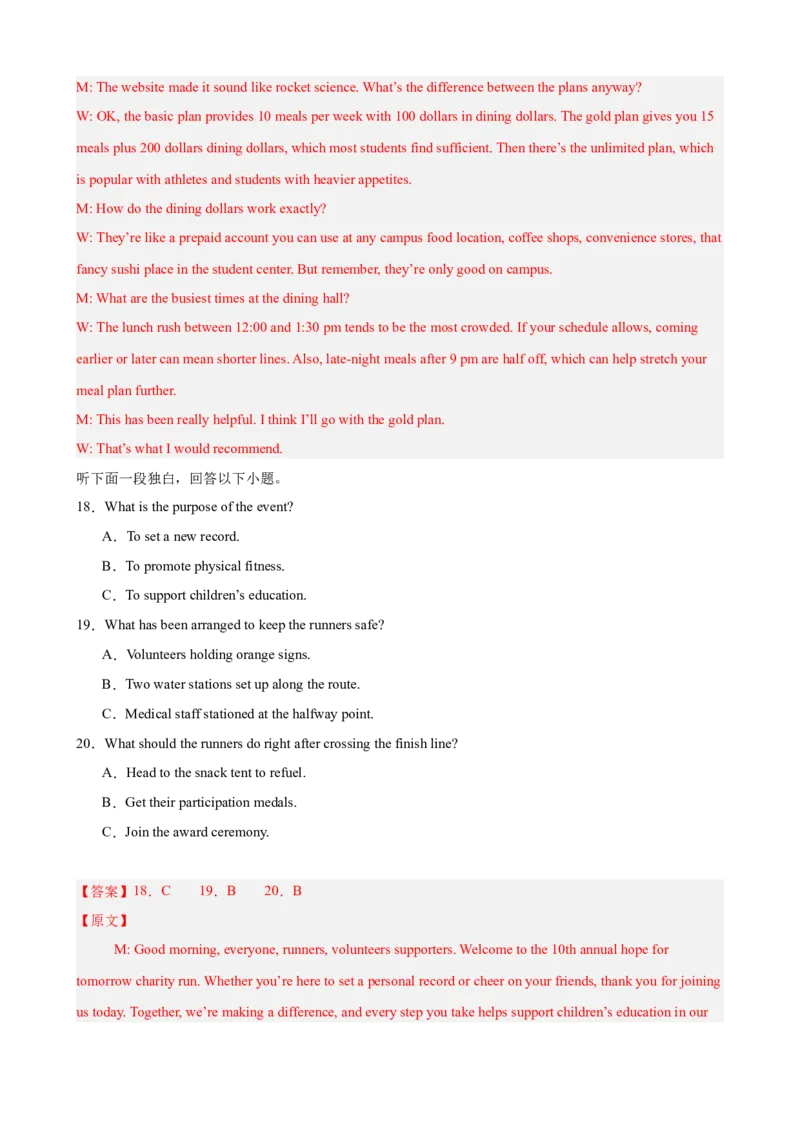
【原文】W: Alright, Taylor. Let’s talk about the most important survival tool on campus. Your meal plan.
M: The website made it sound like rocket science. What’s the difference between the plans anyway?
W: OK, the basic plan provides 10 meals per week with 100 dollars in dining dollars. The gold plan gives you 15
meals plus 200 dollars dining dollars, which most students find sufficient. Then there’s the unlimited plan, which
is popular with athletes and students with heavier appetites.
M: How do the dining dollars work exactly?
W: They’re like a prepaid account you can use at any campus food location, coffee shops, convenience stores, that
fancy sushi place in the student center. But remember, they’re only good on campus.
M: What are the busiest times at the dining hall?
W: The lunch rush between 12:00 and 1:30 pm tends to be the most crowded. If your schedule allows, coming
earlier or later can mean shorter lines. Also, late-night meals after 9 pm are half off, which can help stretch your
meal plan further.
M: This has been really helpful. I think I’ll go with the gold plan.
W: That’s what I would recommend.
听下面一段独白,回答以下小题。
18.What is the purpose of the event?
A.To set a new record.
B.To promote physical fitness.
C.To support children’s education.
19.What has been arranged to keep the runners safe?
A.Volunteers holding orange signs.
B.Two water stations set up along the route.
C.Medical staff stationed at the halfway point.
20.What should the runners do right after crossing the finish line?
A.Head to the snack tent to refuel.
B.Get their participation medals.
C.Join the award ceremony.
【答案】18.C    19.B    20.B
【原文】
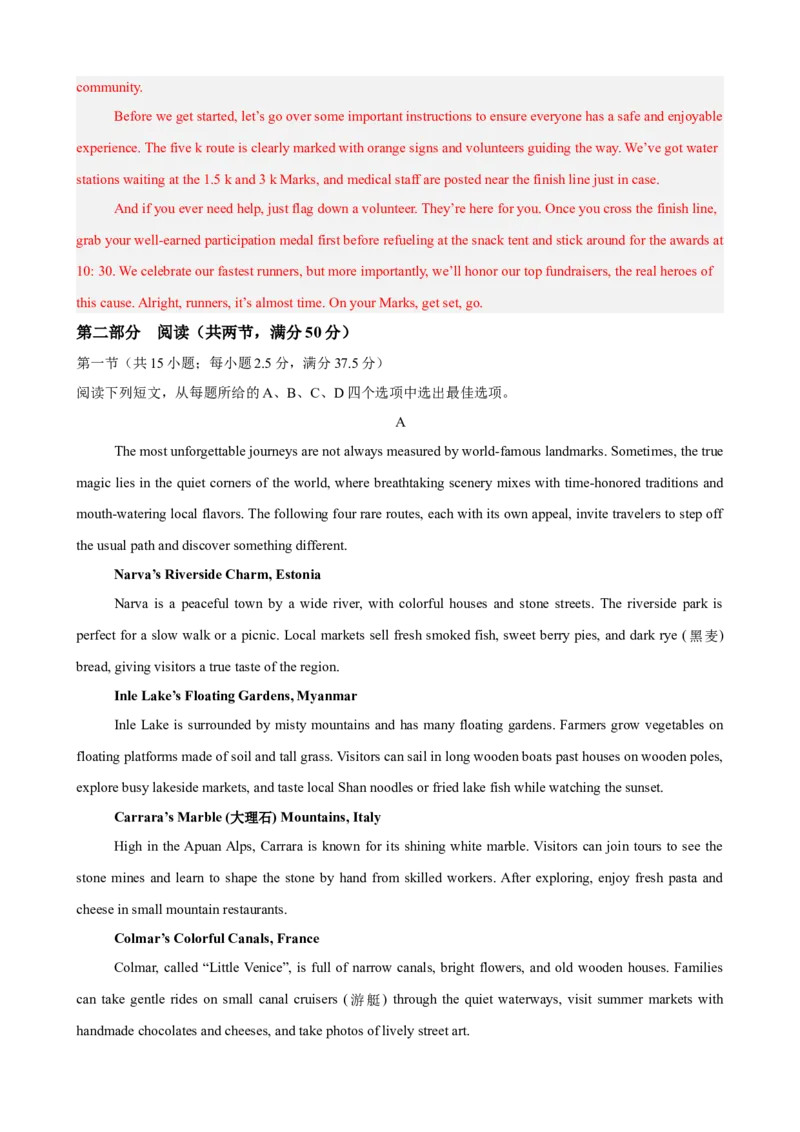
M: Good morning, everyone, runners, volunteers supporters. Welcome to the 10th annual hope for
tomorrow charity run. Whether you’re here to set a personal record or cheer on your friends, thank you for joining
us today. Together, we’re making a difference, and every step you take helps support children’s education in our
community.
Before we get started, let’s go over some important instructions to ensure everyone has a safe and enjoyable
experience. The five k route is clearly marked with orange signs and volunteers guiding the way. We’ve got water
stations waiting at the 1.5 k and 3 k Marks, and medical staff are posted near the finish line just in case.
And if you ever need help, just flag down a volunteer. They’re here for you. Once you cross the finish line,
grab your well-earned participation medal first before refueling at the snack tent and stick around for the awards at
10: 30. We celebrate our fastest runners, but more importantly, we’ll honor our top fundraisers, the real heroes of
this cause. Alright, runners, it’s almost time. On your Marks, get set, go.
第二部分  阅读(共两节,满分50 分)
第一节(共15 小题;每小题2.5 分,满分37.5 分)
阅读下列短文,从每题所给的A、B、C、D 四个选项中选出最佳选项。
A
The most unforgettable journeys are not always measured by world-famous landmarks. Sometimes, the true
magic lies in the quiet corners of the world, where breathtaking scenery mixes with time-honored traditions and
mouth-watering local flavors. The following four rare routes, each with its own appeal, invite travelers to step off
the usual path and discover something different.
Narva’s Riverside Charm, Estonia
Narva is a peaceful town by a wide river, with colorful houses and stone streets. The riverside park is
perfect for a slow walk or a picnic. Local markets sell fresh smoked fish, sweet berry pies, and dark rye ( 黑麦)
bread, giving visitors a true taste of the region.
Inle Lake’s Floating Gardens, Myanmar
Inle Lake is surrounded by misty mountains and has many floating gardens. Farmers grow vegetables on
floating platforms made of soil and tall grass. Visitors can sail in long wooden boats past houses on wooden poles,
explore busy lakeside markets, and taste local Shan noodles or fried lake fish while watching the sunset.
Carrara’s Marble (大理石) Mountains, Italy
High in the Apuan Alps, Carrara is known for its shining white marble. Visitors can join tours to see the
stone mines and learn to shape the stone by hand from skilled workers. After exploring, enjoy fresh pasta and
cheese in small mountain restaurants.
Colmar’s Colorful Canals, France
Colmar, called “Little Venice”, is full of narrow canals, bright flowers, and old wooden houses. Families
can take gentle rides on small canal cruisers ( 游艇) through the quiet waterways, visit summer markets with
handmade chocolates and cheeses, and take photos of lively street art.
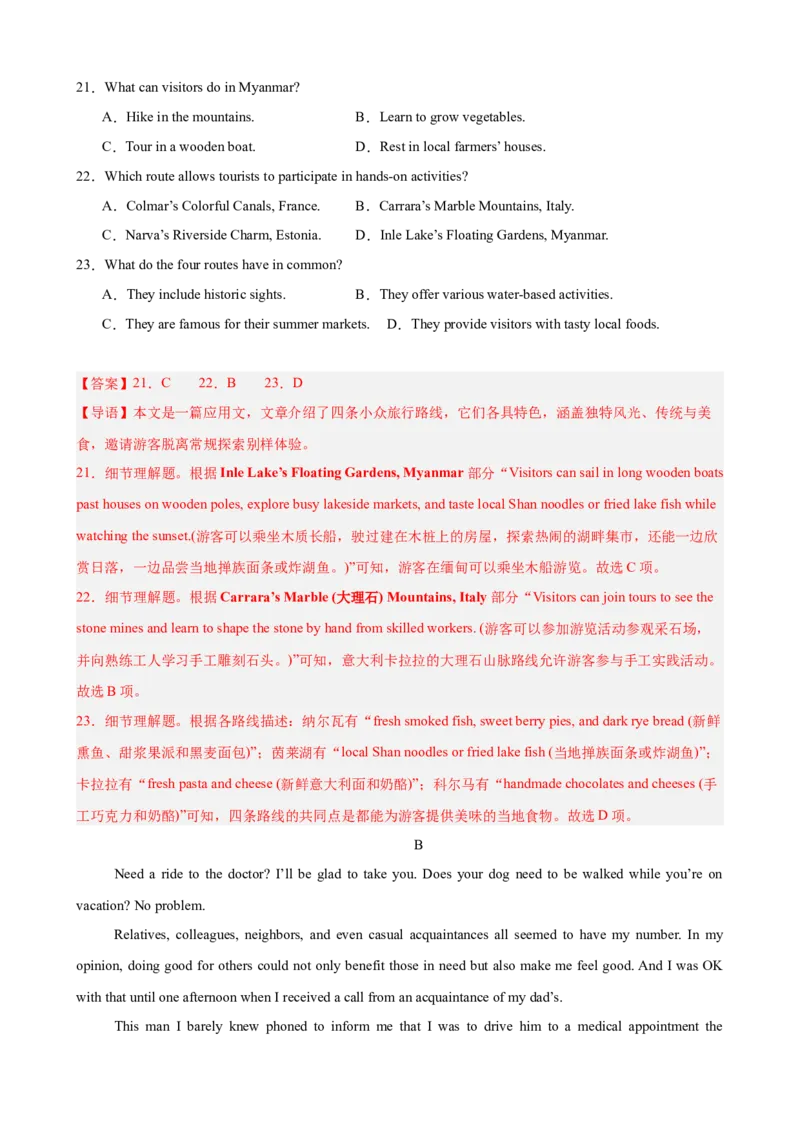
21.What can visitors do in Myanmar?
A.Hike in the mountains.
B.Learn to grow vegetables.
C.Tour in a wooden boat.
D.Rest in local farmers’ houses.
22.Which route allows tourists to participate in hands-on activities?
A.Colmar’s Colorful Canals, France.
B.Carrara’s Marble Mountains, Italy.
C.Narva’s Riverside Charm, Estonia.
D.Inle Lake’s Floating Gardens, Myanmar.
23.What do the four routes have in common?
A.They include historic sights.
B.They offer various water-based activities.
C.They are famous for their summer markets.
D.They provide visitors with tasty local foods.
【答案】21.C    22.B    23.D
【导语】本文是一篇应用文,文章介绍了四条小众旅行路线,它们各具特色,涵盖独特风光、传统与美
食,邀请游客脱离常规探索别样体验。
21.细节理解题。根据Inle Lake’s Floating Gardens, Myanmar 部分“Visitors can sail in long wooden boats
past houses on wooden poles, explore busy lakeside markets, and taste local Shan noodles or fried lake fish while
watching the sunset.(游客可以乘坐木质长船,驶过建在木桩上的房屋,探索热闹的湖畔集市,还能一边欣
赏日落,一边品尝当地掸族面条或炸湖鱼。)”可知,游客在缅甸可以乘坐木船游览。故选C 项。
22.细节理解题。根据Carrara’s Marble (大理石) Mountains, Italy 部分“Visitors can join tours to see the
stone mines and learn to shape the stone by hand from skilled workers. (游客可以参加游览活动参观采石场,
并向熟练工人学习手工雕刻石头。)”可知,意大利卡拉拉的大理石山脉路线允许游客参与手工实践活动。
故选B 项。
23.细节理解题。根据各路线描述:纳尔瓦有“fresh smoked fish, sweet berry pies, and dark rye bread (新鲜
熏鱼、甜浆果派和黑麦面包)”;茵莱湖有“local Shan noodles or fried lake fish (当地掸族面条或炸湖鱼)”;
卡拉拉有“fresh pasta and cheese (新鲜意大利面和奶酪)”;科尔马有“handmade chocolates and cheeses (手
工巧克力和奶酪)”可知,四条路线的共同点是都能为游客提供美味的当地食物。故选D 项。
B
Need a ride to the doctor? I’ll be glad to take you. Does your dog need to be walked while you’re on
vacation? No problem.
Relatives, colleagues, neighbors, and even casual acquaintances all seemed to have my number. In my
opinion, doing good for others could not only benefit those in need but also make me feel good. And I was OK
with that until one afternoon when I received a call from an acquaintance of my dad’s.
This man I barely knew phoned to inform me that I was to drive him to a medical appointment the
following Tuesday. I checked my calendar. Then I told him as nicely as possible that I couldn’t help him that day
because of my tight schedule. His reaction wasn’t very kind.
At that moment, I checked my calendar carefully. I was averaging 14 good deeds a month. I stepped away
from the calendar, eyes finally opened, and took a closer look at myself in the mirror. Dark circles shadowed my
eyes. I didn’t feel like my usual energetic self. Clearly, it was time for me to change.
I brought my concerns to my friend Lucille. Though she was another busy woman, she still had time to
socialize and get a good night’s rest. How did she manage all that? She gave me her secret in one word: limits.
She told me not to run every time someone calls. Instead, ask the person some key questions: Is this an
emergency? Is someone else available to help you? Is this something that can wait? And, the question I knew I
should have been considering all along: Is this something you could do for yourself?
Now I consider those questions before rushing to another’s aid. Thanks to cutting down the favors I do for
others, I have more energy and sleep better at night. Though I was fearful cutting back on my kindness would
have met with disapproval, those friends and relatives started showing some real appreciation for my help. Now,
sometimes, they even help me when I’m in need. And that may be the greatest benefit of all.
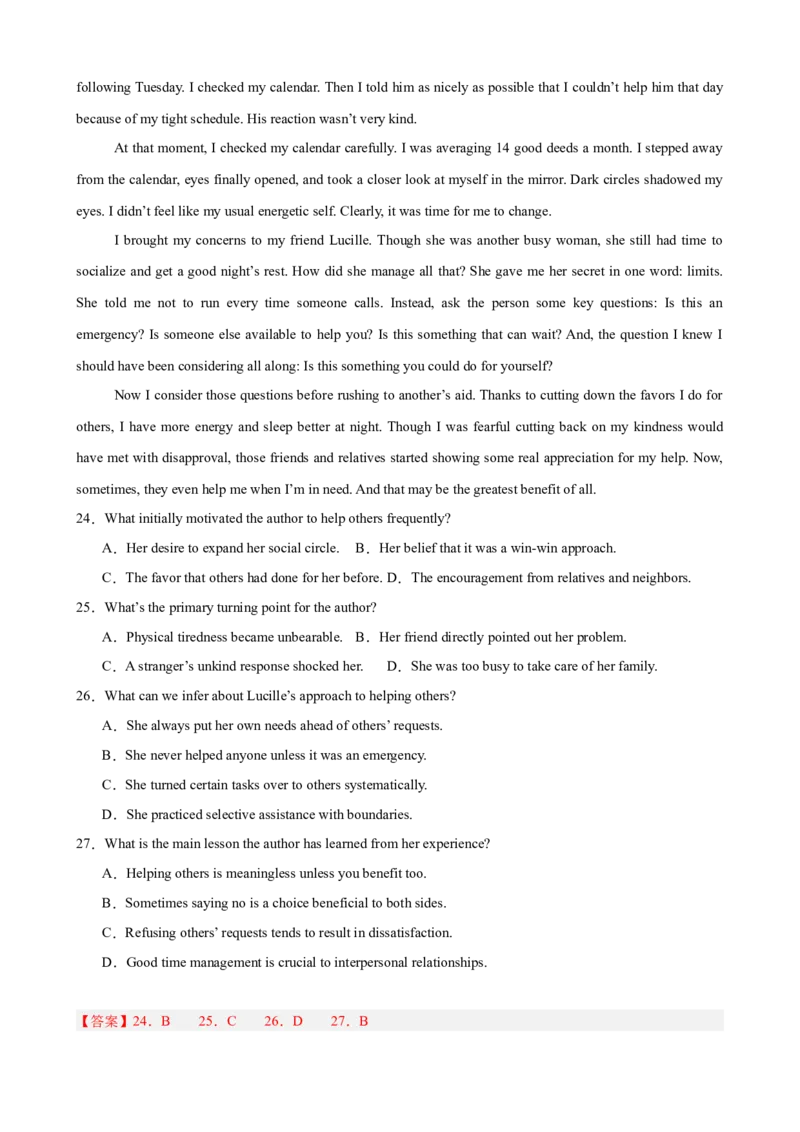
24.What initially motivated the author to help others frequently?
A.Her desire to expand her social circle.
B.Her belief that it was a win-win approach.
C.The favor that others had done for her before. D.The encouragement from relatives and neighbors.
25.What’s the primary turning point for the author?
A.Physical tiredness became unbearable.
B.Her friend directly pointed out her problem.
C.A stranger’s unkind response shocked her.
D.She was too busy to take care of her family.
26.What can we infer about Lucille’s approach to helping others?
A.She always put her own needs ahead of others’ requests.
B.She never helped anyone unless it was an emergency.
C.She turned certain tasks over to others systematically.
D.She practiced selective assistance with boundaries.
27.What is the main lesson the author has learned from her experience?
A.Helping others is meaningless unless you benefit too.
B.Sometimes saying no is a choice beneficial to both sides.
C.Refusing others’ requests tends to result in dissatisfaction.
D.Good time management is crucial to interpersonal relationships.
【答案】24.B    25.C    26.D    27.B
【导语】本文是一篇记叙文。文章讲述了作者过度助人导致身心俱疲,学会拒绝后反而获得了更好的人
际关系。
24.细节理解题。根据第二段中“In my opinion, doing good for others could not only benefit those in need
but also make me feel good.(在我看来,为他人做好事不仅能让那些需要帮助的人受益,也能让我感觉良
好)”可知,作者最初频繁帮助他人是出于认为这是一种双赢的做法,既帮助了别人,自己又感觉良好。故
选B。
25.细节理解题。根据第三段中“This man I barely knew phoned to inform me that I was to drive him to a
medical appointment the following Tuesday. I checked my calendar. Then I told him as nicely as possible that I
couldn’t help him that day because of my tight schedule. His reaction wasn’t very kind.(这个我几乎不认识的人
打电话告诉我,下周二我要开车送他去看医生。我查看了日程表。然后我尽可能礼貌地告诉他,那天我
因为日程安排很紧,帮不了他。他的反应不太友好)”以及第四段中“At that moment, I checked my calendar
carefully. I was averaging 14 good deeds a month. I stepped away from the calendar, eyes finally opened, and took
a closer look at myself in the mirror. Dark circles shadowed my eyes. I didn’t feel like my usual energetic self.
Clearly, it was time for me to change.(那一刻,我仔细查看了日程表。我平均每月做14 件好事。我离开日程
表,终于睁开了眼睛,对着镜子仔细端详自己。黑眼圈笼罩着我的眼睛。我感觉不像平时那样精力充沛。
显然,是时候做出改变了)”可知,作者在因为日程紧无法帮助一个几乎不认识的人,而这个人反应不友好
后,意识到自己需要改变,这是作者的主要转折点。故选C。
26.推理判断题。根据第五段中“She gave me her secret in one word: limits. She told me not to run every
time someone calls. Instead, ask the person some key questions: Is this an emergency? Is someone else available
to help you? Is this something that can wait? And, the question I knew I should have been considering all along: Is
this something you could do for yourself?(她用一个词告诉了我她的秘诀:界限。她告诉我不要每次有人打
电话就跑去帮忙。相反,问对方一些关键问题:这是紧急情况吗?还有其他人可以帮你吗?这是可以等
待的事情吗?还有,我知道我一直应该考虑的问题:这是你自己能做的事情吗?)”可推知,Lucille 帮助别
人的方式是有界限的,会进行选择性帮助。故选D。
27.推理判断题。根据最后一段中“Now I consider those questions before rushing to another’s aid. Thanks to
cutting down the favors I do for others, I have more energy and sleep better at night. Though I was fearful cutting
back on my kindness would have met with disapproval, those friends and relatives started showing some real
appreciation for my help. Now, sometimes, they even help me when I’m in need. And that may be the greatest
benefit of all.(现在,在匆忙去帮助别人之前,我会考虑这些问题。由于减少了为别人做的帮助,我有了更
多的精力,晚上也睡得更好。虽然我担心减少我的善意会遭到反对,但那些朋友和亲戚开始对我的帮助
表示真正的感激。现在,有时候,他们甚至在我需要的时候帮助我。这可能是最大的好处)”可推知,作者
从自己的经历中学到的最主要教训是有时候拒绝别人对双方都有好处。故选B。
C
Nowadays, many Chinese tourists are so troubled by holiday crowds that seeking out unheralded (冷门的)
destinations has become a trend known as “reverse travel”. Aside from providing people with better travel
experiences with fewer crowds, reverse travel also meets their need for novelty and uniqueness.
A key driver of travelers heading to lesser-known cities is cost. While the Labor Day holiday saw record
numbers of domestic travelers, average spending per person remained below pre-pandemic levels according to a
report. Hotels in lesser-known cities can be five times cheaper than in Beijing or Shanghai.
The reverse travel trend has seen surging bookings in smaller cities, driven mostly by young people
escaping the crowds on Shanghai’s Nanjing Road or in Beijing’s Forbidden City. Wang Xinyu is one of them.
During the Labor Day holiday, she left for Weihai, a less famous city for traveling. “Not only can I experience the
local way of life by wandering through a park or exploring a market, but the hotel here also costs only a third of
the price of Nanjing’s downtown hotels — it’s much more cost-effective,” says Wang.
However, escaping large popular cities doesn’t guarantee better experiences. The recent virality of niche
(小众的) travel spots has revealed formerly hidden gems (宝石) to more travelers, but many small towns and rural
areas aren’t well equipped to handle the new tourist influx. Handan, a city of 9 million in Hebei Province, suffered
overcrowding during the Labor Day holiday when it was listed as the seventh most popular “niche” travel spot by
social media. Those who come with high hopes of idyllic ( 田园风的) breaks often instead find limited public
transport, entertainment facilities, and charm. Some even report boredom.
No destination or time is perfect. Either visitors see famous sites and face the crowds, or head off the beaten
track and endure worse accommodation and transport options. “With the crazy amount of people traveling now,
you have to let go of something if you want some peace and quiet,” says Mr. Zhai, a tourism researcher from
Beijing.
28.Why does the author mention Wang Xinyu’s traveling experience?
A.To explain how to choose hotels.
B.To introduce Weihai’s scenic spots.
C.To present reverse travel’s advantages.
D.To prove young people love traveling.
29.What might have caused unpleasant reverse traveling experiences?
A.Low budget way of traveling.
B.Higher hotel costs during holidays.
C.Overcrowding in famous destinations.
D.Inadequate facilities in small destinations.
30.What might be Mr. Zhai’s attitude to traveling?
A.Travelers prefer unheralded spots.
B.Travelers need to think carefully.
C.Traditional tours are in decline.
D.Reverse travel is a new trend.
31.What would be a suitable title for the text?
A.Reverse Travel: Trends and Troubles
B.Cost-effective Holidays Gain Popularity
C.Holiday Crowds Trouble Chinese Tourists
D.Famous Attractions VS Small Destinations
【答案】28.C    29.D    30.B    31.A
【导语】这是一篇说明文。文章主要介绍了“反向旅行”这一新兴旅游趋势,包括其背后的原因、优势
以及可能带来的问题。
28.推理判断题。根据第三段“Wang Xinyu is one of them. During the Labor Day holiday, she left for Weihai,
a less famous city for traveling. “Not only can I experience the local way of life by wandering through a park or
exploring a market, but the hotel here also costs only a third of the price of Nanjing’s downtown hotels — it’s
much more cost-effective,” says Wang. (王馨宇就是其中之一。劳动节假期期间,她去了威海,一个不太有
名的旅游城市。王馨宇说:“我不仅可以通过在公园漫步或逛市场来体验当地的生活方式,而且这里的
酒店价格也只有南京市区酒店价格的三分之一——这要划算得多。”)”可知,王馨宇的旅行经历展示了反
向旅行的好处,即能体验当地生活方式且费用较低。故选C。
29.细节理解题。根据第四段“However, escaping large popular cities doesn’t guarantee better experiences.
The recent virality of niche travel spots has revealed formerly hidden gems to more travelers, but many small
towns and rural areas aren’t well equipped to handle the new tourist influx. (然而,逃离大型热门城市并不能保
证有更好的体验。最近小众旅游景点的流行向更多的旅行者揭示了以前隐藏的宝石,但许多小镇和农村
地区并没有很好的设施来应对新的游客涌入。)”可知,小型旅游目的地的设施不足可能导致不愉快的反向
旅行体验。故选D。
30.推理判断题。根据最后一段“No destination or time is perfect. Either visitors see famous sites and face the
crowds, or head off the beaten track and endure worse accommodation and transport options. “With the crazy
amount of people traveling now, you have to let go of something if you want some peace and quiet,” says Mr.
Zhai, a tourism researcher from Beijing. (没有完美的目的地或时间。游客要么去看著名的景点,面对人群,
要么走不寻常的路,忍受更差的住宿和交通选择。北京的一位旅游研究员翟先生说:“现在旅行的人太
多了,如果你想要一些宁静,你就必须放弃一些东西。”)”可知,翟先生认为旅行者需要仔细考虑,权衡
利弊,做出选择。故选B。
31.主旨大意题。根据第一段“Nowadays, many Chinese tourists are so troubled by holiday crowds that
seeking out unheralded destinations has become a trend known as “reverse travel”. (如今,许多中国游客被假日
人群所困扰,以至于寻找鲜为人知的目的地已成为一种被称为“反向旅行”的趋势。)”和最后一段“No
destination or time is perfect. (没有完美的目的地或时间。)”以及文章中间部分介绍了反向旅行的优势和可
能带来的问题可知,这篇文章主要讨论了反向旅行的趋势及其带来的麻烦,所以选项A:“反向旅游:
趋势与问题”适合作为文章标题。故选A。
D
If you ask a Westerner to name a successful Chinese consumer-goods brand, most would have struggled
until recently. Although China is the world’s leading manufacturing power, it has long fallen behind in creating
imaginative, home-grown retail (零售) brands and products. That, however, is beginning to change.
Innovative Chinese brands are appearing everywhere. From Stockholm to Sydney, the electric cars silently
passing by are increasingly likely to be Chinese. Mixue, an ice-cream and cold drinks company, has overtaken
McDonald’s to become the world’s largest fast-food chain by number of outlets. It is expanding in South America,
as is Meituan, a Beijing-based delivery app. Chagee, a chain of tea shops, is on track to have at least 1, 300 stores
outside China by the end of 2027, mostly in Southeast Asia; just a few years ago, it had almost none. Meanwhile,
Pop Mart, a Chinese toy company, has created a buzz as much as Disney with its unusual grinning nine-toothed
dolls, called Labubus. It is impossible not to admire the creative force behind these successful enterprises.
Western consumers have been buying products made in China for decades. However, these goods were
mostly designed by and produced for foreign companies. Chinese brands were long regarded as low-quality and
lacking creativity.
New companies are now challenging these old assumptions. Many proudly emphasize their Chinese
heritage. For example, Chagee’s logo features a Peking Opera singer in full costume, and its name comes from
“Farewell, My Concubine,” a classic Chinese opera. The video game “Black Myth: Wukong,” one of the most
successful ever, features the Monkey King from the 16th-century novel Journey to the West.
Today, many Chinese brands compete not only on price but also on quality. Chagee’s drinks can even be as
expensive as Starbucks’. Western companies will need to wake up and take notice of bubble tea. In the future, they
will have to make more efforts to understand Chinese consumers’ unique tastes. Some may even partner with
innovative Chinese firms to gain insight and inspiration. Competition from China could eventually push Disney,
Mattel toys, and other major Western brands to reach new levels of creativity.
32.What does the underlined part “created a buzz” in paragraph 2 probably mean?
A.Caused public excitement.
B.Made a loud noise.
C.Lost great popularity.
D.Received negative comments.
33.How did the western consumers find Chinese brands?
A.Full of imagination.
B.Short of creativity. C.Quality guaranteed. D.Mass
produced.
34.What is the author’s advice for the western brands?
A.Notice different bubble tea.
B.Ignore the Chinese influence.
C.Cooperate with Chinese brands.
D.Lower the price of the products.
35.What is the passage mainly about?
A.The history of Chinese retail brands.
B.How foreign firms win Chinese customers.
C.Why Chinese products were unpopular before.
D.The rise of innovative Chinese brands globally.
【答案】32.A    33.B    34.C    35.D
【导语】本文是一篇说明文。文章讲述了中国消费品牌在全球范围内迅速崛起的现象。尽管过去中国以
制造为主,缺乏自主品牌,但现在像Mixue、Meituan、Chagee 等创新品牌已在全球市场取得成功,引发
西方品牌的关注和反思,迫使它们重视中国市场和合作。
32.词句猜测题。根据文章第二段中“Meanwhile, Pop Mart, a Chinese toy company, has created a buzz as
much as Disney with its unusual grinning nine - toothed dolls, called Labubus.(与此同时,中国玩具公司泡泡玛
特凭借其不同寻常的咧嘴露九颗牙的玩偶Labubus,引起了和迪士尼一样的……。)”可知,泡泡玛特凭借
其独特的玩偶和迪士尼一样引起了公众的广泛关注和兴奋,所以“created a buzz”意思是“引起了公众的
兴奋”。A 选项“Caused public excitement.(引发公众的兴奋)”符合语境。故选A。
33.细节理解题。根据文章第三段中“However, these goods were mostly designed by and produced for
foreign companies. Chinese brands were long regarded as low-quality and lacking creativity. (然而,这些商品大
多是由外国公司设计并生产的。长期以来,中国品牌一直被认为质量低劣且缺乏创新性。)”可知,西方消
费者认为中国品牌缺乏创造力。故选B。
34.推理判断题。根据文章最后一段中“Some may even partner with innovative Chinese firms to gain insight
and inspiration.(一些西方公司甚至可能与创新的中国公司合作,以获得洞察力和灵感。)”可知,作者建议
西方品牌与中国品牌合作。C 选项“Cooperate with Chinese brands.( 与中国品牌合作。)”符合题意。故选
C。
35.主旨大意题。根据文章第一段中“Although China is the world’s leading manufacturing power, it has long
fallen behind in creating imaginative, home-grown retail (零售) brands and products. That, however, is beginning
to change.(尽管中国是全球领先的制造业大国,但长期以来,在打造富有创意、本土原创的零售品牌及产
品方面,中国一直落后于其他国家。不过,这种情况正在发生改变。)”以及第二段中“Innovative Chinese
brands are appearing everywhere.(创新的中国品牌无处不在。)”以及后文对中国品牌在全球崛起的描述可知,
文章主要讲述了创新的中国品牌在全球的崛起。D 选项“The rise of innovative Chinese brands globally.(中
国创新品牌在全球范围内的崛起。)”符合题意。故选D。
第二节(共5 小题;每小题2.5 分,满分12.5 分)
阅读下面短文,从短文后的选项中选出可以填入空白处的最佳选项。选项中有两项为多余选项。
Thirst is one of the fundamental urges an organism can have. After all, water is the substance that we rely
on to transport essential molecules ( 分子) and other particles around our bodies to keep us alive.     36

Shouldn’t we have developed a taste for this essential substance?
    37     Several new studies seem to show not only that water does, in fact, have a taste, but that we
might have taste buds (味蕾) that respond directly to it.
We now know that there are at least five basic tastes: salty, sour, sweet, bitter and umami.     38

Researchers have sought to solve the issue once and for all. They’ve figured out an experiment that seeks to
identify any water-sensing taste receptor cells (TRCs) on the tongues of lab mice.
The team first used a technique known as genetic knockout to silence different types of TRCs, in order to
remove the possibility that those cells might accidentally discover some other taste within the water besides the
water itself.     39     It turned out that the acid-sensing sour TRCs were still firing actively, indicating these
cells might have a double purpose, capable of distinguishing water or acidic fluids.
So if you’re on the side of the debate that argues that water is flavorless, you might still be correct.     40
The study also opens up the possibility that our tongues and taste buds might be doing more than merely
providing us with a sense of taste. If this study doesn’t prove that water is the sixth flavor, it might still be the first
evidence of a whole other sense entirely: a water sense.
A.Well, perhaps we have.
B.Actually, we have a sixth taste for water.
C.Our taste buds are tied to a flavor of water.
D.So it’s perhaps a bit doubtful that water doesn’t seem to have any flavor.
E.But water isn’t senseless, at least it doesn’t appear that way according to this research.
F.They then washed their mouths with water to see if any cells were still responding.
G.If there is a sixth taste for water exists, then there should be evidence somewhere in the mouth or tongue.
【答案】36.D    37.A    38.G    39.F    40.E
【导语】这是一篇说明文。文章主要讲述了人们通常认为平时喝的水是没有味道的,但几项新的研究表
明似乎水具有某种味道,至少是可以被人感觉到的。
36.根据上文“Thirst is one of the fundamental urges an organism can have. After all, water is the substance
that we rely on to transport essential molecules (分子) and other particles around our bodies to keep us alive.(口
渴是生物体可能产生的最基本的需求之一。毕竟,水是我们赖以在体内运输各种重要分子和粒子以维持
生命所必需的物质)”以及后文“Shouldn’t we have developed a taste for this essential substance?(我们难道不
该对这种必需物质产生味觉吗?)”可知,前文强调“水对生命至关重要,口渴是基本欲望”,后文以反问
“我们难道不该对这种必需物质产生味觉吗”承接。选项D“因此,水似乎没有任何味道这件事可能有点
令人怀疑”既总结前文“水的重要性”,又通过“怀疑”引出后文对“水是否有味道”的探讨,形成因
果逻辑,衔接自然。故选D。
37.根据后文“Several new studies seem to show not only that water does, in fact, have a taste, but that we
might have taste buds (味蕾) that respond directly to it.(几项新的研究似乎表明,水确实具有自身的味道,而
且我们的味蕾或许还能直接对水的味道做出反应)”以及前文用反问句提出“是否该对水有味觉”,后文则
给出研究结论“水确实有味道,且可能有感知水的味蕾”。选项A“嗯,或许我们已经有这种味觉了”直
接回应前文反问,用“或许”呼应研究结论的探索性,起到“承上启下”的过渡作用。故选A。
38.根据上文“We now know that there are at least five basic tastes: salty, sour, sweet, bitter and umami.(我们
现在知道,至少存在五种基本的味道:咸味、酸味、甜味、苦味和鲜味)”以及后文“Researchers have
sought to solve the issue once and for all. They’ve figured out an experiment that seeks to identify any water-
sensing taste receptor cells (TRCs) on the tongues of lab mice.(研究人员一直试图彻底解决这个问题。他们设
计了一个实验,旨在找出实验鼠舌头上的任何能感知水分的味觉受体细胞(TRC))”可知,前文提到“已
知至少五种基本味觉”,后文转而描述“研究人员通过实验寻找小鼠舌头上感知水的味觉受体细胞”。
选项G“如果存在第六种‘水味’,那么在口腔或舌头上某处应该有证据”衔接“五种味觉”与“寻找水
味证据”,为后文实验的目的做铺垫,逻辑连贯。故选G。
39.根据上文“The team first used a technique known as genetic knockout to silence different types of TRCs, in
order to remove the possibility that those cells might accidentally discover some other taste within the water
besides the water itself.(该团队首先采用了名为“基因敲除”的技术来抑制不同类型的味觉受体细胞,以排
除这些细胞可能意外地在水中发现除水本身之外的其他味道的可能性)”以及后文“It turned out that the
acid-sensing sour TRCs were still firing actively, indicating these cells might have a double purpose, capable of
distinguishing water or acidic fluids.(结果表明,能够感知酸味的酸敏感味觉受体细胞仍在活跃地工作,这
表明这些细胞可能具有双重功能,既能辨别水,也能辨别酸性液体)”可知,前文介绍实验第一步“用基因
敲除技术沉默不同味觉受体细胞”,后文则呈现结果“感知酸味的细胞仍活跃,可能兼具感知水的功
能”。选项F“然后他们用水漱口,观察是否有细胞仍在反应”承接前文“沉默细胞”的操作,描述实验
第二步,符合“先处理细胞→再测试反应”的实验流程,衔接实验步骤与结果。故选F。
40.根据上文“So if you’re on the side of the debate that argues that water is flavorless, you might still be
correct.(所以,如果你站在那种认为水没有味道的观点那一方,那么你或许还是正确的)”以及后文“The
study also opens up the possibility that our tongues and taste buds might be doing more than merely providing us
with a sense of taste. If this study doesn’t prove that water is the sixth flavor, it might still be the first evidence of
a whole other sense entirely: a water sense.(这项研究还提出了一种可能性,即我们的舌头和味蕾的功能可能
远不止是让我们感受到味道。即便这项研究无法证实水是第六种味道,它仍可能是首个揭示出一种全新
感官存在的证据:一种与水相关的独特感知)”可知,前文认可“认为水无味可能正确”,后文则转折指出
“研究揭示味蕾可能不仅负责味觉,还可能存在‘水觉’”。选项E“但水并非无法感知,至少根据这项
研究来看并非如此”用“但”形成转折,既不否定前文观点,又引出后文“水可被感知”的新发现,符
合上下文逻辑。故选E。
第三部分  语言运用(共两节,满分30 分)
第一节  (共15 小题;每小题1 分,满分15 分)
阅读下面短文,从每题所给的A、B、C、D 四个选项中选出可以填入空白处的最佳选项。
I had spent the previous decade working    41    toward my goal of becoming a professor. However,
after my 30th birthday, the attraction of academia    42   . I decided to    43    my academic career plans
and set my sights on business.
Soon, an offer arrived: a six figure research    44    in product development. It seemed to be everything
I    45   , so I took it. Yet, later I found I was back to the    46    tasks I’d once completed as an
undergraduate research assistant.
Repeated routine work wasn’t where I wanted to be in my career. I was more    47    — I wanted to
48    projects and lead a team. But the general manager wouldn’t give those    49    to me until I’d proved
myself.
I realized I need to let go of the idea that I was already a(n) “    50    ” in my field. I had to become a(n)
51     once again. So, in the months that followed, I set out to learn everything I could about my new career. In
some ways, product development was     52     to my academic research. But in other ways, it was vastly
different. I needed to create profit, not just     53    .
As I read professional materials passionately, I realized my PhD gave me a “learner” personality — loving
to     54     and grow. Two years later, I became the chief engineer at the company. When asked to describe
my greatest     55    , I smiled and said: “I have a PhD.I learn incredibly fast.”
41.A.frequently
B.continually
C.unwillingly
D.occasionally
42.A.faded
B.exchanged
C.increased
D.appeared
43.A.try out for
B.take pride in
C.get rid of
D.come up with
44.A.project
B.salary
C.demand
D.position
45.A.owned
B.harvested
C.designed
D.expected
46.A.mixed
B.difficult
C.dull
D.burdensome
47.A.independent
B.ambitious
C.promising
D.generous
48.A.manage
B.change
C.fund
D.study
49.A.benefits
B.responsibilities
C.congratulations
D.pressures
50.A.expert
B.professor
C.partner
D.performer
51.A.member
B.manager
C.student
D.engineer
52.A.equal
B.similar
C.helpful
D.contradictory
53.A.products
B.opportunities
C.knowledge
D.accounts
54.A.expand
B.negotiate
C.advocate
D.recite
55.A.principle
B.aim
C.decision
D.strength
【答案】
41.B    42.A    43.C    44.D    45.D    46.C    47.B    48.A    49.B    50.A
51.C    52.B    53.C    54.A    55.D
【导语】本文是一篇记叙文。文章讲述了作者从追求成为教授的学术道路转向商业领域,虽然初期陷入
重复性工作,但凭借博士学位培养的学习能力,最终成长为首席工程师,并认识到持续学习的重要性。
41.考查副词词义辨析。句意:在过去的十年里,我一直在不断地朝着成为教授的目标努力。A.
frequently 频繁地;B. continually 不断地;C. unwillingly 不情愿地;D. occasionally 偶尔地。根据后文
“toward my goal of becoming a professor”可知,作者一直在朝着成为教授的目标不断努力。故选B 项。
42.考查动词词义辨析。句意:然而,在我30 岁生日之后,学术界的吸引力逐渐消失了。A. faded 褪色,
消失;B. exchanged 交换;C. increased 增加;D. appeared 出现。根据后文“I decided to  ___3___  my
academic career plans and set my sights on business.”可知,作者决定放弃学术生涯,转向商业,说明学术界
的吸引力逐渐消失了。故选A 项。
43.考查动词短语辨析。句意:我决定放弃我的学术生涯计划,将目光投向商业。A. try out for 参加选拔;
B. take pride in 以……为傲;C. get rid of 摆脱,放弃;D. come up with 提出。根据后文“set my sights on
business”可知,作者决定放弃学术生涯,转向商业。故选C 项。
44.考查名词词义辨析。句意:很快,一个机会来了:一个六位数的产品开发研究职位。A. project 项目;
B. salary 薪水;C. demand 需求;D. position 职位。根据后文“in product development”可知,这里指的是一
个产品开发的研究职位。故选D 项。
45.考查动词词义辨析。句意:这似乎是我所期望的一切,所以我接受了。A. owned 拥有;B. harvested
收获;C. designed 设计;D. expected 期望。根据后文“so I took it”可知,作者接受了这个职位,说明这是
他所期望的。故选D 项。
46.考查形容词词义辨析。句意:然而,后来我发现我又回到了曾经作为本科研究助理时完成的枯燥任
务。A. mixed 混合的;B. difficult 困难的;C. dull 枯燥的;D. burdensome 负担重的。根据后文“Repeated
routine work wasn’t where I wanted to be in my career.”可知,作者不想从事重复性的日常工作,说明这些任
务是枯燥的。故选C 项。
47.考查形容词词义辨析。句意:我更有雄心壮志了——我想管理项目和领导团队。A. independent 独立
的;B. ambitious 有雄心的;C. promising 有前途的;D. generous 慷慨的。根据后文“I wanted
to  ___8___  projects and lead a team.”可知,作者想管理项目和领导团队,说明他更有雄心壮志了。故选B
项。
48.考查动词词义辨析。句意:我更有雄心壮志了——我想管理项目和领导团队。A. manage 管理;B.
change 改变;C. fund 资助;D. study 学习。根据后文“and lead a team”以及语境可知,作者想管理项目和
领导团队。故选A 项。
49.考查名词词义辨析。句意:但是总经理在我证明自己之前不会给我这些责任。A. benefits 利益;B.
responsibilities 责任;C. congratulations 祝贺;D. pressures 压力。根据上文“I wanted to  ___8___  projects
and lead a team.”以及后文“until I’d proved myself”可知,作者想管理项目和领导团队,但是总经理在他证
明自己之前不会给他这些责任。故选B 项。
50.考查名词词义辨析。句意:我意识到我需要放弃我已经是该领域“专家”的想法。A. expert 专家;B.
professor 教授;C. partner 伙伴;D. performer 表演者。根据后文“in my field”可知,作者曾经是学术界的,
现在转向商业界,他需要放弃自己已经是该领域“专家”的想法。故选A 项。
51.考查名词词义辨析。句意:我必须再次成为一名学生。A. member 成员;B. manager 经理;C. student
学生;D. engineer 工程师。根据后文“So, in the months that followed, I set out to learn everything I could
about my new career.”可知,作者决定学习关于新职业的一切,说明他必须再次成为一名学生。故选C 项。
52.考查形容词词义辨析。句意:在某些方面,产品开发与我的学术研究相似。A. equal 平等的;B.
similar 相似的;C. helpful 有帮助的;D. contradictory 矛盾的。根据后文“But in other ways, it was vastly
different.”可知,产品开发与作者的学术研究在某些方面相似,但在其他方面却大不相同。故选B 项。
53.考查名词词义辨析。句意:我需要创造利润,而不仅仅是知识。A. products 产品;B. opportunities 机
会;C. knowledge 知识;D. accounts 账户。根据上文“In some ways, product development was ___12___ to
my academic research.”以及“I needed to create profit”可知,作者在商业界需要创造利润,而不仅仅像学术
研究只积累知识。故选C 项。
54.考查动词词义辨析。句意:当我热情地阅读专业材料时,我意识到我的博士学位给了我一个“学习
者”的个性——喜欢扩展和成长。A. expand 扩展;B. negotiate 谈判;C. advocate 提倡;D. recite 背诵。根
据后文“and grow”以及语境可知,作者的博士学位使他喜欢扩展知识和成长。故选A 项。
55.考查名词词义辨析。句意:当被问及描述我最大的优势时,我微笑着说:“我有博士学位。我学得
非常快。”A. principle 原则;B. aim 目标;C. decision 决定;D. strength 优势。根据后文“I have a PhD. I
learn incredibly fast.”可知,作者认为自己的博士学位和快速学习能力是最大的优势。故选D 项。
第二节(共10 小题;每小题1. 5 分, 满分15 分)
阅读下面材料,在空白处填入适当的内容(1 个单词)或所给单词的正确形式。
With profits jumping to nearly 1.3 billion yuan at the box office as of Aug 26, the ink-wash animated film
Nobody has broken    56    previous record set by Big Fish & Begonia (2016), making it the highest-
earning domestic 2D animated film in Chinese cinema history.
The film follows four small monsters — a pig, a toad, a weasel, and an ape — who disguise     57

characters from Journey to the West, seeking to live forever before finding themselves protecting villagers from
evil     58     (force).
     59     (create) the film’s unique Chinese animation style, Yu Shui, director of the film, and his team
conducted field research from northern to southern Shanxi, bringing the beauty of the     60     (province)
ancient architecture onto the silver screen.
“During production, integrating a large number of Shanxi landmarks and elements of ancient architecture
into the film     61     (drive) primarily by the needs of the plot, as these fantastic structures could enhance the
film.     62     (additional), it’s because I am from Taiyuan and have a deep emotional connection to these
ancient buildings,” Yu said.
At the recently     63     (conclude) 7th Shanxi Cultural Industries Fair, Yu invited moviegoers to visit
the province     64     inspired its ancient architectural scenes. The director’s invitation highlights a dynamic
phenomenon in the country’s creative industries — using advanced technology to revive cultural heritage not
within the museums but through engaging and      65      (access) mediums, such as games and films.
【答案】
56.the    57.as    58.forces    59.To create    60.province’s    61.was driven    62.
Additionally    63.concluded    64.that/which    65.accessible
【导语】这是一篇说明文。《浪浪山小妖怪》票房近13 亿元,破国产2D 动画纪录。导演团队采风山西,
融入古建元素,借电影等媒介用科技活化文化遗产。
56.考查冠词。句意:截至8 月26 日,该水墨动画电影的票房利润已飙升至近13 亿元。这部影片打破了
此前由《大鱼海棠》(2016 年)创下的纪录,成为中国电影史上票房最高的2D 动画电影。此处record 特
指之前的记录,用定冠词。故填the。
57.考查介词。句意:这部电影讲述的是四个小怪物的故事——一只猪、一只蟾蜍、一只黄鼠狼和一只
猿猴,它们装扮成《西游记》中的角色,试图长生不老,却最终发现自己要保护村民免受邪恶势力的侵
害。短语disguise as…表示“装扮成……”。故填as。
58.考查名词的数。句意:这部电影讲述的是四个小怪物的故事——一只猪、一只蟾蜍、一只黄鼠狼和
一只猿猴,它们装扮成《西游记》中的角色,试图长生不老,却最终发现自己要保护村民免受邪恶势力
的侵害。此处名词force 数量大于一用复数形式,作宾语。故填forces。
59.考查非谓语动词。句意:为打造影片独特的中国动画风格,导演於水及其团队在山西自北向南开展
实地采风,将该省古建筑之美搬上了银幕。此处create 作目的状语用不定式,首字母大写。故填To
create。
60.考查名词所有格。句意:为打造影片独特的中国动画风格,导演於水及其团队在山西自北向南开展
实地采风,将该省古建筑之美搬上了银幕。此处province 与architecture 构成所属关系,用名词所有格形
式。故填province’s。
61.考查时态语态。句意:在拍摄过程中,将大量山西的地标建筑和古代建筑元素融入影片,主要是出
于剧情的需要,因为这些奇幻的建筑能够为影片增色不少。主语film 与谓语构成被动关系,且发生在过
去用一般过去时的被动语态,谓语用单数。故填was driven。
62.考查副词。句意:“此外,这是因为我来自太原,而且我对这些古老的建筑有着深厚的感情纽
带,”於水说道。修饰后文句子用副词additionally,首字母大写。故填Additionally。
63.考查非谓语动词。句意:在刚刚结束的第七届山西文化产业博览会上,於水邀请观众们前往那个孕
育了众多古建筑景观的地方参观游览。此处为非谓语,动词conclude 与Fair 构成被动关系,故用过去分
词作定语。故填concluded。
64.考查定语从句。句意:在刚刚结束的第七届山西文化产业博览会上,於水邀请观众们前往那个孕育
了众多古建筑景观的地方参观游览。定语从句修饰先行词province,在从句作主语,指物,故填that/
which。
65.考查形容词。句意:这位导演的邀请突显了该国创意产业中的一种活跃现象:利用先进的技术来重
振文化遗产,这些活动并非局限于博物馆内,而是通过具有吸引力且易于理解的媒介来实现,比如游戏
和电影。修饰名词mediums 用形容词accessible。故填accessible。
第四部分 写作(共两节, 满分40 分)
第一节(满分15 分)
66.假定你是李华,上周音乐课上老师带领大家体验了中国传统乐器。请给英国朋友Max 写一封邮件分
享这次经历,内容包括:
1. 体验过程;
2. 你的感受。
注意:
1. 写作词数应为80 左右;
2. 请按如下格式在答题卡的相应位置作答。
Dear Max,
___________________________________________________________________________________________
___________________________________________________________________________________________
___________________________________________________________________________________________
___________________________________________________________________________________________
_______________________________
Yours,
Li Hua
【答案】Dear Max,
I hope this email finds you well. I’m writing to share an amazing experience with you. Last week in the
music class, our teacher led us to experience traditional Chinese musical instruments.
First, the teacher introduced different instruments like the guzheng and erhu, explaining their unique sounds
and histories. Then, we got the chance to play some simple melodies on them. It was quite challenging at first, but
gradually I got the hang of it.
I felt really excited during this process. It was a great way to get closer to Chinese culture. I’m eager to
learn more about these wonderful instruments.
Yours,
Li Hua
【导语】本文是一篇应用文。上周音乐课上老师带领大家体验了中国传统乐器。请考生给英国朋友Max
写一封邮件分享这次经历。
【详解】1.词汇积累:
令人惊叹的:amazing → astonishing
独特的:unique → distinctive
逐渐地:gradually → little by little
掌握:get the hang of → master/catch on to
2.句式拓展:
同义句转换
原句:Last week in the music class, our teacher led us to experience traditional Chinese musical instruments.
拓展句:It was last week in the music class that our teacher led us to experience traditional Chinese musical
instruments.
【点睛】【高分句型 1】 First, the teacher introduced different instruments like the guzheng and erhu,
explaining their unique sounds and histories.(运用了现在分词作状语)
【高分句型 2】 It was a great way to get closer to Chinese culture.(运用了动词不定式作后置定语)
第二节(满分25 分)
67.阅读下面材料,根据其内容和所给段落开头语续写两段,使之构成一篇完整的短文。
I gazed down the frightening snow-covered slope, my heart beating wildly. The accident that took my leg
two years ago replayed in my mind, a memory I couldn’t escape. But with my prosthetic leg (假肢) and persistent
training, I was determined to return to the slopes.
It was my final training session before the competition. As I practiced the difficult jump, the world went
black as I crashed headfirst into the densely packed snow. I rolled down the slope like a man trapped in a washing
machine, unable to break free from the tossing and flipping. When I finally stopped, I found my prosthetic leg had
been forced out of its place.
“I can’t do this!” I yelled, hammering my leg back into place. I freed myself from the snowboard and
struggled to my feet. “Another round?” my coach asked with a soft laugh. He rested his arm on my shoulder as if
to comfort me after his teasing. We both stared at the towering slope ahead. Failure loomed over me like a dark
cloud — it had beaten me too many times before.
“I can’t handle the landing. This leg drags me down. How am I supposed to compete tomorrow?” I
slammed my leg repeatedly with bitterness as tears welled up in my eyes. Every time I fell, I forced myself to get
back on my feet so that I could snowboard again, but I had tricked myself into believing that I could return to
being a professional snowboarder.
“Just remember: dig your heels in, bend your knees, and keep your arms up. Three steps to the gold medal.”
My coach looked me straight in the eyes, his voice firm yet warm. “It’s not your leg holding you back. You’re
using it as an excuse.” His words trailing off like droplets of water forming dotted indents in the snow —
disappearing into the snow forever but leaving their marks behind.
注意:1. 续写词数应为150 个左右;2. 请按如下格式在答题卡的相应位置作答。
Paragraph 1: The fateful day finally arrived.
___________________________________________________________________________________________
___________________________________________________________________________________________
___________________________________________________________________________________________
___________________________________________________________________________________________
___________________________________________________________________________________________
_____
Paragraph 2: The crowd erupted, cheers filling the air.
___________________________________________________________________________________________
___________________________________________________________________________________________
___________________________________________________________________________________________
___________________________________________________________________________________________
___________________________________________________________________________________________
_____
【答案】       The fateful day finally arrived. Standing at the top of the competition slope, I felt my prosthetic leg
trembling beneath me. The memory of the fall haunted me, but my coach’s words echoed in my mind: “It’s not
your leg holding you back.” Taking a deep breath, I repeated the three steps like a mantra: dig heels in, bend
knees, keep arms up. As I pushed off, the cold wind whipped against my face, but for the first time, I felt
completely in control. When I approached the difficult jump that had defeated me yesterday, I focused on the
technique, feeling the perfect alignment of my body through the air.
       The crowd erupted,cheers filling the air. I had successfully landed the jump and completed the course with
flawless technique. As I slid to a stop at the bottom, tears of joy streamed down my face, freezing in the cold air.
My coach ran toward me, his face beaming with pride. “You did it! You conquered your real obstacle!” he
exclaimed, pulling me into a warm embrace. In that moment, I realized he was right — the prosthetic leg had
never been the problem. My fear and self-doubt were the true barriers I needed to overcome. The gold medal
around my neck felt light compared to the heavy burden that had been lifted from my heart.
【导语】本文以一位截肢运动员重返滑雪赛场为线索展开,讲述了主人公在教练的帮助下克服心理障碍、
突破自我,最终在比赛中获胜的励志故事。
【详解】 1. 段落续写:
①由第一段首句内容“命运之日终于到来”可知,第一段可描写比赛当天的紧张氛围、主人公的心理斗
争,以及他如何运用教练指导的技术动作完成比赛。
②由第二段首句内容“人群沸腾,欢呼声四起”可知,第二段可描写比赛结果、主人公的成功感悟,以
及他与教练的情感交流,点明战胜自我的主题。
2. 续写线索:赛前紧张——回忆教练指导——运用技术要点——完成高难度动作——成功感悟——情感
升华
3.词汇激活
行为类
①颤抖:tremble/ quiver
②克服:conquer/ overcome
③完成:complete/ accomplish
情绪类
①害怕:fear/ dread
②喜悦:joy/ elation
【点睛】
【高分句型1】When I approached the difficult jump that had once defeated me, I focused on the technique,
feeling the perfect alignment of my body through the air. (运用了时间状语从句和现在分词短语作状语)
【高分句型2】My coach ran toward me, his face beaming with pride. (运用了独立主格结构)