绝密★考试结束前
2026 年高考第一次模拟考试
英语
(考试时间:120 分钟  试卷满分:150 分)
注意事项:
1.本试卷分第Ⅰ卷(选择题)和第Ⅱ卷(非选择题)两部分。答卷前,考生务必将自己的姓名、准
考证号填写在答题卡上。
2.回答第Ⅰ卷时,选出每小题答案后,用2B 铅笔把答题卡上对应题目的答案标号涂黑。如需改动,
用橡皮擦干净后,再选涂其他答案标号。写在本试卷上无效。
3.回答第Ⅱ卷时,将答案写在答题卡上。写在本试卷上无效。
4.考试结束后,将本试卷和答题卡一并交回。
第一部分 听力(共两节,满分 30 分)
做题时,请先将答案标在试卷上。录音内容结束后,你将有两分钟的时间将试卷上的答案转涂到答
题卡上。
第一节(共5 小题;每小题1.5 分,满分7.5 分)
听下面5 段对话。每段对话后有一个小题,从题中所给的A、B、C 三个选项中选出最佳选项。听完每段
对话后,你都有10 秒钟的时间来回答有关小题和阅读下一小题。每段对话仅读一遍。
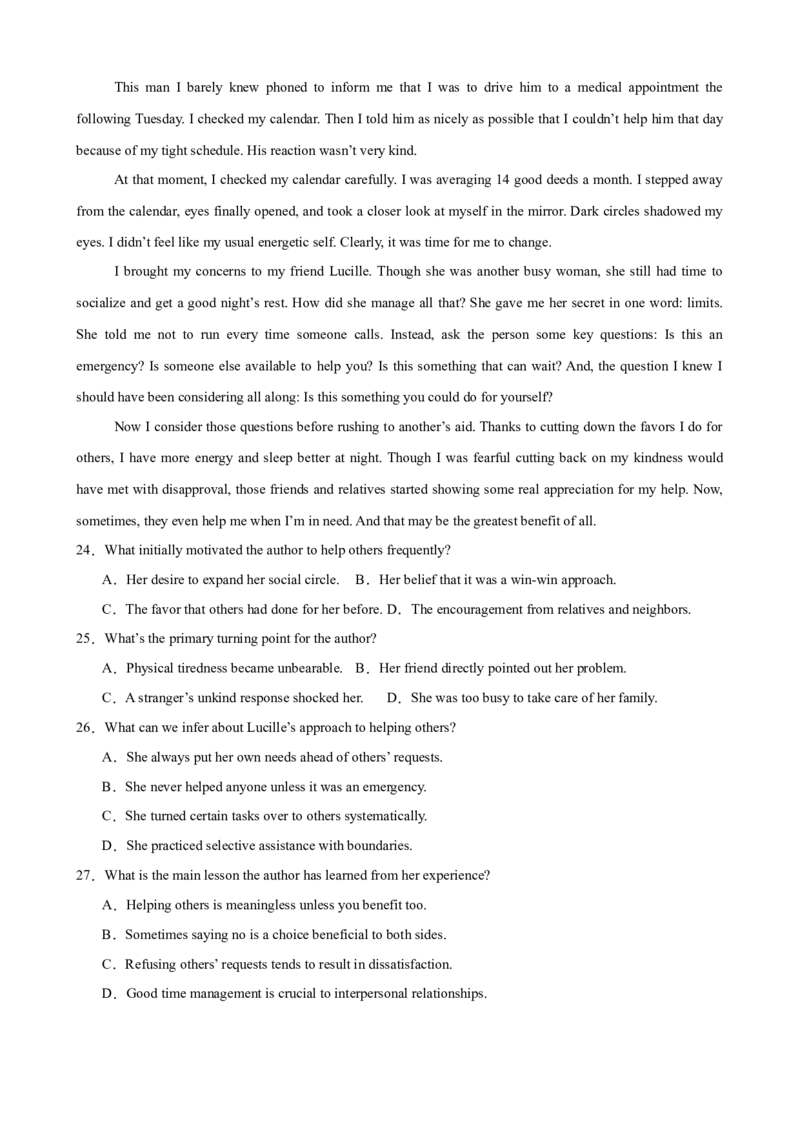
1.Where did the speakers go last night?
A.A live concert.
B.A football game.
C.A comedy show.
2.What does the man think of his trip?
A.Costly.
B.Unpleasant.
C.Enjoyable.
3.What are the speakers talking about?
A.Hosting a business visit.
B.Planning a tour of the city.
C.Discussing dinner arrangements.
4.What did the man use to like?
A.Science fiction.
B.Detective novels.
C.Entertaining stories.
5.What will the speakers do next?
A.Buy the house.
B.Replace the carpets.
C.See another house.
第二节(共15 小题;每小题1.5 分,满分22.5 分)
听下面 5 段对话或独白。每段对话或独白后有几个小题,从题中所给的A、B、C 三个选项中选出最佳
选项,并标在试卷的相应位置。听每段对话或独白前,你将有时间阅读各个小题,每小题 5 秒钟;听完
后,各小题将给出 5 秒钟的作答时间。每段对话或独白读两遍。
听下面一段较长对话,回答以下小题。
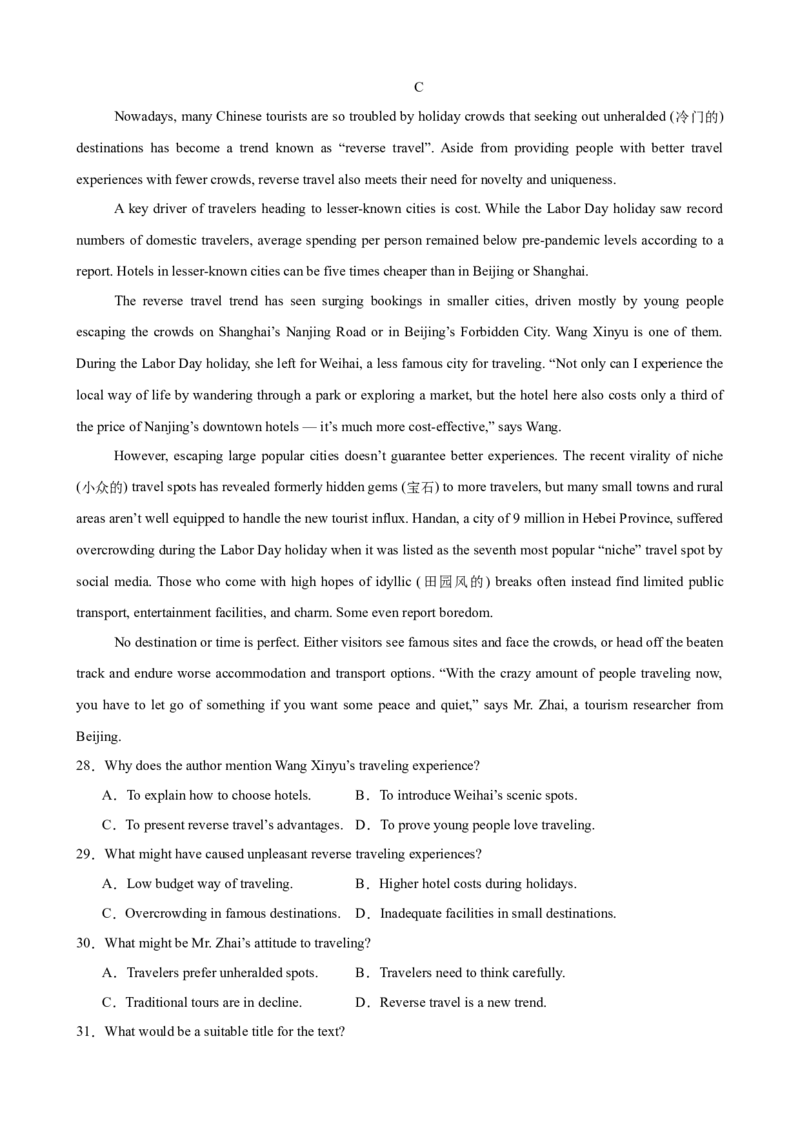
6.What is the possible relationship between the speakers?
A.Child and parent.
B.Student and teacher.
C.Tourist and tour guide.
7.When are they going to meet?
A.3:30.
B.3:25.
C.3:20.
听下面一段对话,回答以下小题。
8.How is Kelly’s service as a baby-sitter?
A.Poorly-rated.
B.Well-reviewed.
C.Rarely-noticed.
9.Why does Kelly think she can raise the rate?
A.She has a CPR certification.
B.She owns a college degree.
C.She used to be a financial advisor.
10.How does Mr. Adams sound at the end of the conversation?
A.Angry.
B.Amused.
C.Interested.
听下面一段对话,回答以下小题。
11.What inspired Mr. Riggs to become a music teacher?
A.A band performance.
B.His passion for music.
C.A teacher’s influence.
12.Why does Mr. Riggs think music is powerful for young people?
A.It teaches important life skills.
B.It serves as a way of escape.
C.It bridges generation gap.
13.How does Mr. Riggs keep his students interested in music?
A.By focusing on human connection.
B.By placing value on AI technology.
C.By helping them produce more music works.
听下面一段对话,回答以下小题。
14.What does Taylor think of the meal plans on the website?
A.Quite easy to follow.
B.Too expensive to afford.
C.Very difficult to understand.
15.Which is the most popular meal plan among students?
A.The Basic plan.
B.The Gold plan.
C.The Unlimited plan.
16.Where can dining dollars be used?
A.At downtown coffee shops.
B.At the main dining hall only.
C.At convenience stores on campus.
17.What is a good way to save money?
A.Eating dinner after 9 pm.
B.Dining between 12 and 1:30 pm.
C.Coming earlier to the dining hall.
听下面一段独白,回答以下小题。
18.What is the purpose of the event?
A.To set a new record.
B.To promote physical fitness.
C.To support children’s education.
19.What has been arranged to keep the runners safe?
A.Volunteers holding orange signs.
B.Two water stations set up along the route.
C.Medical staff stationed at the halfway point.
20.What should the runners do right after crossing the finish line?
A.Head to the snack tent to refuel.
B.Get their participation medals.
C.Join the award ceremony.
第二部分  阅读(共两节,满分50 分)
第一节(共15 小题;每小题2.5 分,满分37.5 分)
阅读下列短文,从每题所给的A、B、C、D 四个选项中选出最佳选项。
A
The most unforgettable journeys are not always measured by world-famous landmarks. Sometimes, the true
magic lies in the quiet corners of the world, where breathtaking scenery mixes with time-honored traditions and
mouth-watering local flavors. The following four rare routes, each with its own appeal, invite travelers to step off
the usual path and discover something different.
Narva’s Riverside Charm, Estonia
Narva is a peaceful town by a wide river, with colorful houses and stone streets. The riverside park is
perfect for a slow walk or a picnic. Local markets sell fresh smoked fish, sweet berry pies, and dark rye ( 黑麦)
bread, giving visitors a true taste of the region.
Inle Lake’s Floating Gardens, Myanmar
Inle Lake is surrounded by misty mountains and has many floating gardens. Farmers grow vegetables on
floating platforms made of soil and tall grass. Visitors can sail in long wooden boats past houses on wooden poles,
explore busy lakeside markets, and taste local Shan noodles or fried lake fish while watching the sunset.
Carrara’s Marble (大理石) Mountains, Italy
High in the Apuan Alps, Carrara is known for its shining white marble. Visitors can join tours to see the
stone mines and learn to shape the stone by hand from skilled workers. After exploring, enjoy fresh pasta and
cheese in small mountain restaurants.
Colmar’s Colorful Canals, France
Colmar, called “Little Venice”, is full of narrow canals, bright flowers, and old wooden houses. Families
can take gentle rides on small canal cruisers ( 游艇) through the quiet waterways, visit summer markets with
handmade chocolates and cheeses, and take photos of lively street art.
21.What can visitors do in Myanmar?
A.Hike in the mountains.
B.Learn to grow vegetables.
C.Tour in a wooden boat.
D.Rest in local farmers’ houses.
22.Which route allows tourists to participate in hands-on activities?
A.Colmar’s Colorful Canals, France.
B.Carrara’s Marble Mountains, Italy.
C.Narva’s Riverside Charm, Estonia.
D.Inle Lake’s Floating Gardens, Myanmar.
23.What do the four routes have in common?
A.They include historic sights.
B.They offer various water-based activities.
C.They are famous for their summer markets.
D.They provide visitors with tasty local foods.
B
Need a ride to the doctor? I’ll be glad to take you. Does your dog need to be walked while you’re on
vacation? No problem.
Relatives, colleagues, neighbors, and even casual acquaintances all seemed to have my number. In my
opinion, doing good for others could not only benefit those in need but also make me feel good. And I was OK
with that until one afternoon when I received a call from an acquaintance of my dad’s.
This man I barely knew phoned to inform me that I was to drive him to a medical appointment the
following Tuesday. I checked my calendar. Then I told him as nicely as possible that I couldn’t help him that day
because of my tight schedule. His reaction wasn’t very kind.
At that moment, I checked my calendar carefully. I was averaging 14 good deeds a month. I stepped away
from the calendar, eyes finally opened, and took a closer look at myself in the mirror. Dark circles shadowed my
eyes. I didn’t feel like my usual energetic self. Clearly, it was time for me to change.
I brought my concerns to my friend Lucille. Though she was another busy woman, she still had time to
socialize and get a good night’s rest. How did she manage all that? She gave me her secret in one word: limits.
She told me not to run every time someone calls. Instead, ask the person some key questions: Is this an
emergency? Is someone else available to help you? Is this something that can wait? And, the question I knew I
should have been considering all along: Is this something you could do for yourself?
Now I consider those questions before rushing to another’s aid. Thanks to cutting down the favors I do for
others, I have more energy and sleep better at night. Though I was fearful cutting back on my kindness would
have met with disapproval, those friends and relatives started showing some real appreciation for my help. Now,
sometimes, they even help me when I’m in need. And that may be the greatest benefit of all.
24.What initially motivated the author to help others frequently?
A.Her desire to expand her social circle.
B.Her belief that it was a win-win approach.
C.The favor that others had done for her before. D.The encouragement from relatives and neighbors.
25.What’s the primary turning point for the author?
A.Physical tiredness became unbearable.
B.Her friend directly pointed out her problem.
C.A stranger’s unkind response shocked her.
D.She was too busy to take care of her family.
26.What can we infer about Lucille’s approach to helping others?
A.She always put her own needs ahead of others’ requests.
B.She never helped anyone unless it was an emergency.
C.She turned certain tasks over to others systematically.
D.She practiced selective assistance with boundaries.
27.What is the main lesson the author has learned from her experience?
A.Helping others is meaningless unless you benefit too.
B.Sometimes saying no is a choice beneficial to both sides.
C.Refusing others’ requests tends to result in dissatisfaction.
D.Good time management is crucial to interpersonal relationships.
C
Nowadays, many Chinese tourists are so troubled by holiday crowds that seeking out unheralded (冷门的)
destinations has become a trend known as “reverse travel”. Aside from providing people with better travel
experiences with fewer crowds, reverse travel also meets their need for novelty and uniqueness.
A key driver of travelers heading to lesser-known cities is cost. While the Labor Day holiday saw record
numbers of domestic travelers, average spending per person remained below pre-pandemic levels according to a
report. Hotels in lesser-known cities can be five times cheaper than in Beijing or Shanghai.
The reverse travel trend has seen surging bookings in smaller cities, driven mostly by young people
escaping the crowds on Shanghai’s Nanjing Road or in Beijing’s Forbidden City. Wang Xinyu is one of them.
During the Labor Day holiday, she left for Weihai, a less famous city for traveling. “Not only can I experience the
local way of life by wandering through a park or exploring a market, but the hotel here also costs only a third of
the price of Nanjing’s downtown hotels — it’s much more cost-effective,” says Wang.
However, escaping large popular cities doesn’t guarantee better experiences. The recent virality of niche
(小众的) travel spots has revealed formerly hidden gems (宝石) to more travelers, but many small towns and rural
areas aren’t well equipped to handle the new tourist influx. Handan, a city of 9 million in Hebei Province, suffered
overcrowding during the Labor Day holiday when it was listed as the seventh most popular “niche” travel spot by
social media. Those who come with high hopes of idyllic ( 田园风的) breaks often instead find limited public
transport, entertainment facilities, and charm. Some even report boredom.
No destination or time is perfect. Either visitors see famous sites and face the crowds, or head off the beaten
track and endure worse accommodation and transport options. “With the crazy amount of people traveling now,
you have to let go of something if you want some peace and quiet,” says Mr. Zhai, a tourism researcher from
Beijing.
28.Why does the author mention Wang Xinyu’s traveling experience?
A.To explain how to choose hotels.
B.To introduce Weihai’s scenic spots.
C.To present reverse travel’s advantages.
D.To prove young people love traveling.
29.What might have caused unpleasant reverse traveling experiences?
A.Low budget way of traveling.
B.Higher hotel costs during holidays.
C.Overcrowding in famous destinations.
D.Inadequate facilities in small destinations.
30.What might be Mr. Zhai’s attitude to traveling?
A.Travelers prefer unheralded spots.
B.Travelers need to think carefully.
C.Traditional tours are in decline.
D.Reverse travel is a new trend.
31.What would be a suitable title for the text?
A.Reverse Travel: Trends and Troubles
B.Cost-effective Holidays Gain Popularity
C.Holiday Crowds Trouble Chinese Tourists
D.Famous Attractions VS Small Destinations
D
If you ask a Westerner to name a successful Chinese consumer-goods brand, most would have struggled
until recently. Although China is the world’s leading manufacturing power, it has long fallen behind in creating
imaginative, home-grown retail (零售) brands and products. That, however, is beginning to change.
Innovative Chinese brands are appearing everywhere. From Stockholm to Sydney, the electric cars silently
passing by are increasingly likely to be Chinese. Mixue, an ice-cream and cold drinks company, has overtaken
McDonald’s to become the world’s largest fast-food chain by number of outlets. It is expanding in South America,
as is Meituan, a Beijing-based delivery app. Chagee, a chain of tea shops, is on track to have at least 1, 300 stores
outside China by the end of 2027, mostly in Southeast Asia; just a few years ago, it had almost none. Meanwhile,
Pop Mart, a Chinese toy company, has created a buzz as much as Disney with its unusual grinning nine-toothed
dolls, called Labubus. It is impossible not to admire the creative force behind these successful enterprises.
Western consumers have been buying products made in China for decades. However, these goods were
mostly designed by and produced for foreign companies. Chinese brands were long regarded as low-quality and
lacking creativity.
New companies are now challenging these old assumptions. Many proudly emphasize their Chinese
heritage. For example, Chagee’s logo features a Peking Opera singer in full costume, and its name comes from
“Farewell, My Concubine,” a classic Chinese opera. The video game “Black Myth: Wukong,” one of the most
successful ever, features the Monkey King from the 16th-century novel Journey to the West.
Today, many Chinese brands compete not only on price but also on quality. Chagee’s drinks can even be as
expensive as Starbucks’. Western companies will need to wake up and take notice of bubble tea. In the future, they
will have to make more efforts to understand Chinese consumers’ unique tastes. Some may even partner with
innovative Chinese firms to gain insight and inspiration. Competition from China could eventually push Disney,
Mattel toys, and other major Western brands to reach new levels of creativity.
32.What does the underlined part “created a buzz” in paragraph 2 probably mean?
A.Caused public excitement.
B.Made a loud noise.
C.Lost great popularity.
D.Received negative comments.
33.How did the western consumers find Chinese brands?
A.Full of imagination.
B.Short of creativity. C.Quality guaranteed. D.Mass
produced.
34.What is the author’s advice for the western brands?
A.Notice different bubble tea.
B.Ignore the Chinese influence.
C.Cooperate with Chinese brands.
D.Lower the price of the products.
35.What is the passage mainly about?
A.The history of Chinese retail brands.
B.How foreign firms win Chinese customers.
C.Why Chinese products were unpopular before.
D.The rise of innovative Chinese brands globally.
第二节(共5 小题;每小题2.5 分,满分12.5 分)
阅读下面短文,从短文后的选项中选出可以填入空白处的最佳选项。选项中有两项为多余选项。
Thirst is one of the fundamental urges an organism can have. After all, water is the substance that we rely
on to transport essential molecules ( 分子) and other particles around our bodies to keep us alive.     36

Shouldn’t we have developed a taste for this essential substance?
    37     Several new studies seem to show not only that water does, in fact, have a taste, but that we
might have taste buds (味蕾) that respond directly to it.
We now know that there are at least five basic tastes: salty, sour, sweet, bitter and umami.     38

Researchers have sought to solve the issue once and for all. They’ve figured out an experiment that seeks to
identify any water-sensing taste receptor cells (TRCs) on the tongues of lab mice.
The team first used a technique known as genetic knockout to silence different types of TRCs, in order to
remove the possibility that those cells might accidentally discover some other taste within the water besides the
water itself.     39     It turned out that the acid-sensing sour TRCs were still firing actively, indicating these
cells might have a double purpose, capable of distinguishing water or acidic fluids.
So if you’re on the side of the debate that argues that water is flavorless, you might still be correct.     40
The study also opens up the possibility that our tongues and taste buds might be doing more than merely
providing us with a sense of taste. If this study doesn’t prove that water is the sixth flavor, it might still be the first
evidence of a whole other sense entirely: a water sense.
A.Well, perhaps we have.
B.Actually, we have a sixth taste for water.
C.Our taste buds are tied to a flavor of water.
D.So it’s perhaps a bit doubtful that water doesn’t seem to have any flavor.
E.But water isn’t senseless, at least it doesn’t appear that way according to this research.
F.They then washed their mouths with water to see if any cells were still responding.
G.If there is a sixth taste for water exists, then there should be evidence somewhere in the mouth or tongue.
第三部分  语言运用(共两节,满分30 分)
第一节  (共15 小题;每小题1 分,满分15 分)
阅读下面短文,从每题所给的A、B、C、D 四个选项中选出可以填入空白处的最佳选项。
I had spent the previous decade working    41    toward my goal of becoming a professor. However,
after my 30th birthday, the attraction of academia    42   . I decided to    43    my academic career plans
and set my sights on business.
Soon, an offer arrived: a six figure research    44    in product development. It seemed to be everything
I    45   , so I took it. Yet, later I found I was back to the    46    tasks I’d once completed as an
undergraduate research assistant.
Repeated routine work wasn’t where I wanted to be in my career. I was more    47    — I wanted to
48    projects and lead a team. But the general manager wouldn’t give those    49    to me until I’d proved
myself.
I realized I need to let go of the idea that I was already a(n) “    50    ” in my field. I had to become a(n)
51     once again. So, in the months that followed, I set out to learn everything I could about my new career. In
some ways, product development was     52     to my academic research. But in other ways, it was vastly
different. I needed to create profit, not just     53    .
As I read professional materials passionately, I realized my PhD gave me a “learner” personality — loving
to     54     and grow. Two years later, I became the chief engineer at the company. When asked to describe
my greatest     55    , I smiled and said: “I have a PhD.I learn incredibly fast.”
41.A.frequently
B.continually
C.unwillingly
D.occasionally
42.A.faded
B.exchanged
C.increased
D.appeared
43.A.try out for
B.take pride in
C.get rid of
D.come up with
44.A.project
B.salary
C.demand
D.position
45.A.owned
B.harvested
C.designed
D.expected
46.A.mixed
B.difficult
C.dull
D.burdensome
47.A.independent
B.ambitious
C.promising
D.generous
48.A.manage
B.change
C.fund
D.study
49.A.benefits
B.responsibilities
C.congratulations
D.pressures
50.A.expert
B.professor
C.partner
D.performer
51.A.member
B.manager
C.student
D.engineer
52.A.equal
B.similar
C.helpful
D.contradictory
53.A.products
B.opportunities
C.knowledge
D.accounts
54.A.expand
B.negotiate
C.advocate
D.recite
55.A.principle
B.aim
C.decision
D.strength
第二节(共10 小题;每小题1. 5 分, 满分15 分)
阅读下面材料,在空白处填入适当的内容(1 个单词)或所给单词的正确形式。
With profits jumping to nearly 1.3 billion yuan at the box office as of Aug 26, the ink-wash animated film
Nobody has broken    56    previous record set by Big Fish & Begonia (2016), making it the highest-
earning domestic 2D animated film in Chinese cinema history.
The film follows four small monsters — a pig, a toad, a weasel, and an ape — who disguise     57

characters from Journey to the West, seeking to live forever before finding themselves protecting villagers from
evil     58     (force).
     59     (create) the film’s unique Chinese animation style, Yu Shui, director of the film, and his team
conducted field research from northern to southern Shanxi, bringing the beauty of the     60     (province)
ancient architecture onto the silver screen.
“During production, integrating a large number of Shanxi landmarks and elements of ancient architecture
into the film     61     (drive) primarily by the needs of the plot, as these fantastic structures could enhance the
film.     62     (additional), it’s because I am from Taiyuan and have a deep emotional connection to these
ancient buildings,” Yu said.
At the recently     63     (conclude) 7th Shanxi Cultural Industries Fair, Yu invited moviegoers to visit
the province     64     inspired its ancient architectural scenes. The director’s invitation highlights a dynamic
phenomenon in the country’s creative industries — using advanced technology to revive cultural heritage not
within the museums but through engaging and      65      (access) mediums, such as games and films.
第四部分 写作(共两节, 满分40 分)
第一节(满分15 分)
66.假定你是李华,上周音乐课上老师带领大家体验了中国传统乐器。请给英国朋友Max 写一封邮件分
享这次经历,内容包括:
1. 体验过程;
2. 你的感受。
注意:
1. 写作词数应为80 左右;
2. 请按如下格式在答题卡的相应位置作答。
Dear Max,
___________________________________________________________________________________________
___________________________________________________________________________________________
___________________________________________________________________________________________
___________________________________________________________________________________________
_______________________________
Yours,
Li Hua
第二节(满分25 分)
67.阅读下面材料,根据其内容和所给段落开头语续写两段,使之构成一篇完整的短文。
I gazed down the frightening snow-covered slope, my heart beating wildly. The accident that took my leg
two years ago replayed in my mind, a memory I couldn’t escape. But with my prosthetic leg (假肢) and persistent
training, I was determined to return to the slopes.
It was my final training session before the competition. As I practiced the difficult jump, the world went
black as I crashed headfirst into the densely packed snow. I rolled down the slope like a man trapped in a washing
machine, unable to break free from the tossing and flipping. When I finally stopped, I found my prosthetic leg had
been forced out of its place.
“I can’t do this!” I yelled, hammering my leg back into place. I freed myself from the snowboard and
struggled to my feet. “Another round?” my coach asked with a soft laugh. He rested his arm on my shoulder as if
to comfort me after his teasing. We both stared at the towering slope ahead. Failure loomed over me like a dark
cloud — it had beaten me too many times before.
“I can’t handle the landing. This leg drags me down. How am I supposed to compete tomorrow?” I
slammed my leg repeatedly with bitterness as tears welled up in my eyes. Every time I fell, I forced myself to get
back on my feet so that I could snowboard again, but I had tricked myself into believing that I could return to
being a professional snowboarder.
“Just remember: dig your heels in, bend your knees, and keep your arms up. Three steps to the gold medal.”
My coach looked me straight in the eyes, his voice firm yet warm. “It’s not your leg holding you back. You’re
using it as an excuse.” His words trailing off like droplets of water forming dotted indents in the snow —
disappearing into the snow forever but leaving their marks behind.
注意:1. 续写词数应为150 个左右;2. 请按如下格式在答题卡的相应位置作答。
Paragraph 1: The fateful day finally arrived.
___________________________________________________________________________________________
___________________________________________________________________________________________
___________________________________________________________________________________________
___________________________________________________________________________________________
___________________________________________________________________________________________
_____
Paragraph 2: The crowd erupted, cheers filling the air.
___________________________________________________________________________________________
___________________________________________________________________________________________
___________________________________________________________________________________________
___________________________________________________________________________________________
___________________________________________________________________________________________
_____