绝密★考试结束前
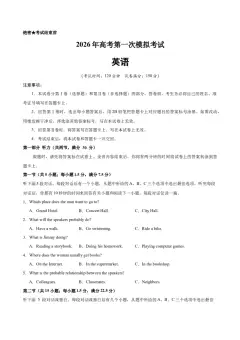
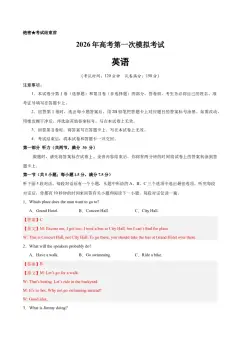
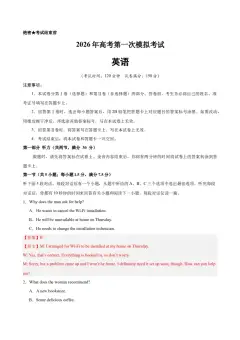
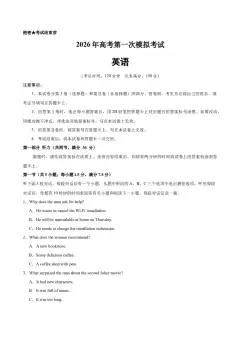
2026 年高考第一次模拟考试(北京卷)
英语
(考试时间:100 分钟  试卷满分:100 分)
注意事项:
1.本试卷分第Ⅰ卷(选择题)和第Ⅱ卷(非选择题)两部分。答卷前,考生务必将自己的姓名、准
考证号填写在答题卡上。
2.回答第Ⅰ卷时,选出每小题答案后,用2B 铅笔把答题卡上对应题目的答案标号涂黑。如需改动,
用橡皮擦干净后,再选涂其他答案标号。写在本试卷上无效。
3.回答第Ⅱ卷时,将答案写在答题卡上。写在本试卷上无效。
4.考试结束后,将本试卷和答题卡一并交回。
第一部分:知识运用(共两节,30 分)
第一节 完型填空(共10 小题:每小题1.5 分,共15 分)
阅读下面短文,掌握其大意,从每题所给的A、B、C、D 四个选项中,选出最佳选项,并在答题纸
上将该选项涂黑。
I never considered myself artistic until that rainy autumn afternoon. Mrs. Riley, our art teacher, handed out
canvases (画布) with an unusual     1    , “Paint what you feel others cannot see.” My classmates     2
dipped brushes into bright colors, while I stared at the     3     surface, no idea in my mind, and immersed
myself in self-doubt.
For years, I had     4     to draw except for stick figures and convinced that     5     wasn’t my
gift. But as raindrops tapped the window like a piece of beautiful music, an idea sparked — I mixed greys and
blues to capture the rhythm of the storm. To my     6    , Mrs. Riley paused and looked at my drawing.
“This... has depth,” she murmured, nodding her head slightly.
That night, I lay awake, torn between excitement and fear. My sketchbook (速写本), long hidden under
textbooks, resurfaced like an old friend. I began sketching shadows dancing through streetlights, steam curling
from teacups — ordinary magic I’d always     7    .
Weeks later, the school exhibition arrived. My piece “Urban Symphony” hung beside abstract paintings.
Visitors rushed past my work without pause until a little girl pulled her mother’s sleeve. “Look! It’s like the city is
breathing!” Her words were beyond my personal     8    .
Now, as I prepare for art college, I often recall Mrs. Riley’s wisdom: “Vision grows when we dare to     9
the invisible.” That blank canvas taught me creativity isn’t about skill, but the     10     to share our unique
perspectives.
1.A.task
B.gift
C.sign
D.game
2.A.suddenly
B.eventually
C.immediately
D.casually
3.A.messy
B.blank
C.torn
D.rough
4.A.pretended
B.decided
C.promised
D.refused
5.A.sincerity
B.creativity
C.curiosity
D.generosity
6.A.surprise
B.anger
C.regret
D.horror
7.A.forgot
B.tracked
C.ignored
D.witnessed
8.A.control
B.authority
C.capacity
D.expectation
9.A.explore
B.question
C.create
D.protect
10.A.dream
B.chance
C.courage
D.demand
第二节 语法填空(共10 小题,每小题1.5 分,共15 分)
阅读下列短文,根据短文内容填空,在未给提示词的空白处仅填写1 个适当的单词,在给出提示词
的空白处用括号内所给词的正确形式填空。
A
One day, an Australian woman arrived home after work, only     11     (discover) a stranger in her
house. Waving a pole that she     12     (place) inside her home before, the stranger was like putting on a pole
dancing show. Soon, she found the stranger was an adorable koala. She quickly contacted the Conservation Park,
who sent out rescuers to release it to safety. Although the problem     13     (resolve) by now, it does highlight
the fact that the natural habitat of wildlife is being decreased as the construction of homes for humans is increased.
B
阅读下面短文,根据短文内容填空。在未给提示词的空白处仅填写1 个恰当的单词,在给出提示词的空
白处用括号内所给词的正确形式填空。
The term “Wen Fang” refers to a reading room or a study     14     intellectuals in ancient times could
enjoy a peaceful moment alone to gain cultural accumulations and to meditate. They demanded a highly aesthetic
space,     15     (decorate) with fine stationery, so that they could be isolated     16     disturbing affairs,
even for a brief time. Besides the well-known “four treasures of the study” — ink brushes, ink cakes, ink stones
and paper — the study is also enriched with other     17     (object) like engraved seals, brush holders,
incense burners and musical instruments.
C
阅读下面短文,根据短文内容填空。在未给提示词的空白处仅填写1 个恰当的单词,在给出提示词的空
白处用括号内所给词的正确形式填空。
Here are some ways for you to fight against anger. Firstly, accept that people will frustrate you. Realizing
that no one is perfect is a good start to avoiding getting angry. Secondly, stop     18     (try) to contain your
anger. A better way of facing up to anger is to identify the root cause. Once you know    19    you get mad, it
is possible to deal with the cause. Lastly, don’t take the easy way. A reaction like throwing something, hitting
someone, or screaming is the easy way. By learning to control, you can become     20     (calm) and less
violent.
第二部分:阅读理解(共两节,38 分)
第一节(共14 小题,每小题2 分,共28 分)
阅读下列短文,从每题所给的A、B、C、D 四个选项中,选出最佳选项,并在答题卡上将该项涂黑。
A
In the latest Student Experience Survey, you told us that you want ongoing services and support to succeed
in your studies. We heard you and, as a result, University of Wollongong Australia (UOW) has introduced
Studiosity — a free online service that provides guidance and feedback on your academic skills, 24/7.
How does Studiosity work?
Upload your written draft and within 24 hours a Studiosity consultant specialising in English will send it
back with relevant comments, suggestions and encouragement. This might include analyzing an assignment
question, providing advice on research skills, or improving grammar and structure, etc.
If you prefer to work through your questions with a real person, you can do that via an interactive
classroom using chat, a collaborative whiteboard and file sharing. This might include discussing specific issues in
your writing or working through math or science questions.
Please note that UOW students can have 15 interactions with Studiosity per session. Each writing feedback
submission or connect live session counts as one interaction. The number of Studiosity interactions you have
remaining is displayed on the right-hand side of your Studiosity portal (门户网站).
How to access Studiosity?
From the beginning of session, you will be able to access your free Studiosity account in most Moodle
subject sites. Click on the “Studiosity: 24/7 study help” link.
If Studiosity isn’t visible, register in the Studiosity (UOW) Moodle site and click the link there. After
clicking the link, you will be directed to your account setup. Create a memorable4-digit PIN. You will also need to
agree to the Studiosity Privacy and Cookies Policy and Acceptable Use Policy, which will provide Studiosity with
your name, UOW email address, and subject ID.
Start using Studiosity today and unlock your full potential!
21.UOW introduces Studiosity to __________.
A.provide free online courses
B.assist students in their studies
C.collect students’ written feedback
D.conduct the Student Experience Survey
22.With Studiosity, students can _____________.
A.share files with each other
B.join online discussion groups
C.obtain advice on polishing their writing D.receive unlimited feedback on assignments
23.What are required for UOW students to access Studiosity?
A.A registration fee and a subject ID.
B.A 4-digit PIN and agreement to privacy policies.
C.A personal email address and Studiosity account.
D.A memorable username and a Moodle subject link.
B
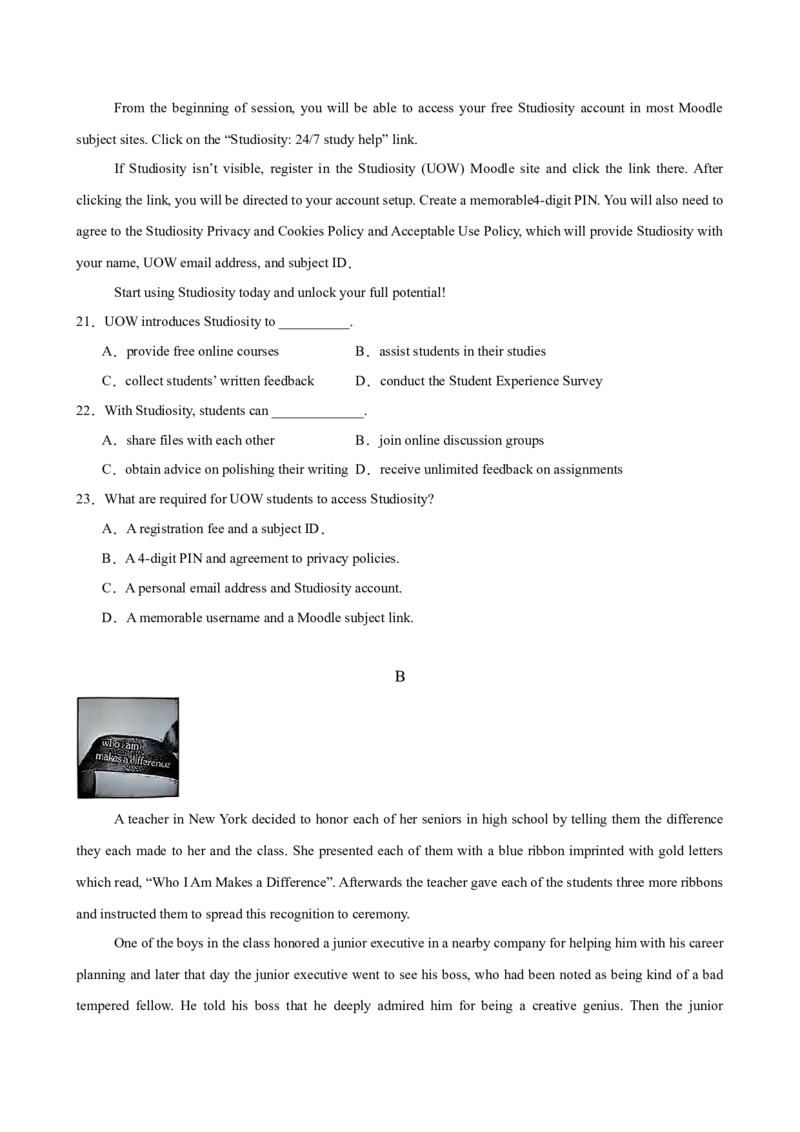
A teacher in New York decided to honor each of her seniors in high school by telling them the difference
they each made to her and the class. She presented each of them with a blue ribbon imprinted with gold letters
which read, “Who I Am Makes a Difference”. Afterwards the teacher gave each of the students three more ribbons
and instructed them to spread this recognition to ceremony.
One of the boys in the class honored a junior executive in a nearby company for helping him with his career
planning and later that day the junior executive went to see his boss, who had been noted as being kind of a bad
tempered fellow. He told his boss that he deeply admired him for being a creative genius. Then the junior
executive placed the blue ribbon on his boss’s jacket.
That night the boss came home to his 14-year-old son and sat him down. He said, “The most incredible
thing happened to me today. I was in my office and one of the junior executives came in and told me he admired
me and gave me a blue ribbon for being a creative genius. Imagine. He thinks I’m a creative genius. Then he put
the blue ribbon that says ‘Who I Am Makes A Difference’ on my jacket above my heart. He gave me an extra
ribbon and asked me to find somebody else to honor. As I was driving home tonight, I started thinking about
whom I would honor with this ribbon and I thought about you, I want to honor you.”
“My days are really stressful and when I come home, I don’t pay a lot of attention to you. Sometimes I
scream at you for not getting good enough grades in school and for your bedroom being a mess, but somehow
tonight, I just wanted to let you know that you do make a difference to me. Besides your mother, you are the most
important person in my life. You’re a great kid and I love you!”
The astonished boy started to sob and sob, and he couldn’t stop crying. His whole body shook. After a long
silence, he looked up at his father and said through his tears, “Thank you, Dad. This blue ribbon means more to
me than anything. I love you too.”
24.The teacher gave each student three more ribbons in order to ______.
A.honor their good behavior in class
B.pass on the act of acknowledgment
C.show her appreciation for their help
D.prepare for the graduation ceremony
25.What can we infer about the boss before receiving the blue ribbon?
A.He was attentive but strict to his son.
B.He had great skills in career planning.
C.He was well-known as a creative genius.
D.He prioritized work over family responsibilities.
26.On hearing his father’s words, the boy felt ______.
A.relieved of long-held insecurities
B.confused by the sudden attention
C.indifferent to his father’s apology
D.upset about being ignored before
27.The story mainly tells us that ______.
A.teachers have great influences on students
B.it is important to express gratitude to others
C.everyone needs to be recognized and appreciated
D.parents should pay more attention to their children
C
In an era of big research, having confidence in scientists, individually or collectively, involves trade-offs.
Science is ideally built on evidence but in reality, for most people, it is based on trust. Scientific evidence is hard
to access. Journals are difficult to get and their articles, written in specialised language, are only understandable to
a few field experts. So, we trust experts’ results without being able to question them ourselves, believing that if
needed, someone knowledgeable will.
Historically, the reputation of individual scientists has been important in facilitating the spread of scıentific
theories and discoveries. If a scientist is, or can appear to be, trustworthy, so might that scientist’s ideas.
This can lead to odd consequences. Recognisable scientists receive more credit and trust, while
unrecognisable scientists often have their work overlooked. The history of science is filled with cases where basic
papers written by relatively unknown scientists were neglected for years. Consider the case of Joseph Fourier,
whose classic paper on the propagation of heat had to wait 13 years to be published.
Since recognisable scientists receive disproportionate ( 不成比例的) credit, their names become
disproportionately associated with discoveries. Statistics professor Stephen Stigler formulated “Stigler’s law of
eponymy” ( 斯蒂格勒命名法则), stating no scientific discovery is named after its original discoverer. For
instance, Pythagoras wasn't the first to discover the Pythagorean theorem, nor was Edwin Hubble the first to
formulate Hubble’s law.
However, modern science operates differently. Large collaborative (合作的) projects often produce papers
with hundreds of authors. The record for the number of authors on a single scientific paper is currently 5,154.
Furthermore, an editorial board composed of project group members actually wrote the papers. The papers were
then placed on an electronic bulletin board for criticism and comment by all. Some massive collaborative projects
constantly maintain author lists of hundreds of names, which are automatically submitted on every publication.
If we can’t identify the thousands in big science projects or know their actual authors, who do we trust? I’d
say we trust “science” itself regardless of the individual scıentists’ integrity. We trust the organisations that are
considered scientific. Any clickbait news articles with “Science Says” in the title show this shift from trusting
individuals to trusting the scientific enterprise.
This shift to trusting “science” itself has risks. Misidentifying experts or trusting dishonest ones can abuse
scientific erodibility. A striking example is Merchants of Doubt, where experts hid truths about acid rain and
global warming. Authorship, then, serves one last function, which in some cases only benefits the historian like
me: accountability.
28.What is the passage mainly about?
A.The moral issues in scientific authorship and accountability.
B.The role of individual scientists in modern scientific research.
C.The evolution of trust in science from individuals to enterprises.
D.The challenges of confirming scientific evidence in the digital age.
29.Why is “Stigler’s law of eponymy” mentioned?
A.To justify an argument.
B.To introduce an approach.
C.To challenge a convention.
D.To evaluate an assumption.
30.According to the passage, the author may agree that ________.
A.modern science collaboration challenges the trust in individual scientists
B.the current trend of trusting science overlooks scientists’ sacrifices
C.authorship ought to be founded upon intellectual contributions
D.it is vital to identify the authors of large-scale science projects
31.What is the author’s attitude towards the shift to trusting science itself?
A.Sympathetic.
B.Cautious.
C.Disapproving.
D.Puzzied.
D
When people view photographs of frightening spiders, scientists usually observe increased electrical
activity deep in their brain, in a region called the periaqueductal gray (PAG). The obvious conclusion is that the
PAG controls fight-or-flight responses in threatening situations. But what if brains don’t have dedicated circuits
for fighting and flighting? Is threat detection really a primary mode of the brain with its own neural circuitry ( 神
经回路)?
This idea of fight-or-flight circuits originates from the “triune brain” model dividing brains into the so-
called lizard brain, including the PAG, for survival functions, the “limbic system” for emotions, and the
“neocortex” for higher-order reasoning. If you know anything about evolution, you might know that something is
spurious. The only animal on this planet with a lizard brain is a lizard. Also, there’s no unified limbic “system” or
the “neocortex” for emotions or rationality (理性) respectively. So where does this leave the fight-or-flight story?
Recently, changes in PAG activity have been observed in nonthreatening tasks, such as reading a
fascinating article about the brain. The PAG has also been proved to regulate bodily systems continuously.
Incidentally, this explains why antianxiety medications manage anxiety disorders without healing them. They
target brain circuits that aren’t dedicated to anxiety or fight-or-flight but that simply regulate the body.
Researches on the brain’s powers also cast new light on our understandings. In daily life, individuals might
feel like they perceive and react to various stimuli as either threatening or safe. Actually, the brain, using past
experiences, skillfully predicts and formulates action plans in anticipation of events before stimuli occur. The
brain’s preparatory mechanism, metabolically (新陈代谢地) expensive, involves complicated neuronal activities
for sustaining multiple predictions and corresponding action plans over extended periods. But the experiences in
fight-or-flight responses crafted by your brain don’t reveal how it works.
Moreover, your brain, which does much more than avoid threats, handles a complex social world full of
uncertainty. That’s a recipe for stress. And what is stress? It reflects energy preparation for anticipated challenges.
Your brain often makes sense of metabolic cost of uncertainty, if it drags on for long enough, as anxiety, but that’s
not a must. People seek uncertainty out — and its positive cousin, novelty — when they try new foods or learn
new skills.
Uncertainty is common, but these days, with social media and round-the-clock news coverage, it sometimes
bombards us and leaves us anxious and exhausted. But these feelings don’t emerge from fight-or-flight circuits.
They may just mean, in an ever changing and only partly predictable world, that you’re doing something hard.
32.The author asks the questions in Paragraph 1 to ________.
A.evaluate a statement
B.justify an assumption
C.challenge an argument
D.introduce a new concept
33.Which does the underlined word “spurious” in Paragraph 2 probably mean?
A.Rare.
B.Wrong.
C.Limited.
D.Unexpected.
34.What can we infer from this passage?
A.Hunting for novelty reduces stress and anxiety.
B.Medicine targeting PAG cures anxiety disorders.
C.Uncertainty is a product of modern media and news cycles.
D.The “Fight or Flight” idea overlooks the brain’s predictive power.
第二节(共5 小题;每小题2 分,共10 分)
根据短文内容,从短文后的七个选项中选出能填入空白处的最佳选项。选项中有项为多余选项。
Whether it’s the echo (回声) of beeping tills in a supermarket or the hissing of a coffee machine in your
local café, the brain is constantly working to decode (解码) hundreds of noises each day.
But for individuals like 25-year-old Sophie, these background noises can be stressful.    35    She says
she can’t figure out where they’re coming from and can’t compute them fast enough. After a hearing test came
back normal, Sophie met a private audiologist (听觉矫正专家) for further testing. She was eventually diagnosed
(诊断) with auditory processing disorder (APD).    36    However, her audiologist believes the overuse of
noise-canceling headphones, which Sophie wears for up to five hours a day, could have a part to play.
Noise-canceling headphones do have advantages for long-term ear health. But some experts warn that by
blocking everyday sounds, the brain may “forget” how to filter (过滤) noise.    37    Over-reliance on noise-
canceling headphones during this period might delay the ability to process speech and noise. Great Ormond Street
Hospital for Children have seen an increase in demand for assessments of children struggling to hear certain
words in noisy environments.    38    Audiologists are calling for more research into the impact of noise-
canceling headphones on teen’s auditory processing.
    39    Mobile apps with “word in noise” training exercises are popular for helping patients distinguish
speech from background noise. Additionally, microphones and low-gain hearing aids can assist in specific
situations. Choosing headphones that don’t completely block the ears is also suggested.
A.The cause of Sophie’s APD diagnosis is unknown.
B.Treatment for APD can make a significant positive difference.
C.Despite having normal hearing, she often struggles to recognize voices.
D.She would leave bars and restaurants early because of the stressful noise.
E.They note that the high-level listening skills don’t fully develop until late teens.
F.One survey showed 61% of 18-24 year olds prefer to watch TV with subtitles on.
G.Hearing a diversity of sounds helps the brain decide what is important to focus on.
第三部分 书面表达(共两节,共32 分)
第一节 阅读表达(共4 小题,第40、41 题各2 分,第42 题3 分,第43 题5 分,共12 分)
阅读下面短文,根据题目要求回答问题。
Main character syndrome is a term that was born on social media to describe a mindset among people to
view themselves as the lead character in their own life story.
People with main character syndrome often have some apparent symbols. They often prioritize their own
needs and experiences, believe their feelings are the most important, create situations to draw attention to
themselves and behavior overly dramatically to fish for praises.
They have a distorted view of reality, ignore or deny the consequences of their behavior. They clash with
people with different perspectives or goals, as they view their storylines as the most important. They believe they
deserve special attention or treatment and expect others to go out of their way to accommodate them. These have
difficulty understanding or valuing the experiences and feelings of others, often showing little genuine concern for
others’ problems. They often view everyone else as supporting actors.
Main character syndrome isn't inherently “bad” . On the positive side, seeing oneself as the protagonist in a
life story can foster a sense of purpose and motivation. It can encourage people to pursue their goals with
determination and confidence. However, the negative aspects often outweigh the positives. This mindset can lead
to self-centered behavior, difficulty empathizing with others, and a lack of genuine connection in relationships.
Exposure to movies, TV shows, and books focusing on individualism can lead people to see their own lives
in a similar light. Social media also facilitate sharing personal experiences, often placing individuals at the center
of their content. This emphasis on self-presentation and pursuing likes, comments, and validation can reinforce
behaviors associated with main character syndrome.
Certain personality traits, such as narcissistic tendencies, can contribute to main character syndrome.
People who naturally seek higher levels of admiration or have an inflated sense of self-importance may be more
prone to this mindset.
Low self-esteem or self-worth, potentially leads to an excessive desire for external validation. Social and
environmental factors, such as family dynamics, upbringing, and social environment can also play a role. People
who are constantly reinforced or encouraged to focus on themselves may develop main character syndrome.
40.What is main character syndrome?

41.What are the obvious performances of people with main character syndrome?

42.Please decide which part is false in the following statement, then underline it and explain why.
★People with main character syndrome often pursue their goals with determination and the negative
effects are equal to the positives.

43.What way(s) do you have to overcome main character syndrome? (In about 40 words)

第二节: 书面表达(共一题,20 分)
44.假设你是红星中学高三学生李华。你打算邀请英国好友Jim 为你们班做一次关于英语写作的线上经验
交流。请你用英文给他写一封电子邮件,内容包括:
1.建议交流的具体内容及其原因;
2.交流时间和其他相关事项。
注意:1.词数100 左右;
2.开头和结尾已给出,不计入总词数。
Dear Jim,
___________________________________________________________________________________________
___________________________________________________________________________________________
___________________________________________________________________________________________
___________________________________________________________________________________________
_______________________________________________________
Yours,
Li Hua