绝密★考试结束前
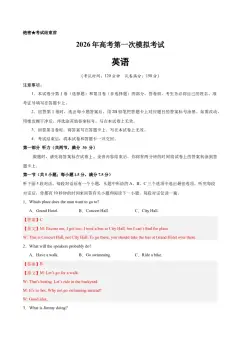
2026 年高考第一次模拟考试(天津卷)
英语
(考试时间:100 分钟  试卷满分:120 分)
注意事项:
1.本试卷分第Ⅰ卷(选择题)和第Ⅱ卷(非选择题)两部分。答卷前,考生务必将自己的姓名、准
考证号填写在答题卡上。
2.回答第Ⅰ卷时,选出每小题答案后,用2B 铅笔把答题卡上对应题目的答案标号涂黑。如需改动,
用橡皮擦干净后,再选涂其他答案标号。写在本试卷上无效。
3.回答第Ⅱ卷时,将答案写在答题卡上。写在本试卷上无效。
4.考试结束后,将本试卷和答题卡一并交回。
第一部分:英语知识运用(共两节,满分45 分)
第一节:单项填空(共15 小题;每小题1 分,满分15 分)
从A、B、C、D 四个选项中,选出可以填入空白处的最佳选项。
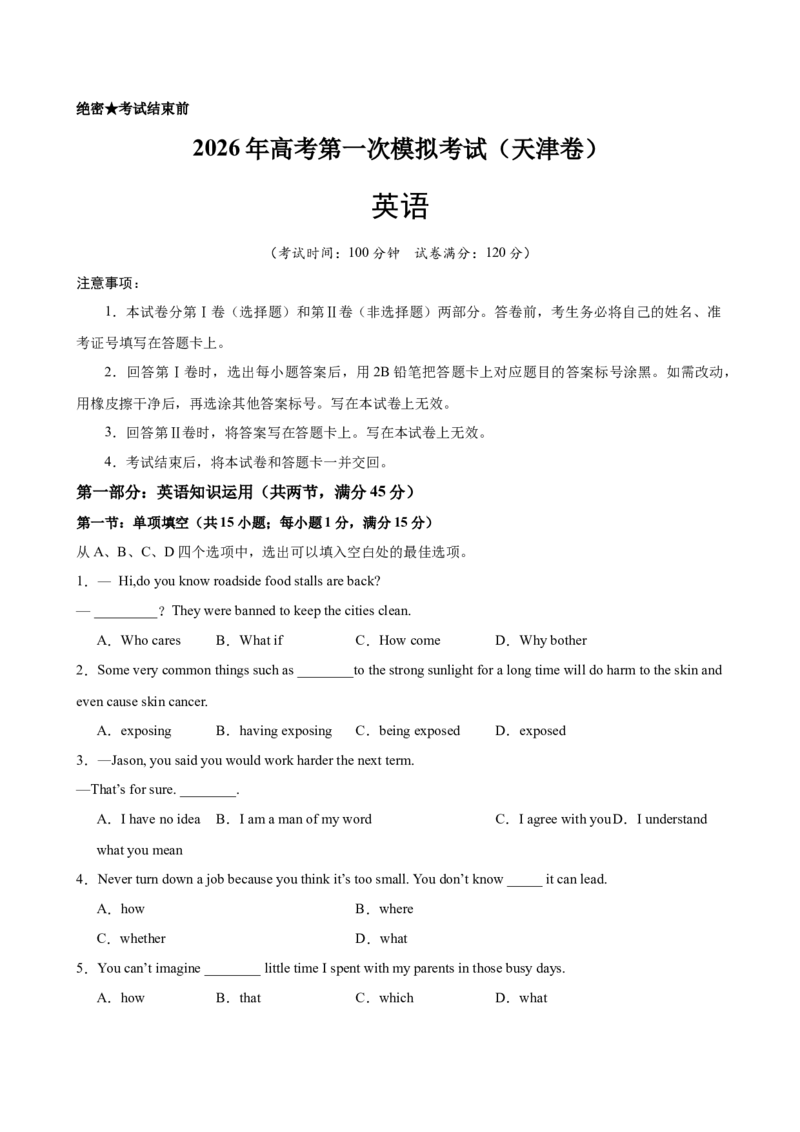
1.— Hi,do you know roadside food stalls are back?
— _________?They were banned to keep the cities clean.
A.Who cares
B.What if
C.How come
D.Why bother
2.Some very common things such as ________to the strong sunlight for a long time will do harm to the skin and
even cause skin cancer.
A.exposing
B.having exposing
C.being exposed
D.exposed
3.—Jason, you said you would work harder the next term.
—That’s for sure. ________.
A.I have no idea
B.I am a man of my word
C.I agree with youD.I understand
what you mean
4.Never turn down a job because you think it’s too small. You don’t know _____ it can lead.
A.how
B.where
C.whether
D.what
5.You can’t imagine ________ little time I spent with my parents in those busy days.
A.how
B.that
C.which
D.what
6.One of my neighbors used to have a beautiful tree in her front yard. Her dad had planted it for her ________
it was nothing more than a little branch and several years later it started to shoot towards the sky at an amazing
speed.
A.unless
B.when
C.until
D.because
7.A good government is not to pick technologies, but to establish conditions ________ innovation is supported
and encouraged into the marketplace.
A.when
B.that
C.as
D.where
8.The old man told his friends he had to leave immediately because he had some urgent business to ______.
A.point to
B.turn to
C.attend to
D.belong to
9.If you have second thoughts, you’d better making a decision until you’ve spoken to your high school advisor.
A.pass up
B.weigh up
C.look into
D.put off
10.The car ______ at the present speed until it reaches the foot of the mountain at about nine o'clock tonight.
A.went
B.is going
C.goes
D.will be going
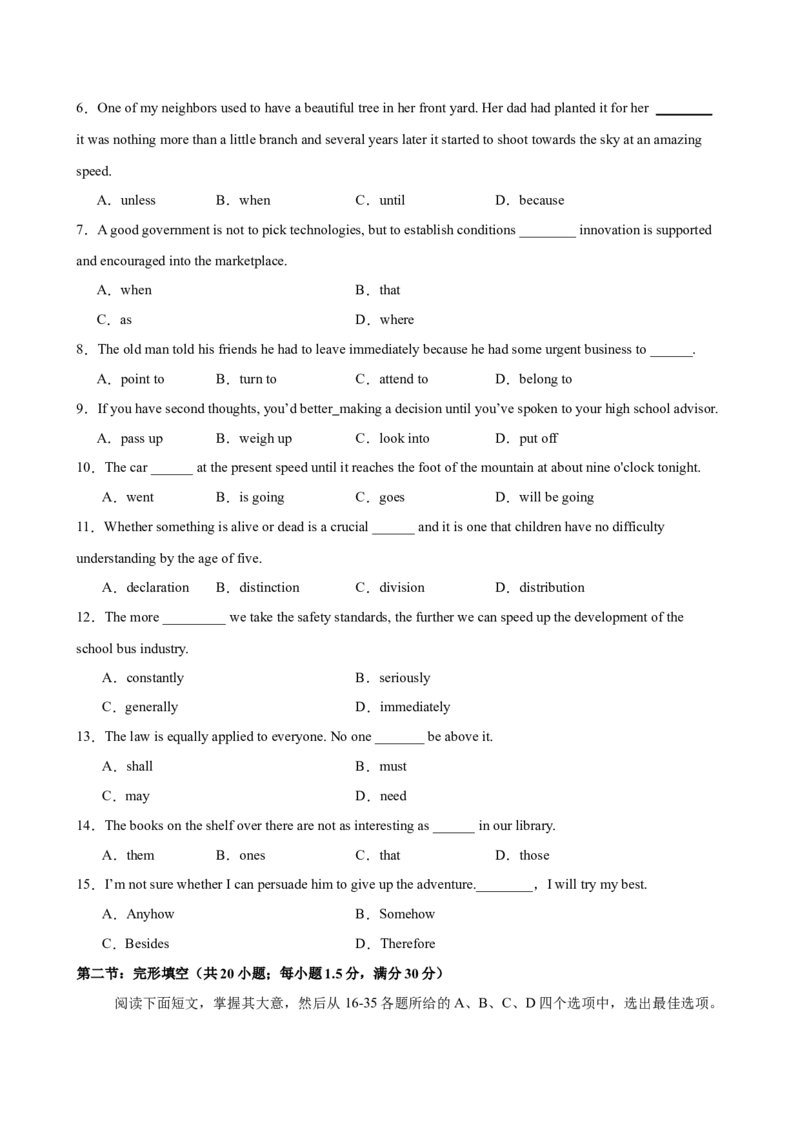
11.Whether something is alive or dead is a crucial ______ and it is one that children have no difficulty
understanding by the age of five.
A.declaration
B.distinction
C.division
D.distribution
12.The more _________ we take the safety standards, the further we can speed up the development of the
school bus industry.
A.constantly
B.seriously
C.generally
D.immediately
13.The law is equally applied to everyone. No one _______ be above it.
A.shall
B.must
C.may
D.need
14.The books on the shelf over there are not as interesting as ______ in our library.
A.them
B.ones
C.that
D.those
15.I’m not sure whether I can persuade him to give up the adventure.________,I will try my best.
A.Anyhow
B.Somehow
C.Besides
D.Therefore
第二节:完形填空(共20 小题;每小题1.5 分,满分30 分)
阅读下面短文,掌握其大意,然后从16-35 各题所给的A、B、C、D 四个选项中,选出最佳选项。
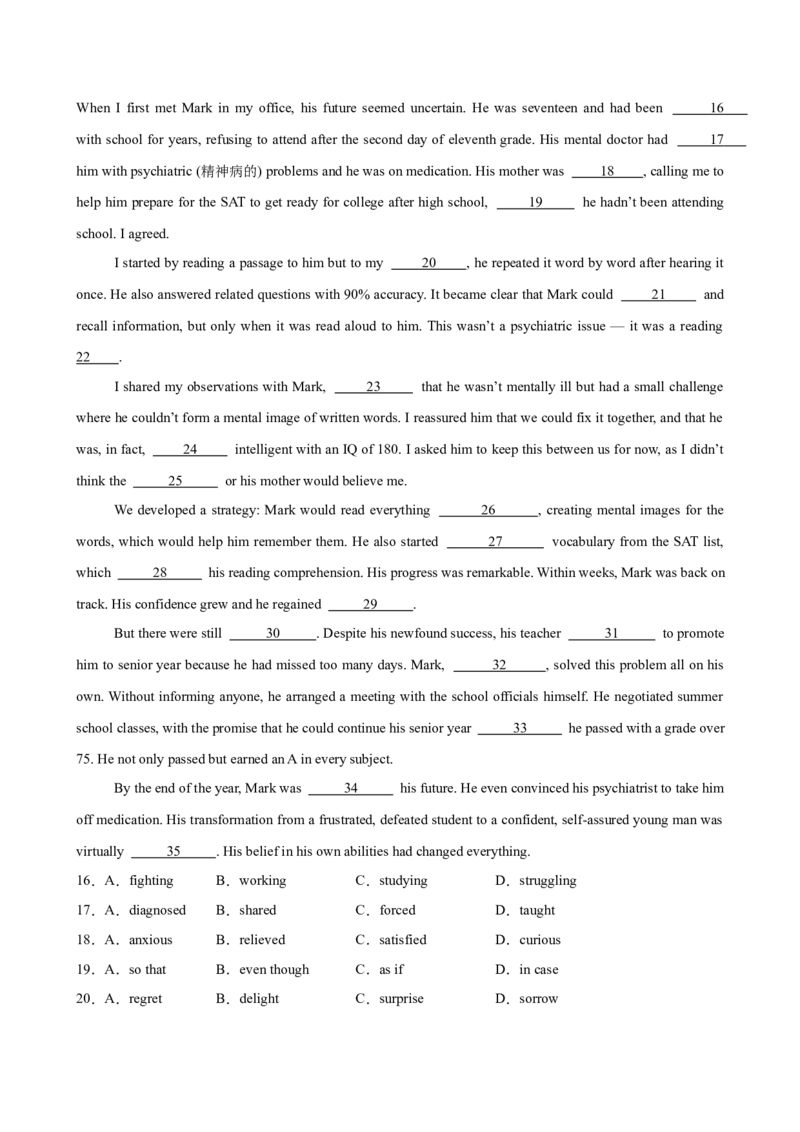
When I first met Mark in my office, his future seemed uncertain. He was seventeen and had been     16

with school for years, refusing to attend after the second day of eleventh grade. His mental doctor had     17

him with psychiatric (精神病的) problems and he was on medication. His mother was     18    , calling me to
help him prepare for the SAT to get ready for college after high school,     19     he hadn’t been attending
school. I agreed.
I started by reading a passage to him but to my     20    , he repeated it word by word after hearing it
once. He also answered related questions with 90% accuracy. It became clear that Mark could     21     and
recall information, but only when it was read aloud to him. This wasn’t a psychiatric issue — it was a reading
22    .
I shared my observations with Mark,     23     that he wasn’t mentally ill but had a small challenge
where he couldn’t form a mental image of written words. I reassured him that we could fix it together, and that he
was, in fact,     24     intelligent with an IQ of 180. I asked him to keep this between us for now, as I didn’t
think the      25      or his mother would believe me.
We developed a strategy: Mark would read everything      26     , creating mental images for the
words, which would help him remember them. He also started      27      vocabulary from the SAT list,
which      28      his reading comprehension. His progress was remarkable. Within weeks, Mark was back on
track. His confidence grew and he regained      29     .
But there were still      30     . Despite his newfound success, his teacher      31      to promote
him to senior year because he had missed too many days. Mark,      32     , solved this problem all on his
own. Without informing anyone, he arranged a meeting with the school officials himself. He negotiated summer
school classes, with the promise that he could continue his senior year      33      he passed with a grade over
75. He not only passed but earned an A in every subject.
By the end of the year, Mark was      34      his future. He even convinced his psychiatrist to take him
off medication. His transformation from a frustrated, defeated student to a confident, self-assured young man was
virtually      35     . His belief in his own abilities had changed everything.
16.A.fighting
B.working
C.studying
D.struggling
17.A.diagnosed
B.shared
C.forced
D.taught
18.A.anxious
B.relieved
C.satisfied
D.curious
19.A.so that
B.even though
C.as if
D.in case
20.A.regret
B.delight
C.surprise
D.sorrow
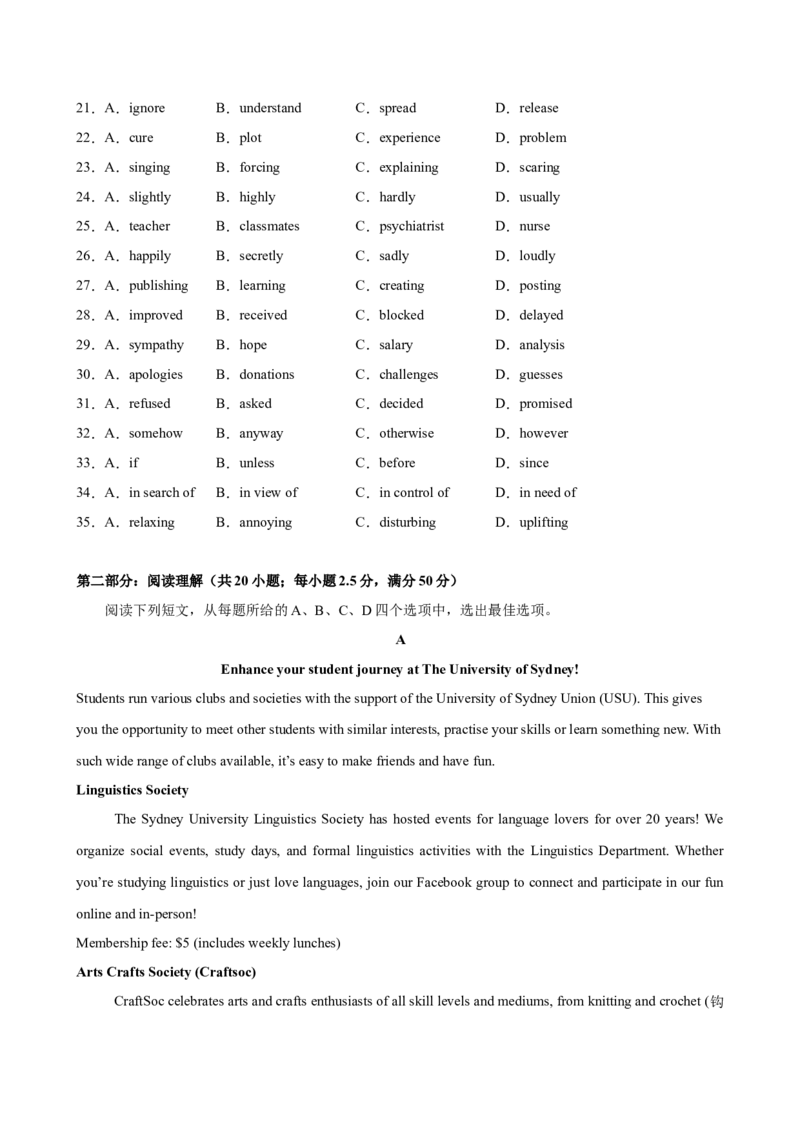
21.A.ignore
B.understand
C.spread
D.release
22.A.cure
B.plot
C.experience
D.problem
23.A.singing
B.forcing
C.explaining
D.scaring
24.A.slightly
B.highly
C.hardly
D.usually
25.A.teacher
B.classmates
C.psychiatrist
D.nurse
26.A.happily
B.secretly
C.sadly
D.loudly
27.A.publishing
B.learning
C.creating
D.posting
28.A.improved
B.received
C.blocked
D.delayed
29.A.sympathy
B.hope
C.salary
D.analysis
30.A.apologies
B.donations
C.challenges
D.guesses
31.A.refused
B.asked
C.decided
D.promised
32.A.somehow
B.anyway
C.otherwise
D.however
33.A.if
B.unless
C.before
D.since
34.A.in search of
B.in view of
C.in control of
D.in need of
35.A.relaxing
B.annoying
C.disturbing
D.uplifting
第二部分:阅读理解(共20 小题;每小题2.5 分,满分50 分)
阅读下列短文,从每题所给的A、B、C、D 四个选项中,选出最佳选项。
A
Enhance your student journey at The University of Sydney!
Students run various clubs and societies with the support of the University of Sydney Union (USU). This gives
you the opportunity to meet other students with similar interests, practise your skills or learn something new. With
such wide range of clubs available, it’s easy to make friends and have fun.
Linguistics Society
The Sydney University Linguistics Society has hosted events for language lovers for over 20 years! We
organize social events, study days, and formal linguistics activities with the Linguistics Department. Whether
you’re studying linguistics or just love languages, join our Facebook group to connect and participate in our fun
online and in-person!
Membership fee: $5 (includes weekly lunches)
Arts Crafts Society (Craftsoc)
CraftSoc celebrates arts and crafts enthusiasts of all skill levels and mediums, from knitting and crochet (钩
针编织) to figurine (小塑像) painting and cosplay. Our activities include a monthly meet-up at the Courtyard
Cafe for Crafternoon Tea-bring your craft or learn a new one! Enjoy exclusive sponsor discounts in our monthly
newsletter.
Membership fee: Free
Film Society (Filmsoc)
Founded in 1947, Filmsoc preserves film stock and keeps cinema alive in Sydney. We screen weekly films
across all genres with free pizza and drinks. Join over 300 members for 26+ free films a year, a short film contest,
and discount movie tickets. It’s a great place for meeting like-minded filmmakers.
Membership fee: $5
Jamming Society (UniJam)
Join UniJam, a community for music enthusiasts of all levels. Attend our casual jam sessions to meet fellow
musicians, perform together and grow your musical skills. No auditions or fees are required-whether you’re a
beginner or a seasoned player, come jam with us, make friends and have fun. With weekly sessions, it’s a great
opportunity to connect with other musicians, socialize and enjoy music. Don’t miss our Friday Specials like
outdoor jams, open mics, and karaoke nights.
Membership fee: Free
You will need to have USU Membership to join, available through the USU. You can search the different
clubs and societies on the USU website. Many of them are free to join and others will require a small fee to help
cover the cost of events or equipment.
You can now join a student club through our new online platform, using your Unikey. You can see what is
on offer, join on the spot and chat and connect with members from more than 250 USU clubs and societies.
Don’t limit yourself-join as many clubs as you wish!
36.What is one of the membership benefits offered by the Linguistics Society?
A.Free monthly workshops.
B.Weekly lunches.
C.Access to exclusive online resources.
D.Discounted movie tickets.
37.What can students do at Filmsoc?
A.They can get free movie tickets.
B.They can enjoy drinks at a discount.
C.They can participate in a short film competition.
D.They can watch over 26 films online per month.
38.Why is UniJam unique compared to the other clubs?
A.It hosts activities both online and offline.B.It welcomes members of all skill levels.
C.It features weekly events on a specific day.
D.It doesn’t charge applicants a fee to join.
39.What is a likely reason for the USU to charge a membership fee for some clubs?
A.To generate benefits for the university.
B.To limit the number of participants in each club.
C.To ensure that only committed students join the clubs.
D.To fund activities and equipment needed for the clubs.
40.What can be inferred about the University of Sydney’s approach to student life?
A.It focuses primarily on competitive activities.
B.It promotes a well-rounded student experience.
C.It emphasizes artistic achievement above all else.
D.It restricts participation in clubs to maintain academic focus.
B
In modern society, people often measure life value through material achievements: high salaries, prestigious
job titles, or luxurious possessions. However, ancient philosophers like Socrates argued that “the unexamined life
is not worth living,” suggesting true value lies in continuous self-reflection and intellectual growth.
Recent studies reveal an intriguing paradox: individuals who prioritize personal fulfillment over external
validation report 37% higher life satisfaction. Take Dr. Maya Lin for an example: she was a scientist who
abandoned a lucrative corporate career to research renewable energy in rural communities. Though her income
dropped significantly, she described her work as “a daily discovery of purpose.” This aligns with psychologist
Abraham Maslow’s theory that self-actualization — not basic needs — defines peak human experiences.
Cultural perspectives further complicate this discussion. In Eastern traditions, Confucianism emphasizes
contributing to societal harmony. A 2024 survey showed 68% of Japanese youth view “fulfilling family duties” as
central to life value, contrasting with Western emphasis on individualism. Yet Martin Luther King Jr.’s famous
words —“Life’s most urgent question is: what are you doing for others?” — bridge this gap, proposing that
personal growth and social responsibility are inseparable.
Ultimately, defining life value requires balancing three elements: self-awareness, contribution to others, and
adaptability in changing circumstances. As technology accelerates societal shifts, the ability to redefine one’s
purpose may become humanity’s greatest wealth.
41.What is the main topic discussed in the passage?
A.Various perspectives on life value.
B.Cultural differences in educational systems.
C.Historical views on wealth accumulation.
D.Psychological theories of happiness.
42.According to the author, what brings genuine fulfillment?
A.High social status.
B.Luxurious possessions.
C.Self-awareness and purpose.
D.Technological advancements.
43.Why does the author mention Martin Luther King Jr.?
A.To contrast Eastern and Western values.
B.To demonstrate universal aspects of life value.
C.To criticize materialistic lifestyles.
D.To explain Maslow’s hierarchy of needs.
44.The word “aligns” most likely means __________.
A.Conflicts
B.measures
C.complicates
D.agrees
45.Which statement would the author most likely agree with?
A.Adaptability enhances life’s meaningfulness.
B.Social media popularity reflects true self-worth.
C.Life value should be measured by material achievements levels.
D.Traditional values are outdated in modern society.
C
One of the most important people in the world of robotics is not a conventional roboticist, but a science-
fiction writer: Isaac Asimov. He coined the word “robotics”, invented the famous Three Laws, which govern the
relation of robots to their human masters, and passed on many myths that affect the way we feel about robots
today. What was it, though, that opened up such new worlds to the writer in the very beginning?
Born in the rural village of Petrovichi, Russia, in 1920, Isaac moved to Brooklyn with his parents when he
was three years old. Making a go of life in the United States turned out to be tougher than the family had
expected. It took them three years to save up enough money for a down payment on a small candy store. As a kid,
Isaac worked long hours in the store where he became interested in one attraction that pulled in customers: pulp
science fiction magazines featuring death rays and alien worlds.
Soon after the first rocket launches in the mid-1920s, scientists announced that space travel had become
possible, opening the door to exciting tales of adventure in outer space. Atomic energy-the source of the death
rays-was also coming into public eye as a potential “super weapon”. But few people actually believed that they
would be able to see either atomic bombs or space travel during their lifetime.
Neither did Isaac’s father. While the science fiction magazines sold like hot cakes, he considered them to be
out-and-out junk. Young Isaac was not allowed to waste time reading about things that did not exist and never
would. Despite his father’s objections, Isaac began secretly reading every pulp magazine that appeared in the
store, handling each one so carefully that Asimov Senior never knew they had been opened. Isaac finally managed
to convince his father that one of the magazines, Science Wonder Stories, had educational value-after all, the
word “science” was in the title.
At the age of 18, Isaac read the magazine Astounding Science Fiction and tried writing a story of his own.
He took the subway and submitted the story in person to the magazine’s famous editor, John Campbell. It was
rejected, but Campbell encouraged the young man to send him more. Isaac kept writing and about four months
later he managed to sell a story. Then two more, including one that broke him into Astounding Science Fiction.
And the rest is history. By the end of his writing career, Isaac was credited with producing more than 500 books
on a wide range of subjects, reaching out not only to distant galaxies but also to the distant past for inspiration.
46.The following statements are all true EXCEPT ________.
A.Isaac Asimov was a productive science fiction writer
B.Isaac Asimov was a Russian immigrant to
America
C.Isaac Asimov used to work as an amateur roboticist
D.Isaac Asimov created the Three Laws of
Robotics
47.Why did atomic energy come into public eye in the 1920s?
A.Because people read science fiction stories featuring death rays.
B.Because the first rocket was launched during this period.
C.Because stories about space adventure were very popular.
D.Because the it had the potential to become a super weapon
48.Isaac’s father discouraged his son from reading science fiction magazines because ________.
A.they depicted life in alien worlds and death rays
B.he thought that the stories were poorly written
C.these magazines didn’t bring in satisfying profits
D.the young boy had to work long hours in their
store
49.According to the article, Isaac ended up selling his first story ________.
A.thanks to the support and guidance of his father
B.to the magazine Astounding Science Fiction
C.when he was still a student in high school
D.about four months after he met John Campbell
50.Much of Isaac’s initial success could be credited to his ________.
A.high intelligence
B.artistic creativity
C.extensive knowledge
D.remarkable persistence
D
Giving blood regularly may not just be saving the lives of other people, it could also be improving your
own blood’s health at a genetic level, according to a new study. A team of researchers compared samples from 217
men who had given blood more than 100 times in their lives, to samples from 212 men who had donated less than
10 times, to look for any variance in blood health.
While the differences were subtle, the frequent donors’ blood was more likely to have beneficial mutations
(突变) in a gene called DNMT3A.Other mutations in DNMT3A have been previously linked to blood cancer.
“Our work is a fascinating example of how our genes interact with the environment as we age.” says stem cell
biologist Dominique Bonnet, from The Francis Crick Institute in the UK. Specifically, the team looked at blood
stem cells, which produce more blood cells on demand. As we get older, these mechanisms can start to break
down, leading to problems with blood cancers such as leukemia (白血病).
Blood loss triggers the production of the hormone erythropoietin (促红细胞生成素激素). In lab tests on
blood stem cells treated with erythropoietin, the researchers found those with the DNMT3A mutation produced
blood faster than those without the mutation. This suggests frequent blood loss leads to more production of the
mutated blood cells. Research in mice shows the DNMT3A mutation results in healthier blood levels after the
stress of blood loss. “Activities that put low levels of stress on blood cell production allow our blood stem cells to
renew and we think this favors mutations that further promote stem cell growth rather than disease.” says Bonnet.
However, there are limitations to consider. Blood donors are more likely to be healthier anyway (it’s a
condition of giving blood), so figuring out any additional health benefit is tricky, because it might actually come
from being in better shape to begin with. “Our sample size is quite modest, so we can’t say that blood donation
definitely decreases the occurrence of pre-leukemic mutations.” says Bonnet. In the US, there’s such an urgent
need for blood donors that someone needs blood or platelets (small fragments in blood) every two seconds.
Having healthier blood is an added bonus.
While waiting for more detailed studies to confirm these findings, the study tells us more about how blood
cancers can get started in the first place. “We’re now aiming to work out how these different types of mutations
play a role in developing leukemia or not, and whether they can be targeted therapeutically.” says stem cell
biologist Hector Huerga Encabo, from the Francis Crick Institute.
51.What was the primary focus of the study mentioned in the passage?
A.The genetic differences between frequent and occasional blood donors.
B.The role of erythropoietin in blood cell production.
C.The relationship between blood donation and leukemia.
D.The therapeutic applications of DNMT3A mutations
52.According to the research, blood loss affects blood stem cells in that ______ .
A.It triggers the production of cancerous cells in the DNMT3A gene
B.It accelerates the growth of cells with beneficial DNMT3A mutations
C.It benefits the overall health condition of the donors
D.It weakens the regenerative capacity of blood stem cells
53.What can be inferred about the DNMT3A gene from the passage?
A.Its activity is primarily regulated by environmental factors.
B.Most mutations in DNMT3A are harmless and non-functional.
C.The gene is only responsible for blood cancer development.
D.Its beneficial mutations may enhance blood cell production efficiency.
54.What limitation does the study acknowledge?
A.Donors’ genetic backgrounds were not fully accounted for.
B.Donors’ pre-existing health conditions might influence results.
C.Erythropoietin levels were not measured in the experiment.
D.Mouse models cannot accurately reflect human genetic mechanisms.
55.Based on the passage, the research team’s next goal is ______ .
A.to develop a new drug targeting DNMT3A mutations
B.to conduct large-scale human trials of erythropoietin therapy
C.to determine which DNMT3A mutations directly cause leukemia
D.to analyze environmental factors influencing blood donation behavior
第二部分:写作(共两节,满分35 分)
第一节:阅读表达(共5 小题;每小题2 分,满分10 分)
阅读下面短文,并根据短文内容完成下列各题。
Once upon a time, in a little village called Charmington, there lived a shy and unconfident girl named Lily.
Lily was a kind-hearted soul. but her lack of self-assurance often led her to doubt her own beauty and worth.
One sunny day, as Lily wandered through the streets of Charmington, she came across a charming little
shop filled with shining hair accessories (配饰). Among the treasures, her eyes were attracted by a lovely bow (蝴
蝶结) that seemed to callout to her. Despite her hesitation, something inside Lily told her to take a small act of
self-expression and pay for the bow. She bought it and gently put it in her hair. At that very moment, a magical
transformation took place. Lily felt a burst of confidence, as if the bow had given her a newfound confidence and
charm.
Excited about her new accessory, Lily confidently walked down the busy streets of Charmington, unaware
that the bow had slipped and dropped unnoticed from her hair. Her newfound confidence made her feel beautiful
inside and out. As Lily walked, something amazing began to happen. People passing by couldn’t help but notice
her beauty, the warmth that shined from herself. Strangers smiled at her, complimenting her on her look and
bright smile.
Confused by their compliments, Lily touched her hair, only to realize that the bow was missing. Instead of
feeling embarrassed or disheartened, she couldn’t help but be amazed by the power of her own confidence. Lily
began to understand that true beauty lies not in outside decorations but in self-assurance and grace. It was her
confidence that had caught the attention and admiration of those around her.
56.What was the biggest challenge for Lily? (No more than 15 words)

57.How did Lily feel after she wore the new bow? (No more than 5 words)

58.What does the underlined word “complimenting” probably mean? (1 word)

59.According to the passage, where is true beauty? (No more than 6 words)

60.In your opinion, how will you build your own confidence? (No more than 20 words)

第二节:书面表达(满分25 分)
61.假设你是晨光中学的李津。下周你校学生会将举行一次英语论坛,探讨如何利用人工智能(AI)促进学
习和生活的智能化改进,请你根据以下提示撰写一篇发言稿。
要点提示:
(1)介绍你是如何利用AI 学习和生活的(至少写出两点);
(2)简单谈谈你对使用AI 的看法;
(3)期待同学们分享他们的经验。
注意:
(1)词数不少于100;
(2)可适当加入细节,使内容充实、行文连贯;
(3)开头和结尾已给出,不计入总词数。
Good morning, dear friends. My name is Li Jin.
___________________________________________________________________________________________
___________________________________________________________________________________________
___________________________________________________________________________________________
___________________________________________________________________________________________
___________________________________________________________________________________________
_____
Thank you.