绝密★考试结束前
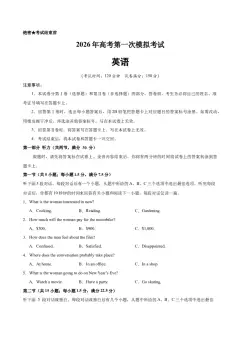
2026 年高考第一次模拟考试
英语
(考试时间:120 分钟  试卷满分:150 分)
注意事项:
1.本试卷分第Ⅰ卷(选择题)和第Ⅱ卷(非选择题)两部分。答卷前,考生务必将自己的姓名、准
考证号填写在答题卡上。
2.回答第Ⅰ卷时,选出每小题答案后,用2B 铅笔把答题卡上对应题目的答案标号涂黑。如需改动,
用橡皮擦干净后,再选涂其他答案标号。写在本试卷上无效。
3.回答第Ⅱ卷时,将答案写在答题卡上。写在本试卷上无效。
4.考试结束后,将本试卷和答题卡一并交回。
第一部分 听力(共两节,满分 30 分)
做题时,请先将答案标在试卷上。录音内容结束后,你将有两分钟的时间将试卷上的答案转涂到答
题卡上。
第一节(共5 小题;每小题1.5 分,满分7.5 分)
听下面5 段对话。每段对话后有一个小题,从题中所给的A、B、C 三个选项中选出最佳选项。听完每段
对话后,你都有10 秒钟的时间来回答有关小题和阅读下一小题。每段对话读两遍。
1.What does the woman advise the man to do?
A.Go to the office.
B.Keep calling.
C.Try online booking.
2.What will the speakers do next?
A.Go out to have dinner.
B.Celebrate a birthday.
C.Study for a test.
3.Who did the woman want to call?
A.Sarah.
B.Tom.
C.Tony.
4.Where is the woman’s mobile phone?
A.In the kitchen.
B.In the bedroom.
C.In the sitting room.
5.What is the man concerned about?
A.The woman’s work.
B.The woman’s health.
C.The woman’s cooking skill.
第二节(共15 小题;每小题1.5 分,满分22.5 分)
听下面 5 段对话或独白。每段对话或独白后有几个小题,从题中所给的A、B、C 三个选项中选出最佳
选项,并标在试卷的相应位置。听每段对话或独白前,你将有时间阅读各个小题,每小题 5 秒钟;听完
后,各小题将给出 5 秒钟的作答时间。每段对话或独白读两遍。
听下面一段较长对话,回答以下小题。
6.Where does the conversation probably take place?
A.In a library.
B.In a shop.
C.In a museum.
7.Why does the man pay for the fine?
A.The book wasn’t returned in time.
B.The book was damaged.
C.The book was lost.
听下面一段对话,回答以下小题。
8.What are the speakers going to do?
A.Go to the USA.
B.Have lunch.
C.Celebrate Christmas.
9.How will the man go to the USA?
A.By plane.
B.By car.
C.By train.
10.What is the woman’s suggestion?
A.Making plans in advance.
B.Going home for Christmas.
C.Booking the ticket immediately.
听下面一段对话,回答以下小题。
11.Who is the woman?
A.A librarian.
B.A receptionist.
C.A ticket seller.
12.Where is the man’s room?
A.On the 2nd floor.
B.On the 3rd floor.
C.On the 4th floor.
13.How long does the breakfast in the restaurant last?
A.2 hours.
B.3 hours.
C.4 hours.
听下面一段对话,回答以下小题。
14.Why does the man come to the woman’s house?
A.To send a present.
B.To decorate the house.
C.To attend a birthday party.
15.What does the woman think of the present?
A.It’s beautiful.
B.It’s cheap.
C.It’s useful.
16.What does the woman mention about her hometown?
A.Its culture.
B.Its weather.
C.Its history.
17.Who likes playing snowball fights?
A.The man’s son.
B.The man’s daughter.
C.The man.
听下面一段独白,回答以下小题。
18.Where can the children work as volunteers?
A.In America.
B.In Canada.
C.In Italy.
19.How much do the trips cost in total?
A.$1,000.
B.$1,600.
C.$2,600.
20.What is the aim of the English Summer Camps?
A.To help children avoid mistakes.
B.To make children speak English perfectly.
C.To make children try their best to learn English.
第二部分  阅读(共两节,满分50 分)
第一节(共15 小题;每小题2.5 分,满分37.5 分)
阅读下列短文,从每题所给的A、B、C、D 四个选项中选出最佳选项。
A
China’s rich intangible cultural heritage (ICH) is vividly preserved in specialized museums that showcase
age-old crafts and traditions. Here are three renowned institutions offering profound cultural insights.
China National Arts and Crafts Museum (Beijing)
Established in 2022, the museum stands on Beijing’s Central Axis, also called China Intangible Cultural
Heritage Museum. Its architectural design mixes Forbidden City aesthetics with modern elements, symbolizing
cultural continuity. The collection spans 11 craft categories, including jade carvings and textiles. highlighting its
treasures are four imperial jade masterpieces carved from a single raw stone, such as Magnificent Scenery of
Mount Tai, representing China’s craft height. Free to visit (with reservation), it’s a premier venue for
understanding national-level ICH.
China Yunjin Museum (Nanjing)
It is dedicated to Yunjin, the “cloud brocade” once exclusive to emperors. Its star exhibit is the Plain Silk
Gown — a Han Dynasty relic thinner than cicada wings, embodying ancient weaving mastery. The museum
preserves traditional Jacques looms and demonstrates the complex production process, where a single piece may
take years to complete. Visitors witness how this luxurious textile, named for its cloud-like beauty, has evolved
while preserving cultural essence.
Puzhen Bai Ethnic Tie-Dye Museum (Yunnan)
It showcases tie-dye, a UNESCO-listed craft. Located in Dali, it displays both traditional and contemporary
works, from indigo-dyed fabrics to innovative designs. What sets it apart is interactive experiences: visitors can
try tying and dyeing fabrics themselves, engaging directly with the “zhahua” technique. The museum preserves
the Bai people’s ecological dyeing methods, using natural paints and plant materials, reflecting harmony between
humans and nature.
These museums not only exhibit artifacts but also breathe life into endangered skills, inviting global
audiences to appreciate China’s cultural legacy.
21.What can we learn about China National Arts and Crafts Museum?
A.It opened to the public in 2020.
B.Its architectural style is fully modern.
C.Visitors need a reservation for free entry. D.Its collection only includes jade carvings.
22.What makes Puzhen Bai Ethnic Tie-Dye Museum unique?
A.Emperor exclusive relics.
B.Traditional cultural works.
C.Textile-related techniques.
D.Hands-on visitor experiences.
23.What is the main purpose of the passage?
A.To teach weaving skills.
B.To compare ICH museums.
C.To call for ICH preservation.
D.To introduce cultural artifacts.
B
On a leisurely afternoon, a post on my Wechat regarding a local stray animal rescue center suddenly caught
my eye. Driven by curiosity, I clicked it open and learned an elderly aunt in her seventies—barely named in the
post—had dedicated years to rescuing stray dogs(流浪狗) and cats, with over 400 saved. Yet she faced trouble—
she couldn’t afford to purchase sufficient food and essential medical supplies, pushing the shabby shelter to the
risk of closure.
Deeply moved by her selflessness and anxious about the animals’ future, I contacted like-minded volunteers
instantly. We discussed online and decided to seek public support via the Internet. First, we sorted out the aunt’s
rescue stories and the animals’ current situation, attached photos of their pitiful looks and the shelter’s shabby
environment, and posted them on social platforms to arouse attention. Then, we launched a live stream, showing
the aunt’s daily care for the animals, answering citizens’ questions patiently with the aim of enabling more people
to know about it.
To help the elderly aunt, we initiated an “online adoption” program, where people could adopt animals
from the centre via live stream or visit in person. That is to say, people didn’t need to take the animals home;
instead, they provided monthly funding to her for the adopted animals. Every day in the live stream, we would
update people on the latest situation of them. Interested citizens could learn about the animals’ personalities, ages
and health. Besides, we urged friends and relatives to share related posts and join our team to expand the activity’s
influence. Ultimately, nearly 95% of animals had been adopted.
This rescue journey carries enlightenment. Kindness never fades—like the 70-year-old aunt, ordinary
people can warm the weak with consistent love. Unity is powerful: individual strength is limited, but collective
efforts with social media can break dilemmas. Caring for strays reflects compassion and safeguards life balance.
Every small act, like sharing posts or donating, builds a harmonious human-animal relationship.
24.What happened to the elderly aunt’s centre?
A.It collaborated with pet hospitals.
B.It was shut down involuntarily.
C.It held a charity donation on Wechat.
D.It suffered a shortage of fund.
25.Why was the live stream launched?
A.To expand the publicity.
B.To enhance moral values.
C.To increase traffic online.
D.To promote animal products.
26.Which of the following best describes the online adoption program?
A.Average.
B.Unsatisfactory.
C.Fruitful.
D.Anticipated.
27.What message does the last paragraph convey?
A.Chance favors the prepared mind.
B.Many hands make light work.
C.When the buying stops, the killing can too.
D.Nothing is impossible to a willing heart.
C
Scientists have discovered life in a place they once thought impossible. In a new study, a research team
explored how tiny living things, or microbes, manage to survive in one of the planet’s harshest underwater
environments. The site has a very high pH level, making it one of the most unfriendly places for life ever
recorded. Because so few living cells exist there, it is often impossible to find signs of life like DNA.
To overcome this challenge, researchers used a different approach. They analyzed special fat molecules,
known as chemical traces, which reveal biological activity. By studying these molecules found in sediment
samples, scientists were able to understand how microbes survive in such extreme conditions. These fat molecules
act as hidden clues to life, showing the survival strategies of organisms that feed on substances like methane. This
method is sensitive enough to detect even the faintest signals from life.
These deep-sea microbial communities play an important role in the Earth’s carbon cycle. They get their
energy not from sunlight, but from minerals in rocks and gases like carbon dioxide. This process produces
methane, a key greenhouse gas. This shows that these microbes operate in a self-contained ecosystem,
independent of the ocean above. Their existence proves that complex life processes can occur in complete
isolation from the sun’s energy.
The discovery is highly significant. It proves that life can exist under extreme conditions, such as high pH
and low levels of organic material. Furthermore, these fat molecules can help scientists tell the difference between
modern, living cells and the remains of ancient life. This provides valuable insights into how life persists in places
with very few nutrients. Some scientists even believe that similar environments could have been the birthplace of
the earliest forms of life on Earth.
The samples were collected from previously unknown underwater mud volcanoes during a deep-sea
research trip. Inspired by these findings, the team now plans to grow these microbes in controlled lab
environments. Their goal is to learn more about how these organisms get nutrients and survive in such harsh
conditions, further pushing the boundaries of our understanding of life itself.
28.What did researchers use instead of DNA to find the microbes?
A.Remains of ancient life.
B.Gases from the rocks.
C.Sunlight from the surface.
D.Special fat molecules.
29.What is the energy source for the deep-sea microbial communities?
A.Sunlight and the ocean surface.
B.Other living creatures in the sea.
C.Minerals from rocks and gases.
D.Methane and the carbon cycle.
30.What does the phrase “a self-contained ecosystem” in Paragraph 3 imply?
A.It operates independently of the ocean above.
B.It produces its own oxygen.
C.It is the only system of its kind on Earth.
D.It does not require any energy source.
31.What can be inferred from the discovery about the limits of life?
A.Life can only exist in environments with neutral pH.
B.Life is more adaptable than previously believed.
C.The deep sea is the only place for extreme life.
D.All microbes are capable of producing methane.
D
Languages are dying at an alarming rate. While teaching them in school can be a great way to ensure its
continued survival via future generations, this isn’t always enough to maintain the vitality of a language.
Fortunately, there are people around the world finding creative ways to revive endangered languages.
Music has documented our history and legends. It’s no surprise, then, that many people are using music to
promote the use of endangered language. One example is Garifuna, a Central American language spoken by fewer
than 1,000,000 people. The interplay of language and music is accomplished not only by performing traditional
songs and dances, but also by creating new music to draw in those not previously interested in the language.
Whether it’s someone’s specific goal to promote an endangered language or musicians wanting to embrace their
roots by singing songs, music extends the long cultural history of these languages.
Films in endangered languages are kind of having a moment, or at least they’ve garnered a lot of media
attention over the past few years. For instance, Disney released a Hawaiian version of Moana for free to Hawaiian
schools, inspiring young people to engage with language. Even if films alone can’t save a language, they can
revitalize a language by removing it from the classroom context and compelling viewers to consider it more
deeply.
The internet has been a double-edged sword for endangered languages. On one hand, speakers of
endangered languages are no longer limited by geography. On the other hand, the internet is overflowing with
English. Yet, young people are finding ways to adapt within digital spaces. For example, Icelandic is facing
decline due to the influence of English from tourism and daily life. Instead of resisting change, young Icelanders
are inventing their own terms to communicate in Icelandic online. By embracing rather than rejecting the change,
there’s greater chance for these endangered languages to stay culturally strong.
Reviving an endangered language isn’t overnight. No single solution will work, but when combined, these
diverse strategies can introduce countless new speakers to the rich variety of languages.
32.How is Garifuna brought to life?
A.By teaching it in schools.
B.By making its old and new music.
C.By documenting its history in books.
D.By persuading musicians to sing in it.
33.How does Internet challenge endangered languages?
A.It makes the use of endangered languages impossible.
B.It provides unlimited space for all languages.
C.It ruins the languages by inventing new terms.
D.It is largely dominated by English.
34.What can be drawn from paragraph 4?
A.English is the most influential language on the internet.
B.The internet can be fully used to protect endangered languages.
C.Icelandic will be removed from the endangered languages list soon.
D.Resisting the use of English is a good way to protect an endangered language.
35.What can we infer about the endangered languages?
A.Their preservation requires consistent joint efforts.
B.Their vitality is maintained due to the artists’ efforts.
C.Their preservation can be achieved by teaching in schools.
D.They are unable to react to changes in modern society.
第二节(共5 小题;每小题2.5 分,满分12.5 分)
阅读下面短文,从短文后的选项中选出可以填入空白处的最佳选项。选项中有两项为多余选项。
Worried about the climate?    36    . Here are some examples to get you started.
•Count the birds and the bees
Get closer to nature by becoming a citizen scientist. You could be counting birds in your garden, butterflies,
insects and flowers, or even reptiles and hedgehogs.    37    . It’s a fun group activity, and your data can help
scientists better understand the impact of human behaviour on natural habitats.
•     38


Media headlines can be alarming when it comes to the climate and nature crisis or ignoring the issues
completely. Hosting a local discussion can allow space for reflection, debate, ideas and collaboration ( 合作) to
take action on global issues at a local level.
•Set up a library of things
Internet shopping has made it too easy to buy new stuff at the click of a button.    39    ? First, it’ll
clutter (凌乱地塞满) your house,then it’ll clutter the planet. Setting up a library of things can encourage local
people to share everything from tools to instruments, cooking gadgets to toys.
•Start a climate emergency centre
    40    . That’s why more and more climate emergency centres are popping up in derelict (废弃地)
shops on high streets and in shopping centres. A climate emergency centre can be a space for events such as an
exhibition on plastic waste or a workshop to learn how to make eco-cleaning products. It can also be a way to
motivate more people to take action.
A.Cooperate with your locals
B.But where is it all going to end up
C.Host a climate and nature discussion
D.But how have we consumed the things
E.The climate and nature crisis isn’t going away
F.There are lots of citizen science projects to take part in
G.Small local actions with neighbors, local businesses and politicians can make a difference
第三部分  语言运用(共两节,满分30 分)
第一节  (共15 小题;每小题1 分,满分15 分)
阅读下面短文,从每题所给的A、B、C、D 四个选项中选出可以填入空白处的最佳选项。
Every morning at 4:30 a.m., Yang He, a 64-year-old photographer, wakes up in the     41     hours and
drives to the banks of the Yangtze River in Yichang, Hubei province. Upon arrival, he patiently waits there for
finless porpoises (江豚) to come out from the water, hoping to     42     their beauty.
As a devoted     43     of finless porpoises, Yang has taken more than 100,000 vivid photos of the
44     species in the past six years. “I know this group of finless porpoises very     45    . They are just like
my children,” he says.
Yangtze finless porpoises are so connected to the Yangtze River that any change in the health of it can
support or threaten their     46    . “I first     47     a finless porpoise as a teenager when there were far
fewer boats on the River. I would     48     see them pursuing boats as they made their way down the river,”
Yang says, adding that as human activity increased, they become rare.
Over the past few decades, however, significant measures have been     49     to change the fate of this
species. In 2017, Yang was fortunate enough to spot a finless porpoise after a long     50    . Over the last five
years alone, the population of Yangtze finless porpoises has increased to 1,249, marking a     51     of 23.4
percent. Today, groups of these creatures can once again be     52     leaping above the water’s surface.
“I will continue to take more beautiful photos of them as long as I am able to     53     a camera and
keep a(n)     54     on them,” Yang says, adding that he will make it his life’s mission to     55     these
remarkable creatures.
41.A.office
B.small
C.big
D.rush
42.A.reflect
B.inquire
C.photograph
D.justify
43.A.admirer
B.specialist
C.keeper
D.subscriber
44.A.motivated
B.endangered
C.occupied
D.caged
45.A.further
B.slightly
C.little
D.well
46.A.comprehensionB.weight
C.survival
D.vision
47.A.pictured
B.trained
C.reserved
D.encountered
48.A.frequently
B.rarely
C.occasionally
D.never
49.A.called off
B.carried out
C.put aside
D.got across
50.A.reference
B.inquiry
C.gap
D.inference
51.A.decline
B.tendency
C.share
D.rise
52.A.justified
B.expected
C.observed
D.dominated
53.A.hold
B.abandon
C.deserve
D.polish
54.A.pace
B.ear
C.secret
D.eye
55.A.advocate
B.document
C.transform
D.donate
第二节(共10 小题;每小题1. 5 分, 满分15 分)
阅读下面材料,在空白处填入适当的内容(1 个单词)或所给单词的正确形式。
At the closing ceremony of the 2008 Beijing Olympic Games, the performance of 200 drummers in red
56    (beat) the drum reveals drum culture in China.
The earliest reference    57   a clay fired drum is in the Pottery Age. Since then, drums have been used
in ancient Chinese    58    (practice) such as sacrifice, military, labor and other activities. The most common
use was    59    (pray) to the gods for a good harvest in agriculture since people believed it could bring rain.
Also, drums    60    (prefer) as a military booster in the war by striking fear in the heart of the enemies. In the
Tang and Song Dynasties, drums were put into    61    (wide) use in the lives of the public than before. One
good example was “Taiping drum”,    62    (characterize) as a means to express hope for peace and
prosperity.
Today, drum culture takes its existence far beyond    63    of a musical instrument    64
contributes a lot to the local culture and history. In the meantime, drums of different types across China further
promote drum culture,    65    prosperity reflects the stability and prosperity of Chinese society.
第四部分 写作(共两节, 满分40 分)
第一节(满分15 分)
66.假定你是李华,上周你校举办了“健康饮食从我做起”活动。请你为校英文报写一篇报道,内容包
括:
(1)活动目的;
(2)活动内容;
(3)你的感想。
注意:
(1)写作词数应为80 个左右;
(2)请按如下格式在答题卡的相应位置作答。
A Campaign for Healthy
Eating______________________________________________________________________________________
___________________________________________________________________________________________
___________________________________________________________________________________________
___________________________________________________________________________________________
___________________________________________________________________________________________
_____
第二节(满分25 分)
67.阅读下面材料,根据其内容和所给段落开头语续写两段,使之构成一篇完整的短文。
Elliot Edwards had always been a curious boy, full of questions about life. But as he grew older, the voices
around him, “Questions don’t help you earn a living”, slowly silenced his wonder. The only shadow heavier than
his unspoken curiosity was the distance between him and his younger brother Thomas
Years ago, in a moment of anger, Elliot had broken their grandfather’s treasured wooden compass — a
family gift given to Thomas on his sixteenth birthday. The compass was carved with moon shapes, and their
grandfather had told them, “True direction is found where hearts meet.” But after their fight, Thomas had left, and
the brothers had not spoken since.
For over ten years, he worked as a library worker, sweeping floors among silent books, his own spirit
gathering dust like the shelves he cared for. One rainy Wednesday, Elliot found a well-worn wool scarf folded
neatly in the corner while cleaning shelves. It belonged to Mrs. Davies, a retired teacher who visited weekly.
When she hurried back, eyes wet, she said softly, “This was my late husband’s last gift. We’d fought, and he gave
it to apologize before he passed away. Don’t wait till it’s too late to make amends (弥补), dear.” Elliot watched her
hold the scarf tight. For the first time, he thought of the compass at home, and wondered if he could fix his bond
with Thomas.
Then, behind an old heater, he found it, a wooden compass, its back damaged but still glowing slightly. The
letters T. E. were carved into the wood. Memories rushed back-his grandfather’s words, Thomas’ s hurt face, the
weight of regret he had carried all these years.
Rain hit the window. Elliot held the compass tight. That moment, he decided to find Thomas-he had to fix
their bond before it was too late.
注意:
1. 续写词数应为150 个左右;
2. 请按如下格式在答题卡的相应位置作答。
Elliot stood before Thomas’ house, the compass heavy in his pocket.
___________________________________________________________________________________________
___________________________________________________________________________________________
___________________________________________________________________________________________
___________________________________________________________________________________________
___________________________________________________________________________________________
_____
One day after that, Elliot met Mrs. Davies in the library.
___________________________________________________________________________________________
___________________________________________________________________________________________
___________________________________________________________________________________________
___________________________________________________________________________________________
___________________________________________________________________________________________
_____