2025 年高考押题预测卷(新八省专用)01
英语·全解全析
(考试时间:120分钟 试卷满分:150分)
注意事项:
1. 答卷前,考生务必将自己的姓名、准考证号填写在答题卡上。
2. 回答选择题时,选出每小题答案后,用铅笔把答题卡上对应题目的答案标号涂黑。如需改动,用橡
皮擦干净后,再选涂其他答案标号。回答非选择题时,将答案写在答题卡上,写在本试卷上无效。
3. 考试结束后,将本试卷和答题卡一并交回。
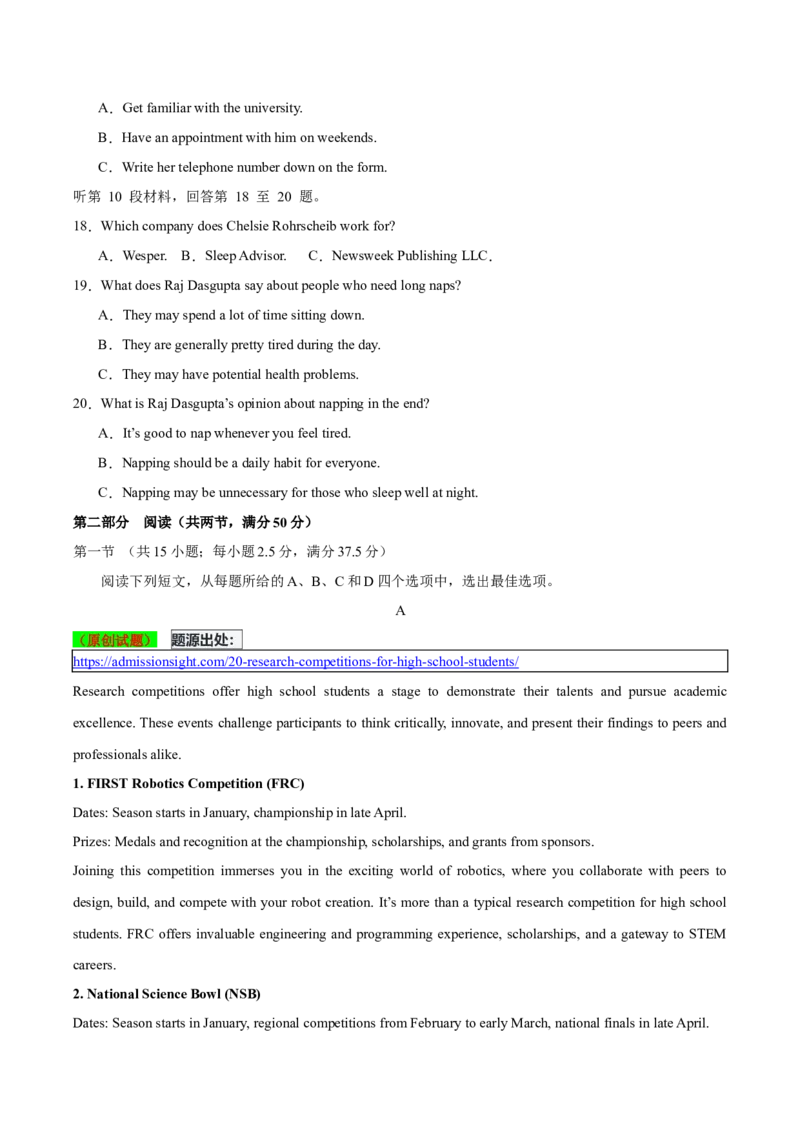
第一部分 听力(共两节,满分 30 分)
做题时,请先将答案标在试卷上。录音内容结束后,你将有两分钟的时间将试卷上的答案转涂到答题卡上。
第一节(共5小题;每小题1.5分,满分7.5分)
听下面5段对话。每段对话后有一个小题,从题中所给的 A、B、C三个选项中选出最佳选项。听完
每段对话后,你都有10秒钟的时间来回答有关小题和阅读下一小题。每段对话仅读一遍。
1.When does the conversation take place?
A.On Wednesday. B.On Thursday. C.On Friday.
2.What does the man want to do?
A.Cancel an appointment. B.Book a repair service. C.Postpone a schedule.
3.Where will the man go next?
A.To a restaurant. B.To Susan’s home. C.To a gas station.
4.What has happened to Nancy?
A.She can’t stand on her feet. B.She is attracted by Tim.C.She has fallen to the ground.
5.What’s the probable relationship between the speakers?
A.Friends. B.Husband and wife. C.Employer and employee.
第二节(共15小题;每小题1.5分,满分22.5分)
听下面5段对话或独白。每段对话或独白后有几个小题,从题中所给的A、B、C三个选项中选出最佳选项,
并标在试卷的相应位置。听每段对话或独白前,你将有时间阅读各个小题,每小题5秒钟;听完后,各小
题将给出5秒钟的作答时间。每段对话或独白读两遍。
听第 6 段材料,回答第 6、7 题。
6.What has happened to the man recently?
A.He has got little deep sleep.B.He has been tired of studying.
C.He has had trouble falling asleep.
7.What can some sleep trackers do?
A. Change habits. B. Monitor sleep environment. C. Measure body temperature.
听第 7 段材料,回答第8至10 题。
8.Why can’t the woman borrow the book?
A.It is misplaced on the shelf. B.It has already been lent out. C.It is reserved for teachers.
9.What is a feature of the recommended novel?
A.Its complex plot. B.Its formal language style. C.Its easy-going language.
10.How long at most can the woman keep the book within a year?
A.Two weeks. B.Three weeks. C.Six weeks.
听第 8 段材料,回答第 11 至 13 题。
11.What is the relationship between the speakers?
A.Host and guest. B.Teacher and student. C.Boss and employee.
12.What does Mrs. Brown consider vital to running a business?
A.Great products. B.Good communication. C.Considerate service.
13.What does Mrs. Brown intend to do at the end of the conversation?
A.Recommend a language training program.
B.Collect opinions for her training program.
C.Encourage people to communicate directly.
听第 9 段材科,回答第 14 至 17 题。
14.What is the woman worried about?
A.How to locate the students’ union.
B.How to get used to the university life.
C.How to find a map of the university.
15.How long are the computer rooms open on weekdays?
A.8 hours. B.10 hours. C.11 hours.
16.Where is the students’ union?
A.On the right of the Science Block.
B.Opposite the chemistry labs.
C.Beside the chemistry labs.
17.What does the man ask the woman to do?A.Get familiar with the university.
B.Have an appointment with him on weekends.
C.Write her telephone number down on the form.
听第 10 段材料,回答第 18 至 20 题。
18.Which company does Chelsie Rohrscheib work for?
A.Wesper. B.Sleep Advisor. C.Newsweek Publishing LLC.
19.What does Raj Dasgupta say about people who need long naps?
A.They may spend a lot of time sitting down.
B.They are generally pretty tired during the day.
C.They may have potential health problems.
20.What is Raj Dasgupta’s opinion about napping in the end?
A.It’s good to nap whenever you feel tired.
B.Napping should be a daily habit for everyone.
C.Napping may be unnecessary for those who sleep well at night.
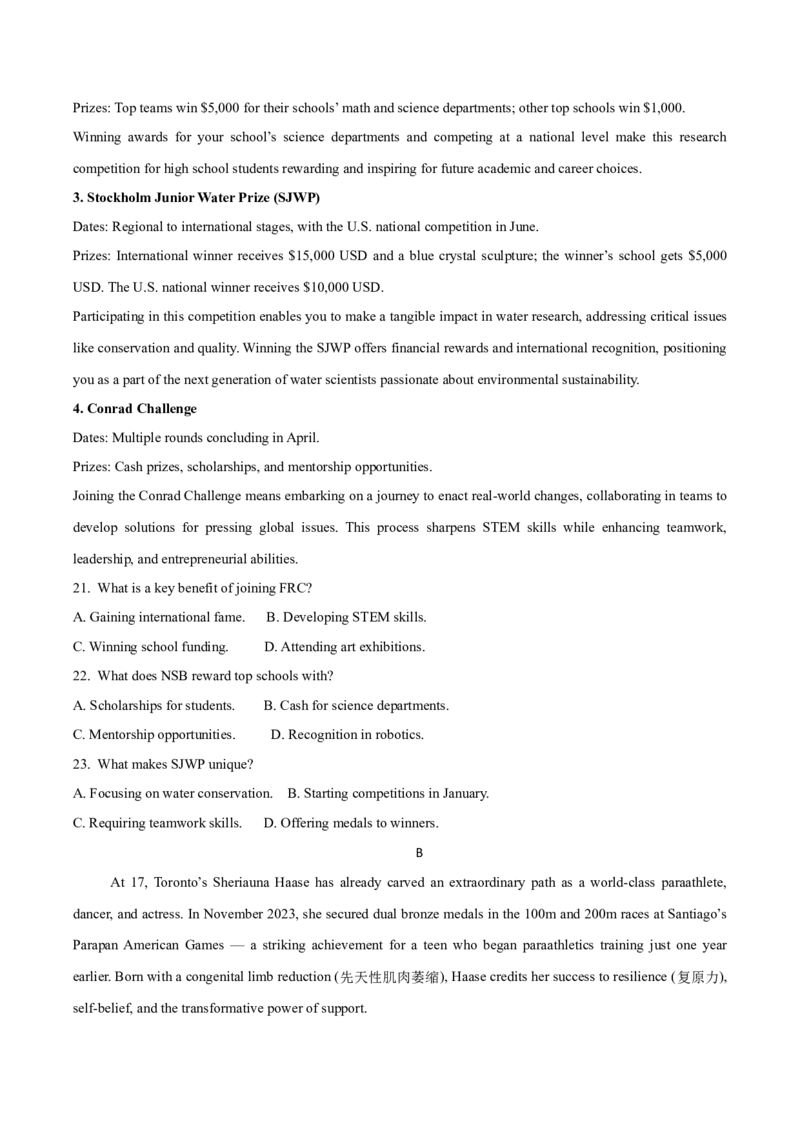
第二部分 阅读(共两节,满分50分)
第一节 (共15小题;每小题2.5分,满分37.5分)
阅读下列短文,从每题所给的A、B、C和D四个选项中,选出最佳选项。
A
(原创试题) 题源出处:
https://admissionsight.com/20-research-competitions-for-high-school-students/
Research competitions offer high school students a stage to demonstrate their talents and pursue academic
excellence. These events challenge participants to think critically, innovate, and present their findings to peers and
professionals alike.
1. FIRST Robotics Competition (FRC)
Dates: Season starts in January, championship in late April.
Prizes: Medals and recognition at the championship, scholarships, and grants from sponsors.
Joining this competition immerses you in the exciting world of robotics, where you collaborate with peers to
design, build, and compete with your robot creation. It’s more than a typical research competition for high school
students. FRC offers invaluable engineering and programming experience, scholarships, and a gateway to STEM
careers.
2. National Science Bowl (NSB)
Dates: Season starts in January, regional competitions from February to early March, national finals in late April.Prizes: Top teams win $5,000 for their schools’ math and science departments; other top schools win $1,000.
Winning awards for your school’s science departments and competing at a national level make this research
competition for high school students rewarding and inspiring for future academic and career choices.
3. Stockholm Junior Water Prize (SJWP)
Dates: Regional to international stages, with the U.S. national competition in June.
Prizes: International winner receives $15,000 USD and a blue crystal sculpture; the winner’s school gets $5,000
USD. The U.S. national winner receives $10,000 USD.
Participating in this competition enables you to make a tangible impact in water research, addressing critical issues
like conservation and quality. Winning the SJWP offers financial rewards and international recognition, positioning
you as a part of the next generation of water scientists passionate about environmental sustainability.
4. Conrad Challenge
Dates: Multiple rounds concluding in April.
Prizes: Cash prizes, scholarships, and mentorship opportunities.
Joining the Conrad Challenge means embarking on a journey to enact real-world changes, collaborating in teams to
develop solutions for pressing global issues. This process sharpens STEM skills while enhancing teamwork,
leadership, and entrepreneurial abilities.
21. What is a key benefit of joining FRC?
A. Gaining international fame. B. Developing STEM skills.
C. Winning school funding. D. Attending art exhibitions.
22. What does NSB reward top schools with?
A. Scholarships for students. B. Cash for science departments.
C. Mentorship opportunities. D. Recognition in robotics.
23. What makes SJWP unique?
A. Focusing on water conservation. B. Starting competitions in January.
C. Requiring teamwork skills. D. Offering medals to winners.
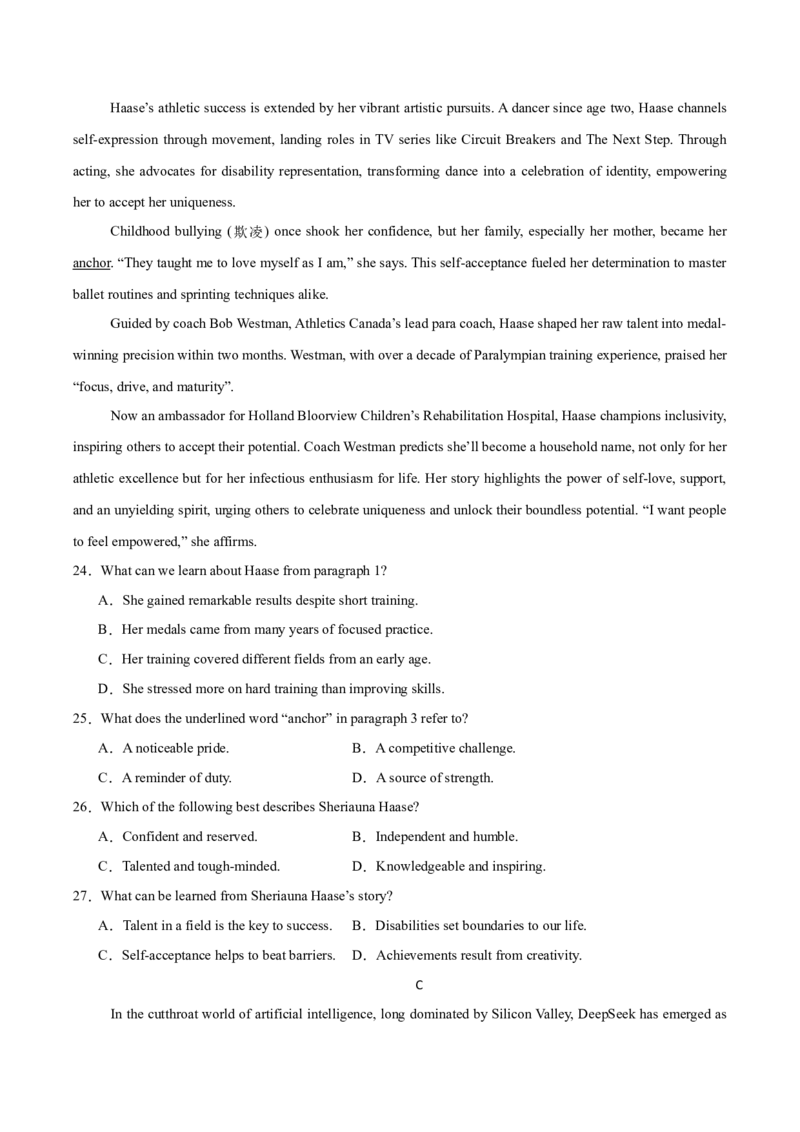
B
At 17, Toronto’s Sheriauna Haase has already carved an extraordinary path as a world-class paraathlete,
dancer, and actress. In November 2023, she secured dual bronze medals in the 100m and 200m races at Santiago’s
Parapan American Games — a striking achievement for a teen who began paraathletics training just one year
earlier. Born with a congenital limb reduction (先天性肌肉萎缩), Haase credits her success to resilience (复原力),
self-belief, and the transformative power of support.Haase’s athletic success is extended by her vibrant artistic pursuits. A dancer since age two, Haase channels
self-expression through movement, landing roles in TV series like Circuit Breakers and The Next Step. Through
acting, she advocates for disability representation, transforming dance into a celebration of identity, empowering
her to accept her uniqueness.
Childhood bullying (欺凌) once shook her confidence, but her family, especially her mother, became her
anchor. “They taught me to love myself as I am,” she says. This self-acceptance fueled her determination to master
ballet routines and sprinting techniques alike.
Guided by coach Bob Westman, Athletics Canada’s lead para coach, Haase shaped her raw talent into medal-
winning precision within two months. Westman, with over a decade of Paralympian training experience, praised her
“focus, drive, and maturity”.
Now an ambassador for Holland Bloorview Children’s Rehabilitation Hospital, Haase champions inclusivity,
inspiring others to accept their potential. Coach Westman predicts she’ll become a household name, not only for her
athletic excellence but for her infectious enthusiasm for life. Her story highlights the power of self-love, support,
and an unyielding spirit, urging others to celebrate uniqueness and unlock their boundless potential. “I want people
to feel empowered,” she affirms.
24.What can we learn about Haase from paragraph 1?
A.She gained remarkable results despite short training.
B.Her medals came from many years of focused practice.
C.Her training covered different fields from an early age.
D.She stressed more on hard training than improving skills.
25.What does the underlined word “anchor” in paragraph 3 refer to?
A.A noticeable pride. B.A competitive challenge.
C.A reminder of duty. D.A source of strength.
26.Which of the following best describes Sheriauna Haase?
A.Confident and reserved. B.Independent and humble.
C.Talented and tough-minded. D.Knowledgeable and inspiring.
27.What can be learned from Sheriauna Haase’s story?
A.Talent in a field is the key to success. B.Disabilities set boundaries to our life.
C.Self-acceptance helps to beat barriers. D.Achievements result from creativity.
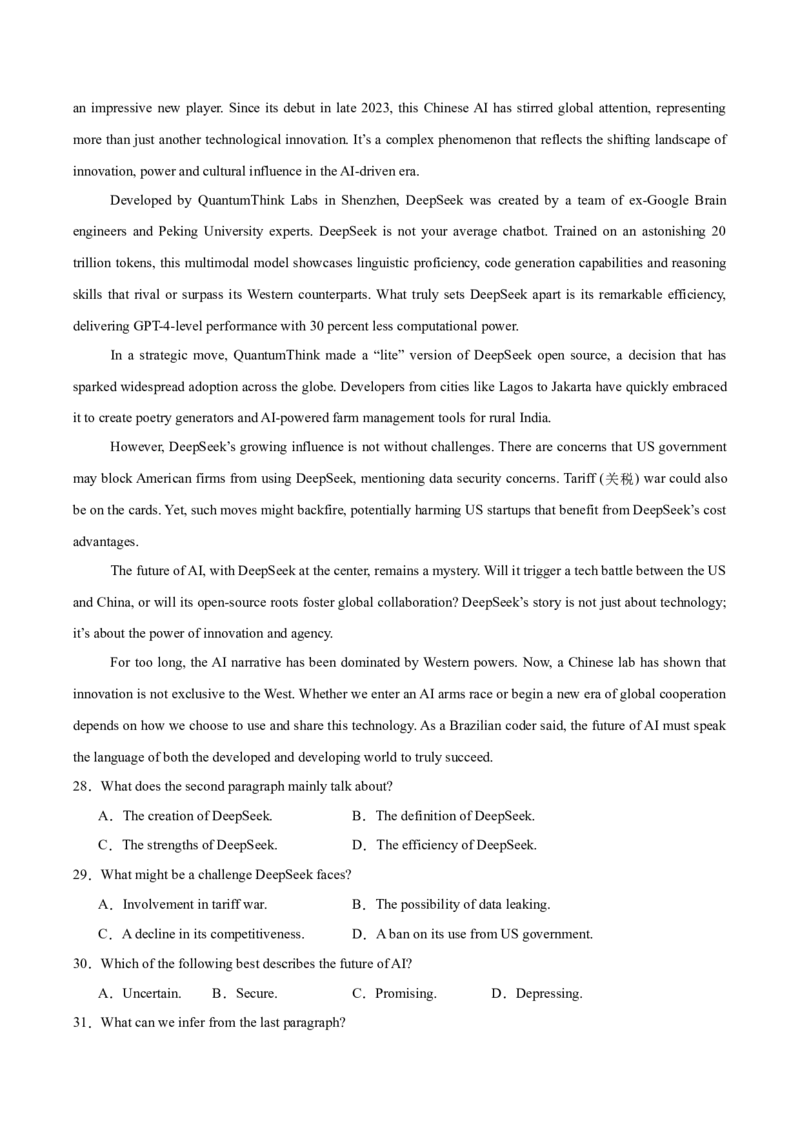
C
In the cutthroat world of artificial intelligence, long dominated by Silicon Valley, DeepSeek has emerged asan impressive new player. Since its debut in late 2023, this Chinese AI has stirred global attention, representing
more than just another technological innovation. It’s a complex phenomenon that reflects the shifting landscape of
innovation, power and cultural influence in the AI-driven era.
Developed by QuantumThink Labs in Shenzhen, DeepSeek was created by a team of ex-Google Brain
engineers and Peking University experts. DeepSeek is not your average chatbot. Trained on an astonishing 20
trillion tokens, this multimodal model showcases linguistic proficiency, code generation capabilities and reasoning
skills that rival or surpass its Western counterparts. What truly sets DeepSeek apart is its remarkable efficiency,
delivering GPT-4-level performance with 30 percent less computational power.
In a strategic move, QuantumThink made a “lite” version of DeepSeek open source, a decision that has
sparked widespread adoption across the globe. Developers from cities like Lagos to Jakarta have quickly embraced
it to create poetry generators and AI-powered farm management tools for rural India.
However, DeepSeek’s growing influence is not without challenges. There are concerns that US government
may block American firms from using DeepSeek, mentioning data security concerns. Tariff (关税) war could also
be on the cards. Yet, such moves might backfire, potentially harming US startups that benefit from DeepSeek’s cost
advantages.
The future of AI, with DeepSeek at the center, remains a mystery. Will it trigger a tech battle between the US
and China, or will its open-source roots foster global collaboration? DeepSeek’s story is not just about technology;
it’s about the power of innovation and agency.
For too long, the AI narrative has been dominated by Western powers. Now, a Chinese lab has shown that
innovation is not exclusive to the West. Whether we enter an AI arms race or begin a new era of global cooperation
depends on how we choose to use and share this technology. As a Brazilian coder said, the future of AI must speak
the language of both the developed and developing world to truly succeed.
28.What does the second paragraph mainly talk about?
A.The creation of DeepSeek. B.The definition of DeepSeek.
C.The strengths of DeepSeek. D.The efficiency of DeepSeek.
29.What might be a challenge DeepSeek faces?
A.Involvement in tariff war. B.The possibility of data leaking.
C.A decline in its competitiveness. D.A ban on its use from US government.
30.Which of the following best describes the future of AI?
A.Uncertain. B.Secure. C.Promising. D.Depressing.
31.What can we infer from the last paragraph?A.AI should prioritize Western languages.
B.We will enter a new era of global AI cooperation.
C.Considering global needs is required to ensure AI’s success.
D.Developing countries will eventually dominate AI innovation.
D
At top universities, there’s a phenomenon known as “Stanford Duck Syndrome (综合征)”. Like ducks,
students appear to move gracefully (优雅地). However, beneath the surface, they’re kicking desperately to keep up.
Experts from Stanford’s Health Services uncovered this troubling trend: during the day, many Stanford
students are seen socializing in cafés, seemingly without any stress or the need to study. However, at night, they
start studying, sometimes for the entire night, trying to maintain the image of effortless success. This comes at a
high price: tiredness and anxiety are widespread. Furthermore, it leads to a common misconception: true geniuses
achieve success with ease, while those working hard are less capable.
In an effort to challenge this misconception, researchers designed an experiment. Participants were asked to
observe a series of colors carefully while scientists tracked their brain activity throughout the process. The
experiment was divided into two parts: one with easily distinguishable colors and the other with colors that were
quite similar, requiring more effort to differentiate. As the difficulty of the task increased, there was a noticeable
increase in brain activity, particularly in areas linked to memory and abstract reasoning.
The study reveals that as tasks require more effort, more areas of the brain become engaged. Growth doesn’t
come from talent alone but from the consistent application of effort. Our brain functions like a muscle. Without
effort, even our inborn talents will fade over time.
This pushes us to reconsider the underlying culture that might lead to this phenomenon. Instead of focusing
too much on outcomes or singing high praise for inborn talents, we should emphasize the learning process and
continuous improvement. By encouraging a culture that values effort, we can help students realize that intelligence
is not fixed but grows through hard work. Such a shift would not only reduce the pressures associated with the
“Stanford Duck Syndrome”, but also have a profound impact on personal development and the future of education.
32.What phenomenon does the “Stanford Duck Syndrome” probably describe?
A.Prioritizing effort over well-being.
B.Relieving stress through social activities.
C.Displaying graceful images to attract others.
D.Hiding hard work to appear naturally gifted.
33.How does the experiment in paragraph 3 challenge the misconception?A.By showing effort fuels the brain activity.
B.By proving focus enhances brain function.
C.By linking color recognition to intelligence.
D.By associating careful observation with talent.
34.What is the author’s main concern about “Stanford Duck Syndrome”?
A.It values the learning process over outcomes.
B.It causes stress and false ideas about success.
C.It prevents students from recognizing their talents.
D.It makes students prioritize socializing over studying.
35.Which of the following might the author agree with?
A.Fortune favors those with a clear vision.
B.Sweat is the ink that writes a masterpiece.
C.Work in silence and let success make the noise.
D.Keep moving forward even when no one sees it.
第二节(共5小题:每小题2. 5分, 满分12. 5分)
阅读下面短文, 从短文后的选项中选出可以填入空白处的最佳选项。选项中有两项为多余选项。
Wildlife documentaries are known for offering breathtaking images of animals in their natural habitats. You
might be thinking that these shows offer a totally real portrayal (描绘) of these animals-an objective window into
their lives as they hunt, rest and raise their young. 36 While the images we see are filmed on location,
many of the sounds are recorded in a sound studio and added to the programs later by human “Foley artists (拟音
师)”.
37 Usually, documentary filmmakers can film their subjects from a great distance, but they
typically can’t get close enough to capture clear sounds without disturbing the animals. 38 There will
probably be background noises such as crew members chatting or walking around if sounds are recorded on
location. In other cases, the animals might make sounds of a frequency or volume that most microphones simply
can’t capture clearly.
“Foley artists” will use a variety of tools to simulate (模拟) the sounds made by animals. And most of them
will create the close-up sounds of animals chewing or yawning with their own mouths. These sounds are created as
the artist watches the videos, making sure they perfectly match the actions they’re paired with. 39
Animal cries — which are far too complex to be simulated — will have to be taken from library recordings.
Watching “Foley artists” at work on wildlife projects gives me a thrill like the one we get when we see how amagic trick is done. Admittedly, the significance of the technique goes further. 40 Sounds have the
ability to affect our understanding of a given species.
A.But this isn’t quite the case.
B.There are some exceptions, though.
C.The Foley process involves a large team.
D.Wildlife documentaries also tend to require large crews.
E.Sounds guide our emotional interpretation of the things we see
F.This is an unavoidable outcome of modern wildlife filmmaking.
G.How it is portrayed in documentaries may also impact conservation efforts.
第三部分 语言运用(共两节,满分30分)
第一节(共15小题:每小题1分,满分15分)
阅读下面短文, 从每题所给的A、B、C、D四个选项中选出可以填入空白处的最佳选项。
My late mother was a famous artist in the Pacific Northwest. Over her many-decade career, her paintings
kept changing. One 41 in her work, however, was excellent technique: If she 42 to paint a naked
guy holding a guitar, that’s 43 what it looked like.
Growing up, I could draw a little myself, but I never had her 44 . Once, I asked her how I could
improve. I 45 her to say something like “Practice 10, 000 hours. ” Instead, she told me to 46 what I
wanted to draw. This 47 me because that’s obviously what I thought I had been doing.
“People almost never actually look carefully at anything,” she 48 , “They glance (瞥) at it and then
rely on their brain to fill in the 49 —which it doesn’t, leading to 50 drawing.” So I tried, looking
long and hard at what I wanted to draw: a tree. I found I 51 much more about its shape, colors, and
shadows. I 52 each detail carefully, and it turned out to be a pretty well-drawn tree.
More than that, I loved the experience of really 53 . What my mom was telling me to do was fully
enjoy the encounter of seeing something 54 and drawing it carefully. And it can be 55 to
many areas of life in ways that help us become better at living.
41.A.favorite B.constant C.potential D.alternative
42.A.preferred B.pretended C.decided D.struggled
43.A.exactly B.probably C.naturally D.strangely
44.A.skill B.permission C.patience D.fame
45.A.urged B.reminded C.encouraged D.expected
46.A.determine B.picture C.observe D.introduce47.A.delighted B.relieved C.angered D.confused
48.A.apologized B.explained C.announced D.repeated
49.A.colors B.details C.outline D.pattern
50.A.awkward B.abstract C.original D.attractive
51.A.accepted B.doubted C.mentioned D.noticed
52.A.analyzed B.remembered C.described D.drew
53.A.thinking B.sharing C.looking D.improving
54.A.deeply B.frequently C.directly D.differently
55.A.exposed B.compared C.applied D.limited
第二节(共10小题:每小题1. 5分, 满分15分)
阅读下面短文, 在空白处填入1个适当的单词或括号内单词的正确形式。
Starting from Wednesday, Ne Zha 2 will begin special screenings in North America, before 56
(it) official release on Friday. Based on the presale situation, North American audiences have shown 57
(enthusiastic) for Ne Zha 2, with occupancy rates over 90 percent. In some showings, tickets are hard to come by.
In Australia, the presale for Ne Zha 2 screenings has also been 58 expectations. As there are 59
(current) no screening plans in Western European countries like the UK and France, some netizens have even
voluntarily formed groups 60 (travel) to Greece for a screening.
61 its release during the Spring Festival holidays, Ne Zha 2 has become a phenomenon-level
film.
It has already topped the global box office chart for a single market and 62 (expect) to challenge
for the No.1 spot in the global animated film box office list. The young boy “Little Ne Zha” from Chinese
mythology, 63 rides on wind-and-fire wheels, is now shaking hands with global box office icons like the
Minions, Buzz Lightyear, and Spider-Man.
Earlier this month, some foreign media outlets highly praised the film for “redefining the heights of China’s
film industry” while some Hollywood producers, after watching the film, 64 (express) hopes for more
cooperation with their Chinese counterparts.
Many international movie fans have flocked to Xiaohongshu with the intention of searching for reviews
65 learning about Chinese mythology as well. It is the unique charm of Chinese mythology in the film that
has attracted so many international audiences.
第四部分 写作(共两节, 满分40分)
第一节(满分15分)假定你是李华,你校将举办一场英语演讲比赛,主题为“The Power of Language”。请你写一封电子邮件,
邀请你的外教Mr. Smith担任评委。内容包括:
(1)介绍比赛相关信息;
(2)发出邀请并阐述理由。
注意:
(1)写作词数应为80个左右;
(2)请按如下格式在答题卡的相应位置作答。
Dear Mr. Smith.
I hope this email finds you well.
____________________________________________________________________________________________
____________________________________________________________________________________________
____________________________________________________________________________________________
Best regards,
Li Hua
第二节(满分25分)
阅读下面材料, 根据其内容和所给段落开头语续写两段, 使之构成一篇完整的短文。
Henry Davis was a retired teacher who decided to take up the hobby of gardening after his wife’s death. He
had a big lawn and wanted to plant some colorful flower bushes, herbs and crops.
One day, Henry drove to the store to buy more gardening tools. While passing the neighborhood primary
school, he noticed a boy being pressed against the wall by his classmates. “You’re such a loser, Lucas!” the kids
shouted at him. The boy was close to tears, trembling and not saying a word. Greatly annoyed, Henry parked the
car on the side of the road and approached them.
“Why are you bullying this young boy? Do you want me to call your teachers or your parents? Leave him
alone!” he shouted. Frightened by Henry, the boy’s classmates ran away immediately. Henry then asked the poor
boy, “Are you all right?” The boy nodded and thanked Henry for help.
After taking a good look at the boy, Henry realized that he was his neighbor Lucas, so he offered to take
Lucas home after a quick stop at the store. While at the store, Lucas discovered Henry’s love for gardening. They
talked about his crops and how gardening made the old man happy.
On the drive home, Henry decided to ask Lucas about his classmates. “Why are they treating you like that?
Do they always give you a hard time?” he asked the boy. “Yes. Maybe because I don’t like the same things as they
do, they keep calling me a loser.” he sighed. “Have you ever asked your parents or teachers for help?” Henryadded. “I think it’s better to avoid trouble if possible.” Lucas shook his head helplessly.
Listening to Lucas’s answer, Henry recalled his days as a teacher. If he were still on the job, he would never
allow such a thing to happen to his students. Looking at this poor child, Henry was determined to do something.
注意:1.续写词数应为150左右;2.请按如下格式在答题卡的相应位置作答。
Paragraph 1:
The next day, Henry invited Lucas to visit his garden.
____________________________________________________________________________________________
____________________________________________________________________________________________
Paragraph 2:
One month later, cornered by his classmates once again, Lucas decided not to keep silent any more.
____________________________________________________________________________________________
____________________________________________________________________________________________