临考押题卷(新高考八省)
(考试时间:120分钟 试卷满分:150分)
注意事项:
1.答卷前,考生务必将自己的姓名、考生号等填写在答题卡和试卷指定位置上。
2.回答选择题时,选出每小题答案后,用铅笔把答题卡对应题目的答案标号涂黑。如需改动,用橡
皮擦干净后,再选涂其他答案标号。回答非选择题时,将答案写在答题卡上。写在本试卷上无效。
3.考试结束后,将本试卷和答题卡一并交回。
第一部分 听力(共两节,满分 30 分)
第一节(共5小题;每小题1.5分,满分7.5分)
听下面5段对话。每段对话后有一个小题,从题中所给的A、B、C三个选项中选出最佳选项。听完每
段对话后,你都有10秒钟的时间来回答有关小题和阅读下一小题。每段对话仅读一遍。
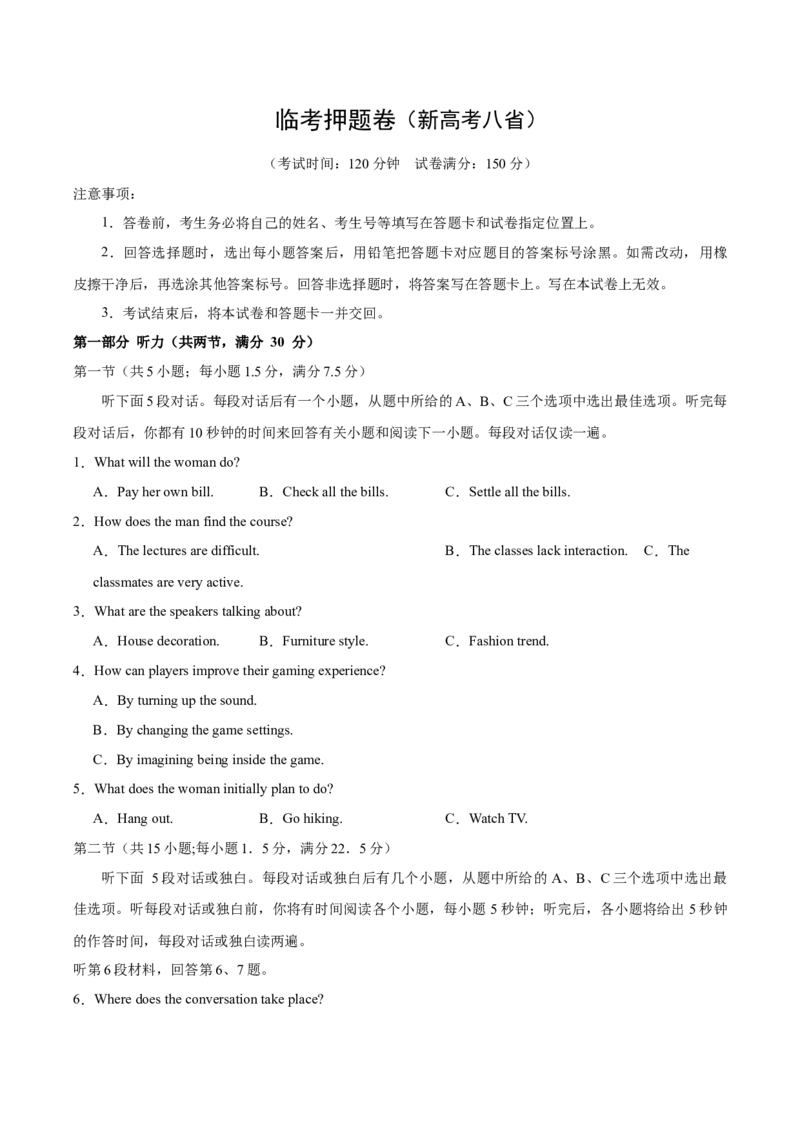
1.What will the woman do?
A.Pay her own bill. B.Check all the bills. C.Settle all the bills.
2.How does the man find the course?
A.The lectures are difficult. B.The classes lack interaction. C.The
classmates are very active.
3.What are the speakers talking about?
A.House decoration. B.Furniture style. C.Fashion trend.
4.How can players improve their gaming experience?
A.By turning up the sound.
B.By changing the game settings.
C.By imagining being inside the game.
5.What does the woman initially plan to do?
A.Hang out. B.Go hiking. C.Watch TV.
第二节(共15小题;每小题1.5分,满分22.5分)
听下面 5段对话或独白。每段对话或独白后有几个小题,从题中所给的 A、B、C三个选项中选出最
佳选项。听每段对话或独白前,你将有时间阅读各个小题,每小题 5秒钟;听完后,各小题将给出5秒钟
的作答时间,每段对话或独白读两遍。
听第6段材料,回答第6、7题。
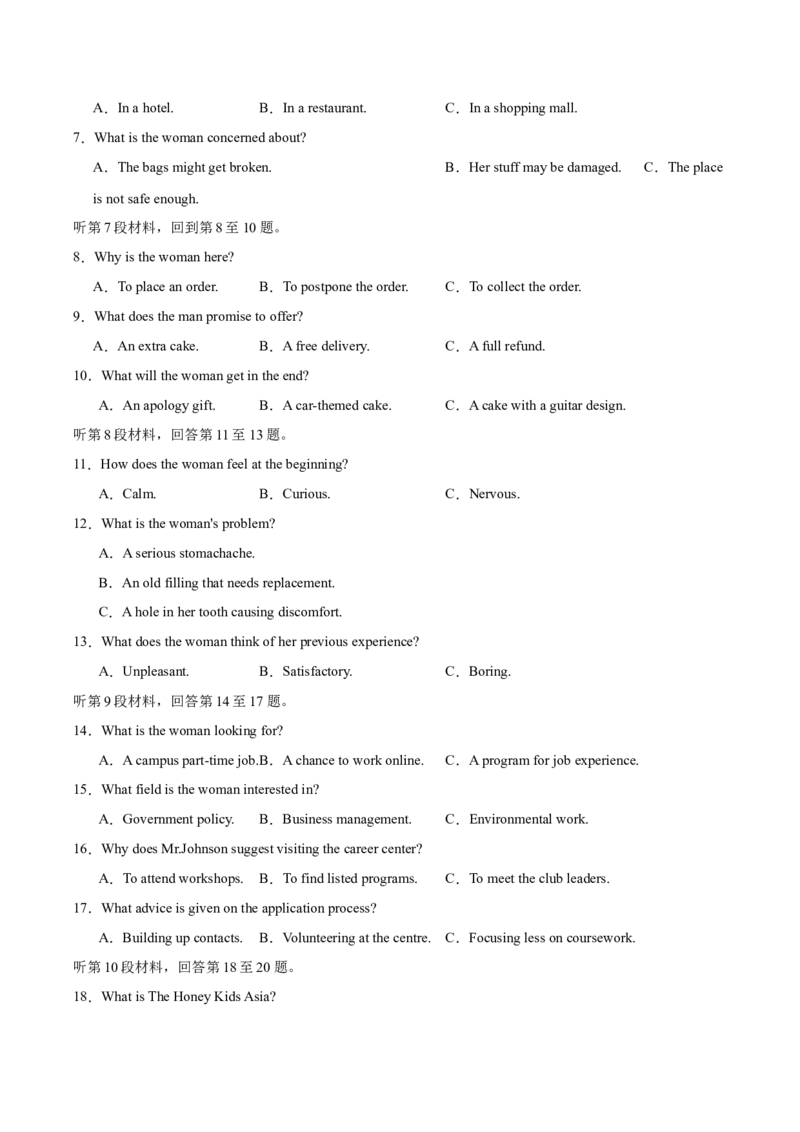
6.Where does the conversation take place?A.In a hotel. B.In a restaurant. C.In a shopping mall.
7.What is the woman concerned about?
A.The bags might get broken. B.Her stuff may be damaged. C.The place
is not safe enough.
听第7段材料,回到第8至10题。
8.Why is the woman here?
A.To place an order. B.To postpone the order. C.To collect the order.
9.What does the man promise to offer?
A.An extra cake. B.A free delivery. C.A full refund.
10.What will the woman get in the end?
A.An apology gift. B.A car-themed cake. C.A cake with a guitar design.
听第8段材料,回答第11至13题。
11.How does the woman feel at the beginning?
A.Calm. B.Curious. C.Nervous.
12.What is the woman's problem?
A.A serious stomachache.
B.An old filling that needs replacement.
C.A hole in her tooth causing discomfort.
13.What does the woman think of her previous experience?
A.Unpleasant. B.Satisfactory. C.Boring.
听第9段材料,回答第14至17题。
14.What is the woman looking for?
A.A campus part-time job.B.A chance to work online. C.A program for job experience.
15.What field is the woman interested in?
A.Government policy. B.Business management. C.Environmental work.
16.Why does Mr.Johnson suggest visiting the career center?
A.To attend workshops. B.To find listed programs. C.To meet the club leaders.
17.What advice is given on the application process?
A.Building up contacts. B.Volunteering at the centre. C.Focusing less on coursework.
听第10段材料,回答第18至20题。
18.What is The Honey Kids Asia?A.A program. B.A magazine. C.A company.
19.Who is The Honey Kids Asia intended for?
A.Tourists. B.Guides. C.Singaporeans.
20.What can The Honey Kids Asia do for you?
A.Babysit kids. B.Save money. C.Open bank accounts.
第二部分 阅读(共两节,满分50分)
第一节 (共15小题;每小题2.5分,满分37.5分)
阅读下列短文,从每题所给的A、B、C、D四个选项中选出最佳选项。
A
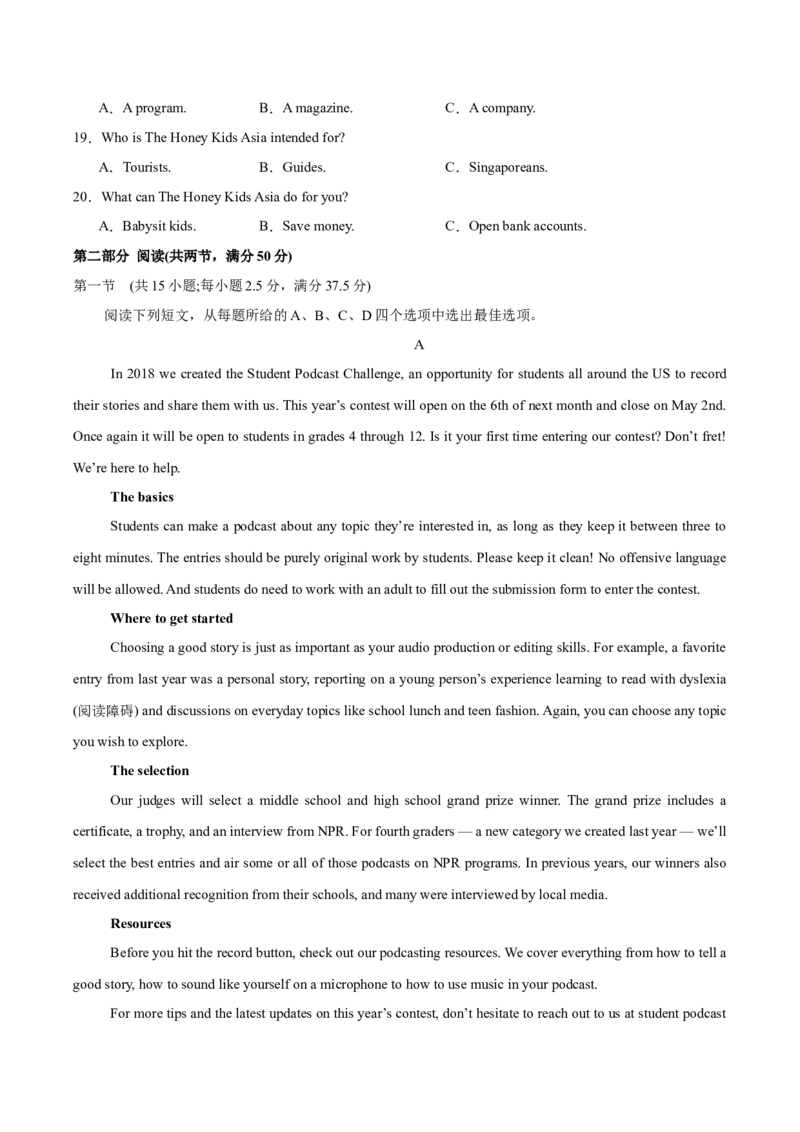
In 2018 we created the Student Podcast Challenge, an opportunity for students all around the US to record
their stories and share them with us. This year’s contest will open on the 6th of next month and close on May 2nd.
Once again it will be open to students in grades 4 through 12. Is it your first time entering our contest? Don’t fret!
We’re here to help.
The basics
Students can make a podcast about any topic they’re interested in, as long as they keep it between three to
eight minutes. The entries should be purely original work by students. Please keep it clean! No offensive language
will be allowed. And students do need to work with an adult to fill out the submission form to enter the contest.
Where to get started
Choosing a good story is just as important as your audio production or editing skills. For example, a favorite
entry from last year was a personal story, reporting on a young person’s experience learning to read with dyslexia
(阅读障碍) and discussions on everyday topics like school lunch and teen fashion. Again, you can choose any topic
you wish to explore.
The selection
Our judges will select a middle school and high school grand prize winner. The grand prize includes a
certificate, a trophy, and an interview from NPR. For fourth graders — a new category we created last year — we’ll
select the best entries and air some or all of those podcasts on NPR programs. In previous years, our winners also
received additional recognition from their schools, and many were interviewed by local media.
Resources
Before you hit the record button, check out our podcasting resources. We cover everything from how to tell a
good story, how to sound like yourself on a microphone to how to use music in your podcast.
For more tips and the latest updates on this year’s contest, don’t hesitate to reach out to us at student podcastchallenge@npr.org. Students, we can’t wait to hear your stories. Good luck!
21.Who are the target participants?
A.NPR’s staff. B.Students around the US.
C.Podcast lovers. D.The US students in grades 4 to 12.
22.What could disqualify a podcast entry?
A.Lacking background music. B.Exceeding the time limit.
C.Choosing a personal topic. D.Using proper language.
23.What is the text?
A.An announcement post. B.A school newsletter.
C.A job advertisement. D.A subscription plan.
B
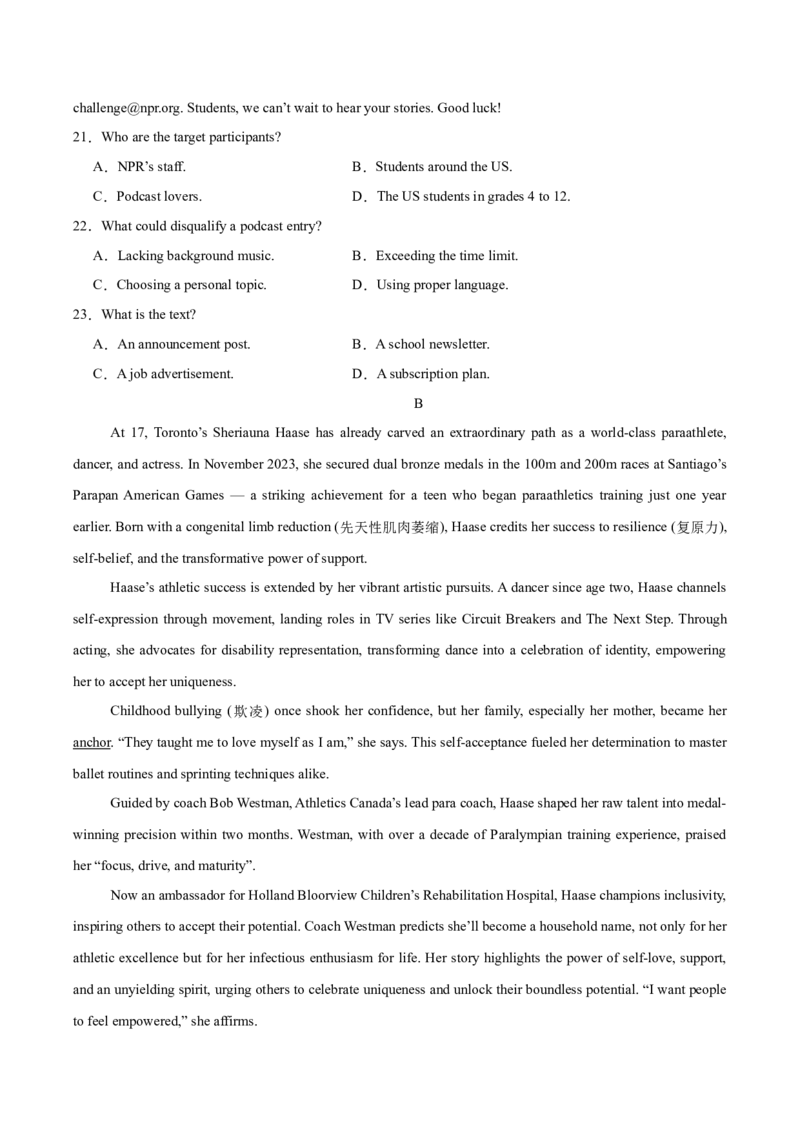
At 17, Toronto’s Sheriauna Haase has already carved an extraordinary path as a world-class paraathlete,
dancer, and actress. In November 2023, she secured dual bronze medals in the 100m and 200m races at Santiago’s
Parapan American Games — a striking achievement for a teen who began paraathletics training just one year
earlier. Born with a congenital limb reduction (先天性肌肉萎缩), Haase credits her success to resilience (复原力),
self-belief, and the transformative power of support.
Haase’s athletic success is extended by her vibrant artistic pursuits. A dancer since age two, Haase channels
self-expression through movement, landing roles in TV series like Circuit Breakers and The Next Step. Through
acting, she advocates for disability representation, transforming dance into a celebration of identity, empowering
her to accept her uniqueness.
Childhood bullying (欺凌) once shook her confidence, but her family, especially her mother, became her
anchor. “They taught me to love myself as I am,” she says. This self-acceptance fueled her determination to master
ballet routines and sprinting techniques alike.
Guided by coach Bob Westman, Athletics Canada’s lead para coach, Haase shaped her raw talent into medal-
winning precision within two months. Westman, with over a decade of Paralympian training experience, praised
her “focus, drive, and maturity”.
Now an ambassador for Holland Bloorview Children’s Rehabilitation Hospital, Haase champions inclusivity,
inspiring others to accept their potential. Coach Westman predicts she’ll become a household name, not only for her
athletic excellence but for her infectious enthusiasm for life. Her story highlights the power of self-love, support,
and an unyielding spirit, urging others to celebrate uniqueness and unlock their boundless potential. “I want people
to feel empowered,” she affirms.24.What can we learn about Haase from paragraph 1?
A.She gained remarkable results despite short training.
B.Her medals came from many years of focused practice.
C.Her training covered different fields from an early age.
D.She stressed more on hard training than improving skills.
25.What does the underlined word “anchor” in paragraph 3 refer to?
A.A noticeable pride. B.A competitive challenge.
C.A reminder of duty. D.A source of strength.
26.Which of the following best describes Sheriauna Haase?
A.Confident and reserved. B.Independent and humble.
C.Talented and tough-minded. D.Knowledgeable and inspiring.
27.What can be learned from Sheriauna Haase’s story?
A.Talent in a field is the key to success. B.Disabilities set boundaries to our life.
C.Self-acceptance helps to beat barriers. D.Achievements result from creativity.
C
The ability to connect an event with its consequences — experts use the term associative learning — is a
crucial skill for adapting to the environment. Recent findings show that adults fail to demonstrate the highest
learning performance in this area. This paves the way for a fresh perspective on associative learning disorders,
which are linked to the development of mental illness later in life.
Researchers from Ruhr University Bochum conducted groundbreaking experiments across four age groups:
babies (0-3), primary school children (6-12), teenagers (13-19), and adults. Participants were required to identify
patterns between visual pictures and corresponding rewards through computer-based tasks. Several learning
sessions were then integrated to assess performance stability.
The research team was amazed by the results: “We’d initially assumed that associative learning improves
continuously with increasing age,” says Dr. Carolin Konrad. However, there was a clear peak in performance at
primary school: “Children at this age achieved the best results, learned most consistently and showed the least
variability in their learning behavior.” Although adults and teenagers learned faster than babies, they didn’t reach
the performance level of primary school children.
It also emerged that repeated exposure to the learned material plays a crucial role for babies and teenagers
since an additional learning session led to an improvement in learning performance in these age groups. Teenagers
improved 40% after additional practice sessions, whereas adults showed minimal progress. This finding highlightsthe “sensitive period” phenomenon — the brain’s higher plasticity during childhood that allows more efficient
knowledge strength.
The study shows that associative learning is present across the lifespan but that the rates and quantities of
learning vary. “This mental capacity not only helps us avoid dangers but also influences emotional regulation
patterns,” concludes Konrad. “Early identification of association of associative learning difficulties could serve as
an indicator for future mental health risks.”
28.Which is an example of associative learning?
A.A baby grasps an object placed in its hand.
B.A student works harder after getting good grades.
C.A driver keeps speeding up when receiving a ticket.
D.A cook follows his recipe despite customer complaints.
29.What were the participants required to do in the experiments?
A.Identify the relationship between different groups.
B.Watch and record their own performance over time.
C.Assess their learning progress during the sessions.
D.Pair pictures with rewards through computer-based tasks.
30.What surprised the researchers about associative learning?
A.Adults possessed greater adaptability.
B.Primary schoolers outperformed others.
C.Teenagers peaked in learning performance.
D.Babies required frequent exposure to knowledge.
31.Why is the “sensitive period” phenomenon mentioned in paragraph 4?
A.To show learning ability differences across all ages.
B.To advise adults to learn efficiently in a gradual way.
C.To stress the significance of learning during childhood.
D.To demonstrate the brain’s ability to adapt in adulthood.
D
The 2023 Nobel Prize in Chemistry has brought the remarkable capabilities of artificial intelligence (AI) into
the spotlight, particularly in the field of protein structure prediction. This year’s award celebrated the development
of AlphaFold, an AI tool created by DeepMind, which has transformed our ability to understand proteins — the
fundamental building blocks of life.Proteins, composed of chains of amino acids (氨基酸), are essential for the structure, function, and
regulation of tissues and organs in the human body. Traditionally, determining a protein’s 3D structure was a time-
consuming process that could take years of meticulous work. However, AlphaFold has revolutionized this field by
predicting protein structures from their amino acid sequences in mere minutes.
AlphaFold’s success lies in its use of deep learning algorithms (算法) that can identify patterns in vast
amounts of data. It has been trained on extensive databases of known protein structures and amino acid sequences,
allowing it to predict over 200 million protein structures. This includes nearly all cataloged proteins known to
science, from humans to plants, bacteria, animals, and other organisms.
The impact of AlphaFold is not just limited to theoretical science; it has practical applications in drug and
vaccine development. For example, AlphaFold played a crucial role in advancing research for a malaria vaccine.
By accurately predicting the structure of a key protein, AlphaFold enabled scientists to identify which parts of the
protein to target in the vaccine, thus accelerating the research from fundamental science to preclinical and clinical
development stages.
Moreover, AlphaFold’s open-source nature allows academic scientists to predict protein interactions, which
is crucial for understanding how proteins behave in the presence of potential drugs. This advancement not only
accelerates biomedical research but also has the potential to improve our understanding of antibiotic resistance and
contribute to the development of enzymes that can decompose plastic, addressing environmental concerns.
With AlphaFold demonstrating how AI can supercharge existing knowledge to benefit mankind, the
possibilities of AI in scientific research are vast and hold the promise of further breakthroughs that could change
the world.
32.Why was AlphaFold celebrated by the 2023 Nobel Prize in Chemistry?
A.It quickly predicts protein structures. B.It simplifies amino acid analysis.
C.It invents new protein functions. D.It reduces lab work for proteins.
33.How does AlphaFold achieve its success in predicting protein structures?
A.By using traditional methods. B.By relying on a small database.
C.By employing deep learning algorithms.D.By identifying patterns of proteins.
34.What practical application of AlphaFold is mentioned in the passage?
A.Developing drugs to cure malaria.
B.Speeding up the development of a malaria vaccine.
C.Enhancing antibiotic resistance in plants.
D.Predicting the structure of plastic-decomposing enzymes.35.Which of the following would be the best title for the passage?
A.The Rise of AI in Biological Science
B.AlphaFold: Unlocking the Secrets of Proteins
C.The Nobel Prize and the Future of AI in Science
D.The Evolution of Protein Structure Research
第二节 (共5小题;每小题2.5分,满分12.5分)
阅读下面短文,从短文后的选项中选出可以填入空白处的最佳选项。选项中有两项为多余选项。
Almost everyone procrastinates (拖延). Whether it’s avoiding an assignment, delaying house chores, or
putting off a visit to the dentist, we’ve all been there. The tasks you avoid aren’t always hard or time-consuming,
but they may trigger discomfort, leading to stress and guilt. 3 6
Begin with bite-sized tasks.
One of the biggest reasons we procrastinate is that tasks seem too big or overwhelming. 3 7 When
you break a task into smaller steps, it becomes much more manageable. For example, if you’re avoiding cleaning
your room, don’t aim to finish it in one day. Instead, focus on sorting just one corner or organizing a single shelf.
3 8
We often procrastinate on the tasks we find most unpleasant. Whether it’s an awkward conversation you
need to have or a particularly tough assignment, putting off these tasks only increases anxiety. However, if you do
them first in the morning, you’ll free up mental space to handle the rest of your day more smoothly.
Use rewards to stay motivated.
3 9 One way to encourage yourself to tackle uncomfortable tasks is by using rewards. Pair an
unpleasant task with a desirable activity, or promise yourself a treat once the task is done. This method transforms
the task into a stepping stone to something you enjoy.
Apply the two-minute rule.
The two-minute rule suggests that if a task can be done in two minutes or less, do it immediately. 4 0
For example, if you need to send a quick email, respond to a text, or wash a few dishes, handle it immediately.
These small actions might seem insignificant, but they can clear your mental burden and create momentum (动力)
towards larger tasks.
A.Cut down on decisions.
B.Tackle your toughest task first.
C.It helps stop small tasks from piling up.
D.Sometimes, we need a little external push.E.The trick is to begin with something simple.
F.Below are some strategies to help you conquer procrastination.
G.It encourages you to take action when you’re 70 percent ready.
第三部分 语言运用 (共两节,满分30分)
第一节 (共15小题;每小题1分,满分15分)
阅读下面短文,从每题所给的A、B、C、D四个选项中选出可以填入空白处的最佳选项。
I remember opening my iPad one day in fifth grade, inspired by a lighthearted conversation with my cousin
about scary stories. Hours later, I had 41 my first short story. Writing 42 became a beloved
hobby, but as I grew older, the 43 began to fade. I started reading more books, encountering critiques
online, and comparing my work to others. Self-doubt crept in, and what once felt like a creative outlet became a
source of 44 . I felt I had to be “good” at writing to share it.
This 45 happens often. Hobbies start as a form of 46 ,a way to relax ourselves. Yet, over
time, societal pressures to 47 can change how we view them. Whether it’s painting, playing an
instrument, or any other 48 , there’s an expectation to perform at a high level. When we don’t meet that
standard, the joy fades, replaced by feelings of inadequacy.
For me, writing has been the one hobby I’ve regularly returned to, 49 moments of self-doubt. I’ve
taken creative writing classes and seen significant improvement, but the constant 50 for perfection tuns
writing from a 51 into a chore. I’ve come to realize that this mindset 52 me of the joy I once
found in it.
We need to recognize that it’s 53 not to be great at something. Perfection is often 54 ,
and more often than not, we are our toughest critics. The challenge, then, is finding balance between enjoyment and
55 . Embrace imperfection, and enjoy the process, even if you’re not “great” at it.
41.A.showed off B.pulled over C.cut off D.wrapped up
42.A.slowly B.openly C.quickly D.carefully
43.A.hope B.surprise C.curiosity D.excitement
44.A.relief B.truth C.inspiration D.stress
45.A.shift B.accident C.blessing D.adjustment
46.A.growth B.escape C.focus D.commitment
47.A.live B.struggle C.excel D.contribute
48.A.ideas B.pursuits C.distraction D.ambition
49.A.by means of B.with respect to C.in spite of D.in search of50.A.drive B.doubt C.supply D.imagination
51.A.story B.passion C.challenge D.possibility
52.A.robs B.reminds C.warns D.informs
53.A.sad B.okay C.intolerable D.awesome
54.A.random B.temporary C.subjective D.magical
55.A.joy B.overwork C.enthusiasm D.expectation
第二节 (共10小题;每小题1.5分,满分15分)
阅读下面短文,在空白处填入1个适当的单词或括号内单词的正确形式。
A recent study has revealed that the famous bronze-winged lion in St. Mark’s Square, Venice, may have
originated in 8th-century China. Through metallurgical (冶金学的) analysis, a multidisciplinary team of experts
discovered that much of the bronze 36 (use) in the lion came from southeastern China.
Stylistic analysis 37 (far) supports this discovery. Researchers found that the lion shares several
design features with “tomb guardian” figures, 38 zhenmushou (镇墓兽), typical of the Tang Dynasty.
These guardian sculptures, often placed at tomb gates to ward off evil spirits, had distinct 39
(characteristic) that mirror those of the St. Mark’s lion. For instance, the lion’s upturned moustache and wide-open
mouth are all common features of zhenmushou statues. Its ears also appear to have been adjusted to make them
look more 40 those of a typical lion. The lion likely traveled west along the Silk Road.
Over the centuries, the lion has undergone several restorations. In the 1790s, the statue 41
(transport) to Paris, where it was damaged during its return to Venice in 1815. The Venetian sculptor Bartolomeo
Ferrari restored the statue, 42 (make) additions while maintaining most of 43 original
structure.
The lion’s Chinese origins highlight the deep 44 (culture) and economic exchanges between East
and West. According to researchers, the lion’s journey exemplifies the far-reaching influence of the Silk Road,
45 connected Eastern Eurasia with Venice and the broader Mediterranean world.
第四部分 写作(共两节,满分40分)
第一节 (满分15分)
假定你是学生会主席,你校计划举办主题为“Say no to obesity (肥胖)”的系列活动。请你以学生会的名义写
一篇通知,号召同学们积极参与。内容包括:
1. 活动目的;
2. 活动内容。
注意:1. 写作词数应为80左右;
2. 请按如下格式在答题卡的相应位置作答。
Notice
Dear fellow schoolmates,
____________________________________________________________________________________________
____________________________________________________________________________________________
____________________________________________________________________________________________
____________________________________________________________________________________________
______________________________________________________________________________________
The Students’ Union
第二节 (满分25分)
阅读下面材料,根据其内容和所给段落开头语续写两段,使之构成一篇完整的短文。
The day before yesterday, my class played a basketball game. As their chemistry teacher and class advisor, I
watched as our team, led by Tom, the captain, fought hard. Tom’s quick moves and precise passes inspired his
teammates. They battled as one, making every play count. The game was intense, with both teams neck and neck.
In the final seconds, Tom made a daring drive to the hoop (篮筐), but the opponent scored a last-minute shot. We
lost by just one point.
The next morning, the classroom was filled with a heavy atmosphere. Tom sat quietly, his head down, still
weighed down by the loss. The rest of the class mirrored his mood — silent and withdrawn. It was clear that the
defeat had dampened their spirits. I knew I had to do something to lift their spirits and remind them to paying more
attention to the process.
The first class of the day was chemistry. As I looked at the lesson plan quickly, an idea began to take shape. I
quickly prepared the necessary laboratory equipment and walked into the classroom.
“Alright, everyone,” I said, trying to get their attention. “I’m going to conduct an experiment, and I want you
to observe it carefully. You’ll need to describe what you see afterward.” The room grew a little quieter as curiosity
began to catch on. They turned their attention to me, and I could see a sign of interest in their eyes.
I picked up a piece of magnesium ribbon (镁条) and held it with a holder. When I brought it close to the
burner fire, the ribbon started to flash. The whole class watched the experiment in amazement, their eyes wide
open, focusing on my operation in awe. The magnesium ribbon burned away, leaving behind a soft white powder.
注意:
(1)续写词数应为150个左右;(2)请按如下格式在答题纸的相应位置作答。
“What impressed you most in the experiment?” I asked.
____________________________________________________________________________________________
____________________________________________________________________________________________
____________________________________________________________________________________________
____________________________________________________________________________________________
____________________________________________________________________________________________
With my encouragement, Tom opened up and shared more.
____________________________________________________________________________________________
____________________________________________________________________________________________
____________________________________________________________________________________________
____________________________________________________________________________________________
____________________________________________________________________________________________